Volume 2 — CHAPTER VII (continued 2)
Reading edition
Meanwhile a whole procession of Emperors came round under the cliff on which I stood. The light was already very bad and it was well that my companions were quick in returning: we had to do everything in a great hurry. I hauled up the eggs in their mitts (which we fastened together round our necks with lampwick lanyards) and then the skins, but failed to help Bill at all. "Pull," he cried, from the bottom: "I am pulling," I said. "But the line's quite slack down here," he shouted. And when he had reached the top by climbing up on Bowers' shoulders, and we were both pulling all we knew Birdie's end of the rope was still slack in his hands. Directly we put on a strain the rope cut into the ice edge and jammed—a very common difficulty when working among crevasses. We tried to run the rope over an ice-axe without success, and things began to look serious when Birdie, who had been running about prospecting and had meanwhile put one leg through a crack into the sea, found a place where the cliff did not overhang. He cut steps for himself, we hauled, and at last we were all together on the top—his foot being by now surrounded by a solid mass of ice.
We legged it back as hard as we could go: five eggs in our fur mitts, Birdie with two skins tied to him and trailing behind, and myself with one. We were roped up, and climbing the ridges and getting through the holes was very difficult. In one place where there was a steep rubble and snow slope down I left the ice-axe half way up; in another it was too dark to see our former ice-axe footsteps, and I could see nothing, and so just let myself go and trusted to luck. With infinite patience Bill said: "Cherry, you must learn how to use an ice-axe." For the rest of the trip my wind-clothes were in rags.
We found the sledge, and none too soon, and now had three eggs left, more or less whole. Both mine had burst in my mitts: the first I emptied out, the second I left in my mitt to put into the cooker; it never got there, but on the return journey I had my mitts far more easily thawed out than Birdie's (Bill had none) and I believe the grease in the egg did them good. When we got into the hollows under the ridge where we had to cross, it was too dark to do anything but feel our way. We did so over many crevasses, found the ridge and crept over it. Higher up we could see more, but to follow our tracks soon became impossible, and we plugged straight ahead and luckily found the slope down which we had come. All day it had been blowing a nasty cold wind with a temperature between -20° and 30°, which we felt a good deal. Now it began to get worse. The weather was getting thick and things did not look very nice when we started up to find our tent. Soon it was blowing force 4, and soon we missed our way entirely. We got right up above the patch of rocks which marked our igloo and only found it after a good deal of search.
I have heard tell of an English officer at the Dardanelles who was left, blinded, in No Man's Land between the English and Turkish trenches. Moving only at night, and having no sense to tell him which were his own trenches, he was fired at by Turk and English alike as he groped his ghastly way to and from them. Thus he spent days and nights until, one night, he crawled towards the English trenches, to be fired at as usual. "Oh God! what can I do!" some one heard him say, and he was brought in.
Such extremity of suffering cannot be measured: madness or death may give relief. But this I know: we on this journey were already beginning to think of death as a friend. As we groped our way back that night, sleepless, icy, and dog-tired in the dark and the wind and the drift, a crevasse seemed almost a friendly gift.
"Things must improve," said Bill next day, "I think we reached bed-rock last night." We hadn't, by a long way.
It was like this.
We moved into the igloo for the first time, for we had to save oil by using our blubber stove if we were to have any left to travel home with, and we did not wish to cover our tent with the oily black filth which the use of blubber necessitates. The blizzard blew all night, and we were covered with drift which came in through hundreds of leaks: in this wind-swept place we had found no soft snow with which we could pack our hard snow blocks. As we flensed some blubber from one of our penguin skins the powdery drift covered everything we had.
Though uncomfortable this was nothing to worry about overmuch. Some of the drift which the blizzard was bringing would collect to leeward of our hut and the rocks below which it was built, and they could be used to make our hut more weather-proof. Then with great difficulty we got the blubber stove to start, and it spouted a blob of boiling oil into Bill's eye. For the rest of the night he lay, quite unable to stifle his groans, obviously in very great pain: he told us afterwards that he thought his eye was gone. We managed to cook a meal somehow, and Birdie got the stove going afterwards, but it was quite useless to try and warm the place. I got out and cut the green canvas outside the door, so as to get the roof cloth in under the stones, and then packed it down as well as I could with snow, and so blocked most of the drift coming in.
It is extraordinary how often angels and fools do the same thing in this life, and I have never been able to settle which we were on this journey. I never heard an angry word: once only (when this same day I could not pull Bill up the cliff out of the penguin rookery) I heard an impatient one: and these groans were the nearest approach to complaint. Most men would have howled. "I think we reached bed-rock last night," was strong language for Bill. "I was incapacitated for a short time," he says in his report to Scott.[158] Endurance was tested on this journey under unique circumstances, and always these two men with all the burden of responsibility which did not fall upon myself, displayed that quality which is perhaps the only one which may be said with certainty to make for success, self-control.
We spent the next day—it was July 21—in collecting every scrap of soft snow we could find and packing it into the crevasses between our hard snow blocks. It was a pitifully small amount but we could see no cracks when we had finished. To counteract the lifting tendency the wind had on our roof we cut some great flat hard snow blocks and laid them on the canvas top to steady it against the sledge which formed the ridge support. We also pitched our tent outside the igloo door. Both tent and igloo were therefore eight or nine hundred feet up Terror: both were below an outcrop of rocks from which the mountain fell steeply to the Barrier behind us, and from this direction came the blizzards. In front of us the slope fell for a mile or more down to the ice-cliffs, so wind-swept that we had to wear crampons to walk upon it. Most of the tent was in the lee of the igloo, but the cap of it came over the igloo roof, while a segment of the tent itself jutted out beyond the igloo wall.
That night we took much of our gear into the tent and lighted the blubber stove. I always mistrusted that stove, and every moment I expected it to flare up and burn the tent. But the heat it gave, as it burned furiously, with the double lining of the tent to contain it, was considerable.
It did not matter, except for a routine which we never managed to keep, whether we started to thaw our way into our frozen sleeping-bags at 4 in the morning or 4 in the afternoon. I think we must have turned in during the afternoon of that Friday, leaving the cooker, our finnesko, a deal of our foot-gear, Bowers' bag of personal gear, and many other things in the tent. I expect we left the blubber stove there too, for it was quite useless at present to try and warm the igloo. The tent floor-cloth was under our sleeping-bags in the igloo.
"Things must improve," said Bill. After all there was much for which to be thankful. I don't think anybody could have made a better igloo with the hard snow blocks and rocks which were all we had: we would get it air-tight by degrees. The blubber stove was working, and we had fuel for it: we had also found a way down to the penguins and had three complete, though frozen eggs: the two which had been in my mitts smashed when I fell about because I could not wear spectacles. Also the twilight given by the sun below the horizon at noon was getting longer.
But already we had been out twice as long in winter as the longest previous journeys in spring. The men who made those journeys had daylight where we had darkness, they had never had such low temperatures, generally nothing approaching them, and they had seldom worked in such difficult country. The nearest approach to healthy sleep we had had for nearly a month was when during blizzards the temperature allowed the warmth of our bodies to thaw some of the ice in our clothing and sleeping-bags into water. The wear and tear on our minds was very great. We were certainly weaker. We had a little more than a tin of oil to get back on, and we knew the conditions we had to face on that journey across the Barrier: even with fresh men and fresh gear it had been almost unendurable.
And so we spent half an hour or more getting into our bags. Cirrus cloud was moving across the face of the stars from the north, it looked rather hazy and thick to the south, but it is always difficult to judge weather in the dark. There was little wind and the temperature was in the minus twenties. We felt no particular uneasiness. Our tent was well dug in, and was also held down by rocks and the heavy tank off the sledge which were placed on the skirting as additional security. We felt that no power on earth could move the thick walls of our igloo, nor drag the canvas roof from the middle of the embankment into which it was packed and lashed.
"Things must improve," said Bill.
I do not know what time it was when I woke up. It was calm, with that absolute silence which can be so soothing or so terrible as circumstances dictate. Then there came a sob of wind, and all was still again. Ten minutes and it was blowing as though the world was having a fit of hysterics. The earth was torn in pieces: the indescribable fury and roar of it all cannot be imagined.
"Bill, Bill, the tent has gone," was the next I remember—from Bowers shouting at us again and again through the door. It is always these early morning shocks which hit one hardest: our slow minds suggested that this might mean a peculiarly lingering form of death. Journey after journey Birdie and I fought our way across the few yards which had separated the tent from the igloo door. I have never understood why so much of our gear which was in the tent remained, even in the lee of the igloo. The place where the tent had been was littered with gear, and when we came to reckon up afterwards we had everything except the bottom piece of the cooker, and the top of the outer cooker. We never saw these again. The most wonderful thing of all was that our finnesko were lying where they were left, which happened to be on the ground in the part of the tent which was under the lee of the igloo. Also Birdie's bag of personal gear was there, and a tin of sweets.
Birdie brought two tins of sweets away with him. One we had to celebrate our arrival at the Knoll: this was the second, of which we knew nothing, and which was for Bill's birthday, the next day. We started eating them on Saturday, however, and the tin came in useful to Bill afterwards.
To get that gear in we fought against solid walls of black snow which flowed past us and tried to hurl us down the slope. Once started nothing could have stopped us. I saw Birdie knocked over once, but he clawed his way back just in time. Having passed everything we could find in to Bill, we got back into the igloo, and started to collect things together, including our very dishevelled minds.
There was no doubt that we were in the devil of a mess, and it was not altogether our fault. We had had to put our igloo more or less where we could get rocks with which to build it. Very naturally we had given both our tent and igloo all the shelter we could from the full force of the wind, and now it seemed we were in danger not because they were in the wind, but because they were not sufficiently in it. The main force of the hurricane, deflected by the ridge behind, fled over our heads and appeared to form by suction a vacuum below. Our tent had either been sucked upwards into this, or had been blown away because some of it was in the wind while some of it was not. The roof of our igloo was being wrenched upwards and then dropped back with great crashes: the drift was spouting in, not it seemed because it was blown in from outside, but because it was sucked in from within: the lee, not the weather, wall was the worst. Already everything was six or eight inches under snow.
Very soon we began to be alarmed about the igloo. For some time the heavy snow blocks we had heaved up on to the canvas roof kept it weighted down. But it seemed that they were being gradually moved off by the hurricane. The tension became well-nigh unendurable: the waiting in all that welter of noise was maddening. Minute after minute, hour after hour—those snow blocks were off now anyway, and the roof was smashed up and down—no canvas ever made could stand it indefinitely.
We got a meal that Saturday morning, our last for a very long time as it happened. Oil being of such importance to us we tried to use the blubber stove, but after several preliminary spasms it came to pieces in our hands, some solder having melted; and a very good thing too, I thought, for it was more dangerous than useful. We finished cooking our meal on the primus. Two bits of the cooker having been blown away we had to balance it on the primus as best we could. We then settled that in view of the shortage of oil we would not have another meal for as long as possible. As a matter of fact God settled that for us.
We did all we could to stop up the places where the drift was coming in, plugging the holes with our socks, mitts and other clothing. But it was no real good. Our igloo was a vacuum which was filling itself up as soon as possible: and when snow was not coming in a fine black moraine dust took its place, covering us and everything. For twenty-four hours we waited for the roof to go: things were so bad now that we dare not unlash the door.
Many hours ago Bill had told us that if the roof went he considered that our best chance would be to roll over in our sleeping-bags until we were lying on the openings, and get frozen and drifted in.
Gradually the situation got more desperate. The distance between the taut-sucked canvas and the sledge on which it should have been resting became greater, and this must have been due to the stretching of the canvas itself and the loss of the snow blocks on the top: it was not drawing out of the walls. The crashes as it dropped and banged out again were louder. There was more snow coming through the walls, though all our loose mitts, socks and smaller clothing were stuffed into the worst places: our pyjama jackets were stuffed between the roof and the rocks over the door. The rocks were lifting and shaking here till we thought they would fall.
We talked by shouting, and long before this one of us proposed to try and get the Alpine rope lashed down over the roof from outside. But Bowers said it was an absolute impossibility in that wind. "You could never ask men at sea to try such a thing," he said. He was up and out of his bag continually, stopping up holes, pressing against bits of roof to try and prevent the flapping and so forth. He was magnificent.
And then it went.
Birdie was over by the door, where the canvas which was bent over the lintel board was working worse than anywhere else. Bill was practically out of his bag pressing against some part with a long stick of some kind. I don't know what I was doing but I was half out of and half in my bag.
The top of the door opened in little slits and that green Willesden canvas flapped into hundreds of little fragments in fewer seconds than it takes to read this. The uproar of it all was indescribable. Even above the savage thunder of that great wind on the mountain came the lash of the canvas as it was whipped to little tiny strips. The highest rocks which we had built into our walls fell upon us, and a sheet of drift came in.
Birdie dived for his sleeping-bag and eventually got in, together with a terrible lot of drift. Bill also—but he was better off: I was already half into mine and all right, so I turned to help Bill. "Get into your own," he shouted, and when I continued to try and help him, he leaned over until his mouth was against my ear. "Please, Cherry," he said, and his voice was terribly anxious. I know he felt responsible: feared it was he who had brought us to this ghastly end.
The next I knew was Bowers' head across Bill's body. "We're all right," he yelled, and we answered in the affirmative. Despite the fact that we knew we only said so because we knew we were all wrong, this statement was helpful. Then we turned our bags over as far as possible, so that the bottom of the bag was uppermost and the flaps were more or less beneath us. And we lay and thought, and sometimes we sang.
I suppose, wrote Wilson, we were all revolving plans to get back without a tent: and the one thing we had left was the floor-cloth upon which we were actually lying. Of course we could not speak at present, but later after the blizzard had stopped we discussed the possibility of digging a hole in the snow each night and covering it over with the floor-cloth. I do not think we had any idea that we could really get back in those temperatures in our present state of ice by such means, but no one ever hinted at such a thing. Birdie and Bill sang quite a lot of songs and hymns, snatches of which reached me every now and then, and I chimed in, somewhat feebly I suspect. Of course we were getting pretty badly drifted up. "I was resolved to keep warm," wrote Bowers, "and beneath my debris covering I paddled my feet and sang all the songs and hymns I knew to pass the time. I could occasionally thump Bill, and as he still moved I knew he was alive all right—what a birthday for him!" Birdie was more drifted up than we, but at times we all had to hummock ourselves up to heave the snow off our bags. By opening the flaps of our bags we could get small pinches of soft drift which we pressed together and put into our mouths to melt. When our hands warmed up again we got some more; so we did not get very thirsty. A few ribbons of canvas still remained in the wall over our heads, and these produced volleys of cracks like pistol shots hour after hour. The canvas never drew out from the walls, not an inch. The wind made just the same noise as an express train running fast through a tunnel if you have both the windows down.
I can well believe that neither of my companions gave up hope for an instant. They must have been frightened but they were never disturbed. As for me I never had any hope at all; and when the roof went I felt that this was the end. What else could I think? We had spent days in reaching this place through the darkness in cold such as had never been experienced by human beings. We had been out for four weeks under conditions in which no man had existed previously for more than a few days, if that. During this time we had seldom slept except from sheer physical exhaustion, as men sleep on the rack; and every minute of it we had been fighting for the bed-rock necessaries of bare existence, and always in the dark. We had kept ourselves going by enormous care of our feet and hands and bodies, by burning oil, and by having plenty of hot fatty food. Now we had no tent, one tin of oil left out of six, and only part of our cooker. When we were lucky and not too cold we could almost wring water from our clothes, and directly we got out of our sleeping-bags we were frozen into solid sheets of armoured ice. In cold temperatures with all the advantages of a tent over our heads we were already taking more than an hour of fierce struggling and cramp to get into our sleeping-bags—so frozen were they and so long did it take us to thaw our way in. No! Without the tent we were dead men.
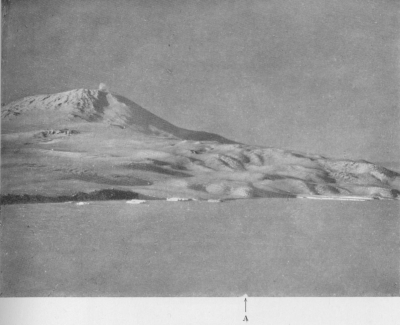
Mt. Erebus
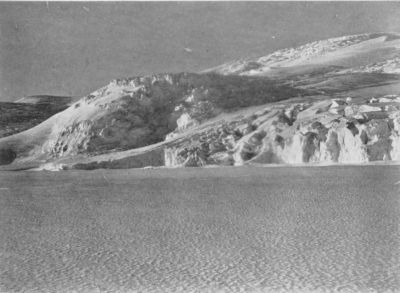
Ice Pressure At A
And there seemed not one chance in a million that we should ever see our tent again. We were 900 feet up on the mountain side, and the wind blew about as hard as a wind can blow straight out to sea. First there was a steep slope, so hard that a pick made little impression upon it, so slippery that if you started down in finnesko you never could stop: this ended in a great ice-cliff some hundreds of feet high, and then came miles of pressure ridges, crevassed and tumbled, in which you might as well look for a daisy as a tent: and after that the open sea. The chances, however, were that the tent had just been taken up into the air and dropped somewhere in this sea well on the way to New Zealand. Obviously the tent was gone.
Face to face with real death one does not think of the things that torment the bad people in the tracts, and fill the good people with bliss. I might have speculated on my chances of going to Heaven; but candidly I did not care. I could not have wept if I had tried. I had no wish to review the evils of my past. But the past did seem to have been a bit wasted. The road to Hell may be paved with good intentions: the road to Heaven is paved with lost opportunities.
I wanted those years over again. What fun I would have with them: what glorious fun! It was a pity. Well has the Persian said that when we come to die we, remembering that God is merciful, will gnaw our elbows with remorse for thinking of the things we have not done for fear of the Day of Judgment.
And I wanted peaches and syrup—badly. We had them at the hut, sweeter and more luscious than you can imagine. And we had been without sugar for a month. Yes—especially the syrup.
Thus impiously I set out to die, making up my mind that I was not going to try and keep warm, that it might not take too long, and thinking I would try and get some morphia from the medical case if it got very bad. Not a bit heroic, and entirely true! Yes! comfortable, warm reader. Men do not fear death, they fear the pain of dying.
And then quite naturally and no doubt disappointingly to those who would like to read of my last agonies (for who would not give pleasure by his death?) I fell asleep. I expect the temperature was pretty high during this great blizzard, and anything near zero was very high to us. That and the snow which drifted over us made a pleasant wet kind of snipe marsh inside our sleeping-bags, and I am sure we all dozed a good bit. There was so much to worry about that there was not the least use in worrying; and we were so very tired. We were hungry, for the last meal we had had was in the morning of the day before, but hunger was not very pressing.
And so we lay, wet and quite fairly warm, hour after hour while the wind roared round us, blowing storm force continually and rising in the gusts to something indescribable. Storm force is force 11, and force 12 is the biggest wind which can be logged: Bowers logged it force 11, but he was always so afraid of overestimating that he was inclined to underrate. I think it was blowing a full hurricane. Sometimes awake, sometimes dozing, we had not a very uncomfortable time so far as I can remember. I knew that parties which had come to Cape Crozier in the spring had experienced blizzards which lasted eight or ten days. But this did not worry us as much as I think it did Bill: I was numb. I vaguely called to mind that Peary had survived a blizzard in the open: but wasn't that in the summer?
It was in the early morning of Saturday (July 22) that we discovered the loss of the tent. Some time during that morning we had had our last meal. The roof went about noon on Sunday and we had had no meal in the interval because our supply of oil was so low; nor could we move out of our bags except as a last necessity. By Sunday night we had been without a meal for some thirty-six hours.
The rocks which fell upon us when the roof went did no damage, and though we could not get out of our bags to move them, we could fit ourselves into them without difficulty. More serious was the drift which began to pile up all round and over us. It helped to keep us warm of course, but at the same time in these comparatively high temperatures it saturated our bags even worse than they were before. If we did not find the tent (and its recovery would be a miracle) these bags and the floor-cloth of the tent on which we were lying were all we had in that fight back across the Barrier which could, I suppose, have only had one end.
Meanwhile we had to wait. It was nearly 70 miles home and it had taken us the best part of three weeks to come. In our less miserable moments we tried to think out ways of getting back, but I do not remember very much about that time. Sunday morning faded into Sunday afternoon,—into Sunday night,—into Monday morning. Till then the blizzard had raged with monstrous fury; the winds of the world were there, and they had all gone mad. We had bad winds at Cape Evans this year, and we had far worse the next winter when the open water was at our doors. But I have never heard or felt or seen a wind like this. I wondered why it did not carry away the earth.
In the early hours of Monday there was an occasional hint of a lull. Ordinarily in a big winter blizzard, when you have lived for several days and nights with that turmoil in your ears, the lulls are more trying than the noise: "the feel of not to feel it."[159] I do not remember noticing that now. Seven or eight more hours passed, and though it was still blowing we could make ourselves heard to one another without great difficulty. It was two days and two nights since we had had a meal.
We decided to get out of our bags and make a search for the tent. We did so, bitterly cold and utterly miserable, though I do not think any of us showed it. In the darkness we could see very little, and no trace whatever of the tent. We returned against the wind, nursing our faces and hands, and settled that we must try and cook a meal somehow. We managed about the weirdest meal eaten north or south. We got the floor-cloth wedged under our bags, then got into our bags and drew the floor-cloth over our heads. Between us we got the primus alight somehow, and by hand we balanced the cooker on top of it, minus the two members which had been blown away. The flame flickered in the draughts. Very slowly the snow in the cooker melted, we threw in a plentiful supply of pemmican, and the smell of it was better than anything on earth. In time we got both tea and pemmican, which was full of hairs from our bags, penguin feathers, dirt and debris, but delicious. The blubber left in the cooker got burnt and gave the tea a burnt taste. None of us ever forgot that meal: I enjoyed it as much as such a meal could be enjoyed, and that burnt taste will always bring back the memory.
It was still dark and we lay down in our bags again, but soon a little glow of light began to come up, and we turned out to have a further search for the tent. Birdie went off before Bill and me. Clumsily I dragged my eider-down out of my bag on my feet, all sopping wet: it was impossible to get it back and I let it freeze: it was soon just like a rock. The sky to the south was as black and sinister as it could possibly be. It looked as though the blizzard would be on us again at any moment.
I followed Bill down the slope. We could find nothing. But, as we searched, we heard a shout somewhere below and to the right. We got on a slope, slipped, and went sliding down quite unable to stop ourselves, and came upon Birdie with the tent, the outer lining still on the bamboos. Our lives had been taken away and given back to us.
We were so thankful we said nothing.
The tent must have been gripped up into the air, shutting as it rose. The bamboos, with the inner lining lashed to them, had entangled the outer cover, and the whole went up together like a shut umbrella. This was our salvation. If it had opened in the air nothing could have prevented its destruction. As it was, with all the accumulated ice upon it, it must have weighed the best part of 100 lbs. It had been dropped about half a mile away, at the bottom of a steep slope: and it fell in a hollow, still shut up. The main force of the wind had passed over it, and there it was, with the bamboos and fastenings wrenched and strained, and the ends of two of the poles broken, but the silk untorn.
If that tent went again we were going with it. We made our way back up the slope with it, carrying it solemnly and reverently, precious as though it were something not quite of the earth. And we dug it in as tent was never dug in before; not by the igloo, but in the old place farther down where we had first arrived. And while Bill was doing this Birdie and I went back to the igloo and dug and scratched and shook away the drift inside until we had found nearly all our gear. It is wonderful how little we lost when the roof went. Most of our gear was hung on the sledge, which was part of the roof, or was packed into the holes of the hut to try and make it drift-proof, and the things must have been blown inwards into the bottom of the hut by the wind from the south and the back draught from the north. Then they were all drifted up. Of course a certain number of mitts and socks were blown away and lost, but the only important things were Bill's fur mitts, which were stuffed into a hole in the rocks of the hut. We loaded up the sledge and pushed it down the slope. I don't know how Birdie was feeling, but I felt so weak that it was the greatest labour. The blizzard looked right on top of us.
We had another meal, and we wanted it: and as the good hoosh ran down into our feet and hands, and up into our cheeks and ears and brains, we discussed what we would do next. Birdie was all for another go at the Emperor penguins. Dear Birdie, he never would admit that he was beaten—I don't know that he ever really was! "I think he (Wilson) thought he had landed us in a bad corner and was determined to go straight home, though I was for one other tap at the Rookery. However, I had placed myself under his orders for this trip voluntarily, and so we started the next day for home."[160] There could really be no common-sense doubt: we had to go back, and we were already very doubtful whether we should ever manage to get into our sleeping-bags in very low temperature, so ghastly had they become.
I don't know when it was, but I remember walking down that slope—I don't know why, perhaps to try and find the bottom of the cooker—and thinking that there was nothing on earth that a man under such circumstances would not give for a good warm sleep. He would give everything he possessed: he would give—how many—years of his life. One or two at any rate—perhaps five? Yes—I would give five. I remember the sastrugi, the view of the Knoll, the dim hazy black smudge of the sea far away below: the tiny bits of green canvas that twittered in the wind on the surface of the snow: the cold misery of it all, and the weakness which was biting into my heart.
For days Birdie had been urging me to use his eider-down lining—his beautiful dry bag of the finest down—which he had never slipped into his own fur bag. I had refused: I felt that I should be a beast to take it.
We packed the tank ready for a start back in the morning and turned in, utterly worn out. It was only -12° that night, but my left big toe was frost-bitten in my bag which I was trying to use without an eider-down lining, and my bag was always too big for me. It must have taken several hours to get it back, by beating one foot against the other. When we got up, as soon as we could, as we did every night, for our bags were nearly impossible, it was blowing fairly hard and looked like blizzing. We had a lot to do, two or three hours' work, packing sledges and making a depôt of what we did not want, in a corner of the igloo. We left the second sledge, and a note tied to the handle of the pickaxe.
"We started down the slope in a wind which was rising all the time and -15°. My job was to balance the sledge behind: I was so utterly done I don't believe I could have pulled effectively. Birdie was much the strongest of us. The strain and want of sleep was getting me in the neck, and Bill looked very bad. At the bottom we turned our faces to the Barrier, our backs to the penguins, but after doing about a mile it looked so threatening in the south that we camped in a big wind, our hands going one after the other. We had nothing but the hardest wind-swept sastrugi, and it was a long business: there was only the smallest amount of drift, and we were afraid the icy snow blocks would chafe the tent. Birdie lashed the full biscuit tin to the door to prevent its flapping, and also got what he called the tent downhaul round the cap and then tied it about himself outside his bag: if the tent went he was going too.
"I was feeling as if I should crack, and accepted Birdie's eider-down. It was wonderfully self-sacrificing of him: more than I can write. I felt a brute to take it, but I was getting useless unless I got some sleep which my big bag would not allow. Bill and Birdie kept on telling me to do less: that I was doing more than my share of the work: but I think that I was getting more and more weak. Birdie kept wonderfully strong: he slept most of the night: the difficulty for him was to get into his bag without going to sleep. He kept the meteorological log untiringly, but some of these nights he had to give it up for the time because he could not keep awake. He used to fall asleep with his pannikin in his hand and let it fall: and sometimes he had the primus.
"Bill's bag was getting hopeless: it was really too small for an eider-down and was splitting all over the place: great long holes. He never consciously slept for nights: he did sleep a bit, for we heard him. Except for this night, and the next when Birdie's eider-down was still fairly dry, I never consciously slept; except that I used to wake for five or six nights running with the same nightmare—that we were drifted up, and that Bill and Birdie were passing the gear into my bag, cutting it open to do so, or some other variation,—I did not know that I had been asleep at all."[161]
"We had hardly reached the pit," wrote Bowers, "when a furious wind came on again and we had to camp. All that night the tent flapped like the noise of musketry, owing to two poles having been broken at the ends and the fit spoilt. I thought it would end matters by going altogether and lashed it down as much as I could, attaching the apex to a line round my own bag. The wind abated after 1½ days and we set out, doing five or six miles before we found ourselves among crevasses."[162]
We had plugged ahead all that day (July 26) in a terrible light, blundering in among pressure and up on to the slopes of Terror. The temperature dropped from -21° to -45°. "Several times [we] stepped into rotten-lidded crevasses in smooth wind-swept ice. We continued, however, feeling our way along by keeping always off hard ice-slopes and on the crustier deeper snow which characterizes the hollows of the pressure ridges, which I believed we had once more fouled in the dark. We had no light, and no landmarks to guide us, except vague and indistinct silhouetted slopes ahead, which were always altering and whose distance and character it was impossible to judge. We never knew whether we were approaching a steep slope at close quarters or a long slope of Terror, miles away, and eventually we travelled on by the ear, and by the feel of the snow under our feet, for both the sound and the touch told one much of the chances of crevasses or of safe going. We continued thus in the dark in the hope that we were at any rate in the right direction."[163] And then we camped after getting into a bunch of crevasses, completely lost. Bill said, "At any rate I think we are well clear of the pressure." But there were pressure pops all night, as though some one was whacking an empty tub.
It was Birdie's picture hat which made the trouble next day. "What do you think of that for a hat, sir?" I heard him say to Scott a few days before we started, holding it out much as Lucille displays her latest Paris model. Scott looked at it quietly for a time: "I'll tell you when you come back, Birdie," he said. It was a complicated affair with all kinds of nose-guards and buttons and lanyards: he thought he was going to set it to suit the wind much as he would set the sails of a ship. We spent a long time with our housewifes before this and other trips, for everybody has their own ideas as to how to alter their clothing for the best. When finished some looked neat, like Bill: others baggy, like Scott or Seaman Evans: others rough and ready, like Oates and Bowers: a few perhaps more rough than ready, and I will not mention names. Anyway Birdie's hat became improper immediately it was well iced up.
"When we got a little light in the morning we found we were a little north of the two patches of moraine on Terror. Though we did not know it, we were on the point where the pressure runs up against Terror, and we could dimly see that we were right up against something. We started to try and clear it, but soon had an enormous ridge, blotting out the moraine and half Terror, rising like a great hill on our right. Bill said the only thing was to go right on and hope it would lower; all the time, however, there was a bad feeling that we might be putting any number of ridges between us and the mountain. After a while we tried to cross this one, but had to turn back for crevasses, both Bill and I putting a leg down. We went on for about twenty minutes and found a lower place, and turned to rise up it diagonally, and reached the top. Just over the top Birdie went right down a crevasse, which was about wide enough to take him. He was out of sight and out of reach from the surface, hanging in his harness. Bill went for his harness, I went for the bow of the sledge: Bill told me to get the Alpine rope and Birdie directed from below what we could do. We could not possibly haul him up as he was, for the sides of the crevasse were soft and he could not help himself."[164]
"My helmet was so frozen up," wrote Bowers, "that my head was encased in a solid block of ice, and I could not look down without inclining my whole body. As a result Bill stumbled one foot into a crevasse and I landed in it with both mine [even as I shouted a warning[165] ], the bridge gave way and down I went. Fortunately our sledge harness is made with a view to resisting this sort of thing, and there I hung with the bottomless pit below and the ice-crusted sides alongside, so narrow that to step over it would have been quite easy had I been able to see it. Bill said, 'What do you want?' I asked for an Alpine rope with a bowline for my foot: and taking up first the bowline and then my harness they got me out."[166] Meanwhile on the surface I lay over the crevasse and gave Birdie the bowline: he put it on his foot: then he raised his foot, giving me some slack: I held the rope while he raised himself on his foot, thus giving Bill some slack on the harness: Bill then held the harness, allowing Birdie to raise his foot and give me some slack again. We got him up inch by inch, our fingers getting bitten, for the temperature was -46°. Afterwards we often used this way of getting people out of crevasses, and it was a wonderful piece of presence of mind that it was invented, so far as I know, on the spur of the moment by a frozen man hanging in one himself.
"In front of us we could see another ridge, and we did not know how many lay beyond that. Things looked pretty bad. Bill took a long lead on the Alpine rope and we got down our present difficulty all right. This method of the leader being on a long trace in front we all agreed to be very useful. From this moment our luck changed and everything went for us to the end. When we went out on the sea-ice the whole experience was over in a few days, Hut Point was always in sight, and there was daylight. I always had the feeling that the whole series of events had been brought about by an extraordinary run of accidents, and that after a certain stage it was quite beyond our power to guide the course of them. When on the way to Cape Crozier the moon suddenly came out of the cloud to show us a great crevasse which would have taken us all with our sledge without any difficulty, I felt that we were not to go under this trip after such a deliverance. When we had lost our tent, and there was a very great balance of probability that we should never find it again, and we were lying out the blizzard in our bags, I saw that we were face to face with a long fight against cold which we could not have survived. I cannot write how helpless I believed we were to help ourselves, and how we were brought out of a very terrible series of experiences. When we started back I had a feeling that things were going to change for the better, and this day I had a distinct idea that we were to have one more bad experience and that after that we could hope for better things.
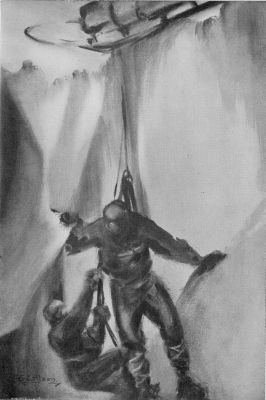
Down A Crevasse
"By running along the hollow we cleared the pressure ridges, and continued all day up and down, but met no crevasses. Indeed, we met no more crevasses and no more pressure. I think it was upon this day that a wonderful glow stretched over the Barrier edge from Cape Crozier: at the base it was the most vivid crimson it is possible to imagine, shading upwards through every shade of red to light green, and so into a deep blue sky. It is the most vivid red I have ever seen in the sky."[167]
It was -49° in the night and we were away early in -47°. By mid-day we were rising Terror Point, opening Erebus rapidly, and got the first really light day, though the sun would not appear over the horizon for another month. I cannot describe what a relief the light was to us. We crossed the point outside our former track, and saw inside us the ridges where we had been blizzed for three days on our outward journey.
The minimum was -66° the next night and we were now back in the windless bight of Barrier with its soft snow, low temperatures, fogs and mists, and lingering settlements of the inside crusts. Saturday and Sunday, the 29th and 30th, we plugged on across this waste, iced up as usual but always with Castle Rock getting bigger. Sometimes it looked like fog or wind, but it always cleared away. We were getting weak, how weak we can only realize now, but we got in good marches, though slow—days when we did 4½, 7¼ 6¾, 6½, 7½ miles. On our outward journey we had been relaying and getting forward about 4½ miles a day at this point. The surface which we had dreaded so much was not so sandy or soft as when we had come out, and the settlements were more marked. These are caused by a crust falling under your feet. Generally the area involved is some twenty yards or so round you, and the surface falls through an air space for two or three inches with a soft 'crush' which may at first make you think there are crevasses about. In the region where we now travelled they were much more pronounced than elsewhere, and one day, when Bill was inside the tent lighting the primus, I put my foot into a hole that I had dug. This started a big settlement; sledge, tent and all of us dropped about a foot, and the noise of it ran away for miles and miles: we listened to it until we began to get too cold. It must have lasted a full three minutes.
In the pauses of our marching we halted in our harnesses the ropes of which lay slack in the powdery snow. We stood panting with our backs against the mountainous mass of frozen gear which was our load. There was no wind, at any rate no more than light airs: our breath crackled as it froze. There was no unnecessary conversation: I don't know why our tongues never got frozen, but all my teeth, the nerves of which had been killed, split to pieces. We had been going perhaps three hours since lunch.
"How are your feet, Cherry?" from Bill.
"Very cold."
"That's all right; so are mine." We didn't worry to ask Birdie: he never had a frost-bitten foot from start to finish.
Half an hour later, as we marched, Bill would ask the same question. I tell him that all feeling has gone: Bill still has some feeling in one of his but the other is lost. He settled we had better camp: another ghastly night ahead. We started to get out of our harnesses, while Bill, before doing anything else, would take the fur mitts from his hands, carefully shape any soft parts as they froze (generally, however, our mitts did not thaw on our hands), and lay them on the snow in front of him—two dark dots. His proper fur mitts were lost when the igloo roof went: these were the delicate dog-skin linings we had in addition, beautiful things to look at and to feel when new, excellent when dry to turn the screws of a theodolite, but too dainty for straps and lanyards. Just now I don't know what he could have done without them.
Working with our woollen half-mitts and mitts on our hands all the time, and our fur mitts over them when possible, we gradually got the buckles undone, and spread the green canvas floor-cloth on the snow. This was also fitted to be used as a sail, but we never could have rigged a sail on this journey. The shovel and the bamboos, with a lining, itself lined with ice, lashed to them, were packed on the top of the load and were now put on the snow until wanted. Our next job was to lift our three sleeping-bags one by one on to the floor-cloth: they covered it, bulging over the sides—those obstinate coffins which were all our life to us.... One of us is off by now to nurse his fingers back. The cooker was unlashed from the top of the instrument box; some parts of it were put on the bags with the primus, methylated spirit can, matches and so forth; others left to be filled with snow later. Taking a pole in each hand we three spread the bamboos over the whole. "All right? Down!" from Bill; and we lowered them gently on to the soft snow, that they might not sink too far. The ice on the inner lining of the tent was formed mostly from the steam of the cooker. This we had been unable to beat or chip off in the past, and we were now, truth to tell, past worrying about it. The little ventilator in the top, made to let out this steam, had been tied up in order to keep in all possible heat. Then over with the outer cover, and for one of us the third worst job of the day was to begin. The worst job was to get into our bags: the second or equal worst was to lie in them for six hours (we had brought it down to six): this third worst was, to get the primus lighted and a meal on the way.
As cook of the day you took the broken metal framework, all that remained of our candlestick, and got yourself with difficulty into the funnel which formed the door. The enclosed space of the tent seemed much colder than the outside air: you tried three or four match-boxes and no match would strike: almost desperate, you asked for a new box to be given you from the sledge and got a light from this because it had not yet been in the warmth, so called, of the tent. The candle hung by a wire from the cap of the tent. It would be tedious to tell of the times we had getting the primus alight, and the lanyards of the weekly food bag unlashed. Probably by now the other two men have dug in the tent; squared up outside; filled and passed in the cooker; set the thermometer under the sledge and so forth. There were always one or two odd jobs which wanted doing as well: but you may be sure they came in as soon as possible when they heard the primus hissing, and saw the glow of light inside. Birdie made a bottom for the cooker out of an empty biscuit tin to take the place of the part which was blown away. On the whole this was a success, but we had to hold it steady—on Bill's sleeping-bag, for the flat frozen bags spread all over the floor space. Cooking was a longer business now. Some one whacked out the biscuit, and the cook put the ration of pemmican into the inner cooker which was by now half full of water. As opportunity offered we got out of our day, and into our night foot-gear—fleecy camel-hair stockings and fur boots. In the dim light we examined our feet for frost-bite.
I do not think it took us less than an hour to get a hot meal to our lips: pemmican followed by hot water in which we soaked our biscuits. For lunch we had tea and biscuits: for breakfast, pemmican, biscuits and tea. We could not have managed more food bags—three were bad enough, and the lashings of everything were like wire. The lashing of the tent door, however, was the worst, and it had to be tied tightly, especially if it was blowing. In the early days we took great pains to brush rime from the tent before packing it up, but we were long past that now.
The hoosh got down into our feet: we nursed back frost-bites: and we were all the warmer for having got our dry foot-gear on before supper. Then we started to get into our bags.
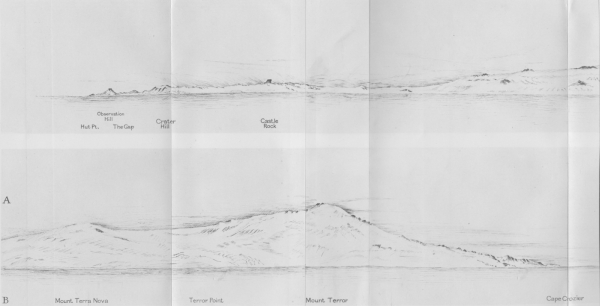
Panorama And Map Of The Winter Journey—Copied at Hut Point by Apsley Cherry-Garrard from a drawing by E. A. Wilson
Birdie's bag fitted him beautifully, though perhaps it would have been a little small with an eider-down inside. He must have had a greater heat supply than other men; for he never had serious trouble with his feet, while ours were constantly frost-bitten: he slept, I should be afraid to say how much, longer than we did, even in these last days: it was a pleasure, lying awake practically all night, to hear his snores. He turned his bag inside out from fur to skin, and skin to fur, many times during the journey, and thus got rid of a lot of moisture which came out as snow or actual knobs of ice. When we did turn our bags the only way was to do so directly we turned out, and even then you had to be quick before the bag froze. Getting out of the tent at night it was quite a race to get back to your bag before it hardened. Of course this was in the lowest temperatures.
We could not burn our bags and we tried putting the lighted primus into them to thaw them out, but this was not very successful. Before this time, when it was very cold, we lighted the primus in the morning while we were still in our bags: and in the evening we kept it going until we were just getting or had got the mouths of our bags levered open. But returning we had no oil for such luxuries, until the last day or two.
I do not believe that any man, however sick he is, has a much worse time than we had in those bags, shaking with cold until our backs would almost break. One of the added troubles which came to us on our return was the sodden condition of our hands in our bags at night. We had to wear our mitts and half-mitts, and they were as wet as they could be: when we got up in the morning we had washer-women's hands—white, crinkled, sodden. That was an unhealthy way to start the day's work. We really wanted some bags of saennegrass for hands as well as feet; one of the blessings of that kind of bag being that you can shake the moisture from it: but we only had enough for our wretched feet.
The horrors of that return journey are blurred to my memory and I know they were blurred to my body at the time. I think this applies to all of us, for we were much weakened and callous. The day we got down to the penguins I had not cared whether I fell into a crevasse or not. We had been through a great deal since then. I know that we slept on the march; for I woke up when I bumped against Birdie, and Birdie woke when he bumped against me. I think Bill steering out in front managed to keep awake. I know we fell asleep if we waited in the comparatively warm tent when the primus was alight—with our pannikins or the primus in our hands. I know that our sleeping-bags were so full of ice that we did not worry if we spilt water or hoosh over them as they lay on the floor-cloth, when we cooked on them with our maimed cooker. They were so bad that we never rolled them up in the usual way when we got out of them in the morning: we opened their mouths as much as possible before they froze, and hoisted them more or less flat on to the sledge. All three of us helped to raise each bag, which looked rather like a squashed coffin and was probably a good deal harder. I know that if it was only -40° when we camped for the night we considered quite seriously that we were going to have a warm one, and that when we got up in the morning if the temperature was in the minus sixties we did not enquire what it was. The day's march was bliss compared to the night's rest, and both were awful. We were about as bad as men can be and do good travelling: but I never heard a word of complaint, nor, I believe, an oath, and I saw self-sacrifice standing every test.
Always we were getting nearer home: and we were doing good marches. We were going to pull through; it was only a matter of sticking this for a few more days; six, five, four ... three perhaps now, if we were not blizzed. Our main hut was behind that ridge where the mist was always forming and blowing away, and there was Castle Rock: we might even see Observation Hill to-morrow, and the Discovery Hut furnished and trim was behind it, and they would have sent some dry sleeping-bags from Cape Evans to greet us there. We reckoned our troubles over at the Barrier edge, and assuredly it was not far away. "You've got it in the neck, stick it, you've got it in the neck"—it was always running in my head.
And we did stick it. How good the memories of those days are. With jokes about Birdie's picture hat: with songs we remembered off the gramophone: with ready words of sympathy for frost-bitten feet: with generous smiles for poor jests: with suggestions of happy beds to come. We did not forget the Please and Thank you, which mean much in such circumstances, and all the little links with decent civilization which we could still keep going. I'll swear there was still a grace about us when we staggered in. And we kept our tempers—even with God.
We might reach Hut Point to-night: we were burning more oil now, that one-gallon tin had lasted us well: and burning more candle too; at one time we feared they would give out. A hell of a morning we had: -57° in our present state. But it was calm, and the Barrier edge could not be much farther now. The surface was getting harder: there were a few wind-blown furrows, the crust was coming up to us. The sledge was dragging easier: we always suspected the Barrier sloped downwards hereabouts. Now the hard snow was on the surface, peeping out like great inverted basins on which we slipped, and our feet became warmer for not sinking into soft snow. Suddenly we saw a gleam of light in a line of darkness running across our course. It was the Barrier edge: we were all right now.
We ran the sledge off a snow-drift on to the sea-ice, with the same cold stream of air flowing down it which wrecked my hands five weeks ago: pushed out of this, camped and had a meal: the temperature had already risen to -43°. We could almost feel it getting warmer as we went round Cape Armitage on the last three miles. We managed to haul our sledge up the ice foot, and dug the drift away from the door. The old hut struck us as fairly warm.
Bill was convinced that we ought not to go into the warm hut at Cape Evans when we arrived there—to-morrow night! We ought to get back to warmth gradually, live in a tent outside, or in the annexe for a day or two. But I'm sure we never meant to do it. Just now Hut Point did not prejudice us in favour of such abstinence. It was just as we had left it: there was nothing sent down for us there—no sleeping-bags, nor sugar: but there was plenty of oil. Inside the hut we pitched a dry tent left there since Depôt Journey days, set two primuses going in it; sat dozing on our bags; and drank cocoa without sugar so thick that next morning we were gorged with it. We were very happy, falling asleep between each mouthful, and after several hours discussed schemes of not getting into our bags at all. But some one would have to keep the primus going to prevent frost-bite, and we could not trust ourselves to keep awake. Bill and I tried to sing a part-song. Finally we sopped our way into our bags. We only stuck them three hours, and thankfully turned out at 3 a.m., and were ready to pack up when we heard the wind come away. It was no good, so we sat in our tent and dozed again. The wind dropped at 9.30: we were off at 11. We walked out into what seemed to us a blaze of light. It was not until the following year that I understood that a great part of such twilight as there is in the latter part of the winter was cut off from us by the mountains under which we travelled. Now, with nothing between us and the northern horizon below which lay the sun, we saw as we had not seen for months, and the iridescent clouds that day were beautiful.
We just pulled for all we were worth and did nearly two miles an hour: for two miles a baddish salt surface, then big undulating hard sastrugi and good going. We slept as we walked. We had done eight miles by 4 p.m. and were past Glacier Tongue. We lunched there.
As we began to gather our gear together to pack up for the last time, Bill said quietly, "I want to thank you two for what you have done. I couldn't have found two better companions—and what is more I never shall."
I am proud of that.
Antarctic exploration is seldom as bad as you imagine, seldom as bad as it sounds. But this journey had beggared our language: no words could express its horror.
We trudged on for several more hours and it grew very dark. There was a discussion as to where Cape Evans lay. We rounded it at last: it must have been ten or eleven o'clock, and it was possible that some one might see us as we pulled towards the hut. "Spread out well," said Bill, "and they will be able to see that there are three men." But we pulled along the cape, over the tide-crack, up the bank to the very door of the hut without a sound. No noise from the stable, nor the bark of a dog from the snowdrifts above us. We halted and stood there trying to get ourselves and one another out of our frozen harnesses—the usual long job. The door opened—"Good God! here is the Crozier Party," said a voice, and disappeared.
Thus ended the worst journey in the world.
And now the reader will ask what became of the three penguins' eggs for which three human lives had been risked three hundred times a day, and three human frames strained to the utmost extremity of human endurance.
Let us leave the Antarctic for a moment and conceive ourselves in the year 1913 in the Natural History Museum in South Kensington. I had written to say that I would bring the eggs at this time. Present, myself, C.-G., the sole survivor of the three, with First or Doorstep Custodian of the Sacred Eggs. I did not take a verbatim report of his welcome; but the spirit of it may be dramatized as follows:
First Custodian. Who are you? What do you want? This ain't an egg-shop. What call have you to come meddling with our eggs? Do you want me to put the police on to you? Is it the crocodile's egg you're after? I don't know nothing about 'no eggs. You'd best speak to Mr. Brown: it's him that varnishes the eggs.
I resort to Mr. Brown, who ushers me into the presence of the Chief Custodian, a man of scientific aspect, with two manners: one, affably courteous, for a Person of Importance (I guess a Naturalist Rothschild at least) with whom he is conversing, and the other, extraordinarily offensive even for an official man of science, for myself.
I announce myself with becoming modesty as the bearer of the penguins' eggs, and proffer them. The Chief Custodian takes them into custody without a word of thanks, and turns to the Person of Importance to discuss them. I wait. The temperature of my blood rises. The conversation proceeds for what seems to me a considerable period. Suddenly the Chief Custodian notices my presence and seems to resent it.
Chief Custodian. You needn't wait.
Heroic Explorer. I should like to have a receipt for the eggs, if you please.
Chief Custodian. It is not necessary: it is all right. You needn't wait.
Heroic Explorer. I should like to have a receipt.
But by this time the Chief Custodian's attention is again devoted wholly to the Person of Importance. Feeling that to persist in overhearing their conversation would be an indelicacy, the Heroic Explorer politely leaves the room, and establishes himself on a chair in a gloomy passage outside, where he wiles away the time by rehearsing in his imagination how he will tell off the Chief Custodian when the Person of Importance retires. But this the Person of Importance shows no sign of doing, and the Explorer's thoughts and intentions become darker and darker. As the day wears on, minor officials, passing to and from the Presence, look at him doubtfully and ask his business. The reply is always the same, "I am waiting for a receipt for some penguins' eggs." At last it becomes clear from the Explorer's expression that what he is really waiting for is not to take a receipt but to commit murder. Presumably this is reported to the destined victim: at all events the receipt finally comes; and the Explorer goes his way with it, feeling that he has behaved like a perfect gentleman, but so very dissatisfied with that vapid consolation that for hours he continues his imaginary rehearsals of what he would have liked to have done to that Custodian (mostly with his boots) by way of teaching him manners.
Some time after this I visited the Natural History Museum with Captain Scott's sister. After a slight preliminary skirmish in which we convinced a minor custodian that the specimens brought by the expedition from the Antarctic did not include the moths we found preying on some of them, Miss Scott expressed a wish to see the penguins' eggs. Thereupon the minor custodians flatly denied that any such eggs were in existence or in their possession. Now Miss Scott was her brother's sister; and she showed so little disposition to take this lying down that I was glad to get her away with no worse consequences than a profanely emphasized threat on my part that if we did not receive ample satisfaction in writing within twenty-four hours as to the safety of the eggs England would reverberate with the tale.
The ultimatum was effectual; and due satisfaction was forthcoming in time; but I was relieved when I learnt later on that they had been entrusted to Professor Assheton for the necessary microscopic examination. But he died before he could approach the task; and the eggs passed into the hands of Professor Cossar Ewart of Edinburgh University.
His report is as follows: