Volume 2 — INTRODUCTION (continued 2)
Reading edition
"There is courage and strength and loyalty and love shining out of the second volume no less than out of the first; there were gallant gentlemen who lived as well as gallant gentlemen who died; but it is the story of Scott, told by himself, which will give the book a place among the great books of the world. That story begins in November 1910, and ends on March 29, 1912, and it is because when you come to the end, you will have lived with Scott for sixteen months, that you will not be able to read the last pages without tears. That message to the public was heartrending enough when it first came to us, but it was as the story of how a great hero fell that we read it; now it is just the tale of how a dear friend died. To have read this book is to have known Scott; and if I were asked to describe him, I think I should use some such words as those which, six months before he died, he used of the gallant gentleman who went with him, 'Bill' Wilson. 'Words must always fail when I talk of him,' he wrote; 'I believe he is the finest character I ever met—the closer one gets to him the more there is to admire. Every quality is so solid and dependable. Whatever the matter, one knows Bill will be sound, shrewdly practical, intensely loyal, and quite unselfish.' That is true of Wilson, if Scott says so, for he knew men; but most of it is also true of Scott himself. I have never met a more beautiful character than that which is revealed unconsciously in these journals. His humanity, his courage, his faith, his steadfastness, above all, his simplicity, mark him as a man among men. It is because of his simplicity that his last message, the last entries in his diary, his last letters, are of such undying beauty. The letter of consolation (and almost of apology) which, on the verge of death, he wrote to Mrs. Wilson, wife of the man dying at his side, may well be Scott's monument. He could have no finer. And he has raised a monument for those other gallant gentlemen who died—Wilson, Oates, Bowers, Evans. They are all drawn for us clearly by him in these pages; they stand out unmistakably. They, too, come to be friends of ours, their death is as noble and as heartbreaking. And there were gallant gentlemen, I said, who lived—you may read amazing stories of them. Indeed, it is a wonderful tale of manliness that these two volumes tell us. I put them down now; but I have been for a few days in the company of the brave ... and every hour with them has made me more proud for those that died and more humble for myself."
I have quoted this review at length, because it gives the atmosphere of hero-worship into which we were plunged on our return. That atmosphere was very agreeable; but it was a refracting medium through which the expedition could not be seen with scientific accuracy—and the expedition was nothing if not scientific. Whilst we knew what we had suffered and risked better than any one else, we also knew that science takes no account of such things; that a man is no better for having made the worst journey in the world; and that whether he returns alive or drops by the way will be all the same a hundred years hence if his records and specimens come safely to hand.
In addition to Scott's Last Expedition and Priestley's Antarctic Adventures, Griffith Taylor, who was physiographer to the Main Party, has written an account of the two geological journeys of which he was the leader, and of the domestic life of the expedition at Hut Point and at Cape Evans, up to February 1912, in a book called With Scott: The Silver Lining. This book gives a true glimpse into the more boisterous side of our life, with much useful information about the scientific part.
Though it bears little upon this book I cannot refrain from drawing the reader's attention to, and earning some of his thanks for, a little book called Antarctic Penguins, written by Levick, the Surgeon of Campbell's Party. It is almost entirely about Adélie penguins. The author spent the greater part of a summer living, as it were, upon sufferance, in the middle of one of the largest penguin rookeries in the world. He has described the story of their crowded life with a humour with which, perhaps, we hardly credited him, and with a simplicity which many writers of children's stories might envy. If you think your own life hard, and would like to leave it for a short hour I recommend you to beg, borrow or steal this tale, and read and see how the penguins live. It is all quite true.
So there is already a considerable literature about the expedition, but no connected account of it as a whole. Scott's diary, had he lived, would merely have formed the basis of the book he would have written. As his personal diary it has an interest which no other book could have had. But a diary in this life is one of the only ways in which a man can blow off steam, and so it is that Scott's book accentuates the depression which used to come over him sometimes.
We have seen the importance which must attach to the proper record of improvements, weights and methods of each and every expedition. We have seen how Scott took the system developed by the Arctic Explorers at the point of development to which it had been brought by Nansen, and applied it for the first time to Antarctic sledge travelling. Scott's Voyage of the Discovery gives a vivid picture of mistakes rectified, and of improvements of every kind. Shackleton applied the knowledge they gained in his first expedition, Scott in this, his second and last. On the whole I believe this expedition was the best equipped there has ever been, when the double purpose, exploratory and scientific, for which it was organized, is taken into consideration. It is comparatively easy to put all your eggs into one basket, to organize your material and to equip and choose your men entirely for one object, whether it be the attainment of the Pole, or the running of a perfect series of scientific observations. Your difficulties increase many-fold directly you combine the one with the other, as was done in this case. Neither Scott nor the men with him would have gone for the Pole alone. Yet they considered the Pole to be an achievement worthy of a great attempt, and "We took risks, we knew we took them; things have come out against us, and therefore we have no cause for complaint...."
It is, it must be, of the first importance that a system, I will not say perfected, but developed, to a pitch of high excellence at such a cost should be handed down as completely as possible to those who are to follow. I want to so tell this story that the leader of some future Antarctic expedition, perhaps more than one, will be able to take it up and say: "I have here the material from which I can order the articles and quantities which will be wanted for so many men for such and such a time; I have also a record of how this material was used by Scott, of the plans of his journeys and how his plans worked out, and of the improvements which his parties were able to make on the spot or suggest for the future. I don't agree with such and such, but this is a foundation and will save me many months of work in preparation, and give me useful knowledge for the actual work of my expedition." If this book can guide the future explorer by the light of the past, it will not have been written in vain.
But this was not my main object in writing this book. When I undertook in 1913 to write, for the Antarctic Committee, an Official Narrative on condition that I was given a free hand, what I wanted to do above all things was to show what work was done; who did it; to whom the credit of the work was due; who took the responsibility; who did the hard sledging; and who pulled us through that last and most ghastly year when two parties were adrift, and God only knew what was best to be done; when, had things gone on much longer, men would undoubtedly have gone mad. There is no record of these things, though perhaps the world thinks there is. Generally as a mere follower, without much responsibility, and often scared out of my wits, I was in the thick of it all, and I know.
Unfortunately I could not reconcile a sincere personal confession with the decorous obliquity of an Official Narrative; and I found that I had put the Antarctic Committee in a difficulty from which I could rescue them only by taking the book off their hands; for it was clear that what I had written was not what is expected from a Committee, even though no member may disapprove of a word of it. A proper Official Narrative presented itself to our imaginations and sense of propriety as a quarto volume, uniform with the scientific reports, dustily invisible on Museum shelves, and replete with—in the words of my Commission—"times of starting, hours of march, ground and weather conditions," not very useful as material for future Antarcticists, and in no wise effecting any catharsis of the writer's conscience. I could not pretend that I had fulfilled these conditions; and so I decided to take the undivided responsibility on my own shoulders. None the less the Committee, having given me access to its information, is entitled to all the credit of a formal Official Narrative, without the least responsibility for the passages which I have studied to make as personal in style as possible, so that no greater authority may be attached to them than I deserve.
I need hardly add that the nine years' delay in the appearance of my book was caused by the war. Before I had recovered from the heavy overdraft made on my strength by the expedition I found myself in Flanders looking after a fleet of armoured cars. A war is like the Antarctic in one respect. There is no getting out of it with honour as long as you can put one foot before the other. I came back badly invalided; and the book had to wait accordingly.
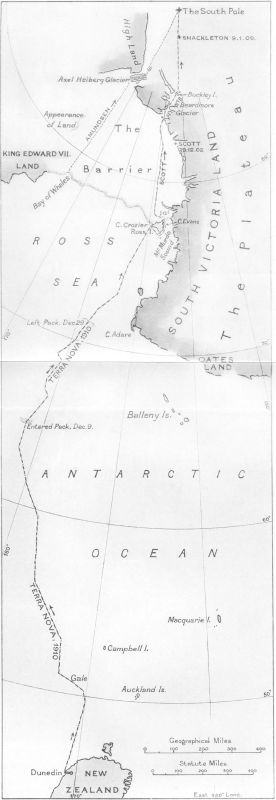
From New Zealand To The South Pole—Apsley Cherry-Garrard, del.—Emery Walker Ltd., Collotypers.