Volume 24 — THE LETTERS OF ROBERT LOUIS STEVENSON (continued 7)
Reading edition
R. L. S.
To John Addington Symonds
The following is the draft of a proposed dedication to the South Sea travel-book which was to be the fruit of the present voyages, as is explained in a note at the end.
November 11th, 1888.
One November night, in the village of Tautira, we sat at the high table in the hall of assembly, hearing the natives sing. It was dark in the hall, and very warm; though at times the land wind blew a little shrewdly through the chinks, and at times, through the larger openings, we could see the moonlight on the lawn. As the songs arose in the rattling Tahitian chorus, the chief translated here and there a verse. Farther on in the volume you shall read the songs themselves; and I am in hopes that not you only, but all who can find a savour in the ancient poetry of places, will read them with some pleasure. You are to conceive us, therefore, in strange circumstances and very pleasing; in a strange land and climate, the most beautiful on earth; surrounded by a foreign race that all travellers have agreed to be the most engaging; and taking a double interest in two foreign arts.
We came forth again at last, in a cloudy moonlight, on the forest lawn which is the street of Tautira. The Pacific roared outside upon the reef. Here and there one of the scattered palm-built lodges shone out under the shadow of the wood, the lamplight bursting through the crannies of the wall. We went homeward slowly, Ori a Ori carrying behind us the lantern and the chairs, properties with which we had just been enacting our part of the distinguished visitor. It was one of those moments in which minds not altogether churlish recall the names and deplore the absence of congenial friends; and it was your name that first rose upon our lips. “How Symonds would have enjoyed this evening!” said one, and then another. The word caught in my mind; I went to bed, and it was still there. The glittering, frosty solitudes in which your days are cast arose before me: I seemed to see you walking there in the late night, under the pine-trees and the stars; and I received the image with something like remorse.
There is a modern attitude towards Fortune; in this place I will not use a graver name. Staunchly to withstand her buffets and to enjoy with equanimity her favours was the code of the virtuous of old. Our fathers, it should seem, wondered and doubted how they had merited their misfortunes: we, rather how we have deserved our happiness. And we stand often abashed, and sometimes revolted, at those partialities of fate by which we profit most. It was so with me on that November night: I felt that our positions should be changed. It was you, dear Symonds, who should have gone upon that voyage and written this account. With your rich stores of knowledge, you could have remarked and understood a thousand things of interest and beauty that escaped my ignorance; and the brilliant colours of your style would have carried into a thousand sickrooms the sea air and the strong sun of tropic islands. It was otherwise decreed. But suffer me at least to connect you, if only in name and only in the fondness of imagination, with the voyage of the Silver Ship.
Robert Louis Stevenson.
DEAR SYMONDS,—I send you this (November 11th), the morning of its completion. If I ever write an account of this voyage, may I place this letter at the beginning? It represents—I need not tell you, for you too are an artist—a most genuine feeling, which kept me long awake last night; and though perhaps a little elaborate, I think it a good piece of writing. We are in heaven here. Do not forget.
R. L. S.
Please keep this: I have no perfect copy.
Tautira, on the peninsula of Taiti.
To Thomas Archer
Tautira, Island of Taiti [November 1888].
DEAR TOMARCHER,—This is a pretty state of things! seven o’clock and no word of breakfast! And I was awake a good deal last night, for it was full moon, and they had made a great fire of cocoa-nut husks down by the sea, and as we have no blinds or shutters, this kept my room very bright. And then the rats had a wedding or a school-feast under my bed. And then I woke early, and I have nothing to read except Virgil’s Æneid, which is not good fun on an empty stomach, and a Latin dictionary, which is good for naught, and by some humorous accident, your dear papa’s article on Skerryvore. And I read the whole of that, and very impudent it is, but you must not tell your dear papa I said so, or it might come to a battle in which you might lose either a dear papa or a valued correspondent, or both, which would be prodigal. And still no breakfast; so I said “Let’s write to Tomarcher.”
This is a much better place for children than any I have hitherto seen in these seas. The girls (and sometimes the boys) play a very elaborate kind of hopscotch. The boys play horses exactly as we do in Europe; and have very good fun on stilts, trying to knock each other down, in which they do not often succeed. The children of all ages go to church and are allowed to do what they please, running about the aisles, rolling balls, stealing mamma’s bonnet and publicly sitting on it, and at last going to sleep in the middle of the floor. I forgot to say that the whips to play horses, and the balls to roll about the church—at least I never saw them used elsewhere—grow ready made on trees; which is rough on toy-shops. The whips are so good that I wanted to play horses myself; but no such luck! my hair is grey, and I am a great, big, ugly man. The balls are rather hard, but very light and quite round. When you grow up and become offensively rich, you can charter a ship in the port of London, and have it come back to you entirely loaded with these balls; when you could satisfy your mind as to their character, and give them away when done with to your uncles and aunts. But what I really wanted to tell you was this: besides the tree-top toys (Hush-a-by, toy-shop, on the tree-top!), I have seen some real made toys, the first hitherto observed in the South Seas.
This was how. You are to imagine a four-wheeled gig; one horse; in the front seat two Tahiti natives, in their Sunday clothes, blue coat, white shirt, kilt (a little longer than the Scotch) of a blue stuff with big white or yellow flowers, legs and feet bare; in the back seat me and my wife, who is a friend of yours; under our feet, plenty of lunch and things: among us a great deal of fun in broken Tahitian, one of the natives, the sub-chief of the village, being a great ally of mine. Indeed we have exchanged names; so that he is now called Rui, the nearest they can come to Louis, for they have no l and no s in their language. Rui is six feet three in his stockings, and a magnificent man. We all have straw hats, for the sun is strong. We drive between the sea, which makes a great noise, and the mountains; the road is cut through a forest mostly of fruit trees, the very creepers, which take the place of our ivy, heavy with a great and delicious fruit, bigger than your head and far nicer, called Barbedine. Presently we came to a house in a pretty garden, quite by itself, very nicely kept, the doors and windows open, no one about, and no noise but that of the sea. It looked like a house in a fairy-tale, and just beyond we must ford a river, and there we saw the inhabitants. Just in the mouth of the river, where it met the sea waves, they were ducking and bathing and screaming together like a covey of birds: seven or eight little naked brown boys and girls as happy as the day was long; and on the banks of the stream beside them, real toys—toy ships, full rigged, and with their sails set, though they were lying in the dust on their beam ends. And then I knew for sure they were all children in a fairy-story, living alone together in that lonely house with the only toys in all the island; and that I had myself driven, in my four-wheeled gig, into a corner of the fairy-story, and the question was, should I get out again? But it was all right; I guess only one of the wheels of the gig had got into the fairy-story; and the next jolt the whole thing vanished, and we drove on in our sea-side forest as before, and I have the honour to be Tomarcher’s valued correspondent, Teriitera, which he was previously known as
Robert Louis Stevenson.
[Mrs. R. L. Stevenson to Sidney Colvin
This letter from Mrs. Stevenson serves to fill out and explain allusions in the three or four preceding. The beautiful brown princess is Princess Moë, ex-queen of Raiatea, well known to readers of Pierre Loti and Miss Gordon Cumming. The move away from Papeete, where Stevenson had fallen seriously ill, had been made in hopes of finding on the island a climate that would suit him better.
Tautira, Tahiti, Dec. 4th [1888].
DEAR, long neglected, though never forgotten Custodian, I write you from fairyland, where we are living in a fairy story, the guests of a beautiful brown princess. We came to stay a week, five weeks have passed, and we are still indefinite as to our time of leaving. It was chance brought us here, for no one in Papeete could tell us a word about this part of the island except that it was very fine to look at, and inhabited by wild people—“almost as wild as the people of Anaho!” That touch about the people of Anaho inclined our hearts this way, so we finally concluded to take a look at the other side of Tahiti. The place of our landing was windy, uninhabited except by mosquitoes, and Louis was ill. The first day Lloyd and the Captain made an exploration, but came back disgusted. They had found a Chinaman, a long way off, who seemed to have some horses, but no desire to hire them to strangers, and they had found nothing else whatever. The next morning I took Valentine and went on a prospecting tour of my own. I found the Chinaman, persuaded him to let me have two horses and a wagon, and went back for the rest of my family. When asked where I wished to go, I could only say to the largest native village and the most wild. Ill as Louis was, I brought him the next day, and shall never cease to be thankful for my courage, for he has gained health and strength every day. He takes sea baths and swims, and lives almost entirely in the open air as nearly without clothes as possible, a simple pyjama suit of striped light flannel his only dress. As to shoes and stockings we all have scorned them for months except Mrs. Stevenson, who often goes barefoot and never, I believe, wears stockings. Lloyd’s costume, in which he looks remarkably well, consists of a striped flannel shirt and a pareu. The pareu is no more or less than a large figured blue and white cotton window curtain twisted about the waist, and hanging a little below the bare knees. Both Louis and Lloyd wear wreaths of artificial flowers, made of the dried pandanus leaf, on their hats.
Moë has gone to Papeete by the command of the king, whose letter was addressed “To the great Princess at Tautira. P.V.” P.V. stands for Pomaré 5th. Every evening, before she went, we played Van John lying in a circle on pillows in the middle of the floor with our heads together: and hardly an evening passed but it struck us afresh how very much you would like Moë, and we told her of you again. The house (really here a palace) in which we live, belongs to the sub-chief, Ori, a subject and relation of the Princess. He, and his whole family, consisting of his wife, his two little adopted sons, his daughter and her two young babies, turned out to live in a little bird-cage hut of one room. Ori is the very finest specimen of a native we have seen yet; he is several inches over six feet, of perfect though almost gigantic proportions, and looks more like a Roman Emperor in bronze than words can express. One day, when Moë gave a feast, it being the correct thing to do, we all wore wreaths of golden yellow leaves on our heads; when Ori walked in and sat down at the table, as with one voice we all cried out in admiration. His manners and I might say his habit of thought are English. In some ways, he is so like a Colonel of the Guards that we often call him Colonel. It was either the day before, or the morning of our public feast, that Louis asked the Princess if she thought Ori would accept his name. She was sure of it, and much pleased at the idea. I wish you could have seen Louis, blushing like a schoolgirl, when Ori came in, and the brotherhood was offered. So now if you please, Louis is no more Louis, having given that name away in the Tahitian form of Rui, but is known as Terii-Tera (pronounced Tereeterah) that being Ori’s Christian name. “Ori a Ori” is his clan name.
Let me tell you of our village feast. The chief, who was our guide in the matter, found four large fat hogs, which Louis bought, and four cases of ship’s biscuit were sent over from the Casco, which is lying at Papeete for repairs. Our feast cost in all about eighty dollars. Every Sunday all things of public interest are announced in the Farehau (an enormous public bird cage) and the news of the week read aloud from the Papeete journal, if it happens to turn up. Our feast was given on a Wednesday, and was announced by the chief the Sunday before, who referred to Louis as “the rich one.” Our hogs were killed in the morning, washed in the sea, and roasted whole in a pit with hot stones. When done they were laid on their stomachs in neat open coffins of green basket work, each hog with his case of biscuits beside him. Early in the morning the entire population began bathing, a bath being the preliminary to everything. At about three o’clock—four was the hour set—there was a general movement towards our premises, so that I had to hurry Louis into his clothes, all white, even to his shoes. Lloyd was also in white, but barefoot. I was not prepared, so had to appear in a red and white muslin gown, also barefoot. As Mrs. Stevenson had had a feast of her own, conducted on religious principles, she kept a little in the background, so that her dress did not matter so much. The chief, who speaks French very well, stood beside Louis to interpret for him. By the time we had taken our respective places on the veranda in front of our door, an immense crowd had assembled. They came in five, instead of four detachments which was what the chief expected, and he was a little confused at first, as he and Louis had been arranging a speech to four sets of people, which ran in this order. The clergyman at the head of the Protestants: the chief, council, and irreligious:—one of the council at their head. The schoolmaster with the schoolchildren: the catechist and the Catholics: but there was another very small sect, by some strange mischance called Mormons, which it was supposed would be broken up and swallowed by the others. But no, the Mormons came in a body alone, marshalled by the best and wittiest speaker—bar Rui—in Tautira. Each set of people came bending under the weight of bamboo poles laden with fruits, pigs, fowls, etc. All were dressed in their gayest pareus, and many had wreaths of leaves or flowers on their heads. The prettiest sight of all was the children, who came marching two and two abreast, the bamboo poles lying lengthwise across their shoulders.
When all the offerings had been piled in five great heaps upon the ground, Louis made his oration to the accompaniment of the squealing of pigs, the cackling of hens, and the roar of the surf which beats man-high upon the roof. A speech was made in return on behalf of the village, and then each section sent forth its orator, the speeches following in the order I have given above. Each speaker finished by coming forward with one of the smaller things in his hand, which he offered personally to Louis, and then shook hands with us all and retired. Among these smaller presents were many fish-hooks for large fishing, laboriously carved from mother-of-pearl shell. One man came with one egg in each hand saying, “carry these to Scotland with you, let them hatch into cocks, and their song shall remind you of Tautira.” The schoolmaster, with a leaf-basket of rose apples, made his speech in French. Somehow the whole effect of the scene was like a story out of the Bible, and I am not ashamed that Louis and I both shed tears when we saw the enchanting procession of schoolchildren. The Catholic priest, Father Bruno, a great friend of ours, said that for the next fifty years the time of the feast of the rich one will be talked of: which reminds me of our friend Donat, of Fakarava, who was temporary resident at the time we were there. “I am so glad,” he said, “that the Casco came in just now, otherwise I should be forgotten: but now the people will always say this or that happened so long before—or so long after—the coming of the Silver Ship, when Donat represented the government.”
In front of our house is a broad stretch of grass, dotted with cocoanuts, breadfruits, mangoes, and the strange pandanus tree. I wish you could have seen them, their lower branches glowing with the rich colours of the fruits hung upon them by Ori and his men, and great heaps lying piled against their roots, on the evening of our feast. From the bamboo poles that they were carried upon, a pen was made for the ten pigs, and a fowl house for the twenty-three fowls that were among the presents. But there was a day of reckoning at hand. Time after time we ran down to the beach to look for the Casco, until we were in despair. For over a month we had lived in Ori’s house, causing him infinite trouble and annoyance, and not even his, at that. Areia (the chief—Areia means the Prince) went to Papeete and came back with a letter to say that more work had to be done upon the Casco, and it might be any time before she could get to Tautira. We had used up all our stores, and had only a few dollars of money left in Tautira, and not very much in Papeete. Could we stand the journey to Papeete, we could not live upon the yacht in the midst of the workmen, and we had not money enough left to live at an hotel. We were playing cards on the floor, as usual, when this message came, and you can imagine its effect. I knew perfectly well that Rui would force us to stay on with him, but what depressed me the most of all, was the fact of Louis having made brothers with him just before this took place. Had there been a shadow of doubt on our dear Rui’s face, I should have fled from before him. Sitting there on the floor waiting for him was too much for my nerves and I burst into tears, upon which the princess wept bitterly. In the meantime the priest had dropped in, so that we had him and Moë, and Areia, as witnesses to our humiliating position. First came Madame Rui, who heard the story, and sat down on the floor in silence, which was very damping for a beginning, and then Ori of Ori, the magnificent, who listened to the tale of the shipwrecked mariners with serious dignity, asking one or two questions, and then spoke to this effect. “You are my brother: all that I have is yours. I know that your food is done, but I can give you plenty of fish and taro. We like you, and wish to have you here. Stay where you are till the Casco comes. Be happy—et ne pleurez pas.” Louis dropped his head into his hands and wept, and then we all went up to Rui and shook hands with him and accepted his offer. Madame Rui, who had been silent only as a dutiful wife, that her husband might speak first, poured forth manifold reasons for our staying on as long as we could possibly manage. During all this scene, an attendant of the princess had been sitting on the floor behind us, a baby in his arms, where he had ensconced himself for the purpose of watching the game. He understood nothing of what was going on; we wondered afterwards what he thought of it. Reduced as we were, we still had a few bottles of champagne left. Champagne being an especial weakness of our gigantic friend, it occurred to some one that this was a proper occasion to open a couple of bottles. Louis, the Princess, and I were quite, as the Scotch so well say, “begrutten,” Areia’s immense eyes were fairly melting out of his head with emotion, the priest was wiping his eyes and blowing his nose: and then for no apparent cause we suddenly fell to drinking and clinking glasses quite merrily: the bewildered attendant clinked and drank too, and then sat down and waited in case there should be any repetition of the drinking part of the performance. And sure enough there was, for in the midst of an animated discussion as to ways and means, Mrs. Stevenson announced that it was St. Andrew’s day, so again the attendant clinked and drank with Ori’s mad foreigners.
It is quite true that we live almost entirely upon native food; our luncheon to-day consisted of raw fish with sauce made of cocoanut milk mixed with sea water and lime juice, taro poi-poi, and bananas roasted in hot stones in a little pit in the ground, with cocoanut cream to eat with them. Still we like coffee in the evening, a little wine at dinner, and a few other products of civilisation. It would be possible, the chief said, to send a boat, but that would cost sixty dollars. A final arrangement, which we were forced to accept, was that Rui should go in his own boat, and the chief would appoint a substitute for some public work that he was then engaged upon. Early the next morning, amidst a raging sea and a storming wind, Rui departed with three men to help him. It is forty miles to Papeete, and Rui, starting in the early morning, arrived there at nine o’clock; but alas, the wind was against him, and it was altogether six days before he got back.
Louis has done a great deal of work on his new story, The Master of Ballantrae, almost finished it in fact, while Mrs. Stevenson and I are deep in the mysteries of hatmaking, which is a ladies’ accomplishment taking the place of water-colour drawing in England. It is a small compliment to present a hat to an acquaintance. Altogether we have about thirteen. Next door to us is Areia’s out-of-door house, where he and the ladies of his family sleep and eat: it has a thatched roof of palm branches, and a floor of boards, the sides and ends being open to the world. On the floor are spread mats plaited of pandanus leaves, and pillows stuffed with silk cotton from the cotton tree. We make little calls upon the ladies, lie upon the mats, and smoke cigarettes made of tobacco leaves rolled in a bit of dried pandanus, and admire their work, or get a lesson; or they call upon us, and lie upon our mats. One day there was an election in the Farehau. It takes place all over the island once a year, and among others, the sub-chief and head-councillor is chosen. For the latter, our Rui was a candidate. In the beginning, the French deposed the born chiefs and told the people to elect men for themselves. The choice of Tautira fell upon Rui, who declined the honour, saying that Areia was his natural chief, and he could not take a position that should belong to his superior; upon which the people elected Areia chief, and Rui sub-chief and head-councillor. We all went over to the Farehau, where Areia sat in the middle of his councillors on a dais behind a long table. The Farehau is an immense bird-cage of bamboos tied together with pandanus fibre, and thatched with palms. In front of the dais the ground is deeply covered with dried leaves. The costume of the dignitaries was rather odd. Areia wore a white shirt and blue flannel coat, which was well enough; but on his plump legs were a pair of the most incredible trousers: light blue calico with a small red pattern, such as servant girls wear for gowns in England: on his feet were neat little shoes and stockings. Rui was a fine sight, and we were very proud of him; he sat, exactly like an English gentleman, holding himself well in hand, alert as a fox and keen as a greyhound: several men spoke from the farther end of the hall, making objections of some sort, we could see. Rui listened with a half satirical, half kindly smile in his eyes, and then dropped a quiet answer without rising from his seat, which had the effect of raising a shout of laughter, and quite demolishing his opponent. Voters came up to the table and dropped their bits of paper into a slit in a box: some led children by the hand, and some carried babies in their arms; across the centre of the great room children and dogs ran chasing each other and playing. I noticed two little maids who walked up and down for a long time with their arms intertwined about each other’s waists. Near where we sat (we were on the dais, above the common herd), a pretty young lady having tied up her dog’s mouth with a tuft of grass, industriously caught and cracked fleas from its back. Both Lloyd and I grew very sleepy, and as we did not like to leave till the election was decided, we just threw ourselves down and took a nap at the feet of the councillors: nor did we wake till the chief called out to us in English “it is finished.” I never thought I should be able to calmly sleep at a public meeting on a platform in the face of several hundred people: but it is wonderful how quickly one takes up the ways of a people when you live with them as intimately as we do.
I hear dinner coming on the table, so with much love from us all to you and other dear ones, including our dear friend Henry James, believe me, affectionately yours,
Fanny V. de G. Stevenson.]
To Sidney Colvin
Yacht Casco, at Sea, 14th January 1889.
MY DEAR COLVIN,—Twenty days out from Papeete. Yes, sir, all that, and only (for a guess) in 4° north or at the best 4°30’, though already the wind seems to smell a little of the North Pole. My handwriting you must take as you get, for we are speeding along through a nasty swell, and I can only keep my place at the table by means of a foot against the divan, the unoccupied hand meanwhile gripping the ink-bottle. As we begin (so very slowly) to draw near to seven months of correspondence, we are all in some fear; and I want to have letters written before I shall be plunged into that boiling pot of disagreeables which I constantly expect at Honolulu. What is needful can be added there.
We were kept two months at Tautira in the house of my dear old friend, Ori a Ori, till both the masts of this invaluable yacht had been repaired. It was all for the best: Tautira being the most beautiful spot, and its people the most amiable, I have ever found. Besides which, the climate suited me to the ground; I actually went sea-bathing almost every day, and in our feasts (we are all huge eaters in Taiarapu) have been known to apply four times for pig. And then again I got wonderful materials for my book, collected songs and legends on the spot; songs still sung in chorus by perhaps a hundred persons, not two of whom can agree on their translation; legends, on which I have seen half a dozen seniors sitting in conclave and debating what came next. Once I went a day’s journey to the other side of the island to Tati, the high chief of the Tevas—my chief that is, for I am now a Teva and Teriitera, at your service—to collect more and correct what I had already. In the meanwhile I got on with my work, almost finished The Master of Ballantrae, which contains more human work than anything of mine but Kidnapped, and wrote the half of another ballad, the Song of Rahero, on a Taiarapu legend of my own clan, sir—not so much fire as the Feast of Famine, but promising to be more even and correct. But the best fortune of our stay at Tautira was my knowledge of Ori himself, one of the finest creatures extant. The day of our parting was a sad one. We deduced from it a rule for travellers: not to stay two months in one place—which is to cultivate regrets.
At last our contemptible ship was ready; to sea we went, bound for Honolulu and the letter-bag, on Christmas Day; and from then to now have experienced every sort of minor misfortune, squalls, calms, contrary winds and seas, pertinacious rains, declining stores, till we came almost to regard ourselves as in the case of Vanderdecken. Three days ago our luck seemed to improve, we struck a leading breeze, got creditably through the doldrums, and just as we looked to have the N.E. trades and a straight run, the rains and squalls and calms began again about midnight, and this morning, though there is breeze enough to send us along, we are beaten back by an obnoxious swell out of the north. Here is a page of complaint, when a verse of thanksgiving had perhaps been more in place. For all this time we must have been skirting past dangerous weather, in the tail and circumference of hurricanes, and getting only annoyance where we should have had peril, and ill-humour instead of fear.
I wonder if I have managed to give you any news this time, or whether the usual damn hangs over my letter? “The midwife whispered, Be thou dull!” or at least inexplicit. Anyway I have tried my best, am exhausted with the effort, and fall back into the land of generalities. I cannot tell you how often we have planned our arrival at the Monument: two nights ago, the 12th January, we had it all planned out, arrived in the lights and whirl of Waterloo, hailed a hansom, span up Waterloo Road, over the bridge, etc. etc., and hailed the Monument gate in triumph and with indescribable delight. My dear Custodian, I always think we are too sparing of assurances: Cordelia is only to be excused by Regan and Goneril in the same nursery; I wish to tell you that the longer I live, the more dear do you become to me; nor does my heart own any stronger sentiment. If the bloody schooner didn’t send me flying in every sort of direction at the same time, I would say better what I feel so much; but really, if you were here, you would not be writing letters, I believe; and even I, though of a more marine constitution, am much perturbed by this bobbery and wish—O ye Gods, how I wish!—that it was done, and we had arrived, and I had Pandora’s Box (my mail-bag) in hand, and was in the lively hope of something eatable for dinner instead of salt horse, tinned mutton, duff without any plums, and pie fruit, which now make up our whole repertory. O Pandora’s Box! I wonder what you will contain. As like as not you will contain but little money: if that be so, we shall have to retire to ’Frisco in the Casco, and thence by sea via Panama to Southampton, where we should arrive in April. I would like fine to see you on the tug: ten years older both of us than the last time you came to welcome Fanny and me to England. If we have money, however, we shall do a little differently: send the Casco away from Honolulu empty of its high-born lessees, for that voyage to ’Frisco is one long dead beat in foul and at last in cold weather; stay awhile behind, follow by steamer, cross the States by train, stay awhile in New York on business, and arrive probably by the German Line in Southampton. But all this is a question of money. We shall have to lie very dark awhile to recruit our finances: what comes from the book of the cruise, I do not want to touch until the capital is repaid.
R. L. S.
To E. L. Burlingame
Honolulu, January 1889.
MY DEAR BURLINGAME,—Here at last I have arrived. We could not get away from Tahiti till Christmas Day, and then had thirty days of calms and squalls, a deplorable passage. This has thrown me all out of gear in every way. I plunge into business.
1. The Master. Herewith go three more parts. You see he grows in bulk; this making ten already, and I am not yet sure if I can finish it in an eleventh; which shall go to you quam primum—I hope by next mail.
2. Illustrations to M. I totally forgot to try to write to Hole. It was just as well, for I find it impossible to forecast with sufficient precision. You had better throw off all this and let him have it at once. Please do: all, and at once: see further; and I should hope he would still be in time for the later numbers. The three pictures I have received are so truly good that I should bitterly regret having the volume imperfectly equipped. They are the best illustrations I have seen since I don’t know when.
3. Money. To-morrow the mail comes in, and I hope it will bring me money either from you or home, but I will add a word on that point.
4. My address will be Honolulu—no longer Yacht Casco, which I am packing off—till probably April.
5. As soon as I am through with The Master, I shall finish The Game of Bluff—now rechristened The Wrong Box. This I wish to sell, cash down. It is of course copyright in the States; and I offer it to you for five thousand dollars. Please reply on this by return. Also please tell the typewriter who was so good as to be amused by our follies that I am filled with admiration for his piece of work.
6. Master again. Please see that I haven’t the name of the Governor of New York wrong (1764 is the date) in part ten. I have no book of reference to put me right. Observe you now have up to August inclusive in hand, so you should begin to feel happy.
Is this all? I wonder, and fear not. Henry the Trader has not yet turned up: I hope he may to-morrow, when we expect a mail. Not one word of business have I received either from the States or England, nor anything in the shape of coin; which leaves me in a fine uncertainty and quite penniless on these islands. H.M.27 (who is a gentleman of a courtly order and much tinctured with letters) is very polite; I may possibly ask for the position of palace doorkeeper. My voyage has been a singular mixture of good and ill fortune. As far as regards interest and material, the fortune has been admirable; as far as regards time, money, and impediments of all kinds, from squalls and calms to rotten masts and sprung spars, simply detestable. I hope you will be interested to hear of two volumes on the wing. The cruise itself, you are to know, will make a big volume with appendices; some of it will first appear as (what they call) letters in some of M’Clure’s papers. I believe the book when ready will have a fair measure of serious interest: I have had great fortune in finding old songs and ballads and stories, for instance, and have many singular instances of life in the last few years among these islands.
The second volume is of ballads. You know Ticonderoga. I have written another: The Feast of Famine, a Marquesan story. A third is half done: The Song of Rahero, a genuine Tahitian legend. A fourth dances before, me. A Hawaiian fellow this, The Priest’s Drought, or some such name. If, as I half suspect, I get enough subjects out of the islands, Ticonderoga shall be suppressed, and we’ll call the volume South Sea Ballads. In health, spirits, renewed interest in life, and, I do believe, refreshed capacity for work, the cruise has proved a wise folly. Still we’re not home, and (although the friend of a crowned head) are penniless upon these (as one of my correspondents used to call them) “lovely but fatil islands.” By the way, who wrote the Lion of the Nile? My dear sir, that is Something Like. Overdone in bits, it has a true thought and a true ring of language. Beg the anonymous from me, to delete (when he shall republish) the two last verses, and end on “the lion of the Nile.” One Lampman has a good sonnet on a “Winter Evening” in, I think, the same number: he seems ill named, but I am tempted to hope a man is not always answerable for his name.28 For instance, you would think you knew mine. No such matter. It is—at your service and Mr. Scribner’s and that of all of the faithful—Teriitera (pray pronounce Tayree-Tayra) or (gallicé) Téri-téra.
R. L. S.
More when the mail shall come.
I am an idiot. I want to be clear on one point. Some of Hole’s drawings must of course be too late; and yet they seem to me so excellent I would fain have the lot complete. It is one thing for you to pay for drawings which are to appear in that soul-swallowing machine, your magazine: quite another if they are only to illustrate a volume. I wish you to take a brisk (even a fiery) decision on the point; and let Hole know. To resume my desultory song, I desire you would carry the same fire (hereinbefore suggested) into your decision on The Wrong Box; for in my present state of benighted ignorance as to my affairs for the last seven months—I know not even whether my house or my mother’s house have been let—I desire to see something definite in front of me—outside the lot of palace doorkeeper. I believe the said Wrong Box is a real lark; in which, of course, I may be grievously deceived; but the typewriter is with me. I may also be deceived as to the numbers of The Master now going and already gone; but to me they seem First Chop, sir, First Chop. I hope I shall pull off that damned ending; but it still depresses me: this is your doing, Mr. Burlingame: you would have it there and then, and I fear it—I fear that ending.
R. L. S.
To Charles Baxter
Honolulu, February 8th, 1889.
MY DEAR CHARLES,—Here we are at Honolulu, and have dismissed the yacht, and lie here till April anyway, in a fine state of haze, which I am yet in hopes some letter of yours (still on the way) may dissipate. No money, and not one word as to money! However, I have got the yacht paid off in triumph, I think; and though we stay here impignorate, it should not be for long, even if you bring us no extra help from home. The cruise has been a great success, both as to matter, fun, and health; and yet, Lord, man! we’re pleased to be ashore! Yon was a very fine voyage from Tahiti up here, but—the dry land’s a fine place too, and we don’t mind squalls any longer, and eh, man, that’s a great thing. Blow, blow, thou wintry wind, thou hast done me no appreciable harm beyond a few grey hairs! Altogether, this foolhardy venture is achieved; and if I have but nine months of life and any kind of health, I shall have both eaten my cake and got it back again with usury. But, man, there have been days when I felt guilty, and thought I was in no position for the head of a house.
Your letter and accounts are doubtless at S. F., and will reach me in course. My wife is no great shakes; she is the one who has suffered most. My mother has had a Huge Old Time; Lloyd is first chop; I so well that I do not know myself—sea-bathing, if you please, and what is far more dangerous, entertaining and being entertained by His Majesty here, who is a very fine intelligent fellow, but O, Charles! what a crop for the drink! He carries it, too, like a mountain with a sparrow on its shoulders. We calculated five bottles of champagne in three hours and a half (afternoon), and the sovereign quite presentable, although perceptibly more dignified at the end....
The extraordinary health I enjoy and variety of interests I find among these islands would tempt me to remain here; only for Lloyd, who is not well placed in such countries for a permanency; and a little for Colvin, to whom I feel I owe a sort of filial duty. And these two considerations will no doubt bring me back—to go to bed again—in England.—Yours ever affectionately,
R. L. S.
To R. A. M. Stevenson
Honolulu, Hawaiian Islands, February 1889.
MY DEAR BOB,—My extremely foolhardy venture is practically over. How foolhardy it was I don’t think I realised. We had a very small schooner, and, like most yachts, over-rigged and over-sparred, and like many American yachts on a very dangerous sail plan. The waters we sailed in are, of course, entirely unlighted, and very badly charted; in the Dangerous Archipelago, through which we were fools enough to go, we were perfectly in ignorance of where we were for a whole night and half the next day, and this in the midst of invisible islands and rapid and variable currents; and we were lucky when we found our whereabouts at last. We have twice had all we wanted in the way of squalls: once, as I came on deck, I found the green sea over the cockpit coamings and running down the companion like a brook to meet me; at that same moment the foresail sheet jammed and the captain had no knife; this was the only occasion on the cruise that ever I set a hand to a rope, but I worked like a Trojan, judging the possibility of hemorrhage better than the certainty of drowning. Another time I saw a rather singular thing: our whole ship’s company as pale as paper from the captain to the cook; we had a black squall astern on the port side and a white squall ahead to starboard; the complication passed off innocuous, the black squall only fetching us with its tail, and the white one slewing off somewhere else. Twice we were a long while (days) in the close vicinity of hurricane weather, but again luck prevailed, and we saw none of it. These are dangers incident to these seas and small craft. What was an amazement, and at the same time a powerful stroke of luck, both our masts were rotten, and we found it out—I was going to say in time, but it was stranger and luckier than that. The head of the mainmast hung over so that hands were afraid to go to the helm; and less than three weeks before—I am not sure it was more than a fortnight—we had been nearly twelve hours beating off the lee shore of Eimeo (or Moorea, next island to Tahiti) in half a gale of wind with a violent head sea: she would neither tack nor wear once, and had to be boxed off with the mainsail—you can imagine what an ungodly show of kites we carried—and yet the mast stood. The very day after that, in the southern bight of Tahiti, we had a near squeak, the wind suddenly coming calm; the reefs were close in with, my eye! what a surf! The pilot thought we were gone, and the captain had a boat cleared, when a lucky squall came to our rescue. My wife, hearing the order given about the boats, remarked to my mother, “Isn’t that nice? We shall soon be ashore!” Thus does the female mind unconsciously skirt along the verge of eternity. Our voyage up here was most disastrous—calms, squalls, head sea, waterspouts of rain, hurricane weather all about, and we in the midst of the hurricane season, when even the hopeful builder and owner of the yacht had pronounced these seas unfit for her. We ran out of food, and were quite given up for lost in Honolulu: people had ceased to speak to Belle29 about the Casco, as a deadly subject.
But the perils of the deep were part of the programme; and though I am very glad to be done with them for a while and comfortably ashore, where a squall does not matter a snuff to any one, I feel pretty sure I shall want to get to sea again ere long. The dreadful risk I took was financial, and double-headed. First, I had to sink a lot of money in the cruise, and if I didn’t get health, how was I to get it back? I have got health to a wonderful extent; and as I have the most interesting matter for my book, bar accidents, I ought to get all I have laid out and a profit. But, second (what I own I never considered till too late), there was the danger of collisions, of damages and heavy repairs, of disablement, towing, and salvage; indeed, the cruise might have turned round and cost me double. Nor will this danger be quite over till I hear the yacht is in San Francisco; for though I have shaken the dust of her deck from my feet, I fear (as a point of law) she is still mine till she gets there.
From my point of view, up to now the cruise has been a wonderful success. I never knew the world was so amusing. On the last voyage we had grown so used to sea-life that no one wearied, though it lasted a full month, except Fanny, who is always ill. All the time our visits to the islands have been more like dreams than realities: the people, the life, the beachcombers, the old stories and songs I have picked up, so interesting; the climate, the scenery, and (in some places) the women, so beautiful. The women are handsomest in Tahiti, the men in the Marquesas; both as fine types as can be imagined. Lloyd reminds me, I have not told you one characteristic incident of the cruise from a semi-naval point of view. One night we were going ashore in Anaho Bay; the most awful noise on deck; the breakers distinctly audible in the cabin; and there I had to sit below, entertaining in my best style a negroid native chieftain, much the worse for rum! You can imagine the evening’s pleasure.
This naval report on cruising in the South Seas would be incomplete without one other trait. On our voyage up here I came one day into the dining-room, the hatch in the floor was open, the ship’s boy was below with a baler, and two of the hands were carrying buckets as for a fire; this meant that the pumps had ceased working.
One stirring day was that in which we sighted Hawaii. It blew fair, but very strong; we carried jib, foresail, and mainsail, all single-reefed, and she carried her lee rail under water and flew. The swell, the heaviest I have ever been out in—I tried in vain to estimate the height, at least fifteen feet—came tearing after us about a point and a half off the wind. We had the best hand—old Louis—at the wheel; and, really, he did nobly, and had noble luck, for it never caught us once. At times it seemed we must have it; old Louis would look over his shoulder with the queerest look and dive down his neck into his shoulders; and then it missed us somehow, and only sprays came over our quarter, turning the little outside lane of deck into a mill race as deep as to the cockpit coamings. I never remember anything more delightful and exciting. Pretty soon after we were lying absolutely becalmed under the lee of Hawaii, of which we had been warned; and the captain never confessed he had done it on purpose, but when accused, he smiled. Really, I suppose he did quite right, for we stood committed to a dangerous race, and to bring her to the wind would have been rather a heart-sickening manœuvre.
R. L. S.
To Marcel Schwob
At Honolulu, Stevenson found awaiting him, among the accumulations of the mail-bag, two letters of friendly homage—the first, I think, he had received from any foreign confrère—addressed to him by the distinguished young French scholar and man of letters, M. Marcel Schwob, since deceased.
Honolulu, Sandwich Islands, February 8th, 1889.
DEAR SIR,—I thank you—from the midst of such a flurry as you can imagine, with seven months’ accumulated correspondence on my table—for your two friendly and clever letters. Pray write me again. I shall be home in May or June, and not improbably shall come to Paris in the summer. Then we can talk; or in the interval I may be able to write, which is to-day out of the question. Pray take a word from a man of crushing occupations, and count it as a volume. Your little conte is delightful. Ah yes, you are right, I love the eighteenth century; and so do you, and have not listened to its voice in vain.—The Hunted One,
Robert Louis Stevenson.
To Charles Baxter
Honolulu, 8th March 1889.
MY DEAR CHARLES,—At last I have the accounts: the Doer has done excellently, and in the words of ——, “I reciprocate every step of your behaviour.”... I send a letter for Bob in your care, as I don’t know his Liverpool address,30 by which (for he is to show you part of it) you will see we have got out of this adventure—or hope to have—with wonderful fortune. I have the retrospective horrors on me when I think of the liabilities I incurred; but, thank God, I think I’m in port again, and I have found one climate in which I can enjoy life. Even Honolulu is too cold for me; but the south isles were a heaven upon earth to a puir, catarrhal party like Johns’one. We think, as Tahiti is too complete a banishment, to try Madeira. It’s only a week from England, good communications, and I suspect in climate and scenery not unlike our dear islands; in people, alas! there can be no comparison. But friends could go, and I could come in summer, so I should not be quite cut off.
Lloyd and I have finished a story, The Wrong Box. If it is not funny, I am sure I do not know what is. I have split over writing it. Since I have been here, I have been toiling like a galley slave: three numbers of The Master to rewrite, five chapters of The Wrong Box to write and rewrite, and about five hundred lines of a narrative poem to write, rewrite, and re-rewrite. Now I have The Master waiting me for its continuation, two numbers more; when that’s done, I shall breathe. This spasm of activity has been chequered with champagne parties: Happy and Glorious, Hawaii Ponoi paua: kou moi—(Native Hawaiians, dote upon your monarch!) Hawaiian God save the King. (In addition to my other labours, I am learning the language with a native moonshee.) Kalakaua is a terrible companion; a bottle of fizz is like a glass of sherry to him; he thinks nothing of five or six in an afternoon as a whet for dinner. You should see a photograph of our party after an afternoon with H. H. M.: my! what a crew!—Yours ever affectionately,
Robert Louis Stevenson.
To Sidney Colvin
Ill-health and pressing preoccupations, together with uncertainty as to when and where letters would reach him, had kept me from writing during the previous autumn and winter.
Honolulu, March 1889.
MY DEAR COLVIN,—Still not a word from you! I am utterly cast down; but I will try to return good for evil and for once give you news. We are here in the suburb of Honolulu in a rambling house or set of houses in a great garden.
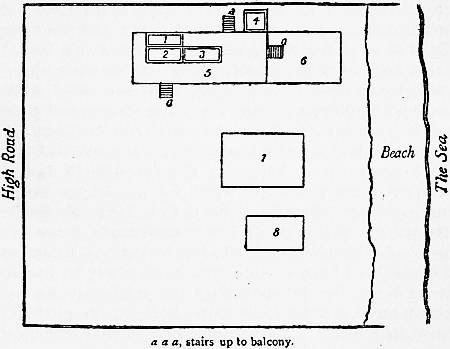
1. Lloyd’s room. 2. My mother’s room. 3. A room kept dark for photographs. 4. The kitchen. 5. Balcony. 6. The Lanai, an open room or summer parlour, partly surrounded with Venetian shutters, in part quite open, which is the living-room. 7. A crazy dirty cottage used for the arts. 8. Another crazy dirty cottage, where Fanny and I live. The town is some three miles away, but the house is connected by telephone with the chief shops, and the tramway runs to within a quarter of a mile of us. I find Honolulu a beastly climate after Tahiti and have been in bed a little; but my colds took on no catarrhal symptom, which is staggeringly delightful. I am studying Hawaiian with a native, a Mr. Joseph Poepoe, a clever fellow too: the tongue is a little bewildering; I am reading a pretty story in native—no, really it is pretty, although wandering and wordy; highly pretty with its continual traffic from one isle to another of the soothsayer, pursuing rainbows. Fanny is, I think, a good deal better on the whole, having profited like me by the tropics; my mother and Lloyd are first-rate. I do not think I have heard from you since last May; certainly not since June; and this really frightens me. Do write, even now. Scribner’s Sons it should be; we shall probably be out of this some time in April, home some time in June. But the world whirls to me perceptibly, a mass of times and seasons and places and engagements, and seas to cross, and continents to traverse, so that I scarce know where I am. Well, I have had a brave time. Et ego in Arcadia—though I don’t believe Arcadia was a spot upon Tahiti. I have written another long narrative poem: the Song of Rahero. Privately, I think it good: but your ominous silence over the Feast of Famine leads me to fear we shall not be agreed. Is it possible I have wounded you in some way? I scarce like to dream that it is possible; and yet I know too well it may be so. If so, don’t write, and you can pitch into me when we meet. I am, admittedly, as mild as London Stout now; and the Old Man Virulent much a creature of the past. My dear Colvin, I owe you and Fleeming Jenkin, the two older men who took the trouble and knew how to make a friend of me, everything that I have or am: if I have behaved ill, just hold on and give me a chance, you shall have the slanging of me and I bet I shall prefer it to this silence.—Ever, my dear Colvin, your most affectionate
R. L. S.
[Mrs. R. L. Stevenson to Mrs. Sitwell
This letter brought to friends in England the first news of the intended prolongation of the cruise among the remoter islands of the Pacific.
Honolulu, towards the end of March 1889.
MY DEAR FRIEND,—Louis has improved so wonderfully in the delicious islands of the South Seas, that we think of trying yet one more voyage. We are a little uncertain as to how we shall go, whether in a missionary ship, or by hiring schooners from point to point, but the “unregenerate” islands we must see. I suppose we shall be off some time in June, which will fetch us back to England in another year’s time. You could hardly believe it if you could see Louis now. He looks as well as he ever did in his life, and has had no sign of cough or hemorrhage (begging pardon of Nemesis) for many months. It seems a pity to return to England until his health is firmly reestablished, and also a pity not to see all that we can see quite easily starting from this place: and which will be our only opportunity in life. Of course there is the usual risk from hostile natives, and the horrible sea, but a positive risk is so much more wholesome than a negative one, and it is all such joy to Louis and Lloyd. As for me, I hate the sea, and am afraid of it (though no one will believe that because in time of danger I do not make an outcry—nevertheless I am afraid of it, and it is not kind to me), but I love the tropic weather, and the wild people, and to see my two boys so happy. Mrs. Stevenson is going back to Scotland in May, as she does not like to be longer away from her old sister, who has been very ill. And besides, we do not feel justified in taking her to the sort of places we intend to visit. As for me, I can get comfort out of very rough surroundings for my people, I can work hard and enjoy it; I can even shoot pretty well, and though I “don’t want to fight, by jingo if I must,” why I can. I don’t suppose there will be any occasion for that sort of thing—only in case.
I am not quite sure of the names, but I think our new cruise includes the Gilberts, the Fijis, and the Solomons. A letter might go from the Fijis; Louis will write the particulars, of which I am not sure. As for myself, I have had more cares than I was really fit for. To keep house on a yacht is no easy thing. When Louis and I broke loose from the ship and lived alone amongst the natives I got on very well. It was when I was deathly sea-sick, and the question was put to me by the cook, “What shall we have for the cabin dinner, what for to-morrow’s breakfast, what for lunch? and what about the sailors’ food? Please come and look at the biscuits, for the weevils have got into them, and show me how to make yeast that will rise of itself, and smell the pork which seems pretty high, and give me directions about making a pudding with molasses—and what is to be done about the bugs?”—etc. etc. In the midst of heavy dangerous weather, when I was lying on the floor clutching a basin, down comes the mate with a cracked head, and I must needs cut off the hair matted with blood, wash and dress the wound, and administer restoratives. I do not like being “the lady of the yacht,” but ashore! O, then I felt I was repaid for all. I wonder did any of my letters from beautiful Tautira ever come to hand, with the descriptions of our life with Louis’s adopted brother Ori a Ori? Ori wrote to us, if no one else did, and I mean to give you a translation of his letter. It begins with our native names.
Tautira, 26 Dec. 1888.
To Teriitera (Louis) and Tapina Tutu (myself) and Aromaiterai (Lloyd) and Teiriha (Mrs. Stevenson) Salutation in the true Jesus.
I make you to know my great affection. At the hour when you left us, I was filled with tears; my wife, Rui Tehini, also, and all of my household. When you embarked I felt a great sorrow. It is for this that I went upon the road, and you looked from that ship, and I looked at you on the ship with great grief until you had raised the anchor and hoisted the sails. When the ship started, I ran along the beach to see you still; and when you were on the open sea I cried out to you, “farewell Louis”: and when I was coming back to my house I seemed to hear your voice crying “Rui farewell.” Afterwards I watched the ship as long as I could until the night fell; and when it was dark I said to myself, “if I had wings I should fly to the ship to meet you, and to sleep amongst you, so that I might be able to come back to shore and to tell Rui Tehini, ’I have slept upon the ship of Teriitera.’” After that we passed that night in the impatience of grief. Towards eight o’clock I seemed to hear your voice, “Teriitera—Rui—here is the hour for putter and tiro” (cheese and syrup). I did not sleep that night, thinking continually of you, my very dear friend, until the morning: being then awake I went to see Tapina Tutu on her bed, and alas, she was not there. Afterwards I looked into your rooms; they did not please me as they used to do. I did not hear your voice crying, “hail Rui.” I thought then that you had gone, and that you had left me. Rising up I went to the beach to see your ship, and I could not see it. I wept, then, till the night, telling myself continually, “Teriitera returns into his own country and leaves his dear Rui in grief, so that I suffer for him, and weep for him.” I will not forget you in my memory. Here is the thought: I desire to meet you again. It is my dear Teriitera makes the only riches I desire in this world. It is your eyes that I desire to see again. It must be that your body and my body shall eat together at our table: there is what would make my heart content. But now we are separated. May God be with you all. May His word and His mercy go with you, so that you may be well and we also, according to the words of Paul.
Ori a Ori; that is to say, Rui.
After reading this to me Louis has left in tears saying that he is not worthy that such a letter should be written to him. We hope to so manage that we shall stop at Tahiti and see Rui once more. I tell myself that pleasant story when I wake in the night.
I find my head swimming so that I cannot write any more. I wish some rich Catholic would send a parlour organ to Père Bruno of Tautira. I am going to try and save money to do it myself, but he may die before I have enough. I feel ashamed to be sitting here when I think of that old man who cannot draw because of scrivener’s paralysis, who has no one year in and year out to speak to but natives (our Rui is a Protestant not bigoted like the rest of them—but still a Protestant) and the only pastime he has is playing on an old broken parlour organ whose keys are mostly dumb. I know no more pathetic figure. Have you no rich Catholic friends who would send him an organ that he could play upon? Of course I am talking nonsense, and yet I know somewhere that person exists if only I knew the place.
Our dearest love to you all.
Fanny.]
To Henry James
Honolulu [March 1889].
MY DEAR JAMES,—Yes—I own up—I am untrue to friendship and (what is less, but still considerable) to civilisation. I am not coming home for another year. There it is, cold and bald, and now you won’t believe in me at all, and serve me right (says you) and the devil take me. But look here, and judge me tenderly. I have had more fun and pleasure of my life these past months than ever before, and more health than any time in ten long years. And even here in Honolulu I have withered in the cold; and this precious deep is filled with islands, which we may still visit; and though the sea is a deathful place, I like to be there, and like squalls (when they are over); and to draw near to a new island, I cannot say how much I like. In short, I take another year of this sort of life, and mean to try to work down among the poisoned arrows, and mean (if it may be) to come back again when the thing is through, and converse with Henry James as heretofore; and in the meanwhile issue directions to H. J. to write to me once more. Let him address here at Honolulu, for my views are vague; and if it is sent here it will follow and find me, if I am to be found; and if I am not to be found, the man James will have done his duty, and we shall be at the bottom of the sea, where no post-office clerk can be expected to discover us, or languishing on a coral island, the philosophic drudges of some barbarian potentate: perchance, of an American Missionary. My wife has just sent to Mrs. Sitwell a translation (tant bien que mal) of a letter I have had from my chief friend in this part of the world: go and see her, and get a hearing of it; it will do you good; it is a better method of correspondence than even Henry James’s. I jest, but seriously it is a strange thing for a tough, sick, middle-aged scrivener like R. L. S. to receive a letter so conceived from a man fifty years old, a leading politician, a crack orator, and the great wit of his village: boldly say, “the highly popular M.P. of Tautira.” My nineteenth century strikes here, and lies alongside of something beautiful and ancient. I think the receipt of such a letter might humble, shall I say even ——? and for me, I would rather have received it than written Redgauntlet or the sixth Æneid. All told, if my books have enabled or helped me to make this voyage, to know Rui, and to have received such a letter, they have (in the old prefatorial expression) not been writ in vain. It would seem from this that I have been not so much humbled as puffed up; but, I assure you, I have in fact been both. A little of what that letter says is my own earning; not all, but yet a little; and the little makes me proud, and all the rest ashamed; and in the contrast, how much more beautiful altogether is the ancient man than him of to-day!
Well, well, Henry James is pretty good, though he is of the nineteenth century, and that glaringly. And to curry favour with him, I wish I could be more explicit; but, indeed, I am still of necessity extremely vague, and cannot tell what I am to do, nor where I am to go for some while yet. As soon as I am sure, you shall hear. All are fairly well—the wife, your countrywoman, least of all; troubles are not entirely wanting; but on the whole we prosper, and we are all affectionately yours,
Robert Louis Stevenson.
To Sidney Colvin
Honolulu, April 2nd, 1889.
MY DEAR COLVIN,—I am beginning to be ashamed of writing on to you without the least acknowledgment, like a tramp; but I do not care—I am hardened; and whatever be the cause of your silence, I mean to write till all is blue. I am outright ashamed of my news, which is that we are not coming home for another year. I cannot but hope it may continue the vast improvement of my health: I think it good for Fanny and Lloyd; and we have all a taste for this wandering and dangerous life. My mother I send home, to my relief, as this part of our cruise will be (if we can carry it out) rather difficult in places. Here is the idea: about the middle of June (unless the Boston Board objects) we sail from Honolulu in the missionary ship (barquentine auxiliary steamer) Morning Star: she takes us through the Gilberts and Marshalls, and drops us (this is my great idea) on Ponape, one of the volcanic islands of the Carolines. Here we stay marooned among a doubtful population, with a Spanish vice-governor and five native kings, and a sprinkling of missionaries all at loggerheads, on the chance of fetching a passage to Sydney in a trader, a labour ship or (maybe, but this appears too bright) a ship of war. If we can’t get the Morning Star (and the Board has many reasons that I can see for refusing its permission) I mean to try to fetch Fiji, hire a schooner there, do the Fijis and Friendlies, hit the course of the Richmond at Tonga Tabu, make back by Tahiti, and so to S. F., and home: perhaps in June 1890. For the latter part of the cruise will likely be the same in either case. You can see for yourself how much variety and adventure this promises, and that it is not devoid of danger at the best; but if we can pull it off in safety, gives me a fine book of travel, and Lloyd a fine lecture and diorama, which should vastly better our finances.
I feel as if I were untrue to friendship; believe me, Colvin, when I look forward to this absence of another year, my conscience sinks at thought of the Monument; but I think you will pardon me if you consider how much this tropical weather mends my health. Remember me as I was at home, and think of me sea-bathing and walking about, as jolly as a sandboy: you will own the temptation is strong; and as the scheme, bar fatal accidents, is bound to pay into the bargain, sooner or later, it seems it would be madness to come home now, with an imperfect book, no illustrations to speak of, no diorama, and perhaps fall sick again by autumn. I do not think I delude myself when I say the tendency to catarrh has visibly diminished.
It is a singular thing that as I was packing up old papers ere I left Skerryvore, I came on the prophecies of a drunken Highland sibyl, when I was seventeen. She said I was to be very happy, to visit America, and to be much upon the sea. It seems as if it were coming true with a vengeance. Also, do you remember my strong, old, rooted belief that I shall die by drowning? I don’t want that to come true, though it is an easy death; but it occurs to me oddly, with these long chances in front. I cannot say why I like the sea; no man is more cynically and constantly alive to its perils; I regard it as the highest form of gambling; and yet I love the sea as much as I hate gambling. Fine, clean emotions; a world all and always beautiful; air better than wine; interest unflagging; there is upon the whole no better life.—Yours ever,
R. L. S.
To E. L. Burlingame
[Honolulu, April 1889.]
MY DEAR BURLINGAME,—This is to announce the most prodigious change of programme. I have seen so much of the South Seas that I desire to see more, and I get so much health here that I dread a return to our vile climates. I have applied accordingly to the missionary folk to let me go round in the Morning Star; and if the Boston Board should refuse, I shall get somehow to Fiji, hire a trading schooner, and see the Fijis and Friendlies and Samoa. He would be a South Seayer, Mr. Burlingame. Of course, if I go in the Morning Star, I see all the eastern (or western?) islands.
Before I sail, I shall make out to let you have the last of The Master: though I tell you it sticks!—and I hope to have had some proofs forbye, of the verses anyway. And now to business.
I want (if you can find them) in the British sixpenny edition, if not, in some equally compact and portable shape—Seaside Library, for instance—the Waverley Novels entire, or as entire as you can get ’em, and the following of Marryat: Phantom Ship, Peter Simple, Percival Keene, Privateersman, Children of the New Forest, Frank Mildmay, Newton Forster, Dog Fiend (Snarleyyow). Also Midshipman Easy, Kingsburn, Carlyle’s French Revolution, Motley’s Dutch Republic, Lang’s Letters on Literature, a complete set of my works, Jenkin, in duplicate; also Familiar Studies, ditto.
I have to thank you for the accounts, which are satisfactory indeed, and for the cheque for $1000. Another account will have come and gone before I see you. I hope it will be equally roseate in colour. I am quite worked out, and this cursed end of The Master hangs over me like the arm of the gallows; but it is always darkest before dawn, and no doubt the clouds will soon rise; but it is a difficult thing to write, above all in Mackellarese; and I cannot yet see my way clear. If I pull this off, The Master will be a pretty good novel or I am the more deceived; and even if I don’t pull if off, it’ll still have some stuff in it.
We shall remain here until the middle of June anyway; but my mother leaves for Europe early in May. Hence our mail should continue to come here; but not hers. I will let you know my next address, which will probably be Sydney. If we get on the Morning Star, I propose at present to get marooned on Ponape, and take my chance of getting a passage to Australia. It will leave times and seasons mighty vague, and the cruise is risky; but I shall know something of the South Seas when it is done, or else the South Seas will contain all there is of me. It should give me a fine book of travels, anyway.
Low will probably come and ask some dollars of you. Pray let him have them, they are for outfit. O, another complete set of my books should go to Captain A. H. Otis, care of Dr. Merritt, Yacht Casco, Oakland, Cal.—In haste,
R. L. S.
To Miss Adelaide Boodle
Honolulu, April 6th, 1889.
MY DEAR MISS BOODLE,—Nobody writes a better letter than my Gamekeeper: so gay, so pleasant, so engagingly particular, answering (by some delicate instinct) all the questions she suggests. It is a shame you should get such a poor return as I can make, from a mind essentially and originally incapable of the art epistolary. I would let the paper-cutter take my place; but I am sorry to say the little wooden seaman did after the manner of seamen, and deserted in the Societies. The place he seems to have stayed at—seems, for his absence was not observed till we were near the Equator—was Tautira, and, I assure you, he displayed good taste, Tautira being as “nigh hand heaven” as a paper-cutter or anybody has a right to expect.
I think all our friends will be very angry with us, and I give the grounds of their probable displeasure bluntly—we are not coming home for another year. My mother returns next month. Fanny, Lloyd, and I push on again among the islands on a trading schooner, the Equator—first for the Gilbert group, which we shall have an opportunity to explore thoroughly; then, if occasion serve, to the Marshalls and Carolines; and if occasion (or money) fail, to Samoa, and back to Tahiti. I own we are deserters, but we have excuses. You cannot conceive how these climates agree with the wretched house-plant of Skerryvore: he wonders to find himself sea-bathing, and cutting about the world loose, like a grown-up person. They agree with Fanny too, who does not suffer from her rheumatism, and with Lloyd also. And the interest of the islands is endless; and the sea, though I own it is a fearsome place, is very delightful. We had applied for places in the American missionary ship, the Morning Star, but this trading schooner is a far preferable idea, giving us more time and a thousandfold more liberty; so we determined to cut off the missionaries with a shilling.
The Sandwich Islands do not interest us very much; we live here, oppressed with civilisation, and look for good things in the future. But it would surprise you if you came out to-night from Honolulu (all shining with electric lights, and all in a bustle from the arrival of the mail, which is to carry you these lines) and crossed the long wooden causeway along the beach, and came out on the road through Kapiolani park, and seeing a gate in the palings, with a tub of gold-fish by the wayside, entered casually in. The buildings stand in three groups by the edge of the beach, where an angry little spitfire sea continually spirts and thrashes with impotent irascibility, the big seas breaking further out upon the reef. The first is a small house, with a very large summer parlour, or lanai, as they call it here, roofed, but practically open. There you will find the lamps burning and the family sitting about the table, dinner just done: my mother, my wife, Lloyd, Belle, my wife’s daughter, Austin her child, and to-night (by way of rarity) a guest. All about the walls our South Sea curiosities, war clubs, idols, pearl shells, stone axes, etc.; and the walls are only a small part of a lanai, the rest being glazed or latticed windows, or mere open space. You will see there no sign of the Squire, however; and being a person of a humane disposition, you will only glance in over the balcony railing at the merrymakers in the summer parlour, and proceed further afield after the Exile. You look round, there is beautiful green turf, many trees of an outlandish sort that drop thorns—look out if your feet are bare; but I beg your pardon, you have not been long enough in the South Seas—and many oleanders in full flower. The next group of buildings is ramshackle, and quite dark; you make out a coach-house door, and look in—only some cocoanuts; you try round to the left and come to the sea front, where Venus and the moon are making luminous tracks on the water, and a great swell rolls and shines on the outer reef; and here is another door—all these places open from the outside—and you go in, and find photography, tubs of water, negatives steeping, a tap, and a chair and an ink-bottle, where my wife is supposed to write; round a little further, a third door, entering which you find a picture upon the easel and a table sticky with paints; a fourth door admits you to a sort of court, where there is a hen sitting—I believe on a fallacious egg. No sign of the Squire in all this. But right opposite the studio door you have observed a third little house, from whose open door lamp-light streams and makes hay of the strong moonlight shadows. You had supposed it made no part of the grounds, for a fence runs round it lined with oleander; but as the Squire is nowhere else, is it not just possible he may be here? It is a grim little wooden shanty; cobwebs bedeck it; friendly mice inhabit its recesses; the mailed cockroach walks upon the wall; so also, I regret to say, the scorpion. Herein are two pallet beds, two mosquito curtains, strung to the pitch-boards of the roof, two tables laden with books and manuscripts, three chairs, and, in one of the beds, the Squire busy writing to yourself, as it chances, and just at this moment somewhat bitten by mosquitoes. He has just set fire to the insect powder, and will be all right in no time; but just now he contemplates large white blisters, and would like to scratch them, but knows better. The house is not bare; it has been inhabited by Kanakas, and—you know what children are!—the bare wood walls are pasted over with pages from the Graphic, Harper’s Weekly, etc. The floor is matted, and I am bound to say the matting is filthy. There are two windows and two doors, one of which is condemned; on the panels of that last a sheet of paper is pinned up, and covered with writing. I cull a few plums:—
“A duck-hammock for each person. A patent organ like the commandant’s at Taiohae. Cheap and bad cigars for presents. Revolvers. Permanganate of potass. Liniment for the head and sulphur. Fine tooth-comb.”
What do you think this is? Simply life in the South Seas foreshortened. These are a few of our desiderata for the next trip, which we jot down as they occur.
There, I have really done my best and tried to send something like a letter—one letter in return for all your dozens. Pray remember us all to yourself, Mrs. Boodle, and the rest of your house. I do hope your mother will be better when this comes. I shall write and give you a new address when I have made up my mind as to the most probable, and I do beg you will continue to write from time to time and give us airs from home. To-morrow—think of it—I must be off by a quarter to eight to drive in to the palace and breakfast with his Hawaiian Majesty at 8.30: I shall be dead indeed. Please give my news to Scott, I trust he is better; give him my warm regards. To you we all send all kinds of things, and I am the absentee Squire,
Robert Louis Stevenson.
To Charles Baxter
Honolulu, April 1889.
MY DEAR CHARLES,—As usual, your letter is as good as a cordial, and I thank you for it, and all your care, kindness, and generous and thoughtful friendship, from my heart. I was truly glad to hear a word of Colvin, whose long silence has terrified me; and glad to hear that you condoned the notion of my staying longer in the South Seas, for I have decided in that sense. The first idea was to go in the Morning Star, missionary ship; but now I have found a trading schooner, the Equator, which is to call for me here early in June and carry us through the Gilberts. What will happen then, the Lord knows. My mother does not accompany us: she leaves here for home early in May, and you will hear of us from her; but not, I imagine, anything more definite. We shall get dumped on Butaritari, and whether we manage to go on to the Marshalls and Carolines, or whether we fall back on Samoa, Heaven must decide; but I mean to fetch back into the course of the Richmond—(to think you don’t know what the Richmond is!—the steamer of the Eastern South Seas, joining New Zealand, Tongatabu, the Samoas, Taheite, and Rarotonga, and carrying by last advices sheep in the saloon!)—into the course of the Richmond and make Tahiti again on the home track. Would I like to see the Scots Observer? Wouldn’t I not? But whaur? I’m direckit at space. They have nae post offishes at the Gilberts, and as for the Car’lines! Ye see, Mr. Baxter, we’re no just in the punkshewal centre o’ civ’lisation. But pile them up for me, and when I’ve decided on an address, I’ll let you ken, and ye’ll can send them stavin’ after me.—Ever your affectionate
R. L. S.
To Charles Baxter
The reference in the first paragraph is to the publication in the press, which Mr. Baxter had permitted, of one of Stevenson’s letters written during the earlier part of his voyage. R. L. S. had remonstrated, always greatly disliking the publication of private letters during the writer’s lifetime; and now writes to soften the effect of his remonstrance.
Honolulu, 10th May 1889.
MY DEAR CHARLES,—I am appalled to gather from your last just to hand that you have felt so much concern about the letter. Pray dismiss it from your mind. But I think you scarce appreciate how disagreeable it is to have your private affairs and private unguarded expressions getting into print. It would soon sicken any one of writing letters. I have no doubt that letter was very wisely selected, but it just shows how things crop up. There was a raging jealousy between the two yachts; our captain was nearly in a fight over it. However, no more; and whatever you think, my dear fellow, do not suppose me angry with you or ——; although I was annoyed at the circumstance—a very different thing. But it is difficult to conduct life by letter, and I continually feel I may be drifting into some matter of offence, in which my heart takes no part.
I must now turn to a point of business. This new cruise of ours is somewhat venturesome; and I think it needful to warn you not to be in a hurry to suppose us dead. In these ill-charted seas, it is quite on the cards we might be cast on some unvisited, or very rarely visited, island; that there we might lie for a long time, even years, unheard of; and yet turn up smiling at the hinder end. So do not let me be “rowpit” till you get some certainty we have gone to Davie Jones in a squall, or graced the feast of some barbarian in the character of Long Pig.
I have just been a week away alone on the lee coast of Hawaii, the only white creature in many miles, riding five and a half hours one day, living with a native, seeing four lepers shipped off to Molokai, hearing native causes, and giving my opinion as amicus curiæ as to the interpretation of a statute in English; a lovely week among God’s best—at least God’s sweetest works—Polynesians. It has bettered me greatly. If I could only stay there the time that remains, I could get my work done and be happy; but the care of my family keeps me in vile Honolulu, where I am always out of sorts, amidst heat and cold and cesspools and beastly haoles.31 What is a haole? You are one; and so, I am sorry to say, am I. After so long a dose of whites, it was a blessing to get among Polynesians again even for a week.
Well, Charles, there are waur haoles than yoursel’, I’ll say that for ye; and trust before I sail I shall get another letter with more about yourself.—Ever your affectionate friend,
R. L. S.
To W. H. Low
The allusions in the latter half of this letter are to the departure for Europe of the young Hawaiian princess Kaiulani (see the poem beginning “When from her land to mine she goes,” in Songs of Travel), and to the circumstances of the great hurricane at Apia on March 15th, 1889.
Honolulu, (about) 20th May ’89.
MY DEAR LOW,—... The goods have come; many daughters have done virtuously, but thou excellest them all.—I have at length finished The Master; it has been a sore cross to me; but now he is buried, his body’s under hatches,—his soul, if there is any hell to go to, gone to hell; and I forgive him: it is harder to forgive Burlingame for having induced me to begin the publication, or myself for suffering the induction.—Yes, I think Hole has done finely; it will be one of the most adequately illustrated books of our generation; he gets the note, he tells the story—my story: I know only one failure—the Master standing on the beach.—You must have a letter for me at Sydney—till further notice. Remember me to Mrs. Will. H., the godlike sculptor, and any of the faithful. If you want to cease to be a republican, see my little Kaiulani, as she goes through—but she is gone already. You will die a red: I wear the colours of that little royal maiden, Nous allons chanter à la ronde, si vous voulez! only she is not blonde by several chalks, though she is but a half-blood, and the wrong half Edinburgh Scots like mysel’. But, O Low, I love the Polynesian: this civilisation of ours is a dingy, ungentlemanly business; it drops out too much of man, and too much of that the very beauty of the poor beast: who has his beauties in spite of Zola and Co. As usual, here is a whole letter with no news: I am a bloodless, inhuman dog; and no doubt Zola is a better correspondent.—Long live your fine old English admiral—yours, I mean—the U.S.A. one at Samoa; I wept tears and loved myself and mankind when I read of him: he is not too much civilised. And there was Gordon, too; and there are others, beyond question. But if you could live, the only white folk, in a Polynesian village; and drink that warm, light vin du pays of human affection and enjoy that simple dignity of all about you—I will not gush, for I am now in my fortieth year, which seems highly unjust, but there it is, Mr. Low, and the Lord enlighten your affectionate
R. L. S.
[Mrs. R. L. Stevenson to Sidney Colvin
This letter shows the writer in her character of wise and anxious critic of her husband’s work. The result, in the judgment of most of his friends, went far to justify her misgivings.
Honolulu, May 21st, 1889.
BEST OF FRIENDS,—It was a joy inexpressible to get a word from you at last. Fortunately for our peace of mind, we were almost positive that your letters had been sent to the places we had already left. Still it was a bitter disappointment to get nothing from you when we arrived here. I wish you could have seen us both throwing over the immense package of letters searching for your handwriting. Now that we know you have been ill, please do let some one send us a line to our next address telling us how you are. What that next address may be we do not yet know, as our final movements are a little uncertain. To begin with, a trading schooner, the Equator, will come along some time in the first part of June, lie outside the harbour here and signal to us. Within forty-eight hours we shall pack up our possessions, our barrel of sauer kraut, our barrel of salt onions, our bag of cocoanuts, our native garments, our tobacco, fish hooks, red combs, and Turkey red calicoes (all the latter for trading purposes), our hand organ, photograph and painting materials, and finally our magic lantern—all these upon a large whaleboat, and go out to the Equator. Lloyd, also, takes a fiddle, a guitar, a native instrument something like a banjo, called a taropatch fiddle, and a lot of song books. We shall be carried first to one of the Gilberts, landing at Butaritari. The Equator is going about amongst the Gilbert group, and we have the right to keep her over when we like within reasonable limits. Finally she will leave us, and we shall have to take the chances of what happens next. We hope to see the Marshalls, the Carolines, the Fijis, Tonga and Samoa (also other islands that I do not remember), perhaps staying a little while in Sydney, and stopping on our way home to see our friends in Tahiti and the Marquesas. I am very much exercised by one thing. Louis has the most enchanting material that any one ever had in the whole world for his book, and I am afraid he is going to spoil it all. He has taken into his Scotch Stevenson head that a stern duty lies before him, and that his book must be a sort of scientific and historical impersonal thing, comparing the different languages (of which he knows nothing, really) and the different peoples, the object being to settle the question as to whether they are of common Malay origin or not. Also to compare the Protestant and Catholic missions, etc., and the whole thing to be impersonal, leaving out all he knows of the people themselves. And I believe there is no one living who has got so near to them, or who understands them as he does. Think of a small treatise on the Polynesian races being offered to people who are dying to hear about Ori a Ori, the making of brothers with cannibals, the strange stories they told, and the extraordinary adventures that befell us:—suppose Herman Melville had given us his theories as to the Polynesian language and the probable good or evil results of the missionary influence instead of Omoo and Typee, or Kinglake32 instead of Eothen. Louis says it is a stern sense of duty that is at the bottom of it, which is more alarming than anything else. I am so sure that you will agree with me that I am going to ask you to throw the weight of your influence as heavily as possible in the scales with me. Please refer to the matter in the letters we shall receive at our first stopping place, otherwise Louis will spend a great deal of time in Sydney actually reading up other people’s books on the Islands. What a thing it is to have a “man of genius” to deal with. It is like managing an overbred horse. Why with my own feeble hand I could write a book that the whole world would jump at. Please keep any letters of mine that contain any incidents of our wanderings. They are very exact as to facts, and Louis may, in this conscientious state of mind (indeed I am afraid he has), put nothing in his diary but statistics. Even if I thought it a desirable thing to write what he proposes, I should still think it impossible unless after we had lived and studied here some twenty years or more.