Volume 24 — THE LETTERS OF ROBERT LOUIS STEVENSON (continued 4)
Reading edition
I was writing your address the other day, ordering a copy of my next, Prince Otto, to go your way. I hope you have not seen it in parts; it was not meant to be so read; and only my poverty (dishonourably) consented to the serial evolution.
I will send you with this a copy of the English edition of the Child’s Garden. I have heard there is some vile rule of the post-office in the States against inscriptions; so I send herewith a piece of doggerel which Mr. Bunner may, if he thinks fit, copy off the fly-leaf.
Sargent was down again and painted a portrait of me walking about in my own dining-room, in my own velveteen jacket, and twisting as I go my own moustache; at one corner a glimpse of my wife, in an Indian dress, and seated in a chair that was once my grandfather’s, but since some months goes by the name of Henry James’s—for it was there the novelist loved to sit—adds a touch of poesy and comicality. It is, I think, excellent, but is too eccentric to be exhibited. I am at one extreme corner; my wife, in this wild dress, and looking like a ghost, is at the extreme other end; between us an open door exhibits my palatial entrance hall and a part of my respected staircase. All this is touched in lovely, with that witty touch of Sargent’s; but, of course, it looks dam queer as a whole.
Pray let me hear from you, and give me good news of yourself and your wife, to whom please remember me.—Yours most sincerely, my dear Low,
Robert Louis Stevenson.
To W. E. Henley
Prince Otto was published in October of this year; and the following refers to two reviews of it—one of them by Mr. Henley, which to the writer’s displeasure had been pruned by the editor before printing; the other by a writer in the Saturday Review who declared that Otto was “a fool and a wittol,” and could see nothing but false style in the story of Seraphina’s flight through the forest.
[Skerryvore, Bournemouth, Autumn 1885.]
DEAR LAD,—If there was any more praise in what you wrote, I think [the editor] has done us both a service; some of it stops my throat. What, it would not have been the same if Dumas or Musset had done it, would it not? Well, no, I do not think it would, do you know, now; I am really of opinion it would not; and a dam good job too. Why, think what Musset would have made of Otto! Think how gallantly Dumas would have carried his crowd through! And whatever you do, don’t quarrel with ——. It gives me much pleasure to see your work there; I think you do yourself great justice in that field; and I would let no annoyance, petty or justifiable, debar me from such a market. I think you do good there. Whether (considering our intimate relations) you would not do better to refrain from reviewing me, I will leave to yourself: were it all on my side, you could foresee my answer; but there is your side also, where you must be the judge.
As for the Saturday. Otto is no “fool,” the reader is left in no doubt as to whether or not Seraphina was a Messalina (though much it would matter, if you come to that); and therefore on both these points the reviewer has been unjust. Secondly, the romance lies precisely in the freeing of two spirits from these court intrigues; and here I think the reviewer showed himself dull. Lastly, if Otto’s speech is offensive to him, he is one of the large class of unmanly and ungenerous dogs who arrogate and defile the name of manly. As for the passages quoted, I do confess that some of them reek Gongorically; they are excessive, but they are not inelegant after all. However, had he attacked me only there, he would have scored.
Your criticism on Gondremark is, I fancy, right. I thought all your criticisms were indeed; only your praise—chokes me.—Yours ever,
R. L. S.
To William Archer
The paper referred to in this and the following letters is one which Mr. Archer wrote over his own signature in the November number of Time, a magazine now extinct.
Skerryvore, Bournemouth, October 28, 1885.
DEAR MR. ARCHER,—I have read your paper with my customary admiration; it is very witty, very adroit; it contains a great deal that is excellently true (particularly the parts about my stories and the description of me as an artist in life); but you will not be surprised if I do not think it altogether just. It seems to me, in particular, that you have wilfully read all my works in terms of my earliest; my aim, even in style, has quite changed in the last six or seven years; and this I should have thought you would have noticed. Again, your first remark upon the affectation of the italic names; a practice only followed in my two affected little books of travel, where a typographical minauderie of the sort appeared to me in character; and what you say of it, then, is quite just. But why should you forget yourself and use these same italics as an index to my theology some pages further on? This is lightness of touch indeed; may I say, it is almost sharpness of practice?
Excuse these remarks. I have been on the whole much interested, and sometimes amused. Are you aware that the praiser of this “brave gymnasium” has not seen a canoe nor taken a long walk since ’79? that he is rarely out of the house nowadays, and carries his arm in a sling? Can you imagine that he is a back-slidden communist, and is sure he will go to hell (if there be such an excellent institution) for the luxury in which he lives? And can you believe that, though it is gaily expressed, the thought is hag and skeleton in every moment of vacuity or depression? Can you conceive how profoundly I am irritated by the opposite affectation to my own, when I see strong men and rich men bleating about their sorrows and the burthen of life, in a world full of “cancerous paupers,” and poor sick children, and the fatally bereaved, ay, and down even to such happy creatures as myself, who has yet been obliged to strip himself, one after another, of all the pleasures that he had chosen except smoking (and the days of that I know in my heart ought to be over), I forgot eating, which I still enjoy, and who sees the circle of impotence closing very slowly but quite steadily around him? In my view, one dank, dispirited word is harmful, a crime of lèse-humanité, a piece of acquired evil; every gay, every bright word or picture, like every pleasant air of music, is a piece of pleasure set afloat; the reader catches it, and, if he be healthy, goes on his way rejoicing; and it is the business of art so to send him, as often as possible.
For what you say, so kindly, so prettily, so precisely, of my style, I must in particular thank you; though even here, I am vexed you should not have remarked on my attempted change of manner: seemingly this attempt is still quite unsuccessful! Well, we shall fight it out on this line if it takes all summer.
And now for my last word: Mrs. Stevenson is very anxious that you should see me, and that she should see you, in the flesh. If you at all share in these views, I am a fixture. Write or telegraph (giving us time, however, to telegraph in reply, lest the day be impossible), and come down here to a bed and a dinner. What do you say, my dear critic? I shall be truly pleased to see you; and to explain at greater length what I meant by saying narrative was the most characteristic mood of literature, on which point I have great hopes I shall persuade you.—Yours truly,
Robert Louis Stevenson.
P.S.—My opinion about Thoreau, and the passage in The Week, is perhaps a fad, but it is sincere and stable. I am still of the same mind five years later; did you observe that I had said “modern” authors? and will you observe again that this passage touches the very joint of our division? It is one that appeals to me, deals with that part of life that I think the most important, and you, if I gather rightly, so much less so? You believe in the extreme moment of the facts that humanity has acquired and is acquiring; I think them of moment, but still of much less than those inherent or inherited brute principles and laws that sit upon us (in the character of conscience) as heavy as a shirt of mail, and that (in the character of the affections and the airy spirit of pleasure) make all the light of our lives. The house is, indeed, a great thing, and should be rearranged on sanitary principles; but my heart and all my interest are with the dweller, that ancient of days and day-old infant man.
R. L. S.
An excellent touch is p. 584. “By instinct or design he eschews what demands constructive patience.” I believe it is both; my theory is that literature must always be most at home in treating movement and change; hence I look for them.
To Thomas Stevenson
[Skerryvore, Bournemouth] October 28, 1885.
MY DEAREST FATHER,—Get the November number of Time, and you will see a review of me by a very clever fellow, who is quite furious at bottom because I am too orthodox, just as Purcell was savage because I am not orthodox enough. I fall between two stools. It is odd, too, to see how this man thinks me a full-blooded fox-hunter, and tells me my philosophy would fail if I lost my health or had to give up exercise!
An illustrated Treasure Island will be out next month. I have had an early copy, and the French pictures are admirable. The artist has got his types up in Hogarth; he is full of fire and spirit, can draw and can compose, and has understood the book as I meant it, all but one or two little accidents, such as making the Hispaniola a brig. I would send you my copy, but I cannot; it is my new toy, and I cannot divorce myself from this enjoyment.
I am keeping really better, and have been out about every second day, though the weather is cold and very wild.
I was delighted to hear you were keeping better; you and Archer would agree, more shame to you! (Archer is my pessimist critic.) Good-bye to all of you, with my best love. We had a dreadful overhauling of my conduct as a son the other night; and my wife stripped me of my illusions and made me admit I had been a detestable bad one. Of one thing in particular she convicted me in my own eyes: I mean, a most unkind reticence, which hung on me then, and I confess still hangs on me now, when I try to assure you that I do love you.—Ever your bad son,
Robert Louis Stevenson.
To Henry James
Skerryvore, Bournemouth, October 28, 1885.
MY DEAR HENRY JAMES,—At last, my wife being at a concert, and a story being done, I am at some liberty to write and give you of my views. And first, many thanks for the works that came to my sickbed. And second, and more important, as to the Princess.13 Well, I think you are going to do it this time; I cannot, of course, foresee, but these two first numbers seem to me picturesque and sound and full of lineament, and very much a new departure. As for your young lady, she is all there; yes, sir, you can do low life, I believe. The prison was excellent; it was of that nature of touch that I sometimes achingly miss from your former work; with some of the grime, that is, and some of the emphasis of skeleton there is in nature. I pray you to take grime in a good sense; it need not be ignoble: dirt may have dignity; in nature it usually has; and your prison was imposing.
And now to the main point: why do we not see you? Do not fail us. Make an alarming sacrifice, and let us see “Henry James’s chair” properly occupied. I never sit in it myself (though it was my grandfather’s); it has been consecrated to guests by your approval, and now stands at my elbow gaping. We have a new room, too, to introduce to you—our last baby, the drawing-room; it never cries, and has cut its teeth. Likewise, there is a cat now. It promises to be a monster of laziness and self-sufficiency.
Pray see, in the November Time (a dread name for a magazine of light reading), a very clever fellow, W. Archer, stating his views of me; the rosy-gilled “athletico-æsthete”; and warning me, in a fatherly manner, that a rheumatic fever would try my philosophy (as indeed it would), and that my gospel would not do for “those who are shut out from the exercise of any manly virtue save renunciation.” To those who know that rickety and cloistered spectre, the real R. L. S., the paper, besides being clever in itself, presents rare elements of sport. The critical parts are in particular very bright and neat, and often excellently true. Get it by all manner of means.
I hear on all sides I am to be attacked as an immoral writer; this is painful. Have I at last got, like you, to the pitch of being attacked? ’Tis the consecration I lack—and could do without. Not that Archer’s paper is an attack, or what either he or I, I believe, would call one; ’tis the attacks on my morality (which I had thought a gem of the first water) I referred to.
Now, my dear James, come—come—come. The spirit (that is me) says, Come; and the bride (and that is my wife) says, Come; and the best thing you can do for us and yourself and your work is to get up and do so right away.—Yours affectionately,
Robert Louis Stevenson.
To William Archer
[Skerryvore, Bournemouth] October 30, 1885.
DEAR MR. ARCHER,—It is possible my father may be soon down with me; he is an old man and in bad health and spirits; and I could neither leave him alone, nor could we talk freely before him. If he should be here when you offer your visit, you will understand if I have to say no, and put you off.
I quite understand your not caring to refer to things of private knowledge. What still puzzles me is how you (“in the witness box”—ha! I like the phrase) should have made your argument actually hinge on a contention which the facts answered.
I am pleased to hear of the correctness of my guess. It is then as I supposed; you are of the school of the generous and not the sullen pessimists; and I can feel with you. I used myself to rage when I saw sick folk going by in their Bath-chairs; since I have been sick myself (and always when I was sick myself), I found life, even in its rough places, to have a property of easiness. That which we suffer ourselves has no longer the same air of monstrous injustice and wanton cruelty that suffering wears when we see it in the case of others. So we begin gradually to see that things are not black, but have their strange compensations; and when they draw towards their worst, the idea of death is like a bed to lie on. I should bear false witness if I did not declare life happy. And your wonderful statement that happiness tends to die out and misery to continue, which was what put me on the track of your frame of mind, is diagnostic of the happy man raging over the misery of others; it could never be written by the man who had tried what unhappiness was like. And at any rate, it was a slip of the pen: the ugliest word that science has to declare is a reserved indifference to happiness and misery in the individual; it declares no leaning toward the black, no iniquity on the large scale in fate’s doings, rather a marble equality, dread not cruel, giving and taking away and reconciling.
Why have I not written my Timon? Well, here is my worst quarrel with you. You take my young books as my last word. The tendency to try to say more has passed unperceived (my fault, that). And you make no allowance for the slowness with which a man finds and tries to learn his tools. I began with a neat brisk little style, and a sharp little knack of partial observation; I have tried to expand my means, but still I can only utter a part of what I wish to say, and am bound to feel; and much of it will die unspoken. But if I had the pen of Shakespeare, I have no Timon to give forth. I feel kindly to the powers that be; I marvel they should use me so well; and when I think of the case of others, I wonder too, but in another vein, whether they may not, whether they must not, be like me, still with some compensation, some delight. To have suffered, nay, to suffer, sets a keen edge on what remains of the agreeable. This is a great truth, and has to be learned in the fire.—Yours very truly,
Robert Louis Stevenson.
We expect you, remember that.
To William Archer
Skerryvore, Bournemouth, November 1, 1885.
DEAR MR. ARCHER,—You will see that I had already had a sight of your article and what were my thoughts.
One thing in your letter puzzles me. Are you, too, not in the witness-box? And if you are, why take a wilfully false hypothesis? If you knew I was a chronic invalid, why say that my philosophy was unsuitable to such a case? My call for facts is not so general as yours, but an essential fact should not be put the other way about.
The fact is, consciously or not, you doubt my honesty; you think I am making faces, and at heart disbelieve my utterances. And this I am disposed to think must spring from your not having had enough of pain, sorrow, and trouble in your existence. It is easy to have too much; easy also or possible to have too little; enough is required that a man may appreciate what elements of consolation and joy there are in everything but absolutely overpowering physical pain or disgrace, and how in almost all circumstances the human soul can play a fair part. You fear life, I fancy, on the principle of the hand of little employment. But perhaps my hypothesis is as unlike the truth as the one you chose. Well, if it be so, if you have had trials, sickness, the approach of death, the alienation of friends, poverty at the heels, and have not felt your soul turn round upon these things and spurn them under—you must be very differently made from me, and I earnestly believe from the majority of men. But at least you are in the right to wonder and complain.
To “say all”? Stay here. All at once? That would require a word from the pen of Gargantua. We say each particular thing as it comes up, and “with that sort of emphasis that for the time there seems to be no other.” Words will not otherwise serve us; no, nor even Shakespeare, who could not have put As You Like It and Timon into one without ruinous loss both of emphasis and substance. Is it quite fair then to keep your face so steadily On my most light-hearted works, and then say I recognise no evil? Yet in the paper on Burns, for instance, I show myself alive to some sorts of evil. But then, perhaps, they are not your sorts.
And again: “to say all”? All: yes. Everything: no. The task were endless, the effect nil. But my all, in such a vast field as this of life, is what interests me, what stands out, what takes on itself a presence for my imagination or makes a figure in that little tricky abbreviation which is the best that my reason can conceive. That I must treat, or I shall be fooling with my readers. That, and not the all of some one else.
And here we come to the division: not only do I believe that literature should give joy, but I see a universe, I suppose, eternally different from yours; a solemn, a terrible, but a very joyous and noble universe, where suffering is not at least wantonly inflicted, though it falls with dispassionate partiality, but where it may be and generally is nobly borne; where, above all (this I believe; probably you don’t: I think he may, with cancer), any brave man may make out a life which shall be happy for himself, and, by so being, beneficent to those about him. And if he fails, why should I hear him weeping? I mean if I fail, why should I weep? Why should you hear me? Then to me morals, the conscience, the affections, and the passions are, I will own frankly and sweepingly, so infinitely more important than the other parts of life, that I conceive men rather triflers who become immersed in the latter; and I will always think the man who keeps his lip stiff, and makes “a happy fireside clime,” and carries a pleasant face about to friends and neighbours, infinitely greater (in the abstract) than an atrabilious Shakespeare or a backbiting Kant or Darwin. No offence to any of these gentlemen, two of whom probably (one for certain) came up to my standard.
And now enough said; it were hard if a poor man could not criticise another without having so much ink shed against him. But I shall still regret you should have written on an hypothesis you knew to be untenable, and that you should thus have made your paper, for those who do not know me, essentially unfair. The rich, fox-hunting squire speaks with one voice; the sick man of letters with another.—Yours very truly,
Robert Louis Stevenson
(Prometheus-Heine in minimis).
P.S.—Here I go again. To me, the medicine bottles on my chimney and the blood on my handkerchief are accidents; they do not colour my view of life, as you would know, I think, if you had experience of sickness; they do not exist in my prospect; I would as soon drag them under the eyes of my readers as I would mention a pimple I might chance to have (saving your presence) on my posteriors. What does it prove? what does it change? it has not hurt, it has not changed me in any essential part; and I should think myself a trifler and in bad taste if I introduced the world to these unimportant privacies.
But, again, there is this mountain-range between us—that you do not believe me. It is not flattering, but the fault is probably in my literary art.
To W. H. Low
The “other thing coming out” mentioned below in the last paragraph but one was The Strange Case of Dr. Jekyll and Mr. Hyde.
Skerryvore, Bournemouth, December 26, 1885.
MY DEAR LOW,—Lamia has not yet turned up, but your letter came to me this evening with a scent of the Boulevard Montparnasse that was irresistible. The sand of Lavenue’s crumbled under my heel; and the bouquet of the old Fleury came back to me, and I remembered the day when I found a twenty franc piece under my fetish. Have you that fetish still? and has it brought you luck? I remembered, too, my first sight of you in a frock-coat and a smoking-cap, when we passed the evening at the Café de Medicis; and my last when we sat and talked in the Parc Monceau; and all these things made me feel a little young again, which, to one who has been mostly in bed for a month, was a vivifying change.
Yes, you are lucky to have a bag that holds you comfortably. Mine is a strange contrivance; I don’t die, damme, and I can’t get along on both feet to save my soul; I am a chronic sickist; and my work cripples along between bed and the parlour, between the medicine bottle and the cupping glass. Well, I like my life all the same; and should like it none the worse if I could have another talk with you, though even my talks now are measured out to me by the minute hand like poisons in a minim glass.
A photograph will be taken of my ugly mug and sent to you for ulterior purposes: I have another thing coming out, which I did not put in the way of the Scribners, I can scarce tell how; but I was sick and penniless and rather back on the world, and mismanaged it. I trust they will forgive me.
I am sorry to hear of Mrs. Low’s illness, and glad to hear of her recovery. I will announce the coming Lamia to Bob: he steams away at literature like smoke. I have a beautiful Bob on my walls, and a good Sargent, and a delightful Lemon; and your etching now hangs framed in the dining-room. So the arts surround me.—Yours,
R. L. S.
To Mrs. de Mattos
With this cousin the writer had always been on terms of close affection, and he now dedicated to her The Strange Case of Dr. Jekyll and Mr. Hyde. In the dedication as published only the second verse stands.
[Skerryvore, Bournemouth] January 1st, 1886.
DEAREST KATHARINE,—Here, on a very little book and accompanied with lame verses, I have put your name. Our kindness is now getting well on in years; it must be nearly of age; and it gets more valuable to me with every time I see you. It is not possible to express any sentiment, and it is not necessary to try, at least between us. You know very well that I love you dearly, and that I always will. I only wish the verses were better, but at least you like the story; and it is sent to you by the one that loves you—Jekyll, and not Hyde.
R. L. S.
Ave!
Bells upon the city are ringing in the night; High above the gardens are the houses full of light; On the heathy Pentlands is the curlew flying free; And the broom is blowing bonnie in the north countrie. We cannae break the bonds that God decreed to bind, Still we’ll be the children of the heather and the wind; Far away from home, O, it’s still for you and me That the broom is blowing bonnie in the north countrie.
R. L. S.
To Alison Cunningham
[Skerryvore, Bournemouth] Jan. 1st, 1886.
MY DEAR KINNICUM,14—I am a very bad dog, but not for the first time. Your book, which is very interesting, came duly; and I immediately got a very bad cold indeed, and have been fit for nothing whatever. I am a bit better now, and aye on the mend; so I write to tell you, I thought of you on New Year’s Day; though, I own, it would have been more decent if I had thought in time for you to get my letter then. Well, what can’t be cured must be endured, Mr. Lawrie; and you must be content with what I give. If I wrote all the letters I ought to write, and at the proper time, I should be very good and very happy; but I doubt if I should do anything else.
I suppose you will be in town for the New Year; and I hope your health is pretty good. What you want is diet; but it is as much use to tell you that as it is to tell my father. And I quite admit a diet is a beastly thing. I doubt, however, if it be as bad as not being allowed to speak, which I have tried fully, and do not like. When, at the same time, I was not allowed to read, it passed a joke. But these are troubles of the past, and on this day, at least, it is proper to suppose they won’t return. But we are not put here to enjoy ourselves: it was not God’s purpose; and I am prepared to argue, it is not our sincere wish. As for our deserts, the less said of them the better, for somebody might hear, and nobody cares to be laughed at. A good man is a very noble thing to see, but not to himself; what he seems to God is, fortunately, not our business; that is the domain of faith; and whether on the first of January or the thirty-first of December, faith is a good word to end on.
My dear Cummy, many happy returns to you and my best love.—The worst correspondent in the world,
Robert Louis Stevenson.
To Mr. and Mrs. Thomas Stevenson
[Skerryvore, Bournemouth] January 1st, 1886.
MY DEAR PEOPLE,—Many happy returns of the day to you all; I am fairly well and in good spirits; and much and hopefully occupied with dear Jenkin’s life. The inquiry in every detail, every letter that I read, makes me think of him more nobly. I cannot imagine how I got his friendship; I did not deserve it. I believe the notice will be interesting and useful.
My father’s last letter, owing to the use of a quill pen and the neglect of blotting-paper, was hopelessly illegible. Every one tried, and every one failed to decipher an important word on which the interest of one whole clause (and the letter consisted of two) depended.
I find I can make little more of this; but I’ll spare the blots.—Dear people, ever your loving son,
R. L. S.
I will try again, being a giant refreshed by the house being empty. The presence of people is the great obstacle to letter-writing. I deny that letters should contain news (I mean mine; those of other people should). But mine should contain appropriate sentiments and humorous nonsense, or nonsense without the humour. When the house is empty, the mind is seized with a desire—no, that is too strong—a willingness to pour forth unmitigated rot, which constitutes (in me) the true spirit of correspondence. When I have no remarks to offer (and nobody to offer them to), my pen flies, and you see the remarkable consequence of a page literally covered with words and genuinely devoid of sense. I can always do that, if quite alone, and I like doing it; but I have yet to learn that it is beloved by correspondents. The deuce of it is, that there is no end possible but the end of the paper; and as there is very little left of that—if I cannot stop writing—suppose you give up reading. It would all come to the same thing; and I think we should all be happier....
To W. H. Low
In the following letter R. L. S. accepts the dedication of Mr. Low’s illustrated edition of Keats’s Lamia, and sends him in return the newly published Jekyll and Hyde, and a set of verses afterwards printed in the Century Magazine and Underwoods, and inscribed by Mr. St. Gaudens on his medallion portrait of the author. The terms of the Lamia dedication are as follows: “In testimony of loyal friendship and of a common faith in doubtful tales from Faery-Land, I dedicate to Robert Louis Stevenson my work in this book.” The Latin legend inscribed above the design runs: “Neque est ullum certius amicitiae vinculum quam consensus et societas consiliorum et voluntatum.”
[Skerryvore, Bournemouth] Jan. 2nd, 1886.
MY DEAR LOW,—Lamia has come, and I do not know how to thank you, not only for the beautiful art of the designs, but for the handsome and apt words of the dedication. My favourite is “Bathes unseen,” which is a masterpiece; and the next, “Into the green recessed woods,” is perhaps more remarkable, though it does not take my fancy so imperiously. The night scene at Corinth pleases me also. The second part offers fewer opportunities. I own I should like to see both Isabella and the Eve thus illustrated; and then there’s Hyperion—O, yes, and Endymion! I should like to see the lot: beautiful pictures dance before me by hundreds: I believe Endymion would suit you best. It also is in faery-land; and I see a hundred opportunities, cloudy and flowery glories, things as delicate as the cobweb in the bush; actions, not in themselves of any mighty purport, but made for the pencil: the feast of Pan, Peona’s isle, the “slabbed margin of a well,” the chase of the butterfly, the nymph, Glaucus, Cybele, Sleep on his couch, a farrago of unconnected beauties. But I divagate; and all this sits in the bosom of the publisher.
What is more important, I accept the terms of the dedication with a frank heart, and the terms of your Latin legend fairly. The sight of your pictures has once more awakened me to my right mind; something may come of it; yet one more bold push to get free of this prison-yard of the abominably ugly, where I take my daily exercise with my contemporaries. I do not know, I have a feeling in my bones, a sentiment which may take on the forms of imagination, or may not. If it does, I shall owe it to you; and the thing will thus descend from Keats even if on the wrong side of the blanket. If it can be done in prose—that is the puzzle—I divagate again. Thank you again: you can draw and yet you do not love the ugly: what are you doing in this age? Flee, while it is yet time; they will have your four limbs pinned upon a stable door to scare witches. The ugly, my unhappy friend, is de rigueur: it is the only wear! What a chance you threw away with the serpent! Why had Apollonius no pimples? Heavens, my dear Low, you do not know your business....
I send you herewith a Gothic gnome for your Greek nymph; but the gnome is interesting, I think, and he came out of a deep mine, where he guards the fountain of tears. It is not always the time to rejoice.—Yours ever,
R. L. S.
The gnome’s name is Jekyll & Hyde; I believe you will find he is likewise quite willing to answer to the name of Low or Stevenson.
Same day.—I have copied out on the other sheet some bad verses, which somehow your picture suggested; as a kind of image of things that I pursue and cannot reach, and that you seem—no, not to have reached—but to have come a thought nearer to than I. This is the life we have chosen: well, the choice was mad, but I should make it again.
What occurs to me is this: perhaps they might be printed in (say) the Century for the sake of my name; and if that were possible, they might advertise your book. It might be headed as sent in acknowledgment of your Lamia. Or perhaps it might be introduced by the phrases I have marked above. I dare say they would stick it in: I want no payment, being well paid by Lamia. If they are not, keep them to yourself.
to will h. low
Damned bad lines in return for a beautiful book
Youth now flees on feathered foot. Faint and fainter sounds the flute; Rarer songs of Gods. And still, Somewhere on the sunny hill, Or along the winding stream. Through the willows, flits a dream; Flits, but shows a smiling face, Flees, but with so quaint a grace, None can choose to stay at home, All must follow—all must roam. This is unborn beauty: she Now in air floats high and free, Takes the sun, and breaks the blue;— Late, with stooping pinion flew Raking hedgerow trees, and wet Her wing in silver streams, and set Shining foot on temple roof. Now again she flies aloof, Coasting mountain clouds, and kissed By the evening’s amethyst. In wet wood and miry lane Still we pound and pant in vain; Still with earthy foot we chase Waning pinion, fainting face; Still, with grey hair, we stumble on Till—behold!—the vision gone! Where has fleeting beauty led? To the doorway of the dead! [Life is gone, but life was gay: We have come the primrose way!]15
R. L. S.
To Edmund Gosse
Skerryvore, Bournemouth, Jan. 2nd, 1886.
MY DEAR GOSSE,—Thank you for your letter, so interesting to my vanity. There is a review in the St. James’s, which, as it seems to hold somewhat of your opinions, and is besides written with a pen and not a poker, we think may possibly be yours. The Prince16 has done fairly well in spite of the reviews, which have been bad: he was, as you doubtless saw, well slated in the Saturday; one paper received it as a child’s story; another (picture my agony) described it as a “Gilbert comedy.” It was amusing to see the race between me and Justin M’Carthy: the Milesian has won by a length.
That is the hard part of literature. You aim high, and you take longer over your work, and it will not be so successful as if you had aimed low and rushed it. What the public likes is work (of any kind) a little loosely executed; so long as it is a little wordy, a little slack, a little dim and knotless, the dear public likes it; it should (if possible) be a little dull into the bargain. I know that good work sometimes hits; but, with my hand on my heart, I think it is by an accident. And I know also that good work must succeed at last; but that is not the doing of the public; they are only shamed into silence or affectation. I do not write for the public; I do write for money, a nobler deity; and most of all for myself, not perhaps any more noble, but both more intelligent and nearer home.
Let us tell each other sad stories of the bestiality of the beast whom we feed. What he likes is the newspaper; and to me the press is the mouth of a sewer, where lying is professed as from an university chair, and everything prurient, and ignoble, and essentially dull, finds its abode and pulpit. I do not like mankind; but men, and not all of these—and fewer women. As for respecting the race, and, above all, that fatuous rabble of burgesses called “the public,” God save me from such irreligion!—that way lies disgrace and dishonour. There must be something wrong in me, or I would not be popular.
This is perhaps a trifle stronger than my sedate and permanent opinion. Not much, I think. As for the art that we practise, I have never been able to see why its professors should be respected. They chose the primrose path; when they found it was not all primroses, but some of it brambly, and much of it uphill, they began to think and to speak of themselves as holy martyrs. But a man is never martyred in any honest sense in the pursuit of his pleasure; and delirium tremens has more of the honour of the cross. We were full of the pride of life, and chose, like prostitutes, to live by a pleasure. We should be paid if we give the pleasure we pretend to give; but why should we be honoured?
I hope some day you and Mrs. Gosse will come for a Sunday; but we must wait till I am able to see people. I am very full of Jenkin’s life; it is painful, yet very pleasant, to dig into the past of a dead friend, and find him, at every spadeful, shine brighter. I own, as I read, I wonder more and more why he should have taken me to be a friend. He had many and obvious faults upon the face of him; the heart was pure gold. I feel it little pain to have lost him, for it is a loss in which I cannot believe; I take it, against reason, for an absence; if not to-day, then to-morrow, I still fancy I shall see him in the door; and then, now when I know him better, how glad a meeting! Yes, if I could believe in the immortality business, the world would indeed be too good to be true; but we were put here to do what service we can, for honour and not for hire: the sods cover us, and the worm that never dies, the conscience, sleeps well at last; these are the wages, besides what we receive so lavishly day by day; and they are enough for a man who knows his own frailty and sees all things in the proportion of reality. The soul of piety was killed long ago by that idea of reward. Nor is happiness, whether eternal or temporal, the reward that mankind seeks. Happinesses are but his wayside campings; his soul is in the journey; he was born for the struggle, and only tastes his life in effort and on the condition that he is opposed. How, then, is such a creature, so fiery, so pugnacious, so made up of discontent and aspiration, and such noble and uneasy passions—how can he be rewarded but by rest? I would not say it aloud; for man’s cherished belief is that he loves that happiness which he continually spurns and passes by; and this belief in some ulterior happiness exactly fits him. He does not require to stop and taste it; he can be about the rugged and bitter business where his heart lies; and yet he can tell himself this fairy tale of an eternal tea-party, and enjoy the notion that he is both himself and something else; and that his friends will yet meet him, all ironed out and emasculate, and still be lovable,—as if love did not live in the faults of the beloved only, and draw its breath in an unbroken round of forgiveness! But the truth is, we must fight until we die; and when we die there can be no quiet for mankind but complete resumption into—what?—God, let us say—when all these desperate tricks will lie spellbound at last.
Here came my dinner and cut this sermon short—excusez.
R. L. S.
To James Payn
The late Mrs. Buckle, a daughter of Mr. James Payn married to the editor of the Times, had laughingly remonstrated, through her father, on recognising some features of her own house in Queen Square, Bloomsbury, in the description of that tenanted by the fair Cuban in the section of Stevenson’s Dynamiter which tells the story of the Brown Box.
Skerryvore, Bournemouth, Jan. 2nd, 1886.
DEAR JAMES PAYN,—Your very kind letter came very welcome; and still more welcome the news that you see ——’s tale. I will now tell you (and it was very good and very wise of me not to tell it before) that he is one of the most unlucky men I know, having put all his money into a pharmacy at Hyères, when the cholera (certainly not his fault) swept away his customers in a body. Thus you can imagine the pleasure I have to announce to him a spark of hope, for he sits to-day in his pharmacy, doing nothing and taking nothing, and watching his debts inexorably mount up.
To pass to other matters: your hand, you are perhaps aware, is not one of those that can be read running; and the name of your daughter remains for me undecipherable. I call her, then, your daughter—and a very good name too—and I beg to explain how it came about that I took her house. The hospital was a point in my tale; but there is a house on each side. Now the true house is the one before the hospital: is that No. 11? If not, what do you complain of? If it is, how can I help what is true? Everything in the Dynamiter is not true; but the story of the Brown Box is, in almost every particular; I lay my hand on my heart and swear to it. It took place in that house in 1884; and if your daughter was in that house at the time, all I can say is she must have kept very bad society.
But I see you coming. Perhaps your daughter’s house has not a balcony at the back? I cannot answer for that; I only know that side of Queen Square from the pavement and the back windows of Brunswick Row. Thence I saw plenty of balconies (terraces rather); and if there is none to the particular house in question, it must have been so arranged to spite me.
I now come to the conclusion of this matter. I address three questions to your daughter:—
1st. Has her house the proper terrace? 2nd. Is it on the proper side of the hospital? 3rd. Was she there in the summer of 1884?
You see, I begin to fear that Mrs. Desborough may have deceived me on some trifling points, for she is not a lady of peddling exactitude. If this should prove to be so, I will give your daughter a proper certificate, and her house property will return to its original value.
Can man say more?—Yours very truly,
Robert Louis Stevenson.
I saw the other day that the Eternal had plagiarised from Lost Sir Massingberd: good again, sir! I wish he would plagiarise the death of Zero.
To W. H. Low
The late Sir Percy and Lady Shelley had in these days attached themselves warmly to R. L. S., and saw in his ways and character a living image of those of the poet, Sir Percy’s father, as they imagined him.
Skerryvore, Bournemouth, Jan. Somethingorother-th, 1886.
MY DEAR LOW,—I send you two photographs: they are both done by Sir Percy Shelley, the poet’s son, which may interest. The sitting down one is, I think, the best; but if they choose that, see that the little reflected light on the nose does not give me a turn-up; that would be tragic. Don’t forget “Baronet” to Sir Percy’s name.
We all think a heap of your book; and I am well pleased with my dedication.—Yours ever,
R. L. stevenson.
P.S.—Apropos of the odd controversy about Shelley’s nose: I have before me four photographs of myself, done by Shelley’s son: my nose is hooked, not like the eagle, indeed, but like the accipitrine family in man: well, out of these four, only one marks the bend, one makes it straight, and one suggests a turn-up. This throws a flood of light on calumnious man—and the scandal-mongering sun. For personally I cling to my curve. To continue the Shelley controversy: I have a look of him, all his sisters had noses like mine: Sir Percy has a marked hook; all the family had high cheek-bones like mine; what doubt, then, but that this turn-up (of which Jeaffreson accuses the poet, along with much other fatras) is the result of some accident similar to what has happened in my photographs by his son?
R. L. S.
To Charles J. Guthrie
“The lad” is Lloyd Osbourne, at this time a student at Edinburgh University.
Skerryvore, Bournemouth, Jan. 18th, 1886.
MY DEAR GUTHRIE,—I hear the lad has got into the Spec. and I write to thank you very warmly for the part you have played. I only wish we were both going there together to-morrow night, and you would be in the secretary’s place (that so well became you, sir) and I were to open a debate or harry you on “Private Business,” and Omond perhaps to read us a few glowing pages on—the siege of Saragossa, was it? or the Battle of Saratoga? my memory fails me, but I have not forgotten a certain white charger that careered over the fields of incoherent fight with a prodigious consequence of laughter: have you? I wonder, has Omond?
Well, well, perierunt, but, I hope, non imputantur. We have had good fun.
Again thanking you sincerely, I remain, my dear Guthrie, your old comrade,
Robert Louis Stevenson.
To Thomas Stevenson
Kidnapped had at this time just been taken up again, and Stevenson explains the course of the story to his father, who had taken the deepest interest in it since they visited together the scene of the Appin murder.
[Skerryvore, Bournemouth, January 25, 1886.]
MY DEAR FATHER,—Many thanks for a letter quite like yourself. I quite agree with you, and had already planned a scene of religion in Balfour; the Society for the Propagation of Christian Knowledge furnishes me with a catechist whom I shall try to make the man. I have another catechist, the blind, pistol-carrying highway robber, whom I have transferred from the Long Island to Mull. I find it a most picturesque period, and wonder Scott let it escape. The Covenant is lost on one of the Tarrans, and David is cast on Earraid, where (being from inland) he is nearly starved before he finds out the island is tidal; then he crosses Mull to Toronsay, meeting the blind catechist by the way; then crosses Morven from Kinlochaline to Kingairloch, where he stays the night with the good catechist; that is where I am; next day he is to be put ashore in Appin, and be present at Colin Campbell’s death. To-day I rest, being a little run down. Strange how liable we are to brain fag in this scooty family! But as far as I have got, all but the last chapter, I think David is on his feet, and (to my mind) a far better story and far sounder at heart than Treasure Island.
I have no earthly news, living entirely in my story, and only coming out of it to play patience. The Shelleys are gone; the Taylors kinder than can be imagined. The other day, Lady Taylor drove over and called on me; she is a delightful old lady, and great fun. I mentioned a story about the Duchess of Wellington—which I had heard Sir Henry tell; and though he was very tired, he looked it up and copied it out for me in his own hand.—Your most affectionate son,
Robert Louis Stevenson.
To C. W. Stoddard
Skerryvore, Bournemouth, Feb. 13th, 1886.
MY DEAR STODDARD,—I am a dreadful character; but, you see, I have at last taken pen in hand; how long I may hold it, God knows. This is already my sixth letter to-day, and I have many more waiting; and my wrist gives me a jog on the subject of scrivener’s cramp, which is not encouraging.
I gather you were a little down in the jaw when you wrote your last. I am as usual pretty cheerful, but not very strong. I stay in the house all winter, which is base; but, as you continue to see, the pen goes from time to time, though neither fast enough nor constantly enough to please me.
My wife is at Bath with my father and mother, and the interval of widowery explains my writing. Another person writing for you when you have done work is a great enemy to correspondence. To-day I feel out of health, and shan’t work; and hence this so much over-due reply.
I was re-reading some of your South Sea Idyls the other day: some of the chapters are very good indeed; some pages as good as they can be.
How does your class get along? If you like to touch on Otto, any day in a by-hour, you may tell them—as the author’s last dying confession—that it is a strange example of the difficulty of being ideal in an age of realism; that the unpleasant giddy-mindedness, which spoils the book and often gives it a wanton air of unreality and juggling with air-bells, comes from unsteadiness of key; from the too great realism of some chapters and passages—some of which I have now spotted, others I dare say I shall never spot—which disprepares the imagination for the cast of the remainder.
Any story can be made true in its own key; any story can be made false by the choice of a wrong key of detail or style: Otto is made to reel like a drunken—I was going to say man, but let us substitute cipher—by the variations of the key. Have you observed that the famous problem of realism and idealism is one purely of detail? Have you seen my Note on Realism in Cassell’s Magazine of Art; and Elements of Style in the Contemporary; and Romance and Humble Apology in Longman’s? They are all in your line of business; let me know what you have not seen and I’ll send ’em.
I am glad I brought the old house up to you. It was a pleasant old spot, and I remember you there, though still more dearly in your own strange den upon a hill in San Francisco; and one of the most San Francisco-y parts of San Francisco.
Good-bye, my dear fellow, and believe me your friend,
Robert Louis Stevenson.
To Edmund Gosse
Concerning the payment which Mr. Gosse had procured him from an American magazine for the set of verses addressed to Mr. Low (see above, p. 172).
[Skerryvore, Bournemouth, Feb. 17, 1886.]
DEAR GOSSE,—Non, c’est honteux! for a set of shambling lines that don’t know whether they’re trochees or what they are, that you or any of the crafty ones would blush all over if you had so much as thought upon, all by yourselves, in the water-closet. But God knows, I am glad enough of five pounds; and this is almost as honest a way to get it as plain theft, so what should I care?—Ever yours,
R. L. S.
To J. A. Symonds
Skerryvore, Bournemouth [Spring 1886].
MY DEAR SYMONDS,—If we have lost touch, it is (I think) only in a material sense; a question of letters, not hearts. You will find a warm welcome at Skerryvore from both the lightkeepers; and, indeed, we never tell ourselves one of our financial fairy tales, but a run to Davos is a prime feature. I am not changeable in friendship; and I think I can promise you you have a pair of trusty well-wishers and friends in Bournemouth: whether they write or not is but a small thing; the flag may not be waved, but it is there.
Jekyll is a dreadful thing, I own; but the only thing I feel dreadful about is that damned old business of the war in the members. This time it came out; I hope it will stay in, in future.
Raskolnikoff17 is easily the greatest book I have read in ten years; I am glad you took to it. Many find it dull: Henry James could not finish it: all I can say is, it nearly finished me. It was like having an illness. James did not care for it because the character of Raskolnikoff was not objective; and at that I divined a great gulf between us, and, on further reflection, the existence of a certain impotence in many minds of to-day, which prevents them from living in a book or a character, and keeps them standing afar off, spectators of a puppet show. To such I suppose the book may seem empty in the centre; to the others it is a room, a house of life, into which they themselves enter, and are tortured and purified. The Juge d’Instruction I thought a wonderful, weird, touching, ingenious creation: the drunken father, and Sonia, and the student friend, and the uncircumscribed, protoplasmic humanity of Raskolnikoff, all upon a level that filled me with wonder: the execution also, superb in places. Another has been translated—Humiliés et Offensés. It is even more incoherent than Le Crime et le Châtiment, but breathes much of the same lovely goodness, and has passages of power. Dostoieffsky is a devil of a swell, to be sure. Have you heard that he became a stout, imperialist conservative? It is interesting to know. To something of that side, the balance leans with me also in view of the incoherency and incapacity of all. The old boyish idea of the march on Paradise being now out of season, and all plans and ideas that I hear debated being built on a superb indifference to the first principles of human character, a helpless desire to acquiesce in anything of which I know the worst assails me. Fundamental errors in human nature of two sorts stand on the skyline of all this modern world of aspirations. First, that it is happiness that men want; and second, that happiness consists of anything but an internal harmony. Men do not want, and I do not think they would accept, happiness; what they live for is rivalry, effort, success—the elements our friends wish to eliminate. And, on the other hand, happiness is a question of morality—or of immorality, there is no difference—and conviction. Gordon was happy in Khartoum, in his worst hours of danger and fatigue; Marat was happy, I suppose, in his ugliest frenzy; Marcus Aurelius was happy in the detested camp; Pepys was pretty happy, and I am pretty happy on the whole, because we both somewhat crowingly accepted a via media, both liked to attend to our affairs, and both had some success in managing the same. It is quite an open question whether Pepys and I ought to be happy; on the other hand, there is no doubt that Marat had better be unhappy. He was right (if he said it) that he was la misère humaine, cureless misery—unless perhaps by the gallows. Death is a great and gentle solvent; it has never had justice done it, no, not by Whitman. As for those crockery chimney-piece ornaments, the bourgeois (quorum pars), and their cowardly dislike of dying and killing, it is merely one symptom of a thousand how utterly they have got out of touch of life. Their dislike of capital punishment and their treatment of their domestic servants are for me the two flaunting emblems of their hollowness.
God knows where I am driving to. But here comes my lunch.
Which interruption, happily for you, seems to have stayed the issue. I have now nothing to say, that had formerly such a pressure of twaddle. Pray don’t fail to come this summer. It will be a great disappointment, now it has been spoken of, if you do,—Yours ever,
Robert Louis Stevenson.
To F. W. H. Myers
In reply to a paper of criticisms on Jekyll and Hyde.
Skerryvore, Bournemouth, March 1st, 1886.
MY DEAR SIR,—I know not how to thank you: this is as handsome as it is clever. With almost every word I agree—much of it I even knew before—much of it, I must confess, would never have been, if I had been able to do what I like, and lay the thing by for the matter of a year. But the wheels of Byles the Butcher drive exceeding swiftly, and Jekyll was conceived, written, re-written, re-rewritten, and printed inside ten weeks. Nothing but this white-hot haste would explain the gross error of Hyde’s speech at Lanyon’s. Your point about the specialised fiend is more subtle, but not less just: I had not seen it.—About the picture, I rather meant that Hyde had brought it himself; and Utterson’s hypothesis of the gift (p. 42) an error.—The tidiness of the room, I thought, but I dare say my psychology is here too ingenious to be sound, was due to the dread weariness and horror of the imprisonment. Something has to be done: he would tidy the room. But I dare say it is false.
I shall keep your paper; and if ever my works come to be collected, I will put my back into these suggestions. In the meanwhile, I do truly lack words in which to express my sense of gratitude for the trouble you have taken. The receipt of such a paper is more than a reward for my labours. I have read it with pleasure, and as I say, I hope to use it with profit.—Believe me, your most obliged,
Robert Louis Stevenson.
To W. H. Low
The following letter relates to a suggestion which Mr. Gilder, as editor of the Century Magazine, had already made in the Hyères time nearly three years previously, and had now lately revived, that Stevenson and his friend Mr. W. H. Low should make a joint excursion down the Saône and Rhone, the result to be a book written by R. L. S. and illustrated by Mr. Low. Considerations of health caused the plan to be promptly abandoned for the second time.
[Skerryvore, Bournemouth, March 1886.]
MY DEAR LOW,—This is the most enchanting picture. Now understand my state: I am really an invalid, but of a mysterious order. I might be a malade imaginaire, but for one too tangible symptom, my tendency to bleed from the lungs. If we could go (1st) We must have money enough to travel with leisure and comfort—especially the first. (2nd) You must be prepared for a comrade who would go to bed some part of every day and often stay silent. (3rd) You would have to play the part of a thoughtful courier, sparing me fatigue, looking out that my bed was warmed, etc. (4th) If you are very nervous, you must recollect a bad hemorrhage is always on the cards, with its concomitants of anxiety and horror for those who are beside me.
Do you blench? If so, let us say no more about it.
If you are still unafraid, and the money were forthcoming, I believe the trip might do me good, and I feel sure that, working together, we might produce a fine book. The Rhone is the river of Angels. I adore it: have adored it since I was twelve, and first saw it from the train.
Lastly, it would depend on how I keep from now on. I have stood the winter hitherto with some credit, but the dreadful weather still continues, and I cannot holloa till I am through the wood.
Subject to these numerous and gloomy provisos, I embrace the prospect with glorious feelings.
I write this from bed, snow pouring without, and no circumstance of pleasure except your letter. That, however, counts for much. I am glad you liked the doggerel: I have already had a liberal cheque, over which I licked my fingers with a sound conscience. I had not meant to make money by these stumbling feet, but if it comes, it is only too welcome in my handsome but impecunious house.
Let me know soon what is to be expected—as far as it does not hang by that inconstant quantity, my want of health. Remember me to Madam with the best thanks and wishes; and believe me your friend,
Robert Louis Stevenson.
To Sidney Colvin
Written just before a visit to London; not, this time, as my guest at the British Museum, but to stay with his father at an hotel in Fitzroy Square.
[Skerryvore, Bournemouth, March 1886.]
MY DEAR COLVIN,—I have been reading the Vth and VIth Aeneid—the latter for the first time—and am overpowered. That is one of the most astonishing pieces of literature, or rather it contains the best, I ever met with. We are all damned small fry, and Virgil is one of the tops of human achievement; I never appreciated this; you should have a certain age to feel this; it is no book for boys, who grind under the lack of enterprise and dash, and pass ignorantly over miracles of performance that leave an old hoary-headed practitioner like me stricken down with admiration. Even as a boy, the Sibyl would have bust me; but I never read the VIth till I began it two days ago; it is all fresh and wonderful; do you envy me? If only I knew any Latin! if you had a decent edition with notes—many notes—I should like well to have it; mine is a damned Didot with not the ghost of a note, type that puts my eyes out, and (I suspect) no very splendid text—but there, the carnal feelings of the man who can’t construe are probably parents to the suspicion.
My dear fellow, I would tenfold rather come to the Monument; but my father is an old man, and if I go to town, it shall be (this time) for his pleasure. He has many marks of age, some of childhood; I wish this knighthood business could come off, though even the talk of it has been already something, but the change (to my eyes) is thoroughly begun; and a very beautiful, simple, honourable, high-spirited and child-like (and childish) man is now in process of deserting us piecemeal. Si quis piorum—God knows, not that he was pious, but he did his hand’s darg or tried to do it; and if not,—well, it is a melancholy business.—Yours ever,
R. L. S.
To Mrs. Fleeming Jenkin
The first letter showing Stevenson’s new interest in the technicalities of music.
[Skerryvore, Bournemouth, March 1886.]
MY DEAR MRS. JENKIN,—I try to tell myself it is good nature, but I know it is vanity that makes me write.
I have drafted the first part of Chapter VI., Fleeming and his friends, his influence on me, his views on religion and literature, his part at the Savile; it should boil down to about ten pages, and I really do think it admirably good. It has so much evoked Fleeming for myself that I found my conscience stirred just as it used to be after a serious talk with him: surely that means it is good? I had to write and tell you, being alone.
I have excellent news of Fanny, who is much better for the change. My father is still very yellow, and very old, and very weak, but yesterday he seemed happier, and smiled, and followed what was said; even laughed, I think. When he came away, he said to me, “Take care of yourself, my dearie,” which had a strange sound of childish days, and will not leave my mind.
You must get Litolf’s Gavottes Célèbres: I have made another trover there: a musette of Lully’s. The second part of it I have not yet got the hang of; but the first—only a few bars! The gavotte is beautiful and pretty hard, I think, and very much of the period; and at the end of it, this musette enters with the most really thrilling effect of simple beauty. O—it’s first-rate. I am quite mad over it. If you find other books containing Lully, Rameau, Martini, please let me know; also you might tell me, you who know Bach, where the easiest is to be found. I write all morning, come down, and never leave the piano till about five; write letters, dine, get down again about eight, and never leave the piano till I go to bed. This is a fine life.—Yours most sincerely,
R. L. S.
If you get the musette (Lully’s), please tell me if I am right, and it was probably written for strings. Anyway, it is as neat as—as neat as Bach—on the piano; or seems so to my ignorance.
I play much of the Rigadoon; but it’s strange, it don’t come off quite so well with me!
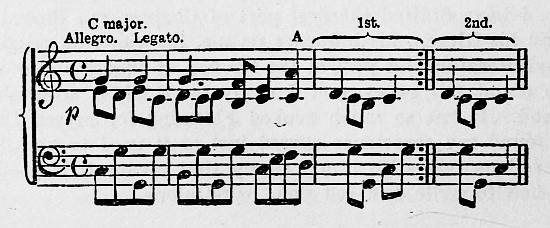
There is the first part of the musette copied (from memory, so I hope there’s nothing wrong). Is it not angelic? But it ought, of course, to have the gavotte before. The gavotte is in G, and ends on the keynote thus (if I remember):—
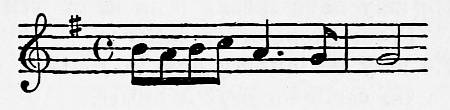
staccato, I think. Then you sail into the musette.
N.B.—Where I have put an “A” is that a dominant eleventh, or what? or just a seventh on the D? and if the latter, is that allowed? It sounds very funny. Never mind all my questions; if I begin about music (which is my leading ignorance and curiosity), I have always to babble questions: all my friends know me now, and take no notice whatever. The whole piece is marked allegro; but surely could easily be played too fast? The dignity must not be lost; the periwig feeling.
To Sidney Colvin
Written after his return from an excursion to Matlock with his father, following on their visit to London. “The verses” means Underwoods. The suppressed poem is that headed “To ——,” afterwards printed in Songs of Travel.
[Skerryvore, Bournemouth, April 1886.]
MY DEAR COLVIN,—This is to announce to you, what I believe should have been done sooner, that we are at Skerryvore. We were both tired, and I was fighting my second cold, so we came straight through by the west.
We have a butler! He doesn’t buttle, but the point of the thing is the style. When Fanny gardens, he stands over her and looks genteel. He opens the door, and I am told waits at table. Well, what’s the odds; I shall have it on my tomb—“He ran a butler.”
He may have been this and that, A drunkard or a guttler; He may have been bald and fat— At least he kept a butler. He may have sprung from ill or well, From Emperor or sutler; He may be burning now in Hell— On earth he kept a butler.
I want to tell you also that I have suppressed your poem. I shall send it you for yourself, and I hope you will agree with me that it was not good enough in point of view of merit, and a little too intimate as between you and me. I would not say less of you, my friend, but I scarce care to say so much in public while we live. A man may stand on his own head; it is not fair to set his friend on a pedestal.
The verses are now at press; I have written a damn fine ballad.—And I am, dear S. C., ever yours,
Tomnoddy.
To Thomas Stevenson
Want of health preventing the author at this time from carrying the adventures of David Balfour, as narrated in Kidnapped, through to their issue as originally designed, it was resolved to wind them up for the present with the discomfiture of the wicked uncle, leaving open the possibility of a sequel, which was supplied six years later in Catriona.
[Skerryvore, Bournemouth, April 1886.]
MY DEAR FATHER,—The David problem has to-day been decided. I am to leave the door open for a sequel if the public take to it, and this will save me from butchering a lot of good material to no purpose. Your letter from Carlisle was pretty like yourself, sir, as I was pleased to see; the hand of Jekyll, not the hand of Hyde. I am for action quite unfit, and even a letter is beyond me; so pray take these scraps at a vast deal more than their intrinsic worth. I am in great spirits about David, Colvin agreeing with Henley, Fanny, and myself in thinking it far the most human of my labours hitherto. As to whether the long-eared British public may take to it, all think it more than doubtful; I wish they would, for I could do a second volume with ease and pleasure, and Colvin thinks it sin and folly to throw away David and Alan Breck upon so small a field as this one.—Ever your affectionate son,
R. L. S.
To Miss Monroe
The next is in answer to criticisms on Prince Otto received from a lady correspondent in Chicago.
Skerryvore, Bournemouth, May 25th, 1886.
DEAR MISS MONROE,—(I hope I have this rightly) I must lose no time in thanking you for a letter singularly pleasant to receive. It may interest you to know that I read to the signature without suspecting my correspondent was a woman; though in one point (a reference to the Countess) I might have found a hint of the truth. You are not pleased with Otto; since I judge you do not like weakness; and no more do I. And yet I have more than tolerance for Otto, whose faults are the faults of weakness, but never of ignoble weakness, and who seeks before all to be both kind and just. Seeks, not succeeds. But what is man? So much of cynicism to recognise that nobody does right is the best equipment for those who do not wish to be cynics in good earnest. Think better of Otto, if my plea can influence you; and this I mean for your own sake—not his, poor fellow, as he will never learn your opinion; but for yours, because, as men go in this world (and women too), you will not go far wrong if you light upon so fine a fellow; and to light upon one and not perceive his merits is a calamity. In the flesh, of course, I mean; in the book the fault, of course, is with my stumbling pen. Seraphina made a mistake about her Otto; it begins to swim before me dimly that you may have some traits of Seraphina?
With true ingratitude you see me pitch upon your exception; but it is easier to defend oneself gracefully than to acknowledge praise. I am truly glad that you should like my books; for I think I see from what you write that you are a reader worth convincing. Your name, if I have properly deciphered it, suggests that you may be also something of my countrywoman; for it is hard to see where Monroe came from, if not from Scotland. I seem to have here a double claim on your good nature: being myself pure Scotch and having appreciated your letter, make up two undeniable merits which, perhaps, if it should be quite without trouble, you might reward with your photograph.—Yours truly,
Robert Louis Stevenson.
To Sidney Colvin
Evidently written about the 10th of June, very soon after the decision of Mr. Gladstone to dissolve Parliament on the defeat of the Home Rule Bill (June 8). As to the Travelling Companion, see above, p. 68.
[Skerryvore, Bournemouth, June 1886.]
MY DEAR COLVIN,—I am in bed again—bloodie jackery and be damned to it. Lloyd is better, I think; and money matters better; only my rascal carcase, and the muddy and oily lees of what was once my immortal soul are in a poor and pitiful condition.
Litany
Damn the political situation
” you
” me
and
” Gladstone.
I am a kind of dam home ruler, worse luck to it. I would support almost anything but that bill. How am I to vote? Great Cæsar’s Ghost!—Ever yours,
R. L. S.
O! the Travelling Companion won’t do; I am back on it entirely: it is a foul, gross, bitter, ugly daub, with lots of stuff in it, and no urbanity and no glee and no true tragedy—to the crows with it, a carrion tale! I will do no more carrion, I have done too much in this carrion epoch; I will now be clean; and by clean, I don’t mean any folly about purity, but such things as a healthy man with his bowels open shall find fit to see and speak about without a pang of nausea.—I am, yours,
A Repentant Dankist.
The lakeists, the drainists, the brookists, and the riverites; let me be a brookist, faute de mieux.
I did enjoy myself in town, and was a thousandfold the better of it.
To Miss Monroe
[Skerryvore, Bournemouth, June 1886.]
MY DEAR MISS MONROE,—I am ill in bed and stupid, incoherently stupid; yet I have to answer your letter, and if the answer is incomprehensible you must forgive me. You say my letter caused you pleasure; I am sure, as it fell out, not near so much as yours has brought to me. The interest taken in an author is fragile: his next book, or your next year of culture, might see the interest frosted or outgrown; and himself, in spite of all, you might probably find the most distasteful person upon earth. My case is different. I have bad health, am often condemned to silence for days together—was so once for six weeks, so that my voice was awful to hear when I first used it, like the whisper of a shadow—have outlived all my chief pleasures, which were active and adventurous, and ran in the open air: and being a person who prefers life to art, and who knows it is a far finer thing to be in love, or to risk a danger, than to paint the finest picture or write the noblest book, I begin to regard what remains to me of my life as very shadowy. From a variety of reasons, I am ashamed to confess I was much in this humour when your letter came. I had a good many troubles; was regretting a high average of sins; had been recently reminded that I had outlived some friends, and wondering if I had not outlived some friendships; and had just, while boasting of better health, been struck down again by my haunting enemy, an enemy who was exciting at first, but has now, by the iteration of his strokes, become merely annoying and inexpressibly irksome. Can you fancy that to a person drawing towards the elderly this sort of conjunction of circumstances brings a rather aching sense of the past and the future? Well, it was just then that your letter and your photograph were brought to me in bed; and there came to me at once the most agreeable sense of triumph. My books were still young; my words had their good health and could go about the world and make themselves welcome; and even (in a shadowy and distant sense) make something in the nature of friends for the sheer hulk that stays at home and bites his pen over the manuscripts. It amused me very much to remember that I had been in Chicago, not so many years ago, in my proper person; where I had failed to awaken much remark, except from the ticket collector; and to think how much more gallant and persuasive were the fellows that I now send instead of me, and how these are welcome in that quarter to the sitter of Herr Platz, while their author was not very welcome even in the villainous restaurant where he tried to eat a meal and rather failed.
And this leads me directly to a confession. The photograph which shall accompany this is not chosen as the most like, but the best-looking. Put yourself in my place, and you will call this pardonable. Even as it is, even putting forth a flattered presentment, I am a little pained; and very glad it is a photograph and not myself that has to go; for in this case, if it please you, you can tell yourself it is my image—and if it displease you, you can lay the blame on the photographer; but in that, there were no help, and the poor author might belie his labours.
Kidnapped should soon appear; I am afraid you may not like it, as it is very unlike Prince Otto in every way; but I am myself a great admirer of the two chief characters, Alan and David. Virginibus Puerisque has never been issued in the States. I do not think it is a book that has much charm for publishers in any land; but I am to bring out a new edition in England shortly, a copy of which I must try to remember to send you. I say try to remember, because I have some superficial acquaintance with myself: and I have determined, after a galling discipline, to promise nothing more until the day of my death: at least, in this way, I shall no more break my word, and I must now try being churlish instead of being false.
I do not believe you to be the least like Seraphina. Your photograph has no trace of her, which somewhat relieves me, as I am a good deal afraid of Seraphinas—they do not always go into the woods and see the sunrise, and some are so well-mailed that even that experience would leave them unaffected and unsoftened. The “hair and eyes of several complexions” was a trait taken from myself; and I do not bind myself to the opinions of Sir John. In this case, perhaps—but no, if the peculiarity is shared by two such pleasant persons as you and I (as you and me—the grammatical nut is hard), it must be a very good thing indeed, and Sir John must be an ass.
The Book Reader notice was a strange jumble of fact and fancy. I wish you could have seen my father’s old assistant and present partner when he heard my father described as an “inspector of lighthouses,” for we are all very proud of the family achievements, and the name of my house here in Bournemouth is stolen from one of the sea-towers of the Hebrides which are our pyramids and monuments. I was never at Cambridge, again; but neglected a considerable succession of classes at Edinburgh. But to correct that friendly blunderer were to write an autobiography.—And so now, with many thanks, believe me yours sincerely,
Robert Louis Stevenson.
To Alison Cunningham
Accompanying a presentation copy of Kidnapped. Alison Cunningham’s maiden name had been Hastie.
[Bournemouth, July 1886.]
MY DEAR CUMMY,—Herewith goes my new book, in which you will find some places that you know: I hope you will like it: I do. The name of the girl at Limekilns (as will appear if the sequel is ever written) was Hastie, and I conceive she was an ancestor of yours: as David was no doubt some kind of relative of mine.
I have no time for more, but send my love, and remembrances to your brother.—Ever your affectionate
R. L. S.
To R. A. M. Stevenson
During these months, as already indicated, Stevenson was very much taken up, in by-hours, with trying to learn something of the theory and practice of music, and spent much of his time “pickling,” as he called it, in an elementary manner on the piano. He even tried his hand in an experimental way at composition, and had sent one of his attempts for criticism to his cousin, Mr. R. A. M. Stevenson, who was better versed in the art.
Skerryvore, Bournemouth, July 1886.
SIR,—Your foolish letter was unduly received. There may be hidden fifths, and if there are, it shows how dam spontaneous the thing was. I could tinker and tic-tac-toe on a piece of paper, but scorned the act with a Threnody, which was poured forth like blood and water on the groaning organ. If your heart (which was what I addressed) remained unmoved, let us refer to the affair no more: crystallised emotion, the statement and the reconciliation of the sorrows of the race and the individual, is obviously no more to you than supping sawdust. Well, well. If ever I write another Threnody! My next op. will probably be a Passepied and fugue in G (or D).
The mind is in my case shrunk to the size and sp. gr. of an aged Spanish filbert. O, I am so jolly silly. I now pickle with some freedom (1) the refrain of Martini’s Moutons; (2) Sul margine d’un rio, arranged for the infant school by the Aged Statesman; (3) the first phrase of Bach’s musette (Sweet Englishwoman,18 No. 3), the rest of the musette being one prolonged cropper, which I take daily for the benefit of my health. All my other works (of which there are many) are either arranged (by R. L. Stevenson) for the manly and melodious forefinger, or else prolonged and melancholy croppers.... I find one can get a notion of music very nicely. I have been pickling deeply in the Magic Flute; and have arranged La dove prende, almost to the end, for two melodious forefingers. I am next going to score the really nobler Colomba o tortorella for the same instruments.
This day is published The works of Ludwig van Beethoven arranged and wiederdurchgearbeiteted for two melodious forefingers by,
Sir,—Your obedient servant,
Pimperly Stipple.
That’s a good idea? There’s a person called Lenz who actually does it—beware his den; I lost eighteenpennies on him, and found the bleeding corpses of pieces of music divorced from their keys, despoiled of their graces, and even changed in time; I do not wish to regard music (nor to be regarded) through that bony Lenz. You say you are “a spoon-fed idiot”; but how about Lenz? And how about me, sir, me?
I yesterday sent Lloyd by parcel post, at great expense, an empty matchbox and empty cigarette-paper book, a bell from a cat’s collar, an iron kitchen spoon, and a piece of coal more than half the superficies of this sheet of paper. They are now (appropriately enough) speeding towards the Silly Isles; I hope he will find them useful. By that, and my telegram with prepaid answer to yourself, you may judge of my spiritual state. The finances have much brightened; and if Kidnapped keeps on as it has begun, I may be solvent.—Yours,
Threnodiæ Avctor
(The author of ane Threnodie).
Op. 2: Scherzo (in G Major) expressive of the Sense of favours to come.
To R. A. M. Stevenson
Skerryvore [Bournemouth, July 1886].
DEAR BOB,—Herewith another shy; more melancholy than before, but I think not so abjectly idiotic. The musical terms seem to be as good as in Beethoven, and that, after all, is the great affair. Bar the dam bareness of the bass, it looks like a piece of real music from a distance. I am proud to say it was not made one hand at a time; the bass was of synchronous birth with the treble; they are of the same age, sir, and may God have mercy on their souls!—Yours,
The Maestro.
To Mr. and Mrs. Thomas Stevenson
Mr. and Mrs. T. Stevenson had been thinking of trying a winter at Bournemouth for the sake of being near their son, a plan which was eventually carried out. The health of the former was now fast and painfully breaking. Mr. J. W. Alexander, the well-known American artist, had been down at Skerryvore with an introduction from Mr. Gosse, and had made a drawing of Stevenson’s head.
Skerryvore, Bournemouth, July 7th, 1886.
MY DEAR PEOPLE,—It is probably my fault, and not yours, that I did not understand. I think it would be well worth trying the winter in Bournemouth; but I would only take the house by the month—this after mature discussion. My leakage still pursues its course; if I were only well, I have a notion to go north and get in (if I could) at the inn at Kirkmichael, which has always smiled upon me much. If I did well there, we might then meet and do what should most smile at the time.
Meanwhile, of course, I must not move, and am in a rancid box here, feeling the heat a great deal, and pretty tired of things. Alexander did a good thing of me at last; it looks like a mixture of an aztec idol, a lion, an Indian Rajah, and a woman; and certainly represents a mighty comic figure. F. and Lloyd both think it is the best thing that has been done of me up to now.
You should hear Lloyd on the penny whistle, and me on the piano! Dear powers, what a concerto! I now live entirely for the piano, he for the whistle; the neighbours, in a radius of a furlong and a half, are packing up in quest of brighter climes.—Ever yours,
R. L. S.
P.S.—Please say if you can afford to let us have money for this trip, and if so, how much. I can see the year through without help, I believe, and supposing my health to keep up; but can scarce make this change on my own metal.
R. L. S.
To Charles Baxter
[Skerryvore, Bournemouth, July 1886.]
DEAR CHARLES,—Doubtless, if all goes well, towards the 1st of August we shall be begging at your door. Thanks for a sight of the papers, which I return (you see) at once, fearing further responsibility.
Glad you like Dauvit; but eh, man, yon’s terrible strange conduc’ o’ thon man Rankeillor. Ca’ him a legal adviser! It would make a bonny law-shuit, the Shaws case; and yon paper they signed, I’m thinking, wouldnae be muckle thought o’ by Puggy Deas.—Yours ever,
R. L. S.
To Alison Cunningham
Hecky was a dog belonging to his correspondent’s brother. Stevenson was always interested by his own retentiveness of memory for childish things, and here asks Cummy some questions to test the quality of hers.
[Skerryvore, Bournemouth, July 1886.]
MY DEAR CUMMY,—I was sorry to get so poor account of you and Hecky. Fanny thinks perhaps it might be Hecky’s teeth. Sir Walter Simpson has a very clever vet. I have forgotten his name; but if you like, I send a card and you or James might ask the address.
Now to what is more important. Do you remember any of the following names: Lady Boothroyd, Barny Gee, Andrew Silex, the Steward, Carus Rearn, Peter Mangles, Richard Markham, Fiddler Dick? Please let me know and I will tell you how I come to ask. I warn you, you will have to cast back your eyes a good long way, close upon thirty years, before you strike the trail on which I wish to lead you.
When I have had an answer I will write you a decent letter. To-day, though nothing much is wrong with me, I am out of sorts and most disinclined for writing.—Yours most affectionately,
Robert Louis Stevenson.
To Thomas Stevenson
“Coolin,” mentioned below, had been a favourite Skye terrier of Heriot Row days.
[Skerryvore, Bournemouth] July 28, 1886.
MY DEAR FATHER,—We have decided not to come to Scotland, but just to do as Dobell wished, and take an outing. I believe this is wiser in all ways; but I own it is a disappointment. I am weary of England; like Alan, “I weary for the heather,” if not for the deer. Lloyd has gone to Scilly with Katharine and C., where and with whom he should have a good time. David seems really to be going to succeed, which is a pleasant prospect on all sides. I am, I believe, floated financially; a book that sells will be a pleasant novelty. I enclose another review; mighty complimentary, and calculated to sell the book too.
Coolin’s tombstone has been got out, honest man! and it is to be polished, for it has got scratched, and have a touch of gilding in the letters, and be sunk in the front of the house. Worthy man, he, too, will maybe weary for the heather, and the bents of Gullane, where (as I dare say you remember) he gaed clean gyte, and jumped on to his crown from a gig, in hot and hopeless chase of many thousand rabbits. I can still hear the little cries of the honest fellow as he disappeared; and my mother will correct me, but I believe it was two days before he turned up again at North Berwick: to judge by his belly, he had caught not one out of these thousands, but he had had some exercise.
I keep well.—Ever your affectionate son,
R. L. S.
To Alison Cunningham
Anticipating the gift of a cupboard and answering the questions set in his last. The date of the readings had been his seventh year. Mr. Galpin was a partner in Cassell, Petter, Galpin, & Co.
[Skerryvore, Bournemouth, July or August 1886.]
MY DEAR CUMMY,—The cupboard has not yet turned up, and I was hanging on to be able to say it had. However, that is only a trick to escape another letter, and I should despise myself if I kept it up. It was truly kind of you, dear Cummy, to send it to us: and I will let you know where we set it and how it looks.
Carus Rearn and Andrew Silex and the others were from a story you read me in Cassell’s Family Paper, and which I have been reading again and found by no means a bad story. Mr. Galpin lent me all the old volumes, and I mean to re-read Custaloga also, but have not yet. It was strangely like old times to read the other; don’t you remember the poisoning with mushrooms? That was Andrew Silex.—Yours most affectionately,
R. L. S.
To Mrs. Thomas Stevenson
Having given up going to Scotland for a summer change, Stevenson had started on the “outing” which he mentions in the last letter. It took the shape of a ten days’ visit to my house at the British Museum, followed by another made in the company of Mr. Henley to Paris, chiefly for the sake of seeing the W. H. Lows and the sculptor Rodin.
British Museum [August 10th, 1886].
MY DEAR MOTHER,—We are having a capital holiday, and I am much better, and enjoying myself to the nines. Richmond is painting my portrait. To-day I lunch with him, and meet Burne-Jones; to-night Browning dines with us. That sounds rather lofty work, does it not? His path was paved with celebrities. To-morrow we leave for Paris, and next week, I suppose, or the week after, come home. Address here, as we may not reach Paris. I am really very well.—Ever your affectionate son,
R. L. S.
To T. Watts-Dunton
Written after his return from London and Paris.
Skerryvore, Bournemouth [September 1886].
DEAR MR. WATTS,—The sight of the last Athenæum reminds me of you, and of my debt, now too long due. I wish to thank you for your notice of Kidnapped; and that not because it was kind, though for that also I valued it, but in the same sense as I have thanked you before now for a hundred articles on a hundred different writers. A critic like you is one who fights the good fight, contending with stupidity, and I would fain hope not all in vain; in my own case, for instance, surely not in vain.
What you say of the two parts in Kidnapped was felt by no one more painfully than by myself. I began it partly as a lark, partly as a pot-boiler; and suddenly it moved, David and Alan stepped out from the canvas, and I found I was in another world. But there was the cursed beginning, and a cursed end must be appended; and our old friend Byles the butcher was plainly audible tapping at the back door. So it had to go into the world, one part (as it does seem to me) alive, one part merely galvanised: no work, only an essay. For a man of tentative method, and weak health, and a scarcity of private means, and not too much of that frugality which is the artist’s proper virtue, the days of sinecures and patrons look very golden: the days of professional literature very hard. Yet I do not so far deceive myself as to think I should change my character by changing my epoch; the sum of virtue in our books is in a relation of equality to the sum of virtues in ourselves; and my Kidnapped was doomed, while still in the womb and while I was yet in the cradle, to be the thing it is.