Volume 7 — JEUX D'ESPRIT AND MINOR POEMS, 1798-1824.
Reading edition

EPIGRAM ON AN OLD LADY WHO HAD SOME CURIOUS NOTIONS RESPECTING THE SOUL.
In Nottingham county there lives at Swan Green,[1] As curst an old Lady as ever was seen; And when she does die, which I hope will be soon, She firmly believes she will go to the Moon!
1798. [First published, Letters and Journals, 1830, i. 28.]
FOOTNOTES:
EPITAPH ON JOHN ADAMS, OF SOUTHWELL, A CARRIER, WHO DIED OF DRUNKENNESS.
John Adams lies here, of the parish of Southwell, A Carrier who carried his can to his mouth well; He carried so much and he carried so fast, He could carry no more—so was carried at last; For the liquor he drank being too much for one, He could not carry off;—so he's now carri-on.
September, 1807. [First published, Letters and Journals, 1830, i. 106.]
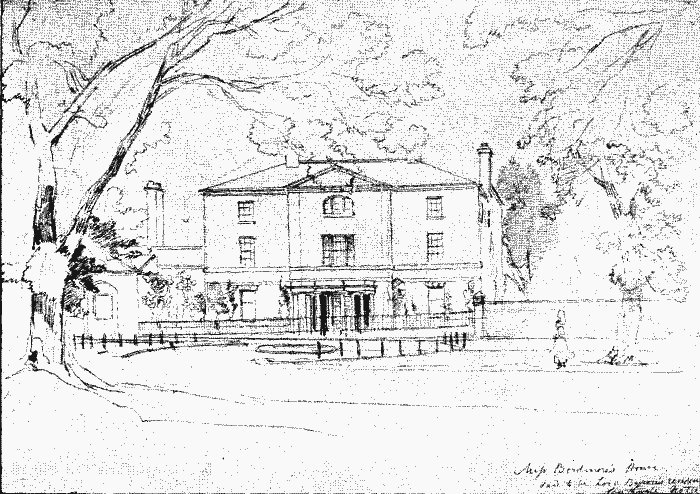
Mrs. Birdmere's House, Southwell
A VERSION OF OSSIAN'S ADDRESS TO THE SUN. FROM THE POEM "CARTHON."
O thou! who rollest in yon azure field, Round as the orb of my forefather's shield, Whence are thy beams? From what eternal store Dost thou, O Sun! thy vast effulgence pour? In awful grandeur, when thou movest on high, The stars start back and hide them in the sky; The pale Moon sickens in thy brightening blaze, And in the western wave avoids thy gaze. Alone thou shinest forth—for who can rise Companion of thy splendour in the skies! The mountain oaks are seen to fall away— Mountains themselves by length of years decay— With ebbs and flows is the rough Ocean tost; In heaven the Moon is for a season lost, But thou, amidst the fullness of thy joy, The same art ever, blazing in the sky! When tempests wrap the world from pole to pole, When vivid lightnings flash and thunders roll, Thou far above their utmost fury borne, Look'st forth in beauty, laughing them to scorn. But vainly now on me thy beauties blaze— Ossian no longer can enraptured gaze! Whether at morn, in lucid lustre gay, On eastern clouds thy yellow tresses play, Or else at eve, in radiant glory drest, Thou tremblest at the portals of the west, I see no more! But thou mayest fail at length, Like Ossian lose thy beauty and thy strength, Like him—but for a season—in thy sphere To shine with splendour, then to disappear! Thy years shall have an end, and thou no more Bright through the world enlivening radiance pour, But sleep within thy clouds, and fail to rise, Heedless when Morning calls thee to the skies! Then now exult, O Sun! and gaily shine, While Youth and Strength and Beauty all are thine. For Age is dark, unlovely, as the light Shed by the Moon when clouds deform the night, Glimmering uncertain as they hurry past. Loud o'er the plain is heard the northern blast, Mists shroud the hills, and 'neath the growing gloom, The weary traveller shrinks and sighs for home.
1806. [First published, Atlantic Monthly, December, 1898. [2]]
FOOTNOTES:
LINES TO MR. HODGSON. WRITTEN ON BOARD THE LISBON PACKET.
1. Huzza! Hodgson[3], we are going, Our embargo's off at last; Favourable breezes blowing Bend the canvas o'er the mast. From aloft the signal's streaming, Hark! the farewell gun is fired; Women screeching, tars blaspheming, Tell us that our time's expired. Here's a rascal Come to task all, Prying from the Custom-house; Trunks unpacking Cases cracking, Not a corner for a mouse Scapes unsearched amid the racket, Ere we sail on board the Packet. 2. Now our boatmen quit their mooring, And all hands must ply the oar; Baggage from the quay is lowering, We're impatient, push from shore. "Have a care! that case holds liquor— Stop the boat—I'm sick—oh Lord!" "Sick, Ma'am, damme, you'll be sicker, Ere you've been an hour on board." Thus are screaming Men and women, Gemmen, ladies, servants, Jacks; Here entangling, All are wrangling, Stuck together close as wax.— Such the general noise and racket, Ere we reach the Lisbon Packet. 3. Now we've reached her, lo! the Captain, Gallant Kidd,[4] commands the crew; Passengers their berths are clapt in, Some to grumble, some to spew. "Hey day! call you that a cabin? Why't is hardly three feet square! Not enough to stow Queen Mab in— Who the deuce can harbour there?" "Who, sir? plenty— Nobles twenty Did at once my vessel fill."— "Did they? Jesus, How you squeeze us! Would to God they did so still! Then I'd 'scape the heat and racket Of the good ship, Lisbon Packet." 4. Fletcher! Murray! Bob![5] where are you? Stretched along the deck like logs— Bear a hand, you jolly tar, you! Here's a rope's end for the dogs. Hobhouse muttering fearful curses, As the hatchway down he rolls, Now his breakfast, now his verses, Vomits forth—and damns our souls. "Here's a stanza[6] On Braganza— Help!"—"A couplet?"—"No, a cup Of warm water—" "What's the matter?" "Zounds! my liver's coming up; I shall not survive the racket Of this brutal Lisbon Packet." 5. Now at length we're off for Turkey, Lord knows when we shall come back! Breezes foul and tempests murky May unship us in a crack. But, since Life at most a jest is, As philosophers allow, Still to laugh by far the best is, Then laugh on—as I do now. Laugh at all things, Great and small things, Sick or well, at sea or shore; While we're quaffing, Let's have laughing— Who the devil cares for more?— Some good wine! and who would lack it, Ev'n on board the Lisbon Packet?
Falmouth Roads, June 30, 1809. [First published, Letters and Journals, 1830, i. 230-232.]
FOOTNOTES:
[TO DIVES.[7] A FRAGMENT.]
Unhappy Dives! in an evil hour 'Gainst Nature's voice seduced to deeds accurst! Once Fortune's minion now thou feel'st her power; Wrath's vial on thy lofty head hath burst. In Wit, in Genius, as in Wealth the first, How wondrous bright thy blooming morn arose! But thou wert smitten with th' unhallowed thirst Of Crime unnamed, and thy sad noon must close In scorn and solitude unsought the worst of woes.
1809. [First published, Lord Byron's Works, 1833, xvii. 241.]
FOOTNOTES:
FAREWELL PETITION TO R. C. H., ESQRE.
O thou yclep'd by vulgar sons of Men Cam Hobhouse![8] but by wags Byzantian Ben! Twin sacred titles, which combined appear To grace thy volume's front, and gild its rear, Since now thou put'st thyself and work to Sea And leav'st all Greece to Fletcher[9] and to me, Oh, hear my single muse our sorrows tell, One song for self and Fletcher quite as well— First to the Castle of that man of woes Dispatch the letter which I must enclose, And when his lone Penelope shall say Why, where, and wherefore doth my William stay? Spare not to move her pity, or her pride— By all that Hero suffered, or defied; The chicken's toughness, and the lack of ale The stoney mountain and the miry vale The Garlick steams, which half his meals enrich, The impending vermin, and the threatened Itch, That ever breaking Bed, beyond repair! The hat too old, the coat too cold to wear, The Hunger, which repulsed from Sally's door Pursues her grumbling half from shore to shore, Be these the themes to greet his faithful Rib So may thy pen be smooth, thy tongue be glib! This duty done, let me in turn demand Some friendly office in my native land, Yet let me ponder well, before I ask, And set thee swearing at the tedious task. First the Miscellany![10]—to Southwell town Per coach for Mrs. Pigot frank it down, So may'st them prosper in the paths of Sale,[11] And Longman smirk and critics cease to rail. All hail to Matthews![12] wash his reverend feet, And in my name the man of Method greet,— Tell him, my Guide, Philosopher, and Friend, Who cannot love me, and who will not mend, Tell him, that not in vain I shall assay To tread and trace our "old Horatian way,"[13] And be (with prose supply my dearth of rhymes) What better men have been in better times. Here let me cease, for why should I prolong My notes, and vex a Singer with a Song? Oh thou with pen perpetual in thy fist! Dubbed for thy sins a stark Miscellanist, So pleased the printer's orders to perform For Messrs. Longman, Hurst and Rees and Orme. Go—Get thee hence to Paternoster Row, Thy patrons wave a duodecimo! (Best form for letters from a distant land, It fits the pocket, nor fatigues the hand.) Then go, once more the joyous work commence[14] With stores of anecdote, and grains of sense, Oh may Mammas relent, and Sires forgive! And scribbling Sons grow dutiful and live!
Constantinople, June 7th, 1810. [First published, Murray's Magazine, 1887, vol. i. pp. 290, 291.]
FOOTNOTES:
TRANSLATION OF THE NURSE'S DOLE IN THE MEDEA OF EURIPIDES.
Oh how I wish that an embargo Had kept in port the good ship Argo! Who, still unlaunched from Grecian docks, Had never passed the Azure rocks; But now I fear her trip will be a Damn'd business for my Miss Medea, etc., etc.[15]
June, 1810. [First published, Letters and Journals, 1830, i. 227.]
FOOTNOTES:
MY EPITAPH.[16]
Youth, Nature, and relenting Jove, To keep my lamp in strongly strove; But Romanelli was so stout, He beat all three—and blew it out.
October, 1810. [First published, Letters and Journals, 1830, i. 240.]
FOOTNOTES:
SUBSTITUTE FOR AN EPITAPH.
Kind Reader! take your choice to cry or laugh; Here Harold lies—but where's his Epitaph? If such you seek, try Westminster, and view Ten thousand just as fit for him as you.
Athens, 1810. [First published, Lord Byron's Works, 1832, ix. 4.]
EPITAPH FOR JOSEPH BLACKET, LATE POET AND SHOEMAKER.[17]
Stranger! behold, interred together, The souls of learning and of leather. Poor Joe is gone, but left his all: You'll find his relics in a stall. His works were neat, and often found Well stitched, and with morocco bound. Tread lightly—where the bard is laid— He cannot mend the shoe he made; Yet is he happy in his hole, With verse immortal as his sole. But still to business he held fast, And stuck to Phoebus to the last. Then who shall say so good a fellow Was only "leather and prunella?" For character—he did not lack it; And if he did, 'twere shame to "Black-it."
Malta, May 16, 1811. [First published, Lord Byron's Works, 1832, ix. 10.]
FOOTNOTES:
ON MOORE'S LAST OPERATIC FARCE, OR FARCICAL OPERA.[18]
Good plays are scarce, So Moore writes farce: The poet's fame grows brittle[i]— We knew before That Little's Moore, But now't is Moore that's little.
September 14, 1811. [First published, Letters and Journals, 1830, i. 295 (note).]
FOOTNOTES:
[R. C. DALLAS.][19]
Yes! wisdom shines in all his mien, Which would so captivate, I ween, Wisdom's own goddess Pallas; That she'd discard her fav'rite owl, And take for pet a brother fowl, Sagacious R. C. Dallas.
[First published, Life, Writings, Opinions, etc., 1825, ii. 192.]
FOOTNOTES:
1. Oh well done Lord E—— n! and better done R——r![22] Britannia must prosper with councils like yours; Hawkesbury, Harrowby, help you to guide her, Whose remedy only must kill ere it cures: Those villains; the Weavers, are all grown refractory, Asking some succour for Charity's sake— So hang them in clusters round each Manufactory, That will at once put an end to mistake.[23] 2. The rascals, perhaps, may betake them to robbing, The dogs to be sure have got nothing to eat— So if we can hang them for breaking a bobbin, 'T will save all the Government's money and meat: Men are more easily made than machinery— Stockings fetch better prices than lives— Gibbets on Sherwood will heighten the scenery, Shewing how Commerce, how Liberty thrives! 3. Justice is now in pursuit of the wretches, Grenadiers, Volunteers, Bow-street Police, Twenty-two Regiments, a score of Jack Ketches, Three of the Quorum and two of the Peace; Some Lords, to be sure, would have summoned the Judges, To take their opinion, but that they ne'er shall, For Liverpool such a concession begrudges, So now they're condemned by no Judges at all. 4. Some folks for certain have thought it was shocking, When Famine appeals and when Poverty groans, That Life should be valued at less than a stocking, And breaking of frames lead to breaking of bones. If it should prove so, I trust, by this token, (And who will refuse to partake in the hope?) That the frames of the fools may be first to be broken, Who, when asked for a remedy, sent down a rope.
[First published, Morning Chronicle, Monday, March 2, 1812.]
[See a Political Ode by Lord Byron, hitherto unknown as his production, London, John Pearson, 46, Pall Mall, 1880, 8º. See, too, Mr. Pearson's prefatory Note, pp. 5, etc.]
FOOTNOTES:
TO THE HONBLE MRS GEORGE LAMB.[24]
1. The sacred song that on mine ear Yet vibrates from that voice of thine, I heard, before, from one so dear— 'T is strange it still appears divine. 2. But, oh! so sweet that look and tone To her and thee alike is given; It seemed as if for me alone That both had been recalled from Heaven! 3. And though I never can redeem The vision thus endeared to me; I scarcely can regret my dream, When realised again by thee.
1812. [First published in The Two Duchesses, by Vere Foster, 1898, p. 374.]
FOOTNOTES:
[LA REVANCHE.]
1. There is no more for me to hope, There is no more for thee to fear; And, if I give my Sorrow scope, That Sorrow thou shalt never hear. Why did I hold thy love so dear? Why shed for such a heart one tear? Let deep and dreary silence be My only memory of thee! 2. When all are fled who flatter now, Save thoughts which will not flatter then; And thou recall'st the broken vow To him who must not love again— Each hour of now forgotten years Thou, then, shalt number with thy tears; And every drop of grief shall be A vain remembrancer of me!
Undated, ?1812. [From an autograph MS. in the possession of Mr. Murray, now for the first time printed.]
TO THOMAS MOORE. WRITTEN THE EVENING BEFORE HIS VISIT TO MR. LEIGH HUNT IN HORSEMONGER LANE GAOL, MAY 19, 1813.
Oh you, who in all names can tickle the town, Anacreon, Tom Little, Tom Moore, or Tom Brown,—[25] For hang me if I know of which you may most brag, Your Quarto two-pounds, or your Two-penny Post Bag; But now to my letter—to yours 'tis an answer— To-morrow be with me, as soon as you can, sir, All ready and dressed for proceeding to spunge on (According to compact) the wit in the dungeon—[26] Pray Phoebus at length our political malice May not get us lodgings within the same palace! I suppose that to-night you're engaged with some codgers, And for Sotheby's Blues[27] have deserted Sam Rogers; And I, though with cold I have nearly my death got, Must put on my breeches, and wait on the Heathcote;[28] But to-morrow, at four, we will both play the Scurra, And you'll be Catullus, the Regent Mamurra.[29]
[First published, Letters and Journals, 1830, i. 401.]
FOOTNOTES:
ON LORD THURLOW'S POEMS.[30]
1. When Thurlow this damned nonsense sent, (I hope I am not violent) Nor men nor gods knew what he meant. 2. And since not even our Rogers' praise To common sense his thoughts could raise— Why would they let him print his lays? 3. 4. 5. To me, divine Apollo, grant—O! Hermilda's[31] first and second canto, I'm fitting up a new portmanteau; 6. And thus to furnish decent lining, My own and others' bays I'm twining,— So, gentle Thurlow, throw me thine in.
June 2, 1813. [First published, Letters and Journals, 1830, i. 396.]
FOOTNOTES:
TO LORD THURLOW.[32]
1. "I lay my branch of laurel down." "Thou lay thy branch of laurel down!" Why, what thou'st stole is not enow; And, were it lawfully thine own, Does Rogers want it most, or thou? Keep to thyself thy withered bough, Or send it back to Doctor Donne:[33] Were justice done to both, I trow, He'd have but little, and thou—none. 2. "Then, thus, to form Apollo's crown." A crown! why, twist it how you will, Thy chaplet must be foolscap still. When next you visit Delphi's town, Enquire amongst your fellow-lodgers, They'll tell you Phoebus gave his crown, Some years before your birth, to Rogers. 3. "Let every other bring his own." When coals to Newcastle are carried, And owls sent to Athens, as wonders, From his spouse when the Regent's unmarried, Or Liverpool weeps o'er his blunders; When Tories and Whigs cease to quarrel, When Castlereagh's wife has an heir, Then Rogers shall ask us for laurel, And thou shalt have plenty to spare.
[First published, Letters and Journals, 1830, i. 397.]
FOOTNOTES:
1. The Devil returned to Hell by two, And he stayed at home till five; When he dined on some homicides done in ragoût, And a rebel or so in an Irish stew, And sausages made of a self-slain Jew, And bethought himself what next to do, "And," quoth he, "I'll take a drive. I walked in the morning, I'll ride to-night; In darkness my children take most delight, 10And I'll see how my favourites thrive. 2. "And what shall I ride in?" quoth Lucifer, then— "If I followed my taste, indeed, I should mount in a waggon of wounded men, And smile to see them bleed. But these will be furnished again and again, And at present my purpose is speed; To see my manor as much as I may, And watch that no souls shall be poached away. 3. "I have a state-coach at Carlton House, 20A chariot in Seymour-place;[35] But they're lent to two friends, who make me amends By driving my favourite pace: And they handle their reins with such a grace, I have something for both at the end of the race. 4. "So now for the earth to take my chance," Then up to the earth sprung he; And making a jump from Moscow to France, He stepped across the sea, And rested his hoof on a turnpike road, 30No very great way from a Bishop's abode.[36] 5. But first as he flew, I forgot to say, That he hovered a moment upon his way, To look upon Leipsic plain; And so sweet to his eye was its sulphury glare, And so soft to his ear was the cry of despair, That he perched on a mountain of slain; And he gazed with delight from its growing height, Nor often on earth had he seen such a sight, Nor his work done half as well: 40For the field ran so red with the blood of the dead, That it blushed like the waves of Hell! Then loudly, and wildly, and long laughed he: "Methinks they have little need here of me!" 6. Long he looked down on the hosts of each clime, While the warriors hand to hand were— Gaul—Austrian and Muscovite heroes sublime, And—(Muse of Fitzgerald arise with a rhyme!) A quantity of Landwehr![37] Gladness was there, 50For the men of all might and the monarchs of earth, There met for the wolf and the worm to make mirth, And a feast for the fowls of the Air! 7. But he turned aside and looked from the ridge Of hills along the river, And the best thing he saw was a broken bridge,[38] Which a Corporal chose to shiver; Though an Emperor's taste was displeased with his haste, The Devil he thought it clever; And he laughed again in a lighter strain, 60O'er the torrent swoln and rainy, When he saw "on a fiery steed" Prince Pon, In taking care of Number One— Get drowned with a great many! 8. But the softest note that soothed his ear Was the sound of a widow sighing; And the sweetest sight was the icy tear, Which Horror froze in the blue eye clear Of a maid by her lover lying— As round her fell her long fair hair, 70And she looked to Heaven with that frenzied air Which seemed to ask if a God were there! And stretched by the wall of a ruined hut, With its hollow cheek, and eyes half shut, A child of Famine dying: And the carnage begun, when resistance is done, And the fall of the vainly flying! 9. Then he gazed on a town by besiegers taken, Nor cared he who were winning; But he saw an old maid, for years forsaken, 80Get up and leave her spinning; And she looked in her glass, and to one that did pass, She said—"pray are the rapes beginning?"[39] 10. But the Devil has reached our cliffs so white, And what did he there, I pray? If his eyes were good, he but saw by night What we see every day; But he made a tour and kept a journal Of all the wondrous sights nocturnal, And he sold it in shares to the Men of the Row, 90Who bid pretty well—but they cheated him, though! 11. The Devil first saw, as he thought, the Mail, Its coachman and his coat; So instead of a pistol he cocked his tail, And seized him by the throat; "Aha!" quoth he, "what have we here? 'T is a new barouche, and an ancient peer!"[40] 12. So he sat him on his box again, And bade him have no fear, But be true to his club, and staunch to his rein, 100His brothel and his beer; "Next to seeing a Lord at the Council board, I would rather see him here." 13. Satan hired a horse and gig With promises to pay; And he pawned his horns for a spruce new wig, To redeem as he came away: And he whistled some tune, a waltz or a jig, And drove off at the close of day. 14. The first place he stopped at—he heard the Psalm 110That rung from a Methodist Chapel: "'T is the best sound I've heard," quoth he, "since my palm Presented Eve her apple! When Faith is all, 't is an excellent sign, That the Works and Workmen both are mine." 15. He passed Tommy Tyrwhitt,[41] that standing jest, To princely wit a Martyr: But the last joke of all was by far the best, When he sailed away with "the Garter"! "And"—quoth Satan—"this Embassy's worthy my sight, 120Should I see nothing else to amuse me to night. With no one to bear it, but Thomas à Tyrwhitt, This ribband belongs to an 'Order of Merit'!" 16. He stopped at an Inn and stepped within The Bar and read the "Times;" And never such a treat, as—the epistle of one "Vetus,"[42] Had he found save in downright crimes: "Though I doubt if this drivelling encomiast of War Ever saw a field fought, or felt a scar, Yet his fame shall go farther than he can guess, 130For I'll keep him a place in my hottest Press; And his works shall be bound in Morocco d'Enfer, And lettered behind with his Nom de Guerre." 17. The Devil gat next to Westminster, And he turned to "the room" of the Commons; But he heard as he purposed to enter in there, That "the Lords" had received a summons; And he thought, as "a quondam Aristocrat," He might peep at the Peers, though to hear them were flat; And he walked up the House so like one of his own, 140That they say that he stood pretty near the throne. 18. He saw the Lord Liverpool seemingly wise, The Lord Westmoreland certainly silly, And Jockey of Norfolk—a man of some size— And Chatham, so like his friend Billy;[43] And he saw the tears in Lord Eldon's eyes, Because the Catholics would not rise, In spite of his prayers and his prophecies; And he heard—which set Satan himself a staring— A certain Chief Justice say something like swearing.[44] And the Devil was shocked—and quoth he, "I must go, 151For I find we have much better manners below. If thus he harangues when he passes my border, I shall hint to friend Moloch to call him to order." 19. Then the Devil went down to the humbler House, Where he readily found his way As natural to him as its hole to a Mouse, He had been there many a day; And many a vote and soul and job he Had bid for and carried away from the Lobby: But there now was a "call" and accomplished debaters 161Appeared in the glory of hats, boots and gaiters— Some paid rather more—but all worse dressed than Waiters! 20. There was Canning for War, and Whitbread for peace, And others as suited their fancies; But all were agreed that our debts should increase Excepting the Demagogue Francis. That rogue! how could Westminster chuse him again To leaven the virtue of these honest men! But the Devil remained till the Break of Day 170Blushed upon Sleep and Lord Castlereagh:[45] Then up half the house got, and Satan got up With the drowsy to snore—or the hungry to sup:— But so torpid the power of some speakers, 't is said, That they sent even him to his brimstone bed. 21. He had seen George Rose—but George was grown dumb, And only lied in thought![46] And the Devil has all the pleasure to come Of hearing him talk as he ought. With the falsest of tongues, the sincerest of men— 180His veracity were but deceit— And Nature must first have unmade him again, Ere his breast or his face, or his tongue, or his pen, Conceived—uttered—looked—or wrote down letters ten, Which Truth would acknowledge complete. 22. Satan next took the army list in hand, Where he found a new "Field Marshal;" And when he saw this high command Conferred on his Highness of Cumberland,[47] "Oh! were I prone to cavil—or were I not the Devil, 190I should say this was somewhat partial; Since the only wounds that this Warrior gat, Were from God knows whom—and the Devil knows what!" 23. He then popped his head in a royal Ball, And saw all the Haram so hoary; And who there besides but Corinna de Staël![48] Turned Methodist and Tory! "Aye—Aye"—quoth he—"'t is the way with them all, When Wits grow tired of Glory: But thanks to the weakness, that thus could pervert her, 200Since the dearest of prizes to me's a deserter: Mem—whenever a sudden conversion I want, To send to the school of Philosopher Kant; And whenever I need a critic who can gloss over All faults—to send for Mackintosh to write up the Philosopher."[49] 24. The Devil waxed faint at the sight of this Saint, And he thought himself of eating; And began to cram from a plate of ham Wherewith a Page was retreating— Having nothing else to do (for "the friends" each so near 210Had sold all their souls long before), As he swallowed down the bacon he wished himself a Jew For the sake of another crime more: For Sinning itself is but half a recreation, Unless it ensures most infallible Damnation. 25. But he turned him about, for he heard a sound Which even his ear found faults in; For whirling above—underneath—and around— Were his fairest Disciples Waltzing![50] And quoth he—"though this be—the premier pas to me, 220Against it I would warn all— Should I introduce these revels among my younger devils, They would all turn perfectly carnal: And though fond of the flesh—yet I never could bear it Should quite in my kingdom get the upper hand of Spirit." 26. The Devil (but 't was over) had been vastly glad To see the new Drury Lane, And yet he might have been rather mad To see it rebuilt in vain; And had he beheld their "Nourjahad,"[51] 230Would never have gone again: And Satan had taken it much amiss, They should fasten such a piece on a friend of his— Though he knew that his works were somewhat sad, He never had found them quite so bad: For this was "the book" which, of yore, Job, sorely smitten, Said, "Oh that mine enemy, mine enemy had written"! 27. Then he found sixty scribblers in separate cells,[52] And marvelled what they were doing, For they looked like little fiends in their own little hells, 240Damnation for others brewing— Though their paper seemed to shrink, from the heat of their ink, They were only coolly reviewing! And as one of them wrote down the pronoun "We," "That Plural"—says Satan—"means him and me, With the Editor added to make up the three Of an Athanasian Trinity, And render the believers in our 'Articles' sensible, How many must combine to form one Incomprehensible"!
December 9, 1813. [Stanzas 1, 2, 3, 4, 5, 8, 10, 11, 12, 17, 18, first published, Letters and Journals, 1830, i. 471-474: stanzas 6, 7, 9, 13, 14, 15, 16, 19-27, now published for the first time from an autograph MS. in the possession of the Earl of Ilchester.]
FOOTNOTES:
WINDSOR POETICS.
LINES COMPOSED ON THE OCCASION OF HIS ROYAL HIGHNESS THE PRINCE REGENT BEING SEEN STANDING BETWEEN THE COFFINS OF HENRY VIII. AND CHARLES I., IN THE ROYAL VAULT AT WINDSOR.
Famed for contemptuous breach of sacred ties, By headless Charles see heartless Henry lies; Between them stands another sceptred thing— It moves, it reigns—in all but name, a king: Charles to his people, Henry to his wife, —In him the double tyrant starts to life: Justice and Death have mixed their dust in vain, Each royal Vampire wakes to life again. Ah, what can tombs avail!—since these disgorge The blood and dust of both—to mould a George.[53]
[First published, Poetical Works, Paris, 1819, vi. 125.]
[Another Version.]
ON A ROYAL VISIT TO THE VAULTS.[54]
[or Cæsar's Discovery of C. I. AND H. 8. in ye same Vault.]
Famed for their civil and domestic quarrels See heartless Henry lies by headless Charles; Between them stands another sceptred thing, It lives, it reigns—"aye, every inch a king." Charles to his people, Henry to his wife, In him the double tyrant starts to life: Justice and Death have mixed their dust in vain. The royal Vampires join and rise again. What now can tombs avail, since these disgorge The blood and dirt[55] of both to mould a George!
FOOTNOTES:
ICH DIEN.
From this emblem what variance your motto evinces, For the Man is his country's—the Arms are the Prince's!
?1814. [From an autograph MS. in the possession of Mr. A. H. Hallam Murray, now for the first time printed.]
CONDOLATORY ADDRESS
TO SARAH COUNTESS OF JERSEY, ON THE PRINCE REGENT'S RETURNING HER PICTURE TO MRS. MEE.[56]
When the vain triumph of the imperial lord, Whom servile Rome obeyed, and yet abhorred, Gave to the vulgar gaze each glorious bust, That left a likeness of the brave, or just; What most admired each scrutinising eye Of all that decked that passing pageantry? What spread from face to face that wondering air? The thought of Brutus[57]—for his was not there! That absence proved his worth,—that absence fixed 10His memory on the longing mind, unmixed; And more decreed his glory to endure, Than all a gold Colossus could secure. If thus, fair Jersey, our desiring gaze Search for thy form, in vain and mute amaze, Amidst those pictured charms, whose loveliness, Bright though they be, thine own had rendered less: If he, that Vain Old Man, whom truth admits Heir of his father's crown, and of his wits, If his corrupted eye, and withered heart, 20Could with thy gentle image bear to part; That tasteless shame be his, and ours the grief, To gaze on Beauty's band without its chief: Yet Comfort still one selfish thought imparts, We lose the portrait, but preserve our hearts. What can his vaulted gallery now disclose? A garden with all flowers—except the rose;— A fount that only wants its living stream; A night, with every star, save Dian's beam. Lost to our eyes the present forms shall be, 30That turn from tracing them to dream of thee; And more on that recalled resemblance pause, Than all he shall not force on our applause. Long may thy yet meridian lustre shine, With all that Virtue asks of Homage thine: The symmetry of youth—the grace of mien— The eye that gladdens—and the brow serene; The glossy darkness of that clustering hair,[58] Which shades, yet shows that forehead more than fair! Each glance that wins us, and the life that throws 40A spell which will not let our looks repose, But turn to gaze again, and find anew Some charm that well rewards another view. These are not lessened, these are still as bright, Albeit too dazzling for a dotard's sight; And those must wait till ev'ry charm is gone, To please the paltry heart that pleases none;— That dull cold sensualist, whose sickly eye In envious dimness passed thy portrait by; Who racked his little spirit to combine 50Its hate of Freedom's loveliness, and thine.
May 29, 1814. [First published in The Champion, July 31, 1814.]
FOOTNOTES:
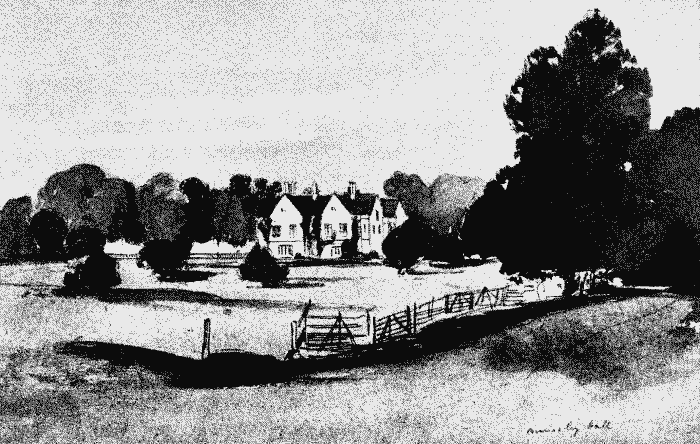
Annesley Hall
FRAGMENT OF AN EPISTLE TO THOMAS MOORE.
"What say I?"—not a syllable further in prose; I'm your man "of all measures," dear Tom,—so here goes! Here goes, for a swim on the stream of old Time, On those buoyant supporters, the bladders of rhyme. If our weight breaks them down, and we sink in the flood, We are smothered, at least, in respectable mud, Where the divers of Bathos lie drowned in a heap, And Southey's last Pæan has pillowed his sleep; That Felo de se who, half drunk with his Malmsey, Walked out of his depth and was lost in a calm sea,10 Singing "Glory to God" in a spick and span stanza, The like (since Tom Sternhold was choked) never man saw.[59] The papers have told you, no doubt, of the fusses, The fêtes, and the gapings to get at these Russes,[60]— Of his Majesty's suite, up from coachman to Hetman,— And what dignity decks the flat face of the great man. I saw him, last week, at two balls and a party,— For a Prince, his demeanour was rather too hearty. You know, we are used to quite different graces, The Czar's look, I own, was much brighter and brisker, 21But then he is sadly deficient in whisker; And wore but a starless blue coat, and in kersey- mere breeches whisked round, in a waltz with the Jersey,[61] Who, lovely as ever, seemed just as delighted With Majesty's presence as those she invited.
June, 1814. [First published, Letters and Journals, 1830, i. 561, 562 (note).]
FOOTNOTES:
ANSWER TO 'S PROFESSIONS OF AFFECTION.
In hearts like thine ne'er may I hold a place Till I renounce all sense, all shame, all grace— That seat,—like seats, the bane of Freedom's realm, But dear to those presiding at the helm— Is basely purchased, not with gold alone; Add Conscience, too, this bargain is your own— 'T is thine to offer with corrupting art The rotten borough[62] of the human heart.
?1814. [From an autograph MS., now for the first time printed.]
FOOTNOTES:
ON NAPOLEON'S ESCAPE FROM ELBA.[63]
Once fairly set out on his party of pleasure, Taking towns at his liking, and crowns at his leisure, From Elba to Lyons and Paris he goes, Making balls for the ladies, and bows to his foes.
March 27, 1815. [First published, Letters and Journals, 1830, i. 611.]
FOOTNOTES:
ENDORSEMENT TO THE DEED OF SEPARATION, IN THE APRIL OF 1816.
A year ago you swore, fond she! "To love, to honour," and so forth: Such was the vow you pledged to me, And here's exactly what 't is worth.
[First published, Poetical Works, 1831, vi. 454.]
[TO GEORGE ANSON BYRON(?)[64]]
1. And, dost thou ask the reason of my sadness? Well, I will tell it thee, unfeeling boy! 'Twas ill report that urged my brain to madness, 'Twas thy tongue's venom poisoned all my joy. 2. The sadness which thou seest is not sorrow; My wounds are far too deep for simple grief; The heart thus withered, seeks in vain to borrow From calm reflection, comfort or relief. 3. The arrow's flown, and dearly shalt thou rue it; No mortal hand can rid me of my pain: My heart is pierced, but thou canst not subdue it— Revenge is left, and is not left in vain.
?1816. [First published, Nicnac, March 25, 1823.]
FOOTNOTES:
SONG FOR THE LUDDITES.[65]
1. As the Liberty lads o'er the sea Bought their freedom, and cheaply, with blood, So we, boys, we Will die fighting, or live free, And down with all kings but King Ludd! 2. When the web that we weave is complete, And the shuttle exchanged for the sword, We will fling the winding sheet O'er the despot at our feet, And dye it deep in the gore he has poured. 3. Though black as his heart its hue, Since his veins are corrupted to mud, Yet this is the dew Which the tree shall renew Of Liberty, planted by Ludd!
December 24, 1816. [First published, Letters and Journals, 1830, ii. 58.]
FOOTNOTES:
TO THOMAS MOORE.
What are you doing now, Oh Thomas Moore? What are you doing now, Oh Thomas Moore? Sighing or suing now, Rhyming or wooing now, Billing or cooing now, Which, Thomas Moore? But the Carnival's coming, Oh Thomas Moore! The Carnival's coming, Oh Thomas Moore! Masking and humming, Fifing and drumming, Guitarring and strumming, Oh Thomas Moore!
December 24, 1816. [First published, Letters and Journals, 1830, ii. 58, 59.]
TO MR. MURRAY.
To hook the Reader, you, John Murray, Have published "Anjou's Margaret,"[66] Which won't be sold off in a hurry (At least, it has not been as yet); And then, still further to bewilder him, Without remorse, you set up "Ilderim;"[67] So mind you don't get into debt,— Because—as how—if you should fail, These books would be but baddish bail. And mind you do not let escape These rhymes to Morning Post or Perry, Which would be very treacherous—very, And get me into such a scrape! For, firstly, I should have to sally, All in my little boat, against a Galley; And, should I chance to slay the Assyrian wight, Have next to combat with the female Knight: And pricked to death expire upon her needle, A sort of end which I should take indeed ill!
March 25, 1817. [First published, Letters and Journals, 1830, ii. 91.]
FOOTNOTES:
VERSICLES.
I read the "Christabel;"[68] Very well: I read the "Missionary;"[69] Pretty—very: I tried at "Ilderim;" Ahem! I read a sheet of "Marg'ret of Anjou;" Can you? I turned a page of Webster's "Waterloo;"[70] Pooh! pooh! I looked at Wordsworth's milk-white "Rylstone Doe;"[71] Hillo! I read "Glenarvon," too, by Caro Lamb;[72] God damn!
March 25, 1817. [First published, Letters and Journals, 1830, ii. 87.]
FOOTNOTES:
QUEM DEUS VULT PERDERE PRIUS DEMENTAT.[73]
God maddens him whom't is his will to lose, And gives the choice of death or phrenzy—choose.
[First published, Letters, 1900, iv. 93.]
FOOTNOTES:
TO THOMAS MOORE.
1. My boat is on the shore, And my bark is on the sea; But, before I go, Tom Moore, Here's a double health to thee! 2. Here's a sigh to those who love me, And a smile to those who hate; And, whatever sky's above me, Here's a heart for every fate. 3. Though the Ocean roar around me, Yet it still shall bear me on; Though a desert shall surround me, It hath springs that may be won. 4. Were't the last drop in the well, As I gasped upon the brink, Ere my fainting spirit fell, 'T is to thee that I would drink. 5. With that water, as this wine, The libation I would pour Should be—peace with thine and mine, And a health to thee, Tom Moore.[74]
July, 1817. [First published, Waltz, London, W. Benbow, 1821, p. 29.]
FOOTNOTES:
EPISTLE FROM MR. MURRAY TO DR. POLIDORI.[75]
Dear Doctor, I have read your play, Which is a good one in its way,— Purges the eyes, and moves the bowels, And drenches handkerchiefs like towels With tears, that, in a flux of grief, Afford hysterical relief To shattered nerves and quickened pulses, Which your catastrophe convulses. I like your moral and machinery; 10Your plot, too, has such scope for Scenery! Your dialogue is apt and smart; The play's concoction full of art; Your hero raves, your heroine cries, All stab, and every body dies. In short, your tragedy would be The very thing to hear and see: And for a piece of publication, If I decline on this occasion, It is not that I am not sensible 20To merits in themselves ostensible, But—and I grieve to speak it—plays Are drugs—mere drugs, Sir—now-a-days. I had a heavy loss by Manuel—[76] Too lucky if it prove not annual,— And Sotheby, with his Orestes,[77] (Which, by the way, the old Bore's best is), Has lain so very long on hand, That I despair of all demand; I've advertised, but see my books, 30Or only watch my Shopman's looks;— Still Ivan, Ina,[78] and such lumber, My back-shop glut, my shelves encumber. There's Byron too, who once did better, Has sent me, folded in a letter, A sort of—it's no more a drama Than Darnley, Ivan, or Kehama; So altered since last year his pen is, I think he's lost his wits at Venice. In short, Sir, what with one and t' other, 40I dare not venture on another. I write in haste; excuse each blunder; The Coaches through the street so thunder! My room's so full—we've Gifford here Reading MS., with Hookham Frere, Pronouncing on the nouns and particles, Of some of our forthcoming Articles. The Quarterly—Ah, Sir, if you Had but the Genius to review!— A smart Critique upon St. Helena, 50Or if you only would but tell in a Short compass what—but to resume; As I was saying, Sir, the Room— The Room's so full of wits and bards, Crabbes, Campbells, Crokers, Freres, and Wards And others, neither bards nor wits: My humble tenement admits All persons in the dress of Gent., From Mr. Hammond to Dog Dent.[79] A party dines with me to-day, 60All clever men, who make their way: Crabbe, Malcolm,[80] Hamilton,[81] and Chantrey, Are all partakers of my pantry. They're at this moment in discussion On poor De Staël's late dissolution. Her book,[82] they say, was in advance— Pray Heaven, she tell the truth of France! 'T is said she certainly was married To Rocca, and had twice miscarried, No—not miscarried, I opine,— 70But brought to bed at forty-nine. Some say she died a Papist; some Are of opinion that's a Hum; I don't know that—the fellows Schlegel,[83] Are very likely to inveigle A dying person in compunction To try th' extremity of Unction. But peace be with her! for a woman Her talents surely were uncommon, Her Publisher (and Public too) 80The hour of her demise may rue— For never more within his shop he— Pray—was not she interred at Coppet? Thus run our time and tongues away;— But, to return, Sir, to your play: Sorry, Sir, but I cannot deal, Unless 't were acted by O'Neill. My hands are full—my head so busy, I'm almost dead—and always dizzy; And so, with endless truth and hurry, 90Dear Doctor, I am yours, JOHN MURRAY.
August 21, 1817. [First published, Letters and Journals, 1830, ii. 139-141. Lines 67-82 first published, Letters, 1900, iv. 161.]
FOOTNOTES:
EPISTLE TO MR. MURRAY.
1. My dear Mr. Murray, You're in a damned hurry To set up this ultimate Canto;[84] But (if they don't rob us) You'll see Mr. Hobhouse Will bring it safe in his portmanteau. 2. For the Journal you hint of,[85] As ready to print off, No doubt you do right to commend it; But as yet I have writ off The devil a bit of Our "Beppo:"—when copied, I'll send it. 3. In the mean time you've "Galley"[86] Whose verses all tally, Perhaps you may say he's a Ninny, But if you abashed are Because of Alashtar, He'll piddle another Phrosine.[87] 4. Then you've Sotheby's Tour,—[88] No great things, to be sure,— You could hardly begin with a less work; For the pompous rascallion, Who don't speak Italian Nor French, must have scribbled by guess-work. 5. No doubt he's a rare man Without knowing German Translating his way up Parnassus, And now still absurder He meditates Murder As you'll see in the trash he calls Tasso's. 6. But you've others his betters The real men of letters Your Orators—Critics—and Wits— And I'll bet that your Journal (Pray is it diurnal?) Will pay with your luckiest hits. 7. You can make any loss up With "Spence"[89] and his gossip, A work which must surely succeed; Then Queen Mary's Epistle-craft,[90] With the new "Fytte" of "Whistlecraft," Must make people purchase and read. 8. Then you've General Gordon,[91] Who girded his sword on, To serve with a Muscovite Master, And help him to polish A nation so owlish, They thought shaving their beards a disaster. 9. For the man, "poor and shrewd,"[92] With whom you'd conclude A compact without more delay, Perhaps some such pen is Still extant in Venice; But please, Sir, to mention your pay. 10. Now tell me some news Of your friends and the Muse, Of the Bar, or the Gown, or the House, From Canning, the tall wit, To Wilmot,[93] the small wit, Ward's creeping Companion and Louse, 11. Who's so damnably bit With fashion and Wit, That he crawls on the surface like Vermin, But an Insect in both,— By his Intellect's growth, Of what size you may quickly determine.[94]
Venice, January 8, 1818. [First published, Letters and Journals, 1830, ii. 156, 157; stanzas 3, 5, 6, 10, 11, first published, Letters, 1900, iv. 191-193.]
FOOTNOTES:
ON THE BIRTH OF JOHN WILLIAM RIZZO HOPPNER.[95]
His father's sense, his mother's grace, In him, I hope, will always fit so; With—still to keep him in good case— The health and appetite of Rizzo.
February 20, 1818. [First published, Letters and Journals, 1830, ii. 134.]
FOOTNOTES:
[E NIHILO NIHIL; OR AN EPIGRAM BEWITCHED.]
Of rhymes I printed seven volumes—[96] The list concludes John Murray's columns: Of these there have been few translations[97] For Gallic or Italian nations; And one or two perhaps in German— But in this last I can't determine. But then I only sung of passions That do not suit with modern fashions; Of Incest and such like diversions Permitted only to the Persians, Or Greeks to bring upon their stages— But that was in the earlier ages Besides my style is the romantic, Which some call fine, and some call frantic; While others are or would seem as sick Of repetitions nicknamed Classic. For my part all men must allow Whatever I was, I'm classic now. I saw and left my fault in time, And chose a topic all sublime— Wondrous as antient war or hero— Then played and sung away like Nero, Who sang of Rome, and I of Rizzo: The subject has improved my wit so, The first four lines the poet sees Start forth in fourteen languages! Though of seven volumes none before Could ever reach the fame of four, Henceforth I sacrifice all Glory To the Rinaldo of my Story: I've sung his health and appetite (The last word's not translated right— He's turned it, God knows how, to vigour)[98] I'll sing them in a book that's bigger. Oh! Muse prepare for thy Ascension! And generous Rizzo! thou my pension.
February, 1818. [From an autograph MS. in the possession of Mr. Murray, now for the first time printed.]
FOOTNOTES:
TO MR. MURRAY.
1. Strahan, Tonson, Lintot of the times,[99] Patron and publisher of rhymes, For thee the bard up Pindus climbs, My Murray. 2. To thee, with hope and terror dumb, The unfledged MS. authors come; Thou printest all—and sellest some— My Murray. 3. Upon thy table's baize so green The last new Quarterly is seen,— But where is thy new Magazine,[100] My Murray? 4. Along thy sprucest bookshelves shine The works thou deemest most divine— The Art of Cookery,[101] and mine, My Murray. 5. Tours, Travels, Essays, too, I wist, And Sermons, to thy mill bring grist; And then thou hast the Navy List, My Murray. 6. And Heaven forbid I should conclude, Without "the Board of Longitude,"[102] Although this narrow paper would, My Murray.
Venice, April 11, 1818. [First published, Letters and Journals, 1830, ii. 171.]
FOOTNOTES:
BALLAD. TO THE TUNE OF "SALLEY IN OUR ALLEY."
1. Of all the twice ten thousand bards That ever penned a canto, Whom Pudding or whom Praise rewards For lining a portmanteau; Of all the poets ever known, From Grub-street to Fop's Alley,[103] The Muse may boast—the World must own There's none like pretty Gally![104] 2. He writes as well as any Miss, Has published many a poem; The shame is yours, the gain is his, In case you should not know 'em: He has ten thousand pounds a year— I do not mean to vally— His songs at sixpence would be dear, So give them gratis, Gaily! 3. And if this statement should seem queer, Or set down in a hurry, Go, ask (if he will be sincere) His bookseller—John Murray. Come, say, how many have been sold, And don't stand shilly-shally, Of bound and lettered, red and gold, Well printed works of Gally. 4. For Astley's circus Upton[105] writes, And also for the Surry; (sic) Fitzgerald weekly still recites, Though grinning Critics worry: Miss Holford's Peg, and Sotheby's Saul, In fame exactly tally; From Stationer's Hall to Grocer's Stall They go—and so does Gally. 5. He rode upon a Camel's hump[106] Through Araby the sandy, Which surely must have hurt the rump Of this poetic dandy. His rhymes are of the costive kind, And barren as each valley In deserts which he left behind Has been the Muse of Gally. 6. He has a Seat in Parliament, Is fat and passing wealthy; And surely he should be content With these and being healthy: But Great Ambition will misrule Men at all risks to sally,— Now makes a poet—now a fool, And we know which—of Gally. 7. Some in the playhouse like to row, Some with the Watch to battle, Exchanging many a midnight blow To Music of the Rattle. Some folks like rowing on the Thames, Some rowing in an Alley, But all the Row my fancy claims Is rowing—of my Gally.
April 11, 1818.[107]
FOOTNOTES:
ANOTHER SIMPLE BALLAT.
1. Mrs. Wilmot sate scribbling a play, Mr. Sotheby sate sweating behind her; But what are all these to the Lay Of Gally i.o. the Grinder? Gally i.o. i.o., etc. 2. I bought me some books tother day, And sent them down stairs to the binder; But the Pastry Cook carried away My Gally i.o. the Grinder. Gally i.o. i.o., etc. 3. I wanted to kindle my taper, And called to the Maid to remind her; And what should she bring me for paper But Gally i.o. the Grinder. Gally i.o. i.o., etc. 4. Among my researches for Ease I went where one's certain to find her: The first thing by her throne that one sees Is Gally i.o. the Grinder. Gally i.o. i.o., etc. 5. Away with old Homer the blind— I'll show you a poet that's blinder: You may see him whene'er you've a mind In Gally i.o. the Grinder. Gally i.o. i.o., etc. 6. Blindfold he runs groping for fame, And hardly knows where he will find her: She don't seem to take to the name Of Gally i.o. the Grinder. Gally i.o. i.o., etc. 7. Yet the Critics have been very kind, And Mamma and his friends have been kinder; But the greatest of Glory's behind For Gally i.o. the Grinder. Gally i.o. i.o., etc.
April 11, 1818. [From an autograph MS. in the possession of Mr. Murray, now for the first time printed.]
EPIGRAM. FROM THE FRENCH OF RULHIÈRES.[108]
If for silver, or for gold, You could melt ten thousand pimples Into half a dozen dimples, Then your face we might behold, Looking, doubtless, much more snugly, Yet even then 'twould be damned ugly.
August 12, 1819. [First published, Letters and Journals, 1830, ii. 235.]
FOOTNOTES:
EPILOGUE.[109]
1. There's something in a stupid ass, And something in a heavy dunce; But never since I went to school I heard or saw so damned a fool As William Wordsworth is for once. 2. And now I've seen so great a fool As William Wordsworth is for once; I really wish that Peter Bell And he who wrote it were in hell, For writing nonsense for the nonce. 3. It saw the "light in ninety-eight," Sweet babe of one and twenty years![110] And then he gives it to the nation And deems himself of Shakespeare's peers! 4. He gives the perfect work to light! Will Wordsworth, if I might advise, Content you with the praise you get From Sir George Beaumont, Baronet, And with your place in the Excise!
1819. [First published, Philadelphia Record, December 28, 1891.]
FOOTNOTES:
ON MY WEDDING-DAY.
Here's a happy New Year! but with reason I beg you'll permit me to say— Wish me many returns of the Season, But as few as you please of the Day.[111]
January 2, 1820. [First published, Letters and Journals, 1830, ii. 294.]
FOOTNOTES:
EPITAPH FOR WILLIAM PITT.
With Death doomed to grapple, Beneath this cold slab, he Who lied in the Chapel Now lies in the Abbey.
January 2, 1820. [First published, Letters and Journals, 1830, ii. 295.]
EPIGRAM.
In digging up your bones, Tom Paine, Will. Cobbett[112] has done well: You visit him on Earth again, He'll visit you in Hell. or— You come to him on Earth again He'll go with you to Hell!
January 2, 1820. [First published, Letters and Journals, 1830, ii. 295.]
FOOTNOTES:
EPITAPH.
Posterity will ne'er survey A nobler grave than this; Here lie the bones of Castlereagh: Stop traveller, * *
January 2, 1820. [First published, Lord Byron's Works, 1833, xvii. 246.]
EPIGRAM.
The world is a bundle of hay, Mankind are the asses who pull; Each tugs it a different way,— And the greatest of all is John Bull!
[First published, Letters and Journals, 1830, ii. 494.]
MY BOY HOBBIE O.[113]
New Song to the tune of
"Whare hae ye been a' day, My boy Tammy O.! Courting o' a young thing Just come frae her Mammie O."
1. How came you in Hob's pound to cool, My boy Hobbie O? Because I bade the people pull The House into the Lobby O. 2. What did the House upon this call, My boy Hobbie O? They voted me to Newgate all, Which is an awkward Jobby O. 3. Who are now the people's men, My boy Hobbie O? There's I and Burdett—Gentlemen And blackguard Hunt and Cobby O. 4. You hate the house—why canvass, then? My boy Hobbie O? Because I would reform the den As member for the Mobby O. 5. Wherefore do you hate the Whigs, My boy Hobbie O? Because they want to run their rigs, As under Walpole Bobby O. 6. But when we at Cambridge were My boy Hobbie O, If my memory don't err You founded a Whig Clubbie O. 7. When to the mob you make a speech, My boy Hobbie O, How do you keep without their reach The watch within your fobby O? 8. But never mind such petty things, My boy Hobbie O; God save the people—damn all Kings, So let us Crown the Mobby O! Yours truly, (Signed) Infidus Scurra
March 23d, 1820. [First published Murray's Magazine, March, 1887, vol. i. pp. 292, 293.]
FOOTNOTES:
LINES ADDRESSED BY LORD BYRON TO MR. HOBHOUSE ON HIS ELECTION FOR WESTMINSTER.[114]
Would you go to the house by the true gate, Much faster than ever Whig Charley went; Let Parliament send you to Newgate, And Newgate will send you to Parliament.
April 9, 1820. [First published, Miscellaneous Poems, printed for J. Bumpus, 1824.]
FOOTNOTES:
A VOLUME OF NONSENSE.
Dear Murray,— You ask for a "Volume of Nonsense," Have all of your authors exhausted their store? I thought you had published a good deal not long since. And doubtless the Squadron are ready with more. But on looking again, I perceive that the Species Of "Nonsense" you want must be purely "facetious;" And, as that is the case, you had best put to press Mr. Sotheby's tragedies now in M.S., Some Syrian Sally From common-place Gally, Or, if you prefer the bookmaking of women, Take a spick and span "Sketch" of your feminine He-Man.[115]
Sept. 28, 1820. [First published, Letters, 1900, v. 83.]
FOOTNOTES:
STANZAS.[116]
When a man hath no freedom to fight for at home, Let him combat for that of his neighbours; Let him think of the glories of Greece and of Rome, And get knocked on the head for his labours. To do good to Mankind is the chivalrous plan, And is always as nobly requited; Then battle for Freedom wherever you can, And, if not shot or hanged, you'll get knighted.
November 5, 1820. [First published, Letters and Journals, 1830, ii. 377.]
FOOTNOTES:
TO PENELOPE.[117] January 2, 1821.
This day, of all our days, has done The worst for me and you:— 'T is just six years since we were one, And five since we were two.
November 5, 1820. [First published, Medwin's Conversations, 1824, p. 106.]
FOOTNOTES:
THE CHARITY BALL.[118]
What matter the pangs of a husband and father, If his sorrows in exile be great or be small, So the Pharisee's glories around her she gather, And the saint patronises her "Charity Ball!" What matters—a heart which, though faulty, was feeling, Be driven to excesses which once could appal— That the Sinner should suffer is only fair dealing, As the Saint keeps her charity back for "the Ball!"
December 10, 1820. [First published, Letters and Journals, 1830, ii. 540.]
FOOTNOTES:
EPIGRAM ON THE BRAZIERS' ADDRESS TO BE PRESENTED IN ARMOUR BY THE COMPANY TO QUEEN CAROLINE.[119]
It seems that the Braziers propose soon to pass An Address and to bear it themselves all in brass; A superfluous pageant, for by the Lord Harry! They'll find, where they're going, much more than they carry.
Or—
The Braziers, it seems, are determined to pass An Address, and present it themselves all in brass:— A superfluous {pageant/trouble} for, by the Lord Harry! They'll find, where they're going, much more than they carry.
January 6, 1821. [First published, Letters and Journals, 1830, ii. 442.]
FOOTNOTES:
ON MY THIRTY-THIRD BIRTHDAY. JANUARY 22, 1821.[120]
Through Life's dull road, so dim and dirty, I have dragged to three-and-thirty. What have these years left to me? Nothing—except thirty-three.
[First published, Letters and Journals, 1830, ii. 414.]
FOOTNOTES:
MARTIAL, Lib. I. Epig. I.
"Hic est, quem legis, ille, quem requiris, Toto notus in orbe Martialis," etc. He, unto whom thou art so partial, Oh, reader! is the well-known Martial, The Epigrammatist: while living, Give him the fame thou would'st be giving; So shall he hear, and feel, and know it— Post-obits rarely reach a poet.
[N.D. ? 1821.] [First published, Lord Byron's Works, 1833, xvii. 245]
BOWLES AND CAMPBELL.
To the air of "How now, Madam Flirt," in the Beggar's Opera.[121] BOWLES. "Why, how now, saucy Tom? If you thus must ramble, I will publish some Remarks on Mister Campbell. Saucy Tom!" CAMPBELL. "Why, how now, Billy Bowles? Sure the priest is maudlin! (To the public) How can you, d—n your souls! Listen to his twaddling? Billy Bowles!"
February 22, 1821. [First published, The Liberal, 1823, No. II. p. 398.]
FOOTNOTES:
ELEGY.
Behold the blessings of a lucky lot! My play is damned, and Lady Noel not.
May 25, 1821. [First published, Medwin's Conversations, 1824, p. 121.]
JOHN KEATS.[122]
Who killed John Keats? "I," says the Quarterly, So savage and Tartarly; "'T was one of my feats." Who shot the arrow? "The poet-priest Milman (So ready to kill man) "Or Southey, or Barrow."
July 30, 1821. [First published, Letters and Journals, 1830, ii. 506.]
FOOTNOTES:
FROM THE FRENCH.
Ægle, beauty and poet, has two little crimes; She makes her own face, and does not make her rhymes.
Aug. 2, 1821. [First published, The Liberal, 1823, No. II. p. 396.]
TO MR. MURRAY.
1. For Orford[123] and for Waldegrave[124] You give much more than me you gave; Which is not fairly to behave, My Murray! 2. Because if a live dog, 't is said, Be worth a lion fairly sped, A live lord must be worth two dead, My Murray! 3. And if, as the opinion goes, Verse hath a better sale than prose,— Certes, I should have more than those, My Murray! 4. But now this sheet is nearly crammed, So, if you will, I shan't be shammed, And if you won't,—you may be damned, My Murray![125]
August 23, 1821. [First published, Letters and Journals, 1830, ii. 517.]
FOOTNOTES:
[NAPOLEON'S SNUFF-BOX.][126]
Lady, accept the box a hero wore, In spite of all this elegiac stuff: Let not seven stanzas written by a bore, Prevent your Ladyship from taking snuff!
1821. [First published, Conversations of Lord Byron, 1824, p. 235.]
FOOTNOTES:
THE NEW VICAR OF BRAY.
1. Do you know Doctor Nott?[127] With "a crook in his lot," Who seven years since tried to dish up A neat Codicil To the Princess's Will,[128] Which made Dr. Nott not a bishop. 2. So the Doctor being found A little unsound In his doctrine, at least as a teacher, And kicked from one stool As a knave or a fool, He mounted another as preacher. 3. In that Gown (like the Skin With no Lion within) He still for the Bench would be driving; And roareth away, A new Vicar of Bray, Except that his bray lost his living. 4. "Gainst Freethinkers," he roars, "You should all block your doors Or be named in the Devil's indentures:" And here I agree, For who e'er would be A Guest where old Simony enters? 5. Let the Priest, who beguiled His own Sovereign's child To his own dirty views of promotion, Wear his Sheep's cloathing still Among flocks to his will, And dishonour the Cause of devotion. 6. The Altar and Throne Are in danger alone From such as himself, who would render The Altar itself But a step up to Pelf, And pray God to pay his defender. 7. But, Doctor, one word Which perhaps you have heard "He should never throw stones who has windows Of Glass to be broken, And by this same token As a sinner, you can't care what Sin does. 8. But perhaps you do well: Your own windows, they tell, Have long ago sufferéd censure; Not a fragment remains Of your character's panes, Since the Regent refused you a glazier. 9. Though your visions of lawn Have all been withdrawn, And you missed your bold stroke for a mitre; In a very snug way You may still preach and pray, And from bishop sink into backbiter!"
[First published, Works (Galignani), 1831, p. 116.]
FOOTNOTES:
LUCIETTA. A FRAGMENT.
Lucietta, my deary, That fairest of faces! Is made up of kisses; But, in love, oft the case is Even stranger than this is— There's another, that's slyer, Who touches me nigher,— A Witch, an intriguer, Whose manner and figure Now piques me, excites me, Torments and delights me— Cætera desunt.
[From an autograph MS. in the possession of Mr. Murray, now for the first time printed.]
EPIGRAMS.
Oh, Castlereagh! thou art a patriot now; Cato died for his country, so did'st thou: He perished rather than see Rome enslaved, Thou cut'st thy throat that Britain may be saved! So Castlereagh has cut his throat!—The worst Of this is,—that his own was not the first. So He has cut his throat at last!—He! Who? The man who cut his country's long ago.
?August, 1822. [First published, The Liberal, No. I. October 18, 1822, p. 164.]
THE CONQUEST.[129]
The Son of Love and Lord of War I sing; Him who bade England bow to Normandy, And left the name of Conqueror more than King To his unconquerable dynasty. Not fanned alone by Victory's fleeting wing, He reared his bold and brilliant throne on high; The Bastard kept, like lions, his prey fast, And Britain's bravest Victor was the last.
March 8-9, 1823. [First published, Lord Byron's Works, 1833, xvii. 246.]
FOOTNOTES:
IMPROMPTU.[130]
Beneath Blessington's eyes The reclaimed Paradise Should be free as the former from evil; But if the new Eve For an Apple should grieve, What mortal would not play the Devil?
April, 1823. [First published, Letters and Journals, 1830, ii. 635.]
FOOTNOTES:
JOURNAL IN CEPHALONIA.
The dead have been awakened—shall I sleep? The World's at war with tyrants—shall I crouch? The harvest's ripe—and shall I pause to reap? I slumber not; the thorn is in my Couch; Each day a trumpet soundeth in mine ear, Its echo in my heart——
June 19, 1823. [First published, Letters, 1901, vi. 238.]
SONG TO THE SULIOTES.
1. Up to battle! Sons of Suli Up, and do your duty duly! There the wall—and there the Moat is: Bouwah![131] Bouwah! Suliotes! There is booty—there is Beauty, Up my boys and do your duty. 2. By the sally and the rally Which defied the arms of Ali; By your own dear native Highlands, By your children in the islands, Up and charge, my Stratiotes, Bouwah!—Bouwah!—Suliotes! 3. As our ploughshare is the Sabre: Here's the harvest of our labour; For behind those battered breaches Are our foes with all their riches: There is Glory—there is plunder— Then away despite of thunder!
[From an autograph MS. in the possession of Mr. Murray, now for the first time printed.]
FOOTNOTES:
[LOVE AND DEATH.]
1. I watched thee when the foe was at our side, Ready to strike at him—or thee and me. Were safety hopeless—rather than divide Aught with one loved save love and liberty. 2. I watched thee on the breakers, when the rock Received our prow and all was storm and fear, And bade thee cling to me through every shock; This arm would be thy bark, or breast thy bier. 3. I watched thee when the fever glazed thine eyes, Yielding my couch and stretched me on the ground, When overworn with watching, ne'er to rise From thence if thou an early grave hadst found. 4. The earthquake came, and rocked the quivering wall, And men and nature reeled as if with wine. Whom did I seek around the tottering hall? For thee. Whose safety first provide for? Thine. 5. And when convulsive throes denied my breath The faintest utterance to my fading thought, To thee—to thee—e'en in the gasp of death My spirit turned, oh! oftener than it ought. 6. Thus much and more; and yet thou lov'st me not, And never wilt! Love dwells not in our will. Nor can I blame thee, though it be my lot To strongly, wrongly, vainly love thee still.[132]
[First published, Murray's Magazine, February, 1887, vol. i. pp. 145, 146.]
FOOTNOTES:
LAST WORDS ON GREECE.
What are to me those honours or renown Past or to come, a new-born people's cry? Albeit for such I could despise a crown Of aught save laurel, or for such could die. I am a fool of passion, and a frown Of thine to me is as an adder's eye. To the poor bird whose pinion fluttering down Wafts unto death the breast it bore so high; Such is this maddening fascination grown, So strong thy magic or so weak am I.
[First published, Murray's Magazine, February, 1887, vol. i. p. 146.]
ON THIS DAY I COMPLETE MY THIRTY-SIXTH YEAR.[133]
1. 'T is time this heart should be unmoved, Since others it hath ceased to move: Yet, though I cannot be beloved, Still let me love! 2. My days are in the yellow leaf; The flowers and fruits of Love are gone; The worm, the canker, and the grief Are mine alone! 3. The fire that on my bosom preys Is lone[iii] as some Volcanic isle; No torch is kindled at its blaze— A funeral pile. 4. The hope, the fear, the jealous care, The exalted portion of the pain And power of love, I cannot share, But wear the chain. 5. But 't is not thus—and 't is not here—[iv] Such thoughts should shake my soul, nor now Where Glory decks the hero's bier,[v] Or binds his brow. 6. The Sword, the Banner, and the Field,[vi] Glory and Greece, around me see! The Spartan, borne upon his shield,[134] Was not more free. 7. Awake! (not Greece—she is awake!) Awake, my spirit! Think through whom Thy life-blood tracks its parent lake,[vii] And then strike home! 8. Tread those reviving passions down,[ix] Unworthy manhood!—unto thee Indifferent should the smile or frown Of Beauty be. 9. If thou regret'st thy youth, why live? The land of honourable death Is here:—up to the Field, and give Away thy breath! 10. Seek out—less often sought than found— A soldier's grave, for thee the best; Then look around, and choose thy ground, And take thy Rest.
Missolonghi, Jan. 22, 1824. [First published, Morning Chronicle, October 29, 1824.]