ECLOGUES. (continued 2)
Jeremiah Holmes Wiffen translation
SALICIO.
No! ravishment is mine At this strange tale divine, So well set forth by thy enchanting tongue; Within my breast I felt, Long as thine accents dwelt On the rare virtues of a prince so young, My throbbing heart beat higher, And glow with the desire To contemplate him present—the foretold Of Fame, whose visnomy, Though absent from mine eye, By thy divine account I now behold: Who but must wish to see the storied scrolls, Since o'er the lively urn the silent billow rolls! After what thou hast told, Religiously I hold The opinion that Severo's powers can shed Light on the clouded brain, Albanio's frenzy chain, Health to the sick, and almost to the dead Give being; it is just We put our perfect trust In him to whom such secrets were revealed, As one whose skilful hand Disorders can withstand, Bid ev'n disease itself fresh vigour yield, And by his subtle wisdom quickly raise To bloom whatever droops, or sickens, or decays.
NEMOROSO.
To this result since thine opinions tend, Salicio, what with our distracted friend?
SALICIO.
Act a friend's part; take presently our course From hence, and ere his frenzy gathers force Or from indulgence or delay, present Our patient to Severe:
NEMOROSO.
I consent. We on the morrow, ere the clear warm ray Of the arising sun is seen to play Upon the purple hills, will go; and sure I feel, his skill will work an easy cure.
SALICIO.
Fold now the flock, for from the mountain's head Cool airs descend, and longer shadows spread. Look round, and see how from the farms whereto Those labourers trudge, the calm smoke, rising blue, Curls in a column to the rosy sky! Seek with our flocks the usual vale, whilst I Attend the youth—since he has lain so long In quiet swoon, his fit cannot be strong.
NEMOROSO.
If thou should'st first reach home, go not to bed, But speed the supper, and see Lyca spread The cloth—'tis much if yet her fire's alight:
SALICIO.
I will; I will; unless in my despite Albanio hurl me down some breakneck dell: Farewell, dear friend!
NEMOROSO.
Salicio, friend, farewell!
ECLOGUE III. TO THE LADY MARIA DE LA CUEVA, COUNTESS OF UREÑA.
TYRRENO. ALCINO.
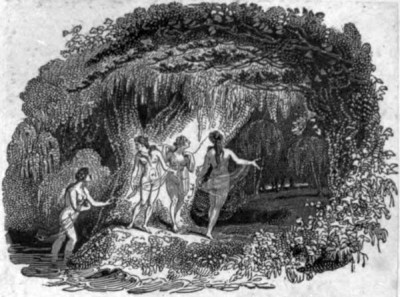
The pure ambition and sincere desire, Most beautiful Señora, that whilere Was wont my soul in secret to inspire, To sing thy beauty, wit, and virtue rare, Spite of strong Fortune, that unstrings my lyre, And turns to other paths my steps of care, Glows, and shall glow within me, whilst the flame Of soul lights up this perishable frame. I fancy even, that after life this flow Of song shall live; that when my heart grows chill, And my lips cease to call, in joy or woe, Eolian murmurs to my pastoral quill, Freed from its narrow cell my ghost shall go O'er the dark river, celebrating still Thy glorious name, and curbing with the sound Oblivion's waters, slowly stealing round. But Fate, not satisfied with crossing, rives me From every good; grief but to grief gives place; Now from my country, from my love she drives me, Now proves my patience in a thousand ways; But what I feel more, is that she deprives me Of these fond papers where my pen thy praise Inscribes, and in their room nought, nought supp'ies But fruitless cares and mournful memories. Yet, let her try her utmost force, my heart She shall not change; the world shall never say She moves me to forsake so sweet an art; In poesy's still walks, embowered with bay, Apollo and the Nine shall yet impart Leisure, and life, and language, to display The least of thine accomplishments, the most My feeble powers can ever hope to boast. Let it not irk thee if I sing meanwhile The scenes and sylvans thou hast loved, nor deem Ill of this untrimmed portion of my style, Which once thy goodness held in kind esteem; Midst arms—with scarce one pause from bloody toil, Where war's hoarse trumpet breaks the poet's dream, Have I these moments stolen, oft claimed again, Now taking up the sword, and now the pen. To the wild music of my oaten reed Listen thou then, though, naked and ungraced With ornamental touches, it indeed Is all unmeet to strike thine ear of taste; But oft pure thoughts from artless lips succeed, Chaste witnesses of sentiments as chaste, To win the will, and pleasure more impart Than all the' elaborate eloquence of art. I, for this cause, though others failed my theme, Merit thine ear; the gift which at thy feet I cast, receive with favour; I shall deem Myself, sweet friend, enriched by the receipt. Of four choice Nymphs that from loved Tagus' stream Proceed, I sing; Phyllodoce the sweet, Dynamene, fair Clymene, and last, Nyse, in loveliness by none surpassed. In a sweet solitude beside the flood, Is a green grove of willows, trunk-entwined With ivies climbing to the top, whose hood Of glossy leaves, with all its boughs combined, So interchains and canopies the wood, That the hot sunbeams can no access find; The water bathes the mead, the flowers around It glads, and charms the ear with its sweet sound. The glassy river here so smoothly slid With pace so gentle on its winding road, The eye, in sweet perplexity misled, Could scarcely tell which way the current flowed. Combing her locks of gold, a Nymph her head Raised from the water where she made abode, And as the various landscape she surveyed, Saw this green meadow, full of flowers and shade. That wood, the flowery turf, the winds that wide Diffused its fragrance, filled her with delight; Birds of all hues in the fresh bowers she spied, Retired, and resting from their weary flight. It was the hour when hot the sunbeams dried Earth's spirit up—'twas noontide still as night; Alone, at times, as of o'erbrooding bees Mellifluous murmurs sounded from the trees. Having a long time lingered to behold The shady place, in meditative mood, She waved aside her flowing locks of gold, Dived to the bottom of the crystal flood, And when to her sweet sisters she had told The charming coolness of this vernal wood, Prayed and advised them, to its green retreat To take their tasks, and pass the hours of heat. She had not long to sue,—the lovely three Took up their work, and looking forth descried, Peopled with violets, the sequestered lea, And toward it hastened: swimming, they divide The clear glass, wantoning in sportful glee Through the smooth wave; till, issuing from the tide, Their white feet dripping to the sands they yield, And touch the border of that verdant field. Pressing the' elastic moss with graceful tread, They wrung the moisture from their shining hair, Which, shaken loose, entirely overspread Their beauteous shoulders and white bosoms bare; Then, drawing forth rich webs whose spangled thread Might in fine beauty with themselves compare, They sought the shadiest covert of the grove, And sat them down, conversing as they wove. Their woof was of the gold which Tagus brings From the proud mountains in his flow divine, Well sifted from the sands wherewith it springs, Of all admixture purified and fine; And of the green flax fashioned into strings, Subtile and lithe to follow and combine With the bright vein of gold, by force of fire Already drawn into resplendent wire. The subtile yarn their skill before had stained With dyes pellucid as the brightest found On the smooth shells of the blue sea, engrained By sunbeams in their warm and radiant round: Each nymph for skill in what her fingers feigned, Equalled the works of painters most renowned,— Apelles' Venus, or the famous piece Wherein Timanthes veils the grief of Greece. Phyllodoce, who of that beauteous band Was for her majesty considered queen, Had figured with a bold and dexterous hand The river Strymon: on one side were seen Green plains, on the reverse, a mountain grand And savage, where no human foot had been, Until the sweet, sad melodist of Thrace Charmed with his lyre the' inhospitable place. Beauteous Eurydice was pictured, stung In her white foot by the small snake that lay Collecting venom, closely coiled among The herbs and flowers that blossomed in her way; She was discoloured as the rose, yet young, Plucked out of season, waning to decay: And in her rolling eyes the soul divine Seemed on the wing to quit its charming shrine. Broidered at length the history was told Of her fond lord; how, daring to descend To the pale king of ghosts, by love made bold, He the lost lady by his lyre regained; How, mad once more her aspect to behold, He turned, again to lose her, and arraigned— Ever arraigned to mountain, cave, and spring, The cruel terms, and unrelenting king. Dynamene with no less skill and grace Adorned the tale her fancy had designed; She drew robust Apollo, to the chase In echoing woods exclusively resigned; But soon revengeful Love, reproached as base, Changed the blythe scene; with grief Apollo pined; The God had pierced him with his gold-tipt shaft, And clapped his wings, and at his victim laughed. Daphne with long dishevelled hair was hieing So without pity to her tender feet, O'er briers and rocks, that fond Apollo, sighing, Seemed in the chase to move with steps less fleet, For her sweet sake; he following, she still flying, Thus the race held; he, flushed with amorous heat; She, cold as though she froze beneath the dart Of hatred lodged in her disdainful heart. But at the last her arms increase and shoot Into stiff boughs; those tresses turn to leaves, That wont the palm of splendour to dispute With the fine gold, whilst to the mountain cleaves In thousand tortuous roots each lily foot; Her frantic lover the swift change perceives; Looks her late features in the tree to find, And clasps and kisses the yet panting rind. Blending the radiant threads and sparkling wire With the most exquisite address and skill, Of beeches, oaks, and caverns hung with brier, Rapt Clymene pourtrayed a mighty hill, Where ran a boar whose red eye darted fire, With gnashing teeth—all eagerness to kill A youth who in his hand a boar-spear shook, Handsome in form, and spirited in look. Anon the boar was dying of a wound From the too valiant and adventurous youth, And he himself lay stretched upon the ground, Gored by the outrageous brute's avenging tooth; His sunbeam-tinted tresses drooped unbound, Sweeping the earth in negligence uncouth; The white anemonies that near him blew Felt his red blood, and red for ever grew. This spoke the youth Adonis, and close by Venus accordingly was seen to grieve; Viewing the deep wound in his snowy thigh, She o'er him hung, half dying, to receive, Lip fondly pressed to lip, the last faint sigh Of that sweet spirit that was wont to give Life to the form for which, in blest accord, She walked the world, and held high heaven abhorred. White-bosomed Nyse took not for her theme Memory of past catastrophes, nor twined In her fine tissue aught that poets dream In antique fable, for her heart inclined To the renown of her dear native stream; The glorious Tagus therefore she designed, There where he blesses with his sinuous train The happiest of all lands, delightful Spain! Deep in a rocky valley was compressed The wealthy river, winding almost round A mountain, rushing with impetuous haste, And roaring like a lion as it wound; Mad for its prey, high flew its foaming crest; But it was labour lost, and this it found; For soon, contented with its wrack, the wave Lost its resentment, and forgot to rave. On the high mountain's airy head was placed Of ancient towers a grand and glorious weight; Here its bare bosom white-walled convents graced, There castles frowned in old Arabian state;[9] In windings grateful to the eye of taste, Thence the smooth river, smilingly sedate, Slid, comforting the gardens, woods, and flowers, With the cool spray of artificial showers. Elsewhere, the web, so richly figured o'er, Showed the fair Dryads issuing from a wood, With anxious haste all tending to the shore, The grassy margin of the shaded flood; In sable stoles, with aspect sad, they bore Baskets of purple roses in the bud, Lilies and violets, which they scattering poured On a dead nymph whom deeply they deplored. All with dishevelled hair were seen to shower Tears o'er the nymph, whose beauty did bespeak That death had cropt her in her sweetest flower, Whilst youth bloomed rosiest in her charming cheek: Near the still water, in a myrtle bower, She lay amongst the green herbs, pale and meek, Like a white swan that, sickening where it feeds, Sighs its sweet life away amidst the reeds. One of the Goddesses whose charms outshined Her sisters, charming though they were, whose vest Disordered, whose pale face, and eyes declined, The deep affliction of her soul expressed, Was duteously engraving on the rind Of a fair poplar, separate from the rest, The lovely nymph's memorial epitaph, Which thus, deciphered, spoke on her behalf. "Eliza I, whose name the vocal grove, Whose name the mountain murmurs through its caves, In faithful record of the grief and love Of Nemoroso, as for me he raves, Calling Eliza in loud shrieks that move Responding Tagus, whose sonorous waves Bear my name with them toward the Lusian sea, Where heard, I trust, and reverenced it will be." Last on this web, which we divine might deem, Figured the history at full was found, That on the banks of this romantic stream Of Nemoroso was so far renowned; For all sweet Nyse knew, and in his theme Of sorrow took an interest so profound, That as his exclamations reached her ears, A thousand times she melted into tears. And that the mournful theme might not avail To be resounded in the woods alone, But with o'ermastering tenderness prevail Where'er in Tethys the blue wave is blown, Therefore it was fond Nyse wished the tale Of the lost nymph should in her web be shown, And publish thus her beauty and his love Through the moist kingdoms of Neptunian Jove. With these fair scenes and classic histories The webs of the four sisters were inlaid, Which sweetly flushed with variegated dyes, In clear obscure of sunshine and of shade, Each figured object to observant eyes In rich relief so naturally displayed, That, like the birds deceived by Zeuxis' grapes, It seemed the hand might grasp their swelling shapes. But now the setting sun with farewell rays Played on the purple mountains of the west, And in the darkening skies gave vacant place For Dian to display her silver crest; The little fishes in her loving face Leaped up, gay lashing with their tails the breast Of the clear stream, when from their tasks the four Arose, and arm in arm resought the shore. Each in the tempered wave had dipt her foot, And toward the water bowed her swanlike breast, Down to their crystal hermitage to shoot,— When suddenly sweet sounds their ears arrest, Mellowed by distance, of the pipe or flute, So that to listen they perforce were prest; To the mild sounds wherewith the valleys ring, Two shepherd youths alternate ditties sing. Piping through that green willow wood they roam Amidst their flocks, which, now that day is spent, They to the distant folds drive slowly home, Across the verdurous meadows, dew-besprent; Whitening the dun shades, onward as they come, Clear and more clear the fingered instrument Sounds in accord with the melodious voice, And cheers their task, and makes the woods rejoice. These shepherd youths were wealthy of estate, And skilled in singing above all that feed Their flocks along the stream,—Tyrreno that, Alcino this was named; their years agreed; One was their taste; prepared now to debate The palm of pastoral music they proceed; In turn the voice, in turn the pipe they try, One sings, and one makes apposite reply.
TYRRENO.
Oh gentle Flerida! more sweet to me And flavourous than the grape, than milk more white, And far more charming than a flower-filled lea, When April paints the landscape with delight; If the true love Tyrreno bears to thee Thou dost with equal tenderness requite, Thou to my fold wilt surely come, before The reddening orient tells that night is o'er.
ALCINO.
Beautiful Phyllis, who so stern as thou! May I to thee be bitterer than the broom, And severed from thee, sorrow like the bough Stript of its leaves before the tree's in bloom, If the grey bat that flits around me now More hates the light, and more desires the gloom, Than I to see this day of anguish o'er, To me much longer than a year before!
TYRRENO.
As Spring, attended by the laughing Hours, After long storm is wont to reappear, When the mild Zephyr, breathing through the bowers, Brings back its former beauty to the year, And goes enamelling the banks with flowers, Blue, white, and red, all eyes and hearts to cheer; So when returning Flerida is seen, My heart too gladdens, and my hope grows green.
ALCINO.
Have ye the fury of the wind beheld, When down the rough Sierra's crags it shoots, How it hurls down the reverend rocks of eld, And tears the quivering pines up by the roots, Nor thus content, how with its pride upswelled, It loudly with the frightful sea disputes? Less fierce this rage is of the wind-borne Jove, Than Phyllis angry at Alcino's love.
TYRRENO.
The vine and olive flourish; the green lea Yields plenteous pasture for the flocks at morn; Mountains the goats, the blossom feeds the bee, And Ceres joys amidst the growing corn: Where'er my Flerid looks, it seems to me That generous Plenty pours forth all her horn; But if she take away her smiling eyes, The landscape weeps, and nought but briers arise.
ALCINO.
The field, the flock, with barrenness oppressed, Pines fast away, each living thing conceives Corruption, mildew—Ceres' fatal pest— Poisons the grass and taints the wheaten sheaves; The bird abandons its dismantled nest, That was hedged in before with lively leaves; But if sweet Phyllis chance to pass that way, The flock revives, and all again looks gay.
TYRRENO.
For Daphne's laurel Phœbus gave his voice, The towering poplar charmed stern Hercules, The myrtle sweet, whose gifted flowers rejoice Young hearts in love, did most warm Venus please; The lithe green willow is my Flerid's choice, She gathers it amidst a thousand trees: Thus laurel, poplar, and sweet myrtle now, Where'er it grows, shall to the willow bow.
ALCINO.
All know that in the woods the ash reigns queen, In graceful beauty soaring to the sky, And that in grandeur and thick shade the green And lofty beech all sylvans does outvie; But whoso sees the beauty of thy mien, Thy comely shape and austere dignity, Will own, fair Phyllis, that thy charms impeach The ash's grace and grandeur of the beech. Thus sang the youths in challenge and reply, And having finished now their rural hymn, With blythe attention to their charge apply, Pacing with faster steps the pastures dim; The Sisters, hearing now the rumour nigh, Threw themselves forth into the stream to swim; The shaded waves with froth were whitened o'er, And murmurs spread along the silent shore.