Volume 1 / Act 1 — PHILIP DORMER STANHOPE, FOURTH EARL OF CHESTERFIELD.
Reading edition
The King of Table Wits.—Early Years.—Hervey's Description of his Person.—Resolutions and Pursuits.—Study of Oratory.—The Duties of an Ambassador.—King George II.'s Opinion of his Chroniclers.—Life in the Country.—Melusina, Countess of Walsingham.—George II. and his Father's Will.—Dissolving Views.—Madame du Bouchet.—The Broad-Bottomed Administration.—Lord-Lieutenant of Ireland in Time of Peril.—Reformation of the Calendar.—Chesterfield House.—Exclusiveness.—Recommending 'Johnson's Dictionary.'—'Old Samuel,' to Chesterfield.—Defensive Pride.—The Glass of Fashion.—Lord Scarborough's Friendship for Chesterfield.—The Death of Chesterfield's Son.—His Interest in his Grandsons.—'I must go and Rehearse my Funeral.'—Chesterfield's Will.—What is a Friend?—Les Manières Nobles.—Letters to his Son.
The subject of this memoir may be thought by some rather the modeller of wits than the original of that class; the great critic and judge of manners rather than the delight of the dinner-table: but we are told to the contrary by one who loved him not. Lord Hervey says of Lord Chesterfield that he was 'allowed by everybody to have more conversable entertaining table-wit than any man of his time; his propensity to ridicule, in which he indulged himself with infinite humour and no distinction; and his inexhaustible spirits, and no discretion; made him sought and feared—liked and not loved—by most of his acquaintance.'
This formidable personage was born in London on the 2nd day of September, 1694. It was remarkable that the father of a man so vivacious, should have been of a morose temper; all the wit and spirit of intrigue displayed by him remind us of the frail Lady Chesterfield, in the time of Charles II.[23]—that lady who was looked on as a martyr because her husband was jealous of her: 'a prodigy,' says De Grammont, 'in the city of London,' where indulgent critics endeavoured to excuse his lordship on account of his bad education, and mothers vowed that none of their sons should ever set foot in Italy, lest they should 'bring back with them that infamous custom of laying restraint on their wives.'
Even Horace Walpole cites Chesterfield as the 'witty earl:' apropos to an anecdote which he relates of an Italian lady, who said that she was only four-and-twenty; 'I suppose,' said Lord Chesterfield, 'she means four-and-twenty stone.'
By his father the future wit, historian, and orator was utterly neglected; but his grandmother, the Marchioness of Halifax, supplied to him the place of both parents, his mother—her daughter, Lady Elizabeth Saville—having died in his childhood. At the age of eighteen, Chesterfield, then Lord Stanhope, was entered at Trinity Hall, Cambridge. It was one of the features of his character to fall at once into the tone of the society into which he happened to be thrown. One can hardly imagine his being 'an absolute pedant,' but such was, actually, his own account of himself:—'When I talked my best, I quoted Horace; when I aimed at being facetious, I quoted Martial; and when I had a mind to be a fine gentleman, I talked Ovid. I was convinced that none but the ancients had common sense; that the classics contained everything that was either necessary, useful, or ornamental to men; and I was not even without thoughts of wearing the toga virilis of the Romans, instead of the vulgar and illiberal dress of the moderns.'
Thus, again, when in Paris, he caught the manners, as he had acquired the language, of the Parisians. 'I shall not give you my opinion of the French, because I am very often taken for one of them, and several have paid me the highest compliment they think it in their power to bestow—which is, "Sir, you are just like ourselves." I shall only tell you that I am insolent; I talk a great deal; I am very loud and peremptory; I sing and dance as I walk along; and, above all, I spend an immense sum in hair-powder, feathers, and white gloves.'
Although he entered Parliament before he had attained the legal age, and was expected to make a great figure in that assembly, Lord Chesterfield preferred the reputation of a wit and a beau to any other distinction. 'Call it vanity, if you will,' he wrote in after-life to his son, 'and possibly it was so; but my great object was to make every man and every woman love me. I often succeeded: but why? by taking great pains.'
According to Lord Hervey's account he often even sacrificed his interest to his vanity. The description given of Lord Chesterfield by one as bitter as himself implies, indeed, that great pains were requisite to counterbalance the defects of nature. Wilkes, one of the ugliest men of his time, used to say, that with an hour's start he would carry off the affections of any woman from the handsomest man breathing. Lord Chesterfield, according to Lord Hervey, required to be still longer in advance of a rival.
'With a person,' Hervey writes, 'as disagreeable, as it was possible for a human figure to be without being deformed, he affected following many women of the first beauty and the most in fashion. He was very short, disproportioned, thick and clumsily made; had a broad, rough-featured, ugly face, with black teeth, and a head big enough for a Polyphemus. One Ben Ashurst, who said a few good things, though admired for many, told Lord Chesterfield once, that he was like a stunted giant—which was a humorous idea and really apposite.'
Notwithstanding that Chesterfield, when young, injured both soul and body by pleasure and dissipation, he always found time for serious study: when he could not have it otherwise, he took it out of his sleep. How late soever he went to bed, he resolved always to rise early; and this resolution he adhered to so faithfully, that at the age of fifty-eight he could declare that for more than forty years he had never been in bed at nine o'clock in the morning, but had generally been up before eight. He had the good sense, in this respect, not to exaggerate even this homely virtue. He did not rise with the dawn, as many early risers pride themselves in doing, putting all the engagements of ordinary life out of their usual beat, just as if the clocks had been set two hours forward. The man in ordinary society, who rises at four in this country, and goes to bed at nine, is a social and family nuisance. Strong good sense characterized Chesterfield's early pursuits. Desultory reading he abhorred. He looked on it as one of the resources of age, but as injurious to the young in the extreme. 'Throw away,' thus he writes to his son, 'none of your time upon those trivial, futile books, published by idle necessitous authors for the amusement of idle and ignorant readers.'
Even in those days such books 'swarm and buzz about one:' 'flap them away,' says Chesterfield, 'they have no sting.' The earl directed the whole force of his mind to oratory, and became the finest speaker of his time. Writing to Sir Horace Mann, about the Hanoverian debate (in 1743, Dec. 15), Walpole praising the speeches of Lords Halifax and Sandwich, adds, 'I was there, and heard Lord Chesterfield make the finest oration I have ever heard there.' This from a man who had listened to Pulteney, to Chatham, to Carteret, was a singularly valuable tribute.
Whilst a student at Cambridge, Chesterfield was forming an acquaintance with the Hon. George Berkeley, the youngest son of the second Earl of Berkeley, and remarkable rather as being the second husband of Lady Suffolk, the favourite of George II., than from any merits or demerits of his own.
This early intimacy probably brought Lord Chesterfield into the close friendship which afterwards subsisted between him and Lady Suffolk, to whom many of his letters are addressed.
His first public capacity was a diplomatic appointment: he afterwards attained to the rank of an ambassador, whose duty it is, according to a witticism of Sir Henry Wotton's 'to lie abroad for the good of his country;' and no man was in this respect more competent to fulfil these requirements than Chesterfield. Hating both wine and tobacco, he had smoked and drunk at Cambridge, 'to be in the fashion;' he gamed at the Hague, on the same principle; and, unhappily, gaming became a habit and a passion. Yet never did he indulge it when acting, afterwards, in a ministerial capacity. Neither when Lord-Lieutenant of Ireland, or as Under-secretary of State, did he allow a gaming-table in his house. On the very night that he resigned office he went to White's.
The Hague was then a charming residence: among others who, from political motives, were living there, were John Duke of Marlborough and Queen Sarah, both of whom paid Chesterfield marked attention. Naturally industrious, with a ready insight into character—a perfect master in that art which bids us keep one's thoughts close, and our countenances open, Chesterfield was admirably fitted for diplomacy. A master of modern languages and of history, he soon began to like business. When in England, he had been accused of having 'a need of a certain proportion of talk in a day:' 'that,' he wrote to Lady Suffolk, 'is now changed into a need of such a proportion of writing in a day.'
In 1728 he was promoted: being sent as ambassador to the Hague, where he was popular, and where he believed his stay would be beneficial both to soul and body, there being 'fewer temptations, and fewer opportunities to sin,' as he wrote to Lady Suffolk, 'than in England.' Here his days passed, he asserted, in doing the king's business, very ill—and his own still worse:—sitting down daily to dinner with fourteen or fifteen people; whilst at five the pleasures of the evening began with a lounge on the Voorhoot, a public walk planted by Charles V.:—then, either a very bad French play, or a 'reprise quadrille,' with three ladies, the youngest of them fifty, and the chance of losing, perhaps, three florins (besides one's time)—lasted till ten o'clock; at which time 'His Excellency' went home, 'reflecting with satisfaction on the innocent amusements of a well-spent day, that left nothing behind them,' and retired to bed at eleven, 'with the testimony of a good conscience.'
All, however, of Chesterfield's time was not passed in this serene dissipation. He began to compose 'The History of the Reign of George II.' at this period. About only half a dozen chapters were written. The intention was not confined to Chesterfield: Carteret and Bolingbroke entertained a similar design, which was completed by neither. When the subject was broached before George II., he thus expressed himself; and his remarks are the more amusing as they were addressed to Lord Hervey, who was, at that very moment, making his notes for that bitter chronicle of his majesty's reign, which has been ushered into the world by the late Wilson Croker—'They will all three,' said King George II., 'have about as much truth in them as the Mille et Une Nuits. Not but I shall like to read Bolingbroke's, who of all those rascals and knaves that have been lying against me these ten years has certainly the best parts, and the most knowledge. He is a scoundrel, but he is a scoundrel of a higher class than Chesterfield. Chesterfield is a little, tea-table scoundrel, that tells little womanish lies to make quarrels in families: and tries to make women lose their reputations, and make their husbands beat them, without any object but to give himself airs; as if anybody could believe a woman could like a dwarf baboon.'
Lord Hervey gave the preference to Bolingbroke; stating as his reason, that 'though Lord Bolingbroke had no idea of wit, his satire was keener than any one's. Lord Chesterfield, on the other hand, would have a great deal of wit in them; but, in every page you see he intended to be witty: every paragraph would be an epigram. Polish, he declared, would be his bane;' and Lord Hervey was perfectly right.
In 1732 Lord Chesterfield was obliged to retire from his embassy on the plea of ill-health, but probably, from some political cause. He was in the opposition against Sir Robert Walpole in the Excise Bill; and felt the displeasure of that all-powerful minister by being dismissed from his office of High Steward.
Being badly received at court he now lived in the country; sometimes at Buxton, where his father drank the waters, where he had his recreations, when not persecuted by two young brothers. Sir William Stanhope and John Stanhope, one of whom performed 'tolerably ill upon a broken hautboy, and the other something worse upon a cracked flute.' There he won three half-crowns from the curate of the place, and a shilling from 'Gaffer Foxeley' at a cock-match. Sometimes he sought relaxation in Scarborough, where fashionable beaux 'danced with the pretty ladies all night,' and hundreds of Yorkshire country bumpkins 'played the inferior parts; and, as it were, only tumble, whilst the others dance upon the high ropes of gallantry.' Scarborough was full of Jacobites: the popular feeling was then all rife against Sir Robert Walpole's excise scheme. Lord Chesterfield thus wittily satirized that famous measure:—
'The people of this town are, at present, in great consternation upon a report they have heard from London, which, if true, they think will ruin them. They are informed, that considering the vast consumption of these waters, there is a design laid of excising them next session; and, moreover, that as bathing in the sea is become the general practice of both sexes, and as the kings of England have always been allowed to be masters of the seas, every person so bathing shall be gauged, and pay so much per foot square, as their cubical bulk amounts to.'
In 1733, Lord Chesterfield married Melusina, the supposed niece, but, in fact, the daughter of the Duchess of Kendal, the mistress of George I. This lady was presumed to be a great heiress, from the dominion which her mother had over the king. Melusina had been created (for life) Baroness of Aldborough, county Suffolk, and Countess of Walsingham, county Norfolk, nine years previous to her marriage.
Her father being George I., as Horace Walpole terms him, 'rather a good sort of man than a shining king,' and her mother 'being no genius,' there was probably no great attraction about Lady Walsingham, except her expected dowry.
During her girlhood Melusina resided in the apartments at St. James's—opening into the garden; and here Horace Walpole describes his seeing George I., in the rooms appropriated to the Duchess of Kendal, next to those of Melusina Schulemberg, or, as she was then called, the Countess of Walsingham. The Duchess of Kendal was then very 'lean and ill-favoured.' 'Just before her,' says Horace, 'stood a tall, elderly man, rather pale, of an aspect rather good-natured than august: in a dark tie-wig, a plain coat, waistcoat, and breeches of snuff-coloured cloth, with stockings of the same colour, and a blue riband over all. That was George I.'
A ROYAL ROBBER.
The Duchess of Kendal had been maid of honour to the Electress Sophia, the mother of George I. and the daughter of Elizabeth of Bohemia. The duchess was always frightful; so much so that one night the electress, who had acquired a little English, said to Mrs. Howard, afterwards Lady Suffolk,—glancing at Mademoiselle Schulemberg—'Look at that mawkin, and think of her being my son's passion!'
The duchess, however, like all the Hanoverians, knew how to profit by royal preference. She took bribes:—she had a settlement of £3,000 a year. But her daughter was eventually disappointed of the expected bequest from her father, the king.[24]
In the apartments at St. James's Lord Chesterfield for some time lived, when he was not engaged in office abroad; and there he dissipated large sums in play. It was here, too, that Queen Caroline, the wife of George II., detected the intimacy that existed between Chesterfield and Lady Suffolk. There was an obscure window in Queen Caroline's apartments, which looked into a dark passage, lighted only by a single lamp at night. One Twelfth Night Lord Chesterfield, having won a large sum at cards, deposited it with Lady Suffolk, thinking it not safe to carry it home at night. He was watched, and his intimacy with the mistress of George II. thereupon inferred. Thenceforth he could obtain no court influence; and, in desperation, he went into the opposition.
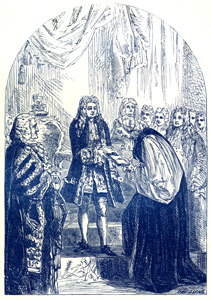
On the death of George I., a singular scene, with which Lord Chesterfield's interests were connected, occurred in the Privy Council. Dr Wake, Archbishop of Canterbury, produced the king's will, and delivered it to his successor, expecting that it would be opened and read in the council; what was his consternation, when his Majesty, without saying a word, put it into his pocket, and stalked out of the room with real German imperturbability! Neither the astounded prelate nor the subservient council ventured to utter a word. The will was never more heard of: and rumour declared that it was burnt. The contents, of course, never transpired; and the legacy of £40,000, said to have been left to the Duchess of Kendal, was never more spoken of, until Lord Chesterfield, in 1733, married the Countess of Walsingham. In 1743, it is said, he claimed the legacy—in right of his wife—the Duchess of Kendal being then dead: and was 'quieted' with £20,000, and got, as Horace Walpole observes, nothing from the duchess—'except his wife.'
The only excuse that was urged to extenuate this act on the part of George II., was that his royal father had burned two wills which had been made in his favour. These were supposed to be the wills of the Duke and Duchess of Zell and of the Electress Sophia. There was not even common honesty in the house of Hanover at that period.
Disappointed in his wife's fortune, Lord Chesterfield seems to have cared very little for the disappointed heiress. Their union was childless. His opinion of marriage appears very much to have coincided with that of the world of malcontents who rush, in the present day, to the court of Judge Cresswell, with 'dissolving views.' On one occasion he writes thus: 'I have at last done the best office that can be done to most married people; that is, I have fixed the separation between my brother and his wife, and the definitive treaty of peace will be proclaimed in about a fortnight.'
Horace Walpole related the following anecdote of Sir William Stanhope (Chesterfield's brother) and his lady, whom he calls 'a fond couple.' After their return from Paris, when they arrived at Lord Chesterfield's house at Blackheath, Sir William, who had, like his brother, a cutting, polite wit, that was probably expressed with the 'allowed simper' of Lord Chesterfield, got out of the chaise and said, with a low bow, 'Madame, I hope I shall never see your face again.' She replied, 'Sir, I will take care that you never shall;' and so they parted.
There was little probability of Lord Chesterfield's participating in domestic felicity, when neither his heart nor his fancy were engaged in the union which he had formed. The lady to whom he was really attached, and by whom he had a son, resided in the Netherlands: she passed by the name of Madame du Bouchet, and survived both Lord Chesterfield and her son. A permanent provision was made for her, and a sum of five hundred pounds bequeathed to her, with these words: 'as a small reparation for the injury I did her.' 'Certainly,' adds Lord Mahon, in his Memoir of his illustrious ancestor, 'a small one.'
For some time Lord Chesterfield remained in England, and his letters are dated from Bath, from Tonbridge, from Blackheath. He had, in 1726, been elevated to the House of Lords upon the death of his father. In that assembly his great eloquence is thus well described by his biographer:—[25]
'Lord Chesterfield's eloquence, the fruit of much study, was less characterized by force and compass than by elegance and perspicuity, and especially by good taste and urbanity, and a vein of delicate irony which, while it sometimes inflicted severe strokes, never passed the limits of decency and propriety. It was that of a man who, in the union of wit and good sense with politeness, had not a competitor. These qualities were matured by the advantage which he assiduously sought and obtained, of a familiar acquaintance with almost all the eminent wits and writers of his time, many of whom had been the ornaments of a preceding age of literature, while others were destined to become those of a later period.'
The accession of George II., to whose court Lord Chesterfield had been attached for many years, brought him no political preferment. The court had, however, its attractions even for one who owed his polish to the belles of Paris, and who was almost always, in taste and manners, more foreign than English. Henrietta, Lady Pomfret, the daughter and heiress of John, Lord Jeffreys, the son of Judge Jeffreys, was at that time the leader of fashion.
Six daughters, one of them, Lady Sophia, surpassingly lovely recalled the perfections of that ancestress, Arabella Fermor whose charms Pope has so exquisitely touched in the 'Rape of the Lock.' Lady Sophia became eventually the wife of Lord Carteret, the minister, whose talents and the charms of whose eloquence constituted him a sort of rival to Chesterfield. With all his abilities, Lord Chesterfield may be said to have failed both as a courtier and as a political character, as far as permanent influence in any ministry was concerned, until in 1744, when what was called the 'Broad-bottomed administration' was formed, when he was admitted into the cabinet. In the following year, however, he went, for the last time, to Holland, as ambassador, and succeeded beyond the expectations of his party in the purposes of his embassy. He took leave of the States-General just before the battle of Fontenoy, and hastened to Ireland, where he had been nominated Lord-Lieutenant previous to his journey to Holland. He remained in that country only a year; but long enough to prove how liberal were his views—how kindly the dispositions of his heart.
Only a few years before Lord Chesterfield's arrival in Dublin, the Duke of Shrewsbury had given as a reason for accepting the vice-regency of that country, (of which King James I. had said, there was 'more ado' than with any of his dominions,) 'that it was a place where a man had business enough to keep him from falling asleep, and not enough to keep him awake.'
Chesterfield, however, was not of that opinion. He did more in one year than the duke would have accomplished in five. He began by instituting a principle of impartial justice. Formerly, Protestants had alone been employed as 'managers;' the Lieutenant was to see with Protestant eyes, to hear with Protestant ears.
'I have determined to proscribe no set of persons whatever,' says Chesterfield, 'and determined to be governed by none. Had the Papists made any attempt to put themselves above the law, I should have taken good care to have quelled them again. It was said my lenity to the Papists had wrought no alteration either in their religious or their political sentiments. I did not expect that it would: but surely that was no reason for cruelty towards them.'
Often by a timely jest Chesterfield conveyed a hint, or even shrouded a reproof. One of the ultra-zealous informed him that his coachman was a Papist, and went every Sunday to mass. 'Does he indeed? I will take care he never drives me there,' was Chesterfield's cool reply.
It was at this critical period, when the Hanoverian dynasty was shaken almost to its downfall by the insurrection in Scotland of 1745, that Ireland was imperilled: 'With a weak or wavering, or a fierce and headlong Lord-Lieutenant—with a Grafton or a Strafford,' remarks Lord Mahon, 'there would soon have been a simultaneous rising in the Emerald Isle.' But Chesterfield's energy, his lenity, his wise and just administration saved the Irish from being excited into rebellion by the emissaries of Charles Edward, or slaughtered, when conquered, by the 'Butcher,' and his tiger-like dragoons. When all was over, and that sad page of history in which the deaths of so many faithful adherents of the exiled family are recorded, had been held up to the gaze of bleeding Caledonia, Chesterfield recommended mild measures, and advised the establishment of schools in the Highlands; but the age was too narrow-minded to adopt his views. In January, 1748, Chesterfield retired from public life. 'Could I do any good,' he wrote to a friend, 'I would sacrifice some more quiet to it; but convinced as I am that I can do none, I will indulge my ease, and preserve my character. I have gone through pleasures while my constitution and my spirits would allow me. Business succeeded them; and I have now gone through every part of it without liking it at all the better for being acquainted with it. Like many other things, it is most admired by those who know it least.... I have been behind the scenes both of pleasure and business; I have seen all the coarse pulleys and dirty ropes which exhibit and move all the gaudy machines; and I have seen and smelt the tallow candles which illuminate the whole decoration, to the astonishment and admiration of the ignorant multitude.... My horse, my books, and my friends will divide my time pretty equally.'
He still interested himself in what was useful; and carried a Bill in the House of Lords for the Reformation of the Calendar, in 1751. It seems a small matter for so great a mind as his to accomplish, but it was an achievement of infinite difficulty. Many statesmen had shrunk from the undertaking; and even Chesterfield found it essential to prepare the public, by writing in some periodical papers on the subject. Nevertheless the vulgar outcry was vehement: 'Give us back the eleven days we have been robbed of!' cried the mob at a general election. When Bradley was dying, the common people ascribed his sufferings to a judgment for the part he had taken in that 'impious transaction,' the alteration of the calendar. But they were not less bornés in their notions than the Duke of Newcastle, then prime minister. Upon Lord Chesterfield giving him notice of his Bill, that bustling premier, who had been in a hurry for forty years, who never 'walked but always ran,' greatly alarmed, begged Chesterfield not to stir matters that had been long quiet; adding, that he did not like 'new-fangled things.' He was, as we have seen, overruled, and henceforth the New Style was adopted; and no special calamity has fallen on the nation, as was expected, in consequence. Nevertheless, after Chesterfield had made his speech in the House of Lords, and when every one had complimented him on the clearness of his explanation—'God knows,' he wrote to his son, 'I had not even attempted to explain the Bill to them; I might as soon have talked Celtic or Sclavonic to them as astronomy. They would have understood it full as well.' So much for the 'Lords' in those days!
After his furore for politics had subsided, Chesterfield returned to his ancient passion for play. We must linger a little over the still brilliant period of his middle life, whilst his hearing was spared; whilst his wit remained, and the charming manners on which he had formed a science, continued; and before we see him in the mournful decline of a life wholly given to the world.
He had now established himself in Chesterfield House. Hitherto his progenitors had been satisfied with Bloomsbury Square, in which the Lord Chesterfield mentioned by De Grammont resided; but the accomplished Chesterfield chose a site near Audley Street, which had been built on what was called Mr. Audley's land, lying between Great Brook Field and the 'Shoulder of Mutton Field.' And near this locality with the elegant name, Chesterfield chose his spot, for which he had to wrangle and fight with the Dean and Chapter of Westminster, who asked an exorbitant sum for the ground. Isaac Ware, the editor of 'Palladio,' was the architect to whom the erection of this handsome residence was intrusted. Happily it is still untouched by any renovating hand. Chesterfield's favourite apartments, looking on the most spacious private garden in London, are just as they were in his time; one especially, which he termed the 'finest room in London,' was furnished and decorated by him. 'The walls,' says a writer in the 'Quarterly Review,' 'are covered half way up with rich and classical stores of literature; above the cases are in close series the portraits of eminent authors, French and English, with most of whom he had conversed; over these, and immediately under the massive cornice, extend all round in foot-long capitals the Horatian lines:—
'Nunc . veterum . libris . Nunc . somno . et . inertibus . Horis. Lucen . solicter . jucunda . oblivia . vitea.
'On the mantel-pieces and cabinets stand busts of old orators, interspersed with voluptuous vases and bronzes, antique or Italian, and airy statuettes in marble or alabaster of nude or semi-nude opera nymphs.'
What Chesterfield called the 'cannonical pillars' of the house were columns brought from Cannons, near Edgeware, the seat of the Duke of Chandos. The antechamber of Chesterfield House has been erroneously stated as the room in which Johnson waited the great lord's pleasure. That state of endurance was probably passed by 'Old Samuel' in Bloomsbury.
In this stately abode—one of the few, the very few, that seem to hold noblesse apart in our levelling metropolis—Chesterfield held his assemblies of all that London, or indeed England, Paris, the Hague, or Vienna, could furnish of what was polite and charming. Those were days when the stream of society did not, as now, flow freely, mingling with the grace of aristocracy the acquirements of hard-working professors; there was then a strong line of demarcation; it had not been broken down in the same way as now, when people of rank and wealth live in rows, instead of inhabiting hotels set apart. Paris has sustained a similar revolution, since her gardens were built over, and their green shades, delicious, in the centre of that hot city, are seen no more. In the very Faubourg St. Germain, the grand old hotels are rapidly disappearing, and with them something of the exclusiveness of the higher orders. Lord Chesterfield, however, triumphantly pointing to the fruits of his taste and distribution of his wealth, witnessed, in his library at Chesterfield House, the events which time produced. He heard of the death of Sarah, Duchess of Marlborough, and of her bequest to him of twenty thousand pounds, and her best and largest brilliant diamond ring, 'out of the great regard she had for his merit, and the infinite obligations she had received from him.' He witnessed the change of society and of politics which occurred when George II. expired, and the Earl of Bute, calling himself a descendant of the house of Stuart, 'and humble enough to be proud of it,' having quitted the isle of Bute, which Lord Chesterfield calls 'but a little south of Nova Zembla,' took possession, not only of the affections, but even of the senses of the young king, George III., who, assisted by the widowed Princess of Wales (supposed to be attached to Lord Bute), was 'lugged out of the seraglio,' and 'placed upon the throne.'
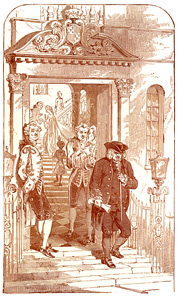
Chesterfield lived to have the honour of having the plan of 'Johnson's Dictionary' inscribed to him, and the dishonour of neglecting the great author. Johnson, indeed, denied the truth of the story which gained general belief, in which it was asserted that he had taken a disgust at being kept waiting in the earl's antechamber, the reason being assigned that his lordship 'had company with him;' when at last the door opened, and forth came Colley Cibber. Then Johnson—so report said—indignant, not only for having been kept waiting but also for whom, went away, it was affirmed, in disgust; but this was solemnly denied by the doctor, who assured Boswell that his wrath proceeded from continual neglect on the part of Chesterfield.
Whilst the Dictionary was in progress, Chesterfield seemed to forget the existence of him, whom, together with the other literary men, he affected to patronize.
He once sent him ten pounds, after which he forgot Johnson's address, and said 'the great author had changed his lodgings.' People who really wish to benefit others can always discover where they lodge. The days of patronage were then expiring, but they had not quite ceased, and a dedication was always to be in some way paid for.
When the publication of the Dictionary drew near, Lord Chesterfield flattered himself that, in spite of all his neglect, the great compliment of having so vast an undertaking dedicated to him would still be paid, and wrote some papers in the 'World,' recommending the work, more especially referring to the 'plan,' and terming Johnson the 'dictator,' in respect to language: 'I will not only obey him,' he said, 'as my dictator, like an old Roman, but like a modern Roman, will implicitly believe in him as my pope.'
Johnson, however, was not to be propitiated by those 'honeyed words.' He wrote a letter couched in what he called 'civil terms,' to Chesterfield, from which we extract the following passages:
'When, upon some slight encouragement, I first visited your lordship, I was overpowered, like the rest of mankind, by the enchantment of your address; and could not forbear to wish that I might boast myself vainqueur du vainqueur de la terre—that I might obtain that regard for which I saw the world contending; but I found my attendance so little encouraged, that neither pride nor modesty would suffer me to continue it. When I had once addressed your lordship in publick, I had exhausted all the art of pleasing which a retired and uncourtly scholar can possess. I had done all that I could; and no man is well pleased to have his all neglected, be it ever so little.
'Seven years, my lord, have now past, since I waited in your outward room, or was repulsed from your door, during which time I have been pushing on my work through difficulties, of which it is useless to complain, and have brought it, at last, to the verge of publication without one act of assistance, one word of encouragement, or one smile of favour: such treatment I did not expect, for I never had a patron before.... Is not a patron, my lord, one who looks with unconcern on a man who is struggling for life in the water, and, when he has reached ground, encumbers him with help? The notice which you have been pleased to take of my labours, had it been early, had been kind; but it has been delayed till I am indifferent and cannot enjoy it; till I am solitary and cannot impart it; till I am known and do not want it. I hope it is no very cynical asperity not to confess obligations where no benefit has been received, or to be unwilling that the publick should consider me as owing that to a patron which Providence has enabled me to do for myself.'
The conduct of Johnson, on this occasion, was approved by most manly minds, except that of his publisher, Mr. Robert Dodsley; Dr. Adams, a friend of Dodsley, said he was sorry that Johnson had written that celebrated letter (a very model of polite contempt). Dodsley said he was sorry too, for he had a property in the Dictionary, to which his lordship's patronage might be useful. He then said that Lord Chesterfield had shown him the letter. 'I should have thought,' said Adams, 'that Lord Chesterfield would have concealed it.' 'Pooh!' cried Dodsley, 'do you think a letter from Johnson could hurt Lord Chesterfield? not at all, sir. It lay on his table, where any one might see it. He read it to me; said, "this man has great powers," pointed out the severest passages, and said, "how well they were expressed."' The art of dissimulation, in which Chesterfield was perfect, imposed on Mr. Dodsley.
Dr. Adams expostulated with the doctor, and said Lord Chesterfield declared he would part with the best servant he had, if he had known that he had turned away a man who was 'always welcome.' Then Adams insisted on Lord Chesterfield's affability, and easiness of access to literary men. But the sturdy Johnson replied, 'Sir, that is not Lord Chesterfield; he is the proudest man existing.' 'I think,' Adams rejoined, 'I know one that is prouder; you, by your own account, are the prouder of the two.' 'But mine,' Johnson answered, with one of his happy turns, 'was defensive pride.' 'This man,' he afterwards said, referring to Chesterfield, 'I thought had been a lord among wits, but I find he is only a wit among lords.'
In revenge, Chesterfield in his Letters depicted Johnson, it is said, in the character of the 'respectable Hottentot.' Amongst other things, he observed of the Hottentot, 'he throws his meat anywhere but down his throat.' This being remarked to Johnson, who was by no means pleased at being immortalized as the Hottentot—'Sir,' he answered, 'Lord Chesterfield never saw me eat in his life.'
DR. JOHNSON AT LORD CHESTERFIELD'S.
Such are the leading points of this famous and lasting controversy. It is amusing to know that Lord Chesterfield was not always precise as to directions to his letters. He once directed to Lord Pembroke, who was always swimming 'To the Earl of Pembroke, in the Thames, over against Whitehall. This, as Horace Walpole remarks, was sure of finding him within a certain fathom.'
Lord Chesterfield was now admitted to be the very 'glass of fashion,' though age, and, according to Lord Hervey, a hideous person, impeded his being the 'mould of form.' 'I don't know why,' writes Horace Walpole, in the dog-days, from Strawberry Hill, 'but people are always more anxious about their hay than their corn, or twenty other things that cost them more: I suppose my Lord Chesterfield, or some such dictator, made it fashionable to care about one's hay. Nobody betrays solicitude about getting in his rents.' 'The prince of wits,' as the same authority calls him—'his entrance into the world was announced by his bon-mots, and his closing lips dropped repartees that sparkled with his juvenile fire.'
No one, it was generally allowed, had such a force of table-wit as Lord Chesterfield; but while the 'Graces' were ever his theme, he indulged himself without distinction or consideration in numerous sallies. He was, therefore, at once sought and feared; liked but not loved; neither sex nor relationship, nor rank, nor friendship, nor obligation, nor profession, could shield his victim from what Lord Hervey calls, 'those pointed, glittering weapons, that seemed to shine only to a stander-by, but cut deep into those they touched.'
He cherished 'a voracious appetite for abuse;' fell upon every one that came in his way, and thus treated each one of his companions at the expense of the other. To him Hervey, who had probably often smarted, applied the lines of Boileau—
'Mais c'est un petit fou qui se croit tout permis, Et qui pour un bon mot va perdre vingt amis.'
Horace Walpole (a more lenient judge of Chesterfield's merits) observes that 'Chesterfield took no less pains to be the phœnix of fine gentlemen, than Tully did to qualify himself as an orator. Both succeeded: Tully immortalized his name; Chesterfield's reign lasted a little longer than that of a fashionable beauty.' It was, perhaps, because, as Dr. Johnson said, all Lord Chesterfield's witty sayings were puns, that even his brilliant wit failed to please, although it amused, and surprised its hearers.
Notwithstanding the contemptuous description of Lord Chesterfield's personal appearance by Lord Hervey, his portraits represent a handsome, though hard countenance, well-marked features, and his figure and air appear to have been elegant. With his commanding talents, his wonderful brilliancy and fluency of conversation, he would perhaps sometimes have been even tedious, had it not been for his invariable cheerfulness. He was always, as Lord Hervey says, 'present' in his company. Amongst the few friends who really loved this thorough man of the world, was Lord Scarborough, yet no two characters were more opposite. Lord Scarborough had judgment, without wit: Chesterfield wit, and no judgment; Lord Scarborough had honesty and principle; Lord Chesterfield had neither. Everybody liked the one, but did not care for his company. Everyone disliked the other, but wished for his company. The fact was, Scarborough was 'splendid and absent.' Chesterfield 'cheerful and present:' wit, grace, attention to what is passing, the surface, as it were, of a highly-cultured mind, produced a fascination with which all the honour and respectability in the Court of George II. could not compete.
In the earlier part of Chesterfield's career, Pope, Bolingbroke, Hervey, Lady Mary Wortley Montagu, and, in fact, all that could add to the pleasures of the then early dinner-table, illumined Chesterfield House by their wit and gaiety. Yet in the midst of this exciting life, Lord Chesterfield found time to devote to the improvement of his natural son, Philip Stanhope, a great portion of his leisure. His celebrated Letters to that son did not, however, appear during the earl's life; nor were they in any way the source of his popularity as a wit, which was due to his merits in that line alone.
The youth to whom these letters, so useful and yet so objectionable, were addressed, was intended for a diplomatist. He was the very reverse of his father: learned, sensible, and dry; but utterly wanting in the graces, and devoid of eloquence. As an orator, therefore, he failed; as a man of society, he must also have failed; and his death, in 1768, some years before that of his father, left that father desolate, and disappointed. Philip Stanhope had attained the rank of envoy to Dresden, where he expired.
During the five years in which Chesterfield dragged out a mournful life after this event, he made the painful discovery that his son had married without confiding that step to the father to whom he owed so much. This must have been almost as trying as the awkward, ungraceful deportment of him whom he mourned. The world now left Chesterfield ere he had left the world. He and his contemporary Lord Tyrawley were now old and infirm. 'The fact is,' Chesterfield wittily said, 'Tyrawley and I have been dead these two years, but we don't choose to have it known.'
'The Bath,' he wrote to his friend Dayrolles, 'did me more good than I thought anything could do me; but all that good does not amount to what builders call half-repairs, and only keeps up the shattered fabric a little longer than it would have stood without them; but take my word for it, it will stand but a very little while longer. I am now in my grand climacteric, and shall not complete it. Fontenelle's last words at a hundred and three were, Je souffre d'être. deaf and infirm as I am, I can with truth say the same thing at sixty-three. In my mind it is only the strength of our passions, and the weakness of our reason, that makes us so fond of life; but when the former subside and give way to the latter, we grow weary of being, and willing to withdraw. I do not recommend this train of serious reflections to you, nor ought you to adopt them.... You have children to educate and provide for, you have all your senses, and can enjoy all the comforts both of domestic and social life. I am in every sense isolé, and have wound up all my bottoms; I may now walk off quietly, without missing nor being missed.'
The kindness of his nature, corrupted as it was by a life wholly worldly, and but little illumined in its course by religion, shone now in his care of his two grandsons, the offspring of his lost son, and of their mother, Eugenia Stanhope. To her he thus wrote:—
'The last time I had the pleasure of seeing you, I was so taken up in playing with the boys, that I forgot their more important affairs. How soon would you have them placed at school? When I know your pleasure as to that, I will send to Monsieur Perny, to prepare everything for their reception. In the mean time, I beg that you will equip them thoroughly with clothes, linen, &c., all good, but plain; and give me the amount, which I will pay; for I do not intend, from this time forwards, the two boys should cost you one shilling.'
He lived, latterly, much at Blackheath, in the house which, being built on Crown land, has finally become the Ranger's lodge; but which still sometimes goes by the name of Chesterfield House. Here he spent large sums, especially on pictures, and cultivated Cantelupe melons; and here, as he grew older, and became permanently afflicted with deafness, his chief companion was a useful friend, Solomon Dayrolles—one of those indebted hangers-on whom it was an almost invariable custom to find, at that period, in great houses—and perhaps too frequently in our own day.
Dayrolles, who was employed in the embassy under Lord Sandwich at the Hague, had always, to borrow Horace Walpole's ill-natured expression, 'been a led-captain to the Dukes of Richmond and Grafton, used to be sent to auctions for them, and to walk in the parks with their daughters, and once went dry-nurse in Holland with them. He has belonged, too, a good deal to my Lord Chesterfield, to whom I believe he owes this new honour, "that of being minister at the Hague," as he had before made him black-rod in Ireland, and gave the ingenious reason that he had a black face.' But the great 'dictator' in the empire of politeness was now in a slow but sure decline. Not long before his death he was visited by Monsieur Suard, a French gentleman, who was anxious to see 'l'homme le plus aimable, le plus poli et le plus spirituel des trois royaumes,' but who found him fearfully altered; morose from his deafness, yet still anxious to please. 'It is very sad,' he said, with his usual politeness, 'to be deaf, when one would so much enjoy listening. I am not,' he added, 'so philosophic as my friend the President de Montesquieu, who says, "I know how to be blind, but I do not yet know how to be deaf."' 'We shortened our visit,' says M. Suard, 'lest we should fatigue the earl.' 'I do not detain you,' said Chesterfield, 'for I must go and rehearse my funeral.' It was thus that he styled his daily drive through the streets of London.
Lord Chesterfield's wonderful memory continued till his latest hour. As he lay, gasping in the last agonies of extreme debility, his friend, Mr. Dayrolles, called in to see him half an hour before he expired. The politeness which had become part of his very nature did not desert the dying earl. He managed to say, in a low voice, to his valet, 'Give Dayrolles a chair.' This little trait greatly struck the famous Dr. Warren, who was at the bedside of this brilliant and wonderful man. He died on the 24th of March, 1773, in the 79th year of his age.
The preamble to a codicil (Feb. 11, 1773) contains the following striking sentences, written when the intellect was impressed with the solemnity of that solemn change which comes alike to the unreflecting and to the heart stricken, holy believer:—
'I most humbly recommend my soul to the extensive mercy of that Eternal, Supreme, Intelligent Being who gave it me; most earnestly at the same time deprecating his justice. Satiated with the pompous follies of this life, of which I have had an uncommon share, I would have no posthumous ones displayed at my funeral, and therefore desire to be buried in the next burying-place to the place where I shall die, and limit the whole expense of my funeral to £100.'
His body was interred, according to his wish, in the vault of the chapel in South Audley Street, but it was afterwards removed to the family burial-place in Shelford Church, Nottinghamshire.
In his will he left legacies to his servants.[26] 'I consider them,' he said, 'as unfortunate friends; my equals by nature, and my inferiors only in the difference of our fortunes.' There was something lofty in the mind that prompted that sentence.
His estates reverted to a distant kinsman, descended from a younger son of the first earl; and it is remarkable, on looking through the Peerage of Great Britain, to perceive how often this has been the case in a race remarkable for the absence of virtue. Interested marriages, vicious habits, perhaps account for the fact; but retributive justice, though it be presumptuous to trace its course, is everywhere.
He had so great a horror in his last days of gambling, that in bequeathing his possessions to his heir, as he expected, and godson, Philip Stanhope, he inserts this clause:—
'In case my said godson, Philip Stanhope, shall at any time hereinafter keep, or be concerned in keeping of, any race-horses, or pack of hounds, or reside one night at Newmarket, that infamous seminary of iniquity and ill-manners, during the course of the races there; or shall resort to the said races; or shall lose, in any one day, at any game or bet whatsoever, the sum of £500, then, in any the cases aforesaid, it is my express will that he, my said godson, shall forfeit and pay, out of my estate, the sum of £5,000 to and for the use of the Dean and Chapter of Westminster.'
When we say that Lord Chesterfield was a man who had no friend, we sum up his character in those few words. Just after his death a small but distinguished party of men dined together at Topham Beauclerk's. There was Sir Joshua Reynolds; Sir William Jones, the orientalist; Bennet Langton; Steevens; Boswell; Johnson. The conversation turned on Garrick, who, Johnson said, had friends, but no friend. Then Boswell asked, 'what is a friend?' 'One who comforts and supports you, while others do not.' 'Friendship, you know, sir, is the cordial drop to make the nauseous draught of life go down.' Then one of the company mentioned Lord Chesterfield as one who had no friend; and Boswell said: 'Garrick was pure gold, but beat out to thin leaf, Lord Chesterfield was tinsel.' And, for once, Johnson did not contradict him. But not so do we judge Lord Chesterfield. He was a man who acted on false principles through life; and those principles gradually undermined everything that was noble and generous in character; just as those deep under-ground currents, noiseless in their course, work through fine-grained rock, and produce a chasm. Everything with Chesterfield was self: for self, and self alone, were agreeable qualities to be assumed; for self, was the country to be served, because that country protects and serves us: for self, were friends to be sought and cherished, as useful auxiliaries, or pleasant accessories: in the very core of the cankered heart, that advocated this corrupting doctrine of expediency, lay unbelief; that worm which never died in the hearts of so many illustrious men of that period—the refrigerator of the feelings.
One only gentle and genuine sentiment possessed Lord Chesterfield, and that was his love for his son. Yet in this affection the worldly man might be seen in mournful colours. He did not seek to render his son good; his sole desire was to see him successful: every lesson that he taught him, in those matchless Letters which have carried down Chesterfield's fame to us when his other productions have virtually expired, exposes a code of dissimulation which Philip Stanhope, in his marriage, turned upon the father to whom he owed so much care and advancement. These Letters are, in fact, a complete exposition of Lord Chesterfield's character and views of life. No other man could have written them; no other man have conceived the notion of existence being one great effort to deceive, as well as to excel, and of society forming one gigantic lie. It is true they were addressed to one who was to enter the maze of a diplomatic career, and must be taken, on that account, with some reservation.
They have justly been condemned on the score of immorality; but we must remember that the age in which they were written was one of lax notions, especially among men of rank, who regarded all women accessible, either from indiscretion or inferiority of rank, as fair game, and acted accordingly. But whilst we agree with one of Johnson's bitterest sentences as to the immorality of Chesterfield's letters, we disagree with his styling his code of manners the manners of a dancing-master. Chesterfield was in himself a perfect instance of what he calls les manières nobles; and this even Johnson allowed.
'Talking of Chesterfield,' Johnson said, 'his manner was exquisitely elegant, and he had more knowledge than I expected.' Boswell: 'Did you find, sir, his conversation to be of a superior sort?'—Johnson: 'Sir, in the conversation which I had with him, I had the best right to superiority, for it was upon philology and literature.'
It was well remarked how extraordinary a thing it was that a man who loved his son so entirely should do all he could to make him a rascal. And Foote even contemplated bringing on the stage a father who had thus tutored his son; and intended to show the son an honest man in everything else, but practising his father's maxims upon him, and cheating him.
'It should be so contrived,' Johnson remarked, referring to Foote's plan, 'that the father should be the only sufferer by the son's villany, and thus there would be poetical justice.' 'Take out the immorality,' he added, on another occasion, 'and the book (Chesterfield's Letters to his Son) should be put into the hands of every young gentleman.'
We are inclined to differ, and to confess to a moral taint throughout the whole of the Letters; and even had the immorality been expunged, the false motives, the deep, invariable advocacy of principles of expediency, would have poisoned what otherwise might be of effectual benefit to the minor virtues of polite society.