Volume 1 — GEORGE VILLIERS, SECOND DUKE OF BUCKINGHAM.
Reading edition
Signs of the Restoration.—Samuel Pepys in his Glory.—A Royal Company.—Pepys 'ready to Weep.'—The Playmate of Charles II.—George Villiers's Inheritance.—Two Gallant Young Noblemen.—The Brave Francis Villiers.—After the Battle of Worcester.—Disguising the King.—Villiers in Hiding.—He appears as a Mountebank.—Buckingham's Habits.—A Daring Adventure.—Cromwell's Saintly Daughter.—Villiers and the Rabbi.—The Buckingham Pictures and Estates.—York House.—Villiers returns to England.—Poor Mary Fairfax.—Villiers in the Tower.—Abraham Cowley, the Poet.—The Greatest Ornament of Whitehall.—Buckingham's Wit and Beauty.—Flecknoe's Opinion of Him.—His Duel with the Earl of Shrewsbury.—Villiers as a Poet.—As a Dramatist.—A Fearful Censure!—Villiers's Influence in Parliament.—A Scene in the Lords.—The Duke of Ormond in Danger.—Colonel Blood's Outrages.—Wallingford House and Ham House.—'Madame Ellen.'—The Cabal.—Villiers again in the Tower.—A Change.—The Duke of York's Theatre.—Buckingham and the Princess of Orange.—His last Hours.—His Religion.—Death of Villiers.—The Duchess of Buckingham.
Samuel Pepys, the weather-glass of his time, hails the first glimpse of the Restoration of Charles II. in his usual quaint terms and vulgar sycophancy.
'To Westminster Hall,' says he; 'where I heard how the Parliament had this day dissolved themselves, and did pass very cheerfully through the Hall, and the Speaker without his mace. The whole Hall was joyful thereat, as well as themselves; and now they begin to talk loud of the king.' And the evening was closed, he further tells us, with a large bonfire in the Exchange, and people called out, 'God bless King Charles!'
This was in March 1660; and during that spring Pepys was noting down how he did not think it possible that my 'Lord Protector,' Richard Cromwell, should come into power again; how there were great hopes of the king's arrival; how Monk, the Restorer, was feasted at Mercers' Hall (Pepys's own especial); how it was resolved that a treaty be offered to the king, privately; how he resolved to go to sea with 'my lord:' and how, while they lay at Gravesend, the great affair which brought back Charles Stuart was virtually accomplished. Then, with various parentheses, inimitable in their way, Pepys carries on his narrative. He has left his father's 'cutting-room' to take care of itself; and finds his cabin little, though his bed is convenient, but is certain, as he rides at anchor with 'my lord,' in the ship, that the king 'must of necessity come in,' and the vessel sails round and anchors in Lee Roads. 'To the castles about Deal, where our fleet' (our fleet, the saucy son of a tailor!) 'lay and anchored; great was the shoot of guns from the castles, and ships, and our answers.' Glorious Samuel! in his element, to be sure.
Then the wind grew high: he began to be 'dizzy, and squeamish;' nevertheless employed 'Lord's Day' in looking through the lieutenant's glass at two good merchantmen, and the women in them; 'being pretty handsome;' then in the afternoon he first saw Calais, and was pleased, though it was at a great distance. All eyes were looking across the Channel just then—for the king was at Flushing; and, though the 'Fanatiques' still held their heads up high, and the Cavaliers also talked high on the other side, the cause that Pepys was bound to, still gained ground.
Then 'they begin to speak freely of King Charles;' churches in the City, Samuel declares, were setting up his arms; merchant-ships—more important in those days—were hanging out his colours. He hears, too, how the Mercers' Company were making a statue of his gracious Majesty to set up in the Exchange. Ah! Pepys's heart is merry: he has forty shillings (some shabby perquisite) given him by Captain Cowes of the 'Paragon;' and 'my lord' in the evening 'falls to singing' a song upon the Rump to the tune of the 'Blacksmith.'
The hopes of the Cavalier party are hourly increasing, and those of Pepys we may be sure also; for Pim, the tailor, spends a morning in his cabin 'putting a great many ribbons to a sail.' And the king is to be brought over suddenly, 'my lord' tells him: and indeed it looks like it, for the sailors are drinking Charles's health in the streets of Deal, on their knees; 'which, methinks,' says Pepys, 'is a little too much;' and 'methinks' so, worthy Master Pepys, also.
Then how the news of the Parliamentary vote of the king's declaration was received! Pepys becomes eloquent.
'He that can fancy a fleet (like ours) in her pride, with pendants loose, guns roaring, caps flying, and the loud "Vive le Roi!" echoed from one ship's company to another; he, and he only, can apprehend the joy this enclosed vote was received with, or the blessing he thought himself possessed of that bore it.'
Next, orders come for 'my lord' to sail forthwith to the king; and the painters and tailors set to work, Pepys superintending, 'cutting out some pieces of yellow cloth in the fashion of a crown and C. R.; and putting it upon a fine sheet'—and that is to supersede the States' arms, and is finished and set up. And the next day, on May 14, the Hague is seen plainly by us, 'my lord going up in his night-gown into the cuddy.'
And then they land at the Hague; some 'nasty Dutchmen' come on board to offer their boats, and get money, which Pepys does not like; and in time they find themselves in the Hague, 'a most neat place in all respects:' salute the Queen of Bohemia and the Prince of Orange—afterwards William III.—and find at their place of supper nothing but a 'sallet' and two or three bones of mutton provided for ten of us, 'which was very strange. Nevertheless, on they sail, having returned to the fleet, to Schevelling: and, on the 23rd of the month, go to meet the king; who, 'on getting into the boat, did kiss my lord with much affection.' And 'extraordinary press of good company,' and great mirth all day, announced the Restoration. Nevertheless Charles's clothes had not been, till this time, Master Pepys is assured, worth forty shillings—and he, as a connoisseur, was scandalized at the fact.
And now, before we proceed, let us ask who worthy Samuel Pepys was, that he should pass such stringent comments on men and manners? His origin was lowly, although his family ancient; his father having followed, until the Restoration, the calling of a tailor. Pepys, vulgar as he was, had nevertheless received an university education; first entering Trinity College, Cambridge, as a sizar. To our wonder we find him marrying furtively and independently; and his wife, at fifteen, was glad with her husband to take up an abode in the house of a relative, Sir Edward Montagu, afterwards Earl of Sandwich, the 'my lord' under whose shadow Samuel Pepys dwelt in reverence. By this nobleman's influence Pepys for ever left the 'cutting-room;' he acted first as secretary, (always as toad-eater, one would fancy), then became a clerk in the Admiralty; and as such went, after the Restoration, to live in Seething Lane, in the parish of St. Olave, Hart Street—and in St. Olave his mortal part was ultimately deposited.
So much for Pepys. See him now, in his full-buttoned wig, and best cambric neckerchief, looking out for the king and his suit, who are coming on board the 'Nazeby.'
'Up, and made myself as fine as I could, with the linning stockings on, and wide canons that I bought the other day at the Hague.' So began he the day. 'All day nothing but lords and persons of honour on board, that we were exceeding full. Dined in great deal of state, the royalle company by themselves in the coache, which was a blessed sight to see.' This royal company consisted of Charles, the Dukes of York and Gloucester, his brothers, the Queen of Bohemia, the Princess Royal, the Prince of Orange, afterwards William III.—all of whose hands Pepys kissed, after dinner. The King and Duke of York changed the names of the ships. The 'Rumpers,' as Pepys calls the Parliamentarians, had given one the name of the 'Nazeby;' and that was now christened the 'Charles:' 'Richard' was changed into 'James.' The 'Speaker' into 'Mary,' the 'Lambert,' was 'Henrietta,' and so on. How merry the king must have been whilst he thus turned the Roundheads, as it were, off the ocean; and how he walked here and there, up and down, (quite contrary to what Samuel Pepys 'expected,') and fell into discourse of his escape from Worcester, and made Samuel 'ready to weep' to hear of his travelling four days and three nights on foot, up to his knees in dirt, with 'nothing but a green coat and a pair of breeches on,' (worse and worse, thought Pepys,) and a pair of country shoes that made his feet sore; and how, at one place he was made to drink by the servants, to show he was not a Roundhead; and how, at another place—and Charles, the best teller of a story in his own dominions, may here have softened his tone—the master of the house, an innkeeper, as the king was standing by the fire, with his hands on the back of a chair, kneeled down and kissed his hand 'privately,' saying he could not ask him who he was, but bid 'God bless him, where he was going!'
Then, rallying after this touch of pathos, Charles took his hearers over to Fecamp, in France—thence to Rouen, where, he said, in his easy, irresistible way, 'I looked so poor that the people went into the rooms before I went away, to see if I had not stolen something or other.'
With what reverence and sympathy did our Pepys listen; but he was forced to hurry off to get Lord Berkeley a bed; and with 'much ado' (as one may believe) he did get 'him to bed with My Lord Middlesex;' so, after seeing these two peers of the realm in that dignified predicament—two in a bed—'to my cabin again,' where the company were still talking of the king's difficulties, and how his Majesty was fain to eat a piece of bread and cheese out of a poor body's pocket; and, at a Catholic house, how he lay a good while 'in the Priest's Hole, for privacy.'
In all these hairbreadth escapes—of which the king spoke with infinite humour and good feeling—one name was perpetually introduced:—George—George Villiers, Villers, as the royal narrator called him; for the name was so pronounced formerly. And well he might; for George Villiers had been his playmate, classfellow, nay, bedfellow sometimes, in priests' holes; their names, their haunts, their hearts, were all assimilated; and misfortune had bound them closely to each other. To George Villiers let us now return; he is waiting for his royal master on the other side of the Channel—in England. And a strange character have we to deal with:—
'A man so various, that he seemed to be Not one, but all mankind's epitome: Stiff in opinions, always in the wrong, Was everything by starts, and nothing long; But, in the course of one revolving moon, Was chemist, fiddler, statesman, and buffoon.'[1]
Such was George Villiers: the Alcibiades of that age. Let us trace one of the most romantic, and brilliant, and unsatisfactory lives that has ever been written.
George Villiers was born at Wallingford House, in the parish of St. Martin-in-the-Fields, on the 30th January, 1627. The Admiralty now stands on the site of the mansion in which he first saw the light. His father was George Villiers, the favourite of James I. and of Charles I.; his mother, the Lady Katherine Manners, daughter and heiress of Francis, Earl of Rutland. Scarcely was he a year old, when the assassination of his father, by Felton, threw the affairs of his family into confusion. His mother, after the Duke of Buckingham's death, gave birth to a son, Francis; who was subsequently, savagely killed by the Roundheads, near Kingston. Then the Duchess of Buckingham very shortly married again, and uniting herself to Randolph Macdonald, Earl of Antrim, became a rigid Catholic. She was therefore lost to her children, or rather, they were lost to her; for King Charles I., who had promised to be a 'husband to her, and a father to her children,' removed them from her charge, and educated them with the royal princes.
The youthful peer soon gave indications of genius; and all that a careful education could do, was directed to improve his natural capacity under private tutors. He went to Cambridge; and thence, under the care of a preceptor named Aylesbury, travelled into France. He was accompanied by his young, handsome, fine-spirited brother, Francis; and this was the sunshine of his life. His father had indeed left him, as his biographer Brian Fairfax expresses it, 'the greatest name in England; his mother, the greatest estate of any subject.' With this inheritance there had also descended to him the wonderful beauty, the matchless grace, of his ill-fated father. Great abilities, courage, fascination of manners, were also his; but he had not been endowed with firmness of character, and was at once energetic and versatile. Even at this age, the qualities which became his ruin were clearly discoverable.
George Villiers was recalled to England by the troubles which drove the king to Oxford, and which converted that academical city into a garrison, its under-graduates into soldiers, its ancient halls into barrack-rooms. Villiers was on this occasion entered at Christ Church: the youth's best feelings were aroused, and his loyalty was engaged to one to whom his father owed so much. He was now a young man of twenty-one years of age—able to act for himself; and he went heart and soul into the cause of his sovereign. Never was there a gayer, a more prepossessing Cavalier. He could charm even a Roundhead. The harsh and Presbyterian-minded Bishop Burnet, has told us that 'he was a man of a noble presence; had a great liveliness of wit, and a peculiar faculty of turning everything into ridicule, with bold figures and natural descriptions.' How invaluable he must have been in the Common-rooms at Oxford, then turned into guard-rooms, his eye upon some unlucky volunteer Don, who had put off his clerkly costume for a buff jacket, and could not manage his drill. Irresistible as his exterior is declared to have been, the original mind of Villiers was even far more influential. De Grammont tells us, 'he was extremely handsome, but still thought himself much more so than he really was; although he had a great deal of discernment, yet his vanities made him mistake some civilities as intended for his person which were only bestowed on his wit and drollery.'
But this very vanity, so unpleasant in an old man, is only amusing in a younger wit. Whilst thus a gallant of the court and camp, the young nobleman proved himself to be no less brave than witty. Juvenile as he was, with a brother still younger, they fought on the royalist side at Lichfield, in the storming of the Cathedral Close. For thus allowing their lives to be endangered, their mother blamed Lord Gerard, one of the Duke's guardians; whilst the Parliament seized the pretext of confiscating their estates, which were afterwards returned to them, on account of their being under age at the time of confiscation. The youths were then placed under the care of the Earl of Northumberland, by whose permission they travelled in France and Italy, where they appeared—their estates having been restored—with princely magnificence. Nevertheless, on hearing of the imprisonment of Charles I. in the Isle of Wight, the gallant youths returned to England and joined the army under the Earl of Holland, who was defeated near Nonsuch, in Surrey.
A sad episode in the annals of these eventful times is presented in the fate of the handsome, brave Francis Villiers. His murder, for one can call it by no other name, shows how keenly the personal feelings of the Roundheads were engaged in this national quarrel. Under most circumstances, Englishmen would have spared the youth, and respected the gallantry of the free young soldier, who, planting himself against an oak-tree which grew in the road, refused to ask for quarter, but defended himself against several assailants. But the name of Villiers was hateful in Puritan ears. 'Hew them down, root and branch!' was the sentiment that actuated the soldiery. His very loveliness exasperated their vengeance. At last, 'with nine wounds on his beautiful face and body,' says Fairfax, 'he was slain.' 'The oak-tree,' writes the devoted servant, 'is his monument,' and the letters of F. V. were cut in it in his day. His body was conveyed by water to York House, and was entombed with that of his father, in the Chapel of Henry VII.
His brother fled towards St. Neot's, where he encountered a strange kind of peril. Tobias Rustat attended him; and was with him in the rising in Kent for King Charles I., wherein the Duke was engaged; and they, being put to the flight, the Duke's helmet, by a brush under a tree, was turned upon his back, and tied so fast with a string under his throat, 'that without the present help of T. R.,' writes Fairfax, 'it had undoubtedly choked him, as I have credibly heard.'[2]
Whilst at St. Neot's, the house in which Villiers had taken refuge was surrounded with soldiers. He had a stout heart, and a dexterous hand; he took his resolution; rushed out upon his foes, killed the officer in command, galloped off and joined the Prince in the Downs.
The sad story of Charles I. was played out; but Villiers remained stanch, and was permitted to return and to accompany Prince Charles into Scotland. Then came the battle of Worcester in 1651: there Charles II. showed himself a worthy descendant of James IV. of Scotland. He resolved to conquer or die: with desperate gallantry the English Cavaliers and the Scotch Highlanders seconded the monarch's valiant onslaught on Cromwell's horse, and the invincible Life Guards were almost driven back by the shock. But they were not seconded; Charles II. had his horse twice shot under him, but, nothing daunted, he was the last to tear himself away from the field, and then only upon the solicitations of his friends.
Charles retired to Kidderminster that evening. The Duke of Buckingham, the gallant Lord Derby, Wilmot, afterwards Earl of Rochester, and some others, rode near him. They were followed by a small body of horse. Disconsolately they rode on northwards, a faithful band of sixty being resolved to escort his Majesty to Scotland. At length they halted on Kinver Heath, near Kidderminster: their guide having lost the way. In this extremity Lord Derby said that he had been received kindly at an old house in a secluded woody country, between Tong Castle and Brewood, on the borders of Staffordshire. It was named 'Boscobel,' he said; and that word has henceforth conjured up to the mind's eye the remembrance of a band of tired heroes, riding through woody glades to an ancient house, where shelter was given to the worn-out horses and scarcely less harassed riders.
But not so rapidly did they in reality proceed. A Catholic family, named Giffard, were living at White-Ladies, about twenty six miles from Worcester. This was only about half a mile from Boscobel: it had been a convent of Cistercian nuns, whose long white cloaks of old had once been seen, ghost-like, amid forest glades or on hillock green. The White-Ladies had other memories to grace it besides those of holy vestals, or of unholy Cavaliers. From the time of the Tudors, a respectable family named Somers had owned the White-Ladies, and inhabited it since its white-garbed tenants had been turned out, and the place secularized. 'Somers's House,' as it was called, (though more happily, the old name has been restored,) had received Queen Elizabeth on her progress. The richly cultivated old conventual gardens had supplied the Queen with some famous pears, and, in the fulness of her approval of the fruit, she had added them to the City arms. At that time one of these vaunted pear-trees stood securely in the market-place of Worcester.
At the White-Ladies, Charles rested for half an hour; and here he left his garters, waistcoat, and other garments, to avoid discovery, ere he proceeded. They were long kept as relics.
The mother of Lord Somers had been placed in this old house for security, for she was on the eve of giving birth to the future statesman, who was born in that sanctuary just at this time. His father at that very moment commanded a troop of horse in Cromwell's army, so that the risk the Cavaliers ran was imminent. The King's horse was led into the hall. Day was dawning; and the Cavaliers, as they entered the old conventual tenement, and saw the sunbeams on its walls, perceived their peril. A family of servants named Penderell held various offices there, and at Boscobel. William took care of Boscobel, George was a servant at White-Ladies; Humphrey was the miller to that house, Richard lived close by, at Hebbal Grange. He and William were called into the royal presence. Lord Derby then said to them, 'This is the King; have a care of him, and preserve him as thou didst me.'
Then the attendant courtiers began undressing the King. They took off his buff-coat, and put on him a 'noggon coarse shirt,' and a green suit and another doublet—Richard Penderell's woodman's dress. Lord Wilmot cut his sovereign's hair with a knife, but Richard Penderell took up his shears and finished the work. 'Burn it,' said the king; but Richard kept the sacred locks. Then Charles covered his dark face with soot. Could anything have taken away the expression of his half-sleepy, half-merry eyes?
They departed, and half an hour afterwards Colonel Ashenhurst, with a troop of Roundhead horse, rode up to the White-Ladies. The King, meantime, had been conducted by Richard Penderell into a coppice-wood, with a bill-hook in his hands for defence and disguise. But his followers were overtaken near Newport; and here Buckingham, with Lords Talbot and Leviston, escaped; and henceforth, until Charles's wanderings were transferred from England to France, George Villiers was separated from the Prince. Accompanied by the Earls of Derby and Lauderdale, and by Lord Talbot, he proceeded northwards, in hopes of joining General Leslie and the Scotch horse. But their hopes were soon dashed: attacked by a body of Roundheads, Buckingham and Lord Leviston were compelled to leave the high road, to alight from their horses, and to make their way to Bloore Park, near Newport, where Villiers found a shelter. He was soon, however, necessitated to depart: he put on a labourer's dress; he deposited his George, a gift from Henrietta Maria, with a companion, and set off for Billstrop, in Nottinghamshire, one Matthews, a carpenter, acting as his guide; at Billstrop he was welcomed by Mr. Hawley, a Cavalier; and from that place he went to Brookesby, in Leicestershire, the original seat of the Villiers family, and the birthplace of his father. Here he was received by Lady Villiers—the widow, probably, of his father's brother, Sir William Villiers, one of those contented country squires who not only sought no distinction, but scarcely thanked James I. when he made him a baronet. Here might the hunted refugee see, on the open battlements of the church, the shields on which were exhibited united quarterings of his father's family with those of his mother; here, listen to old tales about his grandfather, good Sir George, who married a serving-woman in his deceased wife's kitchen;[3] and that serving-woman became the leader of fashions in the court of James. Here he might ponder on the vicissitudes which marked the destiny of the house of Villiers, and wonder what should come next.
That the spirit of adventure was strong within him, is shown by his daring to go up to London, and disguising himself as a mountebank. He had a coat made, called a 'Jack Pudding Coat:' a little hat was stuck on his head, with a fox's tail in it, and cocks' feathers here and there. A wizard's mask one day, a daubing of flour another, completed the disguise it was then so usual to assume: witness the long traffic held at Exeter Change by the Duchess of Tyrconnel, Francis Jennings, in a white mask, selling laces, and French gew-gaws, a trader to all appearance, but really carrying on political intrigues; every one went to chat with the 'White Milliner,' as she was called, during the reign of William and Mary. The Duke next erected a stage at Charing Cross—in the very face of the stern Rumpers, who, with long faces, rode past the sinful man each day as they came ambling up from the Parliament House. A band of puppet-players and violins set up their shows; and music covers a multitude of incongruities. The ballad was then the great vehicle of personal attack, and Villiers's dawning taste for poetry was shown in the ditties which he now composed, and in which he sometimes assisted vocally. Whilst all the other Cavaliers were forced to fly, he thus bearded his enemies in their very homes: sometimes he talked to them face to face, and kept the sanctimonious citizens in talk, till they found themselves sinfully disposed to laugh. But this vagrant life had serious evils: it broke down all the restraints which civilised society naturally, and beneficially, imposes. The Duke of Buckingham, Butler, the author of Hudibras, writes, 'rises, eats, goes to bed by the Julian account, long after all others that go by the new style, and keeps the same hours with owls and the Antipodes. He is a great observer of the Tartar customs, and never eats till the great cham, having dined, makes proclamation that all the world may go to dinner. He does not dwell in his house, but haunts it like an evil spirit, that walks all night, to disturb the family, and never appears by day. He lives perpetually benighted, runs out of his life, and loses his time as men do their ways in the dark: and as blind men are led by their dogs, so he is governed by some mean servant or other that relates to his pleasures. He is as inconstant as the moon which he lives under; and although he does nothing but advise with his pillow all day, he is as great a stranger to himself as he is to the rest of the world. His mind entertains all things that come and go; but like guests and strangers, they are not welcome if they stay long. This lays him open to all cheats, quacks, and impostors, who apply to every particular humour while it lasts, and afterwards vanish. He deforms nature, while he intends to adorn her, like Indians that hang jewels in their lips and noses. His ears are perpetually drilling with a fiddlestick, and endures pleasures with less patience than other men do their pains.'
The more effectually to support his character as a mountebank, Villiers sold mithridate and galbanum plasters: thousands of spectators and customers thronged every day to see and hear him. Possibly many guessed that beneath all the fantastic exterior some ulterior project was concealed; yet he remained untouched by the City Guards. Well did Dryden describe him:—
'Then all for women, painting, rhyming, drinking, Beside ten thousand freaks that died in thinking. Blest madman, who could every hour employ With something new to wish or to enjoy.'
His elder sister, Lady Mary Villiers, had married the Duke of Richmond, one of the loyal adherents of Charles I. The duke was, therefore, in durance at Windsor, whilst the duchess was to be placed under strict surveillance at Whitehall.
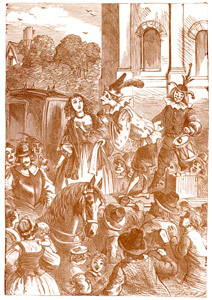
Villiers resolved to see her. Hearing that she was to pass into Whitehall on a certain day, he set up his stage where she could not fail to perceive him. He had something important to say to her. As she drew near, he cried out to the mob that he would give them a song on the Duchess of Richmond and the Duke of Buckingham: nothing could be more acceptable. 'The mob,' it is related, 'stopped the coach and the duchess ... Nay, so outrageous were the mob, that they forced the duchess, who was then the handsomest woman in England, to sit in the boot of the coach, and to hear him sing all his impertinent songs. Having left off singing, he told them it was no more than reason that he should present the duchess with some of the songs. So he alighted from his stage, covered all over with papers and ridiculous little pictures. Having come to the coach, he took off a black piece of taffeta, which he always wore over one of his eyes, when his sister discovered immediately who he was, yet had so much presence of mind as not to give the least sign of mistrust; nay, she gave him some very opprobrious language, but was very eager at snatching the papers he threw into her coach. Among them was a packet of letters, which she had no sooner got but she went forward, the duke, at the head of the mob, attending and hallooing her a good way out of the town.'
VILLIERS IN DISGUISE—THE MEETING WITH HIS SISTER.
A still more daring adventure was contemplated also by this young, irresistible duke. Bridget Cromwell, the eldest daughter of Oliver, was, at that time, a bride of twenty-six years of age; having married, in 1647, the saintly Henry Ireton, Lord Deputy of Ireland. Bridget was the pattern heroine of the 'unco guid,' the quintessence of all propriety; the impersonation of sanctity; an ultra republican, who scarcely accorded to her father the modest title of Protector. She was esteemed by her party a 'personage of sublime growth:' 'humbled, not exalted,' according to Mrs. Hutchinson, by her elevation: 'nevertheless,' says that excellent lady, 'as my Lady Ireton was walking in the St. James's Park, the Lady Lambert, as proud as her husband, came by where she was, and as the present princess always hath precedency of the relict of the dead, so she put by my Lady Ireton, who, notwithstanding her piety and humility, was a little grieved at the affront.'
After this anecdote one cannot give much credence to this lady's humility: Bridget was, however, a woman of powerful intellect, weakened by her extreme, and, to use a now common term, crochety opinions. Like most esprits forts, she was easily imposed upon. One day this paragon saw a mountebank dancing on a stage in the most exquisite style. His fine shape, too, caught the attention of one who assumed to be above all folly. It is sometimes fatal to one's peace to look out of a window; no one knows what sights may rivet or displease. Mistress Ireton was sitting at her window unconscious that any one with the hated and malignant name of 'Villiers' was before her. After some unholy admiration, she sent to speak to the mummer. The duke scarcely knew whether to trust himself in the power of the bloodthirsty Ireton's bride or not—yet his courage—his love of sport—prevailed. He visited her that evening: no longer, however, in his jack-pudding coat, but in a rich suit, disguised with a cloak over it. He wore still a plaster over one eye, and was much disposed to take it off, but prudence forbade; and thus he stood in the presence of the prim and saintly Bridget Ireton. The particulars of the interview rest on his statement, and they must not, therefore, be accepted implicitly. Mistress Ireton is said to have made advances to the handsome incognito. What a triumph to a man like Villiers, to have intrigued with my Lord Protector's sanctified daughter! But she inspired him with disgust. He saw in her the presumption and hypocrisy of her father; he hated her as Cromwell's daughter and Ireton's wife. He told her, therefore, that he was a Jew, and could not by his laws become the paramour of a Christian woman. The saintly Bridget stood amazed; she had imprudently let him into some of the most important secrets of her party. A Jew! It was dreadful! But how could a person of that persuasion be so strict, so strait-laced? She probably entertained all the horror of Jews which the Puritanical party cherished as a virtue; forgetting the lessons of toleration and liberality inculcated by Holy Writ. She sent, however, for a certain Jewish Rabbi to converse with the stranger. What was the Duke of Buckingham's surprise, on visiting her one evening, to see the learned doctor armed at all points with the Talmud, and thirsting for dispute, by the side of the saintly Bridget. He could noways meet such a body of controversy; but thought it best forthwith to set off for the Downs. Before he departed he wrote, however, to Mistress Ireton, on the plea that she might wish to know to what tribe of Jews he belonged. So he sent her a note written with all his native wit and point.[4]
Buckingham now experienced all the miseries that a man of expensive pleasures with a sequestrated estate is likely to endure. One friend remained to watch over his interests in England. This was John Traylman, a servant of his late father's, who was left to guard the collection of pictures made by the late duke, and deposited in York House. That collection was, in the opinion of competent judges, the third in point of value in England, being only inferior to those of Charles I. and the Earl of Arundel.
It had been bought, with immense expense, partly by the duke's agents in Italy, the Mantua Gallery supplying a great portion—partly in France—partly in Flanders; and to Flanders a great portion was destined now to return. Secretly and laboriously did old Traylman pack up and send off these treasures to Antwerp, where now the gay youth whom the aged domestic had known from a child was in want and exile. The pictures were eagerly bought by a foreign collector named Duart. The proceeds gave poor Villiers bread; but the noble works of Titian and Leonardo da Vinci, and others, were lost for ever to England.
It must have been very irritating to Villiers to know that whilst he just existed abroad, the great estates enjoyed by his father were being subjected to pillage by Cromwell's soldiers, or sold for pitiful sums by the Commissioners appointed by the Parliament to break up and annihilate many of the old properties in England. Burleigh-on-the-Hill, the stately seat on which the first duke had lavished thousands, had been taken by the Roundheads. It was so large, and presented so long a line of buildings, that the Parliamentarians could not hold it without leaving in it a great garrison and stores of ammunition. It was therefore burnt, and the stables alone occupied; and those even were formed into a house of unusual size. York House was doubtless marked out for the next destructive decree. There was something in the very history of this house which might be supposed to excite the wrath of the Roundheads. Queen Mary (whom we must not, after Miss Strickland's admirable life of her, call Bloody Queen Mary, but who will always be best known by that unpleasant title) had bestowed York House on the See of York, as a compensation for York House, at Whitehall, which Henry VIII. had taken from Wolsey. It had afterwards come into possession of the Keepers of the Great Seal. Lord Bacon was born in York House, his father having lived there; and the
'Greatest, wisest, meanest of mankind,'
built here an aviary which cost £300. When the Duke of Lennox wished to buy York House, Bacon thus wrote to him:—'For this you will pardon me: York House is the house where my father died, and where I first breathed; and there will I yield my last breath, if it so please God and the King.' It did not, however, please the King that he should; the house was borrowed only by the first Duke of Buckingham from the Archbishop of York, and then exchanged for another seat, on the plea that the duke would want it for the reception of foreign potentates, and for entertainments given to royalty.
The duke pulled it down: and the house, which was erected as a temporary structure, was so superb that even Pepys, twenty years after it had been left to bats and cobwebs, speaks of it in raptures, as of a place in which the great duke's soul was seen in every chamber. On the walls were shields on which the arms of Manners and of Villiers—peacocks and lions—were quartered. York House was never, however, finished; but as the lover of old haunts enters Buckingham Street in the Strand, he will perceive an ancient water-gate, beautifully proportioned, built by Inigo Jones—smoky, isolated, impaired—but still speaking volumes of remembrance of the glories of the assassinated duke, who had purposed to build the whole house in that style.
'Yorschaux,' as he called it—York House—the French ambassador had written word to his friends at home, 'is the most richly fitted up of any that I saw.' The galleries and state rooms were graced by the display of the Roman marbles, both busts and statues, which the first duke had bought from Rubens; whilst in the gardens the Cain and Abel of John of Bologna, given by Philip IV. of Spain to King Charles, and by him bestowed on the elder George Villiers, made that fair pleasaunce famous. It was doomed—as were what were called the 'superstitious' pictures in the house—to destruction: henceforth all was in decay and neglect. 'I went to see York House and gardens,' Evelyn writes in 1655, 'belonging to the former greate Buckingham, but now much ruined through neglect.'
Traylman, doubtless, kept George Villiers the younger in full possession of all that was to happen to that deserted tenement in which the old man mourned for the departed, and thought of the absent.
The intelligence which he had soon to communicate was all-important. York House was to be occupied again; and Cromwell and his coadjutors had bestowed it on Fairfax. The blow was perhaps softened by the reflection that Fairfax was a man of generous temper; and that he had an only daughter, Mary Fairfax, young, and an heiress. Though the daughter of a Puritan, a sort of interest was attached, even by Cavaliers, to Mary Fairfax, from her having, at five years of age, followed her father through the civil wars on horseback, seated before a maid-servant; and having, on her journey, frequently fainted, she was so ill as to have been left in a house by the roadside, her father never expecting to see her again.
In reference to this young girl, then about eighteen years of age, Buckingham now formed a plan. He resolved to return to England disguised, to offer his hand to Mary Fairfax, and so recover his property through the influence of Fairfax. He was confident of his own attractions; and, indeed, from every account, he appears to have been one of those reckless, handsome, speculative characters that often take the fancy of better men than themselves. 'He had,' says Burnet, 'no sort of literature, only he was drawn into chymistry; and for some years he thought he was very near the finding of the philosopher's stone, which had the effect that attends on all such men as he was, when they are drawn in, to lay out for it. He had no principles of religion, virtue, or friendship; pleasure, frolic, or extravagant diversion, was all he laid to heart. He was true to nothing; for he was not true to himself. He had no steadiness nor conduct; he could keep no secret, nor execute any design without spoiling it; he could never fix his thoughts, nor govern his estate, though then the greatest in England. He was bred about the king, and for many years he had a great ascendant over him; but he spoke of him to all persons with that contempt, that at last he drew a lasting disgrace upon himself. And he at length ruined both body and mind, fortune and reputation, equally.'
This was a sad prospect for poor Mary Fairfax, but certainly if in their choice
——'Weak women go astray, Their stars are more in fault than they,'
and she was less to blame in her choice than her father, who ought to have advised her against the marriage. Where and how they met is not known. Mary was not attractive in person: she was in her youth little, brown, and thin, but became a 'short fat body,' as De Grammont tells us, in her early married life; in the later period of her existence she was described by the Vicomtesse de Longueville as a 'little round crumpled woman, very fond of finery;' and she adds that, on visiting the duchess one day, she found her, though in mourning, in a kind of loose robe over her, all edged and laced with gold. So much for a Puritan's daughter!
To this insipid personage the duke presented himself. She soon liked him, and in spite of his outrageous infidelities, continued to like him after their marriage.
He carried his point: Mary Fairfax became his wife on the 6th of September, 1675, and, by the influence of Fairfax, his estate, or, at all events, a portion of the revenues, about £4,000 a year, it is said, were restored to him. Nevertheless, it is mortifying to find that in 1682, he sold York House, in which his father had taken such pride, for £30,000. The house was pulled down; streets were erected on the gardens: George Street, Villiers Street, Duke Street, Buckingham Street, Off Alley recall the name of the ill-starred George, first duke, and of his needy, profligate son; but the only trace of the real greatness of the family importance thus swept away is in the motto inscribed on the point of old Inigo's water-gate, towards the street: 'Fidei coticula crux.' It is sad for all good royalists to reflect that it was not the rabid Roundhead, but a degenerate Cavalier, who sold and thus destroyed York House.
The marriage with Mary Fairfax, though one of interest solely, was not a mésalliance: her father was connected by the female side with the Earls of Rutland; he was also a man of a generous spirit, as he had shown, in handing over to the Countess of Derby the rents of the Isle of Man, which had been granted to him by the Parliament. In a similar spirit he was not sorry to restore York House to the Duke of Buckingham.
Cromwell, however, was highly exasperated by the nuptials between Mary Fairfax and Villiers, which took place at Nun-Appleton, near York, one of Fairfax's estates. The Protector had, it is said, intended Villiers for one of his own daughters. Upon what plea he acted it is not stated: he committed Villiers to the Tower, where he remained until the death of Oliver, and the accession of Richard Cromwell.
In vain did Fairfax solicit his release: Cromwell refused it, and Villiers remained in durance until the abdication of Richard Cromwell, when he was set at liberty, but not without the following conditions, dated February 21st, 1658-9:—
'The humble petition of George Duke of Buckingham was this day read. Resolved that George Duke of Buckingham, now prisoner at Windsor Castle, upon his engagement upon his honour at the bar of this House, and upon the engagement of Lord Fairfax in £20,000 that the said duke shall peaceably demain himself for the future, and shall not join with, or abet, or have any correspondence with, any of the enemies of the Lord Protector, and of this Commonwealth, in any of the parts beyond the sea, or within this Commonwealth, shall be discharged of his imprisonment and restraint; and that the Governor of Windsor Castle be required to bring the Duke of Buckingham to the bar of this House on Wednesday next, to engage his honour accordingly. Ordered, that the security of £20,000 to be given by the Lord Fairfax, on the behalf of the Duke of Buckingham, be taken in the name of His Highness the Lord Protector.'
During his incarceration at Windsor, Buckingham had a companion, of whom many a better man might have been envious: this was Abraham Cowley, an old college friend of the duke's. Cowley was the son of a grocer, and owed his entrance into academic life to having been a King's Scholar at Westminster. One day he happened to take up from his mother's parlour window a copy of Spenser's 'Faerie Queene.' He eagerly perused the delightful volume, though he was then only twelve years old: and this impulse being given to his mind, became at fifteen a reciter of verses. His 'Poetical Blossoms,' published whilst he was still at school, gave, however, no foretaste of his future eminence. He proceeded to Trinity College, Cambridge, where his friendship with Villiers was formed; and where, perhaps, from that circumstance, Cowley's predilections for the cause of the Stuarts was ripened into loyalty.
No two characters could be more dissimilar than those of Abraham Cowley and George Villiers. Cowley was quiet, modest, sober, of a thoughtful, philosophical turn, and of an affectionate nature; neither boasting of his own merits nor depreciating others. He was the friend of Lucius Cary, Lord Falkland; and yet he loved, though he must have condemned, George Villiers. It is not unlikely that, whilst Cowley imparted his love of poetry to Villiers, Villiers may have inspired the pensive and blameless poet with a love of that display of wit then in vogue, and heightened that sense of humour which speaks forth in some of Cowley's productions. Few authors suggest so many new thoughts, really his own, as Cowley. 'His works,' it has been said, 'are a flower-garden run to weeds, but the flowers are numerous and brilliant, and a search after them will repay the pains of a collector who is not too indolent or fastidious.'
As Cowley and his friend passed the weary hours in durance, many an old tale could the poet tell the peer of stirring times; for Cowley had accompanied Charles I. in many a perilous journey, and had protected Queen Henrietta Maria in her escape to France: through Cowley had the correspondence of the royal pair, when separated, been carried on. The poet had before suffered imprisonment for his loyalty; and, to disguise his actual occupation, had obtained the degree of Doctor of Medicine, and assumed the character of a physician, on the strength of knowing the virtues of a few plants.
Many a laugh, doubtless, had Buckingham at the expense of Dr. Cowley: however, in later days, the duke proved a true friend to the poet, in helping to procure for him the lease of a farm at Chertsey from the queen, and here Cowley, rich upon £300 a year, ended his days.
For some time after Buckingham's release, he lived quietly and respectably at Nun-Appleton, with General Fairfax and the vapid Mary. But the Restoration—the first dawnings of which have been referred to in the commencement of this biography—ruined him, body and mind.
He was made a Lord of the Bedchamber, a Member of the Privy Council, and afterwards Master of the Horse,[5] and Lord Lieutenant of Yorkshire. He lived in great magnificence at Wallingford House; a tenement next to York House, intended to be the habitable and useful appendage to that palace.
He was henceforth, until he proved treacherous to his sovereign, the brightest ornament of Whitehall. Beauty of person was hereditary: his father was styled the 'handsomest-bodied man in England,' and George Villiers the younger equalled George Villiers the elder in all personal accomplishments. When he entered the Presence-Chamber all eyes followed him; every movement was graceful and stately. Sir John Reresby pronounced him 'to be the finest gentleman he ever saw.' 'He was born,' Madame Dunois declared, 'for gallantry and magnificence.' His wit was faultless, but his manners engaging; yet his sallies often descended into buffoonery, and he spared no one in his merry moods. One evening a play of Dryden's was represented. An actress had to spout forth this line—
'My wound is great because it is so small!'
She gave it out with pathos, paused, and was theatrically distressed. Buckingham was seated in one of the boxes. He rose, all eyes were fixed upon a face well known in all gay assemblies, in a tone of burlesque he answered—
'Then 'twould be greater were it none at all.'
Instantly the audience laughed at the Duke's tone of ridicule, and the poor woman was hissed off the stage.
The king himself did not escape Buckingham's shafts; whilst Lord Chancellor Clarendon fell a victim to his ridicule: nothing could withstand it. There, not in that iniquitous gallery at Whitehall, but in the king's privy chambers, Villiers might be seen, in all the radiance of his matured beauty. His face was long and oval, with sleepy, yet glistening eyes, over which large arched eyebrows seemed to contract a brow on which the curls of a massive wig (which fell almost to his shoulders) hung low. His nose was long, well formed, and flexible; his lips thin and compressed, and defined, as the custom was, by two very short, fine, black patches of hair, looking more like strips of sticking-plaster than a moustache. As he made his reverence, his rich robes fell over a faultless form. He was a beau to the very fold of the cambric band round his throat; with long ends of the richest, closest point that was ever rummaged out from a foreign nunnery to be placed on the person of this sacrilegious sinner.
Behold, now, how he changes. Villiers is Villiers no longer. He is Clarendon, walking solemnly to the Court of the Star Chamber: a pair of bellows is hanging before him for the purse; Colonel Titus is walking with a fire shovel on his shoulder, to represent a mace; the king, himself a capital mimic, is splitting his sides with laughter; the courtiers are fairly in a roar. Then how he was wont to divert the king with his descriptions! 'Ipswich, for instance,' he said, 'was a town without inhabitants—a river it had without water—streets without names; and it was a place where asses wore boots:' alluding to the asses, when employed in rolling Lord Hereford's bowling-green, having boots on their feet to prevent their injuring the turf.
Flecknoe, the poet, describes the duke at this period, in 'Euterpe Revived'—
The gallant'st person, and the noblest minde, In all the world his prince could ever finde, Or to participate his private cares, Or bear the public weight of his affairs, Like well-built arches, stronger with their weight, And well-built minds, the steadier with their height; Such was the composition and frame O' the noble and the gallant Buckingham.'
The praise, however, even in the duke's best days, was overcharged. Villiers was no 'well-built arch,' nor could Charles trust to the fidelity of one so versatile for an hour. Besides, the moral character of Villiers must have prevented him, even in those days, from bearing 'the public weight of affairs.'
A scandalous intrigue soon proved the unsoundness of Flecknoe's tribute. Amongst the most licentious beauties of the court was Anna Maria, Countess of Shrewsbury, the daughter of Robert Brudenel, Earl of Cardigan, and the wife of Francis, Earl of Shrewsbury: amongst many shameless women she was the most shameless, and her face seems to have well expressed her mind. In the round, fair visage, with its languishing eyes, and full, pouting mouth, there is something voluptuous and bold. The forehead is broad, but low; and the wavy hair, with its tendril curls, comes down almost to the fine arched eyebrows, and then, falling into masses, sets off white shoulders which seem to designate an inelegant amount of embonpoint. There is nothing elevated in the whole countenance, as Lely has painted her, and her history is a disgrace to her age and time.
She had numerous lovers (not in the refined sense of the word), and, at last, took up with Thomas Killigrew. He had been, like Villiers, a royalist: first a page to Charles I., next a companion of Charles II., in exile. He married the fair Cecilia Croft; yet his morals were so vicious that even in the Court of Venice to which he was accredited, in order to borrow money from the merchants of that city, he was too profligate to remain. He came back with Charles II., and was Master of the Revels, or King's Jester, as the court considered him, though without any regular appointment, during his life: the butt, at once, and the satirist of Whitehall.
It was Killigrew's wit and descriptive powers which, when heightened by wine, were inconceivably great, that induced Villiers to select Lady Shrewsbury for the object of his admiration. When Killigrew perceived that he was supplanted by Villiers, he became frantic with rage, and poured out the bitterest invectives against the countess. The result was that, one night, returning from the Duke of York's apartments at St. James's, three passes with a sword were made at him through his chair, and one of them pierced his arm. This, and other occurrences, at last aroused the attention of Lord Shrewsbury, who had hitherto never doubted his wife: he challenged the Duke of Buckingham; and his infamous wife, it is said, held her paramour's horse, disguised as a page. Lord Shrewsbury was killed,[6] and the scandalous intimacy went on as before. No one but the queen, no one but the Duchess of Buckingham, appeared shocked at this tragedy, and no one minded their remarks, or joined in their indignation: all moral sense was suspended, or wholly stifled; and Villiers gloried in his depravity, more witty, more amusing, more fashionable than ever; and yet he seems, by the best-known and most extolled of his poems, to have had some conception of what a real and worthy attachment might be.
The following verses are to his 'Mistress':—
'What a dull fool was I To think so gross a lie, As that I ever was in love before! I have, perhaps, known one or two, With whom I was content to be At that which they call keeping company. But after all that they could do, I still could be with more. Their absence never made me shed a tear; And I can truly swear, That, till my eyes first gazed on you, I ne'er beheld the thing I could adore. 'A world of things must curiously be sought: A world of things must be together brought To make up charms which have the power to make, Through a discerning eye, true love; That is a master-piece above What only looks and shape can do; There must be wit and judgment too, Greatness of thought, and worth, which draw, From the whole world, respect and awe. 'She that would raise a noble love must find Ways to beget a passion for her mind; She must be that which she to be would seem, For all true love is grounded on esteem: Plainness and truth gain more a generous heart Than all the crooked subtleties of art. She must be—what said I?—she must be you: None but yourself that miracle can do. At least, I'm sure, thus much I plainly see, None but yourself e'er did it upon me. 'Tis you alone that can my heart subdue, To you alone it always shall be true.'
The next lines are also remarkable for the delicacy and happy turn of the expressions—
'Though Phillis, from prevailing charms, Have forc'd my Delia from my arms, Think not your conquest to maintain By rigour or unjust disdain. In vain, fair nymph, in vain you strive, For Love doth seldom Hope survive. My heart may languish for a time, As all beauties in their prime Have justified such cruelty, By the same fate that conquered me. When age shall come, at whose command Those troops of beauty must disband— A rival's strength once took away, What slave's so dull as to obey? But if you'll learn a noble way To keep his empire from decay, And there for ever fix your throne, Be kind, but kind to me alone.'
Like his father, who ruined himself by building, Villiers had a monomania for bricks and mortar, yet he found time to write 'The Rehearsal,' a play on which Mr. Reed in his 'Dramatic Biography' makes the following observation: 'It is so perfect a masterpiece in its way, and so truly original, that notwithstanding its prodigious success, even the task of imitation, which most kinds of excellence have invited inferior geniuses to undertake, has appeared as too arduous to be attempted with regard to this, which through a whole century stands alone, notwithstanding that the very plays it was written expressly to ridicule are forgotten, and the taste it was meant to expose totally exploded.'
The reverses of fortune which brought George Villiers to abject misery were therefore, in a very great measure, due to his own misconduct, his depravity, his waste of life, his perversion of noble mental powers: yet in many respects he was in advance of his age. He advocated, in the House of Lords, toleration to Dissenters. He wrote a 'Short Discourse on the Reasonableness of Men's having a Religion, or Worship of God;' yet, such was his inconsistency, that in spite of these works, and of one styled a 'Demonstration of the Deity,' written a short time before his death, he assisted Lord Rochester in his atheistic poem upon 'Nothing.'
Butler, the author of Hudibras, too truly said of Villiers 'that he had studied the whole body of vice;' a most fearful censure—a most significant description of a bad man. 'His parts,' he adds, 'are disproportionate to the whole, and like a monster, he has more of some, and less of others, than he should have. He has pulled down all that nature raised in him, and built himself up again after a model of his own. He has dammed up all those lights that nature made into the noblest prospects of the world, and opened other little blind loopholes backward by turning day into night, and night into day.'
The satiety and consequent misery produced by this terrible life are ably described by Butler. And it was perhaps partly this wearied, worn-out spirit that caused Villiers to rush madly into politics for excitement. In 1666 he asked for the office of Lord President of the North; it was refused: he became disaffected, raised mutinies, and, at last, excited the indignation of his too-indulgent sovereign. Charles dismissed him from his office, after keeping him for some time in confinement. After this epoch little is heard of Buckingham but what is disgraceful. He was again restored to Whitehall, and, according to Pepys, even closeted with Charles, whilst the Duke of York was excluded. A certain acquaintance of the duke's remonstrated with him upon the course which Charles now took in Parliament. 'How often have you said to me,' this person remarked, 'that the king was a weak man, unable to govern, but to be governed, and that you could command him as you liked? Why do you suffer him to do these things?'
'Why,' answered the duke, 'I do suffer him to do these things, that I may hereafter the better command him.' A reply which betrays the most depraved principle of action, whether towards a sovereign or a friend, that can be expressed. His influence was for some time supreme, yet he became the leader of the opposition, and invited to his table the discontented peers, to whom he satirized the court, and condemned the king's want of attention to business. Whilst the theatre was ringing with laughter at the inimitable character of Bayes in the 'Rehearsal,' the House of Lords was listening with profound attention to the eloquence that entranced their faculties, making wrong seem right, for Buckingham was ever heard with attention.
Taking into account his mode of existence, 'which,' says Clarendon, 'was a life by night more than by day, in all the liberties that nature could desire and wit invent,' it was astonishing how extensive an influence he had in both Houses of Parliament. 'His rank and condescension, the pleasantness of his humours and conversation, and the extravagance and keenness of his wit, unrestrained by modesty or religion, caused persons of all opinions and dispositions to be fond of his company, and to imagine that these levities and vanities would wear off with age, and that there would be enough of good left to make him useful to his country, for which he pretended a wonderful affection.'
But this brilliant career was soon checked. The varnish over the hollow character of this extraordinary man was eventually rubbed off. We find the first hint of that famous coalition styled the Cabal in Pepys's Diary, and henceforth the duke must be regarded as a ruined man.
'He' (Sir H. Cholmly) 'tells me that the Duke of Buckingham his crimes, as far as he knows, are his being of a cabal with some discontented persons of the late House of Commons, and opposing the desires of the king in all his matters in that House; and endeavouring to become popular, and advising how the Commons' House should proceed, and how he would order the House of Lords. And he hath been endeavouring to have the king's nativity calculated; which was done, and the fellow now in the Tower about it.... This silly lord hath provoked, by his ill carriage, the Duke of York, my Lord Chancellor, and all the great persons, and therefore most likely will die.'
One day, in the House of Lords, during a conference between the two Houses, Buckingham leaned rudely over the shoulder of Henry Pierrepont Marquis of Dorchester. Lord Dorchester merely removed his elbow. Then the duke asked him if he was uneasy. 'Yes,' the marquis replied, adding, 'the duke dared not do this if he were anywhere else.' Buckingham retorted, 'Yes, he would: and he was a better man than my lord marquis:' on which Dorchester told him that he lied. On this Buckingham struck off Dorchester's hat, seized him by the periwig, pulled it aside, and held him. The Lord Chamberlain and others interposed and sent them both to the Tower. Nevertheless, not a month afterwards, Pepys speaks of seeing the duke's play of 'The Chances' acted at Whitehall. 'A good play,' he condescends to say, 'I find it, and the actors most good in it; and pretty to hear Knipp sing in the play very properly "All night I weepe," and sung it admirably. The whole play pleases me well: and most of all, the sight of many fine ladies, amongst others, my Lady Castlemaine and Mrs. Middleton.'
The whole management of public affairs was, at this period, intrusted to five persons, and hence the famous combination, the united letters of which formed the word 'Cabal:'—Clifford, Arlington, Buckingham, Ashley, and Lauderdale. Their reprehensible schemes, their desperate characters, rendered them the opprobrium of their age, and the objects of censure to all posterity. Whilst matters were in this state a daring outrage, which spoke fearfully of the lawless state of the times, was ascribed, though wrongly, to Buckingham. The Duke of Ormond, the object of his inveterate hatred, was at that time Lord Lieutenant of Ireland. Colonel Blood,—a disaffected disbanded officer of the Commonwealth, who had been attainted for a conspiracy in Ireland, but had escaped punishment,—came to England, and acted as a spy for the 'Cabal,' who did not hesitate to countenance this daring scoundrel.
His first exploit was to attack the Duke of Ormond's coach one night in St. James's Street: to secure his person, bind him, put him on horseback after one of his accomplices, and carry him to Tyburn, where he meant to hang his grace. On their way, however, Ormond, by a violent effort, threw himself on the ground; a scuffle ensued: the duke's servants came up, and after receiving the fire of Blood's pistols, the duke escaped. Lord Ossory, the Duke of Ormond's son, on going afterward to court, met Buckingham, and addressed him in these words:—
'My lord, I know well that you are at the bottom of this late attempt on my father; but I give you warning, if he by any means come to a violent end, I shall not be at a loss to know the author. I shall consider you as an assassin, and shall treat you as such; and wherever I meet you I shall pistol you, though you stood behind the king's chair; and I tell it you in his majesty's presence, that you may be sure I shall not fail of performance.'
Blood's next feat was to carry off from the Tower the crown jewels. He was overtaken and arrested: and was then asked to name his accomplices. 'No,' he replied, 'the fear of danger shall never tempt me to deny guilt or to betray a friend.' Charles II., with undignified curiosity, wished to see the culprit. On inquiring of Blood how he dared to make so bold an attempt on the crown, the bravo answered, 'My father lost a good estate fighting for the crown, and I considered it no harm to recover it by the crown.' He then told his majesty how he had resolved to assassinate him: how he had stood among the reeds in Battersea-fields with this design; how then, a sudden awe had come over him: and Charles was weak enough to admire Blood's fearless bearing and to pardon his attempt. Well might the Earl of Rochester write of Charles—
'Here lies my sovereign lord the king, Whose word no man relies on; Who never said a foolish thing, And never did a wise one.'
Notwithstanding Blood's outrages—the slightest penalty for which in our days would have been penal servitude for life—Evelyn met him, not long afterwards, at Lord Clifford's, at dinner, when De Grammont and other French noblemen were entertained. 'The man,' says Evelyn, 'had not only a daring, but a villanous, unmerciful look, a false countenance; but very well-spoken, and dangerously insinuating.'
Early in 1662, the Duke of Buckingham had been engaged in practices against the court: he had disguised deep designs by affecting the mere man of pleasure. Never was there such splendour as at Wallingford House—such wit and gallantry; such perfect good breeding; such apparently openhanded hospitality. At those splendid banquets, John Wilmot, Earl of Rochester, 'a man whom the Muses were fond to inspire, but ashamed to avow,' showed his 'beautiful face,' as it was called; and chimed in with that wit for which the age was famous. The frequenters at Wallingford House gloried in their indelicacy. 'One is amazed,' Horace Walpole observes, 'at hearing the age of Charles II. called polite. The Puritans have affected to call everything by a Scripture' name; the new comers affected to call everything by its right name;
'As if preposterously they would confess A forced hypocrisy in wickedness.'
Walpole compares the age of Charles II. to that of Aristophanes—'which called its own grossness polite.' How bitterly he decries the stale poems of the time as 'a heap of senseless ribaldry;' how truly he shows that licentiousness weakens as well as depraves the judgment. 'When Satyrs are brought to court,' he observes, 'no wonder the Graces would not trust themselves there.'
The Cabal is said, however, to have been concocted, not at Wallingford House, but at Ham House, near Kingston-on-Thames.
In this stately old manor-house, the abode of the Tollemache family, the memory of Charles II. and of his court seems to linger still. Ham House was intended for the residence of Henry, Prince of Wales, and was built in 1610. It stands near the river Thames; and is flanked by noble avenues of elm and of chestnut trees, down which one may almost, as it were, hear the king's talk with his courtiers; see Arlington approach with the well-known patch across his nose; or spy out the lovely, childish Miss Stuart and her future husband, the Duke of Richmond, slipping behind into the garden, lest the jealous mortified king should catch a sight of the 'conscious lovers.'
This stately structure was given by Charles II., in 1672, to the Duke and Duchess of Lauderdale: she, the supposed mistress of Cromwell; he, the cruel, hateful Lauderdale of the Cabal. This detestable couple, however, furnished with massive grandeur the apartments of Ham House. They had the ceilings painted by Verrio; the furniture was rich, and even now the bellows and brushes in some of the rooms are of silver filigree. One room is furnished with yellow damask, still rich, though faded; the very seats on which Charles, looking around him, saw Clifford, Arlington, Buckingham, Ashley (the infamous Shaftesbury), and Lauderdale—and knew not, good easy man, that he was looking on a band of traitors—are still there. Nay, he even sat to Sir Peter Lely for a portrait for this very place—in which, schemes for the ruin of the kingdom were concocted. All, probably, was smooth and pleasing to the monarch as he ranged down the fine gallery, ninety-two feet long; or sat at dinner amid his foes in that hall, surrounded with an open balustrade; or disported himself on the river's green brink. Nay, one may even fancy Nell Gwynn taking a day's pleasure in this then lone and ever sweet locality. We hear her swearing, as she was wont to do, perchance at the dim looking-glasses, her own house in Pall Mall, given her by the king, having been filled up, for the comedian, entirely, ceiling and all, with looking-glass. How bold and pretty she looked in her undress! Even Pepys—no very sound moralist, though a vast hypocrite—tells us: Nelly, 'all unready' was 'very pretty, prettier far than he thought.' But to see how she was 'painted,' would, he thought, 'make a man mad.'
'Madame Ellen,' as after her elevation, as it was termed, she was called, might, since she held long a great sway over Charles's fancy, be suffered to scamper about Ham House—where her merry laugh perhaps scandalised the now Saintly Duchess of Lauderdale,—just to impose on the world; for Nell was regarded as the Protestant champion of the court, in opposition to her French rival, the Duchess of Portsmouth.
Let us suppose that she has been at Ham House, and is gone off to Pall Mall again, where she can see her painted face in every turn. The king has departed, and Killigrew, who, at all events, is loyal, and the true-hearted Duke of Richmond, all are away to London. In yon sanctimonious-looking closet, next to the duchess's bed-chamber, with her psalter and her prayer-book on her desk, which is fixed to her great chair, and that very cane which still hangs there serving as her support when she comes forth from that closet, murmur and wrangle the component parts of that which was never mentioned without fear—the Cabal. The conspirators dare not trust themselves in the gallery: there is tapestry there, and we all know what coverts there are for eaves-droppers and spiders in tapestried walls: then the great Cardinal spiders do so click there, are so like the death-watch, that Villiers, who is inveterately superstitious, will not abide there. The hall, with its enclosing galleries, and the buttery near, are manifestly unsafe. So they heard, nay crouch, mutter, and concoct that fearful treachery which, as far as their country is concerned, has been a thing apart in our annals, in 'my Lady's' closet. Englishmen are turbulent, ambitious, unscrupulous; but the craft of Maitland, Duke of Lauderdale—the subtlety of Ashley, seem hardly conceivable either in a Scot or Southron.
These meetings had their natural consequence. One leaves Lauderdale, Arlington, Ashley, and Clifford, to their fate. But the career of Villiers inspires more interest. He seemed born for better things. Like many men of genius, he was so credulous that the faith he pinned on one Heydon, an astrologer, at this time, perhaps buoyed him up with false hopes. Be it as it may, his plots now tended to open insurrection. In 1666, a proclamation had been issued for his apprehension—he having then absconded. On this occasion he was saved by the act of one whom he had injured grossly—his wife. She managed to outride the serjeant-at-arms, and to warn him of his danger. She had borne his infidelities, after the fashion of the day, as a matter of course: jealousy was then an impertinence—constancy, a chimera; and her husband, whatever his conduct, had ever treated her with kindness of manner; he had that charm, that attribute of his family, in perfection, and it had fascinated Mary Fairfax.
He fled, and played for a year successfully the pranks of his youth. At last, worn out, he talked of giving himself up to justice. 'Mr. Fenn, at the table, says that he hath been taken by the watch two or three times of late, at unseasonable hours, but so disguised they did not know him; and when I come home, by and by, Mr. Lowther tells me that the Duke of Buckingham do dine publickly this day at Wadlow's, at the Sun Tavern; and is mighty merry, and sent word to the Lieutenant of the Tower, that he would come to him as soon as he dined.' So Pepys states.
Whilst in the Tower—to which he was again committed—Buckingham's pardon was solicited by Lady Castlemaine; on which account the king was very angry with her; called her a meddling 'jade;' she calling him 'fool,' and saying if he was not a fool he never would suffer his best subjects to be imprisoned—referring to Buckingham. And not only did she ask his liberty, but the restitution of his places. No wonder there was discontent when such things were done, and public affairs were in such a state. We must again quote the graphic, terse language of Pepys:—'It was computed that the Parliament had given the king for this war only, besides all prizes, and besides the £200,000 which he was to spend of his own revenue, to guard the sea, above £5,000,000, and odd £100,000; which is a most prodigious sum. Sir H. Cholmly, as a true English gentleman, do decry the king's expenses of his privy purse, which in King James's time did not rise to above £5,000 a year, and in King Charles's to £10,000, do now cost us above £100,000, besides the great charge of the monarchy, as the Duke of York has £100,000 of it, and other limbs of the royal family.'
In consequence of Lady Castlemaine's intervention, Villiers was restored to liberty—a strange instance, as Pepys remarks, of the 'fool's play' of the age. Buckingham was now as presuming as ever: he had a theatre of his own, and he soon showed his usual arrogance by beating Henry Killigrew on the stage, and taking away his coat and sword; all very 'innocently' done, according to Pepys. In July he appeared in his place in the House of Lords, as 'brisk as ever,' and sat in his robes, 'which,' says Pepys, 'is a monstrous thing that a man should be proclaimed against, and put in the Tower, and released without any trial, and yet not restored to his places.'
We next find the duke intrusted with a mission to France, in concert with Halifax and Arlington. In the year 1680, he was threatened with an impeachment, in which, with his usual skill, he managed to exculpate himself by blaming Lord Arlington. The House of Commons passed a vote for his removal; and he entered the ranks of the opposition.
But this career of public meanness and private profligacy was drawing to a close. Alcibiades no longer—his frame wasted by vice—his spirits broken by pecuniary difficulties—Buckingham's importance visibly sank away. 'He remained, at last,' to borrow the words of Hume, 'as incapable of doing hurt as he had ever been little desirous of doing good to mankind.' His fortune had now dwindled down to £300 a year in land; he sold Wallingford House, and removed into the City.
And now the fruits of his adversity, not, we hope, too late, began to appear. Like Lord Rochester, who had ordered all his immoral works to be burnt, Buckingham now wished to retrieve the past. In 1685 he wrote the religious works which form so striking a contrast with his other productions.
That he had been up to the very time of his ruin perfectly impervious to remorse, dead also to shame, is amply manifested by his conduct soon after his duel with the Earl of Shrewsbury.
Sir George Etherege had brought out a new play at the Duke of York's Theatre. It was called, 'She Would if she Could.' Plays in those days began at what we now consider our luncheon hour. Though Pepys arrived at the theatre on this occasion at two o'clock—his wife having gone before—about a thousand people had then been put back from the pit. At last, seeing his wife in the eighteen-penny-box, Samuel 'made shift' to get there and there saw, 'but lord!' (his own words are inimitable) 'how dull, and how silly the play, there being nothing in the world good in it, and few people pleased in it. The king was there; but I sat mightily behind, and could see but little, and hear not at all. The play being done, I went into the pit to look for my wife, it being dark and raining, but could not find her; and so staid, going between the two doors and through the pit an hour and a half, I think, after the play was done; the people staying there till the rain was over, and to talk to one another. And among the rest, here was the Duke of Buckingham to-day openly in the pit; and there I found him with my Lord Buckhurst, and Sedley, and Etheridge the poet, the last of whom I did hear mightily find fault with the actors, that they were out of humour, and had not their parts perfect, and that Harris did do nothing, nor could so much as sing a ketch in it; and so was mightily concerned, while all the rest did, through the whole pit, blame the play as a silly, dull thing, though there was something very roguish and witty; but the design of the play, and end, mighty insipid.'
Buckingham had held out to his Puritan friends the hope of his conversion for some years; and when they attempted to convert him, he had appointed a time for them to finish their work. They kept their promise, and discovered him in the most profligate society. It was indeed impossible to know in what directions his fancies might take him, when we find him believing in the predictions of a poor fellow in a wretched lodging near Tower Hill, who, having cast his nativity, assured the duke he would be king.
He had continued for years to live with the Countess of Shrewsbury, and two months after her husband's death, had taken her to his home. Then, at last, the Duchess of Buckingham indignantly observed, that she and the countess could not possibly live together. 'So I thought, madam,' was the reply. 'I have therefore ordered your coach to take you to your father's.' It has been asserted that Dr. Sprat, the duke's chaplain, actually married him to Lady Shrewsbury, and that his legal wife was thenceforth styled 'The Duchess-dowager.'
He retreated with his mistress to Claverdon, near Windsor, situated on the summit of a hill which is washed by the Thames. It is a noble building, with a great terrace in front, under which are twenty-six niches, in which Buckingham had intended to place twenty-six statues as large as life; and in the middle is an alcove with stairs. Here he lived with the infamous countess, by whom he had a son, whom he styled Earl of Coventry, (his second title,) and who died an infant.
One lingers still over the social career of one whom Louis XIV. called 'the only English gentleman he had ever seen.' A capital retort was made to Buckingham by the Princess of Orange, during an interview, when he stopped at the Hague, between her and the Duke. He was trying diplomatically to convince her of the affection of England for the States. 'We do not,' he said, 'use Holland like a mistress, we love her as a wife.' 'Vraiment je crois que vous nous aimez comme vous aimez la vôtre,' was the sharp and clever answer.
On the death of Charles II., in 1685, Buckingham retired to the small remnant of his Yorkshire estates. His debts were now set down at the sum of £140,000. They were liquidated by the sale of his estates. He took kindly to a country life, to the surprise of his old comrade in pleasure, Etherege. 'I have heard the news,' that wit cried, alluding to this change, 'with no less astonishment than if I had been told that the Pope had begun to wear a periwig and had turned beau in the seventy-fourth year of his age!'
Father Petre and Father Fitzgerald were sent by James II. to convert the duke to Popery. The following anecdote is told of their conference with the dying sinner:—'We deny,' said the Jesuit Petre, 'that any one can be saved out of our Church. Your grace allows that our people may be saved.'—'No,' said the duke, 'I make no doubt you will all be damned to a man!' 'Sir,' said the father, 'I cannot argue with a person so void of all charity.'—'I did not expect, my reverend father,' said the duke, 'such a reproach from you, whose whole reasoning was founded on the very same instance of want of charity to yourself.'
Buckingham's death took place at Helmsby, in Yorkshire, and the immediate cause was an ague and fever, owing to having sat down on the wet grass after fox-hunting. Pope has given the following forcible, but inaccurate account of his last hours, and the place in which they were passed:—
'In the worst inn's worst room, with mat half hung, The floors of plaster and the walls of dung, On once a flock-bed, but repaired with straw, With tape-tied curtains never meant to draw; The George and Garter dangling from that bed, Where tawdry yellow strove with dirty red, Great Villiers lies:—alas! how changed from him, That life of pleasure and that soul of whim! Gallant and gay, in Claverdon's proud alcove, The bower of wanton Shrewsbury and love, Or, just as gay, at council in a ring Of mimic'd statesmen and their merry King. No wit to flatter left of all his store, No fool to laugh at, which he valued more, Then victor of his health, of fortune, friends, And fame, this lord of useless thousands ends.'
Far from expiring in the 'worst inn's worst room,' the duke breathed his last in Kirby Moorside, in a house which had once been the best in the place. Brian Fairfax, who loved this brilliant reprobate, has left the only authentic account on record of his last hours.
The night previous to the duke's death Fairfax had received a message from him desiring him to prepare a bed for him in his house, Bishop Hill, in York. The next day, however, Fairfax was sent for to his master, whom he found dying. He was speechless, but gave the afflicted servant an earnest look of recognition.
The Earl of Arran, son of the Duke of Hamilton, and a gentleman of the neighbourhood, stood by his bedside. He had then received the Holy Communion from a neighbouring clergyman of the Established Church. When the minister came it is said that he inquired of the duke what religion he professed. 'It is,' replied the dying man, 'an insignificant question, for I have been a shame and a disgrace to all religions: if you can do me any good, pray do.' When a Popish priest had been mentioned to him, he answered vehemently, 'No, no!'
He was in a very low state when Lord Arran had found him. But though that nobleman saw death in his looks, the duke said he 'felt so well at heart that he knew he could be in no danger.'
He appeared to have had inflammation in the bowels, which ended in mortification. He begged of Lord Arran to stay with him. The house seems to have been in a most miserable condition, for in a letter from Lord Arran to Dr. Sprat, he says, 'I confess it made my heart bleed to see the Duke of Buckingham in so pitiful a place, and so bad a condition, and what made it worse, he was not at all sensible of it, for he thought in a day or two he should be well; and when we reminded him of his condition, he said it was not as we apprehended. So I sent for a worthy gentleman, Mr. Gibson, to be assistant to me in this work; so we jointly represented his condition to him, who I saw was at first very uneasy; but I think we should not have discharged the duties of honest men if we had suffered him to go out of this world without desiring him to prepare for death.' The duke joined heartily in the beautiful prayers for the dying, of our Church, and yet there was a sort of selfishness and indifference to others manifest even at the last.
'Mr. Gibson,' writes Lord Arran, 'asked him if he had made a will, or if he would declare who was to be his heir? but to the first, he answered he had made none; and to the last, whoever was named he answered, "No." First, my lady duchess was named, and then I think almost everybody that had any relation to him, but his answer always was, "No." I did fully represent my lady duchess' condition to him, but nothing that was said to him could make him come to any point.'
In this 'retired corner,' as Lord Arran terms it, did the former wit and beau, the once brave and fine cavalier, the reckless plotter in after-life, end his existence. His body was removed to Helmsby Castle, there to wait the duchess' pleasure, being meantime embalmed. Not one farthing could his steward produce to defray his burial. His George and blue ribbon were sent to the King James, with an account of his death.
In Kirby Moorside the following entry in the register of burials records the event, which is so replete with a singular retributive justice—so constituted to impress and sadden the mind:—
'Georges Villus Lord dooke of Buckingham.'
He left scarcely a friend to mourn his life; for to no man had he been true. He died on the 16th of April according to some accounts; according to others, on the third of that month, 1687, in the sixty-first year of his age. His body, after being embalmed, was deposited in the family vault in Henry VII.'s chapel.[7] He left no children, and his title was therefore extinct. The Duchess of Buckingham, of whom Brian Fairfax remarks, 'that if she had none of the vanities, she had none of the vices of the court,' survived him several years. She died in 1705, at the age of sixty-six, and was buried in the vault of the Villiers' family, in the chapel of Henry VII.
Such was the extinction of all the magnificence and intellectual ascendency that at one time centred in the great and gifted family of Villiers.