Front matter (continued 3)
Reading edition
At the end of the summer when the first frost had touched the leaves and dressed them in red and yellow garb; when a blue haze hung over the landscape and the air was balmy with the summer's departing fragrance, the pastor and his wife bade an affectionate farewell to the friends who had been so kindly hospitable, and returned to Edgerly.
Pauline, capable, willing and always considerate, preceded them and had the parsonage aired and renovated when Mr. and Mrs. Thorpe arrived.
Mrs. Thorpe expostulated: "You should have waited and allowed me to help you," she said. "I can never repay you for all your kindness."
"The dust and close air would have been bad for Maurice," Pauline replied. "And, my dear," she said, "you have been with Maurice constantly and perhaps you cannot see as I can that the summer has not improved his health. To me he seems thinner and more broken than when he went away."
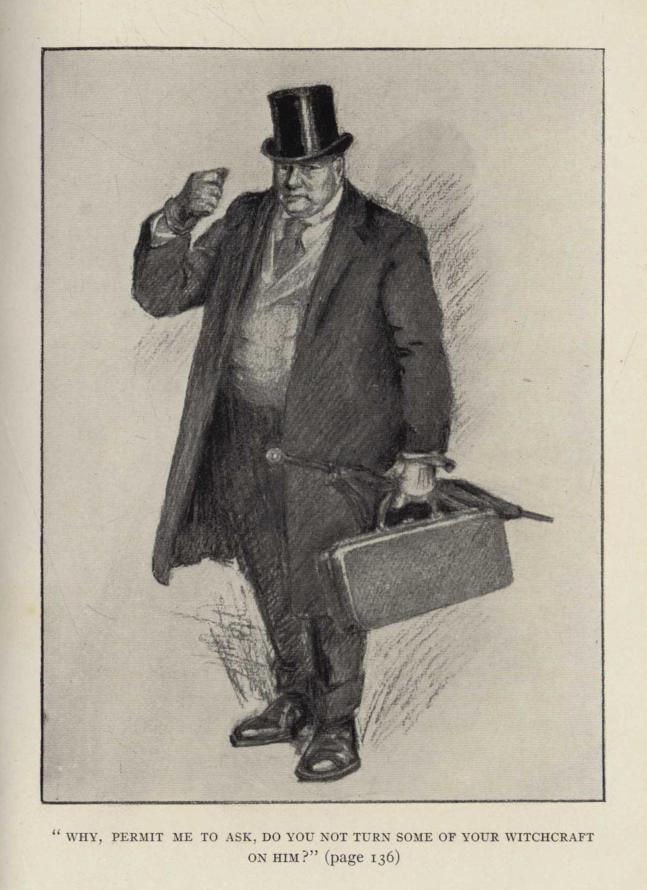
"WHY, PERMIT ME TO ASK, DO YOU NOT TURN SOME OF YOUR WITCHCRAFT ON HIM?" (page 136)
CHAPTER XII
THE MINISTER'S DECLINE
The family had not been home many days before Mr. Thorpe's cough again became alarming; weakness and fever followed, and Dr. Eldrige was again summoned. The old doctor prescribed and commanded. The patient must be kept quiet, but nothing to indicate his condition must be manifested by the family. He also advised that Mr. Thorpe resign his position as pastor.
"He cannot preach this winter," he said, "and it will be the death of him to try. Let him resign and have all care off his mind."
Mr. Thorpe objected to this and wished to obtain a substitute for a time; Mrs. Thorpe agreed with him that this would be the better way; and Pauline, although she said nothing, felt that his resignation would be a tacit admission that he would never regain his health.
Dr. Eldrige fumed and stormed, as he always did when he met with opposition. He told Mrs. Thorpe and Pauline to go on and have their way, but to remember his words when they heard the clods upon the coffin lid. And Mr. Thorpe's resignation was duly sent in.
As was his custom, Dr. Eldrige discussed his patient with his son. He made a pretense of scoffing at his son's methods and manners, yet he was always ready to lay his cases before him, and counted more upon the young doctor's opinions and depended more upon his judgment than he would under any circumstances admit.
"Our pious pastor is going to die," he said to his son. "Pious or devilish, we all come to the same place at last, and we all go through the same door and out into the same black hole."
Dr. Eldrige Jr. made no comment, but gave the consent of silence to his father's statements; he felt that they needed no corroboration.
After a few moments the elder doctor spoke again: "Perhaps, though, a man's better off dead than alive when he has a witch-wife," lie said.
"A witch-wife!" the young man ejaculated, and there was both incredulity and remonstrance in his voice; but he said no more; he knew better than to question his father outright, and he half regretted that he had allowed the exclamation to escape him.
"Yes," the old man stormed; "a witch-wife, a distracted, wild-eyed manes who has had seven devils--seventy for what I know--cast out of her and now blooms forth in pristine freshness. When witches inhabit the earth the doctors can seek another world in which to practice their vile profession of medicine; their services will not be required in this one. However, when our witch friend gets out among people she may find that she has fewer friends in her health than she had in her sickness. She may be able to ride over chimney tops on a broomstick and hobnob with black cats in the forest for a time--but it may be a short time."
Heretofore the young doctor had given little heed to his father's bluster about Mrs. Thorpe's recovery; but now he understood that his words contained a covert threat. In the course of their relations together the son had fallen into the way of arbiter between his father and his father's patients, and many times he was able to prevent his father's malevolent designs and to heal the wounds that he inflicted. Now he looked up from the book that he was reading; he did not look full into his father's face, but scanned it surreptitiously, and he admitted to himself that his father's malady was working upon him again. The harsh grating of his voice and his evil, malicious words had portrayed it; and the fleeting glance at the old man's face had revealed the purplish tinge, the swollen veins, and the murderous gleam of his eyes.
Never could he forget the day that he had discovered his father's secret--the disease that was ravaging body and brain. He had come upon him suddenly, unexpectedly, and had turned hastily from him, partly in recoil at what he saw and also to shield his father from the knowledge that he had discovered his trouble. And from that time, as he valued his life, he had given no hint of what he knew, although there was a silent understanding regarding it between him and his father. And this understanding had enabled him to know his choleric parent as he had never known him before. He felt that the anger and malignity and rancor to which his father gave vent were but the outflow, the suppuration of the horror which held him in its grasp; and he dared not put the question to himself, whether it might not be that this thing of horror was but his father's evil moods materialized in the flesh. And now he read an expression of his father's virulence in his remarks concerning the pastor and his wife, and had he read no more than this he would have made no reply, but he feared that his father's words contained a menace to the peace of those to whom he was ministering, and he believed it was time for him to ascertain the state of affairs at the parsonage.
"If Mr. Thorpe's decline is, as you say, slow and gradual," he said, "so long as there are no complications, you may as well let me take the case." His manner was quiet, free from curiosity, and indicated that he was not interested in the matter of Mrs. Thorpe's recovery. "I have calls that will take me in that part of the town to-morrow," he continued, "and I will see Mr. Thorpe for you if you like."
Dr. Eldrige Jr. felt that he had scored a victory that was worth while. His father would get a new grievance bye and bye, and then, if he saw no more of the Thorpes, he would forget this one.
He called at the parsonage the next afternoon and found Mr. Thorpe resting comfortably. The cough was better and the other symptoms less pronounced. After this he continued his calls at different times for several days; then a call came that took him out of town for a few days and the old doctor made the call on Mr. Thorpe.
After the visit he said to Mrs. Thorpe, who had accompanied him to the hall: "The present treatment seems to be working so well that it will not be necessary for me to call again until Mr. Thorpe is taken worse; but be sure and let me know at the first return of the unfavorable symptoms." He spoke of this contingency as though it were a foregone conclusion; that it was only a matter of time.
This was the first real intimation that Mrs. Thorpe had had that her husband's condition was serious. For the first moment she felt as if her heart had ceased to beat, or was it that she was blind that the daylight should be so black? Then she felt that a burden so heavy that she could not bear it had been suddenly and rudely thrust upon her. She felt that she staggered and was unsteady on her feet. But she faced the doctor and spoke as bravely as she could, although her voice sounded in her ears like a voice that she had never heard before. Yet in her consciousness there mingled with this deadly certainty that the doctor expressed something of her new-found faith in a higher power, and so she said:
"If he is taken worse we will let you know at once."
Dr. Eldrige lowered his head and looked at her over his glasses; he was in a villainous mood, and that little flame of faith that had shot out in her words had not escaped him.
"If," he roared; "indeed, Mrs. Thorpe, there is no 'if' about it; he will be taken worse." Then with the heart of one who knows he has maimed, but craves to kill, he said: "Don't you know that your husband is going to die?"
Mrs. Thorpe paled to the lips. She looked the man steadily in the face, but no words came to her.
He saw that she did not shriek nor cry aloud; she did not faint nor fall; and with all the malevolence in his nature he made another thrust.
"There was a time," he said, "when I believed that you would leave your husband free in the world, but the tables have turned. Why, permit me to ask, do you not turn some of your witchcraft on him? What is fair for one ought to be fair for another. You saved yourself by some devilish machination, but you are little inclined, it seems, to save your husband by the same process."
The horror and resentment of Mrs. Thorpe's outraged soul were depicted upon her face and gleamed from her dilated eyes. She had trained her mind to dwell on the divine attributes in man; but alas, how human, how very human, she felt this passion to be that possessed her now! Her blood was like fire in her veins, a strange noise was in her ears and hot, scathing words leaped to her lips.
"Dr. Eldrige," she said, and the words came keen and sharp; all her anguish and passionate anger were there, but she caught her breath sharply and stopped. Then again: "Dr. Eldrige--" Her voice wavered, fell and broke. She turned and walked to the window. The doctor began drawing on his gloves, his hand was on the door. Then she walked back to him. Her face was white, her eyes fathomless. "You are my husband's physician," she said. "I have no quarrel with you." Her voice was even, guardedly calm.
The doctor regarded her curiously. He had read her horror and resentment and with the utmost exactness he read her passion and her anguish; now he as surely read her victory. His ill-will toward her did not soften. He stood with his cane and medicine case in his hand, ready to go, and without a word he turned and left her.
A lightning flash will sometimes cause objects and outlines to stand out with more distinctness than does the noonday sun. The keen flash of her bitter passion revealed to Mrs. Thorpe what the long summer days had not disclosed.
Why had she not been free and frank with her husband and confessed to him the change that had come into her life? Why had she shut her blessing in her own heart and uttered no word to those about her?
The consciousness that had come to her of the power of Truth over all evil and error never wavered nor failed. The actual demonstration of what she had experienced was manifested in her own life.
God's truth is not a complex thing, difficult to explain and hard to demonstrate; it is simple and natural. Health is the natural condition; sickness is abnormal. Righteousness is the simple state of man; sin is a distortion. But to live and demonstrate these truths in this many-sided, complex life requires all the wisdom that Christ came to earth to teach.
Mrs. Thorpe never doubted that could the saving power of Truth be revealed to her husband his infirmities would fall from him; yet with this message warm in her heart she had not broken the silence that lay between them. In this course that she had taken she had shielded herself behind the conviction that her husband would not accept this message; and she had put back with a quieting touch, hushed and kept asleep that which all the time had been to her so patent--that she was deceiving her husband--afraid to make known to him her new conception of the Christ-love and its transforming power.
Mr. Thorpe was in his study one morning, sorting and arranging his books. The disease from which he was suffering has been known to play with its victims as a cat delights to play with a mouse, and this was one of the times when Mr. Thorpe fully believed that he was to regain his health. He was finding great pleasure in his books this morning; he had been away from them so long that now as he handled them they seemed to him like dearest friends. Mrs. Thorpe tapped at the door of the study and he bade her enter.
"It seems good to find you here, Maurice," she said; "like old times again."
"Old times!" How the thought stirred his spirit--the time when there was no barrier between them. The sunshine streamed through the window and lay, a golden bar, on the floor; symbolic, he thought, of the barrier that had insinuated itself between him and this fair, smiling woman who stood before him; a barrier silent, far-reaching, heaven-high.
Mrs. Thorpe's eyes also were on the shaft of light.
"See how the sunshine lies like a bridge between us," she said; "a beautiful golden bridge. I hope I may be able to build as fair a one, Maurice, between your confidence and mine. I have been keeping something from you. I wish to talk to you about it--about the new belief--the light that has come to me."
Her heart was beating tumultuously. Her hand rested on a table beside her husband and he noticed the firm, white flesh of her arm, where once pitiful emaciation had marked it. He looked into her face and saw the signs of health and vigor there--evidence that she had cast her lot with some foreign power--some ungodly fetish!
"Evelyn," he said, "I have not questioned your belief nor demanded an explanation concerning this new, strange doctrine which you have embraced."
"No," she said, "you have not questioned nor demanded. I feel that you have trusted me, you have been kind--"
"No, Evelyn! Not that--I have been weak, culpable, a coward--fearing to ask lest from your own lips I get confirmation of the worst."
Mrs. Thorpe felt that her husband had thrust her suddenly outside the pale of his sympathy. The hope in her heart grew cold and all her glad words that she had been ready to speak deserted her; yet she answered bravely:
"This is no evil thing that has come into my life, you need not dread or fear it." Then, more eagerly: "Oh, Maurice, can you not see that it has restored my health, taken away my infirmities, blessed my life and made me whole?" The flood-gates were opened and the fullness of her soul poured forth. "It is the Truth that has made me free; there is no real power in the world save God's power. There is a better conception of life than that which admits sickness and disease to be real and powerful. Have not we to-day the same Savior who walked the Galilean shore healing all forms of sin and sickness? God is the same yesterday, to-day and forever. Is not our Christ just as tender, as compassionate, as able, now as then?" She stopped at the sight of her husband's face. The light had gone out of it; it was grim and set.
"That which I feared has come upon me," he said. "I had hoped that this folly of yours might pass; I have prayed daily that you might be delivered from this fallacy, and restored to the fold; but I see that you have gone from me--gone from me, from my church and my God."
Mrs. Thorpe had felt sure that her husband would not approve of her new belief, and in her darkest moments she had feared that by confessing to him the change that had come into her life, the perfect trust and confidence between them might be broken. But what was this that his words portended? Gone from his church--his God--from him! Was there anything--anything on earth or in Heaven that could compensate her for this? Yet with the question still passionate in her soul she realized that were it possible, for the sake of the mortal love her soul so craved, for her to deny her conception of the Infinite, she could never retrace her steps. With her own free hand she had torn down the old relationship between herself and her husband. For the moment she felt that she had plucked from its stem the fairest flower that ever blossomed; now it must wither and die, no power on earth could prevent it.
The glistening sunlight radiated sparks of living fire, then reeled in darkness. Suddenly she found herself as one who departs on a strange, new road, and finds all other paths barred and blocked. A tremor shook her form and her breath came with a sob. Even though she find that the night awaits her in Gethsemane and Calvary looms on before, she must go on--but not alone--she has beside her One whose feet had passed that way before.
Her husband sat before her with bowed head.
"Maurice," she said gently, yet with the keenness of her heart's pain in her voice, "the sternest judge does not condemn without a hearing, much less should you who have always been kind and just condemn me before you have investigated the views I hold."
"I have no desire to investigate your views, Evelyn. This assertion that you have made, that a weak and sinful human being has power to overcome sickness and disease, is placing mortals on a level with the Son of God and is a defamation of the very character of God Himself. I would have given my life for you rather than that you should have embraced so heretical and blasphemous a doctrine. Yet even though this cup prove more bitter than I can bear; even though it blights my life and destroys my affection, I will not ask you to spare me now. I desire to know how far you have gone--I would like to know how far you are from me."
Mrs. Thorpe felt herself alone; her isolation closing in about her. Never before had her husband thrust her from him, never before had he been unsympathetic and unkind. Then the thought came to her that in all the years of her married life she had never before arrayed herself in open opposition to him; and she realized now, for the first time, that although she had loved this man she had also feared him with an awful, shrinking fear. Now she felt that he had not only thrust her from him, but that he had aimed deliberately to pain and wound her, and with this thought a new element sprang to life within her--a dauntless, unflinching courage.
"Maurice," she said, "you have thrown down the gauntlet which, were I to take up in like spirit, would result in wounding both our hearts even as you have wounded mine. Were I to reply to you as you have spoken to me, I think this power of Christ about which we disagree would prove singularly lacking in both our hearts. I came here to talk to you about the new belief that has come into my life; but can one talk of the heart's sacred joy, the deep, hidden things of God before a stern and unsympathetic judge? All I ask now is that you grant me the freedom of religious thought that you demand as your inalienable right."
Now Mr. Thorpe was aware that a woman he had never known stood before him, and he also knew that in purity of thought and in her sense of justice, in Christ-likeness, she towered above him. Heretofore she had bent to his will so readily that he scarcely knew how thoroughly he dominated her. Now she stood before him asking and demanding freedom of thought, independence in her religious belief--even that for which their forefathers had fought. And this was Evelyn, his wife, not crushed by his scathing condemnation, but triumphant in her sweet humility, and mistress of the situation.
There was silence between them for a few moments, then Mrs. Thorpe laid her hand on her husband's shoulder. She knew that her thrust had gone straight to the mark and her heart ached with the pain she had inflicted.
"Maurice," she said, "I would not willingly incur your disfavor, much less cause you pain."
There was a tremor in her voice that threatened tears; but her husband remained motionless and irresponsive.
"Can our conceptions of God come between us, Maurice--alienate us---when we have been so much to each other?" Her voice choked and she felt that her heart was breaking.
"I cannot understand, Evelyn," Mr. Thorpe said, in a voice that had lost its harshness and was broken and unsteady, "how anything so visionary, so fallacious, so palpably false, can have taken so strong a hold upon you. What is it that has diverted your allegiance from the church--the church of Christ?"
"Maurice, there is no command given for the observance of God's laws but I most humbly reverence and endeavor to obey. All that to me seems good and true in church and creed I hold and keep, but this I will say, that the conception that I now have of spiritual things is deeper, stronger, mightier than the old, as the ocean is mightier than the rivulet. I do not condemn the church, but I must have more than it has ever given me. I believe that Christ loves sick and sinful humanity to-day as he loved it when he walked the earth healing all manner of evil and error."
"Evelyn, it is the heretical books that you have read that have blinded you and caused you to put a false interpretation on the works of Christ. Can you not see that when Christ came to earth and men were slow to acknowledge Him that it was necessary for Him to give to the world some evidence incontrovertible, irrefutable, that He was of divine origin? To establish this fact beyond all doubt and question He chose a most miraculous expedient: he healed the sick, cast out devils, raised the dead. And now, even in this wicked and degenerate age, these mortals whom He came to save claim the power to do these works that He did. To say nothing of the absurdity of the thing, I little believed you capable of accepting so blasphemous a fallacy."
Mrs. Thorpe turned and walked to the window, and her eyes followed the incline that led up to the church.
"Christ takes the place in the spiritual life," she thought, "that the church takes in the world; something exalted, set aside, to be looked up to and worshiped, but never to aid and comfort. He came to glorify Himself; his mission was to prove His own superior origin, and, the church, following this conception of Him, holds itself superior to the human family it stands to bless." There flashed before her a vision of the dark-faced girl whose life had been robbed of its chastity and sent to its ruin, while the adherents of the stately church before her followed this conception of Christ. She thought of the sin and suffering she had seen on the Bolton Flat; the lives of anguish and crime that were lived there while the Savior of men, tender and compassionate, presided over the beautiful church and blessed and glorified it.
When she turned again to her husband her face was blanched and her eyes were glowing with a strange light.
"And all this great gift of Christ's life, His suffering and sacrifice--what was it for?" she asked. "If He healed the sick--not because He had compassion upon the multitude, not because He was touched with the feeling of their infirmities; if He cast out evil spirits--anger, jealousy, malice and all the vagaries of a sin-sick mortal mind--not because He wished the children of a loving Father to be pure in heart, clean of life; if He raised the dead--not because the great heart of God is merciful and tender--if these things would have been beneath His notice had they not served in gaining His end, indisputable evidence that He is the Great I AM, then He used them to fix the gulf, to measure the distance between Himself and humanity--used them, He the Christ, the Savior of men, for His own aggrandizement!"
Mr. Thorpe held out his hands with a gesture of horror. "Evelyn, desist!" he cried. "What profanation is this?"
"But answer me this, Maurice: Were Christ's miracles performed to prove Himself divine or were they works of mercy to prove His Saviorhood to humanity?"
"Your question is irreverent, and in the sense in which you ask it, sacrilegious and unchristian. Whatever it was that actuated Christ to do those mighty works it is wildness, mania, for one to claim that this power is in the world to-day."
"Yet for years, Maurice, you prayed that God would restore my health and strength, and now it is sacrilege to affirm that the God to whom you prayed has answered your prayer?"
"We will not prolong this discussion, Evelyn. Your feet have found a strange, new road, while I, as I hope to see my God, must cleave to the old. I knew that the hand of God was hard and grievous upon you, but I could not believe that you would forsake the straight and narrow way. The bitterness of death sinks before this."
Mrs. Thorpe knelt beside her husband and buried her face in his hands. "God is our judge," she said; "let us leave our differences with Him."
"I have one promise to ask, one demand to make, Evelyn, and then this subject shall be dropped between us. My life is in God's hands; when He calls me I am ready to go. Whatever power you possess, or believe you possess, over the human organism, I ask, demand, that you forebear to exercise it in any manner where my welfare is concerned."
Mrs. Thorpe, still upon her knees, saw in the future pain, suffering, separation--evils which, should she give her promise, she dare not deny.
Mr. Thorpe put her from him and arose to his feet. She arose also and looked into his face; it was haggard and gray.
"Oh, Maurice!" she cried, "that I who love you should cause you to suffer so!" She extended her hands to him, but he ignored her advance.
"I have asked a promise, made a demand," he said, "and you have not answered me."
Again the living fire glittered in the sunshine; again the darkness reeled before her. "Oh, Christ," she sobbed, inaudibly, "you who suffered and died for the truth, help and keep me now!" Her face was drawn and gray as her husband's, and when she spoke her voice was sharp and keen with pain.
"I cannot--cannot deny my God," she said.
CHAPTER XIII
THE PURE IN HEART
The term, "A man of the world," is elastic enough to cover a multitude of sins, and it gives the impression that however far from exemplary the man may be to whom the term is applied, and however far from spotless his character, that having made no avowal of virtue, he is in some degree excusable for exercising the prerogatives of a villain.
Max Morrison was a man of the world. Men knew him as an all around good fellow; women knew him as a bright and shining light about which many a pretty moth had singed its gilded wings, been scorched, maimed, wounded. But his popularity increased rather than diminished because of this, and Edgerly's best society welcomed him warmly.
But the best society and all that it offers, as well as the amusements that cannot bear the light of day, pall on a man in time and that which is fine within him, silent, yet alive, cries for expression. When the flush of youth is over, life begins to look more profound and sometimes a bit somber, and then the stirrings of a man's heart are for a home and fireside, wife, and the voice of children, and he begins to look about him for a queen to reign in his home. And here, in making a choice of a life companion, men generally show a superiority over women. A woman, governed by her emotions and her desires, and taking a superficial view of the future, will give her heart, her honor and her life to a man, no matter what his past has been nor what his present is, if only he makes her fair promises for the future. But a man, when he chooses a wife, must know beyond the shadow of a doubt that the woman he honors is of spotless character.
Let no woman breathe one word to break down this high standard that man has set for womankind; but rather, let women demand of men that which men require of them.
Max Morrison desired for his wife a woman pure as the angels in Heaven; and this is what he believed Geraldine Vane to be. And after a long and intimate friendship he decided to win her for his wife. He fully realized the importance of the step, and he also realized that when a man has a past and there are places in that past where the sun has never shone, that phantom hands are liable to rise out of these dark places and lay a blighting finger on the beautiful, blameless future. Many times when his thoughts sought matrimonial byways, a vision of a dark, eager face with full, voluptuous lips and passion-filled eyes arose before him. There were times when he denounced himself as a fool whose folly had ruined his life. There had been good material in Margaret, as well as the fatal traits that had ruined her. Suppose her circumstances had been different, or that someone had lent her a helping hand; defended and protected her. What a woman she would have made! What a force in the world! Was there one in the world who could equal what she might have been? The thought was torture to him and he banished the dark face from his vision; it had not been pleasant to look upon the last time he had seen it, and Geraldine was the woman to be considered now. He consoled himself as best he could with the thought that no doubt Geraldine, with her placid temper and quiet, acquiescent ways, would lead a man a more comfortable life than would a passionate, spirited woman such as Margaret would have made.
Max was not exactly a vain man, but he had known many women and been repulsed by none. He had no serious apprehension that he might not be able to win the woman that he had decided to honor; but he desired to make his footing sure as possible, and he wished also to be honorable and irreproachable in his conduct toward this woman and her family. To this end he approached Mr. Mayhew on the subject.
"My friendship with your niece," he said to that gentleman, "is, as you know, of long standing. You have accorded me the greatest kindness and hospitality; now I ask your permission to pay my addresses to Geraldine as a suitor for her hand."
Mr. Mayhew's business instinct, always keen and shrewd, became at once active and alert. On general principles his policy was to conceal an advantage until he saw its consummation, and he saw no reason to depart from his usual course in this instance. And in his estimation a proposition would have to be questionable indeed if he could not from here and there bring in enough that was moral to make it tenable. However many dark places there might be in a course he wished to pursue, he never allowed himself to be too Puritanical to find some defensible ground on which to make a stand. He thought it very probable that Max did not know that Geraldine was a dowerless girl, absolutely dependent, and he had no compunctions that the fact had been well guarded. If Max wished to marry the girl, her fortunes ought to make no difference to him. And if Geraldine was willing to accept him for a husband, she could do as thousands of other women had done--overlook or ignore the past. Here, then, was the high tenable ground, and without any hesitation he took his stand. Yet in his heart he knew that if this fair girl beneath his roof had a fortune of her own he would see that she got a better man for a husband than this one to whom he now gave full and free consent to woo her.
Mr. Mayhew would like to have had the co-operation of his wife in influencing Geraldine to make her choice. He understood that Max expected him to use his influence to predispose the girl in his favor, and also that he desired him to palliate his past conduct, if there was need of palliation in Geraldine's mind. But Mr. Mayhew was too shrewd a man to see only one side of the question. His wife he believed to be one of the most satisfactory women in the world yet he realized that there were times when she was a power to be dealt with, and he believed it always better to circumvent a woman than to oppose her. He never attempted to lower her ideals of honor and morality; but he took it upon himself to see that they did not interfere with the practical advantages of life. Now he counted that all he could say in Max's favor would have less weight with Geraldine than that which his wife could say against him, if she cared to do so. And rather than risk having Geraldine consult with her aunt as to the suitability of Max as a husband, he decided to let her make the reply to the all-important question with as little premeditation as possible. And as though in response to his unspoken preference, Max did not delay his purpose long.
It was a stormy night in early winter, Max called at the Mayhew home and was shown into the library, where he found Geraldine deep in a volume of old-time valorous deeds. She had read of knights and chivalry and maidens fair and true until her heart throbbed with the spirit of the olden time, and that which is brave and fine in human nature lay uppermost in her mind.
She greeted her caller with a mingling of the fervor of a Joan of Arc and the sweet dignity of a Lady Jane Grey. Her eyes were bright, there was an unusual glow on her cheeks, and no queen ever wore a crown of gems and jewels more becoming than was Geraldine's crown of golden hair. She drew a chair to the fire for her caller.
"You were brave to face the storm," she said.
Max settled himself comfortably in the grateful warmth and glow.
"One could well face a fiercer storm for a moment of lesser bliss," he said.
The firelight fell on his swarthy face and magnificent proportions. How like a veritable knight stepped out of the book of brave deeds he appeared!
The library door stood open, and Dr. Eldrige Jr., who had been called to see one of the Mayhew children slightly ailing, passed this door on his way to the nursery and saw the man and woman sitting in the firelight. His face grew hard, and involuntarily his fingernails cut into the flesh of his palms.
"There was a time," he thought, "a time centuries ago, when true men were knights and challenged to deadly conflict villains who dared to approach women of honor. There would be satisfaction in grappling with a man of Morrison's stamp; grappling until his cursed blood flows red--or give my life in the effort. But in these days, these better, Christian days, we have done away, if not with honor, with all aggressive vindication of it; we no longer call our enemy to halt and demand of him his aims and intentions; we get out of his way and give him full swing." The doctor came to a sudden halt; a new train of thought had flashed into his mind. "My God! I cannot tell what this man's intentions may be. He may intend to marry Geraldine!"
It was the first time this aspect of the affair had presented itself to him, and while it seemed a thing too hideous to contemplate, he felt sure that it was true. But although his indignation and despair broiled and seethed in his heart, he ministered to the child with a touch skilled and tender as a woman's; then he gave the nurse exact directions for the night and took his departure.
When he again passed the library the door had swung to and no sound came to him from behind the closed portal. He passed quickly, quietly out of the house and into the street, out into the dark, moaning night. Rain and sleet were falling; the wind buffeted him and strange sounds from the shivering trees and their bare, wailing branches came to him. All the black face of the night seemed possessed of a wild and witch-like fierceness. Voices shrieked and hissed at him. The woman--the one woman in the world--the woman that he loved--what was life to him now and all that it contained? Was the future that stretched before him less black than this tempestuous night? Alone in the storm and the darkness he felt himself a part of the tumultuous elements about him.
In the library the firelight lay warm and red over the furnishings, and fantastic shadows lurked here and there about the room. The wind when it arose in its fury could be heard like the sobbing of some unhappy spirit.
Max stood before Geraldine, his soul in his eyes and a great tenderness in his musical, well-modulated voice.
"You must have known that I love you, Geraldine," he said; "love and adore you." He extended his hands to her, pleading, passionate. "Geraldine!"
But Geraldine, sitting there wrapped in the red firelight, did not stir nor move. The color had gone from her face, her eyes were bright and her eyelids burned hot and dry. She saw the dark, dominating figure beside her, she heard the pleading and she understood; yet she remained silent and motionless before him.
He bent over and took her hand in his. "Geraldine," he whispered, close to her white face, "come to me."
Then the blood beat into her face and flushed it crimson red. Her tense muscles relaxed and she arose and stood before him. The warm firelight enfolded them, and the wind came to them in wailing sobs; but silence lay between them, and Geraldine was alone--alone as it comes to us all to be sometimes--many times, perhaps. No word of her aunt's warning came to her now; no thought of her uncle's unspoken wish was with her; the world, with its perplexities, was forgotten; life that had already grieved and distressed her was lost in oblivion and she was in the silence, the vastness, the grandeur of self--alone--and her pure heart, her woman's heart knew its own. There are voices that come to us sometimes, other than those that come over the vibrations of air waves. The deep, still voice of truth needs no material means through which to speak. A wordless message came to Geraldine, as she stood silent and alone; it called to the depth of her soul, and smote upon the sweet, vibrant chords of her womanhood.
"Max," she said, "I cannot--cannot--"
"Geraldine--oh, Geraldine!"
"I cannot, Max--I do not love you."
He looked at her then as one looks at a rare and beautiful gem, and a desire to possess her such as he had not felt before arose within him; and even the dark-faced girl that at one time he had fancied stood unseen beside him in the firelight was forgotten.
"Geraldine, it cannot be--you do not understand." He seized her hands and his eyes burned upon her compellingly, as he sought by the superior force of his will to dominate and control her. "My love, be kind; you would not cast me off, ruin my life--"
"I cannot, Max," she said. Her voice faltered and her eyes looked compassionately into his. "I do not love you."
How many women he had loved, or professed to love, and not one of them had answered him as he was answered now. What sort of woman, then, was this one, whom persuasion could not influence and passion could not sway? By what standard had her life been fashioned? What was its center and controlling power? With all that he had seen of life, could it be that he had failed in his judgment of womankind? Was there something in the nature of a woman, a good woman, that he had never known?
His thoughts had found a new channel and he was at their mercy. Was there something in human nature, in life, deeper, truer, stronger than he had ever known? He turned from the firelight and the trembling girl on the hearth and walked across the room. The bare branches of a sweet-brier outside tapped against the window-pane. The blinds were drawn, but he could hear the tapping, and in fancy see the bare, brown branches at the mercy of the wind. He sat down by the window and bowed his head and covered his eyes with his hand.
Had he all this time been dealing with the outer sham of life, deluded in the belief that he was living in the very heart of it? Had he been surfeiting himself with the husks, believing that he was feasting on the rare, sweet-flavored kernel?
For a time Geraldine remained by the hearth, then she crossed the room and stood beside him and laid her hand gently on his arm.
"Max," she said, "we have been friends, good friends--in our friendship we have been true to each other, we must be true to each other still, and true to ourselves--to the best that is in us. I cannot give you what you ask. Shall I be false and give you less? You desire a woman's heart, her life and love--shall I defraud you of this? Some day, perhaps, you will be glad that I have been true to myself--and to you, Max."
When Max stepped out into the night the wind had grown less boisterous; now and then a fitful gust went by like a wanderer in the night. The cold had become keener; overhead the clouds had rifted and a few stars kept watch with the night.
Geraldine lay awake long after she had sought her rest. The low moaning of the wind came to her in her upper room, and from her window she could see the rifted clouds and scattered stars. From a child she had looked from this same window at the face of the night, and the feeling had grown up with her that the great enfolding darkness was guarding and protecting her. Her trust and her simple faith had been as natural as her breathing or her existence. All her life before Faith and Trust had pillowed her head at night, and gently touched her eyelids, and whispered sweet dreams to her; but to-night dark, foreboding Doubt became her companion, and she tossed restlessly on her bed and looked down the long vista of years and saw herself alone, forgotten and unloved. With maidenly reserve and a woman's pride she had endeavored to shut out and debar from her thoughts one whom she believed had ceased to care for her, even as a friend; but when she had stood alone in the presence of her conscious self, the pleading of the man beside her had not seemed so real, so vital to her as did the vibrations of the wordless, evanescent message that came to her above the sobbing wind and the spirit of the tumultuous night.
Mrs. Mayhew noticed her heavy eyes and swelled lids the next morning, and Geraldine told her of Max's proposal and her rejection of him. Mrs. Mayhew had felt sure that Geraldine was to face this question, and in her heart she was glad of the girl's decision; yet her happiness came first, and it was evident that she was not happy, and she felt sure that there was something that Geraldine had not disclosed; yet she understood the fineness of the girl's nature too well to desire to force her confidence. And Geraldine could not speak of that about which she felt no woman has a right to speak. And so a barrier, subtle, thin as gauze, yet impenetrable, hung like a curtain between them. And Mrs. Mayhew, with rare wisdom, realizing that her girl had grown into a woman, was content to let her alone with her woman's secrets.
When Mr. Mayhew came home from his office that day his mood was not exactly a happy one. He had seen Max and knew the outcome of his proposal. He was both surprised and displeased; but he concealed the fact from Max and hinted that a woman's "no" often means "yes," and he determined to see Geraldine and speak plainly to her. When Max first spoke to him about Geraldine he had begun to look upon her as he might upon a commodity that had lain for years almost forgotten, but which had suddenly become of great value. Now, with her own hand she had shattered his plans for her, and refused one of the best fortunes in Edgerly.
After dinner he asked Geraldine to come to him in the library. He was seated near the fire reading when she entered the room. She did not disturb him, but went over and stood by the window and watched the sweet-brier as it tapped gently now against the window-pane.
Mr. Mayhew lowered his paper and looked at her, and his mind became reminiscent. He was impressed anew with Geraldine's likeness to her father; and this man seemed to come out of the shadowy past and confront him. Noble he had been, high-minded, conscientious and--poor. A musician, his artist's soul pure as the divine strains of his melodies, he seemed like one whom chance had placed in a wrong world, or a wrong age. Then his mind ran over the different members of the Vane family; scholars, musicians, professional men, high-minded and noble, but could anything excuse their poverty?
Geraldine turned and met his gaze. He arose and placed a chair for her.
"I wished to speak to you," he said direct, "I wish to speak about Max."
"Yes," she said, and her manner was gentle and womanly.
He was conscious of thinking that she had good blood in her veins; her voice and manner proclaimed it; and all she lacked was a fortune such as Max could give her.
"You understand, Geraldine, that Max has all the comforts of life to give the woman he marries."
"Yes, I know."
"The truth sometimes sounds harsh when spoken plainly, Geraldine; but you are aware, that however loved and welcome you have been beneath my roof, that you are a dowerless girl. It was my desire that you be given every advantage that a girl of wealth receives, and your aunt has seen that my wishes were carried out. Now you are offered a home and fortune that will give you the comforts and luxuries of life to which you have been accustomed. Can you afford to lose this opportunity?"
"I cannot marry Max Morrison."
He met her eyes; they had been dark and sweet like pansies; now they were wide and blue. He felt the hopelessness of argument. He knew the Vanes; they appeared yielding and docile, but he knew them to be flint and steel where a principle was concerned. He arose, impatient to be away.
A few days later it was known that Max Morrison had enlisted with a company of volunteers, and was going to the Philippines.
CHAPTER XIV
A FRIEND IN NEED
Mr. Thorpe went to Colorado for his health. A cousin of his, a brother of Pauline's, lived there, and Mr. Thorpe had a standing invitation to come and try the effect of the climate on his health. Pauline accompanied him; she had become so used to caring for him and watching over him as a mother watches over an ailing child, that she could not bring herself to part with him now, when she believed his condition to be more critical than it had ever been before. Then, too, she knew that all was not well between him and his wife, and, knowing this, she had no desire to remain with Mrs. Thorpe.
The pastor who was called in Mr. Thorpe's place was an unmarried man, and had no use for the parsonage, and Mr. Thorpe, by courtesy of the church committee, had been permitted to retain the use of it. But now, left alone, Mrs. Thorpe felt the necessity of finding a home for herself.
Some years previous she had, by the death of an uncle, come into possession of a small legacy. This her husband had insisted that she keep intact against a day of need.
On the Flat side of the church-crowned incline there was a small cottage set in a bit of ground, somewhat back from the rambling street. On either side of it were smaller houses, with ill-kept yards in which neglected children played and where untidy women talked across broken down fences and quarreled over petty grievances. Mrs. Thorpe had often noticed this cottage on her way to and from the Flat. The fact that it stood a little back from the street had given her the impression that the builder of it had desired more privacy, was more retiring, perhaps, than were those who had built their houses against the street; and she had planned in her mind how flowers and shrubs might be grown in the yard and vines trained over the windows and the place made to take on a homelike appearance, if the owner desired it. Now, confronted with the problem of finding a home for herself, her thoughts went directly to this cottage.
Alone in the world, broken-hearted, strong in spirit, yet all at sea as to the future, the thought of a cottage on the Flat was not distasteful to her. Perhaps her work lay there; she meant to work, and it made little difference to her what the work should be or where it took her. She knew that the place was for sale, and when she found that the price was within the limit of her possessions she hesitated no longer, and the cottage became hers. Deep within her heart she knew that she was influenced by the fact that from its location she could see the church--might almost feel that she lived within the shadow of it--the church that her husband had loved. In the morning she would see it, as she had so often seen it from the parsonage, with the sun rising over the hills and mantling it with roseate splendor; and in the evening she could see the long shadow of the church spire; and on the Sabbath she could hear the bell as it called the worshipers to its altars. Full well she knew that she loved the church, knew that she must always love it and reverence that for which it stands. The fact that it is profaned by the hollow-hearted and ungodly does not change its sacred character nor destroy its spiritual significance, any more than the making "my Father's house a place of merchandise" destroyed the spiritual significance of the Temple.
Sometimes in her ever-vivid imagination she saw the whole Christianity-professing world as an Edgerly, and the poor, the ignorant and the unfortunate in the world as this great Edgerly's Flat; and always the church-crowned prominence with its prosperous, complacent money-changers between. And always she was glad that henceforth her home was to be on the Flat side, with those who needed her. Had her Master ever chosen to walk in the high places with the great ones of earth?
It was a day in early winter when Mrs. Thorpe had her possessions moved from the parsonage to the cottage on the Flat. She engaged the services of a strong woman to assist her with her work and in putting her new home in order. When this was done she paid the woman her hire and allowed her to go; her income would not warrant her keeping a servant nor a companion; she would live alone, and frugally.
When sorrow, or pain, or disappointment knocks at our door we struggle and strive, sometimes we faint and fail, yet always the knowledge comes to us that we may be strong if we will. There is no time nor place nor circumstance in life stronger than the central force within us.
Since her husband's departure Mrs. Thorpe's time had been taken up with work that pressed upon her; many cares and real labor claimed her time and strength. But now all was done, her house was in order and she was alone, sitting with empty hands--alone--beside her silent hearth. The wind blustered noisily outside, foretelling the ravages of winter, and sleet and rain came spasmodically against her window-panes. And here in the solitude of her new home old memories crowded round her and ghosts of her former self trooped through the silent rooms. She recalled how she had tried in the early days of her married life to penetrate the future, the sealed and silent future. Merciful love of the Infinite One, who turns the pages of life's book one at a time!
A sudden gust of wind came furiously against her window. She arose and walked about the room and pressed her face against the window-pane and looked out into the darkness. A white, transparent face it was, with eyes too large and dark for their setting. Then she came back and stood before her fire, a slender, girlish figure with clasped hands and bowed head. A sigh arose to her lips and ended in a quivering sob. She sank upon her knees beside her chair and buried her face in her hands.
"Maurice!" she cried, "Maurice--it is all false and untrue--this trouble that parts us. There is no evil, no pain, no sickness in God's world--Maurice--God's power is absolute; there is no other. God is supreme--love will conquer."
It was not the heart of the mortal woman, loyal and loving though it was with human affection; but the soul of her diviner self that was crying in the silence for its own. And never yet has the soul called in vain. Yet, is it not true that the Mount of Calvary is the mount of answered prayer? It was here that the great love-born prayer for humanity was consummated; a consummation attained by the adorable surrender of the finite to the Infinite.
Mrs. Thorpe had prayed; back in those haunted, troubled days she had dared to pray that all forms of suffering might be heaped upon her, that she might become an outcast in the world, if by this means she might know God. Now she felt the living presence of the Infinite enfolding her, and her life merged into the great Life. Had she not been all the way to Calvary?
When she arose from her knees she sat quietly, bravely before her open fire, and listened to the wind and rain without. After a time she experienced a feeling, vague, indefinite at first, that something was required of her, someone needed her. She could not tell who it was, nor where, but the feeling grew upon her that she was needed by someone in trouble. After a time this unvoiced conviction become so persistent that she arose and took her hood and rain-coat from the closet.
"It may be Mrs. Boyd," she thought. "Her baby is sick; I will call over and see."
At the door the wind caught her and the rain dashed into her face; but she pulled her garments more firmly about her and faced the storm. At her gate she paused for a moment in the face of the gale. "What is it," she questioned, "that is drawing me out into the night and the tempest?"
No one had sent for her, she had spoken no word to anyone, yet the feeling was so strong within her that she persisted, and made her way to her neighbor's door.
Mrs. Boyd met her garrulously: "And are you out in the storm, Mrs. Thorpe? Lonesome? Well, no doubt, no doubt; it's hard living alone for a woman, and a bad night to keep one's own company."
"I came to inquire about the baby," Mrs. Thorpe said. "How is he to-night?"
"The baby's better, thank you, Mrs. Thorpe. He's sleepin' natural to-night."
"I am glad to know it," Mrs. Thorpe replied. "I had a feeling of uneasiness about the little fellow; but if I am not needed I will go back at once, for I think the storm increases."
Again out in the dark, windy night, she questioned her purpose. What was it that had impelled her to go out into the night and the storm?
The part of the street that lay between this house and her cottage was scarcely more than a foot-path, and she was following it somewhat uncertainly when she stopped short and drew back in sudden fright.
There was something directly in front of her, flapping in the wind, like the dark wing of some great bird or evil spirit. For a moment she wavered, trembling and irresolute, then her unflinching spirit asserted itself and she approached the object. Now she could discern that it was a garment that was flying in the wind, and as she drew near to the object it moved, partly arose, and fell back again.
"Who is this?" asked Mrs. Thorpe, now close to the prostrate form. "Are you hurt or ill?" She stooped and laid her hand upon the object. "Are you ill?" she repeated. "Can I assist you? Why are you here?" She was down beside the creature now, and a moan and a bitter cry greeted her.
"Why am I here--why--why am I here--" It was a woman's voice.
Mrs. Thorpe took hold of her.
"Do what you can to help yourself," she said, "and I will assist you." But she soon saw that the burden was too great for her strength, and the unfortunate creature was down on the ground again. She was about to go back and ask Mrs. Boyd to assist her when she saw the figure of a man approaching. As he drew near she spoke to him.
"Would you be so kind as to lend me your assistance?" she said. "I found this unfortunate creature here in the street. I fear she is ill."
The man stood close beside her in the darkness.
"Mrs. Thorpe!" he said, "Mrs. Thorpe, what are you doing here in the night and the storm?"
With a glad cry she held out her hands to him.
"Dr. Eldrige! How fortunate that you happened this way. I found this poor creature here; she must be ill, I think. Help me now and we will take her into my house."
The doctor took the woman in his arms and helped her, half carrying her to the cottage door. Mrs. Thorpe turned the key in the lock, pushed open the door, and the light from the room streamed out and fell upon the woman's face. And then Mrs. Thorpe's questions were answered. She knew why old memories had crowded upon her; she knew why she had gone to the source of Power for strength, and why she had gone out into the wild night storm. The face was the dark, passion-stamped face of Margaret McGowan.
The doctor crossed the room and laid his burden on the couch as Mrs. Thorpe directed him. Then he straightened himself and looked into Mrs. Thorpe's face.
Never in her life had she seen a face so haggard, so deadly white and set. The time may come to a human heart when sympathy is as keenly craved as is food and drink to a man stranded in the desert. For one long minute the doctor held Mrs. Thorpe's eyes with his, and she read in their awful depths the tragedy of his life. Ah, these heart tragedies! Faith, hope, love--faithless, hopeless, forsaken! Not a word was spoken; the man turned to be alone, and the vibrating silence lay between them. But who can know what message may have gone out from the man's tortured soul? Dr. Eldrige's thought held to the wronged woman suffering and cold on the cot, but the soul of his manhood went out to that other woman shielded in the warm firelight. What, after all, are our material concepts of life where the realities of being are concerned? Who places our limitations upon us and makes our communication with a loved one dependent on time and space?
Both the doctor and Mrs. Thorpe turned to the prostrate form on the couch. "We must attend to her without delay," the doctor said; and they drew off her rain-soaked shoes, and warmed her aching feet, and removed her wet garments, and wrapped her in warm flannels. And Mrs. Thorpe brewed her a steaming cup of tea; and after the girl had drank this they assisted her to a bed and made her as comfortable as possible for the night. Then the doctor prepared to take his departure.
"I will send you someone to stay with you through the night, if you like," he said to Mrs. Thorpe.
"Not unless you think it necessary," she replied. "I am not afraid; believe me, I am not afraid." And so he left her alone with her patient.
The girl fell into an uneasy sleep and Mrs. Thorpe drew a chair to her bedside and sat beside her. And watching by this erring girl who had been so often in her thoughts, Mrs. Thorpe realized how small had been the measure of her faith; for she had not dared to believe that the opportunity to repay Margaret for the wrong she had done her would ever come to her.
After a time Margaret fell into a deep slumber, and Mrs. Thorpe left her and sought her rest. The next morning she found her tossing restlessly on her pillows. Her eyes, wide open now, were staring and bloodshot; the blood was leaping wildly through her veins and fever burned in her face. She laid her hand on the girl's forehead.
"Margaret," she said, "my poor Margaret."
A wild laugh greeted her, then a moan and a cry of pain. Mrs. Thorpe talked to her and soothed her as best she could, and when she grew quieter she prepared a plate of tempting food for her and brewed a cup of coffee to a deep, rich brown and flavored it with the cream she had reserved for her own morning beverage.
During the day Dr. Eldrige called in and inquired about her.
"You are doing all there is to be done for her," he said to Mrs. Thorpe. "Stimulating food and good care are all that she needs. If you could keep her with you--if she could be kept away from her temptations--there is good in the girl, Mrs. Thorpe, or at least there once was good in her."
Mrs. Thorpe looked at him with her eyes misty, unfathomable.
"No one understands the truth of what you say better than I do, Dr. Eldrige; I shall keep her with me--always, perhaps."
As the day wore away and evening came on, Margaret began to realize her condition and she recognized Mrs. Thorpe.
"I thought it was a dream," she said, "all a dream, and I dreaded to awake; and now I do not understand. Where am I? And why are you here, Mrs. Thorpe? How came we beneath the same roof--you who are good--and I who--thank God--if there is a God--I who am bad?"
Mrs. Thorpe looked into the girl's face. What should she say to her? What could she tell her? How could she win her?
"You have been ill for a time, Margaret, and I have been caring for you," she said.
"Where am I? Who brought me here, and why have you been caring for me?"
"This is my home. I found you in need and brought you here. I am very glad to have you, Margaret; and you were ill, you know." But Mrs. Thorpe noticed that there was a hard and sullen look on the girl's face. She did not speak for some time, and then she said:
"I do not know why you brought me here, Mrs. Thorpe. Perhaps you expect me to thank you for what you have done for me. You have saved my life, no doubt. There was a time when I was worth saving--and you could have saved me--but now I had rather have died in the street than to have taken one favor from your hand."
Mrs. Thorpe stepped to the girl's side and slipped an arm about her.
"Margaret," she said, "you have an old grievance against me, and justly, too. But girl, girl, do you think that I, too, have not suffered for that day's ignorance and folly? Do you think that the condemnation that the past has brought is more bitter upon you than it is upon me? Do you think that the stain of your sin is upon you alone? Margaret, Margaret, hear me. As we stand before God, I do believe I am the guiltier woman of the two." Mrs. Thorpe's voice choked with sobs and her face was wet with tears. "I sent you, passionate and misguided, to your sin; you but did the thing I drove you to. In the sight of our fellow men the condemnation is upon you; but how blind and ignorant is the judgment of men! Yet this I will say: I never meant to harm you, Margaret. I had no slightest thought of what it meant to you and your mother. I was ignorant, and oh, I, too, was passionate and misguided! But now that I have found you again, now that I have you here in my home while you need me and I need you--and I do need you, Margaret--stay with me, stay here with me."
"Stay with you? Stay here with you? Little you know what it is you ask, Mrs. Thorpe--little you know! I must get back--yes, back."
"I will not let you go, Margaret. I will never let you go."
The girl's anger and passion flamed into her face.
"You don't know what it is you ask," she said. "I tell you, you don't know--I'm not a woman that you want here."
"Margaret, I do want you. I want you to feel that this is your home; and oh, my child, I want you to know that I am your friend--always and always your friend."
The girl's eyes were furious, yet piteous, like the eyes of an animal at bay; her passion had burned almost to frenzy.
"Know, then," she hissed, close to Mrs. Thorpe's face, "know, then, what it is that I must have! I tell you, I am a ruined woman--I must have--"
But Mrs. Thorpe put out her hand.
"Hush, Margaret," she said. "Do you think that I do not know? I do know, and, believe me, I know what you suffer! But oh, my child! How many, many who were dire distressed pressed close to the Healer's side--and never one was turned away."
Margaret scanned Mrs. Thorpe's face with a look that was terrible--keen as a lightning flash. For a moment the transfiguration of hope, desire, faith, lay in the dark depth of her eyes. Her face relaxed; the frenzy and passion died out of it and left it quivering with a new-born anguish. She threw herself prostrate on a couch and burst into a paroxysm of tears.
A woman's tears--a fallen woman's tears! The sacred pages that are so few, yet hold the record of all that guides the human family from the beginning to the end, had space for this, a fallen woman's tears. The sins, blood-red, that have been made like wool; as scarlet, that have become white as snow, washed in the fountain of penitent tears! And beating in divine cadence, sounding forever through the centuries, are the words of the great Forgiver of men:
"Go thy way and sin no more."
CHAPTER XV
NEITHER DO I CONDEMN THEE
Mrs. Thorpe beguiled Margaret into leading a quiet life. She prevailed upon her to go out but little, and never allowed her to go alone. There were days when the old rebellion arose within the girl and her abnormal craving grew all but intolerable, when bodily pain and mental anguish rendered her less woman than monster.
But into the work of helping to readjust this unfortunate girl's life Mrs. Thorpe brought her dauntless courage, her understanding of the Truth and her faith in the supreme Power. There were no halfway places in this woman's character; there were no doubts in her creed, no cringing fears in her belief. The power of God is a power to save once, every time and forever. To doubt once, to admit one fear, to let go for one instant the everlasting principle of Truth, is to hurl oneself from the mountain peak, to cast oneself from the pinnacle of the Temple.
The winter was a severe one. The great banks of snow piled higher and higher during the short winter days; and when the days began to lengthen the cold grew more keen and cutting. There was suffering on the Flat as there had been winters before. Mrs. Thorpe went among the people with words of cheer, and such material aid as she could render. The ladies of the church and the Edgerly Benevolent Society soon found her out, and her little home became a distributing point between Christian Edgerly and the suffering Flat. The Society soon learned that Mrs. Thorpe knew where the need was greatest, and what the needs of the individual were; she knew which shivering child the little scarlet coat that some mother's darling had outgrown would fit; she knew where the shoes that had become too shabby for a child of fortune to wear would be most welcome, and which pair of cold, pinched hands should have the half-worn, fur-topped mittens; she knew where there was sickness and where the larder was empty; she knew also where the needy ones could be trusted with funds and where they could not.
And the Benevolent Society, finding that she knew all these things, found it a great relief to leave their offerings with her. It saved the painful harrowing of their feelings that personal contact with these people brought, and also gave them a comfortable sense of the works being well done. And in simple truth, was not this, to gain the feeling of conscious comfort that comes from the doing of a good deed, the primary object of their charity?
Mrs. Thorpe willingly took this work upon herself. It was a joy to her that she was able in any degree to lighten the burdens of these people, and her zest and interest in the work grew from day to day; yet from the depths of her heart she grieved over it.
"Daughters of Jerusalem, weep not for me, but weep for yourselves and your children." Were these Christian women of Edgerly the daughters and the children of the daughters that the prophetic vision saw down the stretch of the centuries?
Margaret became interested in the work of distribution. It may be that it was the interest and spirit with which she entered into this work that saved her. Mrs. Thorpe saw that little by little the girl's thoughts were turning from self, away from the dark record with its paralyzing effect, to another's need, another's suffering, another's pleasure. Sometimes among the garments that were sent to them there would be one that must be altered in some way, or buttons be replaced, or stitches taken. With forethought and tact Mrs. Thorpe kept Margaret employed; kept her hands at works of kindness and her mind filled with thoughts of others.
Among the members of the Benevolent Society there was one who took an active interest in the relief work, one who cared to go among the people and know them. This was Geraldine Vane, who had become a frequent visitor in Mrs. Thorpe's home. The trouble that had come to Geraldine had turned her thoughts from her own favored life and made her more thoughtful of others, and in Mrs. Thorpe she had found a friend such as many a girl craves, a woman older and more mature than herself.
And there was something in Margaret, this passionate girl with her turbulent, troubled past, that appealed to the favored child of chastity and gave her a broader, more sympathetic outlook; gave her that peculiar knowledge the lack of which Mrs. Mayhew had once deplored. The two girls were of about the same age; they had grown to womanhood in the same town, but circumstances had forced their paths far apart. Now the threads of their lives, so different in form and color, were weaving together the pattern of a unique friendship.
Together these two visited a poor home one day, where death had entered. A little child lay dead, and they performed the last services for the little sleeper and prepared her for her rest. Together they stood by the poor little grave and heard the minister's words and saw the earth heaped above the little form. Mrs. Thorpe remained in the home, where another child lay ill. When they returned from the grave they found Dr. Eldrige Jr. ministering to the sick child. Mrs. Thorpe saw the doctor's face grow cold and grave as he greeted Geraldine, and she noted the reserve that the girl drew about herself. Yet, after the greeting was over she saw in the man's eyes a look such as a thirsty traveler might direct toward a stream of water which was beyond his reach. And on Geraldine's face there was a shadow which she had noticed there before, the shadow of a long endurance.
Some days later Mrs. Thorpe met the doctor again. He had finished his round of calls and was on his homeward way when he overtook her near her gate.
"Come in with me and rest a bit before the long climb up the hill," she said.
"Always a long, hard climb to the top of the hill," he replied. And Mrs. Thorpe, seeing that he hesitated to accept her invitation, said:
"Margaret and Geraldine have gone across the Flat to see a sick child; they will not be back for some time, I think."
Then, without further words, he opened the gate for her and accompanied her to the house. She gave him a chair by the fire and stirred up the coals in the grate, then she removed her wraps and seated herself by the fire. There was no uncertainty in her mind as to why she had asked him to come in; she knew exactly what it was she wished to say to him; but she felt that kind Providence must aid her in finding a way to say it. Since that night, when in the tragic silence a bond of sympathy had sprung up between them, she had learned a fact which she was desirous of communicating to him.
She had a personal liking for this man, and a great admiration for the manner in which he was devoting his time and skill to the relief of the unfortunate. Then, too, she had not forgotten that he had been her friend in the days of her sorest perplexity; and she knew as well as did he that his judgment and prompt action had once saved her reason. And then, when all her skies were black, at that time in her affairs when she knew not whether in all this world she had more than one thing left her, when of all she had believed she had, she was sure of just this one thing--the love of God--at this time she knew that Dr. Eldrige had by his actions, rather than by words or arguments, defended her against the malevolence of his father, and with his quiet scorn had removed the venom from the wild, improbable reports that the older man had circulated, and had maintained before her friends and acquaintances that these unreasonable tales were a disgrace, not to the one lone woman, but to the community which countenanced and repeated them.
When her friends came back to her and life began to flow again on the old level, a word dropped by one or another, a statement or a half confession from friend or casual acquaintance, revealed to Mrs. Thorpe the sincerity of this man's quiet, unostentatious friendship. Now the knowledge came to her that his life had been robbed of its happiness and all its sweetest harmonies had given place to discord. And she longed to tell him that which she knew to be a fact, that it was his own unskilled touch that was producing the discords.
"You are finding plenty of work here this winter, Mrs. Thorpe," he said. "The good you are doing is inestimable."
"An appreciation which might easily be returned, Dr. Eldrige. I know whose name is a household word over all this Flat."
"Yet the lives of these people are hard," he said; "hard and pitiable, for all your efforts and mine."
"But not so hard as they might otherwise be; and as for that, many lives are hard--every life that lives and labors under false impressions is hard."
He glanced at her as though to catch the import of her words, and then he knew that there was something in her thought more than her words signified; but he waited for her to continue.
"A mistaken idea is quite as capable of causing unhappiness as the sternest reality," she said.
"There is something you wish to say to me, Mrs. Thorpe. Why do you disguise your meaning? Can we not be frank with each other?"
"Thank you, Dr. Eldrige; I hope that our friendship is not so poor a thing that it cannot stand a straightforward word. This, then, is what I wish to say: I believe your standards to be excellent and your sense of justice fine and true, yet in your estimate of another you have allowed yourself to be influenced by outside appearances; and while I can see your point of view, yet I know you are condemning as good and true a woman as ever lived, for something she did not know existed."
Mrs. Thorpe saw the man's face harden, his brows contract, and pain, keen and sharp, flash in his eyes; and when he spoke there was severity in his voice.
"She knew the man's character," he said.
Mrs. Thorpe's eyes, level, unflinching, met his.
"What is your authority for your statement?" she asked.
The doctor arose and came over to Mrs. Thorpe's side.
"Mrs. Thorpe," he said, "can it be--can it be possible that she did not know?"
"She did not know, Dr. Eldrige; she has told me that she did not know."
"She has told you--Geraldine has told you?"
"Geraldine has told me that she did not know the man's character; that she never dreamed of the thing that you and I know. Mrs. Mayhew has told me that at one time she tried to enlighten the girl, but she confesses that she did not handle the subject fearlessly as she should. I, myself, told Geraldine the truth as I know it; but it was not until after Max had gone."
The doctor resumed his seat; he rested his elbow on the arm of his chair and covered his face with his hand.
Mrs. Thorpe arose and left the fireside and went over to the window; her eyes wandered far across the frost-covered Flat, but her heart was with the man sitting in silence before her fire--her whole heart was with him--his happiness--his future--his life. Had she made possible for him that condition of life which she knew to be so perfect, so near to Heaven?--knew because it had once been hers. Then she felt his presence near her and turned and faced him. He took her hands in his.
"You are the best friend I have ever known," he said; "a better friend than I deserve. Your loving kindness has made you dear to me--dear as friend can be to friend."
She looked into his face, strong, steadfast beneath the flush of happiness that illumined it.
"If I have been able to help you to your happiness this will make me glad all my life," she said. Then a gleam of humor lighted up her face. "I do not know whether you can ever make your peace with Geraldine or not," she said, "but I thought it right that you should know the truth."
He flushed with the confusion of a schoolboy.
"But to know the truth," he said; "just to know what you have told me, this has changed the face of all the earth for me. I can never thank you."
"We are even, then," she said, "for I have never tried to thank you for your many kindnesses to me."
Dr. Eldrige left the house as Margaret and Geraldine were seen coming up the street. He lifted his hat to Margaret as he passed her at the gate, and spoke to Geraldine, who was passing on.
"Miss Vane, permit me to join you," he said, and together they ascended the long hill. The setting sun blazed redly upon the church and its lingering rays shed a glory over the man and woman toiling up the long incline. When the summit was reached they paused for a few moments before the glorified church; then they passed on and down on the other side. When they parted at the door of Geraldine's home Dr. Eldrige had received permission to call later in the evening.
When he called again he found Geraldine in the library beside the fire, very much as he had seen her that other night, and his heart smote him for the injustice he had done her. She arose to meet him; he came over to her, and the love of his life, so long held in subjection, now ruled supreme. He held out his arms to her and she came straight into them.
"Geraldine, I have wanted you so--longed so for you."
"And I have loved you always, Allen Eldrige," she said.
The walk home in the winter sunshine brought a glow to Margaret's cheeks, but there was a look of pathos in her dark eyes; the slumbering fire of her spirit was burning there. She assisted Mrs. Thorpe with the evening meal, and in the fruitful silence that often means more than words, they sat together over their biscuit and tea. After supper Margaret drew her chair before the fire and remained silent with her thoughts. Mrs. Thorpe busied herself with her ever-ready work, but she spoke no word to intrude upon the girl's thoughts. When Margaret spoke at last, her voice was quiet and even.
"Mrs. Thorpe," she said, "I cannot allow this to go on. This restful life has meant much to me; it is hard for me to leave it, but I have been idle too long. I must get to work again."
Mrs. Thorpe understood the import of the words, and more; for there was more in tone and manner, in pause and silence, than the words conveyed.
There was little doubt that Margaret was done with the old life. The fierce, consuming struggle was over. The battle against her seeming foes, ever alive, alert, ever ready for open attack or covert sting, had been fought. There is much that one person can do for another in the struggle toward righteousness; there is the handclasp of comradeship, the countenance of faith, and, more potent than these, there is the force of thought held supreme and infallible. Yet when the test comes, when the enemy, grown strong, or snarling and impatient of delay, or crawling, insidious, in the dim shadows, makes a stand and demands its victim, then forever anew, and always alone, the old battle with the Serpent must be fought. Then the kingdoms of the world and all that they contain must be perceived, measured, weighed, balanced and judged for exactly what they are. The delusions of mortal sense have not lost their subtle deception since the days of the talking snake; and with undeviating certainty comes the time, even as it came to the first man and woman, when choose we must. Yet saving power of the Infinite, though we have lost our Eden, even as our first parents lost theirs, the Kingdom of Heaven is neither visionary nor transitory, but forever remains.
Margaret's Eden was gone; she had stepped out of her purity into darkness and evil, and the Angel with the flaming sword stood forbidding on one hand, and on the other the Beasts that had sought to destroy her. But into her life had come the understanding that there is but one real power--the Power of Eternal Good.
"What is it you have in mind to do, Margaret?" asked Mrs. Thorpe.
"I have not decided upon anything, but I must work; I cannot remain idle."
"You have not been idle, Margaret; and there is work, quantities of it, not remunerative but humane, for both of us here on the Flat."
The firelight rose and fell and fitful shadows lingered about the room, and again there was silence. Margaret was again the first to speak.
"I am not fit for the work here, Mrs. Thorpe, even if I were at liberty to devote myself to it. My past stands between me and the Master's work."
It was the first mention that had been made of the past since that day, months before, when the anguish of her remorse had swept over her like the devouring billows of the sea; when her tears had flowed sufficient, if tears have efficacy, to wash away every crimson stain.
"If he who is without sin casts the first stone, Margaret, you need have no fear of the condemnation of men. Tune up the fine, invisible instrument of your better nature and let the words of the Divine Man ever sound there: 'Neither do I condemn thee.'"
Margaret slipped from her chair, and on her knees buried her face in Mrs. Thorpe's lap; and her form shook and quivered with the passion of her sobs.
"Mrs. Thorpe," she said, "I want my mother--my poor, broken-hearted, forsaken mother--mother--mother--and little, suffering Jamie!"
Mrs. Thorpe laid her hand caressingly on the girl's dark hair, and her own face was wet with tears.
"Tell me about your mother, Margaret. Where is she now, and what is she doing?"
"I have not seen her for over a year. I knew then that she never wished to see my face again--oh, poor mother! But a longing to hear from her came over me, and I asked Geraldine to-day if she had seen her. She told me that mother has given up sewing again, and that she goes out to service wherever she can get a day's work, and be with Jamie at night."
"We will go and see her, Margaret, you and I. It will gladden her heart to see her Lassie again, and it will do you good, too. We will go to-morrow, and I am sure we shall find some way to assist her."
"Now go to your rest, my child, and never doubt that all good belongs to you and yours."
CHAPTER XVI
MRS. THORPE'S WORK
"The work of men--and what is that? Well we may, any of us, know very quickly, on the condition of being wholly ready to do it.
"But many of us are for the most part thinking, not of what we are to do, but of what we are to get; and the best of us are sunk into the sin of Ananias, and it is a mortal one--we want to keep back part of the price; and we continually talk of taking up our cross, as if the only harm in a cross were the weight of it--as if it were only a thing to be carried instead of to be crucified upon.
"'They that are His have crucified the flesh with the affections and lusts.'
"Does that mean, think you, that in times of national distress, of religious trial, of crises for every interest and hope of humanity--none of you will cease jesting, none will cease idling, none put themselves to any wholesome work, none take so much as a tag of lace off their footmen's coats to save the world? Or does it rather mean that they are ready to leave houses and lands and kindred--yes, and life if need be? Life! Some of us are ready enough to throw that away, joyless as we have made it. But station in life--how many are ready to quit that? Is it not always the great objection when there is a question of finding something useful to do--we cannot leave our stations in life?"--(John Ruskin.)
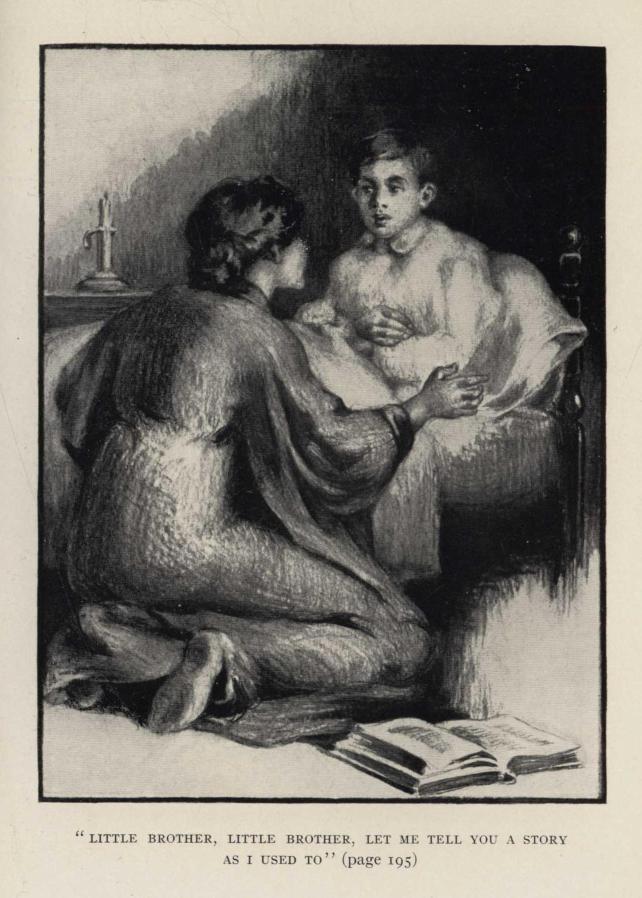
"LITTLE BROTHER, LITTLE BROTHER, LET ME TELL YOU A STORY AS I USED TO" (Page 195)
Margaret found her mother ill. She had been working beyond her strength, and the exposure and hardship of the work had worn her out; and her eyes, tried beyond their strength, had almost failed her. Dr. Eldrige Jr. had told her that the only hope of saving them lay in rest and quiet. But how impossible was this; she had no means, for years she had worked beyond her strength to keep herself from beggary. Jamie, the cripple, was not able to leave his couch without help. Day after day, while his mother worked for the pittance that kept them alive, he lay on his little cot, alone; often in pain, always lonely, counting the hours until his mother's return.
"We will take your mother and Jamie home with us, Margaret," Mrs. Thorpe said. "We can all live together until your mother is well again, and Jamie need not be alone."
Margaret consented to the plan. She understood the power that ruled Mrs. Thorpe's life and prompted her actions. She had looked into her face and found it warm with kindness, and with keener vision she had looked into her heart and found it touched with the feeling of another's infirmities. She knew that this thing that she proposed to do was not an act of charity prompted by the desire to save the harrowing of her own feelings, but because of her loving kindness she desired to do it.
Mrs. McGowan was too much overcome by the restoration of her girl to protest, and Jamie was radiant at the prospect. Mrs. Thorpe called on Mrs. Mayhew and left Margaret alone with her mother for a time. And afterwards Mrs. Mayhew sent her carriage to take Mrs. McGowan and Jamie to Mrs. Thorpe's cottage. Before parting, Mrs. Mayhew pressed a banknote into Mrs. Thorpe's hand.
"You shall not have all the merit there is in the case, you loving soul, you good Samaritan," she said. "Let me share your good deed with you."
The day passed quietly at the cottage. It was mild and clear and the first indications of spring were visible. The great banks of snow were beginning to show reefs along their sides and the atmosphere contained a suggestion of the change of seasons.
Margaret was more like the winsome lass of former years than she had been for many months, and her mother's eyes followed her lovingly. Faith and Hope, immortal sisters, what magic in the tones they cause to vibrate upon the human heart-strings! All the world and all the glory of it is ours when Faith and Hope sing for us their seraphic song.
Margaret took Jamie to her room at bedtime.
"You shall have a little cot near me, my boy," she said. "I am going to be your nurse, and whatever your wants may be it shall be my pleasure to supply them."
The boy smiled happily.
"It is a good world, after all, Margy," he said, when they were alone for the night. "I have always tried to make mother believe it is a good world. Mother's eyes will get better now, wont they, sister?"
"There is a great Physician who heals all kinds of infirmities, Jamie. He used always to be especially kind to the blind."
"Did He pity them more because it is so very bad not to see?"
"Perhaps that was the reason. He was always very, very kind."
"Have you seen Him, this great man, Margy?"
"I have felt His healing power, little brother."
"Do you suppose--sister--could He make me walk like other boys, and run--oh, Margy, do you suppose I ever can run?"
"There is nothing the great Physician cannot do, Jamie."
Margaret reached for her Bible, one that Mrs. Thorpe had given her. She turned the leaves until she found the place that she desired.
"I am going to read you something that I have read many times, Jamie, and always with thoughts of you in mind:
"'And a certain man, lame from his mother's womb, was carried, whom they laid daily at the gate of the temple which is called Beautiful, to ask alms of them that entered into the temple.
"'Who, seeing Peter and John about to go into the temple, asked an alms.
"'And Peter, fastening his eyes upon him with John, said: "Look on us."
"'And he gave heed unto them, expecting to receive something of them.
"'Then Peter said: "Silver and gold have I none; but such as I have I give to thee. In the name of Jesus Christ of Nazareth, rise up and walk." And he took him by the right hand and lifted him up, and immediately his feet and ankle bones received their strength.