Front matter (continued 2)
Reading edition
"All is well with the world."
Geraldine Vane, a little lower than the angels, her blue eyes like stars and her yellow hair like a halo of light, put her own heart-pulse into the music. In the anthem that followed, Max Morrison's strong, clear voice rang out the joyful message:
"Peace on earth, good-will, good-will to men."
The congregation joined in singing a song and the words burned themselves into Mrs. Thorpe's brain and caused her heart to quiver and her soul to writhe--
"Not all the blood of beasts on Jewish altars slain,
Could give the guilty conscience peace, nor wash away the stain.
But Christ the heavenly lamb takes all our sins away.
A sacrifice of nobler name and richer blood than they.
My soul looks back to see the burden Thou didst bear
While hanging on the cursed tree, and knows his guilt was there."
The Reverend Maurice Thorpe then stepped forward and gave the waiting audience his text:
"For God so loved the world that He gave His only begotten Son, that whoso believeth on Him should not perish, but have everlasting life."
The pastor's voice was musical and cultured and the words of the text as he uttered them met with a magnetic response from the audience. This silent applause, this outpouring of the commendation of his hearers was as manifest to Mr. Thorpe as though it had been demonstrated by visible signs or audible words; as manifest and more satisfactory, for the sense of exultation which it gave him was perceived by no one save himself.
Sensitive and responsive, he always knew in what spirit his people received his text. He read their faces as an open book, and took his keynote from them. It was this intangible method of getting at the hearts of his people that made it possible for him to comfort and satisfy them, while preaching the most orthodox doctrine and restricted creed.
Mrs. Thorpe's battle began with the text. She kept her eyes withdrawn from the pastor's face and she endeavored to keep her mind from dwelling wholly on what he was saying. She thought of the long line of snow-capped homes that led up to the church; and about her heart there clutched a hardness cold and unyielding as the frost king's embrace of the earth. Each building and frost-hung shrub and white-branched tree reared itself into a mountain of ice and snow. And Mrs. Thorpe felt that just such a range of ice-bound mountains, relentless, forbidding, impassable, lay between her and the love of God.
The pastor, with nice discernment, was able to give his voice just the proper pitch and volume to cause it to fill the room; every word was carefully articulated, clear and distinct:
"From the beginning, man, the crowning work of God's hand, manifested a disposition to disobey, and this disobedience plunged the world into a chaos of sin and disorder. From the earliest record we see man demonstrating his evil nature, his tendency to sin and all unrighteousness.... The priests of old endeavored to cleanse and purify from sin. Moses was chosen the deliverer of the Lord's ancient people; David in his day was called to rule over them; Solomon was given wisdom with which to direct them; Jeremiah threatened them with destruction; and Habakkuk exhorted them to a renewal of righteousness and prayed the Lord to be merciful to them. But the downward tendency was inherent within them and the record of man is one long record of sin and unfaithfulness....
"From time to time, owing to the wickedness of the people, it became necessary to visit punishment and destruction upon them. And many sacrifices were offered to God for the sins of the people. Lambs were slain and offered upon consecrated altars; goats and bullocks were sacrificed and altars ran red with the blood that was shed to wash away the still more crimson stain of men's sins. But there came a time when a long-suffering God could not thus be appeased; there came a time my friends, my brothers, there came a time when the blood of goats and bullocks was not sufficient to wash away the sins of man; was not sufficient to appease the wrath of Almighty God. When this time came, the only begotten Son was given into the hands of men to be crucified....
"A child, a little, helpless child, was cradled in a manger and ministered to by His Virgin mother. No man has trod nor can ever tread the pathway of pain and suffering that lay before this child, given to die for the sins of men. No man can drink the cup that He drank, or suffer the anguish that He suffered. He must die upon a cross, scorned and reviled by the world He came to save.... In the blood of His own beloved Son God wiped out the sins of the world, and so great is the corruption in which the children of men are steeped, that had one drop in the bitter cup, one sigh of anguish in the Garden, one nail that pierced the defenseless hand of the Christ been spared, the God of righteousness and justice would not have been appeased. This, then, this sacrifice sealed in blood, is the price of your salvation and mine, and there is no other way under heaven whereby men may be saved. Our pardon has been bought with the innocent blood of a crucified Savior."
Mrs. Thorpe felt her breath coming in short, quick gasps. Her cheeks were a scarlet flame and a white line was drawn about her mouth. How could men live and praise and exult under this carnage of blood! Where should she fly--how escape? Was there no way out of this--this--THIS! Was it inevitable, irrevocable, that she must reap the benefit of this awful carnage, this slaughter of a world's Redeemer? Who had at her birth, yea, before she was born, laid upon her sins for which another was called to suffer--who had dared to do this? If a blood sacrifice was required for her conscious sins, then her blood it should be--not another's--not innocent blood for culpable sin!
But the acme of her suffering lay in the thought that the God of the world had decreed this thing, in His own heart He had conceived it, from the beginning He had foreseen it--premeditated it. What wonder that chaos reigns in His world? What wonder that the children of His creation have from the beginning gone astray? What wonder that envy and hatred, strife, bitterness and despair live and flourish? Can man rise above his conception of his Creator? Can he consistently worship a God who had planned and caused to be done a thing from which the compassionate human heart must shrink and human hand must stay? Is not the whole story of the Creation, the Fall, the Sacrifice, the Redemption, as we have heard it in all its harrowing details, absurd, deplorable, culpable? Can we in sincerity acknowledge ourselves guilty of a sin for which we are not responsible, and grateful to a Creator who, possessing absolute power, fashioned men free in will and action, and then forced upon them the blood of His own innocent Son to save them from the consequences of their freedom?
Yet, bewildered and entangled as Mrs. Thorpe felt herself to be, in this labyrinth of doubt and rebellion, she was aware that other thoughts than these were tapping at the door of her consciousness; tapping and pleading for admission. Deep in her heart soil a grain of truth was throwing out its penetrating rootlets and struggling toward the light. But so completely would these thoughts, if admitted and accepted, uproot every preconceived idea, so entirely would they cast out and destroy that which all her life she had been taught to believe, that their pleading for admittance but increased the confusion of her thoughts and rendered her mental state more chaotic.
When the service was over Mrs. Thorpe became aware that many eyes, curious and sympathetic, were upon her; yet few of her friends spoke to her, for there was an unwritten law that no one should go out of the way to speak to another and that little demonstration should be made inside the church. All was orderly and dignified and befitting the house of the Lord. Strangers came and went; newcomers felt the chill of propriety that pervaded the atmosphere, and the old members felt it, too, and gloried in it.
In her fertile brain Mrs. Thorpe beheld them all, the old members and the new, and the strangers among them, as in a vision, and all were trying to climb the mountains of ice, trying to reach Heaven over a pathway of cold indifference and fixed and rigid form.
Mr. Thorpe joined his wife near the church door and he put his arm protectingly about her as she descended the church steps. He felt that the Lord had been specially kind to give her strength to be present at this service.
Pauline preceded them and was already in the kitchen overseeing the dinner when they arrived. Mrs. Thorpe went directly to her room and, removing her wraps, sank down in her easy chair. Her eyes were dry and bright, but she covered her face with her hands and her shoulders quivered as if beneath a load.
"Never again," she moaned, "never again can I trust myself to hear his voice from the pulpit."
The admission wrung her heart and hurt her as hearts are wrung and hurt when some dear one passes from view of mortal sight.
Pauline tapped at the door and announced dinner. Mrs. Thorpe arose and stood for a moment before her fire.
"If there were a God," she whispered, "if there were a God, loving and strong and powerful--oh, a God who cares for His own, how passionately would I beseech Him to be with me now, to help and uphold me!" She walked over and opened her door. "There really should be such a God--Friend--Father," she continued in an undertone, "for we need Him so!"
Mr. Thorpe and Pauline were awaiting her in the dining-room. Mr. Thorpe, who was never lacking in the small courtesies of the home, seated her at the table and took his place opposite.
"I am glad to see that the exertion of the morning has not overtried your strength, my dear," he said. "Your face in the congregation is an inspiration to me. I hope you will be able to attend regularly hereafter."
Pauline, whose insight was keener than the pastor's, divined that all was not well with Mrs. Thorpe, and broached another subject.
"The church was well filled this morning," she remarked.
"Yes," said Mr. Thorpe. "There seems to be something about the Christmas season that touches all hearts. And I think the Savior's birth means more to the world every year."
"Is this because men's hearts are changing," asked Mrs. Thorpe, "or do we understand Christ's mission better?"
"I think the religious world realizes as it never has before the greatness of the sacrifice that has been made for humanity," replied Mr. Thorpe. "We may call it Christ's mission if we like, but I prefer the term sacrifice in connection with Him who was born to die that we might live."
The flow of talk continued, but as it often happened, Pauline and Mr. Thorpe kept up the conversation. Mrs. Thorpe did not venture another remark, and after the meal went directly to her room. Her husband followed her and seated himself before her open fire. Neither spoke for a few moments, and the pastor reached for a book that lay on a stand nearby. Mrs. Thorpe saw the movement and moved as though to intercept him; but the book was in his hand. It was a small volume bound in white and gold.
Mrs. Thorpe lay back in her chair and her face framed with her dark hair seemed drawn and white as it lay against the scarlet cushion.
"What have you here, my dear? What are you reading nowadays?" asked Mr. Thorpe in a full, smooth voice. And something in the tone caused Mrs. Thorpe's heart to vibrate as to a well-loved melody. How she loved this man; bowed to him, reverenced him. She did not answer him now, she did not stir nor turn her head.
Mr. Thorpe opened the little book at random and his eyes fell upon the following: "God is a spirit and they who worship Him must worship him in spirit and in truth.
"It is difficult to understand how the idea of God as a personal being of power and wrath has taken so strong a hold upon men's minds. Not until this idea is eliminated, totally overcome and cast out, can we know our God as He is, and understand the divine mission that Christ came to perform....
"The Son of God became incarnate on the earth--not to die for men's sins--albeit a cruel and misguided people crucified Him--but by His life to teach the Truth of Life. Not to die the death of a martyr, not to offer a human sacrifice to a God of love, but to teach the children of God's creation to live."
Mr. Thorpe closed the book with his forefinger at the place. Mrs. Thorpe felt, rather than saw, his eyes upon her and she turned and looked into his face.
"Evelyn," he said, "what have you here? Where did you get this--this absurd book?"
Mrs. Thorpe did not answer him; instead she sank back into her chair and closed her eyes.
Mr. Thorpe regarded her for a moment, then he opened the book again and ran his eyes down the page. He halted at this paragraph:
"It may be true that the reluctance with which men change their conception of God, their propensity to cling to the creed and doctrines which have been handed down to them, serves to keep their hearts reverent and worshipful; nevertheless that which is false, all that is erroneous and misleading must die. The world to-day is demanding the truth about the deep hidden things of God.
"No matter how sacred a teaching or belief may have been to our forefathers, nor how efficacious it seemed to meet their needs, we must know that while the immortal Truth changes not, the ideas of men concerning it have changed with the process of the ages. Does anyone believe that while we are progressing in every line of industry, art and science, that to be Christian we must continue to stand in our religious convictions where our forefathers stood?"
Mr. Thorpe glanced at his wife. She had not changed her position, but he noticed a twitching of her eyelids and that the color had rushed into her face, burning her cheeks to a scarlet flame. He did not speak, but continued the next paragraph.
"Let us, then, with all reverence yet unafraid, seek the saving truth of God, strip it of creed and form, remove the tattered garment of prejudice and bigotry, lay low the orthodox beliefs which, while claiming to house and shelter this divine Truth, have hedged it about and endeavored to limit it to that which mortal hands have bound upon church altars."
Mr. Thorpe closed the book sharply, then opened it again and looked for the writer's name. It was a new name to him. He laid the book back on the stand and stepped to his wife's side. He laid his hand gently on her hair.
"Evelyn," he said, "how came you by that book?"
She looked full into his face and answered directly: "I found it in a book-store, down town."
"And you bought it, Evelyn?"
"Yes."
Mr. Thorpe went back to the table, and he saw there another book, one that he had not noticed before. This one was bound in black leather and stamped in gilt. On the cover there was stamped a circle of gilt, and around the circle were these words: "Heal the sick, raise the dead, cleanse the lepers, cast out demons." Inside the circle was a cross and a crown. Mr. Thorpe recognized this book, he knew it by sight. He did not touch it now, however, but pointing to it he addressed his wife: "And this book, is this one yours, too, Evelyn?"
"No," she replied, "that is one Mrs. Vane let me take."
Mr. Thorpe resumed his seat by the fire.
"If I believed it necessary to warn you against this sort of reading," he said, "or to caution you against these distortions of the Scripture, I hope I should not hesitate in doing my duty; but I feel that any such warning or caution would imply a lack of faith in your honor, and in your fidelity to your church vows. I have confidence in your judgment, Evelyn, and faith in your sincerity, but I request you to return Mrs. Vane's book at your earliest convenience."
"I had intended to do so," she said, "and shall attend to it to-morrow." Her voice was not quite steady.
She took the offending volumes and laid them on a shelf in the curtained alcove. She felt a sickening sensation creep over her, a sense of dishonor and of disloyalty to her husband.
CHAPTER VIII
STRANDED
Mrs. Thorpe sat in her room one morning, a piece of needlework in her hands. It was a beautiful piece of work and she held it from her and looked at it critically.
"You are my sedative," she said. "When a heart cries for God and cannot find Him; when a sacrilegious questioner tries to solve some of the problems of this life, or to learn the cause of this great world's woe--when one is so lacking in judgment as to try to do this, serious trouble is likely to follow and then one must have something, really must have something to distract the mind for a time." She gave an odd little laugh and drew her work to her.
A phantasm of her imagination had caused her to discard her books. Whenever she opened a book and prepared to read, a phantom form, sable and somber, peered over her shoulder and read with her.
Then she resolved to read no more books and to think as little as possible about those she had read; and to this end she had taken up needlework. She knew what her condition was physically, and realized that it was only by the exertion of her will power that her mind, too, was not a wreck. She had a curious habit of looking at her mind and brain as something apart from herself, and as another personality she studied their condition.
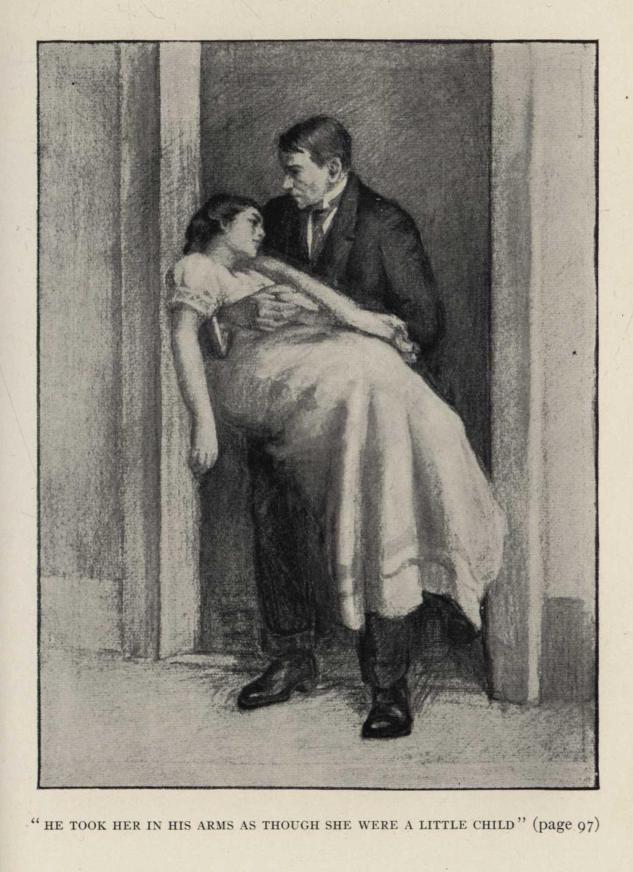
"HE TOOK HER IN HIS ARMS AS THOUGH SHE WERE A LITTLE CHILD" (page 97)
When she discarded her books, the phantom disappeared for a time, and she believed that she had exorcised it. But after a time she saw that she was mistaken in this, for it returned at intervals, more grim and determined than before. It never made a sudden impression on her, and it never startled her; but always when she became aware of its presence she felt that it had been with her all the time--always, only she had not recognized it. Then silently it would jeer at her blindness and dullness of perception, and triumphantly assert that no one on whom it fixed its choice ever eluded it.
Mrs. Thorpe had begun sorting her silks for her work when her attention was attracted by a song that Pauline was singing:
"Is not this the land of Beulah,
Blessed, blessed land of light
Where the flowers bloom forever
And the sun is always bright?"
The words of the song caused her unrest to burn within her.
"The land of Beulah--blessed land of light," Pauline could sing of this; while she--why had she failed? Had she not worked and watched and prayed--yet the blackness of darkness was about her.
"I am dwelling on the mountains
Where the golden sunlight gleams,
O'er a land whose wondrous beauty
Far exceeds my fondest dreams."
The low, sweet strain continued. Pauline often sang at her work, and the song bubbled forth as though the full heart could not contain it.
"I am drinking at the fountain
Where I ever would abide,
For I've tasted life's pure river
And my soul is satisfied."
Mrs. Thorpe dropped her work and clasped her hands over her mouth, for she felt that she must shriek aloud.
"Satisfied! My soul is satisfied! Was it possible that this was vouchsafed to some, while every hope of hers was gone, every longing unfulfilled?"
When she took up her work again she placed stitch after stitch with careful deliberation.
"I must adhere to my resolutions," she thought. "I have no quarrel with the world. I am not responsible for its woes. I cannot fight its wrongs. I will live simply and contentedly, live for my husband and my home." But she refrained from looking over her shoulder, for the black wings of her phantom hovered there.
A few moments later Pauline came into the room. "Mrs. Mayhew is in the parlor and wishes to see you," she said.
Mrs. Thorpe greeted her friend cordially. "I am so glad to see you," she said; "I was feeling a bit down-hearted this morning and longing for a congenial friend."
"Then my plan is opportune," said Mrs. Mayhew. "I came in the carriage to take you home with me for the day. Mr. Thorpe will come to tea and spend the evening, I hope. My brother, Professor Vane, is spending a few days with us, and he and Mr. Thorpe are congenial spirits, you know."
"I am sure that Mr. Thorpe will be pleased to meet your brother again. I had a letter from Mrs. Vane a few days ago. She mentioned that the Professor meant to visit you before long."
"I am glad to know that your friendship with Mrs. Vane ripened into a correspondence."
"We do not correspond regularly. I had a book of hers, one which she let me take last summer. I returned it not long ago and received a letter from her saying that it had arrived safely."
Mrs. Thorpe accepted her friend's invitation for the day and as they drove through the bracing atmosphere her unhappy fancies seemed to fall away from her. There was something in Mrs. Mayhew's personality, wholesome and practical, yet winsome as well, that had a tendency to arouse Mrs. Thorpe out of her troubled dreams and dispel the visions of her morbid imagination.
Yet when they were seated in Mrs. Mayhew's parlor, each with her bit of work, the first topic of conversation plunged her troubled mind again into a sea of doubt and despair.
Mrs. Mayhew drew her chair a little nearer to the grate, rested comfortably in its cushioned depths and let her work lay idle in her hands.
"They tell me," she said, "that there is a great deal of suffering among the poor people on the Flat this winter. The Ladies' Benevolent Society is doing what it can to help them, but cannot reach them all. Geraldine went over to the Flat with some of the ladies yesterday. She tells me that the condition of some of the homes they visited is dreadful to behold."
It is needless to say that Mrs. Mayhew did not know the effect that her words would have upon her friend. She knew that Mrs. Thorpe was often inclined to take other people's burdens sadly to heart, but she was far from knowing the state of mind that her words had wrought in her now.
She, too, was often troubled about the state of affairs on the Flat, but her outlook was very different from Mrs. Thorpe's. She saw in these miserable homes and destitute, unfortunate people, isolated cases of suffering, and their condition she looked upon as something that only the effort of the individual concerned could remedy. By his own effort and endeavor he must extricate himself from this class and advance to one higher. This always left those who remained the same privilege as that of the one who had escaped. Mrs. Mayhew believed this to be the way of the world, and she had learned never to analyze nor to question the world's ways.
Mrs. Thorpe did not interrogate the individual nor consider the class; her mind overreached these and went directly to the overruling Law--that which has created, and which does, or should, control. What greater folly than for man to endeavor to undo what the Lord has done? An overruling, unalterable, unrelenting Law lay over and made helpless and absolutely powerless the puny efforts of man.
She would share her porridge with a hungry neighbor, yes, go hungry herself to relieve a needy one; she would divide her garments to the last shred with those who had none. But while doing so, while trying to defeat the decree of the Ruler, would she prostrate herself before him, bow down and worship him?
"It is not only on Bolton Flat that people are suffering and miserable and destitute and without a God," she said. "The world is circled with woe; the cry of suffering echoes wherever the feet of men have trod. In the still watches of the night when all was quiet and peaceful about me I have heard the moaning of children. And on the street when all was bustle and confusion I have heard the agonized cry of lost souls; and I knew that those about me heard it, yet they paid not the slightest attention, and I, too, went unheeding on my way. Yet men and women everywhere are talking of a Christ--proclaiming a message! Their voices are musical, even as sounding brass and a tinkling cymbal; their phraseology--long prayers in the market place; the border of their garments and the broadness of their phylacteries proclaim their devotion!"
Her words ceased, but her thoughts, which she had long held in subjection, were now beyond her control. The fire of her spirit, that had leaped within her earlier in the day, now flamed up and consumed her. Throughout the length and breadth of the land God's men and women were going to a death more horrible than even her wildest hallucinations could picture--wailing and weeping and gnashing of teeth! Children were born into an environment that handicapped them at birth; women and young girls were obliged to sell their souls in order to keep the pitiful life in their bodies; men made a legal, licensed business of crazing their fellow men with drink. And those who professed to follow the world's Redeemer, comfortably housed, with rich garments and sumptuous fare, wrapped themselves in their righteousness and sang songs of praise in costly churches and gave thanks that they were not as other men.
The enormity of the thing was to her a blow straight from a powerful shoulder, a blow that staggered her and left her white with passion. And she felt that in all this world there was nothing so heartrending as the injustice of God. More to herself than to her friend, she said:
"If God is all powerful He is responsible for the conditions resulting from His creation; if He is not all powerful He is not God."
Her limitations were such that she could not know that these things which were so grievous to her were but a foul and tattered garment with which human kind has covered the great heart of God. Pride, vain-glory, uncharitableness, ostentation--from these she shrank in righteous revolt; and without the slightest realization that she had allowed them to become as a bandage about her eyes, blinding her to the overruling Love of the Creator and to the priceless thing in the hearts of her fellow men.
Something of this Mrs. Mayhew was able to understand. She felt that her friend's heresy was not so much a thing of the heart as a distortion of her too finely wrought sensibilities; and she wondered that a hand so exquisitely refined and sensitive should reach out into this bleeding world and touch and handle its ghastly sin-stained burdens.
"My dear friend," she said; "you say that if God is God He is responsible for these things, yet He may be working in a way that you and I know nothing about. It has always been a comforting thought to me that there may be a wideness and a mercy in His plans that our finite minds are not able to grasp. But be this as it may, you have thrown the responsibility back upon Him, then why do you not let it rest there? Why do you fret and worry yourself about it? My dear, I am afraid you are allowing these things to weigh upon you and make you unhappy."
"Unhappy! Mrs. Mayhew I am wretched, tormented, ill, I fear I shall be--mad!"
"Mrs. Thorpe, what has happened to your life? What has brought about all this questioning and unrest?"
"Oh, my friend, if you knew the weary way that I have gone--alone--alone--I have no God!"
"But why have you cut yourself off from these things which the world has accepted? I cannot understand what has caused you to renounce your faith in God. Are you not afraid to stand thus alone?"
"There was a time when I was afraid, when I believed that I must believe that which I could not believe. It was a gruesome part of the way; yet there was no other part that I was so reluctant to leave. While living in fear I believed, most surely, that the first step out of it would be over a precipice; but this conception of what will follow is all that fear really is. Freed from this, my burden became lighter, but the darkness is none the less black."
"But why do you feel that you must go this troubled way alone? The world has accepted a religion. Why do you reject it?"
"The world has accepted a cleverly devised plan whereby men expect to be saved from their sins; they have woven into it the story of the Cross, the tale of the Christ. From the most beautiful life and tragic death that the world has ever known men have gleaned the harrowing, sordid details and fashioned them into form and creed and call it Religion. This thing I do reject. Could a completer foil be devised for mankind than that the nailing of a Christ to the Cross is to save them from the consequences of their iniquitous and selfish living?"
"I believe, have always believed, and my torment is that I must continue to believe that there is a God of justice some place--some how, some where--He lives! I have lain in my bed at night and heard the voice of the wind and it has whispered to me: 'There is a God;' I have seen the tender grass come forth in the spring and every tiny blade proclaimed Him; I have seen the rush of the storm, black, ominous, fearful, and behind it I have seen His face; and all the stars at night have broken into a song of praise to Him. And after this can I bow down to a conception, a mere idea of God? Can I worship simply because others have worshiped? Our Bible and our Christ tell us of a wonderful life; a great Heart touched with the feeling of our infirmities; One in whom the great, throbbing heart of the universe, the secret of all things, is embodied. Where is this great Master-Spirit, drawing all men to Him, healing their infirmities and cleansing them from sin? Have you seen Him in the hearts of those who attend our church, living in comfort and luxury--while over on the Flat--Mrs. Mayhew--over on the Flat--can you bear to think of it? Have you seen aught of His healing power? How many can you count among the members of our church who are suffering from some infirmity? How many are every whit whole?
"I have longed for the touch, the presence, the realization of the God that lives as I have never longed for earthly possessions. I have prayed in my heart that I might be deprived of every earthly joy, every pleasure, every comfort, that I might be an outcast on the face of the earth, that I might know the anguish in the Garden, that I might feel the nails in my hands, if by this means I might have in my life and soul a realization of the Infinite, might feel and know the Divine presence."
Mrs. Thorpe's face was white and drawn and a red light was in her eyes. Mrs. Mayhew was by her side, her cool hand on her brow.
"Geraldine," she said as her niece passed the door, "bring me a glass of water, please, Mrs. Thorpe has become faint."
With the first return of consciousness Mrs. Thorpe thought of her husband. Had she not compromised his honor? Put to hazard his position, perhaps? She looked into Mrs. Mayhew's face:
"I have betrayed my weakness," she said; "I have shown you my unworthiness. It was not my intention to do this; over and over I have promised myself that no word that might cast dishonor on my husband's calling or cause him pain should ever pass my lips."
Mrs. Mayhew with quick intuition, understood all that her friend did not say, quite as well as that which she uttered. She read the story of repression and self-subjugation, and the heroism that hid her trouble and despair rather than cause another pain. And she also had a glimpse of the love this woman bore her husband, and of the fineness of her nature that even for the sake of this love, could not tamper with her soul's conception of truth. Her face was warm with sympathy:
"Dear troubled soul," she said, "I am your friend, not to distress and embarrass you, but if I can, to aid and comfort you."
During the remainder of the day Mrs. Mayhew endeavored to keep the conversation free from all topics that might distress her guest, and to limit the flow of talk to a circle of light and pleasant thought.
Mr. Thorpe came in time for dinner. Between him and Professor Vane there was much of common interest. Professor Vane was a teacher in a theological seminary; and the two men discussed the world of theology, the Church and its mission, the seminary and its work.
"I cannot account for the diversity of opinion I find among theological students," Professor Vane said. "There are scarcely two of them who see the questions of creed and doctrines in the same light. What the outcome of all of these new lines of thought will be it is difficult to predict."
There was a spirit of resentment, righteous he believed it to be, in Mr. Thorpe's mind toward these new lines of religious thought. He believed that the Leviathan of doubt, and the subtle Serpent of false belief had threatened the sanctity of his own home. And he was strong in the belief that it was time for men of integrity and conviction to strike these monsters, to crush and destroy them.
"It is my opinion that these digressions and irregularities must prove disastrous," he said. "We must have a creed and a doctrine, and I do not hesitate to say, that men who cannot conform to them have no call to preach the Gospel."
Professor Vane did not answer at once, and Mrs. Thorpe who had listened in silence, waited anxiously for his reply.
Mrs. Mayhew believed she knew what was in her brother's mind. She recalled a frail little woman tortured with pain, whom her brother used to carry in his arms, and lift from one position to another. This woman, his wife had been restored to health and strength, and the joy of living, by a digression from accepted creeds and doctrines. A system of Christian healing had restored her.
"How far we have a right to judge another's conception of God is a mooted question," Professor Vane said thoughtfully. "If I err I hope it may be on the side of charity."
"On the side of charity, yes," said Mr. Thorpe; "but I can see little love or justice in allowing doubts and fallacies to intrench themselves in the consciousness of another." He could not quibble over this question, nor fail to express himself fearlessly, even though he should strike a blow nearer Professor Vane's heart then the students under his care. He was strong in the belief of his own just purpose.
Mrs. Mayhew with quick perception read his design. She knew that he had never reconciled Mrs. Vane's recovery with any grain of spiritual truth. But she saw the blood surge into Mrs. Thorpe's face, and she knew that his well aimed blow had struck where he had not meant that it should.
She laid her hand on Mrs. Thorpe's shoulder, "Let us leave the gentlemen to their theology," she said, "Come with me and watch the children go to bed; it will do you good to see them."
One by one the little garments came off and little white slips went on. Shoes were untied, and stockings removed, and little pink toes peeped out.
A visitor in the nursery at bedtime was an unusual occurrence, and unusually good order prevailed; yet Charley insisted on getting into his gown feet first, as he considered it unmanly to have it put over his head, and Mabel refused to be comforted because nurse unbuttoned Mattie's pinafore first. The three-year-old baby insisted on disrobing without assistance from anyone, and cried lustily because he could not untie his little red shoes.
But finally all troubles were overcome, the little hearts were comforted and all was quiet. Then by each little white bed a white-robed figure knelt with clasped hands and lisped a childish prayer.
Mrs. Thorpe kissed each child a happy good-night, and wished them sweet and pleasant dreams. But Mrs. Mayhew noticed that there was a strange expression on her face, and that the troubled look had not left her eyes since their talk in the morning.
When they returned to the parlor they found that Mr. Thorpe had taken his departure.
"A messenger came for him a few minutes after you left us," explained Professor Vane. "He was called to the bedside of a dying woman. He told me that he had been expecting the summons for many days."
"Mrs. Ritchie, I presume," said Mrs. Mayhew. "Poor soul! we cannot regret that the end has come for her at last. She has suffered a great deal."
Mrs. Mayhew sent Mrs. Thorpe home in the carriage, as Mr. Thorpe was not expected until late; he might be away all night.
Mrs. Thorpe explained his absence to Pauline, whom she found awaiting her.
"You are looking very tired, Evelyn; are you ill?" Pauline asked.
"No, Pauline, not ill; only very, very tired. I will go to my room at once."
"Very well; I will hear Maurice when he comes and let him in."
As Mrs. Thorpe arose to go to her room Pauline noticed that she shuddered as though a cold draught had struck her.
"What is it, Evelyn, are you cold?"
"I'm so tired, Pauline," she said, and sank down in her chair again. "And Maurice's being called away was something of a shock, you know."
Pauline went over to her. "Yes, I know," she said. "And I know you are tired; you look all worn out. Shall I go to your room with you?"
"Oh, no, thank you; that is not necessary. I shall be all right when I am rested again. Good-night, Pauline." And she started again for her room.
"Good-night, Evelyn. There is a light in your room. I hope you sleep well."
As Mrs. Thorpe entered her dimly lighted room a cold, dizzy sensation again came over her. She sank into her easy chair and the events of the day passed before her. Suddenly she sat upright and gazed with horror at the sight which greeted her. She tried to shriek, but her tongue was silent; she tried to fly, but her feet were motionless. She closed her eyes, but it was not with her natural vision that she saw the outline of phantom forms and ghoulish faces that filled the room.
"She is ours at last! She will never resist us again." It was not a voice that she heard; there was not a sound in the room; the silence was oppressive. Over and over, around and about, circling, advancing, retreating, the forms filled every foot of space, and yet she was sure that the room was empty save the furnishings; the chairs, the bed, the table, these stood out clearly and distinctly. She felt the rush of bodies, the bustle and strife among the myriad forms as they jostled each other in their struggle to be near her; yet there was not a breath of air stirring in the room; all was motionless and quiet. Then a space above her cleared, the air seemed to open and the somber form and sable wings that she had seen so often descended upon her. She was conscious of wondering how it could be that she had met this phantom so many times and denounced and driven it from her. She felt so stupid now, so numb and powerless; yet the horror had never been one half so great. She felt the claw-like fingers clutch her shoulder and the blood gushed forth in a crimson stream, yet there was no sensation of pain, only the grim and awful horror of it. She felt herself borne away, the multitude of forms and faces following in her wake. What a ghastly burden she was! Blood oozed from every pore and left a crimson trail behind. Her phantom carrier went tirelessly on and on, through space and over distances until it reached an abyss, wide, deep and black. Over this, with fluttering wings, it paused. And could it be--broiling, seething, writhing below--oh, could it be--was it true? She must be wild--her vision blasted--her senses gone. She had heard the wail and moan of suffering children, the call of lost souls; she had seen the world circled with the maimed, the bruised and the broken hearted, but this--oh, this which she now saw and heard! How could it be that the abyss contained that which greeted her vision! The carrier, with poised wings, now let go its grasp upon her shoulder and slowly, yet with deadly certainty, she slid down into the abyss--to become one of them!
It was past midnight when Mr. Thorpe left the stricken home where he had been called. He had performed the last sacred rites for the dying woman; he had knelt at her bedside and committed her soul to the keeping of Him who gave it. It had been a painful scene and he was tired and depressed when he reached home. He entered his wife's room and found her in her easy chair in a dead faint. He hastily summoned Pauline and sent a message for Dr. Eldrige. Mrs. Thorpe was ill, very ill. Dr. Eldrige, fussing and fuming, declared that her nervous system was a complete wreck. There was little that he could do for her. Proper nourishment, careful nursing, and, above all, perfect quiet. These were the only remedies in a case of this kind.
To his son he said: "The thing I predicted has happened; the woman's mind is gone. She is mad as a March hare, and it is my opinion that much learning or effort toward learning has made her so."
Dr. Eldrige Jr. recalled his last interview with Mrs. Thorpe. Evidently she had not followed his advice. He was not surprised at this, for he had not really expected that she would. He felt, too, that the advice that he had given her at that time was very much like giving to a patient in the full flush of fever remedies intended to prevent fevers generally in their incipient stages. He resolved, however, to satisfy himself whether there was anything that could be done for her now. The manner in which he obtained his father's consent to call upon her was typical of the method by which he managed to have his own way when he especially desired it, and yet get along smoothly with his irascible parent.
"If this woman has brought about her own destruction, as you believe," he said, "while doing what we can for her professionally, we can also study her condition for the benefit of science. I wouldn't mind calling on her myself."
"You are a likely limb, my boy. If you could get some of the foolishness out of your head you might make your mark in the world yet. To-morrow you can go and tell those pious people at the parsonage that your old dad is indisposed and sends you in his place."
When Dr. Eldrige entered the sick room the next day Mrs. Thorpe fixed her eyes intently upon him. Never in his experience had he felt the compassion, the depth of sympathy for a fellow being that her appearance kindled within him. Every expression of her face, every movement, every muscle was blended in physical pain and mental horror.
Love and compassion, as well as other emotions strong and deep, are not limited to the mind in which they have their inception; neither are they bound nor fettered, and they cannot fail to effect in some degree the being that has called them forth. Dr. Eldrige Jr. advanced to the bedside and quietly regarded the sufferer.
Mrs. Thorpe, who seemed to have taken no notice of anyone before, now raised herself to a sitting posture and, as a child reaches out its hands to a parent, she extended her hands to him.
"Take me out of this," she said, and there was fear and pleading, piteous and frenzied in her voice. Her eyes, in which no light of reason glimmered, wandered apprehensively about the room and back to the doctor's face. "Oh, do help me!" she gasped. "Take me out of this!"
The doctor's mind was working rapidly; with quick perception he detected that all reason was not gone, for it was evident that Mrs. Thorpe recognized him; yet he could not doubt that her mind was unbalanced to the extent that she believed herself in some place or condition the horror of which was unspeakable. If a condition, he must find some way to work upon what remained of her intellect, until, in her mind this condition was changed; but if it were a place or surroundings, his task might be less difficult, but it must be performed quickly. Without more than a moment's hesitation he extended his hands to her in return.
"Certainly," he said in a brisk, cheerful voice, "certainly I will take you out. That is exactly what I came for." He bent over her and took her in his arms as though she were a little child. Then to the nurse he said:
"Show me the nearest bed outside this room."
The nurse opened the door, crossed the hall and swung open the door of the room opposite. It was Pauline's room, and as usual it was in perfect order and spotless. The doctor said no word to his patient, but laid her quietly upon the bed. She rested her head on the pillow with her hand under her cheek and her eyes wandered curiously about the room. Then her eyelids fluttered drowsily, fluttered and closed. The doctor held up his finger commanding quiet and the nurse remained motionless where she stood. A little clock on the mantel ticked off the minutes; there was no other sound in the room and the sufferer fell quietly asleep. It was the first sleep that had come to her since her illness, and her condition, which the older doctor had pronounced hopeless, at least so far as her reason was concerned, dated its improvement from this time.
CHAPTER IX
EASTERTIDE
The Reverend Maurice Thorpe had not been so successful in his work as he had hoped to be; not so successful as the beginning of his pastorate had promised. Of late he felt that his work was falling below par. The fine touch, the artistic setting, the convincing logic that had once been his were slipping from him. He could not feel that his ardor had cooled nor his interest waned, but his faculties seemed to have lost their keenness and his tongue its cunning. His health was not up to the desired standard and his wife's illness had been a severe strain upon him. There had been a time when he felt that there was nothing left in this world for him unless his wife regained her physical and mental powers. Now he felt that perhaps he had not been properly reconciled to the will of Providence, and he prayed for greater grace and threw himself heart and soul into his work and resolved to regain, if possible, that which he had lost.
At his request special preparations were made for an elaborate Easter service. He wished this to be a service that would arouse the people, something that would interest them and induce them to come again. The music has so much to do with the success of the modern church that the pastor planned always to keep in touch with his choir. The song service must be fitted to the sermon, either to emphasize the beauty of the text, or else to soften and subdue the undressed truth which must sometimes be spoken.
Geraldine Vane was a capable and willing worker in the choir. The plans for the Easter service were arranged, the parts assigned and the practicing began.
In this work Geraldine and Max Morrison were thrown much together. There were some disreputable stories afloat about the man's character, but no one seemed to regard them very seriously; and his voice was so great an attraction that the choir was glad of his help.
When on his way to choir practice Max had fallen into the way of calling for Geraldine, and he often spent an evening in the Mayhew home. And as time passed he began to feel more than a casual interest in this girl with the shell-tinted face and golden hair. The Mayhew children, too, amused and interested him. He liked to talk to them, to ask them questions, and hear their naive answers and innocent speeches.
During the winter his acquaintance with Geraldine had ripened into a more intimate friendship. Their love for music and their proficiency in the art formed a bond between them. Geraldine, a veritable St. Cecelia, her figure swaying with the rhythm of the music as her fingers flew over the ivory keys, and Max with his bow calling forth the sweet, weird melody of the violin, would feel their pulses quicken as the blended melodies throbbed and sighed and quivered.
It was at this time that Dr. Eldrige Jr. condemned the woman he had loved from her girlhood and stepped aside and gave his rival possession of the field. Fine and true to the heart's core himself, he would not seek nor desire the love of a woman who demanded less than this in manhood. Nor was it in his nature to wage a warfare for a woman's love. This priceless, this sacred thing, must come, if at all, freely and naturally as the beauty and fragrance of nature comes to waiting earth.
During the preparation for the Easter service Max and Geraldine were thrown together even more man usual. And it was at this time that Mrs. Mayhew felt an indefinite fear, a vague alarm concerning their friendship. She went to her husband with her half-formed conjecture.
Mr. Mayhew was a practical man of affairs, shrewd and sagacious.
"I see no cause for alarm," he said. "We have known Max from his boyhood, and although his career has not been entirely exemplary nor his character spotless, for a young man of wealth to-day he is not a bad sort. And as to his fancying Geraldine, I see no reason to object if he should. There's many a girl gets a worse husband than Max will make. With a girl like Geraldine for a wife Max might settle down and make a model husband."
Mrs. Mayhew rarely opposed her husband. She believed that, owing to his position, his contact with men and his conflict with the world, his judgment must be better than hers. She realized in a way that her judgment was a thing of the heart and lacking in that worldly wisdom that her husband possessed. She remembered many times when she had taken his advice against her own convictions and afterwards found that she had not been the loser thereby. Yet, being a fair-minded woman, she sometimes came to a place where another's judgment could not answer for her; where her impulse and desires prompted her to act from the dictates of her own heart.
Geraldine's father had died before the girl was born and her mother had yielded up her life at the birth of her child. Mrs. Mayhew had taken the little one and reared her as her own and loved her as her own. But aside from this love and watchful care there was a feeling of responsibility different from that which a mother feels for her own children; their welfare and happiness she is responsible for as for her own flesh and blood. She was responsible for Geraldine as a child of another birth and branch.
The girl had been loving and affectionate, willful and passionate at times, yet always ready to confess her faults. Mrs. Mayhew had seen her through the unsettled period of adolescence and knew that at the present time she was a true-hearted woman, looking into the future, trusting and unafraid. Had there ever been a time since she held her in her arms, an infant of a day, when she had needed a guiding hand and love and care more than at this present time?
Mrs. Mayhew resolved that, let the consequences be what they might, Geraldine should have some enlightenment as to Max Morrison's real character.
It was a few days before Easter. Outside there raged a storm of rain and sleet such as the Middle West often sees in the early spring. The snow had disappeared, except here and there a dark-hued bank by the roadside or in some well-filled corner. Out in the country the fields and meadows lay bare and brown, awaiting the magic touch of spring--Nature's resurrection.
But within the Mayhew home a warm radiance covered all. The interview took place in Geraldine's room. The room was typical of the girl. An air of purity and daintiness was lent by soft, white draperies; yet everywhere there was a suggestion of ease and restfulness. Conspicuous, but not prominent, a pair of cherubs were enfolded in a shimmering gauze of drapery. A picture of the Virgin with the Christ Child in her arms hung above the mantel and on the wall opposite, the tender, loving face of the Savior. And beneath the Christ face hung the picture of a sweet, calm-eyed woman and a manly, dark-browed man--the parents that the girl had never known.
Mrs. Mayhew was perfectly familiar with the room, but with her mission in mind she was aware that it impressed her in a different manner from its wont. A mind less pure than Geraldine's could not have planned and fashioned it. This quality of mind and heart was apparent in all that the girl did. Suppose she were robbed of this chastity of thought and the evil things in the lives of others thrust upon her vision. Could she ever be just the same girl again? Mrs. Mayhew had eased her mind with like sophistry before, but now she felt that the hand of necessity was upon her.
Geraldine sat before her fire, a piece of needlework in her hands. Mrs. Mayhew drew her chair to the grate and produced her own bit of work. She cast about in her mind for some way to lead up to the subject upon which she wished to speak, but finding none, she broached it abruptly.
"Geraldine, do you know you are very unsophisticated for a girl of your age? That you know very little of the evil there is in the world?"
"Do you think I would be better if I knew more, Aunt Agnes?"
"It is not a question of your being better, Geraldine; I think the trouble is that you are too good already. Do you believe your friends to be as good as you are?"
"Why, Aunt Agnes! Am I any better than you are, or Mrs. Thorpe, or my girl friends? Why do you say such things to me?"
"Because I must say them, my dear; you must know more about your friends. You are not more virtuous, perhaps, than the ones whom you have mentioned; but you are as a creature of another world compared to Max Morrison, for instance."
The seashell color in Geraldine's face deepened to flame, but ignoring the display of feeling she had been too unguarded to suppress, she met her aunt's eyes full and true.
"Is there anything objectionable about Max that I should know?" she asked.
Mrs. Mayhew knew that there was no turning back now. She wished to be honest with the girl and at the same time as charitable as possible toward others. She must show Geraldine that, desirable and praise-worthy as purity and chastity are, and obligatory as they are in a woman, she should not expect to find these qualities in this man, nor hardly in the degree that a pure-hearted girl possesses them, in any man, and that it would not be wise nor just, perhaps, to condemn Max for a lack of them. She recalled her husband's attitude on the subject, and although it did not break her resolution to be frank with the girl, it tempered it appreciably; and a queer blending of her conscientiousness and her husband's practicality were the result. A distorted vision pictured itself impishly before her. Being a woman, she should cleave virtuously to the good, but be willing to fall on her knees at the marriage altar and accept the bad! She felt that the magnitude of the question was crushing her, and that its complexity would be her undoing. The longer she hesitated for the words in which to express her meaning, the more helplessly lost she became, and Geraldine was waiting for the answer to a direct question.
"To allow you to believe that Max is virtuous as you understand virtue would not be justice to you, Geraldine," she said.
"Please be quite frank, Aunt Agnes. What is it you wish me to know?"
"None of us are perfect, my dear, and very few of us are good. It is a hard world to live in. Not many young men go through the trying period of early manhood unscathed, and it comes to us women sooner or later to know these things."
Geraldine did not speak, and silence fell between them. Mrs. Mayhew noticed the steady, even stroke of the girl's needle and her quiet composure.
Had her words failed to make an impression, or was Geraldine too strong and firm to show her feelings, or was it that she did not care?
But she found no answer to her questions and the silence continued. Mrs. Mayhew was relieved when the children came and tapped at the door. Geraldine bade them enter and they flocked in, frolicking and laughing, and filled the room with their chatter.
When they were all gone and Geraldine was alone she stood, a white figure among her white draperies, and looked out at the storm and listened to the sleet and rain against her window-pane. The color burned into her cheeks again and a shadow lay in her eyes. She was beginning to believe the world a rather difficult place in which to live, and life not so bright and joyous as she had thought it to be.
Easter morning dawned gray and cold, but the sun, seeming to repent its sullen mood, broke through the clouds and shed a warm radiance over the cold, soaked earth.
The great church with its arched ceiling and taper windows seemed impressed with its own solemnity and its silence was intense and worshipful. The banks of lilies, emblems of peace and purity, seemed to harmonize with the spirit of the place; for their fragrance and beauty were far removed from all that is plain and common and their golden hearts were untouched by humanity's woes. Above the bank of lilies and ferns hung a picture of the Christ with a halo about His head. The painter's art showed in pose and expression, in every line and detail. The eyes were pathetic and beseeching, as they must have been when those most heart-rending words the world has ever known--the prayer in the garden--were uttered. The brow was calm with the peace of Heaven and the mouth, so fine and true, was yet sensitive and pleading. If this Friend of man could speak, what would be His message to the worshipers gathered there? If those eyes could see the nodding plumage of the forests' songsters adorning the heads bowed in worship; if those ears could hear the rustle of costly garments--Easter outfits--while over on the Flat little children shivered, bare-footed and garbed in rags; if those finely penciled nostrils could breathe the incense from the lilies' golden hearts, while from meagre, unkept homes vile odors arose--what, in truth, would be the message from the Christ this Easter day? If those hands were alive, those hands that carried healing, health and blessing in their touch, what would their mission be? Would not the crippled boy stand erect and walk? the tortured shoulders of the rheumatic straighten? the blind eyes of a parishioner's daughter open? and the deaf ears of the white-haired sexton hear, as they had not heard for twenty years, the Resurrection message?
But the eyes saw not, the ears heard not, the lips spoke no word and the hands bestowed neither health nor blessing. Was it then only a painted Christ that dwelt in the costly church? Only a painted Christ that confronted the Easter worshipers? Was there in their midst no heart touched by the feeling of their infirmities?
The song service was all that those that had planned and executed it had hoped for. The house was crowded; pews that had been dusted and cared for for months without occupancy were filled. The seats in the back of the church were filled also. Many of the poor came to feast their eyes on the lilies--conclusive evidence that, buried in their hearts, hidden from sight, perhaps, and struggling for existence, other lilies bloomed.
The song service was artistic, exquisite; not a flaw or discord marked the time or tone as the perfect blending of trained voices rose and fell with the pulse and throb of the music.
The pastor delivered his carefully prepared sermon with its rhetorical wording and euphonious flow, with more dignity and enthusiasm than had characterized him for many months past.
During the service Geraldine Vane, on her raised seat in the choir, turned and looked into the steel-gray eyes of Dr. Eldrige, Jr., who occupied a pew in front. It was but a flash, a passing glance, but the color deepened in her cheeks regardless of her endeavor to keep her attention on the pastor's words, and there came to her again something of the great difficulty of life's problems.
After the service Max Morrison joined her near the door and she stood beside him, bewitching in her Easter gown, and about her the sweet incense of the lilies she carried.
Then she became aware of another presence and looked again into the eyes of young Dr. Eldrige. But she read no friendly greeting there; the recognition was cold and formal and he passed on out of the church.
The warning that Mrs. Mayhew's words contained had assumed dimensions gigantic in Geraldine's mind, while their palliative qualities robbed her of all sense of proportion. A half-suspicion possessed her, a harrowing doubt assailed her; many questions besieged her and she found herself in a state far from conducive to a peaceful state of mind or a tranquil spirit. But she walked down the street beside the tall figure of Max Morrison and she held her head proudly and endeavored to still the contending voices within her.
Mr. Thorpe felt a keen sense of satisfaction as he descended the church steps and took his way homeward. The service had been all that he could desire. No doubt there would be mention made of it in the papers during the week and it would give his church an enviable reputation. But this elation, gratifying as it was for the time, was doomed to be short-lived; before the day was done there was a reaction. The spirit of worship had waned and left a sense of chill and despondency. Mrs. Thorpe noticed the droop of her husband's shoulders, the worn look on his face, and her heart cried out against whatever it might be that gave him pain.
The Easter sun sank behind the tree-tops and its last rays lay warm and tender over the church and parsonage and over the meanest hovel on the Flat. Great Illuminator which seeks not the place of its shining and respects not one person above another--typical of the love of God.
CHAPTER X
THE DISCERNMENT OF TRUTH
Mrs. Thorpe was sitting one day in the familiar seat by the window, and her thoughts were centered on the conditions about her. Outside the vine was putting forth new buds and tender leaves; a bird on a swinging bough was singing his mating song; the grass was growing green on the incline that led up to the church. The winter had not destroyed the heart and life of that which it had blasted outwardly, and Nature was emerging into newness of life.
A world of growing things, abundant, forceful, alive, are springing from the brown, fructuous earth; spring is pregnant, alive with a power beyond human conception. Boundless, limitless, infinite Power!
Now questions that at first seemed to come to her timid, elusive, quivered before Mrs. Thorpe's mental vision and insinuated themselves into her consciousness. Was this material evidence before her eyes the substance and reality of that which she saw, or was there something hidden from her mortal vision, something in this scene before her which her senses could not recognize? Here before her was the seed-bed, the seed and the form of the fruitage; but were these the reality, or were they but the fleeting forms of matter, and the divine Idea the only reality? Which is real, the plant and the flower, or the life of the plant and the flower? These questions that had come to her haltingly, falteringly, gradually assumed larger proportions until they included herself, the universe, and all that the universe contains. Time, place, conditions, and all material relations shifted and changed, and she saw God's world, and God's power controlling it; a just and majestic God asking only conformity to the perfect conditions he has created.
Now all of Mrs. Thorpe's preconceived knowledge vanished and melted away. Every structure that she had built had been founded on shifting, undulating sand, upon her belief of life in matter. The ideas and conceits of her childhood, the ardor and energy of her young womanhood, and all the strain of recent years all passed before her, and all were empty, vain, human and finite. She saw mortals bowed and broken, guided by finite wisdom and helped by finite power, trying to do God's work; struggling and agonizing, trying to aid Infinite strength, and to supplement Infinite wisdom.
She saw man--upright, holy, divine--yet dominated by his false beliefs and his conceptions of evil, believing himself the sinful, unclean thing that his distorted vision pictures him to be; ignorant, misguided, toiling in pain and sorrow. Christ, ah, Christ! Who would not be a Christ, a Savior of men; who would not sacrifice this stage of life, yea, die a thousand deaths, if by pain and sacrifice he might show this bruised and broken people the perfection of life, and the harmony of the condition in which Infinite love has placed them?
Every cord that held her to the moorings of her old belief gave way, and Mrs. Thorpe found herself alone on a shoreless, fathomless sea; no sail was in sight, no hand reached out to her. Adrift--alone--there was no measuring of time or space. But she was not afraid, for the science of Being had been revealed to her. Alone--yet he whose voice stilled the sea, he whose voice stills human passion, fear, pain and suffering was with her, and she walked upon the water with this Man of Galilee.
In their blindness and error men have produced that which is not beautiful, and which is not good, but there are no blemishes in God's world, and there are no iniquities. The God of love has put beauty, and grace, and joy, and gladness into everything that He has created.
Now Mrs. Thorpe saw before her all that has been, all that is, and all that is to be; and her eyes were not holden to the emblems and symbols through which the solution of God's world was hers. "Neither death nor life, nor angels, nor principalities, nor powers, nor things present, nor things to come, nor height, nor depth, nor any other creature," shall be able now to separate her from the love of God.
The peace that passeth understanding is like a calm on mighty waters, like the strength of rugged forests, like the blending of many melodies. Mrs. Thorpe fell on her knees and buried her face in her hands. But this attitude was not taken to humble herself before the God that she had found; this Deity that was revealed to her was the great and perfect Whole, and herself she recognized as the spiritual image and likeness of God.
"There is a Spirit in man and the inspiration of the Almighty giveth him understanding." "The inspiration of the Almighty;" there is no other source of supply, no other way to understand than to let the Spirit speak to the "Spirit in man." Mrs. Thorpe's mind was emptied of worldly wisdom; the tablets of her heart were renewed clean as an unwritten page. Freed from the thought of her material selfhood, and her intellectual beliefs, she was receptive, ready and waiting in the hands of the Master of men.
The preparation of the clay that is to be molded into a work of art is of first importance; and when this preparation is completed the artist begins his work of bringing beauty and grace out of a pliable, yielding mass ready to his hand. When a piece of ground is to bring forth a harvest of golden grain or succulent fruit the ground must first be prepared. There must be an upheaval; the weeds and tares must be uprooted; the plow-share and the harrow must do their work; the soil must be torn and broken and turned up to the mellowing sun, and then the seed is sown.
Upon her knees Mrs. Thorpe was not denied the knowledge that her years of suffering were years of preparation; that the anguish and pain wrought by her great desire had not been in vain. When she arose to her feet she knew that she had found the Kingdom of Heaven; it was within her.
A flood of sunshine lay over the room; each familiar object was in its place, yet all was changed. She stepped to the window and looked out, and the transfigured earth, and air, and sky greeted her; yet even in this first newness of her joy she knew that this change which glorified all things was in her own heart. And that which tongue has never named and pen has never described descended upon her and enfolded her like a garment; and henceforth and forever she was secure from harm; she had come into her own. She felt her heart overflowing and exulting; the vigor of the spring was in her veins, the unseen growth of the vine was expanding her soul, and the birds' song filled her with joy.
Then like a flash, like the cut of a knife, the sting of a lash, a black, evil thought darted into the radiance. The phantoms--where were they? The dark visage, the black wings, the hissing, shrieking voice--where were these? She looked fearfully about her with dilated eyes; but all was quiet, and there was neither form nor shape visible. The room lay bathed in sunshine, and there was a soft balminess in the air. Yet for one awful moment she felt that she was losing this wonderful thing that she had found, she was afraid--led into the wilderness and tempted. Then with a supreme courage she put it to the test; she stood upright and looked over her shoulder. The space behind her was empty! Trembling, agonized, yet in ecstasy, she looked again--the space was empty! Not even in dimmest outline, half-hidden, elusive as her enemy sometimes appeared, did he now show his face; not the faintest flutter of wings was discernible; no whisper came to her. She turned and walked across the room and back again to the window. She could not yet be satisfied that she was free; the sickening horror, the awful dread had not left her, and she turned and looked again over her right shoulder, where her phantom most often appeared, then over her left shoulder, where it sometimes surprised her by lurking. The space was empty! Now she felt that if she longer held her peace the very furnishings of the room must cry out. "Father, Spirit, God of Truth," she cried, "Love has liberated me!"
Had a miracle been wrought for her deliverance? Mrs. Thorpe had always known that it was her imagination, her own distorted fancy against which she battled and fought. A phantom is not a reality, however real it may appear. The truth is always true, however distorted our view of it may be. When Mrs. Thorpe fixed her mind on the central Truth of creation, and spiritually discerned it, she realized that all the doubts and fears that had held her were but distortions of her material sense. All of her questionings and perplexities, vain fancies and evil imaginings were obliterated; her mental conception was changed, the hallucination dispelled, and she was free.
Free! Men have been freed from the dungeon and from chains; reprieves have come at a moment when prisoners were to meet at the hands of their fellow men a violent death; floods and flames have been faced and deliverance miraculously given. These are physical horrors, relieved by physical causes. Mrs. Thorpe's deliverance was from a mental foe, one who would destroy not only her physical frame, but who would twist and warp and dethrone her reason as well; her deliverer was the royal Truth of life. Now indeed she had burst her chrysalis, she was no longer a worm of earth, but clothed with the spirit of immortality, she saw God's creation, not as human weakness has interpreted it, but as a loving Father designed it.
Pauline, ever watchful and alert, was the first to notice a change in Mrs. Thorpe. She noted the returning vigor and observed the unusual buoyancy of spirit. There was also a consideration and thoughtful kindness in her manner that Pauline had never noticed before. A great deal of charity must be manifested toward one who is ill and in pain, unpleasant manners and disagreeable ways must be overlooked. Pauline had had the tact and patience to do this; she was not one to judge a sick woman unkindly. But now there was a winsomeness about this woman whom she had long looked upon as her charge, an optimism that she found it difficult to adjust to Mrs. Thorpe's former attitude.
CHAPTER XI
A SUMMER'S VACATION
Mr. Thorpe noticed the change in his wife and rejoiced in her recovery. Her quiet manner and uniform cheerfulness brought to his mind the early days of their wedded life, and he felt that perhaps the many prayers that he had offered for her recovery had reached the throne of mercy.
But the pastor's own cares were pressing him sorely. All that he had gained by the Easter service he had lost, and more. His congregation grew smaller each succeeding Sabbath, and with bitterness and despair he admitted that he was not obliged to look outside of himself for the cause. He felt his strength slipping from him, and in some way that he could not analyze nor comprehend, and his mental capacity seemed dwarfed and contracted. Thoughts of beauty and grandeur flitted through his brain, but when he tried to fix them there, to put them into words or on paper they eluded him, mocked and evaded him.
When spring merged into summer a council of his church convened and voted him a vacation for the summer months. This was gratefully accepted; for he felt that a season's rest, a long vacation in which to recuperate and regain his lost powers would put him in condition again for his work in the autumn.
Mrs. Thorpe was to accompany him, and they planned to spend the summer with an uncle who lived in a small village in an adjoining state. This uncle was a retired minister, who for forty years had preached the Gospel. Now with his wife still beside him, he was spending what was left of his life in well-earned peace and quiet. He sent an earnest invitation to his nephew to come to him and spend his vacation in this quiet, restful village.
After the vacation was arranged, and the invitation accepted, Mr. Thorpe threw himself with all of his remaining strength and energy into the preparation of a farewell sermon. He desired this to be of high excellence, and especially adapted to the occasion; he wished to say something that would appeal to the hearts of his people, and cause them to remember him, and to be ready to welcome him back in the autumn. For days he worked on this sermon, comparing words and phrases, seeking just the shade of meaning he desired, harmonizing sentences, and striving for an agreeable rise and flow of language.
Mrs. Thorpe, who had attended church for several Sundays, accompanied her husband on this last Sunday morning. She walked beside him now with easy grace, and mingled with her friends and seemed not to notice their wondering looks and incredulous glances; she met them without self-consciousness, neither shrinking nor boasting.
When the pastor entered the pulpit, and the deep, sweet tones of the organ sounded, her soul glad and worshipful, left every care and material thought. Then she heard her husband's voice in prayer, praying for his people, and for the great world of humanity. But she did not follow the prayer closely; her new conception of God's creation enabled her to know that the Lord's blessing was already upon these people, that they needed only to realize and accept it. She saw toiling millions begging for a blessing that has been theirs forever, and that can never in any manner possibly cease to be theirs.
For his text the pastor had taken, "To him that overcometh," and he dwelt largely on the reward ready for those who are able to endure to the end.
As the sermon progressed, Mrs. Thorpe was reminded of her old troubled conception of the Father and His children in the field. She did not wonder that this idea had once possessed her; for was not this the very interpretation of life that her husband was presenting? But now before her vision she saw a kind and compassionate Father, and man in His spiritual likeness.
She had found that the propensity of mortal man to worship images of belief that he himself has created, rather than to hold as his own that which God has created for him, and has bestowed without limit or stint upon him, is the cause of man's woe, the cause of all his grief and pain. God has given man only good; He could give nothing else, for He has created or fashioned nothing else. She heard the sermon through, however, without inward questioning or discord. Since the deep, sweet Truth of life had become the bread and wine of her existence she was not troubled by another's conception of truth. All truth, however small, however great, is a part of the Truth, just as every drop of the ocean, or rippling wave, or mighty billow is a part of the sea.
Mrs. Thorpe knew something of the hard toil and effort this sermon had cost her husband; she knew that he had builded it word upon word, sentence upon sentence, and she understood the intensity of his purpose, the sincerity of his belief; but the thought came to her forcibly at this time that the laws of God are not influenced by man's conception of life and truth, but that, perfect and harmonious, they go undeviatingly on, regardless of what man believes or teaches.
After the service Mrs. Thorpe noticed that there was no change in the rigidity of the manner that marked the worshipers. All was orderly and formal; those nearest to her spoke in subdued tones, and expressed a cold pleasure at seeing her again. This concourse of people, each heart carrying its own peculiar burden, had come to the service, listened to the music, heard the Scripture read and the sermon delivered; now each went again his own way without solace or comfort, his burden not one whit the lighter.
It was a dull, gray morning; lowering clouds hung threateningly about, and a fine, penetrating mist filled the air.
"This dampness and mist is as bad as a pouring rain," said Pauline, on the way from church. "You had better fasten your muffler close about your throat, Maurice, and turn up your coat collar; I fear this will bring on your cough again."
When they reached the parsonage Pauline saw that the fires were built and the rooms warmed and dried, although it was early summer. The dry, hacking cough that Mr. Thorpe was subject to was something to be fought and doctored continually. And in this instance Pauline's fears seemed to be well grounded; soon after dinner Mr. Thorpe was seized with a paroxysm of coughing, followed by a spell of weakness. By evening a low fever had developed and it was thought best to send for Dr. Eldrige.
The old doctor came, examined the patient and gave minute directions for his care; after this he came every day for a week. At the end of this time Mr. Thorpe's condition was greatly improved, and one day when alone with him Dr. Eldrige broached a subject that had been much in his mind since he began calling at the parsonage.
"Thorpe," he said, in his usual blunt manner, "what has brought about your wife's recovery? A few months ago she was a stricken invalid; now we see her in the full flush of health. Some great physician must have been consulted--or some occult power. It might be well for you to get around with your explanations if you value her reputation or your own."
Had Dr. Eldrige unsheathed a dagger and stabbed his patient, the blow could scarcely have been keener felt. For a time he repented his blunt words, for Mr. Thorpe's distress and agitation were alarming. The doctor mixed a stimulating draught and gave it to him, and at the same time, in a quiet, smooth manner, introduced another topic of conversation and soon after took his departure. He congratulated himself on being an adept at dealing crushing blows.
"I have, I think, given our pious pastor something to think about," he chuckled as he left the parsonage.
At the end of another week the delayed preparations for their departure were resumed, and a few days later the family separated, Pauline to spend the summer in the old home town with a relative and the pastor and his wife enroute for the little village among the mountains.
The old couple gave Mr. and Mrs. Thorpe a warm greeting and a hearty welcome to their simple, wholesome home. They acquainted them with the resources of the place; gave them directions for reaching the mountain peaks; showed them the mountain stream where the speckled trout abounded; pointed out to them the woodland path that led to the lake and the glades and dells where the wild flowers grew, and then left them to make their own plans and find their own amusements.
To Mrs. Thorpe the place seemed like a fairy bower, a land of enchantment--one of her old daydreams come true. Here were the beauties of God's world, indescribable, luxurious, exquisite. Why had He made the hills and mountains so fair? Why were the skies so azure blue, the air so rare and sweet with the breath of flowers? Why do the waters of the rippling lake lay smiling in the sun? And why does the sun bathe woodland and field, mountain and lake in golden glory and flaming splendor? One of the books that she had read, the work of a popular scientist, told her that Nature's works are fixed and fashioned regardless of man; that in the plan of the universe no account was taken of his needs, and no cognizance of his desires. She recalled another book which told her that man is the central object of the universe and that all things are created to minister to his needs and desires. But deep in her own heart she believed the realities of life, all beauty, truth and harmony to be reflections of the one Life.
"It may be that mine was a case of too many books," she thought. "I depended too much on the knowledge that can be derived from the works of man, and considered too little the wisdom that comes from God, and can never come in any other way than by direct revelation--the heart of God speaking to the heart of man: 'Be still and know that I am God.'" And in this stillness, this sanctuary and solemn grandeur, there opened before her an unwritten book--the overreaching Law of Love, the compelling goodness of God.
That which has been spoken and that which has been written pertains to the material sense; but that which has been heard in the silence, and seen in "the light that no man can approach unto," and experienced in the grandeur of the limitless life--this is God--no tongue has told it, no pen has portrayed it, yet in letters of glory we all may read it. From the mountains and the hills, from the summer skies and the smiling water, the leaves of this unwritten book unfolded before Mrs. Thorpe and she read the deep hidden things of God.
The long golden days came and went like a radiant, glorified dream, each with its share of pleasure, some new joy, some added gladness. There were days when the summer rain beat upon the roof in mellow cadence; when the gray, leaden skies emphasized the cheer and comfort of the plain mountain home. Then, Mrs. Thorpe with some light work in hand, would listen while her hostess, the dear old aunt, related chapters from the past and told incidents and anecdotes from her long experience as a pastor's wife. There were days when the damp earth, warm beneath the sun, gave forth a blissful fragrance of growing things and the green, swelling buds burst into showers of bloom; when the mountain brook, swelled by the rain, babbled in wild, sweet song and dashed its turbulent waters into the placid lake.
There were days when the pastor renewed his boyhood and spent long hours on the shaded banks of the mountain stream with his fishing tackle, baiting for speckled trout. Mrs. Thorpe always accompanied him and sought to divert his mind from every care; while he fished, or perhaps tramped through the woods and sought the homes of the feathered songsters, she would busy herself with some piece of needlework, and when he threw himself on the velvet grass beside her she would read to him from some book, bright, crisp and care-destroying. Sometimes the noonday lunch was carried in a basket and eaten at the foot of the towering, blue-hung mountain, and then together they scaled the mountain's height and from its summit viewed the valleys and woodlands below; saw the lake like a silver basin and the stream like a white thread; and all the world below seemed hushed and at rest, and their individual cares and perplexities seemed to shrink and fall away, and they breathed the life-giving ozone and felt that Life is so much greater thing than its material forms can ever demonstrate. These were days that long afterward lay in the memory like gems, rare, radiant, exquisite.
Mr. Thorpe spent a considerable time with his venerable kinsman, the old minister, and together they lived in the past, a past peopled with father and mother and the sadly lamented brother cut down in his prime, and other dear ones gone to the far, fair shore. When alone Mr. Thorpe's thoughts tended to carry him back to a time when no shadows clouded his life, when no fears regarding physical or spiritual strength assailed him. With the ready assurance which is a phase of the disease from which he was suffering, he felt that he was regaining his health, and believed that full bodily vigor would be restored to him. But where were the hopes and aspirations of his life, once so strong and indomitable? Where the joy and gladness he had once felt in his work?
A dull despair filled him now. Willingly, gladly, he had put his all in his work; and what had he received in return? He felt his heart "Smitten and withered like grass." And the people to whom he had ministered, to whom he had laid bare his heart and life, whom he had sought with all the passion and pleading of his soul, was there anything in their deeds or actions to indicate that their lives were marked with the impress of the Master? And always amid his introspection, there came the thought of his wife. The woman he loved had departed from the beliefs of his life, from the tenets of his faith, she had not followed him; her footsteps had taken a strange, new road, which must lead her ever farther and farther from him. Yet this, that she had not followed him, bitter as it was, was not the bitterest drop in his cup, was not the worst aspect of the trouble that weighed upon him. He had so cultivated the reverence in his nature for that which appealed to him in religion, and so stimulated his devotion to that which he worshiped, that he did not know that any soul-saving righteousness could exist outside the orbit in which his mind revolved. Then it was not only that she had not followed him--when he had so loved her--but it must follow that she was a lost soul.
After long deliberation, Mr. Thorpe, feeling the burden and responsibility of his wife's departure too great to be borne alone, he laid the case before his venerable uncle.
The old man, thoughtful and considerate, heard him through without a word. Then in his gentle voice, slightly tremulous, he said:
"I think you made a mistake, Maurice, when you adopted a lenient attitude toward that which your judgment condemned. From your account, the book you found on your wife's table was rank heresy, openly opposed to established forms of religion. I have thought that perhaps this false conception of the works of Christ, this spurious growth that we know is gaining ground in the world to-day, is the very anti-Christ against which we have been so strenuously warned. It certainly is your duty to show your wife the falsity and error of these attacks on established creeds and doctrines. This blasphemy about spiritual healing is the most egregious error, the most harmful and misleading thing, the most damned and baneful thing that the enemies of pure religion have ever devised. I cannot understand how any honest person can adopt a neutral attitude toward it."
Mr. Thorpe was silent for a few moments, and when he spoke the life and spirit had gone out of his voice, and the shadow that had darkened his life brooded over him.
"There is nothing neutral nor conciliatory in my mind toward this 'wind of doctrine,'" he said. "In my opinion there is no greater sacrilege than for man to claim the power of Christ." He hesitated a moment and then continued as one who forces down the last drop of a bitter draught. "Evelyn was a Christian woman when I married her," he said, "orthodox as you or I; she has been very near to me in all my work, yet she has departed from me; she has not been able to feed and live on that which I could give. And if this woman, whom I have loved and trusted, has failed to find spiritual food under my teaching, how shall I judge my life's work?"
"This is a serious question, Maurice, and far-reaching; but your outlook is morbid and unfair to yourself. Have no scruples about your life's work; never doubt that the Lord has need of your service; let nothing turn you from this. If there is any condemnation upon you it is because you have allowed your heart to pervert your judgment."
There was silence again for a few moments, while a smile flickered across the old man's wrinkled face; a smile that spoke of many things; demons met and battles fought and every trace of human affection subservient to the creed that rules his life. Nowhere in the history of paganism do we find such atrocities as have been committed in the name of Religion. The blood of the martyrs had within it the principle that would condemn another to martyrdom and at the same time, if put to the test, face, undaunted, an atrocious death. And the devotee to the creeds and doctrines of our orthodox church will, for his faith, flay alive the quivering soul of a loved one and yield his own soul to be flayed with equal readiness. The smile, or the trace of it, lingered on the old minister's face.
"I have a thought, Maurice," he said, "that it is the old story, old as the Garden of Eden, of man's yielding to the witchery of woman. The curse of Adam's weakness is in our veins, but there is no extenuation for us in yielding to it. Were I in your place I should either root this obnoxious thing from Evelyn's mind, or else deal with her exactly as I should with any other heretic in the church. Go and read Mark 9, from 43 to 49."