FRIEDRICH NIETZSCHE
Anthony M. (Anthony Mario) Ludovici translation
TRANSLATED BY
ANTHONY M. LUDOVICI
VOL. II
BOOKS III AND IV
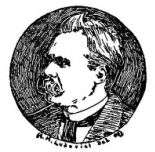
The Complete Works of Friedrich Nietzsche
The First Complete and Authorised English Translation
Edited by Dr Oscar Levy
Volume Seventeen
T.N. FOULIS
13 & 15 FREDERICK STREET
EDINBURGH: AND LONDON
1913
CONTENTS OF VOL. II.
Third Book. the Principles of a New Valuation. I. The Will to Power in Science— (a) The Method of Investigation 3 (b) The Starting-Point of Epistemology 5 (c) The Belief in the "Ego." Subject 12 (d) Biology of the Instinct of Knowledge. Perspectivity 20 (e) The Origin of Reason and Logic 26 (f) Consciousness 38 (g) Judgment. True—False 43 (h) Against Causality 53 (i) The Thing-in-Itself and Appearance 62 (k) The Metaphysical Need 74 (l) The Biological Value of Knowledge 96 (m) Science 99 II. The Will to Power in Nature— 1. The Mechanical Interpretation of the World 109 2. The Will to Power as Life— (a) The Organic Process 123 (b) Man 132 3. Theory of the Will to Power and of Valuations 161 III. The Will to Power As Exemplified in Society and in the Individual 1. Society and the State 183 2. The Individual 214 IV. The Will to Power in Art 239 Fourth Book. Discipline and Breeding. I. The Order of Rank— 1. The Doctrine of the Order of Rank 295 2. The Strong and the Weak 298 3. The Noble Man 350 4. The Lords of the Earth 360 5. The Great Man 366 6. The Highest Man as Lawgiver of the Future 373 II. Dionysus 388 III. Eternal Recurrence 422
TRANSLATOR'S PREFACE.
For the history of the text constituting this volume I would refer readers to my preface to The Will to Power, Books I, and II., where they will also find a brief explanation of the actual title of the complete work.
In the two books before us Nietzsche boldly carries his principle still further into the various departments of human life, and does not shrink from showing its application even to science, to art, and to metaphysics.
Throughout Part I. of the Third Book we find him going to great pains to impress the fact upon us that science is as arbitrary as art in its mode of procedure, and that the knowledge of the scientist is but the outcome of his inexorable will to power interpreting facts in the terms of the self-preservative conditions of the particular order of human beings to which he belongs. In Aphorisms 515 and 516, which are typical of almost all the thought expressed in Part I., Nietzsche says distinctly: "The object is not 'to know,' but to schematise,—to impose as much regularity and form upon chaos as our practical needs require."
Unfamiliarity, constant change, and the inability to reckon with possibilities, are sources of great danger: hence, everything must be explained, assimilated, and rendered capable of calculation, if Nature is to be mastered and controlled.
Schemes for interpreting earthly phenomena must be devised which, though they do not require to be absolute or irrefutable, must yet favour the maintenance of the kind of men that devises them. Interpretation thus becomes all important, and facts sink down to the rank of raw material which must first be given some shape (some sense—always anthropocentric) before they can become serviceable.
Even the development of reason and logic Nietzsche consistently shows to be but a spiritual development of the physiological function of digestion which compels an organism to make things "like" (to "assimilate") before it can absorb them (Aph. 510). And seeing that he denies that hunger can be a first motive (Aphs. 651-656), and proceeds to show that it is the amœba's will to power which makes it extend its pseudopodia in search of what it can appropriate, and that, once the appropriated matter is enveloped, it is a process of making similar which constitutes the process of absorption, reason itself is by inference acknowledged to be merely a form of the same fundamental will.
An interesting and certainly inevitable outcome of Nietzsche's argument appears in Aph. 516, where he declares that even our inability to deny and affirm one and the same thing is not in the least necessary, but only a sign of inability.
The whole argument of Part I. tends to draw science ever nearer and nearer to art (except, of course, in those cases in which science happens to consist merely of an ascertainment of facts), and to prove that the one like the other is no more than a means of gaining some foothold upon the slippery soil of a world that is for ever in flux.
In the rush and pell-mell of Becoming, some milestones must be fixed for the purposes of human orientation. In the torrent of evolutionary changes pillars must be made to stand, to which man can for a space hold tight and collect his senses. Science, like art, accomplishes this for us, and it is our will to power which "creates the impression of Being out of Becoming" (Aph. 517).
According to this standpoint, then, consciousness is also but a weapon in the service of the will to power, and it extends or contracts according to our needs (Aph. 524). It might disappear altogether (Aph. 523), or, on the other hand, it might increase and make our life more complicated than it already is. But we should guard against making it the Absolute behind Becoming, simply because it happens to be the highest and most recent evolutionary form (Aph. 709). If we had done this with each newly acquired characteristic, sight itself, which is a relatively recent development, would also have required to have been deified.
Pantheism, Theism, Unitarianism—in fact all religions in which a conscious god is worshipped, are thus aptly classed by Nietzsche as the result of man's desire to elevate that which is but a new and wonderful instrument of his will to power, to the chief place in the imaginary world beyond (eternal soul), and to make it even the deity itself (God Omniscient).
With the question of Truth we find Nietzsche quite as ready to uphold his thesis as with all other questions. He frankly declares that "the criterion of truth lies in the enhancement of the feeling of power" (Aph. 534), and thus stands in diametrical opposition to Spencer, who makes constraint or inability the criterion of truth. (See Principles of Psychology, new edition, chapter ix.... "the unconceivableness of its negation is the ultimate test of the truth of a proposition.")
However paradoxical Nietzsche's view may seem, we shall find that it is actually substantiated by experience; for the activity of our senses certainly convinces us more or less according to the degree to which it is provoked. Thus, if we walked for long round a completely dark room, and everything yielded, however slightly, to our touch, we should remain quite unconvinced that we were in a room at all, more particularly if—to suppose a still more impossible case—the floor yielded too. What provokes great activity in the bulbs of our fingers, then, likewise generates the sensation of truth.
From this Nietzsche proceeds to argue that what provokes the strongest sentiments in ourselves is also true to us, and, from the standpoint of thought, "that which gives thought the greatest sensation of strength" (Aph. 533).
The provocation of intense emotion, and therefore the provocation of that state in which the body is above the normal in power, thus becomes the index to truth; and it is a very remarkable thing that two prominent English thinkers should, at the very end of their careers, have practically admitted this, despite the fact that all their philosophical productions had been based upon a completely different belief. I refer, of course, to Spencer and Buckle, who both upheld the view that in a system of thought the emotional factor is of the highest importance.
It follows from all this, that lies and false doctrines may quite conceivably prove to be even more preservative to species than truth itself, and although this is a view we have already encountered in the opening aphorisms of Beyond Good and Evil, in Aph, 538 this volume we find it further elucidated by Nietzsche's useful demonstration of the fact that "the easier way of thinking always triumphs over the more difficult way"; and that logic, inasmuch as it facilitated classification and orderly thought, ultimately "got to act like truths."
Before leaving Part I., with which it would be impossible to deal in full, a word or two ought to be said in regard to Nietzsche's views concerning the belief in "cause and effect." In the Genealogy of Morals (1st Essay, Aph. 13), we have already read a forecast of our author's more elaborate opinions on this question, and the aphorism in question might be read with advantage in conjunction with the discussion on the subject found in this book (Aphs. 545-555).
The whole of Nietzsche's criticism, however, resolves itself into this, that the doctrine of causality begins with an unnecessary duplication of all that happens. Language, and its origin among a people uneducated in thoughts and concepts, is at the root of this scientific superstition, and Nietzsche traces its evolution from the primeval and savage desire always to find a "doer" behind every deed: to find some one who is responsible and who, being known, thus modifies the unfamiliarity of the deed which requires explaining. "The so-called instinct of causality [of which Kant speaks with so much assurance] is nothing more than the fear of the unfamiliar."
In Aph. 585 (A), we have a very coherent and therefore valuable exposition of much that may still seem obscure in Nietzsche's standpoint, and we might almost regard this aphorism as the key to the epistemology of the Will to Power. When we find the "will to truth" defined merely as "the longing for a stable world," we are in possession of the very leitmotiv of Nietzsche's thought throughout Part I., and most of what follows is clearly but an elaboration of this thought.
In Part II. Nietzsche reveals himself as utterly opposed to all mechanistic and materialistic interpretations of the Universe. He exalts the spirit and repudiates the idea that mere pressure from without—naked environment—is to be held responsible (and often guilty!) for all that materialistic science would lay at its door. Darwin again comes in for a good deal of sharp criticism; and, to those who are familiar with the nature of Nietzsche's disagreement with this naturalist, such aphorisms as Nos. 643, 647, 649, 651, 684, 685, will be of special interest. There is one question of great moment, which all Nietzsche's perfectly sincere and profoundly serious deprecation of the Darwinian standpoint ought to bring home to all Englishmen who have perhaps too eagerly endorsed the conclusions of their own British school of organic evolution, and that is, to what extent were Malthus, and afterwards his disciple Darwin, perhaps influenced in their analysis of nature by preconceived notions drawn from the state of high pressure which prevailed in the thickly-populated and industrial country in which they both lived?
It is difficult to defend Darwin from the fundamental attack which Nietzsche directs at the very root of his teaching, and which turns upon the question of the motive of all Life's struggle. To assume that the motive is always a "struggle for existence" presupposes the constant presence of two conditions—want and over-population,—an assumption which is absolutely non-proven, and it likewise lends a peculiarly ignoble and cowardly colouring to the whole of organic life, which not only remains unsubstantiated in fact, but which the struggle for power completely escapes. In Part III., which, throughout, is pretty plain sailing, Aphorism 786 contains perhaps the most important statements. Here morality is shown to be merely an instrument, but this time it is the instrument of the gregarious will to power. In the last paragraph of this aphorism Nietzsche shows himself quite antagonistic to Determinism, because of its intimate relation to, and its origin in, a mechanistic interpretation of the Universe. But we should always remember that, inasmuch as Nietzsche would distribute beliefs, just as others distribute bounties—that is to say, according to the needs of those whom he has in view, we must never take for granted that a belief which he deprecates for one class of man ought necessarily, according to him, to be denied another class.
Hard as it undoubtedly is to bear this in mind, we should remember that his appeal is almost without interruption made to higher men, and that doctrines and creeds which he condemns for them he would necessarily exalt in the case of people who were differently situated and otherwise constituted. Christianity is a case in point (see Will to Power, vol. i. Aph. 132).
We now come to Part IV., which is possibly the most important part of all, seeing that it treats of those questions which may be regarded as Nietzsche's most constant concern from the time when he wrote his first book.
The world as we now see and know it, with all that it contains which is beautiful, indifferent, or ugly, from a human standpoint, is, according to Nietzsche, the creation of our own valuing minds. Perhaps only a few people have had a hand in shaping this world of values. Maybe their number could be counted on the fingers of two hands; but still, what Nietzsche insists upon is, that it is human in its origin. Our whole outlook, everything that gives us joy or pain, must at one time or other have been valued for us, and in persisting in these valuations we, as the acclimatised herd, are indebted to our artists, to our higher men, to all those in history, who at some time or other have dared to stand up and to declare emphatically that this was ugly and that that was beautiful, and to fight, and if necessary to die, for their opinion.
Religion, morality, and philosophy, while they all aim at so-called universal Truth, tend to depreciate the value of life in the eyes of exceptional men. Though they establish the "beautiful" for the general stock, and in that way enhance the value of life for that stock, they contradict higher men's values, and, by so doing, destroy their innocent faith in the world. For the problem here is not, what value is true?—but, what value is most conducive to the highest form of human life on earth?
Nietzsche would fain throw all the burden of valuing upon the Dionysian artist him who speaks about this world out of the love and plenitude of power that is in his own breast, him who, from the very health that is within him, cannot look out upon life without transfiguring it, hallowing it, blessing it, and making it appear better, bigger, and more beautiful. And, in this view, Nietzsche is quite consistent; for, if we must accept his conclusion that our values are determined for us by our higher men, then it becomes of the highest importance that these valuers should be so constituted that their values may be a boon and not a bane to the rest of humanity.
Alas! only too often, and especially in the nineteenth century, have men who lacked this Dionysian spirit stood up and valued the world; and it is against these that Nietzsche protests. It is the bad air they have spread which he would fain dispel.
An to what art means to the artist himself, apart from its actual effect on the world, Nietzsche would say that it is a manner of discharging his will to power. The artist tries to stamp his opinion of what is desirable, and of what is beautiful or ugly, upon his contemporaries and the future; it is in this valuing that his impulse to prevail finds its highest expression. Hence the instinctive economy of artists in sex matters—that is to say, in precisely that quarter whither other men go when their impulse to prevail urges them to action. Nietzsche did not of course deny the sensual nature of artists (Aph. 815); all he wished to make plain was this, that an artist who was not moderate, in eroticis, while engaged upon his task, was open to the strongest suspicion.
In the Fourth Book Nietzsche is really at his very best. Here, while discussing questions such as "The Order of Rank," he is so thoroughly in his exclusive sphere, that practically every line, even if it were isolated and taken bodily from the context, would bear the unmistakable character of its author. The thought expressed in Aphorism 871 reveals a standpoint as new as it is necessary. So used have we become to the practice of writing and legislating for a mass, that we have forgotten the rule that prevails even in our own navy—that the speed of a fleet is measured by its slowest vessel.
On the same principle, seeing that all our philosophies and moralities have hitherto been directed at a mass and at a mob, we find that their elevation must of necessity be decided by the lowest of mankind. Thus all passions are banned, because base men do not know how to enlist them in their service. Men who are masters of themselves and of others, men who understand the management and privilege of passion, become the most despised of creatures in such systems of thought, because they are confounded with the vicious and licentious; and the speed of mankind's elevation thus gets to be determined by humanity's slowest vessels.
Aphorisms 881, 882, 886 fully elucidate the above considerations, while in 912, 916, 943, and 951 we have plans of a constructive teaching which the remainder of Part I. elaborates.
And now, following Nietzsche carefully through Part II. (Dionysus), what is the inevitable conclusion of all we have read? This analysis of the world's collective values and their ascription to a certain "will to power" may now seem to many but an exhaustive attempt at a new system of nomenclature, and little else. As a matter or fact it is very much more than this. By mean? of it Nietzsche wishes to show mankind how much has lain, and how much still lies, in man's power By laying his finger on everything and declaring to man that it was human will that created it. Nietzsche wished to give man the courage of this will, and a clean conscience in exercising it. For it was precisely this very will to power which had been most hated and most maligned by everybody up to Nietzsche's time.
Long enough, prompted by the fear of attributing any one of his happiest thoughts to this hated fundamental will, had man ascribed all his valuations and all his most sublime inspirations to something outside himself,—whether this something were a God, a principle, or the concept Truth. But Nietzsche's desire was to show man how human, all too human, have been the values that have appeared heretofore; he wished to prove, that to the rare sculptors of values, the world, despite its past, is still an open field of yielding clay, and in pointing to what the will to power has done until now, Nietzsche suggests to these coming sculptors what might still be done, provided they fear nothing, and have that innocence and that profound faith in the fundamental will which others hitherto have had in God, Natural Laws, Truth, and other euphemistic fictions.
The doctrine of Eternal Recurrence, to which Nietzsche attached so much importance that it may be regarded almost as the inspiration which led to his great work, Thus Spake Zarathustra, ought to be understood in the light of a purely disciplinary and chastening creed. In one of his posthumous works we find Nietzsche saying: "The question which thou shalt have to answer before every deed that thou doest;—is this such a deed as I am prepared to perform an incalculable number of times,—is the best ballast." Thus it is obvious that, feeling the need of something in his teaching which would replace the metaphysics of former beliefs, he applied the doctrine of Eternal Recurrence to this end. Seeing, however, that even among Nietzscheans themselves there is considerable doubt concerning the actual value of the doctrine as a ruling belief, it does not seem necessary to enter here into the scientific justification which he claims for it. Suffice it to say that, as knowledge stands at present, the statement that the world will recur eternally in small things as in great, is still a somewhat daring conjecture—a conjecture, however, which would have been entirely warrantable if its disciplinary value had been commensurate with its daring.
ANTHONY M. LUDOVICI.
THIRD BOOK.
THE PRINCIPLES OF A NEW VALUATION.
I.
THE WILL TO POWER IN SCIENCE.
(a) The Method of Investigation.
466.
The distinguishing feature of our nineteenth century is not the triumph of science, but the triumph of the scientific method over science.
467.
The history of scientific methods was regarded by Auguste Comte almost as philosophy itself.
468.
The great Methodologists: Aristotle, Bacon, Descartes, Auguste Comte.
469.
The most valuable knowledge is always discovered last: but the most valuable knowledge consists of methods.
All methods, all the hypotheses on which the science of our day depends, were treated with the profoundest contempt for centuries: on their account a man used to be banished from the society of respectable people—he was held to be an "enemy of God," a reviler of the highest ideal, a madman.
We had the whole pathos of mankind against us,—our notion of what "truth" ought to be, of what the service of truth ought to be, our objectivity, our method, our calm, cautious and distrustful manner were altogether despicable.... At bottom, that which has kept men back most, is an æsthetic taste: they believed in the picturesque effect of truth; what they demanded of the scientist was, that he should make a strong appeal to their imagination.
From the above, it would almost seem as if the very reverse had been achieved, as if a sudden jump had been made: as a matter of fact, the schooling which the moral hyperboles afforded, gradually prepared the way for that milder form of pathos which at last became incarnate in the scientific man....
Conscientiousness in small things, the self-control of the religious man, was a preparatory school for the scientific character, as was also, in a very pre-eminent sense, the attitude of mind which makes a man take problems seriously, irrespective of what personal advantage he may derive from them....
(b) The Starting-point of Epistemology.>
470.
Profound disinclination to halt once and for all at any collective view of the world. The charm of the opposite point of view: the refusal to relinquish the stimulus residing in the enigmatical.
471.
The hypothesis that, at bottom, things proceed in such a moral fashion that human reason must be right, is a mere piece of good-natured and simple-minded trustfulness, the result of the belief in Divine truthfulness—God regarded as the Creator of all things.—These concepts are our inheritance from a former existence in a Beyond.
472.
The contradiction of the so-called "facts of consciousness." Observation a thousand times more difficult, error is perhaps the absolute condition of observation.
473.
The intellect cannot criticise itself, simply because it can be compared with no other kind of intellect, and also because its ability to know would only reveal itself in the presence of "actual reality"; that is to say, because, in order to criticise the intellect, we should have to be higher creatures with "absolute knowledge." This would presuppose the existence of something, a "thing-in-itself," apart from all the perspective kinds of observation and senso-spiritual perception. But the psychological origin of the belief in things, forbids our speaking of "things in themselves."
474.
The idea that a sort of adequate relation exists between subject and object, that the object is something which when seen from inside would be a subject, is a well-meant invention which, I believe, has seen its best days. The measure of that which we are conscious of, is perforce entirely dependent upon the coarse utility of the function of consciousness: how could this little garret-prospect of consciousness warrant our asserting anything in regard to "subject" and "object," which would bear any relation to reality!
475.
Criticism of modern philosophy: erroneous starting-point, as if there were such things as "facts of consciousness"—and no phenomenalism in introspection.
476.
"Consciousness"—to what extent is the idea which is thought of, the idea of will, or the idea of a feeling (which is known by us alone), quite superficial? Our inner world is also "appearance."
477.
I am convinced of the phenomenalism of the inner world also: everything that reaches our consciousness is utterly and completely adjusted, simplified, schematised, interpreted, the actual process of inner "perception," the relation of causes between thoughts, feelings, desires, between subject and object, is absolutely concealed from us, and may be purely imaginary. This "inner world of appearance" is treated with precisely the same forms and procedures as the "outer" world. We never come across a single "fact": pleasure and pain are more recently evolved intellectual phenomena....
Causality evades us; to assume the existence of an immediate causal relation between thoughts, as Logic does, is the result of the coarsest and most clumsy observation. There are all sorts of passions that may intervene between two thoughts: but the interaction is too rapid—that is why we fail to recognise them, that is why we actually deny their existence....
"Thinking," as the epistemologists understand \r it, never takes place at all: it is an absolutely gratuitous fabrication, arrived at by selecting one element from the process and by eliminating all the rest—an artificial adjustment for the purpose of the understanding....
The "mind," something that thinks: at times, even, "the mind absolute and pure"—this concept is an evolved and second result of false introspection, which believes in "thinking": in the first place an act is imagined here which does not really occur at all, i.e. "thinking"; and, secondly, a subject-substratum is imagined in which every process of this thinking has its origin, and nothing else—that is to say, both the action and the agent are fanciful.
478.
Phenomenalism must not be sought in the wrong quarter: nothing is more phenomenal, or, to be more precise, nothing is so much deception, as this inner world, which we observe with the "inner sense."
Our belief that the will is a cause was so great, that, according to our personal experiences in general, we projected a cause into all phenomena (i.e. a certain motive is posited as the cause of all phenomena).
We believe that the thoughts which follow one upon the other in our minds are linked by some sort of causal relation: the logician, more especially, who actually speaks of a host of facts which have never once been seen in reality, has grown accustomed to the prejudice that thoughts are the cause of thoughts.
We believe—and even our philosophers believe it still—that pleasure and pain are the causes of reactions, that the very purpose of pleasure and pain is to occasion reactions. For hundreds of years, pleasure and pain have been represented as the motives for every action. Upon reflection, however, we are bound to concede that everything would have proceeded in exactly the same way, according to precisely the same sequence of cause and effect, if the states "pleasure" and "pain" had been entirely absent; and that we are simply deceived when we believe that they actually cause anything:—they are the attendant phenomena, and they have quite a different purpose from that of provoking reactions; they are in themselves effects involved in the process of reaction which takes place.
In short: Everything that becomes conscious is a final phenomenon, a conclusion—and is the cause of nothing; all succession of phenomena in consciousness is absolutely atomistic.—And we tried to understand the universe from the opposite point of view—as if nothing were effective or real, save thinking, feeling, willing! ...
479.
The phenomenalism of the "inner world!" A chronological inversion takes place, so that the cause reaches consciousness as the effect.—We know that pain is projected into a certain part of the body although it is not really situated there; we have learnt that all sensations which were ingenuously supposed to be conditioned by the outer world are, as a matter of fact, conditioned by the inner world: that the real action of the outer world never takes place in a way of which we can become conscious.... That fragment of the outer world of which we become conscious, is born after the effect produced by the outer world has been recorded, and is subsequently interpreted as the "cause" of that effect....
In the phenomenalism of the "inner world," the chronological order of cause and effect is inverted. The fundamental fact of "inner experience" is, that the cause is imagined after the effect has been recorded.... The same holds good of the sequence of thoughts: we seek for the reason of a thought, before it has reached our consciousness; and then the reason reaches consciousness first, whereupon follows its effect. All our dreams are the interpretation of our collective feelings with the view of discovering the possible causes of the latter; and the process is such that a condition only becomes conscious, when the supposed causal link has reached consciousness.[1]
The whole of "inner experience" is founded on this: that a cause is sought and imagined which accounts for a certain irritation in our nerve-centres, and that it is only the cause which is found in this way which reaches consciousness; this cause may have absolutely nothing to do with the real cause—it is a sort of groping assisted by former "inner experiences," that is to say, by memory. The memory, however, retains the habit of old interpretations,—that is to say, of erroneous causality,—so that "inner experience" comprises in itself all the results of former erroneous fabrications of causes. Our "outside world," as we conceive it every instant, is indissolubly bound up with the old error of cause: we interpret by means of the schematism of "the thing," etc.
"Inner experience" only enters consciousness when it has found a language which the individual can understand—that is to say, a translation of a certain condition into conditions with which he is familiar; "understand" means simply this: to be able to express something new in the terms of something old or familiar. For instance, "I feel unwell"—a judgment of this sort presupposes a very great and recent neutrality on the part of the observer: the simple man always says, "This and that make me feel unwell,"—he begins to be clear concerning his indisposition only after he has discovered a reason for it.... This is what I call a lack of philological knowledge; to be able to read a text, as such, without reading an interpretation into it, is the latest form of "inner experience,"—it is perhaps a barely possible form....
480.
There are no such things as "mind," reason, thought, consciousness, soul, will, or truth: they all belong to fiction, and can serve no purpose. It is not a question of "subject and object," but of a particular species of animal which can prosper only by means of a certain exactness, or, better still, regularity in recording its perceptions (in order that experience may be capitalised)....
Knowledge works as an instrument of power. It is therefore obvious that it increases with each advance of power....
The purpose of knowledge: in this case, as in the case of "good" or "beautiful," the concept must be regarded strictly and narrowly from an anthropocentric and biological standpoint. In order that a particular species may maintain and increase its power, its conception of reality must contain enough which is calculable and constant to allow of its formulating a scheme of conduct. The utility of preservation—and not some abstract or theoretical need to eschew deception—stands as the motive force behind the development of the organs of knowledge; ... they evolve in such a way that their observations may suffice for our preservation. In other words, the measure of the desire for knowledge depends upon the extent to which the Will to Power grows in a certain species: a species gets a grasp of a given amount of reality, in order to master it, in order to enlist that amount in its service.
(c) The Belief in the "Ego." Subject.
481.
In opposition to Positivism, which halts at phenomena and says, "These are only facts and nothing more," I would say: No, facts are precisely what is lacking, all that exists consists of interpretations. We cannot establish any fact "in itself": it may even be nonsense to desire to do such a thing. "Everything is subjective," ye say: but that in itself is interpretation. The subject is nothing given, but something superimposed by fancy, something introduced behind.—Is it necessary to set an interpreter behind the interpretation already to hand? Even that would be fantasy, hypothesis.
To the extent to which knowledge has any sense at all, the world is knowable: but it may be interpreted differently, it has not one sense behind it, but hundreds of senses.—"Perspectivity."
It is our needs that interpret the world; our instincts and their impulses for and against. Every instinct is a sort of thirst for power; each has its point of view, which it would fain impose upon all the other instincts as their norm.
482.
Where our ignorance really begins, at that point from which we can see no further, we set a word; for instance, the word "I," the word "do," the word "suffer"—these concepts may be the horizon lines of our knowledge, but they are not "truths."
483.
Owing to the phenomenon "thought," the ego is taken for granted; but up to the present everybody believed, like the people, that there was something unconditionally certain in the notion "I think," and that by analogy with our understanding of all other causal reactions this "I" was the given cause of the thinking. However customary and indispensable this fiction may have become now, this fact proves nothing against the imaginary nature of its origin; it might be a life-preserving belief and still be false.
484.
"Something is thought, therefore there is something that thinks": this is what Descartes' argument amounts to. But this is tantamount to considering our belief in the notion "substance" as an "a priori" truth:—that there must be something "that thinks" when we think, is merely a formulation of a grammatical custom which sets an agent to every action. In short, a metaphysico-logical postulate is already put forward here—and it is not merely an ascertainment of fact.... On Descartes' lines nothing absolutely certain is attained, but only the fact of a very powerful faith.
If the proposition be reduced to "Something is thought, therefore there are thoughts," the result is mere tautology; and precisely the one factor which is in question, the "reality of thought," is not touched upon,—so that, in this form, the apparitional character of thought cannot be denied. What Descartes wanted to prove was, that thought not only had apparent reality, but absolute reality.
485.
The concept substance is an outcome of the concept subject, and not conversely! If we surrender the concept soul, the subject, the very conditions for the concept "substance" are lacking. Degrees of Being are obtained, but Being is lost.
Criticism of "reality": what does a "plus or minus of reality" lead to, the gradation of Being in which we believe?
The degree of our feeling of life and power (the logic and relationship of past life) presents us with the measure of "Being," "reality," "non-appearance."
Subject i this is the term we apply to our belief in an entity underlying all the different moments of the most intense sensations of reality; we regard this belief as the effect of a cause,—and we believe in our belief to such an extent that, on its account alone, we imagine "truth," "reality," "substantiality."—a "Subject" is the fiction which would fain make us believe that several similar states were the effect of one substratum: but we it was who first created the "similarity" of these states; the similising and adjusting of them is the fact—not their similarity (on the contrary, this ought rather to be denied).
486.
One would have to know what Being is, in order to be able to decide whether this or that is real (for instance, "the facts of consciousness"); it would also be necessary to know what certainty and knowledge are, and so forth.—But, as we do not know these things, a criticism of the faculty of knowledge is nonsensical: how is it possible for an instrument to criticise itself, when it is itself that exercises the critical faculty. It cannot even define itself!
487.
Should not all philosophy ultimately disclose the first principles on which the reasoning processes depend?—that is to say, our belief in the "ego" as a substance, as the only reality according to which, alone, we are able to ascribe reality to things? The oldest realism at length comes to light, simultaneously with man's recognition of the fact that his whole religious history is no more than a history of soul-superstitions. Here there is a barrier; our very thinking, itself, involves that belief (with its distinctions—substance, accident, action, agent, etc.); to abandon it would mean to cease from being able to think.
But that a belief, however useful it may be for the preservation of a species, has nothing to do with the truth, may be seen from the fact that we must believe in time, space, and motion, without feeling ourselves compelled to regard them as absolute realities.
488.
The psychological origin of our belief in reason.—The ideas "reality," "Being," are derived from our subject-feeling.
"Subject," interpreted through ourselves so that the ego may stand as substance, as the cause of action, as the agent.
The metaphysico-logical postulates, the belief in substance, accident, attribute, etc. etc., draws its convincing character from our habit of regarding all our actions as the result of our will: so that the ego, as substance, does not vanish in the multiplicity of changes.—But there is no such thing as will. We have no categories which allow us to separate a "world as thing-in-itself," from "a world of appearance." All our categories of reason have a sensual origin: they are deductions from the empirical world. "The soul," "the ego"—the history of these concepts shows that here, also, the oldest distinction ("spiritus," "life") obtains....
If there is nothing material, then there can be nothing immaterial. The concept no longer means anything.
No subject-"atoms." The sphere of a subject increasing or diminishing unremittingly, the centre of the system continually displacing itself, in the event of the system no longer being able to organise the appropriated mass, it divides into two. On the other hand, it is able, without destroying it, to transform a weaker subject into one of its own functionaries, and, to a certain extent, to compose a new entity with it. Not a "substance," but rather something which in itself strives after greater strength; and which wishes to "preserve" itself only indirectly (it wishes to surpass itself).
489.
Everything that reaches consciousness as an entity is already enormously complicated: we never have anything more than the semblance of an entity.
The phenomenon of the body is the richer, more distinct, and more tangible phenomenon: it should be methodically drawn to the front, and no mention should be made of its ultimate significance.
490.
The assumption of a single subject is perhaps not necessary, it may be equally permissible to assume a plurality of subjects, whose interaction and struggle lie at the bottom of our thought and our consciousness in general. A sort of aristocracy of "cells" in which the ruling power is vested? Of course an aristocracy of equals, who are accustomed to ruling co-operatively, and understand how to command?
My hypotheses. The subject as a plurality. Pain intellectual and dependent upon the judgment harmful, projected. The effect always "unconscious": the inferred and imagined cause is projected, it follows the event. Pleasure is a form of pain. The only kind of power that exists is of the same nature as the power of will: a commanding of other subjects which thereupon alter themselves. The unremitting transientness and volatility of the subject. "Mortal soul." Number as perspective form.
491.
The belief in the body is more fundamental than the belief in the soul: the latter arose from the unscientific observation of the agonies of the body. (Something which leaves it. The belief in the truth of dreams)
492.
The body and physiology the starting-point: why?—We obtain a correct image of the nature of our subject-entity, that is to say, as a number of regents at the head of a community (not as "souls" or as "life-forces") as also of the dependence of these regents upon their subjects, and upon the conditions of a hierarchy, and of the division of labour, as the means ensuring the existence of the part and the whole. We also obtain a correct image of the way in which the living entities continually come into being and expire, and we see how eternity cannot belong to the "subject"; we realise that the struggle finds expression in obeying as well as in commanding, and that a fluctuating definition of the limits of power is a factor of life. The comparative ignorance in which the ruler is kept, of the individual performances and even disturbances taking place in the community, also belong to the conditions under which government may be carried on. In short, we obtain a valuation even of want-of-knowledge, of seeing-things-generally-as-a-whole, of simplification, of falsification, and of perspective. What is most important, however, is, that we regard the ruler and his subjects as of the same kind, all feeling, willing, thinking—and that wherever we see or suspect movement in a body, we conclude that there is co-operative-subjective and invisible life. Movement as a symbol for the eye; it denotes that something has been felt, willed, thought.
The danger of directly questioning the subject concerning the subject, and all spiritual self-reflection, consists in this, that it might be a necessary condition of its activity to interpret itself erroneously. That is why we appeal to the body and lay the evidence of sharpened senses aside: or we try and see whether the subjects themselves cannot enter into communication with us.
(d) Biology of the Instinct of Knowledge. Perspectivity.
493.
Truth is that kind of error without which a certain species of living being cannot exist. The value for Life is ultimately decisive.
494.
It is unlikely that our "knowledge" extends farther than is exactly necessary for our self-preservation. Morphology shows us how the senses and the nerves as well as the brain evolve in proportion as the difficulties of acquiring sustenance increase.
495.
If the morality of "Thou shalt not lie" be refuted, the sense for truth will then have to justify itself before another tribunal—as a means to the preservation of man, as Will to Power.
Likewise our love of the beautiful: it is also the creative will. Both senses stand side by side; the sense of truth is the means wherewith the power is appropriated to adjust things according to one's taste. The love of adjusting and reforming—a primeval love! We can only take cognisance of a world which we ourselves have made.
496.
Concerning the multifariousness of knowledge. The tracing of its relation to many other things (or the relation of kind)—how should "knowledge" be of another? The way to know and to investigate is in itself among the conditions of life; that is why the conclusion that there could be no other kind of intellect (for ourselves) than the kind which serves the purpose of our preservation is an excessively hasty one: this actual condition may be only an accidental, not in the least an essential; one.
Our apparatus for acquiring knowledge is not adjusted for knowledge.
497.
The most strongly credited a priori "truths" are, to my mind, mere assumptions pending further investigation; for instance, the law of causation is a belief so thoroughly acquired by practice and so completely assimilated, that to disbelieve in it would mean the ruin of our kind. But is it therefore true? What an extraordinary conclusion! As if truth were proved by the mere fact that man survives!
498.
To what extent is our intellect also a result of the conditions of life?—We should not have it did we not need to have it, and we should not have it as we have it, if we did not need it as we need it—that is to say, if we could live otherwise.
499.
Thinking in a primitive (inorganic) state is to persevere in forms, as in the case of the crystal.—In our thought, the essential factor is the harmonising of the new material with the old schemes (= Procrustes' bed), the assimilation of the unfamiliar.
500.
The perception of the senses projected outwards: "inwards" and "outwards"—does the body command here?
The same equalising and ordering power which rules in the idioplasma, also rules in the incorporation of the outer world: our sensual perceptions are already the result of this process of adaptation and harmonisation in regard to all the past in us; they do not follow directly upon the "impression."
501.
All thought, judgment, perception, regarded as an act of comparing[2] has as a first condition the act of equalising, and earlier still the act of "making equal." The process of making equal is the same as the assimilation by the amœba of the nutritive matter it appropriates.
"Memory" late, in so far as the equalising instinct appears to have been subdued: the difference is preserved. Memory—a process of classification and collocation; active—who?
502.
In regard to the memory, we must unlearn a great deal: here we meet with the greatest temptation to assume the existence of a "soul," which, irrespective of time, reproduces and recognises again and again, etc. What I have experienced, however, continues to live "in the memory"; I have nothing to do with it when memory "comes," my will is inactive in regard to it, as in the case of the coming and going of a thought. Something happens, of which I become conscious: now something similar comes—who has called it forth? Who has awakened it?
503.
The whole apparatus of knowledge is an abstracting and simplifying apparatus—not directed at knowledge, but at the appropriation of things: "end" and "means" are as remote from the essence of this apparatus as "concepts" are. By the "end" and the "means" a process is appropriated (—a process is invented which may be grasped), but by "concepts" one appropriates the "things" which constitute the process.
504.
Consciousness begins outwardly as co-ordination and knowledge of impressions,—at first it is at the point which is remotest from the biological centre of the individual; but it is a process which deepens and which tends to become more and more an inner function, continually approaching nearer to the centre.
505.
Our perceptions, as we understand them—that is to say, the sum of all those perceptions the consciousness whereof was useful and essential to us and to the whole organic processes which preceded us: therefore they do not include all perceptions (for instance, not the electrical ones);—that is to say, we have senses only for a definite selection of perceptions—such perceptions as concern us with a view to our self-preservation. Consciousness extends so far only as it is useful. There can be no doubt that all our sense-perceptions are entirely permeated by valuations (useful or harmful—consequently, pleasant or painful). Every particular colour; besides being a colour, expresses a value to us (although we seldom admit it, or do so only after it has affected us exclusively for a long time, as in the case of convicts in gaol or lunatics). Insects likewise react in different ways to different colours: some like this shade, the others that. Ants are a case in point.
506.
In the beginning images how images originate in the mind must be explained. Then words, applied to images. Finally concepts, possible only when there are words—the assembling of several pictures into a whole which is not for the eye but for the ear (word). The small amount of emotion which the "word" generates,—that is, then, which the view of the similar pictures generates, for which one word is used,—this simple emotion is the common factor, the basis of a concept. That weak feelings should all be regarded as alike, as the same, is the fundamental fact. There is therefore a confusion of two very intimately associated feelings in the ascertainment of these feelings;—but who is it that ascertains? Faith is the very first step in every sensual impression: a sort of yea-saying is the first intellectual activity! A "holding-a-thing-to-be-true" is the beginning. It were our business, therefore, to explain how the "holding-of-a-thing-to-be-true" arose! What sensation lies beneath the comment "true"?
507.
The valuation, "I believe that this and that is so," is the essence of "truth." In all valuations, the conditions of preservation and of growth find expression. All our organs and senses of knowledge have been developed only in view of the conditions of preservation and growth. The trust in reason and its categories, the trust in dialectics, and also the valuation of logic, prove only that experience has taught the usefulness of these things to life: not their "truth." The prerequisites of all living things and of their lives is: that there should be a large amount of faith, that it should be possible to pass definite judgments on things, and that there should be no doubt at all concerning all essential values. Thus it is necessary that something should be assumed to be true, not that it is true.
"The real world and the world of appearance"— I trace this contrast to the relation of values. We have posited our conditions of existence as the attributes of being in general. Owing to the fact that, in order to prosper, we must be stable in our belief, we developed the idea that the real world was neither a changing nor an evolving one, but a world of being.
(e) The Origin of Reason and Logic.
508.
Originally there was chaos among our ideas. Those ideas which were able to stand side by side remained over, the greater number perished—and are still perishing.
509.
The kingdom of desires out of which logic grew: the gregarious instinct in the background. The assumption of similar facts is the first condition for "similar souls." For the purpose of mutual understanding and government.
510.
Concerning the origin of logic. The fundamental proneness to equalise things and to see them equal, gets to be modified, and kept within bounds, by the consideration of what is useful or harmful—in fact, by considerations of success: it then becomes adapted in suchwise as to be gratified in a milder way, without at the same time denying life or endangering it. This whole process corresponds entirely with that external and mechanical process (which is its symbol) by which the protoplasm continually assimilates, makes equal to itself, what it appropriates, and arranges it according to its own forms and requirements.
511.
Likeness and Similarity.
1. The coarser the organ the more apparent likenesses it sees;
2. The mind will have likeness—that is to say, the identification of one sensual impression with others already experienced: just as the body assimilates inorganic matter.
For the understanding of Logic:—
The will which tends to see likeness everywhere is the will to power—the belief that something is so and so (the essence of a judgment), is the result of a will which would fain have it as similar as possible.
512.
Logic is bound up with the proviso: granted that identical cases exist. As a matter of fact, before one can think and conclude in a logical fashion, this condition must first be assumed. That is to say, the will to logical truth cannot be consummated before a fundamental falsification of all phenomena has been assumed. From which it follows that an instinct rules here, which is capable of employing both means: first, falsification; and secondly, the carrying out of its own point of view: logic does not spring from a will to truth.
513.
The inventive force which devised the categories, worked in the service of our need of security, of quick intelligibility, in the form of signs, sounds, and abbreviations.—"Substance," "subject," "object," "Being," "Becoming," are not matters of metaphysical truth. It was the powerful who made the names of things into law, and, among the powerful, it was the greatest artists in abstraction who created the categories.
514.
A moral—that is to say, a method of living which long experience and experiment have tested and proved efficient, at last enters consciousness as a law, as dominant.... And then the whole group of related values and conditions become part of it: it becomes venerable, unassailable, holy, true; a necessary part of its evolution is that its origin should be forgotten.... That is a sign that it has become master. Exactly the same thing might have happened with the categories of reason: the latter, after much groping and many trials, might have proved true through relative usefulness.... A stage was reached when they were grasped as a whole, and when they appealed to consciousness as a whole,—when belief in them was commanded,—that is to say, when they acted as if they commanded.... From that time forward they passed as a priori, as beyond experience, as irrefutable. And, possibly, they may have been the expression of no more than a certain practicality answering the ends of a race and a species,—their usefulness alone is their "truth."
515.
The object is, not "to know," but to schematise,—to impose as much regularity and form upon chaos, as our practical needs require. In the formation of reason, logic, and the categories, it was a need in us that was the determining power: not the need "to know," but to classify, to schematise, for the purpose of intelligibility and calculation. (The adjustment and interpretation of all similar and equal things,—the same process, which every sensual impression undergoes, is the development of reason!) No pre-existing "idea" had anything to do with it: but utility, which teaches us that things can be reckoned with and managed, only when we view them roughly as equal.... Finality in reason is an effect, not a cause: Life degenerates with every other form of reason, although constant attempts are being made to attain to those other forms of reason;—for Life would then become too obscure, too unequal.
The categories are "truths" only in the sense that they are the conditions of our existence, just as Euclid's Space is a conditional "truth." (Between ourselves, as no one will maintain that men are absolutely necessary, reason, as well as Euclid's Space, are seen to be but an idiosyncrasy of one particular species of animals, one idiosyncrasy alone among many others....)
The subjective constraint which prevents one from contradicting here, is a biological constraint: the instinct which makes us see the utility of concluding as we do conclude, is in our blood, we are almost this instinct.... But what simplicity it is to attempt to derive from this fact that we possess an absolute truth! ... The inability to contradict anything is a proof of impotence but not of "truth."
516.
We are not able to affirm and to deny one and the same thing: that is a principle of subjective experience—which is not in the least "necessary," but only a sign of inability.
If, according to Aristotle, the principium contradictionis is the most certain of all principles; if it is the most ultimate of all, and the basis of every demonstration; if the principle of every other axiom lie within it: then one should analyse it all the more severely, in order to discover how many assumptions already lie at its root. It either assumes something concerning reality and Being, as if these had become known in some other sphere—that is to say, as if it were impossible to ascribe the opposite attributes to it; or the proposition means: that the opposites should not be ascribed to it. In that case, logic would be an imperative, not directed at the knowledge of truth, but at the adjusting and fixing of a world which must seem true to us.
In short, the question is a debatable one: are the axioms of logic adequate to reality, or are they measures and means by which alone we can, create realities, or the concept "reality"?... In order to affirm the first alternative, however, one would, as we have seen, require a previous knowledge of Being; which is certainly not the case. The proposition therefore contains no criterion of truth, but an imperative concerning that which should pass as true.
Supposing there were no such thing as A identical with itself, as every logical (and mathematical) proposition presupposes, and that A is in itself an appearance, then logic would have a mere world of appearance as its first condition. As a matter of fact, we believe in that proposition, under the influence of an endless empiricism which seems to confirm it every minute. The "thing"—that is the real substratum of A; our belief in things is the first condition of our faith in logic. The A in logic is, like the atom, a reconstruction of the thing.... By not understanding this, and by making logic into a criterion of real being, we are already on the road to the classification of all those hypostases, substance, attribute, object, subject, action, etc., as realities—that is to say, the conception of a metaphysical world or a "real world" (—this is, however, once more the world of appearance...).
The primitive acts of thought, affirmation, and negation, the holding of a thing for true, and the holding of a thing for not true,—in so far as they do not only presuppose a mere habit, but the very right to postulate truth or untruth at all,—are already dominated by a belief, that there is such a thing as knowledge for us, and that judgments can really hit the truth: in short, logic never doubts that it is able to pronounce something concerning truth in itself (—that is to say, that to the thing which is in itself true, no opposite attributes can be ascribed).
In this belief there reigns the sensual and coarse prejudice that our sensations teach us truths concerning things,—that I cannot at the same moment of time say of one and the same thing that it is hard and soft. (The instinctive proof, "I cannot have two opposite sensations at once," is quite coarse and false.)
That all contradiction in concepts should be forbidden, is the result of a belief, that we are able to form concepts, that a concept not only characterises but also holds the essence of a thing.... As a matter of fact, logic (like geometry and arithmetic) only holds good of assumed existences which we have created. Logic is the attempt on our part to understand the actual world according to a scheme of Being devised by ourselves; or, more exactly, it is our attempt at making the actual world more calculable and more susceptible to formulation, for our own purposes....
517.
In order to be able to think and to draw conclusions, it is necessary to acknowledge that which exists: logic only deals with formulæ for things which are constant. That is why this acknowledgment would not in the least prove reality: "that which is" is part of our optics. The ego regarded as Being (not affected by either Becoming or evolution).
The assumed world of subject, substance, reason, etc., is necessary, an adjusting, simplifying falsifying, artificially-separating power resides in us. "Truth" is the will to be master over the manifold sensations that reach consciousness; it is the will to classify phenomena according to definite categories. In this way we start out with a belief in the "true nature" of things (we regard phenomena as real).
The character of the world in the process of Becoming is not susceptible of formulation; it is "false" and "contradicts itself." Knowledge and the process of evolution exclude each other. Consequently, knowledge must be something else: it must be preceded by a will to make things knowable, a kind of Becoming in itself must create the illusion of Being.
518.
If our "ego" is the only form of Being, according to which we make and understand all Being: very good! In that case it were very proper to doubt whether an illusion of perspective were not active here—the apparent unity which everything assumes in our eyes on the horizon-line. Appealing to the body for our guidance, we are confronted by such appalling manifoldness, that for the sake of method it is allowable to use that phenomenon which is richer and more easily studied as a clue to the understanding of the poorer phenomenon.
Finally: admitting that all is Becoming, knowledge is only possible when based on a belief in Being.
519.
If there is "only one form of Being, the ego," and all other forms of Being are made in its own image,—if, in short, the belief in the "ego," together with the belief in logic, stands and falls with the metaphysical truth of the categories of reason: if, in addition, the "ego" is shown to be something that is evolving: then——
520.
The continual transitions that occur, forbid our speaking of the "individual," etc.; the "number" of beings itself fluctuates. We should know nothing of time or of movement, if, in a rough way, we did not believe we saw things "standing still" behind or in front of things moving. We should also know just as little about cause and effect, and without the erroneous idea of "empty space" we should never have arrived at the concept of space at all. The principle of identity is based on the "fact of appearance" that there are some things alike. Strictly speaking, it would not be possible to "understand" and "know" an evolving world; something which is called "knowledge" exists only in so far as the "understanding" and "knowing" intellect already finds an adjusted and rough world to hand, fashioned out of a host of mere appearances, but become fixed to the extent in which this kind of appearance has helped to preserve life; only to this extent is "knowledge" possible—that is to say, as a measuring of earlier and more recent errors by one another.
521.
Concerning logical appearance.—The concept "individual" and the concept "species" are equally false and only apparent. "Species" only expresses the fact that an abundance of similar creatures come forth at the same time, and that the speed of their further growth and of their further transformation has been made almost imperceptible for a long time: so that the actual and trivial changes and increase of growth are of no account at all (—a stage of evolution in which the process of evolving is not visible, so that, not only does a state of equilibrium seem to have been reached, but the road is also made clear for the error of supposing that an actual goal has been reached—and that evolution had a goal...).
The form seems to be something enduring, and therefore valuable; but the form was invented merely by ourselves; and however often "the same form is attained," it does not signify that it is the same form,—because something new always appears; and we alone, who compare, reckon the new with the old, in so far as it resembles the latter, and embody the two in the unity of "form." As if a type had to be reached and were actually intended by the formative processes.
Form, species, law, idea, purpose—the same fault is made in respect of all these concepts, namely, that of giving a false realism to a piece of fiction: as if all phenomena were infused with some sort of obedient spirit—an artificial distinction is here made between that which acts and that which guides action (but both these things are only fixed in order to agree with our metaphysico-logical dogma: they are not "facts").
We should not interpret this constraint in ourselves, to imagine concepts, species, forms, purposes, and laws ("a world of identical cases") as if we were in a position to construct a real world; but as a constraint to adjust a world by means of which our existence will be ensured: we thereby create a world which is determinable, simplified, comprehensible, etc., for us.
The very same constraint is active in the functions of the senses which support the reason—by means of simplification, coarsening, accentuation, and interpretation; whereon all "recognition," all the ability of making one's self intelligible rests. Our needs have made our senses so precise, that the "same world of appearance" always returns, and has thus acquired the semblance of reality.
Our subjective constraint to have faith in logic, is expressive only of the fact that long before logic itself became conscious in us, we did nothing save introduce its postulates into the nature of things: now we find ourselves in their presence,—we can no longer help it,—and now we would fain believe that this constraint is a guarantee of "truth." We it was who created the "thing," the "same thing," the subject, the attribute, the action, the object, the substance, and the form, after we had carried the process of equalising, coarsening, and simplifying as far as possible. The world seems logical to us, because we have already made it logical.
522.
Fundamental solution.—We believe in reason: this is, however, the philosophy of colourless concepts. Language is built upon the most naïf prejudices.
Now we read discord and problems into things, because we are able to think only in the form of language—we also believe in the "eternal truth" of "wisdom" (for instance, subject, attribute, etc.).
We cease from thinking if we do not wish to think under the control of language; the most we can do is to attain to an attitude of doubt concerning the question whether the boundary here really is a boundary.
Rational thought is a process of interpreting according to a scheme which we cannot reject.
(f) Consciousness.
523.
There is no greater error than that of making psychical and physical phenomena the two faces, the two manifestations of the same substance. By this means nothing is explained: the concept "substance" is utterly useless as a means of explanation. Consciousness may be regarded as secondary, almost an indifferent and superfluous thing, probably destined to disappear and to be superseded by perfect automatism—
When we observe mental phenomena we may be likened to the deaf and dumb who divine the spoken word, which they do not hear, from the movements of the speaker's lips. From the appearance of the inner mind we draw conclusions concerning invisible and other phenomena, which we could ascertain if our powers of observation were adequate for the purpose.
For this inner world we have no finer organs, and that is why a complexity which is thousandfold reaches our consciousness as a simple entity, and we invent a process of causation in it, despite the fact that we can perceive no cause either of the movement or of the change—the sequence of thoughts and feelings is nothing more than their becoming visible to consciousness. That this sequence has anything to do with a chain of causes is not worthy of belief: consciousness never communicates an example of cause and effect to us.
524.
The part "consciousness" plays,—It is essential that one should not mistake the part that "consciousness plays" it is our relation to the outer world; it was the outer world that developed it. On the other hand, the direction—that is to say, the care and cautiousness which is concerned with the inter-relation of the bodily functions, does not enter into our consciousness any more than does the storing activity of the intellect: that there is a superior controlling force at work in these things cannot be doubted—a sort of directing committee, in which the various leading desires make their votes and their power felt. "Pleasure" and "pain" are indications which reach us from this sphere: as are also acts of will and ideas.
In short: That which becomes conscious has causal relations which are completely and absolutely concealed from our knowledge—the sequence of thoughts, feelings, and ideas, in consciousness, does not signify that the order in which they come is a causal order: it is so apparently, however, in the highest degree. We have based the whole of our notion of intellect, reason, logic, etc., upon this apparent truth (all these things do not exist: they are imaginary syntheses and entities), and we then projected the latter into and behind all things!
As a rule consciousness itself is understood to be the general sensorium and highest ruling centre; albeit, it is only a means of communication: it was developed by intercourse, and with a view to the interests of intercourse.... "Intercourse" is understood, here, as "relation," and is intended to cover the action of the outer world upon us and our necessary response to it, as also our actual influence upon the outer world. It is not the conducting force, but an organ of the latter.
525.
My principle, compressed into a formula which savours of antiquity, of Christianity, Scholasticism, and other kinds of musk: in the concept, "God is spirit," God as perfection is "denied...."
526.
Wherever people have observed a certain unity in the grouping of things, spirit has always been regarded as the cause of this co-ordination: an assumption for which reasons are entirely lacking. Why should the idea of a complex fact be one of the conditions of that fact? Or why should the notion of a complex fact have to precede it as its cause?
We must be on our guard against explaining finality by the spirit: there is absolutely no reason whatever for ascribing to spirit the peculiar power of organising and systematising. The domain of the nervous system is much more extensive: the realm of consciousness is superadded. In the collective process of adaptation and systematising, consciousness plays no part at all.
527.
Physiologists, like philosophers, believe that consciousness increases in value in proportion as it gains in clearness: the most lucid consciousness and the most logical and impassive thought are of the first order. Meanwhile—according to what standard is this value determined?—In regard to the discharge of will-power the most superficial and most simple thought is the most useful—it might therefore, etc. etc. (because it leaves few motives over).
Precision in action is opposed to the far-sighted and often uncertain judgments of caution: the latter is led by the deeper instinct.
528.
The chief error of psychologists: they regard the indistinct idea as of a lower kind than the distinct; but that which keeps at a distance from our consciousness and which is therefore obscure, may on that very account be quite clear in itself. The fact that a thing becomes obscure is a question of the perspective of consciousness.
529.
The great misapprehensions:—
(1) The senseless overestimation of consciousness, its elevation to the dignity of an entity: "a spirit," "a soul," something that feels, thinks, and wills;
(2) The spirit regarded as a cause, especially where finality, system, and co-ordination appear;
(3) Consciousness classed as the highest form attainable, as the most superior kind of being, as "God";
(4) Will introduced wherever effects are observed;
(5) The "real world" regarded as the spiritual world, accessible by means of the facts of consciousness;
(6) Absolute knowledge regarded as the faculty of consciousness, wherever knowledge exists at all.
Consequences:—
Every step forward consists of a step forward in consciousness; every step backwards is a step into unconsciousness (unconsciousness was regarded as a falling-back upon the passions and senses—as a state of animalism ....)
Man approaches reality and real being through dialectics: man departs from them by means of instincts, senses, and automatism....
To convert man into a spirit, would mean to make a god of him: spirit, will, goodness—all one.
All goodness must take its root in spirituality, must be a fact of consciousness.
Every step made towards something better can be only a step forward in consciousness.
(g) Judgment. True—false.
530.
Kant's theological bias, his unconscious dogmatism, his moral outlook, ruled, guided, and directed him.
The πρῶτον ψεῡδος: how is the fact knowledge possible? Is knowledge a fact at all? What is knowledge? If we do not know what knowledge is, we cannot possibly reply to the question, Is there such a thing as knowledge? Very fine! But if I do not already "know" whether there is, or can be, such a thing as knowledge, I cannot reasonably ask the question, "What is knowledge?" Kant believes in the fact of knowledge: what he requires is a piece of naïveté: the knowledge of knowledge!
"Knowledge is judgment." But judgment is a belief that something is this or that! And not knowledge! "All knowledge consists in synthetic judgments" which have the character of being universally true (the fact is so in all cases, and does not change), and which have the character of being necessary (the reverse of the proposition cannot be imagined to exist).
The validity of a belief in knowledge is always taken for granted; as is also the validity of the feelings which conscience dictates. Here moral ontology is the ruling bias.
The conclusion, therefore, is: (1) there are propositions which we believe to be universally true and necessary.
(2) This character of universal truth and of necessity cannot spring from experience.
(3) Consequently it must base itself upon no experience at all, but upon something else, it must be derived from another source of knowledge!
Kant concludes (1) that there are some propositions which hold good only on one condition; (2) this condition is that they do not spring from experience, but from pure reason.
Thus, the question is, whence do we derive our reasons for believing in the truth of such propositions? No, whence does our belief get its cause? But the origin of a belief, of a strong conviction, is a psychological problem: and very limited and narrow experience frequently brings about such a belief! It already presupposes that there are not only "data a posteriori" but also "data a priori"— that is to say, "previous to experience." Necessary and universal truth cannot be given by experience: it is therefore quite clear that it has come to us without experience at all?
There is no such thing as an isolated judgment!
An isolated judgment is never "true," it is never knowledge; only in connection with, and when related to, many other judgments, is a guarantee of its truth forthcoming.
What is the difference between true and false belief? What is knowledge? He "knows" it, that is heavenly! Necessary and universal truth cannot be given by experience! It is therefore independent of experience, of all experience! The view which comes quite a priori, and therefore independent of all experience, merely out of reason, is "pure knowledge"!
"The principles of logic, the principle of identity and of contradiction, are examples of pure knowledge, because they precede all experience."—But these principles are not cognitions, but regulative articles of faith.
In order to establish the a priori character (the pure rationality) of mathematical axioms, space must be conceived as a form of pure reason.
Hume had declared that there were no a priori synthetic judgments. Kant says there are—the mathematical ones! And if there are such judgments, there may also be such things as metaphysics and a knowledge of things by means of pure reason!
Mathematics is possible under conditions which are not allowed to metaphysics. All human knowledge is either experience or mathematics.
A judgment is synthetic—that is to say, it co-ordinates various ideas. It is a priori—that is to say, this co-ordination is universally true and necessary, and is arrived at, not by sensual experience, but by pure reason.
If there are such things as a priori judgments, then reason must be able to co-ordinate: co-ordination is a form. Reason must possess a formative faculty.
531.
Judging is our oldest faith; it is our habit of believing this to be true or false, of asserting or denying, our certainty that something is thus and not otherwise, our belief that we really "know"—what is believed to be true in all judgments?
What are attributes?—We did not regard changes in ourselves merely as such, but as "things in themselves," which are strange to us, and which we only "perceive"; and we did not class them as phenomena, but as Being, as "attributes"; and in addition we invented a creature to which they attach themselves—that is to say, we made the effect the working cause, and the latter we made Being. But even in this plain statement, the concept "effect" is arbitrary: for in regard to those changes which occur in us, and of which we are convinced we ourselves are not the cause, we still argue that they must be effects: and this is in accordance with the belief that "every change must have its author";—but this belief in itself is already mythology; for it separates the working cause from the cause in work. When I say the "lightning flashes," I set the flash down, once as an action and a second time as a subject acting; and thus a thing is fancifully affixed to a phenomenon, which is not one with it, but which is stable, which is, and does not "come."—To make the phenomenon the working cause, and to make the effect into a thing—into Being: this is the double error, or interpretation, of which we are guilty.
532.
The Judgment—that is the faith: "This and this is so. In every judgment, therefore, there lies the admission that an "identical" case has been met with: it thus takes some sort of comparison for granted, with the help of the memory. Judgment does not create the idea that an identical case seems to be there. It believes rather that it actually perceives such a case; it works on the hypothesis that there are such things as identical cases. But what is that much older function called, which must have been active much earlier, and which in itself equalises unequal cases and makes them alike? What is that second function called, which with this first one as a basis, etc. etc, "That which provokes the same sensations as another thing is equal to that other thing": but what is that called which makes sensations equal, which regards them as equal?—There could be no judgments if a sort of equalising process were not active within all sensations: memory is only possible by means of the underscoring of all that has already been experienced and learned. Before a judgment can be formed, the process of assimilation must already have been completed: thus, even here, an intellectual activity is to be observed which does not enter consciousness in at all the same way as the pain which accompanies a wound. Probably the psychic phenomena correspond to all the organic functions—that is to say, they consist of assimilation, rejection, growth, etc.
The essential thing is to start out from the body and to use it as the general clue. It is by far the richer phenomenon, and allows of much more accurate observation. The belief in the body is much more soundly established than the belief in spirit.
"However strongly a thing may be believed, the degree of belief is no criterion of its truth." But what is truth? Perhaps it is a form of faith, which has become a condition of existence? Then strength would certainly be a criterion; for instance, in regard to causality.
533.
Logical accuracy, transparency, considered as the criterion of truth ("omne illud verum est, quod clare et distincte percipitur."—Descartes): by this means the mechanical hypothesis of the world becomes desirable and credible.
But this is gross confusion: like simplex sigillum veri. Whence comes the knowledge that the real nature of things stands in this relation to our intellect? Could it not be otherwise? Could it not be this, that the hypothesis which gives the intellect the greatest feeling of power and security, is preferred, valued, and marked as true—The intellect sets its freest and strongest faculty and ability as the criterion of what is most valuable, consequently of what is true....
"True"—from the standpoint of sentiment—is that which most provokes sentiment ("I");
from the standpoint of thought—is that which gives thought the greatest sensation of strength;
from the standpoint of touch, sight, and hearing—is that which calls forth the greatest resistance.
Thus it is the highest degrees of activity which awaken belief in regard to the object, in regard to its "reality." The sensations of strength, struggle, and resistance convince the subject that there is something which is being resisted.
534.
The criterion of truth lies in the enhancement of the feeling of power.
535.
According to my way of thinking, "truth" does not necessarily mean the opposite of error, but, in the most fundamental cases, merely the relation of different errors to each other: thus one error might be older, deeper than another, perhaps altogether ineradicable, one without which organic creatures like ourselves could not exist; whereas other errors might not tyrannise over us to that extent as conditions of existence, but when measured according to the standard of those other "tyrants," could even be laid aside and "refuted." Why should an irrefutable assumption necessarily be "true"? This question may exasperate the logicians who limit things according to the limitations they find in themselves: but I have long since declared war with this logician's optimism.
536.
Everything simple is simply imaginary, but not "true." That which is real and true is, however, neither a unity nor reducible to a unity.
537.
What is truth?—Inertia; that hypothesis which brings satisfaction, the smallest expense of intellectual strength, etc.
538.
First proposition. The easier way of thinking always triumphs over the more difficult way;—dogmatically: simplex sigillum veri.—Dico: to suppose that clearness is any proof of truth, is absolute childishness. . . .
Second proposition. The teaching of Being, of things, and of all those constant entities, is a hundred times more easy than the teaching of Becoming and of evolution. . .
Third proposition. Logic was intended to be a method of facilitating thought: a means of expression, —not truth. . . . Later on it got to act like truth. . . .
539.
Parmenides said: "One can form no concept of the non-existent";—we are at the other extreme, and say, "That Of which a concept can be formed, is certainly fictional."
540.
There are many kinds of eyes. Even the Sphinx has eyes—therefore there must be many kinds of "truths," and consequently there can be no truth.
541.
Inscriptions over the porch of a modern lunatic asylum.
"That which is necessarily true in thought must be necessarily true in morality."—HERBERT SPENCER.
"The ultimate test of the truth of a proposition is the inconceivableness of its negation,"—HERBERT SPENCER.
542.
If the character of existence were false,:—and this would be possible,—what would truth then be, all our truth? ... An unprincipled falsification of the false? A higher degree of falseness? ...
543.
In a world which was essentially false, truthfulness would be an anti-natural tendency: its only purpose would be to provide a means of attaining to a higher degree of falsity. For a world of truth and Being to be simulated, the truthful one would first have to be created (it being understood that he must believe himself to be "truthful").
Simple, transparent, not in contradiction with himself, lasting, remaining always the same to himself, free from faults, sudden changes, dissimulation, and form: such a man conceives a world of Being as "God" in His own image.
In order that truthfulness may be possible, the whole sphere in which man moves must be very tidy, small, and respectable: the advantage in every respect must be with the truthful one.—Lies, tricks, dissimulations, must cause astonishment.
544.
"Dissimulation" increases in accordance with the rising order of rank among organic beings. In the inorganic world it seems to be entirely absent. There power opposes power quite roughly —ruse begins in the organic world; plants are already masters of it. The greatest men, such as Cæsar and Napoleon (see Stendhal's remark concerning him),[3] as also the higher races (the Italians), the Greeks (Odysseus); the most supreme cunning, belongs to the very essence of the elevation of man. ... The problem of the actor. My Dionysian ideal.... The optics of all the organic functions, of all the strongest vital instincts: the power which will have error in all life; error as the very first principle of thought itself. Before "thought" is possible, "fancy" must first have done its work; the picturing of identical cases, of the seemingness of identity, is more primeval than the cognition of identity.
(h) Against Causality.
545.
I believe in absolute space as the basis of force, and I believe the latter to be limited and formed. Time, eternal. But space and time as things in themselves do not exist. "Changes" are only appearances (or mere processes of our senses to us); if we set recurrence, however regular, between them, nothing is proved beyond the fact that it has always happened so. The feeling that post hoc is propter hoc, is easily explained as the result of a misunderstanding, it is comprehensible. But appearances cannot be "causes"!
546.
The interpretation of a phenomenon, either as an action or as the endurance of an action (that is to say, every action involves the suffering of it), amounts to this: every change, every differentiation, presupposes the existence of an agent and somebody acted upon, who is "altered."
547.
Psychological history of the concept subject. The body, the thing, the "whole," which is visualised by the eye, awakens the thought of distinguishing between an action and an agent; the idea that the agent is the cause of the action, after having been repeatedly refined, at length left the "subject" over.
548.
Our absurd habit of regarding a mere mnemonic sign or abbreviated formula as an independent being, and ultimately as a cause; as, for instance, when we say of lightning that it flashes, even the little word "I." A sort of double-sight in seeing which makes sight a cause of seeing in itself: this was the feat in the invention of the "subject" of the "ego."
549.
"Subject," "object," "attribute"—these distinctions have been made, and are now used like schemes to cover all apparent facts. The false fundamental observation is this, that I believe it is I who does something, who suffers something, who "has" something, who "has" a quality.
550.
In every judgment lies the whole faith in subject, attribute, or cause and effect (in the form of an assumption that every effect is the result of activity, and that all activity presupposes an agent), and even this last belief is only an isolated case of the first, so that faith remains as the most fundamental belief! there are such things as subjects, everything that happens is related attributively to a subject of some sort.
I notice something, and try to discover the reason of it: originally this was, I look for an intention behind it, and, above all, I look for one who has an intention, for a subject, an agent: every phenomenon is an action, formerly intentions were seen behind all phenomena, this is our oldest habit. Has the animal also this habit? As a living organism, is it not also compelled to interpret things through itself. The question why? is always a question concerning the causa finalis, and the general "purpose" of things. We have no sign of the "sense of the efficient cause"; in this respect Hume is quite right, habit (but not only that of the individual) allows us to expect that a certain process, frequently observed, will follow upon another, but nothing more! That which gives us such an extraordinarily firm faith in causality, is not the rough habit of observing the sequence of processes, but our inability to interpret a phenomenon otherwise than as the result of design. It is the belief in living and thinking things, as the only agents of causation; it is the belief in will, in design—the belief that all phenomena are actions, and that all actions presuppose an agent; it is the belief in the "subject." Is not this belief in the concepts subject and object an arrant absurdity?
Question: Is the design the cause of a phenomenon? Or is that also illusion? Is it not the phenomenon itself?
551.
A criticism of the concept "cause."—We have absolutely no experience concerning cause, viewed psychologically we derive the whole concept from the subjective conviction, that we ourselves are causes—that is to say, that the arm moves.... But that is an error. We distinguish ourselves, the agents, from the action, and everywhere we make use of this scheme—we try to discover an agent behind every phenomenon. What have we done? We have misunderstood a feeling of power, tension, resistance, a muscular feeling, which is already the beginning of the action, and posited it as a cause; or we have understood the will to do this or that, as a cause, because the action follows it. There is no such thing as "Cause," in those few cases in which it seemed to be given, and in which we projected it out of ourselves in order to understand a phenomenon, it has been shown to be an illusion. Our understanding of a phenomenon consisted in our inventing a subject who was responsible for something happening, and for the manner in which it happened. In our concept "cause" we have embraced our feeling of will, our feeling of "freedom," our feeling of responsibility and our design to do an action: causa efficiens and causa finalis are fundamentally one.
We believed that an effect was explained when we could point to a state in which it was inherent. As a matter of fact, we invent all causes according to the scheme of the effect: the latter is known to us.... On the other hand, we are not in a position to say of any particular thing how it will "act." The thing, the subject the will, the design—all inherent in the conception "cause." We try to discover things in order to explain why something has changed. Even the "atom" is one of these fanciful inventions like the "thing" and the "primitive subject."...
At last we understand that things—consequently also atoms—effect nothing: because they are non-existent; and that the concept causality is quite! useless. Out of a necessary sequence of states, the latter's causal relationship does not follow (that would be equivalent to extending their active principle from 1 to 2, to 3, to 4, to 5). There is no such thing as a cause or an effect. From the standpoint of language we do not know how to rid ourselves of them. But that does not matter. If I imagine muscle separated from its "effects," I have denied it....
In short: a phenomenon is neither effected nor capable of effecting. Causa is a faculty to effect something, superadded fancifully to what happens....
The interpretation of causality is an illusion.... A "thing" is the sum of its effects, synthetically united by means of a concept, an image. As a matter of fact, science has robbed the concept causality of all meaning, and has reserved it merely as an allegorical formula, which has made it a matter of indifference whether cause or effect be put on this side or on that. It is asserted that in two complex states (centres of force) the quantities of energy remain constant.
The calculability of a phenomenon does not lie in the fact that a rule is observed, or that a necessity is obeyed, or that we have projected a law of causality into every phenomenon: it lies in the recurrence of "identical cases."
There is no such thing as a sense of causality, as Kant would have us believe. We are aghast, we feel insecure, we will have something familiar, which can be relied upon.... As soon as we are shown the existence of something old in a new thing, we are pacified. The so-called instinct of causality is nothing more than the fear of the unfamiliar, and the attempt at finding something in it which is already known.—It is not a search for causes, but for the familiar.
552.
To combat determinism and teleology.—From the fact that something happens regularly, and that its occurrence may be reckoned upon, it does not follow that it happens necessarily. If a quantity of force determines and conducts itself in a certain way in every particular case, it does not prove that it has "no free will." "Mechanical necessity" is not an established fact: it was we who first read into the nature of all phenomena. We interpreted the possibility of formularising phenomena as a result of the dominion of necessary law over all existence. But it does not follow, because I do a determined thing, that I am bound to do it. Compulsion cannot be demonstrated in things: all that the rule proves is this, that one and the same phenomenon is not another phenomenon. Owing to the very fact that we fancied the existence of subjects "agents" in things, the notion arose that all phenomena are the consequence of a compulsory force exercised over the subject—exercised by whom? once more by an "agent." The concept "Cause and Effect" is a dangerous one, so long as people believe in something that causes, and a something that is caused.
(a) Necessity is not an established fact, but an interpretation.
***
(b) When it is understood that the "subject" is nothing that acts, but only a thing of fancy, there is much that follows.
Only with the subject as model we invented thingness and read it into the pell-mell of sensations. If we cease from believing in the acting subject, the belief in acting things, in reciprocal action, in cause and effect between phenomena which we call things, also falls to pieces.
In this case the world of acting atoms also disappears: for this world is always assumed to exist on the pre-determined grounds that subjects are necessary.
Ultimately, of course, the "thing-in-itself" also disappears: for at bottom it is the conception of a "subject-in-itself." But we have seen that the subject is an imaginary thing. The antithesis "thing-in-itself" and "appearance" is untenable; but in this way the concept "appearance" also disappears.
***
(c) If we abandon the idea of the acting subject, we also abandon the object acted upon. Duration, equality to self, Being, are inherent neither in what is called subject, nor in what is called object: they are complex phenomena, and in regard to other phenomena are apparently durable—they are distinguishable, for instance, by the different tempo with which they happen (repose—movement, fixed —loose: all antitheses which do not exist in themselves and by means of which differences of degree only are expressed; from a certain limited point of view, though, they seem to be antitheses. There are no such things as antitheses; it is from logic that we derive our concept of contrasts—and starting out from its standpoint we spread the error over all things).