INDEX
Reading edition
Acevedo, Captain P., 297
Acigami, Lake, 300;
boat excursion on, 301;
high summits west of, 301
Aconcagua, Mount, 132;
river journey along, 129
Adalbert Channel, passing through, 87
Adam, Mount, ascent of, 21
Admiralty Inlet, nature of, 38
Albatross Channel, passing through, 87
Albatrosses, fishing of, 315
Alerce, 108
Allardyce, W. L., ix, 3, 31
Allen, A. L., x.
Allen Gardiner Bay, visit to, 303
Alm, steamer, 90
Alstrœmeria, 210
Ancud, aspect of, 106;
cathedral, 108;
harbour, 106;
plaza, 108;
schools, 107
Andersson, A., 320
Andersson, J. G., vii, 40, 303, 306, 307, 308
Andersson, K., 300
Andrew Sound, visit to, 87
Anita Channel, narrow passage in, 82
Antarctic Expedition, 40
Anthus antarcticus, 320
Antiguos River, adventurous descent to, 216
Arauco district, geological survey in, 126
Arauz Bay, seeking refuge in, 74
Arctocephalus australis, 320
Argentino, Lake, boat excursion on, 272;
icebergs, 277;
storms, 275, 276
Aristotelia magui, 137
Armadillo, 209
Arrayán, 195
Asado, 43, 169
Aspero, Mount, ascent of, 235
Auchenia huanaco, 42
Aysen Valley, 193;
excursion to the Pacific, 194;
roads, 193, 194
Azara, Lake, boat excursion on, 234
Azara lanceolata, 195
Azopardo River, camping at, 39;
canvas boat on, 57
Azopardo Valley, 41
Baguales Mountains, South Patagonia, crossing of, 267
Baguales Range, Aysen Valley, crossing of, 194
Bahia del Padre, visit to, 143
Baker Company, 86
Baker Inlet, visit to, 86
Baker, River, crossing of, 239;
sources, 225
Balæna australis, 324
Balanids on whales, 327
Baleens, treatment of, 328
Bamboo, 115, 196
Bariloche, visit to, 162;
departure from, 165
Barrow Cove, visit to, 298
Bay of Isles, visit to, 322
Beagle Channel, ancient shore-lines in, 305;
glaciers, 299;
nature of east part, 305;
of west part, 299, 311
Belgrano, Lake, camping on, 229;
boat excursion, 233;
nature of, 233;
shallow part, 237
Benney, Messrs., x, 21
Berberís buxifolia, 56;
Darwinii, 115
Berthon boats, excursions with, 41, 45, 247
Bertrand, R., x.
Betbeder Valley, survey of, 40, 51
Billing, J., 127
Bismarck Glacier, remarkable nature of, 273
Blanco, Mount, 236 (west of Lake Belgrano); 287 (west of Payne)
Blechnum magellanicum, 84
Boklund, Mr., 133
Bolus, Mr., x, 25
Bordes, J., 75, 77, 79, 87
Brand, Mr., 190
Brecknock Passage, 298
Bridges, Th., 302
Bridges, W., 40, 306
Brockow, C., 33
Brookes, Mr., 205
Brunel, A., 263
Bueno, Point, 89;
Indians in, 84
Buenos Aires, Lake, visit to, 206;
Mount, ascent of, 266
Buller, Cape, 322
Burbury, T., 268, 271, 278
Cabeza del Mar, nature of, 295
Cachalote, steamer, 313;
damage to, 314
“Calafate,” 56
Calbuco, volcano, 158
Cameron, A., 271
Camp, V., 329
Campsidium chilense, 99
“Canelo,” 56
Cangrejo River, camping at, 260
Canis Azaræ, 279;
falklandicus, 13
Caracoles, railway station, 130
Carbón River, valley of, 243
Casma, steamer, 134
Castillo farm, visit to, 268
Castro, appearance and history of, 117
Cattle, Mr., 265
Centinela, Mount, 221;
valley of, 267
Cereus, 128
Chacao Channel, 106
Chaigneau, F., 33
Chalía River, sources of, 199
Challenger Expedition, 30
“Charqui” (dried meat), 111
Chasm Reach, echo in, 87
“Chaura,” 56
“Chicha,” 110
Chilcas River, camping at, 213
Chile, central valley of, 128;
longitudinal railway, 133;
national feast, 132
Chilean money, fluctuation of, 296
Chiliotrichum diffusum, 245
Chiloé, bullock-carts, 115;
Catholic church, 107;
culture of potatoes, 114;
excursions on horseback, 111;
flamingos, 113;
forests, 115;
history, 104;
life in, 110;
nature, 109;
oysters, 112;
roads, 108, 111, 115;
valuable timber, 108;
whaling, 112
Chilotes, character of, 109
Chloëphaga, 28, 44
Chubut River, crossing of, 175
Chusquea colihue, 115;
quila, 115
“Ciruelillo,” 196
Cisnes Valley, excursion into, 188
Ciudad de los Césares, 151
Clarke, Mr., 180
Cobb, F. E., ix.
Cochamó Company, 184
Cochayuyo, 110
Colihue, 115, 196
Compañía, Argentina de Pesca, 313;
comercial y Ganadera Chile-Argentina, 156, 172;
industrial del Rio Aysen, 193
Concepcion, visit to, 126
Condor, 50, 244
Condor, steamer, 298
Consuelo Harbour, visit to, 288
Contreras, Mount, 268
“Copihue,” 84, 254
Corcolén, 195
Corcovado Gulf, volcanoes, 113, 122;
Mount Corcovado, landing at, 123
Corintos River, crossing of, 181
Coronel, visit to, 126
Corral, visit to, 125
Cox, G., 153
Coyaike bajo, visit to, 193
Crown Princess Victoria, steamer, returning on, 329
Ctenomys magellanicus, 189
Cuarenta Dias Harbour, visit to, 79
Cumberland Bay, 317
Curtis, Mr., 129
Cutter Cove, visit to, 63
Cypress, 84
Dafonte, Mr., 310
Darwin, Ch., 30, 75, 105, 120, 144, 152, 299, 308
Darwin Glacier, 300;
Harbour, 28
Dasypus minutus, 209
Dawson Island, visit to mission station, 35
Day, R., 183
Deseado, Lake, excursion to, 37;
River, nature of, 212
Diaz Palacios, Lake, 62
Diomedea chlororhyncha, 16;
exulans, 320
Donoso, Mount, ascent of, 281
Douglas Bay, visit to mission station, 302
Dreyfus, Mr., 112
Drimys Winteri, 43
Duc d’Aumale, sailing vessel, 15
Dun, Mr., 193
Durvillea, 9, 110
Dusén, P., 156
Eberhard, H., 288, 291
Edwards, Port, 311
Ekdahl, G., 127
Embothrium coccineum, 196
Empetrum rubrum, 51
English-Argentine Land Company, 176
English Harbour, landing in, 142
English Narrows, 85
Escallonia, 250
Escarpada Island, old Indian camp on, 66
Esguel Mountains, 180
Espersen, Mr., 205
Eudyptes chrysocome, 16;
remarkable track of, 17
Evangelistas Islands, landing on, 80;
nature of, 81
Excelsior Sound, Indian portage in, 101
Fagnano, Lake, appearance of, 42;
arrival at, 43;
boat trip on, 54;
camp at, 47;
depth of, 57;
history of exploration, 34;
return from, 58;
road past, 306
Falkland Islands, albatross rookery, 16;
alpine plants, 21;
bishop, 4;
boggy ground, 29;
climate, 5, 21, 23;
climate during Ice Age, 17;
fossil forest, 18;
foxes, 13;
history, 22, 30;
lack of trees, 6, 17;
marine life, 8, 9;
mountainous district, 21;
nature, 6, 10;
origin of stone-runs, 18;
outlying islands, 13, 14;
penguin rookery, 16;
position, 2;
riding in, 19, 24, 27, 30;
sheepfarming, 20;
shepherds, 20;
tidal currents, 11, 12, 22;
tussock grass, 7, 16;
wild cattle, 12
Falkland Island Company, 4
Fallos Channel, 87
Felis concolor, 203
Felix Lighthouse, 90
Felton, A., x, 15
Fenix River, 207;
vegetation at, 210;
water-divide of, 212
Ferrier, W., 280, 285, 286
Fitzroy’s excursion in Patagonia, 152
Fitzroy Channel, 65
Fitzroya Patagonica, 108
Flach, C., 185
Foley, Ch., x, 28
Fonck, C., 153
Fontaine River, survey of valley, 44
Fósiles River, floating soil at sources, 244;
geological discoveries at, 245;
mountain pass, 245
Fortuna, Port, 298
Fox Bay, visit to, 25
Frank, S., 246
Fria, Laguna, 160
Frias Valley, excursion into, 188
Frio, Lago, 274
Froward, Cape, 63, 311
Fuchsia magellanica, 65
Fuhr, K., 263
Furcifer chilensis, 189
Furlong, Ch., 307
Gable Island, fossils on, 306
Gajardo Channel, survey in, 69, 70
Gajardo, T., 62
Galapagos Islands, 144
Gallant, Port, Indians in, 77
Gardiner, H., 152
Gesa Inlet, discovery of, 289
Gio River, camping at, 221
Girling, W. C., ix, 2
Glacier Sound, 299
Glossopteris, 27, 312
Glossotherium, 290
Gomez, Port, visits to, 38, 61
Granfelt, G., 126
Grappler, Port, Indians in, 84, 85
de Grey, Lake and River, 286
Guanaco, 42, 52, 208;
curiosity of, 220;
large herds, 179, 191;
tracks, 41, 45, 219
Guia Narrows, Indians in, 84
Gunnera peltata, 139
Guyon, Mr., 66
Gyldén, O., 1
Halle, J. G., viii.
Harberton Harbour, visit to, 306, 310
Harding, W., ix, 4, 27
“Harina tostada,” 111
Hatcher Expedition, 155, 242
Hauthal, R., 155, 273
Herrera, Mr., 304
Hielo, River, 286;
sources of, 287
Hill Cove, settlement in, 19
Hogberg, C., 240, 247
Holdich, Sir J., 155
Hooker, Sir J. D., 30
Hope Bay, camping in, 38, 59
Hoste Island, 303
Howard, Port, 24
Huafo Island, excursion to, 118;
forests on, 119;
gales, 118, 120;
wild dogs, 119
Huapiguilan Islands, 118, 120
Huemul, first encounter, 189;
hunting, 218, 226;
tameness, 220, 283
Huemul, steamer, 33, 60, 62, 65;
aground, 72;
damaged, 73
Huilliches, 105
Hülphers, H., 286
Hush Indians, 307
Hymenophyllum, 66, 139
Icy Reach, drifting ice in, 85
Inca Lake, 130
Indians of Patagonian Channels, appearance, 92;
food, 95;
future, 103;
garments, 94;
habits, 93, 94;
industry, 94, 97;
language, 102;
polygamy, 97;
portages, 101;
travels, 99, 100;
weapons, 96
Indian canoe, construction of, 91, 99
Indian interpreter, 77
Inocentes Channel, 85
Jeinemeni Valley, difficult passage, 217
Jerome Channel, nature of, 63;
nightly passage, 73
Johow, F., 139
Jones, Mr., 162
Joya, Lake, 235
Juan Fernandez Islands, arrival at, 135;
first appearance, 135;
history of discovery, 146;
lobsters, 147;
magui, 137;
palm trees, 138;
remarkable flora, 137;
sandal tree, 141;
situation, 134
Juania australis, 138
Juncal, railway station, 129
Kachaik, Mount, aspect of, 258
Karl, steamer, hunting whales on, 324
Kelpgeese, 44
Kentish Islands, 88
King, Cape, 82
Koslowsky Valley, 201
Krüger, P., 155
Laccolites in the Andes, 236, 282
Lacteo River, 237
Lafonia, district, nature of, 27
Lafonia, schooner, 10, 13, 25, 27
Landgren, T., 122
Lapataia, visit to, 300
Larson, C. A., 313, 320, 321
Larus Scoresbyi, 28
Las Cuevas, railway station, 131
Laurel, 108, 195
Laurelia serrata, 195
Lebu, 126
Lehmann-Nietsche, R., 307
Lelej, English farm, 176, 178
Leña dura, 286
León, F., 152
Leona River, 261;
bare landscape near, 262
Lessonia, 19, 22
Libocedrus chilensis, 162;
tetragona, 84, 108, 121
Lista, R., 154
Lista Valley, aspect of, 241
Llanguihue Province, colonisation in, 157
Los Amigos, stay at, 65
Los Andes, visit to, 128, 132
Lota, famous pack in, 126
Löwenborg, A., 33, 129
Löwenborg Lake, 53
Luche, 110
Luma, 108
Lundberg, Mr. (Koslowsky Valley), 205
Lundberg, Mr. (Lapataia), 300
Macrocystis, 10, 79
Macrorhinus leoninus, 319
Maldonado, R., 116
Mañiú, 84, 195
Mañiuales River, excursion to, 195
Margueirat, F., 297
Maria, Mount, ascent of, 24
Marsippospermum grandiflorum, 94
Martial Mountains, aspect of, 305
Masafuera Island, ascent of, 144;
flora, 144, 146;
future, 148;
penal settlement, 147;
topography, 144, 146;
wild goats, 144
Masatierra Island, topography of, 136, 138
Mascardi, Father, mission journeys of, 152
Mascarello River, 42;
camping at, 46
Mata Blanca, 245
Maté, 49
Mathews, Mr., x, 24
Mayer, Mr., 39
Mayer River, 242
Mayo River, boggy ground along, 199
Maytén, farm, 175
Maytenus magellanica, 286
Megaptera, 326
Merino, J. E., 117
Meseta Chalia, difficult crossing of, 199
Meseta Guenguel, pass across, 206
Meseta del Viento, crossing, 259
Messier Channel, 85
Meteoro, steamer, 76
Miguens, A., 181
Miller, Mr., x.
Mogole, Lake, 236
Montt, J., 75, 127
Moreno, F. P., 153, 212
Morro Chico, stopping at, 292
Moyano, Mr., 153
Mulinum spinosum, 167
Müller, F., 49, 54
Murray Narrows, 302
Musters, G., 153
Mylodon Cave, visit to, 289, 291
Myrcengenia apiculata, 195
Myrtus luma, 108
Nahuelhuapi, Lake, 161
Navarin Island, 302
Ñire, 41
Ñirehuao Valley, excursions in, 191
Ñires River, camping at, 241
Nordenskiöld, E., 290
Nordenskjöld, O., 40, 289
Ñorquinco, last telegraph office, 172
Nothofagus antarctica, 41, 65, 89;
betuloides, 43;
pumilio, 51, 64
Obstruction Sound, Indian road to, 101
Ogmorhinus leptonyx, 319
Olivia, Mount, 305
Ona Indians, 306
Orange Bay, visit to, 308
Oravia, steamer, 1, 2
Oronsa, steamer, 31
Osborne, Mr., 13
Osorno volcano, 157
Otway Station, visit to, 293
Otway Water, nature of, 64
Pacheco Island, 82
Packe, V., x.
Packsaddle Bay, visit to, 304
Pagels, A., 34, 62, 150, 162
Palinurus frontalis, 147
Pampa Chica, stay at, 184
Pascua River, 249
Patagonia, alpine flora, 220;
boundary dispute, 154;
camping in, 169, 170;
cedars, 162;
dryness of, 187;
equipment for voyage in, 163;
forests in, 182, 195, 234;
foxes, tameness of, 279;
fur trade, 208;
history of discoveries, 151, 154;
horses, 163;
hospitality, 184;
journey planned, 150;
lamb-marking, 192;
life of peons, 177;
ostriches, 179;
rapid changes of temperature, 211;
salt-lagoons, 18;
solifluction, 200;
swamps, 198;
table-mountains, 188;
thefts of horses, 174;
water-birds, 187, 213;
vegetation of pampas, 107, 182, 203
Patagonian Channels, animal life in, 83;
forests, 84;
glaciers, 299;
latitudinal changes of vegetation, 84;
meeting Indians in, 82, 84, 85;
nature, 83;
scenery, 78;
traffic, 84;
weather, 79, 83;
western passage, 85
Patagonian skerries, nature of, 79
Payne, Mount, ascent of, 282;
aspect of, 280;
geology, 282, 284
Pearce, J., 8
Peel Inlet, survey in, 88;
possibility of crossing inland ice to, 287
Pembroke lighthouse, 7, 8
Penas Gulf, visit to, 85
Peninsula, Lake, 236
Perez-Rosales Pass, crossing of, 160
Pernettya mucronata, 56
Peulla, arrival in, 159;
forests round, 161
Pico River, visit to German settlement, 188
Pillar cactus, 128
Pitt Channel, bad anchorage in, 87
Philesia buxifolia, 84, 254
Philippi, F., 141
Philippi, R. A., 153
Philomel, Port, 11
Poa flabellata, 16
Podocarpus nubigena, 84
Poncho, 107, 129, 164
Popper, J., 309
Port Egmont, old settlement in, 22
Port Louis, 30
Port Stanley, life in, 3
Porvenir, steamer, 296
Posadas, Lake, visit to, 222, 224
Pot Harbour, changes in, 317
Potrancas, rivulet, 242
Preston, Mr., 176
Primero de Mayo, 297
Princess Ingeborg, leave Sweden on, 1
Principio, Mount, camping at, 222
Pudeto River, voyage up, 113
Pudú, 115
Puerto Blest, 160;
snowstorm in, 161
Puerto Montt, departure from, 156
Puerto Varas, 157
Pueyrredon, Lake, visit to, 222
Puma, 203
Punta Arenas, 32, 199, 312
Quebrada de las Casas, 144
Queen Adelaide group, 82
Quellon, visit to, 122
Quemado, Mount, camping at, 177
Quensel, P. D., viii.
Querquedula Eatoni, 320
Quila, 115
Quillango, 208
Ramirez, Chilean settlement, 83
Reeves, Mr., 259, 262
Reid, A., ix, 2
Resi Inlet, discovery of, 289
Rhea, 179
Rhodostachys bicolor, 115
Rio Grande, excursion to, 75
Robinson Crusoe, 135
Robinson’s Grotto, 143
Roble, 56, 64
Robles River, crossing of, 239
Roca, Lake, boat excursion on, 301
Rogberg, C., 1, 312
Rojas, B., 33, 62, 296
Rojas River, discovery of, 53
Romanche Bay, visit to, 299
Rosario, Lake, dangerous swamps near, 182
Roth, C., 159
Roth, S., 155
Roy Cove, settlement in, 15
Samuel Cove, visit to, 118
San Carlos, excursion to settlements, 29
San Clementi, Mount, 206
San Lorenzo, Mount, 236
San Martin, Lake, boat excursion on, 249;
glaciers, 253, 255;
icebergs, 249, 255;
terrible squalls, 250, 252
San Pedro Island, 117;
primeval forest, 120
San Valentin, Mount, 206
Santa Cruz River, crossing of, 264
Santalum fernandezianum, description of last specimen, 142
Santiago, Swedish colony in, 127
H.M.S. Sappho, arrival of, 31
Sarmiento Channel, 84
Sarmiento, Lake, remarkable nature of, 284
Sarmiento, Mount, 298
Saunders Island, visit to, 22
Saunders, Mr., 293
Saxegothea conspicua, 195
Schönmeyr, A., 127
Schönmeyr glacier, 255
Sea-elephant, 319, 323
Sea-leopard, 319
Selkirk, A., 139;
commemoration tablet to, 140
Senguerr River, crossing of, 191
Sheep-dip, 247, 268
Shehuen, valley of, 259
Sixteenth October Valley, 180;
rain-forests in, 182;
Welsh Colony, 181
Skottsberg, C., viii.
Skottsberg, Lake, visit to, 283
Skunk, 260
Skyring Water, coal mines, 73;
colonists, 66;
fossils, 73;
gales, 65;
glaciers, 67, 68;
history of discovery, 62;
hydrography, 72;
nature of, 67;
travels of Indians, 66, 68
Slogget Bay, gold-digging in, 309;
fossils in, 308;
marine flora, 310
Smyth Channel, 84
Sociedad Esplotadora de Tierra del Fuego, 268, 271
Solanum tuberosum, 114
South Georgia, arrival in, 317;
climate, 318;
hunting whales, 325;
hurricanes, 323;
nature of, 318;
vegetation, 319;
voyage to, 314;
whaling industry, 313, 321
South Patagonia, gold-digging in, 64;
history of colonies, 269, 289
Steffen, H., 155
Stewart, Mr., 193
Stipa, 261
Svea, Mount, visit to, 51
Tachyeres cinereus, 47
Talkahuano, naval port, 126
Tar, Lake, swamps round, 258
Tecka River, 184
Tehuelches, 199, 237
Témpanos Narrows, strong tidal currents, 69
Témpanos, Port, discovery of, 89
Tepú, Tepualia stipularis, 96, 121
Thesleff, A., 155
Thessalia, steamer, 312
Tierra del Fuego, alpine flora, 50;
arrival at, 38;
bird life, 44, 47, 55;
boundary dispute, 311;
camp life, 48;
equinoctial gales, 57;
forests, 55;
gold prospecting, 309;
mission station, 35;
mountain scenery, 45, 49;
peat bogs, 42, 45;
tertiary fossils, 75;
weather, 43, 52, 55
Todos los Santos, Lake, 158
Toro, steamer, 117, 124
Transandino railway, 128;
great tunnel, 130;
wild life among labourers, 130
Trichomanes, 139
Tronador, Mount, excursion to, 160;
glaciers with vegetation on, 160
Tropilla, 163
Troya Channel, 86
Tuco-tuco, 189
Tuco-tuco, rivulet, 241
Turbis River, 292
Ulloa, F., 104
Ultima Esperanza, visit to, 288;
boat excursion from, 289;
great caverns near, 291, 292
Ulva, 110
Underwood’s farm, stay in, 180
Undine, steamer, 321
Upsala glacier, survey near, 277
Usborne, Mount, ascent of, 29
Ushuaia, visit to, 304, 311
Uspallata Pass, crossing of, 130;
statue of Christ in, 131
Vacas Mountains, 241
Valdivia, visit to, 126
Valdivia, P., 104
Valdivia, steamer, 116
Valdivieso Mountains, 40;
discovery of pass across, 53
Valenzuela, F., 296
Valparaiso, visit to, 127
Ventisqueros Inlet, survey in, 68
Verbena, 210
Verde, Mount, 40
Veronica elliptica, 13
Vestfold, steamer, 124, 127
Viedma, Lake, visit to, 261
Viel Channel, first encounter with channel Indians, 82
Warrah River, excursion in valley of, 23, 24
Westpoint Island, nature of, 15
Whales, blue, 326;
fin, 326;
humpback, 326;
right, 324;
whale-oil, 327
Whaleboat Sound, 298
Whaling steamers, 324
Wickham Heights, 29
Winter’s Bark, 43, 56, 66
Wollaston Islands, vegetation of, 304
Woodsworth Bay, beautiful waterfall in, 90
Worsley Sound, 289
Yahgan Indians, disappearance of, 101;
encounter with, 302, 303;
mussel-banks of, 301
Yegua Madrina, 163
Yelcho River, excursion in valley of, 123
Yerba, 49
Zapallar, visit to, 132
Zapato, Mount, 287
Zeballos River, camping at, 219;
mountain scenery east of, 220
Printed by BALLANTYNE & COMPANY LTD Tavistock Street Covent Garden London
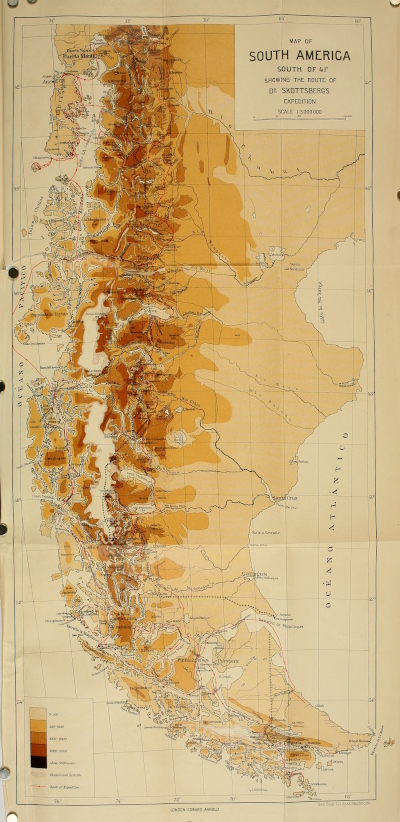
MAP OF SOUTH AMERICA SOUTH OF 41° SHOWING THE ROUTE OF Dᴿ SKOTTSBERG’S EXPEDITION SCALE 1:3000000
(click image to enlarge)
Telegrams: “Scholarly, London.” Telephone: No. 1833 Mayfair. 41 and 43 Maddox Street, Bond Street, London, W. September, 1911.
Mr. Edward Arnold’s
LIST OF NEW BOOKS,
Autumn, 1911.
MEMOIRS AND LETTERS OF THE RIGHT HON. SIR ROBERT MORIER, G.C.B.,
FROM 1826-1876.
Edited by His Daughter, Mrs. ROSSLYN WEMYSS
In Two Volumes. With Portraits. Demy 8vo. 32s. net.
These two volumes of the Memoirs and Letters of a very eminent diplomatist are of intense value, not only from a literary, but also from an historical point of view, containing as they do a most graphic and lucid description of the various events that went to make up the history of Germany from 1853 to 1876. The matters that led to the War of Schleswig-Holstein are dealt with in a vivid and interesting fashion, and with a clarity which will enable the reader to understand many points that have hitherto seemed obscure. The story of the struggle for supremacy in Germany, and for German Unity, and of the Franco-German War, is set forth impartially and without prejudice by one who witnessed critical events from the inside.
Subjects of the most vital interest—as, for instance, the war scare of 1875, the spread of European Liberalism, etc.—are dealt with by Sir Robert Morier in his correspondence in a style which must appeal to anyone at all interested in the European history of the past century. The distinguished diplomatist’s views upon the Foreign Office, the Emperor William I., and Bismarck, are given in a series of letters to various correspondents all over the world, among whom we may mention Jowett, Sir Louis Mallet, Lady Derby, and the Emperor Frederick. The friends and acquaintances of Sir Robert Morier’s youth—Froude, Tennyson, and other eminent contemporaries—are portrayed with a skilful pen.
NUTS AND CHESTNUTS.
By the Hon. L. A. TOLLEMACHE, Author of “Old and Odd Memories.”
One Volume. Crown 8vo. 2s. 6d. net.
A MEMOIR OF EDWARD CHARLES WICKHAM,
DEAN OF LINCOLN, AND FORMERLY HEAD-MASTER OF WELLINGTON COLLEGE.
By Canon LONSDALE RAGG,
Rector of Tickencote. Author of “Dante and His Italy,” “The Book of Books,” etc.
With Illustrations. One Volume. 7s. 6d. net.
The interest of a life is not necessarily proportioned to its share of dramatic incident and adventure. Edward Charles Wickham was essentially a scholar and a student rather than a man of action: his life was almost exclusively academic—at Winchester, at New College, at Wellington College, and finally in the Deanery at Lincoln. But it was far from being in any sense a stagnant one. Wherever he went he bore with him the inspiration of a born reformer, combined with an enlightened reverence for the past like that which made his illustrious father-in-law, Mr. W. E. Gladstone, a thorough-going Conservative in certain departments. In accordance with what would certainly have been the Dean’s own wish, the Memoir has been kept within strictly modest limits, and a sparing use has been made of letters; but the record is enriched by reminiscences contributed by not a few of Wickham’s former associates, colleagues, and pupils. Mr. A. O. Prickard supplies an appreciation of Wickham’s contribution to Scholarship, and Dr. Lock an appreciation of his University Preaching. Dr. Wickham’s singular gifts as a preacher are too well known to call for mention. Specimens of a few of his most notable sermons are given in an Appendix.
HANDLEY CROSS;
OR,
MR. JORROCKS’S HUNT.
Illustrated by CECIL ALDIN.
In Two Volumes, with 24 Coloured Plates and about 100 Black-and-White Illustrations in the Text. The Ordinary Edition will be Royal 8vo., handsomely bound. 21s. net.
Also a limited Edition de Luxe of 250 copies only for the British Empire, each Copy Numbered and Signed by the Artist. £3 3s. net.
This is a complete edition of Surtees’ glorious work, illustrated by the one artist of the day who is pre-eminently fitted to do justice to it. The tale of the immortal Jorrocks and his Hunt is to-day the most popular classic work on fox-hunting, and Mr. Cecil Aldin is unquestionably the most popular sporting artist. He has entered heart and soul into the spirit of the work, and the excellence of his pictures proves that they were inspired by enthusiasm for his subject. The period is one that Mr. Aldin has made peculiarly his own, and while preserving the traditional representation of the characters, he has been able to give full play to his powers of depicting old-fashioned country scenes both indoors and in the open, especially, of course, those in the hunting-field. His strikingly original style brings out the full flavour of the famous book.
THE HORSE:
Its Origin and Development, combined with Stable Practice.
By Colonel R. F. MEYSEY-THOMPSON,
Author of “A Hunting Catechism,” “Reminiscences of Camp, Course, and Chase,” etc.
With Illustrations. One Volume. Demy 8vo. 15s. net.
This work covers a large field of remarkable interest to all lovers of the horse. It is full of valuable matter, combined with sound advice. The volume commences with the horse in its earliest shape, and traces briefly its development down to the present time. Each breed has a special chapter devoted to it which has been submitted to the best known authorities in each department; and, amongst others, it may be mentioned that Lady Anne Blunt has kindly criticized the chapter upon Arabian Horses, while Mr. Hermon Biddell has done the same for Suffolk Punches, Mr. Walter Winans that on American Trotting Horses, and Mr. Alfred Withers has overlooked the account of Carriage Horses; in this way it is hoped the work may be regarded as authoritative on these subjects. The latter half of the book deals with Stable Practice, Simple Ailments and how to treat them, Breeding, Riding, Driving, Race-Riding, and Training Horses for the race-course and for hunting. Colonel Meysey-Thompson has had a lifetime’s experience in all these subjects, and is admirably qualified to deal with them.
THE PACIFICATION OF BURMA.
By Sir CHARLES CROSTHWAITE, K.C.S.I.,
Chief Commissioner of Burma, 1887-1890; Member of the Council of India, etc.
With Maps and Illustrations. One Volume. Demy 8vo. 16s. net.
Sir Charles Crosthwaite succeeded the late Sir Charles Bernard as Chief Commissioner of Burma when that officer was compelled by sickness to leave the Province in March, 1887. From that date until December, 1890, he administered Burma, and he had every opportunity, therefore, of knowing what was done. The measures by which, in four years and in a country which has been described by a soldier as “one vast military obstacle,” order and law were established, are narrated. After the military measures, without which no attempt at a Civil Government would have been possible, the constitution of the Indian military police and the establishment on a legal basis of the indigenous village system were the chief means of restoring peace. These measures are explained, and the way in which order was gradually evolved out of confusion is told. Separate chapters deal with the Shan States, with the wild Chins on the West between Burma and Bengal, with the Kachins about Mogaung on the North, and the Red Karrus on the South-East.
MY ADVENTURES IN THE CONGO.
By MARGUERITE ROBY.
With Numerous Illustrations and a Map. One Volume. Demy 8vo. 12s. 6d. net.
This is a book that casts an entirely new light on the vexed question of Belgian rule in the Congo. The authoress travelled alone with black porters for hundreds of miles through the very districts in the Congo where the alleged Belgian atrocities have been taking place, and the results of her observations, as here set forth, put a somewhat startling complexion upon some views of the situation that have been commonly accepted hitherto.
Although the conclusions drawn by Mrs. Roby from her travels in Central Africa are such as to set all truly patriotic Britons thinking, this book is no mere political tract. On the contrary, it is a stirring human document, in which humour, pathos, adventure, and indomitable pluck stand out from every page.
The devotion of “Thomas,” the authoress’s black boy, who stood by her when everyone else had deserted her, and to whom on more than one occasion she owed her life; her desperate straits amongst mutinous porters who sought to kill her; her days and nights of raging fever, alone and delirious in the Bush; her big-game exploits; her experiences with savages who had never before clapped eyes on a white woman; these and innumerable other incidents combine to make this one of the most remarkable books ever penned by traveller.
The emotions of a lifetime are crowded into this record of a six-months’ trek through Darkest Africa.
A feature that makes the book still more fascinating is the series of splendid photographs taken by the authoress and her black boy during their hazardous journey.
THE WILDS OF PATAGONIA.
A Narrative of the Swedish Expedition to Patagonia, Tierra del Fuego, and the Falkland Islands in 1907-1909.
By CARL SKOTTSBERG, D.Sc., etc.
With Illustrations and Maps. One Volume. Demy 8vo. 15s. net.
Three years after his return from the great Swedish Antarctic expedition in which he played so prominent a part, Dr. Carl Skottsberg, the distinguished naturalist and botanist, set forth once more, with two eminent fellow-scientists, Dr. Quensel and Dr. Halle, to explore the territories of Patagonia and Tierra del Fuego, of which so little is known to the outside world. This “Swedish Magellanic Expedition,” as it was called, not only resulted in many valuable biological, botanical, and geological discoveries, but was also the means of supplying Dr. Skottsberg with the material upon which he has founded his book, “The Wilds of Patagonia.” Full of interest and excitement are the graphic accounts which the author gives in this volume of the various expeditions made by him in the Falkland Islands, of the hardships he endured in the unknown interior of Tierra del Fuego, of his constant exposure to wind and weather in the heart of Chile, of his visit to Robinson Crusoe’s romantic island, and his journeys across the Andes and through the Cordilleras. Dr. Skottsberg writes with humour as well as charm, and while the descriptions of his various adventures and misadventures are amusing as well as thrilling, his pen-pictures of South American scenery are striking and vivid. This book should appeal especially to the naturalist and the traveller, but cannot fail to prove a source of pleasure and interest to the general reader. Its attractive character is further enhanced by a number of illustrations from photographs taken by the author in the course of his travels.
BRITISH AND GERMAN EAST AFRICA.
Their Economic and Commercial Relations.
By Dr. H. BRODE,
Author of “Tippoo Tib.”
With a Map. One Volume, Demy 8vo. 7s. 6d. net.
In this book Dr. Brode graphically describes the growth and development of British and German territories in East Africa, gives most interesting details as to the trade of the country, the shipping and railway services, etc., and discusses the question of native taxation and the position of native labour. He deals at length with the agricultural position of East Africa, its natural products and resources, the education of its aboriginal inhabitants, and many other matters of paramount importance. The comparison which Dr. Brode draws between the administration and commercial methods and arrangements of Germany and Great Britain respectively is of the greatest possible interest to British readers, and the tables of statistics with which he supplements his arguments must prove of enormous value to all who seek for information on the subject of East Africa.
THE KING’S CARAVAN.
Across Australia in a Waggon.
By E. J. BRADY.
With Illustrations and Map. One Volume. Demy 8vo. 12s. 6d. net.
After attaining eminence in the musical and cricket worlds, Australia seems to be rapidly coming to the front in literature. The Sydney Bulletin has for some time been the centre of a group of young Australian-born writers who bid fair to do their country great service by revealing its charms to the world at large through the medium of both poetry and prose. One of the strongest among them is Mr. Brady, whose volume announced above is the outcome of an adventurous driving tour he made a few years ago. Starting from Sydney in a light waggon, he made his way gradually to Townsville in the north of Queensland. The route he took—parallel with the coast, but for the most part some way inland—enabled him to visit all the places of importance on the way, and to study the conditions of life under great variations of climate. The result of his observations, given with much dry humour and interspersed with interesting yarns, will be a revelation to English readers, and probably very largely so to Australians. The trip was not without its dangers, for the veneer of civilization is in parts still somewhat thin, while there were also tornados, snakes, alligators, and the peculiarly Australian terror of getting lost.
FROM PILLAR TO POST.
By Lieut.-Colonel H. C. LOWTHER, D.S.O., M.V.O.,
Scots Guards.
With Illustrations. One Volume. Demy 8vo. 15s. net.
Colonel Lowther is already well known as a soldier and a diplomatist. He has held a commission in the Scots Guards for over twenty years, has served with distinction in the last South African War, and has held an important appointment in the Intelligence Department of the War Office. In 1905 he accompanied the Diplomatic Mission to Fez, and for the next four years filled the responsible position of Military Attaché at Paris, Madrid, and Lisbon. Colonel Lowther, who is a brother of the present Speaker of the House of Commons, has recently been appointed Military Secretary to H.R.H. The Duke of Connaught, who is shortly to take up his duties as Governor-General of Canada. In his volume of personal reminiscences, “From Pillar to Post,” Colonel Lowther shows himself not only as a soldier and a diplomat, but also as an explorer, a world-wide traveller, and a sportsman, possessing great powers of observation, a facile and gifted pen, and a keen sense of humour. In a light and breezy style he describes his travels all over the world—from Crete to Morocco, from Ceylon to East Africa. He narrates his experiences of cattle-ranching in America and of lion-hunting in Somaliland, and gives a most interesting account of his adventures in times of peace and war, on active service in South Africa, and on manœuvres at home. The volume is illustrated throughout by original photographs taken by the author.
MY LIFE STORY.
By EMILY, SHAREEFA OF WAZAN.
With Illustrations. One Volume, Demy 8vo. 12s. 6d. net.
Some forty years ago there was a considerable stir in European circles in Morocco, and in London as well, when the news was published that a young Englishwoman was about to marry the Grand Shareef of Wazan, who is the Ecclesiastical Head of Morocco. There was a violent discussion in the London Press, many people going so far as to protest against the intended marriage. Now, in 1911, the Grand Shareef is no more, but his widow is still living in Morocco, and, at the request of their many friends in Europe and America, has set down the story of her life. It may be safely said that her experiences have not been paralleled by any European woman, and that she has been brought face to face with the intimate seclusion of the Moorish woman’s life, even while maintaining her original faith. The story of her life has been edited by Mr. S. L. Bensusan, and Mr. R. B. Cunninghame Graham has written a preface. The book is dedicated by permission to Princess Henry of Battenberg, and will contain many original illustrations.
PERU OF THE TWENTIETH CENTURY.
By PERCY F. MARTIN,
Author of “Mexico of the Twentieth Century,” etc.
With 32 pages of Illustrations and a Map. One Volume. Demy 8vo. 15s. net.
Of all the South American Republics, perhaps Peru ranks as the most interesting, not only on account of its romantic history and the extremely picturesque nature of its people, but because its future is, by general consent of those travellers who have sufficiently studied the subject, one of the most brilliant and likely to prove one of the most permanent.
Of the many volumes upon Peru which have been issued from time to time, the economic student has sought in vain for a complete account of the Republic’s commercial and industrial conditions, and thus a new work from the pen of an acknowledged authority upon this part of South America will be especially welcome.
Herein will be found a careful, well-considered, and painstaking account of the Republic’s present condition and future prospects. The writer has studied the country very closely and very carefully; and it was generally admitted in Peru at the time of his visit last year that he actually travelled more extensively throughout the State, and looked more deeply and critically into its economic resources, than any author who had latterly visited it.
The result is a volume literally crammed with valuable first-hand information about the leading industries. The many different railways are described fully. The copper, gold, and other mines are carefully dealt with. The sugar, guano, rubber, oil, and cotton industries are faithfully depicted and frequently illustrated, and new mercantile prospects of every description are foreshadowed.
SALVADOR OF THE TWENTIETH CENTURY.
By PERCY F. MARTIN,
Author of “Mexico of the Twentieth Century,” etc.
With 32 pages of Illustrations and a Map. One Volume. Demy 8vo. 15s. net.
Of late months the smaller Latin-American States—those forming what is known geographically as “Central America”—have attracted a great amount of attention, principally owing to the attempt made by the United States to force an alliance, commercial and financial, with them. Hitherto not a single book has been written regarding the most important, because most settled and most progressive, of these States—Salvador—and the present volume will therefore meet with more than ordinary attention. This work is from the pen of Mr. Percy F. Martin, F.R.G.S., the author of several well-known publications, most of which (at least those devoted to Argentina and Mexico) have received the cachet of “standard works” upon their particular subjects. Mr. Martin has probably seen more of Latin-America than any living writer; and he has made this particular portion of the world his careful and special study. “Salvador of the Twentieth Century” will afford a complete description of the Republic; will show its gradual emancipation from the thraldom of the Spanish yoke; its early struggles against annexation by more powerful neighbours; its commercial accomplishments and possibilities—in fact, it will afford a thorough insight into a little-known but extremely interesting land with vast potentialities.
Mr. Martin, who travelled extensively throughout the Republic, and was accorded every facility by the Government for making his enquiries and investigations untrammelled by official interference, has shown us in these pages an unexpectedly impressive and attractive picture of Central American life and progress, which, being assisted by a number of capital illustrations, should prove a welcome addition to Latin-American literature.
ROUGHING IT IN SOUTHERN INDIA.
By Mrs. M. A. HANDLEY.
With Numerous Illustrations. One Volume. Demy 8vo. 12s. 6d. net.
“Roughing it in Southern India” is just what its name implies—a book of travel, but with such a refreshingly picknicky air about it as lifts it quite out of the common rut of such books. The work is an account of the writer’s journeyings with her husband through the wilder forest tracts of Coimbatore, the Wynâd, and Malabar—vast districts, each of them—in the course of his duties as an officer of the Madras Woods and Forests Department; it relates a story of adventure and novel experience in pursuance of work and shikar with all the incidental predicaments and obstacles. It describes encounters, sought and unsought, with wild animals; dealings with quaint jungle-people; excitements of travel along bad roads and no roads; difficulties in great variety, all of which had to be got through and over somehow. The manner in which these difficulties are portrayed gives a vivid human interest to every page, the whole being sketched in with an enviable lightness of touch, and clearly shows that nerve without nerves is indispensable to make such a day-after-day life as is here depicted possible, to say nothing of enjoyable. To a person hampered with nerves it could be no better than a series of nightmares.
The book gives one a pleasant feeling that the day has gone by when Englishmen in India thought it fine to speak slightingly of, and even to, natives as “niggers”—a manner of speech as ignorant as it is insulting.
THE LIFE OF A TIGER.
By S. EARDLEY-WILMOT,
Author of “Forest Life and Sport in India.”
With nearly 150 Original Illustrations. One Volume. Medium 8vo. 7s. 6d. net.
In his popular work, “Forest Life and Sport in India,” published last autumn, Mr. Eardley-Wilmot devoted a chapter to the habits of tigers. This, however, by no means exhausted his material, but it aroused much interest in an enthralling subject and paved the way for the present volume. The author has cast his work in the form of a life-history of an individual tiger from birth until, owing to the inroads of civilization into his ancient preserves, he becomes a man-eater and is finally shot. It would be difficult to over-emphasise the fascination of this tale, which not only records the vie intime of the tiger family, but introduces the whole life of the jungle in a series of vivid and kaleidoscopic pictures. The attractions of the book are enhanced by about 150 thumb-nail sketches by the author’s daughter, as well as by reproductions of some of Mrs. Eardley-Wilmot’s charming and artistic photographs.
THE SPORT OF SHOOTING.
By OWEN JONES,
Author of “Ten Years of Game-Keeping,” etc.
With Illustrations. One Volume. Demy 8vo. 10s. 6d. net.
This is an informative volume of absorbing interest and utility to the ever-increasing army of shooting-men, and to those many others who cherish an innate hankering after shot-gun sport. While the seasoned sportsman cannot fail to glean many a useful idea, the chief object of the book is to cater sympathetically (at the same time avoiding technical phraseology) for the beginner, whether he be an eager youngster or one whose opportunities have come with riper years—to put him from the first on the right track, and save him the endless disappointments of unguided inexperience. It explains those perplexing questions which undermine confidence and account for disheartening failures, puts him in the way of meeting each difficulty as it comes, assists him in laying out his money to good advantage, in buying a gun, cartridges, or dog: taking a shoot, engaging a keeper, and managing them both: or in distributing appropriate tips. Thus, perceiving the why and wherefore of this or that all-important detail of the ropes of shooting, he will be resourceful, self-reliant, and independent of others for the goodness of his sport; find abundance of healthy recreation in the making of a modest bag; by his own wise woodcraft cancel mere deficiencies of marksmanship; and last, but not least, whether as guest or host, add tenfold to his own enjoyment and that of his companions.
THE ROMANCE OF THE HOLY LAND.
By Dr. CHARLES LEACH, M.P.
With Numerous Illustrations. Large Crown 8vo. 7s. 6d. net.
Avoiding technical terms and scientific descriptions, the author has produced a volume that should be welcomed by men and women in every country who have even a remote interest in the Bible and the land in which it was produced.
The writer has made nine visits to Palestine during the last twenty years, and has delivered lectures upon it in many of the large towns of England. He takes the reader on a tour to the Holy Land, and travels with him to the principal places of Biblical interest. He describes many of the chief towns in such terms that the reader not only sees them as they are to-day, but can picture them as they were in the far-off first century. He describes the manners and customs of the people, the physical features of the country, the rivers and lakes of Palestine, and some of the remarkable historic events which have made the land famous throughout the world.
Those who have been to the Holy Land will welcome this book, whilst those who have not been so fortunate will profit greatly from its pages.
THE GRAVEN PALM.
A Manual of the Science of Palmistry.
By Mrs. ROBINSON.
With about 250 Original Illustrations. Medium 8vo. 10s. 6d. net.
This work is the result of nearly twenty years’ practical experience, and the careful examination of many thousands of hands. The illustrations are drawn by Mrs. Robinson herself, and are in every case taken from hands which she has herself read. The great majority of the lines given are entirely original—i.e., are not to be found in any known work upon the Science of Palmistry.
This book will enable those who study it to read character correctly from the shapes of the hands and the comparative lengths of fingers and phalanges; to understand the values of the different mounts, as bearing upon the character and life; and, by the full and comprehensive delineation of the six principal and the many chance lines upon the hand, to understand and read correctly the events of their own past and future, as given by the lines on the Mount of Venus in particular, and also in a minor degree by the lines of fate, fortune, and health.
There are also at the end of the book several photographs of the hands of well-known and celebrated people.
SOCIETY SKETCHES IN THE EIGHTEENTH CENTURY.
By NORMAN PEARSON,
Author of “Some Problems of Existence.”
With Photogravure Portraits. One Volume. Demy 8vo. 12s. 6d. net.
This book deals with some features and figures of the eighteenth century which have hitherto escaped any detailed treatment, and with certain aspects of familiar persons which have been unduly overlooked. The Virtuosi who founded the Royal Society, but also called into existence a host of scientific quacks and charlatans; the Scowrers, and their successors the Mohocks, who infested the streets of London at the beginning of the eighteenth, and the Highwaymen who survived into the nineteenth century, are discussed in its pages. An essay is devoted to the fashionable Wits of the period, and another throws new light upon the inner history of the Macaronis. Tradition represents these as mere brainless fops, but the author shows that this reproach belongs rather to their later imitators than to the Macaronis of 1764.
Governor Pitt, grandfather of the first Lord Chatham, the brilliant scapegrace “Etheldreda” (third Viscountess Townshend), the “Mad Duchess” of Queensberry, and that clever oddity Soame Jenyns, also find a place in the book, while new aspects of even such well-known characters as Horace Walpole and Hannah More are revealed in “The Serious Side of a Worldly Man,” and “The Lighter Side of a Serious Woman.”
CAMEO BOOK-STAMPS.
By CYRIL DAVENPORT, F.S.A.,
Superintendent of Bookbinding in the British Museum.
With about 150 Illustrations from Original Drawings by the Author.
The First Edition will be limited to 500 Copies only. In One Volume.
Super-Royal 8vo. 21s. net.
Bookbinding stamps of different kinds have already been much written about, especially heraldic ones, but cameo stamps, although they have now and then been mentioned, have up to the present received no special recognition. They are in low relief, like medals, and are generally left ungilded and uncoloured.
These stamps—the larger and more important of which are illustrated in this book—form, in fact, a very important division of the subject of decorative bookbinding, and, unlike most of the other kinds of book decoration, they rarely can be satisfactorily photographed. Mr. Davenport’s drawings, however, are singularly accurate copies of their originals, and will undoubtedly prove of the utmost value both to book-collectors and dealers in books.
Some of the stamps shown are well known—those English ones, for instance, showing the Tudor Rose, and the coat-of-arms of Henry VIII.; but others are not so common. The English stamps of St. George and of St. Michael are very fine indeed. The beautiful French stamps of the vision of the Emperor Augustus, and the very interesting Italian stamps of Horatius Codes and of Marcus Curtius, will doubtless come as a revelation to many, and so with the “Canevari” stamp of Apollo, although it is better known to connoisseurs.
The large series of German stamps, mostly on pigskin, is of great importance; there are several excellent portraits of Luther and of Melanchthon, and quaint stamps of Lot and his daughters, Judith and Holofernes, Jonah and the Whale, and many delicately cut stamps of incidents in the life of Christ and of the Virgin Mary.
All these stamps, of which there are about 150, are beautifully and truthfully copied from the originals, and with each is a short description. At the end is a full and most useful index. Every inscription, whether in Greek, Latin, or German, is translated, and every initial noted and indexed.
The book will be invaluable to every librarian—in fact, necessary—and it will add much to the interest of every book, whether in morocco, calf, or pigskin, that bears upon it one of the stamps illustrated.
A LITTLE HISTORY OF MUSIC.
By ANNETTE HULLAH.
With Numerous Illustrations. One Volume. Medium 8vo. 5s.
This is a history of music written in a simple way for young people. After a chapter on aboriginal songs and dance-tunes, and another on the music of ancient nations, the Romans lead us into early Britain, and so to the first Christian chants. Then we have mediæval monks and scholars arranging scales. Minstrels and troubadours, with the stories of their time, bring us to the Elizabethian age of masque and madrigal. How Florentine genius developed these into the first operas and oratorios completes the next century. Then we come to a period of fine players and fine instruments, of Corelli and Tartini, of Amati and Stradivarius, of harpsichordists like Scarlatti, and of German organists long since eclipsed by the light of Bach. What he, and the other great composers since his day, did for music fills up the rest of the chapters and takes the record down to our own time. There are many legends and anecdotes in the book, and illustrations of quaint musical instruments of old days.
THE FRAMEWORK OF HOME RULE.
By ERSKINE CHILDERS,
Author of “War and the Arme Blanche,” “The Riddle of the Sands,” etc.
One Volume. Demy 8vo. 10s. 6d. net.
A study of the Irish question, mainly from the Imperial standpoint. First sketching the history of Ireland in close conjunction with that of the lost American Colonies and the present self-governing Dominions, the author shows that the same forms of misgovernment arising from similar conditions have always led to the same mischievous results, and that their only remedy, when applied in time, has been Home Rule. He then reviews the present state of Ireland, describing the extraordinary anomalies of the semi-colonial government. Full attention is given also to the brighter side of Irish life. But the author points out the deep marks of arrested development, and the need for self-reliance and self-development under a responsible Irish Government.
With regard to the form Home Rule should take, the author devotes special attention to the vital questions of finance and Irish representation at Westminster, as well as to guarantees for an Ulster minority, executive power, police, judges, and numerous other points of secondary importance.
The aim is to supply not only a reasoned defence of Home Rule, but a practical up-to-date guide to the legislative settlement of the question.
PROS AND CONS OF POLITICAL PROBLEMS.
By Sir J. D. REES, K.C.I.E.
One Volume. 7s. 6d. net.
In this book Sir J. D. Rees, K.C.I.E., ex.-M.P., surveys the more important political problems at present before the nation from the points of view of both great parties in the State. The following subjects are dealt with: Imperial Organization, Defence, Foreign Policy, Indian and Colonial Problems, Trade Relations and Tariff Reform, Suffrage, Home Rule, Education, Disestablishment, Finance, Socialism, Labour Questions, Land Reform, and the Constitutional Problems at present before the country. To each great question a chapter is devoted which gives the reader a concise survey of the points at issue and a summary of the position at the present day, and to every chapter are appended the arguments for and against: in the hope that the reader in a few pages may find a guide to the reasons upon which political parties base their case. The utility of the work to the student and politician will be enhanced by the bibliographical notes at the end of each chapter, which indicate the scope of the works recommended, so that the reader may be able to follow up his study of any political question. The information has been compressed into a volume of handy size so as to be of use to speakers and politicians. It is not, however, merely a work of reference—although an excellent index and the sub-division of the chapters make reference easy—but is intended to be read.
ECONOMICS FOR BEGINNERS.
By GEORGE W. GOUGH, M.A.,
Sometime Exhibitioner of Balliol College.
One Volume. Crown 8vo. 3s. 6d. net.
The need of a short textbook of economics which teachers can place in the hands of pupils who are starting the subject with a view to preparing for the more elementary parts of the higher examinations in it, is well known, and Mr. Gough’s little volume is an attempt to meet it. The core of this vast subject, if the expression may be used, is fully and simply treated in accordance with authoritative opinion. Hence the beginner who means to continue his studies will be put in a position to read one or more of the larger manuals with advantage. As appendices there will be given a guide to further reading, a selection of typical questions—for the answers to which the text of the book will be found to furnish materials and hints—and a short selection of statistics illustrating modern economic conditions in the United Kingdom. It is, further, the author’s hope that the book will be useful to older students interested in social problems, and that they will find in it the elements of the economic principles bearing on their solution.
THE GREAT PLATEAU OF NORTHERN RHODESIA.
By CULLEN GOULDSBURY AND HERBERT SHEANE,
Of the British South Africa Company’s Service.
With Preface by Sir ALFRED SHARPE, K.C.M.G., C.B.
With 40 pages of Illustrations and a Map. One Volume. Demy 8vo. 16s. net.
This book has been written about the Tanganyika Plateau of Northern Rhodesia, which—though some fifty thousand square miles in extent—is still practically unknown, since it has not yet been penetrated, or its resources tapped by the Cape to Cairo Railway.
Apart from its abundant natural resources, the excellent climate of the Plateau and its high altitude (from 4,000 to 6,000 feet) render it as healthy and suitable for white colonization as the far-famed Highlands of British East Africa.
The book is divided into two parts, European and Ethnographic. The Ethnographic Section is dealt with by Mr. Sheane, who, during the past ten years, has made a special study of language and native customs upon the Tanganyika Plateau.
The needs of prospective settlers and ranchers are fully discussed, and information for sportsmen and travellers is supplied in two chapters dealing with elephant-hunting and the species and habits of game, big and small, to be found upon the Plateau.
Lastly, the Native chapters should prove of value, not only to anthropologists, but also to that increasing body of readers who are interested in the problems of native life and of native law and custom in Central Africa.
HINTS TO SPEAKERS AND PLAYERS.
By ROSINA FILIPPI.
One Volume. Crown 8vo. 3s. 6d. net.
Miss Rosina Filippi is an actress well known to, and deservedly popular with, the playgoing public of Great Britain. The excellent work she has done in teaching the younger members of her profession has evoked the admiration of her colleagues who recognize her claims to a front place on the English stage which she has long adorned. She has, indeed, won a deservedly high reputation as a teacher of dramatic art, and many are the students who have profited by her instruction and owe their success to her ripe experience. “Hints to Speakers and Players” is, as its name implies, a guide or handbook to all who desire to attain proficiency in the art of speaking or acting. In this work the author offers invaluable advice upon such subjects as Elocution, Diction, Gesticulation, Ranting, etc., not only to would-be actors, but also to Members of Parliament, orators, clergymen, and all who may be called upon to deliver speeches on the political platform, in the pulpit, or at the dinner-table. Her facile pen ranges over the wide field of her experience and deals in a light but informing fashion with a hundred matters that must inevitably prove interesting to all who are compelled to raise their voices in public.
THE AUTOBIOGRAPHY AND LIFE OF FATHER TYRRELL.
By MAUD PETRE.
In Two Volumes. Demy 8vo., cloth. 21s. net.
The first volume, which is autobiographical, will cover the period from George Tyrrell’s birth in 1861 to the year 1885, including an account of his family, his childhood, schooldays, and youth in Dublin; his conversion from Agnosticism, through a phase of High Church Protestantism to Catholicism; his experiences in Cyprus and Malta, where he lived as a probationer before entering the Society of Jesus; his early life as a Jesuit, with his novitiate and first studies in scholastic philosophy and Thomism. This autobiography, written in 1901, ends just before the death of his mother, and was not carried any farther. It is edited with notes and supplements to each chapter by M. D. Petre.
The second volume, which takes up the story where the first ends, deals chiefly with the storm and stress period of his later years. Large use is made of his own notes, and of his letters, of which a great number have been lent by correspondents of all shades of thought. Various documents of importance figure in this later volume, in which the editor aims at making the history as complete and objective as possible. Incidentally some account is given of the general movement of thought, which has been loosely described as “modernism,” but the chief aim of the writer will be to describe the part which Father Tyrrell himself played in this movement, and the successive stages of his mental development as he brought his scholastic training to bear on the modern problems that confronted him. The work ends with his death on July 15, 1909, and the events immediately subsequent to his death. The date of publication is uncertain, but will be announced as soon as possible.
THE PARTING OF THE WAYS.
Essays on Judaism and Christian Origins.
By GRADUATES OF JESUS COLLEGE, CAMBRIDGE.
Edited by Dr. F. J. FOAKES-JACKSON.
With an Introduction by the Very Rev. W. R. INGE, D.D.,
Dean of St. Paul’s.
One Volume. Demy 8vo. 10s. 6d. net.
Several volumes of Theological Essays have appeared from the two ancient Universities, but none hitherto by members of a single college. Jesus College, Cambridge, has, however, had exceptional opportunities for encouraging the study of Divinity, owing to the fact that of recent years it has numbered two Lady Margaret Professors among the fellows, and has been generously endowed by the late Lord Justice Kay, who founded scholarships for post-graduate study in Theology.
The object of these essays is to trace the origin of Christianity from Judaism, and its development till the final parting of the two religions. With the exception of the Introduction and Essays I. and III., all the writers have taken their degrees quite recently, and though they have obtained high honours at the University, the volume must be judged as a young men’s book. As such it may prove the more interesting as illustrating the ideas of some of our younger theologians. The essays are not the product of any school, but represent all shades of thought in the Church of England, whilst one is written by a Nonconformist, and another by a Jewish scholar. All the essayists have, however, been the pupils of the editor, and most have come under the influence of the Dean of St. Paul’s.
HOW TO DEAL WITH MEN.
By the Rev. PETER GREEN, M.A.,
Rector of St. Philip’s, Salford, and Canon of Manchester. Author of “How to Deal with Lads,” etc.
One Volume. Crown 8vo. 2s. 6d. net.
Beginning with chapters on the nature of work among men, and the special needs of the present time, and on the type of man required for success in this kind of work, the author goes on to treat in detail such subjects as the Men’s Bible-Class; the various methods for promoting its success; the different kinds of work which should spring out of the work of the class; and some of the commoner dangers to be watched and guarded against. Following the chapters on the Bible-Class and its developments, come chapters on social and recreative work, such as that of the Men’s Club and the minor clubs in connection with it, temperance benefit societies, and social and parochial work for men. The second part of the book is devoted to a detailed treatment of personal work with individual men. Methods with men troubled with religious doubt, or with other intellectual difficulties, and methods of dealing with various moral problems, are carefully and fully discussed.
THE FAITH OF AN AVERAGE MAN.
By the Rev. CHARLES H. S. MATTHEWS, M.A.,
Author of “A Parson in the Australian Bush,” etc.
One Volume. Crown 8vo. 3s. 6d. net.
The author is profoundly convinced that on the one hand the endless restlessness of modern life is a witness to man’s need of a vital faith, and on the other that the continued vitality of the historic Church of England is in itself a proof of her power to meet this fundamental need of men. The position he occupies, and would in this book commend to others, may best be described as a kind of progressive Catholicism, a true via media between an exclusive Protestantism on the one hand, which seems to him to be founded on a view of the Bible no longer tenable, and an equally exclusive Catholicism on the other, which in its turn seems to be founded on a no less untenable view of the Church. It is the author’s hope that his appeal may be read, not only by laymen, but also by the younger clergy.
THE CHURCH AND MODERN PROBLEMS.
By the Rev. C. F. GARBETT, M.A.,
Vicar of Portsea.
One Volume. Crown 8vo. 3s. 6d. net.
An interesting volume, composed of addresses mainly delivered in the course of the author’s ordinary parochial work during the last two years. They are all united by the attempt to state the attitude of the Church to some of the many modern problems of religious thought and action. Among these are Modernism, Rationalism, Agnosticism, the Higher Criticism, Inspiration, the Reunion of Christendom, Divorce, Temperance Reform, and Socialism. The attitude of the Church to all these tremendous intellectual, moral, and social problems is briefly argued and discussed with tact and ability.
THE MIND OF ST. PAUL:
As Illustrated by his Second Epistle to the Corinthians.
By Canon H. L. GOUDGE, D.D.
Principal of Ely Theological College.
One Volume. Crown 8vo. 2s. 6d. net.
A GOODLY FELLOWSHIP
Thoughts in Verse and Prose from many Sources.
Collected by ROSE E. SELFE.
With a Preface by His Grace the ARCHBISHOP OF CANTERBURY.
One Volume. Small 8vo. 2s. 6d. net.
This small religious anthology has been compiled in the hope that the various suggestions and counsels, the voices of praise and aspiration, and the poets’ visions of the past, present, and future may come through the windows of the soul, which are open to receive them with comfort, encouragement, and inspiration. The passages are grouped under the following headings: Religion in Childhood, Our Human Life, Sorrow and Suffering, On Prayer, Aspiration and Communion, The Incarnate Christ, Christian Seasons, Old Age, Death and After. But there are no hard and fast divisions, and many of the extracts might be appropriately classed under two or more of these headings. More than seventy authors have been laid under contribution, including some as widely separated in time as Boethius, Thomas Traherne, William Law, Christina Rossetti, the present Dean of St. Paul’s (Dr. W. R. Inge), and Mr. G. K. Chesterton.
New and Cheaper Edition.
SCOTTISH GARDENS.
By the Right Hon. Sir HERBERT MAXWELL, Bart.
With 32 Coloured Plates from Pastel Drawings especially done for this work by
Miss M. G. W. WILSON,
Member of the Pastel Society and of the Scottish Society of Artists
New Edition. Medium 8vo. 7s. 6d. net.
It was not originally intended that this charming work, of which both the Edition de Luxe and the ordinary Edition were sold out two months after publication, should be reprinted. So persistent, however, have been the inquiries for it that it has been decided to re-issue it in a cheaper edition, but with all the original plates. The success of the book in the first instance may be attributed both to the attractiveness of the subject and to the harmonious combination of artistic and literary skill which characterized it, and these features will in no sense be modified in the new edition.
A New Edition Revised.
A BOOK ABOUT ROSES.
By the late Very Rev. S. REYNOLDS HOLE,
Dean of Rochester.
With Coloured Plates. Crown 8vo. 3s. 6d.
This edition contains the Dean’s latest corrections of his famous book, a new chapter on “Progress” up to the present time by Dr. Alfred Williams, Member of Committee of the National Rose Society, and a full and up-to-date list of roses compiled and classified by the same competent hand.
NEW FICTION.
TANTE.
By ANNE DOUGLAS SEDGWICK
(Mrs. Basil de Sélincourt),
Author of “Franklin Kane,” “Valérie Upton,” etc.
One Volume. Crown 8vo. 6s.
A deeply interesting book, which, it is believed, will be considered by far the most powerful work the author has accomplished. It is a long story, but the interest never flags, and the plot culminates in an exceedingly dramatic way.
THE BRACKNELS.
By FORREST REID.
One Volume. Crown 8vo. 6s.
This is an interesting novel describing the fortunes of an Irish family, into the midst of which comes Mr. Rusk, a young English tutor. Each member of the family is well and distinctly portrayed, and there is an under-current of mysticism of a distinctly uncanny tendency. Denis, a boy of sixteen, the pupil of Mr. Rusk, is a particularly charming figure, who contrasts sharply with some of the other members of the Bracknel family.
A ROMANCE OF THE SIMPLE.
By MARY J. H. SKRINE.
Author of “A Stepson of the Soil.”
6s.
MORE GHOST STORIES.
By Dr. M. R. JAMES,
Provost of King’s College, Cambridge.
Author of “Ghost Stories of an Antiquary,” etc.
Medium 8vo. 6s.
THE MOTTO OF MRS. McLANE.
The Story of an American Farm.
By SHIRLEY CARSON.
One Volume. Crown 8vo. 3s. 6d.
A very clever piece of character drawing; the scene is laid in a Western American farm, where the McLane family have been settled for a considerable number of years. Life on the farm at various seasons is painted in vivid and attractive colours, but the feature of the story is the shrewd homely wit of Mrs. McLane and her neighbours. Their conversations remind one of the success of “Mrs. Wiggs of the Cabbage Patch,” and are so clever and spontaneous that they cannot fail to be thoroughly enjoyed by all readers.
LOVE IN BLACK.
By Sir H. HESKETH BELL, K.C.M.G.,
Governor of Northern Nigeria.
One Volume. Medium 8vo. 6s.
This volume contains a number of sketches of native life in West Africa, in the garb of fiction. No one has had better opportunities than the author of penetrating the veil of mystery and fetish that enshrouds the inner life of the native, and no one has drawn their characters with a more sympathetic and romantic hand. The titles of the sketches give some idea of the contents of the volume. Among them are “The Fetish Mountain of Krobo,” “The Yam Custom,” “The Tale of a Tail-Girl,” “His Highness Prince Kwakoo,” “On Her Majesty’s Service,” “A Woman of Ashanti.”
STEAM TURBINE DESIGN:
With Especial Reference to the Reaction Type.
By JOHN MORROW, M.Sc., D.Eng.,
Lecturer in Engineering, Armstrong College, Newcastle-on-Tyne.
Demy 8vo. Fully illustrated with 150 Diagrams and 9 Folding Plates.
Since the days of Watt no greater revolution has taken place in steam machinery than the advent of the turbine. In the face of the greatest difficulties it was introduced by the Hon. Sir Charles A. Parsons both for marine and electrical work, and with the success of the s.s. Lusitania and Mauretania the public for the first time realized that it had come to stay. Many books, both of description and theory, have been written on the steam turbine, yet up to the present few have been devoted definitely to its design. In the present volume Dr. Morrow gives a clear explanation of the principles and practice of turbine design and construction as followed out in the drawing-office and engineering workshop.
LONDON: EDWARD ARNOLD, 41 & 43 MADDOX STREET, W.