Captain Mayne Reid (continued 3)
Reading edition
Wacora, after reaching the camp, dismissed his warriors, and entered his tent alone.
The remainder of that night he passed in meditation.
Was it the influence of the white blood flowing in his veins that made him think of the slaughter he had directed and taken part in?
Strange inconsistency of nature.
The heroic chief, still decked in the war paint of his father’s race, as he reviewed the events of the past few hours, could not restrain himself from shuddering.
His mother’s spirit seemed to hover around him; her eyes sad and reproachful; her heart heavy.
“They were the people of my race, and so of yours, that you have immolated on the throne of your vengeance.”
So seemed it to say!
His head sank upon his breast. He sighed heavily.
Long he continued in his gloomy abstraction; his thoughts deeper than plummet ever sounded.
The weary hours of night crept slowly past, and yet he stirred not.
Fears and forebodings filled his warrior’s heart.
“I have done all for the best,” muttered he to himself. “Witness it, thou Great Spirit; all for the best. For the future of my father’s race I have closed my heart to pity. It was not for present vengeance alone that I urged on the wild people to the slaughter. It was that they might then begin the great work of regeneration, assured in their strength, and conscious of their invincibility.”
Like all high-strung natures, Wacora was subject to fits of despondency.
With want of action this had come upon him. The excitement over, gloomy doubt had succeeded to bright hope.
The sun was high in the heavens ere he could bestir himself, and shake off such thoughts. He at length made the effort, and emerged from his tent to consult with the warriors of his tribe.
As he stepped forth, he perceived Maracota slowly approaching.
In an instant the slumbering passion of hate was awakened; he saw in the young Indian’s eye that he had news to communicate.
Speak! have you found him?
“Yes, he is found.”
“I mean Warren Rody. Make no error, Maracota—tell me, is it Warren Rody you have found?”
“He has been found.”
“Then all is well. Quick! bring him to me. Let me look upon this dog of a pale-face!”
Maracota made no answer, but stood silent.
“Do you hear me? Bring the dog before me. My eyes hunger for a sight of his craven countenance—I would see his white-livered face of fear—watch his trembling frame as he stands in my presence!”
Still Maracota did not speak.
“By the Great Spirit, Maracota, why do you not go for him? Why do you not answer me?”
“Maracota dreads your anger.”
“You an Indian warrior, and afraid. What do you mean?”
“That I have disobeyed your commands—”
“Ha! wretch! I understand. You found him, but he escaped.”
“Not that—”
“What is it then? Speak, did he defy you? Was he too powerful? Then summon our warriors, and if it cost the life of every Indian in Florida I swear he shall be captured. Answer me or I shall do you mischief.”
“Maracota deserves punishment.”
The young chief, now fully aroused to anger, cast a significant look at his subordinate; he could scarce refrain from striking him to the ground, and it was with an effort that he resumed speech—
“No more mystery. Speak! where is he?”
“Dead.”
Wacora made a bound towards the speaker, as he cried, “Did you kill him?”
“I did.”
Maracota fearlessly stood to await the stroke of the upraised tomahawk.
It fell, but not on the Indian’s skull.
Wacora flung his weapon on the grass.
“Wretch!” he cried, “you have robbed me of my revenge. May the arm that took that man’s life hang palsied by your side for ever! May—oh, curse you—curse you!”
Maracota’s head fell upon his breast. He dared not meet his chief’s angry glance—more dreaded than the blow of his hatchet.
For some moments there was silence; whilst Wacora paced to and fro like a tiger in its cage.
Chapter Thirty One.
A Sad Spectacle.
After a time the enraged chief, pausing in his steps, stood by the side of the silent warrior.
“Tell me how it happened,” he said, apparently becoming calmer. “Tell me all.”
Maracota related the circumstances as they had happened.
“It was to save Nelatu’s life that you fired upon the monster?”
“It was.”
“And he—where is Nelatu?”
“He is close by. See, they come this way.”
As Wacora looked in the direction indicated, he perceived his two cousins approaching.
The beautiful maiden, now wan and sad, seemed absorbed in the contemplation of some wild flowers which she held in her hand. There were others wreathed in her hair.
In this manner had she been conducted to the camp.
Nelatu turned to his sister, put his arm in hers, and was about to lead her off, when a man rushed into the presence of the chief, crying out as he approached—
“Good news! The body of the white chief, Rody, has been found, and—”
The warning gesture had been lost upon the impatient speaker.
It was too late now, Sansuta had heard the fated name.
Casting from her the flowers she had been trifling with, she uttered shriek upon shriek, running wildly and beseechingly, backwards and forwards, from her brother to her cousin, who both stood spell-bound with surprise and grief.
“Where have you hid him? Give him to me. You shall not kill him; no—no—no! I say you shall not hurt him! Warren! Warren! ’tis Sansuta calls. Murderers! He never injured you. Take nay life—not his! Warren! Warren! Oh, do not keep him from me. See, that is his blood upon your hands—his eyes are closed in death! It is you, wretches, that have murdered him. No, no—stand back—I would not have you touch me whilst your hands are red with his blood. Back! back! I will find him!—No, you shall kill me first!—I will find Warren Rody! Help, help! save me from his murderers!”
With renewed screams of agony that struck horror into the listeners’ hearts, the girl, eluding their grasp, darted away into the forest.
At a signal from Wacora, Nelatu started in pursuit.
“May the lightnings blast all who have brought about this! Fool that I was just now to feel pity for the pale-faces; nothing that revenge can accomplish will make up for this. Here I swear to take vengeance far more terrible—vengeance to which that of last night shall be but a mockery!”
With these words the young chief hastened away from the spot, followed by Maracota and the messenger.
Chapter Thirty Two.
“Spare Her! Spare Her!”
The opportunity of this vengeance was already close at hand.
Within the space enclosed by the Indian tents, under guard of some warriors, stood a group of pale-face prisoners.
It consisted of several men, and among them a young girl.
Wacora stopped on perceiving the group.
His features were illumined with a savage joy.
One of the chiefs, advancing, reported their having been captured while attempting to escape through the adjoining forest.
“What’s to be done with them?” he asked.
“They shall die by torture!”
“The girl?”
“She, too, shall die. Who is she?”
“I don’t know.”
Turning to Maracota, he propounded a similar question.
Maracota was equally ignorant of the person of the captive.
The chief ordered her to be brought before him.
With an undaunted step, although evidently suffering from debility and sorrow, the girl allowed herself to be led along.
Once in Wacora’s presence, with a modest courage, she gazed into his face.
“Who are you?” he asked.
“Your prisoner.”
“When where you captured?”
“About two hours ago.”
“You were trying to escape?”
“I was.”
“Your companions—who are they?”
“I know nothing of them, except that they are people belonging to the settlement. They were kind to me, and endeavoured to help me in my escape.”
“You know your doom?”
She answered, sadly—
“I expect no mercy.”
Wacora, struck with this reply, felt an interest in the courageous girl, which he could not account for.
“You have been taught to think of the red man as a remorseless savage?”
“Not as remorseless, only as revengeful.”
“Then you acknowledge that we have just cause for revengeful feelings?”
“I did not say so.”
“But you implied it.”
“All men have enemies. The truly great are the only ones who can forego revenge.”
“But savages must act according to their instincts.”
“Savages—yes. But men who know right from wrong should act by their judgment.”
“If I spared your life, you would still consider me a savage.”
“My life is nothing to me. All those I loved are now dead.”
“Your mother?”
“She died when I was a child.”
“Your father?”
“Was killed last night.”
Wacora seemed lost in thought as he said, half aside—
“So young, and yet with no fear of death!”
The young girl overheard the muttered soliloquy, and made answer to it—
“To the unhappy death is welcome.”
“Unhappy?”
“I have told you that all I love are dead?”
“Yet death is terrible.”
“Your name?”
“Alice Rody.”
With a cry of fiendish delight, Wacora grasped the maiden’s arm.
“You, the daughter of that accursed man—the daughter of that demon in human form! Then, by the Great Spirit above us! by the ashes of my ancestors, you shall die! My own hand shall inflict the blow.”
As he uttered these words, he drew a knife from his belt, and was on the point of sheathing it in her heart, when his arm was seized, and a voice full of agony vibrated in his ear—
“Spare her!—oh! spare her. Take my life instead.”
“Nelatu!”
“Yes, Nelatu; your cousin, your slave, if you will—only spare her life!”
“You forget her name.”
“No, no; I know it but too well.”
“You forget that her father has been the accursed cause of all this misery?”
“No; I remember that too.”
“Then you are insane thus to beg for her life. She must die!”
“I am not insane. Oh! Wacora, on my knees I implore you to spare her!”
“Rise, Nelatu; the son of Oluski should not bend his knee to man. At your intercession, her life shall be spared!”
Nelatu rose from the ground.
“You are indeed our chief, Wacora. Your heart is open and generous.”
“Stay, yet, before you mistake me. I give you her life, but ‘an eye for an eye!’ She shall suffer what Sansuta has suffered; spare her life, but not her honour.”
“Wacora!”
“I have said it. Here”—turning to the assembled warriors who had been amazed witnesses of the scene—“this is the child of our enemy, Elias Rody. I have, at Nelatu’s entreaty, spared her life; I bestow her upon the tribe; do with her what you will.”
Nelatu leaped before the advancing braves.
“Back!” he cried. “The first who lays hands upon her, dies!”
Wacora gazed upon his cousin.
In his breast rage contended with wonder.
“Heed him not; he is insane.”
“No; not insane.”
“Speak; what then?”
“I love her! I love her!”
The young girl, who had stood like a statue throughout all the previous scene, gave a start, and, cowering to the ground, buried her face in her hands.
To Wacora the words of Nelatu were no less surprising.
Turning to the shrinking maiden, he said—
“You hear what Nelatu says? He loves you.”
She murmured faintly—“I hear.”
“He loves you. Wacora, too, has loved. That love has been trampled upon, and by your wretch of a brother! Yet still it shall plead for Nelatu. His request is granted. You are spared both life and honour, but must remain a prisoner. Conduct her hence!”
“And these?” asked a warrior, pointing to the other prisoners.
Wacora’s heart, touched for an instant by his cousin’s pleading, as well as by Alice Rody’s heroic bearing, became again hardened.
He replied—
“They must die! Not by the torture, but at once. Let them be shot!”
The brave fellows, disdaining to sue for mercy, were led away from the spot.
Soon after he heard several shots that came echoing from the woods.
His captives had been released from all earthly care.
Chapter Thirty Three.
Ruin among the Ruins.
The Indians’ encampment near Tampa Bay was broken up.
The women and children, attended by a few warriors had departed for the town.
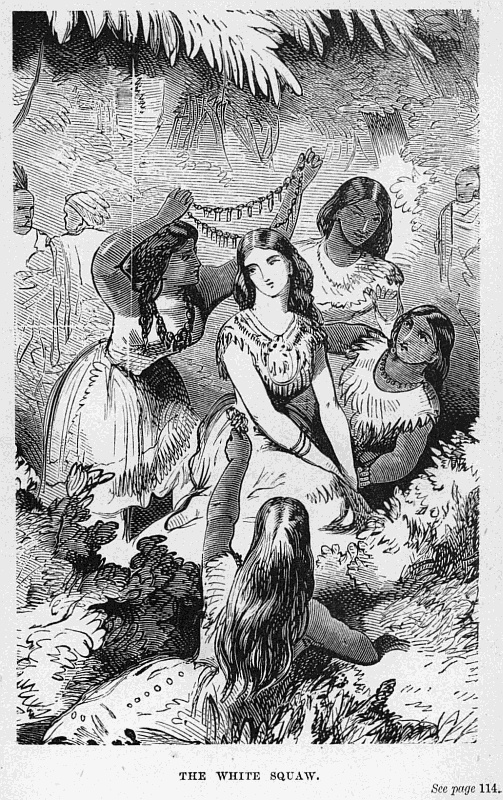
Alice Rody, a prisoner, went along with them.
Wacora, Nelatu, and the rest of the tribe, joined others of their race in the war which was now rapidly spreading over the whole peninsula.
For a time the Seminole tribe led a wandering life.
The varying successes or defeats of the protracted contest entailed upon them both vigilance and activity.
It was, therefore, only occasionally that the cousins were enabled to visit the town in which their people permanently resided.
Sansuta had now seldom any relapses of her fits of violent madness.
She was silent and melancholy, and wandered about wrapped in her own bewildered thoughts.
Alice, although a prisoner, was suffered to come and go as it pleased her.
Nelatu’s love for the pale-faced maiden made no progress.
A wan smile was all the reward the Indian youth received for his patient devotion.
He felt that his passion was hopeless, but still he nursed it.
To Sansuta, Alice indeed proved a guardian angel.
At first the Indian girl repelled the tender solicitude expressed by the white maiden, and with an alarmed look seemed to dread even her voice.
In time, however, won by the magic of kindness, she sought the company of the captive, and in her presence seemed happy.
Often they would stroll away from the town, and in some quiet spot pass hours together—Alice in silent thought, Sansuta in such childish employment as stringing beads, or making baskets with the flowers and tendrils of the wild vine.
A favourite haunt with them both was the old fort.
Amongst its ruins they would seat themselves in silence, each busy with her own thoughts.
And thus was their time tranquilly passed, while war was raging around them.
But the first storm of conflict had been passed, and was succeeded by a temporary calm.
The pale-faces had abandoned the smaller settlements and detached plantations, and in the neighbouring towns awaited the arrival of the Government troops on their way to prosecute the campaign throughout the whole peninsula.
The Indians had sought their respective rendezvous, there to mature plans for a more perfect organisation.
Nelatu and Wacora had returned home, for such was the title Wacora now gave to the place where Oluski’s tribe had their permanent residence.
The exigencies of the contest had compelled the withdrawal of his own warriors from his father’s town, and the two tribes, Oluski and his own, had become fused into one powerful community.
The chief’s views towards his captive had undergone a marked change.
He no longer wished to harm her, and had she demanded from him her liberty, he would have granted it freely.
Of what use is liberty to the homeless?
Alice Rody had become careless of her freedom—nay, in a manner, preferred her captivity to the uncertainty of an unknown future, where no kindred awaited her return, no friend stood expectant to receive her.
A sense of security—almost contentment—had stolen into her heart.
Time had done much to assuage the terrible sorrow from which she had suffered.
It was a wonderful transformation to the once high-spirited girl who had shown such energy and fortitude in the midst of danger.
So thought the young chief, Wacora.
To Nelatu it was a negative happiness. She had not energy to chide his ardent devotion, but submitted to it passively, without bestowing the slightest encouragement.
One lovely afternoon Sansuta, conducted by Alice, strolled to the ruined fort.
Arrived there, Sansuta proceeded to embroider a pouch she had commenced to make.
Alice, seated on a fragment of stone, watched her companion’s trivial employment.
As the Indian girl nestled close to the pale-faced maiden, she seemed on the point of fainting.
She had grown thinner during the last few weeks, and her hollow cheeks were tinted with a hectic flush.
“Rest your head on my lap, Sansuta.”
As Alice spoke, she gently caught the poor girl in her arms.
“I am tired, oh, so tired!” said Sansuta.
“You must not walk so far as this another time. We must seek some place nearer to the town.”
The Indian girl did not appear to heed her, but commenced singing softly to herself.
She paused abruptly in her song, and looked up into her companion’s face.
“Last night I dreamed I was in another land, walking along a footpath. It was strewn with lovely flowers. On both sides were beautiful creeping plants, over which bright butterflies sailed. There were two birds—such birds—their plumage of silver and gold. I heard music. Was it the land of the Great Spirit? Do you think it was?”
“Who knows? it might have been!”
“There I met my father. Not stern as our warriors are, but sad and weeping. Why did he weep?”
Alice was silent. Her own tears hindered her from making answer to the artless question.
“When I saw him weeping, I, too, wept, and kissed him. He spoke kindly to me; but why did he weep?”
Still no answer from her listening companion.
“Then I dreamt—no, I cannot remember what else I dreamt—yet there was some one else there. I seemed to know his face, too; but a great storm arose, and all became dark, and I grew frightened. What was that?”
“Alas! Sansuta, I cannot read my own dreams, far less yours.”
But Sansuta had already forgotten her question, and was again singing softly to herself.
Presently she stopped once more, and putting both arms around Alice’s neck, murmured that she was tired.
The pale-faced maiden kissed her, and, as she did so, the tears from her eyes fell on Sansuta’s cheek.
“Why do you weep? Who has injured you?”
Had Alice framed her thoughts into words she would have answered, the whole world; but, instead, she only replied to her companion with gentle endearments, and, at length, caressed her into a gentle sleep.
It was a beautiful tableaux for a painter to delineate—beautiful—but at the same time sadly impressive.
A young Indian chief, who had been a silent witness to it, must have thought so, by the sigh that escaped him, as he turned his face away.
Wacora was the chief who thus sighed.
Chapter Thirty Four.
Strange Changes.
Wacora’s love for Sansuta had long since changed into pity.
A new feeling now possessed his heart.
A new love had arisen from the ashes of the past:
Alice Rody was the object!
He had at first been struck with admiration at her courage; afterwards he had witnessed her discretion and tenderness, and then noted her beauty.
His thoughts, thus stirred; soon ripened into a passion far stronger than respect.
Pity and love had exchanged places within his bosom.
He and his captive had done the same.
The girl was free; her gaoler had become her prisoner.
This new phase of feeling was not accomplished suddenly.
It grew silently and slowly but surely.
One thought troubled Wacora.
It was Nelatu’s admiration for Alice Rody.
He saw that she cared not for his cousin, but he forebore to urge his suit, out of compassion for Sansuta’s brother.
His love, therefore, was speechless, and his captive was unconscious of it.
But what of her? She, too, had changed.
By one of those marvellous transformations of which the human heart is capable, Alice Rody not only became reconciled to her residence among the Indians, but even found much that interested her, even to the awakening of pleasant thoughts.
Many of the Seminoles were, as has been stated, well educated, and with education had come the usual chastening influence.
This was especially true of the young chief Wacora, and she had not failed to observe it.
Her first reflection was what he might have been had he been brought up amongst her own race, for, although she had not been told of his mother being a white woman, she did not doubt that he had white blood in his veins.
What might not a man of his intelligence, chivalric courage, and purity of thought have become in a society where civilisation would have developed all these mental qualities?
The question was a natural one when viewing only the advantages which high culture presented; but its obverse was unfavourable, when considering that civilisation is often an approach to barbarism through selfishness and rapacity.
She answered the query herself, and favourably for him. This mental questioning once commenced, did not pause, but went on to farther consideration of the character of the young chief.
His thoughtfulness seemed as much sprung from regret at the compulsory warfare he was waging against her race, as the noble enthusiasm with which his soul was filled.
The heart of a woman easily yielded its admiration to an enthusiast!
The motive may be condemned, but the spiritual essence of thought that prompts to action still remains to be admired.
It will then be seen that the first abhorrence had given place to interest; and interest had ripened into—
Into what?
There was no answer to that question. As it came before Alice Rody’s mind she evaded it, and strove calmly to consider Wacora as her captor.
But it soon seemed impossible to look upon him in this light.
No preux chevalier could be more courteous in his bearing—no prince more calmly conscious of his own birthright.
His was of the oldest patent. Whether thinking so or not, he was one of Nature’s noblemen.
A few months had wrought these marvellous changes in the personages of our tale, and upon Wacora’s sudden departure to the scene of war, both he and his captive felt a strange void in their hearts, unaccountable, because novel.
Nelatu, whose hope of winning the regard of the pale-faced maiden had sunk into a calm state of despair, departed with his cousin, hoping that in the field of battle he might find a still calmer rest.
His fate, wrapt in the dark mystery of the future, was veiled from him.
Chapter Thirty Five.
A Peaceful Warning.
The summer had waned into autumn.
With the changing season came also a change over the hapless Indian maiden, Sansuta.
Her weakness, which had been continually increasing, was now so great that she could no longer stray with Alice to their favourite haunts.
The poor girl’s form had wasted away, and her features become shrunken. Her dark, lustrous eyes alone seemed to retain their vitality.
All her former violence had disappeared, and a change had also made itself manifest in her mental condition.
Now and then she had lucid moments of thought, during which she would shed torrents of tears on Alice’s shoulder, only with the return of her malady would she appear happy and at peace.
Towards sunset of a lovely day the two girls sat together at the door of Sansuta’s dwelling.
“See!” said the Indian girl, “the flowers are closing, the birds have gone into the deep forest. I have been expecting some one, but he has not come yet. Do you know who it is?”
“No, I do not.”
“’Tis Warren. Why do you start and tremble? He will not hurt you. Who was it you thought I meant?”
“I cannot tell, dear Sansuta.”
“No one but him—I think of him always, although,” she added lowering her voice to a whisper, “I dare not call his name. I’m afraid to do that. I’m afraid of my brother Nelatu and my cousin Wacora. Why does the sun look so fiery? It is the colour of blood—blood—blood! That red colour, is it on your hands, too? Ah, no! You are no murderer!”
“Hush, Sansuta! you are excited.”
“Ah, yonder sun! Do you know that I feel as if it were the last time I should ever see it set. See, there are dark lines across the sky—ribbed with bands of black clouds. It is the last day—the last day—”
“I see nothing, only the approach of night.”
“But you hear something. Don’t you hear the spirits singing their death march over Oluski’s grave? He was my father—I hear it. It is a summons. It is for me. I must go.”
“Go? Where?”
“Far away. No; it is of no use clasping me to your heart. It is not Sansuta’s body that will leave you—it is her spirit. In the happy hunting grounds I shall meet with him—”
A few moments after she became tranquil; but the lucid interval succeeded, and hot tears coursed down her hollow cheeks.
Again her mind wandered, and for two or three hours, refusing to enter the house, she sate muttering to herself the same fancies.
Alice could but sit beside her and listen. Now and then she sought to soothe her, but in vain.
By and bye Sansuta’s voice grew faint. She seemed to lean heavier on the arm of her pale-faced friend, and the lustre of her eye gradually became dimmer.
The change was alarming, and Alice would have risen and called for help, but an imploring glance from Sansuta prevented her.
“Don’t leave me,” she murmured gently.
Her voice was changed; she had recovered reason, and her companion perceived it.
“Do not leave me. I shall not detain you long. I know you now—have known you it seems for years. I know all, for there is peace in my heart towards all, even to those who took his life. Forgiveness has come back with reason, and my last prayers shall be that they who made Sansuta unhappy may be forgiven!”
She spoke in so low a voice that it was with difficulty her companion could hear what she said.
“Kiss me, Alice Rody! Speak to me! Let me hear you say that Sansuta was your friend!”
“Was—is my friend!”
“No—let me say was, for I am about to leave you. The time is come; I am ready! My last prayer is ‘Pity and forgiveness! Pity and—’”
By the gentle motion of her lips she appeared to be praying.
That motion ceased, and with it her unhappy life!
Alice still continued to hold her in her arms long after her soul had passed into Eternity!
Chapter Thirty Six.
The Burnt Shanty.
The ghost of Crookleg did not in any way disturb Cris Carrol, either sleeping or awake.
The worthy backwoodsman believed that he had done a highly meritorious action in for ever disposing of that malevolent individual.
“The infernal black skunk, to be cuttin’ his capers over the bodies of brave men who had laid down their lives in a war he, and sich as he, brought about! It were no more nor an act of justice to send him to everlastin’ perdition, and, if I never done a more valuable thing to society than stickin’ three inches of cold steel atween his two shoulder-blades, I think I desarves the thanks of the hul community.”
This consolation Cris indulged in whenever he thought of that terrible episode upon Tampa hill.
He had returned a few days after the massacre and had found the dead decently buried.
Wacora had commanded it to be done.
The charred ruins of Rody’s house, however, recalled the memory of that eventful night.
For some time after his last visit to Tampa Bay, Cris Carrol had not been seen.
Neither the pale-faces nor the redskins had been able to discover his whereabouts.
The truth is, that the backwoodsman was glad to get away from scenes where so much violence had been done to his feelings.
As he had said, he couldn’t fight against the Indians, and he wouldn’t take up arms against the whites.
“It ain’t in human nature to shoot and stab one’s own sort, even when they’re in the wrong, unless they’d done somethin’ agin oneself; an’ that they hain’t done as regards me. I’ll be eternally dog-goned if I think the red-skins are to blame for rising agin oppression and tyranny, which is what old Rody did to them, to say nothin’ agin him now he’s dead, but to speak the truth, and that’s bad enough for him. No, they war not to blame for what they did, arter his conduct to them—the old cuss; who, bad as he war, had one redeemin’ feature in his karactur, and that war his angeliferous darter. Where kin she have gone a hidin’? Thet puzzles this chile, it do.”
Cris was unaware of Alice’s capture and imprisonment.
As suddenly as he had taken his departure from Tampa, Cris returned to the same neighbourhood. He expected the war to be transferred to a more distant point, and wished still to keep out of the way.
“It’s the durned’st fightin’ I ever heard on,” said he to himself; “first it’s here, then it’s there, and then it ain’t nowhere, till it breaks out all over again, where it was before, and they’re as far off the end as I am from Greenland. Durn it, I never knowed nothin’ like it.”
On his return to Tampa, he found the country around altogether deserted. Most of the buildings and the planter’s house had been destroyed, even his own wretched hut had been burnt to the ground.
“This is what they call the fortun’ of war, I ’spose?” he remarked, as he stood gazing at the ruins. “Wal, it war a ramshackle, crazy ole shanty anyhow, and I allers despised four walls an’ a roof at the best o’ times—still it war ‘home.’ Pshaw!” he added, after a moment’s silence, “what have I to grow molloncholly about, over sich a place as this—calling it ‘home,’ when I still have the Savannas to hunt over an’ sleep upon. If thar’s such a place as home for me that’s it, and no other.”
For all his stoicism, the old hunter sighed as he turned from the blackened spot which marked the site of his former dwelling.
He paused at the bend of the road, where Crookleg had first met Nelatu, to gaze again at his ruined home. Not only paused, but sat down upon the self-same rail that the negro had perched upon, and from gazing upon it, fell to reflecting.
So absorbed was he in his contemplation, that contrary to his usual custom, he took no note of the time, nor once removed his eyes from the subject of his thoughts.
He did not perceive the approach of a danger.
It came in the form of four individuals who had silently and stealthily crept close to the spot where he was sitting. Before he knew of their proximity, he was their prisoner.
“Red-skins!” he exclaimed, struggling to free himself.
His captors smiled grimly at his vain efforts.
“By the eternal! I’m fixed this time! Darn my stupid carcase for not havin’ eyes set in the back o’ my head. Wal, you may grin, old copper-skins, it’s your turn now—maybe, it’ll be mine next. What are you a-doin’ now?”
Without deigning a reply the Indians bound his arms securely behind him.
That done they made signs to him to follow them.
“Wal, gentlemen!” said Cris, “yur about as silent a party as a man might wish to meet, darn me, if you aint. I’m comin’.”
“Much obleeged to you for your escort, which I ked a done without. Thanks to your red-skin perliteness for nothin’. Go ahead, I kin walk without your helpin’ me. Where are ye bound for?”
“To the chief,” answered one of the men.
“The chief! What chief?”
“Wacora.”
Cris uttered an emphatic oath.
“Wacora, eh? If that’s the case, I reckon the days o’ Cris Carrol air drawin’ to a close. The fiercest and most ’vengeful cuss of them all, I’ve heard say. Lead on, I’ll go along with ye willin, but not cheerful. If they kill me like a man I’ll not tremble in a jint; but if it’s the torture—there, go ahead. Don’t keep the party waitin’.”
Brave heart, as he was, he followed them with as bold and free a step to what he believed to be his death, as if alone, and at liberty on the Savanna.
The Indians without exchanging a word, either among themselves or with him, proceeded in the direction of Oluski’s town.
Chapter Thirty Seven.
Death at the Stake.
At night they encamped in the forest.
Lighting no fires, lest the light might betray them to their enemies, they produced from their packs some dried meat and meal cake.
Cris did full justice to the humble fare, although he made rather a wry face at the gourd of spring water with which he was invited by his captors to wash down the frugal repast.
Mastering his aversion, he, however, managed to swallow a few mouthfuls.
Supper over, two of his captors wrapped themselves up in their blankets, and immediately fell asleep. The other two remained awake, watching him.
Carrol saw that any attempt to escape under the eyes of two Indians would be idle.
One he might have coped with, even unarmed as he was. Two would be more than a match for him, and he knew that on the slightest alarm the sleeping men would awake, making it four to one.
With the philosophy of a stoic he threw himself upon the ground, and also fell asleep.
He awoke once in the night to find that his guard had been changed. There was no better prospect of freedom than before.
“Dura them! they’re bound to fix me, I kin see that plain enough. Besides, with these ’tarnal all-fired thongs cuttin’ into my elbows, what could I do?”
Apparently nothing, for with a muttered curse at his own stupidity, he again composed himself to slumber.
With the dawn of morning Cris Carrol and his captors continued their journey.
They made no other halt before reaching the town.
Carrol in vain tried to draw from them the reason of their unexpected presence at so great a distance from the residence of the tribe.
They gave him no satisfaction.
He discovered, however, that whatever errand they had been sent on, they had failed in accomplishing it, and his own capture began to be considered by him as a peace offering with which they intended to mollify Wacora’s wrath at their want of success in the mission with which they had been charged.
“Wal,” reflected he, “I suppose I’m in some poor devil’s place; perhaps I mout take more pleasure in doing him this good turn if I only knowed who he is. No doubt he’s got some folks as ’ud grieve over him, but there ain’t a many as will fret over Cris Carrol, not as I know on—yes, all right! go ahead. Let’s go whar glory waits us, ye catawampous scamps, you. Ah! four to one; if it had been two to one, or, at a pinch, three to one, I’d have tried it on, if it had cost me all I’ve got, and that’s my life—yah! it’s almost enough to make one turn storekeeper to think on’t.”
Unmoved by the taunts and jeers which Cris liberally bestowed upon them during the journey, the Indians continued to watch him narrowly.
It was about mid-day when they arrived at their destination.
On entering the Indian town Carrol was thrust into one of the houses, where he was left to await the order of Wacora as to his final disposition. Four guards were kept over him, two inside the house, the other two without.
He expected immediate death, but he was left undisturbed for the rest of the day, and at night received some supper, consisting of dried meat, bread, and water. He was then permitted to pass the hours till morning as seemed best to him.
The hunter soon arranged his plans. He wrapped the blanket that had been given him around his body, and in a few moments was in a sound slumber.
His sleep lasted until a hand upon his shoulder, along with a summons to awake, aroused him.
It was one of his guards of yesterday who addressed him.
“Come!”
“Is that you, old Dummy?” asked he, recognising the Indian. “I can’t say I’m glad to see yur, since yur’ve broke in on the pleasantest dream I’ve had for a long time. But never mind, how shed you know that you whar a doing it, you poor savage critter you, that don’t know nothin’ but to handle a tomahawk, and raise the hair off a human head? What do you want with me now?”
“The warriors are assembled!”
“Air they? Wal, that’s kind of them, only they needn’t have put themselves out o’ the way to get up so early on my account; I could ha’ waited.”
“Come.”
“Wal, I’m comin’; d’ye think I’m afraid, durn yur? D’ye think I’m afraid of you or all the warriors of your tribe, or of your chief, Wacora, either?”
“Wacora is not here.”
“Not here! Where is he?”
“I cannot answer the pale-face’s questions. I came to bring you before the council.”
“Wal, I’m ready to go afore the council.”
As they were about to emerge from the house, a sudden idea seemed to strike Carrol, and he stopped his conductors.
“Stay, friend, will you tell me one thing?”
“Speak!”
“Whar are we?”
“At Oluski’s town.”
Carrol’s face beamed with a sudden joy.
“And his son Nelatu—is this his home?”
“It is.”
“Hurray! Now, I dare say you wonder at my bein’ struck all of a heap wi’ delight. But I’ll tell you one thing, red-skin—no offence, not knowin’ your name—you and yur three partners have taken a most uncommon sight o’ trouble all for nothin’.”
“What do you mean?”
“Just this—go and tell Nelatu that Cris Carrol is the party as you sneaked up to and took prisoner, and arter that, streak it for your precious lives.”
“Nelatu?”
“Yes, Nelatu, he’s a friend o’ this ole coon, and one that’ll prove himself so, too, in givin’ you skunks as took me a deal more nor you bargained for.”
“Nelatu is not here.”
“Not here? Why, didn’t you tell me just now that this war his father’s town?”
“I did; but Nelatu is not here.”
“Not now, perhaps; but I s’pose he’ll be here?”
“He will not return for weeks.”
Carrol’s countenance fell.
“Then, dog-gone yur skin, lead on! I throw up the pack of cards now that the trump’s out of ’em. It’s my luck, and it’s the darndest luck I ever seed; there’s no standin’ agin it. I s’pose I must give in.”
Without another word he followed his guards.
They entered the council chamber, where the assembled warriors awaited them.
With his foot upon the threshold, his manner entirely changed from the light, jeering hilarity he had exhibited to that of a calm and dignified bearing.
He saw in an instant that he was foredoomed.
The stern expression of his judges told him as much.
The mock ceremonial of examination was proceeded with, and a vain attempt made to extract from him intelligence of the movements of the whites, especially of the numbers and disposition of the Government troops, some of whom had by this time arrived in the peninsula.
His disdainful refusal to betray his own race did him no service.
True, he was already sentenced to die, but the manner of his death might inflict horror on him who had no fear of dying.
Though the questions were skilfully put to him, the old hunter saw through them all.
He did not, indeed, possess much knowledge of the military invasion; but had he been in the secret of the commanding officer himself, he could not have been more reticent in his replies.
Utterly foiled in their questions, the warriors played their last card, and with threats of the most terrible tortures endeavoured to wring from his fears what his honour would not reveal.
Vain effort on their part.
Cris did, indeed, wince when they first spoke of torture; but, recovering himself, he became more proudly defiant than before.
“Ye may shake my old body with rackin’ pains. I know you’ve got devil’s inventions, and I don’t deny but they’re awful; but there’s somethin’ about me that ye can’t make tremble, not if all the imps o’ hell war yer slaves—that’s my soul. It’ll come out of yer fiery ordeal as calm as it is now; and with its last thoughts it’ll despise and dare ye! Cris Carrol arn’t bin backwoods hunter for a matter goin’ on forty year to be skeart at burnin’ sticks or hot lead; and he’ll die as he has lived, an honest man!”
A mingled murmur of admiration and anger ran through the assembled crowd, and it was evident that many of the warriors would have given their consent to his being set free.
There is something about TRUE courage which extorts admiration even from an enemy.
A hurried consultation took place among the head men in council.
It was speedily over, and the oldest of their number rose and pronounced sentence against the prisoner.
It was death by burning at the stake!
Cris Carrol was not surprised on hearing it.
The sentence had already lost half of its terror. He had made up his mind that this would be his doom.
Only one word of response came from his lips—
“When?”
“To-morrow!” replied he who had pronounced judgment.
Without bestowing a glance upon those who had thus fixed the limit of his earthly career, the hunter strode from the council chamber with calm and measured steps.
As he passed out the crowd made way for him, and many of the faces expressed admiration—some even pity.
The stoic bravery of the Indian is marvellous, and for him death has no terrors. With them it is a sort of fatalism.
What they do not dread themselves, they make but light of in others.
Por all that they have the highest admiration for a man who dares meet death calmly.
In their eyes the white captive had assumed all the importance of a great warrior.
Yet was he an enemy—one of the race with whom they were at war—therefore he must die.
Thus strangely do civilisation and barbarism meet on common ground.
Chapter Thirty Eight.
The Sleeping Draught.
Cris Carrol’s fortitude did not desert him, when he once more found himself alone in his prison.
He was not wholly unmoved by the reflection that on the morrow he must die; for it was a death such as even a brave man might not meet bravely, but a lingering death by torture.
The hunter knew what this meant.
“A bullet ain’t nothin’,” said he to himself, “it’s into yer body afore ye knows it, and if it’s in your vitals there’s an end on it; but to stand up to be prodded with burning sticks, requires philosophy a’most as much as this hyar chile have got. Dog-rot it, it won’t bear thinkin’ on—that it won’t. But I’ll be all-fired eternally if them fellows shall know how it hurts Cris Carrol! So let ’em do their worst, dura ’em!”
After this self-consoling soliloquy, he calmly went to work to make himself comfortable, by laying his blanket on the bare ground and improvising a pillow out of some logs that lay within reach.
As he handled the billets, a strange desire seized him. It was to knock his guard’s brains out and make a dash for liberty. But a moment’s reflection convinced him that the attempt at escape would be futile, the men outside being doubtless prepared to oppose his exit.
A disinclination to shed blood uselessly decided him, and he lay down composedly after lighting his pipe.
For some time he ruminated on his condition, puffing curls of smoke into the air, and watching them as they disappeared.
Once or twice he heard a scratching noise near the corner of the room, but it ceased almost as soon as he had noticed it.
At length, giving way to weariness, he composed himself to sleep, and before long, his loud snoring suggested to his guards that they might relax their vigilance.
They accordingly retired outside the door, after having assured themselves that his slumber was genuine.
There were still four of them, and they began chattering to each other, for a time forgetting their prisoner.
He was at length awakened by a gentle tug at his arm, which had to be repeated several times before it had the effect of arousing him.
In an instant he sat up.
“Eh? what? By the etarnal—”
An admonition of silence checked him, and he surveyed, with an astonished countenance, the cause of his disturbance.
In the darkest corner of the hut he perceived an opening, through which the face of a young girl was visible. He started on recognising her.
“Hush!” she said in a whisper. “Remember you are watched. Lie down again—listen; but say nothing. Ha! they are coming back!”
At these words the speaker withdrew, just in time, as two of the guards next moment re-entered the room.
They did not stay long. The heavy snoring which Cris improvised for them disarmed them of suspicion.
The moment they were again gone, he turned his eyes towards the opening, and listened.
“Do you know me?—answer by a sign.”
Cris nodded in the affirmative.
“You believe I am desirous to serve you?”
To this question he almost nodded his head off.
“Listen, then; and be careful to obey my instructions. This opening leads into the next house. The exit from it is through another—unfortunately it is a public room; therefore you cannot escape that way without as much risk as you would by going directly out by the door. Don’t go that way, but by the window. You see that window?”
Cris looked up. He had seen the window, certainly, and had already looked at it in every possible light, while considering a means of escape, but had come to the conclusion that it wouldn’t suit.
In reply, he shook his head despairingly.
His visitor seemed to understand him.
“It is too high, perhaps?”
Cris intimated by a sign that the difficulty was not in its height.
“The bars would prevent you getting out?”
The hunter’s head nodded like a mandarin’s.
“Is that all? Then I may as well tell you. Hush! some one is coming.”
One of the sentinels had thrust his head inside the door; he luckily withdrew it, convinced that all was right.
On its disappearance Carrol’s mysterious visitor returned, and resumed the conversation.
“You think those bars would hinder your escape?”
Another nod was the answer.
“You are mistaken.”
The backwoodsman, now perfectly au fait with his pantomimic part of the dialogue, gave a modest but expressive look of dissent.
“I tell you you are mistaken,” continued the young girl, “they are all sawn through. I see you are curious to know who did that?”
Cris said “yes,” without speaking a word.
“It was I!”
“You?” he telegraphed.
“Yes; I was once a close prisoner in this very room—not watched as you are, but still a prisoner. I broke a watch to pieces, took out the mainspring, filed a saw with the nail-cleaning blade of a pen-knife, and with that I sawed away the bars, leaving barely enough to hold them together.”
Carrol’s look expressed astonishment.
“Yes; it was hard work, and it took weeks to accomplish it. I dare say you wonder why I didn’t make my escape. That’s too long a story to tell you now.”
The backwoodsman’s look was very eloquent, and his visitor equally quick of comprehension. By that look he asked a question.
“No; I’m not a prisoner now,” she answered, “only in name. You shall have the benefit of my labours. But you must do everything cautiously. And first, to get rid of your guards.”
“How was that to be done?”
It was the captive who asked himself this question.
“Here is a bottle,” continued she; “it contains a sleeping draught. When they return, ask them for a drink; they will give it to you in a gourd; manage to pour the contents of this bottle into the gourd, and invite them to drink along with you. They will do so, as they never refuse a condemned captive. In a few minutes the draught will take effect. Then climb to the window, remove the bars without noise, let yourself down softly, and make your way straight into the forest. No thanks, till I see you again!”
With these words his visitor vanished, the opening in the wall closed noiselessly, and Cris lay wondering whether he had been sleeping or waking, listening to a soft, delicate voice, or only dreaming that he heard it.
The phial in his hand, however, gave token that he had not been dreaming. His visitor was no creature of another world, but one of this mundane sphere.
The hunter scratched his head with bewilderment, and mentally reviewed the situation.
“Wal, of all the surprisingest things as ever I met, this air the most tremenjous. Bite me to death with gallinippers if ever I thought to have seed sich a thing and not yell right out! And me a lyin’ here when that splendiferous critter war a botherin’ her brain to sarve this old sinner! It’s the most etarnal ’stonishing thing ever heerd on—that’s what it is. Yah! so you’re come agin, air ye?” he continued, as two of his guards re-entered. “Wal, I reckon I’ve got somethin’ as ’ill suit your complaint. Come in, ye devils, you!”
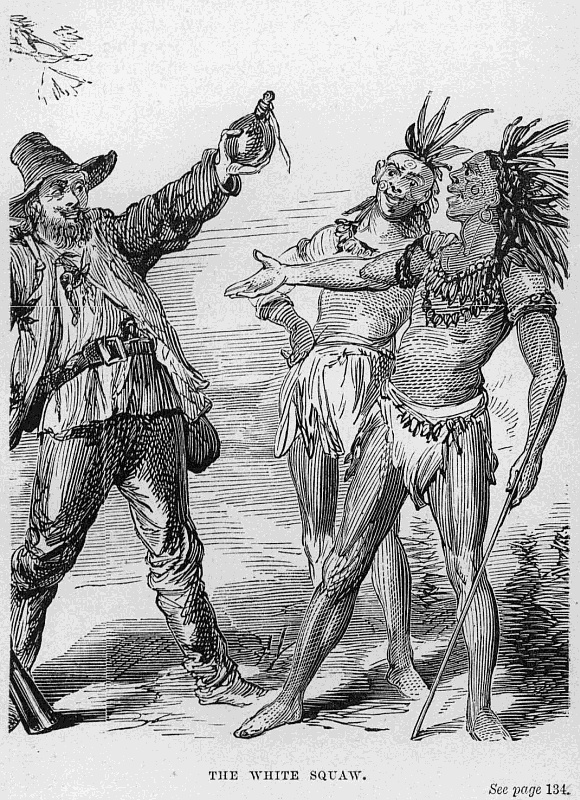
The unconscious objects of his apostrophe having entered the room, seated themselves not far from him, chattering with each other. The subject of the conversation was uninteresting to their prisoner, who lay revolving in his mind what was best to be done.
The time for putting his plan into execution had at length arrived.
His sentinels had ceased conversing, and were with difficulty keeping themselves awake.
“Look hyar, red-skins,” he said, addressing them, “have ye sich a thing as a drop of water? I’m most chokin’ wi’ thirst, and I see its no use waiting till you axes me, so I’ll take the trouble off your hands, and axe you.”
One of the Indians good-naturedly went outside, returning with a gourd, which he handed to the prisoner.
Cris raised it to his lips, and drank; then paused, as if for breath.
“By the etarnal!” said he, “if I didn’t think I seed one of your comrades put his head in that thar door. What kin he want?”
The men looked in the direction of the door.
The contents of the phial were poured into the gourd.
When the Indians looked again at their captive, he was apparently enjoying another long draught of water.
Not a drop, however, passed his lips.
“Ah!” he exclaimed, after his seemingly exhausting imbibation, and with the greatest difficulty suppressing a grimace, “there’s nothing like water to refresh one. It a’most gives a dyin’ man new lease o’ his life. I wonder I never tried it afore. There’s a smack o’ freedom about it that’s worth its weight in gold. Try it yourselves, and don’t stand staring, as if you was agoin’ to swallow me.”
The comical expression of their captive’s face, more than the long speech he made to the two men, induced them to oblige him.
Putting their lips to the gourd, each took a draught of the water.
They did not seem to coincide with him in his opinion of its virtues.
The old hunter laughed in his sleeve on perceiving their wry faces.
“Don’t like it, eh? Wal, you don’t know what’s good for ye. Poor benighted critters! how should ye?”
As he made the remark he fell back upon his log bolster, and again seemed to compose himself to sleep.
If the Indians had been somnolent before drinking the water, they were not rendered more wakeful by the indulgence, and it was almost ludicrous to see what useless efforts they made to battle against the potent narcotic.
In vain they talked to each other, got up, and paced the room, and endeavoured to stand up without leaning up against the wall.
This struggle between sleep and watchfulness at length came to a close.
In less than ten minutes after taking the draught, both lay stretched along the floor in a deep death-like slumber.
The backwoodsman lost no more time.
With an agile motion, he planted his feet in the interstices of the logs, and reached the window.
A slight wrenching of the bars showed the skill with which they had been sawn asunder.
One after another gave way, and the whole framework was in his hands.
He was on the point of dropping it gently, when outside, under the window, a human form appeared.
It was that of an Indian!
Chapter Thirty Nine.
An Old Acquaintance.
On seeing the Indian, Cris Carrol felt himself in a dilemma.
But he did not pause long before taking action.
He saw that the man was not watching him, but seemed to have his eyes fixed upon the windows of the adjoining habitation.
Quietly pulling in the iron framework which was beginning to feel heavy, Cris deposited it without noise in the interior of the room and again clambered up to the window. Before doing so, however, he stole his knife from one of the sleeping sentinels.
The Indian outside had still maintained his attitude.
When Cris looked forth again, he saw him with his eyes fixed on the same spot.
What was to be done?
The only thing that suggested itself to the hunter was precisely what he did do.
He crept through the window.
So quietly, that ere the individual below was aware of his presence, he had seized him by the throat and forced him to the ground.
A surprise awaited him when he had accomplished this feat. The Indian’s face was revealed, and, to Carrol’s surprise, no less than his joy, for not having plunged the knife into his heart, he recognised it.
“Nelatu!”
“Carrol!”
“Hush! or you’ll alarm all the red-skins about the place.”
“What are you doing here?”
“I’ve just dropped out o’ that thar window,” he paid, pointing to the opening above.
“How came you to go in there?”
“I didn’t go in of my own will, you may bet high on that. I war brung.”
“Who brought you?”
“Some o’ yur own Injuns.”
“A prisoner?”
“That’s about the size o’ it. I shouldn’t have been one much longer.”
“What do you mean?”
“Why, that to-morrow I’d have been as dead as a man could be, with forty or fifty fellows playing blue-blazes on his carcase.”
“Ha! they have decreed on burning you?”
“That’s it, lad, and consarn me if I ain’t glad to be out hyar in the open air a tellin’ it you, ’stead of in there a thinkin’ on it.”
“Who condemned you?”
“Wal, names hev a kind o’ slipped my memory, but they wur warriors and braves of yur enlightened community.”
“Why did you not send for me?”
“I thought of that, but they told me you war gone, and wouldn’t be back in time for the ceremony.”
“How did you get out here? Who opened the window?”
“That war done by a angel.”
“An angel?—what do you mean?”
“Jist this; that at one of the corners of that thar eternal hole, a angel appeared and showed me the road to liberty.”
“Who was it?”
“Wal, it air no use keepin’ it from you—”
“Speak! who was it?”
“I’ll tell you, but first listen a spell to somethin’ else. Nelatu, lad, I once did you a sarvice.”
“You did! I shall never forget it!”
“Durn it, it warn’t for that I made mention on’t. It war only this—look me in the face, and tell me on the word of a man you mean square with me. Do that an’ I’ll put my trust in ye, as I’m now puttin’ my life in your hands.”
“Upon an Indian warrior’s word, I am your friend!”
“You air, Nelatu? Then dog-gorn me if I doubt you. Your hand!”
They exchanged a friendly grasp.
“It is more nor my life—it am the good name and actions of the most splendiferous, angeliferous critter the sun ever set eyes on! It air—”
“Alice Rody!”
The hunter showed some surprise as Nelatu uttered the name.
“Yes, it war that same gal; but how on airth did you come for to guess it so straight?”
“Because that one name is never absent from my thoughts.”
The hunter uttered a strange exclamation.
“Ho-ho!” he muttered to himself, “the wind sits in that quarter, do it? Poor lad, I’m fear’d thar ain’t no chance for him.”
“I fear it,” said Nelatu, overhearing the muttered remark; “but, come!—what she has commenced, I will accomplish. At all risks I shall assist you in regaining your liberty.”
“Wal, I’ll be glad to get it.”
“Then, follow me!”
The Indian rapidly crossed the open space at the back of the house, and led the way to the edge of the forest.
The released captive strode silently after.
They paused under a grove of live oaks, in the shadow of which Carrol perceived a horse.
“It is yours,” said Nelatu, “follow the straight path, and you are free.”
“Nelatu,” said the backwoodsman, “you’ve done me a great sarvice. I’m goin’ to give you a bit of advice in return for it—”
“Give up the angeliferous critter that’s your prisoner; send her back to her own people, and forget her!”
“If I could forget her, you mean?”
“Wal, I don’t know much myself about them thar things; only my advice is—Give her up! You’ll be a deal happier,” he added, suddenly waxing impassioned. “That ere gal am as much above either you or me, or the likes of us, as the genooine angels air above all mortals. Therefor’ give her up, lad—give her up!”
Again pressing Nelatu’s hand in his, the old hunter climbed into the saddle, gave a kick to the horse, and rode off a free man.
“Kim up, ye Seminole critter!” said he to the animal he bestrode, “an’ take me once more to the open savannas; for, durn me! if this world arn’t gettin’ mixed up so, thet it’s hard for a poor ignorant feller like me to know whether them that call ’emselves civilised air more to be thought on than them air savages, or wisey wersey.”
The question was one that has puzzled clearer brains than those of Cris Carrol.
Chapter Forty.
The Tale of an Indian Chief.
As the old hunter has ridden out of our sight for ever, let us return to the Indian town, where Alice Rody was so strangely domiciled.
Her people had buried the ill-fated Sansuta near the old fort.
The wild flowers she had loved so well had already blossomed over her grave.
Wacora and Nelatu had both been present—both much affected.
The events of the contest had called them away immediately afterwards. Wacora remained absent, but his cousin had made a stolen visit to the town, as shown by the incidents already related.
The search for the escaped captive was carried on for some time with vigour, but was at length abandoned.
Meanwhile, the other captive’s life passed without incident. The aid she had given the backwoodsman had afforded her the greatest pleasure.
She had been informed of his capture immediately after his condemnation, and was resolved to help him in his escape.
She did not know of Nelatu’s presence near the scene, nor of his well-timed assistance.
The Indian youth had ridden many miles that evening, merely to stand and gaze at her window.
To feel that he was near her seemed a happiness to him.
He departed without even seeing her.
Weeks had elapsed since the Indian maiden had been laid to rest within the old fort.
Alice often visited the spot.
And there Wacora, who had once, more returned to the town again, saw her.
She was resting on the same stone where Sansuta’s head had rested on her bosom.
On perceiving the chief’s approach she rose to her feet, as if to quit the spot.
“Does my coming drive you away?” he asked.
“Not that; but it is growing late, and I must return to my prison.”
“Your prison?”
“Is it not my prison?”
“It is no more your prison than you are a prisoner. You have long been free.”
There was a mournful sadness in Alice Rody’s speech which touched the heart of the Indian chief.
“Freedom is a boon only to those who can enjoy it,” she said, after a pause.
“And are you unhappy?” asked Wacora.
“Can you ask that question?—you who have done so much—” She paused; her generous nature hesitated to inflict pain.
He concluded her speech for her.
“I have done so much to make you unhappy. You are right. I have been an instrument in the hands of Fate, and you owe your misery to me. But I am only an instrument, not the original cause. My will had no voice in my actions, and but one motive prompted me. That was Duty.”
“Duty?” she asked, a smile curling her lip.
“Yes, duty! I could prove it to you had you the desire to hear me.”
She resumed her seat, and said, quietly—
“I will hear you.”
“There was an Indian chief, the son of a Spanish woman. His father was a Seminole. Both are dead. He was reared amongst his father’s people, and learned from them all that Indian youths are taught. Schools then existed amongst the Seminoles. The white missionaries had established them, and were still at their heads. They had both the ability and the desire to teach. From them Wacora learned all that the pale-faced children are taught. His mind was of his mother’s race; his heart inclined to that of his father.”
“But why this difference?” she asked.
“Because the more he knew the more was he convinced of the cruel oppression that had been suffered in all ages. History was a tissue of it. Geography marked its progress. Education only proved that civilisation was spread at the expense of honour and of right. This is what the schools taught him.”
“That is but one side of the question.”
“You are right, so he resolved to make himself familiar with the other. The story of the past might be applicable to the events of the present. Believing this, he left the schools, and sought the savannah and the forest. What did he find there? Nothing but the repetition of the past he had read of in books, aggravated by the lawlessness and rapacity of the present. The red man was ignorant. But did the pale-faces seek to educate him? No! They sought and still seek to keep him ignorant, because, in his ignorance, lies their advantage.”
“Was that all the fault of our race?” Alice asked, as she noticed the enthusiastic flush upon the speaker’s face.
“Not all. That were to argue falsely. The red man’s vices grew greater as the chances of correcting them were denied him. His instinct prompted him to retaliation, for by this he sought to check oppression. ’Twas a vain effort. He found it so; and was forced to practise cruelty. So the quarrel progressed till to-day the Indian warrior sees in every white man only an enemy.”
“But now? Surely you are not so?”
“I am the Indian chief I have attempted to describe. Take that for your answer.”
The young girl was silent.
“If my heart bleeds for suffering, it is my mother’s nature pleading within me. I check it, because it would be unworthy of a warrior, and the leader of warriors. The storm has arisen—I am carried along with it!”
As he uttered the last words his form seemed to dilate, while his listener stood wondering at it spell-bound.
After a pause, he continued in a tone more subdued, but still full of feeling.
“If I have caused you unhappiness, think of me as the involuntary instrument. My uncle was beloved by all his tribe—by all our race. His injuries were ours; it was ours to avenge them. And for her”—his voice trembled as he pointed to Sansuta’s grave—“she was his only hope and joy upon earth.”
Alice Rody’s tears fell in torrents over the last resting-place of the Indian maiden. Wacora observed them, and, with a delicacy of feeling, was about to withdraw from her presence, when she stayed him with a motion of her hand.
For some time neither uttered a word. Alice at length spoke, through sobs which she vainly strove to check or conceal.
“Forgive me,” said she, “for I have done you a great wrong. Much that was dark and terrible appears now just and natural. I cannot say that I am happier, but I am less troubled than before.”
He would have kissed her hand, but, with a slight shudder, she drew back.
“No, no; do not touch me! Leave me to myself. I shall be more composed by-and-bye.”
He obeyed, without saying a word; leaving her alone.
For a long time she sat in the same place, a prey to thoughts she scarce understood.
At length she rose, to all appearance more composed, and retracing the forest path with slow, sad steps, she re-entered the Indian town.
Chapter Forty One.
A Treacherous Bridge.
There was one among the Indians who viewed their fair captive with no great favour.
It was Maracota.
His devotion to Oluski had been so blindly true that, in his narrow-minded memory of the old chief’s wrongs, he had become bloodthirsty and remorseless. Naturally of a revengeful disposition, he saw, in the leniency of both Wacora and Nelatu towards the pale-faced maiden, too much of forgiveness.
This stirred his evil passions to their depth, and he sought for an opportunity to do her an injury.
With a shrewd guess at the truth, he looked upon Cris Carrol’s escape as another evidence of that toleration which ill consorted with his sanguinary hatred of the white race.
He dared not take open measures, but insidiously strove to turn the people of the tribe against their white captive, as well as Wacora.
His success was not commensurate with his wishes. They admired their chief too much to believe anything to his prejudice, and Maracota became himself looked upon as a restless agitator—a subject more zealous than loyal.
He saw, accordingly, that any injury to the captive must be accomplished by his own agency; the more so, as he had already endeavoured to excite a feeling of jealousy in Nelatu’s mind, of which she and Wacora were the objects. The generous youth not only refused belief, but angrily reproved the slanderer, for daring to couple his cousin’s name with an act so unworthy!
When a person resolves upon mischief it is astonishing how many opportunities present themselves.
Alice, although unsuspicious of the enmity of which she was the object, avoided Maracota. She did so from a different motive. She knew that it was he who had fired the fatal shot at her brother, and could not help regarding the act with abhorrence. His sister, how could she?
And, as his sister, how could she look upon his executioner without repugnance—more than repugnance—with horror?
The exigencies of the war had kept Maracota away from the town, and for long periods; but the same causes that brought Wacora back, also controlled his return.
He felt that now, if ever, was the time to carry out his schemes of malignity.
He accordingly watched her every movement; amongst others, the many lonely visits she paid to the ruined fort.
There was the opportunity he wanted, if he could only find the means to avail himself of it.
In a community of red men, where everything is reduced, even in times of a temporary peace, to dull routine, it was not difficult to devise a plan of revenge. But it must be unnoticed, or go unpunished, for he had a wholesome dread of Wacora’s displeasure, and was not disposed to incur it.
Some days had elapsed since the interview described between the chief and his captive, during which time they had seen nothing of each other.
Wacora, with great delicacy, had avoided her, and she had kept herself within the dwelling assigned to her, afraid to meet him, yet pondering deeply over what he had said.
In spite of a natural prejudice against the Indian race, she was startled and wonder-stricken at the nobility of thought and rare talent he had exhibited. She did not doubt but that a portion, at least, of his argument was based on false reasoning, but she was not subtle enough, or perhaps indisposed, to detect the erroneous argument. We are very apt to acknowledge the truth of what we admire, whilst admitting its errors.
Alice Rody was in this predicament.
She had learned to respect the Indian chief, and her respect was tinged with admiration of his good qualities.
This mental ratiocination had occupied her during the days of her seclusion.
She endeavoured to divert her mind to other subjects, and to this end determined to pay another visit to the old fort. She was prompted to it by a thought of having too long forgotten the Indian maiden who slept within the ruins.
It was a glorious morning as she set forth for a walk to the place.
The way was through a belt of timbered land leading to a creek, spanned by a rude wooden bridge. On the other side lay the ruin.
The wood was passed in safety, and she reached the water’s edge. To her amazement she found the creek greatly swollen; this often happened after heavy rains, though she had never before seen it in that condition.
She proceeded along the causeway leading to the bridge, that seemed to offer a safe means of crossing.
She paused to contemplate the current, bearing upon its bosom the torn trunks of trees caught in its rapid course.
In another moment she was upon the bridge, and had got midway over it, when a tremulous motion of the planks caused her to hesitate. As she stood still the motion ceased, and smiling at her fears she again proceeded.
Not far, however. Ere she had made three steps forward, to her horror the motion re-commenced with greater violence.
She saw it was too late to retreat, and sped onward, the planks swaying fearfully towards the water.
Believing it best to proceed, she took courage for a fresh effort, and kept on towards the other side. It was a fatal resolution.
Just as she had prepared for her last spring the planks gave way with a creaking sound, and she was precipitated into the stream.
Her presence of mind was gone, and in an instant she was submerged beneath the seething current of the flood.
She rose again, gave utterance to a shriek, and was again swallowed up, her wail of agony being uttered in the water.
At that moment a face that expressed fiendish delight appeared through the bushes, on the bank; nor did it vanish until assured that all was over, and Alice Rody had sunk below the surface, never more to return to it alive.
Then, and not till then, the form emerged from out the underwood, and scrambling to the rude pier from which the planks had parted, stood surveying the scene.
It was Maracota!
“Good!” cried he. “So perish all who would make the red man forgive the injuries of his race. She was the child of a villain—the sister of a fiend!”
He stooped down and examined the broken fragments of the bridge.
“Maracota’s axe has done the deed well,” said he, continuing his soliloquy, “and he has nothing to fear. Her death will be attributed to accident. It was a great thought, and one that Oluski’s spirit will approve. Maracota was his favourite warrior, and to please his shade has he done this deed, and will do more. Death to the pale-faces—death to their women and children! Death and extermination to the accursed race!”
The vengeful warrior rose from his stooping position, cast one hurried glance upon the turbulent stream, and once more entering the underwood, disappeared from the spot.
Chapter Forty Two.
A Soliloquy.
Wacora came from the council chamber, where the warriors had assembled, and passed over to the house where dwelt his white captive.
This was no unusual thing for him when he deemed himself safe from her observation. Upon the day in question, however, he had resolved to see her.
The time had come when active measures were about to be taken by the United States Government in order to “suppress” (such was the term used) the Indians in Florida, and although none could know at that moment how difficult the undertaking would prove, all were alive to the fact that the work was about to commence in earnest.
Information of this had reached the young Seminole chief; and he saw the necessity of removing his tribe from their present residence.
Hence the council—hence, also, his visit to Alice Rody.
He had determined to lay the facts fully before her, in order that she might name the time of return to her own people.
Thus reflecting, he walked on towards the house tenanted by his captive.
On arriving at the place he found she was not there; but some children playing near told him she had gone into the woods, and pointed in the direction she had taken.
The young chief hesitated about following her. He was unwilling to thrust himself into her presence at a time she had, perhaps, devoted to self communion and repose.
Turning in another direction, he wandered for some time purposelessly, taking no note of the locality, until he had reached the belt of the woods which Alice had herself traversed on her road to the old ruin. Wacora, however, entered it at some distance farther off from the skirts of the town.
Once under the shadow of the trees he abated his pace, which, up to this time, had been rapid. Now walking with slow step, and abstracted air, he finally stopped and leant against a huge live oak, his eyes wandering afar over the sylvan scene.
“Here,” he soliloquised in thought, “here, away from men and their doings, alone is there peace! How my heart sickens at the thought that human ambitions and human vanities should so pervert man’s highest mission—peace—turning the world into scenes of strife and bloodshed! I, an Indian savage, as white men call me, would gladly lay down this day and for ever the rifle and the knife; would willingly bury the war hatchet, and abandon this sanguinary contest!
“Could I do so with honour?” he asked, after a pause of reflection. “No! To the end I must now proceed. I see the end with a prophetic eye; but I must go on as I’ve begun, even if my tribe with all our people should be swept from the earth! Fool that I’ve been to covet the leadership of a forlorn hope!”
At the end of this soliloquy he stamped the ground with fury.
Petty dissensions had arisen among the people he deemed worthy of the highest form of liberty. By this his temper had been chafed—his hopes suddenly discouraged. He was but partaking of the enthusiast’s fate, finding the real so unlike the ideal. It is the penalty usually paid by intelligence when it seeks to reform or better the condition of fallen humanity.
“And she,” he continued, in his heart’s bitterness, “she can only think of me as a vain savage; vain of the slight superiority education appears to give me over others of my race. I might as well aspire to make my home among the stars as in her bosom. She is just as distant, or as unlikely to be mine.”
In the mood in which the Indian was at that moment, the whole universe seemed leagued against him.
Bitterly he lamented the fate that had given him grand inspirations, while denying him their enjoyment.
As he stood beneath the spreading branches of the live oak a double shadow seemed to have fallen upon him—that of his own thoughts, and the tree thickly festooned with its mosses. Both were of sombre hue.
He took no heed of the time, and might have stood nursing his bitter thoughts still longer, but for a sound that suddenly startled him from his reverie.
It was a shriek that came ringing through the trees as if of one in great distress.
The voice Wacora heard was a woman’s.
Lover-like, he knew it to be that of Alice Rody in peril.
Without hesitating an instant he rushed along the path in the direction from which it appeared to come.
In that direction lay the stream.
His instinct warned him that the danger was from the water. He remembered the rain and storm just past. It would be followed by a freshet. Alice Rody might have been caught by it, and was in danger of drowning.
He made these reflections while rushing through the underwood, careless of the thorns that at every step penetrated his skin, covering his garments with blood.
His demeanour had become suddenly changed. The sombre shadow on his brow had given place to an air of the wildest excitement. His white captive, she who had made him a captive, was in some strange peril.
He listened as he ran. The swishing of the branches, as he broke through them, hindered him from hearing. No sound reached his ears; but he saw what caused him a strange surprise. It was the form of a man, who, like himself, was making his way through the thicket, only in a different direction. Instead of towards the creek the man was going from it, skulking off as if desirous to shun observation.
For all this Wacora recognised him. He saw it was Maracota.
The young chief did not stay to inquire what the warrior was doing there, or why he should be retreating from the stream? He did not even summon the latter to stop. His thoughts were all absorbed by the shriek he had heard, and the danger it denoted. He felt certain it had come from the creek, and if it was the cry of one in the water, there was no time to be lost.
And none was lost—not a moment—for in less than sixty seconds after hearing it he stood upon the bank of the stream.
As he had anticipated, it was swollen to a flood, its turbid waters carrying upon their whirling surface trunks and torn branches of trees, bunches of reeds and grass uprooted by the rush of the current.
He did not stand to gaze idly upon these. The bridge was above him. The cry had come from there. He saw that it was in ruins. All was explained!
But where was she who had given utterance to that fearful shriek?
He hurried along the edge of the stream, scanning its current from bank to bank, hastily examining every branch and bunch borne upon its bosom.
A disc of whitish colour came before his eyes. There was something in the water, carried along rapidly. It was the drapery of a woman’s dress, and a woman’s form was within it!
The young chief stayed not for further scrutiny; but plunging into the flood, and swimming a few strokes, he threw his arms around it.
And he knew that in his arms he held Alice Rody! In a few seconds after her form lay dripping upon the bank, apparently lifeless!
Chapter Forty Three.
Saved! Saved!
Wacora had saved his white captive. She still lived!
The struggle between life and death had been long and doubtful, but life at length triumphed.
Por days had she lingered upon the verge of existence, powerless to move from her couch; scarce able to speak. It was some time before she could shape words to thank her deliverer, though she knew who it was.
She had been told it was Wacora.
The young chief had been unremitting in his attentions, and showed great solicitude for her recovery. He found time, amidst the warlike preparations constantly going on, to make frequent calls at her dwelling, and make anxious inquiry about her progress.
The nurses who attended upon her did not fail to note his anxiety.
Nelatu had been absent and did not return to the town until she was convalescent.
He was grieved to the heart on hearing what had happened.
Wacora, suspecting that Maracota was the guilty one, sought him in every direction, but the vengeful warrior was nowhere to be found.
He had fled from the presence of his indignant chief.
It was not until long after that his fate became known.
He had been captured in his flight by some of the settlers, and shot; thus dying by the hands of the enemies he so hated.
Several weeks elapsed, and no active movement had, as yet, been made by the government troops. Wacora’s tribe still continued to reside in their town undisturbed.
His captive continued to recover, and, along with her restored strength, came a change over the spirit of her existence. She seemed transformed into a different being.
The past had vanished like a dream. Only dimly did she remember her residence at Tampa Bay, her father, the conflict on the hill, the massacre, her brother’s sad fate, all seemed to have faded from her memory, until they appeared as things that had never been, or of which she had no personal knowledge, but had only heard of them long, long ago.
It is true they still had a shadowy existence in her mind, but entirely disassociated with the events of her life, since she had been a captive among the Indians. Nor was there much to regret in this impaired recollection, for both the events and personages had been among the miseries of her life.
Of her present she had a more pleasurable appreciation. She was living a new life, and thinking new thoughts.
Nelatu and Wacora both strove in a thousand kind ways to render her contented and happy.
They had no great luxuries to offer her, but such as they had were bestowed with true delicacy.
Strange to say, that in this common solicitude there was not a spark of jealousy between the two cousins.
Nelatu’s nature was generosity itself; and self-sacrifice appeared to him as if it was his duty or fate!
Still, while he basked in the sunshine of the young girl’s beauty, he had not the courage to imagine to himself that she could ever belong to another. Not to him might her love be given, but surely not to another! He could not think of that.
True that at times he fancied he could perceive a look bestowed on Wacora such as she never vouchsafed to him—a tremor in her voice when speaking to his cousin, which had never betrayed itself in her discourse with himself.
But he might be mistaken. Might? He was certain of it. If she did not love him, at any rate he could not think that she loved Wacora.
Thus did the Indian youth beguile himself!
Innocent as a child, he knew little of the heart of woman.
That look—that tremor of the voice—should have told him that she loved Wacora.
Yes; the end had come, and love had conquered.
The white maiden was in love with the young Indian chief!
Wacora and his captive—now more than ever his captive—were seated within the ruined fort near Sansuta’s grave.
“You are pleased once more to be here?” he asked.
“I am. During my illness I promised myself if ever I recovered that my first visit should be to this spot.”
“And yet it was in paying such a visit that you nearly lost your life.”
“The life you saved.”
“’Twas a happy chance. I cannot tell what led me to the forest on that occasion.”
“What were you doing there?” she asked.
“Like the blind mortal that I am, I was blaming myself, and my fate, too, when I should have been blessing my fortune.”
“For what?”
“For conducting me to the spot where I heard you cry.”
“What fortune were you blaming?”
“That which made me unworthy.”
“Unworthy of what?”
He did not immediately answer her, but the look he gave her caused her to turn her eyes to the ground.
“Do you really wish to know of what I think myself unworthy?”
She smiled as she replied, “If you betray no confidence in telling me.”
“None; none but my own.”
“Then, tell me if you like.”
Was it the faint tremor in her voice that emboldened him to speak?
“Unworthy of you!” was his answer.
“Of me?” she said, her face averted from his.
“Of you, and you only. But why should I withhold further confidence? You have given me courage to speak; have I also your leave?”
She made no answer to the last question, but her look was eloquent of assent.
“I thought on that day,” he continued, “that I was accursed by man and heaven—that I, an Indian savage, was not accounted worthy to indulge in thoughts of love that had sprung up within my heart, like a pure flower, only to be blighted by the prejudices of race; that all my adoration for the fair and excellent, must be kept down by the accident of birth; and that whilst nurturing a holy passion, I must crush it out and stifle it for ever.”
“But now?” Her voice was low and tremulous.
“Now—all rests upon one word. Upon that word depends my happiness or misery now and for ever.”
“And what is it?”
“Do not ask it from me. It must come from your eyes—from your lips—from your heart!”
There was an eloquence that spoke the answer without a word being uttered.
It was the eloquence of love!
In another instant the lips of the white maiden touched those of her Indian lover.
From their rapturous embrace they were startled by a sound. It was a groan!
It came from the other side of Sansuta’s grave, behind which there was a clump of bushes.
Wacora rushed towards the spot, while Alice kept her place, transfixed to it by a terrible presentiment.
The young chief uttered an exclamation of horror, as he looked in among the bushes.
His cousin was lying beneath them, stretched out—dead! a dagger, which his right hand still clutched, sheathed in his heart!
With his last groan, and his heart’s blood, the generous youth had yielded up his love with his life.
L’Envoi.
The Seminole war continued for eight years.
Eight years of bloodshed and horror, in which the white man and the Indian struggled for the supremacy.
The whites fought for conquest, the Indians to retain possession of their own.
On both sides were acts of cruelty—terrible episodes illustrating the lex talionis.
As in all such contests, the pale-faces were the victors, and the red men were in time subdued.
Such of the Seminoles as survived the war were allotted lands beyond the Mississippi; and, far distant from their native home, were commanded to be content and happy.
They had no alternative but to submit to their adverse fate, and in several detachments they were transported to their new homes.
In one of the migrating bands, who passed through New Orleans, bound west of the Mississippi river, was a young chief who attracted great notice by his commanding presence no less than by a companion seen constantly by his side—a white woman!
She was of great beauty, and those who saw her naturally made enquiry about her name, parentage, and station, as also the name of the young chief.
The Indians who were asked simply made answer that the chief was Wacora, and that she by his side was his wife, known among them as—
“The White Squaw.”
|
Chapter 1
| |
Chapter 2
| |
Chapter 3
| |
Chapter 4
| |
Chapter 5
| |
Chapter 6
| |
Chapter 7
| |
Chapter 8
| |
Chapter 9
| |
Chapter 10
| |
Chapter 11
| |
Chapter 12
| |
Chapter 13
| |
Chapter 14
| |
Chapter 15
| |
Chapter 16
| |
Chapter 17
| |
Chapter 18
| |
Chapter 19
| |
Chapter 20
| |
Chapter 21
| |
Chapter 22
| |
Chapter 23
| |
Chapter 24
| |
Chapter 25
| |
Chapter 26
| |
Chapter 27
| |
Chapter 28
| |
Chapter 29
| |
Chapter 30
| |
Chapter 31
| |
Chapter 32
| |
Chapter 33
| |
Chapter 34
| |
Chapter 35
| |
Chapter 36
| |
Chapter 37
| |
Chapter 38
| |
Chapter 39
| |
Chapter 40
| |
Chapter 41
| |
Chapter 42
| |
Chapter 43
|