Captain Mayne Reid (continued 2)
Reading edition
“Ah, Alice, you here?” said he, facing towards her. “I did not know you were abroad—”
It was her brother Warren.
Alice recognised in the “black rascal” no less a personage than Crookleg.
Warren thrust a piece of silver into the negro’s hands.
“There, there, that’ll do. I’ll forgive you this time, but remember! Now be off with you—be off, I say.”
Crookleg, cut short in his attempt to address Alice, hobbled away, muttering some words to himself.
“Why, Warren,” asked his sister, “what makes you speak so harshly to poor Crookleg?”
“Because he’s a pestilent fellow. I want him to know his place.”
“But a kind word doesn’t cost much.”
“There, sister! no scolding, if you please. I’m not in the best of humours now. Where is your horse?”
Alice told her brother of the incident, and spoke warmly of Carrol.
“So the old hunter did you a good service, did he? I didn’t think he had it in him, the old bear.”
“How unjust you are, Warren. Bear, indeed! I tell you that Cris Carrol is as good a gentleman as ever lived!”
As she said this she showed signs of indignation.
“Is he, indeed!” was the brother’s mocking retort.
“Yes—a thorough gentleman! One who wouldn’t wound another’s feelings if he could help it—and that’s my idea of a gentleman!”
“Well, we won’t argue the point. He has done good this time, and that’ll go to his credit; for all that, I don’t like him!”
Alice bit her lip with vexation, but made no reply.
“He’s too officious,” continued Warren; “too free with his advice—and I hate advice!”
“Most people do, especially when it is good,” quickly answered his sister.
“Who said it was good?”
“I know it is, or you would have liked it, and have followed it.”
“You are sarcastic.”
“No—truthful.”
“Well, as I am in no mode for quarrelling, we’ll drop the subject, and Cris Carrol too.”
“You may, but I shall never drop him. He is my friend from this time forward!”
“You are welcome to choose your friends—I’ll select my own.”
“You have done so already.”
“What do you mean?”
“That Nelatu, the Indian, seems to be one of them.”
“Have you anything against him?”
“Oh, no. I am only afraid he’ll be the loser by the intimacy.”
“Am I so dangerous?” asked her brother.
“Yes, Warren, you are dangerous, for, with all your pretended goodness, you lack principle. You cannot conceal your real character from me. Remember, I am your sister.”
“I am glad you remind me. I should forget it.”
“That’s because you avoid me so much. If you believed in my wishes for your welfare, you would not do that.”
Her voice trembled as she spoke.
“Indeed, then I beg you won’t waste your sympathy on me. I’m perfectly able to take care of myself.”
“You think you are.”
“Well, have it that way if it pleases you better. But what has this to do with my friendship for the Indian?”
“A great deal. I don’t like your intimacy with him. Not because he’s an Indian—although that is one reason—but because you have some purpose to serve by it that’ll do him no good.”
“Why, one would think you were in love with the young copper-skin!”
“No, but they might think he’s in love with me.”
“What! has he dared—”
“No, he has dared nothing; only a woman’s eye can see more than a man’s. Nelatu has never spoken a familiar word to me, but, for all that, I can see that he admires me.”
“And you—do you admire him?”
The young girl stopped in her walk.
Her eyes sparkled strangely as she answered—
“Shame, brother, to put such a question! I am a white woman—he is an Indian. How dare you speak of such a thing?”
Warren laughed lightly at his sister, as he answered.
“Why, you don’t think that I care for the fellow, do you?”
The young girl saw her opportunity, and seized it.
“And yet you pretend to be his friend. Ah! have I caught you by your own confession?”
“Again, what do you mean?”
“That my doubts are now certainties—that some wicked scheme is concealed under this false friendship for Nelatu.”
“You are mad, Alice.”
“No, perfectly sane. You have some design, and I advise you, whatever it be, to abandon it. You don’t like my tears, so I’ll try to suppress them if I can; but I implore you, Warren, brother, to give it up now and for ever.”
She dashed a few bitter drops from her eyes ere she spoke again.
“I have only you and my father to look to for support and comfort; my heart has yearned towards you both, but has met with nothing but coldness. Oh, Warren, be a brave man—brave enough to despise wickedness, and you will not only make me happy, but, perhaps, avert that terrible retribution which overtakes transgression. There is time yet; hear my prayer before it is too late.”
Her pleading voice fell upon an ear that heard not.
The appeal did not reach her brother’s stony heart.
With a few commonplaces he endeavoured to exculpate himself from any evil intentions towards the young Indian.
All in vain.
Her woman’s instinct saw through his hypocrisy, and showed him to her as he was—wicked!
That night Alice Rody prayed long and earnestly for support in an affliction which she felt was but too surely coming; and she wept till her pillow was bedewed with tears!
Chapter Sixteen.
A Changed Character.
A wonderful change had taken place in the conduct of Elias Rody.
He was most gracious—most condescending.
He kissed all the children, chatted with the mothers, and listened to their narratives of infant ailments, husbands’ delinquencies, or household troubles.
To the surprise of many of the poorer settlers the hitherto aristocratic governor took, or appeared to take, great interest in their affairs, and, more wonderful still, in some instances, put his hand into his pocket to relieve their pressing necessities.
Petty matters seemed to become deeply interesting to him, and he devoted time and attention to their adjustment.
Through all this his temper was conciliating and amiable.
Many personal quarrels, amongst settlers, were forgotten and forgiven through his means, whilst coolness were warmed into new friendships by his mediation.
This was the work of some time, and the astonishment of his amiability gave way to self censure on the part of the observers, who charged themselves with having done him great injustice.
No churlish man would have sent down provisions for the poor, have rebuilt Widow Jones’s barn, or bought Seth Cheshire a new horse; and what mean man would have lent money to that drunken but popular Jake Stebbins, whose fiery nose, should Jake be abroad, was as a lighthouse on a dark night to any belated traveller?
This was the impression that gradually got abroad about Elias Rody.
He only smiled, rubbed his hands softly together, and muttered, “Humph!”
The monosyllable was full of meaning.
It meant that he thought his labour well bestowed, and that the design he had in view prospered even beyond his expectations.
What this design was must be already apparent.
He had courted this popularity to enable him to accomplish the dearest wish of his heart.
After his bland dismissal of Oluski, laden with gifts, he had acquired a control over his own naturally impetuous temper which astonished himself.
The refusal of the Seminole chief to give him quiet possession of the hill was the more annoying because it seemed to close for ever any further attempt at negotiation.
He understood the Indian character sufficiently to know that they were unchangeable in their opinions, and seldom, if ever, to be moved from a resolution once taken.
This tenacity of purpose had, time out of mind, brought ruin and devastation upon themselves as on those who sought to coerce them, and Rody ground his teeth with impotent rage when Oluski had announced the decision of the Indian council.
The Judas smile that succeeded had root in another thought, which the governor had left out of his mind until the supreme moment of his defeat.
Hence his changed conduct towards his fellow-settlers.
They became almost to a man believers in him, and ready to do his bidding.
He did not neglect, in his Machiavelian policy, to insinuate in every artful way his pet project of possessing the property on which the Indians were encamped. So artfully, indeed, that in most instances the idea seemed to have originated in his listener’s mind, and by them to have been suggested to Elias, thus skilfully reversing the true facts of the case.
This once accomplished the rest was simple.
A general feeling got abroad that the red men were interlopers, and had no right to usurp a spot so necessary and so useful to the colonists. This feeling, although not loudly expressed, was very deep, and, in nearly every instance, sincere.
The few clear-headed and impartial planters who, proof against Rody’s sophistical speeches, were assailed by him in a different manner—by specious promises of enlarged possessions, or by matter-of-fact appeals for the advancement of civilisation. If he did not gain their approval, he, at any rate, made their objections seem narrow-minded and selfish.
Only a few sturdy, honest men held out. These Elias could do nothing with. They rejected his proposals, laid bare his false arguments, and laughed at his facts—but as they were a very small minority, they had little influence.
Ere Rody had accomplished this pacific revolution of opinion, the autumn had waned, and the winter months—if such a word can be used where there is no winter—approached, and with it the limit of the term of the Indians’ stay upon the hill.
With the first appearance of cool weather, Oluski and his tribe repacked their household gods, took their dwellings to pieces, and with their wives, children, horses, and cattle, quitted their late encampment.
The bare poles again appeared cutting against the clear sky.
The hill was once more uninhabited.
A new sort of activity had sprung into existence upon its table top.
In the place of Indians, with their painted plumes and primitive finery, the ground was occupied by white men—carpenters and other artisans, along with their negro attendants.
Piles of prepared lumber, stones, and other building materials strewed the ground, whilst the busy workmen, black and white, made the air resonant with their jocund voices.
A finished frame-house soon made its appearance on the spot where the Indians had but recently dwelt—a large structure, substantially built, and ornamental in finish.
It belonged to Elias Rody.
He had secured the sanction of the settlers, and they had determined to support him in his piratical design. Only a very few of them had stood out against it.
Thus strengthened, he had resolved upon, and had now completed his act of usurpation.
Chapter Seventeen.
Over Confidence.
Oluski’s dwelling, in his place of permanent abode, was a more pretentious affair than the wigwam temporarily inhabited by him at Tampa Bay.
This eastern residence was an old Indian town that had been built long before the Spaniards had landed in Florida, and in it his people, for many generations, had dwelt.
The chief having returned from an extended hunting excursion, was pleased to find himself once more beneath his paternal roof.
Doubly pleased; for he had brought back with him his nephew, Wacora, who, thinking of his pretty cousin, had accepted his uncle’s invitation with alacrity.
Behold them, then, with pipes lighted, seated inside the house, Sansuta in attendance.
Wacora watched the lithe-limbed maiden; as she flitted to and fro, engaged in household duties, he thought her as attractive as ever. A certain consciousness on her part of the fact, in no way detracted from her beauty.
“I am pleased, nephew,” said Oluski, “pleased to see you here again. I feel that I am no longer young, the support of your arm in a wearying day’s march has been very welcome.”
“It is always at your service, uncle.”
“I am sure of it. If Oluski thought otherwise he would be unhappy. Your cousin, Sansuta,” addressing his daughter, “came to see you as much as to bear me company. You should thank him for it.”
“I do.”
“Wacora is thanked already in the smile of welcome that met him in Sansuta’s eyes.”
The young girl blushed at the delicate compliment, and, going out, left the two chiefs together.
“You tell me, Wacora, that the affairs of your tribe are prosperous, and that there is peace and harmony in your council chamber?”
“Yes, uncle, the same as in my father’s lifetime.”
“That is well, for without that there is no real strength. So it is with us.”
“You have told me nothing of the pale-faces at Tampa Bay.”
“They are our firm friends still. In spite of your fears, Wacora, to the contrary, Rody and the colonists are true to their promises.”
“I am pleased to hear Oluski say so,” was the nephew’s reply.
“I did not tell you that he had made an offer to buy the hill.”
“To buy the hill! What hill?”
“That on which we make our annual encampment. We call it Tampa after the bay.”
“Indeed! He wants that, too?” rejoined the young chief, in a tone savouring of indignation.
“Yes; I called our council together, and told them of the offer.”
“And their answer?”
“The same as my own; they refused.”
Wacora gave a sigh of relief.
“When I carried that answer to the white he was not angry, but met me like a friend.”
“Indeed!”
“Yes; he pressed upon my acceptance rich presents, and told me that Oluski’s friendship was worth more than land.”
“But you refused the presents,” said the young Indian, eagerly.
“I could not; my old friend would take no denial. Fearing to offend him, I yielded.”
The conversation was interrupted by the entrance of an Indian, one of the warriors of the tribe.
“What does Maracota want?” asked Oluski.
“To speak to Wacora, the chief.”
Wacora desired him to express his wishes in the presence of his uncle.
“Marcota must speak to Wacora alone, if Oluski will allow it.”
Oluski made a sign to his nephew, who rising, followed the man outside the door.
“Wacora must follow me further,” signified the Indian.
“Go on, I will do so.”
Maracota led the way, and only paused in his walk when he had got some distance from the dwelling.
“Has Wacora faith in Maracota?”
The young chief started at the question which his guide had put to him in a tone of strange earnestness.
“Yes. I have faith in you.”
“And he would serve Oluski, our chief?”
“With my life!”
“Sansuta is dear to Oluski.”
Again Wacora started. Maracota’s words were enigmatical.
His guide continued—
“Sansuta is beautiful.”
“We all know that. Was it to tell me this that you brought me here?”
“The pale-faces admire the beauty of our Indian maidens.”
“What of that?”
“One pale-face has marked Sansuta’s beauty.”
“Ha!”
“His eyes gladden at sight of her. Her cheeks grow red at sight of him.”
“His name?”
“Warren Rody.”
“How do you know all this?”
“Maracota is Oluski’s friend and watches over his chief’s happiness. To-night Warren’s messenger was in town—the negro, Crookleg.”
The young chief was silent. Maracota watched him without breaking in upon his thoughts.
Recovering himself, Wacora asked—
“Where did you see the negro?”
“In the old fort.”
“The old fort! What was he doing there?”
“Maracota followed his trail—a lame foot and a stick—and saw him as he entered the ruin; some one was waiting for him inside.”
“Who was with the negro,” demanded Wacora.
“His master,” repeated Maracota.
“Warren Rody?”
Maracota nodded.
“I heard their talk,” he said.
“What did they say?” asked the young chief.
“At first, I could not hear—they spoke in whispers. After a time they grew angry. Warren abused Crookleg and struck him. The black man uttered a fierce oath and leaped over the wall of the fort at the side opposite to where I lay hid.”
“Did you hear their conversation before they quarrelled?”
“I heard the pale-face say Crookleg had only half done his errand and must return to complete it. The black refused. It was then the other got angry and struck him.”
“This is very strange, Maracota. It is some treachery I cannot understand. The negro must be found and questioned!”
“Well, Massa Injun, dat ain’t hard to do. He, he, he!”
Had the fiend of darkness himself risen between the two Indians, they could not have been more startled than when these words were uttered in their ears, for it was Crookleg who spoke.
The darkey appeared delighted at the effect his sudden appearance had created, and continued for some time to chuckle in great glee.
“Yas! here be de ’dentical nigger wot you was a-wishin’ for. You hab found him ’ithout gwin far. He, he, he!”
Wacora turned sternly towards him.
“And having found you, wretch, I mean to keep you till I’ve made you speak the truth.”
“De trufe, Massa Injun, am what dis ole nigga always ’peak. He can’t help it, kase it comes so na’tral to him. Trufe an’ innocence is dis chile’s on’y riches, tank heaven!”
The look which accompanied this impious speech was almost diabolical.
Wacora cut him short in an attempt to continue his speech, by a command instantly to make known what Warren Rody wanted, with what message he had been charged, and to whom.
Crookleg, however was not easily taken at a disadvantage.
“Well, Massa Injun, I don’t mind tellin’ you somet’ing, but I don’t like talkin’ afore other folk. You send dis indiwiddle away,” pointing to Maracota, “an’ ole Crook’ll tell you all about it. He meant to do so, when he comed here so sudden.”
With a sign the chief dismissed Maracota, and telling the black to follow, led him a little distance further from the town.
A long, and apparently interesting conversation ensued, in which Crookleg’s gesticulations were, as usual, violent, while the young chief, with arms folded, and brows knit, listened to his narration.
It was late ere they separated, the negro hobbling back in the direction of the ruin, while Wacora returned to his uncle’s dwelling.
Chapter Eighteen.
A Love Meeting.
The old fort, as already said, was in a ruinous condition.
It had at one time been a stronghold of the Spaniards, but on their quitting that part of the country, it had been suffered to fall into decay.
Early in the morning succeeding Wacora’s interview with Crookleg, two persons stood conversing near the inner wall of the ruin.
They were Sansuta and Warren Rody.
The Indian girl had stolen from her father’s house unnoticed by the few early risers, and with cautious steps had gained the fort.
Warren’s presence at such a distance from Tampa Bay, as well as Crookleg’s attendance upon him, were thus explained:—
“I am very grateful to you, Sansuta, for coming here to meet me.”
“I am afraid I have done wrong.”
“Wrong! What can you mean?”
“That I am deceiving my father, my kind father; but it is for the last time.”
“The last time?”
“Yes, I have determined that this shall be our last meeting. I could not endure my father’s reproaches, if he knew that I betrayed his confidence.”
“Do you doubt my love for you, Sansuta? Will it not make up for Oluski’s anger?”
“Warren!”
The reproachful tone in which Sansuta uttered his name, recalled young Rody to himself.
He immediately changed his tactics.
“But why talk of Oluski’s anger? Rather speak of my love. Surely you do not doubt it?”
The Indian maiden heaved a sigh.
“Sansuta does not doubt you, but she is unhappy.”
“Unhappy! Why?”
“Because an Indian girl would make but a poor wife to a white gentleman.”
A strange smile crossed the young man’s face. He did not, however, interrupt her.
“If Sansuta cared for you less, she would not have been here this morning; she would not have seen you again.”
“Come, come, dearest, you alarm yourself without reason. Need I tell you how much I love you—how I have always loved you? Have we not grown up together? What more natural than love like mine?”
“But your father—”
“He will not object. Why should he? Is he not Oluski’s best friend?”
“Yes, they are friends, but still—”
Warren saw that the girl was nervous and alarmed. He lost no time in reassuring her.
“And, after all, dearest, we need not tell them of our love until we are sure of their consent. In the meantime, let us think only of ourselves. You have not yet told me what I longed to hear.”
“What is that?”
“The whispering assurance that your heart is mine?”
A painful struggle was evidently taking place in the maiden’s breast. Filial duty and self-reproach contended with that feeling, nurtured by the soft blandishments of the scoundrel by her side.
In such a contest love is always the victim.
This case was not exceptional. Softly murmuring the young man’s name, Sansuta hid her head upon his shoulder.
His arm enclasped her waist.
The confession had been made. The die was cast!
They were both startled by a sound heard near. It was like some one sighing.
Warren, with the eye of a lynx, searched among the weeds and wild vines, and pierced through the foliage on all sides, but saw nothing.
Reassuring her with honeyed words, he then led the girl away from the spot.
As soon as they had disappeared a man’s form was seen standing upon the place they had last occupied; while another was visible at no great distance from it.
He who first made appearance seemed utterly bowed down with grief, whilst a cloud black as night was visible on his brow. It was the chief, Wacora!
With an angry and contemptuous action he flung some pieces of money to the other who had followed him, and was the negro Crookleg.
“Begone! Wacora may use you for his revenge—you shall not witness his grief. Begone!”
The black picked up the coins, grinned hideously and hobbled away.
Wacora stood for some time rapt in his own sad thoughts. Then, turning his back upon the old fort, he retraced his steps to Oluski’s dwelling.
The old chief found but a dull guest in his nephew during that and many succeeding days.
He would sit for hours seemingly lost to all that was passing around him.
Then starting up suddenly he would stride out of the dwelling with rapid steps, pass out of the town, and on to the adjoining woods, plunging into their depths, to emerge from them hours after, sullen and abstracted as ever!
His anxiety to return to his own tribe seemed to have passed away; and day by day he deferred his departure on the plea of some trivial excuse of remaining.
He watched Sansuta’s movements, however, with the jealous care a mother might exercise over her infant child. Every look, word, and action seemed to command the closest scrutiny.
The girl often trembled as she caught the young chief’s eye gazing upon her. His stern demeanour agitated her. She suspected that he knew her secret; although neither by word or action did he betray the knowledge.
Oluski was amazed at his conduct. In their conversation there was a renewed bitterness when they talked of the pale-faces and their actions. It astonished the old Seminole chief. He could not understand the sudden growth of such an unjust antipathy; therefore became more reticent, and would sit for hours without exchanging a word with his nephew.
Time passed in this manner until the period for the annual migration of the tribe to Tampa Bay. To Oluski’s surprise, Wacora signified his intention to accompany them, and along with them he went.
Chapter Nineteen.
A Changed Scene.
A still greater surprise was in store for the Seminole chief and his tribe.
The Indians stood as if petrified, when they came within eight of the well-known hill.
Upon its table top, and visible for miles around, stood a frame mansion, in all the glitter of fresh paint.
When Oluski first saw it, he uttered an exclamation of agonised anger, at the same time clutching hold of Wacora’s arm; but for its friendly support he had fallen to the ground.
“Look, Wacora; look yonder! What is it we see?”
As he spoke, he passed his hands across his eyes to shade off the sun.
No; they had not deceived him; there was no glamour over them. The sun’s beams were shining brightly upon a house.
His nephew looked sadly into the old man’s face, fervently pressing his hand. He dared not trust himself to speak.
“And this is the act of a friend. So much for my blind faith in the traitor’s deceitful words. May the curse of the Great Spirit fall on him and his!”
Wacora added—“Yes; may both be accursed!”
Then drawing his uncle away from the contemplation of the painful sight, he conducted him to a neighbouring grove of oaks; the tribe halting near the spot.
A council of the chief men was instantly called, and a plan of action resolved on.
Oluski and Wacora were commissioned to visit the white settlement, and demand the reason of this scandalous usurpation.
The Indians proceeded no farther.
That night they encamped upon the spot where they had halted, and early the next morning the two chiefs departed on their mission.
As they approached the hill another surprise awaited them.
Surrounding it was a strong wooden stockade, with substantially built block-houses at regular distances from each other. Behind the palisading men were seen, as if watching the approach, and ready to receive them in a hostile manner.
“See!” cried Wacora, “they are prepared for our reception. The robbers have determined to maintain themselves in their stolen possession.”
“Yes, yes! I see. But let us not act rashly. We will first make an appeal in the name of justice. If they refuse that, then we must prove ourselves worthy the blood in our veins! worthy of our ancestors! Oh, I would rather be lying among them in yonder graveyard than that this should have arisen! The fault has been mine, and upon me let fall the punishment. Come on!”
They reached the central block-house, and were summoned to a halt by one of the settlers, who, gun in hand, stood by the entrance.
“Who are you? What do you want?”
Oluski answered—
“White man, go tell your governor that Oluski, the Seminole chief, would speak with him.”
The sentinel answered sharply—
“The governor is not here. He is at his house, and cannot be disturbed.”
Wacora’s hand clutched his tomahawk. Oluski perceiving the act, laid hold of his nephew’s arm.
“Patience, Wacora, patience! The time for bloodshed will come soon enough. For my sake be patient.”
Then, turning to the sentry, he continued, his eyes flashing in their sockets. “Fool!” said he, “go with my message; the lives of hundreds may depend upon it. Tell your chief that I am here! Bring him instantly before me!”
The dignity of the old Indian’s manner struck the man with respect. Perhaps the nervous twitching of Wacora’s fingers about the handle of his tomahawk had also its effect.
Calling out to a comrade who was near, and placing him at the post, he hastened off towards the house.
The two Indians, without exchanging speech, patiently awaited his return.
There was evidently some commotion within the frame dwelling at the reception of the news, as several men, well armed, were observed hurrying off in different directions, and taking station along the line of the stockade.
Shortly after, the man who had been sent was seen coming back.
Throwing open the strong slab door, he beckoned the two chiefs to enter.
They did so; and then, leading them inside the block-house, the man told them there to await the governor’s arrival. It was not long delayed.
Elias Rody was seen coming forth from his new mansion, followed by five or six stalwart settlers.
All save himself carried rifles.
The Indians stood still as statues.
They made no movement to lessen the distance between themselves and the white men.
At length Elias Rody and Oluski stood face to face.
A close observer might have detected signs of fear in the governor’s countenance.
Despite his assumed boldness of bearing, he found it hard to look into the face of the man he had so cruelly wronged.
It was he, however, who first broke the silence so painful to himself.
“What does Oluski wish to say to me?”
“What is the meaning of this?” asked the chief, pointing to the mansion as he spoke.
“That is my new residence.”
“By what right have you built it on this ground?”
“By the right of possession—bought and paid for?”
Oluski started as if a shot had struck him.
“Bought and paid for? Dog of a liar! What do you mean?”
“Only that I have built my house upon land purchased from you. Your memory appears bad, my old Indian friend.”
“Purchased from me? When—how?”
“Do you already forget the guns, powder, and valuables I gave you? Fie, fie! you are trying to cheat me! Surely you must remember your bargain! But if your memory fail you, these gentlemen,” here Rody pointed to the settlers, “these gentlemen are prepared to certify to the truth of what I say.”
Oluski only groaned.
The audacious treachery of the white man was beyond his simple belief.
Wacora, burning with indignation, spoke for him.
“False wretch, the lie these men are ready to swear to is too monstrous to be believed, even were they upon their oaths! Those gifts were thrust upon my uncle, falsely bestowed as the lands he gave you were falsely claimed for services done to him! Your black heart never conceived a generous thought or a just deed! All was for a treacherous end—the betrayal of this noble-minded chief, as much your superior as the Deity you profess to worship is above the white man himself! Wacora despises you! Wacora has said it!”
He drew Oluski towards him, and stood erect and proud in the consciousness of right before the trembling usurper and his adherents.
The aged chief had recovered himself while his nephew was speaking.
“What Wacora has said is good, and he only utters my own thoughts. I came here ready to receive atonement for the wrong done me and my people. I now see that there is a darker depth of treachery in you, even than this which has robbed a confiding man of his best-loved possession. I, Oluski, the Seminole, spit at and despise you! I have spoken!”
With a kingly dignity the old chief folded his blanket around him, and leaning on his nephew’s arm, slowly departed from the spot.
Rody and his followers, as if transfixed by the withering contempt with which the Indians had treated, them, suffered the two to depart without molestation.
They now redoubled their watchfulness, stationed additional sentinels around the stockade, and looked after the arms and ammunition, with which they would, no doubt, have to defend the usurped possession.
The small cloud that had been slowly gathering over the settlement was growing dark and portentous. The soft breeze was rapidly rising to a storm.
The people of the settlement, alarmed by the news of the interview between Rody and the Indian chief’s, which spread rapidly among them, hastened to take measures for the safety of their families. The women and children were hurriedly brought in from the outlying plantations, and lodged in temporary abodes within the stockade, whilst provisions in plenty were carried to the same place.
The war signal had sounded, and before long the work of carnage would commence!
Chapter Twenty.
Still Another Sorrow.
Disappointed and chafed, the two chiefs returned in all haste to the Indian encampment.
But few words had been spoken between them on their way from the hill. A firm pressure of his uncle’s hand was proof that Wacora, once embarked in the impending contest, would remain faithful to its end.
It needs no speech among true men to establish confidence. Between the two chiefs it was mutual.
As they neared the spot where the tribe had pitched their tents, an unusual excitement was observable. Men and women were conversing in little groups, animated apparently by the receipt of some startling news.
The two chiefs at first imagined that the result of their interview was already known; but on reflection, the impossibility of the thing became apparent to them, and their surprise was extreme.
All at once they saw Nelatu hastening towards them.
The young man seemed ready to drop as if from fatigue. His looks told that he was a prey to the keenest anxiety.
On arriving before the two chiefs, he was for some moments unable to speak.
Words rose to his tongue, but they found no articulate utterance. His lips seemed glued together. Drops of sweat glistened upon his brow.
The father, with a dreadful prescience of new sorrows, trembled at the sight of his son.
“Nelatu,” he said, “what anguish awaits me? Of what fresh disaster do you bring the tidings? Speak! speak!”
The young Indian again essayed, but only succeeded in muttering “Sansuta!”
“Sansuta! What of her? Is she dead? Answer me!”
“No; she is not dead. Oh! father be calm—have courage—she is—”
“Speak, boy, or I shall go mad! What of her?”
“She is gone!”
“Gone! Whither?”
“I have sought her everywhere. I only heard of her departure after you left the encampment. Bury your tomahawk in my brain if you will, for I have been the cause.”
“What does the boy rave about? What does it all mean? Has the Great Spirit cursed me in all my hopes? Speak, Nelatu. Where is your sister? You say she is gone. Gone! Gone! With whom?”
“With Warren Rody!”
Oluski uttered a shriek of mingled rage and grief, pressed his hand upon his heart, and reeling, would have fallen to the earth but for Wacora’s arm, at that instant thrown around him.
The two young men bent over his prostrate form, which his nephew had gently laid upon the sward.
A few faint, murmuring words escaped from his lips; so faint, indeed, that they were not comprehended by either son or nephew.
The frown which had gathered on his brow in his interview with Elias Rody gradually gave place to a gentle smile. His eyes, for an instant, rested sorrowfully on the face of Nelatu, then on Wacora, and were closed for ever!
With that look had his life ended. The spirit of the Seminole Chief had departed to a better land.
Wounded in his friendship, doubly wounded in his pride, cruelly stabbed by the desertion of his own daughter and the weakness of his own son, outraged as friend and father, the old man’s heart had burst within his bosom!
Tenderly covering the body with his blanket, Wacora stooped and kissed the cold brow in silence, registering a vow of vengeance upon his murderers!
Nelatu, stunned by the suddenness of the event, hid his face in his hands, and gave way to lamentation and tears.
That evening the remains of their chief were interred in a temporary grave, around which the warriors of the tribe, by their own consent now commanded by Wacora, joined in an oath of sure and ample vengeance. Coupled with their oath was the declaration that war and rapine should not cease until the hill was again their own, and the body of their beloved chief laid peacefully beside the bones of his ancestors.
That night the red pole was erected in their encampment, and under the glare of pine torches was performed around it the fearful scalp-dances of the tribe.
The white sentinels upon the hill saw afar off the fiendlike performance, and, as around echoed in their ears their wild shriek, they turned trembling from the hill, and cursed Elias Rody!
Chapter Twenty One.
Wacora Chosen Chief.
Wacora was unanimously elected war chief of the tribe over which his uncle had long ruled. Nelatu’s claims were so slight, his ability so deficient, that not one of the warriors wished to nominate him for the important position.
To Wacora the honour was of inestimable value. By its means there was now a hope for the realisation of his long-cherished dream—the redemption of the red-man by the union of all the tribes into one powerful nation.
He instantly dispatched messengers to the braves of his own sub-tribe, summoning them to Tampa Bay, to take part in the conflict.
He was answered by the speedy arrival of a large and well-armed force, who, mingling with Oluski’s people, now became one community.
Obedient to his mandate, they continued to preserve an ominously peaceful attitude towards the settlers, who, but for a knowledge to the contrary, might have comforted themselves with a belief that the red men had left the bay.
But although unseen, their presence was not unfelt. The news of Oluski’s death had spread a feeling of alarm among the white colonists, which the heartless and assumed indifference of Elias Rody and his adherents could not dismiss from their minds.
The “governor” seemed to have returned to the courses of his early life. He had for many years been a man of sober habits; but since the building of his new house a change had come over him. He had begun to drink freely, and in the excitement of preparation for the defence of his usurped property, he found a thousand excuses for the indulgence of that appetite so long kept under control.
Still another matter gave discomfort to the governor. His son had been for some time missing from the settlement, and in a mysterious manner. His disappearance had a marked effect on his father’s temper, and when not cursing himself for the general discomfort he had caused, he cursed the son for adding to it!
It will thus be seen that although Elias Rody had prepared his own bed, and was obliged to lie upon it, it was proving anything but a bed of roses.
Had it not been for the presence of his daughter Alice, the new mansion in which he now lived, and for which he might yet have to pay dearly, would have been a perfect pandemonium to him.
That amiable girl, by her gentle behaviour, did much to soften the rude, inharmonious elements around her; and the roughest of her father’s roystering companions were silent and respectful in her presence.
She was like a ministering angel among those who had taken refuge within the stockade. She never seemed to tire of attending upon them or their wants. Her kind sympathetic voice and assiduous care were of inestimable service to the sick, who blessed her in their hearts.
Nothing in the meantime had been heard of her brother Warren.
Crookleg had also disappeared, although no one particularly missed him.
Cris Carrol, the hunter, had not returned to the settlement. In some distant savanna he was no doubt tranquilly passing his time, at peace with all the world. Such was the condition of affairs.
The first preparations for strife between the Whites and Indians had been made; and to several other outrages, similar to that committed by Elias Rody, may be traced the causes of that Seminole war which cost the government of the United States some thousands of lives, along with several millions of dollars, to say nought of the reputation of six hitherto distinguished generals.
Chapter Twenty Two.
A Conversation between Cousins.
The tranquil state of affairs did not last for long.
The Indians, eager to revenge Oluski’s death, wore impatient of the restraint Wacora would have imposed upon them, and at a council convened for that purpose, they determined to attack the stockade upon the hill.
This determination was hastened by several rencontres which had taken place in the outlying districts.
A small party of the red men, led by Maracota, had pillaged and destroyed a plantation.
Near the bay they had been met by some of the white settlers as they were returning from their work of destruction.
In the mêlée which ensued a number of Indians were killed, while their white adversaries met with little loss.
These and some individual cases of contest had worked the red men up to a pitch of savage earnestness that took all Wacora’s temporising power to restrain.
He knew the character of the people he had to deal with too well to hazard opposition to their will, the more so as his own desire for vengeance was as deep and earnest, but more deadly than theirs.
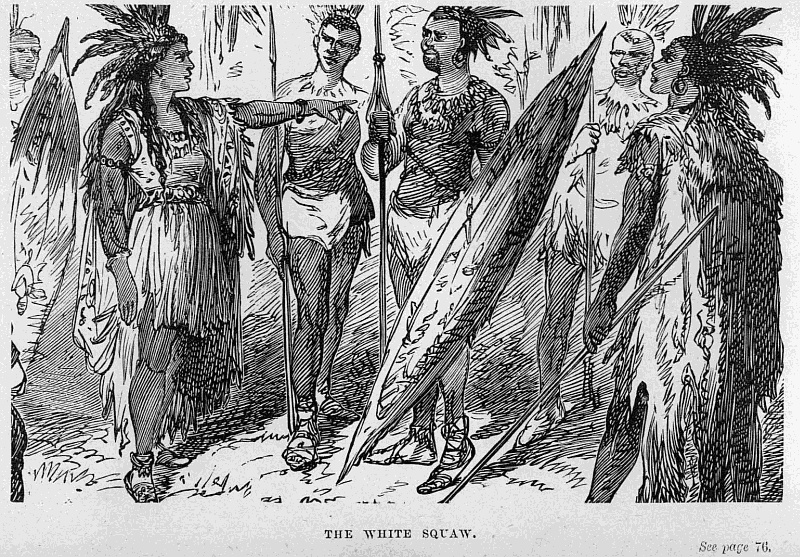
One thought occupied his mind nobler than that of revenge—the regeneration of the Indian race.
A chimera it may have been, but still his great ambition.
He thus spoke to the assembled chiefs—
“I do not urge upon you to withhold vengeance for injuries done to our race by the white enemy. I only desire to make it more full and terrible. This is but the beginning of a long list of retributions, the overflowing of accumulated wrongs, the first step towards freedom and redemption! To take that step we must be patient until certain of success. Then begins a warfare that will only end with the annihilation of our hated enemies and in a new existence for the red men! Have I spoken well?”
Loud approbation greeted him from the assembled warriors; but such is the inconsistency of human character that individually they devised means for immediate retaliation on the settlers.
Hence the several encounters which had already taken place.
Nelatu, mortified at his own weakness, was among the warriors addressed by Wacora.
On returning from the council, the young chief approached his cousin.
“Nelatu, you would do something to make up for your blind infatuation, that has led to such misfortunes?”
“I would, Wacora, I would. My father’s face seems always before me, reproaching me as my sister’s destroyer.”
“Then action is the only way by which to shake off the remorseful feeling. Our efforts have till now been fruitless in tracing the spot to which your sister has been carried. She must be found, and the punishment of the guilty made sure.”
“Not Sansuta. You would not injure her?”
Wacora smiled sadly, as he pressed his hand upon his heart.
“No, Nelatu, I would not injure your sister. Alas! I had already learned to love her. I would not hurt her for worlds. It is the wretch who has carried her away. I would have him suffer a thousand deaths, and every death more terrible than the other!”
“Tell me, what can I do? If I remain idle, I shall die!”
“Take three or four of my own people, follow every trail that promises to lead to where they are concealed, and having found the monster, bring him to me alive.”
Wacora’s eyes, as he uttered these words, blazed with passion.
“I would rather go alone,” said Nelatu.
“As you please; but remember, that there is one man you dare not trust, and yet he may be the means of finding Sansuta.”
“His name?”
“Crookleg, the negro.”
“But he, too, is missing.”
“I know it, and therefore he can lead you to their hiding-place, if he can be found. With Crookleg to assist you, you may succeed; without him your search will be fruitless.”
“How am I to find him?”
“By diligent search. He is not near the spot, but yet not so distant as to be ignorant of what is passing. He has the cunning of the wild cat; remember that.”
“I’ll be a match for him, never fear, cousin.”
Wacora glanced pityingly at the simple youth.
He thought of his confiding nature, and felt that if the only chance of finding Sansuta lay in cunning, they would never be discovered.
“Well, Nelatu, I have given you the best advice I can. Will you undertake the search?”
“I will!”
“When?”
“At once, Wacora.”
With these words the cousins separated.
Chapter Twenty Three.
The Strayed Canoe.
That night Nelatu left the Indian camp.
Wacora had given him a few hints by which he thought his search for Crookleg might be facilitated.
He had suggested that the negro lay hid within the neighbouring swamp.
This wilderness, difficult to traverse, was of great extent. It was only by a knowledge of its intricate paths that it could be successfully explored.
Nelatu, fully appreciating the difficulty of his undertaking, was more than usually depressed.
This journey through the track of dry timber was easy enough.
On emerging from it he found himself on a broad savanna.
On the other side of which lay the swamp to which Wacora had directed him.
Its gloomy appearance struck a chill to the young chief’s heart.
Could it by any possibility be the place selected by Warren for Sansuta’s concealment?
He almost hoped his search for her in its sombre fastnesses might prove futile.
Its aspect was especially forbidding at the time Nelatu reached it, which was in the early morning.
A heavy fog rose from its dark waters, clinging around the rank vegetation, and veiling the mosses and spectral limbs of the decayed trees.
A foetid breath exhaled from the thick undergrowth, and the air seemed charged with poison.
No note of bird was heard; no bloom of flower seen. Death in life was everywhere apparent!
Carefully, and with the quick natural instinct of his race, Sansuta’s brother struck upon a well-defined trail leading inwardly from the borders of the morass.
Following this with care, he had soon made considerable progress.
The sun rising higher as he advanced, only revealed more clearly the gloomy character of the scene.
The thick mist became dispelled; the verdure, dark but rich, glistened with drops of moisture, and the ghostly moss waved to and fro, stirred by a gentle breeze that had helped to dissipate the fog.
With the bright sky, however, there came a corresponding lightness over the young man’s spirit, and a doubt arose in his mind as to the guilt of his former friend.
“I cannot believe all that he has been accused of. Perhaps he is not guilty of carrying off Sansuta. I always trusted him. Why should he be so evil without a suspicion having crossed my mind that he was so? He has not been seen since she disappeared; but yet Crookleg might be the guilty one. If all I have been told be true, and Warren be the man, he shall bitterly pay for his crime. But I will not believe it until I am convinced ’tis so.”
It will be seen that Nelatu was still a firm friend, ready to doubt even villainy.
Suddenly the trail he was following came to an end.
A deep black lagoon was before his feet.
How to cross it?
Its unrippled bosom showed it to be deep.
Here and there jagged cypress stumps, to which clung drooping parasites, stood out of it.
Nelatu felt that the trail he had followed was purposely terminated at the edge of the lake, doubtless to be discovered on its opposite shore.
How to cross it? That was the question.
Stooping, he scanned the shore, but failed to trace any further evidence of the footsteps of man.
He was on the point of retracing his path in order to look for a trail, when he was arrested by a faint sound, as from a movement in the water.
It was very faint, but unmistakeable in its character.
It was the stroke of an oar!
He strained his eyes to catch a view of the boat which he felt sure was traversing the lake.
After some time spent in the endeavour, his scrutiny was rewarded.
A strange tableau was revealed to him.
At a distance appeared the shadowy form of a canoe, in which two figures were seated.
The fog, like a dull silver veil, was still spread over the lagoon, and his efforts to recognise the phantom-like forms were unavailing.
The intervening curtain of vapour baffled even the keen eye-sight of an Indian.
He hallooed to the spectral figures until the swamp re-echoed his shouts.
In vain!
No response came from the silent voyagers.
He fancied that the measured pulling of the oars for an instant ceased, but so dim and unreal did it all appear, that he began to doubt the evidence of his senses.
As he gazed the canoe glided silently out of sight.
Muttering an angry adjuration at the ghostly oarsman, he threw himself upon the ground.
Overcome with the fatiguing journey, and dispirited by his fruitless search, he soon fell into a deep slumber.
The last film of the fog was now dispelled by the powerful rays of the sun.
Birds sang in the trees above him, and from the black waters of the lagoon a huge caiman crawled up the banks to bask in the noontide glare.
Still Nelatu slumbered.
He slept until the meridian heat had passed, and the evening approached, seeming to lull all nature into silence.
The young man’s sleep was placid. With his head pillowed on his arm, he lay like one dead.
From this sweet unconsciousness he awoke with a start.
A rippling sound as of some craft cleaving the water, once more fell upon his ear.
Had the phantom canoe returned?
A glance answered the question.
Drifting near the shore was an empty dug-out.
The broken manilla rope, dragging at the stern, told him why it was adrift.
Without hesitation he plunged into the water, and in a few strokes reached the straying craft.
Scrambling into it, he seized an oar found lying in its bottom, and paddled back to the place whence he had started. Placing his gun ready beside him, he again paddled off, and rowed into the centre of the lake, steering his course, as nearly as he could remember, in the direction which, in the morning, he had observed the canoe to take.
The spot, as he had marked it, was near a huge cypress tree.
It proved to be at a greater distance than he thought, and the sun had well sunk in the western sky before he arrived at it.
Once there he came to a stop. Those he sought had evidently either gone further out into the open water of the lagoon or had made for one or other of the numerous narrow canals which debouched into it.
Selecting that which appeared of the greatest width, he plied his oar and advanced towards it.
Chapter Twenty Four.
A Smoke Interrupted.
Although Cris Carrol was absent from the immediate neighbourhood of the settlement, he was none the less informed of what had happened since his departure.
Several of the colonists, alarmed at the prospect of affairs, had quietly left Tampa Bay, and, meeting with the hunter, had told him of the events that had transpired within the past month.
The backwoodsman’s foresight had not deceived him.
The whites, by which he meant Elias and his followers, had not heeded his advice, and worse had come of it.
The hunter was nothing, if not oracular.
“Wal,” said he, “Governor Rody thought himself smart when he set to work buildin’ that thar frame-house of his’n on the red-man’s ground, but I reckon he’ll pay for it yet in bloody scalps and broken bones. Confound the old cormorant; his house will cause all of them poor white settlers no end of trouble. It don’t bear thinkin’ on, that it don’t. As for his black-hearted whelp of a son, darn me if I wouldn’t like to put an ounce o’ lead into his carcass, if it war only to larn him some human feelin’.”
“But won’t you go back to the settlement now, and see if your presence can do any good?”
To this question, propounded by one of the fugitive settlers, Cris answered—
“Good! What good can I do now? No, lad, the fat’s in the fire this time, and, may be, I may better help some poor critter away from the place than anigh it. I’ll tell ye what it is, and it aint no use denyin’ it. Them there red devils means mischief, and the old cuss Rody knows it by this time. The chief, Oluski, what you tell me air dead, war worth a whole settlement of Rody’s—barrin’ one—that is, barrin’ one.”
“And who may that be?”
“Who but his darter. The most beautifullest gal that this coon ever set eyes on. Bless her, I hope no hurt won’t come to her, and there shan’t either, if Cris Carrol can prevent it.”
In this manner did the honest hunter comment on the alarming news brought by the fugitives from Tampa Bay.
Not that he approached the spot closely. No; he had formed an idea of the manner in which he might be most useful; and, to do so, he must carefully avoid any appearance of interference between the contending parties.
He, therefore, pursued his occupation of hunting; but contrived materially to narrow the circle of his excursions.
Often as the image of Alice Rody presented itself to his mind, he would heave a painful sigh.
“How such a gal came to be a child of that old trait’rous heathen is more nor I can reckon up. It’s one of them thar things as philosophers call startlers!”
In one of these moralising, wandering moods the old hunter was seated on a tree stump on the afternoon of a day that had been more than usually fatiguing to him.
He knocked the ashes from his pipe, took a plug of tobacco from his pouch, and began to cut up a supply for another smoke.
“Ah!” muttered he, shaking his head, “I remember the time when there was happiness in the savannahs, and when them red-skins were ready to help the white man rather than fight agin them. Them times is gone from hyar for ever!”
He struck a light with his flint, and applied it to his pipe.
Just as he had puffed two or three small clouds of smoke, and was preparing to enjoy himself to the fullest extent, a flash suddenly appeared, the pipe was knocked from his mouth, and the whizz of a bullet sounded in his ears!
To grasp his rifle and shelter himself behind a tree, on the side opposite to that from which the shot proceeded, was but the work of an instant.
“Red-skins, by the eternal! I know it by the twang of that rough-cast bullet.”
Whether red-skins or white men, he did not find it easy to be certain, although he was up to every move in such an emergency.
He knew that to look in the direction of the shot was to expose himself to almost certain death.
He listened with breathless anxiety for the slightest sound, which might give evidence of the movements of the enemy.
All remained perfectly still.
Adopting a very old ruse, he stuck his skin cap upon the barrel of his rifle, and held it out a few inches beyond the trunk of the tree, by the side of which he had ensconced himself.
A flash, a report, and it was pierced by a bullet!
He was now fully satisfied that there was but one enemy with whom he had to cope.
Had there been more, the first bullet, which struck the pipe from his mouth, would have been followed by another as quickly, but perhaps more surely aimed.
With a rapid glance he surveyed the ground behind him.
It was covered with undergrowth and fallen timber.
His resolution was at once taken.
He fell flat upon the earth, and noiselessly gliding away reached a tree, distant some paces, and in an oblique direction from the one he had left.
From that spot he made his way to another, at a greater angle, and about equally distant from the second.
The movements were affected with such agile stealthiness, as to be entirely unperceived by his unseen enemy.
By the change of position he now commanded a side view of his unknown antagonist, who, unsuspicious of it, was keeping a close watch upon Carrol’s supposed shelter.
To raise his rifle to his shoulder was a natural action of the old hunter.
Instead of pulling the trigger, however, some idea seemed to cross his mind, and pausing, he scanned his adversary.
He saw it was Maracota who had fired at him!
Carrol knew Maracota as a faithful and devoted follower of the late chief, and he felt loth to take his life, although he might easily have done so.
The better thought prevailed.
He felt convinced that the bullet fired by the Indian had been aimed in reality at one for whom Maracota had mistaken him.
Advancing cautiously towards the unconscious warrior, the old backwoodsman crept from tree to tree until he was close upon him.
Not anticipating an attack from the rear, and still fancying he commanded the hiding-place of the white man, Maracota, in spite of his Indian cunning, was completely in the white man’s power.
A loud shout, a quick bound, and Carrol had him in his grasp.
With one hand upon his throat, the hunter had pinned him to the earth.
“Not a word, you darned catamount, or I’ll run my knife into your ribs! So you thought to circumwent me, did yer, with your Injun treachery? What would you say now if I war to raise your har, ’stead of letting you take mine?”
Maracota could make no reply to the question, as the pressure on his throat stopped his breath as well as speech.
The backwoodsman saw by the expression upon the Indian’s face, that his own surmise had been correct.
He was not the victim Maracota would have doomed to death.
It was a mistake, but rather a serious one.
Loosening his hold, he suffered the astonished Maracota to rise to his feet.
“Yes; I can tell you’ve made a random shot at me. Next time, try and see a man’s face ’fore you pulls trigger on him, or it might be awkward. There’s no harm done, only a worse shot nor yours I never saw. I’d eat my rifle, stock, lock and barrel, afore I’d own to sich shooting. Who war it you were arter?”
Having at length recovered breath, the Indian was able to answer.
“I took you for Warren Rody.”
“Much obleeged for the compliment. Do I look such a skunk as that fellow? If I do, put a brace of bullets into me, and we won’t quarrel.”
The warrior grimly smiled.
“Maracota has sworn to avenge Oluski’s death. Warren Rody must die!”
“Wal, let him die. I shan’t stop you from riddin’ the world of such as he. What made you follow my trail?”
“It was no trail I followed. I have been seeking one from the north; yours came from the east.”
“Right you air; that’s whar I hail from last.”
“Have you seen anything of him, or Sansuta?”
“Hark hyar, Injun. Altho’ I might draw blood in the scoundrel if I saw him, I ain’t a man-hunter, and that’s why I haint been a follerin’ any trail of his’n.”
Maracota’s eager look gave place to one of despondency, as he muttered,—
“Not found yet! Where can they be?”
“Ah, whar? It ain’t Warren as has hid whar he can’t be found. Some knowin’ hand has put him up to it.”
“Yes, Maracota thinks so. It must be the negro Crookleg.”
“Crookleg! Is that all-fired nigger varmint mixed up with him? That makes a brace of the durndest hounds that ever run together. Who told you that Crookleg helped young Rody?”
“The chief thinks so.”
“Wal, then, I’ll bet a ’possum skin agin a musk rat’s that he’s right. Your chief, Wacora, is as likely an Injun at reck’nin up the merits o’ a case as this coon knows on. Now you’ve missed liftin’ my scalp, what do you intend doin’?”
“Go on looking for the chief who stole Oluski’s heart, find him, and kill him.”
The glance that accompanied these words was full of deadly determination.
“Wal, go, and good luck attend you. Don’t ask me to jine you, I tell you I ain’t no man-hunter nor never will be; only, if either of them thar scamps should be out walkin’ whar I chance to be, they had better have met with a mad bar than this Cris Carrol. Never mind sayin’ a word about that bad shot o’ yourn. The moment I seed you I knowed you didn’t mean it for me, only next time be more partiklar, that’s all.”
Without making reply, Maracota turned away, and was soon lost under the shadows of the forest.
As soon as he was out of sight, the old hunter renewed his preparations for a smoke.
Drawing from his pouch (which seemed to contain everything that the heart of a hunter could desire) another pipe, he was soon once more sending clouds of blue smoke up into the air.
“If that Maracota meets Warren Rody or Crookleg he’ll be an awkward customer to either or both on ’em; and that he may meet ’em he has Cris Carrol’s best prayers and wishes.”
With this homely but sincere expression of his desires, the backwoodsman ceased to think of the deadly danger lately threatening himself.
Chapter Twenty Five.
Preparing for the Attack.
The Indians had, at length, determined upon making an attack upon Elias Rody’s stronghold.
The governor had got wind of their intention through a spy, a slave belonging to the tribe, who had turned informer through his seductive offers.
A meeting of the settlers within the stockade was at once called.
“Fellow citizens,” said Rody, addressing them, “I have received some information that our enemies have resolved upon attacking us. It is my duty to tell you this in order that every man may be prepared to defend himself and his family. One thing I would have you remember; this war will be one of extermination; therefore be careful not to waste a bullet. Let every pull upon your trigger send an Indian to his long account. Let the cry be ‘no quarter!’”
“Perhaps that’ll be their motto too,” remarked a voice in the crowd.
“I perceive, sir,” replied Rody, a little nettled at the running commentary on his speech, “I perceive that there are still one or two dissatisfied people amongst us. Let them step forward, and declare themselves. We want neither renegades or traitors in our midst.”
“That’s so,” the voice replied.
“Again I say, let those displeased with my views step boldly out, and allow me to answer any objections they may raise. I’ve done nothing I am ashamed of. I blush for nothing that I do.”
“No, you’re past blushing!” was the ironical rejoinder.
A suppressed titter ran round the assemblage at these pertinent remarks of the unknown; and the governor’s temper was not improved by observing the effect the words had produced on his hearers.
“I scorn to answer the fellow who is afraid to show himself; but I warn you all to be prepared for a desperate contest. We have only ourselves to look to for our defence. We are in the hands of Providence.”
“We are!”
This sudden change from jeering comment to deep solemnity of utterance on the part of the unknown speaker struck awe into the crowd, and caused Rody to turn pale.
In the hands of Providence!
Yes, for good or evil. For punishment or reward.
The thought expressed in this manner was too much for the governor.
He dismissed the meeting with a hurried admonition to be prepared for the worst.
As he re-entered his house, he encountered his daughter face to face.
“Father, I was about to seek you,” said she. “They tell me that you have heard bad news.”
“Bad enough, girl! The red-skins are going to attack us.”
“Is there no hope?”
“Hope, for what?”
“That this bloodshed may be avoided. Will they not listen to an offer of reconciliation?”
“And who would dare to make it?”
“Dare, father! I do not understand you. It is the duty of those who have done wrong to contrive by concession to atone for it, and, if possible, to make peace.”
“But who has done wrong?”
Alice did not answer in words, but the look she bestowed upon her father was eloquence itself.
“I see what you’re thinking about, my girl. It’s very hard that inside of my own home I should meet with reproaches. Isn’t it enough for me to have to bear the sneers and taunts of others, without being forced to listen to them from you?”
“Father!”
“Oh, yes; now you’ll try to say you didn’t mean to reproach me; but it won’t do. I see it in your face; and, there, your eyes are full of tears. That’s the way with you girls, when you can’t use your tongues, you have always a stock of tears ready. But blubbering won’t mend this matter; it’s got to be settled with blows.”
“Oh, father! can nothing be done?”
“Nothing, but prepare for the worst. Now, girl, stop your crying, or you’ll drive me stark mad. I’ll tell you what it is, I’m just in that sort of state that if I don’t do something, I shall go clean out of my mind. What with the worrying work here, and the grumbling discontent of a few paltry hounds about the settlement, I don’t know how I keep my senses about me.”
The angry mood into which he had worked himself was, however, no novelty to his daughter. She had of late seen it too often, and sorrowfully noted the change.
Still, she was a brave girl, and knowing she had a duty to perform, she did it fearlessly.
“Oh, father!” she exclaimed, apologisingly, “I did not mean to reproach you. If my looks betrayed my thoughts, I cannot help them, much as I may regret giving you pain. What I wanted to say was, that if there is any honourable way to avoid this bloodshed, it should be tried. There is no disgrace in acknowledging a fault.”
“Who has committed one?”
“You know wrongs have been done by white people against the Indians, not alone now, but ever since the two races have been brought together. We are no better than others; but we can avoid their errors by trying to remedy the grievances they complain of.”
Old Rody stamped the floor with rage; his daughter’s remarks made him wince. Conscience, which he deemed asleep, was at work, and upon the tongue of his own child had found utterance.
“Begone, girl!” he cried, “before I forget that you are my own flesh and blood. You insult me beyond endurance. I will manage my affairs my own way, without impediment from you. Ay, not only my own affairs, but the affairs of all here. I will have blind obedience; I demand it, and will exact it. Begone!”
His daughter looked him boldly in the face.
“Be it so, father,” she answered; “I have done my duty—will always do it. Think, however, before it is too late, that to your conduct in this matter, the groans of widows and the sighs of orphans may be laid. The happiness or misery of many rests upon your single word. It is an awful risk—reflect upon it, dear father, reflect!”
Her proud bearing gave place to tears. Her womanly heart was full to overflowing. It conquered her spirit for a time; and as she parted from her father’s presence, she felt that the last hope of peace had vanished.
“By the eternal powers!” cried he, “this will prove too much for me. It must come to an end!”
As Rody uttered these words, he drew from his pocket a flask and applied it to his lips.
It was a bottle of brandy. It seemed the last friend left him.
Chapter Twenty Six.
Forced into Service.
After entering the narrow stretch of water, Nelatu, for some time, plied his paddle with vigour.
He then paused to examine the place.
Sedges and cane-brakes grew thickly down to the water’s edge.
There appeared no passage through them.
Resuming his course, he attentively watched for any sign of habitation, but for a long time without success.
Just as he was turning the head of the canoe again in the direction of the lagoon, an object, floating on the surface, attracted his attention.
It was an oar.
A glance convinced him that it was the fellow of the one he held in his hand.
Re-animated by this assuring proof that he was going in the right direction, he fished it up, and abandoning the more laborious mode of paddling, he adjusted the oars in the rowlocks, and bending to them, made more rapid way.
He kept his eyes turning to right and left, on the lookout for a landing-place, which he now felt assured could not be far distant.
His scrutiny was at length rewarded.
A few hundred yards from where he had picked up the floating oar, a post was seen sticking up out of the bank.
To this was attached a Manilla rope, the broken strands of which showed it to be the other portion of that fastened to the stern of the canoe.
The clue was found.
Those he had dimly seen in the morning, were doubtless close at hand.
He ran the craft in shore, fastened it securely to the post, and landed.
With cautious steps he followed the footprints now seen in the soft mud of the bank.
They led to a sheltered spot, upon which a rude hut had been erected.
The sound of a man’s voice arrested his steps.
“He, he! I ’clare it makes dis chile larf, to t’ink about de trubble dat’s brewing for dem. De long time am comin’ round at last. I’se bin a waitin’ for it, but it am comin’ now.”
It was Crookleg who spoke; but for the time he said no more.
A stunning blow from Nelatu’s clubbed rifle—which would have crushed any skull but that of a negro—felled him senseless to the ground.
On recovering consciousness, he found himself bound in a most artistic manner by a thong of deer-skin, which Nelatu had found near the hut.
“Hush!” said the Indian, in a half-whisper; “not a word, except to answer my questions. Don’t move, dog, or I’ll dash out your brains!”
The negro trembled in every limb.
“Is Warren Rody inside that hut?”
Crookleg shook his head.
“Where is he?”
“Don’t know, Massa Injun; don’t know nuffin ’bout him.”
“Liar!”
“By him tressed life, massa, dis chile don’t know.”
“Answer me—where is Warren Rody? I give you one chance for your wretched life. Tell me, where is Warren Rody?”
The raising of a tomahawk above the negro’s head convinced him that death would be the sure reward of untruth.
“Don’t, massa, don’t kill de ole nigger. He’ll tell you all he knows. Oh, don’t kill me!”
“Speak.”
“He war here, but he am gone.”
“Where?”
“Out ob de swamp into de woods.”
“And Sansuta?”
“De gal am gone ’long wid him.”
Nelatu groaned.
Warren, then, was guilty.
“Do you know me?” he asked.
“Oh, yes, massa, I knows you well—you am Sansuta’s brodder. I tole Warren he war a-doin’ wrong, but he am so headstrong he would take your sister. Dis chile’s begged him not to do it.”
“False dog! you are deceiving me.”
“I swear, Mass ’Latu, I’se speaking the bressed trufe.”
Not deigning to reply, the Indian strode on to the hut, and entered it. It was deserted.
A bead bracelet lying inside attested to the truth of that portion of Crookleg’s story which told him Sansuta had been there.
He returned to the negro.
“Rise,” he said, in a commanding tone.
“I can’t, massa; you has tied me so tight that I can’t move.”
“Rise, I tell you,” repeated the Indian with a threatening gesture.
Beginning to obey, the negro rolled over the ground in the direction of the rifle which Nelatu had laid aside in order to tie him.
Could he but reach that, he might defy his raptor.
But the Indian was too quick for him.
With a kick which made Crookleg howl with pain, he forced him aside, and secured the weapon himself.
Seeing that his only chance was submission, the negro got upon his feet with some difficulty, and stood awaiting further orders.
Nelatu now unfastened the thongs that bound him.
“Go before me,” he said.
Crookleg hobbled forward with a demoniac look upon his face.
They reached the water’s edge.
“Is that your canoe?”
“Yes, massa; dat dug-out b’long to me.”
“Get in.”
The black scrambled into the stern.
“Not there—the other end.”
Crookleg obeyed.
Nelatu took the vacated seat.
“Now, lay hold of these oars, bend your back, and row me to the place where you landed Warren Rody and my sister. Remember, that if you make the slightest attempt to deceive me, I will bury my tomahawk deep in your brain.”
Thus admonished, the negro plied the oars, and the canoe darted rapidly through the water.
Chapter Twenty Seven.
The Lost Sister.
For more than an hour Crookleg was compelled to use the oars, until they had reached the other side of the lagoon.
Nelatu, silent and wrapped in his own gloomy thoughts, watched his every motion.
It was twilight when they made a landing within a sheltered bay upon that side of the swamp nearest the settlement.
Beyond this lay the woods of which the negro had spoken.
Compelling the black to precede him, Nelatu urged him forward until they had reached a mound covered with bushes.
“Hush! Massa Injun, we are near de place.”
“I see no signs of habitation!”
“We is near it, for all dat. It ain’t a easy ting to find a place like dis ’ere whare dere are nuffin to show but de ground and dese ere bushes!”
“Quick! lead me to the place!”
“By-am-by, massa; for a mercy’s sake hab jist a little patience. ’Twont do no good to be in a hurry, ’twont, indeed.”
Suspecting treachery, Nelatu would hear of no delay.
“Remember, slave! what I threatened you with. Conduct me at once to their hiding-place!”
“Well, den, Massa Injun, if you must go, step light, or we’ll gib Massa Warren de alarm. He’s as quick eared as a rabbit; dat he am. And he may shoot us both afore we know; dat is, if he ’spects you am coming after de gal.”
With this caution, to which his companion silently agreed, they skirted the mound to its extreme end, where it seemed to terminate abruptly in a deep chasm.
Once there, Crookleg threw himself upon the ground, motioning the Indian to do the same.
Nelatu complied, still watching for any movement of betrayal on the part of his guide.
With a stealthy hand the negro parted the bushes, and signed to the young man to look through the opening.
He did so.
Before his eyes was the entrance of a cave or grotto.
Inside the entrance a pine-torch, stuck in the ground, illumined a portion of the interior.
The light was obscured by the bushes, and it was only when these were parted that it became visible.
Inside the grotto was Sansuta. She was reposing upon a bed of moss.
Behind her, on a large boulder of rock, sat Warren Rody!
Nelatu was on the point of rushing forward, when he was stayed by the negro’s hand clutching his arm.
“Not yet, massa,” he whispered, “you’d be shot afore you get two steps in dar, and dis poor ole nigga would nebba get away ’gain. Let me go speak first, and gib Massa Rody de signal; and den I’ll find a way to bring him out to you. Don’t you see that’ll be de best plan to fix him?”
“I cannot trust you from my sight. Take your hand off my arm! let me go!”
“Oh, massa, I shall be ruined, and murdered complete. Don’t you see dat afore you reach him he’d see you and fire? De ole nigga’s plan am de best. Let me bring de fox out ob his hole!”
Crookleg spoke reasonably.
Nelatu might, it is true, have easily killed Warren from where he lay, but his sister’s presence, Wacora’s command, and a certain reluctance to shed blood, stayed his hand.
“Well, then, do it, but on conditions.”
“What conditions, Massa Injun? Name ’em, and I’se obey.”
“That you bring him away from my sister’s side out here into the open ground; that every word you speak shall be loud enough for me to hear. Go!”
“I’ll go, massa.”
“See!”
As Nelatu uttered this monosyllable he tapped his rifle.
Crookleg took the hint.
“I’se swear, massa, do dis ting right! Dis ole nigga don’t want no bullet through him karkiss. I’se swear to do as you say!”
With this asseveration he rose erect and entered boldly among the bushes, while Nelatu concealed himself behind them.
Warren started to his feet, calling out—
“Who’s there?”
“Hush, Massa Warren! It’s only me—ole Crookleg.”
“Come in, Crookleg.”
“No, Massa Warren, you come out here. I’se want to show you somethin’.”
With a hasty glance at the slumbering maiden Warren Rody emerged from the cave.
At the entrance he was suddenly confronted by Nelatu.
“Nelatu!”
A yell of fiendish laughter from Crookleg answered the exclamation.
“He, he, he, he! ho, ho, ho! Oh, dat am de best ting dis ole nigga eber done! Ah, de time am comin’ now! Ho, ho! Massa Warren, who kicked de ole dog of a nigga wot fetch and carry for de white man to de Injun gal? Ha, ha, ha! I ’clare to mercy it am splendid! Now I’ll leave you two friends togedder; but don’t quarrel—don’t! Only remember, Massa Warren, remember Crookleg to your dyin’ day!”
With these words the negro darted off, and was soon lost to sight behind the bushes.
Warren stood grating his teeth in impotent rage.
He saw that he had fallen into a trap laid for him by Crookleg.
Nelatu stirred not an inch.
Again young Rody pronounced his name.
“Nelatu!”
“Yes, Nelatu—the brother of Sansuta! Does not the sight of me turn you into stone? Is your heart so hardened that you do not tremble?”
Warren gave a short, mocking laugh.
“Go away from here,” he said; “I owe no account of my actions to any one.”
“Yes, you owe an account of them to that Great Spirit who is alike your God and mine.”
“Pah! stand aside, I say.”
“My arm will brain you if you move or step! Nelatu is a chief, and must be heard!”
“Well, then, go on.”
“You once said you were my friend. Nelatu tears your friendship from his breast and casts it to the wind! You are an assassin—a thief! What answer do you make?”
“I make none.”
“You are right; nothing can be said to palliate the crime of falsehood, murder, and robbery! Come along with me.”
“Indeed! Where to?”
“To our chief—to Wacora.”
“A prisoner?”
“Yes.”
“And who is to take me?”
“I will.”
“You!” retorted Rody, with a sneer.
“Yes; your life was in my hands but a minute ago. You live only because I would not kill you in my sister’s presence. Your very slave has proved false to you. You are in my power; Wacora shall pass sentence on you, and that sentence will be death.”
With a bound Warren rushed at Nelatu, who, suddenly dropping his rifle, grappled with him.
A terrible struggle ensued.
The young men were about equally matched in size and strength, while each knew that it was a contest for life or death.
Warren, by his unexpected onset, had at first some advantage over his antagonist; but the Indian speedily recovered it by his great power of endurance.
All feeling of pity had vanished from his breast. He had intended to take him a prisoner; he would now kill him.
He made several unsuccessful efforts to draw his tomahawk; whilst Warren, inspired by the certainty that death would be the result, strove to his utmost to prevent him from wielding the weapon.
Long did they continue the struggle without either speaking a word. Their heavy breathing, as they rolled over and over on the grass, was the only audible sound.
Nelatu at length succeeded in getting his antagonist under him, and with one arm strove to hold him, whilst with the other he groped for his tomahawk.
At this moment Warren made a superhuman effort, threw the Indian off, and, with the speed of lightning, snatched his rifle from the ground.
Nelatu had stumbled as he was thrown off, and lay sprawling upon the earth.
Another instant and he would have had a bullet through his body.
Was it an echo that answered the cocking of the rifle held in Rody’s hand?
That was the last thought that crossed Warren Rody’s mind.
The next moment he was a corpse.
A bullet had pierced his brain!
It came from Maracota’s gun, who had arrived upon the ground at the moment of Nelatu’s fall.
Before either of the two Indians could speak a word, a piercing cry echoed in upon their ears; a girl came gliding through the bushes, and flung herself prostrate over the body.
It was Sansuta!
The air was filled with her lamentations as she kissed the cold forehead of Warren Rody, and with a thousand endearing terms endeavoured to recall him to life.
Nelatu approached and gently raised her from the ground.
He was about to address her, but he started back in horror.
Her wild, starting eyes, with that unmeaning smile upon her lips, told the sad tale.
Her reason had departed.
Chapter Twenty Eight.
The Struggle in the Stockade.
On that same night the Indians, led by Wacora, stormed the stockade upon the hill.
The combat proved long and desperate, but the place was at length taken.
Bravely as the settlers fought, they had a foe to deal with implacable and determined.
As fast as the red warriors fell in the attack, others took their places, and from out the darkness legions seemed to rise to avenge the deaths of their fallen comrades.
The white women loaded the rifles, stood by their brothers and husbands assisting them in the fearful strife.
But valour availed not; the settlers were doomed.
Never had Elias Rody been seen to greater advantage.
He seemed ubiquitous, cheering and inspiring the men around him.
Many who had condemned him till then gave him credit for his bravery.
He seemed to bear a charmed life, and was seen where-ever bullets whistled, unharmed and undaunted!
All his hopes on earth were centred in successfully maintaining himself; and that strong physical courage which he undoubtedly possessed, stimulated by his frightful responsibility, made him for the moment heroic.
His daughter, the gentle Alice, showed herself equally brave.
She took under her care the wounded men—she who, at any other time, would have fainted at the sight of blood—bound up the ghastly wounds, and stood on that dreadful night by more than one death-bed, calm and courageous, upheld by the sustaining idea.
But what availed courage and devotion against numbers?
The stockade was at length carried, and, after it, the house, which was instantly given to the flames.
A horrible carnage ensued amongst those who, unable to fly, were left to the besiegers’ fury.
The worst passions were displayed in their worst forms, and helplessness pleaded in vain to hearts steeled with revenge.
The moon’s rays lighted up a fearful scene.
Corpses of Indians and settlers, with their wives and children strewed the ground of the enclosure!
The glare of the burning house added to the horror of the sight.
Some few of the colonists fled across the country, pursued by their relentless foes.
Though a small number escaped with life, many perished in their flight.
With revengeful cries the Indians sought for Elias Rody, but failed to find him.
Had he, too, escaped?
It seemed so, for nowhere could his body be discovered among the slain.
His daughter had also disappeared.
But half of their revenge seemed accomplished, and Wacora felt that, with Rody alive, his uncle’s death was not yet avenged.
In vain did he send warrior after warrior in search of the missing man.
All returned with the same answer.
The white chief was not to be found!
Enraged at being thus baffled in his revenge, Wacora called his straggling forces together, and returned with them to the Indian camp.
After their departure there was profound stillness within the stockade, more awful from contrast with the battle there so late raging.
The dead were left to repose in peace.
For a long time this stillness continued unbroken.
Then from afar sounds began to be heard, gradually drawing nearer and nearer.
It was the howling of the gaunt Florida wolves as they scented a rich repast.
Ere long they could be seen skulking through the enclosure, and quarrelling over the corpses upon the plain. Above them, with shadowy wings, the vultures hovered, waiting to come in for their share of the spoil.
The moon sank in the sky, and drew a pall over the dreadful sight.
At intervals a flickering tongue of flame shooting up from the expiring embers of the burnt house, imparted a weird aspect to the scene, lighting it up, only to display its ghastly horrors.
Where was Elias Rody?
He had proved deceitful to the last.
Wacora and his warriors had sought him everywhere, but had failed to find him.
For all that he was near.
In the last attack made by the red men, he had been wounded—not severely, but sufficiently to make him feel faint and giddy. He knew that he could no longer hope for success, and determined, if possible, to save his own life while there was a chance.
Amidst the smoke and confusion he found no difficulty in withdrawing from the combat. Remembering a species of cellar he had caused to be dug in the rear of the house, he staggered towards it, and reached it unobserved.
He paused before entering. A thought of Alice arrested him—the thought of the hopelessness of saving her, and tottering forward, half-blinded by his own blood, he descended the steps of the cellar, at the bottom of which he fell insensible to the floor.
The yells of the victorious Indians, the glare of the burning mansion, the shrieks of the wounded, and the agonising wail of defenceless women and children as they committed their souls to Heaven, Elias Rody, though the cause of all this, heard nothing.
Beneath his own burning house, miraculously sheltered by some huge timbers which had fallen over the excavation, he lay for a long time insensible to thought as to feeling.
When he at length recovered consciousness, and crawled forth from his concealment, the sun had risen, lighting up the ruined pile.
He shuddered at the sight.
He suffered a thousand deaths in the contemplation of the horrors his mad selfishness had caused.
Bitter remorse, stronger than his shattered physical frame could endure, gnawed at his heart. But it was selfish remorse for all that.
Here was vengeance for Oluski, had the chief only been alive to witness it.
Too weak to get away from the spot, Rody groaned in the bitterness of his spirit.
“Ten thousand times may I be accursed for all this! Fool—blind, infatuated fool—that I have been. Every aspiration might have been gratified, every hope fulfilled, had not my impatience blinded me against caution. May the fiend of darkness overtake these red—”
How long this tirade of blasphemous repentance of his villainy might have lasted it is impossible to say. It was stopped, however, by a physical pain, and with a faint voice, he cried—
“Water! water!”
Blood there was in plenty around him, but not one drop of water.
Others had yelled for it through the long, dreadful night, as agonisingly as he, but had been answered by the same solemn silence. They had died in their agony. Why should not he?
“Well, then, let death come! The full accumulation of mortal torment has fallen on myself; it cannot be greater?”
Wrong in this, as in everything else.
See! Skulking along the brow of the hill, stooping over and examining corpse after corpse, with a look of demoniac joy upon his hideous features, something in human shape, and yet scarce a man, appears.
Horror of horrors! he is robbing the dead.
Rody saw him not, for he had again fainted.
With a harsh voice, rivalling the vulture’s croak, the skulker continued his hideous task.
“Ha! ha! ha!” chuckled he to himself, “there am nice pickings after all for dis chile, boaf from de bodies of white man and de red. Bress de chances what set ’em agin’ each oder! Oh, but de ole nigger am glad—so glad! But where am he?—where am he? If dis chile don’t find him, why den his work ain’t more den half done!”
Diligently did Crookleg, for it was he, continue to search, turning over dead bodies, snatching some bauble from their breasts, and so passing to others, as if still unsatisfied.
For whom was he seeking?
As he proceeded in his work, a voice that came from among a heap of ruins, was heard feebly calling for “water!”
The negro started on hearing it, sending forth a shout of triumph.
He had recognised it as the voice of Elias Rody, the man for whom he had been searching.
As the latter recovered consciousness, he saw a hideous face close to his own, that caused him to start up, at the same time uttering a cry of horror.
Chapter Twenty Nine.
An Exulting Fiend.
“I has found you, has I?”
“Crookleg!”
“Yes, it am Crookleg.”
“A drop of water, for the love of God; a drop of water!”
“If de whole place war a lake, dis chile wouldn’t sprinkle you parched lips with a drop out ob it.”
“What do you mean, Crookleg?”
“Ha! the time I been waitin’ for has come at last. It hab been long, but it am come! Do you know war you son Warren am?”
“Thank heaven! away from this, and in safety.”
“Ha! ha! ha! Safe; yes, he am safe enough wid a big bullet through his brain!”
Elias Rody, with an effort, raised himself into a sitting posture, and glared upon the speaker.
“Dead!”
“Yes, dead; and it war me dat bro’t him to it. Ha! ha! ha!”
“Who are you? Has hell let loose its fiends to mock me?”
“Perhaps it have. Who am I? Don’t you know me yet, Rody—Massa Rody?”
“No, devil! I know you not. My son dead—oh, God! what have I done to deserve all this?”
“What hab you done? What hab you not done? You had done ebery ting that de black heart ob a white man do, and de day of recknin’ am come at last. So you don’t know me, don’t you?”
“Away, fiend, and let me die in peace!”
“In peace—no; you shall die as you hab made oders live—in pain! When you can’t hear dis nigga’s voice plainly, he’ll hiss it in at your ear, so it may reach your infernal soul, in de last minutes of you life!”
“Who—who are you?”
“I am Reuben, de son of Esther.”
“Esther!”
“Yes, Esther, your father’s slave. You was de cause ob her death. Do you know me now?”
Rody groaned.
“Dey call me Crookleg, kase I was lame. Who made me lame?”
Still no answer.
“It war you dat put de ball in my leg for sport, when you war a boy, and I war de same. I have been close to you for years, but you didn’t know me. I war too mean—too much below de notice of a proud gentleman like you. But I hab a good memory, and de oath I’d taken to be even wid ye, am kept. My mother war a slave, but she war my mother for all dat, an’ if I war a black man I war still a human bein’, although you and de likes of you didn’t think so. Do you know me now?”
Rody uttered not a word.
“When I war forced to limp away from your father’s plantation, I war but a boy, but de boy had de same hate for de cruel massa dat de lame nigga hab now for Elias Rody. Days and years hab passed since den, but de hate war kept hot as ever; and I’se happy now when I knows dat de dyin’ planter am at de mercy of de mean slave. Don’t be skear’d, I wouldn’t lift dis hand to help you eider die or live. All I’se a going to do is to sit hyar an’ watch ober you till you am cold and stiff. Every flutter you wicked soul makes to get free from you ugly body, will be a joy to me!”
“Oh, devil!” exclaimed the wounded man, in the depth of his agony.
“Debbil! Yes, I is a debbil, and you has made me one!”
The negro, as he said this, knelt down by Rody’s side and thrust his face close up to that of the dying man, while a demoniac joy lit up his horrid features.
And he continued to gaze upon his victim until the grey shadow of dissolution stole over his countenance, the senses wandered, and the once bright eyes were becoming dimmed with the film of death.
At last a scream burst from the lips of the dying man, followed by words of piteous appeal.
“Ha—help—water—water! My soul’s on fire! Devils—demons! Away—away! Let me go! Unloose your burning hands from my heart! Unloose—ah, horror!”
The cries ceased.
Elias Rody was dead!
Remorselessly did the negro glare upon his expiring enemy as he uttered these last frantic speeches, and when, at last, the spirit had passed away, he bounded to his feet and began to exult over his now unconscious victim.
At this moment another personage appeared upon the scene.
At some little distance from the spot a man, leaning upon his rifle, stood taking a survey of the smoking ruins.
He had been for some time ignorant that any living being but himself was upon the hill.
His attention was now called to Crookleg, who, assured of his enemy’s death, could no longer restrain his immense joy, but was giving vent to it in cries and fantastic caperings.
“Ho, ho—dead! It am ’plendid sport to de ole nigga! Only to tink dat dis poor ole lame darkey hab been de cause ob a war ’tween de whites and de red-skins! Ha, ha, ha! it am most too good to be beliebed! But it am true—it am true!”
As the monstrous creature concluded the speech he was seen to spring suddenly into the air and fall flat upon his face—a corpse!
A long hunting-knife had penetrated his back!
“There, ye black hound! If you have been the cause of one war, you’ll never have a hand in another. I swore not to fight agin my own blood, nor to take part agin the red-skins, but black blood don’t count in my bargain!”
Saying this, Cris Carrol drew his blade from the negro’s body and coolly sauntered away from the spot.