THE WHIRL (continued 3)
Reading edition
"I think, Susan, when you go home this summer, you may as well arrange to remain during the winter. I intend to take the future Lady Carlyon in hand and show her a few things, and I can't do it as well with you here. I shall ask her to preside here."
Mrs. Vereker gasped. The intimation was not wholly displeasing to her after three years of trial with Lord Baudesert, but the idea of an American woman doing the honours of Lord Baudesert's Embassy was enough to stagger anybody, certainly a person so easily staggered as Mrs. Vereker.
On a June morning in a small church in Bardstown, Kentucky, Lucy Armytage became Lady Carlyon. It was the simplest little wedding imaginable, without any token that Lucy was making a splendid marriage. She was a charming and unaffected bride, and looked all happiness. Sir Percy, however, after the manner of an Englishman who has attained his heart's desire, was silent, and looked somewhat bored.
On the same day, at a fashionable church in Washington, Alicia Vernon became Alicia March. The first news she heard of Sir Percy Carlyon was that he was promoted, and appointed Minister at a small Continental court. Thus Lady Carlyon and Mrs. March had separate orbits many thousand miles apart.
IX
Four years and a half afterwards, on a mild, sunny December afternoon, Senator March, whilst walking through the still fashionable, fine old street in which his house was, saw a beautiful victoria, superbly horsed, drawn up to the sidewalk. In it sat a lady and gentleman, whom he instantly recognised as Sir Percy Carlyon, recently appointed Ambassador to Washington, and Lady Carlyon. They had stopped for a moment to speak to two beautiful little boys, three and two years of age, in the care of a stately nursemaid and her assistant. Senator March's eyes rested with longing upon the charming little children. He was passionately fond of children, and they were the only gift of Heaven which seemed denied to him. When the nurse moved away with her charges Senator March stepped up and grasped Sir Percy's hand, and then Lady Carlyon laid her little white-gloved hand in his.
"I didn't know you had arrived," said Senator March. "I watched the newspapers, and so has Mrs. March, thinking that we would not let twenty-four hours go by without seeing you."
"We reached town only last night," said Sir Percy; "and we were speaking of you five minutes ago when we drove past your house."
While Sir Percy was speaking, Senator March, man-like, kept his eyes fixed upon Lady Carlyon. One glance showed to him that she had found herself; she was far prettier than she had ever been before, and there was a new meaning and intelligence in her black eyes and added charm in her agreeable and well-cultivated voice. She seemed to have grown taller, and she had a sweet, unaffected dignity of wifehood and motherhood. The dainty, high-bred girl had become a woman, had developed into an Ambassadress worthy of the name. It was she who said to Senator March:
"I hope Mrs. March is well, and of course she is happy?"
"She appears to be both," replied Senator March, smiling; "perhaps it is only her British pluck which enables her to stand the American husband."
"I shall hope to see her very soon," said Lady Carlyon, and then Sir Percy inquired about General Talbott.
"We are expecting him in the spring. As you may imagine, Mrs. March does not let any long interval pass between her visits to General Talbott in England and his visits to us. By the way, what an odd fatality has always interfered with our seeing you and Lady Carlyon when we have been in Europe. We seemed to be playing a game of hide-and-seek, but now there will be no escaping each other, and we must see as much as we can of you and Lady Carlyon."
"Thank you," answered Sir Percy, with the utmost cordiality, but it was Lady Carlyon who added: "Yes, pray remember us to Mrs. March, and we shall look forward to seeing General Talbott as soon as he arrives. We shall expect to see you very shortly."
Then after a few moments more of conversation the carriage drove away.
A victoria, with a coachman and footman in hearing, is no place for a private conversation, and nothing was said about Senator March and his wife until Sir Percy and Lady Carlyon had reached home and were alone in Sir Percy's library.
"Dearest," said Lady Carlyon, laying her little hand upon his sleeve, "there is but one attitude to take: we must be friendly with her. Remember Senator March's position and how you stand with General Talbott."
"I know it all," answered Sir Percy doggedly.
They were standing together, and Sir Percy took his wife's hand and kissed it.
"You are the better diplomatist of the two," he said; "I could not bring myself to mention Alicia March's name. If it hadn't been for your readiness Senator March must have suspected something. It must be hard for you?"
"Very! But I have been preparing myself for this complication ever since you told me that story. After all, it is quite natural that Mrs. March should make a fight for her position in the world. It isn't every woman who has it in her to be a Louise la Vallière."
"It is certainly not in Alicia March; however, there is nothing so cowardly as for a man to complain of a woman. I should be glad to take all the pain of my own wrongdoing, but you, poor, innocent child, must suffer too."
"Let us not think of it," said Lady Carlyon, drawing her husband's lips to hers.
Sir Percy said nothing, but his kiss and his eyes were eloquent of love and gratitude. Then Lady Carlyon went into the drawing-room and Sir Percy followed her. Deep in his heart he was a sentimentalist, and he loved his wife with single-hearted devotion. He could not but compare her, as she moved about the room, her white cloth gown trailing upon the floor, with the slim, pretty and inconsequent young girl whose waltzing had first charmed him. She was still slim and pretty, but she had grown wise with soft, sweet wisdom. It was she, now, who thought for him, smoothed over the rough places, practised an easy and graceful self-control, and was all that the wife of an Ambassador should be.
The tea-tray was brought in, and Lady Carlyon gave Sir Percy his tea, a thing comforting in itself, with the same gracious air that she would have handed it to the Ambassador of France.
"It was in the ball-room that I first saw you, waltzing with young Stanley, the naval officer," said Sir Percy, drinking his tea with calm deliberation, "and it was in the library that Lord Baudesert warned me that a diplomat should never marry an American, and I swore to him I never would."
"It is all wrong in principle," replied Lady Carlyon, making a pretty little grimace--she retained for Sir Percy's benefit alone all the little roguish tricks and airs which made Lucy Armytage so charming, but would scarcely have been becoming in Lady Carlyon--"I never thought that anything would induce me to marry any man outside of Kentucky. I have often been shocked by your want of knowledge of horses."
Sir Percy tweaked her ear. The form and ceremony with which horses were treated in England had been a revelation to Lady Carlyon, and Sir Percy himself was no mean judge of a horse. Nevertheless, Lady Carlyon, when she chose to be once more Lucy Armytage, would give herself supercilious airs to Sir Percy upon all equine subjects.
"You hardly know a horse from a cow, my Lady Lucy," he said.
This was the name by which he called his wife when they were alone. He had explained to her at the beginning of their married life, when instructing her in titles, that she could not really be Lady Lucy Carlyon unless she were an earl's daughter, to which Lucy replied demurely that she had always supposed every gentleman in Kentucky to be the equal of the biggest earl in England. The small joke amused Sir Percy, and from that on she became to him "Lady Lucy." In some way Lord Baudesert had also caught the name, which so pleased his fancy that "Lady Lucy" became applied in tenderness to Lady Carlyon. It recalled Lord Baudesert, and Lady Carlyon said, as she gave Sir Percy his second cup of tea:
"I don't think your uncle will be able to keep away long from Washington. He will be sure to come back here as a visitor. He declares that he finds London, Paris, Vienna and Berlin dull after Washington."
"Perhaps it is because he is no longer an Ambassador, or else that the English, French, German and Austrian sense of humour is not so acute as he found the American, and my uncle can't have the ambassadorial joke as he did here."
"And Mrs. Chantrey is still unmarried," said Lady Carlyon, and then they both laughed.
Lady Carlyon kept away from the hateful subject of Mrs. March, but Sir Percy understood well that his wife would shoulder the burden and carry it bravely and quietly. The idea of Alicia March being under his roof was odious and humiliating to Sir Percy Carlyon, but he saw no way out of it. His immediate departure for England after his marriage, and thence to his Continental post, had kept Lady Carlyon and Alicia March apart. The Carlyons had not been to America but once since, and then only for a few weeks, within a year of their marriage. Colonel Armytage had been stricken with paralysis, and Lady Carlyon, with Sir Percy, had hastened to him, arriving in time to find him conscious, but dying. Mrs. Armytage had followed her husband within a fortnight, her last days tended by Lady Carlyon, to whom she had been a mother. Within a month all was over and Lady Carlyon returned to Europe without going near Washington. The chapter of accidents which Senator March mentioned as having kept him and his wife from meeting the Carlyons in Europe had been really a series of clever stratagems on the part of the latter. When the Marches were on the Continent, especially at the Capitol, where Sir Percy Carlyon took his preliminary canter as Minister before winning the blue ribbon of an Embassy, he and Lady Carlyon had found it convenient to be absent at those times. Then when the Marches went to London the Carlyons managed to be on the Continent. Sir Percy could not possibly put himself in the position of avoiding General Talbott, who had visited him at his Continental post, and had been made an honoured guest. Only one person suspected why the Marches and the Carlyons had never met, and that was Alicia March. Nor were the Carlyons the only persons who avoided her, but of this her husband remained entirely ignorant.
The stories of Senator March's wealth made a sensation in the sphere of General Talbott's and Mrs. March's acquaintances. Mrs. March herself gave evidence of it in the splendour of her jewels and the cost and exquisiteness of her costumes. She spent with a lavish hand, and the world knew it. Sir Percy Carlyon, hearing rumours of this, thought to himself: "It is the same Alicia, whose passion for spending has grown by what it feeds on." Sir Percy Carlyon turned these things over in his mind while drinking tea on this December afternoon, but he said nothing of them.
Then when tea was over, following the custom established after the birth of their first boy, the Carlyons went upstairs to pay a visit to the nursery. In saying good-night to the two beautiful little children, Lady Carlyon knelt down by their cribs and made a silent prayer, and Sir Percy, standing near her, did likewise, and thought himself the happiest of men, but for one thing--that which had happened in the far-away hill-country of India long years ago.
Meanwhile, on parting from the Ambassador and Lady Carlyon, Senator March soon reached his own door. The outward aspect of the house had been changed and wonderfully improved. The adjoining house on each side had been demolished, and wings built out in the same simple but dignified style of architecture of the original house. One wing was a ball-room and the other was a picture gallery. As Senator March entered the hall a footman handed him a box which contained a bouquet; this was Roger March's daily tribute to his wife ever since his marriage. Within the house the note of luxury was struck, and it increased in an ascending scale until it came to Alicia March's boudoir, which was part of the new building. Senator March's quarters alone had escaped the tide of splendour, and his own rooms remained as simple as in his bachelor days.
He knocked at the door of 'his wife's boudoir and Alicia bade him enter. The four years and a half, which had developed Lucy Armytage into an Ambassadress worthy of the name, had also made a subtle change in Alicia March. She was apparently no older than on the day when she had first seen Roger March. She was an admirable subject for the great London and Paris dressmakers, and she had reached that stage of a woman's existence where dress ceases to be a passion and becomes a fine art. Time had left no mark on her, but her eyes--her beautiful violet eyes--had an expression of apprehension, even of fear, in them, and she, heretofore the most placid and self-controlled of women, had become strangely nervous. She started as her husband entered, but smiled as she received his gift of flowers with the graceful thanks which she never omitted. Then Senator March asked her how the day had passed.
"Very well," she replied. "I didn't wish to go out until you had come in. What have you been doing to-day?"
"I worked like a cart horse until three o'clock, then walked uptown for exercise, and whom do you think I saw half-a-square away?"
"The Carlyons," answered Mrs. March calmly. "I saw them drive past. Did you speak to them?"
"Oh, yes! I was delighted to see them again. You know I have a special reason for gratitude to Carlyon, as it was through him I met you."
Mrs. March turned her beautiful eyes on her husband with a look which every woman's eyes have when she receives a sincere compliment.
Senator March continued:
"Sir Percy is looking very well; that man has had unbroken good fortune of the most brilliant sort. I believe him to be the youngest Ambassador in the diplomatic service, and Lady Carlyon!--bless me--she is Lucy Armytage and yet she is not Lucy Armytage--that is to say, she has grown up. She has a charming dignity without the slightest pretension, and one can see at a glance that she will do well anywhere. They had stopped the carriage for a moment to speak to their children, two fine boys."
"I saw them, too," said Mrs. March; "they looked quite adorable. Did Sir Percy ask for me or send me any message?"
Senator March tried to recall.
"I really can't remember anything special. Both of them were most cordial, and Lady Carlyon particularly said she hoped to see us very soon."
Mrs. March smiled.
"Sir Percy has forgotten, perhaps," she said softly after a moment, "his first six months in India."
"Oh, I think not! He told me during our first acquaintance all about that and the enormous obligations he was under to your father. We must call and see the Carlyons very soon, and have them here to dinner."
Then Alicia suddenly changed the subject, and began to ask him about his day's work.
"There is a tremendous amount of work on hand for the committee, as there is a great mass of information to be mastered before one can treat intelligently this whole railway subject, for instance."
Then Senator March went on to describe the pitfalls and obstacles in the way of certain intended legislation concerning railways. His wife listened with the deepest attention, occasionally putting in an intelligent question. Presently the Senator said:
"I believe you know as much about the matter as I do. You should be an interstate commerce commissioner."
Alicia smiled, she rarely laughed.
"That is the way with Englishwomen: we accommodate ourselves to our husbands instead of requiring them to mould themselves to us."
"It is a very pleasant way," replied Senator March gallantly, and then, being full of his subject, he went on talking about it until, suddenly recalling himself, he said: "You have not been for your drive and it is already growing dark. I can't go with you to-day; I have a lot more of this business on hand in my study."
"I don't think I shall drive this afternoon," replied Mrs. March. "I think I shall walk for half-an-hour. You wish to be undisturbed until dinner?"
"Yes," said Senator March, going into his own quarters.
Ten minutes later Mrs. March, in a plain walking dress, with a thin black veil over her face, went out of her own door, and when she was well around the corner called a cab and gave the address of a plain hotel in the lower part of the city. As she leaned back in the ramshackle cab she drew her veil still more closely over her face and tried to collect her thoughts for the interview which she sought, but her mind wandered to all manner of subjects. How strange it was that she, the wife of one of the richest men in the Senate, with an allowance which was a fortune in itself, should be at that moment harassed for money! She never remembered the time in her life that such had not been the case. When she married Senator March it was with the expectation that never again as long as she lived would she ever want for money, but within the year the old emptiness of purse returned. Money slipped through her fingers she knew not how. She loved pearls and diamonds and beautiful things with an insatiable love. Senator March had loaded her with jewels, but she wanted more. It seemed to her that wealth was not wealth if one had to consider how it was spent. That principle had caused her to spend not only a splendid income, but had piled up debts to which her old burdens were a mere nothing. The same principle of shame and even fear that she had felt toward her father prevented her from opening her heart to her husband, the soul of indulgence. There was a kind of rigid morality about Roger March, and the idea that she had made debts which she concealed from him she knew would appear as a crime in his eyes. He would, of course, pay them--of that she felt quite certain--but in spite of her husband's love and gentleness, he had always inspired her with a certain fear, just as her father did, and General Talbott would know the whole story which she so shrank from telling. She found a curious lack of power in herself to stop spending money. Then came Nicholas Colegrove's opportunity.
He had seen Alicia March several times during the first winter of her marriage, when she immediately became one of the great hostesses of Washington. Colegrove was by nature social, and liked, as well as any one, a good dinner, a good glass of wine and a pretty woman on each side of him. His position as the moving spirit of an association of great railways, which some people called a conspiracy, placed him somewhat at a disadvantage with public men in Washington. Senator March, however, liked Colegrove well enough, and was by no means afraid of him, and if Alicia March wanted to have him at her brilliant dinners her husband made no objection. Senator March was chairman of the committee which was dealing with Colegrove and his associates, but so far nothing had been discovered of a nature damaging to Colegrove or his friends. As he good-humouredly told Senator March, the railways asked only to be let alone; and Senator March, with equal good humour, replied that was the very thing that the committee did not mean to do.
As the committee would not agree to let Colegrove alone, but persisted in asking prying questions, the next best thing for him was to find out exactly what the committee knew, and how it proposed to act. Alicia March was the instrument ready to his hand. Colegrove, who had a vast quantity of that semi-divine gift known as common-sense, was under no illusion respecting Alicia March's influence over her husband. Senator March was deeply devoted to his wife, but neither she nor any other human being who ever lived could swerve Roger March from his duty, or cause him to betray the smallest trust. He was not, however, on guard against his wife, and Colegrove knew it.
When he passed the March house late at night and saw the lights burning in Senator March's study, and knew that he was at work there with his clerk and a stenographer, Colegrove longed to know what they were writing. How easy it would be for Mrs. March to make a few copies of the letters and memoranda, which would be immensely useful to the A.F.&O.! Reflecting on this, Colegrove cultivated Mrs. March's society. Being a man of acute observation, he found out some things about Alicia March which not even her husband knew. He discovered that she had a strange sense of dislocation in her new place. She had been forced, as she thought, in her previous life to have many concealments, and she still had them, but they gave her a vague sense of discomfort which she had never known before. Still the habit was upon her, and she had the conviction that concealment, however wrong, was absolutely necessary.
Colegrove alone of all the men she had ever known seemed to penetrate at once into everything which she wished to keep secret. He had got out of her the fact that she was pressed for money within a year of her marriage. This he proposed to remedy in a manner at once easy, simple and honourable: to get hold of stocks which would cost next to nothing to buy, and would sell for a fortune, and this he would do for Alicia March in his own name. He made the condition, however, that she should not mention it to her husband, and to this Alicia March agreed readily enough, knowing the transaction could not take place unless it were kept a secret from Senator March. Then money flowed into her hands, not enough to make her independent of Colegrove, but enough to ease the perpetual strain. At this point Colegrove had asked her to get copies of certain letters which he knew were in Senator March's desk in his study. At this Alicia recoiled and then refused, but when payment was demanded for a couple of black pearls which she had bought, and her dividends from her stocks were not forthcoming, Colegrove told her plainly that he must have copies of those letters before any more money was paid. Alicia had realised some time before that she was playing a dangerous game, but who fears the danger of a game as long as one is winning? It was ridiculously easy to get what Colegrove wanted, and love for the black pearls was stronger in Alicia March than honour or fear. Colegrove got his copies and Alicia's stock suddenly, according to Colegrove, declared a tremendous dividend.
Colegrove congratulated himself on what he had accomplished with Mrs. March and incidentally was scorched. All men are dreamers of dreams, and at last the dream took shape with Colegrove that he should force a wedge between Roger March and his wife. As for Colegrove's own wife, the fretful lady in a far-away western city, that was easily managed--he could drive her into a divorce any day he liked. He was the last man on earth who would betray himself, and what seemed an unguarded outbreak of passion for Alicia March was really a carefully calculated procedure. Alicia received it with a calmness and capacity to deal with the situation which showed him that she was no apprentice in such matters. She held him off, but she did not break with him. Each was too useful to the other to come to an open rupture, and so matters had gone on for more than three years.
In that time no human being, not even Roger March, suspected that Alicia March and Colegrove ever met except in the presence of others, and generally at dinners. Nevertheless, they had brief interviews, chiefly relating to bills and their payment, and papers were handed over to Colegrove, and crisp new bills for considerable amounts were received by Alicia. These meetings generally took place in unfrequented streets and parks at twilight, and might easily be explained as accidental. Those were not occasions of sentiment, but when Alicia and Colegrove met in drawing-rooms Colegrove then said things which conveyed to Alicia that her husband was puritanical in his ideas, which Colegrove was not, and when she should find Roger March intolerable there was a refuge waiting her. It seemed quite natural to Alicia March to hear these veiled declarations from Colegrove. She admired the ingenuity with which he made them and listened to them with a smiling composure, the meaning of which not all Colegrove's acuteness could discover. Alicia herself did not know her own feeling towards her husband, nor had the brilliant life upon which she had entered acquired any true sense of reality and proportion. She felt as if she were living in a dream, silent, changeful, exciting, but still a dream.
As the cab jogged along over the streets Alicia turned all these things over in her mind. It was the first time she had ever had a meeting with Colegrove which was open to the slightest suspicion, but Colegrove had written to her that he did not desire it to be known that he was in Washington while the great railroad legislation was pending until he should be called as a witness, and for that reason he would come to Washington for a few hours, stopping at a plain hotel where he was not known, when he was supposed to be on a hunting trip in Pennsylvania.
It was almost dark when she stepped out of the cab in front of the hotel where Colegrove was staying. He was watching for her and came down the steps to meet her. Time had dealt lightly with him, and he was the same strong, supple, keen-eyed man of four years before, with the same captivating frankness of manner, which did not reveal himself, but revealed others to him.
"Now," he said, when Alicia and he were in the lobby of the little hotel, "you won't mind coming to my sitting-room, where we can talk privately?"
"I mind very much," replied Alicia coolly. "There must be a public drawing-room somewhere about, and we can talk there."
"Here it is," replied Colegrove, opening a door near by and entering a large, showily furnished room glaring with gas. "But this is a very public drawing-room," said Colegrove, smiling, "and it is not to be supposed that Mrs. March is not known by sight to a great many people who are not on her visiting list. You had better come to my sitting-room."
Without a word Alicia followed him to the lift and they ascended one flight. Colegrove's sitting-room was a small replica of the drawing-room below.
"It is a good many years since I entertained a lady in a place like this, but I hope you will excuse it. I don't want your husband's committee to know that I am within a hundred miles of this town. Before we begin talking business, tell me how you have been. You are looking blooming, as well as I can see under that veil."
"I remembered that you told me," was Alicia's reply, "that you must have copies of the correspondence. I never have any trouble in getting copies, but it always makes me ashamed."
Colegrove paid no attention to the latter sentence, but stored up the first, and thought it a lucky admission on Alicia's part. She opened the costly little bag which she carried in her hand, and took out half-a-dozen letters, which Colegrove read rapidly, and with an air of satisfaction. Then, putting them in his breast pocket, he said pleasantly:
"By the way, that A.F.&O. stock has gone sky-high, and will soon go down in a hole in the ground. I sold a thousand shares of that investment of yours which stands in my name, and here is the money for it. You understand why I am obliged to give it to you in money instead of a cheque?"
He handed out a roll of bills, naming a considerable sum, and Alicia, without counting it, put it into her bag. Colegrove, having transacted the business part of the interview, would have liked to have had half-an-hour's conversation with Mrs. March, whose charming voice and speaking eyes had a steady and increasing fascination for him, but Alicia would not stay.
"We can talk," she said, "when you come to Washington openly. My husband, I think, likes you very much, and he says he is warring on the corporation, not on individuals."
"Will you ask me to dinner, Mrs. March?"
"With pleasure," replied Alicia, smiling faintly.
"I am glad it gives you a little pleasure; it gives me a great deal," replied Colegrove. "When a man has led the life that I have led, and has to do with large affairs, most women appear to him like children whose range of ideas is soon exhausted. Not so with you, however."
"I never was reckoned a clever woman," responded Alicia.
"Oh, Lord! I hate cleverness in both men and women. It assumes to be everything and takes the place of nothing. But you have lived from the very hour you made that unlucky first marriage. No one admires Senator March more than I do, but he ought to have married a purely conventional person, like Miss Chantrey, for example, whom I have met at your house. There must be a good many things you can't talk about to your husband."
Colegrove's words were guarded, but something in his tone expressed a subtle contempt for Senator March. Suddenly, and without the slightest premonition, Alicia March felt herself colouring with anger at Colegrove's words. He dared to say one word against her husband in her presence! It was the first strong feeling she had ever experienced where Roger March was concerned, and it lighted up her eyes, and brought the blood to her face, and she answered him sharply:
"I am not worthy of my husband, you and I both know it," and walked out of the room.
Colegrove followed her, hat in hand, and full of apologies, professing ignorance as to how he had offended her. She allowed him to assist her into the cab, but merely bade him a chilly good-bye. Colegrove watched the cab as it fumbled off in the dusk and then said to himself:
"I shall let her get into a tighter place than ever for money before I give her another lift. But, by Jove! if I were in March's place I would have had that woman's confidence long ago."
Then it occurred to him that there was in reality a great gulf between Senator March and the woman who was his wife, and a man like himself. This did not disconcert Colegrove in the least, as it was his invariable practice to see things as they were and never to blink the truth.
It was half-past six o'clock before Alicia March entered the door of her home. Instead of going to her boudoir, she went into Senator March's study. He was at his desk hard at work--he was known as the hardest worked man in the Senate--but he had not failed to notice his wife's absence.
"Really," he said, turning in his chair and taking her hand as she came forward into the circle of light cast by the old-fashioned student lamp which burned upon his desk, "you must not stay out so late. If I had known in what direction you had walked, I should have gone to meet you at six o'clock."
"You are fanciful," replied Alicia, and, for almost the first time in their married life, gave him an unasked caress, passing her arm around his neck and stooping to kiss him. It was not lost on Senator March.
"You know how to win pardon," he said, "but--but don't do it again. Since you have been gone I have been studying up some of the performances of your friend Colegrove, and I can't make out whether he is a virtuous sufferer or a very able and accomplished scamp."
"I met Mr. Colegrove while I was out," said Alicia, remembering the sum in her little bag, which would by no means pay all her bills, "and I promised to ask him to dinner," and then suddenly remembered that Colegrove had told her not to mention his presence in Washington. She had in truth been thinking more of her husband than of Colegrove for the last half-hour.
Senator March, however, did not observe any significance in his wife's casual words, and answered:
"Oh, very well! I am not down on Colegrove personally; he is a very good dinner guest, and there isn't any reason why you shouldn't ask him if you wish to. Will you invite him to meet the Carlyons?"
Alicia March turned a little pale at the suggestion. She had begun to be somewhat afraid of Colegrove's singular acuteness and power to make her tell things she did not mean to tell him. He might divine something of that past which had existed between Sir Percy Carlyon and herself. And Sir Percy, having known her long before either Colegrove or her husband, might suspect something between Colegrove and herself. She had, however, been used to these complications for many years, and could readily bring herself to meet them. Her sense of humour was small, but she had a glimmer when she said to her husband:
"Yes; we can have Mr. Colegrove and the Carlyons together."
X
Within a week Senator and Mrs. March one afternoon paid their first visit to the British Embassy. At the moment of greeting, Mrs. March saw that Lady Carlyon knew all of the story of what had occurred sixteen years before. Not that Lady Carlyon showed the slightest haughtiness or restraint on meeting Mrs. March; on the contrary, her bearing was perfect and her dignity and grace could not have been surpassed. Lady Carlyon was by no means the Lucy Armytage whom Mrs. March, as Alicia Vernon, had cross-examined so easily four years before. But there is a psychic understanding between women, a glance of the eye, a note of the voice, which tells the story to which the words may give a flat contradiction.
It cannot be said, however, that Sir Percy Carlyon's demeanour was perfect in spite of his sixteen years' training in diplomacy. The deep resentment which burned within him against Mrs. March was kindled into new life when he saw her shaking hands with his wife, and his greeting showed a certain restraint; nor was he over-cordial to Senator March, but this passed unobserved. There were other visitors present, and nothing in the least awkward occurred. Alicia had one moment of that revenge which is the sweetest draught a woman can quaff when, as the visit drew to a close, she said smilingly to Lady Carlyon and Sir Percy:
"Senator March tells me that you have promised to give us the pleasure of dining with us before long. Can you fix the date now?"
Sir Percy remained silent, but Lady Carlyon replied readily:
"I shall have to look at our book of engagements and I will write. You are most kind to ask us."
"Thank you," answered Alicia, with a peculiar inflection of pleasure in her voice.
It would be one of the most triumphant moments of her life when she forced Sir Percy Carlyon to bring his wife to dine with her. Senator March, standing by, expressed a frank and cordial pleasure at the prospect of seeing the Carlyons under his own roof. Man-like, he had observed nothing in the attitude of Sir Percy and Lady Carlyon, either towards himself or his wife, and Alicia was the last person on earth to enlighten him.
Within a day or two a pretty note came from Lady Carlyon saying that she and Sir Percy would have the pleasure of dining with Senator and Mrs. March on the thirtieth of January, if that date would be convenient to their hostess. Alicia passed the note over to her husband across the tea-table in her boudoir, and smiled as she tried to realise the effort it had caused the wife of the British Ambassador to write it.
Every incident connected with the dinner was an added triumph to Mrs. March. She collected a brilliant company, even in that place of brilliant dinners--Washington--and Colegrove was among the invited guests. She had engaged a great singer to lend the magic of his voice to the evening afterwards. In every detail she had the kindest interest of her husband. She was an Englishwoman entertaining, for the first time, the Ambassador from her own country, and Senator March determined that she should do it well. He even gave his attention to his wife's gown and jewels, which were consequently superb.
On the evening of the dinner, Alicia March was dressed and in her splendid drawing-room half-an-hour before the guests were due. She was conscious of looking her best; splendour became her mature beauty. Like most Englishwomen of her class she knew how to wear jewels, her hair glittered with diamonds which fell in a glorious rivière upon her bosom, and sparkled on her arms. Senator March, coming down later, paid her a sincere compliment in saying that he had never seen her look so handsome. They went into the dining-room, a superb apartment in Pompeian red, and glanced into the ball-room, where the music was to take place after dinner. All was satisfactory to Senator March and more than satisfactory to his wife. With the nicety of courtesy, the first guests to arrive were the Carlyons. Lady Carlyon seemed, as Senator March had said, to have grown taller, certainly her air and figure had gained great beauty in the four years of her married life. She wore an exquisitely fitting, but perfectly simple, white gown, with a bouquet of violets on her breast; not a jewel of any description shone upon her. She had jewels, of course, as every woman of position would have, and Mrs. March happened to know that there were some very nice family jewels which Sir Percy's wife must have, but not one of them did Lady Carlyon wear on this occasion. She was a good diplomatist, as Lord Baudesert predicted she would become, but, like all women, there was a point with her where diplomacy gave way to feeling. Lady Carlyon had schooled herself to meet Alicia March, had fought and outwardly conquered the deep repugnance and disdain she felt for the woman who had made a blot upon her husband's life; but when she had the chance Lady Carlyon, like Achilles, could not forbear dragging her dead enemy at her chariot wheels. She knew that Alicia March would blaze with splendour, and therefore elected to dress with marked simplicity. She was as simply gowned as on that memorable night in her girlhood when she attended her first Embassy ball, and met her fate.
When the two women stood contrasted, Alicia March knew at once what Lady Carlyon's studied simplicity meant, and felt herself overdressed and bedizened, but she gave no hint of her chagrin. As each guest arrived Alicia March felt as if she were paying off the score between the Carlyons and herself. Her position and prestige as Senator March's wife must be obvious to the Carlyons. The last person to arrive was Colegrove. He was certainly the handsomest man present, but by no means the most distinguished, and could not have the place of honour on Alicia's left hand. When Mrs. March took Sir Percy Carlyon's arm to go in to dinner it was the first time she had so touched him since those days on the frontier of Afghanistan. She gave him a look, half mirthful, half menacing, but wholly triumphant, which Sir Percy understood. His manner to her was rather an indifferent piece of acting, but this was not observed by any one except Mrs. March and Lady Carlyon.
The dinner was splendid--rather too splendid Alicia realised; her tendency was somewhat to excess. The conversation was agreeable and sparkling. Alicia was an accomplished hostess; without great brilliance and esprit herself, she knew how to bring out these qualities in others, and Senator March shone in his own house. Colegrove, sitting on the opposite side of the vast round table, saw nothing at first, except the natural desire of an Englishwoman to do honour to her own Ambassador and Ambassadress, but he noted the extreme simplicity of Lady Carlyon's gown, and thought her the handsomer for it. Nevertheless it puzzled him, but as soon as his eyes fell on his hostess a light dawned upon him. There was some rivalry between these two women. With that first thread to go on, he observed his hostess and her guests more closely.
When the ladies rose Mrs. March led the way into the picture gallery. Lady Carlyon did not, as Mrs. March supposed she would, subtly avoid her hostess. On the contrary, she remained close to Alicia, whom she asked to tell her the names of the artists whose pictures were on the wall, Lady Carlyon listening with smiling attention. Presently it dawned upon Alicia March's mind that Lady Carlyon was making her exhibit her possessions and give a list of them--it was Lady Carlyon now who had the upper hand and not Alicia. Mrs. March, however, went around the gallery with Lady Carlyon, and by that time the men appeared, and a few other guests invited for the after-dinner music. Colegrove was now watching with all his eyes. Senator March in his hearty, outspoken way, had mentioned the friendship of General Talbott and Sir Percy Carlyon in those early days on the Afghan frontier, and Colegrove knew that Alicia had been with her father at that time. Sir Percy shied off from the subject very obviously, and this was not lost on Colegrove. All of this made Colegrove suspect that there had been an affair between Sir Percy Carlyon and Mrs. March. He recollected that she had never mentioned Sir Percy to him, although she had spoken freely of persons and events in her life. He sat turning these things over in his mind with the interest with which everything concerning Alicia awakened in him, at the time he was listening to the great tenor whose every note was worth a bank-note.
When the evening was over, and most of the guests had taken their departure, Colegrove, going up to Mrs. March, said to her smilingly:
"You look quite superb to-night. Lady Carlyon evidently didn't wish to be in the competition. When a woman wears a simple white gown and a bunch of violets she means something by it."
Alicia smiled faintly.
"Perhaps Lady Carlyon thought the occasion not important enough for jewels," she said.
"She won't find a more important occasion," replied Colegrove, laughing, "not even at the White House, as that is purely perfunctory, you know, when she goes in on the same footing as the Chinese Ambassador and the Korean Minister. I am afraid Lady Carlyon is slightly unappreciative. Good-night, and thank you for a charming evening."
After accepting the Marches' dinner invitation it was inevitable that they should be placed upon the dinner list of the British Embassy, so Lady Carlyon told Sir Percy, as they drove back through the January night to the Embassy, and it must be done at once; for Senator March was a man who could not be ignored either socially or politically, Lady Carlyon reminded Sir Percy, urging him at the same time to be more cordial to Senator March.
"I never saw a man I liked better than March," replied Sir Percy; "he was the first friend I made in Washington, but I admit that it staggers me to look at him in the light of Alicia Vernon's husband."
"I am afraid," answered Lady Carlyon, "that it will be observed in spite of all that I can do to smooth things over."
"I don't think I could have managed it at all without you," replied Sir Percy; "you are the better diplomatist of the two."
"Oh, you may always expect something great from Bardstown, Kentucky!" replied Lady Carlyon, and was Lucy Armytage again, looking with sweet, laughing eyes into her husband's sombre face.
Within a fortnight an invitation to dine at the British Embassy came for Senator March and his wife, and it was accepted. It was not to be supposed, however, that the Marches and the Carlyons had not met many times during that fortnight. They moved in the same orbit and were continually within sight of each other. Sir Percy, bearing in mind Lady Carlyon's caution, was more cordial in his manner to Senator March. He found no difficulty in being so, for the two men met, as they often did in the society of men alone, at men's dinners, at the club, and like places. Sir Percy, following the example of Lord Baudesert, was an indefatigable student of American affairs, and Senator March was a mine of information.
It was a source of some surprise to Senator March that there was nothing like intimacy between the Carlyons and his wife and himself. He could see that his wife and Sir Percy Carlyon did not stand to each other in the relation of old friends, although they were old acquaintances. And there was something guarded in the attitude of Lady Carlyon and Alicia March towards each other. He would have liked very much to have renewed his old friendship and even fondness for Lady Carlyon, but although she met him with unvarying sweetness, she did not take up the thread of intimacy which had existed between them from the days when she was a school-girl and he was a senator. Senator March had lived long enough to know that there are strange convolutions in personal relations, especially between women. It soon became plain that Alicia March and Lady Carlyon were not drawn together. Senator March's confidence in his wife was such that he felt sure that her course was regulated by good taste and good sense, and that was enough for him.
The dinner at the Embassy was brilliant, and Lady Carlyon did the honours with extraordinary grace. This time she wore very handsome jewels, although nothing to compare with those of Alicia March.
Senator March had intended to suggest to Alicia that she should invite the Carlyons to spend the week-end at the country place where their romance had culminated, but, seeing the futility of his plan, did not mention it even to his wife. Meanwhile great affairs pressed upon him. The big railways had been finally brought to bay and Senator March, as chairman of the committee of investigation, had his hands full. Colegrove was in town continuously and spent many days explaining the inexplicable before the committee.
Senator March, listening, tabulating and making notes, began to have a very high admiration for Colegrove's abilities and even a belief in the man. Great corporations, Senator March knew, are not associations of archangels for the benefit of the human race, but commercial organisations, with an eye to profit. All of this was taken into account by Senator March in judging Colegrove and his confrères. One thing, however, was certain: Colegrove was the real man who was making the fight. His colleagues showed great confidence in him, and it was plain that he had organised, and was directing, the campaign. He had contrived, however, to arouse the antagonism of certain members of the committee; the investigation threatened to become a prosecution, and Senator March found himself often in the position of defending, and bespeaking a fair show for, Colegrove. The interest of the public in the railway question was widespread and intense. The Presidential election was less than a year off, and the party in power was relying upon its treatment of two or three great questions, of which this was one, to secure the next administration. In fact, politics entered so largely into the railway question that many public men lost sight of justice. Not so Senator March. He had no higher ambition than the senatorship, and laughed when it was suggested that he should enter the presidential race, but swore when he was asked to consider the vice-presidency. He was entirely satisfied with his place as senator, of which he was now serving his third term, and believed that he could hold it as long as he desired it. He had, in short, reached that lofty height--always a dangerous point in human affairs--when his life, his surroundings, his career, everything satisfied him exactly. He had no children, and that alone was a disappointment.
The thought that all his wishes and ambitions were satisfied came over him one afternoon in March when he reached his own door. Alicia was waiting for him in her splendid victoria, perfectly turned out in every particular. She looked uncommonly handsome, and greeted him, as always, with the greatest amiability. Senator March getting into the carriage, they drove off toward the park. Alicia wore a particularly charming white hat, and her husband told her so.
"I was afraid the hat was too young for me," she replied, smiling.
"Not at all," protested Senator March; "a charming woman is always young. It is one of my greatest sources of happiness that you are not a girl-wife who would drag me around to tea parties and balls, and not have any respect for my years."
"Have you had a hard day's work?" asked Alicia.
"Very. So much so that I have not been able to glance at the afternoon papers. If you will excuse me, I will look at the headlines."
By that time they had reached the beautiful wooded park, where, fifteen minutes from the fashionable quarter of Washington, one can be in the heart of the woods. The afternoon was balmy and the scent of the spring was in the air; all the earth was brown and green, and on the southern slopes of the hillsides little leaves were coming out shyly; already the blue birds and robins were riotous with song, and between the interlacing tree-tops, full of brown buds, the sky shone blue with the blueness of spring. The stream, swollen by the melting snows, rushed and swirled, and the little waterfalls laughed and danced madly in the golden sunlight. The park was full of smart carriages, automobiles and men and girls on horseback.
Senator March, taking the newspaper out of his pocket, adjusted his glasses and began to read. Alicia March lay back in her corner of the carriage, seeing neither her husband nor the beauty and glory of earth and sky around her. It was the old story, she knew not where to turn for money, and the sum she had spent and what she had to show for it bewildered her. Colegrove, for the third or fourth time, had demanded copies of certain letters and documents, and Alicia knew that no money would be forthcoming until she had secured them. Colegrove had not become in the least insolent in his manner; on the contrary, Alicia saw, with the eye of experience, that he was becoming more ingratiating. She even suspected that Colegrove was after another kind of stake, and more delicate plunder than legislation favourable to railways. She felt a singular and growing dislike to deceiving her husband. It was new to her, and was a part of that strange dislocation and unreality of life that she should have scruples. Formerly she had not known what scruples meant and had no fears whatever, but now she was troubled with both scruples and fears, which bewildered and tormented her. If she ceased to hold any communication with Colegrove it meant a revelation of her debts, her duns, and complications to her husband, and if she continued upon the path in which she had entered a precipice lay before her.
Alicia March and her husband sat silent for half-an-hour as the thoroughbred horses, champing their bits, trotted slowly along the wooded road. All at once Alicia glanced at her husband; his face had turned an ashen grey, and his eyes, with a strange expression in them, were fixed upon the newspaper before him and he was as motionless as a dead man. Then as Alicia watched him with amazed and terrified eyes, he glanced at her and silently laid the newspaper in her lap.
On the front page, with great headlines, was a double-leaded article of several columns devoted to Colegrove. In it was laid bare Colegrove's whole career, especially his management of the great railway interests confided to him. As Senator March had seen long before, Colegrove had gained a complete ascendancy over his associates, who followed his leadership like so many schoolboys. Then came the most singular part of all--the assertion that Colegrove had got advance information, which was invaluable to him, through the wife of a certain public man, and although Senator March's name was not mentioned, it was so plainly indicated that it was impossible to mistake who was meant. Then came a history of Colegrove's alleged transactions in stocks for the benefit of the senator's wife, and many other particulars, which Alicia had supposed were known only to herself and Colegrove. She read the article through rapidly, to the accompaniment of the steady beat of the horse's hoofs on the park road and the soft carolling of the woodland birds. She felt herself growing benumbed like a person being paralysed by inches; when she finished reading the article she made an effort to speak, which seemed to cost her all her strength.
"Stop," she said to the footman, and then turning to her husband said: "Let us walk a little way in the woods down by the water."
The carriage stopped and the footman jumped down and assisted Senator March to alight, and Mrs. March followed him. The two walked together into a path which led down to the water where there was a bench concealed by some shrubbery. They both looked so pale, and Senator March moved so heavily, that the footman exchanged looks with the coachman and remarked, putting his finger on his nose:
"Something is up between 'em."
Down by the water Senator March dropped upon the bench and Alicia seated herself beside him.
"It is a great blow," he said after a minute, "a very great blow. It is the first aspersion cast upon me or any of my family during the thirty years of my public life. It is easy enough to disprove it, but it is humiliating and terrible that such things should be said of you and me, my poor, innocent Alicia."
It was the very phrase which General Talbott had so often used in Alicia's presence, and it always moved and touched her, but not as it did now. With her father, Alicia had ever felt a sense of triumph that she had saved him the knowledge of much that would have maddened him, but with her husband she felt a strange impulse to confess all. She was, however, not a woman to act on such impulses and she remained silent, turning her head away. She could feel at first the pity in Senator March's glance, and then by intuition she felt, rather than saw, her husband's look change from pity to startled inquiry and then to dreadful certainty. Presently he said, in a voice so stern that she scarcely recognised it as his own:
"Tell me, is it true? If you will deny it, I will take your word against that of the whole world."
It would have been so easy to say "No," and Alicia could have said it readily enough to any person on earth except her husband, but something seemed to rise within her to forbid the lie, and she remained silent: she either could not or would not speak. All around them was the silence of the woods, and they were themselves so still that a robin, more daring than his fellows, hopped close by their feet and chirruped a sweet little song. After a long pause Senator March repeated, in the same voice:
"Will you not speak? Am I to believe--" He stopped, and Alicia longed to speak, but as before no words came to her.
She rose as if to walk towards the carriage, but she swayed so that her husband took her arm to support her. Then they went up the hill and, entering the waiting carriage, were driven towards the city. Not a word was spoken during the homeward drive. When they reached the asphalted streets Senator March directed the coachman to drive to the smart hotel where Colegrove had a splendid suite of rooms. Alicia's trembling heart sank lower; she thought it a fearful blunder that Senator March's carriage should be seen at Colegrove's hotel, but Senator March had never in his life concealed anything, and he was too stunned to adopt any of the small precautions of fear. When they reached the hotel he alighted and said with somewhat of his usual composure to the footman:
"Mrs. March will drive home," and then, lifting his hat to Alicia, he walked into the hotel.
Entering the lift, the Senator went straight to Colegrove's apartments. He opened the door without knocking and turned into the study of the suite, and there found Colegrove sitting at a large table, covered with books and papers, with a couple of the greatest railways' lawyers in America sitting with him. March bowed to them politely, and then, without sitting down, said coldly to Colegrove:
"I must be allowed to interrupt these gentlemen for a few minutes while I speak with you alone."
All three men had risen as Senator March entered; he was too important a man to be received with other than the highest respect, nor did Colegrove make the slightest objection to leading the way into the next room. The light of battle was in his eye, and it was plain that he was prepared to fight. After closing the door he said at once:
"You have, of course, seen the story in the afternoon newspapers? Much of it, I need hardly say, is a batch of lies, a part of it we have no reason to conceal, and the rest can be explained. There is no occasion for anybody to fall into a panic."
"I didn't come here to discuss that with you," replied Senator March, looking fixedly at Colegrove.
"You wish to know about your wife's transactions with me?" calmly asked Colegrove, carrying the war into Africa according to his invariable custom.
Senator March remained silent; he could not bring himself to put into words what he had come to ask. Colegrove went back into the next room and, returning in a minute, brought a tin box, which he opened. Out of it he took every copy, every paper and letter which he had received from Alicia March, and every note in which she acknowledged receiving money from him. Then from a little book he read the statement of every dollar he had ever paid Alicia March. The Senator, sitting at the table with Colegrove, read every piece of writing in the tin box, then, gathering them up in his hands, he put them carefully in his breast pocket. Colegrove, watching him meanwhile, prepared to throw himself, with a vigour acquired in his college days from a good boxing master, upon Senator March if he attempted to leave the room without returning the papers.
"To-morrow," said March without a tremor, "when the Senate is convened, I shall acknowledge every charge against me. I shall also claim that every penny which went out of your pocket to my wife was paid to me, and I shall resign my seat in the Senate, telegraphing the Governor of the State to-night."
"You are a madman!" cried Colegrove.
"It is the sanest act of my life," answered Senator March.
"There is but one thing to do," persisted Colegrove, "and that is to deny everything and call for proof."
Senator March smiled slightly.
"I think, Mr. Colegrove, we have different standards. I see in your eye that you mean to attack me in order to get these letters and documents. Well, it would be of no use, because my confession and resignation will not call for proof."
Colegrove, for once staggered and at a loss, allowed Senator March to open the door into the next room, where the two lawyers stood talking in low voices. The moment for using force was lost and, besides, the Senator's promise of confession and resignation put so new a phase on the case that Colegrove was bewildered.
XI
Senator March went downstairs and passed through the hotel lobby, where everybody stared at him open-mouthed, and went out into the streets. The sun lay low in the west, and the streets were full of people, walking and driving. Many persons turned and looked at him, some with pity, some with contempt, some with incredulity. In ten minutes he reached his own door; as he entered it he said to the footman:
"Don't admit any one to-night," and passed upstairs.
He knocked at the door of his wife's boudoir, but receiving no answer, entered the luxurious little room and found it empty, but through the door leading into her bedroom he caught sight of Alicia walking up and down the floor. She had not removed her hat or even her gloves, and was nervously twisting the handle of her lace parasol as she walked restlessly about the room. The bedroom, if possible, was more luxurious than the boudoir. The red silk hangings, which had once belonged to the Empress Eugénie, had been paid for, not by Senator March's money, as he had imagined, but with money made by the alleged sale of stocks by Colegrove. The mantel clock and candelabra, real Louis Quinze gems, had come from the same source, as had the great silver-framed mirror on the dressing-table which reflected Alicia's pale face.
Senator March entered the room without ceremony and took from his breast pocket the packet of letters and documents in Alicia's handwriting, and handed them to her silently. She took them in her trembling hands, glanced at them and then gave them back to him. His face, although perfectly composed, had the same strange greyness about it which she had noticed as they sat together on the bank of the stream in the park. For the first time in her life Alicia March felt a desire to throw wide the doors of her soul and make a confession. She was frightened at the impulse, and would have restrained it, but her will power, usually so strong, was as feeble over this impulse as the hand of a child over a maddened horse. So far she had not spoken a word since the moment, less than an hour before, when the discovery had been made, but now she burst forth:
"I don't know what to say--he invested some money for me," she began breathlessly, and then went on, blundering, stammering and sobbing, to tell him her transactions with Colegrove.
Her husband heard her incoherent story through, and when she stopped, panting and wringing her hands, he remained silent for a few minutes. Alicia turned her agonised face away from him, covering it with her hands. Presently the Senator spoke in a quiet voice:
"Say not one word of this to any one. To-morrow I will acknowledge everything, only saying that the money was paid to me instead of to you, and that you are innocent. I shall resign my seat in the Senate--I am telegraphing to-night to the Governor of the State to that effect. It is much better for us not to meet again. I shall go to my ranch in the Sierras. I gave you a deed to this house when we were married, you remember, so it is yours, with everything in it, except my books, and I will give you an income to support it and to supply every reasonable wish you may have, but on one condition only."
Alicia was looking at him with wide, wild eyes.
"What is that condition?" she gasped.
"That you make no effort whatever to see or communicate with me again. I shall leave this house to-morrow morning, never to re-enter it."
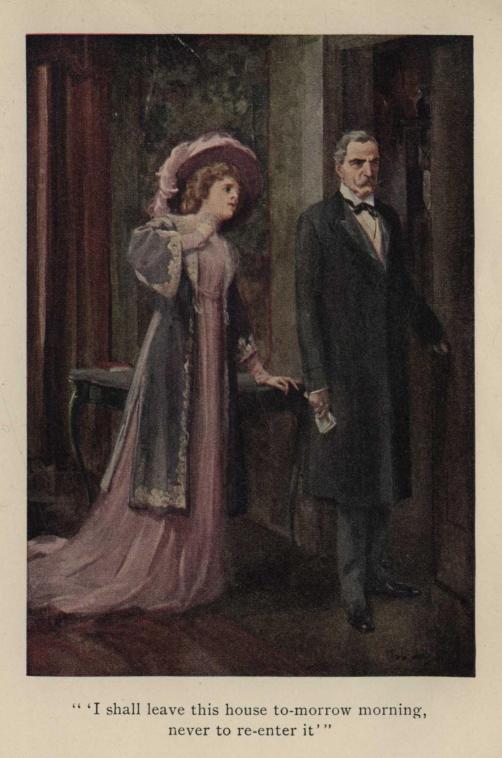
"'I shall leave this house to-morrow morning, never to re-enter it'"
He turned and went into his own study, closed and locked the door.
Alicia's mood of terror changed suddenly to one of fury. She had heard of these people who had no understanding of the temptations that beset the weaker ones. Her husband had decided everything as if she were a child, or rather as if she had not existed; he had hardly listened to her stumbling regrets, her sobbed-out confession. In one short hour it seemed as if his love had turned to the bitterest hate. If he would but have been reasonable something might have been done, but without one moment's hesitation he was sacrificing himself and her, too. She threw herself upon the bed, torn with fury and remorse and a multitude of emotions, which she could neither control nor understand.
The servants in the house knew that something had happened, and when dinner was announced did not expect either the Senator or Mrs. March to come down. Senator March, however, did so, with the same extraordinary coolness and courage with which he would have dined the night before his execution. The door-bell had been ringing constantly, and cards, letters and telegrams had begun to arrive in shoals. No one had been admitted, but half-a-dozen reporters were camped out on the pavement.
When Senator March's solitary dinner was over he returned to his study and called up by telephone his man of business, James Watson, arranging with him to come at ten o'clock with his stenographer, prepared to work all night if necessary. As the evening wore on, the ringing of the telephone and door-bells, the delivery of despatches and letters increased, but only one person was admitted other than Watson, who arrived punctually at ten. About eleven o'clock an elderly gentleman, whom the footman recognised as the Secretary of State, called, and when the footman gave the stereotyped message, that Senator March asked to be excused, the Secretary paid no attention to it, walked across the hall and upstairs into the study. Watson and the stenographer rose at once, and left the floor clear for the great man and the Senator.
"What about this yarn in the afternoon newspapers?" asked the Secretary abruptly as soon as the door closed.
"I have just telegraphed to the Governor of the State that a vacancy will exist in the Senate after twelve o'clock to-morrow," answered Senator March; "I am prepared to confess everything before the Senate to-morrow and resign my seat."
"What have you to confess?" asked the Secretary, "it was your----"
He had meant to say "your wife," but something in Senator March's eyes stopped him.
"I am the guilty person," he said, looking the Secretary steadily in the eye, "it is better for me and better for the party that I should get out now."
"What do you mean?" cried the Secretary of State.
"Just what I say. Not a vote will be lost to the party in the Senate as the state legislature is ours, but I must go, and go quickly."
The Secretary began an impetuous argument but presently stopped, saying:
"I fear it is useless for me to reason with you. A Berserker madness possesses you."
"It is a question of honour," replied Senator March.
The Secretary of State, who had been walking about the room eyeing Senator March, went up to him and offered his hand.
"It is useless for me to remain," he said. "I think I know the truth of the business, and perhaps I should act just as you are acting. Good-bye."
He grasped Senator March's hand, and the two men, looking into each other's eyes, understood perfectly. If Senator March had been guilty, as he proclaimed, the Secretary of State was not the man to offer him a hand.
Meanwhile, in these eventful hours, at the White House, and at every other political centre in Washington, the agitation was profound, nor was it confined to those who had a direct interest in Senator March's downfall. That night there was a large dinner at the British Embassy, and although the subject of Senator March was uppermost in every mind little was said about it, and that with bated breath. It was too astounding and not to be intelligently discussed until Senator March had been heard. The general belief was not far from the real truth.
When the last guest was gone, Sir Percy and his wife went to Lady Carlyon's own sitting-room. It was the first moment they had been alone together since they had seen the startling news in the evening journal. As they entered the room, Lady Carlyon gave her husband his favourite chair, and drew the lamp shade so that the light should not vex him--all those graceful little attentions which are so soothing to a wearied and perplexed man. She knew by intuition what his first words would be.
"It seems to me," he said, "as if I had brought about this whole frightful catastrophe, as I introduced Senator March to Alicia Vernon. But for me, and for my folly and bad conduct sixteen years ago, Alicia Vernon and Senator March would probably never have met. All the consequences ought to have fallen upon me, but you see they don't, they fall upon the man who is the soul of truth and honour, and wreck him while I sit in peace by my own fireside with you."
Lady Carlyon, being a true woman, would rather the consequences of her husband's early misdoing should fall anywhere than on him, and with a woman's conception or misconception of abstract justice said so to Sir Percy. He felt, however, as if the Fates and Furies had fallen upon the wrong man. Lady Carlyon combated this with tender sophistry, which did not convince her husband.
"At all events," she said, "Senator March is an innocent man, and can no doubt disprove all these things. I should like to hear his disclaimer. Would there be any objection to my going to the Senate chamber, for of course the matter will be taken up at once?"
Lady Carlyon had not been brought up in a representative's family without knowing something of the way things went on in Congress.
"I think you may go," replied Sir Percy. "Of course, Senator March is innocent, but it would be just like him to sacrifice himself for his wife."
"As you or any other man, who is a man, would do," responded Lady Carlyon.
"Yes; but men are not called upon to sacrifice themselves for the right kind of women like yourself, my dainty Lady Lucy," and then they kissed each other, and forgot for a time all the troubles and perplexities and remorses of life.
The next morning dawned clear and bright and soft, an ideal spring morning in Washington. Alicia March, who had not once lost herself in sleep through all the miserable hours of the night, rose early and dressed herself without her maid. Throughout the splendid house was the sombre and intangible atmosphere of calamity; the servants had read the newspapers, and knew that disgrace and disaster were at hand for the master and mistress of that house. They were full of curiosity, and whispered among themselves, speculating upon their chances of getting new places.
Alicia watched the whole of the early morning for some communication from her husband in his locked room, only two doors away from her, but there was no message or letter. Senator March's own brougham always came for him at half-past ten, and it was the same on this fateful morning. Alicia, looking out of the window, saw some light luggage brought down and placed upon the box. She turned to her desk, and writing a few appealing words, took them herself to the door of the study and knocked loudly. She could hear voices within--Senator March giving his directions to his secretary and to Watson, his man of business. No attention was paid to her, not even when she thrust the note under the door. There was, however, a pause, and she thought perhaps her husband was reading what she had to say. She did not hear another door of the study open and the three men pass quickly down the softly carpeted stair, but hearing the bang of the carriage door, she ran toward the window and saw her husband drive off alone. A wild desire took possession of her to see the tragedy brought about by herself played to the end. She rang the bell violently for her maid, and with great agitation was dressed in the same simple black gown and hat and thick veil she had worn when going to Colegrove's hotel in the winter. As on that day, she went out as if to walk, not caring for her carriage to be seen at the Capitol, and, calling a cab, directed the man to drive her to the dome-capped building on the hill.
She had feared being recognised, but when seeing the surging mass of people, those crowds of the unknown who year in and year out swarm through the Capitol, pack the galleries and block the corridors, who seem strangers to the town and to each other, she realised that there was little danger of her identity being known. She joined the surging mass, and was swept onward to the public gallery, where the crowd was clamouring at the doors and the doorkeepers were holding them back. Alicia, making her way toward one of the doorkeepers, whispered:
"I am Mrs. March, and desire to go inside."
The man recognised her instantly; he had often seen her passing through the corridors on the way to and from the private gallery--Senator March's wife was too important a person to be unknown to the Capitol officials. He opened the door a foot or two, and, still keeping the crowd back, passed Alicia into the gallery. There was scarcely standing room, and Alicia was almost suffocated with the pressure; nevertheless, standing at the very back of the crowd, she was safe from observation. She glanced around the great hall with its grained-glass ceiling through which the yellow sunlight filtered, casting a mellow glow upon the scene. Nearly every senator was in his seat, and every gallery, even the one sacred to the diplomats, was filled. There on the front bench sat Lady Carlyon. Never had she appeared more handsome; she wore a white gown and a hat decked with roses, and seemed the epitome of the spring. She was smiling and talking to the French Ambassador, who was leaning over toward her. To Alicia's miserable eyes it seemed as if Lady Carlyon were there to flaunt her happiness, her splendid position, her youth and beauty, in the face of the storm and shipwreck which would that day befall Alicia March and her husband.
It was still half-an-hour before the Vice-President's gavel would fall, and it was one of the most painful half-hours in Alicia March's life. She cowered behind her neighbours and dreaded to be seen, while Lady Carlyon seemed to court the attention of which she was the object. Precisely at twelve o'clock the Senate was called to order and the Chaplain offered a short prayer. Just as the prayer was concluded, Senator March entered the chamber; except for his deathly pallor, he gave no indication of what he had undergone, nor of the ordeal before him. He walked to his desk and sat down; every eye was fixed upon him, but there was some pretence of beginning routine business. When he rose and, catching the Vice-President's eye, asked to be heard upon a point of the highest privilege, the Vice-President bowed, and instantly silence like that of death fell upon the Senate Chamber. Senator March spoke in a perfectly composed manner and his voice, though low and agreeable, had a carrying power which made it distinctly audible in every part of the vast hall and galleries. He alluded to the publication of the charges affecting him, and then declared, without a quaver, that there was enough of truth in them to make it advisable that he should resign his seat in the Senate, adding that he had already telegraphed his resignation to the Governor of the State. He had nothing to say in extenuation, and only one thing to say in explanation; this last was that he alone was concerned in the A.F.&O. transactions.
"There have been certain innuendos," he said, raising his voice slightly, "against an innocent person, a perfectly innocent and helpless person, whom I now appear to defend. To bring, even by implication, the name of this person into this matter was most cruel and unjustifiable, and I hereby protest against it with all my might. I ask no consideration for myself, but I demand it for that misjudged and blameless person who has been attacked under the cover of the public press. I leave this chamber never to return to it; if a lifetime of regret can atone for what, I now feel, was not the proper use of my position as senator, these acts of mine will be atoned. I can say no more, and I can say no less."
The whole incident did not occupy five minutes. The breathless silence was maintained as Senator March came out into the aisle and bowed low to the Vice-President, by whom the bow was scrupulously returned, and at the same moment, acting by a common impulse, every senator rose to his feet; this was followed by a sound like the waves upon the seashore, for every spectator in the galleries also rose, moved by that spectacle of the most high-minded of men taking upon himself the burden of another's guilt.
Senator March stopped for a moment and glanced around the chamber in which he had had a place for nearly fifteen years. The great wave of sympathy and respect made itself obvious to him. The colour rushed to his pale face, and then as suddenly departed, leaving him whiter than before. He walked with a steady step towards the door and the door-keepers, in throwing the leaves wide for him, bowed low, a salute which Senator March returned with formal courtesy.
Then the silence was broken by a faint cry and a commotion in the public gallery; it was thought that some one, overcome by the crowd and excitement, had fainted. Not so; it was Alicia March who had uttered that faint cry, but the next moment she had slipped through the door and was making her way swiftly out of the place. No one stopped her or even recognised her, and she made her way to the ground-floor entrance, where Senator March's carriage was drawn up. She saw her husband pass out directly in front of her. His step was still steady and his iron composure had not deserted him. He entered the waiting carriage, which was driven rapidly off, and when it was out of sight down the hill Alicia crept forth and stepped into the shabby cab, in which the most luxurious of women had gone, as it were, to the place of execution.
XII
It took half-an-hour for the decrepit cab horse to drag the vehicle to the door of the splendid home which was now Alicia March's alone. As she entered she met Watson.
"Is my husband here?" she asked.
Watson raised his eyebrows in cool contempt.
"He is on his way to his ranch in the West, never to return. May I see you now for a few minutes to transact some necessary business?"
Alicia without a word led the way to her own boudoir, passing the door of her husband's study. The desk was clear and already men were at work packing the books which were all that Roger March took from the noble fittings of what had once been his home. It was so like removing the paraphernalia of a dead man that Alicia shuddered as she passed the door. Seated at a table in her own rooms, Watson passed over to her certain deeds, papers, and a bank-book showing a large sum of money deposited to her credit at the bank.
For all of these he required Alicia's signed receipt, which she mechanically gave, understanding little of the details of business. When it was over, Watson rose and took his hat.
"But," said Alicia, dazed and distraught by all that had passed so quickly, and helpless in the management of affairs, "what shall I do with these things? Will you take charge of them? I really don't--don't understand."
"Excuse me," answered Watson coldly, "it is impossible for me to act further in your affairs. If you wish any more information, and will notify me who is your man of business, I will consult with him at any time." And without saying good-morning, and putting his hat on in her presence, Watson left the room.
Alicia sat stunned, but dimly conscious of the indignity and affront put upon her. She was of a caste accustomed to all the niceties of respect, and she had managed to retain them until now. She began to ask herself, if she received such treatment from Watson, what might she expect from the whole world? And then there was an awful sense of loss in the mere absence of her husband. Often during the four years of her last marriage it had seemed to her as if her husband was the person who put everything out of joint. She had her establishment, her money, her liberty, and could do as she pleased, which was freely granted her, and life would have been delightful, but close to her always was this man before whom she must ever act the part of a perfectly upright woman. It was that which had produced the curious sense of dislocation and bewilderment which had always haunted her. Now that he was gone, however, the dislocation and bewilderment seemed greater than ever. She came of good fighting stock, and presently she found a little of her courage, and began to think what was best to do in order to save herself. The first thing, of course, was to have her father come to her. She wrote out a long and urgent cablegram, certain to bring General Talbott at once, and then ringing for a servant, sent it off. There would be time enough before General Talbott's arrival to consider what she should tell and what should remain unknown. Then the thought that Sir Percy and Lady Carlyon must surmise the truth came to her, and it was poignant enough to make itself felt even in those first hours of shock. She was no more able to rid herself of the involuntary hold which Sir Percy Carlyon had upon her than she had been a dozen years before. With the Carlyons, however, she had a strong card to play in General Talbott, who would soon be at hand. She sent for the servants and calmly informed them that her husband, whom she called Mr. March for the first time, would be absent indefinitely, and that the establishment would be kept up, and they could retain their positions if their conduct remained good.
In the afternoon Colegrove's card was brought up to her. She went down into one of the vast, silent drawing-rooms to see him. Colegrove was not pleased at this, and would rather have seen her in her boudoir, but nevertheless met her with a smile and debonair manner. Alicia looked pale, but her manner was quite composed.
"I hope you will pardon me for saying that I am afraid your husband has acted hastily," said Colegrove, when they were seated, "but of course the career of a man like that can't be closed so suddenly. All this will blow over in time, and five years from to-day we may see him in the Senate again. As far as I am concerned, I have lost a good friend, and I shall now be hounded into retirement, if not into prison."
He smiled as he spoke, showing his white even teeth, and Alicia could not but admire his cool courage in the face of what must have been to him a catastrophe scarcely less than her own. They were sitting in the embrasure of a window, and their low voices were lost in the expanse of the great room. Nevertheless Colegrove did not consider it an ideal place to say what he had come to say. He said it, however, glancing through the wide-open doors to see that no person was in hearing.
"March has accused himself of what no one believes, but has left you to bear the real burden. That is really what his alleged confession amounts to. I don't think that you owe him anything. If he stays away, as you tell me he means to, you may claim your freedom at any time, and then perhaps you will consider me, who would never leave you as March has done. For my own part, I, of course, can get a divorce any day I choose."
The same strange feeling of indignation came over Alicia which she felt when Colegrove had once before made implication against Roger March. Still she did not repulse him, who was the only human being that had voluntarily come to her that day, and she felt intuitively that he was the only one who would continue to come.
"You must not speak of such things," she said coldly, and rising.
Colegrove rose too. He had implanted the notion in her mind that March, after all, had sacrificed her, and that she was nothing to him. A new expression came into Alicia's speaking eyes. She looked fixedly at Colegrove and then bent her head in reflection.
"I go now," said Colegrove, "to fight my battle. I don't know how, or when, or where it will end, but if they drag me down I will, like Samson, drag down all I can with me, and the crash will be heard from one end of this continent to the other. Here is an address that will always find me."
He lifted her passive hand to his lips, put a card within it, and went away without another word.
Alicia spent the intervening hours between then and a solitary dinner walking up and down the great drawing-rooms. She did not give Colegrove a thought; her mind, agonised and tormented, was working upon the problem whether or not March, in the intensity of his anger, had deliberately sacrificed her.
The sense of fitness and good taste, which had never left Alicia Vernon, remained with Alicia March. She did not run away from Washington, but, having determined to take up the attitude of an injured woman, remained in her house, but in strict seclusion. Every day she took the air in a closed carriage, or, heavily veiled, walked for hours. She continually met her acquaintances, who spoke to her coolly and passed on, and Alicia did the same. A few persons, chiefly silly women and foolish young men, left cards for her, but Mrs. March, knowing that such backing was a detriment instead of a help, was excused at the door. She had received an immediate response from her father, who had taken the first steamer for America. Within a fortnight from the day Roger March left his home General Talbott arrived. He knew of March's resignation from the Senate, and Alicia, in the first hour of her father's arrival, put in his hand the newspaper which contained the charges and The Congressional Record, with March's speech, and left him to draw his own conclusion. General Talbott read them through carefully, and then, taking Alicia's hand, said to her with tears in his brave old eyes:
"My child, you have been singled out for ill-treatment, and to bear the sins of others. March's conduct was inherently wrong, but it showed a cruel disregard of you not to make some show of fight for his name. Your father, however, will remain your steadfast friend."
The presence of General Talbott sensibly improved Alicia March's position in Washington. His old friends, of whom he had many, called to see him, and perforce left cards for Mrs. March. Among them was the card of Sir Percy Carlyon, but no card was left for Alicia, nor did Lady Carlyon's card accompany her husband's. Alicia observed this, but she did not choose to notice it openly at present. She meant that considerable time should pass before she began an active struggle to regain her lost position.
Early in May the great house was shut up and Alicia March and her father sailed for England. It was two years and a half before she reappeared in Washington. During that interval no one in Washington heard of March, except Watson, who received occasional communications from him on business. He seemed to have dropped out of the world; the depths of the Sierras is a very good hiding-place for a broken-hearted man.
Those two years and a half seemed to be unclouded for the Carlyons. Sir Percy found his mission exactly to his liking, and his prestige was steadily increased by his management of affairs. It even met with the approval of Lord Baudesert, who found himself unable to keep away from his beloved Washington. Mrs. Chantrey, whose hopes of being an Ambassadress had been dashed by Lord Baudesert's retirement, still cherished dreams of being Lady Baudesert, and was warmly encouraged in her aspirations by that wicked old gentleman during his whole visit to Washington. Eleanor Chantrey had remained unmarried. Her beauty and her fortune would have enabled her to make a choice of many brilliant marriages, but deep in her heart rankled something like disappointment. She had not been in love with Sir Percy Carlyon, but she would have married him if he had asked her, an attitude of mind commoner among women towards men than is generally supposed. Eleanor was certainly fitted to be an Ambassadress, but Lady Carlyon had fitted herself with consummate address for that lofty position. Lord Baudesert was openly delighted at the position which Lady Carlyon had made for herself. Her dignity, her sweetness and good sense had given her also a prestige which made her backing of the greatest value. Every woman in Washington society whose social and personal record was not like the driven snow was eager for the support of Lady Carlyon. With natural good judgment and acquired prudence Lady Lucy, as Lord Baudesert, like Sir Percy, called her, managed to escape every pitfall. She could neither be used, nor worked, wheedled, nor bullied, but pursued a course inspired alike by good taste and good feeling. Her two boys increased day by day in beauty and intelligence, and Sir Percy would have reckoned himself among the happiest as well as the most successful of men but for the memory of Alicia March. He was haunted by the thought, not without reason, that he was responsible for the tragedy which had befallen Roger March. He could readily imagine the motive which inspired March, and the thought of him dragged down by his wife's dishonour, seeking oblivion in the farthest corner of the continent, was a keen and ever-present regret to Sir Percy Carlyon. He had heard occasionally from General Talbott, who was abroad with his daughter. The great March house remained closed but tenantless, and Sir Percy surmised that Alicia March would in time return to the scene of her greatest triumphs and her deepest humiliation.
The echoes of the great railway scandal lasted during all of these two years and a half. Colegrove was not the man to go down without a terrific struggle. March's acknowledgment of the charges and his resignation would have been too strong for any except the strongest of men to withstand, but Colegrove, finding himself with his back to the wall, fought with a desperation worthy of a better cause. He had the money, the courage and the adroitness to drag everything into the courts, where the law's delay was a great help to him. So many powerful interests were involved that they made a bulwark around him. At the end of the two years and a half he was actually in much better case than he had been when he had first been pinned to the wall by his enemies, and his supply of ammunition had been increased. He had succeeded, by pouring out money like water, in enmeshing everybody and everything in a legal tangle from which no one could see a way out. His natural genius for making money was such that he could always contrive to make vast sums, and the wonder was, as with a clever pickpocket, why he did not satisfy himself with the brilliant success he could have made legitimately. Every two or three months during that time he communicated with Alicia March. He had an apparent reason for doing so, as he represented that the stocks held for her in his name were always earning dividends, and every letter contained a cheque. One of these letters informed her that his wife had got a divorce from him. The poor lady had in truth been goaded into it. Alicia March made no reference to this in the brief replies she sent to his letters.
XIII
One afternoon in December, nearly three years after Mrs. March had left Washington, Lady Carlyon was driving through the fashionable street in which the March house was situated. Lord Baudesert, who was on his annual visit to Washington, was in the carriage with her.
"Look, my Lady Lucy!" he said; "Mrs. March has come back, like another Joan of Arc, to defy her enemies. By Jupiter! that woman is as brave as Hector and Lord Nelson rolled in one. I have heard some pretty stories about her."