THE WHIRL (continued 2)
Reading edition
Sir Percy had some thought of excusing himself from his semi-weekly visit to Lucy on that evening, but, doggedness still possessing him, he went, thinking to himself, at any moment the explosion might come, any meeting might be their last, therefore would he have as many as possible. He had not reached his present position without acquiring perfect mastery over his manner, his voice and his countenance, and Lucy had no suspicion that he was not entirely at his ease when he entered the Armytages' sitting-room.
Never had he seen Lucy more charming than when she came forward to meet him. She was full of the lessons in languages she was taking, especially in rubbing up her superficial knowledge of French. She had got a French newspaper, and read with admirable accent some editorials in which Sir Percy was interested. Mrs. Armytage went sound asleep as usual, and the lovers could talk with a sweet unrestraint. Heretofore it was Sir Percy who had risen promptly on the stroke of ten, but to-night it was a quarter past before he stirred, and Lucy then forced him away. He returned to his chambers accompanied by the ghost of his wrong-doing, and the black dog who kept watch over him prevented him from sleeping all night long.
The next afternoon at five o'clock Sir Percy Carlyon was ushered into General Talbott's and Alicia Vernon's charming little drawing-room at the hotel. As he came in, General Talbott met him with both hands outstretched. Sir Percy realised, as he always did in General Talbott's presence, that here was a man of no common mould. He was small, bald and low-voiced, but in distinction of bearing and manner there were few men superior to General Talbott. This distinction also belonged to Alicia Vernon, and Sir Percy could not but recognise it as she rose and advanced towards him and gave him her hand. She was quite forty, and showed it. Like most women of her exquisite blonde type, each year left a visible mark. Her chestnut hair had lost much of its lustre, and her fine white skin had little marks and lines in it, like a crumpled roseleaf. She had not the freshness and naturalness which Sir Percy Carlyon reckoned the chief charm of the American women. Alicia Vernon was the product of an old civilisation, and showed it; but her tall and stately figure retained all its symmetry, and her eyes and her voice and her smile--ah, they were matchless still! Her voice, low, soft and clear, had a melancholy sweetness and power of expression that Sir Percy Carlyon had never known in any woman's voice but hers, and her eyes, the colour of the violets, had in them a depth of fire, and flickering shadows like the heart of an opal. Everything about her was individual and distinctive. Sir Percy was not much versed in the details of a woman's dress, but he felt, rather than knew, the beauty of the sweeping, pale blue draperies which undulated about Alicia Vernon, and the seductive perfume which exhaled from everything which she wore and used. Hers was the charm of the Shulamite.
In meeting Sir Percy her manner and tone were perfectly calm, friendly and composed. Towards her father she was always perfect; and his air of tender, chivalrous protection was touching and beautiful.
The three sat around the fire and talked intimately, as friends do after a long absence. Mrs. Vernon offered Sir Percy a cup of tea, and even handed it to him with her own hands sparkling with gems, but he declined it. If it had been in Italy during the time of the Borgias he would have hesitated to drink any cup offered him by Alicia Vernon. She said little, leaving the conversation chiefly to her father and Sir Percy. As they talked she sat in a large chair, her head half turned towards Sir Percy and holding between the fire and her face an antique fan painted by Greuze. She had been a slip of a girl when her lips had sought Sir Percy's, and had shown him, in triumph, her long, bright hair; but in some things she was unchanged, and Sir Percy felt that a stripling of to-day, such as he had been in the old days, would not be safe with Mrs. Vernon. While they were talking Lord Baudesert's card was brought to General Talbott. On it was scrawled:
"My first chance to take the air. Gout has me by the leg, so come down and drive with me for an hour."
General Talbott rose at once. Sir Percy had no excuse to leave at the same time and remained perforce.
When the door was shut on General Talbott Sir Percy Carlyon's face changed into the hardness of a flint, and he sat silent waiting to see what position Mrs. Vernon would take with him. She too remained silent for a while, fixing upon him two wells of violet light. The setting sun streamed through a western window upon Sir Percy's face, and she studied it carefully. No; he was not handsome even as a young man, and at thirty-eight his moustache was growing grey and his hair scanty, and there were crow's feet in the corners of his eyes. But what did that matter to her? He was the most considerable man upon whom she had ever tried her power.
"After all," she said presently, her low voice filling the room as a trained singer's softest note is heard at the Paris Opera, "I was right even in my youth, and knew that before you was a great destiny. You are to be the next Ambassador here."
"How did you know that?" asked Sir Percy.
"Partly by observation and partly by a clever guess. I have been staying in the same house with the Prime Minister, and quite naturally we spoke of you. I told him that we were old friends."
As she said the last two words Sir Percy Carlyon turned away his head and a dull flush dyed his sunburnt face.
"However, those are matters really of prescience. I was very young when we loved, but even then I knew that some day you would be a great, if not a famous, man."
"I am neither," responded Sir Percy, taking refuge in commonplace.
Then there was silence again for a time. The firelight played over Mrs. Vernon's face and figure and the masses of pale blue draperies, and over the tip of her pale blue slippers, upon which stones sparkled. Her eyes were fixed upon Sir Percy, and, raising herself in her chair, she leaned over towards him and said calmly:
"Guy Vernon, you know, has been dead more than a year."
Sir Percy knew what she meant--that she was now free.
"I had not heard it," he replied with equal calmness. "I hope that your latter days with him were happier than the earlier ones."
"I had not seen or spoken with him for several years. We had much unhappiness together. If I had been happily married----"
She broke off suddenly and then continued after a while:
"It would be hypocritical for me to express any grief at Guy Vernon's death, and, whatever I am, I am not a hypocrite--except to my father. I love him, for I can love, and he is the one person I really fear--except you."
As she spoke she leaned forward again, and, closing her fan, almost laid the tip of it upon Sir Percy's hand, outstretched on the arm of his chair. In another instant it would have been a caress, but Sir Percy coolly moved his hand and Mrs. Vernon quickly withdrew the fan.
"General Talbott is a man very much to be feared as well as loved," was his answer. "Whenever the memory comes to me of what I owe him and how I repaid him I feel like shooting myself."
"But we were very happy in that time," murmured Alicia, leaning back and letting her hands fall in her lap as she watched the fire.
Sir Percy rose and Alicia Vernon rose too.
"You know very well," she said, showing some agitation, "why I came here. I wanted to see you. I am a fool, of course--every woman is about some man. I have tried to forget you, I have been trying to do that for twelve years, but I have not yet succeeded. Do you remember those tragic stories of the Middle Ages, when a woman who loved a man would dress herself as a page and follow him to the Crusades? Such are the women who knew how to love; not those conventional creatures who sit by the fire and to whom one man is the same as another."
As she spoke her eyes filled and two large bright tears dropped upon her cheeks, and she pressed her handkerchief to her eyes with a trembling hand. Sir Percy had meant to be stern with her, but no man, if he be a man, can be stern to a woman in tears. He remained silent for a minute or two, moved, in spite of himself, at Alicia Vernon's emotion.
"Alicia," he said, and then paused. It was the first time he had called her by her name for years, and as he spoke her eyes lighted up and a sad smile played about her mouth. "I, least of all human beings, can reproach you. I am willing to take upon myself all the guilt, all the shame, of that bygone time, but it was guilt and shame, and let us not deceive ourselves."
"Was it guilt and shame?" she asked in her thrilling voice. "Was it rather not fate? I was married at twenty to a worthless wretch. I was formed to love and be loved, and I found myself tied to a creature like Guy Vernon. Then I met in you the man for whom I was meant and I came into my own. At least I was disinterested, for then you were both poor and obscure. I never had one regret for anything that happened. Do you suppose that Marguerite Gautier regretted, even when she was dying, that she had loved Armand? I always go, when I can, to hear that opera, La Vie de Bohème. Mimi's death is really a triumph of love. Let me tell you this: no woman who ever loved ever regretted it. If she regretted it she did not love. Men feel and act differently about these things. You know you loved me once and you have seemed to hate me ever since, but love will prevail--it will yet prevail."
It was a piteous sight to see her with clasped hands and the glory of an undying hope in her eyes and voice. To make her believe that the end had come long since between Sir Percy Carlyon and herself was like fighting a shadow. The resolve took possession of Sir Percy to tell her of Lucy Armytage, and then she might realise the inevitable.
"We will speak no more of the past," he said, "and I will tell you what has happened in the present. I have met a woman whom I truly love, and she has promised to marry me."
Alicia Vernon turned deathly pale, and stood looking at him with eyes like those of Dido when she saw Æneas sail away from her. She walked steadily to the window and looked with unseeing eyes at the glory of red and gold in which the sun was sinking. Sir Percy Carlyon, standing where she had left him, had to battle with his common-sense. Reason told him that he had done this woman no injury--rather she had injured him--and although Alicia Vernon's protestation of love for him carried with it conviction of truth, it had not kept her in the straight path. Nevertheless he felt as if he had struck her a physical blow. Presently she came from the window towards the fire, and said to Sir Percy what any woman of forty would say:
"The girl you love is young?"
"Yes."
"That is the way of the world," cried Alicia--"youth is everything. What is it François Coppée says? 'There is nothing for women but a little love when they are young.' I ask, however, one thing of you. You can scarcely refuse it." Sir Percy remained silent. He did not refuse it, but he was too much on his guard to promise it. "Only this, let me see this woman whom you prefer to me. You think it childish? Very well; all women have something of the child in them."
Sir Percy went towards the door, and his face, already dark and flushed, grew still darker. Alicia came up to him and said with pleading in her voice:
"You can't suppose that I would let her suspect anything? I think I have shown that I know how to keep the secrets of my life. I would hardly be so foolish as to betray myself to this girl who has succeeded where I have failed."
Then came one of the most exquisitely painful moments of Sir Percy Carlyon's life. The thought of bringing Lucy Armytage into the same room with Alicia Vernon filled him with rage and shame. Rather than see Lucy Armytage become what Alicia Vernon was he would have killed her with his own hand. Something of this dawned upon Alicia's mind as she looked at him. It flashed from her eyes and burst into words.
"It is the old story. You are worthy to marry her, but I am not worthy to speak to her. Oh, what a world it is!"
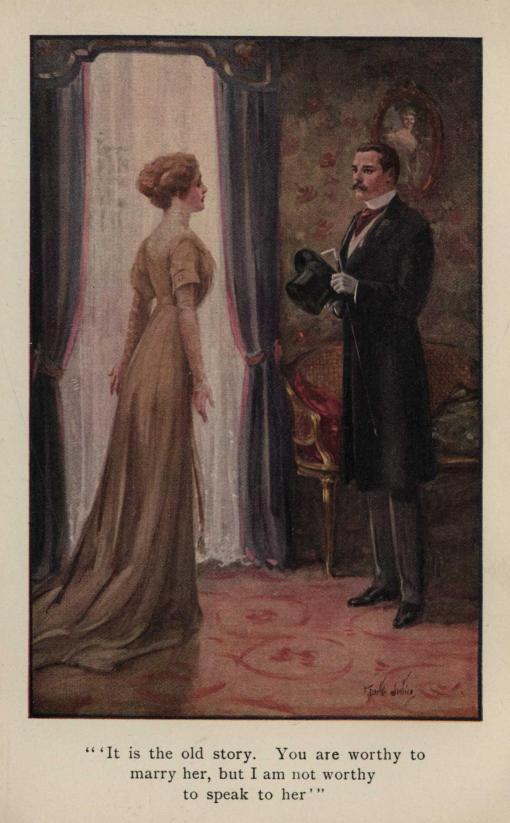
"'It is the old story. You are worthy to marry her, but I am not worthy to speak to her'"
"It is the world which has made that law, not I," responded Sir Percy. "Don't think that I reckon myself worthy to marry this woman whom I love--I only hope to make myself a little less unworthy. Ever since the world was made it has demanded more of women than of men."
"That law sounds well when it is enforced by you against me. Good-bye," was Alicia's response.
VI
Sir Percy Carlyon went out into the cool March air, which steadied his much-shaken nerves. He had refused to bring about a meeting between Alicia Vernon and Lucy Armytage, and with masculine directness made not the slightest secret to himself why he did it. Yet he was not without shame at the part he had played in the matter.
It was early for his walk, as the spring afternoons were growing longer. He struck out toward the northwest and walked for an hour. As he was returning he reached the top of the hill, where the paved streets began, when Lord Baudesert's carriage with its high-stepping bays overtook him. Lord Baudesert called out of the window, and in another minute Sir Percy was sitting in the carriage opposite Lord Baudesert and General Talbott.
"It is rather pleasant," said Lord Baudesert, "to come across a countryman once in a while, and not to be always considering American susceptibilities. Talbott, here, is delighted with the country as far as he has got. I told him it is the most interesting, as it certainly is the most complex, of all nations and societies." Lord Baudesert leaned back in the carriage and settled himself comfortably to talk upon that agreeable subject, his own affairs. "The Ambassadors at Paris and Berlin and other European capitals have an easy berth compared with mine. I can walk in and talk with the President and arrange affairs to our mutual satisfaction. It might be supposed that I had accomplished something, as it would be in any Chancellery of Europe, but not here, if you please. At the next Cabinet meeting the Secretary of State may say that it is all a stupid blunder on the part of the President, or the Attorney-General may put in his oar, and all goes to smash. Then, if it gets as far as the approval of the Secretary of State, and the permission of the Attorney-General, as soon as it is done up in official form, it goes to the Senate. The Senate likes to lay the Secretary of State by the heels and the British Ambassador on top of him; and that is where our carefully studied arrangements generally land. The House of Representatives, too, can generally find a peg on which to hang some objection, and, if there is any money involved, we can't turn a wheel without the help of the House. That is diplomacy in America."
"How do you get anything done, then?" said General Talbott.
"There are ways, my dear Talbott. The Speaker of the House is a useful man to have as a friend, and there are, besides, a few men in the Senate who can deny themselves the joy of tripping up an Ambassador. One of them I particularly desire you to meet--Senator March. He stands high with the administration, and with everybody, in fact. He is an uncommonly able man, and has a candour and fairness which disarms opposition. I should not venture to call him absolutely the most gifted man in the Senate, or the most profound lawyer, or the most brilliant speaker, but, take him altogether, I consider him the strongest man in public life in Washington to-day. You will meet him when you dine at the Embassy next week. I will send a card in due form to yourself and Mrs. Vernon. I think I had the pleasure of meeting your daughter once before her marriage?"
"That marriage turned out most unfortunately for my poor child," replied General Talbott, with the peculiar tenderness in his voice with which he always spoke of Alicia. "Guy Vernon had a large fortune, but he was a scapegrace inborn. My daughter was young, innocent, and had never had the command of money, so you may imagine she made some mistakes, but she was most cruelly treated; that I found out after her patience could no longer stand her husband's unkindness. Vernon died more than a year ago, after having lived long enough to ruin the life of my only child."
Sir Percy Carlyon, sitting with his back to the horses, listened with an impassive face to General Talbott's words.
"Mrs. Vernon had her settlements, had she not?" asked Lord Baudesert.
"Yes. But she and Vernon between them managed to get some of the provisions of that arrangement set aside, and spent a great part of the money which was supposed would be a provision for my daughter in the event of Vernon's death. Luckily, there were no children. I shouldn't care to have a grandchild with Guy Vernon's blood in him. My daughter is an angel. Pardon a father's pride."
"She looked an angel," replied Lord Baudesert, "when I saw her in the first bloom of her beauty."
Sir Percy Carlyon, listening to this, reflected that his shrift would be short if General Talbott knew what had happened twelve years before.
Lord Baudesert dropped General Talbott at his hotel, then drove back with Sir Percy to the Embassy, where Sir Percy joined the family circle at dinner. When the ladies left the table and the uncle and nephew were alone was Lord Baudesert's favourite time for exchanging confidences with Sir Percy. To-night he chose the subject of General Talbott and his daughter.
"While I have not seen Talbott's daughter for many years, I remember well what a beautiful and captivating young girl she was, but it seems to me that I have heard rumours--eh? Bad marriage, worthless husband, and gay wife. Do you know anything about it?"
Sir Percy then calmly and deliberately proceeded to lie like a gentleman.
"Nothing except what the world knows. I saw a great deal of Mrs. Vernon twelve years ago when I was in India. As you see, General Talbott is a most devoted father and Mrs. Vernon a most affectionate daughter. She was virtually separated from Vernon when I first knew her."
"And had squandered a lot of money?"
"Both of them were spendthrifts, as far as that goes. Mrs. Vernon was a beautiful young woman and much admired."
"And a little gay, perhaps?"
"Not that I ever heard," responded Sir Percy coolly, looking Lord Baudesert in the eye. "It would be hard to believe that General Talbott's daughter were not everything she should be. He is, I think, altogether the finest man I ever knew."
Lord Baudesert, with a catholic interest in beauty, asked:
"You saw Mrs. Vernon this afternoon. Is she still beautiful?"
Sir Percy paused before answering this question.
"Yes, she is still beautiful, but she is no longer a girl, of course. If you will excuse me now, I will join my aunt in the drawing-room."
Sir Percy went from bad to worse--because as soon as he appeared in the drawing-room Mrs. Vereker and the three girls fell upon him like playful sheep and began to ask him all manner of questions about Alicia Vernon. Was she a great beauty, as Mrs. Vereker had heard, and was she going to marry somebody else, now that Guy Vernon was dead? Jane wished to know how Mrs. Vernon dressed her hair. Sarah inquired if her sleeves were large or small, according to the latest London fashion, and complained that, for her part, Americans changed the mode of their sleeves so often that she could not keep up with them! Isabella yearned to know whether Mrs. Vernon smoked cigarettes or not. Sir Percy almost laughed at the latter suggestion. He had never seen any woman in his life so careful to pay the tithe of mint, anise and cummin to the world as Alicia Vernon, or more ready to avoid the weightier matters of the law. The slightest aroma of fastness was rigidly forsworn by her, and no Cromwellian ever kept out of the way of the fast set more absolutely than did the lady of the violet eyes.
In the midst of this patter of questions Lord Baudesert entered the drawing-room, and the three girls suddenly grew mute, while Mrs. Vereker asked Lord Baudesert, for the fourth time that evening, if the east wind hadn't given him a touch of gout. Having answered this question three times with much savagery, Lord Baudesert let it pass, and demanded pen and paper, directing Isabella, who was the family scribe, to make out the list for the dinner which was to be given next week in honour of General Talbott and Mrs. Vernon. The first name put down was Senator March, and then followed a list of eight or ten other representative men whom Lord Baudesert thought General Talbott would like to meet. The selection of the women was more difficult. By way of disciplining Mrs. Vereker, who did not need it in the least, Lord Baudesert commanded Isabella to begin the list of ladies as follows:
"Mrs. Chantrey."
Mrs. Vereker ventured to say feebly:
"Mrs. Chantrey has already dined here twice this season."
"She may be dining here oftener than you think," was Lord Baudesert's menacing reply, and Mrs. Vereker, in her mind's eye, saw Mrs. Chantrey as the future Lady Baudesert, presiding with much majesty over the British Embassy.
Some girls were required for the unmarried men who were asked. It was the unwritten law that at dinners only one of Mrs. Vereker's covey should appear at the table--an honour which was always received with nervous apprehension by the successful candidate. This time it was Isabella who was the Jephtha's daughter of the occasion. Mrs. Vereker suggested several girls, but each one was remorselessly thrown out by Lord Baudesert on various grounds. Presently he asked:
"What is the name of that girl who was here on the afternoon the two South Americans called, and helped to pull us out of the hole?"
"Miss Armytage," replied Mrs. Vereker.
"She struck me as rather an unusual sort of a girl."
Mrs. Vereker, with her usual capacity for misunderstanding Lord Baudesert's meaning, replied faintly:
"Oh, yes, very unusual! She is from a little town called Bardville in Tennessee, or is it Indiana? I forget which. Of course she would not do at all, and we never thought of suggesting her."
"Put down Miss Armytage," snapped Lord Baudesert.
The comedy suddenly became a tragedy to Sir Percy Carlyon. So, then, Alicia Vernon and Lucy Armytage were to be brought face to face after all--and it filled him with a dumb rage. Isabella, meaning to conciliate her uncle, murmured:
"A lovely girl, Miss Armytage, so intelligent, so interesting!"
"A provincial, if ever I saw one," was Lord Baudesert's response to this. "Nevertheless she has some beauty and a pretty voice, and we will have her."
When Lord Baudesert had retired to his library Mrs. Vereker and the three girls talked in subdued tones for fear the ogre might hear them. They mournfully agreed there must be something between Lord Baudesert and Mrs. Chantrey, and Sir Percy was appealed to for his opinion.
"Lord Baudesert wouldn't marry Helen of Troy if she had all the virtues of St. Monica and John D. Rockefeller's wealth into the bargain," was Sir Percy's consoling answer. "He simply talks about Mrs. Chantrey to worry you. I wish them both joy if they get each other, but there isn't the shadow of danger."
Mrs. Vereker, however, refused to be comforted.
"And what a surprise that he should have gone out of his way to ask Miss Armytage, whom he frankly called a provincial! Surely, in the language of the hymn, it might be said of Lord Baudesert, 'He moves in a mysterious way, his wonders to perform.'"
Sir Percy had promised to stay all the evening, but he broke his promise and left early. He began to believe that Fate, and not he, would settle when and how Lucy Armytage would hear the painful story of his youth.
During the next week Sir Percy Carlyon saw General Talbott every day, and for hours, and it was inevitable that he should see much of Alicia Vernon. He did the regular sight-seeing with them, drove with them through the park, went with them to Mount Vernon, and, in short, acted as their cicerone. Nothing could exceed the grace and composure of Alicia Vernon's manner, and in her defeat she was not unlike General Talbott in the few rebuffs that he had experienced during his life. If Sir Percy Carlyon had been a younger or more sanguine man he would have felt quite at ease, but he knew Alicia Vernon too well ever to feel at ease in her neighbourhood. She was not the woman to lay obvious snares and traps to find out things, much less to fall into the open vulgarity of asking questions, yet Sir Percy felt that her sharp intelligence was at work on every word and phrase he uttered, to find out what he had refused to tell her--the name and habitat of the woman he loved.
Cards and invitations began to pour in upon General Talbott and his daughter, but the dinner at the Embassy was the first formal entertainment which they attended.
Sir Percy's first meeting with Lucy Armytage after Alicia Vernon's arrival was purely accidental. He had taken his late afternoon walk eastward, and as he crossed, after sunset, the deserted plaza of the Capitol he noticed Lucy's slim figure standing in the purple dusk upon the Capitol terrace. She did not know he was near until he spoke, and then she turned, her face and eyes flooded with the joy of the unexpected meeting. She had come from the National Library with a book, and announced her intention to walk back to the hotel.
"Since I am to be an Englishwoman, I shall probably be more English than the English themselves. I walk everywhere, and I have bought a pair of large thick boots, which my uncle declares he can't tell from his own."
Lucy's feet were slender enough to take this liberty with them. Lucy was full of her invitation to dinner at the British Embassy, where she had never dined before.
"It will be different," she said, "from any dinner I was ever at, because when Lord Baudesert and Mrs. Vereker know--you understand"--Sir Percy understood well enough, and Lucy continued--"they will, of course, look back and begin to canvass me and I want them to have a good opinion of me."
To which Sir Percy, like a true lover, replied:
"How could they have any other?" Yet the thought of Lucy coming face to face with Alicia Vernon made him sick at heart.
It was still light enough for them to remain out of doors twenty minutes, and the region of the Capitol, which swarmed with people during the day, was absolutely deserted. A sudden impulse prompted Sir Percy to say to her, as they strolled slowly along the quiet streets in the twilight:
"I have something to ask of you, something I hope you will grant."
Lucy turned upon him two laughing, adoring dark eyes; but the look upon Sir Percy's face sobered her.
"It is this--to have enough faith in me to accept my word. There is something in my past life, something which the world might think of no great consequence, something I will tell you all about when we are married. It will be a confession, but I repented of it long before I ever met you, and I have repented of it a thousand times more since."
"I could not marry any man whose word I could disbelieve," replied Lucy with calm confidence.
They walked together until within a square of the hotel, when Lucy demanded that Sir Percy should leave her.
The evening of the Embassy dinner came, and Sir Percy Carlyon, who always acted as assistant host, was the first guest to arrive. Almost immediately General Talbott and Alicia Vernon followed. Alicia, like most Englishwomen, was at her best in the evening. She was one of those rare women who could wear jewels in her hair and look well, and to-night she sparkled with gems. No woman could cross a drawing-room floor with more grace than Alicia Vernon, or could sit and rise and bow with greater dignity. She was more like an enthroned queen than a pretty princess such as Lucy Armytage's air and manner suggested when she entered the drawing-room. Nevertheless their charms were so different that they enhanced, rather than outshone, each other. Lucy carried in her hands a huge bouquet of violets. They had been Sir Percy's gift, and a whispered word of thanks, unnoticed by any one, repaid him. Alicia Vernon, apparently absorbed in conversation with various persons who were introduced to her, after the American fashion, watched closely every woman as she entered the room. She was the last woman in the world to underrate her rival, and with discernment saw that this black-haired girl with the milk-white skin was easily the most attractive woman present. Mrs. Chantrey and Eleanor were the last to arrive. The former wore at least a quart of large diamonds strewn over her person, and, recalling with triumph that this was her third dinner at the Embassy during the season, considered herself as good as married to Lord Baudesert, and adopted condescending airs towards weak Mrs. Vereker. Alicia had claimed a woman's prescience in matters of the heart. She felt instinctively that the beautiful Eleanor Chantrey was not the woman whom Sir Percy loved.
Not a soul except herself at the long, brilliant dinner-table suspected anything between Sir Percy Carlyon and Lucy Armytage, who sat opposite each other. But Alicia Vernon's violet eyes saw everything without watching. She knew the English habit of not conversing across the table, but she observed that Sir Percy Carlyon spoke to Lucy Armytage once or twice. Lucy, herself, instead of answering him with the gaiety and spirit she showed in her conversation with her neighbours, replied to Sir Percy with only a brilliant smile and a word or two. The indications were so slight that not even the hawk-eyed Lord Baudesert noticed them, but nothing escapes a jealous woman.
Meanwhile, never had Alicia Vernon exerted herself more to please. She sat on Lord Baudesert's right hand and on her left was Senator March. Mrs. Vernon was a better listener than talker. She had not the naïve effervescence of the American women, but she had a softness, a charming air of listening with profound attention, which few American women ever acquire. Senator March, struck from the beginning by her manner of the highest breeding, admiring her mature beauty and charmed by her subtle and even silent flattery, thought it the pleasantest dinner he had ever attended. Eleanor Chantrey sat on the other side of him and he experienced a glow of pleasure which a man feels when he basks in beauty's light. But Eleanor Chantrey was not much older than Lucy Armytage and her range of conversation was strictly limited to what had happened since she came out in society. Senator March had passed his fiftieth birthday and liked to talk about things which happened twenty-five years before. He had an agreeable feeling with Mrs. Vernon of being contemporaries, which he could not feel with a younger woman. Alicia Vernon, on her part, recognised Senator March's virtues as a dinner man and was tactful enough to keep to herself the surprise she felt at finding an American so accomplished.
When the ladies left the table and the gentlemen's ranks were closed up for that comfortable after-dinner conversation, which is still the heritage of the Englishman, Lord Baudesert took pains to bring General Talbott and Senator March into conversation together. Between the two men a good understanding was instantly established. General Talbott did not lose interest in Senator March's eyes for being the father of the charming woman who had sat next him. With the frank friendliness of the American, he made greater headway in General Talbott's acquaintanceship during their half-hour's talk than many Englishmen make in a month's companionship. Simultaneously Senator March asked permission to call, and General Talbott gave a cordial invitation to him to do so. Lord Baudesert was in high feather. The dinner had been pleasant and agreeable and he was pleased that General Talbott should see what admirable dinner guests Americans of the best sort made. Sir Percy Carlyon appeared to be in his usual form, but, as he sat smoking and talking pleasantly, the thought that Lucy Armytage and Alicia Vernon were at that moment in the same room, on the same terms, and reckoned to be of the same sort, gnawed him like some ravenous beast.
Mrs. Vernon at that very time was sitting on a sofa with Lucy Armytage, and with perfect art and tact was finding out from her many things which the girl was quite unconscious of betraying. Alicia Vernon was puzzled by the fact of a secret engagement, because Sir Percy had told her that the girl he loved had promised to marry him, and this was evidently unknown to the rest of the world. Without the least trouble, by asking a few half-laughing questions about the custom of engagements in America, Alicia Vernon discovered that such things as unannounced engagements existed and were not considered discreditable. Lucy answered readily, but in speaking her pale cheeks took on a colour like the faint pink of the azalea. Alicia led her on without questions, but with clever suggestions, to tell of her employments, of the books she read and many other things, which Lucy told frankly and without the slightest suspicion that she was being cross-examined, and was adding link by link to the chain of evidence which had begun with the mere probabilities of a guess.
Alicia Vernon's heart burned within her. She would like to have forgotten Sir Percy Carlyon long ago, as she had forgotten many others. She knew that her feeling for him was an infatuation, but in some strange manner he had dominated her imagination from the beginning. It was the most dangerous, on account of General Talbott, of all the affairs in which she had ever been engaged; but all women like Alicia Vernon have one tragic love. The old Greek superstition that those who defy love are punished works out in a different civilisation with those who dishonour love, paying for it in blood and tears.
Alicia Vernon had said to Lucy:
"Sir Percy Carlyon and I are old friends. We met first in India twelve years ago."
Lucy had enough mother wit not to express surprise or to betray how much she knew of the incidents of Sir Percy's life. But she was no match in finesse for Alicia Vernon, who found out, without the least trouble, that the girl knew certain dates, places and events which she could not have known except from Sir Percy Carlyon.
The sight which greeted Sir Percy when he entered the drawing-room was Alicia Vernon and Lucy Armytage still sitting upon the small sofa together, apparently conversing with intimacy. A tall, red-shaded lamp cast a rosy glow over the woman and the girl, and fell upon Alicia Vernon's rich hair, in which a few grey threads showed. Her beautiful eyes were fixed upon Lucy with an expression which Sir Percy Carlyon knew perfectly well. He surmised in a moment what had happened. Lucy was clever as girls are clever, but with Alicia Vernon she was as a bird in the snare of the fowler. His poor little Lucy!
The irruption of the gentlemen into the drawing-room was greeted with enthusiasm, as it always is. Mrs. Chantrey made a dive for the Ambassador, and, wedging him into a corner with a chair, leaned over it girlishly and ogled him, much to Lord Baudesert's delight. Nothing he had ever known in his life had diverted him quite so much as Mrs. Chantrey's determination to become Lady Baudesert if she could possibly contrive it. Lord Baudesert, as usual, made plaint of his poverty outside of his official income, and omitted to mention that his private income was something like £10,000 a year. Mrs. Chantrey then held forth eloquently upon the worthlessness of money except to help those one loves. Lord Baudesert, with malice prepense, led her to the verge of an offer of marriage before making his escape.
Sir Percy Carlyon drew up a chair close to the sofa on which sat the woman he hated and the woman he loved, and smiling and outwardly at ease, talked with both of them. Senator March, too, soon gravitated that way. He wished to see more of his late neighbour with her low, delicious voice and her beautiful, melancholy eyes. Then quite naturally came out the story of the late house party at his country house, and what the guests did to amuse themselves.
"It is very quiet up there," said Senator March; "we are in the Maryland mountains, you see, and there are no ruined abbeys to visit, no hunt balls, or anything of the sort. We simply walk and read and rest and talk; but my friends who give me the privilege of their company are so kind that I feel that they enjoy their visits almost as much as I do."
Lucy hastened to corroborate this, and Sir Percy added pleasantly:
"The pleasure you offer us is just what we like best. I remember those country walks in which the ladies sometimes did us the honour to join us. Don't you remember them, Miss Armytage?"
Alicia Vernon understood this as a cool defiance of her.
"You must pay me another visit as soon as possible," cried Senator March. "The country is looking beautiful, now that spring is approaching. Perhaps Mrs. Vernon and General Talbott will do me the honour to join us? Of course, I count upon you, Miss Armytage and Sir Percy?"
Lucy accepted promptly. So did Sir Percy, with the mental reservation that Lucy should stay away from any house-party of which Alicia Vernon was to be a member.
As the guests were leaving, Alicia passed Sir Percy and said to him, unheard by any one else:
"It is she."
Driving back in the carriage, General Talbott expressed to Alicia his enjoyment of the evening.
"I have not been to a pleasanter party for a long time. What a fine fellow Senator March is! He has an enormous fortune, Lord Baudesert tells me, but lives very simply. He has no capacity for money-making, and the beginning of his fortune was an inheritance, and he became rich rather by accident than effort. It is years since I met a man who pleased me so well."
Then Alicia told the thought which had occurred to her many times during the evening:
"I didn't think that Americans could have such good manners as some of those people had."
But even while she was speaking her mind was upon that strange problem, why could she not cast off the memory, the passion for Sir Percy Carlyon? He hated her and she knew it, but that only made her love him the more, as she reckoned love--so curious a thing is the heart of a woman.
VII
The very next day Senator March called upon General Talbott and Mrs. Vernon and found them both at home. Alicia seemed to him even more charming than on the evening before. There are few occasions that a woman appears better than when dispensing the simple hospitality of her own tea-table, and it is a charm which many Englishwomen possess. Alicia Vernon had it in great perfection, and her tea-table gave an air of home to the hotel sitting-room. Senator March remained a full hour and enjoyed every minute of it. Alicia Vernon's voice was the soul of music, and her soft and gracious manners completed the charm of her voice. Then, too, she was not so ridiculously young. Before Senator March left, he had arranged for a dinner at his own house, and also for a week-end at his country place. Just as he was leaving, Mrs. Chantrey came fluttering in, and that meant still another dinner for the English visitors, and Senator March, being a court card, was at once grabbed by Mrs. Chantrey for her dinner. The next week was to be one of Grand Opera, and Senator March, who loved music, determined to take the best box at the theatre, chiefly for the pleasure of having Alicia Vernon in it. Quite naturally, in all these plans for pleasure, Sir Percy Carlyon was included. Senator March and himself had become almost chums from the beginning of their acquaintance, and what could be more suitable than that Sir Percy should be one of the party when his old friends were entertained? Then Senator March's fondness for Lucy Armytage, and his somewhat limited acquaintance among the younger set, brought her into the circle.
At the dinner which Senator March gave in his big, old-fashioned house Alicia saw, with her own eyes, evidence of inherited as well as acquired wealth. There was a ton, more or less, of family silver on the sideboards and cabinets, while the portraits of three generations hung upon the walls.
Among the twenty-five guests were Lord Baudesert, Mrs. Vereker, Lucy Armytage and Sir Percy Carlyon. The second meeting with Lucy Armytage made Alicia Vernon's confirmation doubly sure; but there was a new personality present which divided her interests with Sir Percy Carlyon and Senator March: this was Colegrove, the man whom Senator March and Sir Percy Carlyon had passed in the hotel lobby on the day of their second meeting. He sat directly across the table from Alicia Vernon, who was on Senator March's left, Mrs. Vereker being on his right. The mellow glow from the shaded candelabra fell full upon Colegrove's head and shoulders. He was instantly struck with the beauty of Alicia Vernon's eyes, as most men were, but Alicia was no less struck with his. They were clear, so compelling--they were the eyes of the commanding officer on the field of battle. His well-shaped, iron-grey head, his clear-cut features, spoke power in the lines of their contour. Alicia Vernon found herself involuntarily glancing across at her neighbour, and whenever she looked at him she found his glance fixed upon her.
When the ladies retired to the drawing-room the conversation turned upon Colegrove, and Alicia found out that he was one of the great railway magnates of America, one of those men of whom she had heard and read about, who, beginning at the lowest rung of the ladder, make their way up by sheer indomitable force to the top, and then kick the ladder down after them. He had a wife, whom no one had ever seen, stowed away somewhere in the West, but was never known to speak of her, much less to present her. Fabulous tales were told of his wealth and of the simplicity of his mode of living. His winters were generally spent at Washington, in a comfortable but not expensive hotel, where he had a modest suite of rooms. While the ladies were talking about him, the gentlemen appeared from the dining-room. Colegrove walked straight up to Alicia, and, seating himself, plunged into conversation with her. Alicia, with infinite tact, led him to speak of himself, his affairs, his wishes, his aspirations, and listened so intelligently that she bewitched him even more than she had Roger March.
"I think," she said presently, in her slow, sweet voice, "that I am getting new ideas all the time in this country about money. You Americans are credited with thinking much about it. I never saw people who value money so little."
"Why should we?" answered Colegrove, smiling. "We have no hereditary nobility, no entailed property to keep up. Every generation here looks out for itself. Then American ladies don't give their husbands the best chance of saving money."
"How can any woman save money?" asked Alicia helplessly. "I am always in want of money, have been all my life, and yet it doesn't seem to me as if I have many costly things or expensive habits."
"Oh, the want of money with a woman is chronic," replied Colegrove easily. "The right way to do would be to pay your bills and ask a smile in return."
He looked at her with such frank admiration that it brought the colour to Alicia Vernon's face; but she was not displeased with him; on the contrary, she rather liked the sense of power, of innate force, which was so plainly his. How trifling to him would seem the mountain of debt under which Alicia had always laboured, and which she had only managed to keep partially from her father's knowledge.
"I shouldn't mind a woman spending money on toilettes, jewelry, carriages and such things. That would be just like buying toys," he said, still smiling. "I am a man of simple tastes--you would be disgusted at the plainness of my rooms at the hotel, but I can understand that white birds should have downy nests."
Colegrove would have monopolised Mrs. Vernon, but Senator March would by no means have it so. He came up and began to talk about the coming house-party, taking Alicia into the library to show her pictures of the place. Then her eyes fell upon pictures of Senator March's family home, which was in a near-by Eastern State, and the photographs he showed of it proved that it was a fine old Colonial house added to with taste and judgment until it was a beautiful and spacious mansion. Also he had a ranch far off in the Northwest, and his near-by country place in Maryland.
"You have as many homes as a great English noble."
"But they are not castles; they are only houses; and a man alone, as I am, has no home. This was my father's town house; he was in the Senate before me, but you see that it is an old barn compared with the splendid modern houses in Washington. Then the home, in my native State, is where I was born, but I have lived there very little. After I left the university I travelled for some years, and then went into public life, and that has kept me pretty close to Washington. My own home is too far away to go to for the week-end, so I have this little place a hundred miles away in the mountains. I don't know exactly how I happened to acquire the ranch. I went into a land purchase with some friends of mine, and the first thing I knew was that I had a ranch, and I don't yet quite understand how I came by it. I didn't know what to do with it, but I went out there, and found it a gloriously lonely place, with an adobe house and a courtyard, stuck up on the side of the mountain. The people out there told me to stock the place--I have the title to a good part of the big valley--I got a manager, and, strange to say, I haven't been swindled. Every year or two I try to go out there for six weeks. It's a superb climate and I live on horseback, as I did when I was a boy. I should like so much to show you the ranch which I found in my pocket one day."
Alicia smiled and shook her head.
"There is so much to see, and one can't stay in America for ever: it is so expensive."
Senator March looked at her with secret pity. He thought what a nasty freak of Fate it was that this exquisite creature should want what he would so easily have given her, but could not.
Alicia Vernon, with a woman's subtlety, noticed and liked this attitude of the American toward women--the eternal readiness to give. It was distinctly different from that of the Englishman, who is strictly just to his womankind, but is not expected to be generous, and the normal woman hates justice as much as she loves generosity. Alicia, with a sigh, recalled the storms concerning money in which her married life with Guy Vernon had been passed, and the laborious subterfuges which she was forced to employ to keep her father from knowing the exact state of her finances. And here were two Americans, strangers to her, and with oceans of money, who were as ready to give it to a wife as they would give sugar-plums to children!
Colegrove determined to see more of his charming vis-à-vis, and went up boldly to General Talbott and asked permission to call on him. General Talbott, the kindliest of men under his English reserve, cordially invited him.
It was a remarkably pleasant dinner to everybody, with one exception--Sir Percy Carlyon. His pride, his self-respect, his self-love, suffered cruelly every moment that Lucy Armytage was in the company of Alicia Vernon. He had taken Lucy in to dinner, and he could not but see the advance she had made, even in the short time, in tact and self-possession. Not a self-conscious word or look escaped her as she sat talking charming nothings to the man whose lips had been upon hers only the night before, and no one would have dreamed that Sir Percy Carlyon was upon any different footing with her than any other woman at the dinner.
The next week was the week of Grand Opera. Senator March took a box for the whole week, and three nights during that week Alicia Vernon and her father were his guests. As Mrs. Vernon sat in the shadow of the box, listening to the enchanting voice of one of the greatest tenors in the world, it dawned upon her mind how privileged was the position of an American woman where men were concerned. The social customs, which permitted men to lie almost at the feet of a woman, were entirely new to her, and when this was done with the tact and high breeding of Senator March, he appealed to the craving for luxury in her which had been her undoing. He had asked her to name which operas in the week's repertoire she would like to hear, and when she had made her selection he called in his carriage for her and her father, and she found a beautiful bouquet waiting for her in the opera box and a supper after the performance.
Whither Senator March was drifting was plain to everybody except himself. He had grown accustomed to consider himself as a bachelor for life. He did not, himself, know the cause of his bachelorhood. Few women pleased him thoroughly, and he had put off from year to year the search for the other half of his being, and suddenly he found himself a middle-aged man. He disliked the idea of an inequality in age and felt no desire to make any of the sparkling young girls he knew Mrs. Roger March, and the women who were suitable in age did not often retain the power to please his æsthetic sense. He had no fancy for widows and did not care to be the object of a woman's second love. When he heard Alicia Vernon's history, however, it occurred to him that a woman's second husband might possibly be her first love.
These things all came to him before the soft spring days which Alicia Vernon, her father and Sir Percy Carlyon spent at his country place. Senator March had particularly desired Lucy Armytage's company. He had been fond of her from childhood, and she was one of the few young girls who did not worry him with the insistencies of youth, but Lucy, after having accepted the first suggestion of the visit with enthusiasm, was not now able to come. Senator March explained why at dinner the first evening of his house-party, which was as large as his modest house could accommodate, and numbered two ladies besides Alicia Vernon.
"I regret very much that my young friend, Miss Armytage, is not one of us, but she found herself obliged to go out to Kentucky for a fortnight's visit to some relatives," he said. "I believe that in Kentucky people are in bondage to their relations. However, I shall hope to have Miss Armytage at our next reunion, for we must come here often. Congress promises to sit into the summer and we must take refuge in the country as often as we can."
Alicia Vernon, sitting on Senator March's right hand, with Sir Percy Carlyon on her left, turned towards him with a look which held a meaning. It was Sir Percy who would not let Lucy stay under the same roof with her, Alicia Vernon. No repulse he had ever given her stung like this. For the first time she felt an impulse of fury towards him and a desire to make him suffer. She lay awake in her bed that night, hot and cold with rage.
The next day was Sunday, and in the afternoon the usual Sunday walk along the mountains was proposed. Senator March was too accomplished a host to devote himself to any lady of the party, and as there were not enough to pair off all the gentlemen, he attached himself to General Talbott for the afternoon. A little clever management on Alicia's part, in the presence of her father, secured Sir Percy Carlyon as her escort. Sir Percy made no effort to escape. He knew that strange liking which women have for opening the grave of a dead passion and dragging the bones of it into life, weeping and wringing their hands over it and crying aloud to it, commanding it to live again.
They walked together in the April afternoon through the budding woods, looking down upon the wide, peaceful valley before them, with the blue peaks cutting the edge of the clear horizon. It was the same walk which Sir Percy had taken Lucy Armytage two months before on the Sunday afternoon, and the recollection of it, and the strangeness of Alicia Vernon being his companion now, almost bewildered him. When they came to a sunny spot on the hillside, where a grey, flat rock afforded a resting-place under the pine-trees, Alicia would have stopped, but Sir Percy said to her almost roughly:
"Not here; we must go on farther."
"Why not?" asked Alicia. "Was it because you and Lucy Armytage once rested here and therefore I am not worthy to stop for a moment in this place?"
It was a chance shot, but it went home. Sir Percy turned his back, and Alicia, with a feeling of triumph, seated herself upon the flat stone where Lucy had first heard the words of love from Sir Percy Carlyon. When he turned round she saw in his face, dark and displeased, that she had scored against him.
"I wish I could forget you," she said, "and not care whether I can hurt you or not, but I can't. You see, there are some parts of a woman's life which she can live only once, and the memory is always tormenting her. This is the first walk we have taken together since--since that time in India. It was a hilly country somewhat like this."
Sir Percy made no answer; the rage in his heart against Alicia Vernon had received an accession in the last fortnight.
"Of course," she continued in a voice of suppressed anger, "you forbade Miss Armytage to come here. You didn't wish her to be under the same roof with me. One would think that I were the only sinner in the world."
"I sinned as much and more than you," replied Sir Percy, "but I have repented."
"That is to say, you grew weary of your passion for me. I think that is what men call penitence."
Sir Percy looked at her, amazed for the thousandth time. Outwardly she could observe every canon of dignity and refinement, but secretly, like every woman who had ever gone wrong, as far as Sir Percy Carlyon's experience went, she had lost all sense of justice, of proportion, of reticence, of discipline, and even of sound sense. He had heard stories of women who trod the downward path and then retrieved themselves, but he had never met one. These women and Alicia Vernon, with her heritage of the best birth and breeding, "were sisters under their skins." The thing which really surprised him was that Alicia maintained so outwardly and unbrokenly the high standard of her birth and breeding, and was still capable of disinterested affection--her love for her father.
As Sir Percy would not reply, Mrs. Vernon said no more for a while. She leaned against the mass of rock at her back and looked around at the still woods, in which only a few trilling bird notes broke the golden silence, across the sunlit valley and then at Sir Percy Carlyon. What strange fate had brought them from one end of the world to the other that they might meet alone in such a place? She was so still that Sir Percy presently looked around to see if she were there. She was sitting quite motionless, looking with deep, inscrutible eyes straight before her. She turned her gaze to him and said:
"I know no more than you do why I could speak to you in this way, or why I could ever think of you again. I am like a child who has got hold of some pretty, shiny thing, which turns out to be a jewel, and the child weeps and struggles when the jewel is taken away."
Sir Percy could not but be sorry for her; he often had moments and hours of silent rage with her, but it would not hold against her in the presence of her despair. Presently she arose and came toward him, smiling.
"Look around you," she said; "this spot, I know, I feel, is associated with the image of that girl. Now you will be unable to think of it without thinking of me also. I will not have it that I only shall think of you; I mean that you shall not be able to escape the thought of me. Come, it is late; let us be going."
They turned and walked back towards the house. Farther along the mountain path they met Senator March and General Talbott; quite naturally the party divided, and Sir Percy joined General Talbott, while Senator March ranged himself with Mrs. Vernon. They fell behind, as Senator March was pointing out the features and general historic points of the landscape, while Sir Percy and General Talbott went ahead. When they were quite far in advance and walking down the country lane bordered with the mountain ash, now with little brown buds upon the bare white branches, and the whole air scented with the coming spring, General Talbott said:
"I think this journey, my dear fellow, to be one of the pleasantest, and even one of the most fortunate, that I ever made. It has been a long time since I have seen my poor child so like her earlier self. She is interested and amused. The social customs over here permit a woman to enjoy a great many pleasures and to receive a great many attentions from men without exciting remark. My daughter is, as you know, extremely careful in her conduct, often prudish. Not that I would wish her otherwise, but still I am glad when she finds herself in an environment that permits her a little innocent enjoyment. Those parties at the opera were extremely pleasant, but no such attention could be offered or accepted in Europe."
"You are quite right; socially American customs are extremely pleasant. They embody liberty without license."
"I agree with you from what I have seen."
As General Talbott spoke, Sir Percy observed in him a cheerfulness and note of pleasure in his voice which always followed when Alicia seemed to be at ease and a little happy.
Sir Percy Carlyon left early on the Monday morning and returned to Washington in advance of the rest of the party. It was still some days before Lucy Armytage arrived from Kentucky. At their first meeting afterwards Lucy asked no questions whatever about Senator March's house-party, and the delicate reticence which she showed on this point was not unnoticed by Sir Percy, who volunteered to tell her all of which he could speak. He did not avoid Alicia Vernon's name, but whenever he spoke of her Lucy saw that peculiar expression of his eye which indicated dislike. She asked, however, a great many questions about Senator March and then said:
"I wonder if Mrs. Vernon will marry him when he asks her."
Sir Percy was thunderstruck; no such idea had entered his thoroughly masculine mind, and after a moment he said so.
"How stupid!" remarked Lucy, eyeing him with profound contempt. "It was perfectly obvious the first night they met. Everybody in town is talking about it."
"They are?" replied Sir Percy after a moment, and then quickly turned the conversation into another channel.
Meanwhile his mind was in a tumult. Alicia Vernon married to Senator March, or to any man of honour, for that matter, and Senator March, chivalrous, high-minded, taking everything for granted in the case of the woman he loved! It was staggering to Sir Percy Carlyon; the whole thing was anomalous, inexplicable. But for him Senator March and Alicia Vernon would never have met. His mind went back to those early days in India: how the web then formed not only entangled him, but caught others, innocent and helpless, in its meshes. He would be forced to stand silently by and see a man who loved his honour better than his life take to his heart a woman unworthy of him. This thought possessed Sir Percy, and brought with it the fiercest stings of remorse. He went about that day with a strange sense of unreality concerning everything. Alicia Vernon might indeed have married even an honourable man, but to see a man as proud and sensitive as Senator March lay his honest, tender heart at the feet of Alicia Vernon was an incredible thing to Sir Percy Carlyon. That evening at the club the first person he saw in the smoking-room was General Talbott.
"I am very glad to have come across you this evening," said General Talbott. "I wish to speak with you confidentially. How are marriages arranged over here?"
"With the least possible trouble," answered Sir Percy with a glimmer of a smile, "and totally unlike marriages anywhere else. They are supposed to be on a basis of pure sentiment, and the question of money is handled in the most gingerly manner."
General Talbott smiled and then continued:
"To be quite confidential with you, my dear fellow, I have seen lately that Senator March takes an uncommon interest in my daughter. Whether Alicia would marry him or not I can't say. This afternoon Senator March called to see me, to tell me, what I had suspected for some little time past, that he is deeply attached to my daughter. I needn't tell you that the idea was quite acceptable to me. I am an old man, and at my death my child would be unprotected in the world; she is one of those delicate creatures unfitted to stand alone, and what I most desired for her was the protection of a good man's arm."
Sir Percy listened with quiet attention, but all the while a sense of unreality deepened upon him; nevertheless he said quite coolly:
"As far as the man himself goes, it would be hard to find Senator March's superior, and, as you probably know, he has a great fortune, honestly come by."
"I am not in love with money myself," said General Talbott, and then stopped and looked meditatively at Sir Percy.
The idea had occurred to him many times since Alicia's widowhood that the friendship, which was all that General Talbott knew had existed between Alicia and Sir Percy, might bring them into a closer relationship. It would have been an ideal marriage for Alicia, her father thought, except that Sir Percy Carlyon was a poor man and Alicia, as her father always said deprecatingly, had little idea of the value of money. He would rather, he thought, that Alicia should marry in her own country, but, recalling Sir Percy's modest income and expectations, General Talbott dismissed the half-formed wish from his mind. No; Alicia was not the wife for a poor man in public life.
"To be still more confidential with you, my dear Carlyon," he said, laying his hand on Sir Percy's knee, "nothing could have been more generous in every way than March's proposition to me. The law makes a liberal provision in America for the wife, I find, but Senator March, knowing our customs, volunteered to make settlements, splendid in their generosity, upon my daughter. She will have an independent income of her own, every year, far exceeding the entire income of Guy Vernon's estates, and for a woman of my daughter's luxurious tastes that is a great consideration. She is so high-minded, however, that I scarcely think she took this in, although after Senator March left I talked with her quite frankly on the subject. Of course, she isn't a young girl any longer, and has realised painfully all her life the restrictions of a modest income."
"But she will marry Senator March?"
"I think so; she has asked a little time for consideration, but you know what that means with ladies. March had the good feeling to say to me that, if she would consent to marry him, he would promise in advance that she should visit England once a year to see me, and he hopes that I will agree to spend a part of each year with them--most considerate of a father's feelings."
As General Talbott talked, Sir Percy saw in him a deep feeling of gratification and even of relief. The only fault her father could find with Alicia was her reckless expenditure, but if she married Senator March she would be far beyond all need of doing without anything--so General Talbott in his simplicity thought. Sir Percy's manner struck General Talbott as being a little peculiar, but he thought he could account for it: Sir Percy had his own private disappointment to bear; such was General Talbott's explanation.
VIII
In Washington there is always an outbreak of gaiety after Easter to atone for a slight suppression during Holy Week. It is then that the results of the season are tabulated and the coming June weddings announced. Two such announcements were made which surprised society: that of Sir Percy Carlyon, First Secretary of the British Embassy, to Miss Lucy Armytage, whose name most of the smart set heard for the first time; and that of Senator March to Mrs. Vernon, the charming Englishwoman, who had been received with open arms by the smartest of the smart. The first was paralysing in the effect it produced. The British Embassy, and all that belongs to it, is reckoned the peculiar property of the smart set, and for any one attached to that Embassy to go outside of the smart set for a bride seemed almost a violation of international law, to say nothing of diplomatic usage. Every particular about Miss Armytage, as the facts came to light, was more appalling; she was from a provincial Kentucky town, of which nobody, outside of Kentucky, had ever heard; she was the niece of a representative in Congress who lived in a down-town hotel; she had never been to Europe, and Newport and Lennox were unknown ground to her. Almost the only fashionable house at which she had ever been seen was that of the Chantreys, and society had from the beginning bestowed Eleanor Chantrey's hand upon Sir Percy Carlyon.
Deep in Eleanor's heart was a disappointed dream of ambition. She had herself too well in hand to fall in love with Sir Percy Carlyon, or any other man, until her love had been asked, but his eligibility had been suggested to her a great many times, chiefly by Mrs. Chantrey, who had visions of possessing the British Embassy, body and bones: herself the Ambassadress, her daughter the wife of the First Secretary. Some hint of this Mrs. Chantrey let drop to Eleanor when they sat together at tea in Eleanor's yellow boudoir on the day that Sir Percy Carlyon's engagement was announced. There are ways by which a daughter, as perfectly well-bred as Eleanor Chantrey, can silence a garrulous mother, and this is what Eleanor did.
"We must go this afternoon," she said calmly, "and call on Miss Armytage. I think her a charming girl, quite clever enough to fill any position whatever."
Mrs. Chantrey, being civilly bullied by her daughter, the two drove down later to the Armytages' hotel and, instead of merely leaving cards, waited to know whether they could see Mrs. and Miss Armytage. They were ushered up into the modest sitting-room, which had been the scene of some halcyon hours to Lucy and Sir Percy.
Eleanor Chantrey, the most sincere of women, honestly admired Lucy Armytage, and the quiet dignity and grace with which Lucy received her congratulations confirmed Eleanor in her previous opinion, that Lucy Armytage would be equal to any position. She thanked Eleanor warmly for her good wishes and kind interest, and the two girls were drawn closer together by the innate nobility which both of them possessed.
Meanwhile, Sir Percy was having what might be called "a roaring time" at the Embassy with Lord Baudesert, his Aunt Susan and Jane, Sarah and Isabella. Sometimes even sheep will make a feint of butting, and, following Lord Baudesert's tigerish assault, the Verekers butted and prodded as viciously as they knew how. Sir Percy had chosen tea-time as the hour to break the news to his family. He first had a private interview with Lord Baudesert in his library. The Ambassador happened to have a real and not a diplomatic touch of gout, and was correspondingly savage. When Sir Percy coolly, and without any preamble, announced that he was engaged to Miss Armytage, and that the wedding would take place at Bardstown, Kentucky, in the middle of June, Lord Baudesert almost jumped from his chair with wrath and surprise, and then fell back again overwhelmed with disgust.
"You swore to me," he bellowed, "that you would never marry an American."
Sir Percy smiled and stroked his moustache.
"Well," he said, "I am of that opinion still. This is the only American I would ever marry under any possible circumstances and I don't propose to do it but once."
"You know the disadvantages of it," cried Lord Baudesert, thumping the table; "her money will be tied up as tight as wax; you will have a tail of relations following you all over Europe, and the whole thing is the most damnable mess I have ever heard of in my life."
"Call it anything you please," replied Sir Percy, still smiling, "only be careful how you mention Miss Armytage. As for her money being tied up, she has very little, so it really doesn't matter."
This was like throwing a bushel of dynamite into a burning house. Lord Baudesert forgot his gout and, getting up from his chair, strode up and down the room, dragging his gouty leg after him, and muttering savagely to himself, with an occasional blast against American marriages. Presently Sir Percy rose and went into the drawing-room, followed by Lord Baudesert. There sat Mrs. Vereker and the three girls, and while Mrs. Vereker was handing Sir Percy his tea, he remarked casually to her:
"Aunt Susan, I hope very much that you and the girls will, as soon as you conveniently can, call upon Miss Armytage, who has done me the honour of promising to become my wife."
If the big chandelier in the middle of the room had tumbled on the tea-table, and had been followed by a patch of the blue sky, Mrs. Vereker could not have been more astounded; her jaw dropped, and the three girls, horror-stricken, gazed at Sir Percy, who went on drinking his tea with the most exasperating calmness.
"Engaged to Miss Armytage," murmured Mrs. Vereker despairingly, when she found her voice. "A most incredible thing! I think you must be joking, and that you are really engaged to Miss Chantrey."
"I assure you that I am not," replied Sir Percy. "Give me another cup of tea, please, Isabella."
"Mamma," said Isabella, without paying the slightest attention to Sir Percy's request, "he is simply teasing us. He certainly is engaged to Miss Chantrey. I have heard it suggested a dozen times in the last month."
"But I am not," said Sir Percy, helping himself to tea, which no one else was sufficiently composed to give him.
Mrs. Vereker shook her head hopelessly. "I am sure it is Miss Chantrey."
This view of the matter acted upon Lord Baudesert's smouldering rage like a stone in front of a rushing railway train, which is at once derailed and helpless. Lord Baudesert exploded into a short laugh.
"No such luck," he said; "Miss Chantrey has a fortune; Miss Armytage has not."
Sir Percy, having finished his tea, put down his cup and rose.
"I shall be very much obliged to you, Aunt Susan, if you will do as I ask. Lord Baudesert, of course, will call to-morrow."
Lord Baudesert growled something between his clenched teeth, which nobody could make out, and Sarah cried:
"Oh, Cousin Percy, how many times have I heard you say that you would never marry an American;" and Jane chimed in, "No one would have minded in the least if it had been Eleanor Chantrey."
"Perhaps," remarked Sir Percy to Jane, meanwhile looking Lord Baudesert full in the eye, "you may yet have the pleasure of being allied with the Chantreys. Common report has it that Lord Baudesert and Mrs. Chantrey are to be married shortly. Good-afternoon." And leaving this bomb behind him, he escaped into the street.
Only to one other did he feel the necessity of imparting the news himself. This was to General Talbott, and through him to Alicia Vernon. He walked to their hotel and was shown to their sitting-room to await their return from a drive. He went to the window and looked down on the street embowered with trees, and with sidewalks full of gaily dressed people, and smart carriages dashing to and fro in the sunny spring afternoon. He had heard that day, as had everybody else, the announcement of Alicia Vernon's engagement, and it brought him no surprise, but only that strange feeling as if such a thing could not be: that Alicia Vernon should become the wife of an honourable man. While he was watching, the carriage with General Talbott and Alicia drove up, and the General, with his own portly grace, assisted his daughter to alight. In a moment or two they entered the room together, and General Talbott grasped Sir Percy's hand and congratulated him from the bottom of an honest and generous heart.
"We, too, have news for you," he said, smiling; "I will leave it to Alicia to tell you, as it is her affair."
Alicia fixed her violet eyes on Sir Percy Carlyon, and in them was the light of triumph. "I think, papa," she said, in the sweet, affectionate voice which she always addressed her father, "if you will leave me with Sir Percy for ten minutes it would be kind. I want to tell so old a friend all about it. So here is your newspaper, and go into your own room for ten minutes and then we shall be delighted to see you."
She took the afternoon newspaper off the table and, thrusting it into General Talbott's hand with an air of tender familiarity, led him to the door and closed it after him, and then she came back to where Sir Percy stood near the window and began to pull off her long gloves.
"Have you told Miss Armytage about that summer at the hill station?" she asked calmly, with a sidelong glance. Sir Percy remained silent, but it won for him no mercy. "I see that you haven't," she said. "Yet you think it right to marry that innocent girl without telling her all? Very well, I shall marry Senator March, but neither shall I tell him all."
It occurred to Sir Percy to ask her if she meant, like himself, to be so true, so devoted in her marriage that she might have some little ground upon which to ask forgiveness. But although he by no means adopted the specious view that the law has no variation for men and women, yet he felt that no one who had violated the law in any part could rebuke his fellow-sinner, and, therefore, remained obstinately silent. Mrs. Vernon had encountered this mood before, but it made the situation rather easier for her, as Sir Percy never contradicted anything she said. After a moment or two she spoke again.
"It is a curious thing that people like Senator March, who have never been tempted, put all poor sinners in the wrong. I feel it every moment that I am with him. I never had this feeling with Guy Vernon, because from the day I married him his wickedness and his weakness were plain to me. But there is a compelling honesty about a man like Senator March from which one can't get away; it is like my father's. Senator March thinks I am marrying him for love; you think I am marrying him for money. This last is true, and I can't deny it, but I also have a disinterested motive--it will make my father happy and put him at ease concerning me. I have a good many debts of which my father knows nothing, and which he would pay, if he knew of them, with his last shilling. I couldn't keep them from him much longer and I dreaded to tell him. Now he is spared all that. I had the satisfaction of dealing honestly with Senator March when I told him that I must still give a part of my life to my father. He kissed my hand and told me he loved me the better because I loved my father so well."
Yes, it was the only redeeming love which Alicia Vernon had ever known, and it had in it a strange element of nobility and perfidy.
"I hope sincerely you may be happy," was all that Sir Percy Carlyon said.
"I don't know whether I wish you to be happy or not," Alicia replied in the same low voice.
"At least the past is now a closed book between us."
"Is the past ever a closed book? Certainly not to a woman. There are some things which are bloodstains upon the page of life and sink through and through its pages until at the very last there is still a red stain. Anyway, I don't hate Senator March and I don't wish to make him unhappy. That is as much as I can feel for any man now, but I could chop him to pieces for my father's sake or for--" The sentence remained unfinished.
Alicia's wild, unreasoning passion, mingled with revenge, regret and chagrin, died hard. There had never been a moment in which she would not have considered a marriage with Sir Percy Carlyon as imprudent and even disastrous. But there had never been a moment, not even the present, when she would not have rushed into this joyous madness. She turned and walked up and down the room once or twice, saddened, as all sentient beings are, when looking down an abyss in which they long to throw themselves, struggling fiercely against the restraining hand. Sir Percy, quite immovable, stood in the same place until Alicia turned towards him and spoke in her usual, quiet tones.
"But I have this to say to you: if, after you are married, you assume that your wife is too good to breathe the same air with me, you may expect me to resent it. We may be in Washington together, remember, for some time, and if I am unjustly treated there will be a catastrophe, and this you may count upon."
Just then General Talbott's bedroom door opened and he walked in.
"The ten minutes are up," he said; "now sit down, Carlyon, and let us talk about coming events. Alicia and I will call to see Miss Armytage to-morrow, taking the privilege of old friends."
"Thank you," said Sir Percy, and could not force himself to say more.
"How strangely things fall out," continued the General pleasantly. "I had no thought when I came to Washington that I should leave Alicia behind me."
"You won't leave me for long, papa," replied Alicia, "because I know in two or three months' time I shall ask Senator March to take me to England and then we will bring you back."
"Oh, yes!" replied General Talbott, smiling, "there will be an eternal fetching and carrying, and some day I shall be a rickety old fellow; then you and March will probably throw me over."
Alicia only answered him with a look which was eloquent.
General Talbott did not think Sir Percy's silence strange; Englishmen are not likely to be talkative under such circumstances; so General Talbott, full of sympathy and kindliness, kept on:
"After having seen Miss Armytage, my dear fellow, one can safely congratulate you. The newspapers say the wedding comes off in the middle of June."
"The newspapers are right for once," answered Sir Percy. "The wedding is to take place in Kentucky, so I am afraid I sha'n't have the pleasure of Mrs. Vernon's presence and yours."
"No; we shall have our own affairs to attend to at that time. We are to be married ourselves, you know," answered General Talbott, laughing, and then Sir Percy said good-bye and went out.
When he was gone General Talbott said to his daughter:
"Miss Armytage is indeed a charming girl, but it is a pity she has not fortune and prestige such as Miss Chantrey has, and fortune and prestige are what Carlyon needs in a wife."
Alicia Vernon made no reply and General Talbott, taking up a batch of newly arrived English newspapers, retired to his own room to read them.
Alicia Vernon, lying back in the depths of a deep arm-chair, sat quite still, looking straight before her. From the street below came the sound of voices, of traffic; outside her window black and white sparrows were wheeling and chattering, and a linden tree in full leaf close by the broad window waved softly in the breeze, making delicate green shadows pass over the room and Alicia's pale face. The phase of existence on which she had entered was as strange to her as if it were that of another planet. Senator March's offer of marriage had not taken her by surprise; she had seen it coming for weeks and had made up her mind from the first to accept it. Nevertheless, when it came she was overwhelmed with the strangeness of her new position. Of all of those who had ever made love to her, he was the first man who believed her to be the soul of truth and purity. It produced in her a faint stirring of a wish to be a little like what Roger March thought her to be. If only she could put Sir Percy Carlyon out of her mind! But his presence, when he came to tell her of his engagement to another woman, had agitated her more than Senator March had been able to do, even in the moment of asking her love.
Suddenly the door opened, and a boy ushered in the person farthest from Alicia Vernon's mind at that moment--Nicholas Colegrove. His personality was so strong that he could not come and go anywhere unnoticed. The sight of his handsome, iron-grey head, the grasp of his firm hand, brought Alicia Vernon to her feet and dispelled instantly the strange, benumbing dream into which she had fallen. Colegrove was saying in his rich voice:
"I took the liberty of a friend, albeit a new one, in coming to offer you my felicitations on what I heard this morning."
Alicia Vernon, now quite herself, smiled and thanked him prettily and asked him to be seated.
"Marriage is a very different thing between men and women and between boys and girls," he said in a tone of good-humoured cynicism. "When a full-grown man and woman marry, I have often noticed they assume a defensive attitude, one to the other; it is best in the long run. Of course, they don't admit it--everything in this blessed country is on the basis of the slightest sentiment--but it is a fact just the same."
Alicia smiled and answered:
"I don't think that American men have ever been on the defensive with women."
"Quite true in a way," answered Colegrove. "My interest in the subject is purely academic. I was married at nineteen to a pink-cheeked girl three years older than myself. We found out our mistake at the end of a few years. I am not a brute and I am willing to give her everything she wants, but she doesn't know what she wants. Sometimes she thinks it's a divorce, but as soon as I agree to it she finds out that she doesn't want it at all. Of course," continued Colegrove, rising and walking about the room, "the time may come when I shall meet a woman who will mean a good deal to me. So far, however, not one of them has been able to make any impression on me as deep as the action of the Board of Directors of the A.F.& O. Railroad. If you don't mind my saying it, however, now that it is too late, I was very much impressed by you. Your type, you know, is very unusual."
Yes; Alicia Vernon knew that her type was very unusual and never in her life had her pride and self-love been more flattered than by Colegrove's frank and debonair admission.
"However," he said, coming and standing before her, "it won't keep me from being friends with Senator March; he is a very strong man in every way, and I hope you will let me be a friend of yours, too. Recollect, if you ever get into a financial tangle, I can give you some good advice."
"I have been in a financial tangle all my life," murmured Alicia, "but now that is past."
"Not if you have been in it all your life, my dear lady; those things are matters of temperament and bear a very indirect relation to the rise and fall of one's income. That's one thing in which I have been always very indulgent towards women. Very few of them have any real idea of the value of money, and the charming and beautiful among them should have it just as they should have plenty of air and sunlight."
This sentiment was peculiarly acceptable to Alicia Vernon.
Colegrove remained twenty minutes longer, and when he left Alicia reflected that in him was embodied that American type of which she had heard so much--men who can deny nothing to women.
The next day Lord Baudesert, cursing and swearing, and Mrs. Vereker, sighing and lamenting, while Jane, Sarah and Isabella sighed and lamented at home, went to call upon Lucy Armytage as the fiancée of Sir Percy Carlyon. Luckily Lucy was not at home, for which mercy Mrs. Vereker was humbly thankful. The visit, however, had to be returned, and within the week Mrs. Armytage and Lucy drove in a hired carriage to the British Embassy and were shown into the drawing-room. Never was there a meeting with greater elements of danger. Besides Mrs. Vereker and the three girls, they had General Talbott, Alicia Vernon and Senator March. It was enough to disconcert a trained woman of the world, but Lucy Armytage, with the natural tact and self-control which was her heritage, bore herself beautifully. She had long since divined that the three Vereker girls followed their mother as if she were a bell cow, while Lord Baudesert was the supreme arbiter of their destinies. Lucy took up the best possible strategic position--a chair next to Lord Baudesert. The Ambassador, in spite of his tendency to harass his womenkind, was a gentleman, and while cursing Lucy from the bottom of his heart, treated her with courtly attention. Something in the softness of her manner and the fearlessness of her eyes struck Lord Baudesert with a sneaking admiration. Lucy Armytage had neither great beauty, great talents, nor great fortune, but she was a conqueror of hearts and her empire was over men. No man had ever withstood her charm when she deliberately chose to exercise it. On this occasion she proceeded with infinite tact to captivate Lord Baudesert. Sir Percy, secretly diverted in spite of himself, watched Lucy serenely walking into the good graces of the Ambassador, and that by a path which few had the courage to tread--the path of polite disagreement with him. Mrs. Vereker turned pale when she heard Lucy say, smilingly, to Lord Baudesert concerning a certain public question then under discussion:
"I speak with much ignorance and more prejudice, but just the same I can't agree with you."
And Lord Baudesert, instead of eating her up in two mouthfuls on the spot, answered amiably:
"My dear young lady, you are no more ignorant and prejudiced than nine men out of ten who have discussed it."
Then Lucy told him, with quiet drollery, of her own views and opinions on the subject and the various others which she had heard expressed by the public men who discussed it, and Lord Baudesert laughed with appreciation. And then they found a book or two in common, and Lord Baudesert made the amazing discovery that a girl might browse about in a library and get hold of interesting odds and ends of knowledge, which she knew how to use without pedantry or affectation. Lucy's information about the Indian Mutiny was a mine of gold to her. Lord Baudesert had been a cornet in the days when there were still cornets, and had been both at Delhi and Lucknow, and sewn upon the breast of his court costume was the medal of the Alighur, which he would not have exchanged for the blue ribbon of the Garter. Lucy was the first woman he had met in America who even knew the date of the Mutiny, and Lord Baudesert therefore soon reckoned her above and beyond the rest of the nation.
The visit was to Lucy a little triumph of her own, which was not lost upon any one present, least of all Alicia Vernon. The manner between these two women was perfect. Lucy had not forgotten Sir Percy Carlyon's word of warning. She knew not why he had no desire for her to be intimate with Mrs. Vernon, but his wishes were respected. Each was carefully polite to the other, and the little shade of reserve was too delicate to be noticed by any one present except Sir Percy Carlyon; Senator March did not notice it in the least, but came up to Lucy as she was leaving, and said in a low voice:
"I hope that you and Mrs. Vernon will become great friends. I owe Sir Percy a debt of gratitude: it was through him, you know, I met Mrs. Vernon."
"Thank you," replied Lucy. "Sir Percy is always laying people under obligations to him," and she turned away smiling.
When, after a short visit, Mrs. Armytage rose to go, Lord Baudesert tried to pin Lucy down. Lucy stayed a little longer, but not even Lord Baudesert's blandishments made her commit the blunder of staying too long.
Lord Baudesert's first remark on finding himself alone in the bosom of his family was to Mrs. Vereker:
"Have her to dinner as soon as you can. Delightful girl, she is. After all, perhaps Percy didn't make any blunder."
Mrs. Vereker shook her heard like a Chinese mandarin, and sighed; she had been shaking her head and sighing ever since the engagement was announced.
The dinner two weeks later was another and greater triumph for Lucy Armytage. Sir Percy had expected her to be frightened out of her wits at the thought of sitting next Lord Baudesert during the whole of the dinner, and he could not quite bring himself to believe that Lucy's calm courage was not foolhardiness. But where men were concerned, Lucy Armytage knew what to say and do as well as any woman that ever lived. As she sat next to Lord Baudesert at the long and glittering dinner-table, she talked with him so prettily, controlling her natural effervescence, but occasionally sparkling into brilliance, that Lord Baudesert found himself captivated as he had never been before in his life. Senator March and Alicia Vernon were present also; it seemed to Sir Percy as if the Fates were still at their terrible work between Alicia Vernon and him.
Mrs. Vereker was sadly polite to Lucy, wondering all the time what Lord Baudesert saw in her to delight him so obviously. When the last guest had departed, Lord Baudesert, standing in front of the fire in the hereditary attitude of the Englishman, with his feet wide apart and his hands behind his back, remarked coolly: