THE WEST INDIES (continued 5)
Reading edition
Napoleon Buonaparte has been much lauded for his diplomacy, but he certainly knew nothing of the West Indies. After the peace of Amiens he had a little time to look after the colonies, and Hayti was among the first to receive attention. Toussaint was then almost at the height of his power, and had prepared a Constitution which was laid before Napoleon, on reading which the First Consul said it was an outrage on the honour of France, and the work of a revolted slave, whom they must punish. It was true that the black President was virtually independent. He lived in the palace at St. Domingo, and, with his councillors of all colours, enacted the part of a little sovereign. To crown his audacity, he, in July, 1801, proclaimed the independence of the island, and himself as supreme chief.
This roused the anger of Napoleon, who retaliated by a proclamation re-establishing slavery in the island—a measure so foolish that even the planters themselves saw the impossibility of carrying it out. To reduce the negroes again to servitude was utterly impossible, even with all the power France could then bring into the island. However, it was attempted with a force of thirty thousand men and sixty-six ships of war. When this immense fleet arrived at Cape François the town was commanded by the negro Christophe, who, finding himself unable to cope with such a force, burnt the palace and withdrew. The French landed and sent two sons of Toussaint, who had been sent to France for their education, and to whom they had given a passage to their father, bearing a letter from Napoleon, offering him great honours if he would declare his allegiance. All that Toussaint said in reply was that he would be faithful to his brethren and his God, and with that he allowed his sons to return.
As yet the declaration that slavery was to be re-established had not been published, and the negroes were working the plantations on a share of the crop, with penalties for idleness. The French tried to put the negroes against Toussaint, in which they succeeded to some extent, the result being that civil war was renewed, and that the power of the black chieftain was broken. Then the general thought it time to issue the proclamation, which fell upon his negro allies like a thunder-clap, and made them again rally round Toussaint. Thus almost everything which had been gained was utterly and for ever lost.
Now the French tried a little double-dealing. The general stated in a new proclamation that ignorance had led him hastily to fall into error, and that to prevent anything of the same kind, and to provide for the future welfare and liberty of all, he convened an assembly of representatives of all the inhabitants, regardless of colour. This won over the leaders, and finally peace was concluded with Toussaint. The fallen president wished to retire to his estate and into private life, but having been cordially invited to meet the general to discuss with him the welfare of the colony, he was seized at the interview and put on board a French frigate, which immediately sailed for France. Here he was imprisoned for life without trial, and finally allowed to starve by withholding food and water for four days.
The negroes again rose, and the soldiers were by this time so weakened by yellow fever, which even carried off the Governor, that little could be done against the rebels. Yet everything possible was attempted. Bloodhounds were brought from Cuba to worry the rebels to death; they were shot and taken into the sea to be drowned in strings. Dessalines had now become their leader, and on the 29th of November, 1803, he with Christophe and Clervaux, the other rebel chiefs, issued the St. Domingo declaration of independence. Restored to their primitive dignity the black and coloured people proclaimed their rights, and swore never to yield them to any power on earth. "The frightful veil of prejudice is torn to pieces, and is so for ever; woe be to whomsoever would dare again to put together its bloody tatters." The landholders were not forbidden to return if they renounced their old errors and acknowledged the justice of the cause for which the blacks had been spilling their blood for twelve years. As for those who affected to believe themselves destined by Heaven to be masters and tyrants, if they came it would be to meet chains or to be quickly expelled. They had sworn not to listen to clemency for those who dared to speak of the restoration of slavery. Nothing was too costly a sacrifice for liberty, and every means was lawful to employ against those who wished to suppress it. Were they to cause rivers and torrents of blood to flow—were they to fire half the globe to maintain it—they would be innocent before the tribunal of Providence.
This declaration was followed on the 30th of March, 1804, by an address of Dessalines, in which he said that everything that reminded them of France also reminded them of the cruelties of Frenchmen. There still remained, he said, Frenchmen on their island—creatures, alas! of their indulgence; when would they be tired of breathing the same air? Their cruelty, when compared with the patient moderation of the blacks—their difference in colour—everything said that they were not brothers, and would never become so. If they continued to find an asylum, troubles and dissensions would be sure to continue. "Citizens, inhabitants of Hayti, men, women, girls, children, cast your eyes upon each point of the island! Seek in it, you, your wives; you, your husbands; you, your sisters!" Their ashes were in the grave, and they had not avenged their deaths. Let the blacks learn that they had done nothing if they did not give the nations a terrible but just example of the vengeance of a brave people, who had recovered liberty, and were jealous to maintain it.
They were again roused, and from the 29th of April to the 14th of May an indiscriminate massacre of the whites took place, as many as 2,500 being killed during the fifteen days. On the 28th of April Dessalines issued a manifesto congratulating them on their success. At length, he said, the hour of vengeance had arrived, and the implacable enemies of the rights of man had suffered the punishment due to their crimes. His arm had too long delayed to strike, but at the signal, which the justice of God had urged, they had brought the axe to bear upon the ancient tree of slavery and prejudice. In vain had time and the infernal politics of Europe surrounded it with triple brass. They had become, like their natural enemies, cruel and merciless. Like a mighty torrent their vengeful fury had carried away everything in its impetuous course. "Thus perish all tyrants over innocence and all oppressors of mankind!" Where was that evil and unworthy Haytian who thought he had not accomplished the decrees of the Eternal by exterminating those bloodthirsty tigers? "If there be one, let him fly—indignant nature discards him from our bosom—let him hide his shame far from hence! The air we breathe is not suited to his gross organs—it is the pure air of liberty, august and triumphant." Yes, they had rendered war for war, crime for crime, outrage for outrage. He had saved his country—he had avenged America. He made this avowal in the face of earth and heaven—it was his pride and glory. Black and yellow, whom the duplicity of Europeans had endeavoured to divide, now made but one family—he advised them to maintain that precious concord and happy harmony. In order to strengthen the tie let them call to remembrance the catalogue of atrocities—the abominable project of massacring the whole population, unblushingly proposed to him by the French authorities. Let that nation which was mad enough to attack him, come—let them bring their cohorts of homicides. He would allow them to land, but woe to those who approached the mountains! "Never again shall a colonist or a European set his foot upon this territory with the title of master or proprietor."
On the 8th of October the writer of these bloodthirsty addresses was crowned as Jacques the First, Emperor of Hayti.
In 1808 an attempt was made on the part of Spain to regain her old colony on the eastern part of the island, where France still maintained a nominal supremacy. Spain was now an ally of Great Britain, and, with the aid of British troops, she took St. Domingo and retained this part of the island until 1821, when a revolution took place and it became independent, to be almost immediately united with its sister republic.
Meanwhile the Emperor Jacques did not long enjoy his throne in peace, for he was murdered by his coloured soldiers on the 17th of October, 1806. A republic followed, under the presidency of General Petion, who was at the head of the mulattoes, but did not agree with the blacks. This led to a division, the north, with Cape François as the capital, coming into the hands of the negro Christophe, who got himself crowned as the Emperor Henry the First; the southern district, with Port au Prince, forming a republic under President Petion.
Henry was a man of good common sense, but like most negroes, much inclined to ape the whites. One of his toasts at a dinner was characteristic: "My brother, the king of Great Britain, and may he be successful against Buonaparte, and continue the barrier between that tyrant and this kingdom." He created a legion of honour, called the Order of St. Henry, built a palace, and began to acquire a fleet; he gave balls and encouraged operas, had a great seal, gave titles of nobility, and procured a set of regalia and jewels, with velvet robes and all other appendages of royalty. Under his rule the country flourished, for he would have no idlers. Yet he was a tyrant, and at last, in 1820, he was attacked by his own guard, and committed suicide to prevent falling into their hands. President Boyer, who had succeeded Petion, now took advantage of the confusion to incorporate the two districts, and two years later he added the revolted Spanish portion, thus bringing the whole island under one rule, the presidency of which he held for twenty-two years.
XIII
EMANCIPATION OF THE SPANISH MAIN
The influence of the French Revolution was felt in most of the other islands, but nowhere did it lead to such disasters as befel Hispaniola. In 1795 there was an insurrection in the island of Grenada, where the coloured people, under French influence, nearly drove the English out of the colony. Even when defeated they held their own in the mountains for about a year, committing many atrocities on the whites who fell into their hands. In most of the French islands there were insurrections more or less dangerous, some of which were put down by the British conquerors, who thus helped to keep the peace. It could not be expected, however, that small places like Martinique and Guadeloupe would ever have made such stubborn resistance as the great island of Hispaniola.
A very great impression was made on the Spanish colonies, who during the war, owing to the distracted condition of the mother country, attained to a degree of freedom hitherto beyond their reach. This led to unfavourable comparisons between past and present, and the feeling that grew up was fomented by the British, who now had many opportunities from the measure of free trade which resulted from the peculiar circumstances of that period. Secret societies were then common all over Europe, and in Spain they were not wanting. In the early years of this century one of the most energetic members was Francisco Miranda, a native of Caracas, who had been a soldier under Washington, and had distinguished himself by his prominence in many of the revolutionary projects of the time. He was the prime organiser of the Creoles of South America, and under his auspices the "Gran Reunion Americana" was founded in London. Bolivar and San Martin were initiated into this society, and took its oath to fight for the emancipation of South America. Miranda did his best to ensure the co-operation of Great Britain and the United States, but failing in this, determined to get up one or more insurrections without their assistance.
On the 27th of March, 1806, he sailed with three vessels and two hundred men from Jacmel, Hayti, and on the 11th of April arrived at the Dutch island of Aruba, from whence the little company proceeded to Puerto Cabello. The demonstration, however, was nipped in the bud, for two of his vessels being almost immediately captured by the Spaniards, Miranda was obliged to fly in the other to Barbados. Here he met Admiral Cochrane, with whom he entered into an arrangement for British assistance. Conceiving that it might be mutually advantageous to Great Britain and the Spanish provinces that the latter should be freed from the yoke of Spain, the admiral agreed to support him in a descent on Venezuela, between the coasts opposite Trinidad and Aruba. The only stipulation was for free trade with Great Britain as against her enemies, and with that Miranda went off to Trinidad.
Here he hoped to gain recruits from among the Spanish people of the island, to whom he issued an address. The glorious opportunity, he said, presented itself of relieving from oppression and arbitrary government a people who were worthy of a better fate, but who were shackled by a despotism too cruel for human nature longer to endure. Groaning under their afflictions they hailed with extended arms the noble cause of freedom and independence, and called upon them to share the God-like action of relieving them.
This stirring address made little impression, and consequently few followers were enrolled. However, he got eight armed vessels and two traders, and sailed from Trinidad on the 25th of July, 1806, for Coro on the Main. The fort and city were taken, but the people, instead of joyfully welcoming their deliverers, ran away and could not be induced to return. Miranda, finding the place untenable, went over to Aruba, of which he took possession as a basis for further operations. But the British authorities looked upon his scheme as impracticable, especially as it tended to injure their trade, and in November Miranda was compelled to disband his little company of less than three hundred at Trinidad.
The time for a revolution had not yet arrived, but it was fast approaching. It could not be expected that Great Britain would assist filibustering against her ally, which Spain now became, and without some outside assistance Miranda found it impossible to do anything. However, the people themselves were at last aroused, and on the 19th of April, 1810, the city of Caracas deposed the captain-general and appointed a Junta to rule in the name of the king. This body invited the other provinces to join and form a league for mutual protection against the French, who now had virtual possession of the mother country. Other provinces took the Government side and prepared to suppress the revolt, which led Caracas to ask the assistance of Great Britain and the United States.
Among the Venezuelans was Simon Bolivar, who afterwards became the most important personage in the struggle for independence. Like Miranda, he was a native of South America, and like him had imbibed revolutionary ideas in Paris. He was a planter, and had taken no part in the overthrow of the captain-general, but from his principles being well known, he was appointed with others to proceed to London in the interests of the Junta. On their arrival they were answered cautiously, the authorities not wishing to commit themselves under the circumstances. Here Bolivar met Miranda, and took the oath of the "Gran Reunion," promising to work for the independence of South America, notwithstanding his nominal position as an advocate of the king of Spain against Napoleon.
Meanwhile the Spanish Regency had proclaimed the leaders of the movement to be rebels, declaring war against them and blockading their ports. The Central Junta responded by raising an army, which was defeated with considerable loss at Coro and had to retire on Caracas. This caused some discouragement, but Miranda now arrived, was welcomed with an ovation, and appointed lieutenant-general of the army. He was also asked to draw up a constitution and to become one of the deputies at the first congress of Venezuela to be held in March, 1811.
LA GUAYRA ON THE MAIN. (From Andrews' "West Indies.")
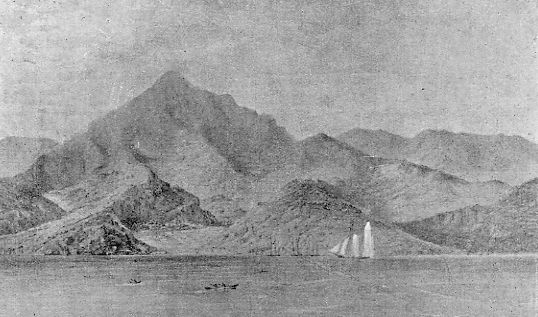
No longer was there any question of the French, the struggle was for entire independence. A civil war began, which raged with varying fortunes for twelve years, in the course of which were enacted scenes more worthy of the days of buccaneers than the beginning of the nineteenth century. In 1812 Caracas was destroyed by an earthquake, and in another locality perished the greater portion of a thousand men, marching against the Spaniards. It was reported that those provinces where the revolution had most influence suffered greatest, while those more loyal almost escaped. This was due to the fact that the mountainous region, in which Caracas is situated, felt the full effect of the earthquake, but the priests, who were mostly loyalists, told the ignorant peasantry that it was a judgment on the Patriots. The result was that large bodies deserted, until the whole Patriot army became disorganised. Miranda was captured and sent to Spain, where he died in prison in 1816, but Bolivar managed to escape.
New Granada had revolted before Venezuela and was more successful. It was to this province that Bolivar retired after the downfall of the Patriot cause in Venezuela. Then the Spanish captain-general, Monteverde, who was called "the Pacificator," commenced his work by imprisoning so many Patriots that the gaols were choked, and many died of hunger and suffocation. In the country districts he let his troops ravage and plunder like hordes of banditti. Even his superiors were at length compelled to recall him on account of the numerous complaints and petitions. At last the people were again fairly roused, until there came a war of extermination, in which both parties tried to outvie the other in murder and rapine.
Off the peninsula of Paria lay the small island of Chacachacare, and on it forty-five fugitives took refuge, where they consulted as to the renewal of the war. With only six muskets and some pistols, they landed on the coast on the 13th of March, 1813, surprised the guard of Güiria, took their arms and marched into the town, where they were joined by the garrison, making their number two hundred. Thus began the second war, in which the Patriots, assisted by the return of Bolivar and a body of troops from New Granada, again took possession of a large part of the province. On the 15th of June Bolivar proclaimed extermination to the Royalists, and named the year, the third of independence and first of the war to the death. This severity created many enemies in Venezuela, as well as in other countries, and even Bolivar himself afterwards said that the proclamation had been issued in a delirium. However, the result was that both sides became more ferocious than ever, especially when the Indians were induced to join the Patriots.
On the 6th of August Bolivar entered Caracas in triumph. The bells rang, cannons roared, and the people cheered him as their liberator. His path was strewn with flowers, blessings were called down upon his head, and beautiful girls, dressed in white and the national colours, led his horse and crowned him with laurel. The prison doors were opened, the Patriots set free, and, in spite of his proclamation, no act of retaliation sullied his triumph. Two days later he re-established the republic and proclaimed himself Dictator as well as liberator.
There were now two Dictators in Venezuela, Marino in the east and Bolivar in the west, but the Spaniards were by no means conquered. Bolivar published another decree on the 6th of September, that all Americans who were even suspected of being Royalists were traitors to their country, and should be treated as such. Ten days later twelve thousand men arrived from Spain, and Bolivar, who had been besieging Puerto Cabello, was forced to retire. This encouraged the Royalists, who got the llaneros of the Orinoco on their side by promises of freedom to kill and plunder in the cause of the king, and threats of punishing by death all who disregarded the call to arms.
Bolivar was captain-general, but he shared his power with Marino, the rights of both resting on force alone. To put an end to this, an assembly of notables was convened at Caracas, to whom he resigned his office, and then accepted it again at their request. But the Patriots, even when united, were as yet unable to stand before the Spanish army, and very shortly afterwards their flag was only visible on the island of Margarita. Bolivar again took refuge in New Granada, where he was elected captain-general, and entitled Liberator and Illustrious Pacificator. He, however, quarrelled with the Governor of Carthagena, and was forced to fly to Jamaica, saying before his departure that Carthagena preferred her own destruction to obedience to the federal government.
In 1815, after the great peace, Marshal Morillo came out with 10,600 men selected from the army that had fought against Napoleon. He was to reduce the whole of the Main from Spanish Guiana to Darien, dealing first with Margarita. In the course of a year he did this, committing such atrocities as made his name a byword over the whole of South America. In the siege of Carthagena, which lasted about three months, the Patriots suffered greatly, hundreds dying of starvation; but at last, on the 6th of December, 1815, it was captured. An amnesty was proclaimed, but in spite of that four hundred old men, women, and children who surrendered were all killed, while most of the stronger men who survived managed to escape.
The remnant of the Patriots was now scattered over the country as guerillas, and while Morillo was subduing New Granada a fresh signal for a general revolt was given. The Royalist Governor, in November, 1815, ordered the arrest of Arismendi, who had been pardoned, and at once the Margaritans rose, took possession of a part of the island, captured the fort, and killed the whole garrison. At the same time the guerillas united under Paez, who now came to the front as a llanero and leader of his class. Thus the struggle was resumed with all its former virulence.
Bolivar, when he heard of the fall of Carthagena, went over to Hispaniola to meet President Petion, who was an ardent supporter of the revolution. Here he received assistance of arms and money, with which he began to fit out an expedition to recover his lost position. There were many refugees from the Main on that island, but they were not altogether friendly with the late Dictator, however Petion managed to secure their co-operation. It followed, therefore, that on the 16th of March, 1816, three hundred Patriots left for Margarita, where they captured two Spanish vessels and united with their fellow-countrymen under Arismendi. Going over to the Main they soon got together a powerful force which overran the whole country and ultimately achieved its independence.
But before this happened the Patriots met with many reverses. Sometimes it appeared as if they would be utterly exterminated; then the tide turned in their favour and they were again successful. The country was devastated by both parties, until cultivation was abandoned in many districts. Provisions for the armies were often unattainable, and this drove the soldiers to plunder wherever there was an opportunity, no matter that the sufferers were of their own party.
The struggle was watched with sympathy by the people of England, and Canning went so far as to make a declaration of neutrality favourable to the Patriots. Then came a systematic attempt to raise British volunteers, and, as there were many officers and men who had been disbanded since the great peace, a considerable force was raised. Carried away by enthusiasm they would hear nothing of the difficulties and dangers they had to encounter, but rushed to fight in the ranks of a people striving to liberate themselves from the grossest oppression. The country was represented as a perfect paradise, and the officers were promised grants of land in this delightful Eden, while the men had offers of double the pay of the British army. A similar call was also made in Germany with good results, and it was expected that what with the British Legion and this other contingent the result would be no longer doubtful.
On their arrival at Margarita, however, they at once began to perceive that poverty reigned everywhere, and that no provision whatever had been made for them. The Patriots foraged for themselves, and anything like a commissariat was virtually unknown; but British soldiers were not accustomed to such a state of things. Then the food supply was at the best only live cattle, which they had to kill for themselves, cassava bread, and a few roots such as yams. The rations were so irregular, that one or two days would pass without any supply whatever, and this ultimately led to complaints and something like a mutiny, which was put down with the "cat."
After some delay the British Legion was sent on to the Main, where they were worse off than in Margarita. Instead of welcoming them, the Patriots seemed to be jealous, and did not even give them the opportunity of fighting as they wished. When posted before Cumaná they were exposed to the burning sun and drenching rains, without tents or any other shelter; their drinking water was stagnant and brackish, and for rations had only a pound of beef per day for each man, from oxen which they had to butcher. They were also greatly shocked at the enormities of the Patriots, who carried on the struggle in a manner suggestive of the Middle Ages rather than modern days. Prisoners were indiscriminately massacred, their murderers enjoying the work as if it were a recreation. It is true that in the then condition of the country large bodies of prisoners could neither be fed nor guarded; still the British could not but feel that the cause they had joined was not altogether what it had been represented. Want of proper food led to sickness, and soon they became quite broken down. Many died of fever and dysentery, some deserted and got away as best they could, the general result being that little benefit was derived from the British Legion by Venezuela.
If such was the experience of the foreigners, what must have been that of the Patriots? They were certainly more used to the country and its food, and therefore suffered less from sickness; but this advantage was lost when it came to actual starvation. With the men engaged in the struggle, only the women and children were left to cultivate enough cassava to keep body and soul together. Even this little was often stolen by a foraging party, who did not hesitate to murder the whole family if any objection was made. Fugitives, if not cut off, made their way in canoes to Trinidad and Demerara, often arriving almost dead from the privations they had endured. Delicate Spanish ladies and little children sometimes arrived—their pitiable condition causing an outflow of sympathy from the planters, and a feeling of detestation for their persecutors.
At the commencement of the year 1820 the Columbian Republic had become an accomplished fact, and on the 25th of November an armistice was concluded between Morillo and Bolivar, which virtually ended the struggle. The United States had looked upon it with favour, and Lafayette in France said that opposition to the independence of the New World would only cause suffering, but not imperil the idea. In 1823 the celebrated Monroe doctrine was formulated, and Canning said in the same year that the battle was won and Spanish America was free.
Central America had not suffered like Venezuela and New Granada. From Mexico to Panama was the old captain-generalship of Guatemala, but little interest was taken in the province, Spain leaving it almost entirely in the hands of the Catholic Missions. It was not until Columbia had gained her independence that Guatemala moved in the same direction, although there were slight disturbances in Costa Rica and Nicaragua from 1813 to 1815. At first there was a project to found a kingdom, but this gave way to the proposal for union with Mexico under the Emperor Iturbide, which was carried out, but did not last long. In 1823 Central America established a Federal Republic, and at once abolished slavery and declared the slave-trade to be piracy—a decision to which the other revolted colonies came about the same time.
XIV
ABOLITION OF SLAVERY
Negro slavery, although it formed the sinews and backbone of the plantations, was, as we have seen, considered unjust by the French republicans and immoral by a large section of the benevolent in Great Britain and the United States. In both countries the Society of Friends, or Quakers, commenced to influence public opinion against its continuance as early as about 1770, and had it not been for the French Revolution it is probable that emancipation would have taken place early in this century. The premature and inconsiderate action of the French in Hayti lost to France her most valuable plantation, for some years giving such an example of what might happen were emancipation to be granted elsewhere, that those in favour of the system could always point to it with the finger of warning. Yet with all that the friends of the slave were undaunted; and as a beginning, in 1807, they procured the abolition of the slave-trade as far as Great Britain and her colonies were concerned, and then went on to get the traffic prohibited by other nations. Denmark had led the van by declaring it unlawful as early as 1792, but little impression was made until the nation most concerned took action.
This was a great blow to the British West Indies. The labour question had always been of the first importance, and to put a sudden stop to the supply meant a check to all progress. For twenty years before a great impetus had been given to planting, which was much assisted by the downfall of Hayti and consequent reduction of her produce to such an extent that she no longer affected the market. Now that the planters could get no more negroes, anything like enlargement of the acreage under cultivation was impossible. Latterly, also, produce had diminished in price, which made cheap labour all the more important. They had great difficulty in making their estates pay, and when sugar fell to half its former value a cry of "Ruin!" went forth all over the West Indies. It is interesting to note that the panacea which they expected would save them was free trade. At that time the British warehouses were filled with sugar and other tropical produce, while every continental port was closed by Napoleon, and the United States by the navigation laws. Not only did Great Britain store the produce of her own colonies, but that from those of the French and Dutch as well. In 1812 it was stated that the sugar consumption of Great Britain amounted to 225,000 hogsheads, while the production of her colonies was 150,000 in excess of this. The Southern States had just taken up cotton cultivation, and brought the price of that article too low for the West Indian planter, and, as if that were not enough, coffee also fell in price to an alarming extent.
Sugar paid best, and was therefore fostered to the exclusion of the other products; and now began the plantation system which became so obnoxious to the anti-slavery party. Hitherto, with a full supply of labour, the negroes did little work as compared with their capabilities—now something like the factory system of the mother country was introduced. The old methods would no longer enable the planter to get a profit, and he must make the best of his labour supply. Great administrative ability, more careful management, attention to economy, and concentration, were all necessary to prevent losses, and that these were not wanting can easily be seen from the results. The slaves were driven into the field in gangs, and kept at work by the threat of the driver's whip, while the overseers and manager gave most careful attention to the whole system.
Not only did the negroes work, but the whites also; in fact, on the part of the latter there was a continual strain after a fortune on which to retire from this tiresome and harassing work of nigger-driving. Where one succeeded, ten failed; many died of the exposure and of the anti-malarial drinks they imbibed so plentifully. So great was the mortality that the colonies became proverbial for their number of widows, some of whom, however, were not above managing their own plantations. It was a race for wealth, to which everything else was secondary.
The slaves diminished every year in the absence of additions from outside, as the whites would have done under similar circumstances. That there was no natural increase was mainly due to the fact that the sexes were unequal, and then, again, maternal affection was sadly wanting in the women, who seemed to care less for their children than some domestic animals. This state of things was mainly the outcome of the system, which was undoubtedly immoral, but the mental disabilities of the race must also be taken into consideration. The anti-slavery party considered that environment was everything; if they could only free the negro from compulsory servitude he would at once become an industrious labourer. Yes, in their opinion, if he had the incentive of wages, it would make him a credit to himself and his community. The slaves, they said, were worked to death, yet as free men they would do more and perform their tasks better. Their experience with free workmen led to these conclusions, but this could not apply to the West Indies nor to the negro race.
The anti-slavery party was very strong, and although it is not stated that they took "Perish the colonies!" for their motto, it is very certain that they cared little about the future of either white or black as long as they carried their object. To this end every possible case of oppression and ill-treatment was exaggerated, and spoken of as if it were common, notwithstanding that the case only came to their notice through the trial and punishment of the offender. The fact was the planter could not afford to ill-treat his slave—no other animal of his live stock was of so much value. If a valuable horse were killed another could be obtained to replace him, but this was almost impossible in the case of the negro. Formerly, when he cost about £20, it might have paid to work him to death; now that his price was five or six times as much, self-interest alone prevented ill-treatment. There was a strong public opinion in every colony which prevented cruelty, and there were societies in some which gave prizes to those in charge of estates who raised the greatest number of children in proportion to their negroes. This breeding of negroes was necessarily very slow work, and did little to make up for the stoppage of importation. It followed, therefore, that every year the amount of available labour became less.
In 1815 the anti-slavery party commenced a further agitation in favour of the negro, with the result that a Registrar of slaves was appointed for each colony, and ultimately a Protector. By obtaining an annual census they hoped to have some check on the decrease, and at the same time see if any Africans were surreptitiously imported. In some places there was already a slave registration for the purpose of adjusting the head-tax; here the planters did not oppose the measure, although they resented interference. Others, like Barbados, protested against the innovation as something quite unnecessary, or even if desirable, not to be imposed upon them from outside. This led to a great deal of discussion at the planters' tables, where the slave waiters listened to what was said, and from thence carried garbled reports to the others.
In every colony were numbers of free negroes and coloured people, some of whom were loafers and spongers on the slaves, while others went about the country peddling. Having nothing to do, they became the news-carriers and circulators of garbled reports. In 1815 there lived in Barbados a free coloured man named Washington Franklin, who, like many negroes, was possessed of a good memory and a great power of declamation. Getting hold of the English and colonial newspapers, he would read the speeches of Wilberforce and others, and after putting his own construction on them, retail them in language tending to rouse the slaves. To him was due an impression that prevailed in Barbados, probably from a misunderstanding of the Registry Bill, that they were all to be free at the beginning of the year 1816. When New Year's Day had passed they became dissatisfied, believing that their masters had received orders to set them free, but would not execute them. They had heard of the successful rising in Hayti, and were determined to attempt a similar revolt in Barbados.
After waiting for the expected freedom until the 14th of April, they determined on that day to have a general rising, which was signalled by burning heaps of cane-trash in the parish of St. Philip. Soon the fields were set on fire, and frenzied mobs, continually increasing in numbers, went from one plantation to another seeking arms. This went on for two days, but on the arrival of the militia they dispersed, leaving a waste behind. As usual a great many of the negroes were executed, although it does not appear that any whites got killed in the revolt. However, the Registry Act was delayed for two years, to be ultimately passed in January, 1817.
Towards the end of the last century a new class of men appeared in the West Indies—the Protestant missionaries. Catholic missions had been established in the Spanish possessions since the time of Columbus, but hitherto, with the exception of a few Moravians, no other Church had done anything to convert the slaves in the British colonies. Between 1780 and 1790, Methodist societies were established in most of the islands, notwithstanding the opposition of the planters, who in some cases appear to have thought that baptized Christians could no longer be held in slavery. This vulgar error, however, was not the real cause of the antagonism to these teachers, but rather the feeling natural to a master which makes him resent any outside interference between himself and his servants. The best and kindest were the first to feel this. The slaves were their children, and to them they applied, in all their troubles and difficulties, as to a great father. It followed, therefore, that when the missionaries came and proclaimed themselves friends to the slaves, giving them advice in secular as well as religious matters, the cordial feeling was broken. "Massa" was much put out, for he liked to hold the position of a little god to these poor ignorant creatures over whom he held such power. The slaves were sometimes whipped as bad children when they did wrong, and as children they cared little for a flogging. It is easily conceivable that a humane missionary might feel more pain at witnessing such a punishment than the culprit himself, but it is a fact that cruel punishment was never mentioned by the slaves as an excuse for a revolt.
The missionaries were shocked at the apparent nakedness and destitution of the negroes, as a visitor to the West Indies will be even now. They did not remember that their clothing and houses were well suited to the climate, and that a home in the English sense of the word would not have been appreciated by them. These things were reported to the societies at home, the members of which knew no more about the tropics than the merchant who once sent a consignment of warming-pans to Barbados. Those who wanted to raise a cry of cruelty to the poor slave, circulated these facts, and put their own construction upon them, one going so far as to state that there were no chimneys to the houses, as if this omission were a slave disability or oppression, although any visitor to the colonies could have told him that these conveniences were hardly found anywhere.
The negro willingly listened to his friend the missionary, and felt eager to perform the rites and ceremonies of the little congregation. The Established Church was that of England, and although in some places there were special services for the blacks, in others "slaves and dogs" were refused admission. This exclusiveness threw the slaves into the hands of the Moravians, Baptists, Methodists, and the agents of the London Missionary Society. The Church government of some of these was in the hands of the congregation, and as this was a sort of playing at "Massa," the slave took to them all the more readily.
No doubt these ministers were very good men, and animated by a great love for the negroes, but this did not prevent their being misunderstood by both master and slave. Then many of them were connected with the anti-slavery society, and however careful they might be not to offend local prejudices, by speaking against the obnoxious system, as conscientious men they could not help showing their bias. The established clergymen, on the contrary, when they preached to the slaves, told them to "be subject to the powers that be," and to remain content in the condition where Providence had placed them.
At first most of the planters only sneered at these attempts to convert the slaves, but when they saw what an attraction the chapels became, they opposed them openly. Gangs of young fellows would attend, and sometimes break up the meetings by jeering at the preacher. In 1807 an ordinance was passed in Jamaica "for preventing the profanation of religious rites and false worshipping of God, under the pretence of preaching and teaching, by illiterate, ignorant, and ill-disposed persons, and of the mischief consequent thereupon." Considering it the first duty of all magistrates to encourage the solemn exercise of religion, and whereas nothing tended more to bring it into disrepute than the pretended preaching and expounding of the Word of God by ignorant persons and false enthusiasts, to persons of colour and slaves, it was enacted that, after the 1st of July, no unauthorised person should presume to teach, preach, offer public prayer, or sing psalms to any assembly of these people, on pain of a fine of a hundred pounds, imprisonment for six months, or whipping. Similar punishments were also to be inflicted on any one preaching in an unlicensed building, as well as on the owner of a house or yard in which it had been permitted.
Another way of stopping the assembly of slaves was to pass a law against their meeting at night, and punish them if they left the estate without a written permission. There were always excuses for this apparent harshness, as plots had been arranged at nocturnal meetings, some of which had given a great deal of trouble. Even if a pass were granted to attend chapel, the estate's authorities could hardly be expected to follow and see that the slave did not go elsewhere. The missionaries took it that all this was done to hamper their work, but such was not the case altogether.
The anti-slavery party became very strong about the year 1820, and every obnoxious regulation was a text for discourses on the infamy of the whole system. If a planter were punished, the case was trumpeted over the country to promote a greater antagonism. How absurd this really was could only be seen by the West Indians themselves, and if they attempted to say anything they were put down as liars, becaused they were biassed in favour of the other side. One writer pertinently remarked that, among the hundreds of military and naval officers stationed in the West Indies, not one had borne out the statements of the missionaries, and we may call attention to the curious fact that Captain Marryat, who was well acquainted with every colony, speaks always of the negro as a happy fellow. The genial novelist does not mince matters when he speaks of oppression on board ship, and it is not to be supposed that he would go out of his way to screen the planters.
Some of the colonies passed laws against indiscriminate manumissions, and these were declaimed against as tyranny. Yet their wisdom was so patent that, under the system, they could only be heartily approved by every one competent to judge. There is one little fact that stands out most prominently as a redeeming point, if such a thing be possible—under slavery there was no poverty—there were no tramps nor beggars. The owner of the plantation had to feed his people in sickness and in health, in childhood and old age. If manumissions could be given by the mere stroke of a pen, many a poor sick or broken-down creature would have been cast adrift to become a burden upon the community. Now and again we yet hear some old woman complain that if this were slavery time, she would not be half-starved as she is to-day, notwithstanding the poor relief.
It may perhaps be thought that we are attempting the defence of slavery; we only wish to show that it was not quite so black as it has been painted. It had its dark side; but, on the other hand, many a bright gleam can be perceived by those who have seen some who were born into servitude and heard their stories. They were well fed, had as much clothing as they really required, were as a matter of policy well treated as a rule, and were quite as happy as they are to-day. Magistrates, policemen, and gaols were almost unknown; the planter gave the negro a slight flogging now and then, and this ended the tale of his misdemeanours. A bad master might be cruel as a bad husband may be also, but we should not condemn marriage on account of its abuses. The great argument against slavery was the degradation it produced on the minds of both parties. However, we are not writing the history of slavery, but the story of the West Indies, and must apologise for the digression.
In 1823 the House of Commons, on a motion of Fowell Buxton, "that the state of slavery is repugnant to the principles of the British Constitution, and of the Christian religion," resolved to ameliorate the condition of the slave by giving him civil rights and privileges. As a result of this, orders were sent out to abolish the flogging of women, and discontinue the use of the whip in the field.
Already the West Indian planters were alarmed at the interference of the British Government, and the overriding of colonial laws by Orders in Council. In 1819 they had petitioned against being compelled to manumit their slaves in cases where they wished to buy their freedom, but their protests went for nothing. Now also they had to submit, although they did so with a bad grace. The British Government left the carrying out of the provisions of the resolutions to the colonial legislatures, but at the same time giving them to understand that there was no option.
In 1811, when the Governor and Court of Policy of Demerara neglected to issue a proclamation allowing negroes to attend chapel in the evening, they received a sharp reprimand, and the Governor was superseded; now they knew that nothing was left but to obey orders.
When, therefore, the despatch containing these resolutions arrived in Demerara, a meeting of the legislature was at once convened to prepare the necessary ordinance. There was no attempt to evade this duty or delay compliance, but such a radical change required great consideration, especially in regard to the control of females without the use of the whip. Negresses were, as a rule, less amenable to discipline than the men, and it was thought that something must be done to prevent insubordination. Several meetings took place from the 21st of July, 1823, to early in August, at which the ordinance was prepared and passed, but up to the 18th of the latter month it had not been published. Such a delay, however, did not imply any intention of evading the duty, for three or four weeks often elapse from the time of passing to the publication of a Bill.
Meanwhile the negroes got an idea that something had been done in England for their benefit. Like the slaves in Barbados and other colonies, they heard discussions at their masters' tables, and supposed that the something which had taken place meant their total emancipation. "The king had freed them, but the planters refused to carry out the order." On the East Coast of Demerara there was then a small chapel belonging to the London Missionary Society, under the charge of the Rev. John Smith. This chapel was a rendezvous for the negroes of the neighbouring plantations, who not only came to service, but met afterwards for a little gossip. Some who could read gave their ideas of what they had gleaned from their masters' newspapers, while others told what had been said at the dinner-tables. It does not appear that Mr. Smith had told them anything of the new resolutions, nor is there evidence that the deacons of the chapel knew of them. It followed, therefore, that all the information they had was these garbled reports of their own people.
On Sunday, the 17th of August, a number of the bolder spirits met after service and discussed a plot which had been already under consideration, for a general rising at eight o'clock next evening. Their idea was to put their masters in the stocks, arm themselves, and, when the Governor came, demand their supposed rights.
On Monday morning a coloured servant informed his master of the plot, on which he at once rode off to Georgetown and interviewed the Governor. Warnings were sent to most of the planters, and preparations made to suppress the revolt if it took place, but such reports were not uncommon, and although the whites looked after their weapons they did not feel much alarm. As a matter of policy it was better to assume indifference, as anything like desertion of the estates, even so far as the sending away of women and children, would have encouraged the negroes.
The signal was given by a fire near the chapel, on which the slaves assembled in great mobs, over-powered their masters, put them in the stocks, and took all the firearms and other weapons they could find. The Governor was already in the neighbourhood with a small party of cavalry, and on seeing the signal proceeded to inquire into its meaning. On the way he was met by an armed mob, who, on being asked what they wanted, answered, "Our right!" He told them of the new law, and promised a full explanation on the morrow if they would disperse and come to him at a neighbouring plantation. There was a slight hesitation for a few moments, but presently, with cries of "No! no!" and the blowing of shells, they drowned his voice. Then some of the more moderate advised him to go away, which he was obliged to do, as his whole company numbered hardly a dozen.
Bearing in mind the disasters of the Berbice insurrection, the people of Georgetown were much alarmed. Placing their women and children on board vessels in the river, the men prepared to resist to the death. Martial law was proclaimed, and every person, without distinction, called upon to enrol at once in the militia, all exemptions being cancelled. They responded heartily, and soon the town put on an appearance as if deserted, except at those places where guards were stationed. The stores were closed, the slaves kept indoors, and, save for the arrival and departure of mounted orderlies, not a sound could be heard. Even the negroes themselves, in their kitchens and outbuildings, were overawed, and hardly spoke above a whisper.
The Methodist ministers came forward and enrolled themselves in the militia, but they were not called upon to perform any duty. The Rev. John Smith, however, took no notice of the proclamation, although he admitted having seen it. On the evening of the revolt he went for a walk with his wife, and on his return found that the manager's house was being attacked by a mob of slaves. He succeeded by expostulation in preventing their doing much injury, and even rescued the manager from their hands, but instead of sending notice of the rising to the neighbouring estates he went quietly home. As far as he knew no one had been warned of the revolt, and he was certainly remiss in his duty when he did nothing whatever. When, on the following day, he was visited by a militia officer, and ordered to enrol himself in accordance with the Governor's proclamation, he refused on the ground of his exemption, although he knew that all exemptions had been cancelled.
As usual the rebels had no proper leaders, and for some reason or other—the missionaries ascribed it to religious teaching—they did not burn the houses or destroy the crops. One or two whites who resisted were wounded, one at least fatally, but here again the insurgents were forbearing. Fortunately they were soon suppressed, and this no doubt prevented such atrocities as had been committed elsewhere. What with the soldiers, the militia, and crews of vessels in the river, the force brought against them was overwhelming. Only one attempt was made to fight, but the first volley of the troops sent the rioters scattering into a cotton field. In about two days the insurrection was over, and then came the hunt for fugitives, who as usual took to the swamp at the back of the estates. A large body of Indians was employed, and in the end most of them were captured, some to be hanged at once and others after sentence by court-martial.
Mr. Smith's behaviour was considered as something more than suspicious—he was believed to have had knowledge of the plot, and charged with an intention to side with the negroes if he saw any prospect of their success. On his refusal to take part in the defence of the colony he was taken prisoner, and after the negroes had been tried and sentenced, his case was brought before a court-martial. He was charged with promoting discontent among the slaves, conspiring to bring about a revolt, knowing of the plot the day before and not reporting it, and holding communication with one of the leaders after it had broken out without attempting to capture him. The case created a great stir, public opinion being universal that he was the prime mover in the whole affair.
His trial lasted over a month, at the end of which he was found guilty and sentenced to be hanged. This sentence, however, seems to have been given to satisfy the people; it was not published, nor was it intended to be executed without reference to the home Government. This is proved by the report in the "Royal Gazette" of the colony, which stated that the trial was over, but the nature of the proceedings was such as to render it imperative on the Governor to transmit them for His Majesty's consideration. The public were not informed of the verdict, but it is not to be supposed that they were ignorant of the result of the trial; on the contrary, the sentence met with their approval, and they complained of the delay in carrying it out, as compared with the hasty executions of the negroes. Mr. Smith was ultimately reprieved, on the understanding that he removed himself from the West Indies, and engaged never to come back to Guiana or go to any of the islands. But the poor missionary was sick, and under treatment before the insurrection, and it may be presumed that the worry of the trial hastened his end. He died in prison before the king's answer arrived, and was buried at night to prevent a hostile demonstration.
We have been thus particular in giving the facts of the Demerara East Coast Insurrection, because it made such an impression in England. The anti-slavery party used the case of the "Martyr" Smith as a watchword, and it was a prime factor in hurrying on emancipation. The immediate result was an Order in Council to enable slaves to contract legal marriage, to hold property, to buy their freedom on a valuation by disinterested parties, and to put them under a Protector, whose duty was to see that their rights were not infringed. They were now citizens, their only civil disabilities being compulsory labour and a tie to the plantation or their masters.
This, however, did not satisfy the anti-slavery party, and they went on with their struggle for total emancipation, in which they at last succeeded. In 1833 an Act of Parliament was passed, by which, after the 1st of August, 1834, slavery was to give place to an apprenticeship of four or six years, according to the status of the slave, the former term for house-servants and the latter for labourers on the plantations, or "predials." Every child born after that date was to be entirely free, and here came in one of the greatest blemishes of the law. These poor infants belonged to nobody; their mothers cared little for them, and it could not be expected that the planters would pay to keep up the old system of superintendence. Even those who had been instrumental in getting the law passed now began to make comparisons between the position of the child-bearing woman under the old and new systems. Hitherto they were unable to find words harsh enough to use in condemning slavery—now they began to find that it had its good points. Then the new system required new administrators, and, to prevent any suspicion of bias, magistrates were brought from England. Yet these very same unbiassed gentlemen ordered flogging for the men and the treadmill and dark cell for the women. The Quaker delegates sent out to inspect the result of their work were horrified. They said that the cat was worse than the old whip, and that the apprenticeship system caused ten times more suffering than slavery.
And such was really the case. The negroes could no longer be kept under subordination—they even claimed entire freedom at once. Several disturbances took place before they could be made to understand that they had to work seven and a half hours every day, to pay for their homes, provision grounds, and other allowances. In Demerara the Governor addressed them as erring children, telling them that they could not all be masters, and that every one must work. They had never seen a white man handle the shovel or the hoe—he was free—now they had attained to the same condition, the same coveted freedom from hard labour must be theirs also. True, there were free negroes, some of whom had learnt trades, but even they were above working in the field. Why should free negroes work? Certainly not for their wives and children. The women got their allowances, and the planter had hitherto looked after the children. The negro had no house rent to pay, his two suits of clothing came regularly every year, and if he was sick the doctor attended to him. Except to deck himself with finery, he had no use for money; a few would work overtime when they wanted something of that sort, but the majority did as little as possible.
THE FIRST OF AUGUST. (From Madden's "West Indies.")
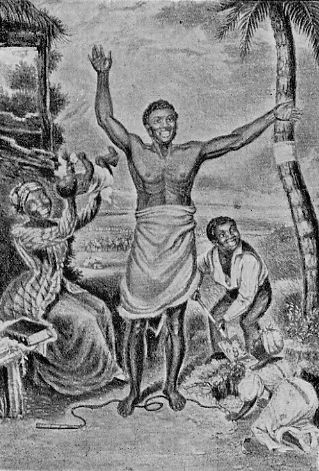
In 1838, when the house servants were to be freed, while the predials must serve two years longer, the difficulties of such an arrangement became insurmountable. A daughter or wife might be entirely free, and the father or husband an "apprentice." Then came the difficulty of classification, which the commissioners appointed to arrange the divisions necessarily decided against the opinion of one or the other disputant, driving him to appeal. All this rendered a continuance of the system impossible, and slavery was terminated altogether on the 1st of August, 1838, the planters receiving from the British people twenty millions sterling as compensation, being about one-third of the estimated value of the slaves.
The French had received such a lesson from the revolt of Hayti that they did little for their negroes. However, after the downfall of Louis Philippe in 1848, the revolutionary Government abolished slavery throughout the colonies, without compensation.
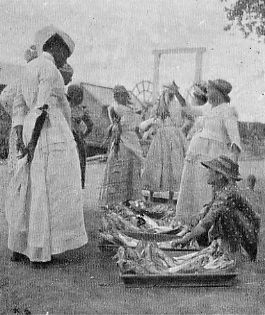
A RELIC OF THE SLAVERY DAYS—OLD SLAVE BUYING FISH.
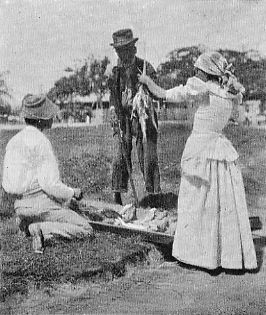
After freedom had been secured in the British colonies the slaves in neighbouring places naturally became discontented. There were not many desertions from the islands, but in Guiana, where the Dutch negroes were slaves on one side of the river Corentyne, and the British free on the other, the runaways from the former caused a great deal of trouble to the Dutch. Whenever an opportunity occurred, a party of slaves stole a boat and made off to the British side, until the Surinam planters became much alarmed. Ultimately a Dutch gunboat was stationed at the boundary river, and this put an end to the migration.
Some of the islands were much affected, especially those of the Danes, which were frequented by British vessels, and were largely English in their sympathies. Here the negroes soon learnt what had happened, and began to express dissatisfaction with their own position. However, Denmark saw that something had to be done, and in 1847 enacted laws for gradual emancipation in her islands. From the 28th of July of that year all children born of slaves were to be free, and at the end of twelve years from that time slavery was to cease altogether.
This did not satisfy the negroes, who became more discontented, and in 1848 an insurrection took place on the island of St. Croix. On the 2nd of July it was rumoured that the slaves would refuse to work next day, and in the evening the whites were alarmed by the ringing of bells and blowing of conch shells. At first it was considered as an alarm of fire, but on inquiry the whites found that the negroes had revolted, and were demanding their freedom. Later, people came in from the country districts with the news that there were noisy demonstrations, but that as yet no actual violence had been committed. So little alarm was as yet felt that no precautions were taken, although some persons became uneasy.
Next morning the negroes streamed into Christiansted in great numbers, and commenced to demolish the police office. An officer coming into town was attacked by a woman with an axe, which fortunately missed him, but the crowd was so good-humoured that, on his treating the matter coolly he was allowed to pass: this apparent good feeling made the authorities hesitate in taking extreme measures, even when the mob came round the fort, shouting and calling for freedom. Now, however, they began to collect trash for the purpose of setting fire to a house, and the Stadthauptman and a Roman Catholic priest went among them to try remonstrances. All the answer they got was that the slaves could not fight the soldiers, but they intended to burn and destroy everything if freedom were not given them. One of the mob carried a British flag as an emblem of liberty, and several English sailors were reported as forming part of the crowd. Soon all their good-humour was gone, and they commenced plundering the stores, the whites running away to vessels in the harbour.
About three o'clock in the afternoon the Governor arrived from St. Thomas, and went among the crowd telling them that they were free, at the same time ordering them to disperse quietly. For a few hours there was a lull, but next morning they reassembled in the country districts as if in doubt whether the Governor really meant what he had said. Some planters now brought their families to town, leaving their houses to be plundered. Parties of soldiers were sent out, and hundreds of prisoners were taken, the mobs, which in some cases numbered two or three thousand, dispersing at their appearance. Martial law was declared, Porto Rico sent six hundred Spanish troops, the insurrection was at last quelled, and peace restored. The Governor stood his trial in Denmark, to be acquitted, and to have his declaration of complete emancipation confirmed.
Slavery still continued in the Dutch possessions until 1863, and even then it was only replaced by compulsory labour for ten years, leaving the final emancipation until 1873. Yet with all that there were no disturbances to hurry on the process or cause trouble. In Cuba a law was passed in 1870 to give freedom to all above the age of sixty, as well as to children born after the passing of the Act. This, however, was not enforced on account of internal dissensions, and although Porto Rico gave her slaves their liberty on the 23rd of March, 1873, the Cuban Emancipation Bill was not passed by the Spanish Senate until February, 1880, and under that law slavery only came to an end on the 6th of October, 1886.
XV
RESULTS OF EMANCIPATION
The slave emancipation was a terrible blow to the West Indies, and one from which many of the islands have not yet recovered. It was, the planters said, the second attempt to ruin them, the first having been the abolition of the slave-trade. The party who brought it about looked to see their protégées become a contented, hard-working peasantry, in place of driven cattle, as they called them. The planters, on the contrary, were morally certain that as free men they would not work, and without a labour supply their estates would be utterly ruined. The British taxpayer grumbled at having to pay twenty millions, but this was a mere sop for the estate owners. With the loss of their human chattels the plantations in many cases became utterly valueless; for the negroes congregated round certain centres, leaving most of the outlying places without enough people to keep up the cultivation. Labour had been degraded by the system, and now the full effects of such influence began to be felt.
NEGRESS, GUIANA.
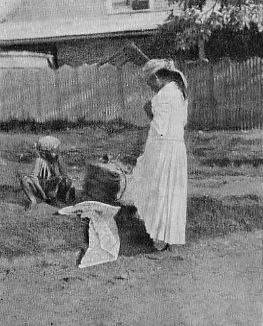
NEGRESS FISH-SELLERS, GUIANA.
The compensation money, in many cases, went towards paying off mortgages and other claims, the holders of which saw the impending ruin and hastened to save themselves as far as possible. But it was not enough even for that, for many plantations had liens of half the appraised value of the land, buildings, and slaves. The last security being entirely gone the others became worthless, and, as no one cared to advance money on such risks, the nominal owners could not even get as much as to pay wages. A plantation valued at perhaps £60,000 a few years before, and easily mortgaged for half that amount, received £16,000 for compensation with which to pay off the claim, and then wanted cash to carry on as well. Banks were established, but only solvent estates could get help from them, and consequently hundreds were abandoned in the larger colonies, and hardly one, with the exception of those in Barbados, could produce as much sugar as formerly. West Indian Nabobs, who had been getting their ten thousand a year and living in England, went out to see what could be done. Their incomes were entirely gone, and with them all hopes for the future. Widows and children lost their only means of support, and ruin fell on hundreds of families in England as well as in the West Indies. But not only did this downfall affect the owners and their relations, but merchants as well. Old firms shook to their very foundations, while many became bankrupt, to bring suffering to the homes of thousands who had hardly known of the sugar colonies beyond the invectives of the anti-slavery society. Many who had been strong advocates of emancipation now wished they had never said anything about it, but the die was cast, and there could never again be anything like the shilly-shallying of the French at Hayti.
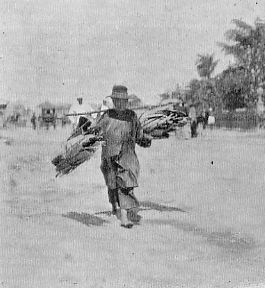
CHINESE WOOD-CARRIER.
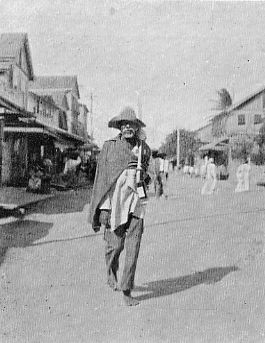
EAST INDIAN COOLIE.
The negroes would not work, and there were no means of forcing them to do so. The anti-slavery party still had their delegates in the West Indies to see that the "poor negro" was not oppressed in any way, and their representatives in Parliament to call the Government to account if they allowed any vagrancy laws, or even the shadow of a coercive measure in the colonies. One ordinance after another for this purpose was disallowed, until every planter was in despair.
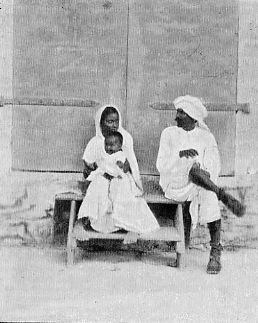
EAST INDIAN COOLIE FAMILY.
COOLIE BARBER.
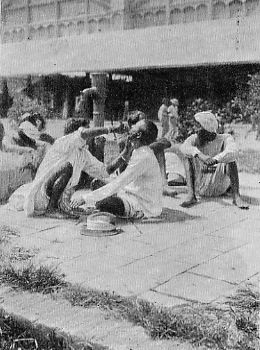
To retain their labourers was a matter of life or death. Some continued the old slave allowances to put them in good humour, but as these made the negroes independent of wages, the privilege was abused. They took everything and did nothing in return. Some went so far as to say that the Queen had promised that their late masters should supply them as usual, entirely regardless of the amount of work they did. This made the planters sore. What with one trouble and another the few who survived the wreck hardly knew how to act. They must not do anything to drive their people away, for there were many inducements offered by others in the same predicament. The negro was master, and he knew it. So much depended on him that he was enticed to labour, by high wages and greater privileges, until this bidding of one against another produced the very result which it was intended to avoid.
EAST INDIAN COOLIE GIRL.
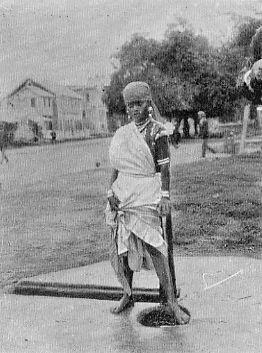
COOLIE WOMEN, BRITISH GUIANA.
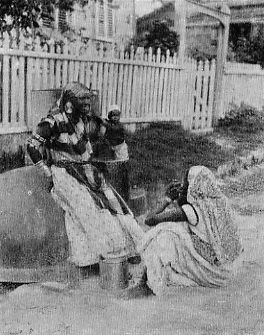
Something had to be done. First, the allowances of those who would not work were stopped; then their houses and provision grounds were taken away. Thousands of fruit-trees were destroyed to prevent their living on mangoes and bananas during the season. Then the planters attempted to combine to bring wages to a paying level, and this led to strikes of the negroes. Everything tended to further estrangement until employer and labourer drifted far apart. In British Guiana the negroes bought some of the abandoned plantations and established villages; in some cases they even attempted to carry them on as sugar estates, but as all wanted to be masters they in every case failed.
COOLIE VEGETABLE SELLERS, BRITISH GUIANA.
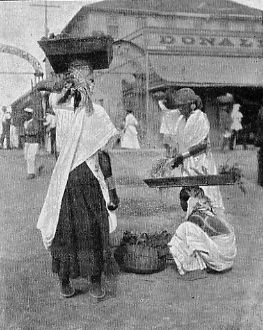
EAST INDIAN COOLIES, TRINIDAD.
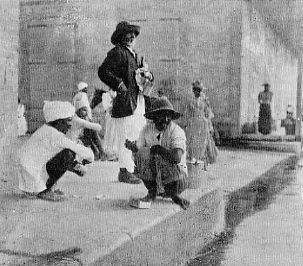
As if this were not enough, the British Government went in for free trade, and allowed foreign slave-grown sugar to compete with that of the colonies. It seemed as if the French revolutionary cry of "Perish the colonies!" had now been introduced into the British Parliament. From one point of view the planters had been amply paid with the compensation money. Some went so far as to say that twenty millions could have bought all the estates in the West Indies, implying that the colonists had no further claim upon them. Even the anti-slavery party would not see that they were encouraging the slave system in other countries by opening their markets. This completed the ruin begun by emancipation, but as long as the principles were adhered to it did not matter.
EAST INDIAN COOLIE, TRINIDAD.
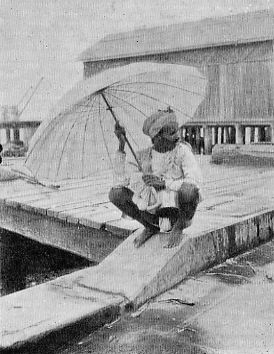
Most of the remaining plantations now fell into the hands of those who had liens upon them, and they, not liking to lose their money altogether, commenced the uphill work of again bringing them into cultivation. Even a few colonists continued the struggle in hopes of better times. In Demerara there were two cases where eminent lawyers—the legal profession, by the bye, doing well when everything else was on the verge of ruin—spent all their profits in keeping their sugar estates from utter abandonment. One of these got so heavily in debt that at one time he could not pay his house rent, and as the landlord dared not sue him, he had metaphorically to go on his knees and beg him to quit.
TRINIDAD COOLIES.
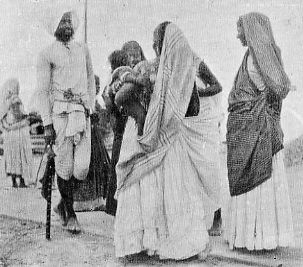
However, the sturdy English spirit survived in a few, and they set to work to obtain labourers from other parts of the world. At first they thought of Africa, but the anti-slavery party would not hear of immigration from the "dark continent," for fear of abuses. Then India was tried, with the result that a few coolies were brought over by private parties, notably to Demerara by John Gladstone. But again the cry of slavery went forth, due to the managers leaving the new-comers in the hands of their headmen or sirdars. It was charged against them that they beat their underlings, and of course the planters had to bear the responsibility. The result was that East Indian immigration was prohibited for a time. After a hard struggle on the part of the planters it was renewed, and in the end prevented Trinidad and British Guiana from utter abandonment.
Besides Hindoo coolies, Chinese were also imported, as well as Maltese, Madeirans, and a few Germans. At first the negro thought little of this competition, but when he gradually dropped into the background, with his missionary friends, he commenced to protest against it. His friends said, and it was the truth, that there was enough labour in the colonies to carry on the estates, but the difficulty was that it could not be depended upon. Then the wages demanded by the negroes was entirely beyond the means of the planters—the price of sugar would not admit of them. It was a case of cheap labour or the alternative of giving up the struggle, and with the East Indians, British Guiana, and Trinidad recovered from the brink of ruin to become more flourishing in some respects than in the years immediately preceding emancipation. Jamaica, the greatest of the British colonies, suffered the most as she got but few immigrants, and it is only during the last decade that she has again begun to hold up her head. Without healthy competition with other races, the negroes sunk back, until they became even more degraded than those of British Guiana and Trinidad.
In Barbados, on the contrary, the population was so dense that the freedman must either work or starve. There were no waste lands and few absentee proprietors, nor were any of the estates abandoned. Labour was plentiful and cheap; it followed, therefore, that the island soon recovered from the check and went on prospering. The compulsion of the whip gave way to the force of circumstances, and the struggle for existence which ensued has made the Barbadian negro the most industrious in the West Indies. Not only is he this, but he is, like his former masters, intensely loyal to Great Britain and "Little England." All the black, coloured, and white people in the other islands call themselves Creoles, but he is "neither Crab (Carib) nor Creole, but true Barbadian born."
In the French, Danish, and Dutch colonies labour laws were enforced after emancipation, and generally with good results. They felt the change, but not to such an extent as their neighbours, and recovered all the sooner. Then they were not utterly disheartened by the unhealthy competition of slave-grown products like the English. Possibly, however, the British freedman would not have borne coercion, for even the Danes resented it.
We have seen already that the negroes of the island of St. Croix were by no means willing to submit to what they considered injustice, and how they forced on their own emancipation. However, down to 1878 they were bound to the soil as it were under annual engagements, from which they were not released without proper notice, even after the term had expired. They had houses, provision grounds, allowances, and very low wages, and were bound to work five days a week. The engagement expired annually on the 1st of October, and on that day those who did not renew their contract assembled in the two towns of the island for a jollification, where something like the old "mop" or hiring fair of England took place.
In 1878 they somehow got the impression that the labour law was about to be relaxed, but there does not seem to have been any combination among them to obtain such an end; they were dissatisfied, and that was all. About the same time the Government were so assured of their peaceable disposition that they reduced the garrison of Christiansted, the capital, to sixty men. When the 1st of October arrived the negroes assembled as usual in Frederiksted, round the rum shops, appearing good-humoured, although noisy, as such a crowd always must be. Nothing particular happened until, at about three o'clock in the afternoon, a cry went up that one of their number had been beaten by a policeman, on which they attacked the peace officers, and drove them into the fort, which was police-station and barracks. Some of the principal whites came out and remonstrated with them, and at first they seemed as if they would disperse, but just then the police-master, his assistant, and two soldiers rode into their midst, brandishing swords and ordering them to move off at once. Infuriated by this, the mob attacked the horsemen with stones, and drove them back into the fort, which they now stormed. The British Vice-Consul then went among them, and, after a little parleying, induced them to go with him to the outskirts of the town. Here he got a statement of their grievances, which were—first, that their wages were too low (only ten cents a day); second, that the annual contract was slavery; third, that the manager of the estate could fine them at will; and fourth, that if they wanted to leave the island they were obstructed. Having promised to do all he could for them, the Vice-Consul begged them to disperse.
BARBADOS. (From Andrews' "West Indies.")
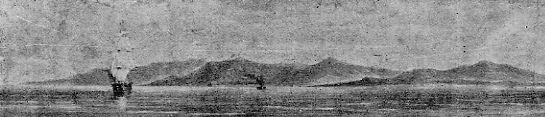
ST. LUCIA. (From Andrews' "West Indies.")
They were apparently leaving the town, when a woman came running up with the report that the man who had been beaten by the police had just died in the hospital. This made them furious, and all further hopes of their pacification had to be given up. They invaded the hospital, knocked down the sick-nurse and a patient who inquired their business, and demanded to see the murdered man. They were informed that he was not dead but only dead drunk, and would soon recover if left alone. On being convinced of this, they again went off and attacked the fort. The defenders, when assailed with stones, fired over their heads, but this only made them all the more violent. The outer gate was broken down and some of the negroes were shot. Just at that moment a planter came up, intending to enter the fort, and at once they beat him with sticks until he was nearly killed.
However, the bullets checked them, but only to throw the attack on other parts of the town. Stores were pillaged and set fire to, until a great portion of the town was in flames. From some of the stores they took weapons in the shape of cane-bills, and in one were alarmed for a few moments by an explosion of gunpowder. The whole of Bay Street was soon in flames, and like troops of fiends the negroes went dancing round the fires, in some places pouring on them cans of petroleum if the houses did not blaze up fast enough. Then the rum casks began to burst, and streams of burning spirit ran down the gutters, adding to the horror of the scene. The women were always the most reckless—they danced and howled with mingled joy and rage. The men added to the din by clashing their sticks together or against the burning stores, some blowing shells as a sort of rallying signal. "Our side!" was the watchword, and all who could not or would not repeat it were severely beaten. Most of the whites, however, had fled, leaving them entirely unchecked in their destructive work.
Meanwhile the police-master had sent to Christiansted for assistance, and while he waited the mob again assailed the fort and again without success. All through the night the disturbance continued, and it was not until six o'clock in the morning that a small band of twenty soldiers arrived. At their first volley the mob dispersed, flying precipitately from the town to carry the riot all over the island. Two soldiers left in charge of a waggon were killed; and on learning this the soldiers were roused to a state of fury almost as great as that of the rioters. They hunted them from one plantation to another, invaded their huts, stabbed through the mattresses, and killed every negro who came in their way, without taking the trouble to inquire whether they had been concerned in the affair or not. Three hundred prisoners were taken, and on the 5th of October a proclamation was issued calling on all the negroes to return to their houses or be treated as rebels, after which the disturbance was quelled. Twelve hundred were sentenced to death, and a Commission of Inquiry was sent out from Denmark, the result of their report being that the obnoxious labour law was repealed.
We have been thus particular in our account of this riot, because it exemplifies the character of the negro and is a type of such disturbances in other colonies. There is generally some ill-feeling at the bottom, but as a rule no conspiracy beforehand. When the dissatisfaction reaches a certain point, little is required to raise the passions of the black man, and that little thing is almost sure to occur. Unlike the European, he does not proclaim his grievances, except in a general way, among his own people—he has not yet arrived at that stage where civilised man uses the platform and press. It follows, therefore, that his passions smoulder for weeks and months, until some trifle—often a misunderstanding—brings them to the surface.
At St. Croix there does not appear to have been anything like race prejudice, or that envious feeling which makes the negro think himself down-trodden by his rivals; but that is a characteristic of most riots, and is strikingly exemplified in two that have taken place in Demerara.
After the emancipation the negro in British Guiana became of less and less importance as more and more immigrants arrived, until he grew quite sore. No longer could he demand extortionate wages, for the labour market was virtually governed by the current rates paid to the coolies. These people, however, were quite able to hold their own, and the negro knew this; it followed, therefore, that he vented his spite upon the most inoffensive people in the colony.
The Portuguese from Madeira came to British Guiana absolutely destitute just after the failure of the vines on their island. They found the negro more prosperous than perhaps he has ever been since, for this was the time when, if he worked, he could always save money if he chose. In fact, many did so, and bought land which is still in the hands of some of their descendants, on which houses much superior to those now in existence were erected. The Portuguese could not endure the hard labour of sugar-planting, but soon found openings as small shopkeepers or pedlars. Hitherto there was little competition in these businesses, but the few who carried them on were negroes or coloured persons. These were soon ousted out, and the Portuguese became almost the only small trader in the colony. This was a grievance to the negro, who could not see that he himself reaped the benefit—certainly he took advantage of the reduced prices while abusing the sellers.
At the beginning of the year 1856 the negroes of Georgetown were excited by the arrival of an anti-Popery agitator, who had become notorious in England, Scotland, and the United States. John Sayers Orr, known as "the Angel Gabriel," because he blew a trumpet to call the people together, was a native of Demerara, and soon found out what a strong antipathy to the Portuguese existed among the people. This suited his ideas exactly, for were they not Roman Catholics—the very body which he had been declaiming everywhere against?
Soon his horn-blowing brought crowds into the market square every Sunday, where his harangues roused his hearers to such a pitch of fury that the authorities became alarmed. He was therefore arrested, brought before a magistrate, charged with convening an illegal assembly, and committed for trial. This committal of the popular hero was the spark which set all the negroes' passions in a blaze, but, strange to say, they did not attack the authorities. Their spite was against the Portuguese, and soon almost the whole colony was the scene of a general raid upon their shops. Hardly any escaped, but one after another was broken open and the goods either carried away or destroyed. Some went so far as to use the Governor's name, as if he had authorised the raid, and in this way got ignorant people in the country districts to help them to seize boats, provisions, and even the produce of the farms of the obnoxious Portuguese.
The riot was ultimately quelled, but not before the damage amounted to over a quarter of a million dollars. Hundreds of prisoners were captured, but beyond the shooting of one policeman there does not appear to have been any serious casualties, neither were there any executions. It is interesting to note that the idea of poisoning, which is connected with Obeah superstition, was conspicuous here as in the Berbice slave insurrection. One black man charged a Portuguese with threatening to poison his customers with the provisions he sold them; but all the satisfaction the negro got was a reprimand from the magistrate.
The second great riot in Georgetown is notable for its similarity to that at St. Croix. The feeling of antipathy to the Portuguese still continued, and the negro had a special grievance on account of the reprieve of a murderer of that nationality. If he had been black he would have been hanged, they said—it was colour prejudice. However, no disturbance took place for several months, and even then it only came about through a misunderstanding. A black boy buying a cent roll of bread in the market, snatched one of the penny rolls instead, when the Portuguese stall-keeper struck him down with a stick. The boy was taken up senseless and carried to the hospital, while his assailant through some misunderstanding was not arrested. At once there was a cry of "Portugee kill black man; Binney (the clerk of the market) let he go," and they began to assail the clerk with sticks and stones.
The police arrived, dispersed the mob, and shut up the market, but this only led to their scattering throughout the city. The report that the black boy was dead was carried into every yard, and at once swarms of women and boys, with comparatively few men, began to smash the Portuguese shops. The authorities did next to nothing, beyond sending out a few special constables, armed only with sticks, to fight against overpowering crowds better provided with weapons than themselves. The consequence was that for two days Georgetown was in the power of thousands of negroes, and damage resulted to the amount of nearly fifty thousand dollars. The disturbance was finally checked by arming the police, and issuing a proclamation that they were authorised to fire on the rioters. Not a single shot was fired, however; the threat was quite sufficient for the purpose.
It will be seen from these cases that of late years the negroes have not perpetrated such massacres as once characterised their insurrections, but the insurrection at St. Thomas-in-the-East in Jamaica seems to show that the old spirit was not dead in 1865.
For several years previous Jamaica had been much depressed—in fact, she had hardly begun to recover from the ruin which followed emancipation. Then came a two years' drought, which caused some distress among the people, who had no other means of support than what was derived from their small provision fields. The Baptist connexion was very strong in the island, and Dr. Underhill, the Secretary of its Missionary Society, went out, and on his return published reports blaming the Government for the distress, which he appears to have highly exaggerated. This tended to produce more dissatisfaction and to give the negroes an object on which they could vent their feelings. In one of Dr. Underhill's letters he said the people seemed to be overwhelmed with discouragement, and that he feared they were giving up their long struggle with injustice and fraud in despair. Thus a feeling was produced which only required some little incident to bring on a serious disturbance.
On the 7th of October a black man was brought up for trial before the Custos of St. Thomas-in-the-East, when a somewhat orderly mob marched into the town to, if possible, release the prisoner. They crowded round the court-house and made such a disturbance that one of them was taken in charge, only, however, to be rescued at once by his friends. Nothing more was done on that day, but warrants having been issued for the arrest of the leaders, their execution was forcibly resisted. The negroes now seem to have planned a general rising and issued notices calling their people to arms. "Blow your shells, roll your drums; house to house take out every man! War is at us; my black skin, war is at hand. Every black man must turn at once, for the oppression is too great." They were, they said, ground down by an overbearing and oppressive foreigner, and if they did not get justice would burn and kill.
On the 11th of October a mob assembled at the same court-house, and being resisted by a small body of volunteers, they killed the Custos, and every white man who opposed them, to the number of twenty-eight, released all the prisoners and burnt the building. Immediately afterwards there was a general rising in the district, which spread for about fifty miles.
Governor Eyre, when he heard the news, at once determined to suppress the insurrection before it affected the whole island. Martial law was declared, a body of maroons employed, and within a few days the riots were suppressed. Many of the negroes were shot as they tried to escape, others taken and hanged at once, their villages burnt to the ground, and altogether they received such a lesson as effectually put a stop to anything of the kind in the future. It was stated that 439 people were killed and 600 flogged; a thousand houses were burnt and a great deal of property destroyed by both parties.
The severity of Governor Eyre caused a great outcry in England, especially among the Baptists. Among those who were executed was Mr. Gordon, a member of the Assembly, who no doubt fell a victim to the feeling aroused among the whites. He was charged with being a prime instigator of the revolt, but it does not appear that he went beyond what is generally allowed to a political agitator. Such agitation, however, amongst ignorant people, who are easily excited, is particularly dangerous, and likely to recoil on the heads of those who initiate it, who must be prepared to risk the consequences.
Governor Eyre was recalled, and prosecuted without success. He undoubtedly saved the island, and, although such executions as were committed can hardly be excused, yet when we consider the alarm and excitement, we must make some allowances. And, after all, it must be remembered that the loss of life would probably have been much greater had not the insurrection been nipped in the bud.
Barbados is unique in several respects, and as may be supposed there is something remarkable even about her riots. The patriotism of the inhabitants, both black and white, is proverbial all over the West Indies. There is no place in the world to equal Barbados—no colony but what has been conquered by the enemy at some time or other. "Little England" was said to have offered an asylum to King George the Third when Buonaparte intended to invade England, and no doubt if such an offer was ever made it was done in all sincerity. Barbadians are proud of their constitution, and jealous of its infringement in the slightest degree. This feeling led to a disturbance in 1876, which was the nearest approach to an insurrection on that island in late years.
It has often been suggested that a confederation of the British West Indies would be advantageous in many ways, and in 1876 the Secretary of State was of opinion that a closer union of Barbados and the other Windward Islands was desirable. The Governor of all the islands was then Mr. Pope Hennessy, who had lately been appointed, and who had been directed to obtain the consent of Barbados to a partial union. The measures proposed were of little importance, consisting only of the amalgamation of the prisons, lunatic asylums, and lazarettos, and the extension of the powers of the Chief Justice, Auditor-General, and the police force to cover the whole of the islands.
An outsider would suppose that there was nothing offensive in these changes, but that, on the contrary, they would be beneficial in many ways, but most of the Barbadians opposed them strongly. Barbados, they said, was solvent, while some of the islands were on the verge of bankruptcy—their island should not be taxed to support paupers. They held meetings at which six points were agreed to, and on which the leaders harangued crowds throughout the island. These were, first, that their Court of Appeal would be abolished; second, that all the mad people from other islands would have to be supported by them; third, that all the lepers would come there; fourth, that the officials of other islands would live on them; fifth, that the power would be taken from the people and given to the Governor; and sixth, that as the House of Assembly had always been faithful they resented any interference with it.
The Governor was desirous of carrying his project, and possibly went farther than was consistent with his instructions, which were to bring about the arrangement in an amicable manner. He did all he could to create a party in its favour, and was charged by the other side with using underhand means to this end. The main point, however, on which he laid stress, and which seems to have caused the trouble, was the advantage to the Barbadians of having the other islands so close as to become virtually like their own parishes, so that the surplus population would be able to take up lands that were then useless, and lying waste.