THE WEST INDIES (continued 4)
Reading edition
It was then stated that the losses from Spanish depredations by plundering and the taking of fifty-two vessels, since 1728, amounted to £340,000. In every case the masters and crews were brutally treated, and in some cases murdered. The English demand for compensation was met by the reply that the king had ordered inquiries to be made, and that if any of his subjects were found guilty they would be punished according to their deserts; also that orders would be given to conform exactly to the treaties. It was, however, claimed that the treaty of 1667 did not contain any clause bearing on the navigation and commerce of the Indies, and that the English had been wrong in supposing they had a right to sail and trade there; they were only permitted to sail to their own islands and plantations, and were therefore subject to confiscation if they changed their course to make for the Spanish possessions without necessity. There were then in Havana fifteen British vessels which had been detained on one pretext or another, and about the same time the Success from London to Virginia was captured off Montserrat, and her captain and crew set adrift in an open boat to find their way ashore as best they could.
In January, 1739, a convention between Great Britain and Spain was arranged, under which the latter agreed to pay £95,000 on account of these demands, less the value of certain vessels which they agreed to restore. This did not satisfy the West India merchants, and they petitioned against it. The indemnity was to be paid on the 10th of July, but that date having passed without a settlement, Great Britain issued letters of marque and ordered all Spanish vessels in her waters to be seized. Spain commenced reprisals the following month, and war was actually declared by Great Britain on the 19th of October. The declaration stated that for several years past unjust seizures and depredations had been carried on, and great cruelties exercised. The British colours had been ignominiously insulted, against the laws of nations and solemn treaties, and Spain had lately ordered British subjects from her dominions within a shorter period than had been covenanted by express stipulation in those treaties.
In July previous a fleet under Admiral Vernon had sailed from Spithead, and after a short cruise off the Spanish coast, went over to the West Indies, arriving at Antigua the 27th of September. Going on to Jamaica, Vernon prepared for a grand raid on the Spanish settlements, leaving for Porto Bello on the 5th of November with six vessels and 2,500 men. They arrived on the 21st, and bombarded the forts, which made a stout resistance; but while this was going on, the British landed and took the town, thus compelling the forts to capitulate. Two warships and several other vessels were captured, as well as specie to the amount of ten thousand dollars, but the town was not pillaged, although the guns were either taken away or rendered useless, and the forts as far as possible demolished. This was virtually the end of that stronghold, as it was afterwards allowed to fall into decay, to be ultimately replaced by Chagres, Grey Town, and Colon. Later, also, the treasure from Peru had much diminished, and the isthmus sunk in importance, especially after the way round Cape Horn and through the Straits of Magellan was adopted more and more.
As the dispute with Spain had arisen from her action in the Indies, so retaliation on the part of Great Britain was greatest on the Main. In February, 1740, Vernon again sailed from Jamaica, and on the 6th of March bombarded Santa Martha, but did not capture it. After repairing damages at Porto Bello he went on to Chagres, took a Spanish man-of-war from under the guns of the fort, captured the place, and demolished it. In January, 1741, Sir Chaloner Ogle came out from England with a fleet, and joined him, making a force of 12,000 men in twenty-nine sail-of-the-line besides smaller vessels.
This great fleet sailed for Hispaniola in hopes of encountering that of Spain and France, but not finding it went on to Carthagena. This, the other great stronghold on the Main, was guarded by two powerful batteries, a boom across the entrance to the port, and four Spanish men-of-war just inside. After a long cannonading the batteries were silenced, a landing accomplished at night, and a passage made by which the fleet entered the harbour. Here, however, further progress was checked by sickness and disagreements among the commanders, with the result that the siege was raised and partial success ended in miserable failure. This was followed by another check at Santiago de Cuba, which virtually terminated all hopes of further great exploits, although attempts were made on La Guayra and Puerto Cabello.
Yet with all this the Spaniards undoubtedly received a great lesson. Their men-of-war were captured from under their fortresses, and small English or colonial vessels performed such deeds of daring as had hardly been equalled since the Elizabethan age. The old spirit still existed although it might lie dormant for a time—the men were there when the hour came. In 1740 Captain Hall in a New England privateer came to an anchor under the fort of Puerto de la Plata, pretending to be a Caracas trader. He wanted to land in the night and surprise the town, but found that the inhabitants kept such a good watch that he had to give up that idea. However, the Governor was sick and sent to ask the loan of Hall's surgeon, and here was the opportunity he wanted. The surgeon, quartermaster, and an interpreter visited the Governor, and at the same time seven of Hall's crew landed and surprised the fort, dismounted the guns, marched into the town and plundered it, finally escaping with the loss of only one man.
Peace was at last concluded on the 7th of October, 1748, but nothing was said in the treaty of the right of search. The Assiento contract was confirmed, and one English trading ship allowed as formerly; free trade with the Indies, however, was still one of those things which could never be conceded.
X
SLAVE INSURRECTIONS AND BUSH NEGROES
With war almost continuously raging at their very doors the West Indian planters not only risked their fortunes but their lives. During the seventeenth century England spent something like thirty-five years in fighting her enemies, and in the eighteenth, forty-six. As long as the quarrel was with Spain alone the colonists cared but little, but when France turned against them the struggle was much fiercer. The French were always most audacious in their assaults, and the consequences were all the more disastrous because they were such near neighbours. We have already spoken of St. Kitt's and the difficulties produced on that island by its division between the two nationalities. These were only terminated by its entire cession to England, which did not take place until the peace of Utrecht in 1713. Meanwhile, besides the two defeats of the English already mentioned, they were driven out in 1689, to return the following year and expel the enemy, retaining entire control until the peace of Ryswick gave France again her share. Then in 1702 England once more held full possession until the island was assured to her entirely.
Barbados, alone among the British West Indian islands, stands in the proud position of a colony that has never fallen into the hands of another nation. It has never even been seriously attacked beyond the attempt of De Ruyter. And yet the island was poorly fortified, as compared with the great strongholds of the West Indies such as Carthagena and Curaçao. Possibly "the game was not worth the candle," for on the one hand there was little plunder to be had, and on the other a strong force of hardy Englishmen to be encountered. We have seen already how the Parliamentary fleet was kept at bay, and what an amount of trouble the islanders gave before they capitulated. Even then they were not actually conquered, although there could be no question as to the ultimate result.
But not only had the colonists to stand up against the enemy from outside, but there was another danger which lay within their plantations and dwellings from which even Barbados was not free. The slaves had to be kept under subjection, and the planters must always be on the alert to anticipate riots and insurrections. For although the negro in most cases was submissive, at times he recovered that savage nature which had only been suppressed by force and discipline.
When we read of flogging to death and other horrible cruelties of the planters and authorities, we are inclined to sympathise with the African and look upon his masters as worse than brutes. But to appreciate the full significance of these punishments we must judge them by the codes in existence at the time, remembering that nothing was ever done to the blacks that had not also been endured by whites for similar crimes. True, these punishments were retained for slaves after they had become obsolete for Europeans, but then the negro was undoubtedly stubborn and less amenable to persuasion than any other race. Like a mule he had to be broken in and trained, and like that stubborn animal he often gave great trouble in the process. There were differences of opinion as to various ways of teaching the negro, and it was only a long experience that ultimately led to gentle conciliation instead of flogging.
A REBEL NEGRO (From Stedman's "Surinam.")
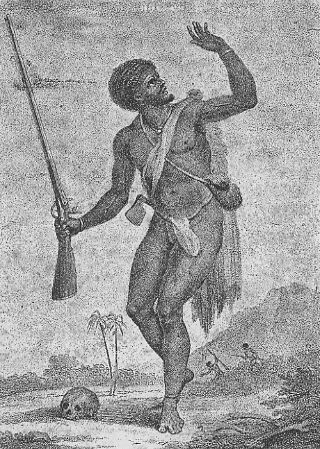
The slaves often ran away, and had to be hunted for and brought back. In the larger islands and on the Main they hid in the forest and swamp, where they formed communities, to which other runaways flocked until they became strong enough to hold their own. From these recesses they often came forth to pillage the plantations, murder the whites, and get the slaves to go off with them in a body. If the buccaneer was ferocious he had at least some method in his madness; the poor ignorant African, on the contrary, let his passions dominate him entirely. In revenge for fancied tyrannies he would commit the most atrocious crimes, torturing his prisoners by cutting them to pieces or even flaying while they still lived.
Is it any wonder that when caught the bush negro or maroon was severely punished, and that the utmost rigour of the law was exercised? As for flogging, every one knows how common that was at the beginning of the present century. Some of us can even look back to a time when the use of the rod and whip on delicate children was a matter of course. Even fine ladies took their little ones to see executions that now horrify us to think of; in a similar way the planter's wife stood at her window to see the punishment of her house-servant.
We could tell of negroes burnt to death, where a downpour of rain put out the fires and left them to linger in torment for hours, of taking pieces of flesh from the unhappy criminals with red-hot pincers, and, most horrible of all, breaking on the wheel. These punishments often took place in the middle of a town, but only on one occasion have we seen any mention of the horror of the scene, and this referred to the smell of burning flesh. Yet the criminals—for it must be remembered that they had been legally convicted and sentenced—showed a stoical indifference to pain almost incredible. As savages they gloried in showing their ability to endure torture, only craving sometimes for a pipe of tobacco to hold between their teeth until it fell.
THE EXECUTION OF BREAKING ON THE RACK. (From Stedman's "Surinam.")
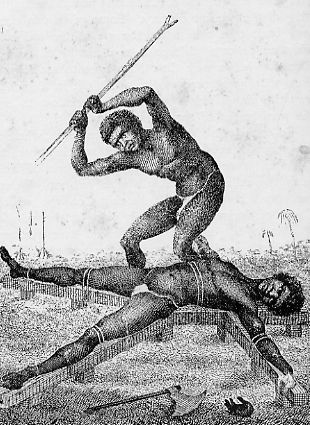
The maroons or bush negroes began to form communities on the Main and in the larger islands from very early times. In Jamaica they were the remnant of the Spanish slaves who ran away on the arrival of the English, with accessions from deserters at later periods; in Surinam some of those who had been sent into the forest to prevent their capture by French corsairs. In both places they maintained their independence, and ultimately made treaties with the colonial authorities, greatly to their own advantage. In Essequebo and Demerara they were kept down by subsidising Arawak Indian trackers, who hunted them from savannah to forest, and from forest to swamp, killing and capturing them almost as fast as they ran away. In the smaller and more settled islands the runaways were generally recaptured at once and severely punished as a warning to others. There the more daring plotted insurrections which often caused much trouble for a few days until suppressed. They did not last long, for the negroes were wanting in the power of combination, because they all wanted to be leaders. Then there was generally some faithful slave or white man's mistress to give the warning, which sometimes caused such prompt action that the outbreak did not occur at all. Yet with all that the danger was serious, and one that could hardly be coped with by forts and batteries.
As early as the year 1649 a plot for a general rising in Barbados was discovered through the information of a bond-servant. All the whites were to have been murdered, but fortunately the ringleaders were arrested before the time fixed and eight of them condemned to death. Then in 1676, under the leadership of a Coromantee, it was arranged that on a certain fixed day, at a signal to be given by blowing shells, all the cane-fields should be set on fire, the white men killed, and their women retained by the negroes as their wives. This also was frustrated by information received from a house negress. Hearing two men talking of the matter, she made inquiries, and learnt of the plot in time to inform her master. Six of the prisoners were burnt alive and eleven beheaded, while five committed suicide by hanging themselves before the trial. The story was told in a pamphlet entitled, "Great Newes from the Barbados, or a true and faithful account of the great conspiracy." Yet again in 1693, after a fearful epidemic had much reduced the number of the whites, a third conspiracy was set on foot. The Governor was to have been killed, the magazine seized, and the forts surprised and taken. When the plot was nearly ripe two of the leaders were overheard conversing about it and instantly arrested. They were hung in chains for four days without food or drink, promises of pardon being made if they revealed their accomplices, which they did at the end of that time, with the result that some were executed and others cruelly tortured. We might go on to tell also of the abortive insurrection of 1702 and several others, but as there were never any very serious risings in Barbados, we must proceed to other colonies.
In Jamaica several abortive attempts at general insurrections were made, some of them assisted by the maroons, who continually received accessions to their numbers from desertion. These people also made incursions on their own account, which led the Government to offer £5 a head for every one killed, the reward being payable on the production of his ears. In 1734 they destroyed several plantations and killed a hundred and fifty white men, which led to an attempt at suppressing them altogether. Captain Stoddart therefore took a detachment of soldiers into the mountains to the maroon town of Nanny. Arriving at night he planted a battery of swivel guns on a height that commanded the collection of huts, before the negroes were aware of his coming. They were rudely awakened from their sleep to find the place surrounded, and in alarm many flung themselves over precipices in their hurry to escape. Some were killed, a few captured, and the town utterly destroyed. About the same time a party of maroons from another place were so bold as to attack the barracks at Spanish Town.
Two years later, under Captain Cudjo, the maroons became so formidable that two regiments of regular troops besides the island militia were employed to reduce them. The Assembly also ordered a line of block-houses or posts to be erected as near as possible to their haunts, at which packs of dogs were to be kept as part of the garrison. Then they sent to the Main for two hundred Mosquito Indians whom they engaged as trackers. This brought matters to a crisis, and Captain Cudjo was compelled to sue for peace, which was granted. A treaty was therefore made with them in 1738 at Trelawny town, by which they were to be considered as free on condition that they captured runaway slaves, assisted in repelling invasions, and allowed two white residents to remain in their towns. Thus peace was restored for a time, and the Mosquito Indians were allowed to go back to their country.
However, Jamaica was not to be free from slave insurrections apart from the maroons, for in May, 1760, at St. Mary's, the slaves of General Forrest's plantation fell suddenly upon the overseer while he was at supper with some friends, and massacred the whole company. They were immediately joined by others, and commenced a career of plundering and burning all the plantations in the neighbourhood. Business in the island was at once suspended, martial law proclaimed, and every white man called out to assist in putting down the revolt. The negroes, however, tried to avoid an open conflict, trusting to hide in the forest, where, however, a large body was discovered and defeated. The maroons had been sent for, but did not arrive until this action had taken place, when they were sent in pursuit of the flying rebels. This they pretended to do, and in a few days returned with a collection of ears which they said had been taken from those whom they had slain, and for which they were paid. The story was found out afterwards to have been a falsehood, as instead of pursuing the fugitives they had simply cut off the ears of those who had been slain before they arrived. This led the authorities to think the maroons in league with the revolted slaves and afterwards to look upon them with distrust. However, by the aid of a body of free negroes, the rebels were at last captured, to be punished in the cruel manner so characteristic of the time. Some were burnt, some hung alive on gibbets, and about six hundred transported to the Bay of Honduras. Two were hung alive on the parade at Kingston, one to linger for seven days and the other for nine, during which time it was said "they behaved with a degree of hardened insolence and brutal insensibility." In the course of the whole insurrection about sixty whites and four hundred negroes were killed, and damage done to the amount of one hundred thousand pounds.
In 1736 a slave revolt took place at Antigua, or rather it was discovered and anticipated. Five negroes were broken on the wheel, six hung in chains and starved to death, one of whom lived for nine days and eight nights, fifty-eight were burnt at the stake, and about a hundred and thirty imprisoned. These horrible punishments were intended as a warning to the others, and no doubt they had such an effect on that generation.
Few of the early insurrections met with any success, notwithstanding that the negroes largely outnumbered the whites in every colony. At the most the blacks had a few days' liberty to murder, burn, and pillage, after which came the terrible retribution. There was, however, one conspicuous exception: poor Berbice was actually taken over, and every white man driven from the plantations.
The Dutch were noted nigger drivers, and although the English were unable to boast much of their humanity, they stigmatised the Hollander as a cruel master. If a negro was obstinate, the Englishman threatened to sell him to a Dutchman or Jew, but the worst threat of all was to give him to a free negro. Whether this bad character was deserved or not is doubtful, but it is quite certain that the criminal law of the Netherlands permitted "the question" when a prisoner would not admit his guilt. This, however, was applicable to white as well as black, there being no particular slave code in the Dutch colonies.
What was the immediate cause of the great rising of 1763, in Berbice, was never exactly ascertained, but vague complaints were made of ill-treatment by certain planters. It commenced on the 27th of February, on an estate in the river Canje, and from thence spread like wildfire over the whole colony. The population consisted of, besides the free Indians, 346 whites, 244 Indian slaves, and about 4,000 negro slaves. The garrison was supposed to consist of sixty soldiers besides officers, distributed at several forts and posts, but owing to sickness only about twenty were fit for duty when the rising took place.
An epidemic of fever and dysentery had prevailed for two years among both whites and slaves, weakening the former in such a manner that they had no courage to contend with the revolted negroes, but mostly ran away to Fort Nassau when they heard of the rising. Almost out of their senses from fright, they urged Governor Hoogenheim to abandon the fort and colony at once. Only one of the councillors stood by the Governor, and it was as much as these two could accomplish to prevent even the soldiers from running away. As for moving against the rebels, this was impossible, for not one of the colonists would follow Councillor Abbinsetts in his attempt to do something. Their fright even affected the officials and soldiers in such a manner that the Governor could hardly escape their importunities to be allowed to leave.
Four vessels lay in the river, two merchant ships and two slavers, but even their crews were sick, and the captain of one so utterly broken down that he could not attend to his duties. The Governor tried to get them to go up the river and do something, but they were almost as frightened as the colonists. Only in one place were the negroes opposed; a few whites taking refuge in the block-house at Peereboom, some distance above the fort, where their way of escape was cut off. But for want of a little assistance they were compelled to make terms with the negroes. Under the agreement the whites were to be allowed to go down to the fort in their own boats, but as soon as they began to embark the negroes fell upon them, men, women, and children, massacred some and took others prisoners, a few only managing to get across the river.
Among the fugitives was a lad named Jan Abraham Charbon, whose story gives a graphic picture of the alarm and consternation produced by the insurrection, and of its results on himself.
He was the son of a planter, and the alarm was brought to the estate at night by a faithful slave. The plantations below were all in the hands of the rebels, who were burning and murdering on both sides of the river. The whites from several neighbouring estates gathered together and decided to make a stand at Peereboom, hoping for assistance from Fort Nassau. They got to the block-house early in the morning, to the number of thirty whites, with a body of faithful slaves, who had not yet deserted them, although they did so later.
Soon after their arrival the insurgents surrounded the house and attacked it, the whites making a successful defence until seven o'clock in the evening. Then one of Charbon's slaves came forward and asked if they wanted peace. On receiving a favourable reply the leaders on both sides came to the agreement above-mentioned. Next morning the whites were fired upon as they went to embark, and Charbon was wounded. However, he jumped into the river and swam across, hiding himself in the jungle, where he came upon another fugitive named Mittelholzer.
For eight days the two wandered about the forest, losing their way and almost dying from hunger and thirst. They dared not approach the river for fear of the negroes. Once they came upon the back of a plantation and hurriedly gathered a few cobs of Indian corn, immediately afterwards running back into the bush to eat them. While lying down a negro with a sabre passed quite close without seeing them, but presently another with a gun peeped into the bushes and caught sight of them. On this Mittelholzer ran out with his drawn sabre and so furiously attacked the rebel that he cut off one of his hands, captured his gun, and put him to flight. However, this audacity did not save him, for he was captured soon afterwards, Charbon managing to escape into the forest. Alone the boy wandered about for six or seven days, until, again becoming desperate from hunger, he returned to the same plantation, to fall into the hands of the negroes. He was stripped of his clothes, put in the stocks, flogged, and threatened with death, but was finally spared on account of his youth, and because the rebel chief, "King" Coffee, wanted a secretary to write letters to Governor Hoogenheim, proposing terms.
Meanwhile the poor Governor hardly knew what to do. He sent to Surinam and Demerara for assistance, but while awaiting this the military officers informed him that the fort was untenable against even a single assault. The wooden palisades were so rotten that a strong man could pull them down easily, and then the building was of wood and could easily be fired. He was ultimately obliged to destroy it and retire down the river, where he at first took possession of the lowest plantation, Dageraad, hoping to remain there until assistance arrived. But even here the rumours of an attack by the rebels made the people clamorous to be allowed to leave, and Hoogenheim had to retire to the mouth of the river, where there was a small guard-house, or signal station, near the site of what is now New Amsterdam. Thus the last hold on the plantations was given up, and the whole colony abandoned to the negroes.
A month passed before the first arrival from Surinam. All that time the Governor and a few whites waited day after day, sometimes almost in despair. The vessels had, at the request of their captains, been allowed to leave, carrying with them some of the people, while others had gone off to Demerara. This desertion was almost necessary, as the food supply was very limited and of a poor quality—cowards were useless, and therefore no objection was made to their departure. Hoogenheim was at last somewhat relieved by the arrival of the English brigantine Betsy with a hundred soldiers from Surinam, and with this small contingent he at once began to retrace his steps with a view to recover the colony. He went back to Dageraad, and in a day or two after was attacked by seven hundred negroes, who fought from early morning to noon, when they retired after suffering a great loss in killed and wounded. It was after this battle that young Charbon arrived with a letter bringing "greetings from Coffee, Governor of the negroes of Berbice." The rebel chief said that as the negroes did not want war, he would give His Honour half the colony, while he himself would govern the other half and go up the river with his people, who were determined never again to be slaves. No notice was taken of this, and Charbon, who had been warned to bring back an answer at his peril, was too pleased to get back to his white friends to again wish for his post of secretary.
Even now the Governor's situation was not only perilous, but most pitiful. St. Eustatius sent two vessels, but almost as soon as they arrived the men were attacked by sickness, and instead of being a help they had to be nursed, even the Governor himself taking his part in the necessary attendance. At one time there were not enough healthy soldiers to relieve guard, but fortunately Coffee had no means of knowing this, or all would certainly have been over with them.
It was not until December that a fleet arrived from the Netherlands, and then a horrible vengeance overtook the rebels. There was not much difficulty in subduing them, especially when a large contingent of Indians was sent overland from Demerara to drive them from the forest. In March, 1764, the trials began with a hundred ringleaders, fifty of whom were sentenced to death. Fifteen of these were burnt, sixteen broken on the wheel, and twenty-two hanged. The following month they executed in similar ways thirty-four, and later again thirty-two. The chiefs were burnt at slow fires, punishment which they bore with the utmost stoicism. One named Atta, however, told the bystanders that he only suffered what he deserved. Finally, in December a general amnesty was proclaimed, which made the negroes cry out with joy, Dankje! Dankje!
Berbice was of course utterly ruined for a time. The plantations were overrun with weeds, the buildings in ruins, and many of the slaves missing. Of the whites only 116 remained; the rest were dead from sickness, had been killed by the negroes, or had fled from the colony. The loss in killed was small, as the general fright prevented any show of resistance. What would have happened if the whites had fallen into the hands of the rebels was shown in one or two flagrant cases. One of the colony surgeons was said to have been flayed alive on the ground that he had poisoned the slaves by forcing them to take medicine. One poor girl who had been captured at Peereboom was compelled to submit to the embraces of King Coffee and driven mad, while another committed suicide to prevent a similar degradation. About eight hundred slaves were missing, most of whom had been killed, as very few managed to escape to the bush.
MARCH THROUGH A SWAMP. (From Stedman's "Surinam.")
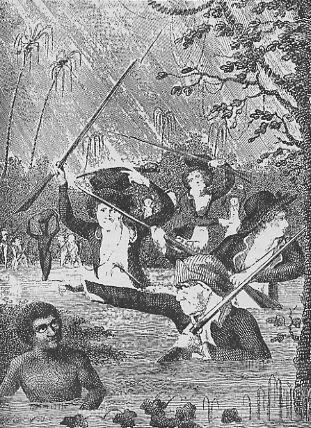
Behind the coast of Guiana is a long stretch of swamp, which in slavery times was the general resort of runaways. For miles extends a grassy plain like a meadow, the sedges entirely covering the two to four feet of water which would otherwise give it the appearance of a great lake. Except through the various streams that drain it, access is almost impossible during the rainy season, and even the Indians care little to explore its recesses beyond fishing in the canal-like creeks. However, here and there are little islands or sand reefs, and on these the runaway slaves took refuge. First, perhaps, a murderer would escape and hide himself for a time until the hue and cry had abated, returning now and again to the plantation at night for the purpose of getting provisions from his friends. Then others would follow, until a party of twenty to a hundred, with their wives, had established a little village. Towards the end of the last century a number of these communities of bush negroes had been formed in Demerara, and their depredations became so common that regular expeditions were sent against them, guided by Indian trackers. In 1795 they joined with the slaves to raise a general insurrection, but special measures were taken so that they were almost suppressed for a time.
Before this they had formed a line of stations for seventy miles from the river Demerara to the Berbice. Every camp was naturally surrounded by water, and by driving pointed stakes in a circle, and leaving the entrance to wind through a double line under water, they were made almost impregnable. To reach them the attacking party had to wade up to their middles through perhaps a mile of ooze and water, to be cut with razor grass, and all the time at the mercy of the negroes. Only during the dry season was anything like success possible, and even then the negroes generally saved themselves by flight.
Many of the slaves were friendly with the runaways, but they were much feared by the more timid. On one occasion a negro went to cut wood at the back of a plantation in Demerara and came suddenly upon the outpost of a camp, probably the entrance to the concealed path which led to the little sand reef. In walking along he stepped upon a bush-rope, and immediately after heard a bell ring above his head. Before he could get away a ferocious bush negro stood before him and demanded his business, but the poor slave was so frightened that he ran home and reported the occurrence to his master. Some of the slaves went so far as to enjoy hunting runaways—in fact, there was little love lost between the two parties. One of these was offered his freedom as a reward for the assistance he had given in an expedition, the Government engaging to purchase him of his owner provided they both consented. Tony, however, did not wish to leave a good master, and refused, stipulating, however, that he should retain the right to accept the kind offer at some future period. When his master ultimately left Demerara, some years afterwards, Tony claimed his promised freedom and got it.
While the bush negroes in other parts of Guiana were kept within reasonable bounds, those of Surinam, like the maroons of Jamaica, had never been conquered. Treaties were agreed to by them in 1749 and 1761, but disputes continually occurred, with the result that the colonists were always more or less in fear of their raids. Then they carried off most of the slaves whenever they attacked a plantation, until their number became so great as to be a real danger. In 1773 the authorities in the Netherlands resolved to make a special effort to conquer them, and for this purpose raised a corps of all nationalities which was put under the command of Colonel Fourgeaud.
That soldiers should be brought from Europe for such a service shows the utter ignorance of the Dutch authorities. If the colonists themselves could not put down the bush negroes, how could it be expected that this would be effected by fresh troops from a cold climate, who had no knowledge of the country, the mode of fighting, or the difficulties of travelling through the bush and swamp?
Commissioners had visited them at different times to arrange the treaties, but there was generally something wrong with the presents (virtually blackmail), or else they were given to the wrong parties. In 1761 the chief Araby had insisted on the commissioners binding themselves by his form of oath. This was done by each party tasting the blood of the other. With a sharp knife a few drops were drawn from the arm of each person into a calabash of water with a few particles of dry earth. After pouring a small quantity of this mixture on the ground as a libation, the calabash was handed round from one to another until all the company had taken a sip. Then the gadoman (priest) took heaven and earth—exemplified by the water and clay—to witness the agreement, and invoked the curse of God upon the first who broke it, the company and crowd of negroes around calling out Da so! (that is so, or amen).
Yet, after all this solemnity, quarrels soon arose again. One chief with his sixteen hundred people had come to terms, but these did not bind his neighbour, who perhaps had half as many. The different chiefs were not united in any way, and it followed, therefore, that, after thousands of guilders had been spent on one, the others made incursions to get a share of the good things for themselves. To the colonists they were all bush negroes, but among themselves they were as distinct as if they had been different nations. Even when at peace, and when the chiefs had received gold-headed canes as symbols of authority, they would often call at the outlying plantations and demand rum or anything else they fancied, which the whites dared not refuse.
The immediate occasion for the special corps from the mother country was an insurrection of the slaves in 1772, who, after plundering and burning some of the plantations, and murdering their owners, fled in great numbers to join the bush negroes. The whole colony was a scene of horror and consternation—the colonists expected the rising to become general, and took refuge in Paramaribo, thus leaving their plantations unprotected. However, it was soon checked, mainly by raising a body of three hundred free negroes, called rangers, who were expert bushfighters, and therefore thoroughly well fitted to cope with the rebels.
One of the chiefs named Baron had settled on an island in the swamp, such as we have described, where he defied the whole colony. There were no means of communication except hidden tracks under water, and in addition to the palisades the chief had erected a battery of swivel guns which he had stolen from the plantations. Thus triply defended by water, stakes, and guns, it is no wonder if he thought his position impregnable. However, he was discovered by a party of rangers, and assaulted by them and a large body of white soldiers. Camping first on the edge of the swamp about a mile away, they could see Baron's flag waving in defiance on the little island, while they were at their wits' ends to find a means of getting at him. A great many shots were wasted by both sides before they found the distance was too great, even for the swivel guns, and then the rangers began to act. Several weeks were passed in attempting to make a causeway by sinking fascines, but when the workers had come within range, so many were killed that it had to be abandoned. In despair of ever effecting anything, they were about to retire, when some of the rangers discovered the hidden pathway under water. A feint was now made of attacking one side by one party, while another crept along the track, and thus at last the fortress was stormed. A terrible hand-to-hand fight took place, in which many were killed on both sides, but even then Baron managed to escape with a good number of his followers.
This defeat made little impression, for soon afterwards the slaves on three plantations killed their white masters, and, like the others, went off to join the bush negroes. It was now felt that something must be done or the colony would have to be abandoned. The bush negroes had to be hunted from their recesses, however difficult the task might be, otherwise there would be no safety even in the town itself. The expeditions could only move in Indian file, exposed to ambushes in the most difficult parts of the track, and firing from behind trees everywhere. There was no possibility of bringing the party together if attacked; it followed, therefore, that the long string of men went forward with the utmost caution. In front came two powerful blacks with machetes or cutlasses to clear the way, and immediately behind them the vanguard. These were followed by the main body alternating with ammunition bearers, and, finally, a long line of carriers with food, medicines, utensils, and kill-devil (rum) with the rearguard. Sometimes the party would flounder through a swamp for hours, holding their firearms above their heads to keep them dry. Then drenching showers would fall, and give the greatest trouble to prevent the powder from becoming useless. Creeks had to be passed on fallen trees, or the party would be detained until a trunk was felled and trimmed to afford a passage. Exposed to malaria, mosquitoes, bush ticks, and maribuntas, they went on day after day, only to find, on reaching the village of the bush negroes, that they had gone elsewhere, to perhaps turn up at some unprotected plantation. The European troops died off in great numbers, while the enemy were in their element. It followed, therefore, that little was done, and that the old system of conciliation had to be adopted, with the same unsatisfactory results. Finally, by utilising their mutual jealousies, about 1793 they were driven so far away from the settlements as to become almost harmless. Their descendants still exist almost as savages, with curious manners and customs, partly inherited from their African forefathers, and partly adopted from their neighbours the Indians.
TRELAWNY TOWN. (From Edwards' "West Indies.")
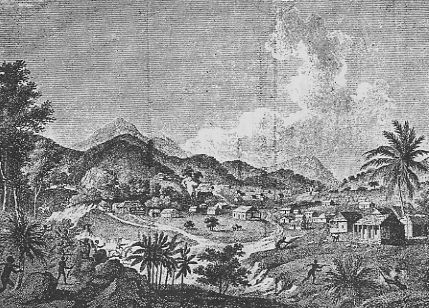
We must now return to the maroons of Jamaica, who had not been conquered, although a nominal treaty existed, and the white residents remained at their posts. In July, 1795, two of them were flogged for pig-stealing, and this was considered a disgrace on the whole community. On the return of the pig-stealers to Trelawny they raised a great outcry, and the resident was at once ordered to leave on pain of death. Efforts were made to pacify them, but they sent a written defiance to the magistrates who had ordered the flogging and declared their intention to attack Montego Bay. The militia were called out and soldiers applied for, but before the preparations were completed, a body of maroons appeared and asked for an interview with four gentlemen whom they named.
Hoping the matter might be prevented from going farther, these and several other whites went to the rendezvous, where they were received by three hundred armed men. The maroons complained of the disgrace on the whole body, through the flogging having been performed by a negro overseer in the presence of felons, and demanded reparation. They wanted, first, an addition to their lands, and, second, a dismissal of the then resident in favour of one they had formerly. Promising to forward their requests to the Governor, the gentlemen left, the maroons appearing as if pacified.
However, this interview was only applied for to gain time, and especially to allow the departure of the British fleet which was then on the point of leaving, and might be detained if they moved too quickly. On the report that there was a probability of a settlement of the matter the fleet left, when the maroons immediately began to plot with the slaves for a general rising. Reports of this had been received by the Governor before, but just after the men-of-war had departed more definite news arrived, which induced him to send a fast-sailing boat to bring them back. Fortunately this was successfully accomplished, and at once confidence drove out the fear of murders, fires, and plundering which had alarmed the inhabitants. The slaves were correspondingly disheartened and left the maroons to fight alone.
But even the maroons themselves became divided in opinion on the return of the military and naval force. The Governor taking advantage of this, issued a proclamation calling upon them to submit, but only thirty-eight old men came forward, the others being determined to fight. They set fire to their own town and commenced hostilities by attacking the outposts. This led to a pursuit in which the whites fell into an ambuscade, many being killed, without as far as was known doing any harm whatever to the enemy. Now commenced a series of raids on the plantations, in which even infants at the breast were massacred.
PACIFICATION OF THE MAROONS. (From Edwards' "West Indies.")
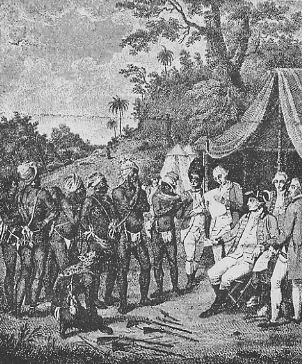
The matter becoming serious, the General Assembly resolved to hunt the rebels with dogs, as had been intended before the treaty. They accordingly sent over to Cuba for huntsmen with their powerful blood-hounds, the descendants of those which had once worried the poor Indians, and afterwards assisted the buccaneers. Times had changed however, and a feeling grew up that hunting men with savage beasts was not quite the thing. This led to some expressions of opinion adverse to the action of the executive, but they excused themselves on the ground that the safety of the island demanded extreme measures. If war was justifiable at all, any and every means, they said, was allowable; in fact, "all was fair in war."
Meanwhile the maroons had been driven to their strongholds in the mountains, where they had little to eat, and were virtually compelled to ravage the plantations for food. On the arrival of forty chasseurs with their hundred dogs, however, they became alarmed, and began to sue for mercy. It does not appear that there was any real necessity for using the animals, their presence being enough for the purpose. They were led behind the troops, and on their appearance the maroons surrendered in great numbers, this putting an end to the insurrection.
Now came the question of what was to be done with them. It was argued that no country could suffer people to live in it unless they could be controlled by law, and that obedience could not be expected from these people. To expect it was entirely out of the question; it was therefore resolved to transport them from the island. Accordingly, in June, 1796, six hundred were sent to Halifax, Nova Scotia, where lands were granted them and a subsistence allowed until crops could be raised. Not liking the climate, they were ultimately established in Sierra Leone, where they became the nucleus of the present colony. Those who had submitted remained in Jamaica, where their descendants are still well known.
XI
THE SOVEREIGNTY OF THE SEAS
By the middle of the eighteenth century Spain had fallen behind, and even Holland had lost her prestige. It followed, therefore, that the only Power that could rival Great Britain was France, and she was an enemy that could never be despised. The struggle in the West Indies between these two Powers now became, if possible, more intense; and if the result gave the sovereignty of the seas to Britons, they have mainly to ascribe it to their naval training in this part of the world. The mistakes of Admiral Vernon were lessons which, being borne in mind by later admirals, tended to prevent similar disasters in the future.
There was a short intermission in the struggle between 1748 and 1756, when the "Seven Years' War" commenced; but before the actual declaration hostilities had commenced between the two rivals in India and North America. Now arose one of England's great admirals, Rodney, who gained his laurels in the Caribbean Sea, and was mainly instrumental in putting France in the background as a naval power. He first came to the front in 1759, when he bombarded Havre, and later, with that other great seaman, Sir Samuel Hood, he became a "household word" in the West Indies.
Before they appeared, however, the British captured Guadeloupe, and commenced a general raid upon the French shipping. But, as usual, our gallant foes were by no means despicable, for in 1760 they claimed to have taken 2,539 English vessels, against a loss of only 944. On the 5th of January, 1762, Rodney sailed from Barbados for Martinique, in command of eighteen ships of the line, and on the 4th of the following month the island capitulated. Then Grenada was taken, to be followed by Dominica, Tobago, St. Vincent, and St. Lucia, thus giving the whole of the French Caribbees into the possession of Great Britain. Spain being also involved, Admiral Pococke attacked Havana in May, and, after a siege of twenty-nine days, took the Morro Castle, a fort hitherto considered impregnable. A fortnight later the Governor of Cuba was compelled to capitulate, thus giving the town also into the hands of the British. These exploits made France and Spain sue for peace, which was signed at Paris in February, 1763, when Grenada, St. Vincent, Dominica, and Tobago were ceded to Great Britain, the other captures being restored.
After this war positive orders were sent to the British West Indies to break off all trade and intercourse with the French and Spanish settlements, with the result that contraband and other traffic was thrown into the hands of the Dutch and Danes. Then the Dutch islands of Curaçao and St. Eustatius began to flourish more and more, and those of the Danes, St. Thomas and St. John, became free ports. During the wars these islands rose to a pitch of prosperity hardly possible to any of those belonging to the combatants, on account of their neutrality. Naturally they were almost barren and of little account as plantations; but as entrepôts they were exceedingly useful, not only to their owners, but to the belligerents as well. Here alone could French, Spanish, and British ships meet without fighting, and for them they could run when pursued by the enemy.
The island of St. Thomas was first colonised in 1666, but for a long time it made little progress. It became useful to the pirates, however, mainly from its being a safe place at which to dispose of their captures. Then merchant vessels found it sometimes convenient to go in to escape these rovers, perhaps to be followed by them, and yet remain safe until an opportunity occurred for escaping their vigilance. Prizes were brought here and sold, the prospect of good bargains leading to the settlement of a number of rich merchants, and especially Jews. What with all this, and a little contraband traffic, the people of St. Thomas did very well, and soon the harbour became one of the busiest in the West Indies.
And here we must mention that the Jews were a very important factor in the development of the early settlements. It will be remembered that large numbers of these people were driven from Spain after the conquest of Granada, and how they went to Portugal and the Netherlands. A large number also went to Brazil, where at first they had a measure of freedom in the exercise of their religion not granted in the mother country. When the Dutch captured Brazil, perfect freedom followed; but after Portugal took her own again, this was withdrawn, and in consequence many left for Surinam and the West Indian islands. Here they were joined by some of their co-religionists from Holland, and in time became a powerful body of planters, but more especially traders. To them were due many improvements in the manufacture of sugar, and even the introduction of the cane into some places. In every colony there was a small community, often with a synagogue, and their connection one with another, as well as their virtual neutrality, made their transactions more safe than those of other traders. As may be supposed, they had no love for the Spaniard, and consequently were the main financiers, not only of privateers, but even pirates.
St. Thomas, Curaçao, and St. Eustatius lived by the misfortunes of others. No longer could the jolly buccaneer sell his prizes and booty at Jamaica; he must go elsewhere, and let other places reap the advantage of his free and easy bargains. For it was "easy come, easy go" with him, and the fortune he made was soon wasted in riotous living. This was all to the advantage of the wily Jew, who first haggled about the price of a cargo, and then got his money back by charging enormous profits on the supplies. The rover was as careless as the proverbial "Jack ashore," and could easily be induced to spend his last piece of eight on the luxuries so temptingly laid before him, utterly regardless of the consequences. He had only to go out and capture another vessel to be able to return and renew his jollification.
In war time these harbours were crowded with the shipping of all nations, and many a fortune was made that enabled the merchant to go to Europe as a West Indian nabob. Then there was a great demand for neutral vessels, in which goods could be transhipped for conveyance to colonies where the belligerent flag might bring a crowd of privateers before the vessel got safely into harbour. Even physicians and surgeons made their piles, for there was always more or less sickness on board the vessels, and a hundred dollars a visit was a common fee.
In 1774 began the dispute with the American colonies of Great Britain, and four years later France joined them, thus bringing trouble again upon the West Indies. The first important move was made by the French, who, in September, 1778, took Dominica, on which the English retaliated by capturing St. Lucia. Then a fleet was sent out from England under Admiral Byron, and another from France under Count de Grasse. The French took St. Vincent and Grenada, and every island of either nation was in a state of alarm and consternation. In July, 1779, Spain joined the others against England, on the ground that her flag had been insulted. To this it was replied that she harboured American privateers, and furnished them with false documents, under which they carried Spanish colours. Thus England had her hands full, for the Yankees alone gave her quite enough work, without the addition of these old rivals.
As yet Rodney had not come out, but in the years 1778 and 1779 he pressed his claim on the Government to have a command in the West Indies. The seas were well known to him, and he had his views as to the proper mode of carrying out operations; but for some time his application was refused. Finally, however, in October, 1779, he was appointed to replace Admiral Byron, with supreme control over the operations in the Caribbean Sea, as well as freedom to intervene if necessary on the American coast.
Rodney was at last satisfied, and he left in December with a convoy, the whole fleet numbering three hundred. In the centre were transports and merchant vessels, and on either side men-of-war. Off Cape Finisterre he captured a convoy of sixteen Spanish vessels, and beyond Cape St. Vincent fought with another squadron, and captured four men-of-war, including the admiral. On then to the relief of Gibraltar, from whence he sent part of the fleet into the Mediterranean, and where he remained until February 13, 1780, when he sailed for the West Indies.
Arriving off St. Lucia on the 28th of March, he came upon the French fleet under De Guichen, which he attempted to engage, but was prevented from the want of skill in his captains. The result was that both fleets sailed away from each other without much damage to either, both stating that the other refused to fight. As, however, the French had thirty vessels to the English seventeen, they could have compelled an action; so that, although the affair was not creditable to either, it was perhaps a little more disgraceful to the larger fleet. Rodney was in a great rage. He attributed his failure to the incompetency of his subordinates, who had not been properly trained to make combined naval evolutions. Every captain, he said, thought himself fit to be Prime Minister of Britain.
However, he continued his cruise, barring the way of the French, and driving De Guichen to St. Eustatius to refit. Now he began to teach his captains those naval manœuvres in which he considered them so much wanting, which his assistant admiral, Sir Hyde Parker, did not altogether like. Rodney, it appears, treated all his subordinates as if they were raw recruits, and, while he gained obedience, created a great deal of ill-feeling. But, with all their training, they could not bring De Guichen to fight, even when they encountered him a second time; yet we may presume that the training was by no means wasted.
As if Great Britain had not enough enemies, in December, 1780, she declared war with the Dutch, on the ground that they assisted the American colonies. What a formidable array—the Colonies, France, Spain, and Holland! Yet, somehow or other, she managed to cope with the whole.
St. Eustatius was the great offender among the Dutch colonies. Notwithstanding that the home Government had sent out strict orders to all her settlements not to honour the flag of the revolted British colonies, or to supply them with contraband of war, there is no doubt that they were very loose in inquiring into such transactions. As we have said already, this and other islands were very useful to the belligerents; and, as we have just stated, De Guichen went to St. Eustatius to escape Rodney and refit. This was no doubt a sore point with the British admiral, who barred the enemy's passage to his own islands only to see him get what he needed from the Dutch.
When the news of the declaration of war came out, Rodney was ready at once to pounce upon the offender; and on the 3rd of February, 1781, before the authorities of St. Eustatius had heard the news, he appeared in the harbour. The Governor could hardly believe his ears when an officer appeared to demand the surrender of the island to His Majesty of Great Britain, but being entirely unprepared, and quite unfitted to cope with such a force, he was obliged to surrender at discretion.
Here was the opportunity for revenge, and Rodney embraced it. Even his best friends could hardly excuse the arbitrary doings which followed, and which were stigmatised as unworthy and almost dishonourable to a British admiral. Being determined to root out this nest of contrabandists, he confiscated all the property of the inhabitants, and ordered them to quit the island. The harbour was filled with shipping, and the stores with goods, the vessels numbering two hundred and fifty, and the contents of the stores worth about three million pounds. Here was indeed a disaster to the Jews, not only of St. Eustatius, but even of British islands, for they were all in correspondence. Rodney went so far as to say that many of the English merchants ought to have been hanged, for it was through their means, and the help of this neutral port, that the enemy were able to carry on the war.
The people were astonished at such unheard-of treatment. Never before had such a thing happened, except in the raids of buccaneers and pirates. The Jews petitioned Rodney and General Vaughan to rescind their decision. They had received orders to give up the keys of their stores and inventories of the goods in them, as well as household furniture and plate; then they were to prepare themselves to quit the island. Such orders from British commanders, whose principal characteristics were mercy and humanity, had distressed them in the extreme, so that their families were absolutely in despair.
This appeal had no effect, even when it was supported by some of the British officers, and such an auction now began as was never known before. The news reached Barbados and the other islands, and down came a horde of speculators, prepared to make their fortunes at once if possible. Such a haul did not occur every day, and they intended to take advantage of it. Thousands of bales of goods were brought out and sold, without either seller or buyer knowing anything of their contents. They might contain rich silks and velvets or the cheapest slave clothing. It was a grand lottery in which every bidder got a prize, although they were in some cases of little value. No one needed to despair of a bargain, however, for there was so much to sell as compared with the number of purchasers, that everything went cheap. Some few got bitten, but in the end hardly a tithe of the value of the goods was obtained.
While this was going on at St. Eustatius, some Bristol privateers got information of the outbreak of hostilities, and pounced upon Demerara and Berbice, where they levied blackmail and captured most of the shipping. As usual with these plunderers, they had no authority to capture the colony, nor had they in this case even commissions against the Dutch. However, they put the inhabitants in a state of consternation, until, a few days later, two men-of-war arrived from Barbados to receive the capitulation, which was demanded on the same terms as that of St Eustatius, although neither party knew what these terms were. Nothing was left but submission, although the authorities protested against such an unheard-of manner of dictating unknown terms. The Governor of Barbados had heard from one of the inhabitants of that island that the Directeur-General of Demerara had expressed, at his dinner-table, his fears that in case of a war the river would be plundered by privateers, and of his preferring to surrender to one of the king's ships: for this reason he had sent the men-of-war. This was considered a bit of "sharp practice" by the Demerarians, but perhaps turned out for the best.
Two commissioners were appointed by the colony to go in one of the English vessels to St. Eustatius and arrange the articles of capitulation, which were fortunately on altogether different lines from those of that island. Surinam, St. Martin's, Saba, and St. Bartholomew's also surrendered on the same unknown terms, but the admiral said that he and General Vaughan thought they ought to be put on a different footing. They would not treat them like the other, whose inhabitants, belonging to a State bound by treaty to assist Great Britain, had yet nevertheless assisted her public enemies and the rebels to her State, with every necessary and implement of war as well as provisions, thus perfidiously breaking the very treaties they had sworn to maintain.
The treatment of St. Eustatius caused a great stir, not only in the West Indies, but in England as well. A remonstrance was sent to Rodney by the merchants of St. Kitt's, who claimed that a large quantity of their goods had been seized. Some of these were insured in England, and they considered their Excellencies responsible for their losses, for which they would seek redress by all the means in their power. It was impossible, they said, for many of them to be more utterly ruined than they then were, and they asked that certificates in reference to their property should be sent to England, in demanding which they were claiming a right rather than a favour. In reply, Rodney said he was surprised that gentlemen who called themselves subjects and merchants of Great Britain, should, when it was in their power to lodge their effects in the British islands to windward, under the protection of British laws, send them to leeward to St. Eustatius, where, in the eyes of reason and common sense, they could only be lodged to supply their king's and country's enemies. The island, he continued, was Dutch—everything in it was Dutch—all was under the Dutch flag. As Dutch it should be treated, and this was his firm resolution as a British admiral, who had no view whatever but to do his duty to his king and country.
Two merchants from St. Eustatius went to London, where they were examined by the Attorney and Solicitor-Generals. They clamoured for justice, and got it, for one of them was committed on a charge of high treason for corresponding with the American agent at Amsterdam, and for furnishing the Americans with military stores and ammunition. Several attempts were made to injure Rodney with the king, but the blow on the enemy was so severe that His Majesty would not listen to the detractors. It is said that a cry of rage went up from the French and American colonies, and that Rodney gloried in his triumph. He was undoubtedly inclined to ride rough-shod over everybody and everything, but as long as he was successful, only the enemy complained.
But the trouble was not yet over, for the merchants of St. Kitt's sent lawyers to file their claims in the Admiralty Courts. Then St. Eustatius was recaptured for Holland by the French, and the tide turned against the admiral. Now was the time to attack him, and his enemies took advantage of it. The mob that threw up their caps and shouted for joy at the glorious news of the capture, now lifted their hands in horror at Rodney's misdeeds. Even his friend Hood was guilty of the meanness of charging his comrade with carrying off vast sums of money, and never accounting for them. Rodney was recalled to England, where he arrived on the 19th of September, 1781, in ill-health, and rather downspirited. In December Burke moved the House of Commons for a committee to inquire into the affair, but although he pressed the motion with all his powers of oratory it was rejected.
Meanwhile the French were turning the tables upon the late victors and having their revenge for the disasters which had fallen upon them. This led to Rodney being again consulted, with the result that on the 19th of February, 1782, he arrived in Barbados with twelve ships of the line. This was the most critical period during the whole war. On the 19th of October previous, Lord Cornwallis had surrendered to the Americans at Yorktown, and this disaster was followed not only by the loss of the West Indian captures, but of the British colonies of St. Kitt's, Nevis, Montserrat, Dominica, and St. Vincent. It was by the special request of the king that Rodney had been again sent out, and before his departure he declared that either the French admiral or himself should be captured. Lord Sandwich, to impress him the more, on the eve of his departure said: "The fate of this Empire is in your hands, and I have no wish that it should be in those of any other."
Meanwhile the Count de Grasse was at Martinique, preparing a large fleet for the final reduction of the British by conquering Jamaica. He was expecting large reinforcements of French vessels and troops, which Rodney tried unsuccessfully to cut off. On the 8th of April the French were reported as having sailed for Hispaniola, where they were to be joined by a Spanish contingent, and Rodney at once sailed in pursuit. The result was that, at last, on the 12th, a decisive victory was gained off Dominica. Admiral de Grasse was captured, many of his fleet destroyed, and the whole expedition broken up. The British West Indies were thus saved, and the people of Jamaica erected a statue to the gallant admiral. Rodney, in concluding his despatch giving the account, said it was his most ardent wish that the British flag should for ever float in every part of the globe, and there is no doubt that this triumph conduced to such an end. It stands prominently forth as the greatest sea fight of the age, and was only eclipsed by those of Nelson, who we may state received much of his naval training in the West Indies.
In January, 1783, peace was again restored. Great Britain lost her American colonies, restored those she had taken from France and Holland, and got back her own, except the island of Tobago, which was ceded to France. From Spain she got the right to cut logwood between the rivers Hondo and Belize, on the understanding that all other places on the coasts of Central America should be abandoned, and that no forts be erected on the concession.
For ten years there was peace, and during that time the planting colonies were developed to a wonderful extent, while those dependent on the contraband traffic became much depressed. The English settlements increased in value so much, that in 1788 they were calculated to have under cultivation two million and a half acres, with five hundred and sixty thousand slaves. These were the palmy days of the slave-trade, when the importations leapt up year after year, with a corresponding increase in the export of produce. The property was valued at over eighty-six millions sterling, Jamaica coming first, but nearly every other island flourishing to an extent hardly credible to those who have only seen them after their downfall.
What Jamaica was to the English, the western portion of Hispaniola became to the French, and even Spain increased her productions, now that things had become settled, and treasure seeking less remunerative. Altogether, the period from this time, to the end of the century, may be considered as the planter's best days, and the "good old times" of which we hear so much but find it so difficult to precisely indicate.
On the 1st of February, 1793, peace was again broken by the French Convention, the declaration of war being made against England and Holland. Thus began that struggle which seemed interminable at the time, and which actually lasted twenty-two years. As usual the West Indies suffered, but this time they were not quite so much the scene of contention as they had been formerly. Tobago was captured from the French on the 15th of April, but during the remainder of the year little was done. In January, 1794, however, Admiral Sir John Jervis arrived at Barbados, and in the following month took Martinique after a severe struggle. Then he went on to St. Lucia, which also surrendered, and before the end of April Guadeloupe fell. Then came reverses; a French fleet arrived, and all were recaptured.
Meanwhile France had invaded Holland, and established a sister republic on her own lines, rendering it necessary for the Stadtholder, the Prince of Orange, to fly off to England. From Kew, where the king had given him a residence, he wrote letters to all the Dutch colonies, asking the authorities to place them in the hands of the British, and treat people of that nationality as friends and allies. With these despatches British fleets were sent to all the possessions of Holland, but only one or two obeyed the command, the result being that the others had to be taken by force, until hardly a Dutch colony existed in any part of the world.
In October, 1796, Spain joined France on the ground that the British, in their operations against the enemy, had injured her in several ways. One of the reasons given was so absurd that we can hardly conceive it to have been put forth seriously. Great Britain had captured Demerara, and this put her in a situation to possess positions of greater importance. Spain, however, got nothing by her taking up the quarrel, for her trade was absolutely swept from the seas, and communication with America almost cut off. This state of things became so troublesome that for the first time in her history neutral vessels were permitted to trade in her American colonies. She also lost the island of Trinidad, which had remained in her possession since the days of Ralegh.
Soon the whole of the West Indies and Spanish Main were virtually under the control of Great Britain, little opportunity being given to her enemies of crossing the Atlantic. No longer could the Caribbean Sea be the scene of the great struggle—the forces of the combatants were wanted nearer home. Now again came the harvest of the little island of St. Thomas, until Denmark was also numbered among the enemies of the "Queen of the Seas." Then the United States came to get her pickings as a neutral, which gave such an impetus to her ship-building and commerce, that later the seamen trained under such auspices became formidable rivals to the British.
The colonists did not altogether dislike this great war. True, freights and insurances were very high, but then the prices of produce were high also. There was a spice of danger in every voyage, but after all the risk was not so very great until the vessels came into the Channel. Then there was a convoy to protect them, and they might even get prize money by capturing traders of the enemy. Every vessel went armed, and many a privateer of the enemy got severely beaten by a gallant body of merchant seamen and passengers. This was a glorious time for the British navy, but the fleets in the West Indies had little to do after the beginning of the war. There was a great disturbance on the island of Hispaniola, a riot in Grenada, troubles in the French islands, and a few skirmishes here and there, but nothing of much consequence to the British.
There were many small difficulties of course, and the navigation laws had to be relaxed generally in favour of neutrals, as otherwise provisions would have been scarce. The Dutch were not altogether displeased with British rule, for Curaçao, which had not been conquered, was captured from its French garrison in 1800, at the request of the inhabitants, whose trade had been entirely stopped. Then the Spanish colonies came to an arrangement by which much of their produce went through British hands, and this prevented the neutrals from getting everything.
In 1802 the peace of Amiens gave France a rest for about ten months, when she got back her own and the Dutch colonies, leaving Trinidad as an addition to those of Great Britain. Hardly, however, had they taken possession, when the treaty was broken, and the British were again in their midst. A great deal of the work which had been undone by the peace had now to be undertaken afresh, but it was ultimately accomplished, so that things went on much the same as before.
The year 1805 was notable for Nelson's trip across the Atlantic in search of the French fleet, which however fled before him and got back to Europe. The same year also saw the heroic defence of "H.M.S." Diamond Rock, which however was not a ship, but an improvised fortress, which after a long struggle was obliged to capitulate. Hundreds of gallant exploits were performed in the West Indies by both English and French, and thus the war went on year after year, until it became something to be calculated for in commercial transactions. People began to look upon it almost as a natural state of things, and fathers told their children that they had peace on one occasion long ago for as many as ten years.
The British had undoubtedly become very arrogant. Their position on the sea was so supreme that they did much as they pleased with the few neutrals. This sort of thing did not suit the North American traders, who were Englishmen also, and like their forefathers resented any interference whatever. It resulted, therefore, that the United States declared war in January, 1813, and made the planters understand what took place "when Greek met Greek." Almost immediately every colony was pestered and worried by a number of fast-sailing schooners, as dangerous in a sense as had once been the fly-boats of the buccaneers. The heavy sugar boats going from plantation to port were captured in great numbers, and some of the harbours actually blockaded by the "Saucy Jack," the "Hornet," and other audacious Yankee craft with names as suggestive of their characters. Then, indeed, the West Indies were roused from their apathy—war was actually at their doors. However, peace came at last, and after 1815 it might be expected that the islands would go on prospering and to prosper.
Such, however, was not the case. In 1807 a great difficulty had come upon them by the abolition of the slave-trade, which at once put a stop to all extensions, either in the way of new plantations or of the acreage under cultivation. This was the first great check, and with the fall in prices, which ensued when Britain became the consignee of almost every settlement, caused a cry of "Ruin!" to arise, which has continued with short intermissions down to the present day.
XII
DOWNFALL OF HISPANIOLA
Before the abolition of the slave-trade had affected the British islands the French colonies were distracted by the results of their great revolution. Hispaniola, or rather that portion now known as Hayti, had become, as we before said, the most important colony; we must now give the story of its downfall. If this had happened by the fortune of war it would perhaps not have been so deplorable, but to be utterly ruined as it was, until even now, after the lapse of a century, it is behind its neighbours, is very sad.
But, in the struggle for existence the straining after liberty has to be reckoned with, and although the process causes intense suffering to both lord and serf—master and slave—the fight is sure to come at some time or other. Miss Martineau uses the title, "The hour and the man," for her romance of the liberation of this once flourishing island. The hour had come, but we are afraid the man has not yet appeared on Hispaniola.
When the French people took the government from the hands of their king and summoned the States General, revolutionary ideas had already come to a head, and the matter of slavery received much consideration. In all the colonies were numbers of free coloured persons, who had been manumitted by their fathers, and in many cases sent to Europe for their education. In Paris they were brought into communication with a kind of anti-slavery society, called L'Amis des noirs, before which they had opportunities of ventilating their grievances. These consisted of civil disabilities which kept mulattoes in the background, and prevented their taking what they believed to be their proper positions in society. The time was fitted for such an agitation, the people were there, and it was only to be expected that their complaints would come in the long catalogue of charges against the aristocrats, among whom were included the West Indian planters. However, although there was little sympathy with the colonists, nothing particular was done as yet, except the issue of the celebrated declaration that all men were born, and continued to be, free and equal as to their political rights. It might be said, perhaps, that this alone gave freedom to the slave and civil equality to the mulatto, but as it did not specially apply to them, little trouble ensued. The planters, however, were sufficiently acute to see the logical outcome of the declaration, and were correspondingly troubled, as they felt that if published among the negroes it might convert them into implacable enemies, and bring on dangerous insurrections. They were soon pacified, however, by orders to convene provincial assemblies, and send representatives to Paris: this they thought would prevent mischief, as their interests could be made known and promoted in France.
VIEW OF PART OF HISPANIOLA. (From Andrews' "West Indies.")
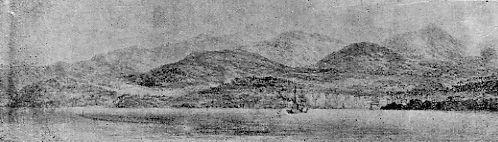
The free coloured people soon heard the news, and at once began to claim their rights as citizens, which the planters were by no means prepared to grant. On this refusal they began to arm themselves, and make demonstrations in various parts of Hayti, but at first were easily put down by the authorities. As yet there was little ill-feeling; the demonstrations were only alarming from their significance and their possible consequences. It followed, therefore, that little was done beyond a demand for submission, the mulattoes being allowed to disperse on promising to keep the peace. A few whites, however, who had been leaders in the agitation, were severely punished, and when a certain Mons. Dubois not only advocated the claims of the coloured people, but the slaves as well, he was banished from the colony.
Mons. de Beaudierre, a ci-devant magistrate, also helped to add to the trouble. He was enamoured of a coloured woman, who owned a valuable plantation, and wanted to marry her, but at the same time wished to see her free from all civil disabilities. Accordingly he drew up a memorial to the committee of his section, claiming for the mulattoes the full benefit of the national declaration of rights. This roused the authorities, who at once arrested him, but so strong was the feeling of the whites that they took the prisoner from gaol and put him to death.
The agitation in Hayti as well as in Martinique led to petitions and remonstrances to the National Assembly, and on the 8th of March, 1790, the majority voted that it was never intended to comprehend the internal government of the colonies in the constitution of the mother country, or to subject them to laws incompatible with their local conditions. They therefore authorised the inhabitants of each colony to signify their wishes, and promised that, as long as the plans suggested were conformable to the mutual interests of the colonies and the metropolis, they would not cause any innovations.
This of course raised a clamour among the friends of the blacks and mulattoes, who considered it as sanctioning the slave-trade, which they wanted to put down. In Hayti the General Assembly met and made some radical changes, which were opposed by many of the old colonists, and this brought discord among the whites. The Governor dissolved the Assembly, but this only brought more trouble, for the subordinate Western body took the part of the General Assembly, and went so far that the Governor tried to suppress it by force. But the members put themselves under the protection of the national guard who resisted the troops sent against them, and after a short skirmish drove them off. Thus all authority was put at defiance by the whites, when if they wanted to keep down the coloured and black people, it was of the greatest consequence that union should exist. The General Convention called the colony to arms, but, before actually commencing hostilities, they resolved to proceed to France, and lay the whole matter before the Convention. Accordingly to the number of eighty-five they sailed on the 8th of August, 1790, the authorities also agreeing to await the result.
Among the coloured residents in France was a young man named James Ogé, the son of a mulatto woman by a white man, whose mother owned a coffee plantation. He was a regular attendant at the meetings of the friends of the blacks, where, under such men as Lafayette and Robespierre, he had been initiated into the doctrine of the equal rights of men. On hearing of the vote of non-interference with the colonies, Ogé, maddened by the thought that the civil disabilities of people of his colour would be continued, resolved to go himself to Hayti. He was confident that the people there would join him, and going out by way of the United States he obtained there a good supply of arms, with which he arrived in October of the same year.
Six weeks after his arrival he wrote to the Governor, demanding that all the privileges of the whites should be extended to every other person, without distinction. As representing the coloured people he made this request, and if their wrongs were not at once redressed, he said, they were prepared to take up arms. He had already been joined by his two brothers, and they were busy calling upon their friends to insist, assuring them that France approved of their claim. But with all his efforts he could get but few followers, the same difficulty cropping up here as in most of the slave insurrections—a want of the power of combination under one of their own race. However, he at last got together two hundred, and, receiving no answer from the Governor, they commenced a series of raids on the plantations. Ogé cautioned them against bloodshed, but the first white man that fell into their hands was murdered, and others soon met with the same fate. Even mulattoes, who refused to join the insurgents, were treated the same way; one man who pointed to his wife and six children, as a reason for his refusal, being murdered with them.
The Governor now sent out a body of troops and militia to suppress the revolt, with the result that Ogé was defeated, and obliged to take refuge with the remnant of his followers in the Spanish colony of St. Domingo. The whites were now roused, and began to cry out for vengeance upon the coloured people in general, whether they had sympathised with Ogé or not. In self-defence they had to take up arms in several places, but by conciliation on the part of the authorities a general insurrection was averted for the time. A new Governor now arrived, and one of his first acts was to demand the extradition of Ogé by the Spaniards, which, being done, he was executed by breaking alive upon the wheel. In his last confession he is said to have stated that a plot was then hatching for the destruction of all the whites, but little notice was taken of this information. The whites believed that now the leader was dead things would go on in the old way, but, unfortunately for them, they were mistaken.
Meanwhile the delegates had arrived in France, where they were honourably received. After an interview with a Committee of the Convention, however, they were informed that their decrees were reversed, the Haytian Assembly dissolved, and they themselves under arrest. This, when the news reached the colony, put the whites into a state of consternation, and for awhile it appeared as if Hayti would be the scene of a civil war. Captain Mauduit, who had led the force against the assembly, was murdered by his own troops, and preparations were made to resist the authorities.
The planters thought these arbitrary measures of France very oppressive, but they had yet to learn how far the revolutionists might go. In May, 1791, the matter of equal rights for the coloured people came up before the National Convention, and their claim was strongly advocated by Robespierre and others. It was now that the words, "Perish the colonies rather than sacrifice one of our principles," were uttered by that bloodthirsty revolutionist, to afterwards become a stock quotation of the extremist in every country. The result of the discussion was the decree of May the 15th, that the people of colour resident in the French colonies, and born of free parents, should be allowed all the privileges of French citizens; to have votes, and be eligible for election to the parochial and colonial assemblies.
This brought on a crisis in Hayti. The coloured people were determined to obtain their rights, and the planters equally resolved that they should remain as before. The Governor was so much alarmed that he at once sent to France for further assistance, at the same time asking for the suspension of the obnoxious decree. Hearing of this, the mulattoes began to assemble and take up arms, and the Governor hardly dared to take action pending the result of his application.
On the morning of the 23rd of August, 1791, the people of Cape François were alarmed by reports that the slaves in the neighbourhood were in open revolt, plundering the plantations and murdering the whites. The disturbance had commenced with the hewing in pieces of a young white apprentice on Pin. Noé, which murder was followed by a general massacre of every white man, except the surgeon, who was spared that he might become useful. From one estate to another the revolt spread, until the whole neighbourhood was a scene of murder, fire, and rapine. The white townspeople put their women and children on board the ships, and then united for a stubborn defence, but the coloured men wanted to remain neutral. This roused such a strong feeling that even at that critical time the whites had to be prevented by the authorities from murdering the mulattoes. By thus protecting the mulattoes their good-will was gained, and they volunteered to go out against the rebels.
Amidst the glare of a hundred conflagrations a strong body of men was collected and sent against the negroes. They defeated one body of four hundred, but accessions were continually made to the side of the rebels, until their overpowering numbers compelled the whites to retreat, and do their best to save the town. The revolt had been continually spreading, and now extended over the whole country, coloured people joining the negroes in their work of destruction. One planter was nailed to a gate, and then had his limbs cut off, one after another; a carpenter was sawn asunder, on the ground that this mode of execution suited his trade; and two mulatto sons killed their white father, notwithstanding his prayers and promises. White, and even coloured children, were killed without mercy at the breasts of their mothers, and young women were violated before the eyes of their parents. Here and there the horror was relieved by kind actions on the part of faithful slaves, who, while joining in the revolt for their own safety, saved their masters and mistresses.
The inhabitants of the town did all they could by sorties, but this was very little. The rebels would run away at the first onset, but only to return in overpowering numbers. A few were taken and broken on the wheel, others fell in the skirmishes, but the insurrection still went on. It spread to the neighbourhood of Port au Prince, but, on the inhabitants of that town agreeing to enforce the obnoxious decree, the rebels retired. This action was at last followed by those of Cape François, and a partial truce ensued. In two months, it was said, a thousand plantations were destroyed, and ten thousand blacks and two thousand whites killed.
The news of this great disaster caused a revulsion of feeling in Paris, and the decree which had caused so much trouble was annulled on the 24th of September, before the results of the insurrection and the truces were known. The arrangement had been come to at Port au Prince on the 11th of the same month, and on the 20th at Cape François. Thus almost at the time when it was being repealed the colonists were promising to see it enforced.
It is hardly necessary to say what could be the only result of the arrival of this revocation. The struggle was renewed, and all hopes of reconciliation were at an end. The coloured party charged the whites with treachery and duplicity; now they would fight until one or the other was exterminated. They captured Port St. Louis, but got a severe repulse from Port au Prince. Both sides were desperate, and although there were fewer massacres in cold blood the rebels fell in thousands. But as they were so numerous this slaughter made little impression. Even when the prisoners were tortured with a refinement of cruelty hardly credible, no good resulted from such examples. The time for all that had passed, yet the whites nailed one poor mulatto by the feet in a cart, and had him driven round the neighbourhood as a spectacle, before breaking him on the wheel.
In January, 1792, three commissioners arrived from France to attempt a reconciliation, which they commenced by publishing the decree revoking the rights of the coloured people. Then they proclaimed a general amnesty for all who should surrender within a given time. Such utter ignorance as was thus shown has hardly been equalled in any age; we can only ascribe it to the fact that the scum had risen to the top. The mulattoes were roused to fury, and the whites equally exasperated. At Petit Goave the rebels held thirty-four white prisoners, and at once they were brought forth to be broken on the wheel, previous to which the proclamation of amnesty was read to them, their executioners mockingly claiming it as a pardon for the cruelties they were exercising.
This sort of thing, however, could not go on very long. Most of the plantations and provision grounds had been destroyed, and both parties felt the want of food. Unless something were done they would all be starved; for without means of buying supplies even the whites could hardly exist, while the blacks did nothing to raise further crops in place of those they had eaten or destroyed. France again made an attempt to put matters straight by declaring, on the 4th of April, 1792, that the people of colour and free negroes ought to enjoy equal political rights with other citizens. New assemblies were to be called, in the election of which they should be allowed to vote; a new Governor of Hayti was appointed, and new commissioners sent out to inquire into the whole matter.
The Governor and the commission arrived at Cape François on the 13th of September, and finding everything in confusion, they sent the late administrator to France as a prisoner, and called a new assembly. Then the commissioners put themselves in communication with the rebels, which made the whites think them about to emancipate the slaves. This was followed by a dispute between them and the Governor, and the appointment of yet another head, who arrived in May, 1793. He refused to recognise the commissioners, but they were not so easily set aside, for having the whole power of the colony under control, they took possession of Port au Prince, Jacmel, and Cape François, afterwards ordering the Governor to leave. This led to another war, in which the coloured rebels and even negroes were utilised by the commissioners, who thus, in a way, sanctioned the revolt. Similar atrocities to those formerly enacted were renewed, and again the colony was distracted in every part.
The ruined planters now lost all hope, and began to leave for the United States, Jamaica, and other colonies. Some went to England, especially those Royalists who attributed all their disasters to the revolution. Here they began to urge the British to conquer Hayti, although as yet war had not been declared with France. In September, 1793, an expedition was sent from Jamaica, and on its arrival at Jeremie the British were apparently welcomed by the whites. But the colony was so utterly distracted that little could be done, and although they took Port au Prince they were repulsed at Cape Tiberon. Then sickness fell upon them—"Yellow Jack"—and this, with the delay of reinforcements, made all prospects of success quite hopeless. With a foreign enemy at hand the commissioners did all they could to reconcile the parties, and to this end, just before the landing of the British, proclaimed complete emancipation of all the slaves, which was ratified in Paris on the 4th of February, 1794. This brought the whole body of rebels together, and the position of the enemy became untenable. Finally came the cession of the Spanish part of the island to France, and now it might be supposed that something could be done to restore peace.
This repulse of the British was greatly due to the influence of a very remarkable personage, Toussaint L'Ouverture, a pure negro, and lately a slave. He had joined the revolt from its commencement, and had succeeded in gaining such an influence over his race as had hitherto been unknown in any slave insurrection. As soon as the general emancipation had been declared, he was so grateful that he joined the French, heart and soul, drove out the British, put down the mulattoes, and was appointed Commander-in-chief of the united forces. In 1801 he became virtually Dictator of the whole island, and was made President for life, with the result that many plantations were re-established, and the colony was making slow progress towards recovery.