Front matter
Max Gysi translation
THE WAY OF INITIATION
BY THE SAME AUTHOR
INITIATION AND ITS RESULTS
a sequel to the
"WAY OF INITIATION"
By RUDOLF STEINER, Ph.D.
Translated from the German by Clifford Bax
CONTENTS
A FOREWORD
I. THE ASTRAL CENTERS (CHAKRAS)
II. THE CONSTITUTION OF THE ETHERIC BODY
III. DREAM LIFE
IV. THE THREE STATES OF CONSCIOUSNESS
V. THE DISSOCIATION OF HUMAN PERSONALITY DURING INITIATION
VI. THE FIRST GUARDIAN OF THE THRESHOLD
VII. THE SECOND GUARDIAN OF THE THRESHOLD
SELECTED LIST OF OCCULT WORKS
In same clear print and rich binding as this book
PRICE $1.00 PREPAID
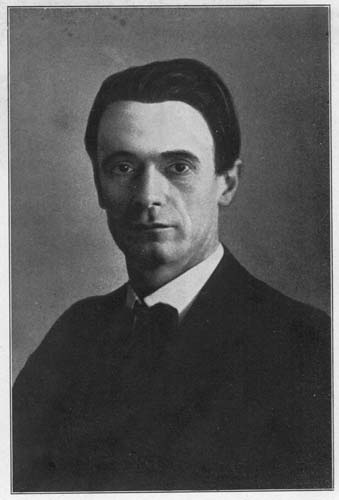
Dr. Rudolf Steiner
THE
WAY OF INITIATION
OR
HOW TO ATTAIN KNOWLEDGE OF THE HIGHER WORLDS
BY
RUDOLF STEINER, Ph.D.
FROM THE GERMAN BY MAX GYSI
WITH SOME BIOGRAPHICAL NOTES OF THE AUTHOR BY EDOUARD SCHURÉ
FIRST AMERICANIZED EDITION
MACOY PUBLISHING AND MASONIC SUPPLY CO. NEW YORK, U.S.A.

CONTENTS.
PAGE
The Personality of Rudolf Steiner and His Development 7
I. The Superphysical World and Its Gnosis 33
II. How to Attain Knowledge of the Higher Worlds 50
III. The Path of Discipleship 65
IV. Probation 81
V. Enlightenment 93
VI. Initiation 117
VII. The Higher Education of the Soul 135
VIII. The Conditions of Discipleship 149
List of Occult and Kindred Books 165
TRANSLATOR'S NOTE.
(FOR THE ENGLISH EDITION.)
Being deeply interested in Dr. Steiner's work and teachings, and desirous of sharing with my English-speaking friends the many invaluable glimpses of Truth which are to be found therein, I decided upon the translation of the present volume. It is due to the kind co-operation of several friends who prefer to be anonymous that this task has been accomplished, and I wish to express my hearty thanks for the literary assistance rendered by them—also to thank Dr. Peipers of Munich for permission to reproduce his excellent photograph of the author.
The special value of this volume consists, I think, in the fact that no advice is given and no statement made which is not based on the personal experience of the author, who is, in the truest sense, both a mystic and an occultist.
If the present volume should meet with a reception justifying a further venture, we propose translating and issuing during the coming year a further series of articles by Dr. Steiner in continuation of the same subject, and a third volume will consist of the articles now appearing in the pages of The Theosophist, entitled "The Education of Children."
Max Gysi.
PUBLISHER'S NOTE.
While the pleasant German vernacular is still discernable in the text of this work, we wish to state that it has been Americanized in spelling, phraseology, and definition, to make plainer to the Western mind the wonderful truths experienced by its distinguished author.
The readers, especially Occult, Theosophic, Masonic, and New Thought students, we believe, will appreciate the clearness with which his teachings lead to the simple rich Harmony of Life.
MACOY PUB. & MASONIC SUP. CO.
THE PERSONALITY OF RUDOLF STEINER AND HIS DEVELOPMENT
By Edouard Schuré [1]
Many of even the most cultivated men of our time have a very mistaken idea of what is a true mystic and a true occultist. They know these two forms of human mentality only by their imperfect or degenerate types, of which recent times have afforded but too many examples. To the intellectual man of the day, the mystic is a kind of fool and visionary who takes his fancies for facts; the occultist is a dreamer or a charlatan who abuses public credulity in order to boast of an imaginary science and of pretended powers. Be it remarked, to begin with, that this definition of mysticism, though deserved by some, would be as unjust as erroneous if one sought to apply it to such personalities as Joachim del Fiore of the thirteenth century, Jacob Boehme of the sixteenth, or St. Martin, who is called "the unknown philosopher," of the eighteenth century. No less unjust and false would be the current definition of the occultist if one saw in it the slightest connection with such earnest seekers as Paracelsus, Mesmer, or Fabre d'Olivet in the past, as William Crookes, de Rochat, or Camille Flammarion in the present. Think what we may of these bold investigators, it is undeniable that they have opened out regions unknown to science, and furnished the mind with new ideas.
No, these fanciful definitions can at most satisfy that scientific dilettantism which hides its feebleness under a supercilious mask to screen its indolence, or the worldly scepticism which ridicules all that threatens to upset its indifference. But enough of these superficial opinions. Let us study history, the sacred and profane books of all nations, and the last results of experimental science; let us subject all these facts to impartial criticism, inferring similar effects from identical causes, and we shall be forced to give quite another definition of the mystic and the occultist.
The true mystic is a man who enters into full possession of his inner life, and who, having become cognizant of his sub-consciousness, finds in it, through concentrated meditation and steady discipline, new faculties and enlightenment. These new faculties and this enlightenment instruct him as to the innermost nature of his soul and his relations with that impalpable element which underlies all, with that eternal and supreme reality which religion calls God, and poetry the Divine. The occultist, akin to the mystic, but differing from him as a younger from an elder brother, is a man endowed with intuition and with synthesis, who seeks to penetrate the hidden depths and foundations of Nature by the methods of science and philosophy: that is to say, by observation and reason, methods invariable in principle, but modified in application by being adapted to the descending kingdoms of Spirit or the ascending kingdoms of Nature, according to the vast hierarchy of beings and the alchemy of the creative Word.
The mystic, then, is one who seeks for truth and the Divine directly within himself, by a gradual detachment and a veritable birth of his higher soul. If he attains it after prolonged effort, he plunges into his own glowing centre. Then he immerses himself, and identifies himself with that ocean of life which is the primordial Force.
The occultist, on the other hand, discovers, studies, and contemplates this same Divine outpouring given forth in diverse portions, endowed with force, and multiplied to infinity in Nature and in Humanity. According to the profound saying of Paracelsus: he sees in all beings the letters of an alphabet, which, united in man, form the complete and conscious Word of life. The detailed analysis that he makes of them, the syntheses that he constructs with them, are to him as so many images and forecastings of this central Divine, of this Sun of Beauty, of Truth and of Life, which he sees not, but which is reflected and bursts upon his vision in countless mirrors.
The weapons of the mystic are concentration and inner vision; the weapons of the occultist are intuition and synthesis. Each corresponds to the other; they complete and presuppose each other.
These two human types are blended in the Adept, in the higher Initiate. No doubt one or the other, and often both, are met with in the founders of great religions and the loftiest philosophies. No doubt also they are to be found again, in a less, but still very remarkable degree, among a certain number of personages who have played a great part in history as reformers, thinkers, poets, artists, statesmen.
Why, then, should these two types of mind, which represent the highest human faculties, and were formerly the object of universal veneration, usually appear to us now as merely deformed and travestied? Why have they become obliterated? Why should they have fallen into such discredit?
That is the result of a profound cause existing in an inevitable necessity of human evolution.
During the last two thousand years, but especially since the sixteenth century, humanity has achieved a tremendous work, namely, the conquest of the globe and the constitution of experimental science, in what concerns the material and visible world.
That this gigantic and herculean task should be successfully accomplished, it was necessary that there should be a temporary eclipse of man's transcendental faculties, so that his whole power of observation might be concentrated on the outer world. These faculties, however, have never been extinct or even inactive. They lay dormant in the mass of men; they remained active in the elect, far from the gaze of the vulgar.
Now, they are showing themselves openly under new forms. Before long they will assume a leading and directing importance in human destinies. I would add that at no period of history, whether among the nations of the ancient Aryan cycle, or in the Semitic civilizations of Asia and Africa—whether in the Græco-Latin world, or in the middle ages and in modern times, have these royal faculties, for which positivism would substitute its dreary nomenclature, ever ceased to operate at the beginning and in the background of all great human creations and of all fruitful work. For how can we imagine a thinker, a poet, an inventor, a hero, a master of science or of art, a genius of any kind, without a mighty ray of those two master-faculties which make the mystic and the occultist—the inner vision and the sovereign intuition.
Rudolf Steiner is both a mystic and an occultist. These two natures appear in him in perfect harmony. One could not say which of the two predominates over the other. In intermingling and blending, they have become one homogeneous force. Hence a special development in which outward events play but a secondary part.
Dr. Steiner was born in Upper Austria in 1861. His earliest years were passed in a little town situated on the Leytha, on the borders of Styria, the Carpathians, and Hungary. From childhood his character was serious and concentrated. This was followed by a youth inwardly illuminated by the most marvellous intuitions, a young manhood encountering terrible trials, and a ripe age crowned by a mission which he had dimly foreseen from his earliest years, but which was only gradually formulated in the struggle for truth and life. This youth, passed in a mountainous and secluded region, was happy in its way, thanks to the exceptional faculties that he discovered in himself. He was employed in a Catholic church as a choir boy. The poetry of the worship, the profundity of the symbolism, had a mysterious attraction for him; but, as he possessed the innate gift of seeing souls, one thing terrified him. This was the secret unbelief of the priests, entirely engrossed in the ritual and the material part of the service. There was another peculiarity: no one, either then or later, allowed himself to talk of any gross superstition in his presence, or to utter any blasphemy, as if those calm and penetrating eyes compelled the speaker to serious thought. In this child, almost always silent, there grew up a quiet and inflexible will, to master things through understanding. That was easier for him than for others, for he possessed from the first that self-mastery, so rare even in the adult, which gives the mastery over others. To this firm will was added a warm, deep and almost painful sympathy; a kind of pitiful tenderness to all beings and even to inanimate nature. It seemed to him that all souls had in them something divine. But in what a stony crust is hidden the shining gold! In what hard rock, in what dark gloom lay dormant the precious essence! Vaguely as yet did this idea stir within him—he was to develop it later—that the divine soul is present in all men, but in a latent state. It is a sleeping captive that has to be awakened from enchantment.
To the sight of this young thinker, human souls became transparent, with their troubles, their desires, their paroxysms of hatred or of love. And it was probably owing to the terrible things he saw, that he spoke so little. And yet, what delights, unknown to the world, sprang from this involuntary clairvoyance! Among the remarkable inner revelations of this youth, I will instance only one which was extremely characteristic.
The vast plains of Hungary, the wild Carpathian forests, the old churches of those mountains in which the monstrance glows brightly as a sun in the darkness of the sanctuary, were not there for nothing, but they were helpful to meditation and contemplation.
At fifteen years of age, Steiner became acquainted with a herbalist at that time staying in his country. The remarkable thing about this man was that he knew not only the species, families, and life of plants in their minutest details, but also their secret virtues. One would have said that he had spent his life in conversing with the unconscious and fluid soul of herbs and flowers. He had the gift of seeing the vital principle of plants, their etheric body, and what Occultism calls the elementals of the vegetable world. He talked of it as of a quite ordinary and natural thing. The calm and coolly scientific tone of his conversation still further excited the curiosity and admiration of the youth. Later on, Steiner knew that this strange man was a messenger from the Master, whom as yet he knew not, but who was to be his real initiator, and who was already watching over him from afar.
What the curious, double-sighted botanist told him, young Steiner found to be in accordance with the logic of things. That confirmed an inner feeling of long standing, and which more and more forced itself on his mind as the fundamental Law, and as the basis of the Great All. That is to say: the two-fold current which constitutes the very movement of the world, and which might be called the flux and reflux of the universal life.
We are all witnesses and are conscious of the outward current of evolution, which urges onward all beings of heaven and of earth—stars, plants, animals and humanity—and causes them to move forward towards an infinite future, without our perceiving the initial force which impels them and makes them go on without pause or rest. But there is in the universe an inverse current, which interposes itself and perpetually breaks in on the other. It is that of involution, by which the principles, forces, entities and souls which come from the invisible world and the kingdom of the Eternal infiltrate and ceaselessly intermingle with the visible reality. No evolution of matter would be comprehensible without this occult and astral current, which is the great propeller of life, with its hierarchy of powers. Thus the Spirit, which contains the future in germ, involves itself in matter; thus matter, which receives the Spirit, evolves towards the future. While, then, we are moving on blindly towards the unknown future, this future is approaching us consciously, infusing itself in the current of the world and man who elaborate it. Such is the two-fold movement of time, the out-breathing and the in-breathing of the soul of the world, which comes from the Eternal and returns thither.
From the age of eighteen, young Steiner possessed the spontaneous consciousness of this two-fold current—a consciousness which is the condition of all spiritual vision. This vital axiom was forced upon him by a direct and involuntary seeing of things. Thenceforth he had the unmistakable sensation of occult powers which were working behind and through him for his guidance. He gave heed to this force and obeyed its admonitions, for he felt in profound accordance with it.
This kind of perception, however, formed a separate category in his intellectual life. This class of truths seemed to him something so profound, so mysterious, and so sacred, that he never imagined it possible to express it in words. He fed his soul thereon, as from a divine fountain, but to have scattered a drop of it beyond would have seemed to him a profanation.
Beside this inner and contemplative life, his rational and philosophic mind was powerfully developing. From sixteen to seventeen years of age, Rudolf Steiner plunged deeply into the study of Kant, Fichte and Schelling. When he came to Vienna some years after, he became an ardent admirer of Hegel, whose transcendental idealism borders on Occultism; but speculative philosophy did not satisfy him. His positive mind demanded the solid basis of the sciences of observation. So he deeply studied mathematics, chemistry, mineralogy, botany and zoology. "These studies," he said "afford a surer basis for the construction of a spiritual system of the universe than history and literature. The latter, wanting in exact methods, would then throw no side-lights on the vast domain of German science." Inquiring into everything, enamored of high art, and an enthusiast for poetry, Steiner nevertheless did not neglect literary studies. As a guide therein he found an excellent professor in the person of Julius Schröer, a distinguished scholar of the school of the brothers Grimm, who strove to develop in his pupils the art of oratory and of composition. To this distinguished man the young student owed his great and refined literary culture. "In the desert of prevailing materialism," says Steiner, "his house was to me an oasis of idealism."
But this was not yet the Master whom he sought. Amidst these varied studies and deep meditations, he could as yet discern the building of the universe but in a fragmentary way; his inborn intuition prevented any doubt of the divine origin of things and of a spiritual Beyond. A distinctive mark of this extraordinary man was that he never knew any of those crises of doubt and despair which usually accompany the transition to a definite conviction in the life of mystics and of thinkers. Nevertheless, he felt that the central light which illumines and penetrates the whole was still lacking in him. He had reached young manhood, with its terrible problems. What was he going to do with his life? The sphinx of destiny was facing him. How should he solve its problem?
It was at the age of nineteen that the aspirant to the mysteries met with his guide—the Master—so long anticipated.
It is an undoubted fact, admitted by occult tradition and confirmed by experience, that those who seek the higher truth from an impersonal motive find a master to initiate them at the right moment: that is to say, when they are ripe for its reception. "Knock, and it shall be opened to you," said Jesus. That is true with regard to everything, but above all with regard to truth. Only, the desire must be ardent as a flame, in a soul pure as crystal.
The Master of Rudolf Steiner was one of those men of power who live, unknown to the world, under cover of some civil state, to carry out a mission unsuspected by any but their fellows in the Brotherhood of self-sacrificing Masters. They take no ostensible part in human events. To remain unknown is the condition of their power, but their action is only the more efficacious. For they inspire, prepare and direct those who will act in the sight of all. In the present instance the Master had no difficulty in completing the first and spontaneous initiation of his disciple. He had only, so to speak, to point out to him his own nature, to arm him with his needful weapons. Clearly did he show him the connection between the official and the secret sciences; between the religious and the spiritual forces which are now contending for the guidance of humanity; the antiquity of the occult tradition which holds the hidden threads of history, which mingles them, separates, and re-unites them in the course of ages.
Swiftly he made him clear the successive stages of inner discipline, in order to attain conscious and intelligent clairvoyance. In a few months the disciple learned from oral teaching the depth and incomparable splendor of the esoteric synthesis. Rudolf Steiner had already sketched for himself his intellectual mission: "To re-unite Science and Religion. To bring back God into Science, and Nature into Religion. Thus to re-fertilize both Art and Life." But how to set about this vast and daring undertaking? How conquer, or rather, how tame and transform the great enemy, the materialistic science of the day, which is like a terrible dragon covered with its carapace and couched on its huge treasure? How master this dragon of modern science and yoke it to the car of spiritual truth? And, above all, how conquer the bull of public opinion?
Rudolf Steiner's Master was not in the least like himself. He had not that extreme and feminine sensibility which, though not excluding energy, makes every contact an emotion and instantly turns the suffering of others into a personal pain. He was masculine in spirit, a born ruler of men, looking only at the species, and for whom individuals hardly existed. He spared not himself, and he did not spare others. His will was like a ball which, once shot from the cannon's mouth, goes straight to its mark, sweeping off everything in its way. To the anxious questioning of his disciple he replied in substance:
"If thou wouldst fight the enemy, begin by understanding him. Thou wilt conquer the dragon only by penetrating his skin. As to the bull, thou must seize him by the horns. It is in the extremity of distress that thou wilt find thy weapons and thy brothers in the fight. I have shown thee who thou art, now go—and be thyself!"
Rudolf Steiner knew the language of the Masters well enough to understand the rough path that he was thus commanded to tread; but he also understood that this was the only way to attain the end. He obeyed, and set forth.
From 1880 the life of Rudolf Steiner becomes divided into three quite distinct periods: from twenty to thirty years of age (1881-1891), the Viennese period, a time of study and of preparation; from thirty to forty (1891-1901), the Weimar period, a time of struggle and combat; from forty to forty-six (1901-1907), the Berlin period, a time of action and of organization, in which his thought crystallized into a living work.
I pass rapidly over the Vienna period, in which Steiner took the degree of Doctor of Philosophy. He afterwards wrote a series of scientific articles on zoology, geology, and the theory of colors, in which theosophical ideas appear in an idealist clothing. While acting as tutor in several families, with the same conscientious devotion that he gave to everything, he conducted as chief editor a weekly Viennese paper, the Deutsche Wochenschrift. His friendship with the Austrian poetess, Marie Eugénie delle Grazie, cast, as it were, into this period of heavy work a warm ray of sunshine, with a smile of grace and poetry.
In 1890 Steiner was summoned to collaborate in the archives of Goethe and Schiller at Weimar, to superintend the re-editing of Goethe's scientific works. Shortly after, he published two important works, Truth and Science and The Philosophy of Liberty. "The occult powers that guided me," he says, "forced me to introduce spiritualistic ideas imperceptibly into the current literature of the time." But in these various tasks he was but studying his ground while trying his strength. So distant was the goal that he did not dream of being able to reach it as yet. To travel round the world in a sailing vessel, to cross the Atlantic, the Pacific and the Indian Ocean, in order to return to a European port, would have seemed easier to him. While awaiting the events that would allow him to equip his ship and to launch it on the open sea, he came into touch with two illustrious personalities who helped to determine his intellectual position in the contemporary world.
These two persons were the celebrated philosopher, Friedrich Nietzsche, and the no less famous naturalist, Ernst Haeckel.
Rudolf Steiner had just written an impartial treatise on the author of Zarathustra. In consequence of this, Nietzsche's sister begged the sympathetic critic to come and see her at Naumburg, where her unhappy brother was slowly dying. Madame Foerster took the visitor to the door of the apartment where Nietzsche was lying on a couch in a comatose condition, inert, stupified. To Steiner there was something very significant in this melancholy sight. In it he saw the final act in the tragedy of the would-be superman.
Nietzsche, the author of Beyond Good and Evil, had not, like the realists of Bismarckian imperialism, renounced idealism, for he was naturally intuitive; but in his individualistic pride he sought to cut off the spiritual world from the universe, and the divine from human consciousness. Instead of placing the superman, of whom he had a poetic vision, in the spiritual kingdom, which is his true sphere, he strove to force him into the material world, which alone was real in his eyes. Hence, in that splendid intellect arose a chaos of ideas and a wild struggle which finally brought on softening of the brain. To explain this particular case, it is needless to bring in atavism or the theory of degeneracy. The frenzied combat of ideas and of contradictory sentiments, of which this brain was the battlefield, was enough. Steiner had done justice to all the genius that marked the innovating ideas of Nietzsche, but this victim of pride, self-destroyed by negation, was to him none the less a tragic instance of the ruin of a mighty intellect which madly destroys itself in breaking away from spiritual intelligence.
Madame Foerster did her utmost to enrol Dr. Steiner under her brother's flag. For this she used all her skill, making repeated offers to the young publicist to become editor and commentator of Nietzsche's works. Steiner withstood her insistence as best he could, and ended by taking himself off altogether, for which Madame Foerster never forgave him. She did not know that Rudolf Steiner bore within him the consciousness of a work no less great and more valuable than that of her brother.
Nietzsche had been merely an interesting episode in the life of the esoteric thinker on the threshold of his battlefield. His meeting with the celebrated naturalist, Ernst Haeckel, on the contrary, marks a most important phase in the development of his thought. Was not the successor of Darwin apparently the most formidable adversary of the spiritualism of this young initiate, of that philosophy which to him was the very essence of his being and the breath of his thought? Indeed, since the broken link between man and animal has been re-joined, since man can no longer believe in a special and supernatural origin, he has begun altogether to doubt his divine origin and destiny. He no longer sees himself as anything but one phenomenon among so many phenomena, a passing form amidst so many forms, a frail and chance link in a blind evolution. Steiner, then, is right in saying: "The mentality deduced from natural sciences is the greatest power of modern times." On the other hand, he knew that this system merely reproduces a succession of external forms among living beings, and not the inner and acting forces of life. He knew it from personal initiation, and a deeper and vaster view of the universe. So also he could exclaim with more assurance than most of our timid spiritualists and startled theologians: "Is the human soul then to rise on the wings of enthusiasm to the summits of the True, the Beautiful and the Good, only to be swept away into nothingness, like a bubble of the brain?" Yes, Haeckel was the Adversary. It was materialism in arms, the dragon with all his scales, his claws, and his teeth.
Steiner's desire to understand this man, and to do him justice as to all that was great in him, to fathom his theory so far as it was logical and plausible, was only the more intense. In this fact one sees all the loyalty and all the greatness of his comprehensive mind.
The materialistic conclusions of Haeckel could have no influence on his own ideas which came to him from a different science; but he had a presentment that in the indisputable discoveries of the naturalist he should find the surest basis of an evolutionary spiritualism and a rational theosophy.
He began, then, to study eagerly the History of Natural Creation. In it Haeckel gives a fascinating picture of the evolution of species, from the amœba to man. In it he shows the successive growth of organs, and the physiological process by which living beings have raised themselves to organisms more and more complex and more and more perfect. But in this stupendous transformation, which implies millions and millions of years, he never explains the initial force of this universal ascent, nor the series of special impulses which cause beings to rise step by step. To these primordial questions, Haeckel has never been able to reply except by admitting spontaneous generation, [2] which is tantamount to a miracle as great as the creation of man by God from a clod of earth. To a theosophist like Steiner, on the other hand, the cosmic force which elaborates the world comprises in its spheres, fitted one into another, the myriads of souls which crystallize and incarnate ceaselessly in all beings. He, who saw the underside of creation, could but recognize and admire the extent of the all-round gaze with which Haeckel surveyed his above. It was in vain that the naturalist would deny the divine Author of the universal scheme: he proved it in spite of himself, in so well describing His work. As to the theosophist, he greeted, in the surging of species and in the breath which urges them onward—Man in the making, the very thought of God, the visible expression of the planetary Word. [3]
While thus pursuing his studies, Rudolf Steiner recalled the saying of his Master: "To conquer the dragon, his skin must be penetrated." While stealing within the carapace of present-day materialism, he had seized his weapons. Henceforth he was ready for the combat. He needed but a field of action to give battle, and a powerful aid to uphold him therein. He was to find his field in the Theosophical Society, and his aid in a remarkable woman.
In 1897 Rudolf Steiner went to Berlin to conduct a literary magazine and to give lectures there.
On his arrival, he found there a branch of the Theosophical Society. The German branch of this Society was always noted for its great independence, which is natural in a country of transcendental philosophy and of fastidious criticism. It had already made a considerable contribution to occult literature through the interesting periodical, The Sphinx, conducted by Dr. Hübbe-Schleiden, and Dr. Carl du Prel's book—Philosophie der Mystik. But, the leaders having retired, it was almost over with the group. Great discussions and petty wranglings divided the theosophists beyond the Rhine. Should Rudolf Steiner enter the Theosophical Society? This question forced itself urgently upon him, and it was of the utmost gravity, both for himself and for his cause.
Through his first Master, through the brotherhood with which he was associated, and by his own innermost nature, Steiner belongs to another school of Occultism, I mean to the esoteric Christianity of the West, and most especially to the Rosicrucian initiation.
After mature consideration he resolved to join the Theosophical Society of which he became a member in 1902. He did not, however, enter it as a pupil of the Eastern tradition, but as an initiate of Rosicrucian esotericism who gladly recognized the profound depth of the Hindu Wisdom and offered it a brotherly hand to make a magnetic link between the two. He understood that the two traditions were not meant to contend with each other, but to act in concert, with complete independence, and thus to work for the common good of civilization. The Hindu tradition, in fact, contains the greatest treasure of occult science as regards cosmogony and the prehistoric periods of humanity, while the tradition of Christian and Western esotericism looks from its immeasurable height upon the far-off future and the final destinies of our race. For the past contains and prepares the future, as the future issues from the past and completes it.
Rudolf Steiner was assisted in his work by a powerful recruit and one of inestimable value in the propagandist work that he was about to undertake.
Mlle. Marie von Sivers, a Russian by birth, and of an unusually varied cosmopolitan education (she writes and speaks Russian, French, German, and English equally well), had herself also reached Theosophy by other roads, after long seeking for the truth which illumines all because it illumines the very depths of our own being. The extreme refinement of her aristocratic nature, at once modest and proud, her great and delicate sensitiveness, the extent and balance of her intelligence, her artistic and mental endowments, all made her wonderfully fitted for the part of an agent and an apostle. The Oriental theosophy had attracted and delighted her without altogether convincing her. The lectures of Dr. Steiner gave her the light which convinces by casting its beams on all sides, as from a transplendent centre. Independent and free, she, like many Russians in good society, sought for some ideal work to which she could devote all her energies. She had found it. Dr. Steiner having been appointed General Secretary of the German Section of the Theosophical Society, Mlle. Marie von Sivers became his assistant. From that time, in spreading the work throughout Germany and the adjacent countries, she displayed a real genius for organization, maintained with unwearied activity.
As for Rudolf Steiner, he had already given ample proof of his profound thought and his eloquence. He knew himself, and he was master of himself. But such faith, such devotion must have increased his energy a hundredfold, and given wings to his words. His writings on esoteric questions followed one another in rapid succession. [4]
He delivered lectures in Berlin, Leipzig, Cassel, Munich, Stuttgart, Vienna, Budapest, etc. All his books are of a high standard. He is equally skilled in the deduction of ideas in philosophical order, and in rigorous analysis of scientific facts. And when he so chooses, he can give a poetical form to his thought, in original and striking imagery. But his whole self is shown only by his presence and his speech, private or public. The characteristic of his eloquence is a singular force, always gentle in expression, resulting undoubtedly from perfect serenity of soul combined with wonderful clearness of mind. Added to this at times is an inner and mysterious vibration which makes itself felt by the listener from the very first words. Never a word that could shock or jar. From argument to argument, from analogy to analogy, he leads you on from the known to the unknown. Whether following up the comparative development of the earth and of man, according to occult tradition, through the Lemurian, Atlantean, Asiatic and European periods; whether explaining the physiological and psychic constitution of man as he now is; whether enumerating the stages of Rosicrucian initiation, or commenting on the Gospel of St. John and the Apocalypse, or applying his root-ideas to mythology, history and literature, that which dominates and guides his discourse is ever this power of synthesis, which co-ordinates facts under one ruling idea and gathers them together in one harmonious vision. And it is ever this inward and contagious fervor, this secret music of the soul, which is, as it were, a subtle melody in harmony with the Universal Soul.
Such, at least, is what I felt on first meeting him and listening to him two years ago. I could not better describe this undefinable feeling than by recalling the saying of a poet-friend to whom I was showing the portrait of the German theosophist. Standing before those deep and clear-seeing eyes, before that countenance, hollowed by inward struggles, moulded by a lofty spirit which has proved its balance on the heights and its calm in the depths, my friend exclaimed: "Behold a master of himself and of life!"
THE WAY OF INITIATION
I
THE SUPERPHYSICAL WORLD AND ITS GNOSIS
In this practical age and because of the many various claims of the day, it is but natural that people, who hear of transcendentalism should at once ask the question: "How may we for ourselves know the truth of such statements?" Indeed, it is noticeable, as a characteristic of the majority, that they will accept nothing on faith, or mere "authority," but wish rather to rely entirely upon their own judgment. Therefore, when a mystic undertakes to explain something of the superphysical nature of man, and of the destiny of the human soul and spirit before birth and after death, he is at once confronted with that fundamental demand. Such doctrine, they seem to think is important only when you have shown them the way by which they may convince themselves of its truth.
This critical inquiry is quite justified; and no true mystic or occultist will dispute its fairness, yet it is unfortunate that with many who make the demand, there exists a feeling of skepticism or antagonism toward the mystic or any attempt on his part to explain anything occult. This feeling becomes especially marked when the mystic intimates how the truths which he has described may be attained. For they say, "Whatever is true may be demonstrated; therefore, prove to us what you assert." They demand that the truth must be something clear and simple, something which an ordinary intellect may comprehend. "Surely," they add, "this knowledge cannot be the possession of a chosen few, to whom it is given by a special revelation." And in this way the real messenger of transcendental truth is frequently confronted with people who reject him, because—unlike the scientist, for example, he can produce no proofs for his assertions, of such a nature as they are able to understand. Again, there are those who cautiously reject any information pertaining to the superphysical because to them it does not seem reasonable. Thereupon they partially satisfy themselves, by claiming that we cannot know anything of what lies beyond birth or death, or of anything which cannot be perceived through our five ordinary physical senses.
These are but a few of the arguments and criticisms with which to-day the messenger of a spiritual philosophy is confronted; but they are similar to all those which compose the key-note of our time, and he who puts himself at the service of a spiritual movement must recognize this condition quite clearly.
For his own part, the mystic is aware that his knowledge rests upon superphysical facts; which to him are just as tangible, for example, as those that form the foundation of the experiences and observations described by a traveller in Africa or any strange land. To the mystic applies what Annie Besant has said in her manual, "Death and After?"
"A seasoned African explorer would care but little for the criticisms passed on his report by persons who had never been there; he might tell what he saw, describe the animals whose habits he had studied, sketch the country he had traversed, sum up its products and its characteristics. If he was contradicted, laughed at, set right, by untravelled critics, he would be neither ruffled nor distressed, but would merely leave them alone. Ignorance cannot convince knowledge by repeated asseveration of its nescience. The opinion of a hundred persons on a subject of which they are wholly ignorant is of no more weight than the opinion of one such person. Evidence is strengthened by many consenting witnesses, testifying each to his knowledge of a fact, but nothing multiplied a thousand times remains nothing."
Here is expressed the mystic's view of his own situation. He hears the objections which are raised on every side, yet he knows that for himself he has no need to dispute them. He realizes that his certain knowledge is being criticized by those who have not had his experience, that he is in the position of a mathematician who has discovered a truth which can lose no value though a thousand voices are raised in opposition.
Then again will arise the objection of the skeptics: "Mathematical truths may be proven to anyone," they will say, "and though perhaps you have really found something, we shall accept it only when we have learned of its truth through our own investigation." Such then have reason to consider themselves to be in the right, because it is clear to them that anyone who acquires the necessary knowledge can prove a mathematical truth, while the experiences professed by the mystic if true depend upon the special faculties of a few elect mystics, in whom they assume they are expected to blindly believe.
For him, who rightly considers this objection, all justification for the doubt immediately vanishes; and mystics can here use the very logical reasoning of the skeptics themselves, by emphasizing the truth that the way to Higher Knowledge is open to anyone who will acquire for himself the faculties by which he may prove the spiritual truths herein claimed. The mystic asserts nothing which his opponents would not also be compelled to assert, if they did but fully comprehend their own statements. They, however, in making an assertion, often formulate a claim which constitutes a direct contradiction of that assertion.
Skeptics are seldom willing to acquire the necessary faculties to test the assertions of the mystic, but prefer to judge him offhand, without regard to their own lack of qualification. The sincere mystic says to them: "I do not claim to be 'chosen' in the sense that you mean. I have merely developed within myself, some of man's additional senses in order to acquire the faculties through which it is possible to speak of glimpses into superphysical regions." These senses are dormant within you and every other person, until they are developed, (as is necessary with the usual senses and faculties more noticeable in the growth of a child). Yet his opponents answer: "You must prove your truths to us as we now are!" This at once appears a difficult task, for they have not complied with the necessity of developing the dormant powers within them, they are still unwilling to do so, and yet they insist that he shall give them proofs; nor do they see that this is exactly as if a peasant at his plough should demand of the mathematician the proof of a complicated problem, without his undergoing the trouble of learning mathematics.
This mixed mental condition appears to be so general and its solution so simple that one almost hesitates to speak of it. And yet it indicates a delusion under which millions of people continue living at the present time. When explained to them they always agree in theory, since it is quite as plain as, that two and two make four; yet in practice they continually act in contradiction. The mistake has grown to be second nature with many; they indulge it without realizing that they do so without desiring to be convinced of its error; just as they set themselves against other laws which they should and would at all times recognize as embodying a principle of the simplest nature, if they but gave it an unbiased consideration. It matters not whether the mystic of to-day moves among thinking artisans, or in a more educated circle, wherever he goes he meets with the same prejudice, the same self-contradiction. One finds it in popular lectures, in the newspapers and magazines, and even in the more learned works or treatises.
Here we must recognize quite clearly that we are dealing with a consensus of opinion that amounts to a sign of the times, which we may not simply pronounce as incompetent, nor deal with as possibly a correct but unjust criticism. We must understand that this prejudice against the higher truths, lies deep in the very being of our age. We must understand clearly that the great successes, the immense advance marking our time, necessarily encourages this condition. The nineteenth century especially had in the above respect a dark side to its wonderful excellences. Its greatness rests upon discoveries in the external world, and conquest of natural forces for technical and industrial purposes. These successes could have been attained only by the employment of the mind directed toward material results.
The civilization of the present day is the result of the training of our senses, and of that part of our mind which is occupied with the world of sense. Almost every step we take in the busy marts of to-day shows us how much we owe to this kind of training. And it is under the influence of these blessings of civilization that the habits of thought, prevalent among our fellow-men, have been developed. They continue to abide by the senses and the mind, because it is by means of these that they have grown great. People were taught to train themselves to admit nothing as true except those things that were presented to them by the senses or the intellect. And nothing is more apt to claim for itself the only valid testimony, the only absolute authority, than the mind or the senses. If a man has acquired by means of them a certain degree of culture, he thenceforth accustoms himself to submit everything to their consideration, everything to their criticism. And again in another sphere, in the domain of Social Life, we find a similar trait. The man of the nineteenth century insisted, in the fullest sense of the word, upon the absolute freedom of personality, and repudiated any authority in the Social Commonwealth. He endeavored to construct the community in such a way that the full independence, the self-chosen vocation of each individual, should, without interference, be assured. In this way it became habitual for him to consider everything from the standpoint of the average individual.
This same individuality is also helpful in the search of knowledge on the spiritual plane, for the higher powers which lie dormant in the soul may be developed by one person in this direction by another in that. One will make more progress, another less. But when they develop those powers, and attach value to them, men begin to differentiate themselves. And then one must allow, to the advanced student, more right to speak on the subject, or to act in a certain way, than to another who is less advanced. This is more essential in matters of the higher realm than on the plane of the senses and the mind, where experiences are more nearly the same.
It is also noticeable that the present formation of the Social Commonwealth has helped to bring about a revolt against the higher powers of man. According to the mystic, civilization during the nineteenth century has moved altogether along physical lines; and people have accustomed themselves to move on the physical plane alone, and to feel at home there. The higher powers are developed only on planes higher than the physical, and the knowledge which these faculties bring is, therefore, unknown to the physical man. It is only necessary to attend mass-meetings, if one wishes to be convinced of the fact that the speakers there are totally unable to think any thoughts but those which refer to the physical plane, the world of sense. This can also be seen through the leading journalists of our papers and magazines; and, indeed, on all sides one may observe the haughtiest and most complete denial of everything that cannot be seen with the eyes, or felt with the hands, or comprehended by the average mind. We do not condemn this attitude for it denotes a necessary stage in the development of humanity. Without the pride and prejudices of mind and sense, we should never have achieved our great conquests over material life, nor have been able to impart to the personality a certain measure of elasticity: neither can we hope that many ideals, which must be founded on man's desire for freedom and the assertion of personality, may yet be realized.
But this dark side of a purely materialistic civilization has deeply affected the whole being of the modern man. For proof it is not necessary to refer to the obvious facts already named; it would be easy to demonstrate, by certain examples (which are greatly underrated, especially to-day), how deeply rooted in the mind of the modern man is this adhesion to the testimony of the senses, or the average intelligence. And it is just these things that indicate the need for the renewal of spiritual life.
The strong response evoked by Professor Friedrich Delitzsch's Babel and Bible Theory fully justifies a reference to its author's method of thinking, as a sign of the time. Professor Delitzsch has demonstrated the relationship of certain traditions in the Old Testament, to the Babylonian accounts of the Creation, and this fact, coming from such a source and in such a form, has been realized by many who would otherwise have ignored such questions. It has led many to reconsider the so-called idea of Revelation. They ask themselves: "How is it possible to accept the idea that the contents of the Old Testament were revealed by God, when we find very similar conceptions among decidedly heathen nations?" This problem cannot here be further discussed. Delitzsch found many opponents who feared that through his exposition, the very foundations of Religion had been shaken. He has defended himself in a pamphlet, Babel and Bible, a Retrospect and a Forecast. Here we shall only refer to a single statement in the pamphlet. One of importance, because it reveals the view of an eminent scientist regarding the position of man with respect to transcendental truths. And to-day innumerable other people think and feel just like Delitzsch. The statement affords an excellent opportunity for us to find out what is the innermost conviction of our contemporaries, expressed quite freely and, therefore, in its truest form.
Delitzsch turns to those who reproach him with a somewhat liberal use of the term "Revelation," and who would fain regard it as "a kind of old priestly wisdom" which "has nothing at all to do with the layman," making this reply.
"For my part, I am of opinion that while our children or ourselves are instructed in school or at church as regards Revelation, not only are we within our right, but it is our duty, to think independently concerning these deep questions, possessing also, as they do, an eminently practical side, were it only that we might avoid giving our children 'evasive' answers. For this very reason it will be gratifying to many searchers after Truth when the dogma of a special 'choosing' of Israel shall have been brought forward into the light of a wider historical outlook, through the union of Babylonian, Assyrian, and Old Testament research…. [A few pages earlier we are shown the direction of such thoughts.] For the rest, it would seem to me that the only logical thing is for Church and School to be satisfied as regards the whole past history of the world and of humanity, with the belief in One Almighty Creator of Heaven and Earth, and that these tales of the Old Testament should be classified by themselves under some such title as 'Old Hebraic Myths.'"
(It may be taken as a matter of course, we suppose, that no one will see in the following remarks an attack on the investigator Delitzsch.) What, then, is here averred in naive simplicity? Nothing less than that the mind which is engaged upon physical investigation may assert the right of judging experiences of superphysical nature. There is no thought that this mind without further development may perhaps be unfit to reflect upon the teachings of these "Revelations." When one wishes to understand that which appears as a "Revelation," one must employ the kind of knowledge or forces through which the "Revelation," itself has come to us.
He who develops within himself the mystical power of perception soon observes that in certain stories of the Old Testament which by Delitzsch were called "Old Hebraic Myths," there are revealed to him truths of a higher nature than those which may be comprehended by the intellect, which is only concerned with the things of sense. His own experiences will lead him to see that these "Myths" have proceeded out of a mystic perception of transcendental truths. And then, in one illuminative moment, his whole point of view is changed.
As little as one may demonstrate the fallacy of a mathematical problem by discovering who solved it first, or even that several people have solved it, just so little may one impugn the truth of a biblical narrative by the discovery of a similar story elsewhere. Instead of demanding that everyone should insist upon his right, or even his duty, to think independently on the so-called "Revelations," we ought rather to consider that only he who has developed in himself those latent powers which make it possible for him to relive that which was once realized by those very mystics, who proclaimed the "supersensuous revelations," has a right to decide anything about the matter.
Here we have an excellent example of how the average intellect, qualified for the highest triumphs in practical sense-knowledge, sets itself up, in naive pride, as a judge in domains, the existence of which it does not even care to know. For purely historical investigation is also carried on by nothing but the experience of the senses.
In just the same way has the investigation of the New Testament led us into a blind alley. At any costs the method of the "Newer Historical Investigation" had to be directed upon the Gospels. These documents have been compared with each other, and brought into relation with all sorts of records, in order that we might find out what really happened in Palestine from the year 1 to the year 33; how the "historical personality" of whom they tell really lived, and what He may really have said.
Angelus Selesius, of the seventeenth century, has already expressed the whole of the critical attitude toward this kind of investigation:
"Though Christ were yearly born in Bethlehem, and never Had birth in you yourself, then were you lost for ever; And if within yourself it is not reared again, The Cross at Golgotha can save you not from pain."
Nor are these the words of one who doubted, but those of a Christian, strong in his belief. And his equally fervent predecessor, Meister Eckhart, said in the thirteenth century:
"There are some who desire to see God with their eyes, as they look at a cow; and just as they love a cow, so they desire to love God…. Simple-minded people imagine that God may be seen as if He stood there and they stood here. But this is not so: in that perception, God and I are one."
These words must not be understood as directed against the investigation of "historical truth." Yet no one can rightly understand the historic truth of such documents as the Gospels, unless he has first experienced within himself the mystical meaning which they contain. All such comparisons and analyses are quite worthless, for no one can discover who was "born in Bethlehem" but he who has mystically experienced the Christ within himself; neither can anyone in whom it has not already been erected, decide how it is that "the Cross at Golgotha" can deliver us from pain. Purely historical investigation "can discover no more concerning the mystic reality than the dismembering anatomist, perhaps, can discover the secret of a great poetical genius." (See my book, Das Christentum als mystische Tatsache, Berlin, C. A. Schwetschke und Sohn, 1902, or its French translation, mentioned on page 1.)
He who can see clearly in these matters is aware how deeply rooted, at the present time, is the "pride" of the intellect, which only concerns itself with the facts of sense. It says: "I do not wish to develop faculties in order that I may reach the higher truths; I wish to form my decisions concerning them with the powers that I now possess."
In a well-meant pamphlet, which is written, however, entirely in that spirit of the age which we have already indicated (What do we know about Jesus? by A. Kalthoff, Berlin, 1904), we read as follows:
"Christ, who symbolizes the life of the Community, may be discerned within himself by the man of to-day: out of his own soul the man of to-day can create Christ just as well as the author of a gospel created him; as a man he may put himself in the same position as the gospel-writers, because he can reinstate himself into the same soul-processes, can himself speak or write Gospel."
"These words might be true, but they may also be entirely erroneous. They are true when understood in the sense of Angelus Silesius, or of Meister Eckhart, that is when they refer to the development of powers dormant in every human soul, which, from some such idea, endeavors to experience within itself the Christ of the Gospels. They are altogether wrong, if a more or less shallow ideal of the Christ is thus created out of the spirit of an age that acknowledges the truth of no perceptions other than those of the senses."
The life of the Spirit can be understood only when we do not presume to criticize it with the lower mind, but rather when we develop it reverently within ourselves. No one can hope to learn anything of the higher truths if he demands that they shall be lowered to the "average understanding." This statement provokes the question: "Why, then, do you mystics proclaim these truths to people who, you declare, cannot as yet understand them? Why should there be Movements in the furtherance of certain teachings, when the powers which render men able to conceive of these teachings are still undeveloped?"
It is the task of this book to elucidate this apparent contradiction. It will show that the spiritual currents of our day originate from a different source, in a different manner, from the science which relies entirely on the lower intellect. Yet, in spite of this, these spiritual currents are not to be considered as less scientific than the science which is based upon physical facts alone. Rather do they extend the field of scientific investigation into the superphysical. We must close this chapter with one more question, which is likely to arise: How may one attain to superphysical truths, and, of what help are spiritual movements towards this attainment?
II
HOW TO ATTAIN KNOWLEDGE OF THE HIGHER WORLDS
In every man there are latent faculties by means of which he may acquire for himself knowledge of the higher worlds. The mystic, master, theosophist, or gnostic speaks of a soul-world and a spirit-world, which are, for him, just as real as the world which we see with our physical eyes, or touch with our physical hands. And those who wish to develop the spiritual senses, which unfold psychic knowledge, should understand that safe advice can be given only by those who have already developed such power within themselves. As long as the human race has existed, there have been lodges and schools in which those who possessed these higher faculties have given instruction to those who were in search of them. Such are called occult schools, and the instruction which is imparted therein is called esoteric science, or occult teaching. This designation sometimes leads to misunderstanding. He who hears it may be very easily misled into the belief that those who work in these schools desire to represent a special, privileged class, which arbitrarily withholds its knowledge from its fellow-creatures. Indeed, he may even think that perhaps there is nothing really important behind such knowledge. For he is tempted to think that, if it were a true knowledge, there would be no need of making a secret of it: one might then communicate it publicly to the advantage of all men.
Those who have been initiated into occult knowledge are not in the least surprised that the uninitiated should so think. Only he who has to a certain degree experienced this initiation into the higher knowledge of being can understand the secret of that initiation. But it may be asked: How, then, shall the uninitiated, considering the circumstances, develop any interest at all in this so-called mystic knowledge? How and why ought they to search for something of the nature of which they can form no idea? Such a question is based upon an entirely erroneous conception of the real nature of occult knowledge. There is, in truth, no fundamental difference between occult knowledge and all the rest of man's knowledge and capacity. This mystic knowledge is no more a secret for the average man than writing is a secret to him who has never learned to read. And just as everyone who chooses the correct method may learn to write, so too can everyone who searches after the right way become a disciple, and even a teacher. In only one respect are the conditions here different from those that apply to external thought-activities. The possibility of acquiring the art of writing may be withheld from someone through poverty, or through the state of civilization into which he has been born; but for the attainment of knowledge in the higher worlds there is no obstacle for him who sincerely searches for it.
Many believe that it is necessary to find, here or there, the Masters of the higher knowledge, in order to receive enlightenment from them. In the first place, he who strives earnestly after the higher knowledge need not be afraid of any difficulty or obstacle in his search for an Initiate who shall be able to lead him into the profounder secrets of the world. Everyone, on the contrary, may be certain that an Initiate will find him, under any circumstances, if there is in him an earnest and worthy endeavor to attain this knowledge. For it is a strict law with all Initiates to withhold from no man the knowledge that is due him. But there is an equally strict law which insists that no one shall receive any occult knowledge until he is worthy and well prepared. And the more strictly he observes these two laws, the more perfect is an Initiate. The order which embraces all Initiates is surrounded, as it were, by a wall, and the two laws here mentioned form two strong principles by which the constituents of this wall are held together. You may live in close friendship with an Initiate, yet this wall will separate him from you just as long as you have not become an Initiate yourself. You may enjoy in the fullest sense the heart, the love of an Initiate, yet he will only impart to you his secret when you yourself are ready for it. You may flatter him; you may torture him; nothing will induce him to divulge to you anything which he knows ought not be disclosed, inasmuch as you, at the present stage of your evolution, do not understand rightly how to receive the secret into your soul.
The ways which prepare a man for the reception of such a secret are clearly prescribed. They are indicated by the unfading, everlasting letters within the temples where the Initiates guard the higher secrets. In ancient times, anterior to "history," these temples were outwardly visible; to-day, because our lives have become so unspiritual, they are mostly quite invisible to external sight. Yet they are present everywhere, and all who seek may find them.
Only within his soul may a man discover the means which will open for him the lips of the Initiate. To a certain high degree he must develop within himself special faculties, and then the greatest treasures of the Spirit become his own.
He must begin with a certain fundamental attitude of the soul: the student of Occultism calls it the Path of Devotion, of Veneration. Only he who maintains this attitude can, in Occultism, become a disciple. And he who has experience in these things is able to perceive even in the child the signs of approaching discipleship. There are children who look up with religious awe to those whom they venerate. For such people they have a respect which forbids them to admit, even in the innermost sanctuary of the heart, any thought of criticism or opposition. These children grow up into young men and maidens who feel happy when they are able to look up to anything venerable. From the ranks of such children are recruited many disciples.
Have you ever paused outside the door of some venerated man, and have you, on this your first visit, felt a religious awe as you pressed the handle, in order to enter the room which for you is a holy place? Then there has been manifested in you an emotion which may be the germ of your future discipleship. It is a blessing for every developing person to have such emotions upon which to build. Only it must not be thought that such qualities contain the germ of submissiveness and slavery. Experience teaches us that those can best hold their heads erect who have learned to venerate where veneration is due. And veneration is always in its own place when it rises from the depths of the heart.
If we do not develop within ourselves this deeply-rooted feeling that there is something higher than ourselves, we shall never find enough strength to evolve to something higher. The Initiate has only acquired the power of lifting his intellect to the heights of knowledge by guiding his heart into the depths of veneration and devotion. The heights of the Spirit can only be reached by passing through the portals of humility. Man can certainly have the right to gaze upon the Reality, but he must first earn this right. You can only acquire right knowledge when you are ready to esteem it. There are laws in the spiritual life, as in the physical life. Rub a glass rod with an appropriate material and it will become electric, that is to say, it will acquire the power of attracting small bodies. This exemplifies natural law. (And if one has learned even a little of physics, one knows this.) Similarly, if one is acquainted with the first principles of Occultism, one knows that every feeling of true devotion aids in developing qualities, which sooner or later, lead to the Path of Knowledge.
He who possesses within himself this feeling of devotion, or who is fortunate enough to receive it from his education, brings a great deal along with him, when, later in life, he seeks an entrance to the higher knowledge. But he who has had no such preparation will find himself confronted with difficulties, even upon the first step of the Path of Knowledge, unless he undertakes, by rigorous self-education, to create the devotional mood within himself. In our time it is especially important that full attention be given to this point. Our civilization tends much more toward criticism, the giving of judgments, and so forth, than toward devotion, and a selfless veneration. Our children criticize much more than they worship. But every judgment, every carping criticism, frustrates the powers of the soul for the attainment of the higher knowledge, in the same measure that all heartfelt devotion develops them. In this we do not wish to say anything against our civilization nor pass judgment upon it. For it is to this critical faculty, this self-conscious human discernment, this "prove all things and hold fast to the good," that we owe the greatness of our civilization. We could never have attained the science, the commerce, the industry, the law of our time, had we not exercised our critical faculty everywhere, had we not everywhere applied the standard of our judgment. But what we have thereby gained in external culture we have had to pay for with a corresponding loss of the higher knowledge, of the spiritual life.
Now the important thing that everyone must clearly understand is that, for him who is right in the midst of the objective civilization of our time, it is very difficult to advance to the knowledge of the higher worlds. He can do so only if he work energetically within himself. At a time when the conditions of outward life were simpler, spiritual exaltation was easier of attainment. That which ought to be venerated, that which should be kept holy, stood out in better relief from the ordinary things of the world. In a period of criticism these ideals are much lowered; other emotions take the place of awe, veneration, respect, and prayer. Our own age continually pushes these better emotions further and further back, so that in the daily life of the people they play but a very small part. He who seeks for higher knowledge must create it within himself; he himself must instil it into his soul. It cannot be done by study; it can only be done through living. He who wishes to become a disciple must therefore assiduously cultivate the devotional mood. Everywhere in his environment he must look for that which demands of him admiration and homage. Whenever his duties or circumstances permit, he should try to abstain entirely from all criticism or judgment. If I meet a brother and blame him for his weakness, I rob myself of power to win the higher knowledge; but if I try to enter lovingly into his merits, I then gather such power. The disciple should seek to benefit both himself and others. Experienced occultists are aware how much they owe to the continual searching for the good in all things, and the withholding of all harsh criticism. This must be not only an external rule of life; but it must take possession of the innermost part of our souls. We have it in our power to perfect ourselves, and by and by to transform ourselves completely. But this transformation must take place in the innermost self, in the mental life. It is not enough that I show respect only in my outward bearing toward a person; I must have this respect in my thought. The disciple must begin by drawing this devotion into his thought-life. He must altogether banish from his consciousness all thoughts of disrespect, of criticism, and he must endeavor straightway to cultivate thoughts of devotion.
Every moment, in which we set ourselves to banish from our consciousness whatever remains in it of disparaging, suspicious judgment of our fellow-men, brings us nearer to the knowledge of higher things. And we rise rapidly when, in such moments, we fill our consciousness with only those thoughts that evoke admiration, respect, and veneration for men and things. He who has experience in these matters will know that in every such moment powers are awakened in man which otherwise would remain dormant. In this way the spiritual eyes of a man are opened. He begins to see things around him which hitherto he was unable to perceive. He begins to understand that hitherto he had seen only a part of the world around him. The man with whom he comes in contact now shows him quite a different aspect from that which he showed before. Of course, through this single rule of life, he will not yet be able to see what has elsewhere been described as the human aura, because, for that, a still higher training is necessary. But he may rise to that higher development if he has previously had a thorough training in devotion. [6]
Noiseless and unnoticed by the outer world is the following of the "Path of Discipleship." It is not necessary that anyone should observe a change in the disciple. He performs his duties as hitherto; he attends to his business as usual. The transformation goes on only in the inner part of the soul, hidden from outward sight. At first the entire soul-life of a man is flooded by this fundamental spring of devotion for everything which is truly venerable. His entire soul-life finds in this devotional mood its pivot. Just as the sun, through its rays, will vivify everything living, so in the life of the disciple this reverence vivifies all the perceptions of the soul.
At first it is not easy for people to believe that feelings like reverence, respect, and so forth, have anything to do with their perceptions. This comes from the fact that one is inclined to think of perception as a faculty quite by itself, one that stands in no relation to what otherwise happens in the soul. In so thinking, we do not remember that it is the soul which perceives. And feelings are for the soul what food is for the body. If we give the body stones in place of bread its activity will cease. It is the same with the soul. Veneration, homage, devotion, are as nutriment which makes it healthy and strong, especially strong for the activity of perception. Disrespect, antipathy, and under-estimation, bring about the starvation and the withering of this activity. For the occultist this fact is visible in the aura. A soul which harbors the feelings of devotion and reverence, brings about a change in its aura. Certain yellowish-red or brown-red tints will vanish, and tints of bluish-red will replace them. And then the organ of perception opens. It receives information of facts in its environment of which it hitherto had no knowledge. Reverence awakens a sympathetic power in the soul, and through this we attract similar qualities in the beings which surround us, that would otherwise remain hidden. More effective still is that power which can be obtained by devotion when another feeling is added. One learns to give up oneself less and less to the impressions of the outer world, and to develop in its place a vivid inward life. He who darts from one impression of the outer world to another, who constantly seeks dissipations, cannot find the way to Occultism. Neither should the disciple blunt himself to the outer world; but let his rich inner life point out the direction in which he ought to lend himself to its impressions. When passing through a beautiful mountain district, the man with depth of soul and richness of emotion has different experiences from the man with few emotions. Only what we experience within ourselves reveals the beauties of the outer world. One man sails across the ocean, and only a few inward experiences pass through his soul; but another will then hear the eternal language of the world-spirit, and for him are unveiled the mysteries of creation.
One must have learned to control one's own feelings and ideas if one wishes to develop any intimate relationship with the outer world. Every phenomenon in that outer world is full of divine splendor, but one must have felt the Divine within oneself before one may hope to discover it without. The disciple is told to set apart certain moments of his daily life during which to withdraw into himself, quietly and alone. At such times he ought not to occupy himself with his own personal affairs, for this would bring about the contrary of that at which he is aiming. During these moments he ought rather to listen in complete silence to the echoes of what he has experienced, of what the outward world has told him. Then, in these periods of quiet, every flower, every animal, every action will unveil to him secrets undreamed of, and thus will he prepare himself to receive new impressions of the external world, as if he viewed it with different eyes. For he who merely desires to enjoy impression after impression, only stultifies the perceptive faculty, while he who lets the enjoyment afterwards reveal something to him, thus enlarges and educates it. He must be careful not merely to let the enjoyment reverberate, as it were; but, renouncing any further emotions of joy, begin to work upon his pleasurable experiences with an inward activity. The danger at this point is very great. Instead of working within one-self, it is easy to fall into the opposite habit of afterward trying to completely exhaust the enjoyment. Let us not undervalue the unforeseen sources of error which here confront the disciple. He must of necessity pass through a host of temptations, each of which tends only to harden his Ego and to imprison it within itself. He ought to open it wide for the whole world. It is necessary that he should seek enjoyment, for in this way only can the outward world get at him; and if he blunts himself to enjoyment he becomes as a plant which cannot longer draw nourishment from its environment. Yet, if he stops at the enjoyment, he is then shut up within himself, and will only be something to himself and nothing to the world. However much he may live within himself, however intensely he may cultivate his Ego, the world will exclude him. He is dead to the world. The disciple considers enjoyment only as a means of ennobling himself for the world. Pleasure to him is as a scout who informs him concerning the world, and after having been taught by pleasure he passes on to work. He does not learn in order that he may accumulate wisdom as his own treasure, but in order that he may put his learning at the service of the world.
In all forms of Occultism there is a fundamental principle which must not be transgressed, if any goal at all is to be reached. All occult teachers must impress upon their pupils that, Every branch of knowledge which you seek only to enrich your own learning, only to accumulate treasure for yourself, leads you away from the Path; but all knowledge which you seek for working in the service of humanity and for the uplifting of the world brings you a step forward. This law must be rigidly observed; nor is one a genuine disciple until he has adopted it as the guide for his whole life. In many occult schools this truth is expressed in the following short sentence: Every idea which does not become an ideal for you, slays a power within your soul: every idea which becomes an ideal creates within you a vital force.
III
THE PATH OF DISCIPLESHIP
At the very beginning of his course the student is directed to the Path of Reverence, and the development of the inner life. The occult teaching also gives practical instructions by the observance of which he may learn to follow that Path and develop that inner life. These practical directions have no arbitrary basis. They rest on ancient experience and ancient wisdom, and wheresoever the ways to higher knowledge are marked out, they are of the same nature. All genuine teachers of Occultism agree as to the essential character of these rules, although they do not always express them in the same words. This difference of expression is of a minor character, more seeming than real, and is due to circumstances which need not be mentioned here.
No teacher wishes, by means of such rules, to establish an ascendency over other persons. He would not tamper with individual independence. Indeed, no one respects and cherishes human individuality more than the teachers of Occultism. It was said, in the first part of this book, that the order which embraces all Initiates was surrounded by a wall, and that two laws formed the principles by which it was upheld. Whenever the Initiate leaves this enclosure and steps forth into the world, he must submit to a third inviolable law. It is this: Keep watch over each of your actions and each of your words, in order that you may not hinder the free-will of any human being. Those who recognize that genuine occult teachers are thoroughly permeated with this principle will understand that they can add to their independence by the practical directions which they are advised to follow.
One of the first of these rules may be thus expressed in our language: "Provide for yourself moments of inward calm, and in these moments learn to distinguish between the real and the unreal." I say advisedly "expressed in our language," because originally all rules and teachings of occult science were expressed in a symbolical sign-language. Those who desire to master its whole scope and meaning must first obtain permission to learn this symbolical language, and before such permission may be obtained, it is necessary to have taken the first steps in occult knowledge. This may be achieved by the careful observance of such rules as are here given. The Path is open to all who earnestly will to enter it.
Simple, in truth and easy to follow, is the rule concerning moments of inner calm; but it leads to the goal only when the pursuit is as earnest and strict as the way is simple. It will, therefore, be stated here, without further preamble, the method in which this rule should be observed.
The student must mark off a small part of his daily life in which to occupy himself with something quite different from the avocations of his ordinary life, and the way in which he occupies himself at such a time must also differ from the way in which he performs the rest of his duties. But this does not mean that what he does in the time thus set apart has no connection with his daily work. On the contrary, the man who seeks such moments in the right way will soon find that it is just this which gives him full power to do his daily task. Nor must it be supposed that the observance of this rule really deprives anyone of time needed for the performance of his duties. If any person really has no more time at his disposal, five minutes a day will suffice. The real point is the manner in which these five minutes are spent.
At these periods a man should raise himself completely above his work-a-day life. His thoughts and feelings must take on a different coloring. His joys and sorrows, his cares, experiences, and actions, must pass in review before his soul. And he must cultivate a frame of mind which enables him to regard all his other experiences from a higher point of view. We need only bear in mind how different is the point of view from which in ordinary life we regard the experiences and actions of another, and that from which we judge our own. This is inevitable, for we are interwoven with our own actions and experiences, while we only contemplate those of another. Our aim, in moments of retirement, must be to contemplate and judge our own experiences and actions, as though it were not ourselves but some other person to whom they applied. Suppose, for example, that a certain misfortune has befallen someone. What a different attitude that person takes towards it as compared with an identical misfortune that has befallen his neighbor! No one can blame this attitude as unjustifiable; it is a part of human nature. And just as it is in exceptional circumstances, so it is also in the daily affairs of life. The student must endeavor to attain the power of regarding himself at certain times as he would regard a stranger. He must contemplate himself with the inward calm of the critic. When this is attained, our own experiences present themselves in a new light. As long as we are interwoven with them and are, as it were, within them, we are as closely connected with the unreal as with the real. When we attain to a calm survey, the real is separated from the unreal. Sorrow and joy, every thought, every resolve, appear changed when we contemplate ourselves in this way. It is as though we had spent the whole day in a place where we saw the smallest objects at the same range of vision as the largest ones, and in the evening climbed a neighboring hill and surveyed the whole scene at once. Then the parts of the place take on proportions different from those they bore when seen from within. The value of such calm inward contemplation depends less on the actual thing we contemplate than on the power which such inward calm develops in us.
For in every human being there is, besides what we call the work-a-day man, a higher being. This higher being remains concealed until it is awakened. And each of us can only awaken it for himself. But as long as this higher being is not awakened, the higher faculties that might lead to supersensual knowledge, must lie dormant or remain hidden in every man. This power which leads to inward calm is a magic force that sets free certain higher faculties. Until a seeker feels this magic force within him, he must continue to follow strictly and earnestly the rules given. To every man who thus perseveres, the day will come when a spiritual light is revealed to him, and a whole new world, whose existence was hitherto unsuspected, is discerned by an eye within him.
Because he begins to follow this rule, there is no need for any outward change in the life of the student. He performs his duties as before, and at first he endures the same sorrows and experiences the same joys as of old. In no way does it estrange him from life, rather is he enabled to devote himself to it the more completely, because in the moments set apart he has a Higher Life of his own. Gradually this Higher Life will make its influence felt on the ordinary life. The calm of the moments set apart will influence his ordinary existence as well. The whole man will grow calmer, will attain serenity in all his actions, and will cease to be perturbed by all manner of incidents. Gradually a student who thus advances will guide himself more and more, and be less governed by circumstances and external influences. Such a man will soon discover how great a source of strength lies for him in these periods of contemplation. He will cease to be annoyed by things that formerly worried him; and countless matters that once filled him with fear will now cease to alarm him. He acquires a new outlook on life. Formerly he may have taken up this or that task with a sense of timidity. He would say: "I lack the power to do this as well as I could wish." Now he no longer admits such a thought but, instead forms one quite different. He says to himself: "I will summon all my strength in order to do my work as well as I possibly can." And he suppresses the thought which encourages timidity; for he knows that this very timidity might spoil his undertaking, and that in any event it can contribute nothing to the improvement of his labor. And thus one thought after another, each fraught with advantage to his whole life, begins to penetrate the student's outlook. They take the place of those which gave a hampering and weakening effect. He begins to steer his own ship, on a firm, secure course, among the waves of life, which formerly tossed it helplessly to and fro.
And this calm and serenity react on the whole being. They assist the growth of the inner man, and of those inner faculties which lead to higher knowledge. For it is by his progress in this direction that the student gradually attains to a state in which he himself determines the manner in which the impressions of the external world shall affect him. Thus, he may hear a word, spoken with the object of wounding or vexing him. Before he began his occult studies it would indeed have been painful or irritating. But now that he is in the Path of Discipleship, he is able to take from it the sting or the power to hurt, even before it enters his consciousness. Take another example: we naturally grow impatient when we are kept waiting, but the student is so permeated, in his moments of calm, with the realization of the uselessness of impatience, that this calmness is present with him on every occasion. The impatience which would naturally overcome him vanishes, and an interval which would otherwise have been wasted in the expression of impatience may be utilized by making some profitable observation during the period of waiting.
Now we must realize the significance of these facts. We must remember that the "Higher Being" in a man is in constant development, and only the state of calm and serenity here described renders an orderly development possible. The waves of outward life press in upon the inner man from all sides, if, instead of controlling this outward life, he is controlled by it. Such a man is like a plant which tries to expand in a cleft in the rock, and is stunted in its growth until new space is given it. No outward forces can supply space for the inner man; it can only be supplied by the inner calm which he may give to his soul. Outward circumstances can only alter the course of his outward life; they can never awaken the spiritual inner man. The student must himself give birth to the new and higher man within him.
The higher man becomes the "inner Ruler," who directs the circumstances of the outer man with sure guidance. As long as the latter has the upper hand, this inner man is enslaved, and cannot therefore develop his powers. If another than myself has the power to make me angry, I am not master of myself, or, to put it better, I have not yet found "the Ruler within me." I must develop the power within, of letting the impressions of the outer world approach me only in the way in which I myself choose; then only do I really become an occult student. And only by earnestly striving after this power can a student reach the goal. It is not of so much importance to achieve a great deal in a given time, as to be earnest in the search. Many have striven for years without noticing any marked advance; but many of those who did not despair, and struggled on undaunted, have sometimes quite suddenly achieved the "inner victory."
In many situations it requires a good deal of effort to achieve these moments of inward calm. But the greater the effort needed, the more important is the achievement. In esoteric studies, everything depends on the energy, inward truthfulness, and uncompromising sincerity with which we contemplate ourselves and our actions from the standpoint of complete strangers.
But only one side of the student's inner activity is characterized by this birth of his own higher being. Something else in addition is needed. Even if a man regards himself as a stranger, it is only himself that he contemplates; he looks at those experiences and actions, with which he is connected, through his particular mode of life, while it is necessary for him to rise above this, and attain to a purely human point of view, to be no longer connected with his own individual circumstances. He must pass on to the contemplation of those things which concern him as a human being, even though he dwell in a different condition and different circumstances. In this way something is brought to birth within him which rises beyond the personal point of view. Thus his gaze is directed to higher worlds than those he knows in every-day life. And then he begins to feel and realize that he belongs to these higher worlds about which his senses and his daily occupations can tell him nothing. In this way he shifts the central point of his being to the inner part of his nature. He listens to the voices within him which speak to him in his moments of calm; and inwardly he cultivates an intercourse with the spiritual world, which removes him from the every-day world, whose voices he no longer hears. Around him there is silence. He puts away from him all his external surroundings, and everything which even reminds him of such external impressions. His entire soul is filled with calm, inward contemplation and converse with the purely spiritual world. This calm contemplation must become a necessity to the student. He is plunged completely into a world of thought, and must develop an earnest desire for calm thinking. He must learn to love the in-pouring of the spirit. Then he will learn to regard this thought-world and its thought-forms as more real than the every-day things which surround him, and he begins to deal with thoughts as with things existing in space. And then the moment is at hand when the revelations of his quiet thinking begin to seem much higher and more real than the things existing in space. He discovers that this thought-world is an expression of life, and realizes that thoughts are not mere phantoms, but that through them, beings, who were hidden before, now speak to him. He begins to hear voices through the silence. Formerly his ear was the only organ of hearing; now he can listen with his soul. An inner language and an inner voice are revealed to him. It is a moment of supremest ecstasy to the student when this experience first comes to him. An inner light floods the whole external world for him, and he is "born anew." Through his being passes a current from a divine world, bringing with it divine bliss.
This thought-life of the soul, which is gradually widened into a life of spiritual being, is designated by the Gnosis and by Theosophy as meditation (contemplative thought). This meditation is the means by which supersensual knowledge is attained. But during such moments the student must not be content to give himself up to the luxury of sensation. He must not permit undefined feelings to take possession of his soul. That would only hinder him from attaining true spiritual knowledge. His thoughts must be clearly and sharply defined, and he will be helped in this by not allowing himself to be carried away blindly by the thoughts that spring up within him. Rather must he permeate his mind with the lofty ideas which originated with advanced students to whom inspiration has already come. Let him first of all study the wisdom which originated in such moments of meditation. The student will find such in the mystical, gnostic, and theosophical literature of our time, and will there gain the material for his meditation. Wise men have inscribed in these books the thoughts of divine science, or have proclaimed them to the world through their agents.
Such meditation produces a complete transformation in the student. He begins to form entirely new conceptions of Reality. All things acquire fresh values in his eyes. And it cannot be declared too often that this transformation does not estrange him from the world nor keep him from his daily round of duties. For he begins to realize that his most insignificant actions or experiences are in close connection with the great cosmic beings and events. When once this connection is revealed to him in his moments of contemplation, he is endowed with fresher and fuller power for his daily duties. For then he knows that his labor and his suffering are given and endured for the sake of a great spiritual cosmic whole. Thus, instead of weariness, his meditation gives him strength to live.