"Adventures in South Africa" (continued 3)
Reading edition
Amongst the first who had their horses killed, were Captain Jamieson, young Flinders, and Sergeant-major Keown; they, however, at the time, escaped personal injury, and so continued to fight on foot until they found themselves separated from their comrades, and standing at bay with their backs against a waggon.
Three worthier representatives of our glorious triune kingdom never faced their sovereign’s foes!
On the left of the “dauntless three” stood the fine old Scotchman, cool and calm as if at sword-play; his grey head bare, his tall commanding figure reared to the full height, his long cavalry sabre red with the blood of his enemies. Next to him was our young hero, a trifle less collected than his veteran chief, but not a whit less fearless; could any of his former school-fellows have beheld Tom Flinders at that moment, they would have rested content that the honour of Rugby was safe in his hands! Tom had lost his sword when his horse was killed, and he was now defending himself with an assegai snatched from an enemy’s hand.
Then on the right—close beside his master’s son—stood that brave and honest son of “Ould Erin,” Patrick Keown, armed with an old-pattern dragoon sabre, which he had picked up cheap in some Cape Town store, and had had sharpened until its edge was as keen as that of a scythe. Patrick Keown was a splendid swordsman (he had been sergeant-instructor of fencing to the C.M.E.), and not a few Caffres had fallen beneath his stalwart arm during the fray; but, alas! that good right arm now hung powerless—for an assegai had pierced it through and through, and poor Patrick’s coat-sleeve was literally saturated with the crimson stream that gushed from the wound—and it was his left hand that was clenched within the basket hilt. Round these devoted men was gathered a mob of yelling savages, who thirsted for their blood, yet hesitated to come within reach of their formidable weapons.
But it was impossible that such an unequal contest could last for more than a few minutes.
Tom Flinders was the first of the trio who fell. Struck on the head by a jagged piece of rock, hurled by one of the infuriated Caffres, Tom dropped as if shot; and rolling between the wheels of the waggon lay motionless on his face—to all appearance dead.
Almost at the same moment Captain Jamieson received a ghastly wound in the breast, and sinking lifeless to the bloodstained ground was instantly despatched by his ruthless assailants. Hard fate his, poor old man! to have fought through many a hotly-contested action with “foemen worthy of his steel;” to have survived the glorious perils of the Peninsula campaigns; and then at last to have fallen by the hand of a South African savage!
When Sergeant-major Keown saw that his chief and his beloved master’s son were both down, he gave utterance to a bitter cry of mingled rage and sorrow, and with uplifted sword rushed madly into the very midst of the exultant foe. Once—twice—thrice did his sabre flash in the sun, and each time that it descended a Caffre “bit the dust.” Then a crushing blow from a knobkerrie—delivered from behind—brought the brave Irishman on his knees; he staggered up, and wiping away the blood that, streaming down his face, obscured his vision, he shortened his sword and thrust at the nearest Caffre, driving the keen point deep into his side; but the next moment a dozen assegais were plunged into Patrick Keown’s body, and he fell to rise no more.
A few of the ill-fated corps succeeded in hewing themselves a path through the dense masses of the enemy, and rode back to the rear-guard; whilst one or two—of whom more anon—were taken prisoners; but the majority of those who took part in the fatal charge were slain fighting—like their heroic commander and his sergeant-major—to the very last gasp. The volunteers who escaped to tell the woeful tale were attached for the rest of the day to a troop of the Cape Mounted Rifles, and with them fought their way across the Keiskamma, and thence on to Chumie Hoek; where, late that same evening, they were joined by Frank Jamieson’s party.
Frank’s grief on hearing that his father and Tom Flinders were amongst the slain was very great, and he would certainly have gone forth alone to search for their bodies, had not the brigadier given him a peremptory order to remain in camp; declaring that—being one of Captain Jamieson’s oldest friends—he would not hear of the young man throwing away his life to no purpose.
The “General Order” issued on the evening of the 18th, informed the weary soldiers and Burgher troops that it was the brigadier’s intention to quit Chumie Hoek on the morrow, and march with his entire force and “impedimenta” to the mission station at Block Drift. This was anything but welcome news to the poor fellows, who sorely needed rest after the fatigues they had undergone, and had looked forward to remaining quiet at least a clear day, instead of only a few short hours; nor were they permitted to enjoy these few hours undisturbed, for during the night they had repeatedly to stand to their arms in order to repel the attacks which the enemy made on the camp. Then when morning dawned there was every indication of another day’s desperate fighting; the mountains above the camp being alive with the enemy, whilst masses of their mounted warriors had assembled on the lower heights of the Chumie range.
As Colonel Somerset’s advance-guard marched from the camping ground, the Caffres moved down from the mountains in vast numbers, extending themselves all along the line of route; and when the column approached the bushy country towards Block Drift, they attacked it in front, centre, and rear.
Somerset immediately gave orders for the Royal Artillery to come into action, and the guns opening with shell and canister, quickly drove the enemy back. When the head of the column neared the mission station, Colonel Somerset rode forward with his advance-guard and two guns, and taking possession of the ford of the Chumie River, placed the guns in position, and opened a hot fire upon the Caffres; who were still hovering round the flanks and rear of the baggage-train—attacking the waggons whenever an opportunity occurred.
About two and a half miles from Block Drift the enemy were strongly posted on a sugar-loaf, bush-clad hill, at the base of which the road passed; here there was some severe fighting, and the rear of the column was at one time very hard pressed. To do the Caffres justice, it must be confessed that they exhibited undeniable courage, and returned again and again to the attack; and that in the face of a destructive artillery and musketry fire, such as might well have daunted even European troops. The passage of the Chumie River was not effected without considerable difficulty and delay, for the banks being precipitous and slippery, many of the waggons stuck fast in the bed of the stream, and had to be hauled up on “terra firma” by the soldiers—the bullocks not being equal to the task.
All this time the fighting in rear of the column was going on with unabated fury, until at last, the ammunition of the infantry of the rear-guard failing, volunteers were called for from the cavalry corps to relieve them. The troopers of the “Black Horse,” and of the Cape Rifles readily responded to the call, and, the required number having been selected from amongst those who stepped to the front, they dismounted and doubled back to the rear.
The Caffre chiefs now began to think they had had enough of it; their losses had been very heavy, and they had only captured one waggon—which, as it turned out, they had much better have left alone; so their attacks became less furious, and at length they were finally repulsed. By that time the last of the waggons had been brought across the Chumie River, and Colonel Somerset continuing his march reached Block Drift in safety and there established his camp, taking advantage of the missionary buildings. Amongst those who were reported as “missing,” after the day’s work was done, was Frank Jamieson!
Thus ended what may be termed the “opening campaign” of the “War of the Axe.”
Chapter Nineteen.
Out of the Frying-pan into the Fire.
When a hard unyielding substance such as a lump of rock, thrown with the full force of a vigorous arm, hits a man fairly on any part of—what Mr Seth Pecksniff, Emperor of servile hypocrites, once described as—“that delicate and exquisite portion of human anatomy, the brain,” that man may think himself exceedingly fortunate if he escapes with no more serious injury than a broken head and a temporary deprivation of his senses. And such was the first thought that entered the mind of our friend Tom Flinders when, some hours after he was struck down in the manner recorded in the foregoing chapter, he found himself capable of thinking at all—in other words, when he so far recovered from the stunning effects of the blow he had received as to be able to realise the fact that he was still in the land of the living.
But though Tom recovered consciousness he certainly did not at once recover the full use of his reasoning faculties, otherwise he would have had “nous” enough to remain beneath the friendly shelter of the waggon until he could be sure that the coast was clear; whereas, instead of doing this, he must needs crawl out on to the road and take a look round him. The consequence of his rashness was that four Caffres, who were still prowling about, pounced upon him before he had time to offer any resistance, and, pinioning his arms with leathern thongs, marched him off in triumph.
Wounded as he was, breathless and almost insensible, the poor lad was half-dragged, half-carried by his savage captors, first across the Keiskamma Drift, then up the precipitous mountain side, until, shortly after sunset, they reached a small kraal situated on one of the rocky spurs of the Amatolas. Here the wretched prisoner’s appearance was hailed with loud shouts of exultation by the few men and the numerous women and children who inhabited the kraal; and after he had been well beaten and loaded with abuse (not a word of which he understood) the thongs that bound his arms were cut, he was stripped of the greater portion of his clothing, and then ignominiously kicked into a hut, where his enemies left him to pass the night as best he might, without a drop of water or the smallest morsel of food.
That Tom Flinders’ reflections as he lay, almost in a state of nudity, on the mud floor of the miserable hut—the interior of which swarmed with noxious insects and vermin—were not of an agreeable nature may be readily imagined. A dull feeling of pain racked his weary limbs, his temples throbbed violently, and a burning thirst consumed him, added to which his mental anguish bade fair to drive him mad.
He could not help calling to remembrance all that he had heard concerning the appalling cruelties practised by the Caffres on those unhappy creatures who chanced to fall into their hands; and the recollection of these horrors almost made him wish that the piece of rock had struck him just a little harder, or that his captors had put an end to his existence when they discovered him, instead of reserving him for a doom of protracted and unutterable suffering.
But Tom was not one to willingly give way to gloomy forebodings, and he strove hard to change his thoughts; so that presently he found himself thinking of his parents, especially of his mother, and of their grief at his sad fate; and next he began to wonder what had become of Captain Jamieson and faithful Patrick Keown (for when Tom crawled from beneath the waggon he had not noticed the mutilated bodies of those brave men lying by the road-side), and of the rest of his comrades—whether any of them had escaped, and if so whether they would make any search for him.
“They might as well look for a needle in a bundle of forage,” said he half aloud.
But thinking of his absent friends was good for poor Tom, for it made him remember that he had One Friend who was never absent; and, reproaching himself for his rebellious and ungrateful feelings and his want of trust, he rose to his knees and offered up an earnest prayer for pardon, and for deliverance from his savage enemies.
After which he stretched himself on the floor of his foul prison, and (in spite of his painful condition and wretched surroundings and the pangs of almost overwhelming thirst) he at length fell into a heavy sleep.
Tom remained in a heavy drowsy slumber—half sleep, half stupor—for eight or nine hours, and when at length he opened his eyes it was broad daylight. On attempting to get up he discovered that his ankles were secured by a stout cord, though his arms were still free.
“So the beggars have been paying me a visit during the night,” said he, assuming a sitting posture and taking a look round the hut. “I must have slept uncommonly sound, for them to have lashed my feet together without rousing me! Halloa! what’s this?” he went on as his eye lighted upon a gourd and a few green mealies placed just within his reach. “Come, they don’t intend that I should die of thirst, after all!” And eagerly seizing the gourd, which contained about a pint and a half of sour milk, he drained it to the dregs.
“I don’t remember ever having enjoyed a drink so much!” exclaimed the poor fellow as he threw down the empty vessel with a sigh. “But oh, don’t I wish there had been three times the quantity!”
The day passed without a soul visiting the prison except one repulsive old woman, who brought Tom another and larger vessel of milk and some more mealies during the afternoon, and who, after regarding him with looks of fiendish malignity, deliberately spat in his face as she left the hut.
“Beastly old crone!” growled Tom as he raised the milk to his lips and took a long draught. “What on earth did she want to do that for?” he added, putting down the half-emptied vessel.
By this time Tom was suffering from the pangs of hunger as well as those of thirst, and so he set to work on the hitherto neglected mealies, and managed to dispose of half of them, untempting though they were.
Next day our captive hero was left entirely alone, receiving neither food nor drink; driven almost to despair he had serious thoughts of freeing himself from his bonds and rushing out upon his foes, regardless of consequences, but he found he was too weak to make the attempt. Then he became quite light-headed, and jabbered and sang to himself, until at last he fell into a regular stupor; and when he once more awoke to consciousness he found that there was another prisoner in the hut, and that prisoner was—Frank Jamieson!
Chapter Twenty.
An unexpected Meeting—A friendly Caffre.
“Can this possibly be you, Tom?” exclaimed Frank Jamieson in utter astonishment, when, in the squalid, half-clad figure lying huddled up against the wall of the hut, he recognised his friend and comrade Tom Flinders. “How came you here? It was officially reported in camp that you were killed when our corps attempted to retake the waggons on the 18th. I am most—”
“Would that the report were true!” interrupted Tom in dejected tones; for he felt so completely broken down that not even the unexpected sight of his friend could rouse him. “I should be out of my misery then. These black devils have beaten and kicked me about like a dog; they’ve insulted and starved me, and driven me half-mad by keeping me without drink. Now I suppose they’ll finish up by torturing us both to death.” And, unable to control himself any longer, for he was quite hysterical from exhaustion, pain, and thirst, the poor lad burst into tears.
In an instant Frank Jamieson was down on his knees beside his prostrate friend, and, taking a spirit-flask from the pocket of his blouse, he raised Tom’s head and made him swallow a small quantity of brandy; he then produced a handful of moss-biscuit from another pocket and pressed him to eat it. But Tom shook his head, saying: “No, thanks, Frank, I’ll not take it; you may want it yourself before long. Food is not plentiful in this miserable hole, I can assure you.”
“Nonsense, man!” retorted the other, seeing that, in spite of his refusal, Tom cast a hungry look at the biscuit. “Eat it at once, or I’ll pitch it away.” Then, as Tom devoured the biscuit, Frank said:
“I think our lives are safe, though we may be detained prisoners for some time. The truth is I have a friend at court, who will do all he can for us.”
“But you’re not a prisoner, Frank?” inquired Tom (upon whom the sup of brandy and mouthful of wholesome food had already had a most beneficial effect), as he regarded his comrade with a puzzled look.
“You cannot for a moment suppose that I came here willingly!” laughed Jamieson. “What makes you ask such an extraordinary question? I hope you don’t think that I am a deserter!”
“Why, you don’t look like a prisoner,” Tom rejoined. “In the first place, the Caffres have left you your clothes; and secondly, they don’t appear to have made free with the contents of your pockets; whereas, they’ve stripped pretty nearly every rag off my back, and knocked me about into the bargain. How is it they let you off so easily?”
“Well, as I told you before, I have a friend at court,” Jamieson answered. “It fortunately happened that Untsikana, the chief into whose clutches I fell, is an old acquaintance—in fact, about two years ago I saved his life; and moreover, he was under great obligations to my poor father—”
“Poor father!” echoed Tom. “I hope the captain is—”
“The dear old governor is dead, Tom,” interrupted Frank with a deep sigh. “I thought you knew it. When last seen he was fighting by your side.”
“So he was, but he was all right when I got knocked over. Are you sure he is killed?”
“There can be no doubt of it, I grieve to say. Untsikana saw his body, and also that of poor Patrick Keown. The corps was almost annihilated—counting the fellows that were with me, there are not more than thirty left.”
Their conversation was now interrupted by the entrance of two Caffre warriors, one of whom was Untsikana himself Frank, who could speak the Caffre language fairly well, at once appealed to him on Tom’s behalf, and with such success that the chief not only provided him with food and drink, and water to bathe his wounds and bruised limbs, but also procured him an old tiger-skin kaross and a pair of “veldt schoon,” to take the place of the garments of which his captors had stripped him, and which had been distributed amongst the dusky inhabitants of the kraal, so that there was no recovering them.
“Who shall say there is not some good in a Caffre?” observed Frank Jamieson as he dressed the wound on his friend’s head; “come, Tom, you must acknowledge that.”
“Your acquaintance Umpty-dumpty, or whatever his name is, is certainly not half a bad chap,” replied Tom, whose customary good spirits were returning. “But he is a wonderful exception to the rule. I wonder what they’ll do with us?” he added. “Turn us into white slaves, I expect!”
“Impossible to say,” his friend answered. “I must sound Untsikana on the subject when he next pays us a visit. I might induce him to aid us in making our escape!”
“Not you,” Tom rejoined with a shake of the head. “That would be testing his gratitude rather too much. By the way, when and how did he take you prisoner?”
“That is soon told,” said Frank. “You must know,” he went on, “that the brigadier broke up his camp at Chumie Hoek on the morning of the 19th, and marched, bag and baggage, for Block Drift.
“I was with the rear-guard in command of the remnants of our poor old corps. The enemy came down in thousands from the mountains and attacked the whole line of waggons, from front to rear, at one time, so that we had some precious hard fighting all along the route.
“Whilst the head of the column was crossing the Chumie River the rear waggons were forced to halt for a bit; and then it was that the Caffres made their hottest attack. The artillery received them with four or five rounds of canister and grape, which staggered them above a bit and checked their advance. A troop of the 7th Dragoon Guards then charged them, and I was ordered to support this charge; because, as no doubt you’ve noticed, the Caffres generally break when charged, and then re-form when the cavalry have passed through them.
“Well, during the charge my old horse ‘Trumpeter’ was killed, and I got a nasty fall, striking my head against a big stone. When I regained my feet our fellows were a hundred yards away, and before I well knew where I was, I was surrounded by a dozen Caffres, who would have quickly put an end to me had I not recognised Untsikana and called out to him to save my life. He at once interfered and would not let his men lay a finger upon me; but, in spite of my entreaties, he carried me off into the mountains. To make a long story short, I was kept, closely guarded, in a cave until yesterday morning, when Untsikana brought me on here.”
“Did the enemy capture any of the waggons?” asked Tom.
“From what I heard them say, I think they must have got hold of the hospital stores waggon,” answered Jamieson. “I saw three or four Caffres yesterday in a very miserable state, and Untsikana told me they had been drinking the white man’s medicines. One fellow was terribly bad, and, from the condition of his mouth and lips, I should imagine that he must have been eating some sort of blister (a fact)—and a precious strong sort, too!”
“Hope it agreed with his complaint, whatever that may have been!” said Tom, grinning at the thought of the wretched Caffre’s discomfiture when the blister began to draw. “But what could have induced the stupid beggar to taste such a thing?”
“Don’t you know that the Caffres have an idea that the white man’s medicines possess extraordinary strength-giving properties?” his friend replied. “You’re not half up in the manners and customs of your coloured compatriots. They will at any time steal physic in any shape or form, and swallow all they steal.”
“And did your friend Umpty go in for this course of promiscuous physicking? Though I don’t suppose we should have found him so amiable if he had.”
“Well,” laughed Frank Jamieson, producing a glass-stoppered bottle from his pocket, “while I was in the cave I saw Untsikana handling this, which no doubt he ‘looted’ from the hospital waggon; and he was on the point of swallowing the contents, when, fortunately for him, I caught sight of the label and snatched the bottle from his hand.”
“Why, what is it?—castor-oil?”
“Castor-oil!—no. He might have drenched himself with that for aught I should have cared,” Frank answered. “This is chloroform—the stuff the surgeons use during operations to produce insensibility. It has only been in general use a few months, I believe.”
“Ah! I heard Dr Fraser talking to old McAlpine about it the other evening,” said Tom. “This is the first time it has been supplied to the field-hospital. But what did you want to keep such dangerous stuff for?” he added. “There’s enough of it to poison a troop, I should think.”
“To tell the truth, I popped the bottle in my pocket, and forgot that it was there until this moment. I must throw it away when I have a chance.”
“The sooner the better,” said Tom. “A pretty job it would be if you smashed the bottle in this dog-hole of a place! We should probably drop off to sleep, and never wake again!”
“I will give the bottle to Untsikana when I see him again,” Frank rejoined, “and advise him to pitch it into the nearest river, or empty it away in the bush. It is nasty stuff to carry about.”
But Frank Jamieson did not see Untsikana again, for the friendly chief quitted the kraal that very evening to rejoin his brother-warriors, the majority of whom had by this time crossed the frontier into British territory, and were committing great ravages and depredations amongst the Albany farms and settlements—so much so that Colonel Somerset had to march with the greater number of his troops to Graham’s Town, and from thence follow up the enemy into Lower Albany.
Chapter Twenty One.
In Durance vile—The Prisoners learn their fate—A fatal Dose.
For three days after Untsikana left the kraal, Tom Flinders and Frank Jamieson were kept in the closest confinement, not being allowed to take any exercise, nor even so much as show their noses outside their narrow prison. During this weary time our unfortunate friends—though they had sufficient both to eat and drink, and were not made to suffer actual personal violence—were forced to put up with the insolent taunts of their captors, and with the virulent abuse of the women and children, who evidently took a delight in congregating round the hut, and assailing its occupants with every insulting epithet they could think of; and, what was far worse, they lost no opportunity of flinging mud, mealie-husks, and other filth through the low doorway, “as though,” as Tom truly remarked, “the hut was not dirty enough already!”
This was, of course, exceedingly annoying, and Tom Flinders waxed very indignant; but his friend took things in a more philosophical spirit, remarking that, as they could not possibly put a stop to these unpleasant attentions, they had best “grin and bear them.” On the fourth morning after the friendly chief’s departure, the old Caffre who had been told off to attend on the prisoners and bring them their daily food, informed Frank Jamieson that he and his companion in misfortune were to be taken under escort to one of the principal Caffre strongholds beyond the Bashee River, and there to become the slaves of Untsikana’s father—a chief of no small importance.
“Never more shall you see your people,” said the old fellow with a malicious grin; for, true to the instincts of his savage nature, he felt a cruel pleasure in attempting to strike terror into the hearts of his prisoners. “Our brave and invincible warriors have eaten up the ‘red soldiers’ of the island-queen, and are now sweeping before them the hated white men. Not one shall be left alive in this land except you and this boy, and you will end your days in slavery!”
“What does the old rascal say?” asked Tom, to whom the Caffre tongue was quite unintelligible. “Something unpleasant, I’ll wager a dollar; he looks so precious satisfied with himself. Ugh, you hoary-headed, hardhearted old sinner!” he added, as the man left the hut.
“He says that Colonel Somerset’s troops have been totally defeated, and that the Caffre warriors are driving our countrymen into the sea,” Frank replied with a slight smile.
“Oh, hang it all! You must tell that to the marines!” exclaimed Tom; though at the same time a feeling of uneasiness came over him lest there should be a spice of truth in their jailer’s report. “I don’t believe a word of it! It cannot possibly be true, you know.”
“And you and I are destined for transportation beyond the Bashee River, where we shall become the bondmen of the great chief Umbodhla—my friend’s father,” continued Frank. “A bright look-out, truly!”
“Very,” ejaculated Tom. “But the beggars haven’t got us there yet, and if we get the chance of giving them the slip, why—”
“We’ll do so,” interrupted Frank. “But, my dear fellow, if we wish to succeed in making our escape we must keep quiet and submit to any affront they may put upon us. Our chief endeavour must be to throw them off their guard, and thus lead them to imagine that we are both thoroughly cowed. Now, do you remember this, Tom! for our success depends upon it. Don’t you show your teeth, old chap—unless you have a good chance of using them.”
“I understand,” growled Tom. “A nod is as good as a wink to a blind horse!”
They had no time to say more to each other, for at that moment their jailer came back, and was followed into the hut by three brawny savages, who, seizing Frank roughly, proceeded to fasten his arms behind him, after which they placed a long “reim” with a running noose round his neck; they then served Tom in a similar fashion.
“Hamb’uye ngapandhle (Get outside),” said the Caffre who appeared to be the leader, striking Tom Flinders a pretty smart blow across the shoulders with the staff of his assegai.
“You uncivilised brute!” shouted Tom, the hot blood mounting to his face. “If my hands were only free—”
“But they’re not, old boy,” interrupted Frank; “so take it quietly, like a sensible fellow. It may be our turn by and by.” And without a murmur he followed the guards out of the hut.
The instant the white prisoners appeared outside the hut the entire population of the kraal—from the grey-headed “indoda” (indoda, man; inkwenkwee, boy; inkosikazi, chief’s wife; intombi, girl) to the woolly-pated, chubby “inkwenkwee;” from the lean and repulsive-looking “inkosikazi” to the plump little “intombi”—set up an awful and prolonged howling and caterwauling, such as would have done credit to an election mob engaged in the pleasing pastime of hooting an unpopular candidate. With this charming chorus ringing in their ears Tom and his friend were conducted by their sable guards through the midst of the kraal.
This was really the first time that Tom had seen the interior of an inhabited kraal (for it was dark when he was brought in after his capture), and in spite of his unpleasant position he cast curious glances round as he passed through. The kraal—which was but a small one—consisted of a number of beehive-shaped huts constructed of canes, wattled and filled in with clay, and thatched with reeds and long grass; the space upon which these huts were erected was inclosed by a wall or lofty hedge, formed of the branches of the “mimosa” strongly and tightly interlaced. The hut in which our friends had been kept in durance vile stood in the very centre of the inclosure, and was not above a quarter the size of the others. “About half as big, and twice as dirty as an English pig-sty, and as full of fleas as a gypsy’s van,” was Tom Flinders’ after description of his uncomfortable prison.
The party told off to escort the white prisoners to Umbodhla’s stronghold beyond the Bashee River consisted of five invalided warriors, who had received wounds during the attack on Campbell’s column on the 17th April; but although their injuries were of such a nature as to prevent their taking part in a “pitched battle” or a hard day’s bush warfare, these warriors were by no means in a weakly condition, and were perfectly capable of marching twenty or thirty miles between daylight and dark, and of resisting any attempt on the part of the prisoners to escape from their custody. The leader of the party—a most ferocious-looking savage, with a sinister and forbidding cast of countenance—was armed with an old-fashioned flint-lock “roer” of Dutch make; but his comrades carried only the usual bundle of assegais and their formidable knobkerries. The leader’s name was Waishlahla, and he, too, was a chief, but of much lower rank than Untsikana.
Quitting the kraal by a narrow opening in the inclosure wall, barely wide enough to allow of three persons passing abreast, the Caffres conducted their prisoners across some cultivated ground by which the kraal was surrounded, and ascended to the summit of the Amatolas. Traversing the range in a northeasterly direction, they presently hit upon a path that, passing down a rocky ravine, led over an extensive plain stretching far away from the base of the Amatolas to the banks of the Kei River.
Down this precipitous and dangerous path the escort proceeded at a rapid pace, forcing their prisoners to keep up with them by repeated blows, and even prods of their assegais, until they reached the mouth of the ravine; they then left the path and struck straight across country in the direction of the Kei River.
Through broken scrub and thorny mimosas, and over rough stony ground, Tom Flinders and Frank Jamieson were hurried at a pace that was well-nigh killing (for when on the march Caffres move over the ground at a sort of double stride or trot, which is terribly trying to those unaccustomed to such rapid travelling) until at length their guards came to a halt on the banks of a small stream. Worn out with heat and fatigue, and suffering intense pain from their bleeding and swollen feet, the weary prisoners—after a long refreshing draught of cool water—sank down on the veldt with a sigh of relief; but one of the escort immediately seized Frank by the collar and dragged him up again, and Waishlahla, severing the thongs that bound his arms, ordered him to strip. Frank hesitated for a moment, and was about to remonstrate, when a sharp blow over the shoulders reminded him that resistance was worse than useless; and so, gulping down his wrath, he threw off all his garments, his shirt excepted, and flung them on the ground.
“Now you may lie down,” said the chief with a savage grin. “You can have an hour’s rest, and then we go on again;” and picking up the clothes he distributed them amongst the escort, whilst Frank, with an exclamation of disgust, stretched himself beside his friend, who had been watching these proceedings with surprise and indignation.
“We’re in a pleasant fix, and no mistake,” whispered Tom as they lay side by side; “why are they treating you in this manner? I thought they intended to leave you your clothes, but now it appears we’re to fare alike!”
“I suppose it is the Caffres’ nature to maltreat those who fall into their power,” answered Frank in the same low tone. “You see as long as Untsikana was present this fellow Waishlahla dared not annoy us, but now—well, you ought to remember the good old nursery rhyme, ‘When the cat’s away the mice will play!’”
“Precious rough play,” growled the other. Then after a pause he said, “I’m afraid we shall not have much chance of getting away from these brutes; they’re a deal too wide-awake.”
“They were not wide-awake enough to fasten my arms again,” his friend rejoined, “and that is something in our favour! Never say die, old fellow! Remember the yarn John Richards spun us; he was in far greater straits than we are, nevertheless he managed to escape from two hundred Red-skins, every one of whom was eager to get his scalp. But turn your back, Tom,” he went on, “and let me see if I cannot loosen your bonds; you will be more at ease then.”
“But I say, Frank, did you take in all that yarn?” asked Tom, as the other cast loose the thongs round his arms. “I didn’t; at least I thought Richards was drawing on his imagination a good deal.”
“Not a bit of it; what he told us was true enough; Richards is not the sort of man to romance. I know him well, for he has acted as our agent at Graham’s Town for the last seven years—in fact ever since he came to South Africa.”
“Well, at all events,” yawned Tom, “I couldn’t escape at this moment if I had the chance; for I’m completely knocked up, and so are you, old fellow; and as we have only one hour—”
“We had better make the most of it,” Frank chimed in. “That is just what I was about to remark, Tom. We must manage to take rest whenever we can, for we shall require all our strength and vigour—mental and physical—if we want to give our guards the slip, and find our way back to the colony.”
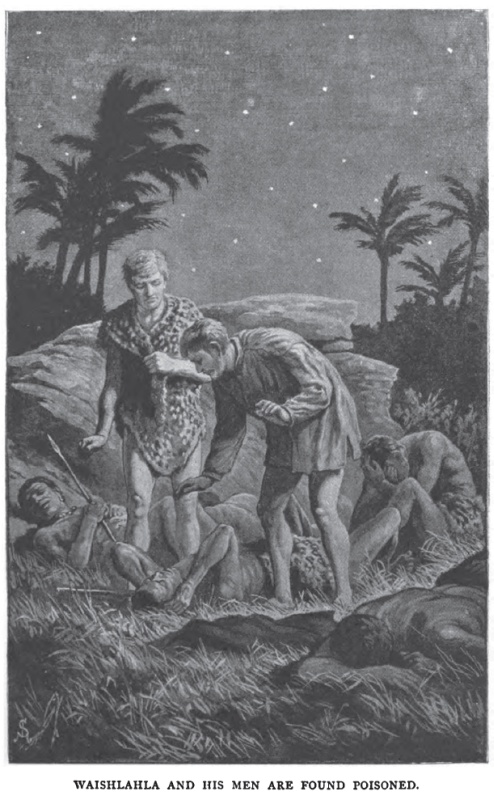
It was about mid-day when our two friends lay down to snatch a hasty repose after their toilsome journey; but when Frank Jamieson awoke he found to his intense surprise that the sun had sunk below the horizon, and darkness was rapidly setting in. Tom Flinders was still asleep by his side, and round them were gathered the five Caffres, apparently also asleep—two of them face downwards, with their woolly heads buried in their arms, the other three stretched on the broad of their backs.
“Halloa!—why, it is nearly dark!” exclaimed Frank, sitting up and rubbing his eyes to make sure that he was quite awake. “We must have been sleeping considerably longer than an hour! Or is it possible that I have been dreaming?” was his mental question; but his bare limbs and swollen, bleeding feet were convincing proofs to the contrary. “Tom—Tom Flinders,” he then whispered, bending over his friend and gently shaking him.
“What’s the row?” cried Tom, waking up with a start.
“H’sh,” whispered Frank; “don’t make a noise! Waishlahla and his men have overslept themselves, and if we mean to make a dash for freedom, it must be now or never! We shall not get such a chance again.”
“I’m game,” Tom answered. “But we had better secure their weapons first, especially the chief’s gun.”
“Leave that to me,” said his companion, as he crept cautiously up to the recumbent figure of Waishlahla, with the intention of taking possession of his “roer.”
The savage chief lay flat on his back, with his brawny arms extended over his head; and when Frank leaned over him he saw that his jaw had dropped, and that his eyes were wide open and staring.
But there “was no speculation in those eyes”—for Waishlahla was stone dead!
In an instant it flashed across Frank’s mind what had happened.
“He must have taken the chloroform!” he exclaimed. “I left the bottle in the pocket of my blouse.”
“What?” cried Tom, looking over his shoulder, “you don’t mean that!”
“There cannot be a doubt about it,” said the other. “See, the man is quite stiff and cold; he must have been dead four or five hours.”
“Then, depend upon it, they’re all in the same boat!”
And such proved to be the case.
Waishlahla had found the bottle of chloroform in the pocket of Frank Jamieson’s blouse, and he and his comrades had drank the whole of the contents—about eight ounces—between them, with, of course, fatal results.
“Frank,” said Tom, as they stood over the chief’s stiffening corpse, “I’m very glad we never thought of giving the poor fellows that stuff! Still—well, it is a lucky thing for us that you didn’t pitch the bottle away!”
Chapter Twenty Two.
A Starlight Tramp.
Although by a concatenation of unforeseen circumstances—that is to say, the accidental possession of a bottle of chloroform, and the Caffres’ extraordinary craze for European medicaments—Tom Flinders and Frank Jamieson were freed from their savage guards, they felt by no means certain that they would even now be able to make good their escape. The untimely fate of Waishlahla and his men had, so to speak, left our friends “prisoners at large;” and this was a step—a long step!—in the right direction; but it was no use disguising the fact that there were still almost insurmountable difficulties to overcome, and unknown perils to encounter, before they could consider themselves fairly out of the wood.
They were alone in a hostile country, with only a scanty supply of food and almost without means of procuring more when that was gone (for, situated as they were, it would be running a great risk to use Waishlahla’s gun, save in self-defence), whilst between them and Albany—the nearest British territory—lay the Amatola Mountains, which they knew to be swarming with their bloodthirsty foes. Moreover, Frank Jamieson had grave misgivings as to whether there might not be a certain amount of truth in what their old jailer had told him—namely, that Colonel Somerset had suffered a serious reverse, and that Albany was now overrun by the victorious Caffres; and, lest this should be the case, he thought it better for them to keep clear of that district altogether, and endeavour to reach—by a long and circuitous route—one of the more distant provinces, where they might reasonably hope the war had not yet spread. And so, after much anxious deliberation, he proposed to his companion that they should shape their course for the Storm Bergen (which lay almost due north), and having crossed that range, should travel in a westerly direction until they reached the Tarka River, and then proceed along its banks to Cradock—a small town in Somerset province, 70 miles north-west of Graham’s Town.
“It will be a serious undertaking,” said Frank, “and we shall have to undergo any amount of privation and hardship; but I know you will agree with me that anything is better than running the risk of falling again into the hands of the Caffres; for, depend upon it, we should not get off so easily a second time! Of course,” he added, “we must travel by night, and conceal ourselves during the day—at any rate until we’re clear of the enemy’s country.”
“But how are you going to find your way?” was Tom’s doubtful query.
“I shall steer by the stars,” replied the other. Then, seeing that his friend’s face still wore a dubious expression, he said, “Remember, Tom, I don’t for a moment suppose that it will be all plain sailing—quite the contrary! But I do honestly believe that in following this route, lies our best—nay, our only chance of eluding the Caffres.”
“All right, old fellow,” cried Tom cheerfully. “I am ready to trust myself to your guidance, and we’ll sink or swim together. Now, the sooner we’re off the better. I feel fresh as possible after my long caulk.”
Frank then resumed his clothes (which luckily for him the Caffres had not put on), whilst Tom despoiled the unfortunate Waishlahla of his gun and ammunition; he also took his knobkerrie, shield, and bundle of assegais; and a bag of green mealies.
“Are you ready, Tom?” asked Frank.
“Ay, ay!” was the prompt reply; “quite ready.”
The air was mild and calm, and the glorious constellations of the south shone down on the young men as they started on the first stage of their perilous journey; not knowing where that stage might end, but resolved to keep moving forward throughout the night. Setting their faces in the proposed direction, they trudged on; now dipping into a deep hollow where the grass grew tall and rank, now topping a gentle rise; now clambering over masses of rock, now forcing their way through spiky mimosa jungle or tangled coppice.
Tom Flinders was deeply impressed by the weird novelty of their first night march.
Strange indeed were the noises that sounded through the still night air—the deep hum of myriads of insects, the melancholy “croak, croak” of the bull-frog, or the shrill scream of the night bird mingling with the moaning bark of the jackal, the laughing cry of the hyaena, or the sullen roar of some prowling leopard; stranger still the gaunt, spectre-like forms which loomed through the darkness or moved from the path with snort of terror or angry growl.
At length the morning dawned, and then the weary, foot-sore fugitives—their faces and limbs scratched and bleeding, their garments rent and torn—climbed into the wide-spreading branches of a well-grown baobab tree, and sought shelter and rest amidst its dark green foliage.
Thus—turning night into day and day into night—our friends journeyed on for a week and a day, covering on an average eight miles betwixt sundown and sunrise.
Not very rapid travelling! True; something less than a mile an hour; but be it remembered that the travellers had to make their way by starlight through an unknown country; up hill and down dale, over “bosch” and “bron,” through deep, rugged, watercourses, and (twice) across rapid streams; keeping all the while a sharp lookout least any of the savage beasts, whose howlings and roarings made the night hideous, should spring upon them as they passed along. Of water, they happily found abundance; but all they had to eat during that wearisome tramp were the green mealies they had taken from the dead Caffres; they certainly might have killed some small birds or even animals, but then they dared not light a fire to cook them, and had no mind to devour raw flesh.
The ninth morning of their journey brought them to a grassy plain watered by a clear, shallow stream, which bubbled over a pebbly bed. This plain was bounded on the north by a long range of lofty mountains exhibiting a magnificent front, clothed with overhanging woods, diversified with hoary rocks, and steep buttresses of green turf.
“Look yonder, Tom!” cried Frank Jamieson, gazing with admiration and thankfulness on the view before; “there are the Storm Bergen! By this time to-morrow I trust we shall be on the far side of them.”
Chapter Twenty Three.
Crossing the Storm Bergen—A Scene of Slaughter—Tom’s last adventure—“Out of the Wood” at last!
Nearly opposite to the spot where the travellers had halted, the Storm Bergen were pierced by a narrow “poort” or valley, presenting a gloomy and terrific aspect of solitude. Through the “poort”—and winding in and out amongst huge boulders of moss-covered rock and beneath frowning precipices, past wild and gorgeous hollows rank with semi-tropical vegetation so peculiar to those regions—a rough track led to the open country north of the range.
Anxious to pass through the mountains before nightfall, our hero and his companion—after a very short rest, and a mouthful of mealie—entered the “poort,” and followed the tortuous path until the sun rose high in the heavens, and its burning rays beat down into the valley with cruel force; then, unable in their debilitated condition to stand the fierce heat, they came to a halt, and concluded to rest until the cool of the evening.
“This has been a tramp!” exclaimed Tom Flinders, dropping on his knees beside a tiny rivulet, that bubbled and sparkled across their path, and lapping up the cool, clear water, like a thirsty hound. “’Pon my life,” he added, when he had quenched his thirst, “there’s nothing to be compared to ‘Adam’s ale,’ when one is really parched! I say, Frank,” he went on in more serious tones, “we’ve a lot to be thankful for.”
“We have that, old fellow,” was Frank Jamieson’s hearty reply. “Our escape has been little short of a miracle.” Then after a pause he said, “But I fear our friends will have mourned for us as dead.”
“I’m afraid so,” rejoined Tom. “I only hope that Wilson hasn’t written to the pater, and reported me ‘killed in action;’ it might be the death of my poor mother to hear such news, in her delicate state of health. When do you think we shall reach Cradock?”
“That, of course, depends a great deal upon circumstances,” Frank answered; “but, barring accidents, I think we may fairly reckon on being there by this day week at the latest. You see, Tom, now we’re able to travel during the day, we shall get over the ground much more rapidly.”
“How far is Cradock from Ralfontein?” queried his friend.
“As the crow flies, something over a hundred miles; but the track, though a good one, is rather—halloa! what’s that noise?”
Frank’s attention was attracted by a rumbling sound, which might be likened to that made by a heavy slow train passing over a bridge just within earshot; a sound which grew louder every second, and was presently mingled with horrible shouts and yells that echoed and re-echoed through the valley.
“I know what that noise is!” exclaimed Tom, seizing the gun and springing to his feet.
“Caffres! we’re lost,” ejaculated Frank Jamieson, his face paling; “we’re lost, Tom!”
But Frank quickly recovered himself, and casting a glance around in the hope of discovering some hiding-place, his eyes rested upon a hollow—or small cave—in the cliff almost immediately over their heads, and about eight or nine feet above the path.
“There’s our chance! let us take refuge in that hole,” said he, catching Tom by the arm. “I’ll help you up first and hand you the gun and assegais; then you can haul me after you. Up you go, there’s not a moment to lose!”
So saying, Frank placed his body against the face of the cliff or rock, which was all but perpendicular, and Tom, without any hesitation, sprang upon his shoulders and clambered into the cave. The gun and assegais were next handed up, then Tom, lying down flat on his stomach, reached over the edge of the cave as far as he dare, and seizing his friend’s outstretched hands, hauled him up. The cave was just deep and wide enough for them to turn round, and just high enough to allow of their squatting on their haunches like a couple of Hindoos; the entrance was partially hidden by an overhanging bush.
Hardly had our friends concealed themselves, when—as though they had dropped from the clouds—a score of sinewy black forms appeared in the valley, and took up a position on either side of the track, directly beneath the cave; they were armed with assegais only, and did not present a very warlike appearance; in fact it was evident that they were of quite a different race to Sandilli’s dusky warriors.
“I don’t believe these fellows will molest us,” Frank Jamieson said with a sigh of relief. “They probably belong to one of the pastoral tribes inhabiting the country in the vicinity of Campbeldorp, and are now on a hunting expedition. Ha! I thought so.”
And as he spoke a vast herd of small deer—beautiful animals, graceful of form and of a light cinnamon colour on the back, with white bellies and legs—came leaping and bounding along the valley, pursued by a number of savages, all yelling and shrieking at the very top of their voices.
“They’re spring-bok,” said Tom, leaning forward to get a fair view of the deer. “I wish I had my double-barrel! A good juicy steak off one of those fellows wouldn’t come amiss, eh, Frank?”
“No indeed,” replied the other. “But, I say, old fellow, take care you don’t overbalance yourself. I wouldn’t trust too much to that bush.”
The leaders of the herd of deer were now almost abreast of the cave, and the sable hunters, who were lying in wait along the path, rushed in upon them. Then commenced a scene of slaughter; numbers of the affrighted spring-bok being slain by the assegais of the savages, whilst not a few fell down and died from sheer terror.
This cruel and unsportsmanlike butchery was at its height when, forgetful of his friend’s warning, Tom Flinders leaned forward to obtain a better view of the scene, and in order to preserve his balance he caught hold of the bush which overhung the entrance of the cave; but, as Frank had suspected, the bush was not very firmly rooted, and so of a sudden it gave way, and poor Tom pitched head first out of the cave and landed right on the shoulders of one of the savages, who fell sprawling amongst the spring-bok, with our hero on the top of him.
Now nine feet is not a very terrible distance to tumble (though, of course, a great deal depends on how a person falls—for there’s a knack in falling, as everybody should know), and Tom would probably have escaped with a few bruises, had he not unfortunately rolled from off the prostrate savage right in front of another, who was in the very act of spearing a spring-bok; the consequence was that his sharp weapon took effect in the biped instead of the quadruped; that is to say, poor Tom received a severe wound, the assegai-head being driven clean through his leg from side to side, an inch or two above the knee-cap.
The sudden and startling appearance of a white man in their midst so electrified the hunters that they stood stock-still, and allowed the spring-bok to dash onward through the valley without attempting to stop them; thus the greater number of the herd would certainly have galloped over Tom’s body, and probably have injured him not a little, had not Frank Jamieson dropped down from the cave, and rushing forward dragged his friend out of harm’s way. Tom was indeed badly hurt, and when Frank drew the assegai from the wound the pain was so sharp that the poor fellow fainted right away.
The blacks—to the number of fifty or sixty—now crowded round, and one of them—who appeared to be in authority—addressed Frank in broken English, volunteering his assistance, and assuring him that he had nothing to fear.
“My name is Ntlororo, and I am captain of a kraal,” said he. “My tribe is at peace with our white brethren, and we will help you in your trouble.”
Frank thanked the chief most warmly, and inquired how far distant his kraal might be.
“Twelve miles,” Ntlororo replied. “But my hunters shall carry your friend thither,” he quickly added, seeing his “white brother’s” face fall considerably. “We will start at once.”
He then gave some orders to his men, who commenced to collect the spring-bok they had slain, whilst Frank, with Ntlororo’s aid, bound up Tom’s injured leg. As soon as the stricken deer were all collected, a rough litter was formed of assegais covered with a kaross; on to this Tom was lifted, and the whole party quitted the scene of slaughter and marched up the valley—Frank Jamieson (forgetful of his fatigue and hunger in his thankfulness and excitement) walking beside the litter. The spring-bok were carried on the shoulders of the hunters, who kept up a sort of triumphant chant as they trudged along.
They were soon clear of the mountain, and three hours’ march brought them to a green savannah, plentifully intersected by the spoor of cattle; which showed Frank Jamieson that they were not any great distance from the kraal. Another half-hour’s “heel and toe,” and the party came in sight of a cluster of ant-hills dotting a grassy slope leading down to a small river, beyond which lay the kraal.
But it was not the sight of the native village that drew forth an exclamation of astonished delight from Frank Jamieson’s lips!
No, indeed! He scarcely noticed the bee-hive-shaped huts, for his eager eyes were fixed upon a couple of large bullock-waggons outspanned on the banks of the river.
Chapter Twenty Four.
The Last.
The bullock-waggons which had attracted Frank Jamieson’s attention, when approaching the kraal, belonged to a certain Mr Abraham Shipp, who was engaged in the adventurous and not unprofitable occupation of trading with the natives in the interior of South Africa, bartering a great variety of British hard goods—principally of “Brummagem” manufacture—for elephants’ tusks, valuable skins and horns, and ostrich feathers. Mr Shipp, after many months’ sojourn amongst the up-country tribes, had come down south, and was now hastening on to Natal, where he hoped to dispose of the ivory, skins, and plumes that he had collected, to some of the British and Dutch traders, who had branch houses in the fast-rising town of D’Urban, or else make arrangements to ship them off to Cape Town in one of the small coasting vessels plying regularly (more or less!) between Port Natal and Table Bay.
But apart from his desire to “trade,” Abraham Shipp had another and more important reason for wishing to reach D’Urban as quickly as possible.
He had with him a sick companion, a young man of four—and—twenty, Oliver Maurice by name. Young Maurice was an Oxford man of good family and fortune, but having “gone the pace” whilst at college, and plunged into the dubious pleasure of what Captain Costigan was wont to call “poloit societee” with rather too much enthusiasm when reading for the bar, he had damaged his fortune and lost all taste for what is termed “life,” and so came out to South Africa to seek enjoyment amidst “fresh woods and pastures new.” Meeting with Abraham Shipp, Maurice had arranged to accompany him on his trading expedition, but whilst up country far north of the Gareep River, he had been seized with sickness, and now it was only too evident that his days were numbered. He suffered no pain, but lay all day in one of the waggons in a state of apathy. Still Mr Shipp clung to the hope that if Oliver Maurice could only be placed under a doctor’s care he might “pull round.”
Shipp, though somewhat brusque-mannered and rough-tongued, was a right good-hearted fellow, and when he heard Frank’s story he at once proposed that they should join company.
“Look you now, my lad,” cried he, slapping Frank’s shoulder with a hand half as big as a fair-sized leg of mutton, “just you give up your mad idea of tramping to Cradock, and make up your mind to come with me. Your chum can share the waggon with poor Noll Maurice; it’s plenty big enough for both, and they’ll cheer one another up; and I’ve got a spare nag—rather a rum ’un, but I can see you won’t mind that!—which you can ride. I’ll find you in meat, baccy, and grog, and rig you out in fresh togs into the bargain. We inspan at daybreak to-morrow, and I hope to be at D’Urban by Tuesday week. Come now, what d’ye say?”
We need hardly add that Frank accepted this generous offer without hesitation.
Early next morning Shipp’s waggons were got on the move, and having taken a friendly leave of Ntlororo—upon whom Frank bestowed Waishlahla’s gun and ammunition—the party left the kraal en route for Natal.
Oliver Maurice seemed very pleased to have Tom as his companion, and before they had known one another four-and-twenty hours they were on friendly terms.
Maurice evidently felt a relief in having somebody with him in whom he could confide, and he gave Tom a brief sketch of his short, but misspent life.
“If I had only been a poor man I might have done better,” said he one evening—the day before they reached D’Urban. “But it is a true saying that money unfairly come by brings—”
“Unfairly come by!” ejaculated Tom. “You surely don’t mean that you stole it?”
“Not exactly, my dear fellow,” replied the sick man, with just the ghost of a laugh. “But nevertheless, though legally mine, the best part of my fortune should by rights have gone to another man. My father had a distant relative—a queer, crochety old fellow whom he had never seen and never wished to see—and this distant relative had an only son, a lieutenant in the royal navy, who unfortunately—”
“Why!” interrupted Tom, a sudden light breaking in upon him, “you don’t mean Weston?”
“Weston was the name of my father’s relative; and his son was dismissed the service for striking his superior officer. Do you know anything about him?”
“I should think I did!” was Tom’s reply; “why, my dear chap, Weston is my father’s partner, and Frank Jamieson’s brother-in-law.” And thereupon he proceeded to give Maurice a full account of Mr Weston’s history.
“I am glad to have the opportunity of making a restitution of this property,” said Maurice when Tom finished. “Ask Shipp to give you some paper, and this very evening I’ll draw up a will in Weston’s favour, which, if I live to reach D’Urban, I will have put into regular legal jargon. I shall leave him every penny—no, I sha’n’t though,” he added with a faint smile; “I owe you something, Tom, and as I see that you feel a tender interest in Miss Gracie Weston I shall leave her a share of the property.”
Poor Maurice was as good as his word; he reached D’Urban just in time to draw up a formal will, which was duly attested by the resident magistrate, leaving his fortune to Mr Weston, with the exception of 3000 pounds, which he settled on Miss Grace Weston. Two days later he breathed his last, and after his funeral Frank Jamieson and Tom Flinders took leave of Mr Shipp and embarked on board the Mary Anne cutter, bound for Table Bay, where they landed after a rough passage of a week’s duration.
Our task is ended; but before parting we must ask our readers to accompany us once again to Ralfontein, and to imagine that ten years have elapsed since our hero and his friend escaped from the Caffres.
Quite a large village has sprung up on the plateau in rear of the old homestead; a village in which may be counted four substantial houses, “standing in their own grounds,” and one tiny wooden church.
On the fertile plains that surround the plateau hundreds of splendid cattle are grazing, whilst the meadows and inclosures nearer home are enlivened by young horses sufficient in number to furnish remounts for any light cavalry corps in the service.
The village is inhabited by the employés of “Jamieson, Flinders, and Weston,” the largest and most successful horse-breeders and farmers in the colony; and in the four substantial houses dwell the families of Messieurs Tom Flinders, Frank Jamieson, George Maurice Weston, and Richard (commonly called Dick) Jamieson; the little church is “served” by the Reverend James Jamieson.
Major and Mrs Flinders reside in the old house with Mr Weston and his wife.
And now let us lay down our pen, saying: “God save all this fayre compagnie!”
The End.
|
Chapter 1
| |
Chapter 2
| |
Chapter 3
| |
Chapter 4
| |
Chapter 5
| |
Chapter 6
| |
Chapter 7
| |
Chapter 8
| |
Chapter 9
| |
Chapter 10
| |
Chapter 11
| |
Chapter 12
| |
Chapter 13
| |
Chapter 14
| |
Chapter 15
| |
Chapter 16
| |
Chapter 17
| |
Chapter 18
| |
Chapter 19
| |
Chapter 20
| |
Chapter 21
| |
Chapter 22
| |
Chapter 23
| |
Chapter 24
|