"Adventures in South Africa" (continued 2)
Reading edition
“All right, father, we’ll not come to grief if we can help it,” rejoined Tom, tightening his girths. “Now, Patrick, hand us over the ‘grub’—there, that’ll be plenty. Are you ready, George?”
“Yes, quite ready,” was the reply. “Come along!”
“Mind you approach the herd to leeward,” shouted the Major, as the boys galloped off.
A smart “scurry” over the yielding turf soon brought our young sportsmen within three or four hundred yards of the unsuspecting hartebeest, when Tom called to his companion to pull up.
“We mustn’t go at them with a rush,” said he. “In fact, I almost think our best plan would be to tether the horses to these trees and stalk the herd on foot. What do you say?”
“I agree with you, old fellow,” replied young Weston. “You see we’re not much accustomed to shoot from the saddle.” And so they both dismounted, tied up their horses to separate trees (for Tom’s nag was rather given to using his heels), and having unslung and loaded their rifles with more than usual care, they advanced towards the hartebeest. The hartebeest—generally supposed to be the Bubalus of the ancients—is one of the commonest breed of deer in Southern Africa. It stands from four to four-and-a-half feet at the withers, the form of its body being something between that of a red-deer and a heifer; the tail reaches nearly to the hocks and is terminated by a tuft of coarse hair. The head of the hartebeest somewhat resembles that of an ox, but the ears are “asinine” in shape, and the eyes are placed very high; below each eye is a pore from which exudes a matter: this matter the Hottentots preserve as a rare and valuable medicine, but what diseases it is supposed to cure we cannot say. The hartebeest is furnished with a pair of strong black horns, embossed with rings; the horns are quite close together at the base, diverging upwards, and at the tops bending rearwards in a horizontal direction almost to the tips, which are several inches apart. The colour of this animal is a dark cinnamon, except the hind-quarter and inside the thighs, which are of a yellowish white; the face and the fore-part of the legs are marked with black.
When galloping, the hartebeest appear to go heavily with a donkey-like action; but nevertheless they get over the ground quite as fast as other large deer; if, when followed, they manage to get ahead, they are apt to stop short and gaze at their pursuers. When hard pressed, this animal—like the wood-antelope and nil-ghau—drops on his knees and shows fight.
Cautiously the two boys crept up to the herd, keeping well under cover of the bushes and tufts of karoo-grass.
“Now, Tom,” said George, who, by the way, was much the best shot; “we’re well within range. I’ll take that big fellow standing near those mimosa bushes.”
“All right, old boy,” replied Tom. “I shall aim at the buck grazing directly in front of us; it is the easiest shot of the two, I think.”
Bang! bang!
“Missed, by all that’s unlucky!” cried Tom. “Here goes again!” He then discharged his second barrel with no better effect; and the herd, alarmed by the report of the rifles, galloped off towards the hills. George Weston had wounded his buck slightly, but not sufficiently to prevent him from following his companions.
The boys at once doubled back to the spot where they had left their horses, and untethering them, sprang in the saddle.
Away they raced after the herd, but the latter had got a splendid start and kept well ahead, until they reached some low, forest-clad hills, which crossed the plain from north to south. Beyond these hills the ground was covered with trees and tangled brushwood. The hartebeest ascended the nearest hill and disappeared from sight, and the boys then pulled up their distressed and panting horses and looked at each other with inquiring eyes.
“What’s to be done?” asked Tom. “The nags are pretty well pumped, I guess.”
“Yes, indeed,” assented his companion; “we came the last mile or so at racing pace. I should never have thought the hartebeest could travel so fast! Shall we go back?”
“What! empty-handed?” cried Tom. “Not if I know it, old chap. At any rate we might overtake the beast you wounded. I’m sure you hit him hard.”
“Well, we can’t gallop up those hills, that’s certain,” returned young Weston. “Suppose we make for that ravine; no doubt we shall meet the herd again, if we have patience. But it’s no use making a ‘stern chase’ of it; we must try and get round him.”
Tom nodding assent, they rode forward at a gentle pace, to allow their horses to recover wind, and presently they entered a narrow ravine, the precipitous sides of which were covered with arboreous and succulent plants.
George Weston was some four horses’ lengths in advance, when of a sudden he gave a shout of delight, as a magnificent female tree-leopard bounded across his path, and turned up the ravine. Tom saw the brute, too; and unslinging their rifles, the boys gave chase—George maintaining his position ahead.
The tree-leopard of South Africa (though called by Africanders the “Cape-tiger”) is to all intents and purposes identical with the Felis leopardus of the naturalists; in plain English, is an ordinary leopard, and partakes of all the characteristics of that beautiful, but dangerous animal—the terror alike of the timid Hindoo, the Chinee, and the savage islander of Sumatra.
Now though the leopard will rarely attack a full-grown man, unless driven into a corner, he is a very awkward customer to deal with when he does turn; and many fatal encounters have been chronicled.
(Some of our readers may remember the sad fate of Captain Bowlby, 94th Regiment, who, shortly before the Transvaal war broke out, was fatally injured by a “Cape-tiger.”)
Our readers will now be able to form a fair idea of the sort of “game” Master Thomas Flinders and George Weston thought fit to go in chase of. Finding herself hotly pursued, the leopard at first endeavoured to escape by clambering up the precipice on her left, but at that moment young Weston pulled up, and let fly with both barrels, inflicting a severe wound in the fleshy part of her shoulder. Maddened with pain and mingled rage and terror, the hard pressed and well-nigh frantic brute turned, and springing upon George dragged him out of the saddle.
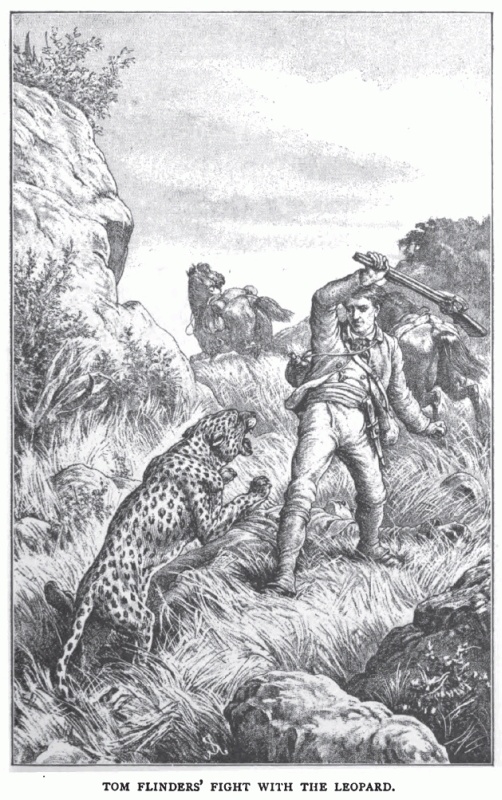
Now, Tom Flinders knew well enough how savage and dangerous a leopard could be if once brought to bay, so when he saw his friend struggling on the ground, he uttered an involuntary cry of horror; then, regardless of the consequences, he jumped off his horse and rushed to the rescue.
Taking aim at the leopard’s flank, Tom gave his two barrels at once; but owing to his natural agitation as well as his fear of injuring George, he missed with both shots. The leopard then abandoned her prostrate and senseless victim, and darted upon Tom with redoubled fury. In spite of the suddenness and ferocity of this onset, the boy was not taken unawares; and clubbing his rifle he swung it round his head, and by great good fortune caught the terrible brute a swashing blow which brought her to the ground. The butt of the rifle was shivered to splinters, but our young hero drew his long hunting-knife and threw himself on the leopard before she could regain her feet. Deep into the brute’s throat Tom pressed the keen blade; with one convulsive effort she shook herself clear of her antagonist and at the same time stunned him with a blow of her powerful paw; then, fatally wounded, she bounded off a few yards and fell dead.
That night, the moon rose upon a curious scene! Upon the bright green turf the two lads were stretched senseless and bleeding, and near them lay the carcass of their four-footed foe.
Chapter Twelve.
Missing!—The search—How Tom was besieged in a cave—The return home.
“Why, here come the boys!” exclaimed Major Flinders, as he and his friend Weston sat round the camp fire, on the banks of the Gamska River, smoking their after-supper pipes and chatting over old times. “I hear the sound of their horses’ gallop.”
“But you did not expect to see them much before noon to-morrow,” said Mr Weston in a tone of surprise. “They would never have returned so soon! You must be mistaken, Mat.”
“There are horses galloping in this direction, that I’ll swear to,” rejoined his friend, who had risen to his feet and was listening attentively. “And what’s more, they’re coming towards us at a tremendous pace. What say you, Keown?”
Kneeling down, Patrick Keown placed his ear to the ground; and after a lengthened pause, replied: “They’re horses, shure enough, sorr; but, by the beat of their gallop, I fear there’s never a sowl on their backs. No, sorr, there’s no doubt about that,” he presently added. “And they’re slackening pace now.”
At that moment, as if to prove the truth of the ex-sergeant’s words, two riderless horses cantered quickly up, and halted a few paces from the camp fire; they were those upon which Tom and George had ridden after the hartebeest in the morning!
The Major and Mr Weston stared at each other in consternation.
The horses were covered with sweat and dirt, and their distended nostrils and heaving, foam-flecked flanks bore silent but convincing testimony that they must have travelled some distance at a stretching gallop; whilst one of them—George’s grey—had an ugly wound on his near shoulder.
“Mat,” said Mr Weston huskily, his face betraying his agitation and alarm, “the poor lads must have come to grief—possibly they have been attacked, and—and murdered by natives!”
“I trust not, my dear Maurice; nay, I am sure that such is not the case,” answered the Major.
“In the first place, the natives would have been nearly certain to secure the horses; and in the second place—”
“This wound in the grey’s shoulder was inflicted by a wild baste, not a human cratur,” interrupted Keown, who had caught George’s horse. “Look ye, Misther Weston, there are the marks of the brute’s claws as plain as a pike-staff.”
“There’s no mistake about it,” said Major Flinders, stooping down and examining the grey’s shoulder; “this is a tiger’s work. Maurice,” he added, “you and Patrick Keown must remain here, whilst I take William and go in search of the poor boys.”
“I would rather go with you, Mat,” replied the other.
“No, old friend, do you remain here, the Hottentot is an admirable ‘tracker,’ and I could not do without him. Patrick, saddle up at once.”
A couple of horses were quickly saddled, and Major Flinders and Black William mounted.
“Is there any hope, Mat?” whispered Mr Weston, as he wrung his friend’s hand at parting.
“We must hope for the best, Maurice,” was the doubtful reply.
It was a bright moonlight night, and the Hottentot had no difficulty in following the back track of the horses, as he and his master went over the ground at a hand-gallop. The Major’s heart was heavy, for he feared the worst; and for some time he rode along in silence.
“What think you, William?” said he at length. “Is there any hope that the young gentlemen are alive?”
Black William shook his woolly head, saying: “I think tiger pull Baas George from his horse, and dat Baas Tom try to save him. But tiger too strong for yong baas to fight.”
The Major’s heart sank within him: not that he had had much hope from the first; and he bitterly reproached himself for having allowed the boys to go off alone. Day was beginning to dawn when they came in sight of the range of hills over which the herd had disappeared when chased by the boys; here the ‘spoor’ of the hartebeest was very distinct, and the Hottentot, tracking them to the foot of the hill, pointed out to his master where they had crossed. Hope then revived in the Major’s breast, for it struck him that the boys might have followed the game afoot, and during their absence the horses must have broken loose and galloped off—frightened most probably by some wild beast.
“We will off-saddle for an hour or so, William,” said he, drawing rein and dismounting near the entrance to the ravine. “And do you ascend the hills, and—”
“Vat dat, baas?” cried Black William, as a rifle-shot echoed amongst the hills—a shot that had evidently been fired at no great distance from the spot where they stood.
“The boys!” shouted Major Flinders; “the boys, no doubt! Come on, man.”
And springing into his saddle, he put spurs to his horse and rode up the ravine at full gallop, followed by the Hottentot.
When Tom Flinders recovered consciousness he staggered to his feet and took a look around him.
A few paces up the ravine lay George Weston; the dead leopard was a little further on; but the horses were nowhere to be seen.
“This is pleasant!” said Tom, feeling himself all over to make sure that no bones were broken. “How my poor head does ache, to be sure; that tiger must have caught me a thundering lick with his paw! I do hope poor old George isn’t done for,” he added, kneeling down by the side of his friend; “he got it far worse than I did. Halloa, George! how are you, old chap?”
At the sound of his friend’s voice George Weston’s senses partially came back to him, and—much to Tom’s relief—he made an attempt to raise his head; but he had been sorely mauled by the leopard, and was quite unable to speak, or help himself.
Seeing this, Tom looked about for a suitable place to take him, and presently hit upon a small cavity in the hillside: thither he carried the senseless boy, and proceeded to dress his wounds as well as he was able; for George was much hurt, the leopard having severely lacerated his thigh with her formidable claws, besides biting him right through the forearm.
However, Tom made him as comfortable as possible; then, seeing that nothing more could be done until morning, he gathered some boughs, brushwood, and large stones, and with them built up a rough breastwork in front of the cavity—which might be described as a small cave about six feet deep, by five or six in height. Then he dragged the dead leopard within it, secured George’s rifle and the shattered remains of his own, and, after a heart-felt prayer of thankfulness for his escape, lay down beside his friend, and fell fast asleep.
The day was breaking when Tom Flinders was awakened by a violent blow on the legs. Jumping to his feet, he seized his rifle and looked over the breastwork; his appearance was immediately hailed by a loud chattering, and a volley of stones and other missiles came whizzing about his ears.
“Niggers!” Tom exclaimed, bringing his rifle to the “ready;” “but where the dickens are they?”
“Hi! what on earth are you about?” he shouted, as a big piece of rock knocked off his hat. “You’re an uncommon good shot, no doubt,” he went on, ducking down in order to escape another stony “projectile;” “but if I catch a glimpse of you, I’ll let you know that it is not a rook you’re pegging at.”
As the boy spoke he caught sight of a dark active form swinging itself from tree to bush on the opposite side of the ravine; without a moment’s thought, he raised his rifle and pulled the trigger, and down came the figure by the run.
“There!” cried Tom angrily, for his temper was considerably ruffled. “I’ll teach you to make a cock-shy of me!” But now the ravine resounded with ear-splitting cries, and to Tom’s utter amazement a whole troop of baboons appeared amongst the trees and bushes; and, after gibbering and grimacing round their deceased brother for a few seconds, they suddenly scampered off, springing from rock to rock, from tree to tree with marvellous agility, until they were lost to view.
“Why, hang it all! I must have bowled over a monkey!” was the boy’s exclamation. “Poor brute! I wish I hadn’t been quite so ready with my rifle.”
The next moment Major Flinders and Black William appeared in sight, and with a wild shout of delight Tom jumped over his barricade and ran to meet them.
The Major looked very grave when he examined poor George’s wounds, for he at once saw that they were of a serious, if not of a highly dangerous, character—such, in fact, as called for skilled treatment. If the boy’s life was to be saved, it would be necessary to procure medical assistance as soon as possible. Now the nearest place where Major Flinders could make certain of finding a surgeon was Fort Crause, a small town and military post situated some thirty-five miles to the east-north-east: and to Fort Crause he resolved to carry the lad without any delay.
“We must start at once, you and I, Tom,” said the Major, as he scribbled a few hasty lines on a leaf torn from his pocket-book. “William will take this note back to Weston; I have briefly related what has occurred, and told him to join us at Fort Crause.”
“And what is to become of Patrick Keown and the horses, father? Are they to follow us, or wait until we return to the Gamska?”
“Keown will come on with Weston, and we shall have to change our route, and return home by the upper road to Tulbagh. Now, my boy, jump up, and we will place George in your arms; you must hold him in as easy a position as you can. There—now raise his head a little more; that will do! I will lead the horse.”
To convey a wounded person thirty miles on horseback under a burning South African sun is a very dangerous experiment; and, had George Weston been taken the whole distance under such circumstances, he would certainly have suffered severely, and probably not have survived the journey; but happily, before they had gone very far, they fell in with an empty mule-waggon returning to Fort Crause, to which George was immediately transferred, and thus he travelled in comparative comfort.
A week later Major Flinders and Tom, with the servants and horses, made a fresh start, and at the end of five days marched into Rondebosch; but George Weston was detained at Fort Crause for more than a month, and of course his father remained to look after him. At first the doctor gave but faint hopes of his recovery—for inflammation set in, and it was feared that tetanus would supervene; but in the end, youth and a famous constitution gained the upper hand, and George was able to rise from his sick-bed.
When, at length, he and his father returned to Rustenburg Farm, they found to their satisfaction that the Major had disposed of the young horses for nearly double the price he paid for them; so, after all, “Kicking Jan” did not dissipate all the profits of the expedition, but when every expense had been allowed for there still remained a good round sum to be placed to the credit of the firm of “Flinders, Weston, and Sons.”
Chapter Thirteen.
Two years after—Rumours of war—Good news for Tom—Mr Weston makes an interesting proposal.
Nearly two years have passed since the events recorded in the previous chapters, and our hero is once more the guest of Captain Jamieson. The Westons, too, are at Ralfontein, likewise Patrick Keown and the faithful Hottentot, Black William.
But not Major Flinders?
No; the Major is away in England with his wife and daughters, and many months must elapse before Tom can hope to see their faces again.
But let us “hark back,” and see what has happened since George Weston was so nearly done to death by the tree-leopard.
In the spring of 1845 Mrs Flinders was suddenly seized with a sharp attack of illness which for some time entirely baffled the skill of the Cape Town doctors; and when, after weeks of anxiety and watching, they seemed to get the better of the disease, the poor lady was left almost at death’s door. Days went by without the patient showing any appreciable signs of improvement, and at length the doctors were obliged to confess that though they had checked the disorder they had by no means conquered it. The plain truth was, they were altogether out of their depth.
Said the pompous and portly Dr Brownjohn: “Major, you must, I fear, take our interesting patient to England, and—ha—and—”
“Seek better advice,” interrupted plain-spoken Mr Spike, his brother-medico. “We can do nothing more, my dear sir. The case is beyond us, I’m grieved to say.”
“And—hum!—and, I was about to say, the sea voyage may possibly benefit her,” continued the great M.D., looking “prussic acid and strychnine” at his candid colleague. “As my young friend Spike suggests,” he added after a pause, “you might consult some well-known London physician. Sir Timothy Glauber and Doctor Peter Bolus are both eminent men—very eminent men, I may say; you could not do better than seek their valuable advice.”
“But will my poor wife be able to stand the voyage?” the anxious husband inquired, glancing from one doctor to the other. “She is lamentably weak, you know.”
“True—very true!” assented Brownjohn, pursing his lips. “But let us hope for the best—yes, my dear sir, let us hope for the best! While there’s life—while there’s life!—hum! Pray, what is your opinion, Mr Spike?”
“That it is her only chance,” bluntly responded Mr Spike. “And hark ye, Major, take Mrs F to Newman—John Newman of Saint Margaret’s Square. He is not a fashionable doctor, but there’s not a more clever fellow in the whole College of Physicians, and what is better, he has had wonderful experience in intricate cases. If any man can pull your wife through this illness it is John Newman!”
And thus it came to pass that Major and Mrs Flinders started for England by the next steamer, their daughters accompanying them.
Now shortly before this trouble befell the Major he and Mr Weston (after much consideration and careful weighing of pros and cons) had, with the approval of Mrs Flinders, made up their minds to migrate to Ralfontein and enter into partnership with Captain Jamieson; and the former was on the point of closing with a most advantageous offer for Rustenburg Farm, when his wife’s illness upset their plans and drove all other ideas from their heads.
In fact, nothing more was said concerning the projected migration until Doctors Brownjohn and Spike advised that Mrs Flinders should be taken to England. The Major then suggested that (as the above-mentioned offer still held good) Rustenburg should be sold forthwith, and that the Westons and Tom should proceed to Ralfontein as soon as the necessary arrangements could be made. To this proposal Mr Weston gave a ready consent; and accordingly he, Gracie, and the two boys, attended by Patrick Keown and Black William, started for Ralfontein a fortnight after the mail steamer sailed from Table Bay; and at the time the present chapter opens they had been with the Jamiesons upwards of six months.
And now we can go ahead with our “plain unvarnished tale” without any more “backing and filling.”
It is a chilly evening in the early part of the Cape autumn, (March, April, and May are the autumn months in South Africa), and Captain Jamieson and his family are gathered round a blazing castange hout fire in the general sitting-room of Ralfontein House. The captain looks anxious and fatigued, as well he may do, for he has just returned from Graham’s Town, whither, ten days before, he was summoned by the Lieutenant-Governor of the Eastern District to attend a “palaver” with some troublesome Caffres; and he has ridden upwards of 100 miles over a difficult country in less than fourteen hours—not bad work for a man who will never see sixty again!
“So we’re in for another Caffre war!” Frank Jamieson said when his father informed them that the result of the “palaver” had been far from satisfactory. “That makes the third in sixteen years, to say nothing of minor affairs.”
“I suppose the Caffres have grown ‘fat’ again,” observed young James.
“‘Fat!’” exclaimed Mr Weston; “in the name of all that’s sensible, what has their growing fat got to do with their going to war?”
Captain Jamieson and his sons laughed at their friend’s astonishment, and the former replied:
“You must know, my dear Weston, that our Cape wars rarely arise from political causes, but chiefly from a desire on the part of the young men of the various tribes to distinguish themselves and earn the coveted title of ‘warrior.’ When a tribe has been some years at peace with its neighbours the number of young men increase; this they call growing ‘fat,’ or, in other words, becoming ready to take the field. Once in this condition the young men never rest until they find a pretext for going to war either with us or their neighbours.”
“And what pretext have they now?” inquired Miss Janet.
“A very simple one, my dear. Two Caffres, warriors of some standing in their tribe, were lately caught in the act of stealing an axe from a Beaufort storekeeper. They were secured, committed by the magistrate, and in due course were sent down to Graham’s Town with some other prisoners to stand their trial at the criminal court—their escort consisting of five or six civil constables. Now the highroad between Fort Beaufort and Graham’s Town runs close along the Caffre border; and before the constables had gone many miles they were suddenly attacked by a party of Gaikas, who had crossed the border with the express purpose of rescuing their fellow-tribesmen. The escort appear to have made a stout resistance, but, overcome by their weight of numbers, they were forced to beat a retreat and leave their prisoners in the hands of the victorious Gaikas. Now it so happened that the warriors who were the cause of this attack were handcuffed to two Hottentots; and their rescuers, not being able to unfasten the handcuffs, and being pressed for time, deliberately murdered these unhappy men, and, cutting off their arms at the elbow-joints, set their rascally friends at liberty.
“When the lieutenant-governor was informed of this outrage he at once sent a message to the chiefs of the offending tribe, and demanded that the two prisoners should be brought back and the murderers of the unfortunate Hottentots surrendered. But the young ‘amadodas’ of the tribe were eager for war, and, their counsels outweighing the counsels of the older men, the government message was treated with contempt.
“A ‘palaver’ was, however, subsequently arranged for; and last Wednesday the lieutenant-governor, the senior officer at Graham’s Town, and I started for the Block Drift mission station to meet the Gaika chiefs. They arrived at the appointed time, attended by a large body of warriors outnumbering the lieutenant-governor’s escort by ten to one.
“That the treacherous scoundrels meant mischief I am certain, but Captain S— who commanded the escort placed his men so judiciously that they made no attempt to attack us; and though the meeting was most unsatisfactory, at any rate it broke up without a rumpus—which was more than I expected. War, of course, is imminent; for it is absolutely necessary that the government should bring the refractory chiefs to order, otherwise our prestige will be seriously damaged throughout South Africa.”
“I suppose we shall have it all our way, Captain Jamieson?” said Tom Flinders, now a strapping young fellow of eighteen, with an incipient moustache and whiskers. “These Gaika fellows won’t make much of a stand against our troops.”
“The Gaikas and their allies are brave men, Tom, and fight well,” was the reply. “Indeed, my experience of Cape warfare is that at first the Caffres have it all their own way, though in the long run they succumb to our superior discipline and resources. Take the advice of an old campaigner, and never despise your enemies.”
“Shall you have to go out this time?” asked Janet Jamieson wistfully, putting her arm round the captain’s neck. “I hope not, dear father!”
“I am afraid so, my girl,” he answered gently. “The Lieutenant-governor has offered me the command of a force of volunteers and burghers, and I could not well refuse it.”
“And what about us?” cried the young men in a breath.
“You cannot all go, boys,” interposed Miss Jamieson, the tears starting into her bright eyes. “Who is to look after the farm and defend us in case of attack?”
“Janet is right,” said her father. “Ralfontein must not be left unprotected, for we cannot tell how far this war may spread or how long it will last.”
“You must allow me to accompany you, Jamieson,” Mr Weston struck in; whereupon Miss Janet started and the colour left her cheeks. “I shall be content to serve as a simple volunteer.”
“My dear Weston, I am relying on your taking command here,” rejoined the captain, looking askance at his daughter. “But let me tell you my plans. In the first place,” he went on, “the lieutenant-governor has offered provisional ensigncies in the Cape Mounted Rifles to Tom Flinders and Frank, on the—”
“Hurrah!” shouted Tom, who, in spite of his incipient whiskers, was as great a boy as ever; “won’t the pater be pleased!”
“On the condition,” resumed his host, smiling at the interruption—“on the condition that they serve a few months with my ‘commando,’ in order to establish a claim on the government. I have accepted this offer on their behalf; so they must go with me. I shall also take Patrick Keown, as he will be useful in assisting me to drill my ‘irregulars’ into something like soldiers. So you see, my dear Weston, you must remain at Ralfontein and take charge of the place, with George and James and David as your lieutenants. I hope you will not refuse the trust.”
“What say the young ladies?” was Mr Weston’s rejoinder. “Are you content to serve under my orders, Miss Janet?”
“If papa wishes it,” answered Miss Janet demurely.
“Then so be it,” laughed Weston; “I accept the responsible post of commandant of Ralfontein. When do you start for the seat of war?”
“Not for some days,” responded the captain. “Whilst at Graham’s Town I did a stroke of business—sold thirty horses to the government. A sergeant’s party of the Rifles are to fetch them in the course of a week or so, and I propose to return with them. And that reminds me I have accepted, in part payment for the horses, a brass six-pounder field-piece, with eighty rounds of canister, grape, and shell. The escort will bring it up with them. Should you have to defend the farm, you will find this gun of considerable service.”
The captain and Mr Weston sat up talking long after the others had sought their couches, and before they retired to rest Mr Weston told his friend that he had formed an attachment for Janet Jamieson.
“I did not intend to broach the subject until I had consulted with Matthew Flinders,” said he; “but after your request that I should remain in charge of your property and family during your absence, I felt in honour bound to mention it. In spite of the disparity in our ages, I cannot but think your daughter returns my affection. If such is the case, are you willing to give her to me?”
And as Captain Jamieson had no objection to offer, but on the contrary appeared well satisfied that the “course of true love should run smooth,” Mr Weston next morning asked Miss Janet to be his wife; to which tender question the young lady, with a becoming blush, said “Yes.”
Chapter Fourteen.
Off to the wars!—Jamieson’s Horse—A bumptious sub—Tom’s first patrol.
Although the Cape government declared war almost immediately after the “palaver” at Block Drift, some considerable time elapsed before the troops received final orders to take the field and enter Caffreland; and the first week of April was nearly over when Captain Jamieson, accompanied by his eldest son, Tom Flinders, and Patrick Keown, and escorted by the Mounted Riflemen in charge of the horses, left Ralfontein to assume command of the volunteers.
In the interval between the captain’s return from Graham’s Town and his departure to join the army, Miss Janet and Mr Weston found time and opportunity to get married, at a Church of England mission chapel forty miles from the farm; so he bade farewell to his family with the consoling assurance that he was leaving them under care of one who now had a relation’s right to comfort them in adversity or defend them in peril.
On the thirty-second anniversary of the battle of Toulouse (Wellington defeated Soult at Toulouse on the 10th April, 1814. It was the final battle of the Peninsular war.) (in which action Donald Jamieson, then sergeant-major of the —th Foot, was severely wounded) the party from Ralfontein arrived at Graham’s Town and handed over the horses to the military authorities; and, having purchased a few articles likely to prove of service during the campaign, they proceeded to join Colonel H. Somerset’s column, encamped at Victoria—a military post which had been recently established on neutral territory between the Kat and Keiskamma Rivers.
The burgher force, of which Captain Jamieson now took command, consisted of about six-score well-armed, well-mounted men; for the most part farmers and their sons from the neighbouring settlements, with a sprinkling of storekeepers and clerks from Graham’s Town and Bathurst. They were hardy, active fellows enough, accustomed to the saddle and the use of the rifle; but—with the exception of a few of the older hands, who had served on “commandos” in former wars—they were as ignorant of drill or military discipline as any civilian in England before the “volunteer movement” had been thought of.
“Shure now, Masther Tom,” observed Patrick Keown, regarding his future comrades (who had mustered and formed up to receive their commandant) with a critical eye, “we have here fornint us the raw matherials for as foine a squadron of Light Horse as there is in Her Majesty’s service. But, bedad, sorr!” he added with a solemn shake of the head, “they’ll take a dale of mixing.”
“Mixing!” laughed Tom. “I should say they’re pretty well mixed as it is. Still, I wager a dollar they know how to ride, and they’ll fight well enough. After all, that’s the main point.”
“They are for work, not for show,” put in young Jamieson.
“True for ye, Misther Frank,” the old sergeant rejoined; “niver-the-less, with your father’s lave, I must tache them to pay attintion to their dhressing and intervals. A loine is a loine, you’ll be plased to remimber, sorr; not a sort of double semicircle.”
Of this irregular corps—which Captain Jamieson formed into two troops—Frank and Tom were appointed officers, with the local and temporary rank of ensign; the lieutenant-governor promising that after they had seen a little service he would recommend their transfer to the Cape Mounted Riflemen as provisional ensigns.
Much to his chagrin, Patrick Keown had scant opportunity of imparting the “ilimints” of drill and discipline to the Albany farmers and townsmen who rode in the ranks of “Jamieson’s Horse;” for three days after he was appointed sergeant-major of that corps the advance against the Caffres commenced.
Early on the morning of the 13th April, the troops marched from Victoria in two columns—one commanded by Colonel Henry Somerset, Cape Mounted Rifles, the other by Colonel Richardson, 7th Dragoon Guards—and crossing the Keiskamma near its junction with Debe River, they, on the 15th, encamped on the Debe Flats, near the base of the “Taban Doda,” or Man Mountain; here the two columns were formed into one division, of which Colonel Somerset assumed command.
At cock-crow on the following day the troops were again on the move; and, the camp having been broken up, they advanced towards the Amatola Mountains. The point at which Colonel Somerset intended to enter the Amatolas was Burns Hill, where there was a large mission station, and near which the great chief Sandilli had his principal kraal.
Shortly before the division was formed up, Captain Jamieson received orders to detail an officer and twenty men of his corps to join a reconnoitring party, under command of Lieutenant B— of the Mounted Rifles. The officer who brought the order was a very young and consequential subaltern of the —th Foot, attached to Colonel Somerset’s staff as galloper. Said he, when he had delivered his message:
“B— has orders to advance towards Burns Hill, and if he finds Sandilli’s kraal deserted, or only held by a small force, he is to occupy it. You’ll be good enough to make your fellows hurry themselves; in affairs like this it is important that no time should be lost.”
“They shall be in the saddle in ten minutes,” the captain replied. “I hear the mission station has been destroyed,” he added. “Is that so?”
“Yes, but the missionaries and their people bolted, and are now at Graham’s Town,” was the reply.
“Should all go well, we shall encamp at Burns Hill this evening, and there await the arrival of Major Sutton’s ‘commando’ of Hottentots from the Kat River. If he joins us to-night, no doubt we shall be at it ‘hammer and tongs’ to-morrow—or next day at the latest.”
“I trust we shall soon bring the Caffres to reason,” Captain Jamieson answered, with something like a sigh. “These oft-recurring little wars must inevitably ruin the country, for they paralyse every industry and trade; besides, the destruction of life and property is simply appalling.”
“I’m afraid we military men think more of ‘medals, rank, ribbons,’ etc, than of trade, industry, or even life and property,” was the flippant rejoinder. “Of course that is the soldier’s point of view; but you amateurs—”
“Amateurs!” exclaimed Tom, boiling over at hearing his “chief” thus designated. “Coxy young—”
“I am scarcely an amateur,” Captain Jamieson interrupted, frowning at Tom to make him hold his tongue. “Allow me to tell you, young gentleman, that I was present at the passage of the Douro, and saw the last shot of the Peninsular war fired at Toulouse. I presume you have heard of the Peninsula?”
“Eh! Peninsula! Oh, yes. I—I—beg pardon, I’m sure!—thought you—you were a—a—a civilian, you know. Very sorry—quite a mistake—Good—good morning!” stammered the ensign turning as red as his shell-jacket. And off he cantered, muttering to himself, “Doosid awkward! Put my foot into it, by George! Hope our fellows won’t hear about it.”
But “our fellows” did hear of it, and the bumptious youth got unmercifully chaffed in consequence; which he most thoroughly deserved, and which, no doubt, did him a vast deal of good.
After a brief consultation with Patrick Keown, Captain Jamieson decided to send Tom Flinders in command of the detachment; so, twenty minutes later, our hero found himself cantering over the Flats at the head of a score of well-armed volunteers. Each man of the detachment was armed with a double-barrelled rifle, hunting-knife, and horse-pistol, and carried a “cross-bag” (after the manner of Dutch burghers when on the “war-path”) containing a supply of moss-biscuit and biltong, sufficient to last for several days. Moss-biscuit, we may add for the information of our readers, is a light, dry biscuit made of fine flour mixed with “mosto,” the unfermented juice of the grape; it will keep good for almost any length of time, and is both portable and nutritious.
Lieutenant B—, who commanded the reconnoitring party, was a right good fellow, and Tom soon became friends with him.
B— had been some years in the Mounted Rifles, and was considered one of the smartest officers in that corps; he was also an enthusiastic sportsman—just the man that a lad of Tom’s age and disposition could look up to, and at the same time be on terms of good fellowship with.
“Were you in the ‘C.M.R.’ with my father?” asked Tom, as they rode side by side; having slackened pace in order to breathe the horses, for they had been “putting on the steam” since they left camp.
“No; but I have often met him. The Major, I think, retired in ’29, and I did not get my commission until ’35; just about the time Hintza was killed. You will remember that business, I daresay.”
“Can’t say I remember it, for I was quite a youngster at the time; only just ‘breeched’ in fact,” Tom replied, “but I have heard the pater mention it. Hintza was shot when attempting to escape, was he not?”
“Yes; when a prisoner on parole.”
“I should like to hear about it,” said Tom, who dearly loved a yarn.
“Well,” replied his companion; “it is rather a long story, but I can tell you the main facts, for I was one of those who pursued him. In May, 1835, Hintza, the paramount Chief of Caffreland, was a prisoner in the British camp, and, for his sins, had been sentenced to pay a fine of 50,000 head of cattle. This fine he expressed himself willing to pay, if he were allowed to return to his own country to superintend the collection of the cattle. At first the governor would not listen to this, but after a lot of palaver and negotiation, it was arranged that Hintza should be permitted to go, under a strong escort; his son Kreilli and his uncle Bookoo being retained as hostages in the British camp.
“An old Rifle Brigadesman, General Sir Harry Smith, was selected to command the escort; which consisted of both horse and foot, regulars and irregulars, but no artillery. I was then serving in the ‘Guides’ corps as a volunteer, and was one of those appointed to the general’s body-guard.
“Well, the column left the head-quarter camp on the banks of the Kei, and advanced into Caffreland by forced marches. Hintza was treated as a sort of a prisoner at large, and usually rode with the general; he was splendidly mounted, and had been permitted to retain his arms—the usual bundle of seven assegais.
“On the fourth morning after leaving the camp, the column reached the summit of a table-topped mountain. We now had a splendid view of the country beyond the Bashee River, and to our surprise, saw thousands and thousands of cattle being driven away from us.
“This circumstance somewhat staggered us, and Sir Harry was examining the retreating masses through his field-glass, when suddenly somebody shouted, ‘Hintza has bolted!’
“On hearing the cry, Sir Harry dropped his glasses and, putting spurs to his charger, raced after the fugitive, who had got a start of fifty or sixty yards. We, of course, joined in the chase, but the general soon distanced us, and, overtaking the chief, ordered him to pull up; whereupon Hintza made a stab at him with his bundle of assegais.
“Sir Harry parried the thrust, and drawing a pistol threatened to shoot the chief, if he did not immediately surrender. Hintza replied by making another attempt to stab him, so Sir Harry fired, but without effect.
“Thousands of Caffres were now to be seen crowning the hills in all directions, and towards them Hintza rode for dear life. Once more Sir Harry dashed up to him, and, seizing him by his tiger-skin kaross, hurled him to the ground; but the impetus of his gallop carried him past the fallen chief, who was on his legs in an instant, and off down the precipitous side of the mountain.
“By this time four of the Guides, who had joined in the chase, came up, and jumping from their horses, followed the fugitive on foot; these four were S—y, D—r, B—r and myself. I sent two shots after the flying chief, both of which went wide of their mark; he then gained the bush at the foot of the hill, and disappeared from sight.
“S—y and B—r now entered the bush from above, and D—r and I (who were further down the hill) from below; and, working towards one another, we presently closed in upon our human quarry, S—y being the first to come upon him.
“Hintza was then standing up to his middle in a narrow stream, which ran through the bush, beneath a shelving rock; and when he caught sight of S—y he drew an assegai, and poised it. Nothing daunted S—y approached and called upon him to surrender, whereupon the Caffre threw back his right arm and was in the act of hurling the assegai at his pursuer, when the latter, seeing that he must either kill or be killed, levelled his rifle and fired. His ball struck the fugitive right in the centre of the forehead, and throwing up his hands, he fell backwards against a rock. We rushed in and lifted him up, but the rifle-ball had done its work, and Hintza, the powerful Chief of Caffraria, had gone to his last account.”
“Serve the treacherous scoundrel right!” exclaimed Tom, when the lieutenant came to the end—the tragical end—of his narrative. “Had he got the escort into his power not one of you would have lived to tell the tale. I suppose that was what he was aiming at?”
“No doubt of it; his purpose was to entice us into the heart of his country, and then surround us with an overwhelming force,” rejoined Mr B—. “He played a bold game, and lost it! Still we were, one and all, from the general downwards, sorry for his untimely death; and nobody more so than the man who shot him. And now, Flinders, I think you had better ride with your troop, for yonder is Burns Hill. The mission station lies to the right, and Sandilli’s kraal is a little beyond it.”
In another ten minutes they came in sight of the mission station, and B— galloped forward to join his advanced files.
“Keep your fellows well in hand,” said he to Tom, before riding off; “and be ready to support me if necessary. From the fact that the houses and chapel are still standing, I am inclined to think that Sandilli intends to hold his ground.”
Mr B—, however, was mistaken, for on approaching, with every precaution, Burns Hill, he found that both the mission station and the chief’s kraal were deserted; but though the former was not burned down (as had been reported), every house had been ransacked, and broken furniture, papers, school-books, Bibles, and many other articles lay scattered in all directions.
“Verily, the Caffre is a destructive animal!” cried Tom, when he rode up and surveyed the scene. “His bump of mischief must be strongly developed.”
“A European mob would commit quite as much damage, if in the mood,” Lieutenant B— answered. “I don’t think there would be much to choose between Santerre’s ‘sans culottes,’ and Sandilli’s ‘amadodas.’ But behold our only trophy!” he added, holding up a couple of lions’ tails. “Sergeant Jackson found them at the entrance of the chief’s hut.”
“What are they?” asked Tom. “Chamboks?” (A peculiar kind of thonged whip.)
“Chamboks! no indeed; they’re the Caffre emblems of royalty.”
Towards noon the division reached Burns Hill, and encamped near the mission station, and shortly afterwards Major Sutton’s “commando” marched up, and formed a separate camp on the other side of the Keiskamma River. So when the tired soldiers lay down to rest that night it was pretty well understood that there would probably be warm work on the morrow.
Chapter Fifteen.
Tom receives an unexpected invitation—With the Cape Rifles—Mountain warfare—Formidable odds—The effects of shell.
Shortly before daylight on the 17th April, the trumpets of the 7th Dragoon Guards and of the Cape Mounted Rifles, and the shrill bugles of the infantry corps, sounding the “reveillé,” roused Tom Flinders from his slumbers; and hardly had he finished a very hasty toilet, and made a hastier breakfast (consisting of a piece of biltong, a handful of “moss-biscuit,” and a draught of icy-cold water from a neighbouring spruit), when the clear notes of the “assembly,” quickly followed by those of “boot and saddle,” rang through the still morning air.
“Now, old chap,” cried Frank Jamieson, who was already in the saddle, “look alive! Sergeant Keown is calling the roll; and—why, here comes the governor looking very down on his luck! What’s the matter, father?” he added as Captain Jamieson cantered up.
“Matter enough,” growled the old gentleman—“matter enough! We’re to remain in camp instead of marching with the column of attack. Where’s that boy Tom Flinders?”
“Here am I, sir,” replied our hero from under the saddle-flap; for he was tugging away at the girths. “Bother these buckles! they’re as stiff as—”
“Never mind the buckles, but listen to me,” his chief struck in. “Your friend B— of the Mounted Rifles has got leave for you to be attached to his troop for to-day. Will you go with him?”
“Will a duck swi—I beg pardon, sir; I mean I’ll go like a shot,” cried Tom.
“To get shot!—eh, Tom?” laughed Frank Jamieson.
“But I say, sir,” continued Tom after a moment’s thought, “perhaps Frank would like to—”
“Frank’s all right, my boy,” interrupted Captain Jamieson; “he is to ride ‘galloper’ to Major Sutton. And now the sooner you’re off the better. The Rifles are parading.”
And Tom, thrusting the remains of his morning meal into his haversack, shook hands with the captain and Frank, jumped into the saddle, and galloped off to the Rifle lines, where he found Lieutenant B— awaiting him.
At a “council of war,” held at the Burns Hill mission station on the previous evening, Colonel Somerset and his brother-commanders had decided to form the division into three columns of attack; and it was in this order that the troops took the field on the morning of the 17th April.
The right column, which was composed entirely of infantry corps, commanded by Major Glencairn Campbell, 91st Foot, entered the Amatola Mountains at the gorge of the Amatola Basin, with Mount McDonald on the right and the Seven Kloof Mountain on the left.
The centre column, consisting of two squadrons of the Cape Mounted Riflemen and Sutton’s Kat River Burgher Horse, crossed the Keiskamma River and ascended one of the ridges of the Seven Kloof Mountain to its summit.
The left column, under Colonels Somerset and Richardson, consisting of the 7th Dragoon Guards (the “Old Black Horse,” as they loved to be styled) and the remaining troops of the Mounted Rifles, with a half-battery of artillery, advanced towards the Seven Kloof Mountain, and, passing along its base, marched in the direction of Chumie Hoek.
The troop of the “C.M.R.,” to which Tom Flinders was attached, was with the centre column, which was led by Major Armstrong, with Major Sutton as his second in command.
When at length, after a toilsome climb up a steep mountain path winding amongst patches of bush and rocky boulders, Major Armstrong’s horsemen reached the summit of the Seven Kloof Mountain, they beheld a strong body of Caffres drawn up in the shape of a crescent, with a dense forest in their rear and their front protected by a tangled mass of brushwood and swamp, apparently impracticable for cavalry.
At the same time the incessant rattle of musketry in the Amatola Basin below told them that Campbell’s infantry were hotly engaged with the enemy.
“They seem to be having a pretty warm time of it down there,” observed Tom to his friend B—.
“You’re right, Flinders,” the other replied. “And I can tell you those fellows yonder will give us a warm time of it up here. Hark to the yelling savages! ’Pon my word, they’re no—”
“No worse than ‘Santerre’s sans culottes,’” Tom broke in with a sly laugh, as he called to mind his friend’s previous remarks anent the “noble savage.”
“I never meant to say that they were,” retorted B—; “so none of your chaff, my boy! But they are very fiends for all that, and Heaven help the poor fellows who fall into their hands! For my part, I’d rather be shot fifty times over than be taken alive by Sandilli’s warriors.”
“Oh, I don’t know,” Tom carelessly replied. “‘While there’s life there’s hope,’ as old Brownjohn used to say.”
“Old Brownjohn, whoever he may be, wouldn’t have much hope left in him if he once fell into a Caffre’s clutches,” was B—’s dry remark. “In a warfare like this our motto should be that of Napoleon’s old guard—‘We die, but we do not surrender!’ Here comes Major Armstrong. I wonder if he intends to attack the enemy’s position?”
All this while the Caffres had been jeering at their foes, uttering loud cries of defiance and derision, brandishing their weapons and shields, and daring them to give battle. This insolent behaviour was very galling to the Mounted Rifles and their Kat River comrades, and they were naturally impatient to accept the challenge and teach the sable warriors a sharp lesson. But Major Armstrong, after consulting with his second in command, decided that the enemy’s position was too strong for him to attack; and so he gave the word for the column to move on towards Chumie Hoek, in order that he might effect a junction with Colonel Somerset.
Though both officers and men were greatly disappointed at their leader’s decision, they could not but own that he was acting wisely. It was one of those cases when “discretion becomes the better part of valour,” and inclination has to give way to duty.
Directly the column was put in motion, the Caffres, advancing with discordant yells (wherewith they thought to strike terror into the hearts of their foes), made an attack on its rear, and some smart skirmishing took place; but they never came to very close quarters, and after a while retired, leaving the column to proceed on its way unmolested.
Armstrong now led his troops down a steepish descent on to a low ridge which divided the Amatola Basin from the Chumie Hoek, at the foot of the Hog’s Back Mountain. Just as he reached the ridge Campbell’s infantry made their appearance, toiling up the precipitous slope of a lofty hill out of the valley of the Amatola, fighting desperately as they went, and evidently hard pressed by superior numbers. They had been attacked immediately after entering the gorge of the basin, and had been in action ever since; their losses had been considerable, and many of the wounded had fallen into the enemy’s hands, there being no means of carrying them off the field.
Now between Major Armstrong’s column and the infantry there was a steep rocky ledge, so that it was quite out of the question his despatching mounted troops to their assistance. Major Campbell, however, when he caught sight of the riflemen, ordered his well-nigh exhausted soldiers to make for the ledge, where the ground became comparatively open; whereupon Armstrong, seeing his opportunity, placed a couple of troops in such a position as would enable them to charge the enemy should he venture upon the open ground.
This some of the Caffres presently did, and then the squadron of Mounted Rifles went at them with a will, and, driving them back, sent them flying right and left into the valley below; at the same time Lieutenant B—’s troop dismounted, and, advancing to the brink of the ledge, held it until the last of Campbell’s infantry had passed over in safety. This was not accomplished without loss, for two riflemen were shot dead, and Tom Flinders got a musket ball right through his “dopper” hat.
Shortly afterwards Colonel Somerset came up from the direction of the Chumie Hoek to his lieutenant’s support, bringing with him two field-guns. These guns were at once unlimbered, and the Caffres were treated to a dose of shell which very soon sent them to the right-about, driving them out of bush and from behind rocks, and dispersing them in all directions, until there was not one to be seen save upon the distant hills.
“That’s always the way!” angrily exclaimed a rifle officer as the enemy rapidly dispersed. “Directly we get a really fair chance at these beggars, they disappear like magic. And yet I’d wager a month’s pay and allowances that, if a small party of our fellows ventured only just out of range of the guns, they would be surrounded and cut to pieces before we could proceed to their assistance.”
Colonel Somerset now ordered the columns to re-form; and the wounded having been placed, some on the gun-limbers and others in front of their mounted comrades, the troops moved down the slope of the hill to the Chumie Hoek.
The afternoon was now pretty far advanced, so Colonel Somerset gave up all idea of returning to the camp at Burns Hill, and decided to move on to an open plain beneath the high point of the Seven Kloof Mountain, close to the sources of a stream known as the “Geel Hout” River, and there bivouac until morning. But before continuing his march to this spot the colonel wrote a hasty despatch to the camp commandant at Burns Hill, directing that officer to advance at break of day to Chumie Hoek with all his forces, guns, ammunition waggons, and camp equipage; and this despatch he intrusted to one of his staff to carry back to the mission station.
A mounted party was at once detailed to escort the staff-officer on his dangerous mission, and, acting on Lieutenant B—’s advice, Frank Jamieson and Tom Flinders obtained leave to accompany the officer, so that they might rejoin their own corps in time to be with it during the morrow’s march. The escort, consisting of a subaltern and twenty-five picked troopers of the Mounted Rifles and four of Sutton’s Kat River Burghers, paraded about four o’clock; and, arms and accoutrements having been carefully inspected, the word was given to “mount” and “away!”
Chapter Sixteen.
The attack on the escort—Fifty to one!—A deed of “Derrin’ do”—Arrival at the camp—Bad news.
The most direct route from the Chumie Hoek to the Burns Hill mission station led along the valley up which Campbell’s infantry column had fought its way that morning; through the gorge of the Amatola Basin, then across a branch of the Keiskamma River, and so on to the camp. A cattle “trek” passed through the valley; but it was ill-defined and difficult to follow, being intersected at frequent intervals by spruits and gulches, and in many parts entirely obliterated by thick patches of “bosch,” huge boulders, and tangled masses of “waght-en-beetje,” or “wait-a-bit” thorn. The march of the column was, however, only too clearly marked by the sad traces of the morning’s bloody fray; for here and there lay the mutilated corpses of the poor soldiers who had fallen in the fight, presenting a ghastly spectacle, stripped as they were of their uniform, and gashed and hacked beyond all recognition.
Along this rough cattle-track the escort proceeded at a smart canter, both officers and men keeping a sharp look-out, as the track was commanded by projecting spurs and bluffs where hundreds of the enemy might be lurking, ready to pounce down upon and annihilate an isolated body of troops. Tom Flinders, with the four Burgher horsemen and two troopers of the Mounted Rifles, rode twenty horse-lengths in advance; then came the main body of the escort in “half-sections,” with “flankers” thrown out on either hand; and Frank Jamieson, with a non-commissioned officer and four troopers, brought up the rear.
In this order they rode for a considerable distance without seeing a solitary Caffre; and they were beginning to hope that the enemy had really retired far away into the surrounding hills, and that they would reach their destination without having to fight their way through a horde of bloodthirsty savages, when one of the Kat River men caught Tom Flinders by the arm, and, pointing to some huge boulders that lay a few yards to the right of the track, exclaimed: “Oh, mynheer! there are the Caffres!” And Tom, looking in the direction indicated, descried the woolly heads of several dusky warriors who were lying in ambush behind the rocks.
Seeing that they were detected, these Caffres at once sprang up from their hiding-place, and, with their old-fashioned flint-lock muskets and fowling-pieces (which were mostly loaded with small bullets cast out of zinc or pewter stolen probably from the neighbouring farm-houses), commenced a hot but ill-directed fusillade on the escort; whereupon Lieutenant S—, the officer in command, at once called in his rear files, and the whole party, bending low in their saddles to avoid as much as possible the leaden shower, dashed past the rocks at racing pace. But hardly had they run the gauntlet of this ambuscade when numbers of the enemy came leaping down from the wooded slopes of the valley, and, forming across the track, opened fire at about thirty paces’ distance.
Coolly as if on parade, Lieutenant S— halted his men and wheeled them into line. “We must cut our way through those fellows,” said he as he fitted fresh caps to his double-barrel. (When in action most of the officers of the C.M. Riflemen carried double-barrelled sporting rifles.) “But first we’ll give them a volley. Take it quietly, my lads, and don’t throw a shot away if you can help it.” The volley was delivered—somewhat hastily, it must be confessed, though not altogether without effect, for several of the Caffres fell before it.
Then, bursting over the rough ground that intervened between them and their enemy, the little band of horsemen charged down upon the yelling, surging horde. The majority of the Caffres broke before this gallant charge, scattering right and left to take refuge in the bush and amongst the rocks; but many stood their ground bravely.
Then for the space of six or seven minutes there ensued a regular mêlée; the troopers, urging forward their half-maddened steeds, wielded their sabres right manfully, and slashed and thrust at their opponents, who in their turn offered a stubborn resistance, striving to drag the soldiers from their saddles, and stabbing furiously at the horses’ bellies as they were ridden down; until at length the escort cut their way right through “the black shining wall of human flesh,” and rode onwards at a swinging canter.
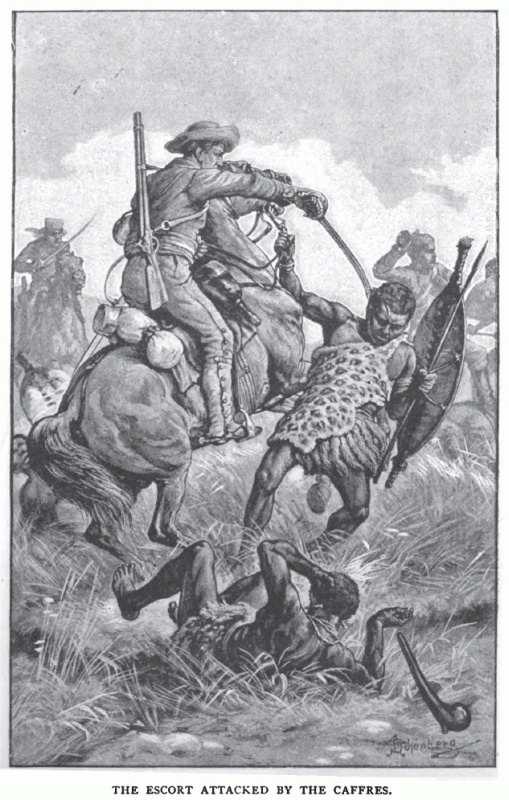
Tom Flinders—who had borne himself in the mêlée as gallantly as any veteran sabreur—was one of the last to get clear through; and he was racing to catch up his comrades when he heard a voice shout out: “Tom! Tom Flinders! for Heaven’s sake don’t leave me!” He at once turned in his saddle, and to his horror saw Frank Jamieson standing across the body of his gallant “mooi paard,” (grey horse) and defending himself against half a dozen Caffres, who were attacking him with their assegais.
Wheeling his horse round like lightning, Tom galloped to the rescue of his friend, and swooping down upon the group rode clean over two of the Caffres, knocking them right and left like nine-pins. A third—a herculean warrior, whose leopard-skin kaross bespoke the chief—sprang at his horse’s head and clung to the bridle; but the brave lad, rising in his stirrups, threw all his strength into one downward cut, and the big chief, cloven clean through the brain-pan, fell beneath the horse’s feet.
“Well done, young Flinders!” cried a cheery voice—“well done, my boy!” And the next moment Lieutenant S— dashed up and put to flight the other Caffres, just as they were on the point of assegaiing Frank Jamieson, whose sword had broken short off at the hilt, leaving him entirely at the mercy of his assailants.
“Jump up behind me, Jamieson,” Mr S— said as the Caffres made off, “and let us get out of this before those savages come on again. I’ve had enough fighting for one day! Now, Flinders, ride for your very life!”
And Frank, being safely mounted en croupe, they rode at full speed after their comrades, who, not perceiving their absence, had galloped on and were now nearly a quarter of a mile ahead. Fortunately, however, the Caffres did not follow in pursuit; so they rejoined their friends without further misadventure.
An hour later the escort arrived safely at Burns Hill...
When the staff-officer delivered his despatch to the camp commandant he learned, to his astonishment, that the troops left behind at Burns Hill had been hotly engaged with the enemy, who early in the day had attacked the camp, and, though finally repulsed with heavy loss, had succeeded in carrying off a number of draught cattle.
In the hope of recapturing these cattle, a troop of the 7th Dragoon Guards under Captain Bambric (a fine old officer who had fought at the battle of Waterloo), and a strong party of the Cape Mounted Riflemen under Lieutenant Boyes, had followed the daring Caffres into the bush, but, being attacked at a disadvantage by a vastly superior force, they had been compelled to retire, leaving their veteran leader mort sur le champ de bataille.
Chapter Seventeen.
Fighting their battles o’er again.
The sun had set and “retreat” long since been sounded when the escort reached Burns Hill, so that by the time Tom Flinders had reported himself to Captain Jamieson, had seen his horse fed, watered, and “fettled up” for the night, and had got rid of the traces of his arduous day’s work, the officers of the various detachments in camp were already gathered round the big watch-fire, and were eating their frugal supper, talking over the stirring events of the day, or paying a soldier’s tribute to the memory of their brave comrades who only the evening before formed part of their circle, but who now lay stiff and stark in the distant bush. Of those who had ridden in from Chumie Hoek the first to join the group round the fire was Lieutenant S—, and he at once proceeded to relate the gallant manner in which Tom had rescued Frank Jamieson from the Caffres. Said he warmly: “It was one of the pluckiest things I have seen for a long time. Young Flinders is a fine lad, and will make a capital officer.”
“He is a ‘chip of the old block,’ as those of you who know Matthew Flinders will agree,” put in Captain Jamieson, who had heard full particulars from his son. “I’m proud of him, I can assure you.”
“And here comes the young hero!” exclaimed Mr S— as Tom walked up to the fire. “We were just talking of you, Flinders,” he added, slapping the lad’s shoulder. “By Saint George, sir, that cut you delivered was worthy of Shaw the life-guardsman!”
“Sit beside me, Tom,” said Captain Jamieson, making room for him. “We’ll find a bone for you to pick somewhere. I can’t say all I wish to say now,” he went on in a low tone. “But you know how deeply I—eh, my dear boy!” And the old officer pressed his young friend’s hand.
“Allow me to congratulate you on your débût in the battle-field, Mr Flinders,” called out Major G—, the camp commandant.
“My friend here has informed me of your gallant behaviour, and you may be sure I shall report most favourably of you to the brigadier.”
Our hero was quite taken aback at thus publicly receiving so much “kudos,” and he felt not a little relieved when the conversation turned from his personal exploits to matters of more general interest.
“The campaign has opened with some hard fighting,” observed Major G—; “and I fully expect that Sandilli and his warriors will give us considerable trouble before we subdue them.”
“If they attack us to-morrow on the line of march we shall have our work cut out for us,” said another dragoon officer. “It will be no easy job to guard the waggons with the force we have.”
“No, indeed,” responded an artillery captain, who had some experience of South African warfare. “Thompson tells me that we have over a hundred bullock-waggons to escort, to say nothing of our guns and ammunition train. We shall have to fight tooth and nail to take them through. What route do you propose to take, major?”
“Well,” replied the major, “Jamieson, who knows the country thoroughly, advises me to follow the regular waggon-track—”
“Ir-regular waggon-track, major,” laughed Mr S—. “The roads about here are not macadamised, though there’s plenty of metal on the surface.”
“Well, then, the ir-regular waggon-track that runs along the banks of Keiskamma and skirts the high ground upon which the ruins of Fort Cox stand,” continued Major G— good-humouredly. “It is a somewhat circuitous route, but in this case the ‘longest way round is the shortest way there.’ No doubt we shall have to fight over every yard of the ground when once we are across the river.”
“’Pon my honour, Jamieson,” struck in an old captain of the Mounted Rifles, “Sandilli promises to give Somerset as much trouble as your old friend Marshal Soult gave the Duke!”
“As the Duke gave Soult, you mean?” was the retort.
“By the way, Jamieson,” said Major G—, “talking of Soult reminds me of your promise to give us an account of the part your old regiment played at Albuera. Suppose we have it now? It is just the time and place for an old campaigner to ‘fight his battles o’er again.’”
A murmur of approval greeted the major’s suggestion; and so Captain Jamieson, willing to accede to what was evidently the wish of his companions-in-arms, thus commenced his “oft-told tale.”
“The early spring of 1811 found me an ‘impatient patient’ in the General Hospital at Belem, suffering from the effects of a dangerous gunshot wound received at Busaco during our retreat down the valley of the Mondego. You must know that I was then colour-sergeant of the Light Company of the —th Foot; and my regiment—which was attached to Colborne’s Brigade, 2nd Division—had marched in pursuit of Massena, who, having broken up his camp before Torres Vedras on the 2nd March, was retiring into Spain, laying waste the country as he went.
“Great was my disappointment at not being allowed to march with the regiment; for I began to fear lest my continued absence from the colours might lead my comrades to suppose that I had become a ‘Belem Ranger,’ and did not intend to soldier any more. However, I was not detained in hospital very much longer, for at the end of April the doctors pronounced me fit for duty; and I was forthwith sent, with a large draft of men belonging to various corps, to rejoin the —th.
“After a fatiguing march the draft joined the 2nd Division at Albuera on the 13th May, and to my great pleasure I found myself reposted to the ‘Light Bobs.’
“Marshal Beresford was then in command of the 2nd Division, General Rowland Hill, its proper leader, being away on leave. Colborne was our brigadier.
“Beresford had taken up a position on the heights of Albuera to cover the siege of Badajos, information having been received that Soult (with 19,000 veteran infantry, 4000 cavalry, and 40 guns) was advancing from Seville to the relief of the beleaguered fortress.
“To oppose the French marshal, Beresford had 32,000 men of all arms; but of this number only 7000 were British troops, the remainder being Spaniards and Portuguese under Blake and Castanos.
“On the 15th May Beresford took post on the Albuera range, about seven miles from the town and fortress of Badajos. This range extends for four miles, and, being easy of ascent, is practicable for both cavalry and artillery. Along the eastern base of the hills flow the Albuera and its tributary the Feria, and between these two rivers is a wooded range of hills. This range Beresford most unfortunately neglected to occupy.
“The village of Albuera is situated above the river just at the junction of the main roads to Badajos and Seville, and Talavera and Valverde.
“Beresford placed Blake’s Spaniards on the right of the position; the British held the centre; Colborne’s brigade (consisting of the 3rd, 31st, 48th, and ‘ours’) being posted near the village, which was occupied by Alten’s Hanoverians; the Portuguese were on the left.
“On the evening of the 15th the light company of the —th was ordered to parade for piquet, and Captain Clarke marched us down to a narrow stone bridge spanning the Albuera in front of the village. Towards eight o’clock on the morning of the 16th Soult sent a battery of light guns, and some squadrons of light cavalry under Godinot, towards the bridge; and as soon as they had unlimbered, the French artillerists opened a smart cannonade upon our position, under cover of which Godinot’s light horsemen advanced as though they would charge across the bridge, which was barely wide enough to allow three horses to cross abreast.
“‘This is but a feint, Sergeant Jamieson,’ Captain Clarke said to me as we watched the movements of the enemy. ‘This is a feint, I feel sure. Depend upon it, Soult will try to turn our right, which is our weak point.’
“Now it happened that Beresford, who had come round to visit the piquets, overheard my captain’s remark, and turning sharply round, said:
“‘They are going to retreat, sir. I expect to attack their rear-guard by nine o’clock!’
“The words were hardly out of his mouth when an aide-de-camp galloped up from the right, where the Spaniards were posted, with the alarming intelligence that our right was turned!
“We afterwards learned that during the night Soult had quietly concentrated 15,000 troops, with 30 guns, behind the wooded range which Beresford left unoccupied, within ten minutes’ march of our weakest point—the right; and this movement he carried out entirely unknown to Beresford or his lieutenants, who remained in total ignorance of the proximity of this powerful force until it was too late to interpose between it and the Spaniards.
“So Blake was vigorously attacked and driven back with great slaughter; and Soult, confident that the day was won, pushed forward his columns.
“At this critical moment General Sir William Stewart galloped up to our brigadier and ordered him to move to the right in support of the Spaniards; our company then rejoined the battalion. Without waiting to form order of battle the brigade, led by the fiery William Stewart, doubled up the hill in open column of companies, and, passing the Spanish right, attempted to open line by succession of battalions as they arrived. But the French fire was too hot and well-directed to be borne quietly, and before the manoeuvre was completed the word was given to ‘charge.’
“With a ringing cheer we dashed onwards, but when close to the enemy the ‘halt’ was unexpectedly sounded, and the ‘retire’ followed almost immediately. At this time a heavy rain was falling, which obscured the view; and whilst we were wondering why the ‘retire’ had sounded the enemy’s cavalry appeared in rear of the ‘Old Buffs,’ who were, I believe, in the very act of re-forming column.
“We then advanced again; but before we had moved many paces a perfect swarm of Polish lancers, supported by several squadrons of chasseurs-à-cheval, charged the rear of the brigade and threw the four regiments into confusion. Separated and taken at a terrible disadvantage, our men had to act for themselves; so they formed groups of six or eight, and thus withstood the furious onslaught of the savage Poles. Many of the officers joined the men, and prepared to sell their lives dearly; for quarter was neither given nor asked for. Captain Clarke, his junior subaltern, Ensign Hay, and I, found ourselves in the midst of a group composed of a dozen men of our own company. Clarke snatched up a musket and blazed away as fast as he could ram home the cartridges, encouraging the men a while with words of approval or exhortation. Ensign Hay followed the captain’s example, and fired as hard as he could fire; and I too abandoned my pike for ‘Old Brown Bess,’ and may safely say that I never made better practice.
“All this time the Polish lancers were wheeling round the groups, stabbing at us with their long lances whenever they got a chance. It was reported afterwards that they had been promised a doubloon apiece if they broke the British line. Gradually our men became mixed up with these lancers and with the chasseurs and French linesmen; and every one of us was thrusting and parrying, hacking and guarding, loading and firing, to the best of his ability. Never have I witnessed such a mêlée.
“I saw a savage-looking, bare-headed lancer attack our ensign and run him through the lungs, the lance coming out at his back. He fell, but regained his feet immediately. The Pole again delivered point, his lance striking Hay’s breast-bone; down he went as if shot, whilst his assailant pitched over his horse’s head and rolled over in the mud beside him. I ran forward to the ensign’s assistance, but came in collision with a chasseur-à-cheval, who cut at me with his sabre and brought me on my knees. I staggered up and drove my bayonet through his leg, pinning him to the saddle. He then cut at me again, inflicting a severe wound on my head and partially depriving me of my senses. At that moment my adversary’s horse was killed by a musket ball, and in its fall the poor brute crushed me to the ground. I struggled hard to regain my feet, but the weight of the dead charger kept me down, and so I was placed hors-de-combat for the rest of the day.
“In this desperate hand-to-hand encounter Colborne’s brigade suffered terribly, for of the four regiments composing it the 31st alone was able to form square when the French cavalry charged us. The 3rd Buffs, the 48th, and ‘Ours’ were nearly annihilated.
“At length a gust of wind blew aside the mist and smoke and revealed our desperate condition to General Lumley, who was in the plain below; and he at once despatched four squadrons of heavy dragoons against the lancers. Almost at the same moment Houghton’s brigade came up, and Major Julius Hartmann brought his light guns into action.
“When I heard the artillery thundering over the ground I gave myself up for lost, making sure that they must inevitably gallop over me; but they passed a few yards to my right, and, quickly unlimbering, opened fire.
“The battle was now continued with redoubled fury; the guns belched forth grape at half-range, the musketry kept up an incessant rattle; and the carnage on both sides was truly awful. Presently our gallant fellows found that their ammunition was beginning to run short, and they were obliged to slacken fire; and at this juncture—misfortunes never come single—another French column established itself on the right flank.
“Marshal Beresford—who had been doing his utmost to induce the cowardly Spaniards to advance to the assistance of their well-nigh vanquished allies—now saw that retreat was inevitable, and he most reluctantly gave the unwelcome order. But happily the battle was saved by the moral courage—hark ye to that, you young fellows!—by the moral courage of a young staff-officer, Colonel Hardinge, (afterwards Lord Hardinge, commander-in-chief), who entirely on his own responsibility rode off at full speed to General Cole (who had just arrived from Badajos) and urged him to advance with the 4th Division and Abercrombie’s brigade of the 2nd Division. Cole readily assented, and at once led the 7th and 23rd Fusiliers, flanked by a battalion of Portuguese caçadores, up the hill; whilst Abercrombie’s brigade followed in support.
“Separating themselves from the crowd of broken soldiery, these fresh troops attacked the French with irresistible fury, and slowly but surely drove them back to the farthest edge of the hill. In vain did Soult call upon his veterans to hold their ground, in vain did he bring up his reserves; nothing could withstand Cole’s splendid infantry; and after a desperate struggle the French masses went down the slope of the hill, breaking like a loosened cliff.
“The battle was over. By three o’clock the last shot had been fired, and the remnant of the British troops, who had fought with such devoted courage, stood triumphant on the bloodstained ground. Since that memorable day I have taken part in many a ‘stricken field,’ but never have I seen harder fighting than at the battle of Albuera.”
“It was indeed a brilliant affair,” said Major G—n when the old officer stopped speaking; “and our soldiers gave unmistakable proof of their superiority over Bonaparte’s veterans. Pray, what were the losses on either side?”
“I cannot say how the Spaniards and Portuguese came off; but out of 6000 British and Hanoverian troops actually engaged more than 4000 were killed, wounded, or missing,” Captain Jamieson replied. “The French, I believe, lost between 7000 and 8000 men. As for the poor old —th, we went into action over 400 strong, and on the morrow only 53 bayonets mustered at parade! The battalion may almost be said to have ceased to exist.”
“Well might Byron exclaim, ‘O Albuera, glorious field of grief!’” said S—. “But you have not told us how you fared after the battle.”
“Well, I lay crushed beneath the chasseur’s dead charger until morning, when I was found by a party of the light company who had been searching for me throughout the night. My wounds were not very severe, and when I recovered, the commanding officer, Major K—, appointed me sergeant-major of the battalion. I held that post until the end of the war, when I was invalided home and promoted to an ensigncy on the half-pay list. In 1821 they gave me my lieutenancy in the Cape Mounted Rifles.”
“You are to be congratulated on having seen so much active service,” said Major G—n. “I always envy you Peninsula heroes. Few men, I should imagine, have passed through so much peril, and yet lived to tell the tale.”
“I am not out of the wood yet, G—n,” was Jamieson’s quiet rejoinder. “But talking of peril, no man has experienced more of ‘moving accidents by flood and field’ than my friend Richards,” he went on, nodding at a wiry-built grave-looking man who sat near him. “You’ve seen some rough work in America—eh, John?”
“Yes, Jamieson,” responded the person addressed, who was an officer of native levies; “but not such work as you’ve been describing. This, you must know, is my first regular campaign. I have always been a ‘man of peace,’ gentlemen—that is to say, when the Red-skins would let me!”
“Which was seldom enough, no doubt,” put in Captain Jamieson. “By the way, hadn’t you a remarkable escape from the Indians some years ago? I think I remember hearing of it.”
“A—ah!” rejoined Mr Richards with a sort of gasp—he spoke, too, with a slight American intonation; “a—ah! that was an adventure! Why, do you know, gentlemen, that though it happened twenty-two years ago come next fall, I feel kinder nervous even now when I think of it; for ’twas just about the very narrowest shave of being scalped that ever I did run.”
“Come, tell us all about it, John,” said the captain. “I’m sure our friends will appreciate the yarn.”
“Well, then, gentlemen,” Mr Richards began, taking a look round the company as if he wanted to find some individual upon whom to fix his eye, “you must know that I met with this adventure in ’25, when I was a smart spry young fellow of nine-and-twenty. I was trapping beavers at the time, in company with my friend Job Potter, near the head-waters of the Missouri; and as we knew that the Blackfoot Indians were on the war-path, and that we should meet with but scant mercy if we fell into their hands, we just set our beaver-traps at night, visited them at dawn, and remained concealed in the woods during the day.
“Early one morning Job and I were paddling up stream in our canoe, on our way to examine the traps, when of a sudden we heard a noise as though a herd of buffaloes were galloping towards us; and the next minute a number of Red-skins in their war-paint came rushing along either bank of the river—a couple of hundred of them at the least.
“We turned the head of the canoe like lightning and paddled down stream as hard as we could paddle, but the Indians sent a flight of arrows after us and killed poor Job Potter, who in his fall upset the canoe. By a miracle, I only received two slight flesh-wounds; and when I found myself in the river I dived like a duck in order to escape the second shower. Now some thirty yards lower down the stream was a small island, and when we paddled past it I had noticed that against the upper part a sort of raft of drift-timber had lodged. This raft, I must explain, was formed of the trunks of several trees, large and small, covered over with smaller and broken wood to the depth of five or six feet.
“In my extremity I happily remembered this raft, and I saw in it my only chance of eluding my pursuers. Rising for one second to the surface in order to make sure of its position, I dived again and swam under water until I found myself directly beneath the raft. I then—not without considerable difficulty—managed to force my head and shoulders between the trunks of trees, so that the upper portion of my body was well above water, and at the same time completely hidden from view by the broken wood on the top of the raft.
“Hardly had I fixed myself in this position when the Indians arrived opposite my place of refuge, and several swam off to the island and searched for me amongst the brushwood; one or two actually got on the raft.
“Gentlemen, I remained in that terrible position for eleven mortal hours!—in fact, until the Red-skins took their departure, which was not before nightfall. As soon as I was certain that they were gone I dived from under the raft and swam some distance down the river, and there landing, made my way to Fort Jefferson. When I arrived there, after two days’ tramp, I found that my hair had turned quite grey; and I can assure you, that, if I live to be a hundred, I shall Dever forget the agony of suspense I suffered when fixed up between those trees.”
Many a thrilling tale of sport and war, of peril by flood and field, was told that evening; and the circle round the watch-fire would not have broken up until the small hours of the morning had not the commanding officer reminded them that they must be on the move by cock-crow. So the officers lay down to rest with their weapons beside them, ready for aught that might occur; and before midnight the camp was hushed in slumber, no sound being heard save the measured tramp of the patrol or the hoarse challenge of the sentinels.
Chapter Eighteen.
The 18th April—A Fight against terrible odds—Numbered with the slain!—The March to Block Drift.
The stars were still bright in the heavens, and the grey dawn of day had not yet appeared in the east, when the camp at Burns Hill was once more astir with the final preparations for the march to Chumie Hoek; and so soon as the waggons were ready and the draught cattle inspanned, the troops paraded without blast of bugle or beat of drum, and the order to form column-of-route was given. The advance-guard moved off just as the morning broke, and was presently followed by the long train of bullock-waggons—one hundred and twenty in number—and the guns and caissons of the Royal Artillery; but the day had “begun its broiling course” before the rear-guard, of which Jamieson’s Horse formed part, was clear of the camping ground.
As daylight grew more distinct, thousands of Caffre warriors were descried pouring down from the mountains; and it became palpable to all concerned that the way would be disputed by a determined and—so far as numbers went—an overwhelming force.
Said old Captain Jamieson, as he brought his glass to bear on the distant hordes, “Mark my words, G—! the 18th April will become famous in the annals of South African warfare. Those fellows yonder mean business; they have no doubt been excited to the verge of madness by their witch doctors, and will attack us with maniacal fury.”
“We shall have hard work to get through them,” the major replied, somewhat gloomily, for he felt much his responsibility; “and I fear many a good soldier amongst us will never see another sunrise. Still, were it not for the ‘impedimenta,’ I would not mind encountering double the number; and if we could only get them in the open for half an hour our cavalry should read them a lesson they’d never forget—a lesson that should be handed down to posterity! But I must move on to the front. Au revoir, Jamieson! I trust we shall meet again at Chumie Hoek before many hours have passed.”
The road by which the convoy was to march followed the bank of the Keiskamma for some two or three miles; until the river, suddenly changing its course by a sharp bend to the right, swept round a rocky eminence upon which stood the ruins of a long-abandoned military post known as Fort Cox. At the base of this eminence (which the road traversed before it again met the Keiskamma at the drift or ford) the way led for nearly a half mile up a precipitous ascent, encumbered with huge boulders, and surrounded by bush.
It was at this point that the Caffre chiefs massed their eager warriors for the attack on the baggage-train.
The leading division of waggons, which carried the “impedimenta” belonging to Colonel Somerset’s column, were so admirably defended by G—n’s advanced-guard and their own escort, that they passed up this dangerous ground without disaster, and descending to the drift (which was held by a squadron of the Cape Mounted Rifles, under Lieutenant Bissett) (General Sir John Bissett, K.C.B., author of Sport and War in South Africa) crossed over the Keiskamma. This part of the train subsequently reached the camp at Chumie Hoek in safety; its rear being covered by Bissett’s riflemen, who, after the passage of the river was effected, were relieved at the ford by Major G—n’s advanced force. But the journey between the ford and Chumie Hoek was not made without opposition, for there was some very hard fighting all through the bushy country, and several of the escort were killed and wounded; Mr Bissett himself had a narrow escape of his life, his charger being shot under him, and his rifle knocked to pieces in his hands.
The centre division of the convoy—consisting principally of the baggage-waggons of the 7th Dragoon Guards—did not meet with similar good fortune; for the enemy attacked the escort with such impetuosity and in such overwhelming numbers, that the latter was compelled to fall back on the troops in the rear, and so the whole of the waggons were captured. To make matters worse, this disaster occurred in a narrow part of the road, and the wily Caffres immediately freed the teams from the yokes, overturned several of the waggons, and so completely blocked the way for the rest of the train.
By this time Colonel Somerset had despatched every man he could spare out of camp to Major G—n’s assistance; namely Sutton’s Kat River Burghers, and two companies of the 91st Regiment, under Captain Scott; but the enemy continued to come up to the attack in such astonishing force that the major was reluctantly compelled to abandon the baggage-waggons of the 7th Dragoon Guards (fifty-two in number) in order that he might have more men to defend the guns and ammunition train, which he was determined to save at all hazards.
Leaving the waggons to their fate, Major G—n made a détour to the left along the bushy slope, and having fought his way across the Keiskamma he entered a valley at the foot of the Seven Kloof Mountain.
Up this valley G—n led his column, fighting over every yard of the broken ground, until—just as night was falling—he reached the open country in the vicinity of Chumie Hoek. The Caffres here made one more desperate attempt to take the guns, but the gunners opening upon them with shot and shell, repulsed the attack, and it was not renewed; the column then marched on, and eventually arrived in camp with the loss of an artillery waggon, which had to be abandoned owing to the collapse of its team of bullocks...
We must now return to the rear-guard, and see how it had fared with our friends in “Jamieson’s Horse” during that eventful day.
When the officer commanding the rear-guard heard that the escort of the centre division of the convoy was being driven back, and that the waggons were in imminent danger of falling into the enemy’s hands, he consulted with Captain Jamieson as to whether he should not take it upon himself to send a troop to their assistance; but before he had time to come to a decision a mounted orderly arrived from the front with the alarming intelligence that the waggons had already been captured, and that the road was entirely blocked; he also brought an order that “Jamieson’s Horse” should be sent forward at once, to retake the waggons and hold the enemy in check until the road had been cleared.
Anxious to reach the scene of the disaster without a moment’s delay, and being well aware that if he advanced along the road he must necessarily meet with more or less hindrance, Captain Jamieson wheeled the corps to the left, and started off at a hand-gallop across country until he lost sight of the convoy; when he changed direction to the right and led his men over some broken ground, which ran almost parallel to, and was within easy rifle-shot of the road. They had advanced about three parts of a mile over this ground, and were within half that distance of the captured waggons—which were now completely surrounded by hundreds of the enemy—when Frank Jamieson, who was riding at the head of the leading troop, espied—away to the left front—a small party of Caffres driving off the bullock teams into the mountains. He at once pointed them out to his father, who ordered him to follow in pursuit with fifteen men, and do his best to recover the teams and bring them back as quickly as possible.
“Without them,” said the captain, “I do not see how we can take the waggons on; for I heard Thompson say that he had no spare draught cattle.”
As soon as Frank had ridden off, Captain Jamieson and the remainder of the corps galloped onwards, and—the nature of the ground and the “din of battle” favouring them—they approached within a couple of hundred yards of the baggage-train without attracting attention; for those of the enemy who were not actually engaged with either the advance-guard or escorts, were busily employed plundering the waggons. Jamieson’s volunteers were thus enabled to deliver a telling volley, and then charge down on the Caffres before the latter were thoroughly alive to the fact that they were being attacked from that quarter; and so impetuous was this charge, that the little band rode right through the dense masses of the enemy up to the waggons without losing a single man or horse. The next minute the Caffres, recovering from their surprise, closed in upon the gallant horsemen, and for a little while there was some desperate hand-to-hand fighting, in which, however, Jamieson and his men at first held their own. But the Caffres outnumbered them twenty to one, and, moreover, were excited to such a pitch of fury that they were utterly reckless of their lives; and as fast as one was cut down or shot, half a dozen others would press forward to take his place; many, too, actually crawled on all-fours amongst the plunging horses, and thrust their assegais again and again into the poor brutes’ bellies, and so in a short time nearly one-third of the volunteers were dismounted, and assegaied before they could disengage themselves from their dead chargers. And now the corps got broken up into groups, and the end soon came.