SECTION V Italy
Reading edition
(5 June 1944–2 May 1945)
The Allies did not halt after taking Rome, but their northward progress was soon slowed by skillful delaying tactics of the retreating enemy and by the fact that all the French and some of the American divisions were being withdrawn from the U. S. Fifth Army for the operation in southern France. The Germans speeded construction of the Gothic Line in the north Apennines, and early in August 1944 the Allies paused for reorganization on a line running approximately from ten miles north of Ancona on the east through Pisa to the west coast. The Fifth Army held the territory south of the Arno River from the sea to a few miles east of Florence; the British Eighth Army was north of Ancona on the Adriatic.
During August preparations were made by the Allied armies in northern Italy to penetrate the heavily fortified Gothic Line. This defensive system of the enemy extended in general from southeast of La Spezia through the mountains to Rimini. After regrouping and building up supplies, the Allied armies started their offensive on 26 August. They succeeded in breaching the Gothic Line in the center and along the coast, but fierce enemy resistance, bad weather, and a shortage of ammunition and replacements halted the offensive south of the Po River plain by the late fall of 1944. The winter of 1944–45 was spent in the mountains overlooking the Po Valley.
The spring drive by the Allied armies started on 9 April 1945. Bologna fell on 20 April, and armor and infantry overran the plain and divided the German forces. On 2 May 1945 the enemy in Italy surrendered unconditionally.
ITALY
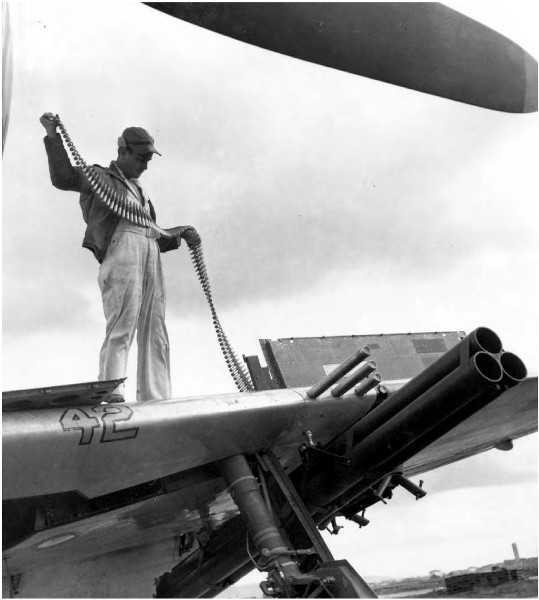
SOLDIER LOADING WING GUNS OF A FIGHTER with .50-caliber ammunition. In Italy these tough and maneuverable fighters were used for a variety of purposes, particularly after other fighter planes with a higher speed and longer range were available for escorting and protecting bombers. The P-47’s became fighter-bombers, and were also equipped to use rockets. (4.5-inch 3-tube AC rocket launcher M15 of a P-47.)
CORSICA
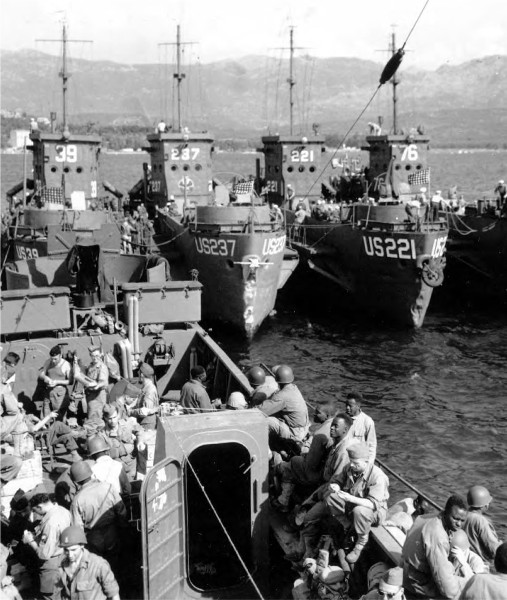
FRENCH COMMANDOS AND SENEGALESE TROOPS on an LCI in a Corsican harbor prior to the attack on the island of Elba. The troops were taken to Elba on 17 June 1944 in U. S. landing craft and in two days the island had been secured.
CORSICA
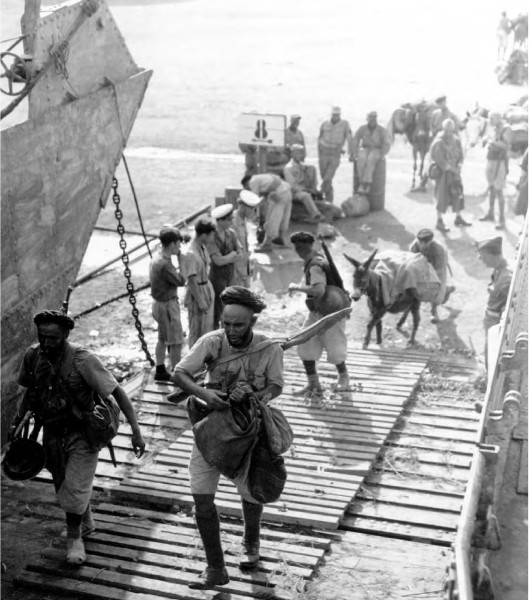
GOUMIERS BOARDING AN LST in Corsica for the attack on Elba. The attack, though not carried out by Fifth Army troops, was co-ordinated by Allied Force Headquarters with the advance on the Italian mainland and was launched when the forces driving up the mainland were nearly opposite the island. The attacking force consisted of French, goumiers, and Senegalese.
ITALY
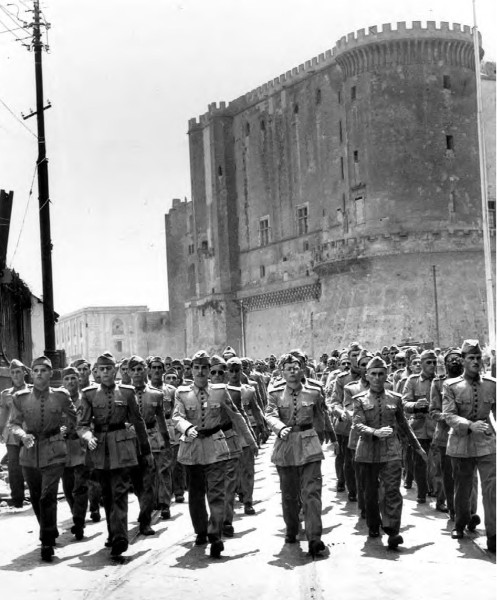
BRAZILIAN SOLDIERS ARRIVING IN NAPLES, July 1944, to serve with the Fifth Army during the 1944–45 winter campaign in the northern Apennines.
ITALY
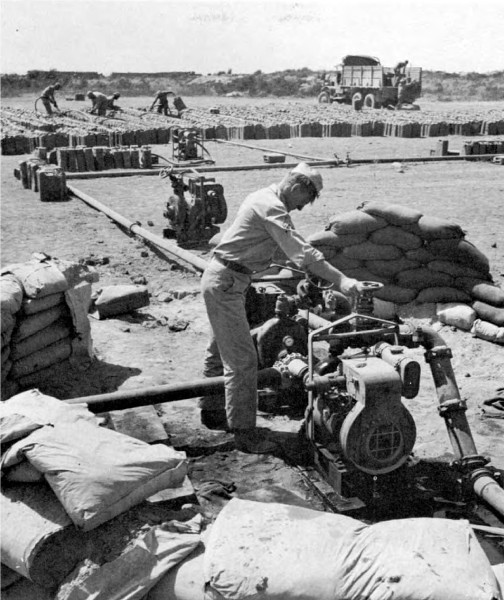
GASOLINE DISTRIBUTION POINT. Oil tankers brought gasoline into major ports. From there it was transported to storage tanks at distribution points by pipeline, trucks, or tankers where it was transferred to five-gallon cans for pickup.
ITALY
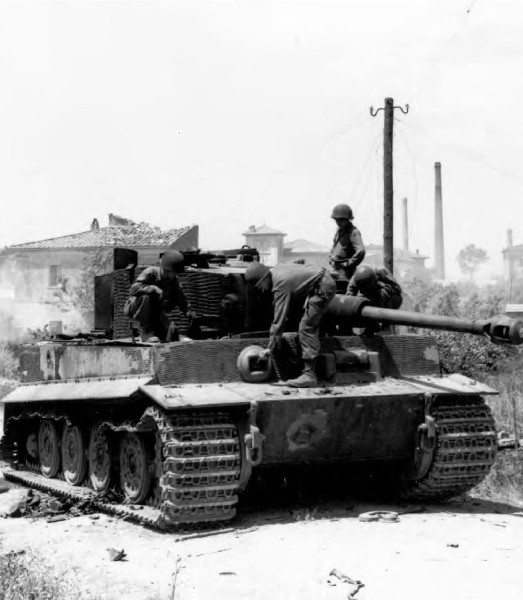
A TIGER TANK, such as was encountered in Tunisia and Sicily, but with a non-magnetic plastic coating. It is believed that most of the tanks thus coated were originally destined for the Russian front where the Germans were greatly troubled by delayed-action magnetic mines which were stuck onto the armor of their tanks by Russian infantry.
ITALY
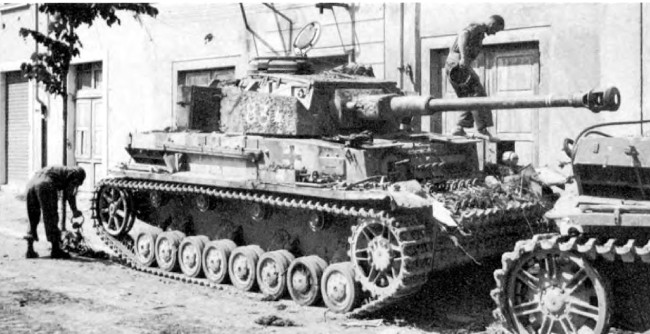
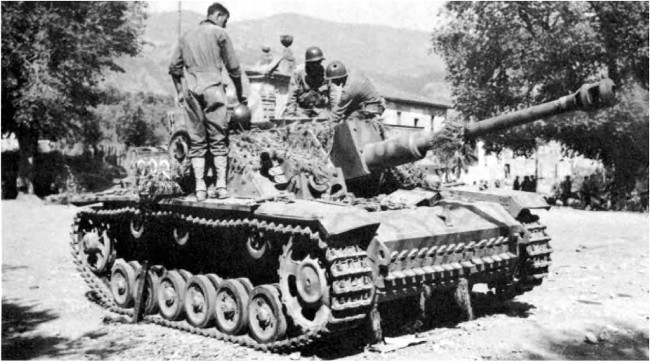
GERMAN ARMOR. Medium tank is the Mark IV (top). Of the four tank types with which the Germans started the war, only this survived in service until the end. Originally it had a short-barreled 75-mm. gun which changed its role from a close-support vehicle to a fighting tank. Assault gun (bottom). The Germans used this in great numbers, and it was often called a tank, but was actually an assault gun and tank destroyer on the chassis of a Mark III tank. (Top: Pz. Kpfw. IV tank with 7.5-cm. Kw. K. 40 (L/43) gun; bottom: Stu. G. III with 7.5-cm. Stu. K. 40 gun.)
ITALY
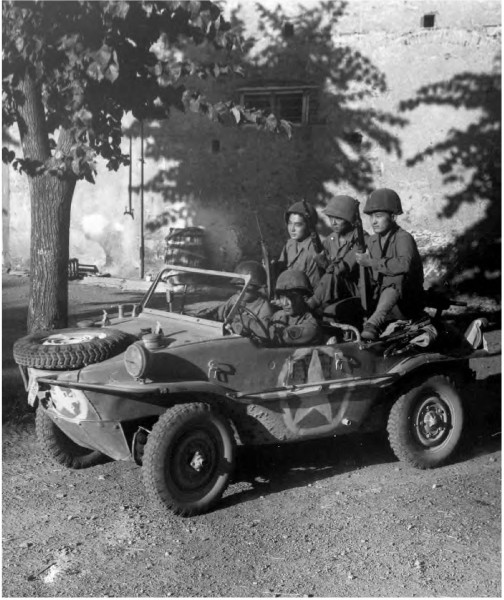
GERMAN AMPHIBIAN JEEP, a version of the light Army car, Volkswagen. Both versions were inferior in every respect to the U. S. jeep except in the comfort of the seating accommodations. (Schwimmwagen, le.P.K w.K.2s.)
ITALY
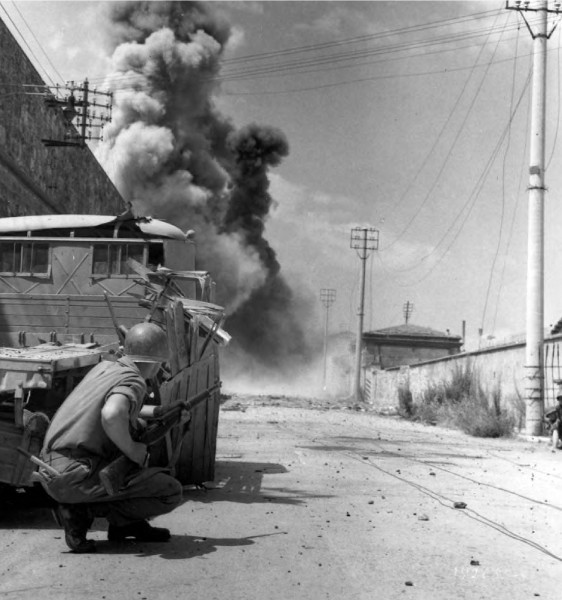
ENGINEERS SETTING OFF ENEMY MINES in a street in Leghorn on 19 July 1944, the day the city fell. The soldier at left is guarding engineers against snipers. The Germans had destroyed all the port facilities, mined the buildings in the harbor area, and made the latter unusable by blocking the entrance with sunken ships. The drive from Rome to the Arno River was a pursuit action in which the Germans, by skillful delaying tactics, slowed the Allied advance so that completion of the Gothic Line defenses in the northern Apennines could be expedited. The mouth of the Arno River was reached by 23 July 1944.
ITALY
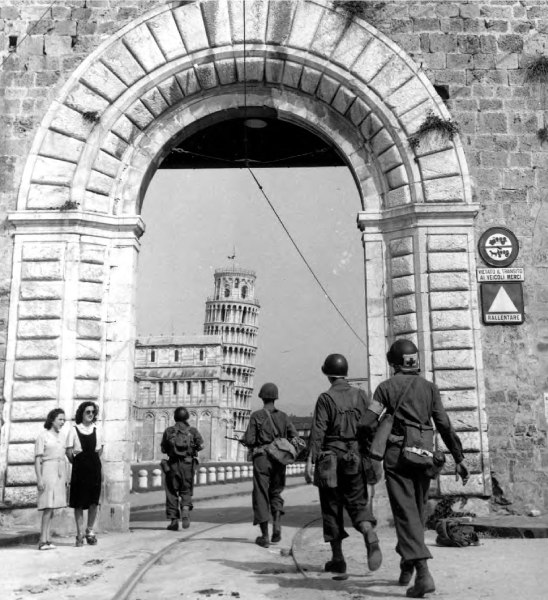
TROOPS IN PISA. The southern outskirts of this town on the Arno River were entered on 23 July 1944. The enemy had destroyed all bridges across the river and when the infantry entered the town they were met by heavy fire from across the river. The southern half of the city was found heavily mined and booby-trapped. During the approach to the Arno River plans were being completed for introduction of antiaircraft units into the lines as infantry since enemy air activity had decreased to the extent that many AA units could be more profitably used as infantry.
ITALY
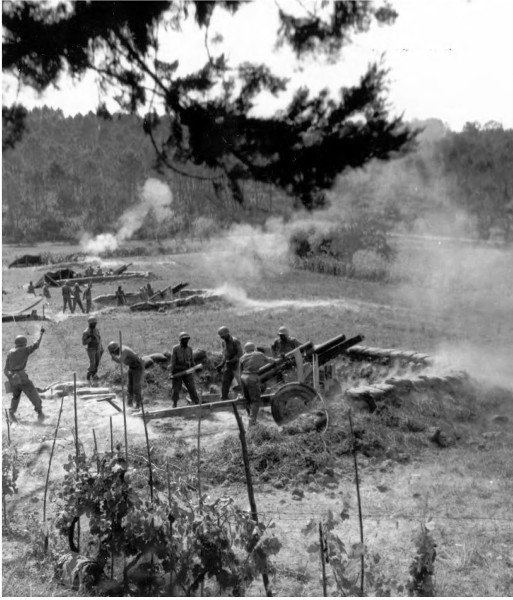
FIRING HOWITZERS across the Arno River in August. The men of this unit were part of an American all-Negro regimental combat team, the first to appear in Italy. They entered the line south of the Arno on 23 August. A few weeks later an entire Negro infantry division was at the front. (105-mm. howitzer.)
ITALY
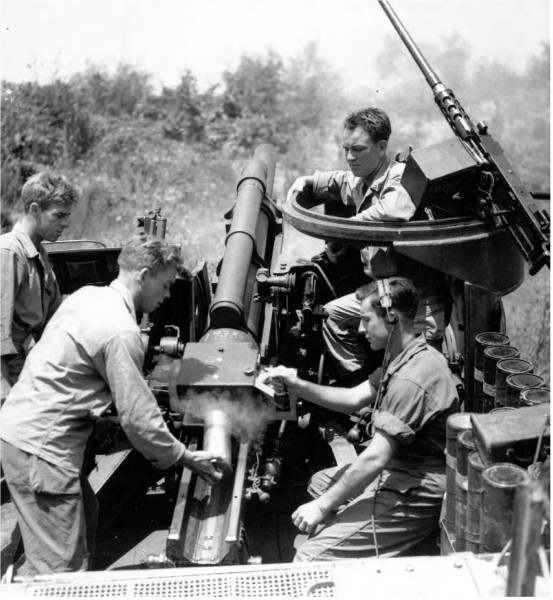
MEMBERS OF AN ARMORED FIELD ARTILLERY UNIT firing a 105-mm. howitzer during training south of the Arno River. The howitzer is mounted on a Priest. The Fifth Army reached the Arno at Pontedera on 18 July and the first week in August found the forces grouped along the southern bank on a thirty-five-mile front reaching from the sea on the west to Florence. The month of August was used for resupplying, resting, and training the units. (105-mm. howitzer; M7 gun motor carriage.)
ITALY
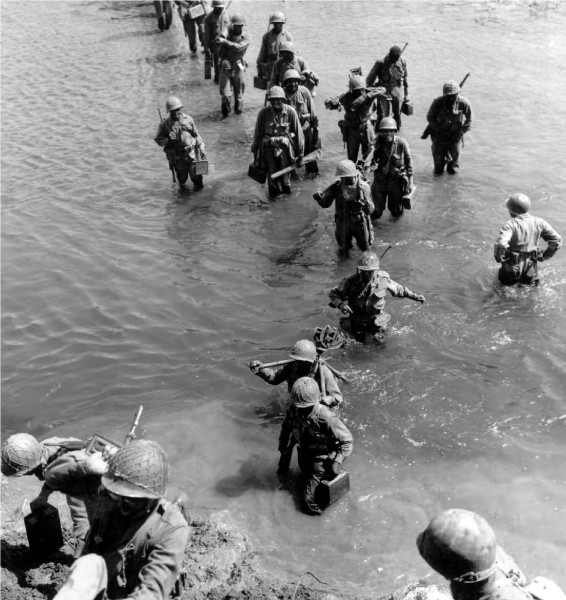
NEGRO TROOPS CROSSING THE ARNO near Pontedera on 1 September, during the drive toward the Gothic Line. The attack on this line was started by the Eighth Army along the east coast on the night of 25–26 August. On 1 September the line had been breached in that sector but by the 6th the advance had been stopped a few miles below Rimini on the Adriatic coast. This advance by the British caused the German High Command to shift three divisions opposing the Americans to the British sector. The forces directly opposite the Arno drew back into the Gothic Line, a distance of about twenty miles.
ITALY
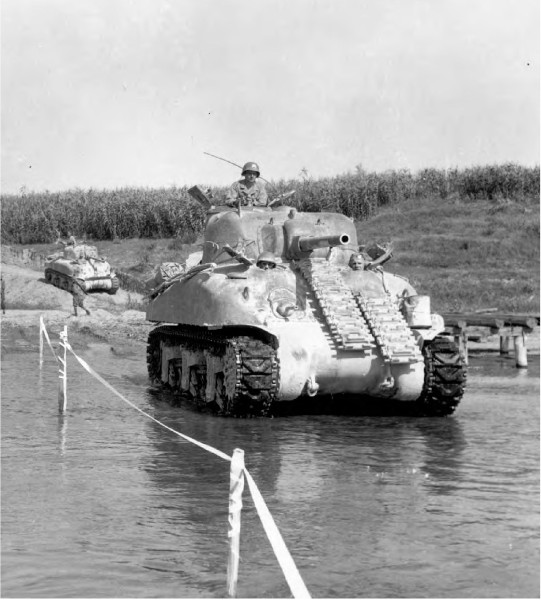
SHERMAN TANK FORDING THE ARNO in the Cascina area on 1 September. Little opposition was met until the Gothic Line was reached. The Germans had started to withdraw into this line during the last days of August. Before the withdrawal, it was estimated that the area between the Arno River and the Gothic Line contained about 350 enemy tanks, half of which were Panthers and Tigers. (Sherman tank M 4A 1.)
ITALY
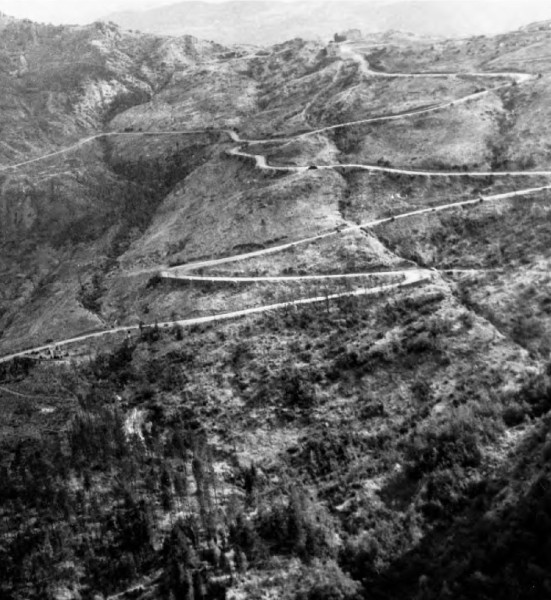
TOP OF IL GIOGO PASS IN THE GOTHIC LINE, looking toward the north. The Fifth Army broke through this pass in the Gothic Line defenses outflanking the heavier prepared fortifications at Futa Pass on Highway 65. The scarcity of roads through the mountains made it possible for the Germans to concentrate their defensive works at a few key points such as the Futa and Il Giogo Passes. Highway 6524 branches off Highway 65 thirteen miles north of Florence, winds through Il Giogo Pass, and ends at Highway 9 in Imola (Po Valley).
ITALY
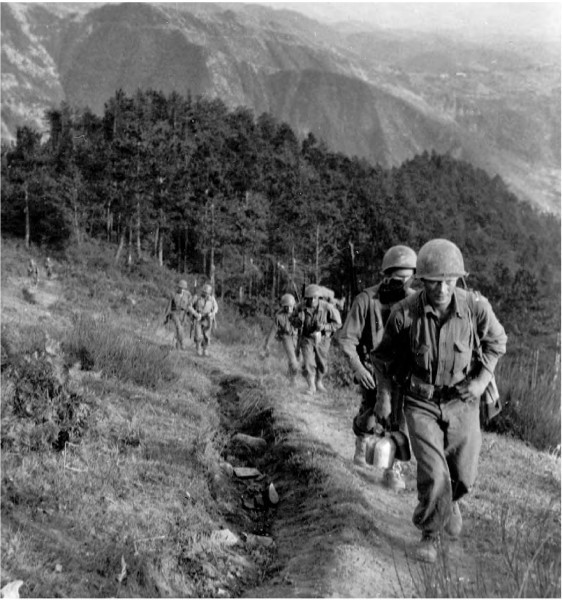
INFANTRY ADVANCING OVER THE HILLS in the area of Il Giogo Pass on 18 September, the day the pass was taken. The fight for the area started on the morning of 12 September. The mountains on each side of Il Giogo Pass are too steep to require antitank defenses other than road blocks, but other defenses such as underground fortresses were numerous and well prepared. Barbed wire and antipersonnel mine fields guarded approaches. Many of the hills were covered with pine woods which made it difficult to locate enemy defenses by the use of aerial photographs. Some information was obtained from partisans who had worked on the Gothic Line.]
ITALY
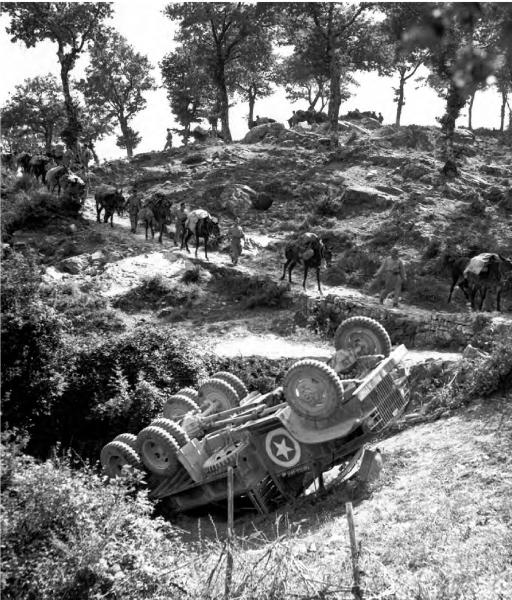
PACK MULE TRAIN approaching the Gothic Line in the area of Il Giogo Pass. For the difficult task of supplying their troops through the mountains the Allied forces had 9 Italian Army mule pack companies, each containing 260 mules. (2½-ton U. S. truck overturned.)
ITALY
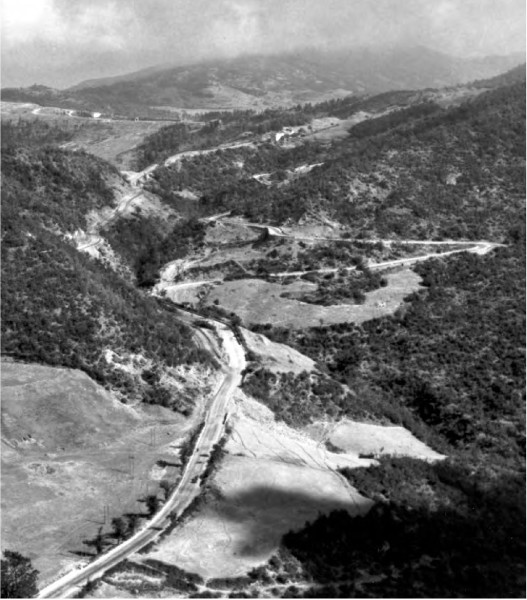
HIGHWAY 65 AT FUTA PASS. This pass, at an altitude of 2,962 feet, is one of the lowest through the northern Apennines. Highway 65, the most direct route to Bologna and the Po Valley, became the main supply route and a principal axis of advance in the Fifth Army area, although the breach in the Gothic Line was not made here. Futa Pass fell on 22 September.
ITALY
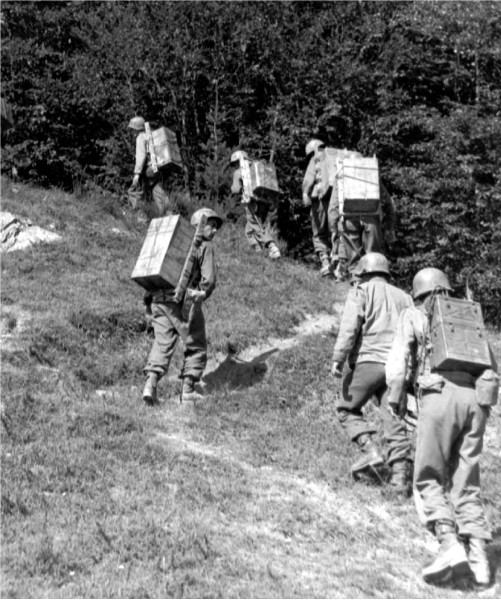
INFANTRY PACK TEAMS bringing supplies to units fighting in the Gothic Line near Futa Pass. Mule pack teams were available but some of the paths were too steep even for pack animals.
ITALY
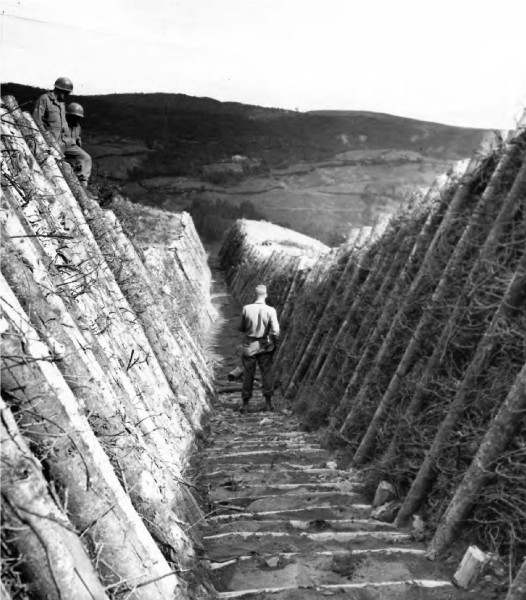
ANTITANK DITCH AT FUTA PASS. This ditch, about three miles long, crossed the road south of the pass. The ditch was covered with a network of infantry positions and bunkers for antitank guns. The area in front of the ditch was mined. Two of the bunkers in this area were topped by Panther tank turrets with long-barreled 75-mm. tank guns.
ITALY
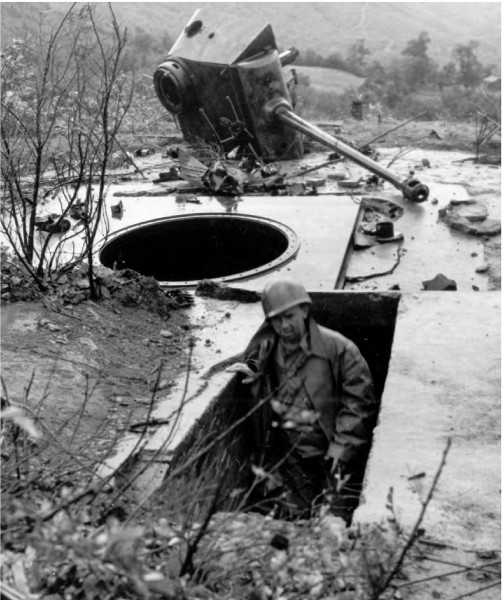
A PANTHER TURRET CASEMATE in the Gothic Line near Futa Pass. The turret could not be penetrated by the guns of any of our tanks, but was vulnerable to artillery fire.
ITALY
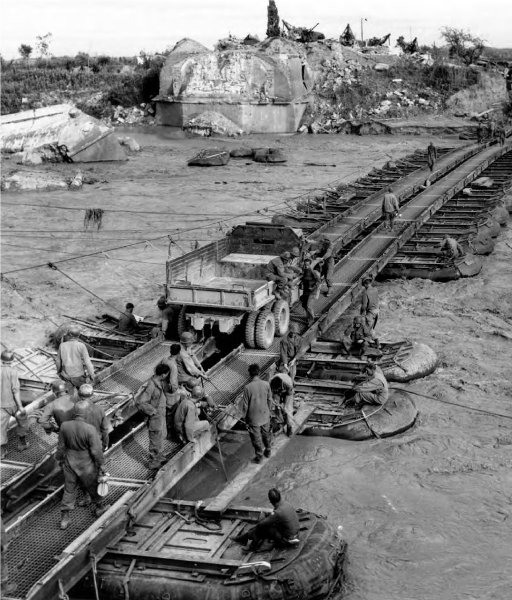
REPAIRING PONTON TREADWAY BRIDGE over the Arno at Pontedera. The supply situation of Fifth Army troops at the Gothic Line was made difficult by fall rains which raised the Arno River to flood level and washed out most of the bridges between Florence and Pontedera.
ITALY
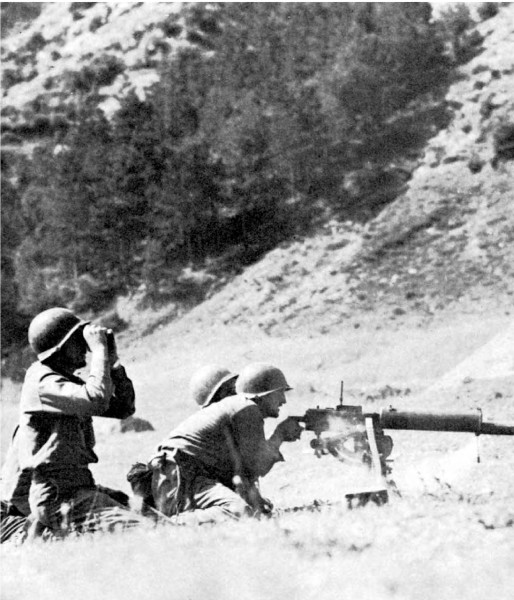
MACHINE GUNNERS FIRING AT GERMANS in the Monticelli area near Il Giogo Pass. Note flash hider attached to front of machine gun. The Americans occupied Firenzuola on 21 September. (.30-caliber Browning machine gun M1917A1, a development of the M1917 which proved its worth in World War I.)
ITALY
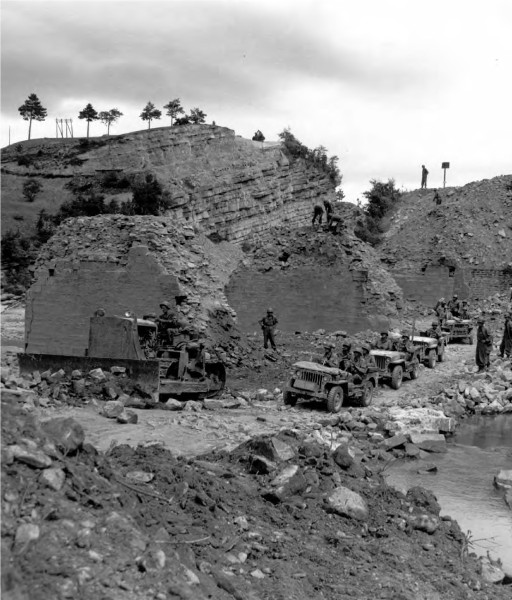
AMERICAN ENGINEERS CONSTRUCTING A BYPASS in the Firenzuola area during the pursuit of the Germans. The combat engineers, prepared to bulldoze a bypass or to install temporary bridges, followed closely behind the leading elements of the infantry and armor. (Jeep; crawler type diesel tractor with angledozer.)
ITALY
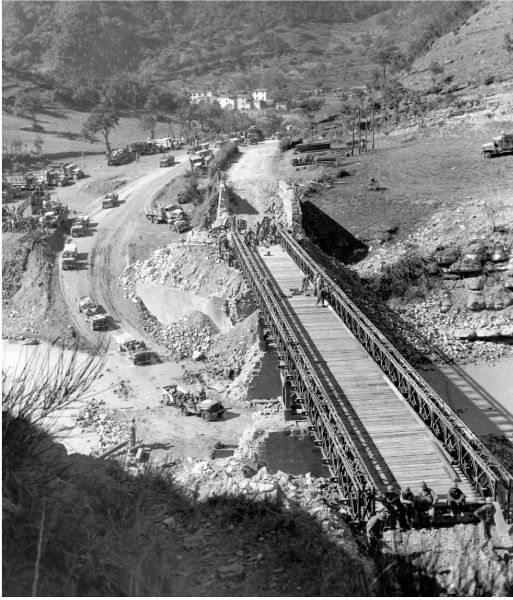
BAILEY BRIDGE in the Firenzuola area. This is the same site as the scene of the bulldozer constructing a bypass, the picture being taken two days later. The Bailey bridge was particularly suitable for operations in the mountains of Italy where sudden rains would swell the rivers and wash out ponton bridges.
ITALY
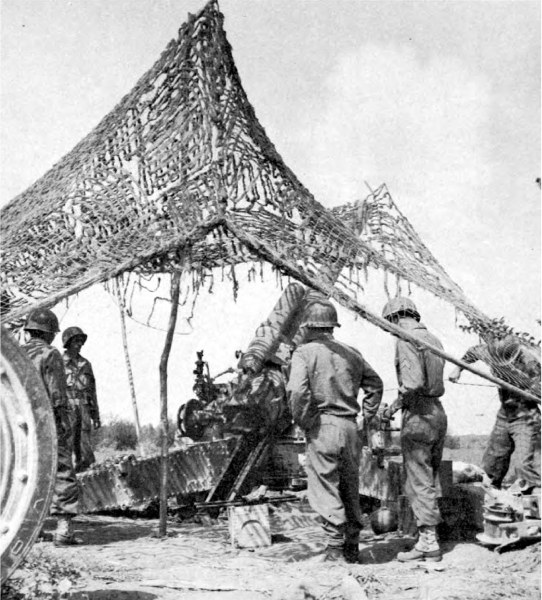
AMERICAN ARTILLERYMEN firing captured German 150-mm. gun near Lucca. Note small amount of smoke. German ammunition was charged with smokeless, flash-less powder which in both night and day fighting helped the enemy tremendously in concealing his fire positions. All U. S. guns, from the rifle to the large howitzer, left telltale puffs of smoke during daytime or showed relatively large and brilliant muzzle flashes at night.
ITALY
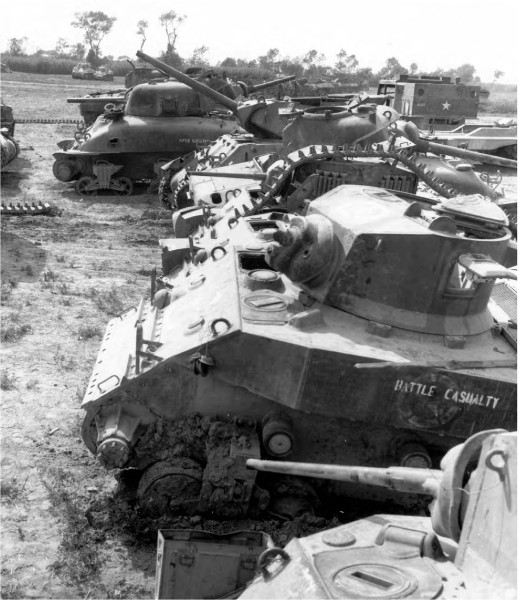
A GROUP OF ARMORED VEHICLES at a salvage yard of a heavy maintenance company in Italy. (1, 2, and 3, light tanks M5; 4, medium tank M4; 5, gun motor carriage M10; 6, medium tank M4. A tractor and tank recovery trailer are partially visible, upper right.)
ITALY
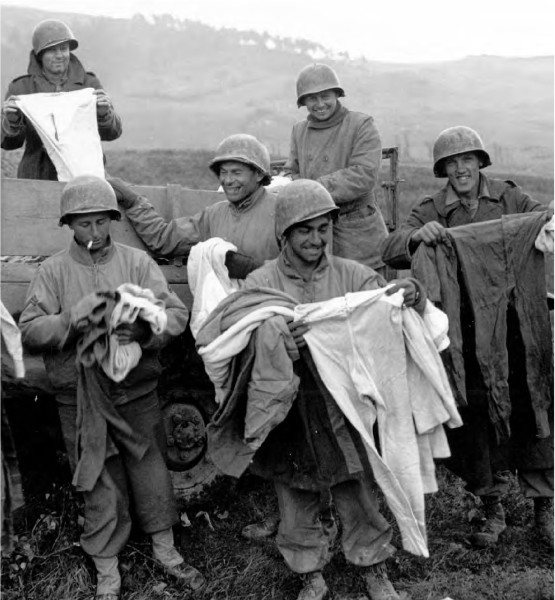
SOLDIERS IN THE APENNINES receiving an issue of woolen underwear, September 1944. Some of the peaks in the northern Apennines rise to well over 5,000 feet and the weather is unpleasantly cold in winter. Fall rains, often turning to sleet, start in September and the higher peaks are usually snow-covered by late October. Highway 65, the main axis of advance, runs mostly on top of the mountain ridges. Here the cold is particularly severe. There is nothing to break the winter winds and part of the road is so high that it is often cloud-covered.
ITALY
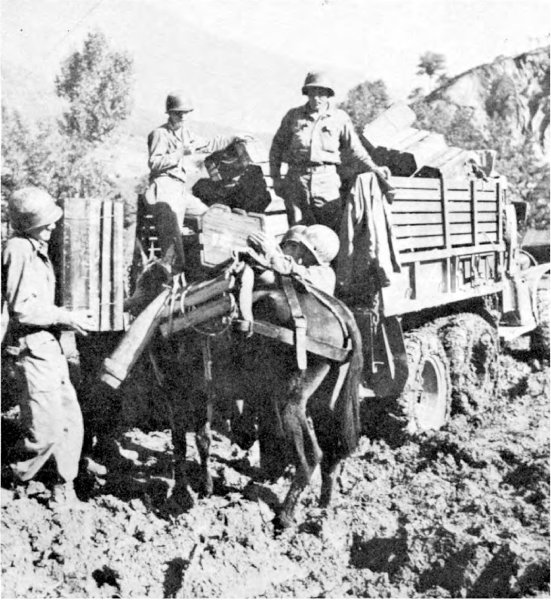
LOADING MULES WITH AMMUNITION for 155-mm. howitzers in the Castel del Rio area on Highway 6524, between Firenzuola and the town of Imola in the Po Valley. After breaching the Gothic Line at Il Giogo Pass an attempt to reach the Po Valley at Imola was made along the route above. Because of the exposed salient and stiff enemy resistance, the axis of attack was changed to Highway 65. On 1 October, the day the picture was made, bloody fighting for possession of the controlling height of Monte Battaglia, east of Castel del Rio, was in progress.
ITALY
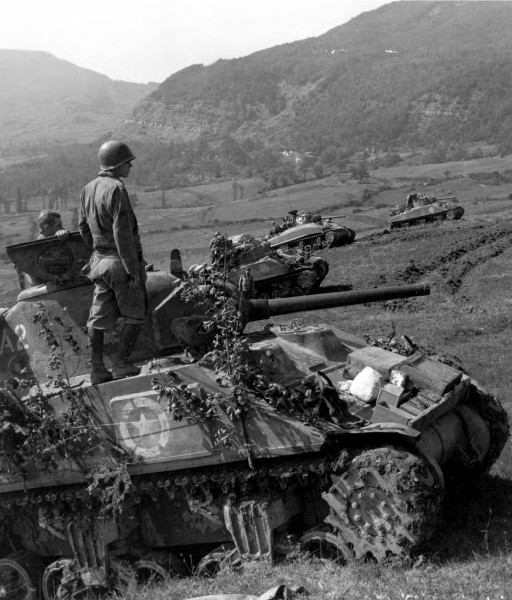
A TANK BATTALION PREPARING TO ATTACK along Highway 65 toward the village of Monghidoro. The attack started on the morning of 1 October and by evening of the 2d the village was securely in Allied hands. The Sherman tanks pictured here are all armed with 76-mm. guns.
ITALY
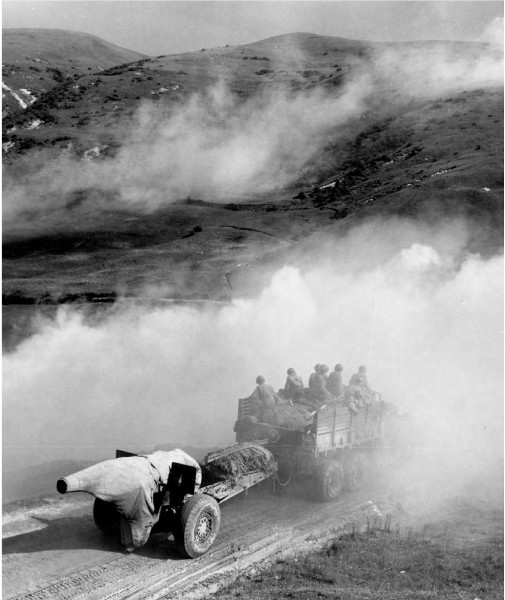
TRUCK TOWING HOWITZER along Highway 65 during the beginning of the 1 October drive. Smoke is from M2 smoke generators. (6-ton truck; 155-mm. howitzer.)
ITALY
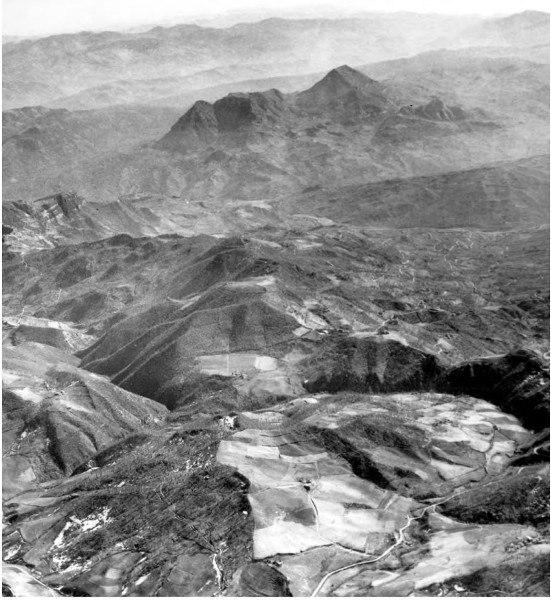
TERRAIN OF THE WINTER STALEMATE in the northern Apennines, looking toward the southeast. The high mountain peak in distance is Monte Vigese. This mountain was taken by the South Africans of the Fifth Army on 6 October 1944 after a three-day fight. The territory in the foreground was in enemy hands until the beginning of March 1945 when it was taken by American and Brazilian troops in a limited offensive to obtain better jumping off places for the main attack toward the Po Valley.
ITALY
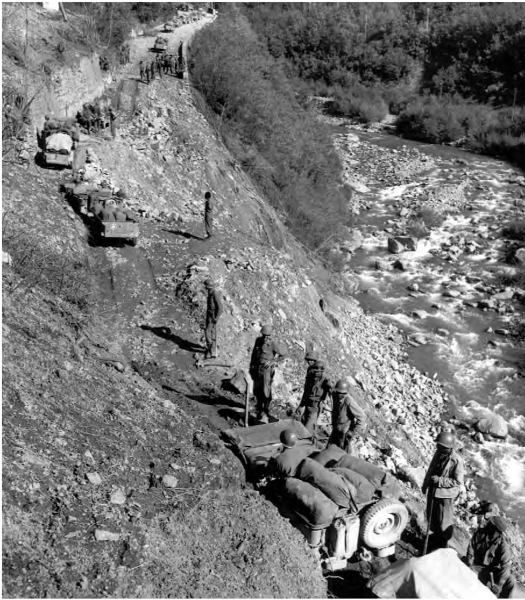
NEGRO TROOPS ADVANCING ON HIGHWAY 12 along the Torrente Lima. Jeeps with trailers were used and in danger areas the windshields were folded forward and covered with canvas to prevent light reflection. The sort of road demolition shown was common during the fighting in the northern Apennines. Valley roads were subject to natural landslides, and large-scale destruction was easy to accomplish.
ITALY
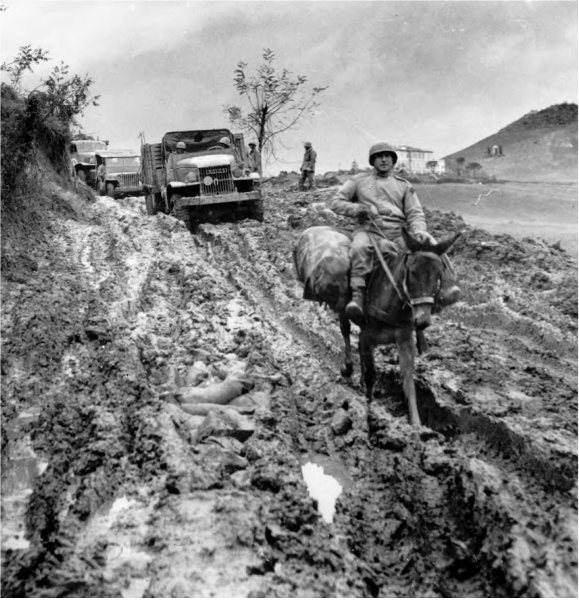
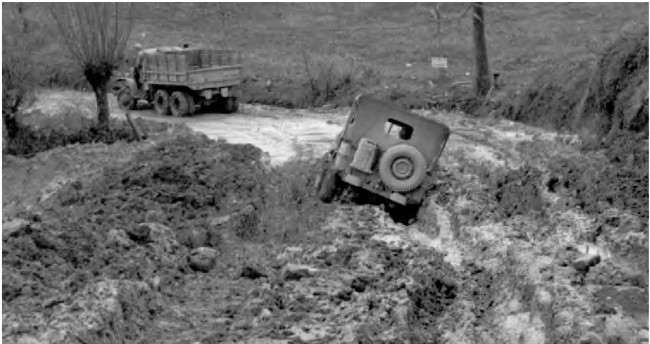
ROAD IN THE APENNINES during the October drive. After the first week, weather was a contributing factor to the slow pace of the offensive. Rainy and foggy days worked almost entirely to the benefit of the enemy. Artillery observation planes were grounded and few of the planned air missions could be flown. Finally, with each mile that the troops advanced over the rain-soaked trails and dirt roads, the problem of keeping supplies moving forward increased. Engineers kept working night and day pouring gravel and crushed rock on the roads. They managed to keep highways open for all types of vehicles and side roads passable for the four-wheel-drive jeep and the powerful 2½-ton truck. (Jeep; 2½-ton truck.)
ITALY
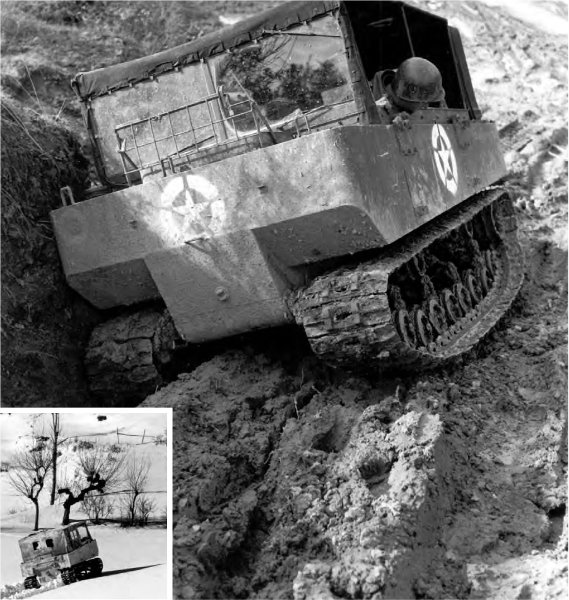
THE WEASEL, officially cargo carrier M29, came into its own during the campaign in the northern Apennines. It operated satisfactorily off the roads under mud or snow conditions and helped to provide lateral communications. Most roads in the Fifth Army sector of the Apennines ran more or less parallel in a northerly direction; the area of the winter fighting was almost completely devoid of east-west roads. The Weasel, originally designed for use over snow and ice, had low ground pressure and proved suitable for operation across fields or poor trails. It had a crew of two and a pay load of approximately 1,000 pounds.
ITALY
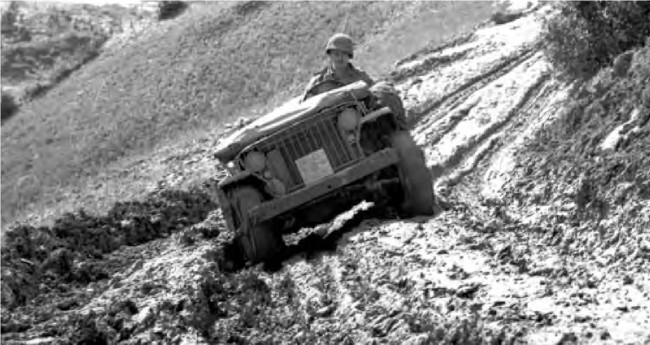
JEEPS ALONG THE SUPPLY ROADS in the northern Apennines. This vehicle was capable of operating over unimproved roads and trails and could be shifted into four-wheel drive for steep grades and muddy or sandy terrain. It could climb a 60 percent grade and attain a speed of 65 miles per hour over level highways. The jeep could also ford a stream 18 inches deep while fully loaded and a deeper stream when especially equipped with exhaust and air-intake extensions. The jeep, truck, and pack mule were always important in the advances made.
ITALY
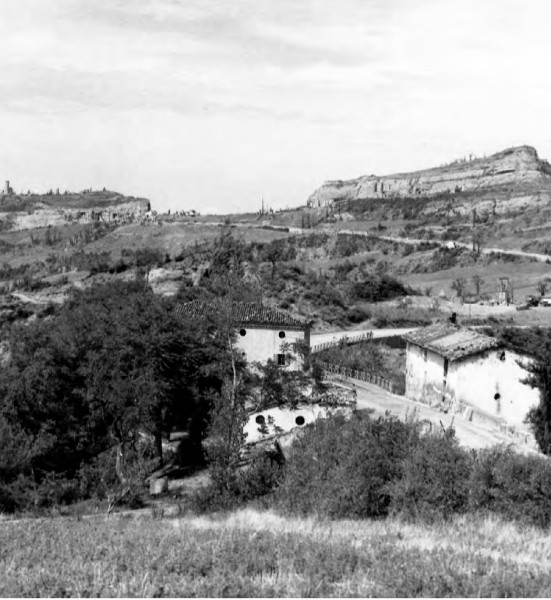
APPROACH TO LIVERGNANO ON HIGHWAY 65, looking from the south along the highway. The village is the small cluster of ruined houses below cliff on left. The Germans occupied the houses as well as the tops and sides of the two hills. The latter were honeycombed with caves which the enemy had enlarged and strengthened. The fighting lasted from 9 to 14 October. On the 14th the enemy was still in possession of most of the village and the two hills but retreated because he had been outflanked from the west.
ITALY
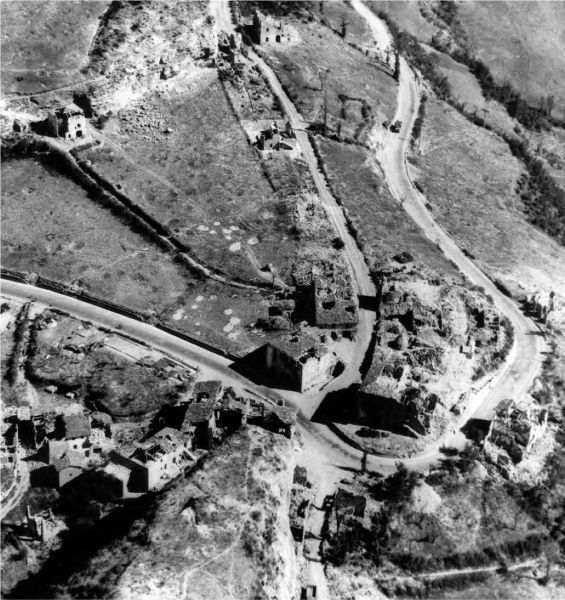
THE RUINS OF LIVERGNANO. The main highway through the village runs to Florence (upper right), and to Bologna (center left). Livergnano, taken in a five-day fight, became known as “Liver and Onions.” During the final attack of this fall offensive toward Bologna, which started on 16 October and bogged down in mud toward the end of the month, the enemy concentrated his artillery fire on this village in an attempt to demolish the houses along the road and thus block the highway, the supply road for the area. The enemy managed to knock down some of the houses but did not succeed in stopping traffic. Bulldozers filled the craters in the road and pushed aside the rubble.
ITALY
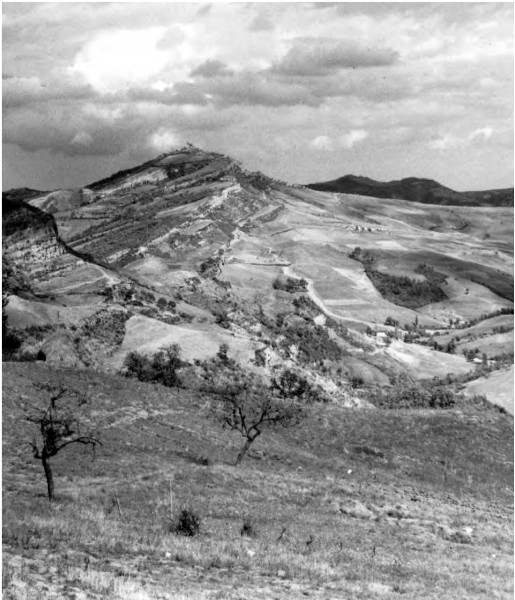
MONTE BELLA FORMICHE, taken after a three-day fight starting on 10 October. This mountain, located east of Highway 65, is 2,092 feet high, the highest of the terrain features in the chain of enemy defenses stretching east and west across Highway 65 through the village of Livergnano.
ITALY
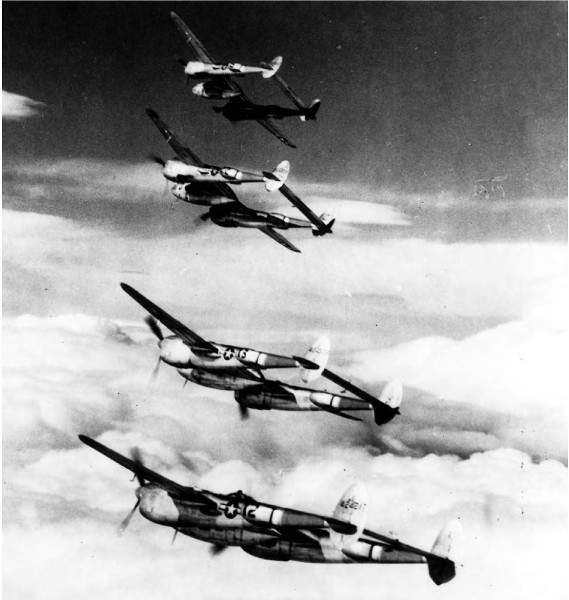
LIGHTNING FIGHTERS. This twin-engined fighter was the first successful long-range bomber escort developed by the United States. Most Allied fighter planes in Italy gradually came to be used as fighter-bombers as the need for protecting bomber formations from hostile aircraft diminished. In August 1943 the Germans had only about six hundred combat aircraft, mostly fighters, in Italy. About a third of these were of limited use. Demands for fighters on the Russian front and the need for protecting production centers in Germany from Allied bombings caused some withdrawal of enemy fighters based in Italy. (P-38.)
ITALY
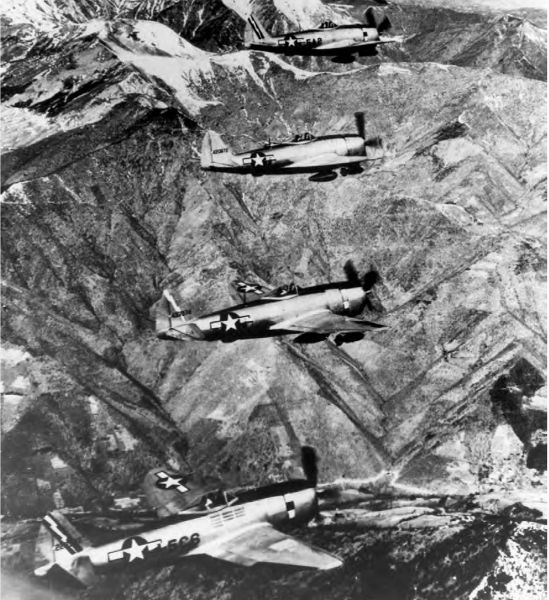
THUNDERBOLT FIGHTER-BOMBERS over the northern Apennines. Note belly tank to increase range, and bombs under wings. Beginning in October 1944, extensive use of the 110-gallon fuel tank incendiary bombs containing a jelly-like mixture called napalm was made for the first time on the Italian front. The bombs proved particularly effective against enemy bivouacs and troop installations in wooded areas where the highly inflammable fuel, scattered over a wide area, could start numerous fires. Fighter-bombers co-operated closely with the ground forces. (P-47.)
ITALY
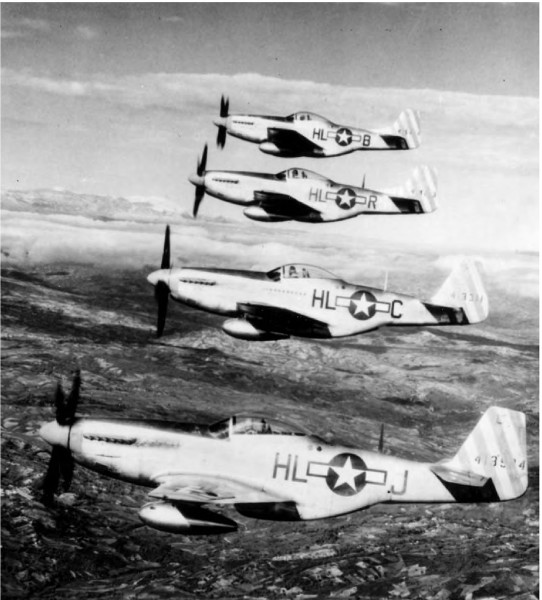
MUSTANG FIGHTERS. This plane, the P-51, was originally made for the British and was used by the Royal Air Force as early as November 1941. The Army Air Forces started to use it in July 1942. The A-36 version of the P-51 was a fighter-bomber, and except for diving brakes and differences in armament, the two ships were alike. With the addition of wing tanks the P-51 became a long-range fighter used to escort bombers.
ITALY
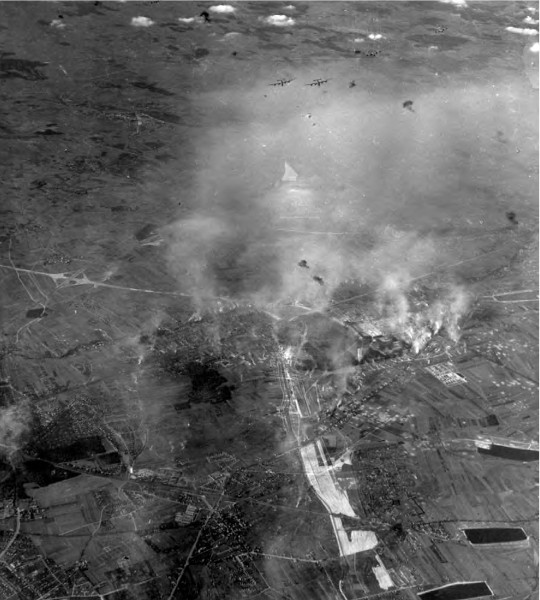
LIBERATOR BOMBERS from Italian bases bombing the Munich area in southern Germany. Smoke-making generators in operation to blanket vital areas. Note black bursts of antiaircraft fare. Heavy bombers from Foggia could easily strike at the passes in the Alps and attack enemy installations and factories in southern Germany and Austria as these targets were closer to Allied bases in Italy than they were to those in England.
ITALY
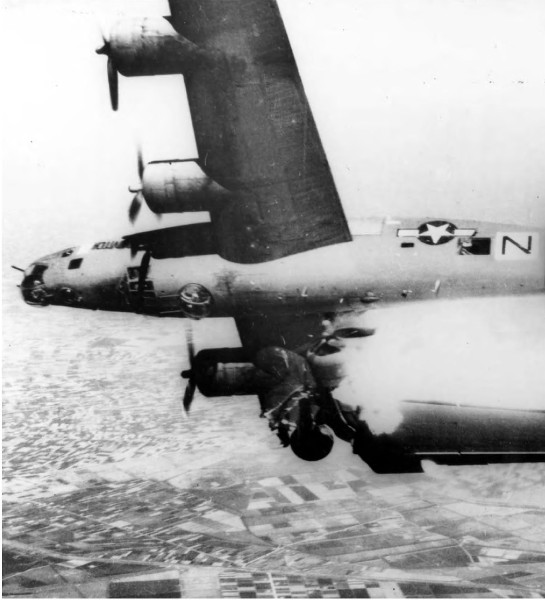
LIBERATOR BEING SHOT DOWN by flak over the Po Valley in northern Italy. As the war in the Mediterranean progressed the size and effectiveness of the enemy air forces decreased, while the antiaircraft defenses increased and became more and more concentrated around the remaining enemy targets. As various enemy targets were damaged beyond usefulness, antiaircraft units defending them were sent to strengthen defenses around industrial plants still in production.
ITALY
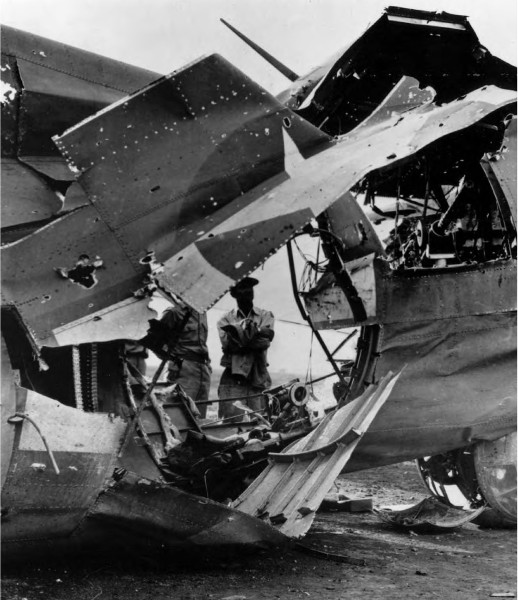
FLAK-DAMAGED FUSELAGE OF A FLYING FORTRESS. This plane received a direct antiaircraft shell hit while on a mission over Hungary but managed to fly back to Italy where it collapsed on landing. In spite of damage to the bomber none of the crew was hurt.
ITALY
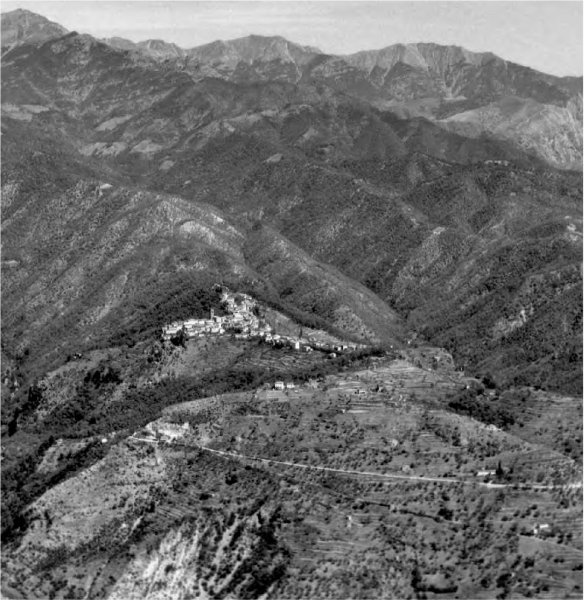
COREGLIA ANTELMINELLI in the mountains west of the Serchio River. This region was being held by an American Negro infantry division. On the morning of 26 December 1944 a mixed enemy force of Germans and Italians started an attack in this vicinity and pushed the division back several miles. An Indian brigade was rushed up to halt the advance of the enemy. Since it was feared that the enemy might break through and threaten the Allied supply base at Leghorn, reinforcements were rushed to the area to protect the vital base. On the night of the 27th the Indians made contact with the enemy who started to retreat. By 31 December almost all the lost territory had been regained and the line was again stabilized.
ITALY
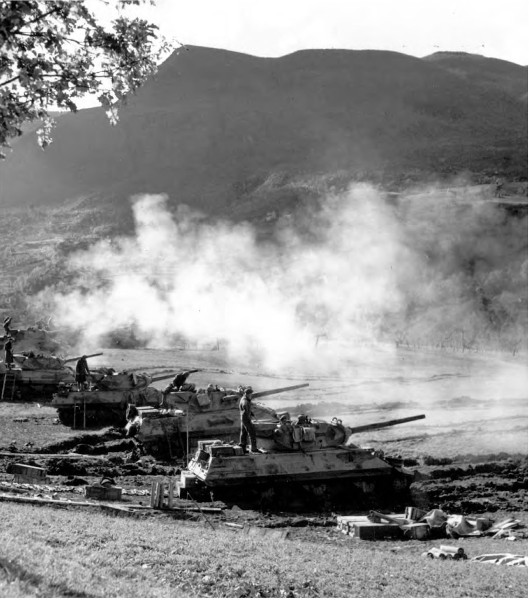
A SOUTH AFRICAN ARMORED UNIT in the Reno River valley firing at German positions across the river, November 1944. Combat action in the Fifth Army sector during November and the first half of December was largely confined to patrol activities and artillery duels. The South African armored division had been transferred from the Eighth Army to the Fifth Army in late August 1944.
ITALY
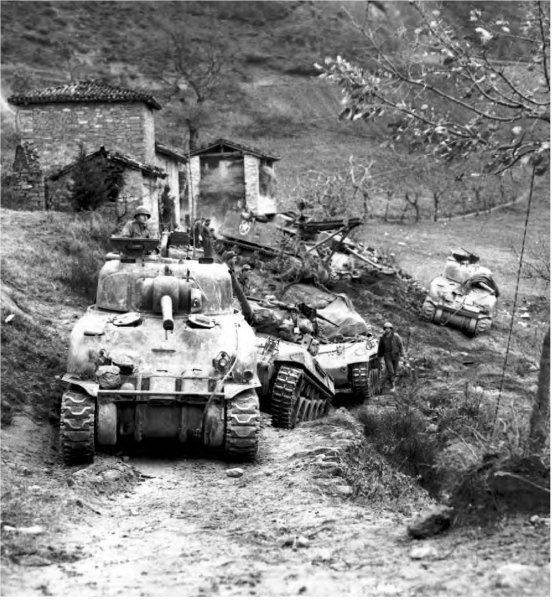
TANK MAINTENANCE POST in abandoned Italian farmhouse. During the long winter stalemate time was utilized to make major repairs on armored vehicles. Minor repairs, such as thrown tracks, were made at forward maintenance posts such as the above which was located only about 400 yards behind the front lines. (1, medium tank M4A1; 2 and 3, 76-mm. gun motor carriage M18; 4, medium tank M4A1; 5, medium tank M4, with 76-mm. gun (note different gun mount); 6, tank recovery vehicle M31.)
ITALY
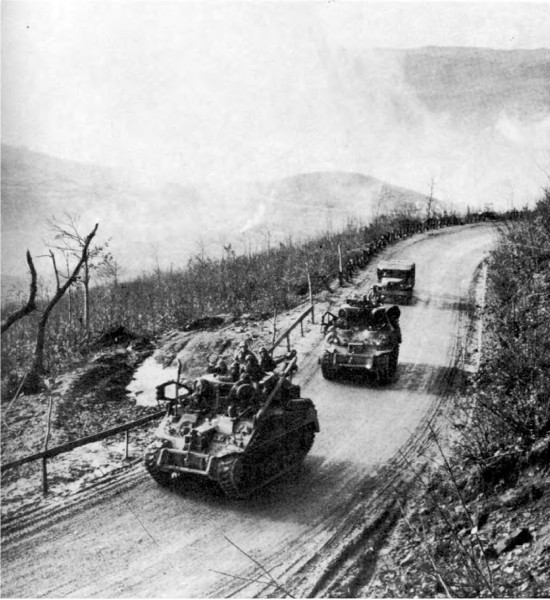
MOBILE FIELD ARTILLERY MAINTENANCE UNIT near the front. These units were used a great deal during the winter. Artillery off the main roads could be moved only with difficulty after the rains started and repairs that were normally made in shops behind the front had to be done in the field. The first two vehicles shown above are tank recovery vehicles M32, and are modifications of the M4 designed primarily for recovery of tanks from battlefields. The fixed turret replaces the customary tank turret. Third vehicle is weapons carrier, ¾-ton 4 x 4 truck.
ITALY
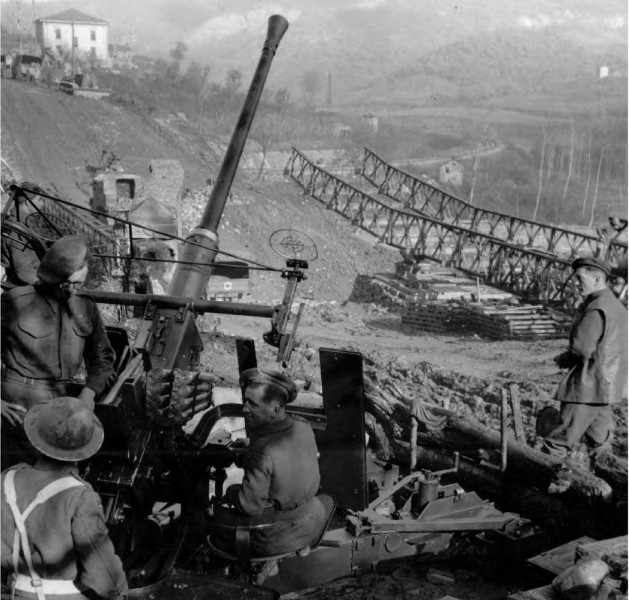
BRITISH ANTIAIRCRAFT GUNNERS protecting U. S. engineers constructing a Bailey bridge on Highway 64 crossing the Reno River. This was in preparation for an attack on Monte Belvedere west of the highway. The 3,600-foot mountain was taken on 24 November 1944 by elements of a U. S. Negro infantry regiment and members of British and U. S. antiaircraft units serving as infantry. The enemy counterattacked for five days and the Allies had to give up the position. During the fall and winter of 1944 most U. S. and British antiaircraft units were being trained for infantry duty as rapidly as training and the issuance of appropriate weapons would permit. (The gun shown is the 40-mm. automatic antiaircraft type, originally made in Sweden and used by the Allies and the enemy. The gun could be towed at 50 miles per hour and transferred from traveling to firing position in 25 seconds.)
ITALY
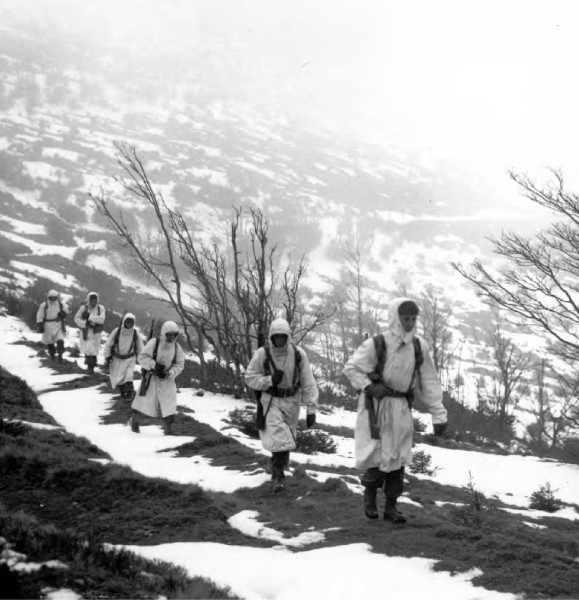
PATROL ACTIVITY, December 1944. During the relatively quiet period of the first half of December, both sides sent patrols to probe the front lines and bring back prisoners. When the cold weather set in, winter clothing was issued, including the reversible, hooded coat known as the parka shown above. One side was the conventional olive drab, the other side white for camouflage in snow. New type shoepacs, combination wool sweaters and cotton field jackets, and sleeping bags left the troops better prepared for inclement weather than they were during the previous winter, but there would be no possibility of keeping dry at the front during an attack when the rain lasted for days on end.
ITALY
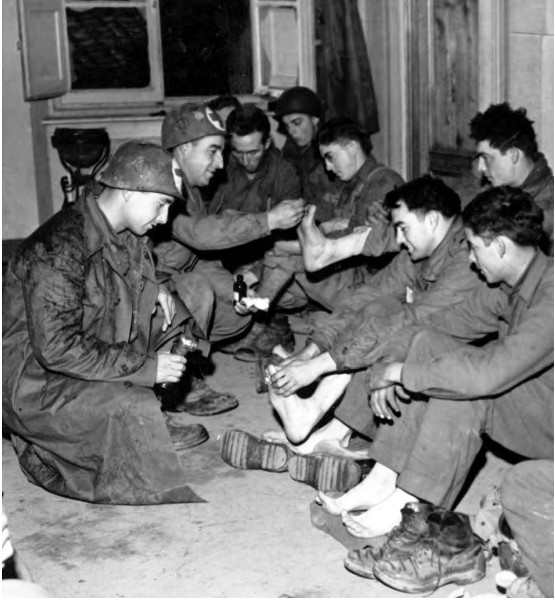
INSPECTING FRONT-LINE TROOPS FOR TRENCH FOOT. The second winter of fighting in Italy found the Allies better equipped to handle the trench foot problem which in November 1943 accounted for 20 percent of the casualties at its peak incidence. Units were gradually being equipped with shoepacs, an important item in the prevention of trench foot. The shoepac consisted of a moccasin-shaped foot of rubber, and a laced, waterproofed leather top, which extended well up the calf of the leg. It was worn with felt inner soles or woolen ski socks.
ITALY
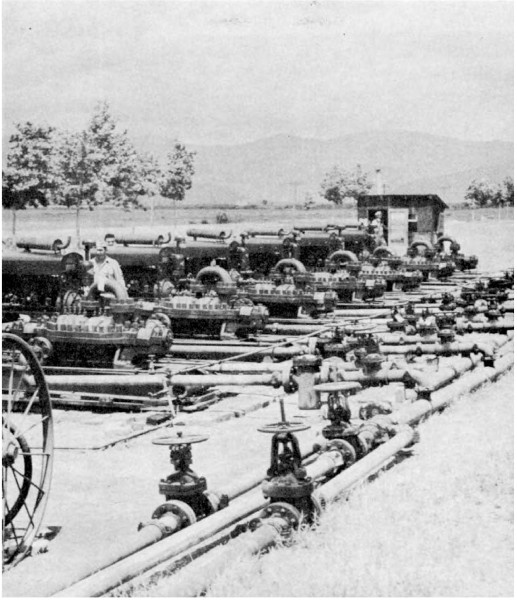
PIPELINE PUMPING STATION AT LEGHORN. Construction of this line started soon after the capture of the port. By 23 November 1944 the pipeline had reached Highway 65 just a few miles behind the front, eliminating the trucking of gasoline over this already overcrowded road.
ITALY
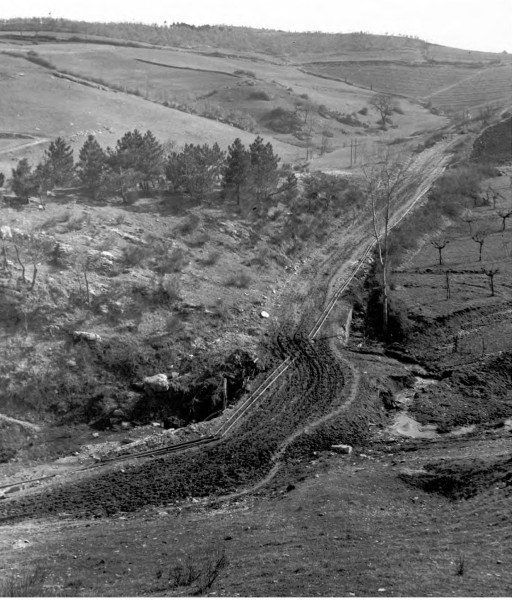
DOUBLE PIPELINE which carried gasoline from the port of Leghorn to the army front in the Apennines. “Pipeline walking” to inspect for leakage was done by jeep whenever possible. Because of hilly terrain several booster pumping stations were necessary. (4-inch double pipeline.)
ITALY
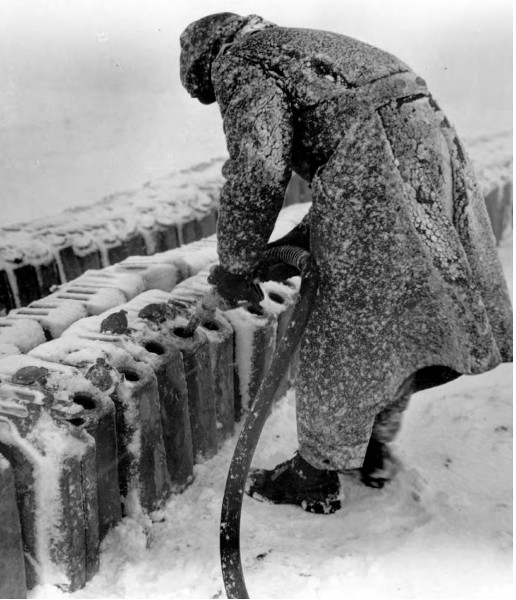
FILLING CANS WITH GASOLINE at the Raticosa Pass on Highway 65, terminal of the pipeline from Leghorn. These cans were picked up by truck and distributed to individual units. As the front moved, the pipeline was extended to keep up with the troops. (Five-gallon gasoline cans.)
ITALY
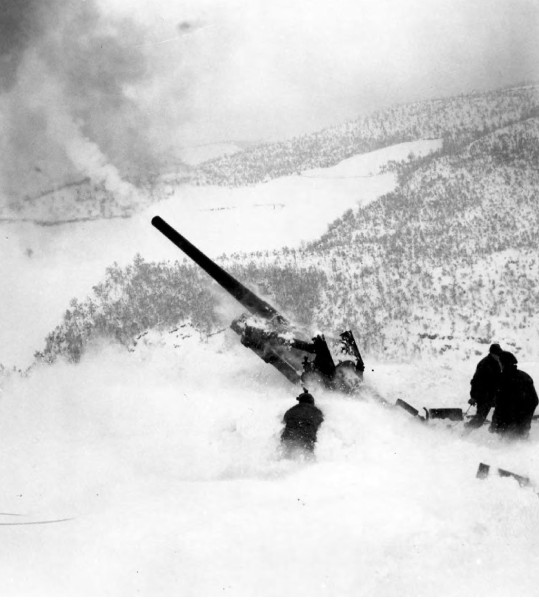
MEMBERS OF A SOUTH AFRICAN UNIT firing a Long Tom. This unit was stationed along Highway 64. During the winter of 1944–45 the U. S. Fifth Army roster included Brazilians, South Africans, British, and Italians as well as U. S. white and Negro troops, while the British Eighth Army along the east side of the peninsula contained New Zealanders, Canadians, Poles, Indians, Italians, and Jewish troops from Palestine in addition to United Kingdom units.
ITALY
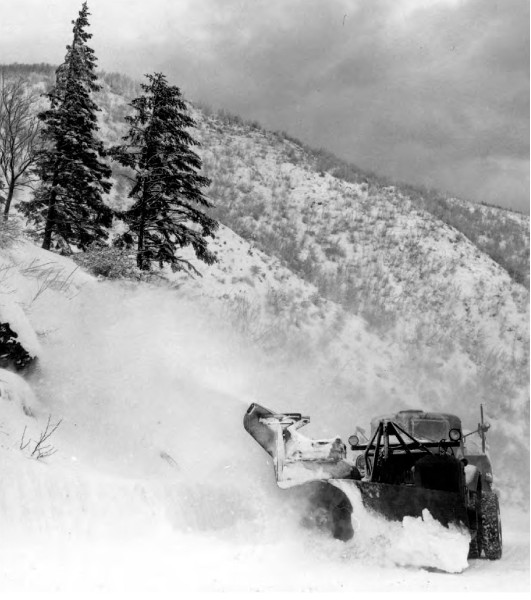
TRUCK WITH ROTARY SNOWPLOW clearing Highway 64 near Collina. The first snow fell in the mountains on 11 November. Snow, rain, sleet, and ice-coated curves on the roads leading to the front made the supply situation a difficult one. The constant work by snowplows and the hand labor of thousands of soldiers and Italian civilians kept the main roads open throughout the winter.
ITALY
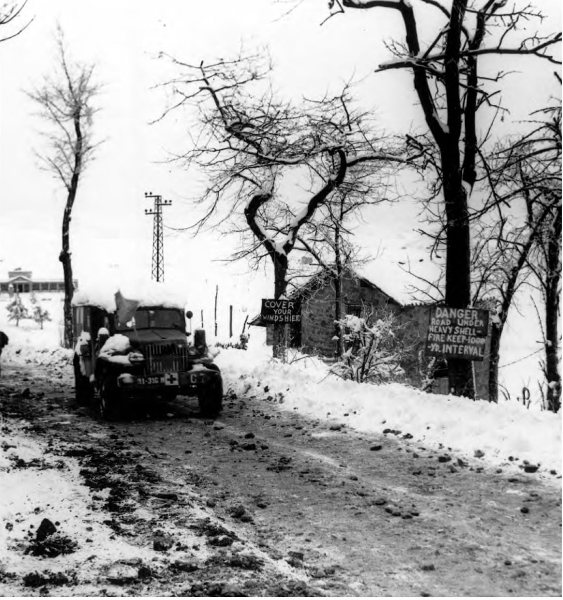
AMBULANCE EVACUATING WOUNDED from the front lines near Highway 65, between Loiano and Livergnano. The flow of wounded from the battlefield was carefully controlled. Evacuation hospitals were kept as free of patients as possible, thereby affording immediate facilities for the most urgent cases. It was found desirable in daylight hours to direct the main stream of casualties to hospitals located farther in the rear, while during the night most of the patients were brought to the forward hospital units in order to reduce the delay caused by blackout ambulance driving over icy roads. (¾-ton 4 x 4 ambulance.)
ITALY
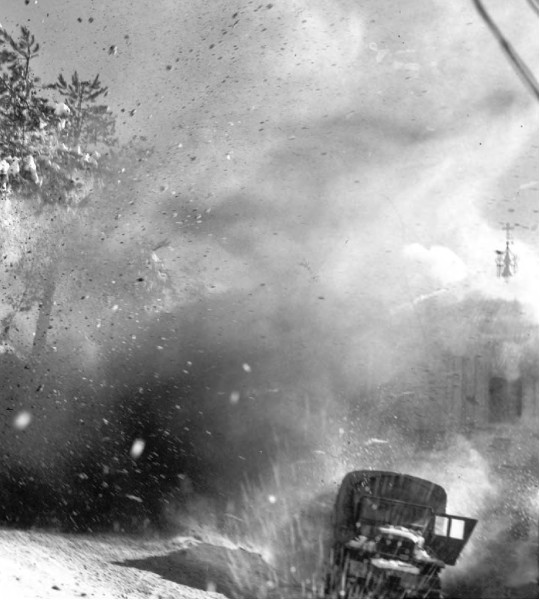
TRUCK ON HIGHWAY 65 near Loiano receives near miss, January 1945. This highway had been the main axis of advance during the October offensive in the U. S. sector and was the only good road in this area. During the winter stalemate and build-up for the spring offensive, a period of about five months, this road was under observed enemy artillery fire directed from Monte Adone, a commanding position between Highways 64 and 65.
ITALY
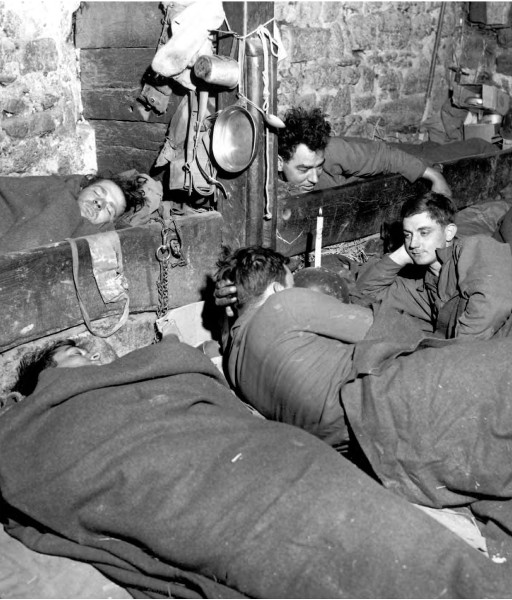
MEN RESTING IN THEIR QUARTERS in an old barn after a day in foxholes at the front. During cold weather, winterization of living quarters was carried out on a large scale, although men in the extreme forward positions usually had to improvise with a raincoat and a blanket in a foxhole.
ITALY
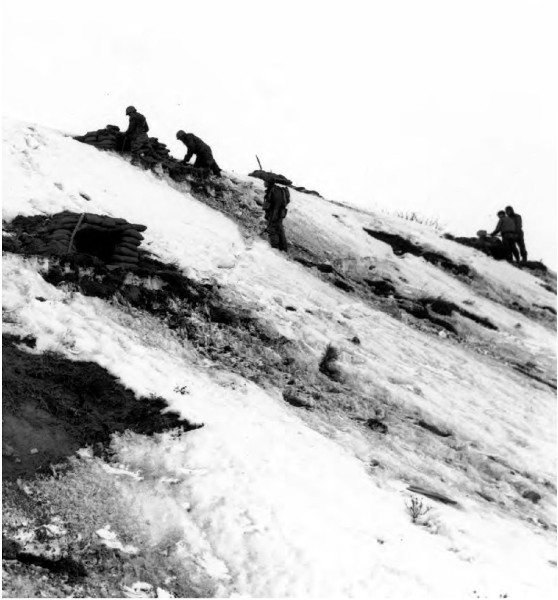
TROOPS IN A DEFENSE POSITION near Highway 65. This area was thinly populated and houses were few and far between. Those still standing drew fire, and troops in support or reserve positions would dig in on the reverse slope of hills and make their foxholes as comfortable as possible. Roofs and walls were constructed from empty shell cases, food containers, and the like and reinforced with sand bags. Keeping warm was a problem: the area is almost bare of trees; most of the heating of the foxholes was done by gasoline stoves, sometimes issued, often improvised.
ITALY
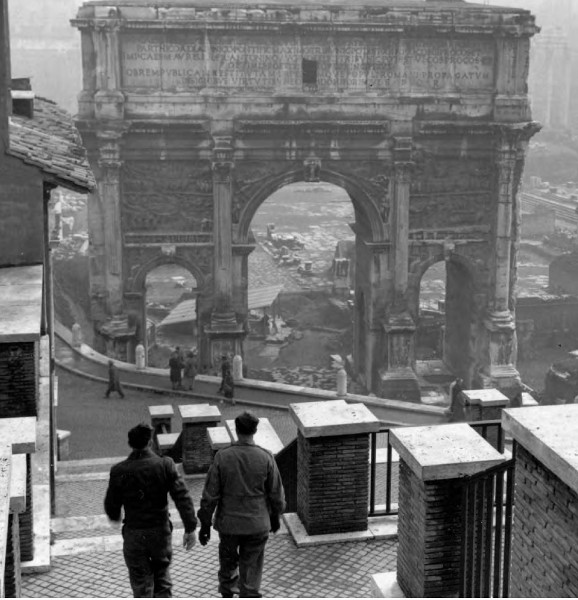
SOLDIERS AT THE ROMAN FORUM during a rest and recreation period away from the front. The rest-center idea, which had proved highly successful during the winter fighting of 1943–44, was carried out on a much larger scale in Rome and in the cities of the Arno Valley in the fall and winter of 1944–45. Hundreds of thousands of troops were rotated through the rest and leave centers set up under military supervision to provide a place of relaxation where men could forget the rigors and dangers of the front line, sleep in beds, take baths, visit places of historic interest, and generally indulge in the pleasures and entertainment of civilization, if only for a brief period.
ITALY
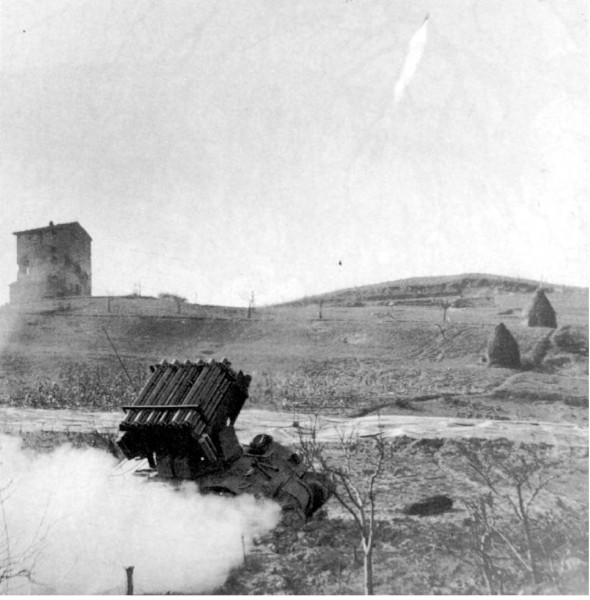
FIRING ROCKET PROJECTILES from a tank mount. Experiments were carried out in January 1945 in the Arno Valley. Of the several different mounts tested, one had 54 tubes placed on top of a medium tank turret, another had 18 tubes mounted on the same carriage as a towed 37-mm. gun. Because of the great variation in deflection and range the weapon was not practical against a point target and the smoke and flame given off when fired tended to disclose its position. It proved effective for a heavy concentration over a wide area for a short period. The short range of the rocket, slightly less than 4,000 yards, was a limiting factor. (Each cluster of 3 magnesium tubes is a rocket launcher, aircraft M15, mounted on M17 (T40) modified rocket launcher frame. 4.5-inch rockets were used.)
ITALY
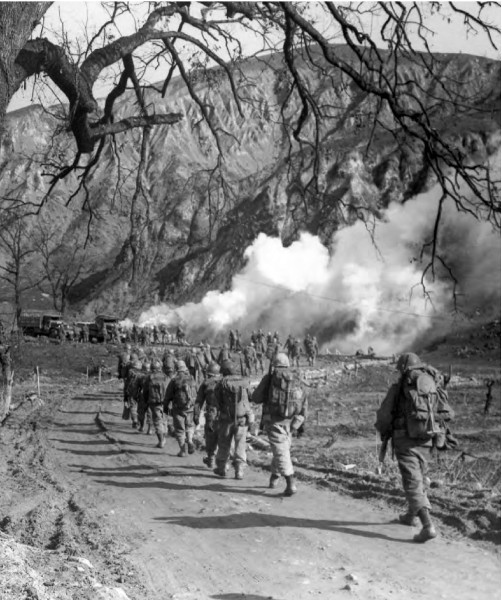
AN INFANTRY COMPANY moves into the line under a smoke screen to relieve another company. During the five-month static period starting at the beginning of November 1944, rotation of units for rest and recreation was a regular procedure.
ITALY
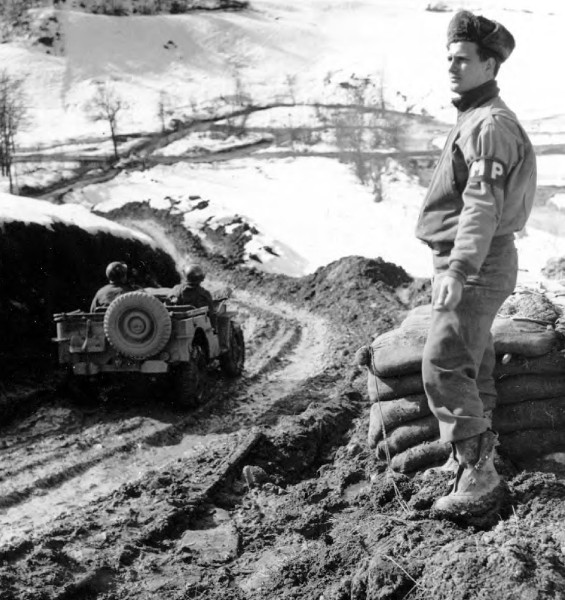
JEEP PASSING A TRAFFIC CONTROL POINT in the northern Apennines. Rigid supervision of transportation over the crowded mountain roads was necessary if proper supply was to be made, tactical movements carried out, and vehicles conserved. To accomplish this, traffic control points were set up. Road movement approval was required for all convoys of ten or more vehicles. The traffic posts also served as a check on unnecessary or unauthorized use of military vehicles. Military police operated “chain points” where vehicles going into the mountains were stopped and beyond which the use of chains was mandatory.
ITALY
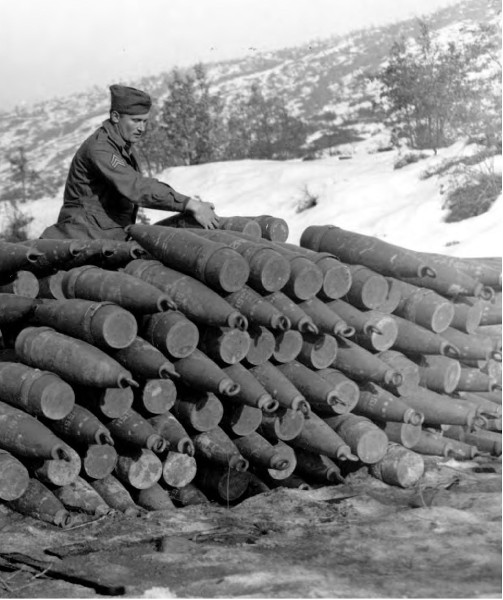
RESTACKING HOWITZER AMMUNITION. German air activity by this time was so slight that dumps a few miles behind the front were not camouflaged. (Ammunition for 155-mm. howitzer.)
ITALY
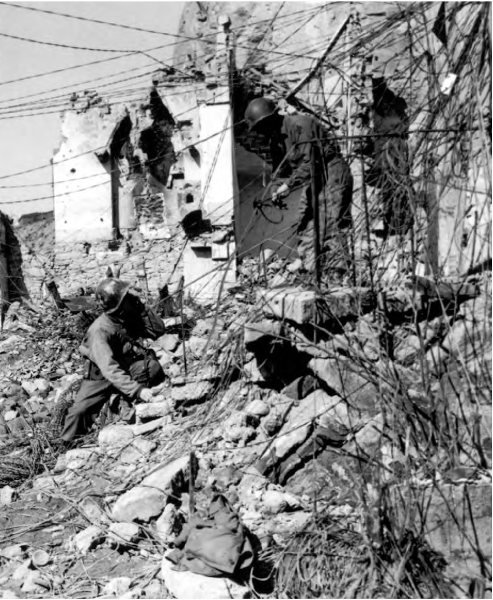
SIGNAL CORPS MEN checking wires outside the telephone exchange in a cave at Livergnano.
ITALY
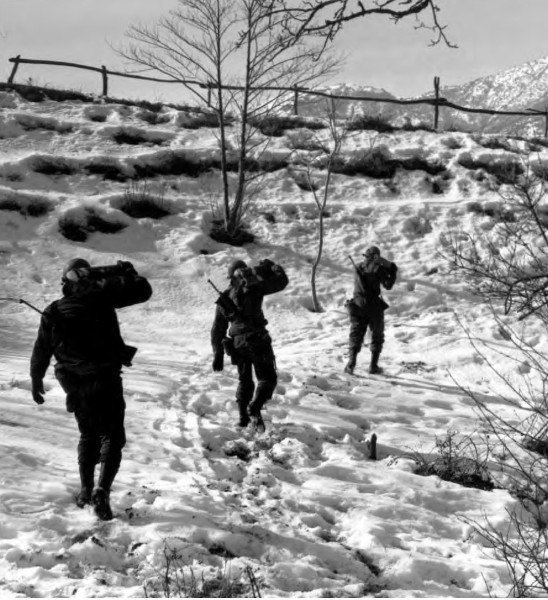
MAN CARRYING HOWITZER AMMUNITION to a battery high in the hills. These men were members of a division especially trained for mountain fighting. On 18 February 1945 this division, together with the Brazilian division under Fifth Army command, started an assault on German positions in the Monte Belvedere area west of Highway 64. The Monte Belvedere area dominated about ten miles of this highway. After severe fighting that lasted until 5 March 1945, the mountain mass was in Allied hands. (Ammunition for 75-mm. howitzer.)
ITALY
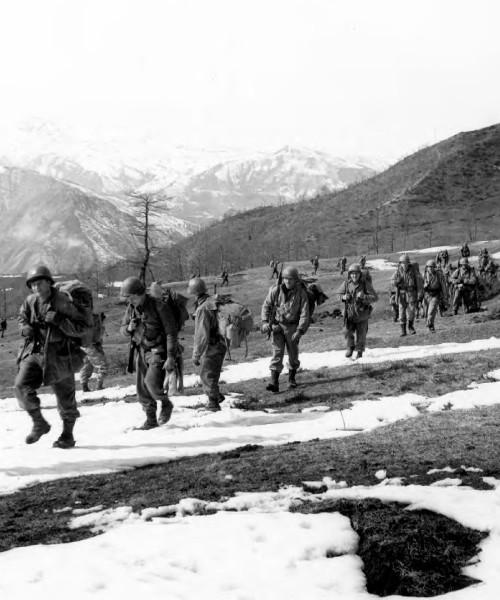
REINFORCEMENTS MOVE UP toward the fighting in the Monte Belvedere area. The men are equipped with M1 rifles and carbines, special shoes, and rucksack type pack.
ITALY
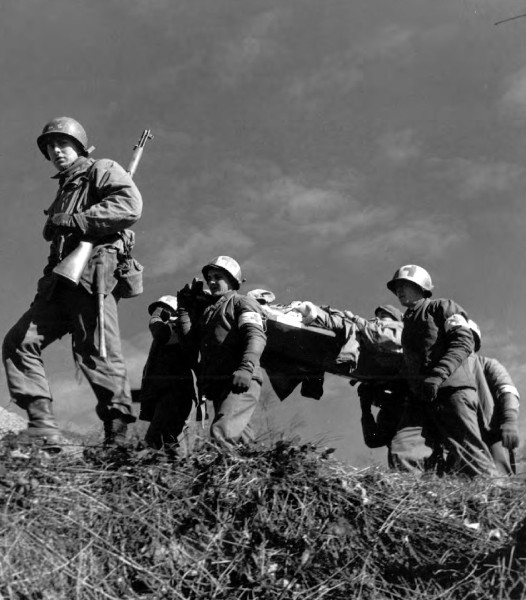
EVACUATING WOUNDED FROM MONTE BELVEDERE. As vehicles could not negotiate the mountain trails, stretcher bearers had to carry the wounded. Casualties from mines were numerous as the enemy had been in position on this dominating hill for several months and had mined and booby-trapped every likely avenue of approach as well as many of the farmhouses on the mountain slopes.
ITALY
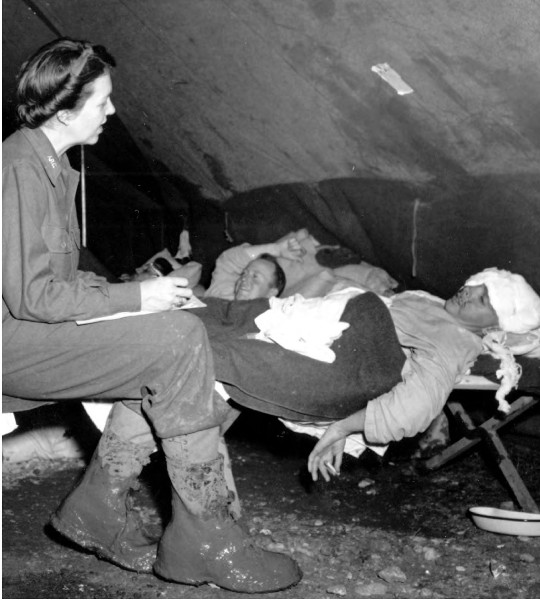
RED CROSS GIRL writing letter for wounded soldier. In addition to performing duties such as this, the American Red Cross operated clubs and motion picture theaters for the soldiers. The clubs served coffee, doughnuts, and ice cream, and sponsored musical programs, vaudeville shows, and dances. All was free of charge. The estimated attendance at the Red Cross clubs in the Arno Valley during February 1945 was 896,000.
ITALY
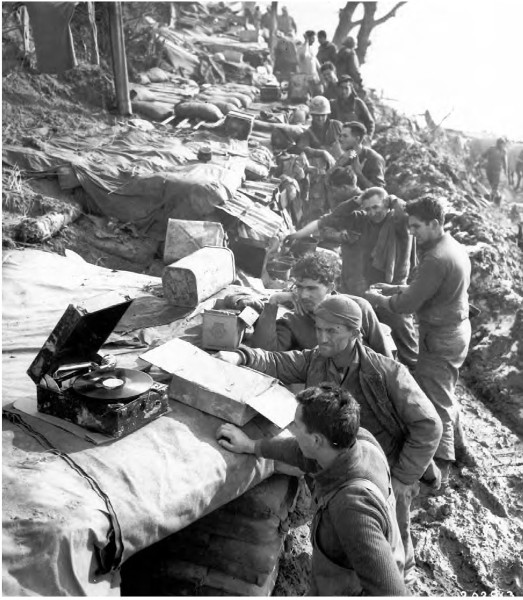
SOLDIERS DURING A LULL IN THE FIGHTING on Monte Grande which was taken on 20 October 1944 after a tough two-day fight. The city of Bologna was only about nine miles away and could be plainly seen from the summit. Because of its commanding position, the Germans made several local attacks during the winter to recapture the mountain but were repulsed each time.
ITALY
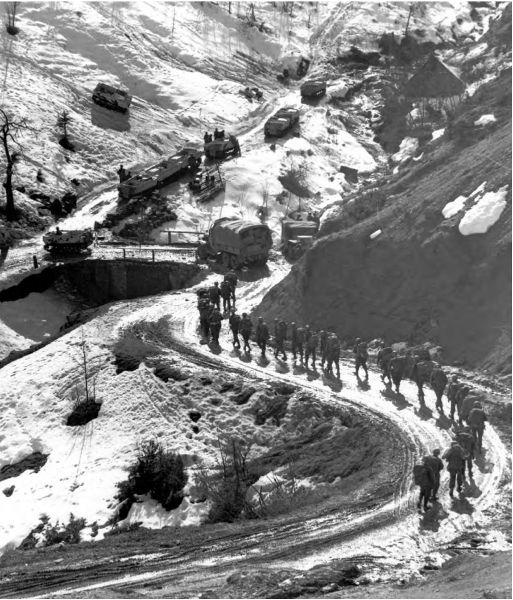
INFANTRY COLUMN passing a supply-transfer point in the Monte Grande area east of Highway 65, February 1945. Supplies were transferred from trucks to the tracked Weasels at this point. Higher in the mountains the mule pack train took over from the tracked vehicles.
ITALY
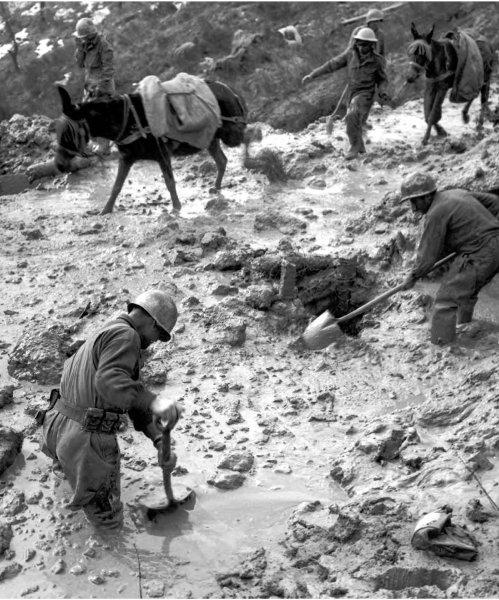
Members of an American Engineer Company working on a trail in the vicinity of Monte Grande. An Indian pack mule convoy is returning after taking supplies to the front line.
ITALY
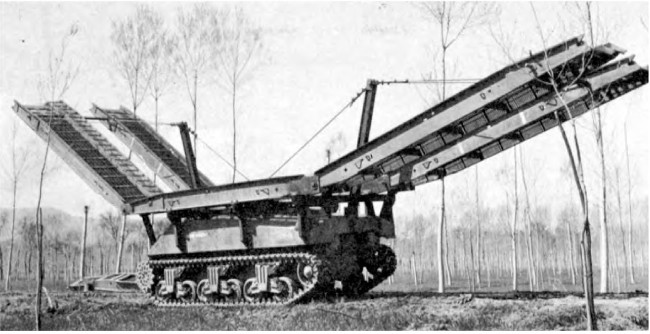
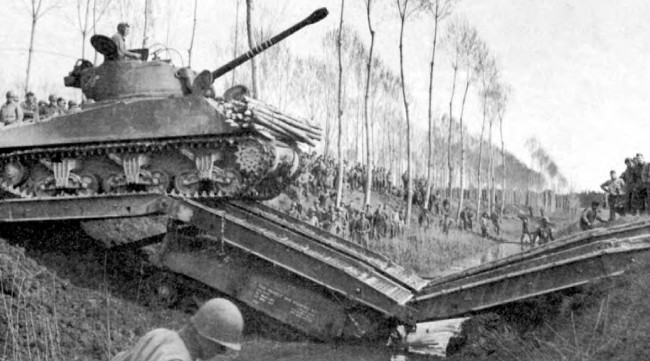
BRIDGING EQUIPMENT. “Ark” with end sections of treadway in raised position (top). Medium tank M4, crossing canal on Ark (bottom). With a total span of 54 feet, the treadway would span a canal about 45 feet wide. After November 1944, when the offensive in the mountains bogged down, most of the armor with the Fifth Army was gradually withdrawn to the Arno Valley where training for the spring offensive took place. New methods and techniques were developed and tried. The Ark above was constructed by an ordnance company for use in crossing canals in the Po Valley.
ITALY
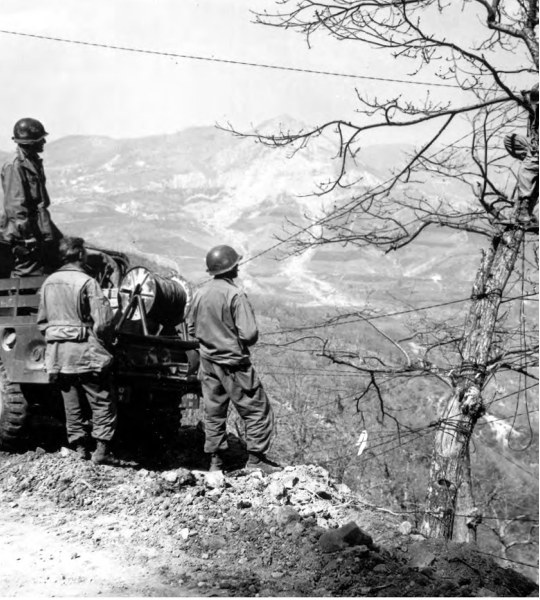
SIGNAL CORPS LINEMEN stringing communication wire in preparation for the coming spring offensive. During the winter stalemate many new lines were strung and hookups were made to the Italian state underground cable system. Circuits linked all units of the Fifth Army and an eight-mile line containing eight open-wire circuits was started in February 1945 from Filigare on Highway 65 near Monghidoro to the village of Lagaro Highway 6620.
ITALY
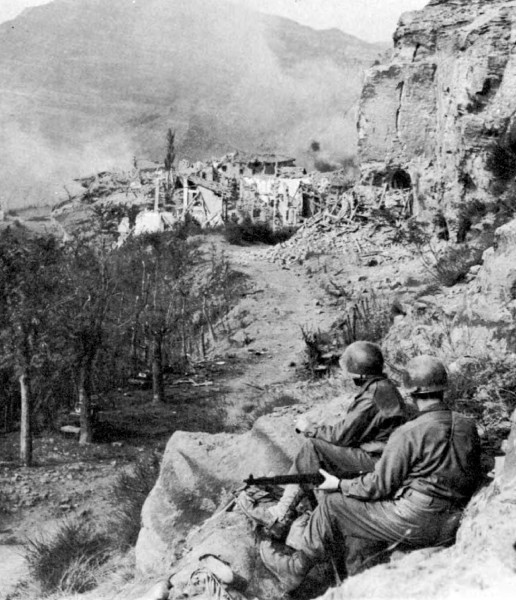
SOLDIERS IN LIVERGNANO watch the shelling of the village by the enemy, March 1945. Livergnano was taken on 14 October 1944 after a five-day fight along Highway 65 in an attempt to break through into the Po Valley. The advance was halted a few miles beyond this village. (Garand M1, .30-caliber rifle.)
ITALY
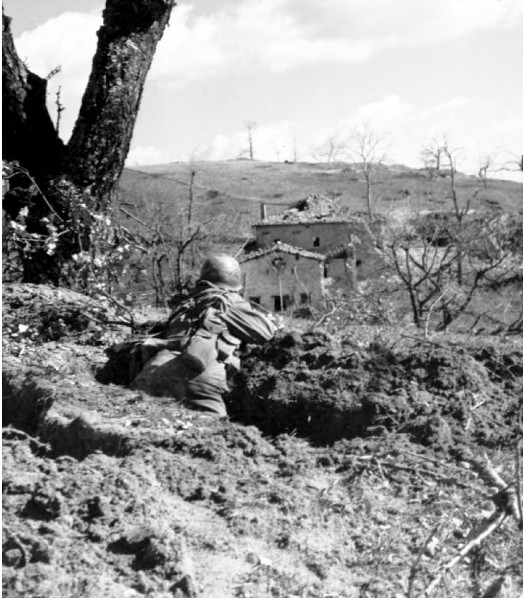
INFANTRY ACTION during the attack toward Monte della Spe. The soldier in the foreground is covering the house with his rifle while the other members of his squad approach it. A few minutes after this picture was made the house and the knoll behind it were taken, netting 57 German prisoners. Monte della Spe, west of Highway 64, was taken on 5 March 1945.
ITALY
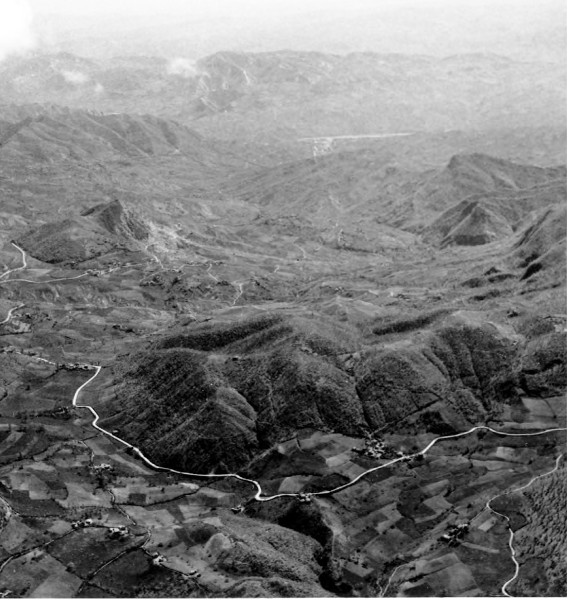
MONTE DELLA SPE AREA, looking toward the east. Highway 64 parallels the Reno River (in distance). The village of Vergato is shown on the west bank of the river. Monte della Spe is the rounded hill in foreground. It was taken on 5 March 1945 during an attack to secure a suitable jumping off place for the spring offensive. Vergato, which was an enemy strong point, and most of the surrounding territory remained in enemy hands after the capture of Monte della Spe. The main offensive, the attack toward the Po Valley, started from here on 14 April 1945 and by the 20th Allied troops had broken into the valley.
ITALY
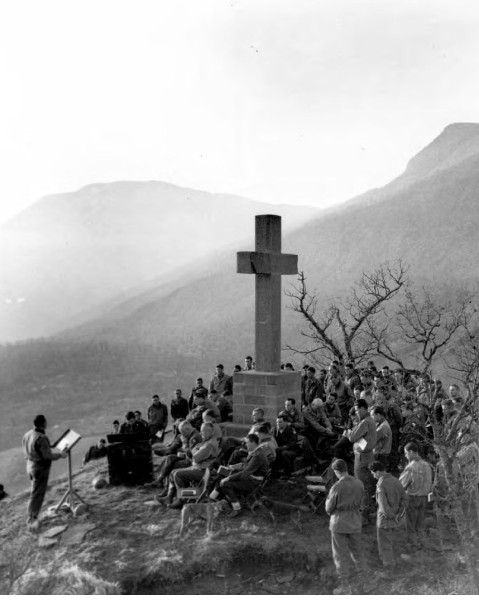
EASTER SERVICE 1 APRIL 1945.
ITALY
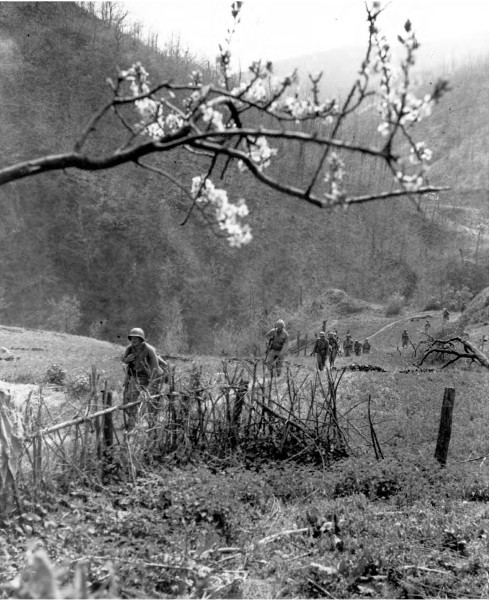
RETURNING PATROL. As the spring offensive became imminent, patrol activities increased.
ITALY
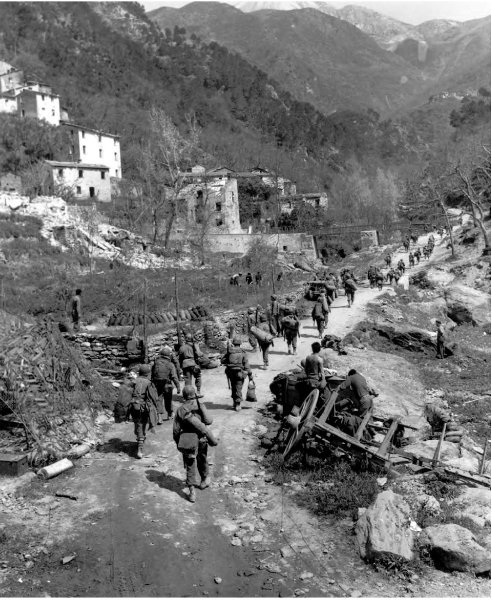
SOLDIERS MOVING UP into the line a few days before the start of the attack toward the Po Valley.
ITALY
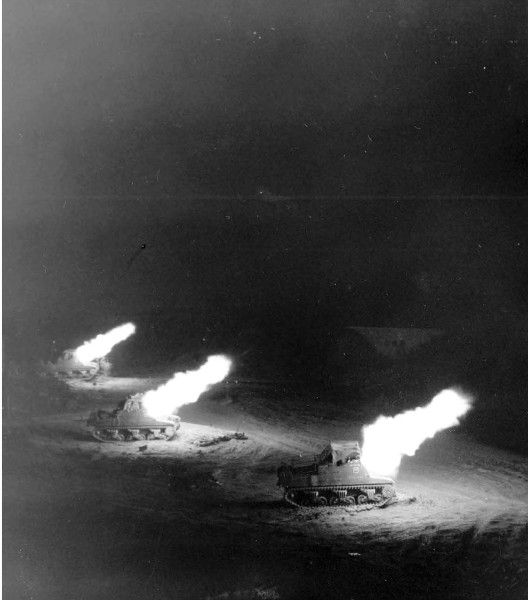
SELF-PROPELLED GUNS of a South African armored unit firing a mission a few days before the attack to break into the Po Valley. These vehicles are American Sherman tanks modified by the British as self-propelled guns. Prior to the jump-off, the units along the Fifth Army front had been engaged in a series of deceptive artillery fires.
ITALY
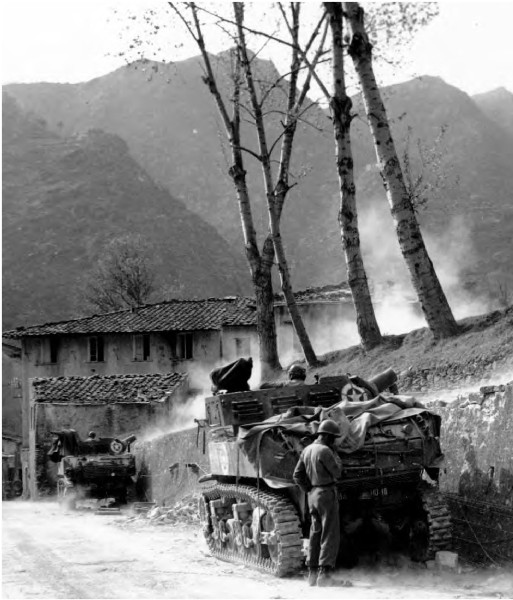
NEGRO SOLDIERS FIRING HOWITZERS in support of the Nisei who were making an attack northward along the mountain ridges toward the towns of Massa and Carrara. The attack started on 5 April 1945. The Nisei were American soldiers of Japanese ancestry. (75-mm. howitzers.)
ITALY
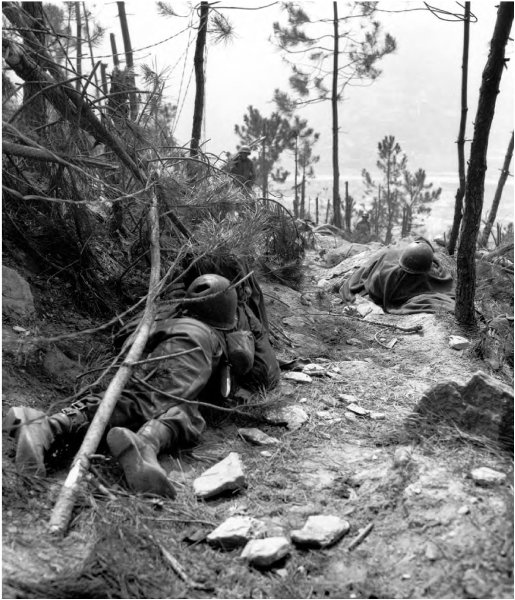
BODIES OF AMERICAN INFANTRYMEN killed during the opening of the spring offensive. Note stretcher bearer in background looking for casualties. The infantry was making an attack across the mountains toward Massa and Carrara on the west coast.
ITALY
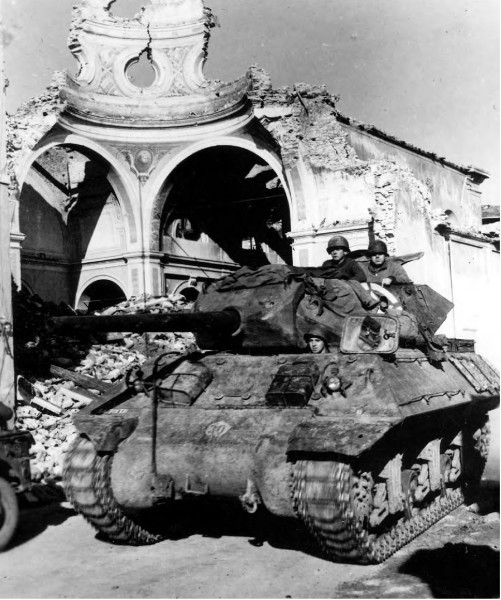
TANK DESTROYER speeding along Highway 1 through the town of Querceta during the spring offensive. The main effort of the army was along Highways 64 and 65.
ITALY
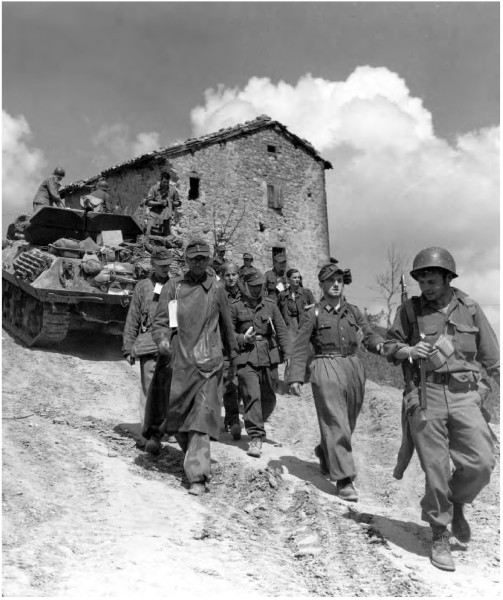
BRINGING IN THE FIRST PRISONERS taken at the start of the main drive to reach the Po Valley. On 14 April at 0945 the offensive was started by U. S. mountain troops in the hills west of Vergato on Highway 64.
ITALY
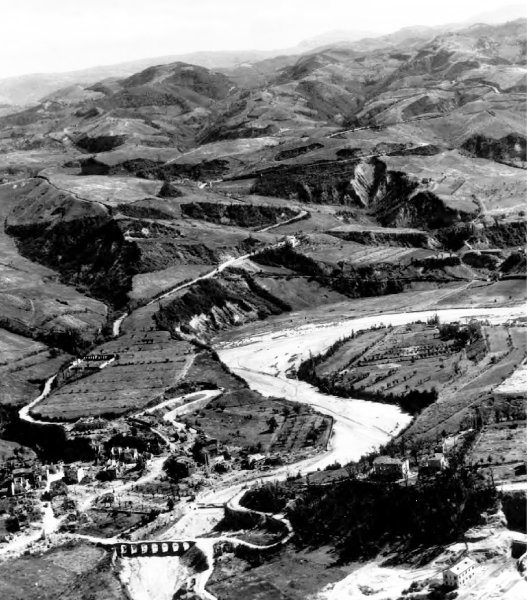
PIANORO ON HIGHWAY 65, looking south toward the hills occupied by the Allies for almost six months. Pianoro, at lower left, was one of the keys of the German defense systems barring entrance to Bologna and the Po Valley. The fight for Pianoro started on 16 April. Entering what was left of the town on the evening of the 18th, the infantry found it booby-trapped.
ITALY
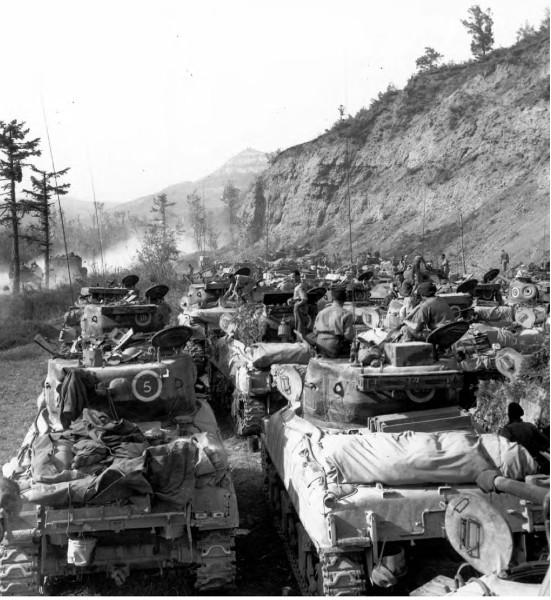
SOUTH AFRICAN ARMOR waiting along Highway 64 for a U. S. infantry division to pass on its way to the Po Valley, 20 April. On this date the troops in the U. S. zone broke through the mountains into the Po Valley just west of Bologna. The two highways in this area, 64 and 65, became congested with troops and vehicles in pursuit of the fleeing enemy. (Sherman medium tanks.)
ITALY
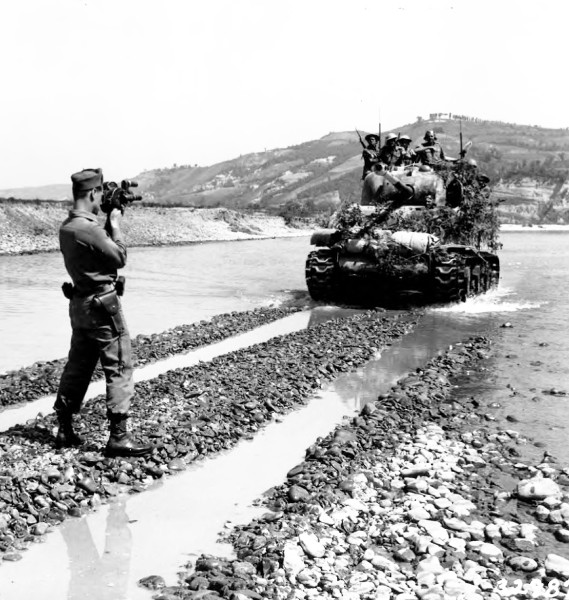
U. S. ARMY MOTION-PICTURE CAMERAMAN photographing the first tank of the South African armored force to cross the Reno River southwest of Bologna, 20 April. The practice of infantrymen riding on tanks while advancing was included in training for armored units in the United States early in 1944. (Sherman M4A3 tank with British 17-pounder; camera: PH-330 (Sig C), Eyemo, Bell, and Howell, 35-mm., three lenses mounted in turret.)
ITALY
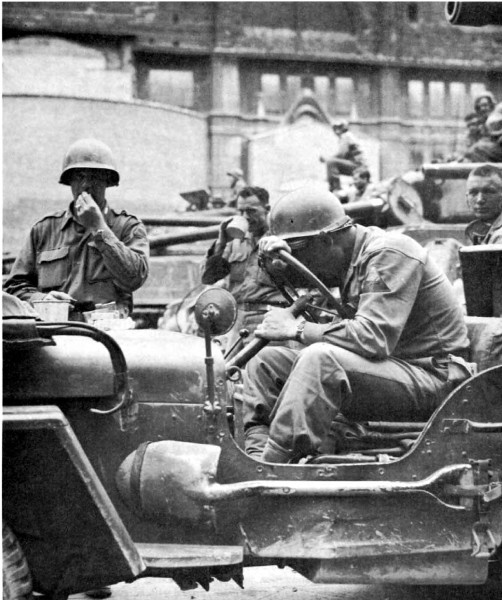
WEARY U. S. TROOPS IN BOLOGNA on the morning of 21 April. The city, entered from the south by U. S. forces and from the east by Poles of the Eighth Army, fell that day. Pressing forward the troops pursued the fleeing Germans.
ITALY
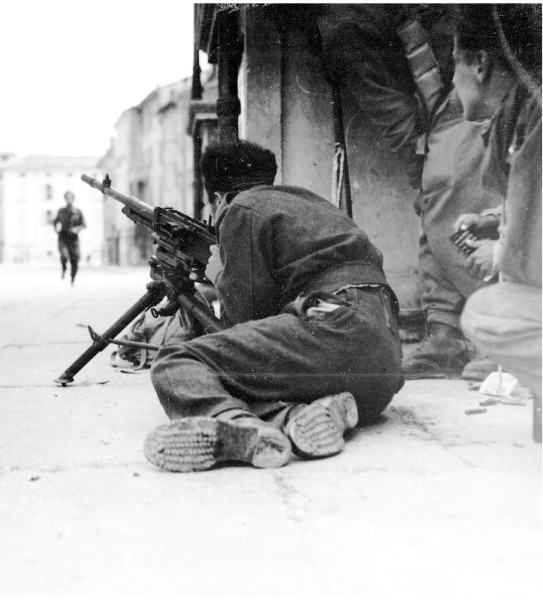
ITALIAN PARTISANS WATCHING FOR SNIPERS. During the winter of 1944–45 Allied officers, arms, and ammunition were dropped behind the enemy lines to assist partisans in the Po Valley. Although partisans, armed with equipment obtained from Italian arsenals or seized from the Germans, first appeared north of Rome, it was not until the Allies reached Bologna that they met the efficiently organized groups from the Po Valley. As troops entered the city, where the Germans were numerous, the partisans struck, seizing government agencies and public utilities.
ITALY
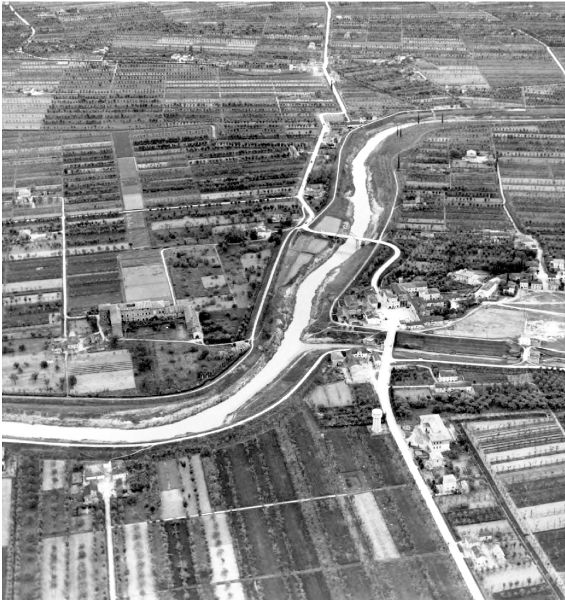
THE PANARO RIVER BRIDGES near Bomporto. After the breakout into the Po Valley, the next objective was the Po River. The area south of this river is broken by small streams and numerous canals. Most of the bridges had been destroyed by the Allied air forces during the winter. Later air reconnaissance found these undamaged bridges at Bomporto. A task force, sent to secure them, passed through the fleeing and disorganized enemy. So sudden was its appearance that, by 1600 on 21 April, it captured the bridges before the Germans could detonate previously laid demolition charges.
ITALY
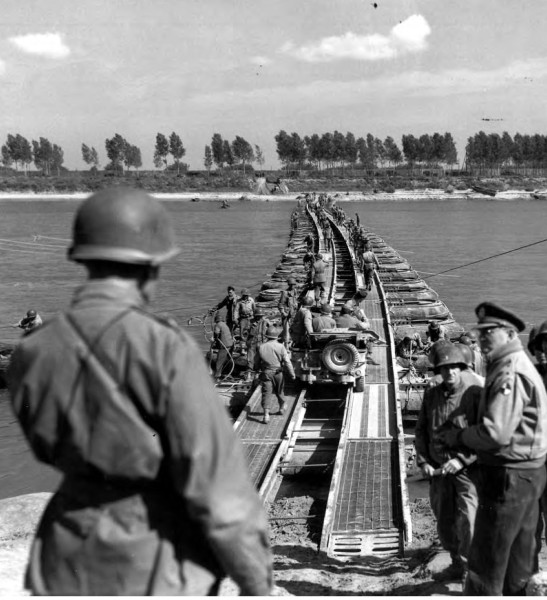
TREADWAY BRIDGE ACROSS THE PO RIVER at San Benedetto. Opened on the afternoon of 25 April, it was the first bridge across the river. The infantry had started to cross in this area on the morning of the 23d in assault boats under heavy machine gun, mortar, and rifle fire as well as fire from enemy antiaircraft guns lowered to fire airbursts on a flat trajectory. Casualties were high, but by 1745 a bridgehead of 2,000 square yards had been established on the north bank of the Po. The bridge above is 915 feet long. (Floating treadway bridge M2, class 18.)
ITALY
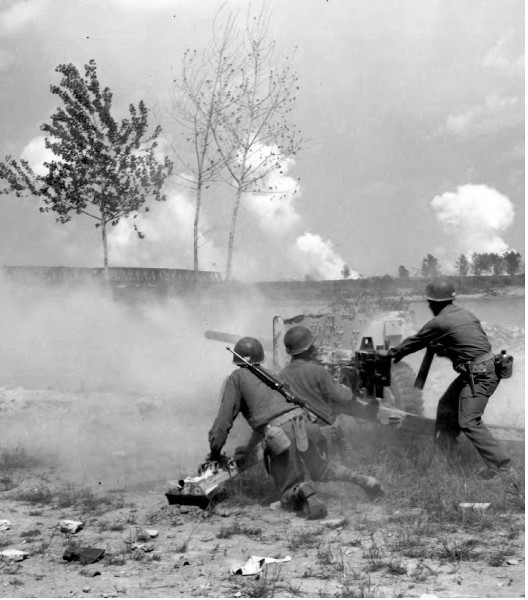
ACTION DURING THE PO RIVER CROSSING at Ostiglia, 24 April. A 57-mm. antitank gun firing in support of an infantry assault across the railroad bridge to the north bank of the river. (The British 6-pounder was the forerunner of the 57-mm. gun. It was adapted for U. S. use and also manufactured for other United Nations under the lend-lease agreement as the 57-mm. antitank gun.)
ITALY
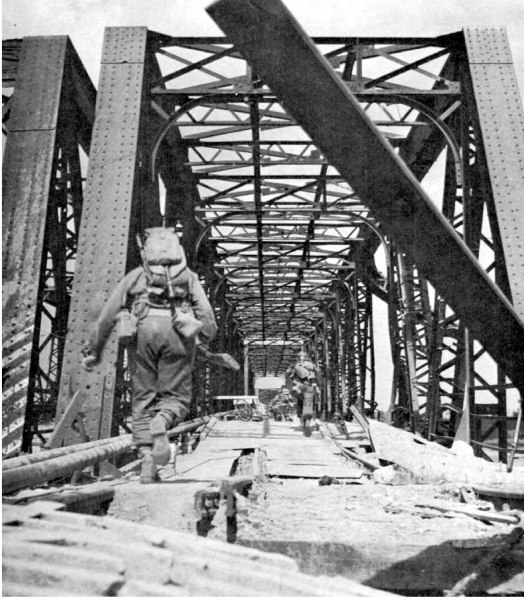
INFANTRY CROSSING PO RIVER UNDER FIRE, Ostiglia railroad bridge, 24 April. The crossing in this zone was opposed by enemy machine guns and 20-mm automatic weapons. The patrol above worked its way to the other side and knocked out enemy guns and crews. The railroad bridge was partially demolished and unfit for vehicles.
ITALY
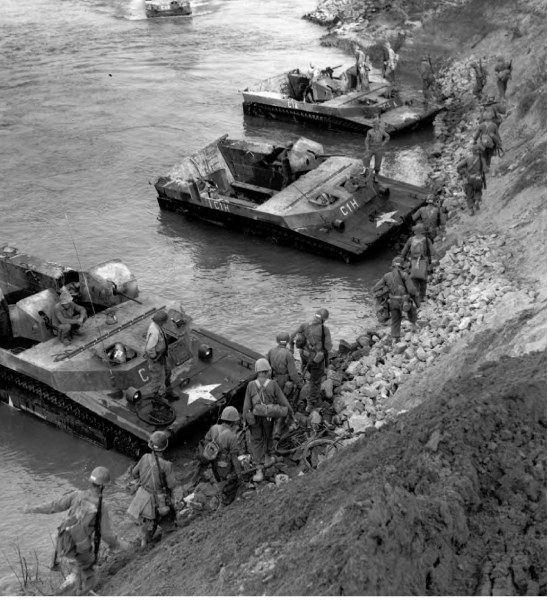
“ALLIGATORS” ABOUT TO CROSS PO RIVER near Ostiglia. Developed by the U. S. Navy, the first shipment of these amphibian tracked vehicles arrived in December 1944 and training was begun. Great secrecy surrounded them and they were kept thoroughly camouflaged before the dash to the Po. They were armored and each had socket mounts at four locations for either .30-or .50-caliber machine guns. A stern ramp could be lowered to take on a vehicle. Maximum capacity was 8,000 pounds and a crew of three. (LVT(4).)
ITALY
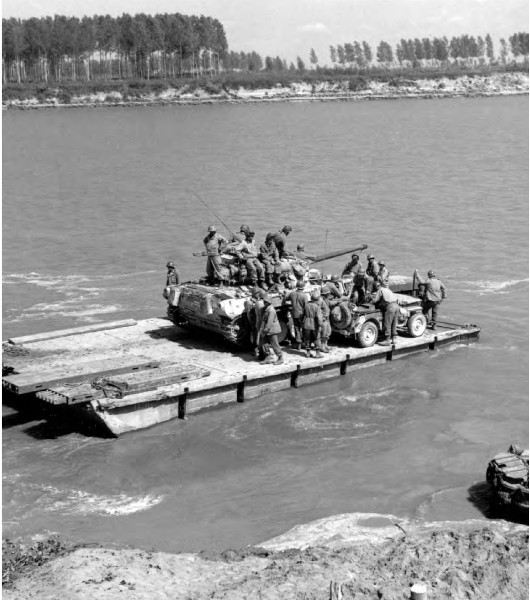
FERRYING EQUIPMENT ACROSS THE PO in support of the infantry assault, Ostiglia, 25 April. The large vehicle is a 76-mm. gun motor carriage M18, designed for tank destroyer use. It was a full track-laying type, using a torsion bar independent suspension, and was front-sprocket driven. The vehicle was lightly armored, had a low silhouette, and was highly mobile.
ITALY
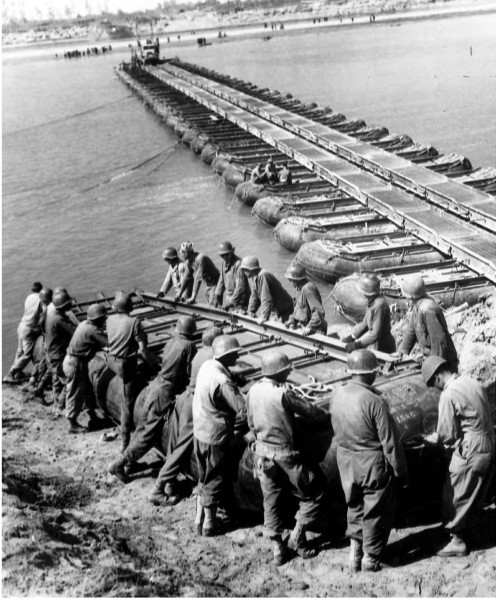
PONTON BRIDGE under construction across the Po River near Ostiglia. This bridge was opened on 25 April. (M2 treadway bridge.)
ITALY
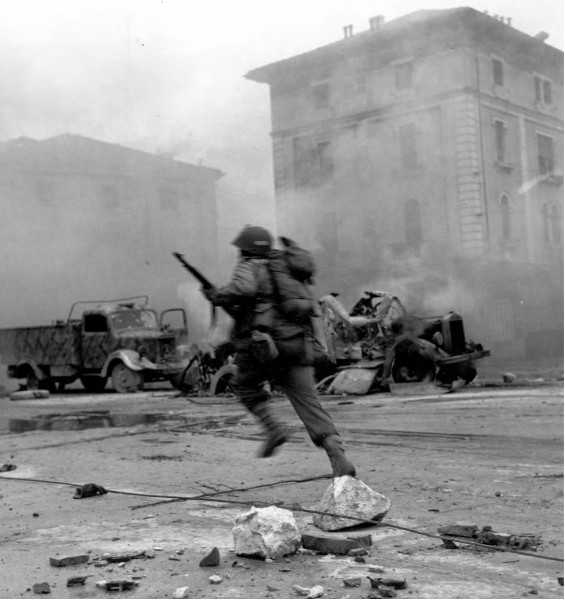
INFANTRY ACTION AT VICENZA, in the foothills of the Alps. The advance of the Allies across the plain was too fast for the Germans to halt, reorganize, and make a determined stand behind either the Po or the other rivers in the Po plain. Speedy thrusts by infantry-armor columns split the enemy forces and severed communications. After the crossing of the Po, the action on both sides developed into a race to the Alps, the enemy hoping to escape into Germany, the Allies determined to prevent them. Many isolated pockets of resistance developed behind the advancing columns and special task forces were organized on 23 April to deal with them.
ITALY
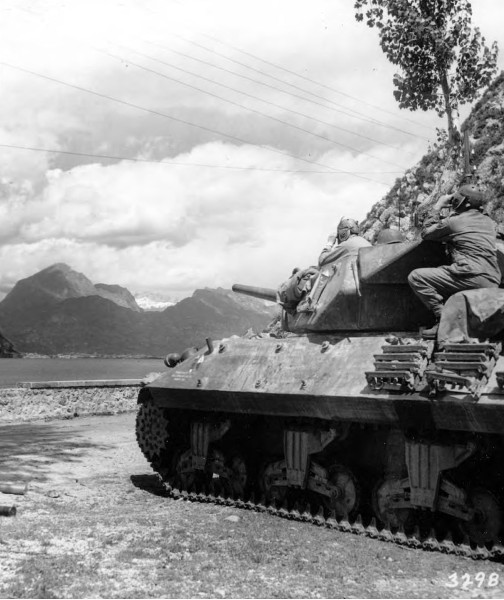
TANK DESTROYER on the shore of Lake Garda blocking one of the escape routes to Brenner Pass. Heavy fighting took place in the demolished tunnels on the road along the east shore of this lake, but on 30 April the area was under Allied control.
ITALY
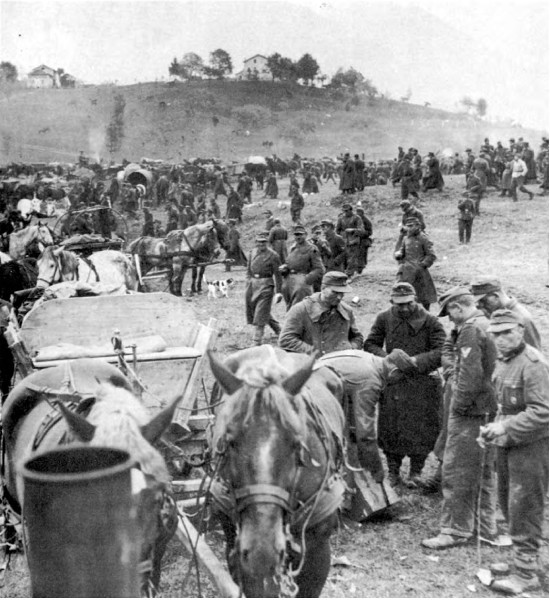
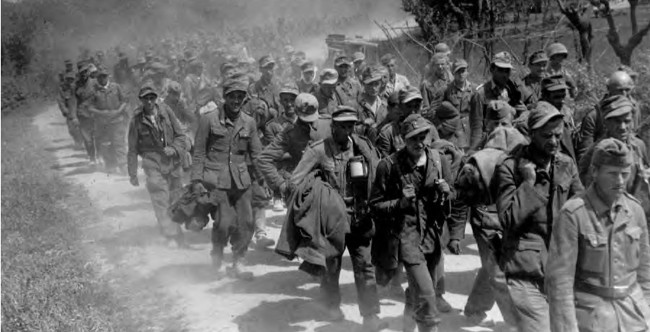
GERMAN PRISONERS and their equipment captured on the Po plain. For the first time in the Italian campaign, the enemy was retreating over terrain suitable for swift pursuit. Since the Germans lacked vehicles and gasoline, they had to rely to a great extent on horse-drawn transportation. They retreated across an open valley having a fine network of roads for mechanized forces and were forced to cross wide rivers by ferries and ponton bridges under constant attack by Allied air forces. The retreat became a rout.
ITALY
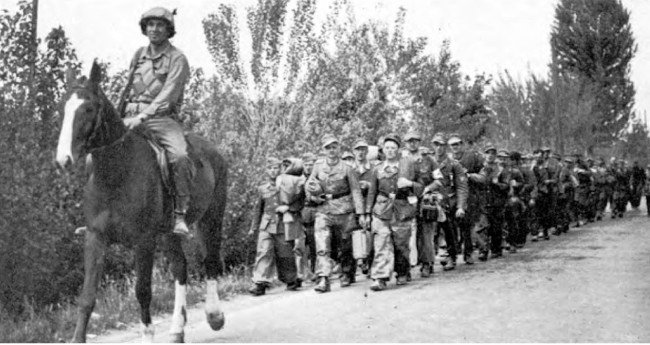
PRISONERS WERE CAPTURED by the tens of thousands in the Po Valley and marched to the rear, often unguarded, or guarded only by one or two men. On 2 May 1945, the Germans signed the terms of the unconditional surrender of their forces in Italy. One week later the war in Europe was concluded with complete victory for the Allies. The Italian campaign had been a bitter one, lasting 607 days (3 September 1943 to 2 May 1945). Casualties of the Fifth Army, including all nationalities serving with that army, totaled 188,546. United States losses were 19,475 killed, 80,530 wounded, and 9,637 missing.