The Art of Violoncello Playing In the Eighteenth Century.
Isobella S. E. Stigand translation
Violoncello.
In the seventeenth century the violoncello still occupied a very subordinate and modest position; during the period mentioned, with very few exceptions, it was employed only as a bass instrument in the orchestra. At the beginning of the eighteenth century, however, there was already a great change; for Mattheson says in his “Neu eröffneten Orchestre,” which appeared in 1713:—
“The PROMINENT Violoncello, the Bass Viol, and the Viola da Spalla are small bass fiddles (viols) similar to the larger ones, with five or six strings, on which can be played all kinds of quick things, variations and movements much more easily than on the larger machines” (Mattheson means the contra-basso).[53]
It is, therefore, quite conceivable that some time was necessary, before the players, who were unaccustomed to the undivided fingerboard of the cello, were sufficiently confident of a finger technique differing so completely from that of the gamba. They were at first limited to the lower part of the fingerboard, as was the case primarily with the violin.[54] The position of the thumb, by means of which the higher and highest positions on the fingerboard could alone be fixed and maintained with certainty, could hardly have been known before the beginning of the eighteenth century. The violoncello at this time, as appears from Mattheson’s account just mentioned, had sometimes a set of five or even six strings like the gamba. On the five-stringed instruments the tuning was:—
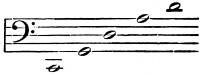
The Abbé Tardieu already referred to, who played the violoncello, according to Gerber, had the same tuning on his instrument. About the third decade of the last century, those who used five-stringed instruments gave up the highest string—(the D). From that time the four-stringed instrument with the tuning C, G, D, A came very generally into use. The latter was not altogether a novelty. Prätorius mentions it in his “Syntagma Mus.” as the “Bass Viol de Braccio.”[55]
In Germany the use of the violoncello as an orchestral instrument ensued later than in Italy, though much sooner than in France. For although it had been introduced into the Parisian Opera in 1727, by the cellist Batistin, to be mentioned later on, it had been already in use since 1680 in the Vienna Hofkapelle. The Saxon Hofkapelle at Dresden next followed by the installation of four violoncellists. Their names are Daniel Hennig, Agostino Antonio de Rossi, Jean Baptiste José du Houbondel, and Jean Prach de Tilloy.[56] As two of these players have French names, it is to be assumed that the violoncello had already found representatives in France at the beginning of the eighteenth century.
The example set by Vienna and Dresden was soon imitated also by other German Courts. The band of Duke Charles Ulrich of Holstein-Gottorp affords a case in point. As this prince, the future son-in-law of Peter the Great, found himself obliged, in 1720, to reside at the Russian Imperial Court, his private musicians followed him thither, amongst whom there was a cellist.[57]
As the gamba enjoyed a great amount of favour[58] in Germany, the introduction of the violoncello was not effected without difficulty, to which indeed the gambists, who thought their pretended rights were thereby infringed, not a little contributed. For in a paper which appeared in 1757 in the French language, “Observations sur la Musique,” &c., it is said: “La seule basse de viole a déclaré la guerre au violoncelle qui a remporté la victoire et elle a été si complète que l’on craint maintenant que la fameuse viole, l’incomparable sicilienne ne soit vendue à quelque inventaire à un prix médiocre et que quelque luthier profane ne s’avise d’en faire une enseigne.”[59]
It was not quite so bad as the last words of the announcement lead one to suppose. Even if the violoncello caused the gamba to be quite superfluous in the orchestra, the latter was cultivated as a solo instrument for some time longer, and many of the good old gambas were in course of time metamorphosed into violoncellos, and made available for further use; while the more insignificant specimens were destroyed, if they were not required for completing instrumental collections and so preserved from destruction.
The art of violoncello playing in the first stages of its development was, as regards the method of treatment, not so much favoured as violin playing. To the latter a definite direction for imitation was early given, as soon indeed as the end of the seventeenth century, by the Roman school founded by Arcangelo Corelli, which was soon followed by the foundation of the Paduan and Piedmontese schools. Violoncello playing lacked such classical parent schools. When a few prominent artists of this instrument had brought it into greater consideration, centres were formed by distinguished masters for the study of the cello, which supplied the want of proper schools, about which we shall have more to say farther on.
It is easy to understand how it followed that the violoncello was first valued in the land of its birth—that is, in Italy, not only as an orchestral instrument but also for solo playing. How this important branch of art was there developed we shall see in the next section.
I.—ITALY.
Italy has the claim of priority in violoncello as well as violin playing. It was the birthplace of the violin and of the cello, and from thence emanated the artistic executive development of both instruments. The first famous Italian cellist of whom we have any notice is—
Domenico Gabrieli, with the surname of Menghino del Violoncello, born about 1640 at Bologna, died in 1690. This artist found a sphere of work in the church of San Petronio in his native town. Then he entered the service of Cardinal Pamfili in Rome. Gabrieli was also a composer of some repute. Fétis mentions eight of his operas which were written partly for Bologna and partly for Venice. His other works consist of a “Cantata a voce sola,” in a collection of Motets, entitled “Vexillum pacis,” for alto solo and instrumental accompaniments, as well as “Baletti, gighe, correnti, e sarabande a due violini e violoncello, con basso continuo” (Op. 1). These three works, of which the last is a reprint, appeared successively in 1691, 1695, and 1703, consequently after Gabrieli’s death. He appears to have composed nothing specially for the cello.
More remarkable as a cellist must have been Attilio Ariosti, the Dominican monk, born at Bologna in 1660. Gerber at least says of him that he was one of the most excellent violoncellists of his time. But he was also a distinguished performer on the Viola d’amore. He occupied himself chiefly, however, with opera compositions, for which the Pope granted him a dispensation from the rule of his order, as without it, being a Dominican, he was forbidden to meddle with anything connected with the theatre. In 1698 Ariosti was sent for to Berlin as Kapellmeister to the Elector of Brandenberg. Thence he went in 1716 to London, where, in the proximity of Handel, he could make no way, and therefore at last returned to his fatherland. He chose Bologna as his place of residence. Like Gabrieli, he appears to have produced no independent[60] violoncello compositions.
His fellow-country man, Giovanni Battista Bononcini (Buononcini),[61] famous as an able cellist, also devoted his talent by preference to the operatic stage. He was the eldest son of the choirmaster, Giov. Maria Bononcini, at the church S. Giovanni, in Monte, at Modena, and was born in 1672, or, according to Fétis, in 1667 or 1668. At first instructed in music by his father, and then perfected by Colonna at Bologna, he betook himself, at twenty-two or twenty-three years of age, to Vienna, where he found a post as cellist in the Imperial Kapelle. Here he turned to opera, which at that time was a favourite means of entertainment for the seeing and listening public, and promised more reputation and gain than all other kinds of composition.
Fétis mentions twenty operas by Bononcini, but he doubtless wrote more. Even in his eightieth year he was occupied for the theatre in Venice. Besides, he wrote an Oratorio, “Joshua,” several orchestral pieces, masses, chamber duets, “Trattenimenti da Camera,” &c., some of which were composed before his entrance into the Vienna Hofkapelle. He also wrote “Sinfonie” for violin and violoncello as well as cello solos. Of the latter there appeared at J. Simpson’s (London) a sonata for two violoncellos in a collection of sonatas by Pasqualini, San Martino, Caporale, Spourni, and Porta. As Caporale was born in 1750 and Porta in 1758, the publication of this collection must have taken place late in the second half of the eighteenth century. The Bononcini sonata contained in it does not give a very favourable impression of this composer’s talent. The development is dry and in places very formal, even here and there somewhat incorrect. To the two figured parts are given accompanying basses, partly simple and partly contrapuntal. The interest which attaches to this composition, consisting of an Allegro, with introductory Andante, a movement marked “Grazioso,” and a “Minuet,” after which the “Grazioso” is to be repeated, rests chiefly on the light which it throws upon the technical condition of cello playing at the beginning of the eighteenth century (for doubtless the composition belongs to that period). In reference to this is to be remarked: the principal part is confined chiefly to the middle tones; the lower ones are only occasionally touched, and the compass of the higher notes reaches to the one-lined A; the thumb position does not come into use. Figure is little developed, and only modest attempts are made at playing double stoppings and chords; the notation is in tenor and bass clefs.
It is reported that during Bononcini’s residence in Paris, between 1735-1748, he composed a Motet with cello obbligato accompaniment, for the royal band there, which last he himself played at the performance of his work in the presence of the king.
Alessandro Scarlatti,[62] the founder of the Neapolitan opera school, had given an example of this use of the violoncello about twenty-five years before in one of his cantatas. Geminiani, Corelli’s pupil, related that this cello part was performed during Scarlatti’s presence in Rome, and with his assistance on the clavier, by the famous violoncellist, Franciscello (Francischello); his playing was so beautiful that Scarlatti described it as heavenly.
This event must have occurred in the year 1713, when Scarlatti was in Rome the last time. Consequently, Franciscello’s birth must be placed with all probability in the year 1692. He would have been twenty-one years of age when he played with the Neapolitan master.
Gerber says that Franciscello went from Rome to Naples in 1725. That he was actually there in the year mentioned is affirmed by Quantz, who himself heard him play. Through Franciscello’s extraordinary performances the violoncello was soon so generally accepted in Italy, that the gamba had, in 1730, almost entirely disappeared from the Italian orchestras.
In the year 1730, Franciscello was summoned to Vienna as Imperial chamber musician, a proof that his name had already penetrated beyond his country. Franz Benda, afterwards celebrated as a violinist, and founder of the Berlin violin school, heard him in the Austrian capital. Franciscello’s manner of playing so impressed him that he took him from that time as his model.
Franciscello remained, it appears, ten years in Vienna. If a notice in the “Musical Almanack for Germany, of the year 1782,” is to be credited, he had already been a member of the Imperial Court and Chamber Music Society in 1766, which is by no means beyond the bounds of possibility, though not very probable. We hold then to the assumption that he was born in 1692 so that, in 1766, he would be already seventy-four years old. It is not known where Franciscello closed his life. Tradition only says that at an advanced age he resided in Genoa, to which the supposition was attached that that city had been his birthplace. It is stated that the elder Duport, the cello virtuoso, who was born in 1741, went from Paris to visit him there.
During his long period of work at Vienna, Franciscello doubtless instructed pupils in cello playing; who they were is however, as little known as the question if or what he composed for his instrument. On both points we are no better off than concerning his somewhat older compatriot
Cervetto, called Jacopo Bassevi, who was born in 1682. Until his forty-sixth year he remained in his fatherland. Then, like so many other Italian musicians of this time, he was seized with a desire to travel, and betook himself to London. There he trafficked at first in instruments which he had brought with him from Italy; this, however, was so little remunerative that he very soon gave it up, and joined the orchestra of Drury Lane Theatre. According to Burney’s judgment, Cervetto was, for his time, a very clever violoncellist, who knew how to manipulate the fingerboard with much dexterity; but his tone must have been rough and harsh. Of his eccentricity the following anecdote is an illustration: Once when the famous Garrick was representing a drunkard and sank down senseless upon a seat, Cervetto broke upon the sudden stillness with an unseemly loud and long-drawn yawn. Garrick immediately got up, severely censuring such behaviour, upon which Cervetto pacifying him answered: “I beg your pardon, I always yawn when I am very pleased.” A few years later Cervetto became Director of Drury Lane Theatre, and thus he laid the foundation of his fortune.
Cervetto must have had a very strong constitution, for he lived to the unusual age of 101 years. His death took place on January 14, 1783. He left a fortune of £20,000 sterling, which he bequeathed to his son James, who was also a cellist; but soon after inheriting from his father he retired into private life. He, also, reached a respectable age, for as he came into the world (in London) in 1747, and died February 5, 1837, he was ninety years old. In 1783 he was performing at the Court concerts of the Queen, as well as taking part in the musical réunions in the house of Lord Abington as one of the best reputed cellists in London. Of cello compositions he published: 1. Twelve “Solos for a Violoncello, with a Thorough Bass for the Harpsichord”; this work, dedicated to the Elector Palatine of Bavaria and Jülich-Eleve-Berg, appeared at the author’s own expense, without date. 2. “Six Solos for a Violoncello, with a Thorough Bass for the Harpsichord, Opera Terza.” London. 3. “Twelve Sonatinas for a Violoncello and a Bass, Op. 4ta.” London. Fétis adds, besides, “Six solos pour la flûte” and “Six trios pour deux violons, et violoncelle,” which must have been in existence not long before the end of the last century. We shall have occasion to refer again farther on to Cervetto’s violoncello compositions.
Taking up again the chronological thread, after Cervetto the elder, the cellist Batistin, whose real name was Joh. Baptist Struck, must be mentioned. He was of German origin and was born in Florence in the second half of the seventeenth century, from thence he went to Paris at the beginning of the eighteenth century. He there entered the band of the Duke of Orleans and the opera orchestra, in which he, conjointly with the brothers Abbé (properly Philippe Pierre and Pierre de Saint-Sévin), played the cello parts. He must have performed well, since Louis XIV., in order to retain him in the French capital, gave him a liberal allowance and, in addition, a sum of 500 francs for certain theatrical compositions to be supplied by him. Besides this he wrote a long list of ballets and operas specially for Court festivities. There appeared in print, by him, during the years 1706 and 1714, in Paris, four books of “Cantatas” and a collection of airs. He does not appear to have composed for the violoncello. He died on December 9, 1755, at the scene of his work. Among the masters of the Neapolitan school, Leonardo Leo, at that time the famous opera composer, distinguished himself as a violoncellist, who was born, 1694, at S. Vito degli Schiavi, in the province of Lecco, and died at Naples in 1746. He also composed six cello concertos with quartet accompaniments, which belong to the years 1737 and 1738. The MSS. of these are in the Library of the Royal Conservatoire at Naples. It is supposed that these are the oldest of existing cello concertos.
Another Italian cellist of that time was Domenico della Bella, of whom nothing further is known than that, in 1704, he published, in Venice, Twelve Sonatas “a due violini e violoncello.”
The information is equally meagre regarding the cellist Parasisi, of whom Gerber says he was an extraordinary artist on his instrument and was with the Italian Opera orchestra at Breslau in 1727.
Concerning the Italian violoncellists Jacchini, Amadio, Vandini, Abaco, dall’Oglio, and Lanzetti, born in the second half of the seventeenth and the beginning of the eighteenth century, we know very little.
Jacchini, whose Christian name was Giuseppe, noted by Gerber as one of the first cellists of his time, was appointed to the church of S. Petronio in Bologna at the beginning of the eighteenth century. That he had distinguished himself as an artist is proved by his nomination as a member of the Bologna Philharmonic Society, a distinction which is only conferred on men of great musical reputation. Of his compositions there is a work entitled “Concerti per Camera a 3 e 4 stromenti, con violoncello obligato (Op. 4). Bologna, 1701,” to be mentioned.
Pippo Amadio, who flourished about the year 1720, was, according to Gerber’s account, a violoncellist, “whose art surpassed all, that up to his time had been produced on his instrument.”
Antonio Vandini, first violoncellist at the church of S. Antonio, Padua, seems to have been no less remarkable. The Italians called his manner of playing and his expression “parlare”—he understood how to make his instrument speak. He was on terms of such close friendship with Tartini, who as is known was engaged at the same church at Padua as solo violinist, that he accompanied him in 1723 to Prague, and remained with him for three years in the service of Count Kinski. Vandini was still living in Padua in 1770. The year of his death is unknown.
Abaco, born at Verona, according to information contained in the second year of the “Leipsic Musical Paper” (p. 345), was a prominent violoncellist, who lived in the first half of the eighteenth century. Gerber possessed a cello solo of his composition, of which he says that it appeared to have been written in the year 1748.
Giuseppe dall’Oglio, the younger brother of the famous violin player, Domenico dall’Oglio, was born about 1700 at Padua,[63] and went to St. Petersburg in 1735. There he remained in the Russian imperial service twenty-nine years, after which he returned to his native land. On his journey thither he stopped at Warsaw, on which occasion King August of Poland nominated him his agent for the Venetian Republic.
Salvatore Lanzetti, born at the beginning of the eighteenth century in Naples, was pupil of the Conservatorio there, Santa Maria di Loreto, and was during the greater part of his life in the service of the King of Sardinia. He died in Turin in 1780. In the year 1736 two volumes of violoncello sonatas appeared by him, and later also a book of instruction, the title of which Fétis gives as: “Principes du doigter pour le Violoncelle dans tous les tons.” It is somewhat differently named by Gerber: “Principes ou l’applicatur de Violoncel par tous les tons.” Lanzetti must have carried out with great skill the staccato touch both up and down the instrument.
We are somewhat better informed regarding the violoncellist Caporale. Neither the place of his home nor the year of his birth nor that of his death are, indeed, known to us, but of his life and work in England we possess some information. In 1735 he came to London and worked under Handel, who wrote for him a cello solo in the third act of his opera “Deidamia” composed in 1739.
His musical education could not have been very thorough, but he must have had certain qualifications which induced Handel to connect himself with him. Simpson’s Collection (see p. 49), published in London, contains a Cello Sonata by Caporale, which does not speak much for his talent in composition. It consists of Adagio, Allegro, and a Theme with three variations after the manner of studies. As a player Caporale was remarkable for his tone, but as regards finish he could not rival either the elder Cervetto or Pasqualini.
This last-named artist, by whom a sonata, scarcely rising above the level of Caporale, was contained in the volume already mentioned as appearing at Simpson’s, was performing in London, in 1745, as a concertist of great repute. Further information regarding him does not exist.
Greater consideration must be yielded to Carlo Ferrari, brother of the violinist Domenico Ferrari, so often referred to in the previous century. On account of an injured foot he was called “the lame.” Born at Piacenza about 1730 he betook himself to Paris in 1758 and appeared with great success in the “Concert Spirituel.” In 1765 he accepted an engagement offered to him by the Count of Parma.[64] He remained in this position until his death, which took place in 1789. It is reported of Ferrari that he was the first Italian cellist who made use of the thumb position. If this be true, France must have been beforehand in the difficult matter of the art of fingering; for the thumb position was already known in Paris, as we have seen, before 1740, consequently at a time when Ferrari was only ten or twelve years old. But if it be acknowledged that violoncello playing was cultivated much earlier in Italy than in France, and had already advanced beyond the elemental stage before it had found representatives among the French, we must be inclined to concede to the Italians the discovery of the thumb position, and indeed to the predecessors of Ferrari. It is highly probable that Franciscello and Batistin already availed themselves of its assistance for the use of the upper parts of the fingerboard. The trick must have been brought into France by the last-named artist who, as we know, settled in Paris at the beginning of the eighteenth century.
The proof that the thumb position was known in Paris before 1740 is established by the violoncello method of Michel Corrette in the year 1741, and which, as far as one can see, was the first work of instruction for the instrument in question. Considering the scarcity at that time of cello compositions this instruction book is the more important, as from it is to be determined with certainty the average standard to which violoncello playing had attained towards the middle of the previous century. This circumstance seems to justify our entering somewhat more fully into Corrette’s school.
The title is: “Méthode, théoretique et pratique, pour apprendre en peu de temps, le violoncelle ... dans sa perfection composée par Michel Corette. XXIVe Ouvrage à Paris, chez l’auteur, Me Boivin et le Sr le Clerc; à Lyon chez M. de Bretonne. Avec Privilège du Roy. MDCCXL1.”[65]
After some introductory paragraphs regarding the use of the F and C clef, in notation for violoncello music, concerning the value of notes and pauses, the formation of sharps, flats, and naturals, as well as regarding the usual marks, the various measures and syncopes, Corrette treats:
1. Of the manner of holding the violoncello; 2. Of the holding and action of the bow; 3. Of its use in the up and down strokes; 4. Of the tuning of the violoncello; 5. Of the division of the fingerboard into diatonic as well as chromatic tones; 6. Of the fingering in the lower (first) and following positions; 7. Of the way and manner of returning from the higher positions to the first; 8. Of trills and appogiaturas; 9. Of the various kinds of bow action; 10. Of double-stops and arpeggios; 11. And also of the thumb position. He also gives instruction for those who wish to go from the gamba to the violoncello, and then in conclusion gives hints for the accompaniment of singing and for instrumental solos.
It is evident that the directions of Corrette have chiefly a mere historical importance, as the technique of the violoncello, after the appearance of his method, underwent substantial changes. His explanation concerning the finger positions of that period and the thumb position which in the higher parts of the fingerboard takes the place of a moveable nut, concerning the manipulation of the bow, and the considerations to be observed in exchanging the gamba for the violoncello have a special interest for us.
With regard to the first of these four points, we remark that the finger position adopted by Corrette for the diatonic scale on all the strings was, in the first two positions, 1, 2, and 4; in the “third position,” 1, 2, 3, 4; and in the “fourth,” 1, 2, and 3; after the latter position the fourth finger was as a rule no longer needed, for which Corrette adduces as a reason that it is too short to be made use of in the higher positions of the fingerboard; in case however it should be necessary to use it, the use of the left arm would be impeded. In exceptional cases, says Corrette in another part of his school, the fourth finger could be used in the “fourth position,” without altering the thumb position, for the B flat and B on the A string, for the E flat on the D string, for the A flat on the G string, and for the D flat on the C string. The finger positions were then, in the first half and about the middle of the last century, somewhat different in the diatonic scale of the violoncello than they were later on. It is especially to be remarked that the E and the B were touched with the second finger upon the two lower strings, though the notes marked were far more convenient for the third finger, which very shortly took the place of the second.
As to the exclusion of the fourth finger, when playing with the thumb position, no proof is needed to show the reason was that it gave an awkward manner of holding the left hand. The finger positions for the chromatic scale still more widely differed from the fingering employed later, as the following scale shows—
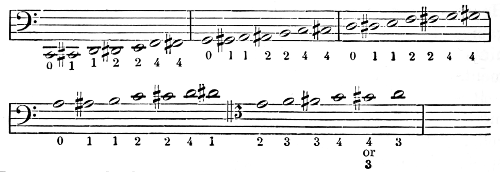
It very nearly happened, that as early as the seventeenth century when a stringed instrument was so much desired as a standard one for the violoncello, that the violin mode of fingering was adopted for the former, which according to the foregoing remarks really was the case, with the exception of the use of the third finger. It had however been overlooked that the cello, on account of its much larger dimensions, demanded an entirely different method of fingering. The regulation of this important point, which offered peculiar difficulties, occupied cellists up to the beginning of our century. In some measure the fingering which Corrette teaches for descending intervals of a second from the higher to the lower tones is unavoidable. He gives the two following examples—
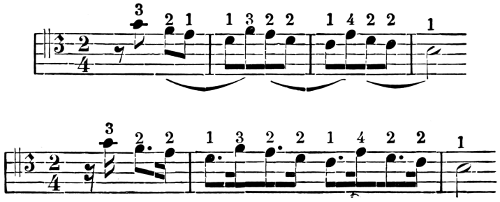
He gave the preference to the second example.
The almost total exclusion of the fourth finger caused a very great restriction in playing with the thumb position. But when Corrette wrote his work this limitation would hardly have been felt, as the higher parts of the fingerboard were little, and, only in exceptional cases, used by cello players and composers. Corrette mentions, as the highest tone, the one-lined B. Caporale and Pasqualini do not go beyond this note in their sonatas, already mentioned, excepting in one instance, when Caporale casually uses the two-lined C. It appears that, with many cellists, in place of the thumb the first finger was made use of in the higher positions as a support, for Corrette remarks concerning his method: “If the first finger is used instead of the thumb the fourth finger must necessarily be made use of; it is, however, on account of its shortness, really useless in the upper ‘positions.’” To beginners Corrette recommended the attempt then in vogue—but a little later combated by Leopold Mozart in his violin school[66]—to introduce marks on the fingerboard indicating the intervals in order to learn to play clearly in tune. For gamba players who, following the spirit of the time, gave up their instrument and turned to the violoncello, which was rapidly coming into use, this means of assistance had a certain value, accustomed as they were to the frets of the gamba fingerboard, for the finger positions of both instruments differ considerably from one another, as appears from the comparison given below by Corrette.
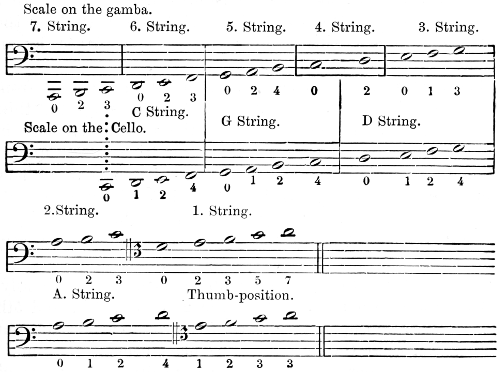
Scale on the gamba. 7. String. 6. String. 5. String. 4. String. 3. String. 2. String. 1. String. Scale on the Cello. C String. G String. D String. A String. Thumb-position.
The figures placed under the gamba scale relate to the frets which are to be attended to by the player, while those of the cello scale are the finger positions to be used.
The lower C, which the string itself forms on the cello, had on the gamba to be touched at the third fret; the succeeding D on the gamba was the open string, while on the cello it was to be touched with the first finger, and so on.
The four highest tones, e, f, g, a, fell in the gamba on the 2nd, 3rd, 5th, and 7th frets, whereas, according to Corrette’s account, those in the cello required the use of the thumb position. It is plain that the gamba players who took up the violoncello had to adopt an entirely different system of fingering.
To a certain extent the handling of the bow presented difficulties to those who exchanged the gamba for the violoncello. The former instrument, on account of the flatness of the bridge, did not allow of an energetic use of the bow. From the violoncello, on the contrary, a powerful tone must be brought out, which had to be learnt by gamba players. Besides, they had also to accustom themselves to other strokes of the bow for the cello. What was played by the latter instrument with a down stroke, was played by an upward one on the gamba, and the reverse.
The holding of the bow was again rather different from the present manner. Corrette gives three ways for this. According to Corrette’s testimony, the most usual way in Italy consisted in placing the 2nd, 3rd, 4th, and 5th fingers upon the rod and the thumb beneath it, so that the bow was held not exactly at the nut, but about a hand’s breadth from it, as formerly and even at the beginning of our century was done by many players. The second way of holding the bow was, the other four fingers being placed as above, to lay the thumb upon the hair. Finally, the bow was also held, so that the 2nd, 3rd, 4th, and 5th fingers were laid upon that part of the rod to which the nut is attached, while the thumb had its place beneath the nut.
Corrette does not give the preference to either of these ways of holding the bow, which in the course of the second half of the last century became more and more obsolete. He was of opinion that they were all good, but left it to each one to choose the manner in which the most power could be attained. It seems, however, noteworthy that Corrette laid it down as a rule that the middle of the bow should be used in playing, whereby its use was limited to a third of its length.
In the preface to his method Corrette speaks of several systems amongst violoncellists, but adds, the best and most generally followed was that of Bononcini, of which also the most skilful masters in Europe made use. From this remark it follows, that in the composition of his school, he took Bononcini’s manner of playing, which he was able to study, soon after the latter’s arrival in Paris, as his guide. In surveying the above principles, detailed by Corrette, regarding the technique of violoncello playing, it must be admitted that, needing improvement in almost every respect about the middle of the last century, it had not progressed, with few exceptions, beyond the elementary stages. The chamber sonatas and suites of Joh. Seb. Bach for violoncello solo, the last of which were originally composed for the Viola pomposa, cannot be cited as proofs to the contrary. In them Bach forestalled the technical capacity of his time by a decade. Although they are composed for that part of the fingerboard on which there is no question of the thumb position, yet they contain difficulties of an extraordinary kind which Bach’s contemporaries had not been able to master.[67] And even in the second half of the last century there could have been no cellist who would have been fully capable of playing them. Therefore it must be considered either, that these compositions, so remarkable of their kind, were not absolutely composed for the cello; or that the violoncello technique took another direction, which was called out by these suites of Bach.
The violoncello, like the violin, is primarily an instrument for the voice. As such it was chiefly used by the Italians, who, up to the second half of the last century, gave the impulse to stringed instrument playing. This is to be gathered from the cello pieces by Italian composers belonging to this period. As instances, next to the sonatas already mentioned, two musical pieces of the same kind may be cited, by San Martini (Giov. Battista Sammartini)[68] and Bernardo Porta.[69] Neither of these composers were violoncellists. Their sonatas are, however, adapted to the nature of the instrument for which they were composed. As compositions they are indeed of little importance, and as regards the technique, they do not rise above the measure of the modest demands which were then required.
With regard to cello technique the younger Cervetto, whose compositions have already been mentioned, p. 52, goes really farther. In them there is a greater variety in the manner of playing, in the use of double-stops and different passages derived from the scale and the chord. Such ways of playing could naturally only at first be found out and perfected in a proper manner by those who were already experienced practised players on an instrument of extreme difficulty on account of its extensions.
The cello pieces of Cervetto formed after the manner of Tartini’s violin sonatas are, as to their contents, quite antiquated, and are only interesting in a purely technical point of view. Like the compositions already considered, they occupy mostly the parts of tenor and bass. Only twice in the first Allegro of the tenth Sonata of his Op. 4 does Cervetto venture to the twice-lined E, and at the conclusion of the same piece to the twice-lined A. In both cases he has to use the treble clef, which does not appear elsewhere.
Besides Cervetto the younger, amongst Italians who cultivated cello playing must be mentioned Gasparini, Moria, Joannini di Violoncello, Zappa, Cirri, Aliprandi, Graziani, Piarelli, Spotorni I. and II., Barni, Bertoja I. and II., Lolli, Sandonati, and Shevioni. We give below the meagre information which exists regarding them.
Quirino Gasparini, a distinguished cellist, was in 1749 Kapellmeister at the Court of Turin. He remained there until 1770. As a composer, he was chiefly occupied with church music, no cello pieces are known by him.
Of Moria, the fact only is known that, in 1755, he was heard at the “Concert Spirtuel” in Paris.
Joannini di Violoncello, from the year 1759 Kapellmeister at St. Petersburg, had a great reputation in his own country as a player.
Zappa, called Francesco, according to Gerber was making a concert tour in 1781, and “enchanted his hearers in Dantsic by his soft and delightful execution.”
Giambattista Cirri, born in the first half of the eighteenth century, at Forli, lived and worked for a long time in England. On the title page of his first work, published at Verona in 1763, he called himself a “Professore di Violoncello.” Of his compositions there appeared in print seventeen different works in London, Paris, and Florence.
As a clever violoncellist, Bernardo Aliprandi, son of the opera composer, Aliprandi, born in Tuscany, was distinguished. His father was composer and Court band-conductor in Munich during the first half of the previous century; but he himself became a member of the orchestra there, where he still was in 1786. His cello pieces, of which several were published, are as obsolete as those of Cirri.
Gerber, in his dictionary, says of Graziani, that after the death of the gamba player, Louis Christian Hesse,[70] he was summoned to Potsdam to take his place as tutor to the Crown Prince of Prussia. When the French violoncellist, Duport (the elder), came to Berlin, in 1773, Graziani lost his post at Court. He died at Potsdam in 1787. The six violoncello solos, Op. 1 (printed in Berlin about the year 1780), as well as the six cello pieces brought out in Paris (Op. 2), mentioned by Gerber in his old Musical Dictionary under the name of Graziani, must have appeared in the latter years of the author’s life.
In the second half of the last century there was a violoncello virtuoso, by name Piarelli, who, about 1784, had printed in Paris six violoncello solos. This is all that is known about him.
Of the brothers Spotorni, Gerber only says that, in 1770, in Italy, “their native land, they were esteemed as violoncellists.”
A very skilful player was Camillo Barni, born on January 18, 1762, at Como. He received his first instructions in cello playing at the age of fourteen years from his grandfather, David Ronchetti. Later on, Giuseppe Gadgi, Canon of the Cathedral at Como, taught him for a few months. At the age of twenty Barni joined the opera orchestra of Milan, of which he became first violoncellist in 1791. In the year 1802 he went to reside permanently in Paris, where he appeared as solo player, and then, for several years, was an active member in the orchestra of the Italian Opera. Between 1804 and 1809 he published several duets for his own instrument and the violin. He also wrote a cello concerto.
Concerning the brothers Bertoja, Gerber only says that both were employed in Venice about 1800, as virtuosi on the violoncello, and were reputed in Italy the first masters of their instrument.
Filippo Lolli, son of the violin virtuoso, Antonio Lolli, was born at Stuttgard, in 1773; practised the cello from early youth, and at eighteen years of age made a concert tour, which led him to Berlin. Here he was heard by the King, who was so pleased with his performance that he recognised it by an honorarium of 100 louis d’or. Lolli then went to Copenhagen, and in the year 1804 played at concerts in Vienna. There is no more information about him extant.
Of Sandonati, Gerber says that he lived in Verona in 1800, and was one of the most renowned violoncellists of those times. Gerber announces the same of the Mantuan, Shevioni, who worked about the same time apparently in Verona.
While all these men were endeavouring to make an advance in violoncello playing, and especially in violoncello compositions, the Italian nation possessed in Boccherini an artist who surpassed in every direction his countrymen.
Luigi Boccherini, the son of a contra-basso player, was born on February 19, 1743, at Lucca. He there received his first musical instruction from the archbishop’s choirmaster, Vanucci. Besides the cultivation of theory, he devoted himself with peculiar zeal to cello playing, of which he was to prove a master. The very promising progress which he made decided his father to send him to Rome for the further prosecution of his studies, and where his talents attained their full development.
When Boccherini, after the course of a few years, returned to his native town, he found there Tartini’s pupil, Filippo Manfredini, his countryman, who was an excellent violinist. He soon formed an intimate friendship with him, which led to an arrangement for making a concert tour. The two artists went to Spain, afterwards to Piedmont, to Lombardy, and the South of France. The favourable reception which the friends experienced encouraged them about 1768 to proceed to Paris. In the French capital they had a splendid success. The compositions of Boccherini gained such great applause that the Parisian music publishers, La Chevardière and Venier, declared themselves ready to undertake the expense of printing all the works already heard. Notwithstanding, he received very little for his compositions, and later on he was not more fortunate.
At the persuasion of the Spanish ambassador in Paris the artists proceeded, at the end of 1768, or the beginning of the next year, to Madrid. Here Boccherini roused the special interest of the Infanta Don Luis, who named him his “Compositore e virtuoso di camera.” When this prince died, on August 7, 1785, Boccherini became Court Kapellmeister of King Charles III. of Spain, a post which he also filled under the succeeding king, Charles IV. He received a still further recognition from the King Frederick William II. of Prussia, who designated him his chamber-composer, when he, in the year 1787, dedicated a work to this art-loving monarch, who conferred on him a considerable honorarium. From that time Boccherini dedicated to him everything that he composed. We may conclude that he was adequately remunerated, for when the king died in November, 1797, and the allowance ceased, Boccherini fell into difficulties, his compositions being badly paid by the publishers. At the same time he seems to have lost his place as Kapellmeister to the King of Spain. However it was, he spent the last years of his life with his family in great need, from which death only released him on May 28, 1805.
Having in view the great quantity of his compositions, Boccherini must be distinguished as an extremely prolific composer. There are in existence 400 instrumental works by him. They consist of 20 symphonies, 125 string quintets—amongst them are 113 for two cellos, of which the first cello is more or less an obbligato—91 string quartets, and numberless trios, septets, quintets with flute or oboe, violin sonatas, as well as several vocal compositions for the church, &c. Very little has proved capable of surviving, and this little only awakens a limited interest. The cause of it seems to be in a certain simplicity which underlies all Boccherini’s music. With great cleverness of form, added to an apt and easy flow, it is certainly not wanting in originality, which has even a humorous tendency; but the manner of expression is characterised by a certain formality which gives to Boccherini’s music an antiquated air. His ideas are wanting in power of thought and depth of feeling; they rarely rise above the pleasing and agreeable.
At the beginning of the century the chamber compositions of Boccherini had an extraordinary popularity, especially amongst the dilettanti. From that time, however, they have been little played, at least in Germany. The interest in them was maintained much longer in France, where they were unusually prized, according to Fétis’s “Biographie Universelle des Musiciens.” There also they have been for some time laid on one side.
Boccherini composed six concerti specially for the violoncello. There are also extant several cello sonatas with bass by him. It is surprising that there is no mention made of them in the list of Boccherini compositions by Fétis. Six of these sonatas have been republished on the one hand by Friedrich Grützmacher, and, on the other, by Alfred Piatti, with piano accompaniment. The violoncello concerti of Boccherini, on the contrary, have fallen almost entirely into oblivion. They are only so far interesting in that by them is shown to what degree of technique cello playing was developed by this master. We must here observe that he was one of the first of the Italian school who gave decided expression to the solo and virtuoso side of his instrument. He not only made possible for cello music the higher and highest parts of the thumb position, with the exception of the complicated harmonics first discovered and made available after his time, but he also considerably extended beyond his predecessors the playing of double stops as well as the execution of passages.[71]
If in form they were somewhat superficially elaborate and worked out after the manner of studies, yet instructive material for practice of an extent and variety hitherto unknown was provided for cellists. For Italy it was a sensible loss that Boccherini spent the greater part of his life abroad, his native land was in consequence deprived of the advantage which the personal influence and example of his strikingly artistic proficiency might have gained. If he had remained there he would, doubtless, have been to his countrymen as regards cello playing what Corelli and Tartini were to Italian violin playing. But under the prevailing conditions Italy lacked a recognised musician who might have been the means of further successfully developing that branch of art. Moreover, the decided preference of the Italians for opera from the end of the last century, which prevailed to the cost of all other musical efforts, checked for a time further impulse to or demand for the cultivation of stringed instrument playing, which until then had been so successfully pursued on the Apennine Peninsula. What, however, Italy’s sons attained in the art of violoncello playing was not lost, but was further perfected by German and French masters, concerning which the following sections will give the necessary explanation.
II.—GERMANY.
The Violoncello had already found its place as an orchestral instrument about the year 1680 at Vienna, and in 1709, in the Dresden Royal orchestra, as we saw. Towards 1720 it had penetrated also into Northern Germany, since the band of the Duke of Holstein-Gottorp evidently possessed one. At the same period this stringed instrument must have been extensively used in other parts of Germany—otherwise Joh. Seb. Bach would scarcely have conceived the idea of composing for it his solo sonatas, which were already extant between the years 1717-1724. There were even at that time two German violoncellists who appeared to Gerber of sufficient importance for him to give them a place in his Dictionary of Music. Their names are: Triemer and Riedel.
Johann Sebald Triemer was born at the end of the seventeenth or the beginning of the eighteenth century, in Weimar, where he was instructed in instrumental playing by the Ducal Chamberlain and Musician, Eylenstein, and in the theory of music by Ehrbach, an old musician of Weimar. As soon as Triemer had made progress sufficient to figure as a soloist, he undertook a concert tour which led him to Hamburg, for, in 1725, he was a member of the theatre orchestra there. Two years after he went to Paris, and remained until 1729. During this time he pursued the study of composition under the direction of Boismortier.[72] He then went to the Dutch city of Alkmaar, and, later on, to Amsterdam, where he died in 1762. At Amsterdam he had six “Sonate a Violoncello solo e continuo” published.
The Silesian, Riedel, was not only a cellist, but also chief of the Fencing School at Liegnitz. He must have been a very good player for his time. About 1727 he went to St. Petersburg, and was there the instructor of the Emperor Peter II. (who, as is known, only reigned three years—1727-1730), both in cello playing and in fencing.
Riedel was also member of the Russian Court band, where he still was in 1740.
The number of German violoncello players very soon increased. Amongst them, Werner must next be mentioned, born at the beginning of the eighteenth century in Bohemia, and died in Prague, 1768. He must have been a most excellent player, since, as Gerber says, in his time no foreign cellist ventured to play in Prague. Werner was for some time established at the Crusaders’ Church, in Prague. Of his numberless concertos and solos for violoncello, none seem to have been printed.
The violoncellist, Caspar Cristelli, born in Vienna at the beginning of the eighteenth century, was, in 1757, chief composer in the service of the Archbishop of Salzburg. He specially distinguished himself as an accompanist, a talent at that time highly prized, for the cellists who accompanied the vocal recitatives played an important part. Cristelli also wrote several compositions for his instrument.
Johann Baptist Baumgärtner, born 1723, in Augsburg, died May 18, 1782, at Eichstädt, as chamber virtuoso of the Prince Bishop, was educated in Munich, and then made a concert tour through Germany, England, Holland, and Scandinavia. Besides some violoncello concertos he wrote: “Instruction de musique théoretique et pratique a l’usage de violoncelle.” This instruction book appeared in 1774 or 1777, at the Hague.
Wenzel Himmelbauer, born 1725, in Bohemia, was in Prague in 1764; went, however, to Vienna, and had a good reputation as cellist. His playing was chiefly famed for firmness of the bow stroke and quickness at sight reading. C. F. Daniel Schubart remarks of him in his “Ideen zu einer Aesthetik der Tonkunst”: “He was a sincere and a most agreeable violoncellist, without any artistic pride; a man of the most upright and amiable heart”; and he further remarks: “No one uses his bow so quietly and easily as this master. He executes the most difficult passages with the most extraordinary ease, and especially pours out his heart in the Cantabile. His sweet expression, his delightful phrasing, and, moreover, his great power in the middle tints are the wonder of all connoisseurs and hearers.” He composed little for his instrument, but this little has all the more intrinsic value.
Of Himmelbauer’s compositions there appeared at Lyons, 1776, as Op. 1, duets for flute or violin and violoncello. A few duets for two violoncellos remained unpublished. The MS. was, in 1795, in the possession of the Bohemian cellist, Emeric Patrzik, and later fell into the hands of the author of “The Art Lexicon for Bohemia,” G. J. Dlabacz.
Philipp Schindlöker must be mentioned as a noteworthy pupil of Himmelbauer’s. Born on October 25, 1753, at Mons, in Hennegau, he went very young to Vienna, whither his parents betook themselves. There he began the study of the violoncello. In 1795 he was appointed solo violoncellist at the Royal Opera House, Vienna, and three years later to the orchestra of the Cathedral, S. Stephan. In the year 1806 he received the title of Imperial Chamber Virtuoso. He died April 16, 1827. Sixteen years previously he had already retired into private life. Of his compositions only a serenade for the Violoncello and Guitar was published. The rest, consisting of a Concerto, Sonatas with bass accompaniment, and a Rondo also with bass accompaniment, remained unpublished.
His nephew, Wolfgang Schindlöker, born in 1789 at Vienna, was educated by him as a clever cellist. After he had been heard at fourteen years of age at a concert, he went in 1807 as chamber musician into the service of the Court at Würzburg. His compositions consisted of a “Grand duo” and three Duets, which were published.
Franz Joseph Weigl belonged to the best German cellists of the last century; he was the father of the opera composer, Joseph Weigl, formerly in much repute. He was born on March 19, 1740, in a Bavarian village, and through the special recommendation of Joseph Haydn was received on June 1, 1761, into the orchestra of Count Esterhazy. In 1769 he left and joined the orchestra of the Italian opera in Vienna. After three years of active work there he was appointed to the Imperial band, and made Court and Chamber musician; his death took place on January 25, 1820. Weigl composed, but if for his own instrument is unknown.
Anton Filtz, a member of the Electoral Chapel at Mannheim, was a gifted cellist and composer. He died in 1768 in early manhood, before his talent had fully developed. He left in MS. several duets and solos, as well as Concertos for the Violoncello.
Joh. Georg Schetky, born 1740, at Darmstadt, deserves special mention as a pupil of Filtz, whose instruction he enjoyed for one month, after his father, who was Secretary to the Grand Duke of Darmstadt and tenor singer at the Cathedral, had given him his first musical education. He seems to have taken up cello playing by himself at first, but his theoretical education was carried on by the Concertmaster Enderle. In the year 1761 Schetky went for six months with his father and two sisters to Hamburg. There he had the opportunity of hearing great artists, which incited him to zealous study on his instrument. On his return to Darmstadt he found a post in the orchestra there. Now and then he performed at concerts in the neighbouring towns. After the death of his parents he finally quitted Darmstadt in 1768. He visited Hamburg and then London, where the patronage of Joh. Christoph Bach was of service to him. Schetky did not however remain long in the English capital, as he received a proposal to go to Edinburgh, which he accepted. He very soon, in consequence of his marriage with a rich widow, retired into private life, being known to fame only through his compositions. These, taking no account of an important collection of various orchestral and chamber music works, consist of numberless Violoncello Concertos, Duets for Violin and Violoncello, Sonatas for Violoncello and Bass, and “Twelve Duets for two Violoncellos, with some Observations and Rules for playing that Instrument” (Op. 7). In these duets, as the title says: “Schetky had a scholastic aim in view.” Yet they can scarcely be called a violoncello school.
One of the last of Schetky’s published works is his Op. 13, which contains six Sonatas for Violoncello with unfigured bass. The compositions therein contained give a distinct idea of his fluent though superficially mechanical manner of writing. It can readily be discerned that Schetky had for the time in which he lived a remarkable technique in playing. He must have been able with ease to play at sight the first violin part in Quartets, a talent which proves at once his skill and readiness. His power and agility in bowing as well as his staccato playing in up and down strokes were famous.
According to Gerber’s account, Schetky died in Edinburgh in 1773. In Forster’s “History of the Violin” it is said, on the contrary, that his death took place only in 1824.[73]
As a “clever and solid concert player and composer for his instrument,” Markus Heinrich Graul, who was born in the first half of the last century, is mentioned by Gerber. In the year 1766 he belonged to the Royal orchestra at Berlin. He also composed pieces for the cello, but did not publish them.
His pupil, Joh. Heinrich Viktor Rose, born on December 7, 1743, at Quedlinburg, was early instructed to play on various instruments by his father, who was town musician in the above-named place. The Princess Amalie, who then filled the office of Abbess in the Quedlinburg Convent, became interested in him, and took him with her to Berlin in 1756, where he studied cello playing for some years under Graul and Mara. In 1763 he entered the service of the Prince of Anhalt-Bernberg. Four years later he relinquished that in order to travel, and accepted a place in the band of the Duke of Dessau. He did not long remain there, for in the year 1772 he accepted an offer to be organist at the place of his birth. According to Gerber’s account he possessed not only an extraordinary readiness on the violoncello, but also a most expressive, graceful rendering. Of his compositions, there were three solos with bass accompaniment published as Op. 1.
His best pupil was Friedrich Schrödel, born on February 4, 1754, in Baruth; died January 10, 1800, at Ballenstedt. Gerber calls him one of the greatest masters on the violoncello of that period, and adds that many were of opinion that he surpassed the famous Mara in precision and delicacy.
Johann Jäger must be noticed with special distinction as belonging to the German cellists of the last century. Schubart, who must have known him personally, says in his eccentric manner: “Jäger is quite original; his bowing new, unconstrained, and impetuously fiery. All masters apply the thumb to the D string, and so bring out the high passages; but Jäger departs entirely from this method—a proof that his genius has more than one way of attaining his aim. He goes with lightning dexterity up to the D and A strings in the highest parts and brings out the most delicate phrases with the greatest tenderness and sweetness.... Jäger is also a great reader, prima vista—that is, he can play from the music at sight the most difficult pieces with wonderful art.”
In regard to the Jäger Violoncello compositions, which altogether remained unpublished, Schubart remarks: “He follows no rules in composition, but is guided solely by his ear. His Concertos and Sonatas consist chiefly of original themes, which are grand, noble, adapted to the instrument, and full of difficulties. Jäger caused his pieces to be revised by good musicians, whereby they were put into correct form. At the same time it must be confessed that the superfluous boughs, the offspring often of an unbridled fancy, have not all been pruned off.”
As Jäger’s compositions are not extant there is no possibility of putting to the proof the justice of Schubart’s judgment.
We can only gather that Jäger was self-taught. He appears to have been so even as a player. There is nowhere any intimation that he had any regular instruction on the violoncello. Gerber makes only the remark that Jäger became, under the influence of the Kapellmeister at Würtemburg, “the great man” whom the world admired.
As Fétis informs us, Jäger was born on August 17, 1748, in the little town of Schlitz.[74] He was originally oboe player in the service of Holland. He cultivated at first as his favourite instrument the French horn. After he had been actively engaged at the Court of Stuttgard, the post of chamber virtuoso in the Anspach Bayreuth orchestra fell to his lot. The position left him a great deal of spare time, so that he was able to practise diligently the violoncello, and also to undertake concert tours, which led him to London in 1781.
Jäger had two sons who were educated as violoncellists under his direction. The elder, Johann Zacharias Leonhard, born 1777, at Anspach, showed an early development and was able, even at nine years of age, to execute solos with rapidity, certainty, and accuracy. In 1787 he played at the Prussian Court, and on that occasion so greatly excited the admiration of the Queen that she wished to acquire him for the Royal band in Berlin, to which, however, the father of the boy would not yield on account of his youth. The Queen, therefore, proved her interest in him by granting him a life-long pension of 100 thalers. On his return home the Margrave of Anspach appointed him his chamber musician. He did not, however, remain long in this position, and went with his father to Breslaw. There Jäger’s younger son was born, whose christian name was Ernst. He possessed even more talent than his brother, for it was not long before he overtook him in cello playing, to which the instructions he received from Bernhard Romberg greatly contributed. Until the year 1825 he lived at Breslaw, after having travelled through a great part of Germany and Hungary. Then he responded to a summons from the Bavarian Court to go as solo cellist to Munich.
Besides his two sons, Johann Jäger educated also Alexander Uber, born at Breslaw, 1783, as a capable violoncellist. His father, by profession a solicitor, was an enthusiastic lover of music, occupied his leisure hours with the composition of chamber music, and instituted weekly two concerts in his house. At one of them symphonies were produced, at the other quartets and quintets. At the beginning of our century, Carl Maria v. Weber, who began his career at the Breslaw Theatre, took part in these musical entertainments, as did also the Director of music in the University at Berne and the piano player Klingohr. The intercourse with these men was not of less importance for the musical development of young Uber than his musical life in his father’s house. At first he enjoyed the violin instruction of Jannizeck, while Schnabel conducted his theoretical studies. But he very soon took up the violoncello, for which Jäger was his teacher. In the year 1804 he undertook his first tour, but returned soon to Breslaw. In the course of time Uber filled many positions as Kapellmeister, until about 1820 he settled at Basle, where he was married. In 1823 he undertook the post of Conductor with the Count of Schönaich and Prince von Karolath, but, in the following year, death carried him off. Of his compositions for the violoncello, Uber published a Concerto (Op. 12), Variations with Quartet accompaniment (Op. 14), Six Caprices (Op. 10), and Sixteen Variations upon a German air.
During the second half of the last century the art of violoncello playing had already very extensively spread throughout Germany and had many more noteworthy representatives than in Italy and France. In the latter country the higher pursuit of music was confined chiefly to Paris, and in Italy, as we have already remarked in a previous paragraph, the opera was most decidedly in the foreground, while there was no great demand for instrumental music. On the contrary, Germany called out more instrumental vigour in order to satisfy the need of good musicians for the numberless Courts. According to Gottlieb Friedrich Krebel’s European genealogical handbook of the year 1770, there were, including the Romaic-German Emperor and the King of Prussia, over two hundred secular and spiritual princes and sovereign counts, the greater number of whom supported Kapelle (bands) or at least chamber music. These persons considered it of utmost importance to have about them not only good violin and wind instrument players, but also capable violoncellists, and consequently more talented young men devoted themselves in Germany to instrumental music, and especially to violoncello playing, than elsewhere.
We have already seen that the introduction of the Violoncello from Italy to Germany was by way of Vienna. At least, up to the present time, there are no proofs that the appreciation of this instrument and its reception into the orchestra had taken place sooner in other German places than in the Austrian capital. There was an eager demand for music from the reign of Maximilian I., to which the musical inclinations of the Imperial family contributed. Maximilian II., Ferdinand III., Leopold I., Charles VI., Francis I., and Joseph II., each in his own way, presented to the inhabitants of Vienna a good example as regarded the encouragement of music. Already several decades before the birth of the last-mentioned prince, who himself played the violoncello, this instrument had been naturalised in Vienna as an orchestral instrument. Under his reign, after the advent of Franciscello, whose performances gave an impulse to emulation, Vienna was already in possession of some remarkable solo cellists. To them belong the two Schindlökers and Joseph Weigl, who have already been mentioned, as well as Johann Hoffmann, member of the Court band, Marteau, Hauer, and Küffel;[75] somewhat later followed the cellists Cajetan, Gottlieb, Scheidl, and Hauschka.
Nothing is known concerning Scheidl. We have more information regarding Vincenz Hauschka, who was born on January 21, 1766, at Mies, in Bohemia, and died in Vienna, 1840. He received his first musical education as choirboy in the Prague Cathedral. After six years’ study he devoted himself to violoncello playing, in which the Bohemian, Christ, instructed him for a short time. He eventually studied independently. At sixteen he had made such progress that he found a place in the Kapelle of Count Thun. Two years later he was released from this engagement by the death of his benefactor. Hauschka then undertook a tour in Germany. In 1792 he appeared in Vienna, where he gained everywhere applause by his performances. Later, a situation was offered to him in the Imperial State service. From that time he made no professional use of his art. But he did not quite abandon it, as he took part in the foundation of the “Society of the Friends of Music,” or “Gesellschaft der Musikfreunde,” as well as the “Concert Spirituel,” and was occupied also in both these musical institutions which were of such importance to musical life in Vienna.
The Dresden Hofkapelle possessed, in the second half of the last century, two noteworthy cellists, Heinrich Megelin and Calmus. The first, according to Gerber’s testimony, was counted amongst the cleverest players of his instrument. Calmus belonged, in 1797, to the orchestra of the Altona “National Orchestra,” and was then a highly reputed member of the Hofkapelle at Dresden, where he died January, 1809.
In Berlin the violoncello first came to be appreciated at its due value through Frederick William II. It is true it had been already well represented under Frederick the Great, in the Court band, by Graul[76] and the two cellists Mara (father and son), to be mentioned elsewhere; but that great monarch, whose favourite instrument was the flute, does not appear to have thought much of the violoncello, which he feigned to allude to as the “nasal instrument,” an expression which might have been bestowed formerly on the gamba.
His nephew, Frederick William II., liked the violoncello, and well understood how to handle it. He appears to have played the gamba in his younger days, for it is reported that the gambist Hesse[77] first taught him, though this instruction might also have referred to the violoncello, which many gambists took up at the same time. Later on the cellist Graziani was master to the Prussian heir to the throne. But when Duport the elder came to Berlin, in 1773, Graziani was dismissed in favour of him. The future king, Frederick William II., must have played with taste and readiness. It is well known that Beethoven dedicated to him his two Cello Sonatas (Op. 5).
Amongst the cellists who belonged to the Berlin Chapel towards the end of the last century must be mentioned—
Johann George Fleischmann, a skilful player, who was at first in the service of the Duke of Courland, but afterwards went to Berlin. In 1792 he followed the king, on his expedition against the French, as his accompanist.
A second cellist, who worked at the same time in the Berlin Kapelle, was S. L. Friedel.
As a pupil of Duport the younger, Heinrich Grosse, born at Berlin, is distinguished. In 1798 he joined the Royal band.
The elder Duport[78] educated the cellist O. F. G. Hansmann, who was born at Potsdam on May 30, 1769, and was engaged at fifteen years of age in the Berlin Kapelle. In 1790 he undertook the post of Choir-director at the opera. He appears to have quite given up his work as Kapellmeister when, in 1809, the place of Organist at the Church of St. Peter, at Berlin, was given to him. He continued in the service of the church until the year 1833, when he was appointed Royal Accountant. Three years later, on May 4, 1836, death called him away.
Finally, the Berlin Kapelle possessed, in Herbig, a pupil of the younger Mara.
At the Court of Mecklenberg, in 1785, Franz Xaver Huber, born in the little Bavarian town of Öttingen, was working as a much esteemed violoncellist.
In the Brunswick Kapelle was A. W. F. Matern, after the middle of the last century a player of some repute, who brought up his two sons as cellists.
Hanover was represented by the brothers Friedrich Ernst and Philipp Friedrich Beneke. Both belonged to the Elector’s Court and Chamber Music Society.
The Hofkapelle at Dessau possessed, in Joh. Christoph Bischoff, born in 1748 at Erfurt, a very fair violoncellist.
As one of the most creditable cellists of the second half of the last century, Joh. Conrad Schlick must be mentioned. He is said to have been born at Münster in 1759, and died at Gotha in 1825, where he was established for more than forty years with the title of Concertmaster of the Ducal band, after he had, about 1776, belonged to the Episcopal Chapel at Münster. In the year 1785 he married the very celebrated violin virtuoso, Regina Strinasacchi, with whom he was engaged, in the winter of 1799-1800, as solo player at the Leipsic Gewandhaus.
Schlick had a gifted pupil in J. G. Hemmerlein, born at Bamberg, who held the post of Concertmaster to the Elector Bishop of Fulda at the end of last century.
At the same time with Schlick, Johann David Scheidler, born in 1748, died on October 20, 1802, was employed as a much-liked violoncellist in the Gotha Kapelle.
The Ducal band of Meiningen also possessed a good violoncellist. It was J. J. Kriegck, originally violinist and member of the Flemish Opera at Amsterdam. During his residence in Paris he took up the violoncello, and received there instruction from the younger Duport. After he had studied for awhile under this artist he was engaged by Prince Laval Montmorency, in whose service he remained four years, when he was summoned to Meiningen. There he worked and was still living in the year 1810. Kriegck was born on June 25, 1750, at Bibra, in the neighbourhood of Eckertsberga, in the district of Merseburg. His cello compositions, consisting of three Concertos and some Sonatas with bass, are among the best of that period.
The violoncellist Hizelberger was, in 1786, in the service of the Bishop of Würzburg as chamber musician.
At the Court of Wallenstein, about 1790, Paul Winneberger was engaged as Director of the Royal Hunt and Table Music. In the year 1800 he exchanged this post for that of cellist and composer to the French Theatre at Hamburg.
In the Thurn-and-Taxis Kapelle at Regensburg were two cellists, Gretsch and Karauschek. The first was there until his death, which occurred in 1784. Karauschek, on the contrary, who was famous as an excellent cellist, only belonged to it from 1750-1760. Religious fanaticism caused him later to go into a Carmelite cloister. He died in 1789.
To the Munich Court music, in the second half of the last century, belonged Virgili.[79] He is remarkable as having given his first instruction to the violoncellist Moralt. This last artist, who was born in the Bavarian capital in 1780, and died in 1829, finished his training under the violoncellist Anton Schwarz, of Mannheim, and, having completed his studies, went into the Hofkapelle of his native city.
Another pupil of Anton Schwarz whose name is well known was Max Bohrer, born at Munich in 1785. He made such progress, that already as a boy of fourteen years of age he entered the Hofkapelle there. Soon after he undertook a concert tour with his brother Anton, who was an able violinist, and this led him to Vienna. There he heard Bernhard Romberg, who henceforth became his model. Towards 1830, after he had for a time been a member of the Royal band at Berlin, he went to Paris, where his fine tone and his ease in surmounting the most difficult passages excited admiration. Then he travelled through Germany, in 1832 was appointed first cellist to the King of Wurtemburg with the title of Concertmeister, went in 1838 (for the second time) to St. Petersburg, and then proceeded to Italy. The years 1842-1843 he spent in America giving concerts. He took his last journey, which led him to the countries of Northern Europe, in 1847, but he was not able to obtain the same amount of approbation, for he had lost a great deal of his power of execution. He died in 1867. He edited three Concertos, several “Airs Variés,” a “Fantasia” on a Russian Volkslied, a Rondoletto with a quartet accompaniment, and some Duets with violin.
Contemporary with the above-named Moralt in the Bavarian Court Kapelle, “Peter the Great,” so-called, according to Gerber, “on account of his talent,” born at Zweibrücken, in 1778, was actively engaged, and in 1792 was promoted to be member of the Bavarian Hofkapelle.
For Stuttgard the violoncellists Zumpsteeg and Kaufmann deserve consideration.
Joh. Rudolph Zumpsteeg was the more important. He was born on January 10, 1760, at Sachsenflur, in the Odenwald, and died on January 27, 1802, at Stuttgard. The royal Kapellmeister Poli (at Wurtemburg) was his teacher. Under his direction Zumpsteeg became not only an excellent performer, but also a creditable composer of music. He received a learned education at the Karlschule, where he entered into friendly relations with Schiller, and set to music many of his poems. He made himself particularly known through ballad compositions, which were first attempted by him.
After he had quitted the Karlschule, Zumpsteeg devoted himself entirely and actively to art. Up to the year 1792 he was simply member of the Stuttgard Court band, of which he became the head after the decease of his master, Poli. Zumpsteeg played the violoncello with “deep feeling, rare precision, and decisive power,” as Gerber remarks. He wrote for it a Concerto, Sonatas, a Duet, and a Trio.
Johann Kaufmann, born in 1760, was likewise a pupil at the Karlschule, whence also came—
Ernst Häusler, born in 1761, in Stuttgard. He led a somewhat variable life. In the year 1788 he went on an artistic tour, during which he played especially in Vienna and Berlin. Soon after he took an engagement in the band of the Prince of Donaueschingen. But in 1791 he relinquished this position in order to obey a summons to Zurich. Thence, six years later, he returned to his native town, and in 1801 went to Augsburg, and, in 1802, to Vienna, to hold concerts. Finally he assumed the office of choir director at the Evangelical Church at Augsburg, in which place he died on February 28, 1837.
The Electoral Kapelle at Mannheim possessed in Carl Lochner, born about 1760, died 1795, as well as in Peter Ritter, remarkable cellists. Ritter, born at Mannheim in 1760, must have had higher claims to distinction on account of his musical education than Lochner, for he was promoted to the direction of the opera at the theatre of his birthplace. With the exception of a journey to Berlin, undertaken in the year 1785, where he played before the Court, he seems to have pursued uninterruptedly his official duties.
To the Mannheim orchestra belonged the violoncellists, Johann Fürst, Ludwig Simon, and Anton Schwarz, already mentioned.
As an offspring of Mannheim, Franz Danzi must also be mentioned, the son of the first violoncellist in the orchestra there, Innocenz Danzi. His father gave him instruction on the cello, and Abt Vogler in composition. He soon made such rapid progress in playing that already, in 1778, he was received into the Electoral Kapelle, which, as is known, was transferred to Munich about this time in consequence of the union of Bavaria with the Palatinate. He immediately began his work as a composer for the opera. Meantime, in the year 1790, he was united in matrimony to the exquisite singer, Margaretha Marchand, daughter of the Opera Director in Munich. The following year the young couple went to Leipsic and Prague, where Danzi conducted the opera of Guardassoni’s Italian Opera Company, while his wife took part as a singer. In 1794-1795 he travelled with his wife in Italy, and in 1797 they both returned to Munich on account of the failing condition of the latter’s health. Danzi was immediately appointed Vice-Kapellmeister, and displayed most praiseworthy activity. He was, however, so overcome by the death, in 1799, of the partner of his life, that for many years he seemed unable to perform the duties of his vocation, and as it was repugnant to his feelings to take up work again in the place where his family happiness had been wrecked, he obeyed a summons to Stuttgard as Court Kapellmeister. He there remained a year, at the end of which he assumed the direction of the opera at Carlsruhe. Danzi was born May 15, 1763, and died April 13, 1826.
In the chapel at Mainz, in the year 1783 to 1784, there were the clever cellist and lutist, Joh. Christian Gottlieb Schindler, the brothers Joseph and Andreas Schwachhofer, and at the Court of Treves was also at that time Carl Caspar Eder, born 1751 in Bavaria, who made himself known as a cello player in several tours.
To the Electoral Kapelle at Bonn belonged Joseph Reicha and Maximilian Willman.
Reicha, uncle of the gifted composer, Anton Reicha, was born at Prague in 1746; found at first a position with Count Wallenstein, and a few years later received the appointment of Concert leader at Bonn. He was working there with some reputation until his death in 1795.
Willman, born in 1768, at Forchtenberg, a village between Würzburg and Mergentheim, was member of the Bonn Hofkapelle in the last decade of the past century, after he had been resident for a few years in Vienna. Later on he returned to Vienna and found a post there as solo player at the theatre. Willman, who died in 1812, had two daughters, the elder of whom was a pupil of Mozart for the pianoforte, and the younger an excellent singer. Louis von Beethoven solicited the hand of the latter, but in vain.
Besides Reicha and Willman, the celebrated violoncellist, Bernhard Romberg, belonged to the Kapelle at Bonn from 1790-1793. With regard to this artist the necessary information will be given in the next section on Germany, for the distinctive influence of his work belongs to the nineteenth century. To the above-mentioned German violoncellists are to be added Immler, Schönebeck, Rauppe, Bauersachs, Alexander, and Arnold.
Immler, born in 1750, at Weitramsdorf, near Coburg, found a sphere for work in Göttingen. His playing was distinguished especially for its fine tone and agreeable manner of rendering. He was also a good violinist.
Karl Siegmund Schönebeck, born on October 26, 1758, at Lübben, in Lower Lusatia, was originally destined for the surgical profession, but felt himself so irresistibly drawn towards music that all attempts to hold him back from it failed through his opposition. In the fourteenth year of his age he was made town musician in his native place. During his fifteenth year he devoted himself, mostly alone, to the learning of various instruments. Then he went as assistant to the town band of the Silesian town of Grüneberg. There he had the opportunity of hearing a travelling violoncellist, whose performances so inspired him that he forthwith resolved to devote himself to cello playing, with which until then he had never occupied himself. He was his own master. After two years of energetic work, Schönebeck went as cellist into the private band of a Count Dohna, though he only remained in it until 1780, preferring to undertake a post which was offered to him as town musician at Sorau. A journey to Berlin procured him the possibility of hearing the violoncello virtuoso Duport, at Potsdam, which incited him to renewed study. Soon after he made, at Dresden, the acquaintance of the French cellist Tricklir,[80] whose playing gave him fresh impulse. From that time Schönebeck led a restless, wandering life, which prevented his attaining to the concentration of his powers. At short intervals he filled, one after the other, positions at the Court of the Duke of Courland, at Sagan; with Count Truchsez, at Waldenberg; and still further at Königsberg. At length, wearied with a musical life, he returned home and devoted himself to husbandry, but did not long persevere with this, and resumed again his artistic career. In the year 1800 he performed at Leipsic, where his pleasing cello compositions, and his playing “with a fine intonation, and rare finish,” met with applause, as Gerber remarks.
Joh. Georg Rauppe, born in July, 1762, at Stettin, devoted himself in early youth to cello playing, and under the elder Duport attained to the rank of a master. His studies ended, he travelled through North Germany as well as Denmark and Sweden. In the year 1786 he betook himself to Amsterdam, and there fulfilled the duties of first cellist in the German Opera as well as at concerts. While in that position he died on June 15, 1814. His playing was famed for the beauty and power of his tone, as well as for readiness and purity of rendering.
Christian Friedrich Bauersachs, born on June 4, 1767, at Pegnitz, in the principality of Anspach, was not only unusually clever on the violoncello, but also played the basset-horn with great skill. He travelled through Hungary and Italy, and then also in Germany, giving concerts with good success. Yet he did not succeed in gaining a permanent post. He therefore gave up music as a means of livelihood, and devoted himself to a miner’s career. On December 14, 1845, he died at Sömmerda.
Joseph Alexander, who, in 1800, lived at Duisburg, and worked there, is worthy of mention on account of two books of Studies, which however are long since obsolete. They consist of a violoncello school, published in 1801, and of an “Air avec xxxvi Variations progressives pour le Violoncelle avec le doigté en différentes clefs, accomp. d’un violon et d’une basse” (1802).
Johann Gottfried Arnold, born on February 1, 1773, in the Würtemburg town of Niedernhall, died July 26, 1806, at Frankfort-on-the-Main, was the son of a school teacher. He early applied himself to music, and chiefly to the violoncello, so that at eight years of age he attracted notice by his performances. In 1785 his father placed him under the tuition of Lüngelsauer, the town musician, with whom he studied for five years. At the expiration of that time Arnold found employment with his uncle, who was Court and town musician at Wertheim. During this period he pursued, alone, with great zeal, his cello studies, but at the same time did not neglect theoretical study. After some fruitless attempts to make himself known as a soloist beyond his native place, he visited Regensburg, where just then the violoncellist Max Willman, mentioned above, was residing. He gave Arnold, during some few months, instructions on the cello, the first which he had received on this instrument. In the year 1796 he had the opportunity, in Hamburg, of hearing Bernhard Romberg and learning from him. Very soon after Arnold was established in the theatre orchestra at Frankfort. At the same time he gave private lessons. He was esteemed by his contemporaries as a great violoncello virtuoso, whose playing, on account of its “enchanting tone,” was excellent, not only in Allegro, but also in Adagio passages. Amongst the German violoncellists of the last century an amateur deserves mention, who so distinguished himself, that he may properly be counted among the artists of his instrument. It was the Prince Christian von Wittgenstein-Berleberg. He was born on December 12, 1753, and in his youth occupied himself eagerly with singing and clavier playing. In more advanced years he learnt the violoncello and succeeded so well that he was heard with the greatest applause publicly at a concert in Wetzlar. He maintained towards the end of his life a private band. This patron of art died October 4, 1800.
These distinguished men up to this period, with few exceptions, endeavoured, besides their practical work, to create by their compositions a literature for their instrument. They wrote concertos, sonatas, and works with variations, in considerable numbers.[81] These productions were substantially increased by other musicians who were not cello players.
Before all, the most prominent are Phil. Emanuel Bach and Joseph Haydn.
The former composed a Violoncello Concerto, the latter several pieces of the same kind. What a lively interest Haydn, especially, took in the violoncello is proved by the fact that he used it as an obbligato in two of his Symphonies. The first of them (B flat major) appears with the title, “Symphonie Concertante à Violon, Violoncell, Flutte, Hautbois et Basson obligés,” as Op. 81; the other, called “le Midi,” was written in 1761.[82] Therein the violoncello is employed as a solo instrument, chiefly in the Adagio, the close of which ends with an elaborate cadenza for violin and violoncello. The cello part in the above-mentioned “Sinfonie Concertante” contains striking difficulties, especially where it is employed in the higher tones.[83]
Amongst other composers of that period who composed Concertos for the violoncello, we will only mention Paul Wranitzky, Ignaz Pleyel, Franz Anton Hofmeister, Franz Christian Neubauer, Leopold Hoffmann, and Johann Ludwig Willing. There were also amateurs who attempted compositions of this kind, such as Ernst Ludwig Gerber, the author of “The Historical-Biographical Dictionary of Musicians,” and Christian Ferd. Daniel Schubart, who, though he had a musical education, was however really by vocation an author. Further Joh. Geog. Albrechtsberger, Joseph Eybler, F. A. Hoffmeister, C. G. Neubauer, Ignaz Pleyel produced Duets for two violoncellos, violin and cello, or for viola and violoncello. There is also in existence a Cello Sonata with unfigured Bass by the contrabassist Christian Spurni (Spourni), who, born in Mannheim, was, during the years 1763-1770, member of the orchestra of the Italian Opera in Paris, and then of Her Majesty’s in London.[84]
The greater number of these compositions, whether emanating from violoncello players or not, are interesting only in so far as from them may be gathered what position German violoncello playing held in the second half of the last century. We have now only to state that the technique at the end of the period mentioned had made great progress, and that Germany, as compared with Italy, even taking into consideration certain cello pieces by Boccherini, was not behindhand. A universally current method for the manipulation of the fingerboard and also for bowing had indeed not yet been attained in either of the two countries. The testing in every way of the executive capabilities of the violoncello naturally followed, as well as discovering the various combinations for playing double stops, the formation of passages and ornaments, and the endeavour to develop and present them in a manner suitable to the nature of the instrument. This tedious work must on the outset have necessarily led to productions in which the question of imagination would not be taken into consideration. In fact, it is with few exceptions of very little value, and as further the figures and runs are antiquated, the compositions in question can awaken no real sympathy. But these trial stages which cello composition had to pass through were necessary in order to arrive at a literature of artistic worth.
III.—FRANCE.
Amongst the first noteworthy French violoncellists the brothers Abbé must be mentioned. They were music masters of the parish church of Agen under their own names of Philipp Pierre and Pierre de Saint Sevin. As such, in conformity with the regulation of that time, they had to wear the “collet” of the Catholic priests over their dress, on account of which they were called shortly Abbé, or l’Abbé. They retained this name, with the addition of “l’Aîné” and “Cadet,” after they had given up their posts in Agen and had entered the Paris Opera Orchestra as cellists in 1727.[85] This is all that is known about them.
There is more information extant concerning Berteau.[86] This artist, born at the beginning of the eighteenth century at Valenciennes, was esteemed by his contemporaries as of eminent talent—indeed, as a genius. In his youth he travelled through Germany, and during this time he applied himself with vigour to gamba playing, under the direction of a Bohemian of the name of Kozecz, and acquired great proficiency. However, after he became acquainted with the superiority of the violoncello, and had heard a solo piece for it by Franciscello,[87] according to Fétis, he went over to that instrument. His progress was so remarkable that he was ever without a rival, and was looked upon as a wonder on his return to Paris, for he also performed unusually well on the flageolet, the playing of which had been little developed. In the year 1739 he was heard for the first time at the “Concert Spirituel”[88] in a solo of his own composition, and aroused great enthusiasm. The result was a frequent appearance at these concerts. His chief strength lay in the production of an extraordinary richness of tone. He wrote for the violoncello four Concertos as well as three Sonatas with bass accompaniment. His death took place in 1756. Berteau was looked upon as the founder of the French school of violoncello playing. Fétis asserts as a proof of this that as pupils he educated Cupis, Janson, Tillière, and the elder of the brothers Duport, who were the propagators of his beautiful tone as well as his melodious manner of rendering.
Jean Baptist Cupis, born in 1741, in Paris, received his first lessons from his father, and in his eleventh year became Berteau’s pupil. Before he had passed the second decade of his life he was already esteemed as one of the cleverest cellists in France. He was soon received into the Opera Orchestra in Paris, and, indeed, with the distinction that he was associated with those members of it who had to accompany the solo singers.
In the year 1771 he gave up his connection with the opera in order to undertake some concert tours. He visited a great part of Germany, remained some time in Hamburg, and then went to Paris and Italy, where he married the songstress Gasparini. In 1794 he was in Milan. From that time nothing more is known about him. The requisite information concerning his pupils, Jean Henri Levasseur and Bréval, will be given farther on.
Cupis composed two Concertos and a couple of pieces with variations, of which the second, for two violoncellos, appeared only as a “Posthumous work” after his death. Besides these, he wrote a violoncello school. It bears the title “Méthode nouvelle et raisonnée pour apprendre à jour du violoncelle, où l’on traite de son accord, de la manière de tenir cet instrument avec aisance, de celle de tenir l’archet, de la position de la main sur la touche, du tact, de l’étendue du manche, de la manière de doigter dans tous les tons majeurs et mineurs, etc. Paris, Boyer.”
Berteau’s second pupil, Jean Baptiste Aimé Joseph Janson, was born at Valenciennes in 1742. At twenty-four he was heard for the first time as solo-player at the “Concert Spirituel.” In 1767 he went as accompanist to the heir-apparent of Brunswick to Italy, and remained there till 1771. He then returned for a few years to Paris, after which he travelled in Germany. From Hamburg, where he remained until 1783, he visited Denmark, Sweden, and Poland. He everywhere reaped great applause for his performances, which were distinguished for their broad and fine tone. In the year 1789 he again found himself in Paris. The value that was set upon his playing there is proved by his being offered the post of teacher of the violoncello at the Conservatoire, which was founded in the year 1795. He died September 2, 1803. Of his violoncello compositions, Fétis mentions three Concertos (Op. 3), three Concertos (Op. 7), both with a bass; six Concertos with orchestra (Op. 15), and six Sonatas with bass (Op. 4).
Janson had a younger brother, whose Christian names were Louis Auguste Joseph, whom he instructed as a skilful cellist, after his father had prepared him for it. In 1789 he was given a place in the Parisian Orchestra, which he held till 1815. He died a few years later. He was born on July 8, 1749. He only published six Sonatas for the violoncello with bass.
Joseph Bonaventure Tillière, of whom neither the day of birth nor death is known, was about 1760 in the service of the Prince de Conti, after he had finished his studies under Berteau. He had the reputation of being a clever player. His published works consist of six Sonatas for violoncello and bass, nine Duets for two violoncellos, of which three appeared as Op. 8, and also of a violoncello school, published in 1764: “Méthode pour le Violoncelle, contenant les principes nécessaires pour bien jouer de cet instrument.” This work appeared in several editions.
Berteau’s best pupil was Jean Pierre Duport, called the elder,[89] whose father was a dancing master. He was born in Paris, November 27, 1741. He was heard at twenty years of age, with unanimous applause, in the “Concert Spirituel.” At the same time (1761) he was appointed one of the private musicians of the Prince de Conti. He gave up the post in 1769 in order to travel. He first went to England, two years later he visited Spain, and in 1773 he went to Berlin, where he remained, as Frederick the Great engaged him for his chamber musician as well as for the opera. He was at the same time teacher to the future King Frederick William II., who named him in 1787 superintendent of chamber music. From that time Duport no longer worked in the Opera, but only played at Court. On December 31, 1818, he died at Berlin. Duport published, in 1787,[90] at Berlin, six Sonatas for violoncello and bass, as well as three Duets for two violoncellos, known as Op. 1.
Gerber, who had the opportunity of hearing this artist in 1793, in Berlin, gives an enthusiastic account of his playing. He especially commended his strong, full tone, and his powerful bowing. According to Fétis, however, his younger brother, Jean Louis, surpassed him, and he seems to have been remarkably gifted. He had at first chosen the violin as his instrument, but took up by preference the violoncello, when he saw the artistic success of his brother, whose pupil he became. He very soon acquired considerable reputation by his appearance at the “Concert Spirituel” and at the “Société Olympique,” formerly known under the name of “Concerts des Amateurs”; and also by his connection with the house of Baron Bagge, so much frequented at that time by native and foreign artists of note.
When Viotti came to Paris, either at the end of 1781 or the beginning of 1782, and Duport heard him, he took his characteristic style of playing as his model, and his performances gained considerably thereby. He undertook his first concert tour to London in company with the English cellist, Crosdill, who was connected with him, and he there met with a most animated reception. This journey kept him six months away from Paris. But he did not remain then long at home. The ominous events which, in 1789, preceded the Revolution caused him, like a great many others, to fly from Paris. He betook himself to his brother in Berlin, where he soon found employment in the Royal orchestra, to which he was attached for seventeen years. During this time he had many pupils, whose names unfortunately are unknown. His pupils of French nationality—Rousseau, Levasseur, and Platel—will be noticed later.
The events of 1806, so unfortunate for Prussia, obliged Duport to leave Berlin. He returned again to Paris. But during his long absence he had been forgotten, and he had to gain for himself another public.