THE VIOLIN
Reading edition
ITS FAMOUS MAKERS AND THEIR IMITATORS
SECTION I
The Early History of the Violin
1.
The early history of the Violin is involved in obscurity, and in consequence, much diversity of opinion exists with regard to it. The chief object of the writer of these pages is to throw light upon the instrument in its perfected state. It is, therefore, unnecessary to enter at great length upon the vexed question of its origin. The increased research attendant upon the development of musical history generally could hardly fail to discover facts of more or less importance relative to the origin of instruments played with a bow; but although our knowledge in this direction is both deeper and wider, the light shed upon the subject has not served to dissipate the darkness attending it. Certain parts have been illumined, and conclusions of more or less worth have been drawn therefrom; for the rest, all remains more hopelessly obscured and doubtful than the identity of the "Man in the Iron Mask" or the writer of the "Letters of Junius."
It is satisfactory to know that the most valuable and interesting part of our subject is comparatively free from that doubt and tradition which necessarily attaches to the portion belonging to the Dark or Middle Ages. When we reflect that Music—as we understand it—is a modern art, and that all instruments of the Viol and Fiddle type, as far as the end of the fifteenth century, were rude if not barbarous, it can scarcely excite surprise that our interest should with difficulty be awakened in subtle questions pertaining to the archæology of bowed instruments.
The views taken of the early history of the leading instrument have not been more multiform than remote. The Violin has been made to figure in history sacred and profane, and in lore classic and barbaric. That an instrument which is at once the most perfect and the most difficult, and withal the most beautiful and the most strangely interesting, should have been thus glorified, hardly admits of wonder. Enthusiasm is a noble passion, when tempered with reason. It cannot be said, however, that the necessity of this qualification has been invariably recognised by enthusiastic inquirers into the history of instruments played with a bow. We have a curious instance of its non-recognition in a treatise on the Viol,1 written by a distinguished old French Violist named Jean Rousseau. The author, bent upon going to the root of his subject, begins with the Creation, and speaks of Adam as a Violist. Perhaps Rousseau based his belief in the existence of Fiddling at this early period of the world's history on the words "and his brother's name was Jubal; from him descended the Flute players and Fiddlers," as rendered by Luther.
1 "Traité de la Viole," Paris, 1687.
The parts Orpheus and Apollo have been made to play in infantile Fiddle history have necessarily been dependent upon the licence and the imagination of the sculptor and the medallist. Inferences of antiquity, however, have been drawn from such representations. Tracings of a bow among the sculpture of the ancients have been sought for in vain: no piece is known upon which a bow is distinguishable. A century since, an important discovery was thought to have been made by musical antiquarians in the Grand Duke's Tribuna at Florence, wherein was a small figure of Apollo playing on a kind of Violin with something of the nature of a bow. Inquiry, however, made it clear that the figure belonged to modern art. Orpheus has been represented holding a Violin in one hand and a bow in the other; inquiry again showed that the Violin and the bow were added by the restorer of the statue.
The views held by musical historians regarding the origin of the Violin may be described by the terms Asiatic and Scandinavian. The Eastern view, it need scarcely be said, is the most prolonged, exceeding some five thousand years along the vista of time, where little else is discoverable but what is visionary, mythical, and unsubstantial. It is related—traditionally of course—that some three thousand years before our era there lived a King of Ceylon named Ravanon,2 who invented a four-stringed instrument played with a bow, and which was named after the inventor "the Ravanastron." If it were possible to identify the instrument of that name, now known to the Hindoos, as identical with that of King Ravanon—as M. Sonnerat declares it to be—the Eastern view of our subject would be singularly clear and defined. A declaration, however, resting on tradition, necessarily makes the gathering of evidence in support of it a task both dubious and difficult.3
2 M. Sonnerat, "Voyage aux Indes Orientales," 1806.
3 In Mr. Engel's "Researches into the Early History of the Violin Family," 1883—a book containing much valuable evidence on the subject—the author rightly remarks: "Now, this may be true; still it is likewise true that most of the Asiatic nations are gifted with a remarkably powerful imagination, which evidently induces them sometimes to assign a fabulously high age to any antiquity of theirs the origin of which dates back to a period where history merges in myth. At the present day the Hindoos possess, among their numerous rude instruments of the Fiddle class, an extraordinarily primitive contrivance, which they believe to be the instrument invented by Ravanon. Their opinion has actually been adopted by some of our modern musical historians as if it were a well established truth."
It is said that Sanscrit scholars have met with names for the bow in Sanscrit writings dating back nearly two thousand years. If this information could be supplemented by reliable monumental evidence of the existence of a bow of some rude kind among the nations of the East about the commencement of the Christian era, its value would necessarily be complete. In the absence of such evidence we are left in doubt as to what was intended to be understood by the reported references to a bow in ancient Sanscrit literature. The difficulty of understanding what Greek and Roman authors meant, in reference to the same subject, must be greatly intensified in the works of ancient Eastern writers.4
4 In the "Reflections" at the end of Vol. I., "Burney's History of Music," we read, "The ancients had instead of a bow, the Plectrum." "It appears too clumsy to produce from the strings tones that had either the sweetness or brilliancy of such as are drawn from them by means of the bow or quill. But, notwithstanding it is represented so massive, I should rather suppose it to have been a quill, or piece of ivory in imitation of one, than a stick or blunt piece of wood or ivory."
The inquiry is simplified from the point of view of a Violinist if we reject all bow-progenitors but those which have been strung with fibre, silk, hair, or other material, the properties of which would permit of the production of sustained sounds. Implements less developed belong to a separate order of sound-producing contrivances, namely plectra, and may be described as permitting strumming by striking in place of twanging or twitching the strings. The imperfect knowledge we have of instruments of the Fiddle kind in Europe, belonging to a period many centuries later than that we are now considering, points to their having been struck or strummed, and not bowed with a view to the sounds being sustained.
The oldest known representation of a contrivance or instrument upon which a string is stretched with a peg to adjust its tension, is probably that described by Dr. Burney as having been seen by him at Rome on an Egyptian obelisk. In a notice of Claudius Ptolemeus, an Egyptian, who wrote upon harmonic sounds about the middle of the second century, we have an illustration of an instrument of a similar character to that found on the obelisk above noticed.5 In all probability neither of these contrivances was intended to be used as a musical instrument further than for scientific purposes, as a means of testing the tension of strings and the division of the scale: in short, they were monochords and dichords.
5 Sir John Hawkins' History.
In following the Eastern branch of our subject, it is necessary to refer to the suggested Arabian origin of the Ribeca of the Italians and the Rebec of the French—a little bowed instrument, shaped like the half of a pear, and having therefore something of the character of the mandoline. We have early mention of this particular view of Violin history among the valuable and interesting manuscript notes of Sir John Hawkins.6 The author states that the Rebab was taken to Spain by the Moors, "from whence it passed to Italy, and obtained the appellation of Ribeca." He also refers to a work entitled "Shaw's Travels," in which mention is made of the Rebeb or Rebab as an instrument common in the East in the eighteenth century. It is, however, upon turning to the dissertation on the invention and improvement of stringed instruments by John Gunn, published in 1793, that we first find a lucid account of Eastern influence in connection with bowed instruments.7 The author refers to the monochord as the invention of the Arabians: he then says, "The early acquaintance which it is probable the Egyptians had of the science and practice of music, was the source whence the Arabians might derive their knowledge. There is a remarkable correspondence between the dichord of the Egyptians and an instrument of the like number of strings of the Arabians. This instrument was played with a bow, and was probably introduced into Europe by the Arabians of Spain, and well known from the Middle Ages down to the last century by the name of the Rebec; it had probably, on its first introduction, only two strings, as it still has among the Moors, and soon after had the number increased to three. Dr. Shaw, who had seen it, calls it a Violin with three strings, which is played on with a bow, and called by the Moors Rebebb." In passing it may be said that the translators of the Bible, historians, painters, and poets have in many instances contributed greatly to the confusion attending the history of bowed instruments from their inability to correctly name and depict corded instruments. About a century after the publication of Dr. Shaw's "Travels in the East," appeared Lane's "Modern Egypt," wherein reference is made to an instrument named Rebab. It is described as being made partly of parchment, and mounted with one or two strings, played on with a bow. These instruments appear to be identical. We do not usually look to the East for progressiveness, and would therefore not expect to discover much difference between a Rebab of the nineteenth century and one of the eighth century. In taking this view we may therefore assume that the existing Rebab has nearly all in common with its Eastern namesake of the eighth century. The rude and gross character of the instrument is remarkable, and renders any connection between it and the Rebec of Europe in the Middle Ages somewhat difficult to realise. Having no certain knowledge of the form of the ancient Rebab, our views regarding its connection with the Rebec must necessarily be speculative, and mainly dependent upon the etymological thread which is drawn between the words Rebec and Rebab. It is worthy of notice in relation to the opinion held by Sir John Hawkins and many other musical historians as to a bowed instrument of the Fiddle kind having been introduced into Spain from the East in the eighth century, that we possess no certain evidence of bowed instrument cultivation in Spain between the eighth and twelfth centuries, whilst we have proof of the use of bowed instruments both in Germany and in England within that period.8 The evidence we have of the use of a description of Viol at that time, from the carvings on the Portico della Gloria of the Church of Santiago da Compostella, does not carry conviction that a bow was used, since none is represented.9
6 Hawkins' "History of Music" was published in the year 1776. The MS. notes, which are attached to the author's copy in the British Museum, were included in the edition published in 1853 by Novello & Co.
7 It may be remarked that nineteen years prior to the publication of John Gunn's dissertation was published the valuable work of Martinus Gerbertus, "De Cantu et Musicâ Sacrâ," dated 1774. The volumes of Gerbertus were evidently perused with care and attention by Gunn. The references of John Gunn to the work are the earliest I have met with.
8 Mention is made by Ash-Shakandi, who wrote on Moorish music in Spain in the thirteenth century, of the Rebab. If this instrument was not more developed than its modern namesake, we have evidence of the Saxons being in possession of bowed instruments infinitely superior at a much earlier date.
9 In "The Violin and its Music," 1881, page 50, I have assumed their use by the performers on the above mentioned arch, believing it not improbable that the use of the bow was introduced by the settlers in Spain from the North.
That the Spanish were influenced by their Moorish conquerors with regard to music, minstrelsy, and dancing is certain. The origin of such movements as the Saraband, the Morisca (or Morris dance), and the Chaconne,10 has been traced to the East. That such dances should have been accompanied by instruments of Eastern origin of the Lute kind may be assumed. Both in Spain and southern France accompanying instruments struck with plectra or twanged with the fingers were adopted at a very early period, and the people of those parts attained to a high state of proficiency—so much so indeed as to have rendered the cultivation of this description of music a national characteristic with them in the use of such instruments. The usage of the bow, however, does not appear to have been cultivated sufficiently, if at all, to leave its traces in history, until about the twelfth century, when the Troubadours sought the aid of the Trouvères and Jongleurs. The Trouvères were minstrel poets belonging to Northern France. The Jongleurs entertained their patrons with jests and arch sayings, and were often joined by the Gigeours of Germany, to accompany their lays with their Geigen and kindred instruments.
10 It need scarcely be said that the Eastern and Spanish ancestor of Bach's Chaconne was terpsichorean, and was unconnected with any kind of scientific musical treatment.
The foregoing remarks point to the absence of reliable evidence of the existence of a bow—worthy of the name from the point of view of a Violinist—among the Asiatic nations in the early centuries of our era. The Ravanastron of India, the Rebab of Arabia, and other stringed instruments used by the Persians and the Chinese, hardly admit of being looked upon as links in the genealogical Fiddle chain. Whatever the shape and use of ancient Eastern instruments—having something in common with the European Violin—may have been, the slight apparent affinity is accidental, and no real relationship exists between the European and the Asiatic Fiddle.11
11 Mr. Engel, "Researches into the Early History of the Violin Family," page 104, remarks: "It is rarely that the name of an Asiatic musical instrument can be traced to a European origin. There are, however, one or two instances in which this seems to be possible. Thus, the Chinese name Ye-Yia, by which they occasionally designate their Fiddle, may possibly be a corruption of giga or geige, considering that the common name of the Chinese Fiddle is Unheen, and that Macao, where this instrument is said to be called Ye-Yin, has been above three hundred years in the possession of the Portuguese, and in constant communication with European nations." This seems to deprive the argument of the Eastern origin of the Fiddle of weight, and favours the already strong evidence of Scandinavian origin centred in the word Geige.
2.
The survey of the early history of bowed instruments in the North of Europe necessarily discovers a broader field of ostensible data than is possible to be found in the Asiatic view of the subject. Tradition, accompanied by its attendant uncertainties, gives place to facts recorded in illuminated manuscripts of the Middle Ages, on sculptured stone, on engraved brasses, in the lay of the minstrel, in the song of the poet, and, finally, in the works of the painter and of the musician. The information obtainable from these several sources is often of the slightest kind, and admits of little else than a rude historical outline being drawn. The varied character of the evidence, however, serves in some instances to counterbalance the lack of detail.
Enquiry into the history of any science seldom fails to make us acquainted with men whose views and opinions were formulated prior to the production of well-digested evidence in favour of their premises—a condition of things resulting oftentimes in their judgments being post-dated, and their names in consequence severed from them; in short—
"Elder times have worn the same, Though new ones get the name."
In relation to our subject, the Hon. Roger North, Attorney-General to King James the Second, occupies a position of the kind described. In his work entitled "Memoirs of Music," written in the early part of the eighteenth century, we have the ingenious author's views as to the source from whence sprung the progenitor of the long line of Fiddle and Viol. His treatment of the subject displays a truly commendable amount of skill and judgment, and more so when we consider the limited sources of information at his disposal in comparison with those at the service of subsequent musical authors. He says, "There is no hint where the Viol kind came first in use." "But as to the invention which is so perfectly novel as not to have been heard of before Augustulus, the last of the Roman Emperors, I cannot but esteem it perfectly Gothic." "I suppose that at first it was like its native country, rude and gross, and at the early importation it was of the lesser kind which they called Viola da Bracchia, and since the Violin." He concludes by expressing his belief that the Hebrews did not sound their "lutes and guitars with the scratch of an horse-tail bow." These opinions of Roger North are for the most part identical with those held by well-known promoters of the Northern view of our subject.12
12 Paul Lacroix remarks, in "The Arts of the Middle Ages": "Stringed instruments that were played on by means of bows were not known before the fifth century, and belonged to the Northern races." Sir Gore Ouseley, in his English edition of Naumann's "History of Music," commenting upon the author's statement that "the Rebab was introduced by Arabs into Southern Europe, and may be the precursor of all our modern stringed instruments," says, "From this view I am compelled to dissent," and speaks in favour of the Northern origin. William Chappell, "Popular Music of the Olden Times," remarks: "I will not follow M. Fétis in his newly adopted Eastern theory of the bow. The only evidence he adduces is its present use in the East, and the primitive form of Eastern instruments." "I would ask how comes it that the bow was unknown to the Greeks and the Romans? Did not Alexander the Great conquer India and Persia? And were not those countries better known to the ancients than to the modern until within the last three hundred years? The Spaniards derived their instruments from the Moors, but the bow was not among them."
About fifty years later than the date of North's "Memoirs of Music" appeared the famous work of Martinus Gerbertus, entitled, "De Cantu et Musicâ Sacrâ." Among the valuable manuscripts referred to by the author is one which supplies the earliest known representation of a bow instrument of the Fiddle kind, and which may be accepted as a description of German Fiddle. The date of this particular manuscript has been ascribed by M. Fétis to the ninth century. It may possibly have belonged to an earlier period.13
13 As the manuscript was destroyed by the fire which burnt nearly the whole of the buildings, Abbey, Church, and Library of St. Blasius in the Black Forest in 1768, the language of Gerbertus, who examined the original manuscript, is worthy of some attention. After referring to certain plates, copied from a manuscript of the year 600, he says that "the other twenty-three representations on the following eighth plate" (in which is included the early German Fiddle) "are from a manuscript a little more recent." Whether the period of three centuries named by M. Fétis can be considered recent is at least questionable. The information taken from this manuscript is of paramount importance, with reference to the Asiatic and Northern views of the origin of the Violin. The view taken by some authorities, that the Europeans received their earliest instructions in infantile Fiddling from the Moors, when they conquered Spain in the eighth century, is already overclouded by the representation of a Fiddle and bow on this German Manuscript, even assuming it to be of the ninth century; but if its date be given prior to the appearance of the Moors in Europe, the Eastern view of the subject is naturally further darkened.
The instrument was described in the manuscript of St. Blasius as a Lyre. Gerbertus rightly observes that it has only one string, and is more like a Cheli.14 He quotes writers of different epochs relative to the meaning of the word Lyre as used by them, the tendency of his remarks apparently being to establish a connection between the German Fiddle named a Lyre in the manuscript and the Rebec. The representation we have of the instrument certainly conveys the idea of its having been a progenitor of the Rebec of the French, the Ribeca of the Italians, and the Fithele and the Geige of the Germans. The mention of an instrument of the kind in a German manuscript, discovered in an ancient German monastery, together with the record being dated by Gerbertus as not far removed from the sixth century, lends much weight to the opinion of Roger North with regard to the part played by the Teutonic race in the early history of bowed instruments.
14 The ancient name of corded instruments of the Lute, Mandoline, and Guitar kinds. Tradition has it that the Nile, having overflowed Egypt, left on shore a dead Cheli (tortoise), the flesh of which being dried in the sun, nothing was left within the shell but nerves and cartilages, and these being braced and contracted were rendered sonorous. Mercury, in walking, struck his foot against the shell of the tortoise, and was delighted with the sound produced, which gave him the idea of a Lyre that he later constructed in the form of a tortoise, and strung with the dried sinews of dead animals. This account of the origin of Lutes, Fiddles, and catgut is classic and picturesque. Tradition and myth have played parts of much consequence in the work of civilisation: they have, however, at length fallen upon a critical and remarkably sceptical age, and rapidly fade and die under the inquisitorial torture of modern inquiry—a result at least to be expected from the contact of their own dreamy and delicate nature with unromantic matter. It is perhaps safer to refer the origin of the name Cheli or tortoise, as applied to corded instruments, to the fact of their having sound chambers, constructed with tortoise-shell, as was the case with the Greek Lyre, or to the circumstance of the bodies of the instruments being shaped like the tortoise. The Germans used the word Chelys to designate their Viols; and Christopher Simpson, in his famous treatise on the "Viol da Gamba," names it Chelys. The application of the word Chelys to bowed instruments is suggestive of their remote connection with the ancient Lyre.
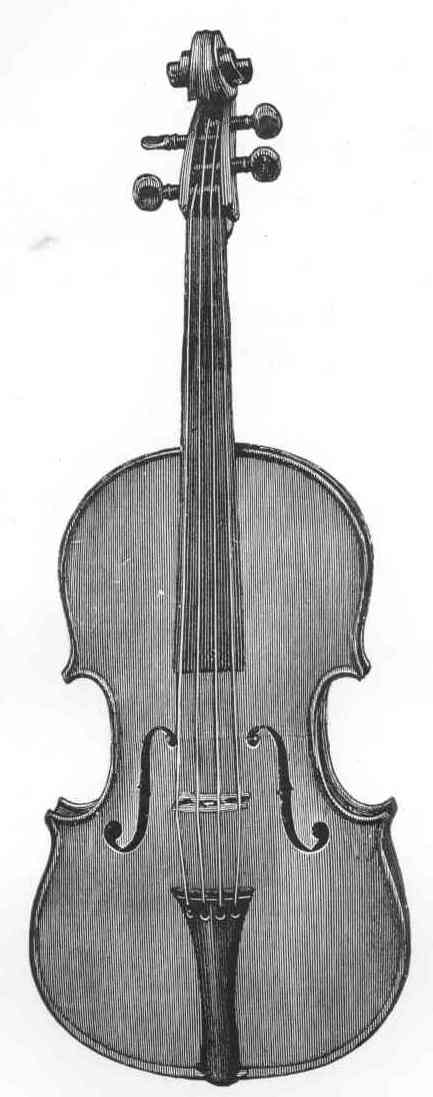
ANTONIO STRADIVARI VIOLA. 1672. Plate I.
It is now necessary to refer to the well-known representation of a Saxon Fiddle contained in the Cottonian manuscripts in the British Museum. Strutt, in his "Sports and Pastimes," supplies us with a copy of the illustration, which is that of a juggler throwing balls and knives to the accompaniment of an instrument of the Fiddle kind. Strutt ascribes the manuscript to the tenth century. The form of this Fiddle is in advance of that supplied in the St. Blasius manuscript, there being four strings, but there is no bridge indicated, and, had there been, it would not have evidenced a Saxon knowledge of tuning the strings to given intervals, and playing upon each string. The little light which has been thrown on the condition of instrumental music at the time renders it doubtful whether any bowed instrument was used, other than for the purpose of rendering a rude extemporaneous accompaniment to the voice or the dance.
The chief authorities upon ancient minstrelsy agree that the Saxon's love of music was cultivated for centuries with ardour by his Saxon ancestors; it would therefore be reasonable to believe that his knowledge of rude Fiddles was derived from the land of his forefathers, and not from any instrument he discovered in Britain.15 The similarity of the instrument of the St. Blasius manuscript and of that in the hands of the Saxon Gleeman in the Cottonian manuscript is evidence of Teutonic origin. It is, moreover, strengthened by the fact of the use of the word Fithele by the Anglo-Saxons for nearly two centuries after the Norman Conquest, which name was adopted with but little variation by the whole of the Teutonic race.16 In Germany the word was used as late as the twelfth century. About this period the word Geige appears to have been applied in Germany to designate a Fiddle. It is described as an improved Rebec, and strung with three strings.17 The use of the word Geige in Germany instead of Fithele in the twelfth century, is worthy of attention as bearing upon Teutonic origin. The earliest information we have of the use of the Geige in France is in connection with the Jongleurs. The Geige was popular in France until the fifteenth century, when, as M. Lacroix says, it disappeared, leaving its name "as the designation of a joyous dance, which for a considerable period was enlivened by the sound of the instrument." The word Geige, I am inclined to think, is important as furnishing evidence of historical value in relation to the ancestry of the Violin. Lacroix believes that Germany created the Geige; other authorities are of opinion that it originated among the people of Provence. The former view is supported by the strongest evidence. Some inquirers derive the word Geige from the French and Italian words for leg of mutton.18 Wigand, however, supposes it to be derived from the old northern word Geiga, meaning trembling, or from Gigel, to quiver. If we consider the nature and character of the instrument, this view of the derivation of the word appears both ingenious and correct. Roger North shrewdly conjectured that the "rude and gross" Gothic Fiddle "used to stir up the vulgar to dancing, or perhaps to solemnise their idolatrous sacrifices." In the Dark Ages dancing may have been regarded as bi-pedal trembling. I have remarked in another place,19 "In the early ages of mankind dancing or jigging must have been done to the sound of the voice, next to that of the pipe, and, when the bow was discovered, to that of a stringed instrument which was named the Geige from its primary association with dancing." The evidence we have of the use to which the leading instrument was put in the days of its adolescence is indicative of its having grown up among dancers, jugglers, and buffoons. In Germany its players gave fame and name to a distinct class of itinerant minstrels named the Gigeours, who were often associated with the Jongleurs in their perambulations. In France, from the days of the Jongleurs to those of Henry IV., and later to those of Louis XIV., the instrument was wedded to the dance. In England to the time of Charles II. it was in the hands of the Fiddler, who accompanied the jig, the hornpipe, the round, and the North Country frisk.
15 In Carl Engel's "Researches into the Early History of the Violin Family," 1883, the author disbelieves in the Crwth having been the lineal ancestor of the Violin, and there can be but little doubt of the correctness of his opinion.
16 It is worthy of remark that the Northmen, who invaded and gave their name to Normandy, carried from their Scandinavian homes a love of minstrelsy.
17 Sebastian Wirdung, a priest, published a work in 1511, in which he describes the bow instruments of his time by the names Gross-Geigen and Klein-Geigen. The illustration of the Klein-Geige differs but little from the Rebec; it has three strings, whilst the Gross-Geige has nine. Further information is supplied by the work of Martin Agricola, published in 1529.—Mendel's German Musical Dictionary, article "Violine."
18 "Almost all our musical writers state, as if it were a well-ascertained fact, that the German word Geige is derived from the Gigue of the French Minstrels, who, during the 13th and 14th centuries, had a sort of Rebec which they called by that name, and which, according to some commentators, resembled in outward appearance the shank of a goat or ram, called Gigot, and hence the origin of all the similar words occurring in different European languages. These commentators have, however, neglected to prove that the old French word Gigue occurs before the 13th century, or that it is earlier than the Middle High German Gige."—Engel's "Researches into the History of the Violin Family."
19 "The Violin and its Music," 1881, page 19.
In pursuing the course of our subject, our inquiries have hitherto been mainly concerned with the leading instrument in a barbarous and semi-barbarous state. We now reach what may be termed the transition stage of the question. The information relative to the appearance of the Geige, or Violin tuned in fifths, is of the slenderest kind. To obtain evidence of much worth it is necessary to reflect upon the condition of instrumental music about the sixteenth century, together with the form and character of bowed instruments belonging to the same period. The manners and customs of peoples have also to be considered. We have hitherto found the Geige or Fiddle among minstrels and itinerant musicians in countries where music and minstrelsy had become an institution with the people. The instrument was rude and gross, and its office was to play extemporaneous accompaniments, with considerable licence. At length domestic music began to be zealously cultivated in Germany and the Low Countries, to which important circumstance the rapid development of stringed instruments is traceable. Viols of various kinds supported the voices, and an important manufacture of such instruments took root in Nuremberg and other German cities. In following the history of the Madrigal much light is thrown upon that of the Viol, to which it is necessary to give attention in order to follow in some degree the development of the Violin.
The condition of music in Italy previous to the time when the father of the Madrigal, Adrian Willaert, followed in the steps of his countrymen and made Italy his home, presents a great contrast to the state of the art in Germany and the Netherlands about the same period. The love of music in these countries had been growing among the people from the days of their minstrel poets and their wandering musicians. In Italy minstrelsy received but little attention or encouragement. The effect of this was probably felt when that extraordinary love of culture and admiration for art manifested itself amid the courts of her princes, about the middle of the fifteenth century. The love of melody then, as now, was deeply rooted in the nature of her people. Musical composition, however, of a high order, and able executants, were to be found elsewhere, and in Flanders in particular, and there the principal music and musicians were sought by the Italian dilettanti. To this fortuitous combination of melody and musical learning we owe the greatest achievements in the art of music. Upon it was raised the work of Palestrina, Scarlatti, and Corelli, which their distinguished followers utilised with such judgment and effect. The progress and development of the Madrigal in Italy may be said to have been co-equal with that of the Viol, for which its music served, and to which the Italians gave the same beauty of form and exquisite refinement. The ingenuity and skilfulness of the early German Viol makers was not less speedily recognised by the Italians than was the learning and power manifested by the Flemish motet writers. The work of the Italians with regard to both the Madrigal and the Viol was artistic in the highest degree, and such as could alone have been accomplished by men nourished on the teachings of the Renaissance, and surrounded by its chief glories.
There is evidence of German influence over the Italian Viol manufacture at the end of the fifteenth century, in the German-sounding names of makers located in Italy, and likewise in the character and construction of the oldest Italian Viols: notably, there is the crescent-shaped sound-hole common to the German Grosse-Geige and Klein-Geige. The most ancient Viols in existence are those by Hieronymus Brensius of Bologna, two of which are in the Museum of the Academy of Music at Bologna, and a third is in my possession. They have labels printed in Roman letters, and doubtless belong to the end of the fifteenth century. These instruments serve to illustrate the condition of the art of Viol-making in Italy at that period. They are rude in form and workmanship, and present a marked contrast to the high artistic work associated with the Italians in other branches of industry. This rudeness is indicative of this particular manufacture being of recent importation, and of its having been received from Germany, and partly perhaps from the Low Countries, where instrumental music was cultivated chiefly by the people, in which case utility would naturally have priority of design and workmanship. With the introduction of Viols, in connection with the Madrigal, into the palaces of Italy, together with their increased use in connection with the service of the Church, a demand speedily arose for instruments of elegant design and finished workmanship, in keeping with the high standard raised by Italian artists in every direction. The work on the Viol by Silvestro Ganassi, published at Venice in 1543, furnishes us with ample proof of the advance made by the Italians in Viol-making since Brensius worked. We see from a representation of a Viol in the above-mentioned work that the sound-holes are better formed, the scroll is artistically designed, and the whole harmonious. These steps towards perfection were mounted by Duiffoprugcar and Gasparo da Salò, both of whom rapidly developed the art. With Gasparo da Salò, or a contemporary, was witnessed the rejection of the crescent-formed sound-hole, and the adoption of that which has held its own for upwards of three centuries. The sound-holes of the Amati and of Stradivari are but those of Gasparo and his contemporaries, marked with their own individuality. All Viols until about 1520 were furnished with pieces of gut tied round the neck and fingerboard to mark the divisions of the scale—in short, were fretted. From the work of Ganassi we learn that the use of these divisions was optional, thus supplying us with authentic information of considerable value with regard to the gradual emancipation of this class of instrument from frets, and foreshadowing the union of the Geige or Fiddle with the Viol. Passing to the question of form given by the Italians, early in the sixteenth century, to Viols, we find the Violono or Bass Viol with its upper and lower sides, middle bouts, belly, and sound-holes almost identical with those of the Tenor Viols, the chief difference being in the back of the latter, which is modelled, whilst the former is flat. This was the form given to the Violono by Gasparo da Salò, and which has been changed in the upper portion of the body of the instrument, to permit of modern passages being executed with greater facility. The original finger-board was short, and generally fretted. The number of strings was five or more, and not as we now string them with three or four. It will be seen that this form of instrument gives us what Mr. Charles Reade describes as the invention of Italy, namely "the four corners."20 The same author in speaking of the order of invention remarks that he is puzzled "to time the Violono, or as we childishly call it (after its known descendant) the Double Bass. If I were so presumptuous as to trust to my eye alone, I should say it was the first of them all." With this opinion I entirely agree, and I am also in unison with Mr. Reade in believing that the large Viola (played on or between the knees) was the next creation, the design of which was that of the Violono or Double Bass already referred to. The next and most important step was in all probability to make the common Geige or three-stringed Fiddle of the same shape as these Tenor and Contralto Viols, thus handing to us the present-shaped Violin. In the MS. notes of Lancetti, reference is made to a three-stringed Violin in the collection of Count Cozio di Salabue, which throws some light upon the question as to three-stringed Violins, of the form of the Italian Viola, having been made prior to the introduction of those with four strings tuned in fifths. The instrument to which Lancetti refers was dated 1546, and was attributed to Andrea Amati. Until the beginning of the present century, this instrument remained in its original condition, when it was altered by the Brothers Mantegazza of Milan into a Violin with four strings. Mention of this curious and valuable fact furnishes us with the sole record of a three-stringed Violin having been in existence during the nineteenth century, and also supplies the link needful to connect the old type of Fiddle with the perfect instrument of the great Italian makers. When or where the four-stringed Violin tuned in fifths first appeared in Italy is a question the answer to which must ever remain buried in the past. It may have seen the light in Mantua, Bologna, or Brescia. The last-mentioned town is usually associated with its advent, and to Gasparo da Salò is given the credit of its authorship.
20 "Cremona Violins," Pall Mall Gazette, 1872. This reference applies to the corners and corner-blocks as made by Gasparo and all makers to the present time, in contradistinction to those seen in the Viol da Gamba and early German Viols.
SECTION II
The Construction of the Violin
The construction of the present form of the Violin has occupied the attention of many scientific men. It cannot be denied that the subject possesses a charm sufficiently powerful to induce research, as endeavour is made to discover the causes for the vast superiority of the Violin of the seventeenth century over the many other forms of bow instruments which it has survived. The characteristic differences of the Violin have been obtained at the cost of many experiments in changing the outline and placing the sound-holes in various incongruous positions. These, and the many similar freaks of inventors in their search after perfection, have signally failed, a result to be expected when it is considered that the changes mentioned were unmeaning, and had nothing but novelty to recommend them. But what is far more extraordinary is the failure of the copyist, who, vainly supposing that he has truthfully followed the dimensions and general features of the Old Masters, at last discovers that he is quite unable to construct an instrument in any way deserving of comparison with the works of the period referred to. The Violin has thus hitherto baffled all attempts to force it into the "march of progress" which most things are destined to follow. It seems to scorn complication in its structure, and successfully holds its own in its simplicity. There is in the Violin, as perfected by the great Cremonese masters, a simplicity combined with elegance of design, which readily courts the attention of thoughtful minds, and gives to it an air of mystery that cannot be explained to those outside the Fiddle world. Few objects possess so charming a display of curved lines as the members of the Violin family. Here we have Hogarth's famous line of beauty worked to perfection in the upper bouts,1 in the lower bouts, in the outer line of the scroll, in the sound-hole. Everywhere the perfection of the graceful curve is to be seen. It has been asserted by Hogarth's enemies that he borrowed the famous line from an Italian writer named Lomazzo, who introduced it in a treatise on the Fine Arts. We will be more charitable, and say that he obtained it from the contemplation of the beauties of a Cremonese Violin.
1 A technical term for the sides.
In looking at a Violin we are struck with admiration at a sight of consummate order and grace; but it is the grace of nature rather than of mechanical art. The flow of curved lines which the eye detects upon its varied surface, one leading to another, and all duly proportioned to the whole figure, may remind us of the winding of a gentle stream, or the twine of tendrils in the trellised vine.
Often is the question asked, What can there be in a simple Violin to attract so much notice? What is it that causes men to treat this instrument as no other, to view it as an art picture, to dilate upon its form, colour, and date? To the uninitiated such devotion appears to be a species of monomania, and attributable to a desire of singularity. It needs but little to show the inaccuracy of such hypotheses. In the first place, the true study of the Violin is a taste which needs as much cultivation as a taste for poetry or any other art, a due appreciation of which is impossible without such cultivation. Secondly, it needs, equally with these arts, in order to produce proficiency, that spark commonly known as genius, without which, cultivation, strictly speaking, is impossible, there being nothing to cultivate. We find that the most ardent admiration for the Violin regarded as a work of art, has ever been found to emanate from those who possessed tastes for kindred arts. Painters, musicians, and men of refined minds have generally been foremost among the admirers of the Violin. Much interest attaches to it from the fact of its being the sole instrument incapable of improvement, whether in form or in any other material feature. The only difference between the Violin of the sixteenth century and that of the nineteenth lies in the arrangement of the sound-bar (which is now longer, in order to bear the increased pressure caused by the diapason being higher than in former times), and the comparatively longer neck, so ordered to obtain increased length of string. These variations can scarcely be regarded as inventions, but simply as arrangements. The object of them was the need of adapting the instrument to modern requirements, so that it might be used in concert with others that have been improved, and allow the diapason to be raised. Lastly, it must be said that, above all, the Violin awakens the interest of its admirers by the tones which it can be made to utter in the hands of a skilful performer. It is, without doubt, marvellous that such sounds should be derivable from so small and simple-looking an instrument. Its expressiveness, power, and the extraordinary combinations which its stringing admits of, truly constitute it the king of musical instruments. These somewhat desultory remarks may suffice to trace the origin of the value set upon the Violin both as a work of art and as a musical instrument.
We will now proceed to consider the acoustical properties of the Violin. These are, in every particular, surprisingly great, and are the results of many tests, the chief of which has been the adoption of several varieties of wood in its construction. In Brescia, which was in all probability the cradle of Violin manufacture, the selection of the material of the sides and back from the pear, lemon, and ash trees was very general, and there is every reason to believe that Brescia was the first place where such woods were used. It is possible that the makers who chose them for the sides and backs of their instruments considered it desirable to have material more akin to that adopted for the bellies, which was the finest description of pine, and that the result was found to be a tone of great mellowness. If they used these woods with this intention, their calculations were undoubtedly correct. They appear to have worked these woods with but few exceptions for their Tenors, Violoncellos, and Double Basses, while they adopted the harder woods for their Violins, all which facts tend to show that these rare old makers did not consider soft wood eligible for the back and sides of the leading instrument; and later experiment has shown them to have arrived at a correct conclusion on this point. The experiments necessary to obtain these results have been effected by cutting woods of several kinds and qualities into various sizes, so as to give the sounds of the diatonic scale. By comparing the intensity and quality of tone produced by each sample of wood, plane-tree2 and sycamore have been found to surpass the rest. The Cremonese makers seem to have adhered chiefly to the use of maple, varying the manner of cutting it. First, they made the back in one piece, technically known as a "whole back"; secondly, the back in two parts; thirdly, the cutting known as the "slab back." There being considerable doubt as to the mode of dividing the timber, the woodcuts given will assist the reader to understand it. Fig. 1 represents the cutting for the back in two pieces—the piece which is separated from the log is divided. Fig. 2 shows the method adopted to obtain the slab form.
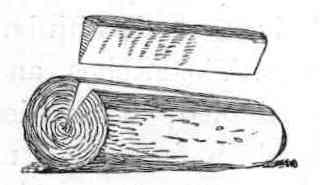
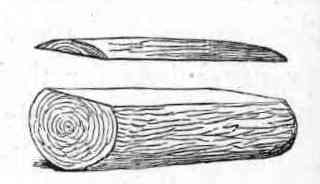
FIG. 1. FIG. 2.
2 The Germans call the plane-tree morgenländischer ahorn—i.e., "oriental maple." From the German word ahorn is probably derived the term "air wood," often corrupted into "hair-wood." Thomas Mace says, respecting the lute, "the air-wood is absolutely the best, and next to that our English maple."—Engel ("Researches into the Early History of the Violin Family").
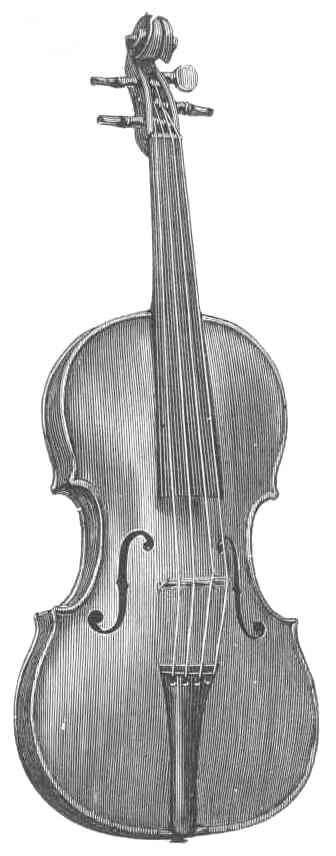
JACOBUS STAINER. Date 1669.
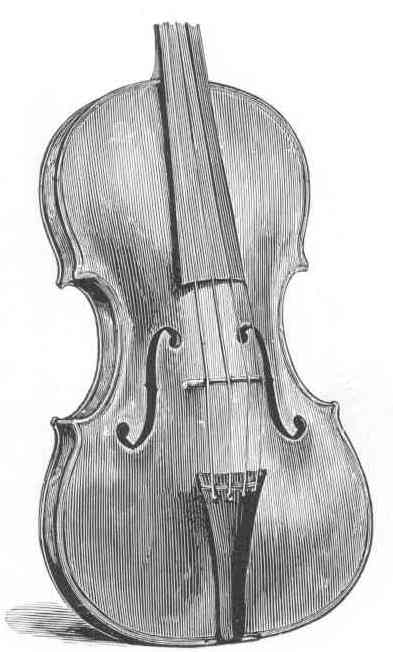
GIUSEPPE GUARNERI DEL GESÙ. (THE "VIEUXTEMPS.")
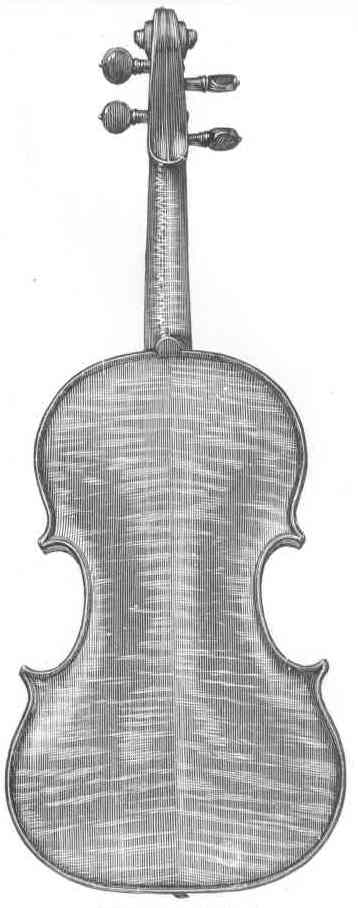
NICCOLÒ AMATI. Grand Pattern. Date 1641. (J. S. COOKE, ESQ.) Plate II.
This mode of cutting is constantly met with in the works of the Brescian makers, and likewise in those of the early Cremonese. Andrea Amati invariably adopted this form. Stradivari rarely cut his wood slab-form. Joseph Guarneri made a few Violins of his best epoch with this cutting, the varnish on which is of an exquisite orange colour, so transparent that the curls of the wood beneath resemble richly illuminated clouds.
There can be no doubt whatever that the Cremonese and Brescian makers were exceedingly choice in the selection of their material, and their discrimination in this particular does not appear to have risen so much from a regard to the beauty as to the acoustic properties of the wood, to which they very properly gave the first place in their consideration. We have evidence of much weight upon this interesting question in the frequent piecings found on the works of Cremona makers, pointing to a seeming preference on their part to retain a piece of wood of known acoustic properties rather than to work in a larger or better preserved portion at the probable expense of tone. The time and care required for such a delicate operation must have been sufficient to have enabled the maker, had he been so minded, to have made a complete instrument. There is also ample proof that Joseph Guarneri possessed wood to the exceptional qualities of which he was fully alive, and the same may be said of Stradivari, Ruggeri, and others. It is scarcely reasonable to suppose that in the seventeenth century there was a dearth in Italy of timber suitable for the manufacture of Violins, and that in consequence these eminent makers were compelled to patch and join their material to suit their purpose. They were men who were in the enjoyment of a patronage certainly sufficient to enable them to follow their calling without privation of any kind. Scarcity of pine and sycamore, good or bad, could not have been the cause, since we find Italian cabinet-work of great beauty that was manufactured at this same period. The plane-tree and pine used by the Amati, Stradivari, and the chief masters in Italy, was usually of foreign growth, and was taken from the Tyrol and Istria. Its value was, therefore, in advance of Italian wood, but hardly so much as to place it beyond the reach of the Cremonese masters. It is, further, improbable that these masters of the art should have expended such marvellous care and toil over their work, pieced as it frequently was like mosaic, when for a trifling sum they could have avoided such a task to their ingenuity by purchasing fresh wood. We are therefore forced to admit that there must have been some cause of great weight which induced them to apply so much time and labour, and that the problem can only be accounted for by the solution before proposed, viz., that external appearance was of less importance than the possession of acoustic properties thoroughly adapted to the old makers' purpose, and that the scarcity of suitable wood was such as to make them hoard and make use of every particle. The selection of material was hence considered to be of prime importance by these makers; and by careful study they brought it to a state of great perfection. The knowledge they gained of this vital branch of their art is enveloped in a similar obscurity to that which conceals their famous varnish, and in these branches of Violin manufacture rests the secret of the Italian success, and until it is rediscovered the Cremonese will remain unequalled in the manufacture of Violins.
We may now pass to the consideration of the various constituent parts of a Violin. It will be found, if a Violin be taken to pieces, that it is constructed of no less than fifty-eight separate parts, an astonishing number of factors for so small and simple-looking an instrument. The back is made of maple or sycamore, in one or two parts; the belly of the finest quality of Swiss pine, and from a piece usually divided; the sides, like the back, of maple, in six pieces, bent to the required form by means of a heated iron; the linings, which are used to secure the back and belly to the sides, are twelve in number, sometimes made of lime-tree, but also of pine. The bass or sound-bar is of pine, placed under the left foot of the bridge in a slightly oblique position, in order to facilitate the vibrating by giving about the same position as the line of the strings. The divergence is usually one-twelfth of an inch, throughout its entire length of ten inches. It is curious to discover that this system of placing the bar was adopted by Brensius of Bologna, a Viol-maker of the fifteenth century, and by Gasparo da Salò. The later Violin-makers, however, for the most part, do not appear to have followed the example, they having placed it in a straight line, thus leaving the system to be re-discovered. The bar of the Violin not only serves the purpose of strengthening the instrument in that part where the pressure of the bridge is greatest, but forms a portion of the structure at once curious and deeply interesting; it may indeed be called the nervous system of the Violin, so exquisitely sensitive is it to external touch. The slightest alteration in its position will effect such changes in the tone as often to make a good Violin worthless. Those troublesome notes technically known as "wolf notes" by its delicate adjustment are sometimes removed, or passed to intervals where the disagreeable sound is felt with less intensity. Numerous attempts have been made to reduce these features to a philosophy, but the realisation of the coveted discovery appears as distant as ever. The most minute variation in the construction of the instrument necessitates a different treatment of this active agent as regards its conjunction with the bridge; and when it is considered that scarcely two Violins can be found of exactly identical structure, it must be admitted that the difficulties in the way of laying down any set of hard and fast rules for their regulation seem to be insuperable.
The next important feature of the internal organism is the sound-post, which serves many purposes. It is the medium by which the vibratory powers of the instrument are set in motion; it gives support to the right side of the belly, it transmits vibrations, and regulates both the power and quality of tone. The terms used for this vital factor of a Violin on the Continent at once prove its importance. The Italians and French call it the "Soul," and the Germans the "Voice." If we accept the bass-bar as the nervous system of a Violin, the sound-post may be said to perform the functions of the heart with unerring regularity. The pulsations of sound are regulated by this admirable contrivance. If mellowness of quality be sought, a slight alteration of its position or form will produce a favourable change of singular extent; if intensity of tone be requisite, the sound-post is again the regulator. It must, of course, be understood that its power of changing the quality of the tone is limited in proportion to the constitutional powers of the instrument in each case. It is not pretended that a badly constructed instrument can be made a good one by means of this subtle regulator, any more than a naturally weak person can be made robust by diet and hygiene.
The position of the sound-post is usually one-eighth to three-eighths of an inch behind the right foot of the bridge, the distance being variable according to the model of the instrument. If the Violin be high-built, the post requires to be nearer the bridge, that its action may be stronger; whilst flat-modelled instruments require that the post be set further away from the bridge. It is not possible to have any uniform arrangement of the sound-post in all instruments; as we have remarked before in reference to the bass-bar, the variations in the thickness, outline, model, &c., of the Violin are so frequent as to defy identity of treatment; uniformity has been sought for, but without success.
The post can only be adjusted by a skilful workman, who either plays himself or has the advantage of having the various adjustments tested by a performer. The necessity of leaving this exceedingly delicate matter in practised hands cannot be too strongly impressed upon the amateur, for the damage done in consequence of want of skill is often irreparable.
There are two methods of setting the sound-post in the instrument: the first fixes it in such a position as to place the grain of the post parallel with the grain of the belly; the second sets it crosswise.
The next important feature to be mentioned is the bridge, which forms no small part of the vibrating mechanism of the instrument, and needs the utmost skill in its arrangement. Its usual position is exactly between the two small niches marked in each sound-hole, but this arrangement is sometimes altered in the case of the stop being longer or shorter. Many forms of bridges have been in use at different periods, but that now adopted is, without doubt, the best. In selecting a bridge great care is requisite that the wood be suitable to the constitution of the Violin. If the instrument is wanting in brilliancy, a bridge having solidity of fibre is necessary; if wanting in mellowness, one possessing soft qualities should be selected.
We now pass to the neck of the Violin, which is made of sycamore or plane-tree. Its length has been increased since the days of the great Italian masters, who seem to have paid but little attention to this portion of the instrument, in regard to its appearance and as to the wood used for its manufacture, which was of the plainest description. It may be observed that in those times the florid passages which we now hear in Violin music were in their infancy, the first and second positions being those chiefly used; hence the little attention paid to the handle of the instrument. Modern requirements have made it imperative that the neck should be well shaped, neither too flat nor too round, but of a happy medium. The difficulties of execution are sensibly lessened when due attention is paid to this requirement.
The finger-board is of ebony, and varies a little in length according to the position of the sound-holes. To form the board properly is a delicate operation, for if it be not carefully made the strings jar against it, and the movements of the bow are impeded. The nut, or rest, is that small piece of ebony over which the strings pass on the finger-board.
The purfling is composed of three strips of lime-tree, two of which are stained black. Whalebone purfling has been frequently used, particularly by the old Amsterdam makers.
The principal parts of the instrument have now been described, and there remain only the pegs, blocks, strings, and tail-piece, the sum of which makes up the number of fifty-eight constituent parts as before mentioned. There is still, however, one item of the construction to be mentioned which does not form a separate portion of the Violin, but which is certainly worthy of notice, viz., the button, which is that small piece of wood against which the heel of the neck rests. The difficulty of making this apparently insignificant piece can only be understood by those who have gone through the various stages of Violin manufacture. The amount of finish given to the button affects in a great measure the whole instrument, and if there is any defect of style it is sure to be apparent here. It is a prominent feature, and the eye naturally rests upon it: as the key-stone to the arch, so is the button to the Violin.
The sound-holes, or f-holes, it is almost needless to remark, are features of vital importance. Upon the form given to them, and the manner of cutting them, largely depend the volume and quality of tone. The Italian makers of Brescia and Cremona appear to have been aware of the singular influence the formation of the sound-hole has upon the production and quality of sound. The variety of original shapes they gave to them is evidence of their knowledge. Appearance in keeping with the outline of their design may have influenced them in some measure, but not entirely. Most makers used patterns from which to cut their sound-holes; Joseph Guarneri and some others appear to have drawn them on the belly, and cut them accordingly.
From the foregoing remarks upon the various portions of the Violin it may be assumed that the reader has gained sufficient insight into the process of its manufacture to enable him to dispense with a more minute description of each stage.
In conclusion, I cannot refrain from cautioning possessors of good instruments against entrusting them into the barbaric hands of pretended repairers, who endeavour to persuade them into the belief that it is necessary to do this, that, and the other for their benefit. The quack doctors of the Violin are legion—they are found in every town and city, ready to prey upon the credulity of the lovers of Fiddles, and the injury they inflict on their helpless patients is frequently irreparable. Unfortunately, amateurs are often prone to be continually unsettling their instruments by trying different bars, sound-posts, &c., without considering the danger they run of damaging their property instead of improving it. Should your instrument need any alteration, no matter how slight, consult only those who have made the subject a special study. There are a few such men to be found in the chief cities of Europe, men whose love for the instrument is of such a nature that it would not permit them to recommend alterations prejudicial to its well-being.
SECTION III
Italian and other Strings
Upon the strings of the Violin depends in a great measure the successful regulation of the instrument. If, after the careful adjustment of bridge, sound-post, and bass-bar, strings are added which have not been selected with due care and regard to their relative proportion, the labour expended upon the important parts named is at once rendered useless. Frequently the strings are the objects least considered when the regulation of a Violin is attempted; but if this be the case, results anything but satisfactory ensue. It is, therefore, important that every Violinist should endeavour to make himself acquainted with the different varieties and powers of strings, that he may arrange his instrument with due facility.
The remarkable conservatism attending the structural formation of the Violin exists more or less in the appliances necessary for the awakening of its dormant music. If we turn to its pegs, we find them of the same character as the peg of its far-removed ancestor, the monochord; and if we compare the Italian peg of the seventeenth century with a modern one, the chief difference lies in the latter being more gross and ugly. Upon turning to the bridge, we see that the bridge of to-day is almost identical with the bridge of Stradivari; and when we come to the strings of the Violin, we discover that we have added but little, if anything, to the store of information regarding them possessed by our forefathers.
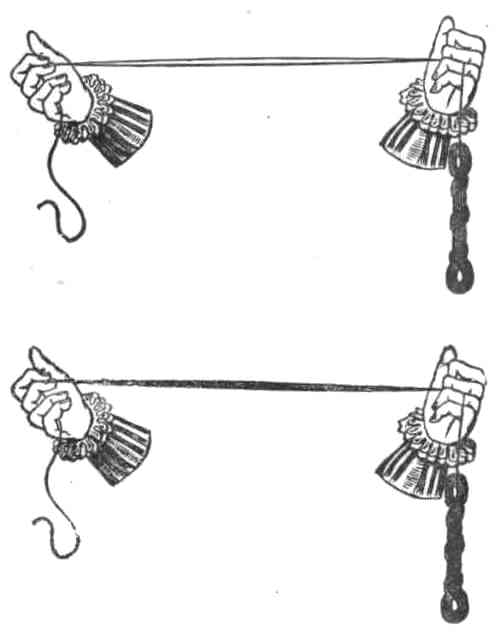
In, perhaps, the earliest book on the Lute, that of Adrian Le Roy, published in Paris in 1570, and translated into English in 1574,1 we read: "I will not omit to give you to understand how to know strings." "It is needful to prove them between the hands in the manner set forth in the figures hereafter pictured, which show on the finger and to the eye the difference from the true with the false." The instructions here given, it will be seen, are those set forth by Louis Spohr in his "Violin School." In the famous musical work of Merseene, published in 1648, we find an interesting account of strings; he says they are of "metal, and the intestines of sheep." "The thicker chords of the great Viols and of Lutes are made of thirty or forty single intestines, and the best are made in Rome and some other cities in Italy. This superiority is owing to the air, the water, or the herbage on which the sheep of Italy feed." He adds that "chords may be made of silk, flax, or other material," but that "animal chords are far the best." The experience of upwards of two centuries has not shaken the soundness of Merseene's opinion of the superiority of gut strings over those made of silk and steel. Although strings of steel and silk are made to some extent on account of their durability and their fitness for warm climates, no Violinist familiar with the true quality of tone belonging to his instrument is likely to torture his ears with the sound of strings made with thread or iron. Continuing our inquiries among the old musical writers in reference to the subject of strings, we find Doni says in his musical treatise, published in 1647: "There are many particulars relating to the construction of instruments which are unknown to modern artificers, as, namely, that the best strings are made when the north and the worst when the south wind blows," a truism well understood by experienced string manufacturers. Thomas Mace, in his curious book on the Lute, enters at some length into the question of strings, and speaks in glowing terms of his Venetian Catlins. The above references to strings, met with in the writers of the sixteenth and seventeenth centuries, indicate a full knowledge of the most important facts concerning them on the part of the musicians and makers of those days; and notwithstanding our superior mechanical contrivances in the manufacture, it is doubtful whether modern strings are generally equal to those made in times when leisure waited on quality, in lieu of speed on quantity.
1 Fétis, in his notice of Le Roy, states that the first edition of this rare book was published in 1557, and was translated by J. Alford into English in 1568.
Musical strings are manufactured in Italy, Germany, France, and England. The Italians rank first, as in past times, in this manufacture, their proficiency being evident in the three chief requisites for string, viz., high finish, great durability, and purity of sound. There are manufactories at Rome, Naples, Padua, and Verona, the separate characteristics of which are definitely marked in their produce. Those strings which are manufactured at Rome are exceedingly hard and brilliant, and exhibit a slight roughness of finish. The Neapolitan samples are smoother and softer than the Roman, and also whiter in appearance. Those of Padua are highly polished and durable, but frequently false. The Veronese strings are softer than the Paduan, and deeper in colour. The variations described are distinct, and the more remarkable that all the four kinds are produced by one and the same nation; as, however, the raw material is identical throughout Italy, the process of manufacture must be looked upon as the real cause of the difference noticed. The German strings now rank next to the Italian, Saxony being the seat of manufacture. They may be described as very white and smooth, the better kinds being very durable. Their chief fault arises from their being over-bleached, and hence faulty in sound. The French take the third place in the manufacture. Their strings are carefully made, and those of the larger sizes answer well; but the smaller strings are wanting in durability. The English manufacture all qualities, but chiefly the cheaper kinds; they are durable, but unevenly made, and have a dark appearance.
The cause of variation in quality of the several kinds enumerated arises simply from the difference of climate. In Italy an important part of the manufacture is carried on in the open air, and the beautiful climate is made to effect that which has to be done artificially in other countries. Hence the Italian superiority. Southern Germany adopts, to some extent, similar means in making strings; France, to a less degree; while England is obliged to rely solely on artificial processes. It therefore amounts to this—the further from Italy the seat of manufacture, the more inferior the string.
From the foregoing references we find that strings, although called "catgut," are not made from the intestines of that domestic animal. Whether they were originally so made, and hence derive their name, it is impossible to learn. Marston, the old dramatist, says:
"How the musicians Hover with nimble sticks o'er squeaking Crowds,2 Tickling the dried guts of a mewing cat."
We may be sure, however, that had the raw material been drawn from that source up to the present time, there would have been no need to check the supply of the feline race by destroying nine kittens out of ten; on the contrary, the rearing of cats would indeed have been a lucrative occupation. A time-honoured error is thus commemorated in a word, the origin of which must be ascribed to want of thought. If the number of cats requisite for the string manufacture be considered for a moment, it is easy to see that Shylock's "harmless necessary" domestics are under no contribution in this matter. Strings are made from the intestines of the sheep and goat, chiefly of the former. The best qualities are made from the intestines of the lamb, the strength of which is very great if compared with those of a sheep more than a year old. This being so, the chief manufacture of the year is carried on in the month of September, the September string-makings being analogous to October brewings. The demand for strings made at this particular season far exceeds the supply, and notably is this the case with regard to strings of small size, which have to bear so great a strain that if they were not made of the best material there would be little chance of their endurance. To enter into a description of the various processes of the manufacture is unnecessary, as it would form a subject of little interest to the general reader; we may therefore conclude this brief notice of strings by a few rules to be observed in their selection.
2 The old English name for a Fiddle.
Endeavour to obtain strings of uniform thickness throughout, a requisite which can only be insured by careful gauging. In selecting the E string, choose those that are most transparent; the seconds and thirds, as they are made with several threads, are seldom very clear. The firsts never have more than a few threads in them, and hence, absence of transparency in their case denotes inferior material. Before putting on the first string, in particular, in order to test its purity it will be well to follow Le Roy's advice, which is to hold between the fingers of each hand a portion of the string sufficient to stretch from the bridge to the nut, and to set it in vibration. If two lines only be apparent, the string is free from falseness; but if a third line be produced, the contrary conclusion must be assumed. In the case of seconds and thirds we cannot always rely on this test, as the number of threads used in their manufacture frequently prevents the line from being perfectly clear. The last precaution of moment is to secure perfect fifths, which can only be done by taking care that the four strings are in true proportion and uniform with each other. To string a violin correctly is a very difficult undertaking, and requires considerable patience. The first consideration should be the constitution of the Violin: the strings that please one instrument torture another. Neither Cremonese Violins nor old instruments in general require to be heavily strung: the mellowness of the wood and their delicate construction require the stringing to be such as will assist in bringing out that richness of tone which belongs to first-rate instruments. If the bridge and sound-board be heavily weighted with thick strings, vibration will surely be checked. In the case of modern instruments, heavy in wood, and needing constant use to wear down their freshness, strings of a larger size may be used with advantage, and particularly when such instruments are in use for orchestral purposes.
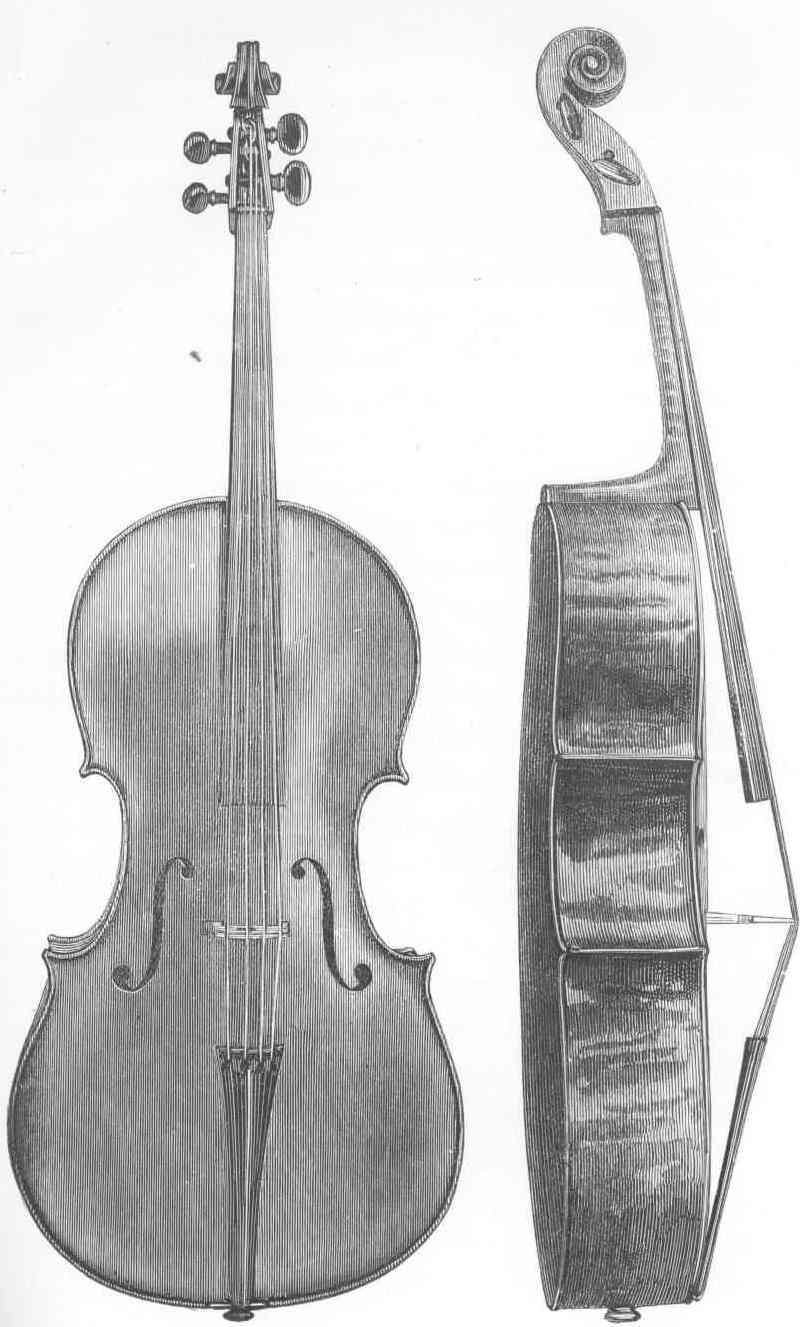
VIOLONCELLO BY ANTONIO STRADIVARI. PRESENTED TO SIGNOR PIATTI BY GENERAL OLIVER. (Herr Robert Mendelssohn.) Plate III.
Vast improvements have been effected in the stringing of Violins within the last thirty years. Strings of immense size were used alike on Violins, Violoncellos, Tenors, and Double Basses. Robert Lindley, the king of English Violoncellists, used a string for his first very nearly equal in size to the second of the present time, and the same robust proportion was observed in his other strings. The Violoncello upon which he played was by Forster, and would bear much heavier stringing than an Italian instrument; and, again, he was a most forcible player, and his power of fingering quite exceptional. Dragonetti, the famous Double-Bass player, and coadjutor of Lindley, possessed similar powers, and used similar strings as regards size. Their system of stringing was adopted indiscriminately. Instruments whether weakly or strongly built received uniform treatment, the result being in many cases an entire collapse, and the most disappointing effects in tone. It was vainly supposed that the ponderous strings of Dragonetti and Lindley were the talisman by use of which their tone would follow as a matter of course, whereas in point of fact it was scarcely possible to make the instruments utter a sound when deprived of the singular muscular power possessed by those famous players. After Lindley's death his system passed away gradually, and attention was directed to the better adaptation of strings to the instrument, and also to the production of perfect fifths.
We have now only to speak of covered strings, in which it is more difficult to obtain perfection than in the case of those of gut. There are several kinds of covered strings. There are those of silver wire, which are very durable, and have a soft quality of sound very suitable to old instruments, and are therefore much used by artistes; there are those of copper plated with silver, and also of copper without plating, which have a powerful sound; and, lastly, there are those which are made with mixed wire, an arrangement which prevents in a measure the tendency to rise in pitch, a disadvantage common to covered strings and caused by expansion of the metals; these strings also possess a tone which is a combination of that produced by silver and copper strings. Here again, however, great discrimination is needed, viz., before putting on the fourth string. The instrument must be understood. There are Violins which will take none but fourths of copper, there are others that would be simply crippled by their adoption. It cannot be too much impressed upon the mind of the player that the Violin requires deep and patient study with regard to every point connected with its regulation. So varied are these instruments in construction and constitution, that before their powers can be successfully developed they must be humoured, and treated as the child of a skilful educator, who watches to gain an insight into the character of his charge, and then adopts the best means for its advancement according to the circumstances ascertained.
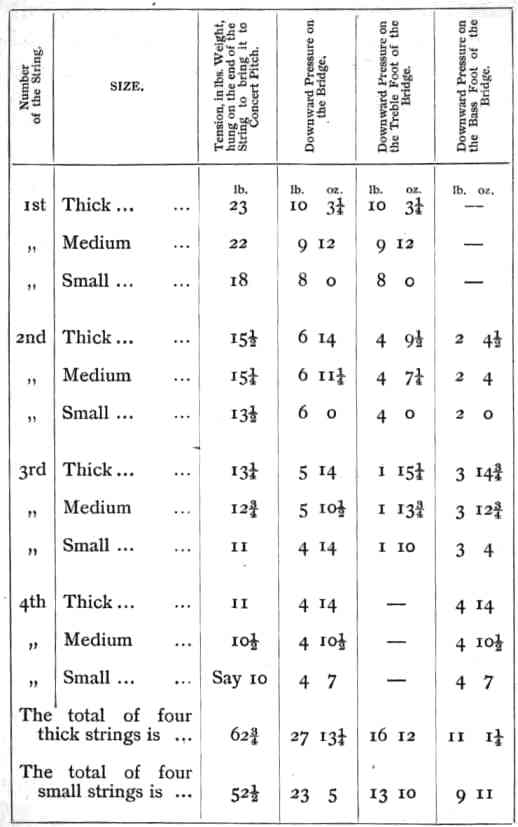
The strain and pressure of the strings upon a Violin being an interesting subject of inquiry, I give the annexed particulars (see Table below) from experiments made in conjunction with a friend interested in the subject, and possessed of the necessary knowledge to arrive at accurate results.
The Violin being held in a frame in a nearly upright position, so that the string hung just clear of the nut to avoid friction, the note was obtained by pressing the string to the nut.
When the Violin was laid in a horizontal position, and the string passed over a small pulley, an additional weight of two or three pounds was required to overcome the friction on the nut and that of the pulley. Therefore it is probable that the difference in the results obtained by other experiments may have arisen from the different methods employed. But with a dead weight hung on the end of each string there could be no error.
TENSION OF VIOLIN STRINGS. Ascertained by Hanging a Dead Weight on the End of the String.
B A C is the average angle formed by a string passing over the bridge of a Violin, and the tension acts equally in the direction A B, A C.
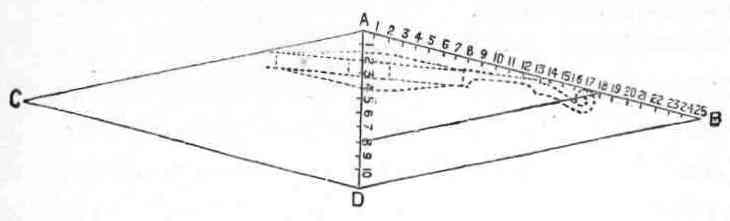
Take A C=A B.
From the point B draw B D parallel to A C. And from the point C draw C D parallel to A B, cutting B D at D.
Join A D.
Then, if a force acting on the point A, in the direction of A B, be represented in magnitude by the line A B, an equal force acting in the direction A C will be represented by the line A C, and the diagonal A D will represent the direction and magnitude of the force acting on the point A, to keep it at rest.
N.B.—The bridge of a Violin does not divide the angle B A C quite equally, but so nearly that A D may be taken as the position of the bridge.
Also, the plane passing through the string of a Violin, on both sides of the bridge, is not quite perpendicular to the belly. To introduce this variation into the calculation would render that less simple, and it will be sufficient to state that about the 150th part must be deducted from the downward pressures given in the above table from the first and fourth strings, and about the 300th part for the second and third strings. The total to be deducted for the four strings will not exceed three ounces.
On the line A B or A C set off a scale of equal parts, beginning at A, and on A D a similar scale beginning at A.
Mark off on the scale A B as many divisions as there are lbs. in the tension of a string, for example 18, and from that point draw a line parallel to B D, cutting A D at the point 8 in that scale. Then, if the tension of a string be 18 lb., the downward pressure on the bridge will be 8 lb.; and therefore for the above angle the downward pressure of any string on the bridge will be 8/18=4/9 of the tension of that string.
The whole of the downward pressure of the first string falls upon the Treble Foot of the Bridge.
The downward pressure of the second string is about 2/3 the Treble Foot of the Bridge, and 1/3 on the Bass Foot.
The downward pressure of the third string is about 1/3 on the Treble Foot, and 2/3 on the Bass Foot.
The whole of the downward pressure of the fourth string falls upon the Bass Foot of the Bridge.
SECTION IV
The Italian School
The fifteenth century may be considered as the period when the art of making instruments of the Viol class took root in Italy, a period rich in men labouring in the cause of Art. The long list of honoured names connected with Art in Italy during the fifteenth, sixteenth, and seventeenth centuries is a mighty roll-call indeed! The memory dwells upon the number of richly-stored minds that have, within the limits of these three centuries, bequeathed their art treasures to all time; and if here we cannot suppress a comparison of the art world of the present Italy with that of the periods named, still less can we fail to be astonished as we discover the abyss into which Italy must be judged to have sunk in point of merit, when measured by the high standard which in former days she set herself. But perhaps the greatest marvel of all is the rapidity of the decadence when it once set in, as it did immediately after the culminating point of artistic fame had been reached.
To reflect for a moment upon the many famous men in Italy engaged in artistic vocations contemporary with the great Viol and Violin makers cannot fail to be interesting to the lovers of our instrument, for it has the effect of surrounding their favourite with an interest extending beyond its own path. It also serves to make prominent the curious fact that the art of Italian Violin-making emerged from its chrysalis state when the painters of Italy displayed their greatest strength of genius, and perfected itself when the Fine Arts of Italy were cast in comparative darkness. It is both interesting and remarkable that the art of Italian Violin-making—which in its infancy shared with all the arts the advantage attending the revival of art and learning—should have been the last to mature and die.
Whilst the artist, scientist, and musician, Leonardo da Vinci, was painting, inventing, and singing his sonnets to the accompaniment of his Lute; whilst Raphael was executing the commands of Leo X., and Giorgio was superintending the manufacture of his inimitable majolica ware, the Viol-makers of Bologna were designing their instruments and assimilating them to the registers of the human voice, in order that the parts of Church and chamber madrigals might be played instead of sung, or that the voices might be sustained by the instruments.1
1 The importance of this epoch in its bearings upon instrumental music generally, and stringed instrument music in particular, can hardly be over-estimated. It may be said that in the Middle Ages no written music for instruments existed. The melodies and accompaniments produced from instruments were either extemporaneous or parrot-like imitations of vocal music. Madrigals and a few dances constituted the food upon which instruments were nursed until towards the close of the sixteenth century, when Gabrielli, or a contemporary musician, prepared a special and distinct aliment, the outcome of which is found in the symphonies of Haydn, Mozart, and Beethoven.
If we turn to the days of Gasparo da Salò, Maggini, and Andrea Amati, we find that while they were sending forth their Fiddles, Titian was painting his immortal works, and Benvenuto Cellini, the greatest goldsmith of his own or any age, was setting the jewels of popes and princes, and enamelling the bindings of their books. Whilst the master-minds of Antonio Stradivari and Giuseppe Guarneri del Gesù were occupied with those instruments which have caused their names to be known throughout the civilised world (and uncivilised too, for many thousands of Violins are yearly made into which their cherished names are thrust, after which they are despatched for the negro's use), Canaletto was painting his Venetian squares and canals, Venetians whose names are unrecorded were blowing glass of wondrous form and beauty. At the same time, in the musical world, Corelli was writing his jigs and sarabands, Geminiani penning one of the first instruction books for the Violin, and Tartini dreaming his "Sonata del Diavolo"; and while Guadagnini and the stars of lesser magnitude were exercising their calling, Viotti, the originator of a school of Violin-playing, was writing his concertos, and Boccherini laying the foundation of classical chamber-music of a light and pleasing character. It would be easy to continue this vein of thought, were it not likely to become irksome to the reader; enough has been said to refresh the memory as to the flourishing state of Italian art during these times. What a mine of wealth was then opened up for succeeding generations! and how curious is the fact that not only the Violin, but its music, has been the creature of the most luxurious age of art; for in that golden age musicians contemporary with the great Violin-makers were writing music destined to be better understood and appreciated when the Violins then made should have reached their maturity.
That Italy's greatest Violin-makers lived in times favourable to the production of works possessing a high degree of merit, cannot be doubted. They were surrounded by composers of rare powers, and also by numerous orchestras. These orchestras, composed mainly of stringed instruments, were scattered all over Italy, Germany, and France, in churches, convents, and palaces, and must have created a great demand for bow instruments of a high class.
The bare mention of a few of the names of composers then existing will be sufficient to bring to the mind of the reader well versed in musical matters the compositions to which they owe their fame. In the sixteenth century, Orlando di Lasso, Isaac, and Palestrina were engaged in writing Church music, in which stringed instruments were heard; in the seventeenth, lived Stradella, Lotti, Bononcini, Lully, and Corelli. In the eighteenth century, the period when the art of Violin-making was at its zenith, the list is indeed a glorious one. At this point is the constellation of Veracini, Geminiani, Vivaldi, Locatelli, Boccherini, Tartini, Viotti, Nardini, among the Italians; while in France it is the epoch of Leclair and Gaviniès, composers of Violin music of the highest excellence. Surrounded by these men of rare genius, who lived but to disseminate a taste for the king of instruments, the makers of Violins must certainly have enjoyed considerable patronage, and doubtless those of tried ability readily obtained highly remunerative prices for their instruments, and were encouraged in their march towards perfection both in design and workmanship. Besides the many writers for the Violin, and executants, there were numbers of ardent patrons of the Cremonese and Brescian makers. Among these may be mentioned the Duke of Ferrara, Charles IX., Cardinal Ottoboni (with whom Corelli was in high favour), Cardinal Orsini (afterwards Pope Benedict XIII.), Victor Amadeus Duke of Savoy, the Duke of Modena, the Marquis Ariberti, Charles III. (afterwards Charles VI., Emperor of Germany), and the Elector of Bavaria, all of whom gave encouragement to the art by ordering complete sets of stringed instruments for their chapels and for other purposes. By the aid of such valuable patronage the makers were enabled to centre their attention on their work, and received reward commensurate with the amount of skill displayed. This had the effect of raising them above the status of the ordinary workman, and permitted them as a body to pass their lives amid comparative plenty. There are, without doubt, instances of great results obtained under trying circumstances, but the genius required to combine a successful battle with adversity with high proficiency in art is indeed a rare phenomenon. Carlyle says of such minds: "In a word, they willed one thing, to which all other things were subordinate, and made subservient, and therefore they accomplished it. The wedge will rend rocks, but its edge must be sharp and single; if it be double, the wedge is bruised in pieces, and will rend nothing." It may, therefore, be affirmed that the greatest luminaries of the art world have shone most brightly under circumstances in keeping with their peaceful labours, it not being essential to success that men highly gifted for a particular art should have this strength of will unless there were immediate call for its exercise.
Judging from the large number of bow-instrument makers in Italy, more particularly during the seventeenth century, we should conclude that the Italians must have been considered as far in advance of the makers of other nations, and that they monopolised, in consequence, the chief part of the manufacture. The city of Cremona became the seat of the trade, and the centre whence, as the manufacture developed itself, other less famous places maintained their industry. In this way there arose several distinct schools of a character marked and thoroughly Italian, but not attaining the high standard reached by the parent city. Notwithstanding the inferiority of the makers of Naples, Florence, and other homes of the art as compared with the Cremonese, they seem to have received a fair amount of patronage, the number of instruments manufactured in these places of lesser fame being considerable.
To enable the reader to understand more readily the various types of Italian Violins, they may be classed as the outcome of five different schools. The first is that of Brescia, dating from about 1520 to 1620, which includes Gasparo da Salò, Maggini, and a few others of less note. The next, and most important school, was that of Cremona, dating from 1550 to 1760, or even later, and including the following makers: Andrea Amati, Girolamo Amati, Antonio Amati, Niccolò Amati, Girolamo Amati, son of Niccolò; Andrea Guarneri, Pietro Guarneri, Giuseppe Guarneri, the son of Andrea; Giuseppe Guarneri ("del Gesù"), the nephew of Andrea; Antonio Stradivari, and Carlo Bergonzi. Several well-known makers have been omitted in the foregoing list simply because they were followers of those mentioned, and therefore cannot be credited with originality of design. The makers of Milan and Naples may be braced together as one school, under the name of Neapolitan, dating from 1680 to 1800. This school contains makers of good repute, viz., the members of the Grancino family, Carlo Testore, Paolo Testore, the Gagliano family, and Ferdinando Landolfi. The makers of Florence, Bologna, and Rome may likewise be classed together in a school that dates from 1680 to 1760, and includes the following names: Gabrielli, Anselmo, Tecchler, and Tononi. The Venetian school, dating from 1690 to 1764, has two very prominent members in Domenico Montagnana and Santo Seraphino; but the former maker may, not inappropriately, be numbered with those of Cremona, for he passed his early years in that city, and imbibed all the characteristics belonging to its chief makers.
Upon glancing at this imposing list of makers, it is easy to understand that it must have been a lucrative trade which in those days gave support to so many; and, further, that Italy, as compared with Germany, France, or England at that period, must have possessed, at least, more makers by two-thirds than either of those three countries. And this goes far to prove, moreover, that the Italian makers received extensive foreign patronage, their number being far in excess of that required to supply their own country's wants in the manufacture of Violins. Roger North, in his "Memoirs of Musick," evidences the demand for Italian Violins in the days of James II. He remarks: "Most of the young nobility and gentry that have travelled into Italy affected to learn of Corelli, and brought home with them such favour for the Italian music, as hath given it possession of our Parnassus. And the best utensil of Apollo, the Violin, is so universally courted and sought after, to be had of the best sort, that some say England hath dispeopled Italy of Violins." We also read of William Corbett, a member of the King's band, having formed about the year 1710 a "gallery of Cremonys and Stainers" during his residence in Rome.
Brescia was the cradle of Italian Violin-making, for the few makers of bowed instruments (among whom were Gaspard Duiffoprugcar, who established himself at Bologna; Dardelli, of Mantua; Linarolli and Maller, of Venice) cannot be counted among Violin-makers. The only maker, therefore, of the Violin of the earliest date, it remains to be said, was Gasparo da Salò, to whom belongs the credit of raising the manufacture of bowed instruments from a rude state to an art. There may be something in common between the early works of Gasparo da Salò and Gaspard Duiffoprugcar, but the link that connects these two makers is very slight, and in the absence of further information respecting the latter as an actual maker of Violins, the credit of authorship must certainly belong to Gasparo da Salò.
We are indebted to Brescia for the many grand Double-basses and Tenors that were made there by Gasparo da Salò and Maggini. These instruments formed the stepping-stones to Italian Violin-making, for it is evident that they were in use long before the first era of the Violin. The Brescian Violins have not the appearance of antiquity that is noticeable in the Double-basses or Tenors, and for one Brescian Violin there are ten Double-basses, a fact which goes far to prove that the latter was the principal instrument at that time.
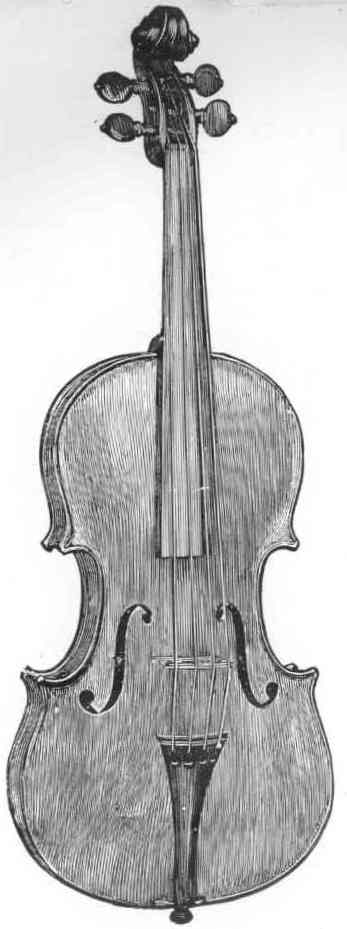
ANTONIO STRADIVARI. Date 1734. (LATE LORD AMHERST OF HACKNEY.)
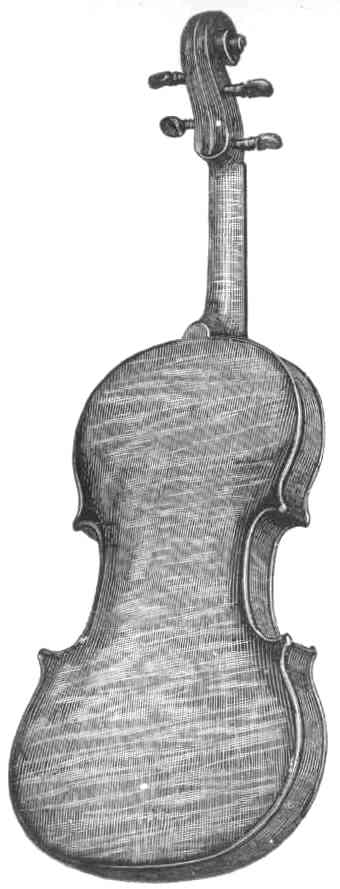
THE EMPEROR "STRAD." Date 1715. (LATE GEO. HADDOCK, ESQ.)
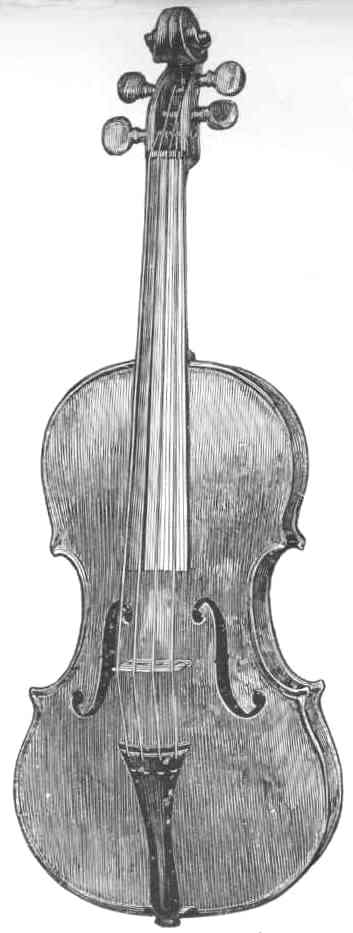
GUARNERI DEL GESÙ. Date 1734. (LATE LORD AMHERST OF HACKNEY.) Plate IV.
From Brescia came the masters who established the School of Cremona. The Amatis took the lead, their founder being Andrea Amati, after whom each one of the clan appears to have gained a march on his predecessor, until the grand masters of their art, Antonio Stradivari and Giuseppe Guarneri del Gesù, advanced far beyond the reach of their fellow-makers or followers. The pupils of the Amati, Stradivari, and Guarneri settled in Milan, Florence, and other cities previously mentioned as centres of Violin-making, and thus formed the distinct character or School belonging to each city. A close study of the various Schools shows that there is much in common among them. A visible individuality is found throughout the works of the Italian makers, which is not to be met with in anything approaching the same degree in the similar productions of other nations. Among the Italians, each artist appears to have at first implicitly obeyed the teaching of his master, afterwards, as his knowledge increased, striking out a path for himself. To such important acts of self-reliance may be traced the absolute perfection to which the Italians at last attained. Not content with the production of instruments capable of producing the best tone, they strove to give them the highest finish, and were rewarded, possibly beyond their expectation. The individuality noticed as belonging in a high degree to Italian work is in many instances very remarkable. How characteristic the scroll and the sound-hole of each several maker! The work of master and pupil differs here in about the same degree as the handwriting of father and son, and often more. Although Stradivari was a pupil of Niccolò Amati, yet how marked is the difference between the scrolls and sound-holes of these two makers; Carlo Bergonzi worked with Stradivari, yet the productions of these two are more easily known apart. A similarly well-defined originality is found, in a more or less degree, to pervade the entire series of Italian Violins, and forms a feature of much interest to the connoisseur.
In closing my remarks upon the Italian School of Violin-making, I cannot withhold from the reader the concluding sentences of the Cremonese biographer, Vincenzo Lancetti, as contained in his manuscript relative to the makers of Cremona. He says: "I cannot help but deeply deplore the loss to my native city (where for two centuries the manufacture of stringed instruments formed an active and profitable trade) of the masterpieces of its renowned Violin-makers, together with the drawings, moulds, and patterns, the value of which would be inestimable to those practising the art. Is it not possible to find a citizen to do honour to himself and his city by securing the collection of instruments, models, and forms brought together by Count Cozio di Salabue, before the treasure be lost to Italy? I have the authority of Count Cozio to grant to such a patron every facility for the purchase and transfer of the collection, conditionally that the object be to resuscitate the art of Violin-making in Cremona, which desire alone prompted the Count in forming the collection." These interesting remarks were written in the year 1823, with a view to their publication at the end of the account of Italian Violin-makers which Lancetti purposed publishing. As the work did not see the light, the appeal of the first writer on the subject of Italian Violins was never heard. Had it been, in all probability Cremona would at this moment have been in possession of the most remarkable collection of instruments and models ever brought together, and be maintaining in at least some measure the prestige belonging to its past in Violin-making.
SECTION V
The Italian Varnish
A word or two must be said upon the famous varnish of the Italians, which has hitherto baffled all attempts to solve the mystery of its formation. Every instrument belonging to the school of Cremona has it, more or less, in all its marvellous beauty, and to these instruments the resolute investigator turns, promising himself the discovery of its constituent parts. The more its lustre penetrates his soul, the more determined become his efforts. As yet, however, all such praiseworthy researches have been futile, and the composition of the Cremonese varnish remains a secret lost to the world—as much so as the glorious ruby lustre of Maestro Giorgio, and the blue so coveted by connoisseurs of china. Mr. Charles Reade truly says: "No wonder, then, that many Violin-makers have tried hard to discover the secret of this varnish: many chemists have given anxious days and nights to it. More than once, even in my time, hopes have run high, but only to fall again. Some have even cried 'Eureka' to the public; but the moment others looked at their discovery and compared it with the real thing,