THE VIOLIN (continued 4)
Reading edition
28 "The Orchestra" of July 15, 1870, contains a notice relative to the circumstance, entitled "The Tomb of Stradivari."
An important point is mentioned by the historian above quoted, viz., that about the year 1720 the Parish Church of St. Matthew being judged too full to allow of further burials in its interior, the Church of San Domenico (its subsidiary church) was chosen as a place of burial for the parishioners, for which purpose it was used down to about 1780, and that Stradivari purchased there the grave mentioned. This statement is confirmed by the autograph letter of Count Cozio di Salabue, of Casale Monferato, Piedmont.
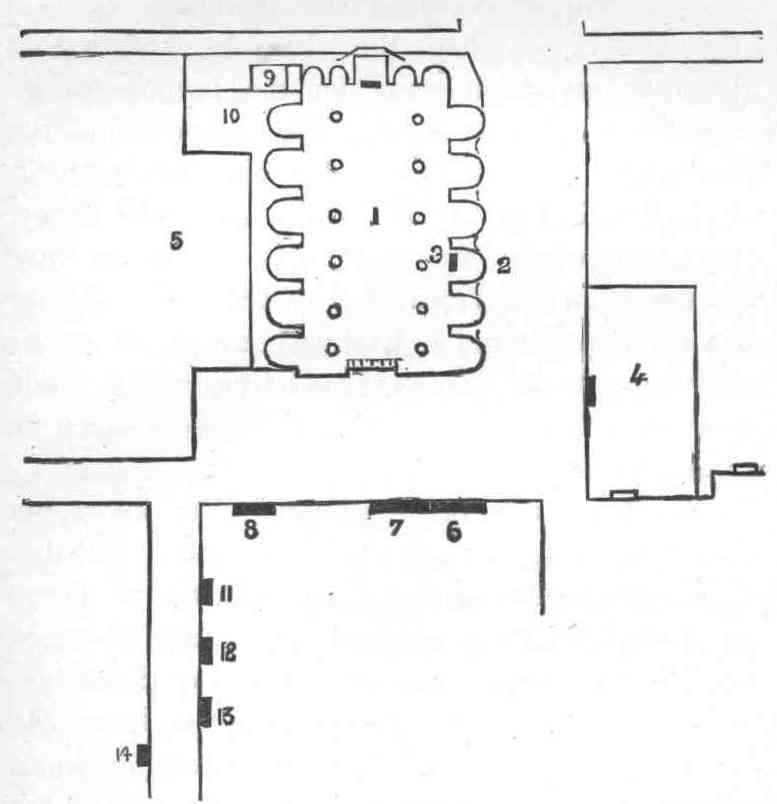
1. Church of S. Domenico. 2. Chapel of the Rosary. 3. Tomb of Stradivari. 4. Church of St. Matthew (since 1820 the Post Office, the church having been profaned in 1808 by the French). 5. Convent of the Dominican Friars. 6. House of Stradivari. 7. House of Bergonzi. 8. House of Guarneri. 9. Tower of the Church of S. Domenico. 10. The Sacristy. 11. Shop of Ruggeri (Via dei Coltellai). 12-13. Shop of Amati. 14. Shop of Storioni, and afterwards that of Ceruti.
The Church of San Domenico was, in consequence of its decayed condition, demolished about the year 1870. Becoming aware of what was taking place, I gave instructions that a photograph should be taken of the chapel in which the body of Stradivari was interred. This was accomplished whilst the workmen were in the act of levelling the structure, and it has been engraved on wood for the purpose of insertion in this volume. The stone with the inscription "Sepolcro di Antonio Stradivari E Svoi Eredi Anno 1729," which served to denote the spot where the body was buried, is now preserved in the Town Hall of Cremona. Signor Sacchi remembered it having been placed in the corner, close to the steps and iron railing inside the third chapel on the right, in the Church of San Domenico.
M. Fétis says of Stradivari, "We know but little respecting that uneventful existence. Polledro, late first Violin at the Chapel Royal of Turin, who died a few years ago, at a very advanced age, declared that his master had known Stradivari, and that he was fond of talking about him. He was, he said, tall and thin, habitually wore, in winter, a cap of white wool, and one of cotton in summer. He wore over his clothes an apron of white leather when he worked, and as he was always working, his costume scarcely ever varied. He had acquired more than competency by labour and economy, for the inhabitants of Cremona were accustomed to say, 'As rich as Stradivari!'"29 The house he occupied stands in the Piazza Roma, formerly called the Square of San Domenico, in the centre of which was the church of the same name. The house is still in good condition, and is the principal place of interest in the old city of Cremona to the many admirers of Stradivari who visit the seat of Violin-making in olden times. After the death of Stradivari it was occupied by his sons Omobono and Francesco; and afterwards by the maker's youngest son, Paolo, who carried on there the business of a cloth merchant. Stradivari worked on the ground floor, and used the upper storey for varnishing.
29 "Notice of Anthony Stradivari."
It is somewhat singular that the Cremonese take but little apparent interest in the matter, and have expressed themselves as being astonished at the demonstrations of respect which their French and English visitors pay to the hallowed spot. The better-informed Cremonese have some acquaintance with the name of Stradivari; but to create any enthusiasm among them from the fact of his having been a Cremonese, or from the historical associations which connect him with that city, would be difficult. After the exercise of considerable patience and determination, Signor Sacchi, in conjunction with a few Cremonese, managed to raise sufficient enthusiasm among the inhabitants to permit the authorities to name a street after Stradivari, and another after Amati. This worthy act was performed by the late librarian, Professor Pietro Fecit, who aided Signor Sacchi in his researches in connection with the past of Cremona's Violin-makers.
This street-naming was much opposed at the time. The citizens of Cremona are, however, not quite singular in this respect. It has been remarked that our American friends show far greater interest in Stratford-upon-Avon and its memories than we ourselves do. I must confess that I have great respect for the genuine enthusiast.
The Cremonese have scarcely an idea of the extent of veneration with which we admirers of the art regard their illustrious citizen. They will be astonished to hear that "Stradivari" forms the Christian name of some Englishmen. A well-known dealer, some years since, determined to commemorate his admiration for the great maker, and, accordingly, named his descendant "Stradivari Turner." We have stepped out of the ordinary path of house nomenclature, and have adopted the cherished name of "Stradivari" to the bewilderment of the passer-by, whose unmusical soul fails to be impressed by it. To crown our seeming eccentricities (in the eyes of our Italian friends), I may mention that the magic name has found its way into circles where little interest is taken in the subject of this notice, judging from the following announcement, which appeared in the profane pages of a newspaper: "Waterloo Purse.—E. Mr. Goodlake's Gilderoy beat Earl of Stair's Stradivarius, and won the Purse;" the result showing that Stradivari was evidently out of place in such company.
Franciscus Stradivarius Cremonensis Filius Antonii faciebat Anno 1742
STRADIVARI, Francesco, Cremona, 1720-43. Son of Antonio Stradivari. Worked with his brother Omobono for several years. Many of the later works of Antonio Stradivari have been attributed to his sons. The character of the work is wholly distinct. I can well understand the error of attributing the instruments of Francesco Stradivari to Carlo Bergonzi, there being many points in common, but that so many marked specimens of the works of Antonio should be deemed apocryphal is beyond my comprehension. The work of Francesco is altogether less finished, but at the same time it shows the hand of the master. The design is bold and original. The tone of Francesco's instruments is invariably rich and telling.
Lancetti states—speaking of Francesco Stradivari—"After the death of his father, he made several Violins and Tenors, to which he put his own name. Although he did not succeed in perfectly imitating the works of his father, the instruments which he made in the years 1740 and 1742, and which remained after his death in the possession of his brother Paolo, were sold at the same price as those of his father, as mentioned in the correspondence between Count Cozio and Paolo. Francesco died at the end of 1742, the year Omobono died, and in which he made the Violins bought by Count Cozio." The date of death (as given by Lancetti), though incorrect by some months—he having died May 11, 1743, aged 72 years—shows the care and trouble taken to render the information as complete as possible, these dates having been given without reference to registers, but simply as stated by Paolo.
Omobonus Stradivarius filius Antonii Cremone fecit, Anno 1740.
STRADIVARI, Omobono, Cremona, 1742. Brother of Francesco. Lancetti remarks, "Omobono chiefly restored instruments and arranged and regulated them." Francesco, it will be seen, survived his brother about thirteen months, and with him, as with Girolamo Amati, the son of Niccolò, we reach the end of the family's long and historical career of Violin-making. Upon the death of Francesco, the shop in the Piazza San Domenico (now named Piazza Roma) was closed, after having been occupied by the family of Stradivari as Violin-makers for upwards of sixty-three years. From here were sent into cathedral, church, and royal orchestras the largest number of Violins and kindred instruments ever made by one maker—instruments which bore the indelible stamp of genius and have gladdened the sight and hearing of untold thousands. The famous shop, as previously noticed, was next opened by Paolo Stradivari, who was a cloth merchant or warehouseman. Paolo died in 1776, a year after the date of the correspondence which passed between him and Count Cozio di Salabue. Antonio, son of Paolo, born in 1738 and married in 1762, had a son Giacomo, born in 1769 and married in 1797. Cesare, the son of Giacomo, became a physician in Cremona, married in 1838, and left, as the representative of the Cremonese branch of the family, Dr. Libero Stradivari, a barrister-at-law and an excellent performer on the flute.
SURSANO, Spirito, Coni, 1714-35.
TANEGIA, Carlo Antonio, Milan, early in the 18th century.
TANINGARD, Giorgio, Rome, 17—.
David Tecchler Liutaro fecit Romæ 17—
TECCHLER, David, Rome, 1680-1743. A highly esteemed maker. He worked in Venice, Salzburg, and Rome, chiefly in the latter city. His instruments vary in form, some having a marked German style: they are high-modelled, and the sound-hole partakes of the Stainer character. These were probably made in Salzburg, to the order of his patrons. Those instruments which date from Rome are chiefly of the Italian type, and are so much superior to the others that it seems difficult to reconcile varieties so distinct as the work of the same man. They are finely formed, have splendid wood, and rich varnish of a yellow tint; the bellies are of a mottled character, similar to those so much used by Niccolò Amati. His Violoncellos are among the finest of his instruments. They are mostly of a large size.
TEDESCO, Leopoldo, pupil of Niccolò Amati. He went to Rome. I have seen a Violin of his make dated from there 1658. Workmanship a little rough, good varnish, Amati outline.
TESTORE, Carlo Giuseppe, Milan, about 1690 to 1720. The form resembles that of Guarneri. The wood is often plain in figure.
TESTORE, Carlo Antonio, Milan, about 1730 to 1764. Son of Giuseppe. Copied Guarneri and Amati. These instruments are bold and well made; their tone is excellent; wood often plain in figure.
TESTORE, Giovanni, son of Carlo Antonio.
TESTORE, Paolo Antonio, Milan, about 1740. Brother of Carlo Antonio. Copied Guarneri. The varnish is mostly yellow; frequently unpurfled.
TIEFFENBRUCKER, Leonardo, Padua, 1587. Lute-maker.
TODINI, Michele, seventeenth century, a native of Saluzzo, lived for many years at Rome. Todini was the inventor and maker of a great number of musical contrivances, in which clockwork played an important part. He occupied himself with this manufacture for several years, and turned his house into a kind of musical museum. He published in 1676 a pamphlet describing its contents. His name is associated with our subject in having adopted a new mode of stringing the Violono, or Double-Bass, by using four strings, and playing himself upon the instrument at oratorio performances in Rome. I have mentioned in Section I. that the Violono was originally used with several strings—five, six, or seven—and with frets. Todini is therefore credited with having introduced the method of stringing the Double Bass which led to the conversion of the old Violonos into Double-Basses fitted for modern requirements.
TONONI, Carlo, Bologna. At the exhibition at Milan in 1881, an inlaid Kit, of beautiful workmanship, was exhibited of this maker.
Carolo Tunonus fecit Bononiae in Platea Castælionis Anno Domini 1698.
Carolus Tononi Bonon fecit Venetiis sub Titulo S. Cecilæ Anno 1739.
TONONI, Carlo Antonio, Venice, born at Bologna, probably a son of the above. The model varies very much; those of the flat pattern are excellent instruments. They are large, and beautifully made. The varnish, though inferior to that of Santo Serafino, is similar. These Violins are branded above the tail-pin. His instruments date from about 1716.
TONONI, Giovanni, about 1700. Similar characteristics.
TONONI, Felice, Bologna.
TONONI, Guido, Bologna.
TOPPANI, Angelo de, Rome, about 1740. Scarce; workmanship resembles that of Tecchler.
TORTOBELLO, Francesco, Rome, 16—. Maggini characteristics.
TRAPANI, Raffaele, Naples, about 1800. Large pattern; flat model; purfling deeply laid; edges sharp; scroll heavy.
VALENZANO, Gio. Maria, Rome, 1771 to about 1830. Neapolitan character; neat work; varnish excellent in some specimens, being soft and transparent.
VETRINI, Battista, Brescia, about 1629. Yellow varnish of good quality; handsome wood; rather small.
VIMERCATI, Paolo, Venice, about 1700. Similar to Tononi. Jacob Stainer is said to have worked in the shop of Vimercati.
WENGER, Padua, Lute-maker, 1622.
ZANNETTO, Pellegrino, Brescia, 1547. M. Chouquet in his "Catalogue Raisonné" of the instruments at the Conservatoire in Paris, describes a six-string Viol da Gamba of this make.
ZANOLA, Giovanni Battista. Flat model; rough workmanship; German character.
Joannes Baptista Zanola, Verona, 17—
ZANOLI, Giacomo, 1740-80. Verona. Worked in Venice, Padua, and Verona. Venetian character.
ZANOTTI, Antonio, Mantua, about 1734.
Antonius Zanotus, fecit Mantuæ, anno 1734.
ZANTI, Alessandro, Mantua, 1765. He copied Pietro Guarneri, but had little knowledge of varnishing, if we are to judge from the few instruments of this maker extant.
ZANURE, Pietro, Brescia, 1509. A maker of Viols.
ZENATTO, Pietro, Treviso, about 1634.
Pietro Zenatto fece in Treviso Anno 1634.
SECTION VII
The French School
The French have long occupied a foremost place in the production of articles needing delicate workmanship, and it is therefore not surprising that they should at an early period have turned their attention to the art of Violin-making, which requires in a high degree both skilful workmanship and artistic treatment. The French manufacture of Violins appears to have commenced about the same period as the English, viz., in the early part of the 17th century, François Médard and Tywersus being among the French makers, and Rayman and Wise their fellows in England. The primitive French makers, like their English brethren, copied the instruments made at Brescia and Cremona, to which course they adhered down to the days of Barak Norman, when the two nations parted company, as regards having a common type, the French continuing the path they had hitherto taken, and copying the Italians, with scarcely any deviation, to the present time. The English left the Italian form for the German one of Jacob Stainer, which they adopted, with but few exceptions, for nearly a century, recovering the Italian about the middle of the 18th century. It is remarkable that French makers should have restrained themselves from following the pattern of the famous German maker when his name was at its height and his instruments were in such demand. That in not adopting the then popular form they were rightly guided, experience has clearly demonstrated. When we scan the older works the French have left us, and consider the advantage they had in keeping to the Italian form, we cannot but feel disappointed in finding so few meritorious instruments among them. There appear to have been many makers who were quite unconcerned whether their instruments possessed merit becoming the productions of a true artist; their chief aim would seem to have been to make in dozens—in other words, quantity in place of quality. If the early French makers are carefully studied, it will be seen that Boquay, Pierray, and one or two of their pupils are the only makers deserving of praise. It must be admitted that the shortcomings of the makers of the first period were adequately supplied by those of the second period, which includes the king of French artists, Nicolas Lupot. The old French school, originating with Tywersus and Médard, includes the following makers: Nicolas Renault, of Nancy, Médard, also of Nancy, Dumesnil, Bertrand, Pierray, Boquay, Gaviniés, Chappuy, Ouvrard, Paul Grosset, Despont, Saint-Paul, Salomon, Véron, with others of less importance. Many of these makers had a fair amount of ideas, which, had they been well directed, might have led to fame. Others contented themselves with copying, without giving any place to their fancy. It will be found that many of the instruments by Boquay, Pierray, and a few others, have varnish upon them closely resembling that of the Venetian school; it is full-bodied, very transparent, and rich in colour. Many of their works are covered with a very inferior quality of varnish, which has caused some confusion respecting the merit due to them as varnishers, they being frequently judged by their inferior instruments, without reference to their good ones. It is evident that they made two qualities of varnish, in accordance with the price they were to obtain, as was commonly done in England by the Forsters, Banks, and Wamsley, where similar confusion exists. The Italians happily avoided this objectionable practice. Their works are of one uniform quality in point of varnish. This divergence may possibly be accounted for by the difference of climate. In Italy, oil varnish, judiciously used, would dry rapidly, whereas in France or England the reverse would be the case; hence its more sparing use.
We will now glance at the second French School of makers, commencing with De Comble. Learning his art in Italy, and, it is said, under Stradivari, he brought to bear a knowledge superior to that possessed by the makers mentioned above. The form he introduced was seen to be in advance of that hitherto met with among the French and Belgian makers, and led to its being chiefly followed. The next maker was Pique, who made Violins and Violas that were excellent in point of workmanship, and had he been equally successful in varnishing he would probably have been held in the same estimation as Nicolas Lupot. From these makers sprang quite a little school of its own, comprising François Gand, in Paris, who succeeded to the business of Lupot, and Bernardel, with several others less known. Mention must not be omitted of another excellent copyist—Silvestre, of Lyons. He has left some charming specimens of his art. They are lighter in character than the works of Nicolas Lupot, and resemble the work of Stradivari from 1680 to 1710. Every portion of the work evidences the skill and judgment of the maker. The wood, with scarcely an exception, has not been manipulated in order to darken it, consequently the instruments become of increasing merit as age acts upon them.
The practice of preparing the wood for Violin-making, either by baking it or by the application of acids, may be traced, in the first instance, to a desire to obtain artificially those results which are brought about by the hand of time. In obtaining lightness and dryness in new wood, it was imagined that the object in view would be reached without the aid of Dame Nature. Experience, however, has shown that Fiddles, like all things intended to pass into green old age, mature gradually, and are not to be benefited by any kind of forcing process. The earliest account I have met with of Fiddle-baking occurred in England about 150 years since. One Jeacocke, a baker by trade, and a lover of music by nature, used to bake his Fiddles in sawdust for a week whenever their tones showed symptoms of not being up to his standard of quality. In France the practice may be said to have been introduced about eighty years ago, with a view of facilitating the creation of such mysteries as Duiffoprugcar and Morella Violins, baked and browned until they had something of a fifteenth-century hue. The same means were adopted in the production of instruments intended as copies of the works of Stradivari and Guarneri. The brown hue of the originals, and the worn and broken condition of the varnish which comes of age alone, were imitated with more or less ingenuity. Happily the error is recognised, as far as the best workmanship is concerned, in France. The legitimate imitator's art no longer includes that of depicting wear and brownness, rendering abortive so much excellent work.
It only remains now to mention Salle, Vuillaume, Chanot, Gand, Germain, Mennégand, Gaillard, and Miremont, all copyists of more or less note, who may be said to complete the modern French school. These makers are or were the chief manufacturers of Violins in France of a better class. Those made by thousands yearly at Mirecourt are not Violins in the eyes of the connoisseur. They are made, as common cabinet work is produced in England, by several workmen, each taking a portion, one making the backs, another the sides, another the bellies, and so on with the other parts of the instrument, the whole being finally arranged by a finisher. Such work must necessarily be void of any artistic nature; they are like instruments made in a mould, not on a mould, so painfully are they alike. This Manchester of Fiddle-making has doubtless been called into being by the great demand for cheap instruments, and has answered thus far its purpose, but it has certainly helped to destroy the gallant little bands of makers who were once common in France, Germany, and England, among whom were men who were guided by reverential feelings for the art, irrespective of the gains they reaped by their labours. The number of instruments yearly made in Mirecourt and Saxony1 amounts to many thousands, and is yearly increasing. They send forth repeated copies of Amati, Maggini, Guarneri, and Stradivari, all duly labelled and dated, to all parts of the world, frequently disappointing their simple-minded purchasers, who fondly fancy they have thus become possessed of the real article at the trifling cost of a few pounds. They produce various kinds of modern antiques in Violins, some of which display an amount of ingenuity worthy of being exercised in a better cause; but usually the whole thing is overdone, and the results, in point of tone, are far more disastrous than in the common French copies. The following list of French, Belgian, and Dutch makers contains many names not included in the first edition of this book. The works wherein several of these names occur are M. J. Gallay's, "Les Luthiers Italiens aux 17ième et 18ième Siècles," 1869; M. Fétis, "Biographie Universelle des Musiciens;" M. Vidal, "Les Instruments à Archet," 1876; the "Catalogue Raisonné," of the instruments at the Conservatoire, by Gustave Chouquet, Paris, 1875; "Recherches sur les facteurs de Clavecins," by M. le Chevalier de Burbure, Antwerp, 1863; Pougin's "Supplement to the Dictionary of Fétis;" and Mendel's "Musikalisches Conversations-Lexikon," 1880.
1 Germany's yearly output of such instruments is enormous, the principal seats of manufacture being Mark-Neukirchen (Saxony) and Mittenwald (Bavaria).
SECTION VIII
French Makers
ALDRIC, Paris, 1790-1844. Copied Stradivari with great skill. He was also well known as a dealer in Cremonese instruments. He was one of the earliest French makers who dealt with Luigi Tarisio, the famous Italian connoisseur. He generally used a red varnish of good quality.
ALLAR, ——, Paris, 1788.
AMELOT, ——, Lorient; worked early in the present century. He used a highly ornamented label.
AUBRY, ——, Paris, 1840. Succeeded his uncle Aldric, mentioned above.
AUGIÈRE, ——, Paris, about 1830, was established in the Rue Saint Eustache, in partnership with Calot, and made some good instruments. Augière formerly worked in the shop of Clement of Paris.
BACHELIER, ——, Paris, 1788.
BASSOT, ——, Paris, 1788.
BERNARDEL, Auguste Sébastien Philippe, born at Mirecourt in 1802, was in the workshop of Lupot, in Paris. The instruments of this maker are excellently made, and the wood judiciously selected. He took his sons into partnership in 1859 and retired from business in 1866. He died in 1870. His sons, Ernst Auguste and Gustave Adolphe, were in partnership with Eugène Gand, and the firm was known as "Gand et Bernardel frères."
BERTRAND, Nicolas, Paris, about 1700 to 1735, used varnish of a superior kind. He made many of the Viols of the type common in Paris, for some time after the Violin had been introduced; they were named Dessus-de-Viole, Pardessus, Quinton, and Viole-haut-contre. His name is often seen branded on the backs of his instruments, inside.
BOIVIN, Claude, about 1749, Paris. M. Chouquet, in his "Catalogue Raisonné" of the instruments at the Paris Conservatoire, described a Guitar by this maker, made for a daughter of Louis XV.
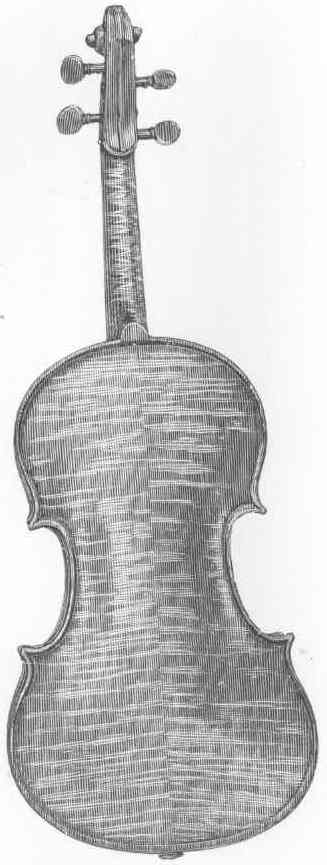
ANTONIO STRADIVARI. 1702.
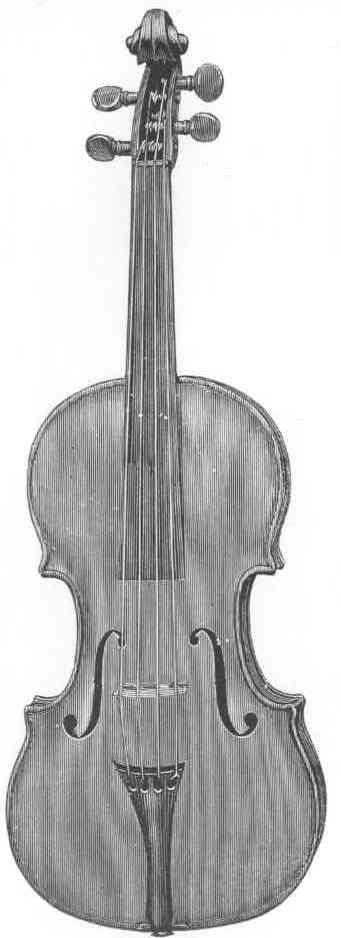
ANTONIO STRADIVARI. 1722.
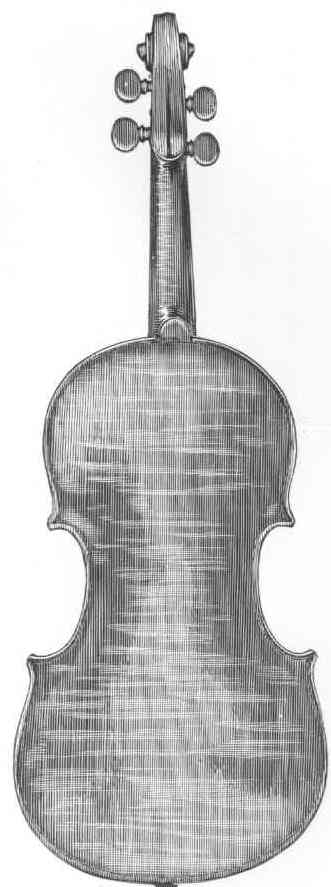
ANTONIO STRADIVARI. 1703. Plate XIII.
Jacques Boquay, rue d'Argenteuil, à Paris, 1723.
BOQUAY, Jacques, Paris, 1700-1730. One of the first of the old French school. He, with a few of his contemporaries, inherited a good amount of the Italian character of workmanship, introduced probably into France by Nicolas Renault. Boquay, with others whose names are mentioned in this list of French makers, used varnish closely allied to that of Cremona; its colour is a warm brown, very transparent, and of a soft nature. He made many instruments of small size. The model is often that of Girolamo Amati, but slightly more arched; the sound-hole is more rounded and less striking. The scroll can scarcely be considered a copy of Girolamo Amati's; it is well cut, but lacks the peculiar grace of the Italian. The tone is sweet, without much power.
BORLON, Artus or Arnould, about 1579, Antwerp, maker of stringed instruments (mentioned in the pamphlet by M. le Chevalier de Burbure).
BORLON, or PORLON, Pierre, Antwerp, about 1647, of whom M. de Burbure says: "Pierre Borlon, or Porlon, made in the year 1647 a Double-Bass for the orchestra of the Cathedral (Antwerp). The instrument is in existence, and inside is the name 'Peeter Porlon tot, Antwerpen f. 1647.'" The same author mentions another early Double-Bass made in 1636 by Maître Daniel for a chapel in Antwerp, and remarks, in passing, that in other countries the Double-Bass was not used until about half a century later. The question of priority in this matter is important and interesting; but in order to arrive at a satisfactory conclusion, it is necessary to be certain that these Belgian Basses are not, together with the Brescian and others, converted Viols.
BORLON, Joannes, Antwerp, also a maker of Viols.
BORLON, François, Antwerp, Viol-maker.
BOULLANGIER, C., 1823-1888. Worked in Paris, and for the late Mr. Withers. Was in business for many years in Frith Street, Soho, and has made many excellent instruments.
BOUMEESTER, Amsterdam, about 1650.
BOURDET, Sébastien, Mirecourt, one of the earliest Violin-makers in Mirecourt.
BOURDET, Jacques, Paris, 1751.
BOUSSU, Eterbeck, le Bruxelles, about 1750.
BRETON, 1777. This name is met with branded on the backs, "Breton à Paris." A little heavy in character, but fairly made; dark brown colour.
BRETON, Le, Mirecourt, 1812-30. Commonplace instruments. Large pattern, usually stamped with name inside.
BRUGÈRE, the name of several contemporary French makers, dating from Mirecourt and elsewhere. Some show good workmanship and varnish.
CALOT, ——, about 1830. He was in the workshop of Clément prior to date given. See AUGIÈRE.
CASTAGNERY, Andrea. See Italian list.
CASTAGNERY, Jean Paul. M. Fétis mentions this maker as having worked in Paris, 1638-62.
CHAMPION, René, Paris, about 1735. His instruments are well made, and the varnish is of good quality.
CHANOT, François, born at Mirecourt in 1788. An engineer by profession. Becoming interested in the construction of Violins, he designed one having sides like those of the guitar. M. Chouquet describes a Violin of this maker, made for Viotti, and remarks that the experiment of François Chanot opened the way to those of Savart. The date of Chanot's patent is 1818. The paper of Savart on the construction of bow instruments was read at the French Academy in the following year.
CHANOT, Georges, Paris. Brother of the above-named; born at Mirecourt, 1801. Throughout life was a most indefatigable worker. He has made a very large number of copies of Stradivari and Guarneri, chiefly of the former, which are also the best. They are well constructed instruments, and the wood is of an excellent description. He was long known as a dealer in Cremonese instruments, and many notable rarities passed into his possession. The instruments of this maker will, at no distant date, be valued higher than they are at the present time. He died in 1883.
CHANOT, Georges, London. Son of Georges Chanot, Paris. Assisted Charles Maucotel, and a short time afterwards started in business on his own behalf. He died in 1893.
CHANOT, F. Son of Georges Chanot.
CHANOT, G. A. Brother of the above-named.
CHAPPUY, Nicolas-Augustin, about 1765. His instruments are chiefly of large pattern; nearly all are branded on the button, in a similar manner to those of the Testore family. Chappuy differed greatly in his work. When he used plenty of wood we have instruments of a good kind and worthy of attention. There are many, however, having his brand that are scarcely fit to be called Violins, so inferior is the work and wood.
The Violin M. Habeneck used during thirty-seven years, when instructing his class at the Conservatoire, Paris, was made by Chappuy, and is preserved at that institution.
CHARDON, Joseph, Paris, son-in-law and pupil of Georges Chanot, Paris, to whose business he succeeded in the year 1872.
CHAROTTE, ——, born at Mirecourt, settled at Rouen. Died in 1836.
CHATERAIN, Paris, about 1759. Good workmanship.
CHEVRIER, André-Augustin, about 1838. Born at Mirecourt, worked in Paris and Brussels.
CLAUDOT, Charles, Paris, possibly came from Mirecourt. The workmanship is heavy; varnish mostly yellow. His instruments are good for orchestral purposes. His name is generally found stamped on the back, inside.
CLAUDOT, Augustin, Paris, "Strad" pattern, yellow varnish, good wood.
CLEMENT, ——, Paris, 1815-40.
CLIQUOT, Henri, Paris, about 1765.
CLIQUOT, Louis Alexandre, about 1765.
COUSINEAU, Paris, about the end of the 18th century. Well made, name often branded on button.
CUNAULT, Georges, Paris, contemporary; worked with Miremont, and afterwards alone; a careful maker.
CUNY, ——, Paris. 18th century.
CUYPERS, Johannes, 1755-18—. Worked at the Hague; varnish often yellow in colour. Well finished instruments, which are rising in value.
DANIEL, ——, 1656, is described as having made a Double-Bass for the orchestra of one of the chapels at Antwerp Cathedral.
DARCHE, Nicholas, Aix la Chapelle, died 1873. Made many useful instruments on the lines of the Cremonese Masters. Other makers of this name worked in Brussels and Mirecourt in the 19th century.
DAVID, ——. Maker to the court of Louis XVI.
Fait à Tournay par Ambroise de Comble, 1750.
DE COMBLE, Ambroise, Tournay, about 1760. It is said that he worked in the shop of Antonio Stradivari, and judging from the character of the work, together with that of the varnish, it is not unlikely that he did receive instructions from the great Cremonese maker. The varnish is very like Italian; the colour often a rich red, with much body. His instruments are inclined to roughness as regards workmanship, and therefore are not pleasing to the eye. There is a resemblance to the instruments of Stradivari after 1732 in form, though not in workmanship, and he would therefore seem to have copied those late instruments. They may be described as of large pattern, flat model, and having an abundance of wood. They are deserving of attention both from the professor and the amateur, the workmanship being skilful and the material excellent. The tone is large, and frequently possesses the richness so much admired in the works of the Italians. This quality is traceable to the soft and flexible nature of the superior varnish with which these instruments are covered. Several Violas and Violoncellos are extant which were made by De Comble.
DEHOMMAIS, Paris, 1870. See GERMAIN (Emile).
DELANOIX, ——, Bruxelles, about 1760.
DELAUNAY, ——, Paris, 1775, Viol-maker. M. Chouquet describes an instrument of this maker which is in the collection at the Conservatoire.
DELEPLANQUE, Gérard, Lille, 1768.
DERAZEY, Honoré, Mirecourt. Many of the instruments of this maker are carefully finished. They are heavy in wood. The varnish is inclined to hardness. Died 1875.
DERAZEY, J. A., Mirecourt, 1815-85. Son of Honoré; purchased the business of Nicolas. Made many useful instruments.
DESPONS, Antoine, Paris, 17th century, is said to have made excellent instruments of various patterns.
DIEULAFAIT, ——, 1720, Viol-maker. A Viol da Gamba of this maker is at the Conservatoire, Paris.
DROULOT, ——, Paris, 1788.
DUCHERON, Mathurin, Paris, 1714.
DU MESNIL, Jacques, Paris, about 1655.
EESBROECK, Jean Van, 1585, Antwerp, Lute-maker. M. C. Chevalier de Brabure states he was the son of Josse van Eesbroeck, of Maria Kerch. He gives some interesting particulars relative to the connection of music with the guild of St. Luke at Antwerp, and speaks of the makers of Clavichords seeking for admission into the Guild in 1557, adding that it was natural these makers should desire to belong to a corporation so great and honourable as that of St. Luke, which since 1480 had its Chambers of Rhetoric "dite de Violiren, de Violier."
FALAISE, ——. Copied the Amatis and Stradivari. The workmanship may be likened to that of Pique. Varnish yellow and thin. There is no indication of a resort to any maturing process. Wood frequently handsome.
FENT, or FENDT, ——, Paris, 1780. A maker known among French connoisseurs; related to the Fendts who worked in London.
FLEURY, Benoist, Paris, from about 1755 to 1788. A Viol da Gamba of this maker, from the Clapisson collection, is at the Conservatoire, Paris.
FOURRIER, Nicolas, Mirecourt. See NICOLAS.
GAILLARD, Charles, Paris, about 1850-81. Born at Mirecourt. Worked in Paris with C. A. Gand, and later on his own account. He was one of the best modern French makers, and his instruments already take high rank and command good prices.
GAILLARD-LAJOUE, J. B., Mirecourt, brother of the above. Apprenticed to Gand, for whom he worked until about 1852. Much of his work is of a high order, and his best instruments are yearly increasing in value. He died about 1870.
GAND, Charles François, Paris. He became a pupil of Nicolas Lupot in the year 1802. During his apprenticeship he proved himself an excellent maker, and was much valued by his famous instructor. He married the daughter of Lupot, and succeeded him in the Rue Croix des Petits Champs in the year 1824. The career of François Gand was one of much activity. As a repairer of the works of the great masters he early obtained a high reputation, and perhaps restored more valuable instruments than any repairer of his time. The care that he took and the judgment which he exercised in endeavouring to bring together the various broken parts of an imperfect instrument, that the original appearance might be maintained as closely as possible, cannot be too highly praised. He often accomplished seeming impossibilities. Splintered cracks were by his ingenuity closed as though no fibre had been severed, while at other times pieces were inserted so deftly that the most experienced eyes might fail to detect their presence. It was with him a labour of love, and he did not scruple to spend days over work on which others would only spend hours. He made many Violins, several of which were given as prizes at the Paris Conservatoire. They are well-made instruments, though heavy in appearance. They are good serviceable instruments, and, the wood not having been browned by baking or other injurious process, age mellows them greatly. He died in the year 1845.
GAND, Charles Adolphe, son of Charles François Gand, was instructed by his father, and succeeded, together with his brother, to the old-established house founded by his grandfather. He died in 1866.
GAND, Charles Nicholas Eugène, Paris, brother of C. Adolphe Gand, was a connoisseur of much experience and reputation. Upon the death of his brother C. Adolphe he entered into partnership with Bernardel Brothers. The firm employed many workmen, and turned out large numbers of useful, well-made instruments, with red varnish. They were the recipients of numerous medals and decorations. C. N. E. Gand died in 1892.
Gaviniés, rue S. Thomas du Louvre, à Paris, 17—
GAVINIÉS, François, Paris, about 1734. Father of Pierre Gaviniés, the Violinist. Old French school. The wood is often of excellent quality, and the varnish also. Many of these old French makers, like our good English ones, made instruments of two qualities, and Gaviniés was one of them.
GERMAIN, Joseph Louis, born at Mirecourt in 1822. In Paris he was employed by François Gand, and afterwards worked for Vuillaume, for whom he made several choice instruments. It is to be regretted that his exceptional abilities were not allowed to add lustre to his name, he having made for the trade. He died in 1870.
GERMAIN, Emile, Paris. Son of the above; established in Paris as a maker and restorer of Violins. He was, until 1882, in partnership with a maker named Dehommais.
GOSSELIN, ——, Paris, 1814-40.
GRAND-GERARD, Paris, about 1800. Commonplace work branded occasionally with his name.
GRANDSON, Fils, Mirecourt, about 1850.
GROSSET, Paul François, Paris, about 1750. Pupil of Claude Pierray.
GUERSAN, Louis, succeeded Paul Pierray.
Ludovicus Guersan prope Comædiam Gallicam, Lutetiæ, Anno 1766.
HEL, Pierre Joseph, Lille, contemporary. Well-made instruments.
HENRY, Jean Baptiste. Born 1757, near Mirecourt. Worked in Paris.
HENRY, Jean Baptiste Felix, son of the above. Established in Paris 1817.
HENRY, Charles, brother of the above, born 1803. Made several excellent instruments.
HENRY, Octave, nephew of Charles.
HENRY, Eugène, son of Charles, born in 1843.
HOFMANS, Mathias, Antwerp, 1700-25. A Kit of this maker was exhibited at Milan in 1870.
JACOBS, Hendrik, Amsterdam, 1690-17—. A close imitator of Niccolò Amati. Few makers have been more mistaken than Jacobs; so exact was he in following the model of Amati, that numbers of his Violins are passed by the inexperienced as original. He mostly selected the grand pattern of Amati for his model, which gave him full scope for the exercise of his powers. He selected wood as nearly as possible resembling that found in the works of Niccolò Amati. The backs are mostly of even grain, and compact; the modelling can only be found fault with near the purfling, where its sharpness at once catches the attention of the critic in these matters, and divulges the true author. The varnish, though good, is not equal to that of Amati. The scroll is inferior to the body in merit. The purfling is of whalebone, like that of most of the Dutch makers.
JACOBS, ——, Amsterdam, probably a son of the above. Excellent varnish, of a deep red, very transparent; full of character, but wanting in finish. Purfling embedded.
JACQUOT, Charles, born at Mirecourt in 1804. Worked in Paris. He obtained prizes for his instruments at the Paris and other exhibitions.
JACQUOT, Pierre Charles, Nancy, son of the above.
JEANDEL, P. N., born in 1812. Worked for some years in Paris, and received prizes at the Paris and other exhibitions. He died in 1879.
KOLIKER, ——, Paris, 1789-1820.
LAMBERT, Jean Nicolas, Paris, about 1745.
LAPAIX, ——, Lille, about 1855.
LAPREVOTTE, Etienne, Paris, 1825-56.
LECLERC, ——, Paris, about 1775.
LECOMTE, ——, Paris, 1788.
LEDUC, Pierre, Paris, 1646.
LEFEBVRE, ——, Amsterdam, about 1730.
LEFEBVRE, ——, Paris, 1788.
LE JEUNE, François, Paris, 175-.
LE PILEUR, Pierre, about 1754.
LESCLOP, François Henry, Paris, 1746.
LOUIS, ——, Geneva.
LOUVET, Jean, Paris, 1750.
LUPOT, Jean, Mirecourt.
LUPOT, Laurent, Mirecourt, born 1696. Son of Jean Lupot, removed to Plombières, afterwards to Luneville, and again to Orleans.
LUPOT, François, born 1736. Son of Laurent. Born at Plombières. In the year 1758 he removed to Stuttgart, and was appointed maker to the Duke of Wurtemberg. François removed with his son Nicolas to Orleans in 1770. He died in Paris in 1804. The workmanship and style are similar to those seen in the instruments of Chappuy and other makers of that period. Scroll rather rough, varnish dark brown, broad pattern.
N. Lupot fils, Luthier, rue d'Illiers, à Orléans, l'an 1791. Nicolas Lupot, Luthier, rue de Grammont; à Paris, l'an 1803. Nicolas Lupot, Luthier, rue Croix des-petits-champs, à Paris, l'an 1817.
LUPOT, Nicolas, son of François, born at Stuttgart in 1758, removed with his father to Orleans in 1770. He established himself in Paris in 1794, his fame having reached that city some time before. The attention which he soon received from the musical world of Paris proved to him that his removal was advantageous. He had not long been in Paris before he was honoured with the patronage of the Conservatoire of Music, an honour which is attended with many benefits, the chief of which is the making of a Violin annually, to be awarded as a prize to the most successful student among the Violinists. By this arrangement the maker has an opportunity of exercising to the best advantage all the skill of which he is capable, as he is at once aware that the attention of the public is directed to the constructor of the prize, as well as to the receiver, and that an immediate road to popularity is thus opened. Lupot's appointment as maker to the Conservatoire was enjoyed by his successor, François Gand, and was retained by the latter's son, in conjunction with Bernardel. Nicolas Lupot may be justly termed the French Stradivari. He was an artist in every sense of the word. He regarded the works of Stradivari with the utmost veneration. While, however, he laboured unceasingly to imitate him, he scorned all those mischievous maturing processes common to so many French copyists; he never desired that his copy should pass with the unwary as the original; it left his hands wholly unsophisticated. There is not an instance in which he did not varnish the copy all over, leaving time to do its work of wear, although by so doing he doubtless sacrificed much in his own time, inasmuch as all new Violins, so varnished, have a crude appearance, notwithstanding any amount of high finish expended upon them. What, however, Lupot lost in his own day has been awarded to his name a hundredfold since. He seldom occupied himself in copying Guarneri or Amati, although there are a few beautiful examples met with now and again in which he adopted these forms. Stradivari was his idol, and from the fact already mentioned, that he is very rarely found to have followed any other model than that of Stradivari, he would seem to have been aware of his own peculiar fitness for the great master's design. Every feature of Lupot's instruments was clearly a matter of study with him. It cannot be said of him, as of most other makers, that certain points are good, while others are weak. Every portion of his work contributes to the harmonious whole. The outline is perfect; the sound-hole is executed in a masterly manner; the model, purfling, and scroll of equal merit. He was untouched in his own day, and his productions have never been approached since. The varnish of Lupot is peculiar to him. Its qualities are good, being free from hardness. Though it is not of the Italian type, neither is it of the kind usually met with on the Violins of his contemporaries: it may be described as a quality of varnish coming between the Italian and the French. Its colour varies between light and dark red. Age has assisted in heightening its lustre, and although it will never rank with the varnish of Cremona, yet it will hold its own among the varnishes of modern times. It is said that many instruments having the name of Pique in them are the work of Lupot, and this misnomer is accounted for by the story that Pique purchased them in an unvarnished state, and varnished them with his preparation. Be this as it may, it is certain that the varnish of Pique could not serve to benefit such instruments; on the contrary, it would reduce their value. The tone of Lupot's instruments improves yearly. The quality is round and telling, and free from roughness. He died in Paris in 1824, aged 66, and was succeeded in his business by his son-in-law, François Gand.
MARQUIS DE LAIR, Mirecourt, about 1800. The name is generally branded on the back. The wood is chiefly of a plain description, and varnish wanting in transparency.
MAST, Jean Laurent, Paris, about 1750.
MAST, Joseph Laurent, Mirecourt and Toulouse. Son of Jean Laurent. A Violin dated 1816 is in the Museum of the Paris Conservatoire.
MAUCOTEL, Charles, born at Mirecourt, in 1807. In 1834 he entered the workshop of Gand in Paris. In 1844 he was employed by Davis, of Coventry Street, London, and ultimately commenced business in Rupert Street, from which he retired in 1860, and returned to France. He made several instruments, all of which have good qualities in workmanship and tone. They are strong in wood and carefully modelled.
MAUCOTEL, Charles Adolphe, Mirecourt, worked in Paris from 1839 until 1858, in which year he died. He made many excellent instruments.
Franciscus Médard fecit Parisiis 1710.
MÉDARD, François, was established in Paris about 1700. The work is excellent, and the varnish soft and transparent.
MÉDARD, Nicolas, Nancy, brother of François.
MÉDARD, Jean, Nancy, brother of Nicolas.
MENNÉGAND, Charles, born at Nancy in 1822. He is distinguished both as a maker and repairer of instruments. He entered the service of Rambaux in Paris in 1840. He has been rightly regarded as having displayed singular ability in the delicate and difficult task of "cutting" the large Italian Violoncellos and Tenors. The practice of reducing the dimensions of Cremonese instruments has happily come to be looked upon as emulative of the acts of the Goths and Vandals. It is in any case certain that numerous instruments have been operated upon with no greater skill than might have been expected at the hands of those barbarians. "These ruthless men," remarks Charles Reade, "just sawed a crescent off the top, and another off the bottom, and the result is a thing with the inner bout of a giant and the upper and lower bout of a dwarf." He rightly names this, "cutting in the statutory sense, viz., cutting and maiming," and implores the owner of an instrument in its original state to spare it, and if too large, to play on one of the value of £5, with the Cremona set before him to look at while he plays. To "cut" a Cremona, and to cut a diamond into a brilliant or a rose, are tasks equally difficult. The indifferent operator, in both cases, suffers more or less from the injury and annoyance his unskilfulness has occasioned. Borgis, a Venetian diamond-cutter, was employed by Shah Jehan to cut the Koh-i-nor, and in place of a reward was fined ten thousand ducats for his imperfect performance. Had it happened that some possessors of Cremonese gems had inflicted monetary or other punishment on incapable instrument cutters, the world would have been richer in Cremonas. Mennégand was at Amsterdam for a few years, and returned to Paris in 1857. He died in 1885.
MIREMONT, Claude Augustin, Paris. Born at Mirecourt in 1827, removed to Paris in 1844. Miremont has made several excellent Violins, copies of Stradivari and Guarneri. He was for some years in New York, but returned to Paris and died at Pontorson in 1887.
MODESSIER, ——, Paris, 1810. Made several instruments of large pattern, excellent for orchestral purposes. Wood of good quality.
MOUGENOT, Georges, Brussels, contemporary.
NAMY, ——, Paris, 1780 to 1806.
NEZOT, ——, about 1750, maker of Viols.
NICOLAS, François (Nicolas Fourrier), went from Mirecourt to Paris, where he is said to have worked from about 1784 to 1816.
NICOLAS, Didier, Mirecourt, 1757-1833. The instruments of this maker are chiefly of large size, the outline being after that of Stradivari. They are mostly stamped on the back, inside, "A la ville de Cremonne, D. Nicolas Ainé." Colour, yellow; tone very powerful, and admirably adapted for the orchestra.
NICOLAS, Joseph, son of Didier, born 1796, died 1864.
OUVRARD, Jean, pupil of Claude Pierray.
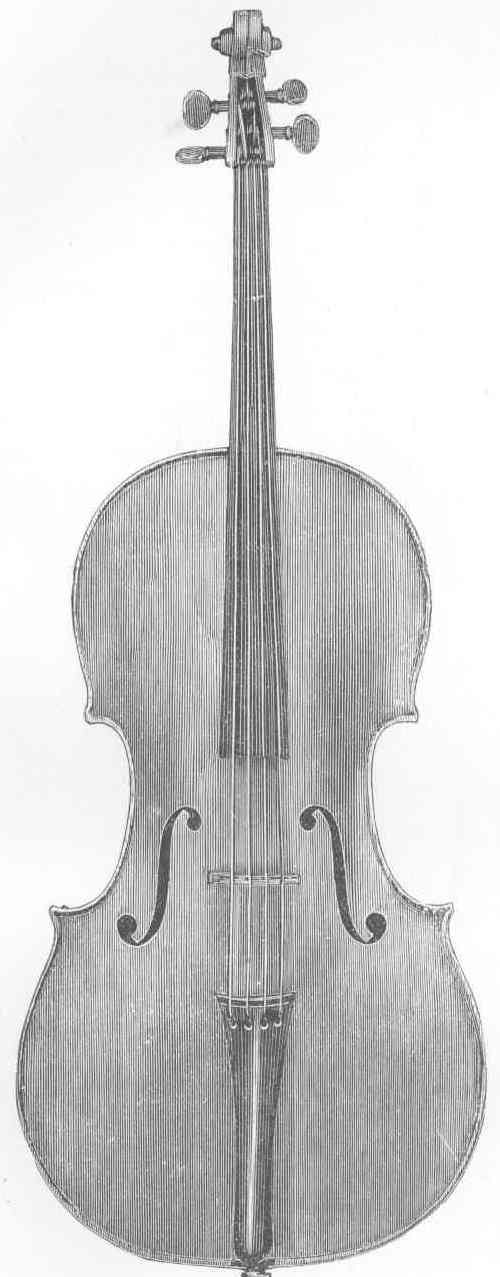
ANTONIO STRADIVARI. Plate XIV.
PACHERELE, Michel, Paris, about 1779.
PACHEREL, Pierre, Nice, died 1871, probably related to Michel Pacherele. Good workmanship; made several copies of Stradivari.
PAUL, Saint, Paris, 17th century. Chiefly copied Amati. In the style of Boquay.
Claude Pierray, proche la Comédie à Paris, 1725.
PIERRAY, Claude, Paris, from about 1700 to 1725. Was an excellent workman, and many of his productions partake of the Italian character to a considerable extent. They are of two patterns, the majority being large. Amati would seem to have been his model, but his instruments can scarcely be considered copies of that maker, the outline only being retained, while the other features are dissimilar. The wood is rarely handsome, but its quality is good; the thicknesses are variable. The work is of average merit. Varnish is of a pale red colour, of good quality. It is interesting to learn that these instruments were appreciated in England at the beginning of the eighteenth century. Tom Britton had in his collection of books and instruments at Clerkenwell a "Claude Pierray," which is described in the sale catalogue as "a very beautiful Violin, and as good as a Cremona."
PIÈTE, N., Paris, about 1780.
PILLEMENT, F., Paris, 1790-1820. Work branded inside.
Pique, rue de Grenelle St. Honoré, au coin de celle des 2 Ecus, à Paris, 1790.
PIQUE, F. L., Paris, about 1788-1822. As a copyist of Stradivari, this maker approached, perhaps, nearest to Nicolas Lupot. It has been supposed that some Violins bearing the name of Pique were made by Lupot, and varnished by Pique. There are several specimens of Pique's instruments upon which have been lavished care and skill of a very high order. Each feature is brought out, while, at the same time, exaggeration, that common error of the copyist, is avoided. The scrolls are well executed, both in point of finish and style; the sound-hole also is cut with precision. Many of his instruments have whole backs, of well-chosen material; the bellies are of a fine quality of wood. The instruments of Pique have long been esteemed, and will grow in reputation.
PIROT, Claude, Paris, about 1800. Pressenda style and appearance.
PONS, César, Grenoble, about 1775.
PONS, ——, Paris, chiefly known as a maker of Guitars.
RAMBAUX, Claude Victor, born 1809. Worked in early life at Mirecourt, and afterwards in Paris. He was a clever repairer, and gifted with excellent judgment in his treatment of the works of the old masters. He was at one time in the workshop of Gand. He died in 1871.
RANCE, Thomas, Brussels, about 1683. Good workmanship, well purfled, flat model.
RAUT, Jean, worked at Rennes about 1760.
REMY, ——, Paris, about 1760.
REMY, Jean Mathurin, Paris, 1770-1854.
REMY, Jules, Paris, 1813-76.
REMY, ——, London, 1840. Originally from Paris. Copied the old masters with average ability, but unfortunately adopted the pernicious practice of preparing the wood, making his instruments prematurely old without the qualities of healthy age.
RENAUDIN, Léopold, Paris, about 1788.
RENAULT, Nicolas, an early maker, contemporary with Tywersus.
ROMBOUTS, Peeter, Amsterdam, about the middle of the 18th century. High model, varnish of much brilliancy, but flaky.
ROZE, ——, Orleans, about 1760. Average workmanship, yellow varnish, heavy scroll.
SACQUIN, ——, Paris, 1830-60, made several excellent instruments; oil varnish of good quality, neat work, "Strad" pattern, name branded on back, inside.
SALLE, ——, Paris, about 1825-50. Made several copies of Guarneri, many of which are excellent. He was also a clever restorer of old instruments, and had a critical eye for the works of the old Italian masters, in which he dealt to some extent.
SALOMON, Jean Baptiste Deshayes, Paris, about 1750.
SAUNIER, ——, about 1740-70.
SCHNOECK, Egidius, Brussels, 1700-30.
SILVESTRE, Pierre, Lyons. A maker of rare abilities. The finish of his instruments is of the highest order; indeed, it would be difficult to find any maker within the range of the modern French school who has surpassed him in delicate workmanship. It may be said of him, as of many others, that extreme fineness of work is obtained often at the expense of character; to develop both qualities needs the mind of a Stradivari. Silvestre was fortunate in procuring wood of beautiful quality; there is scarcely an instrument of his which is not handsome. He chiefly copied Stradivari. It is to be regretted that so few of his works are to be met with. Pierre Silvestre was born at Sommerwiller in 1801, and died at Lyons in 1859. In Paris he worked in the workshop of Lupot, and in that of his successor, François Gand.
SILVESTRE, Hippolyte, born 1808, brother of Pierre, with whom he worked in partnership at Lyons from 1831-48. Hippolyte worked in the shop of Vuillaume. He retired from business in 1865.
SILVESTRE, Hippolyte Chrétien, Lyons, succeeded to the business of his uncles, Pierre and Hippolyte, which he transferred in 1884 to Paris.
SIMON, Claude, Paris, about 1788.
SIMONIN, Charles, Paris and Toulouse, pupil of J. B. Vuillaume.
SOCQUET, Louis, Paris, about 1760-1800.
THERESS, Charles, London.
THIBOUT, Jacques Pierre, Paris, born 1777, died 1856. A well-known dealer in rare Italian instruments. To him belongs the merit of having encouraged Luigi Tarisio to bring to Paris his Cremonese gems. When Tarisio paid his first visit to Paris, the reception that he met with was not of such a nature as to warrant his returning; but having ultimately decided upon once more visiting the French capital, he met with Thibout, who, by earnest solicitation, prevailed on him to remove his rich wares to Paris. Jacques Pierre Thibout was an excellent workman, and his instruments are highly esteemed.
THOMASSIN, ——, Paris, about 1845.
TYWERSUS, ——, Nancy, 16th century.
VAILLANT, François, Paris, about 1750.
VÉRON, Pierre André, 1720-50.
VIBRECHT, Gysbert, Amsterdam, about 1700.
VUILLAUME, Jean, Mirecourt, 1700-40.
VUILLAUME, Claude, Paris, 1772-1834. The earliest maker of this family; made commonplace instruments branded with his name.
VUILLAUME, J. B., Paris, born 1798, died in 1875. There are upwards of 2,500 Violins which bear his name. Many of these he made throughout. The early ones are much appreciated, and having been wisely varnished over at first, now begin to show the good results of such handling. The career of Vuillaume was singularly eventful. Commencing life from the first stage of the ladder, he gradually mounted to the highest, by the help of the usual nurses of fortune, skill and perseverance. He was a great lover of Cremonese instruments, and was intimately associated with Tarisio. At the death of the celebrated Italian connoisseur, he purchased the whole of his collection. He employed a number of skilful workmen, some of whom have achieved independent and individual reputations, and will be found noticed in their proper places in this work.
VUILLAUME, N. F., Brussels. Brother of the above. Was well known both as a maker and connoisseur. Born in 1802; died 1876.
VUILLAUME, Claude François, born 1807.
VUILLAUME, Sébastien, Paris, nephew of J. B. Vuillaume, made a few excellent instruments. He died in the same year, 1875.
SECTION IX
The German School
There is no trace of any German Violins of the time of Gasparo da Salò, or Maggini. This is certainly remarkable, and the more so when we consider how near were the German makers of Lutes, &c., to the old Italian town where Violins were being made. It is evident from this non-production of Violins that the Tyrolese were content with their Viols and Lutes, and did not recognise the wonderful effects of the little Violin until it had become pretty nearly perfected by the Italians. The manufacture of Lutes, Viols, and Guitars in Germany had in 1650, or a little later, reached its zenith, and the exquisite pieces of workmanship, in the shape of Lutes, Viols da Gamba, and Viols d'Amore, richly inlaid with mother-of-pearl, ivory, and tortoiseshell, made at this period, evidence the high state of the art.
To Jacob Stainer is due the credit, to a great extent, of changing the system of modelling so long in vogue in Germany. Although so great a maker, he was seemingly unable to free himself entirely from the proclivities common to his countrymen as Violin makers. There remained, after all Stainer's changes, the German sound-hole and extra arching, &c. Yet it must be readily admitted that the example which Stainer put before his countrymen was of great value, and served to engender an improved style throughout the Violin manufacture of Germany. The exceptional merits of this famous German artist were soon recognised, and his followers were legion. Among them were Sebastian Kloz, George Kloz, Egidius Kloz, and other members of that, perhaps the largest, family of Fiddle-makers the world has seen (had they been as good as they were numerous, what stores of prized Violins would have been bequeathed to us!); Reiss, of Bamberg; Rauch, of Breslau; and Leopold Widhalm, of Nüremberg, who was one of Stainer's best imitators; and others less known.
There were several German makers—led, possibly, by the example of Stainer and Albani the younger—who turned their attention to Italy, as furnishing models superior to their own, and thus combined the styles of both countries; while they endeavoured to copy closely the Italian masters, without attempting to be original. Niccolò Amati was the maker whom these men chiefly copied, and most successfully did they perform their task. These copies, however, did not meet the success to which they were entitled, and the popularity of Stainer's mode was then so great that the instruments made upon systems other than his found no favour in the Fatherland. The makers who were copyists of the Italian masters were Ruppert, Bachmann, Jauch, and Eberle of Prague.
When we consider the long list of makers forming the German School, we cannot fail to feel surprised that the number of really good artists was not much larger; and our surprise increases when the close proximity of the Tyrolese workers to the chief Italian centres of the manufacture of Violins is also considered. If the names of Jacob Stainer and Mathias Albani be excepted, the list is singularly destitute of makers famous for originality. The Germans were certainly great in the manufacture of the older stringed instruments, but seem to have made a poor beginning in the making of Violins. The form selected was bad, and they failed to improve upon it to any great extent. It would be quite impossible to furnish anything approaching a complete list of German makers, their number being so extended, and so many of their instruments being anonymous, and withal so weak in character that it is hard to discern them. Every care, however, has been taken to render the following list as complete as possible.
SECTION X
German Makers
ALBANI, Mathias, Botzen. M. Fétis, quoting the Biographical Dictionary of Moritz Berman, with regard to Albani, states that he was born in 1621, and died in 1673. The form is somewhat like Stainer's, but higher and heavier in construction. The varnish is very rich. Wood of good quality.
Mathias Albani Fecit Bulsani Tyrol 1651. Matthias Albanus Fecit Bulsani in Tyroli 1680.
ALBANI, Mathias, Botzen, about 1650-1712. Son of the above. This maker should, perhaps, have been classed with those of Italy, his style being Italian; but as he was the son of the well-known German maker, it was thought best that his name should follow that of his father under the head of German makers. The son has shown but faint marks of having been tutored by his parent in the art of Violin-making. He is said to have visited Cremona, in order to receive instruction there under Amati, and this circumstance may have given to his work that Italian air which is so pleasing to the connoisseur.1 This maker is often credited with the work of the elder Albani, it having been supposed that there was but one of that name. The model is good, and the workmanship throughout demands high praise. Gerber states that the famous Violinist, Tomaso Albinoni, possessed two Violins of this maker, dated 1702 and 1709.
1 He appears to have worked for a time in Rome, from which city some instruments are dated.
ALBANI, Paolo, Palermo, about 1633. Probably related to the Albanis of Botzen. See Italian makers.
ALETZIE, Paolo, Munich. See Italian makers.
Paulus Aletzee hof Lauten und Geigenmacher in München 1710.
ARTMANN, ——, Weimar, near Gotha, 18th century. Was originally a joiner. Copied Amati very cleverly. The varnish is frequently of amber colour.
BACHMANN, Carl Ludwig, born at Berlin, 1716. Court musician and Violin-maker. The work is clean, and not without style. Bachmann was a performer on the Viol. In 1765 he was appointed instrument maker to the court of Frederick the Great. Bachmann, in conjunction with Ernest Benda, founded in 1770 the concerts for amateurs at Berlin. He died in 1800.
BACHMANN, O., Halberstadt, Violin-maker, and author of a handbook on the construction of bow instruments, published in 1835 at Leipsic.
BAUSCH, Ludwig C. A., Leipsic, born at Nuremberg in 1815. Pupil of B. Fritsche in Dresden.
BAUSCH, Ludwig B. Son of the above.
BAUSCH, Otto B., Leipsic, born 1841, brother of the above.
BECKMANN, Sweno, Stockholm, about 1700. The work is rough.
BEDLER, ——, about 1750.
BÈLA, Szepessy, born at Budapest in 1856. Now living in London.
BINDERNAGEL, ——, Gotha, 18th century. Copied Amati chiefly. There are a few of his instruments which are on the model of Stradivari, and are highly valued in Germany.
BUCHSTADTER, Gabriel David, Ratisbon, 18th century. His Violins are not equal in merit. Some have excellent wood, others very indifferent. When one of his best instruments can be procured, it is a good substitute for a second-class Italian.
CHRISTA, Joseph Paul, Munich, 1730.
Josephus Paulus Christa, Lauten und Geigenmacher in München. 17—
DIEL, Martin (spelt Diehl by later members of the family), Mayence, worked with Nicolaus Döpfer, and later with Carl Helmer of Prague. He was a son-in-law of Döpfer.
DIEL, Nicolaus, born 1779, son of Martin, worked with his uncle Jacob Steininger of Frankfort. He succeeded to the business of his father. Died 1851.
DIEL, Johann, brother of Nicolaus.
DIEL, Jacob, son of Nicolaus, settled in Bremen 1834, later in Hamburg. Died 1873.
DIEHL, Nicolaus Louis, Hamburg, son of Jacob Diehl, died 1876.
DIEHL, Friedrich, Darmstadt, born 1814, son of Nicolaus, received a bronze medal, Paris Exhibition, 1867.
DIEHL, Johann, Mayence.
DIEHL, Heinrich, son of Johann.
DÖPFER, Nicolaus, 1768. The instruments of this maker are well made; the model is less raised than that of many German makers. He made a few large Tenors. Döpfer was the master of Martin Diehl.
DURFEL, J. G., Altenburg, 18th century. A well-known maker of Double-Basses.
EBERLE, J. Ulric, Prague, about 1730-50. Was a good copyist of the Italian masters. Eberle also made Viols d'Amour.
Joannes Udalricus Eberle, Lautenmacher in Prag, 1730.
EDLINGER, T., Prague, about 1712.
EDLINGER, Joseph Joachim, Prague. Son of the above. Worked for some time in Italy. Died 1748.
ELSLER, Johann Joseph, Mayence, 1720-50. Made many good Viols da Gamba.
ERNST, Franz Anton, born in 1745 in Bohemia, died in 1805. He was an eminent Violinist, and received lessons from Antonio Lolli. In 1778 he was engaged as Court musician at Gotha. He took great interest in Violin-making, and made several excellent instruments.
FELDEN, M., Vienna, about 1550. Maker of Viols.
FICHTOLD, Hans, about 1612. Lute-maker.
FICHTL, Martin, Vienna, 1757. Large pattern, good varnish, wood of excellent quality.
FICKER, Johann Christian, Cremona, 1720. Said to have lived in the midst of the greatest makers the world has had; if so, he certainly did not make himself acquainted with the art of Violin-making as understood in Cremona. His instruments may have been made at Mittenwald, and dated from Cremona.
FICKER, Johann Gotlieb, Cremona, 1789.
FISCHER, Zacharie, Würtzburg, 1730. This maker adopted the practice of baking the wood for the manufacture of Violins.
FISCHER, Anton, Vienna, died 1879.
FREY, Hans, Nuremberg and Bologna, born about 1440. A celebrated maker of Lutes. He was the father-in-law of Albert Dürer. John Evelyn, in his Diary, 1645, after speaking in praise of the cheese and sausages of Bologna, refers to the great celebrity of the Lutes by the old makers of that city, and mentions Hans Frey. He says they "were of extraordinary price, and the workmen were chiefly Germans."
FRITZCHE, ——, Leipsic, about 1780-1810.
GEDLER, Johann A., Fussen, about 1750.
GEDLER, Johann B., Fussen, about 1780.
GEISSENHOF, Franz, Vienna, died 1821. The initials F. G. sometimes branded on the button. Stradivari model. Good work.
GERLE, Johann, Nuremberg, 1533 to about 1550. Maker of Lutes and Viols. He also published a book on the Lute, 1533.
GRIESSER, Matthias, Innspruck, 1727.
GRIMM, Carl, Berlin, born about 1794. He died at Berlin, 1855, and was succeeded by a son, Ludwig Grimm.
GROBITZ, A., Warsaw, about 1750.
GUGEMMOS, Fussen, Bavaria, 17—. Indifferent work.
HAENSEL, Johann A., Berlin. Contributed an article to the "Leipsic Musical Gazette" in 1811, entitled "Ueber den Bau der Violin."
HAMBERGER, Joseph, Presburg, 1845.
HAMM, Johann Gottfried, Rome, 18th century. Made instruments of a wide pattern, often with ivory edges, and branded inside with his initials.
HAMMIG, W. H., Leipsic. Now living.
HASSERT, ——, Eisenach, 18th century.
HASSERT, ——, Rudolstadt, 18th century.
HELMER, Carl, Prague, born 1740. Pupil of Eberle of Prague.
HILDEBRANDT, Michael C., Hamburg, 1770.
HILTZ, Paul, Nuremberg, 1656. Maker of Viols.
HOFFMANN, Martin, Leipsic, about 1680 to 1725. Maker of Lutes and Viols.
HOFFMANN, Johann Christian, Leipsic, about 1720. Son of Martin Hoffmann. Lute and Viol maker.
HORNSTAINER, Joseph, Mittenwald, about 1730. Made a few Double-Basses of good quality.
HORNSTAINER, Matthias, Mittenwald, about 1800.
HORIL, Jacob, Rome, about 1742.
HULLER, August, Shoeneck, about 1775.
HUMEL, Christian, Nuremberg, about 1709.
HUNGER, Christoph Friedrich, Leipsic, born at Dresden, 1718, died 1787. One of the best German makers.
JAIS, Johann, Botzen, about 1776. There were other makers of this name.
JAUCH, Johann, Gratz, Styria, Austria. Worked in Dresden about 1774.
KARB, ——, Königsberg, Maker of Viols.
KAMBL, Johann A., Munich, 1640.
Johan Andreas Kambl Churfürstl. Hof Lauten und Geigenmacher in München.
KEMBTER, ——, Dibingen, about 1730. Stainer model. Good wood, and work well purfled.
KIAPOSSE, Sawes, St. Petersburg, 1750.
KIRCHSCHLAG, ——, Tyrol, 1780.
KLOZ, Matthias, Mittenwald, 1656-1743. Is reported to have been a pupil of Stainer. The work is good and the varnish in some cases of a mellow quality, in others somewhat thin. Some of the wood that he used was cut at the wrong season, and is consequently worm-eaten.
Sebastian Kloz, in Mittenwald, An 17—
KLOZ, Sebastian, Mittenwald, 1696-1750, son of Matthias Kloz. The instruments of this maker are much esteemed. The model is flat as compared with most Violins of the German school. The varnish varies.
KLOZ, George, Tyrol, 1687-1737, brother of Sebastian Kloz. Instruments well made, chiefly yellow in colour; wood often worm-eaten.
KLOZ, Egidius, Mittenwald, 1675-1711.
KLOZ, Ægidius, Mittenwald, 1733-1805. Son of Sebastian. One of the best of this very large family of makers.
KLOZ, Joseph, Mittenwald, son of Egidius.
KLOZ, J. Karl, about 1741. Good work, dark varnish, ornamental border round label.
KNITTLE, Joseph, Mittenwald.
KNITTING, Philip, Mittenwald, 1760.
KOHL, Johann, Munich, 1580. Lute-maker to the Bavarian Court.
KOLDITZ, J., Rumburg, died 1796.
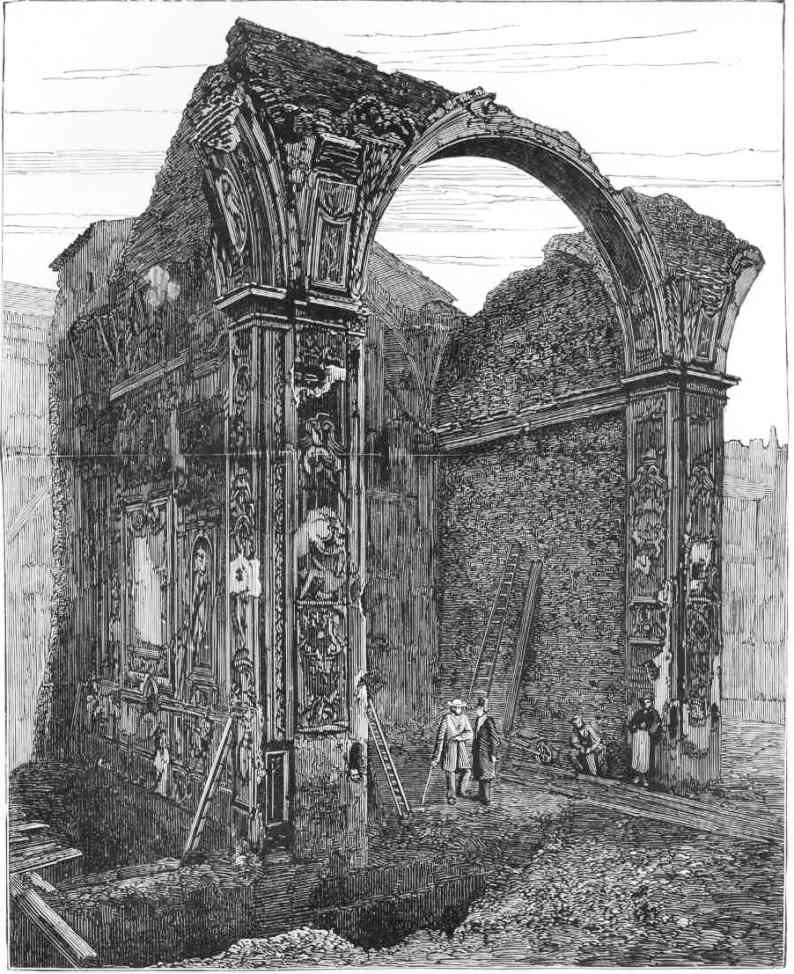
CHAPEL OF THE ROSARY. CHURCH OF ST. DOMENICO, CREMONA. Plate XV.
KOLDITZ, Mathias Johann, Munich, 1720.
Mathias Joannes Koldjz, Lauten und Geigenmacher in München 17—
KRAMER, H., 1717, Viol-maker.
KRINER, Joseph, Mittenwald, 1786.
LASKA, Joseph, Prague, born at Rumburg, 1738, died 1805. Worked with J. Kolditz.
LEMBÖCK, Gabriel, Budapest, 19th century. Maker; also known as a repairer of old instruments.
MANN, Hans, Naples.
MAUSSIELL, Leonard, Nuremberg, 1745. Stainer pattern, excellent workmanship. Thin yellow varnish, raised edges. The style and work is not unlike that of Tecchler.
MAHER (MAIER), Andreas Ferdinand. Good varnish, sometimes with lion scrolls.
Andreas Ferdinandus Mahr, Hof Laut und Geigenmacher in Salzburg. Anno 17—
MEUSIDLER, Johann, Nuremberg, about 1550. Maker of Viols.
MOHR, Philip, Hamburg, 17th century. Viol-maker.
MOLDONNER, Fussen, Bavaria, 18th century.
NIGGEL, Simpertus, Fussen, 17—. Flat model, good workmanship. Branded inside with initials S. N.
OHBERG, Johann, Stockholm, 1773. Workmanship of average merit. Varnish mostly of yellow colour.
OTT, Johann, Nuremberg, about 1463. Lute-maker.
OTTO, Jacob August, born at Gotha, 1762, died 1830. Violin-maker to the Court of Weimar. Received instructions from Franz Anton Ernest. He published a work in 1817 entitled, "Ueber den Bau und die Erhaltung der Geige und aller Bogeninstrumente," and another work with more information in 1828, the first English edition of which was published in 1848.
OTTO, Georg August, son of Jacob August, born 1807, died 1859. Succeeded to the business of his father at Jena.
OTTO, Christian, Halle, second son of Jacob August. Born 1813, died 1876.
OTTO, Heinrich, Berlin, third son of Jacob August. Born 1815, died 1858.
OTTO, Carl, Ludwigslust, fourth son of Jacob August. Born 1825. Violin-maker to the Court of Mecklenburg. Died in 1883.
OTTO, C. U. F., Stockholm, fifth son of Jacob August. Died 1884.
OTTO, Ludwig, St. Petersburg, son of Georg August. Born at Cologne; died 1887.
OTTO, Louis, Dusseldorf, son of Carl, now living.
OTTO, Hermann, St. Petersburg, son of Ludwig. Died 1884.
PARTH, Andreas Nicholas, Vienna, 18th century.
PFRETZSCHNER, Johann Gottlob, Cremona, 1750. Very commonplace.
PFRETZSCHNER, Carl Friedrich, Cremona, son of the preceding; no merit.
PLACK, F., Schoenbock, 1730-45.
POSSEN, L., Schoengau, Bavaria, about 1553. Maker of Viols and Lutes.
RAUCH, ——, Wurtzburg.
RAUCH, Jacob, Manheim, 1720-50. Brother of the above. Court Violin-maker.
RAUCH, Sebastian, Hamburg, 1725. High model, rough workmanship. A maker of this name is said to have worked at Leitmeritz, Bohemia, about 1750. Possibly the same.
RAUCH, ——, Breslau, about 1750.
REICHEL, Johann Gottfried, Absam, 18th century.
REICHEL, Johann Conrad, Neukirchen, 18th century.
REICHERS, August, Berlin, 19th century. Pupil of Bausch of Leipsic.
RIESS, ——, Bamberg, about 1750.
RÖSCHER, C. H. W., Bremen, about 1871.
ROTH, Christian, Augsburg, 17th century.
RUPPERT, Franz, Erfurt, 18th century.
RUPPERT, J. N., Erfurt, 1719-28.
SAINPRAE, Jacques, Berlin, 17th century. A Baryton Viol of this maker is among the musical instruments at the Kensington Museum. It is said to have belonged to Johann Quantz, the famous flute-player.2 The Baryton was a favourite instrument with Haydn. He composed several pieces for the instrument, and was fond of playing it. The Baryton, or Viol di Bordone, is of the character of the Viole d'Amour, being strung with sympathetic metal strings. It is, however, a large and more complicated instrument.
2 The flute-playing of Johann Joachim Quantz in 1728 gave so much pleasure to the Crown Prince of Prussia, afterwards Frederick the Great, that he decided to take lessons from Quantz, who was then in the service of Augustus, Elector of Saxony and King of Poland. Quantz was stationed alternately in Dresden and Warsaw. He became a member of the orchestra of Augustus in 1718, when Jean Baptiste Volumier was its director, of whom mention has been made (page 208) relative to his having been sent to Cremona in 1715 to await the completion of twelve Violins ordered of Stradivari.
SAWICKI, C. N., Vienna, 1792-1850.
SCHEINLEIN, Mathias F., 1710-71. High built; dark varnish.
SCHEINLEIN, Johann Michael, Langenfeld, son of the above. Similar characteristics.
SCHELL, Sebastian, Nuremberg, 1727. Lute-maker.
SCHLICK, ——, Leipsic.
SCHMIDT, ——, Cassel, 1800-25. Copied Stradivari indifferently; wood of an inferior kind.
SCHONFELDER, Johann A., Neukirchen, about 1743.
SCHONGER, Franz, Erfurt, 18th century.
SCHONGER, Georg, Erfurt, son of the above.
SCHORN, Johann, Innspruck, about 1680. An excellent maker; the varnish is similar to that of Albani; high modelled. He appears to have removed to Salzburg. There are Viols of his make dated from there in 1696 and 1699.
SCHORN, Johann Paul, Salzburg, about 1700-16. Court instrument-maker.
SCHOTT, Martin, Prague. Chiefly known as a maker of Lutes.
SCHWARTZ, Strasbourg, about 1845. Several of this name worked in Strasbourg.
SCHWEITZER, J. B., Budapest, died 1875. Flat model, neat workmanship. Made a few Tenors.
STADELMANN, Daniel, Vienna, 1680-1744. Good work, model of Jacob Stainer. Thin varnish, sometimes yellow colour.
STADELMANN, Johann Joseph, Vienna, 18th century. Copied Stainer; average merit.
Jacobus Stainer in Absam prope Oenipontum. 16—
STAINER, Jacob, Absam, born July 14, 1621, at Hall. The celebrity of this maker is second only to that of the great Cremonese artists. His admirers in Germany and England were, at one time, more numerous than those of the principal Italian makers. In a manuscript note which Sir John Hawkins added to his own copy of his History of Music (1776), he says, "The Violins of Cremona are exceeded only by those of Stainer, a German, whose instruments are remarkable for a full and piercing tone." To the connoisseur of to-day such commendation may seem inexplicable, and cause him to believe that Fiddle admirers of past times were incapable of appreciating true beauty of form, and its bearing upon sound, or else that fashion made its influence felt on the Fiddle world as elsewhere. It would be absurd to deny that the greatest German maker of Violins that ever lived was a man of rare abilities, because it is indelibly written on his chief works that he was a thorough artist. Therefore an expression of surprise that Jacob Stainer has been estimated higher than even Stradivari by the Germans and English, must not be understood as a reflection on his abilities, since it refers to the form that he chose to give to his works. To account for the apparent inconsistency in the works of Stainer, and to strike the balance between his exceptional abilities on the one side and his model on the other, is not easy. His form was not a borrowed one; it is as original as that of Stradivari—a fact which makes it more than ever unintelligible that he should have been content with it. To arrive at anything approaching to a satisfactory solution, we must endeavour to trace the history of this model. Jacob Stainer was born in the Tyrol, and passed there his early years, and probably received his first instructions from one of the old Tyrolean Lute and Viol makers, at a period when they raised their model, and introduced into the German School the scooping round the sides of the backs and bellies, the inelegant sound-hole, the harsh outline, and uncouth scroll. As experience ripened his understanding, he may have felt that these characteristics of the German School were not such as could be moulded with advantage by an artist, whatever his talent might be, and resolved to do his best to unlearn much that he had acquired. In order to do so with any chance of success, but one course was open to him—that of studying the works of the Italian masters. It has been stated that he went to Italy when very young. With this view I do not concur. In all cases where there is an absence of direct evidence, opinions can only be formed from particular analogies bearing on the case under consideration. Now in the case of Stainer we have nothing to guide us but his variations of style, and dates of time and place. What is the result of a careful investigation of every particle of evidence that we can glean? The style is ever German, although the great maker is head and shoulders above all his countrymen who followed his art. I am thus forced to believe that had so excellent an artist visited Italy in his youth, as reported, there would have remained but the faintest trace of its origin. That men of less ability should be unable to entirely sever themselves from their national style of work, even under circumstances most favourable for such a release, I can readily understand; it is an incapacity which has been exemplified over and over again; but Jacob Stainer was not one of these ordinary men; he had not his superior in the school of Cremona as a finished workman, with the single exception of Antonio Stradivari. I believe, therefore, that the German style was deeply rooted within him when he ceased to be young, and that if he went to Cremona or Venice, it was not until he recognised the inferiority of the school in which he had been bred, as compared with that of Cremona or Venice. That he did not go far enough in his "second thought" is pretty well acknowledged on all sides. His originality was conceived in the German School, amid the worst examples, and it was too late to undo what had gone before. Here, then, lies, I consider, the key to the seeming anomaly that so great a maker as Stainer should have adopted and clung to so clumsy a model. That he became acquainted with much of the best work of the Italians is evidenced by his improved style. The varnish he used furnishes even stronger evidence of his having possessed a knowledge of the subject equal to that of the Cremonese makers. Whether he acquired this knowledge in Cremona or Venice cannot be stated with certainty, but I am inclined to believe that he gained it in the first-named city. Who but an artist acquainted with the best work of Italy in Violin-making could have made those exquisite Violins known as "Elector Stainers"? The wood, selected for its rare loveliness, the finished workmanship, and charming rose-coloured varnish, render these works of art of which one glimpse is a never-fading memory. These works show the diligent zeal with which Stainer laboured in his studies of the Italian masters. He contrived to give these instruments an air of grace quite foreign to the best efforts of his brother German makers. In the sound-hole and scroll is observable his seeming desire to leave behind the German preferences; and although it must be admitted that he was but partially successful in his endeavours to stamp out early tendencies, the connoisseur cannot but be impressed with the results of the artist's manipulations. Had such skill been exercised on a form nearer akin to the Italian, the result would have been perfect.
Prior to the publication of the interesting facts obtained by Herr S. Ruf, relative to the personal history of Jacob Stainer, we had no really reliable account of this famous maker.3 The industry and research of Herr Ruf has not only supplied all the ascertainable facts with regard to Stainer, but also served to trace the history of Stainer fiction. The last-mentioned portion of Herr Ruf's labours is singularly instructive as to the manner in which romance is spliced on to what is intended to be sober history, and which results oftentimes in the graft being rendered invisible, or even unsuspected. He tells us that the first mention of Jacob Stainer is that made by Johann Primisser, about a century after the death of the Violin-maker, and that he merely states that there lived in Absam in 1673 a celebrated maker named Stainer.
3 The notice of Jacob Stainer in the "Biographie Universelle des Musiciens" contains information supplied by J. B. Cartier, the well-known Violinist, which formed a portion of the history of the Violin which Cartier proposed publishing, also from notes made by Paul L. de Boisgelou, who brought together much curious information relative to music and musicians.
Early in the present century Counsellor Von Sardagna collected certain particulars concerning Stainer, which were published in 1822. He states that Stainer lived at Absam, that it is traditionally reported that he went to Venice or Cremona, and died a madman. It appears that this slight material was at once utilised for the manufacture of nearly all the romantic accounts of Stainer with which we are familiar. Herr Ruf says that in the year 1825 there appeared in a German literary publication a poetical effusion entitled "Jacob Stainer," and that in 1829 Dr. Johann Schuler published a novel of great merit on the same subject.
Herr Ruf states that August Lewald in 1835 made the novel of Dr. Schuler the basis of the romantic account of Stainer, published in his "Guide Book to Tyrol," under the title of "An Evening in Absam," but without any acknowledgment whatever. Notwithstanding the growth of Stainer literature down to 1835, not a single historical fact concerning the maker had been brought to light. In the year 1839 Herr Ruf began his labours of research. He discovered at Hall a register of the parish of Absam, wherein he found all the information we possess as regards the birth and death of Stainer and his family. About this period the poem of Dr. Johann Schuler, "Jacob Stainer," was dramatised by Theodore Rabenalt. Other poems based on the same material appeared in 1843, but still the facts of Stainer's life were all but unknown. At length Herr Ruf was prevailed upon by Dr. Schafhaült (an ardent admirer and collector of Stainer's Violins) to prosecute his inquiries concerning the great maker.
In the archives of the town and salt mines at Hall, Herr Ruf found much information, which he published in the local newspapers, the ephemeral nature of which naturally placed his valuable contributions beyond the reach of those likely to value them. In the meantime Nicolaus Diehl, of Hamburg, published a little book on Violins, into which was imported a portion of the romance traceable to the novels or poems on Stainer. Herr Ruf, feeling disappointed that his labours in discovering the facts relative to Stainer had failed to clear away the cloud of Stainer fiction, published in 1872 his book, "Der Geigenmacher Jacob Stainer von Absam in Tirol," which gives us a full account of his researches, and should have secured to him the full credit due to his industry. His facts, however, like the good fiction found in Dr. Schuler's novel, "Jacob Stainer," have been used by German writers on the subject of the Violin without any acknowledgment. Herr Ruf died at Hall in the year 1877.
It is said that Stainer was apprenticed to an organ-builder at Innsbrück, but owing to his weak constitution he was unable to continue in the business, and chose instead the trade of Violin-making. Amongst the rumours concerning this maker may be mentioned that of his having been a pupil of Niccolò Amati. It is certain there is no direct evidence in support of it, neither is it shown that his work is founded on that of Amati. I am satisfied that Stainer was assisted neither by the Brothers Amati nor Niccolò Amati, and I am strengthened in this opinion by the steadfastly German character of a model which no pupil of Amati could have persisted in using, even though based on his earliest traditions.
The marriage of Stainer took place October 7, 1645. On the 9th of October, 1658, he was appointed by the Archduke Leopold (of Austria, Governor of Tyrol) one of the "archducal servants," and on the 9th of January, 1669, he obtained from the Emperor the title of "Violin-maker to the Court." About this period he is said to have incurred the displeasure of the Jesuits, which led to his being accused of the crime of heresy. The accusation seems to have been based on the fact of books of a controversial kind—chiefly Lutheran—having been found in his possession. The penalty he suffered for daring to indulge in polemical literature was six months' imprisonment, and his future prospects were completely shattered. Prior to this misfortune he appears to have been in pecuniary difficulties, and frequently at law with one Salomon Hübmer, of Kirzchdorf, from whom he had obtained money loans. In the year 1677 he petitioned the Emperor Leopold—who was a great patron and lover of music—to render him pecuniary assistance, but failed to procure it. Over-burdened with troubles, he was bereft of his reason, and died insane and insolvent in the year 1683.
"Alas! misfortunes travel in a train, And oft in life form one perpetual chain."
His widow was left with a family of eight daughters, she dying in poverty in 1689, which chronological fact disposes of the fiction, so widely circulated, that in consequence of the great grief he experienced upon the death of his wife he withdrew from the world, and became an inmate of a Benedictine monastery, and that he made within its walls the famous instruments known as "Elector Stainers," which he presented to the twelve Electors. Whether he made them to order, in the usual manner, whether he presented them, or where he made them, matters little; they are works of great merit, and need no mysterious surroundings to call attention to them. The followers of Stainer have been numerous, and are mentioned in the lists of German and English makers. Probably no maker is more mistaken than Stainer: the array of German instruments called by his name is at least ten times greater than the number he actually made. Nearly every high-built tub of a Violin sails under his colours. Instruments without any resemblance whatever to those of Stainer are accepted by the multitude as original Jacob Stainers. Much of this has arisen from the variety of style and work said to have been shown in the instruments of this maker. That this marked variety exists I do not believe. The pattern varies, but the same hand is traceable throughout.
STAINER, Markus, Kufstein, Tyrol, about 1659, described as a brother of Jacob. He styled himself on his label "Citizen and Violin-maker." Citizenship carried with it special privileges, and this maker apparently recognised the honour by having "Burger" after his name.
STAINER, Andreas, Absam, about 1660. Mention is made of a maker of Baryton Viols of this name.
STAUGTINGER, Mathias W., Würzburg, about 1671. Maker of Viols and Lutes.
STEININGER, Jacob, Frankfort, about 1775. Son-in-law of the Violin-maker Döpfer, and uncle of Nicolas Diehl, to whom he gave instructions in Violin-making.
STEININGER, Franz, St. Petersburg, son of Jacob Steininger.
STOSS, ——. Makers of this name worked at Prague, Vienna, and Fussen, about the end of the 18th century.
STOSS, Martin, Vienna, about 1824. Flat model, good workmanship. Stradivari pattern, indifferent varnish.
STRAUBE, ——, Berlin, about 1775.
STRAUSS, Joseph, Neustadt, about 1750.
TIEFFENBRUCKER. There appear to have been several Lute-makers of this name working in the 16th century in Germany and elsewhere. No genuine Violins are known. See DUIFFOPRUGCAR.
TIELKE, Joachim, Hamburg, about 1539-92. The name of Tielke is associated with the most remarkable instruments of the Lute and Guitar kind ever produced in relation to rich and chaste ornamentation. It is said there are glowing accounts in old German books of the magnificent instruments by Tielke, with elaborate designs in silver, gold, and jewels.4 The ornamentation and workmanship seen in the best instruments of this maker bear the impress of Italian art of a high order, and evidence the employment of Italian draughtsmen by the house of Tielke. In the collection of instruments at Kensington is a Chiterna (an instrument of the Lute kind) of this make. The body is ornamented with tortoiseshell, with mythological figures in ivory and precious stones. It is signed, and dated 1539. In the possession of Mr. George Donaldson is a Guitar of this maker, signed, and dated 1592, which is considered to be the most artistic and highly ornamented work known by Joachim Tielke. It is wonderfully preserved, and admirably shows the style and character of the art-work of the period.
4 Engel's "Descriptive Catalogue of the Musical Instruments in Kensington Museum," 1874.
TIELKE, Joachim, Hamburg, about 1660-86. Viol and Violin maker. The dates met with on the instruments signed "Tielke" cover a period of upwards of a century and a half, and thus evidence the existence of the house, in connection with the manufacture of musical instruments, through two or more generations. There is, of this maker, a Viola di Bordone in the collection at Kensington, dated 1686. Mention is made by Fétis of a Violin dated 1670, which was in the possession of André of Offenbach; and a Chiterna dated 1676, similar to that in the Kensington collection, is owned by Mr. George Donaldson. M. Chouquet, in his catalogue of the collection of instruments at the Conservatoire, Paris, refers to a Lute (No. 136) by Tielke.
VOEL, E., Mayence, about 1840. Excellent workmanship, scroll well cut. Stradivari model. The character of work is not unlike that of Bernard Fendt.
VOGEL, Wolfgang, Nuremberg, 1650.
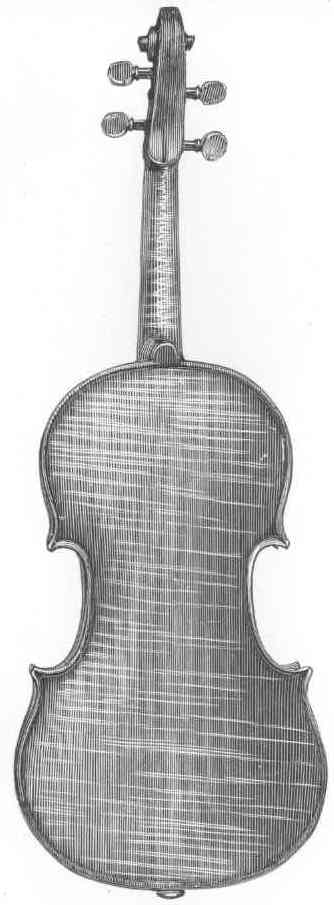
ANTONIO STRADIVARI. Date 1708. (HECTOR HAVEMEYER, ESQ.)
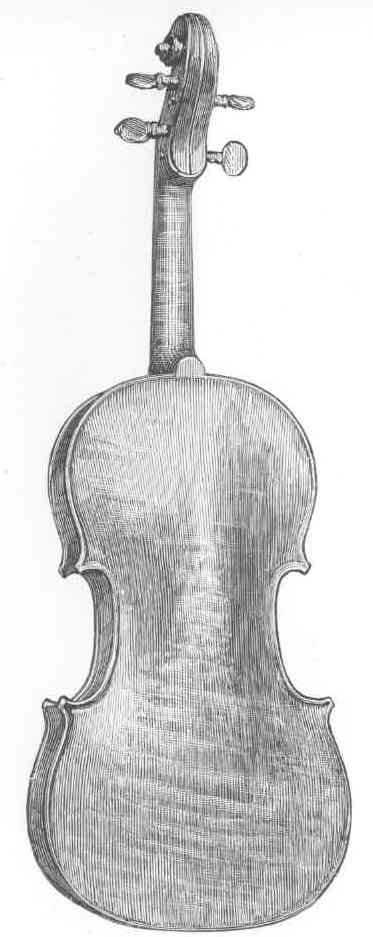
ANTONIO STRADIVARI. 1736.
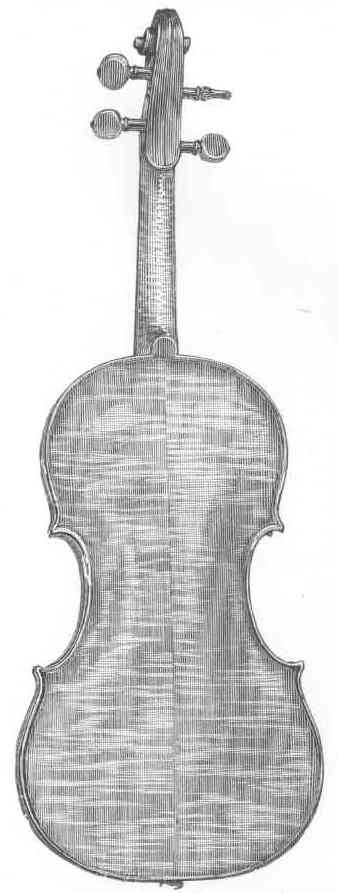
GIUSEPPE GUARNERI DEL GESÙ. Date 1735. (G. HART.) Plate XVI.
VOGLER, Johann Georg, Würzburg, about 1750.
Johann Georg Vogler, Lauten und Geigenmacher in Würzburg. 17—
VOIGT, Martin, Hamburg, about 1726.5
5 About thirty makers named Voigt or Voight hail from Germany, some contemporary and others dating from the 18th and 19th centuries. Their work is not of sufficient importance to require special notice.—EDITORS.
WAGNER, Joseph, 1730, Constance.
WEICKERT, Halle, 1800.
WEIGERT, ——, Lintz, about 1721. Maker of Viols.
WEISS, Jacob, Salzburg, 18th century.
Jacob Weiss, Lauten und Geigenmacher in Salzburg.
WENGER, G. F., Salzburg, 18th century.
Leopold Widhalm Lauten und Geigenmacher, Nürnberg Fecit, A.
WIDHALM, Leopold, Nuremburg, 18th century. One of the best imitators of Stainer. The wood is frequently handsome, the work finished with care. Varnish, although wanting the delicacy of that of Stainer, is generally of good quality; its colour is mostly pale red. Nearly all his instruments are branded with the initials inside. His name has frequently been spelt Withalm.
WITTING, J. G., Mittenwald, about 1775.
WYEMANN, Cornelius, Amsterdam, 18th century.
ZWERGER, Antoni, Mittenwald, about 1750. Neat work, good wood, varnish of the character of that seen on the instruments of Kloz.
SECTION XI
The English School
It is somewhat remarkable that the Continental writers on the Violin should have omitted to mention any English maker, either ancient or modern. Such an omission must have occurred either from want of information concerning our best makers, or, if known, they must have been deemed unworthy of the notice of our foreign friends. There is no mention of an English maker in the work of Fétis, "Antoine Stradivari," 1856, although numerous very inferior German and Italian makers are quoted. The same omission is also conspicuous in "Luthomonographie Historique et Raisonné," 1856, and Otto's "Ueber den Bau der Bogeninstrumente," &c., 1828. It may be that Continental connoisseurs have credited themselves with the works of our best makers, and expatriated them, while they have inexorably allowed bad English Fiddles to retain their nationality. However, it is my desire that my foreign brothers should be enlightened on this point, and in all candour informed of the array of makers that England has at different times produced, and is yet capable of producing, did but the new Violin command the price that would be a fair return for the time and skill required in the production of an instrument at once useful and artistic. It will be my endeavour to show forth the qualities of those of our makers whose names, as yet, seem never to have crossed the Channel, so that when these pages on the English School are read by distant connoisseurs, and the merits and shortcomings of the makers therein are fairly weighed by them, the good shall be found so to outweigh the indifferent as to entirely change the opinions formed of us as makers of the leading instrument.
Until the early nineteenth century makers of Violins in England would appear to have been comparatively numerous, if we take into consideration the undeveloped state of stringed instrument music at that period in this country. Among those makers were men of no ordinary genius—men who worked lovingly, guided by motives distinct from commercial gain, so long as they were allowed to live by their work. When, however, the duties on foreign musical instruments were removed, the effect was to partially swamp the gallant little band of Fiddle-makers, who were quite unable to compete with the French and German makers in price (not excellence, be it distinctly understood, for we were undoubtedly ahead of our foreign competitors, both in style and finish, at this period). The prices commanded by many English makers previous to the repeal of the duty were thoroughly remunerative. Five to twenty pounds were given for English Violins, while Violoncellos and Tenors commanded prices proportionately high. The English Violin-makers were thus enabled to bestow artistic care in the making of their instruments. When, however, they were suddenly called upon to compete on equal terms with a legion of foreign manufacturers, the result was not so much that their ardour was damped, as that they themselves were extinguished, and served as another instance of the truth of the adage that "the good of the many is the bane of the few."
In matters of magnitude, whether artistic or otherwise, competition is undoubtedly healthy, there being always a small body of patrons who are willing to check the tendency to deteriorate, common to all productions, by encouraging the worker with extra remuneration, in order that a high degree of excellence may be maintained; but in matters confined to a small circle, as in the case of Violin-making, the number of those willing to encourage artistic workmanship is so minute as to fail even to support one maker of excellence, and thus, when deprived suddenly of its legitimate protection, the art, with other similar handicrafts, must drift into decadence. If we look around the Violin world, it is everywhere much the same. In Italy there is no Stradivari in embryo, in France no coming Lupot, in Germany no Jacob Stainer, and in England no future Banks or Forster. Why so? The answer is twofold. Partly there is fault in the demand, arising from the marked preference of this age for cheapness at the expense of goodness; partly, too, there is a fault in the supply, a foolish desire on the part of the makers to give maturity to their instruments, wherein they always completely fail, yet they will not give up their conceit. Here, again, were we dealing with matters of greater magnitude, the evil influence would be lessened, the artistic impulses would still be felt, though in a less degree; whereas so contracted is the circle of the Violin world, that under any stress the support given to makers willing to bestow an artist's care on their work is totally inadequate.
The case of modern Violin-makers is unfortunate. Old Violins being immeasurably superior to modern productions, the demand must necessarily set steadily for the former, and the modern maker has only the few patrons of new work to support him. It cannot be expected that the players of to-day should patronise the modern Violin in order that the next generation should reap the benefit. Years since it was quite a different matter. The makers were well paid for their work, and new instruments were then made to supply wants similar to those which the horrid Mirecourt or Saxon copy fulfils at present. As with other things, so is it also with Violins; if they are to be produced with the stamp of artistic merit, they must be paid for accordingly; without patronage the worker necessarily becomes careless. Finding that his skill fails to attract attention, he gradually sinks down into the mere routine of the ordinary workman. When Italy shone brightest in art, the patronage and remuneration which the workers received was considerable. Had it been otherwise, the powers of its Raffaele, its Cellini, and last (though not least to the admirers of the Violin), its Stradivari, would have remained simply dormant. Art, like commerce, is regulated in a great measure by supply and demand. In Raffaele's day, sacred subjects were in demand; the Church was his great patron, and aided him in bringing forth the gift which nature had implanted within him. In modern times, landscape-painting became the favoured subject, particularly in England; the result of which preference has been to place us in the foremost rank in that branch of art. The stage furnishes another instance of the effect that patronage has in bringing forth latent talent. If the history of dramatic art be traced, it will be found that its chief works were written when the taste of an appreciative public could be securely counted upon. As it waned, so the writers of merit became rarer; or perhaps it would be more correct to say, the plays produced became less meritorious, the authors being constrained to pander to the prevailing tastes.
As further evidence of the effect of patronage on art, a case in point is found in the manufacture of Venetian glass. The Venetians, centuries ago, became famous for their works in glass, and the patronage they enjoyed was world-wide; but their country being thrown into an unsettled condition, capital drifted from it, until the blowing of glass, together with other industries, was comparatively extinguished. Within recent years the art of making glass has shown signs, even in Venice itself, of reviving with all its former vigour in the workshops of Salviati, the success of which is due in great measure to English capital.