IV.
Reading edition
Our First Move.
It was the Little Woman who selected our next habitation. Education accumulates rapidly in the Metropolis, and I could see that she already possessed more definite views on "flats and apartments" than she had acquired on many another subject familiar to her from childhood.
Politics, for instance, do not exist for the Little Woman. Presidents come and go, torchlight processions bloom and fade and leave not so much as a wind-riffle on the sands of memory. The stock market, too, was at this time but a name to her. Both of us have acquired knowledge since in this direction, but that is another story. Shares might rise and fall in those early days, and men clutch at each other's throats as ruin dragged them down. The Little Woman saw but a page of figures in the evening paper and perhaps regarded them as a sort of necessary form—somewhat in the nature of the congressional reports which nobody ever reads. Yet all her life she had been amid these vital issues, and now, behold, after two short months she had acquired more information on New York apartment life than she would ever have on both the others put together. She knew now what we needed and she would find it. I was willing that this should be so. There were other demands on my time, and besides, I had not then contracted the flat-disease in its subsequent virulent form.
She said, and I agreed with her, that it was a mistake to be so far from the business center. That the time, car fare, and nerve tissue wasted between Park Place and Harlem were of more moment than a few dollars' difference in the monthly rent.
We regarded this conclusion somewhat in the light of a discovery, and wondered why people of experience had not made it before. Ah, me! we have made many discoveries since that time. Discoveries as old as they are always new. The first friendly ray of March sunlight; the first green leaf in the park; the first summer glow of June; the first dead leaf and keen blast of autumn; these, too, have wakened within us each year a new understanding of our needs and of the ideal habitation; these, too, have set us to discovering as often as they come around, as men shall still discover so long as seasons of snow and blossom pass, and the heart of youth seeks change. But here I am digressing again, when I should be getting on with my story.
As I have said, the Little Woman selected our next home. The Little Woman and the Precious Ones. They were gone each day for several hours and returned each evening wearied to the bone but charged heavily with information.
The Little Woman was no longer a novice. "Single and double flats," "open plumbing," "tiled vestibule," "uniformed hall service," and other stock terms, came trippingly from her tongue.
Of some of the places she had diagrams. Of others she volunteered to draw them from memory. I did not then realize that this was the first symptom of flat-collecting in its acute form, or that in examining her crude pencilings I was courting the infection. I could not foresee that the slight yet definite and curious variation in the myriad city apartments might become a fascination at last, and the desire for possession a mania more enslaving than even the acquirement of rare rugs or old china and bottles.
I examined the Little Woman's assortment with growing interest while the Precious Ones chorused their experiences, which consisted mainly in the things they had been allowed to eat and drink, and from the nature of these I suspected occasional surrender and bribery on the part of the Little Woman.
It was a place well down town that we chose. It was a second floor, open in the rear, and there was sunlight most of the day. The rooms were really better than the ones we had. They could not be worse, we decided—a fallacy, for I have never seen a flat so bad that there could not be a worse one—and the price was not much higher. Also, there was a straight fireplace in the dining-room, which the Precious Ones described as being "lovelly," and the janitress was a humble creature who had won the Little Woman's heart by unburdening herself of numerous sad experiences and bitter wrongs, besides a number of perfectly just opinions concerning janitors, individually and at large.
Altogether the place seemed quite in accordance with our present views. I paid a month's rent in advance the next morning, and during the day the Little Woman engaged a moving man.
THE PRECIOUS ONES WERE RACING ABOUT AMONG BOXES AND BARRELS IN UNALLOYED HAPPINESS.
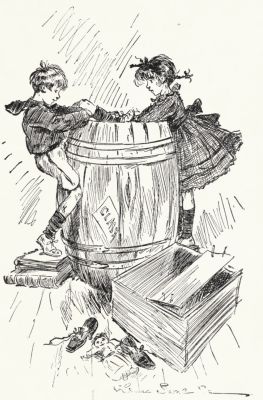
She was packing when I came home and the Precious Ones were racing about among boxes and barrels in unalloyed happiness. It did not seem possible that we had bought so much or that I could have put so many tacks in the matting.
The moving men would be there with their van by daylight next morning, she said. (It seems that the man at the office had told her that we would have to get up early to get ahead of him, and she had construed this statement literally.) So we toiled far into the night and then crept wearily to bed in our dismantled nest, to toss wakefully through the few remaining hours of darkness, fearful that the summons of the forehanded and expeditious moving man would find us in slumber and unprepared.
We were deeply grateful to him that he had not arrived before we had finished our early and scrappy breakfast. Then presently, when we were ready for him and he did not appear, we were still appreciative, for we said to each other that he was giving us a little extra time so that we would not feel upset and hurried. Still, it would be just as well if he would come, now, so that we might get moved and settled before night.
It had been a bright, pleasant morning, but as the forenoon advanced the sky darkened and it grew bitterly cold. Gloom settled down without and the meager steam supply was scarcely noticeable in our bare apartment. The Precious Ones ran every minute to the door to watch for the moving van and came back to us with blue noses and icy hands. We began to wonder if something had gone wrong. Perhaps a misunderstanding of the address—illness or sudden death on the part of the man who had made the engagement—perhaps—
I went around at last to make inquiries. A heavy, dusty person looked into the soiled book and ran his finger down the page.
"That's right!" he announced. "Address all correct. Van on the way around there now."
I hurried back comforted. I do not believe in strong language, but that heavy individual with the soiled book was a dusty liar. There is no other word to express it—if there was, and a stronger one, I would use it. He was a liar by instinct and a prevaricator by trade. The van was not at our door when I returned. Neither had it started in our direction.
We had expected to get down to our new quarters by noon and enjoy a little lunch at a near-by restaurant before putting things in order. At lunch time the van had still not appeared, and there was no near-by restaurant. The Precious Ones began to demand food and the Little Woman laboriously dug down into several receptacles before she finally brought forth part of a loaf of dry bread and a small, stony lump of butter. But to the Precious Ones it meant life and renewed joy.
The moving man came at one o'clock and in a great hurry. He seemed surprised that we were ready for him. There were so many reasons why he had not come sooner that we presently wondered how he had been able to get there at all. He was a merry, self-assured villain, and whistled as he and his rusty assistant hustled our things out on the pavement, leaving all the doors open.
We were not contented with his manner of loading. The pieces we were proud of—our polished Louis-XIVth-Street furniture—he hurried into the darkness of his mighty van, while those pieces which in every household are regarded more as matters of use than ornament he left ranged along the pavement for all the world to gape at. Now and then he paused to recount incidents of his former varied experience and to try on such of my old clothes as came within his reach. I realized now why most of the things he wore did not fit him. His wardrobe was the accumulation of many movings.
This contempt for our furniture was poorly concealed. He suggested, kindly enough, however, that for living around in flats it was too light, and after briefly watching his handling of it I quite agreed with him. It was four o'clock when we were finally off, and the shades of evening had fallen before we reached our new home.
The generous and sympathetic welcome of our new janitress was like balm. One was low-voiced and her own sorrows had filled her with a broad understanding of human trials. She looked weary herself, and suggested en passant that the doctor had prescribed a little stimulant as being what she most needed, but that, of course, such things were not for the poor.
I had a bottle of material, distilled over the peat fires of Scotland. I knew where it was and I found it for her. Then the moving man came up with a number of our belongings and we forgot her in the general turmoil and misery that ensued. Bump—bump—up the narrow stairs came our household goods and gods, and were planted at random about the floor, in shapeless heaps and pyramids. All were up, at last, except a few large pieces.
At this point in the proceedings the moving man and his assistant paused in their labors and the former fished out of his misfit clothing a greasy piece of paper which he handed me. I glanced at it under the jet and saw that it was my bill.
"Oh, all right," I said, "I can't stop just now. Wait till you get everything up, and then I can get at my purse and pay you."
He grinned at me.
"It's the boss's rule," he said, "to collect before the last things is taken out of the van."
I understood now why the pieces of value had gone in first. I also understood what the "boss" had meant in saying that we would have to get up early to get ahead of him. While I was digging up the money they made side remarks to each other on the lateness of the hour, the length of the stairs, and the heaviness of the pieces still to come. I gave them each a liberal tip in sheer desperation.
They were gone at last and we stood helplessly among our belongings that lay like flotsam and jetsam tossed up on a forbidding shore. The Precious Ones were whimpering with cold and hunger and want of sleep; the hopelessness of life pressed heavily upon us. Wearily we dragged something together for beds, and then crept out to find food. When we returned there was a dark object in the dim hall against our door. I struck a match to see what it was. It was a woman, and the sorrows of living and the troubles of dying were as naught to her. Above and about her hung the aroma of the peat fires of Scotland. It was our janitress, and she had returned us the empty bottle.