XIII.
Reading edition
A Home at Last.
We began reading advertisements at once and took jaunts to "see property." The various investment companies supplied free transportation on these occasions. It was a pleasant variation from the old days of flat hunting. The Precious Ones, who remembered with joy our former brief suburban experiment, appreciated it, and raced shouting through rows of new "instalment houses" with nice lawns, all within the commutation limits. We settled on one, at last, through an agency which the trolley-man referred to as the "Reality Trust."
The cash-payment was small and the instalments, if long continued, were at least not discouraging as to size. We had a nice wide lawn with green grass, a big, dry cellar with a furnace, a high, light garret, and eight beautiful light rooms, all our own. At the back there were clothes-poles and room for a garden. In front there was a long porch with a place for a hammock. There was room in the yard for the Precious Ones to romp, as well as space to spread out our rugs. We closed the bargain at once, and engaged a moving man. Our Flat days were over.
And now fortune seemed all at once to smile. The day of our last move was perfect. The moving man came exactly on time and delivered our possessions at the new home on the moment of our arrival there. The Little Woman superintended matters inside, while I spread out my rugs on the grass in the sun and shook them and swept them and scolded the Precious Ones, who were inclined to sit on the one I was handling, to my heart's content. Within an hour the butcher, the baker, and the merry milk-maker had called and established relations. By night-fall we were fairly settled—our furniture, so crowded in a little city apartment, airily scattered through our eight big, beautiful rooms, and our rugs, all fresh and clean, reaching as far as they would go, suggesting new additions to our collection whenever the spell of the dark-faced Armenians in their dim oriental Broadway recess should assert itself during the years to come.
OUR GARDEN FLOURISHED.
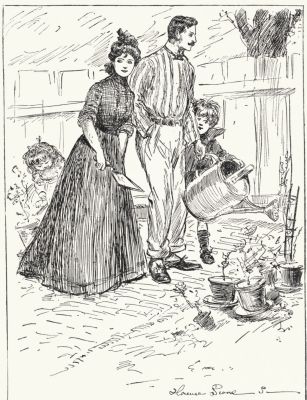
Sweet spring days followed. We fairly reveled in seed catalogues, and our garden flourished. Our neighbors, instead of borrowing our loose property, as we had been led to expect by the comic papers, literally overwhelmed us with garden tools and good advice. We needed both, certainly, and were duly thankful.
As for the Precious Ones, they grew fat and brown, refused to wear hats and shoes when summer came, and it required some argument to convince them that even a fragmentary amount of clothes was necessary. All day now they run, and shout, and fall down and cry, and get up again and laugh, sit in the hammock and swing their disreputable dolls, and eat and quarrel and make up and have a beautiful time. At night they sleep in a big airy room where screens let the breeze in and keep out the few friendly mosquitoes that are a part of all suburban life. We are commuters, and we are glad of it, let the comic papers say what they will. The fellows who write those things are bitten with something worse than mosquitoes, i. e., envy—I know, because I have written some of them myself, in the old days. Perhaps it is hard to get to and from the train sometimes—perhaps the snow may blow into the garret and the lawn be hard to mow on a hot day. But the joy of the healthy Precious Ones and of coming out of the smelly, clattering city at the end of a hot summer day to a cool, sweet quiet, more than makes up for all the rest; while as one falls asleep, in a restful room that lets the breeze in from three different directions, the memories of flat-life, flat-hunting, and janitors—of sweltering, disordered nights, of crashing cobble and clanging trolleys, of evil-smelling halls and stairways, of these and of every other phase of the yardless, constricted apartment existence, blend into a sigh of relief that is lost in dreamless, refreshing suburban sleep.