PREFACE. (continued 3)
Reading edition
It is commonly cut for fencing farms against herds.
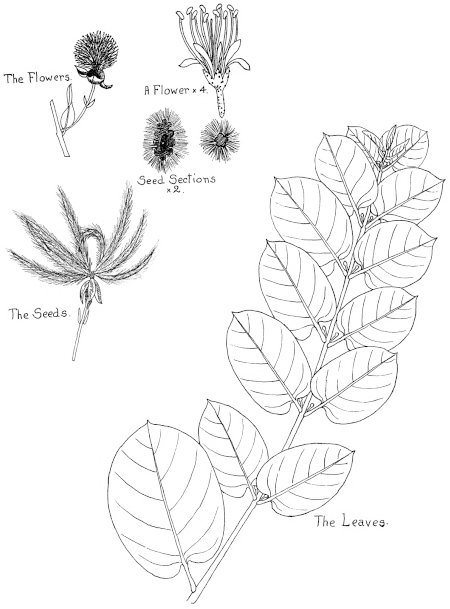
GYMNOSPORIA SENEGALENSIS Loes.—Kunkushewa, Namijin tsada, Mangaladi, Bakororo. CELASTRACEAE.
A shrub or small tree, occasionally as tall as 25 feet with a girth of 2 feet, but more generally a shrub found in large numbers in open secondary growth after cultivation. It does not grow in the far north and requires well-watered and more loamy soils than are found above 13° N. Sometimes it exceeds 50 per cent. of the vegetation on old farm lands, and such land being burnt every year the tree increases very slowly in height and broadens into a compact shrub. The crenate-edged leaves with bright red stalks, the small sharp thorns, small white flowers and globular fruits are distinctive characters.
The Bark of old trees is dark or light grey and covered with very small, close-fitting rectangular scales. That of the shrubs is pale-grey, sometimes almost white, and smooth. The slash is crimson.
The Thorns are in the axils of the leaves and in their axils is a bud. On the new shoots they are green with crimson bases, ¼-½ inch long, very sharp and straight. On old wood and twigs they are brown and very strong.
The Wood is whitish, hard, straight grained, sound and clean and weighs 45 lbs. a cubic foot. The rings are visible as extremely fine lines of alternate hard and soft tissue, the pores and rays both invisible except under good magnification. Planes and saws well but splits in seasoning.
The Leaves vary a great deal in size and shape, but the type is obovate or spoon-shaped with a tapering base and a rounded, broad tip, with or without a cleft of variable depth. Often the tip of the leaf is very deeply cleft, the edge is finely crenate or serrate, the surface smooth, the laterals hardly visible except when held up to the light. The mid-rib is prominent beneath, the laterals waved, the stalk crimson, the length up to 4 inches and breadth 2½ inches. The leaf droops in the sun and becomes limp in texture.
The Flowers, from December to February, are in small cymes in the axils of the leaves, on the old wood or new shoots. On the new shoots there is generally one cyme in each axil, on the older twigs there may be four separate cymes. Each flower is ⅙ inch in diameter, with a very small 5-pointed calyx, 5 white, oval petals, 5 minute stamens and an ovary with a bifid, branched style. There are male and female flowers on the same tree, the female having no stamens.
The Fruit is a capsule, ½ inch in diameter, with 3 cells each containing 2 seeds. They are conspicuous in clusters, turning from pale green to red.
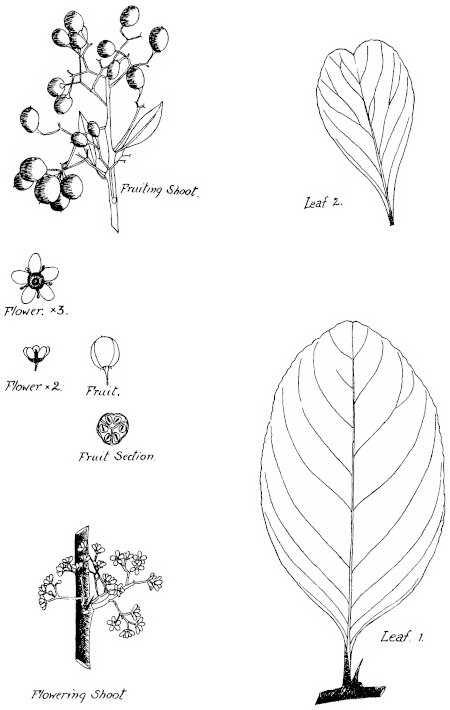
HANNOA UNDULATA Planch.—Takandar giwa. SIMARUBACEAE.
A medium-sized tree which abounds, though not further north than 12° and very local, in Tree savannah and the better type of Bush savannah. Its bark and leaves, once recognised are a ready means of identification. It attains a height of 35 feet with girths of 3-5 feet. It grows erect, with vertically ascending branches which form a high, narrow crown. A bole-length up to 10 feet, but not often more, is common. It is very subject to attacks by a caterpillar which skeletonises the leaves and covers the twigs with a lot of silk.
The Bark is dull, grey with long vertical ridges and fissures of very soft, thick cork. A curious effect, due to the absence of marked scales, is that the bole appears to have no bark at all, but resembles a dead tree whose trunk has turned grey with exposure. The slash is reddish.
The Wood is pale yellow. In transverse section the rings are faintly visible, the pores are mostly in little chains of 2-6 or so, having the appearance of being one long pore divided by partitions, the groups running in radial direction between the rays. Thin lines of soft tissue connect the groups. The wood is soft, saws and planes very easily, with little picking up. The wood requires well seasoning as it is liable to mould and rot. The weight is 35 lbs. a cubic foot.
The Leaves are pinnate, up to 12 inches long with 3 or 4 opposite pairs and a terminal leaflet. The leaflets are far apart and on slender stalks an inch or more in length. They vary in size on the one leaf, up to 2 inches long, excluding the stalk, and almost as broad as long in the case of the lowest pair and the terminal leaflet, with broadly cleft tips and abruptly tapering bases. The margins are sinuous, the mid-rib prominent on both surfaces and the lateral grooved on both surfaces. They are a dull, dark green above and a yellowish green beneath. The leaflets are almost at right angles to the main stalk.
The Flowers appear from October to November and are in large, loose panicles, some 12 inches long. Each is about ⅜ inch in diameter with a small cup-shaped calyx, 6 yellowish petals, 12 stamens, the lower half of the filaments being covered with hairs, and a short blunt pistil on a 6-part ovary. The flowers are scented.
The Fruits are formed by the growth of the several carpels, one or two of which generally crowd out the rest and grow at their expense. Rarely more than two reach maturity and occupy their respective positions on the stalk with their angular side facing the centre. Each is ¾ inch long and half as wide, a flattened or angled oval, with a brown or blackish wrinkled or lined skin, a hard shell and white kernel with light brown coat. Only a small proportion, as a rule, reach maturity, and these are very persistent on the tree, falling with the first rains 3 or 4 months later.
Uses.—The wood is used for all purposes that Bombax buonopozense is, namely basins, stools and cattle troughs, and occasionally drums.
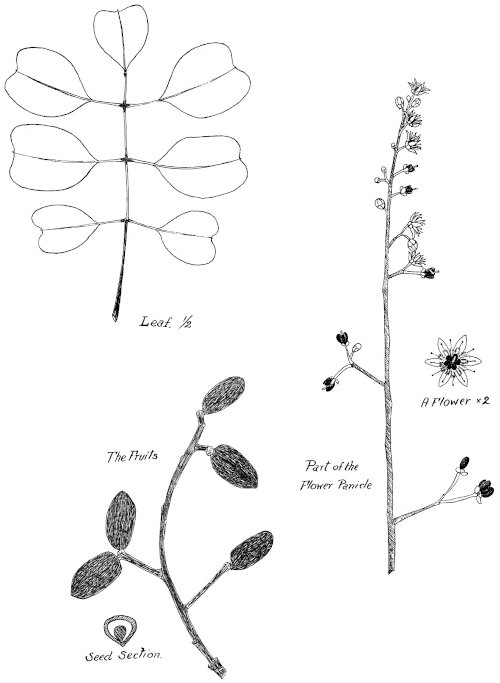
HYMENOCARDIA ACIDA Tul.—Jan Yaro, Jan iche. EUPHORBIACEAE.
A small, erect tree up to 25 feet in height and 2 feet in girth. It is very widely distributed from quite near the coast up to 12° N. As most commonly seen, in open forest, it is not above 15 feet, erect, with ascending, crooked branches and a close, compact little crown. In this form it occurs in great quantities in secondary growth and is very familiar with its pale reddish stem. Older trees may have an 8 feet bole with a compact rounded crown. The male and female are on different trees (dioecious), both very readily distinguished, the first by its red catkins, the second by its red, heart-shaped, double-seeded, winged fruit. The male is often called “taramniya” by the native, owing to the resemblance of its flower-spikes to those of Combretum species.
The Bark is a light reddish or orange colour, sometimes almost white, with a dusty covering up to the extremities of the twigs. Here and there on older trees are a few scattered grey scales. The slash is a dull pink with a thin green edge.
The Wood is pinkish, hard, 55 lbs. per cubic foot, splits in seasoning, planes well with the grain, coarsely against it, exhibiting a bright sheen in cross section, the rings well marked fine dark lines, the pores very small and evenly scattered along the extremely fine rays in chains. The wood darkens considerably on exposure, being almost orange in transverse section.
The Leaves are some 3-4 inches long and 1-1½ broad, rounded or narrow at the base, bluntly pointed at the tip, which is variable, with ½ inch stalks. The mid-rib is prominent beneath. The leaf has a tendency to fold up along the mid-rib, especially towards the tip which is often recurved. The colour is at first a most delicate green, conspicuous from a distance but the leaf turns dark, toughens and loses the few hairs it had when young. They are arranged spirally round the twigs and stand erect.
The Flowers, male on one tree and female on another, appear in February and March. The male are in spikes, which are at first, in bud, short and bright red, gradually lengthening and turning whitish as the stamens open, finally becoming pendulous and as much as 4 inches long. Often they are in great masses and flies and small insects haunt them. Each consists of a small 5-lobed red calyx, no petals and 5 radiating stamens joined below into a short column, the anthers large, whitish and with a bright yellow gland at the tip beneath. There is a rudimentary red ovary with a bifid tip. The female flowers are almost invisible at first but grow into sight very rapidly after fertilisation. They consist of a calyx with long red sepals, varying in number from 5-8, and an ovary with two styles which become very prominent and grow long. These are wrinkled and bent or twisted and beneath them the ovary enlarges till it is about an inch long and 1¼ inches broad, gradually changing from the limp green to the dark red double-seeded, winged fruit so familiar in masses and often persistent till the new leaves of the following year.
The Fruits, as described above, ripen and split into their two cocci, each containing one large flat seed. The seed portion of the coccus is net-veined and the wing portion longitudinally veined.
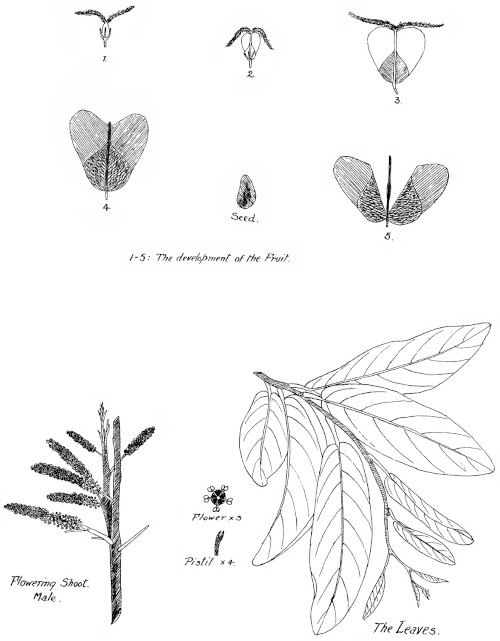
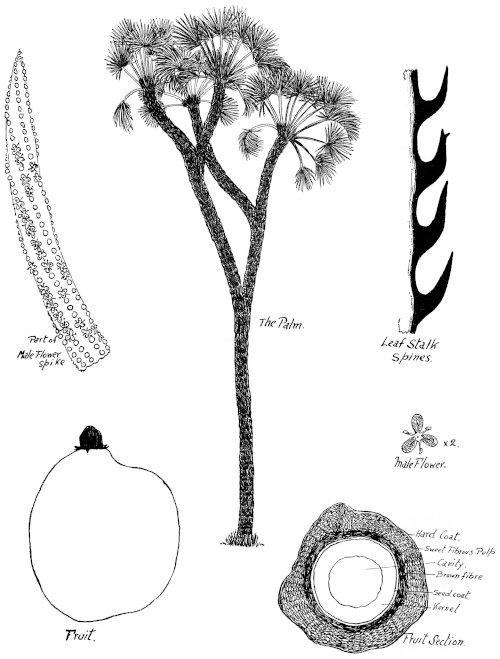
HYPHAENE THEBAICA Mart.—Goriba. “Dum Palm.” PALMACEAE.
This very common palm is found all over N. Nigeria and is distinguished from all others by its branching habit. It thrives in dry country, farther north than any other palm. The height is some 30 feet and the girth about 3 feet. The main stem branches into two and each of these may divide again and even a third time. In agricultural land the ground is densely covered with the seedlings which are cut down each year by the farmer.
The Bark is smooth, the rings of the leaf sheaths clearly marked except at the base of old trees where the stem has the appearance of decay and an uneven surface.
The Wood is very fibrous and has no local use beyond that of roof or door supports. It has been used as fuel.
The Leaves are about 4 feet long, the segments inverted V-shaped, about 18 inches long, with smooth margins, united for a few inches of their length only. The stalk is curved back at the tip and the segments at the base are higher up on one side than on the other. The stalk is heavily armed with black spines and the sheath is divided at the base, remaining clasped to the stem for some time.
The Flowers which appear in March, when the fruit is ripe or fallen, are male and female on different trees. The spadix of both sexes is similar, up to 4 feet long with 2-3 spikes rising from the small branches at intervals along the spadix. The males are small green flowers with 3 sepals, 3 petals and 6 stamens, massed on the spikes, often spirally in rows up the spike. The females have very short stalks and have 3 sepals, 3 shorter petals, 6 rudimentary stamens and a 3-lobed ovary.
The Fruits are 2½—3 inches long and 2-2½ inches broad, light brown when ripe, reddish-brown before ripe, roughly showing 3 lobes on the exterior, smooth and hard. They contain a large, hollow kernel, very hard. The fruit ripens in March.
Uses.—The leaves are used for mats, hats, baskets, fans and various plaited articles. The unripe kernel is eaten raw and the rind of the fruit is used for making sweets. Elsewhere the kernels have been used for buttons.
ISOBERLINIA DALZIELII Craib & Stapf.—Fara doka. LEGUMINOSAE.
This species is very similar to I. doka, the outstanding difference being its generally paler colour in all its parts, especially in the leaves which are covered with a grey bloom. Its habit is the same and its form similar, though it differs in having a higher and rounder crown when small, the leaves not drooping so markedly as those of the other species. The bole is longer and the tree attains a greater height than does I. doka. A height of over 60 feet with a girth of 8 feet is not uncommon in forests of this species as well as in single examples. Long, clean boles with short, rounded root-flanges and high, flat-topped crowns are typical. It regenerates with the same profusion and is as susceptible to fire as I. doka, hollow stems in old trees being the general rule. This species seems to prefer stony and shallow soils and over large areas of such it grows pure, often to the total exclusion of I. doka.
The Bark is light grey, smoother than that of I. doka, and has rather large, oval scales which leave light brown scars. The slash is pale crimson.
The Wood is light red in colour with open grain of this colour and silvery streaks. The sap is dirty white. Weight 50 lbs. a cubic foot.
The Leaves are large, very variable in size and averaging some 18 inches. They have usually 7 leaflets covered with a soft grey bloom which gives them a bluish appearance. They are rounder, paler and softer in texture than those of I. doka, and the bloom is particularly marked in young leaves which pass through the same grades of colouring from pink to green as do those of I. doka.
The Flowers are in large panicles and appear in December. Each is composed of 5 irregular white petals and 5 narrow, pointed sepals, and 10 long stamens, the whole enclosed in a blackish-green, hard, rounded case which splits into two halves in the axil of which the flower sits.
The Fruit is a long, broad, flat pod, covered with a green velvet. It is about 12 inches long and 3 inches wide and splits with a report, the two halves curling up and the seeds being violently projected. This occurs in May and June.
Uses.—The young poles are used for local building purposes, but they are very soft and liable to attacks from white ants and borer-beetles and last only one season. Larger trees are locally cut into planks, and provide an inferior timber.
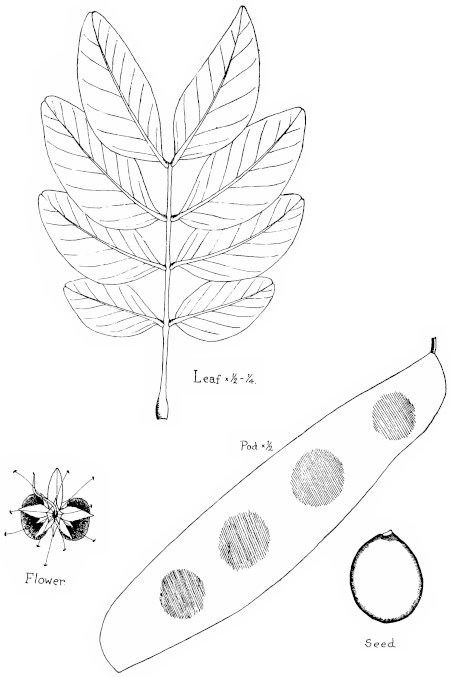
ISOBERLINIA DOKA Craib and Stapf.—Doka. LEGUMINOSAE.
This species, with its congener I. Dalzielii, is a type tree of the Tree savannah and the most common of all trees in that formation. It occurs as high-crowned forest over many hundreds of square miles of the northern provinces, though it does not extend to the extreme north. It is found in all stages according to age, from the dense covering of the cleared farm land to the 40-50 feet high-crowned forests with little undergrowth except that of its own shoots or seedlings. It grows long straight boles, usually forking at 10-15 feet, and its wide-spreading limbs form a high open crown which closes the roof of the forest. Trees in a 25 feet forest have girths of, as a rule, not more than 2-3 feet, and the crown is ¾ of the total height, and narrow, the branches ascending vertically. A girth of 5-6, or more, feet is common in trees 50 feet high. The species is very susceptible to fire and the majority of large trees have hollow centres from this cause. The stem is often a mere shell, filled with the earth of white ants or with a copious volume of reddish sap which flows out and bubbles up from the base when felled. This species seems to be more exacting as to soil conditions than I. Dalzielii, the latter predominating on higher or more stony ground, the change from one species to the other often being very marked. As a rule the species are mixed indiscriminately, especially on level country.
The Bark is dark grey with large, even-sized, rather shaggy scales. It is darker and rougher than that of I. Dalzielii. The slash is light red, the sap sticky.
The Wood is red, varying from bright red to greyish-red, with long, silvery streaks. In transverse section the pores are large, in rows, festoons and small groups, and the rays are extremely fine and close together, showing as small red bars in radial section. In the plank the pores are long, open red lines, the grain often being strikingly waved. The sapwood is silvery with a reddish tinge. The timber saws and planes well, with a smooth finish and no polish. The weight is 50-55 lbs. a cubic foot.
The Leaves are large and pinnate with an average of 7 leaflets, dark-green and shiny. The young leaves are bright red and glistening and pass through every shade from this to the ultimate brilliant green of the new mature leaf. This is most noticeable after a fire when the forest is a blaze of colour. The leaves vary very considerably in size and average some 15-18 inches, those of smaller trees being much larger.
The Flowers, which are similar in both species, are in large panicles, and each consists of 5 white, uneven-sized petals and 10 long stamens. The sepals are small, narrow and white, and the whole flower is enclosed in a hard, round, blackish-green sheath which splits into two portions in which the flower rests. They appear in February.
The Fruit is a large, broad, flat pod some 12 inches long and 3 inches wide, a dull green in colour with a smooth surface. It contains some 4 or 5 large oval, flat, pale-brown seeds which are distributed by the violent splitting of the pod, the two halves separating with a report and curling up into a spiral.
Uses.—The young trees are used for house-building poles, but only last for a season as they are very soft and readily attacked by white ants and borer-beetles. Large trees are cut into planks for local use, but the timber is very inferior.
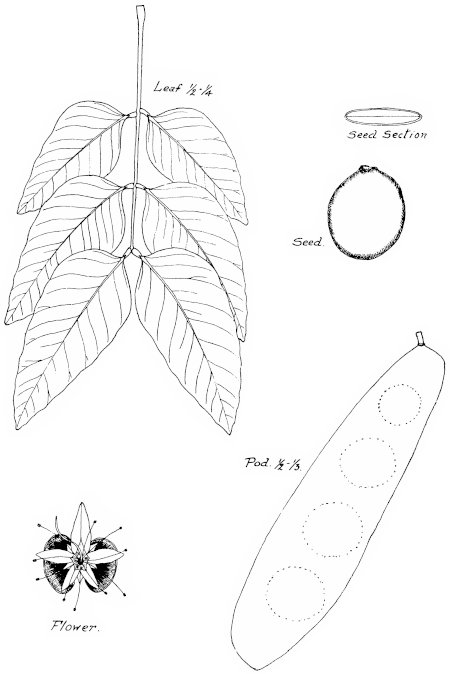
KHAYA SENEGALENSIS Juss.—Madachi. “Mahogany.” MELIACEAE.
This common and well-known Dry Zone Mahogany occurs more or less plentifully all over the north and has a distribution from the rain forest to the French boundary. Its habitat is the banks of streams but its soil and water requirements are comparatively modest and any little valley or moist hollow is sufficient. It abounds in the more northerly “kurmis,” and on the edges of “fadammas” often shows a gregarious habit, clumps of a dozen or so growing close together. Normally it is a small tree some 50-60 feet high with a girth of 6-8 feet, but 70-80 feet and a 10 feet girth are common. Usually not more than 20 feet of its height is clean bole, but no rule can be laid down, as the stem may or may not divide into 2 or 3 large limbs which ascend vertically and form the characteristic open, wide-spreading crown. In the gregarious clumps the tree may have as many as 5 or 6 of these false stems and form an enormous crown. The bole and main limbs show a wavy habit, especially noticeable in smaller trees. The base of the bole is often much swollen by the repeated bark chipping for the bitter tonic.
The Bark is dark grey and covered with small, thin scales. A red sap exudes from the bright crimson slash.
The Wood is a deep red-brown, generally with a pronounced purple tinge which distinguishes it from K. grandifolia, the typical mahogany hue being absent. In transverse section the rings are indistinct colour variations; the pores are small, open, single and scattered about between the long wavy rays which are close together and visible to the naked eye. In vertical section the pores are open and dark coloured, the grain showing as waved bands of varying depth of colour speckled with the pores. The wood is very hard, sometimes badly cross-grained and tough, but at others sound and fairly straight, enabling it to be sawn and planed fairly easily. It is very apt to pick up, but the finished surface takes a good polish. The pore contents glisten. The sapwood is grey with a purplish tinge. The weight is up to 60 lbs. a cubic foot.
The Leaves are pinnate with 4-6 pairs of leaflets. The leaves of young trees will bear as many as 10 leaflets. The leaf is bright and shiny when young but darkens and dulls and the greyish under surface is typical.
The Flowers are in lax panicles amongst the end leaves and are found from December to April, earlier in some parts. The panicles are 6-8 inches long and the small flowers are white with 4 sepals and petals and 8 stamens whose filaments are united to form a crown round the knobbed pistil. The tree often flowers out of season.
The Fruits are capsules, grey, and erect and conspicuous on the top of the tree. They are from 2-2½ inches in diameter and split into 4 sections in each of which the flat, winged, mahogany-brown seeds are tightly packed one above the other. They ripen from March onwards of the next year, the seeds falling from the split capsule on the tree.
Uses.—The wood for furniture, canoes and mortars.
The bark as a bitter tonic after boiling with water, and powdered as a cure of sore backs of horses.
The leaves are gathered for camel and cattle fodder.
The seeds, dried, fried, beaten up and boiled to extract the oil, are used for anointing the body, by pagans.
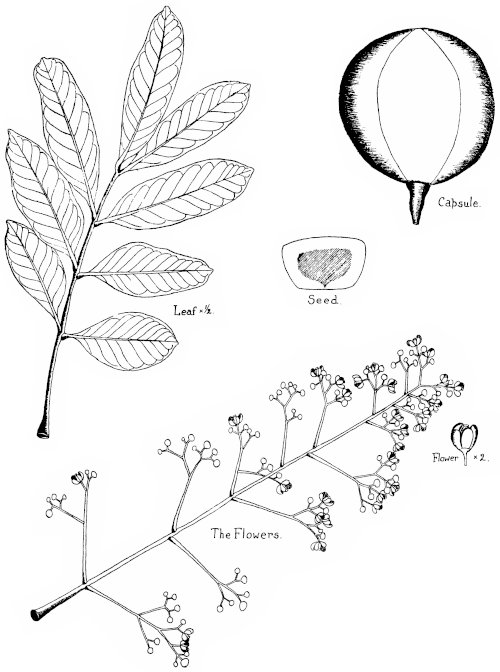
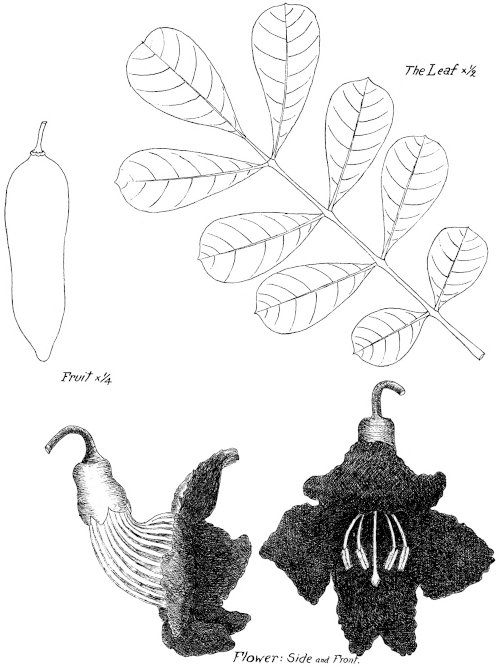
KIGELIA AETHIOPICA Decne. var. BORNUENSIS Sprague.—Rawuya, Rahaina, Nonon Giwa. “Sausage Tree.” BIGNONIACEAE.
A large tree up to 50 feet in height with a girth of 6-7 feet. It occurs in the north mostly in “kurmis” up to 11° N. or more. It is not a savannah tree but has penetrated a great distance into them by way of the streams. It is low-branching or forking, and has large limbs forming a high or wide crown of great spread and dense foliage. Either in flower or fruit it is unmistakable.
The Bark is grey or light brown with small, soft, corky scales, rather scattered and leaving lighter brown patches.
The Leaves are 12-15 inches long, pinnate, with 3-5 pairs of opposite leaflets and a terminal leaflet. The leaflets are obovate with broad tip and small point, and are increasingly longer and larger from below upwards, the lowest pair about 2½ inches long and 1½ inches broad, the upper pair 4-5 inches long and 2-2½ inches broad, the terminal as broad, but not so long. The nerves are prominent beneath but grooved above. The colour is light green and shining, smooth beneath. The margins may be serrate, the teeth quite sharp, or may be quite entire.
The Flowers are in panicles up to 4 feet in length hanging from the branches in February to April. The short flower stalks are curved, the calyx is fleshy, 4-lobed and pale green, and the corolla has a trumpet-shaped tube some 3 inches long, ending in a large, reddish-purple, wrinkled and lobed mouth on the lower side of which lie the 4 stamens and pistil with flattened stigma. The outside of the curved tubular portion is white with reddish lines, and the shape and length of this tube decides the species. There is an unpleasant odour to the flower. The corolla falls entire with the stamens attached.
The Fruit is like an elongated marrow, 12-20 inches long and 3-4 inches broad, greyish in colour with a slightly rough skin. The apex is pointed. Scattered about in the fibrous pulp are a number of small seeds which are let loose by the rotting of the fruit, which takes a long time to mature.
LONCHOCARPUS GRIFFONIANUS Dunn.—Tuburku. LEGUMINOSAE.
This is a large deciduous tree which extends up to 11° by way of the streams and “kurmis” and which, below that latitude will grow away, though not far, from their influence. It attains a height of 60 feet with a girth of 8 feet or more and has an enormous spreading crown with drooping twigs and delicate pinnate foliage which gives heavy shade. Bole lengths of 30 feet are seen in close forest and in the open there may be a number of stems from the ground level or near it. The pods, like strips of tanned leather, are the most distinctive feature, as they persist for some time.
The Bark is smooth, with small, very thin, close-fitting scales which remain attached by their centres before falling. The colour is grey or light brown. The slash is pale yellow, soft and thick.
The Wood is whitish-grey. In transverse section the rings are indistinct lines, the pores are very irregular festoons, dense on some zones and single and scattered in the rings. The rays are very fine and close and much waved, and are visible as a fine stippling in vertical sections. In vertical section the pores are open and their brown colour adds a tint to the wood. It is soft, very easy to work with all tools, the planed surface having a slight sheen. Weight 40 lbs. a cubic foot.
The Leaves are pinnate, 9-10 inches long with three to four pairs and a terminal leaflet. The main stalk is very slender and those of the leaflets very short. The leaflets are obovate, with a tongued tip, the lowest pair rounded, the intermediate pairs narrower and the terminal larger and broader. The upper surface is dark and shiny, the under side paler and smooth. The mid-rib is prominent beneath and slightly sunken above. There is a marked contrast between the colour of the leaflet stalks and the under side of the leaflets when viewed from beneath.
The Flowers appear on the leafless tree in February or March. They are on 6-7 inch long spikes all over the bare twigs, and are a delicate blue or mauve colour and pleasantly scented. They are “pea-flowers,” ¾ inch long, the calyx reddish-purple, the standard petal with a cream centre splash and the keel white. The flowering period is very short and the leaves follow and cover the tree in a few days.
The Fruits are flat pods, 3-5 inches long and ¾ inch broad, very slightly embossed at the seeds, light brown with a grained surface, very like tanned leather, containing up to 3 flat, bean-shaped, dark brown seeds. A large number of pods fall entire without producing seeds.
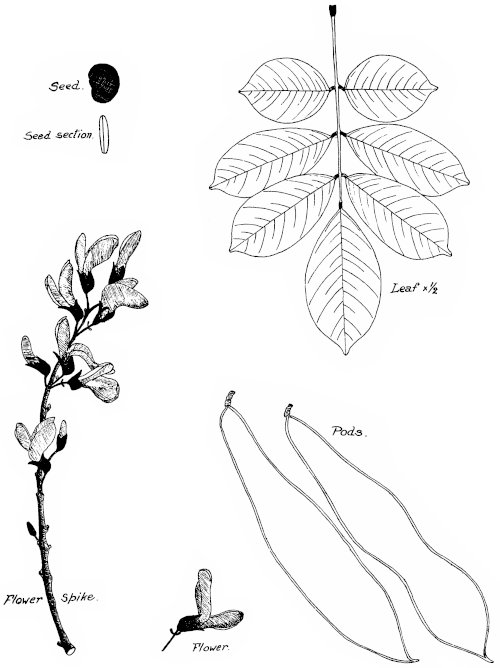
LONCHOCARPUS LAXIFLORUS G. & P.—Farin Sansame, Shunin Biri, Halshen Sa. LEGUMINOSAE.
A small tree some 15-20 feet high, occasionally 30 feet, occurring commonly throughout the drier savannahs, often in small patches or clumps. It resembles Stereospermum Kunthianum (Sansame) in form and leaf but in no other detail. The form is stunted and similar to the majority of the trees in the northern bush savannah, though larger examples with big oval crowns and a 10 foot bole are not uncommon. A curious branching habit is noticed where the main stem grows partly round the base of the side limb forming an enlarged joint. The branches are markedly drooping. The pale bark, purple flowers, narrow flat pods and greyish-green leaves are distinctive features.
The Bark is light grey or yellowish and fairly smooth, the scales being small, close together and corky. Narrow ridges of cork form on the branches and that of the stem thickens for protection against fires. The slash is yellow with black streaks, very distinctive.
The Wood is light yellow, of uniform colour. In transverse section the rings are marked and the concentric lines of hard and soft tissue very plainly seen. The pores are large and small, few, scattered about in the lines of soft tissue in festoons. The rays are straight, variable in width, some visible, others not, to the unaided eye. The areas of hard tissue are clearly divided into rectangles by the sharp lines of soft tissue and the rays. The wood is hard, heavy, not difficult to saw and planing to a smooth finish with a slight sheen. The weight is 55 lbs. a cubic foot.
The Leaves are a foot long with 5-7 leaflets, the terminal longest, the lowest pair shortest. They are grey-green and waxy to the touch and with the exception of the mid-rib the venation is raised on the upper and not on the lower surface. They are 3-4 inches long and tapering to both ends.
The Flowers are in numerous panicles at the twig ends, a mass of purple at first erect, then drooping. The panicles are up to a foot long and the flowers are papilionaceous with a white splash on the face of the standard petal. The calyx is dark purple. They appear from January to March and are fertilised by bees, flies and wasps and other insects.
The Fruits are pods, from 2-5 inches long according to the number of seeds, generally 2, rarely 3, and an inch in width. They are flat, light brown or whitish in colour, in pendulous masses, very conspicuous and the seeds are chestnut brown, ½ inch long, shiny, flat and with a deeply indented hilum. They remain on the tree for a long time.
Uses.—An infusion of the roots with water is used as a tonic.
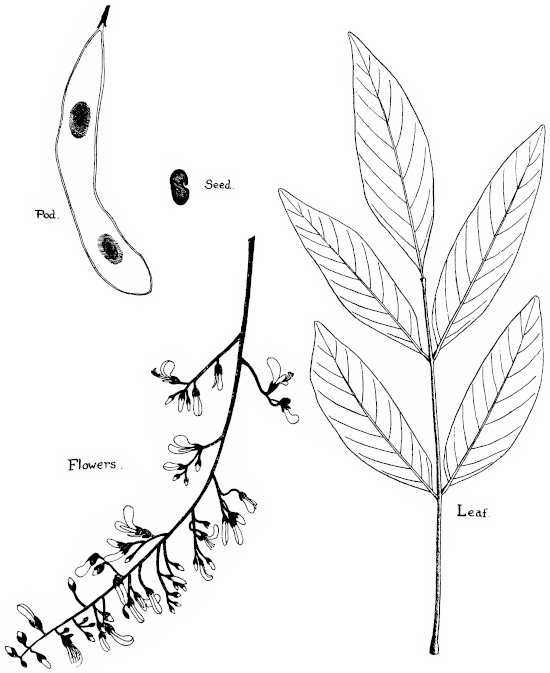
LOPHIRA ALATA Banks.—Namijin Kadai, Mijin Kadai. “Meni Oil Tree.” DIPTEROCARPACEAE.
This is one of the type species of the tree savannah and strongly resembles at first sight the Shea, since both have strap-shaped leaves. This is the only close resemblance and even they are easily distinguished from one another, see below. It attains a height of some 40 feet with a girth up to 6 feet, and has a tall, regular, rather open crown occupying at least two-thirds of the height and often more. The branches ascend at an acute angle to the stem so that the form is narrowed, another distinguishing feature between it and the Shea. It prefers good deep soils and its northern limit is about 12° N.
The Bark is light grey with even-sized scales 1-2 inches long, 1 inch wide and ¼ inch thick. That of the smaller branches is softly corky. The scales are not prominent, nor is there a milky sap, two other features distinguishing it from the Shea. The slash is crimson with bright yellow edges.
The Wood is a dull reddish-brown. The transverse section shows indistinct light rings, close together, the pores small and scattered singly and widely throughout the hard and soft tissue which is clearly separated in thin, wavy concentric dark and light lines. The rays are exceedingly fine and invisible to the naked eye. In vertical section the pores show as if filled with some chalky matter and the grain is straight with the hard and soft tissue marked in fine lines, and the rays as numerous small bands in radial section. The wood is hard to saw and plane, picking up in places, but elsewhere finishes smooth. It is tough and strong and weighs 65 lbs. a cubic foot.
The Leaves are strap-shaped, some 12 inches long, 3-4 inches broad, with an inch stalk. The margin is waved, the mid-rib alone prominent on both surfaces. The venation is extremely delicate, visible when held to the light. The new leaves are bright red, the red colour fading from the base upwards. The surface is shining, the texture soft. Clustered round the end 3-4 inches of the twigs, they appear like rosettes. The delicate venation, short stalk and red tips distinguish it from the Shea.
The Flowers are in clusters on long stalks amongst the leaves and resemble Apple blossom. They are white, cup-shaped, 1½ inches across, with 5 notched white petals and a ring of numerous yellow stamens round a stout bifid pistil. The calyx consists of 5 sepals, 3 small and round, 2 larger and red tipped, the latter enlarging to form the wings of the seed. They are scented, visited by bees and appear from November to February.
The Fruits are winged seeds, the wings formed by the enlargement of the 2 sepals. At first red, they become light green and leathery, the larger 4 inches, the smaller 2 inches long. The fibrous-coated seed elongates till it is a pointed cone an inch long, light brown as are the now dry wings. The seed contains a single kernel, loose when ripe, about March. Few natives will allow that this tree has any seeds, even when shown them, a popular obstinacy.
Uses.—The wood is too tough to carpenter satisfactorily, but is suitable for building posts. The seed contains some 45 per cent. of oil, said to be suitable for soap after testing, but this is not extracted locally.
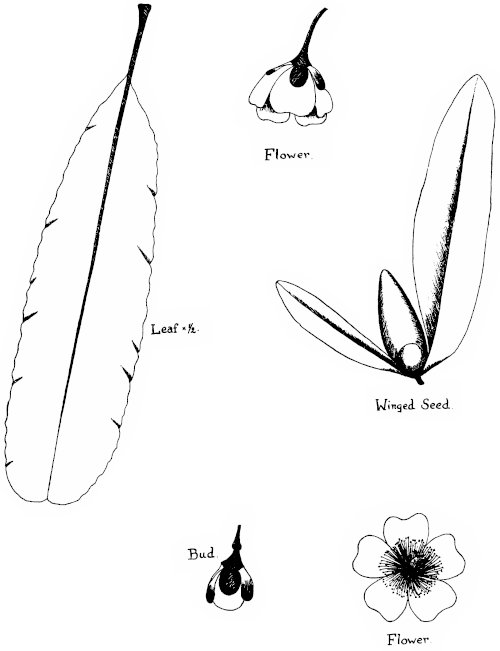
MAERUA ANGOLENSIS DC.—Chichiwa. CAPPARIDACEAE.
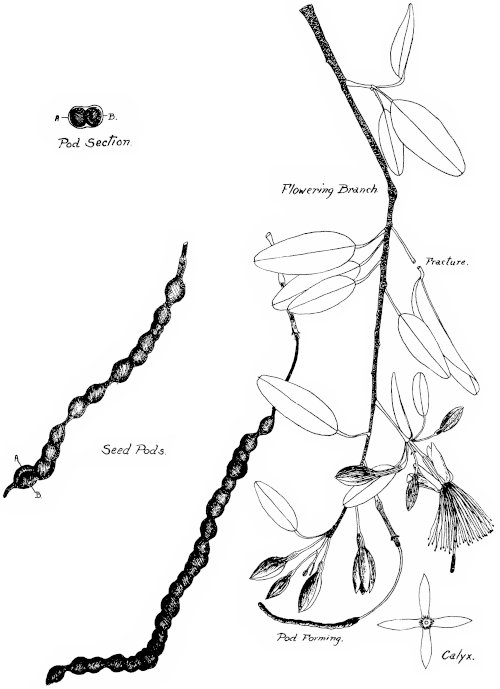
A small tree, widely distributed throughout savannahs of both types, flourishing equally well in dry sandy soils and richer loamy soils. It is straggling, often growing in the shade of other trees and partly supporting itself by them. In the open it is a slender tree about 15 feet in height, the stem dividing and the open low crown with drooping branches. Occasional examples will reach 25 feet with a 2 feet girth. It extends up to 13° N.
The Bark is dark grey to almost black. That of the smaller branches is dark brown, profusely spotted with small white lenticels which give it a mottled appearance, a most distinctive character. Galls on the new twigs and on the stem are very common.
The Leaves are simple, ovate, but variable in length to breadth, averaging 2 inches long and 1 inch broad. The tip is rounded or slightly cleft with a small projection of the mid-rib. The colour is pale and the surface smooth. The mid-rib is prominent beneath, otherwise the venation is practically unnoticeable. The stalks are ½-1 inch long and the last ¼ inch is thickened and bent at an angle and when the leaf is plucked the stalk nearly always parts at this bend.
The Flowers can be found from November to April and the individual flowers for a long time, almost ripe fruits and new flowers occurring at the same time. They are in leafy racemes of large size. Each has a slender stalk, a long column-like torus, 4 sepals which bend right back and finally fall off, no petals and a number of long white stamens, in the middle of which is the long slender style with the ovary at the tip. The lower part of the calyx is tubular, with the torus inside, and round its mouth is a toothed ring.
The Fruit forms at the end of the pistil, the sepals having fallen, the calyx tube shrunk and the toothed disc being exposed. It enlarges up to 6 inches in length and is constricted at intervals so that it looks like a string of irregular-sized beads. Sometimes two seeds lie alongside, and there may be as many as 30. The fruit is yellow and finally brown when ripe, and is similar in appearance to that of Cassia goratensis, though the restrictions are not so narrow as those of that species.
MAERUA CRASSIFOLIA Forsk.—Jiga. CAPPARIDACEAE.
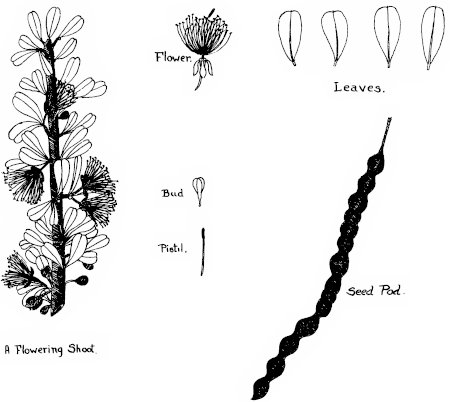
A medium-sized tree from 15-30 feet high and up to 4 feet in girth, which grows in dry localities as far north as 14°. It is quite common in N.E. Sokoto. It has a short bole, up to 12 feet, with ascending branches and can be at once distinguished by its heavily pruned appearance, the lateral branches being very short and resembling Randia nilotica, the rosettes of leaves being borne on stunted shoots on long, straight, tough branches. The form varies from the short tree with wide, compact crown to the tall, narrow growth of larger specimens.
The Bark is dull grey, smooth in young trees and longitudinally scaled in older trees.
The Leaves are in tufts at the end of short woody shoots and are ¾ inch long and ⅓ inch wide, tapering at the base, with a broad tip, in the shallow cleft of which projects the mid-rib. They are a dull, dark green and limp and leathery in texture.
The Flowers which appear in February rise from the leaf-bearing shoots on ½ inch stalks. Each has a calyx of 4 sepals, light green, which fall back to the stalk with maturity, some 30 white stamens with green anthers, all rising from a short column, and a long pistil with thickened stigma. There is a faint perfume.
The Fruits are like those of Maerua angolensis; long, jointed pods formed by the growth of the clubbed pistil. They are brown when ripe and break into sections. The seeds are 10-20 in number and ripen about April.
MIMOSA ASPERATA Linn.—Gumbi, Kaidaji, Kardaji. LEGUMINOSAE.
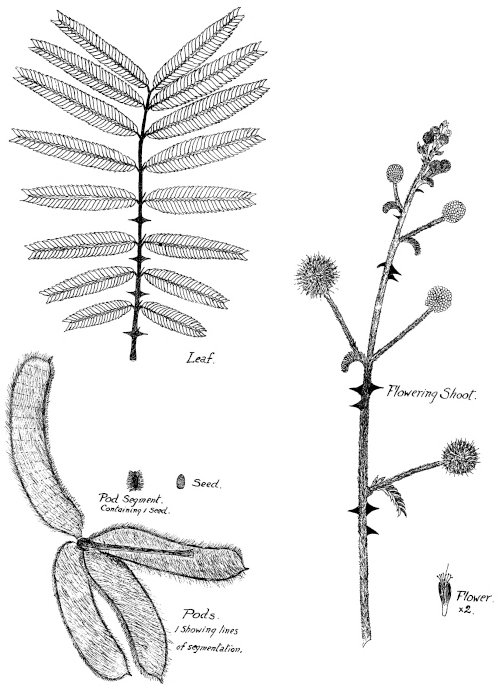
A very common shrub which inhabits marshes, the banks of rivers and the fringes of lakes, in fact, any low-lying, inundated ground, forming dense, impenetrable thickets, often of large extent. On the banks of rivers it is frequently associated with a species of Salix or willow. It has numerous stems and long erect or drooping shoots, 10 to 12 feet in length. The whole plant is covered with hairs.
The Thorns on the stems are in three’s, below each leaf, one thorn directly under the leaf, with a pair a little higher up on either side. The thorns on the stems are all the same size and shape, but those on the leaves differ as described below.
The Leaves are 3-5 inches long with 6-8 pairs of pinnae, bearing up to 40 pairs of long, narrow leaflets. The leaf is sensitive and folds up tight in the evening, the leaflets falling back under the mid-rib. On the upper side, between each pair of leaflets, is a short, slender and very sharp thorn, pointed well forward, and between the lower 4 or 5 pairs is a pair of sharp thorns with broad bases in the same plane as the leaflets. These thorns are absent in the upper part of the leaf. The young leaf is hairy.
The Flowers are in spherical heads about ½ inch in diameter, either white or mauve. Each minute flower has a calyx of 4 sepals, 8 stamens with white or mauve filaments and white anthers, and a long pistil.
The Fruits are pods, 2-2½ inches long, ½ inch wide and ⅛ inch thick, slightly curved. They are covered with erect, bristly hairs whose tips curve forward. On the green pod these hairs are golden brown; on the ripe pod they are unpleasantly penetrating. The pod splits transversely into 15-20 segments, each containing a small bean. The outer rim of the pod remains intact, the sections dropping out in the same manner as those of Entada sudanica.
Uses.—It is used as a fence round farms for protection against grazing, and in places where there is an acute shortage of fuel demands a price in the markets.
MITRAGYNE AFRICANA Korth.—Giyeya. Giyaiya. RUBIACEAE.
A large tree which inhabits “fadammas,” “tabkis” or annually inundated areas. It has several erect, straight stems ascending to a height of 60 feet in large specimens and the foliage reaches almost to ground level. From the branches, especially noticeable when one of these is horizontally inclined, are a number of slender erect shoots, like those of pollarded willow. The crown is the same width throughout with a narrowed or pointed top. The tree coppices very well and would provide a rotation crop if properly worked. It will not stand drought and a succession of dry years will kill the tree, subsequent wet years only serving to rot the dead trees. This is of frequent occurrence in the farthest north.
The Bark is light brown or grey and smooth, a few scales showing on the lower part of the stem in season. The slash is light brown, rapidly darkening.
The Wood is a very light brown. In transverse section the rings show broad bands of a darker colour, a purple tinge which is clearly seen in vertical, especially radial sections. The pores are minute, quite invisible to the naked eye, and with difficulty seen with the lens, in rows between the extremely fine rays which are waved and very close together. The grain is very close and fine; seasons well and is slightly liable to borer beetle attacks, works well with all tools, the plane producing a nice clean finish of a velvety nature. It is one of the best all-round timbers for many purposes and its small sizes are a great misfortune. The weight is 40 lbs. a cubic foot.
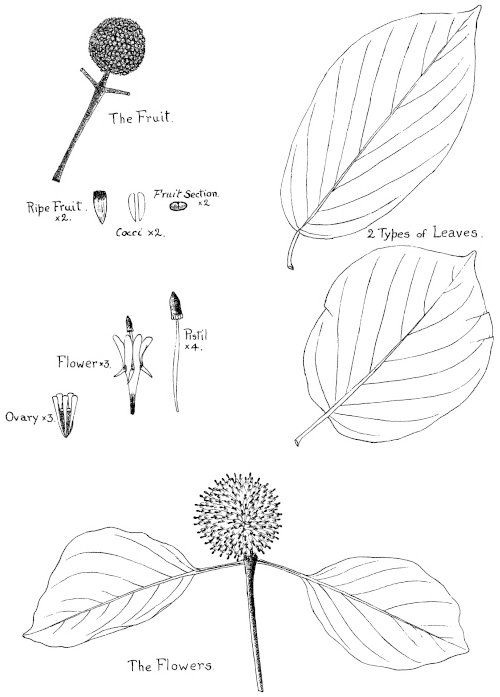
The Leaves vary somewhat in shape from a narrow oval to a broad, rather square oval, both shapes with a pointed tip. They are 3-4 inches long and 2-2½ inches broad with ½-¾ inch stalk. They are in opposite pairs as is so typically seen at the base of the flower or seed head. They are paler beneath than below, very soft and thin in consistency and the venation appears almost white by contrast.
The Flowers are in yellowish balls an inch in diameter, sweet-scented and appearing at the beginning of the rains, though a few blooms may be found at odd seasons. Each flower is about ½ inch long with 5 long sepals narrow at the base, broad at the tip (obconical); a tubular corolla with 5 lobes between each of which protrudes the anther of a stamen, grey in colour; and a long pistil terminating in a reddish stigma, shaped like a bee-hive. The flowers are at first white and then turn yellow.
The Fruits are in spherical heads ¾ inch in diameter and dark brown in colour. Each fruit is what is called di-coccous, i.e., the fruit is formed of two separating carpels, containing seeds. The fruiting heads are most conspicuous and enable the tree to be identified from some distance.
Uses.—The timber has been used lately by the Industrial Schools with great success, and in Sokoto it has been found one of the best for all purposes where large sizes are not necessary. The native makes bowls and spoons from it and it is a good source of poles for building houses. It is supposed to rot rapidly if exposed to wet.
MONOTES KERSTINGII Gilg.—Wasani, Gasa kura, Farin Rura. DIPTEROCARPACEAE.
A small tree of the better types of savannah not extending much north of 11°, and very locally distributed. In certain localities, e.g., S.E. Sokoto and W. Bauchi, it is very abundant and over hundreds of square miles will be found pure in patches and elsewhere composing 40-50 per cent. of the growth. It is slender, erect, up to 30 feet in height, with a stem of 1½-2 feet in girth, with the stem bare of branches up to 10 feet and the crown high, open and narrow. Trees in the open will grow large, round, compact crowns. The distinguishing features are the very light under surface of the leaf and the enlarged sepals which surround the fruit. The species resembles Parinarium.
The Bark is grey with light patches and fairly smooth, with small, close-fitting, not very prominent scales. The slash is dark red.
The Wood is a light brown-pink. In transverse section the rings are distinct as numerous very close fine lines, the pores are minute, numerous and crowded in small festoons interspersed with numerous single pores, the soft tissue being poorly developed. The rays are so fine and close as to be only just visible with the lens. The grain is very close and wavy and the planed surface reflects the light so as to produce a “shot” appearance, with a sheen. The wood is very hard to work with saw and plane and very cross grained. The weight is 64 lbs. a cubic foot.
The Leaves are oval, some 4 inches long and 3 inches broad, slightly cordate at the base, broad at the tip, with a ½ inch long downy stalk. The upper surface is dark green, shining and rough to the touch, with the venation below the surface, and the mid-rib bends at each lateral. The under surface is grey and velvety, the whole venation being prominently marked. At the base of the leaf there is a curious oval space where the blade of the leaf meets over the stalk at the bottom and again at the third lateral, leaving a gap through which the base of the mid-rib seems to appear.
The Flowers, which appear in the rains, are in small axillary clusters, each about ½ inch in diameter, with a 5-pointed calyx, 5 long white pointed petals, a mass of long stamens filling the corolla and a short straight pistil. They are very inconspicuous.
The Fruits are capsules, ½ inch in diameter, roughly round and wrinkled when ripe, with 3 cells in each of which is a small seed loose in the cell. The capsule is hard, fibrous and loosely porous in transverse section. Round it are the 5 greatly enlarged sepals, modified into wings, bright red at first, then drying pale brown. The fruits are very persistent on the tree, many not falling till the new leaves appear. The red wings are conspicuous from a great distance.
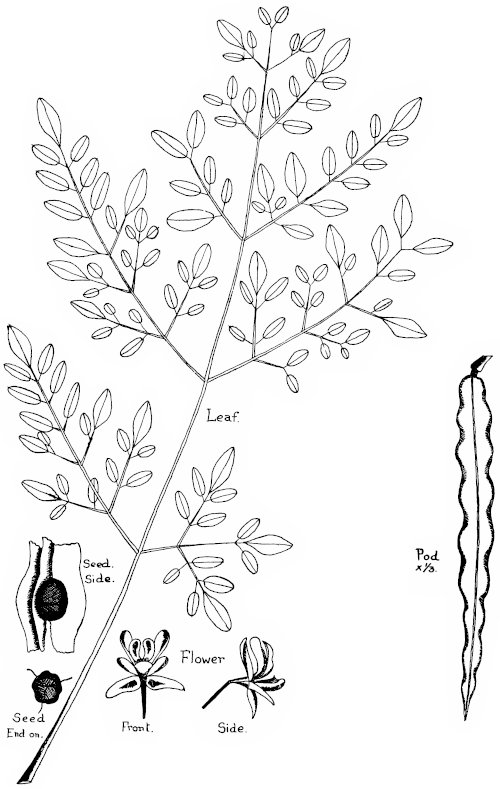
MORINGA PTERYGOSPERMA Gaertn.—Zogalagandi, Bagaruwar Makka. MORINGACEAE.
This is a very familiar little tree, an exotic from India, which is planted in compounds in the north. It grows some 15-25 feet high with a single stem often forking or dividing into 2 or 3 stems at or near the ground. It is distinguished by its tripinnate leaves, white flowers and long triangular, pointed pods.
The Bark is a deep bluish grey and smooth.
The Wood is white, very soft and of no use whatever.
The Leaves are tripinnate, about a foot long, with some 6 pinnae, each with some 2-5 pinnules, some again with one or two pairs of leaflets and a terminal leaflet. The terminal leaflets are generally larger than the others and all are variable in size and shape from small oval to large spear-shaped leaflets. The foliage is very sparse and graceful.
The Flowers are white, in loose panicles, in flower for many months in the year, during the dry season. Each has a 5-parted calyx with unequal sepals, 5 white petals, the 2 upper ones smaller than the others, 5 stamens with and 5 stamens without anthers, and a slender style. The flowers are sweet-scented.
The Fruits are long, triangular capsules up to 18 inches long, slightly jointed, with 2 grooves down each side, a sharp beak at the tip, light brown in colour and splitting down the 3 edges to release the seeds. These are blackish with 3 papery wings so shaped as to overlap and fit into one another, the bottom of the one seed touching the top of the wings of the one below it. The white pith, with a sheen, is indented to hold the seeds.
Uses.—It is commonly used as a fencing to compounds, the mats or cornstalks of which the fence is composed being tied to the growing trees. The roots are eaten as horse-radish and the leaves fresh as a vegetable. The seeds yield a very fine oil (oil of Ben) which has been pronounced as suitable for watch lubrication.
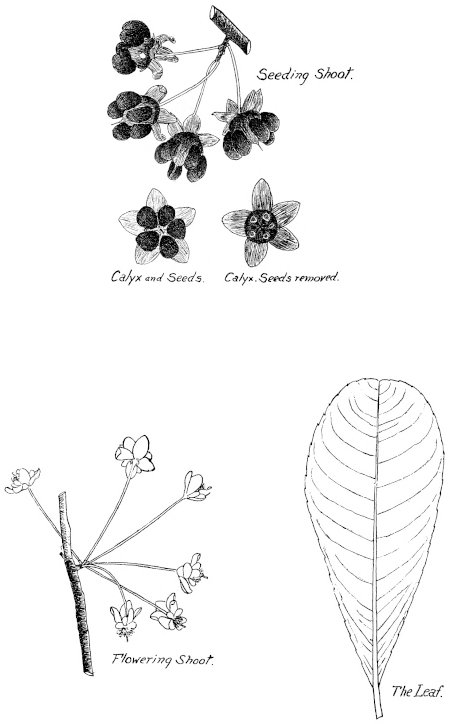
OCHNA HILLII Hutch. OCHNACEAE.
This is a small tree, common locally in parts of Zaria, Bauchi and S. Sokoto, not extending north of 12°. It is as a rule slender and erect, up to 15 feet in height, older trees forming a round crown, younger ones often shrub-like. The yellow flowers and red and black fruiting stage are very conspicuous and the serrate obovate leaves are typical.
The Bark is smooth, a dull grey or brown, with small scales. The slash is yellow, rapidly darkening on exposure.
The Leaves are obovate, 3-4 inches long, 1½-2 inches broad, with cleft tip and finely serrate edges. The venation is prominent on the upper surface. The young leaves are shiny and tinted red, and the mature leaf is tougher and grey-green with a waxy bloom.
The Flowers are borne on a short woody shoot, 4 or 5 together with 1-2 inch, slender stalks. Each has a calyx of 5 pale green overlapping sepals, 5 yellow petals smaller than the sepals and a ring of numerous stamens round an erect pistil. The flowers appear in February or March and the petals sometimes only remain 24 hours on the flower.
The Fruits are drupes, or small plums, in a ring round the much swollen torus or disc. The sepals enlarge and turn crimson, as does the disc, and the seeds, at first green, turn black and shiny, shrivelling when the surrounding pulp dries up. The branches are often borne down by the weight of the large crop of fruit which is a most conspicuous feature. The elongated pistil and the remains of the stamens appear like bristles on the torus. Most of the seeds are destroyed by a grub.
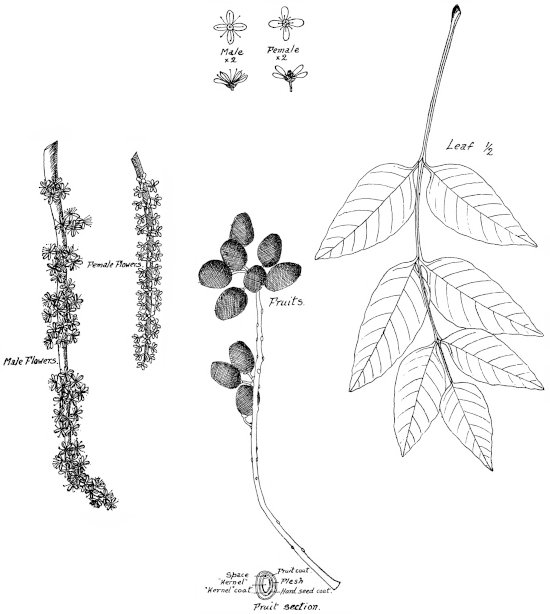
ODINA ACIDA Walp.—Farun mutane. ANACARDIACEAE.
A large tree, similar in flowers, fruits and leaves to O. Barteri, but differing in the absence of hairs on leaves and flower spikes to the extent of those on O. Barteri, and distinguished from it at once by the very smooth bark. It reaches large sizes, but not great heights, the average proportion being some 30 feet high with a girth of 6-8 feet. A very short, stout bole divides into a number of large, widely spreading limbs, the twigs drooping down to near the ground. The crown is open and rounded and of great width, affording little shade. Its habitat is the granite country, where it grows in large quantities on the plains or up in the rocky hills, stunted specimens flourishing on almost bare rock with the roots in the smallest cracks. The branches are very flexible and can be bent almost double without snapping. It is called “Farun mutane” as against the “Farun doya” of O. Barteri, because it is used for food and medicine.
The Bark is silvery grey, smooth to the point of shining, with occasional scales and a few lenticels. Very old trees cast large scales from the lower trunk. The bark frequently shows a marked spiral twisting round the stem and there are folds and creases like a skin. Resin exudes from the slash which is light red and of crumbling texture.
The Wood is practically the same as that of O. Barteri, q.v., for the most part consisting of a soft, dirty white wood, readily sawn and planed and of little value, the small heartwood being red-brown. The weight is about 25 lbs. a cubic foot.
The Leaves are pinnate, 18 inches long with some 4 pairs of leaflets and a terminal leaflet. These are broad at the base, narrowing towards the tip, the margins sinuous, the basal lobes unequal, the short stalks flattened, the upper surface light green, shining, with a few hairs and a pronounced stickiness to the touch. They appear after the flowers. Young leaves are very slightly tinged red.
The Flowers. The spikes of both sexes appear from January to April. The male spikes are up to 9 inches in length, the flowers in irregular clusters with gaps, especially on the lower part of the spike, without flowers. Each has a small, 4-part calyx, 4 petals and 8 short, erect stamens. A few hairs are scattered about the spike, which is scented. The female spikes are some 3 inches long and sparsely flowered. Each has a small, 4-part calyx, 4 petals, the rudiments of 8 stamens and a rounded ovary with 4 stigmas. There is no scent. Though the spikes of both sexes appear well before the leaves, they may persist till the leaves are practically full grown.
The Fruits are similar to those of O. Barteri but very shiny. They hang in dense clusters of spikes, ripening from green to red to a purplish black, resembling cherries. There is a thin skin and juicy flesh round a large, hard stone containing a white kernel attached to the top and not filling the cavity. The fruits ripen in June and the crop is often prolific.
Uses.—The fruits are eaten fresh. The bark is boiled in water and the infusion taken as a medicine for stomach troubles.
ODINA BARTERI Oliv.—Farun doya. ANACARDIACEAE.
A very common tree in open savannahs, flourishing in deep or shallow soils, preferably of granite composition, and plentiful amongst rocks. It is a large tree up to 40 feet in height with girths of 6-8 feet and its characters are a short bole, rarely over 10 feet, and large spreading limbs forming a wide open crown. The branches are very pliant and the twigs droop. This and O. acida occur over large areas together, the rough bark and hairy leaves distinguishing the former.
The Bark is almost black and very rough, with deep, vertical fissures and long heavy scales which fall in large ragged lengths. The stem is thus often very shaggy. The slash is salmon pink with paler streaks.
The Wood is dirty white, with bluish and brown discolorations. In transverse section the rings are indistinct; the pores are very small, numerous, single and fairly evenly distributed; the rays fine and close together, hardly visible to the unaided eye. In vertical section the grain is rather coarse, there are no bands of colour and often a number of small knots. The wood is soft, of poor quality, easily worked and of the quality of Bombax. The weight is only 25 lbs. a cubic foot.
The Leaves are some 18 inches long, pinnate, with some 4 pairs and a terminal leaflet. These are spear-shaped, about 4 inches long and 2 inches wide, with very short, thick stalks. They are dark green, densely covered with short hairs and limp and flaccid. The young leaf shoots are a reddish-brown and densely pubescent.
The Flowers are in spikes, the male and female on separate trees. The male are in 5-6 inch spikes, up to a dozen spikes at a twig tip, often so numerous on the leafless tree as to render it conspicuous from a great distance. They appear from January to April, and are scented. The flowers are in clusters round the spike, not completely covering it. Each has a 4-lobed calyx, 4 small petals, 8 erect stamens and the rudiments of an ovary with 4 stigmas. The flowers fall from the spikes, leaving them bare. The female flowers are on shorter spikes, the flowers are fewer in number and evenly distributed on the spike. Each has a 4-lobed calyx, 4 small petals and an ovary with 4 stigmas. They are not scented. Both spikes are very pubescent.
The Fruits are nuts, flattened ovoids with the stigmas prominent at the tip. They ripen about March to May and are reddish purple, the flesh very resinous and the white kernel attached to the top. They are ½ inch long and are borne in heavy clusters of spikes, generally erect and stiffer than those of O. acida.
Uses.—No part of the tree is edible as in the case of O. acida.
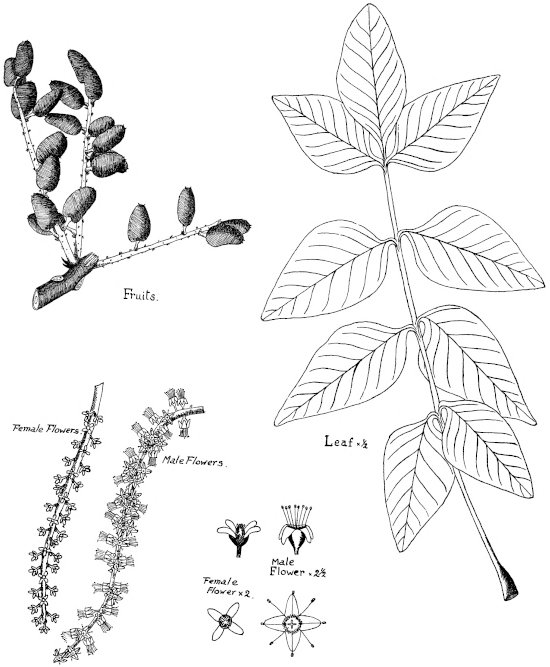
ORMOCARPUM BIBRACTEATUM Baker.—Faskara giwa. Tsa. LEGUMINOSAE.
A small, erect tree up to some 25 feet in height with 1-2 feet girth, locally very plentiful but otherwise infrequent, e.g., in the Anka district of Sokoto it occurs in vast numbers, but nowhere else in the province, and in one or two places in Bauchi small clumps of it are seen. At first sight it is very like an Acacia, with its erect branches and pinnate leaves. The stem branches generally low down, occasionally at a height of 8-10 feet, and the branches are vertical, so that the tree has no width of crown. Owing to the scarcity of the smaller branches the vertical ones are crowded with leaves, and from February to April with flowers, for several feet, there being no side twigs, these being replaced by small shoots covered with bracts.
The Bark is silvery grey with a soft sheen, smooth and very thick, large scales peeling off in season. The effect of fire on young stems is to produce great bosses of light brown cork, often charred. The slash is yellow.
The Leaves are about 2-3 inches long, pinnate, with some 6-8 opposite or sub-opposite leaflets and a terminal leaflet. These are ¼-⅜ inch long and about ³⁄₁₆ inch broad, oval, with or without a slightly notched tip in which the mid-rib protrudes slightly. They are grey-green and hairy and each springs from between a pair of bracts on the twig.
The Flowers are very handsome “Pea-flowers” in small clusters on long stalks, branched, with a bract at each branch, springing from small clusters of bracts on the woody stems. The stalks are purple and hairy, the calyx is irregular, purple and green, and the corolla is a delicate pink with a pale green keel. The flowers are generally in great masses and a curious characteristic is that they dry up and retain almost their original shape, the pod ripening meanwhile.
The Fruits are small black jointed pods 1-1½ inches long with some 4-5 joints, oval, flattened and hairy, each containing one seed, pale brown in colour. The pod will often bend right round and its tip enter the mouth of the flower.
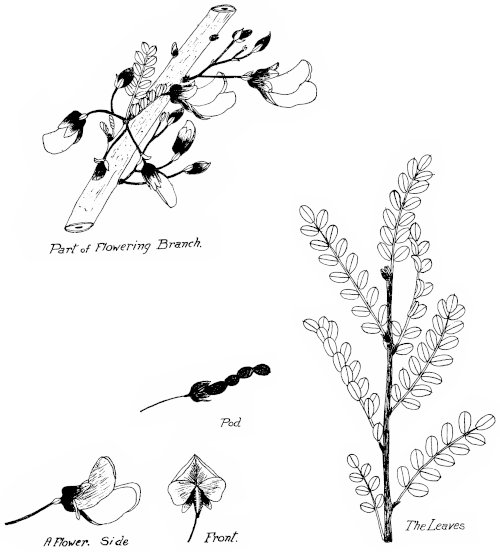
OSTRYODERRIS CHEVALIERI Dunn.—Durbi. LEGUMINOSAE.
A large tree some 40 feet or more high, common in some parts of Sokoto, Zaria and Katsina, but very local in its occurrence and extending as far north as 13°. The girth is up to 7 feet, more often 5 feet. It closely resembles Paradaniellia Oliveri in bark and leaf and form, especially in young trees of the latter species. The bole may be clean and straight for 20 feet and the crown is high and flat-topped in full grown trees. It does not grow on poor soils and its extension to 13° is by way of moister valleys and pockets of alluvial soil. The pods and flowers are the distinctive features.
The Bark is light grey with a strong resemblance to that of Paradaniellia Oliveri, the scales being even-sized, polygonal but not so large as those of P. Oliveri. Nor has it the red tinge of the latter. The slash is most distinctive, being a mixture of fibres of white, dark brown and crimson, like strands of wire.
The Wood is whitish or cream-coloured. In transverse section the rings are indistinct but the concentric lines of hard and soft tissue are well marked. The pores are single or in small groups, unequally scattered. The rays are invisible to the unaided eye, and waved slightly. In vertical section the pores are long and open, the hard and soft tissue well marked in parallel lines and the rays show as long, fine bands on the radial section. The wood is soft, medium weight, shows red streaks, is easily worked and the planed surface is smooth. It has a curious smell, The weight is 45 lbs. a cubic foot.
The Leaves are pinnate, 10-15 inches long with some 6 pairs and a terminal leaflet. The leaflets are opposite or nearly so and increase in size towards the top pair, the largest 3 inches long and 1½ broad, with cordate base, unequal lobes and an even taper to a rounded, cleft tip. The upper side is bluish-green with a bloom, the underneath pale grey-green. The venation is prominent beneath.
The Flowers, from February to April, are in erect panicles on the stout twig ends, some dozen or so on each twig. Each flower is white, papilionaceous, ¾ inch long. The calyx is covered with brown hairs, as are the flower-stalks and there is a green splash in the centre of the standard petal. The panicles are 6-8 inches long, gradually drooping.
The Fruits are pods, at first limp and green, then brittle and dark brown. They are 3-6 inches long, 1¾ inches broad, flat and strap-shaped, the surface veined, and a prominent ridge runs round the outside a little way from the edge, outside which ridge there is no veining. The seeds, more often 1 than 2, are slightly embossed, and are flat, brown, round beans with a white hilum. The pods ripen from May onwards and numbers of them persist on the tree till the following flowering season.
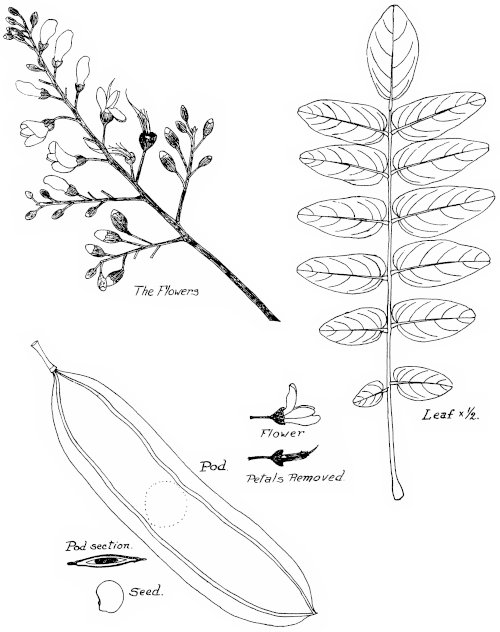
PARADANIELLIA OLIVERI Rolfe.—Maje, Kadaura. “Copaiba Balsam Tree.” LEGUMINOSAE.
This is one of the largest trees of the savannahs and gives an enormous volume of timber. It reaches a height of 80 feet and girths of 12 feet are common. A girth of 26 feet combined with a 40 feet bole has been measured. It has a gregarious habit similar to Khaya senegalensis on the edges of “fadammas” and in flat country where water lies during the rainy season. Hundreds of saplings may be found round these clumps. It is most readily distinguished from other species, at a distance, by the straight, light-grey stem, which is generally tapering in form, and by the shape of its crown which is triangular with a flat top. The crown is dense and dark, the limbs at an angle of about 30 degrees to the bole and the bulk of the foliage being on the summit. The bole is generally swollen at the base. It is a very fast growing species.
The Bark is very light in colour, this being emphasised at a distance. It is rough with large even-sized scales. The bark of saplings, owing to the annual fires, is very thick and scaly, cracking in horizontal rings round the stem. This forms a highly protective covering. An oleo-resin, or balsam, exudes from the slash, which is dark crimson with small white streaks.
The Wood, of which a great volume is yielded by the tree, is red-brown with darker streaks. In transverse section the rings are fairly well defined dark, regular lines, the pores are large, mostly single, widely and fairly evenly distributed, the rays fine, continuous, unevenly spaced but 3 to 4 to each pore, bending in a curious manner where they cross the lines of soft tissue, just visible with the naked eye. In radial section the rays are small light-reflecting bands and in the tangential section are clearly visible as fine ripples. The sapwood is whitish with a faint brown or pinkish tinge, and the rays are very clearly marked on the two vertical sections. This is a very good light-weight timber, very easily worked and not very durable or strong, but its large sizes, soundness and appearance enhance its value. It has a most pleasant cedar-wood smell. Weight 44 lbs. a cubic foot.
The Leaves are 18 inches long, pinnate with some 6 pairs of large, pointed, dark-green, shiny leaflets. The young leaves are soft and pink in colour.
The Flowers are conspicuous, chiefly at the top of the tree, in large, flat panicles, in December. The flowers stand erect on the horizontal panicle and consist of a 5-lobed, imbricate calyx, one sepal being smaller than the others, greenish-white in colour; 10 white stamens, 2 inches long and a long, white pistil which swells to form the seed-pod. The flower parts are borne on a stout club-shaped receptacle.
The Fruit is a flat pod, about 3 inches long and 2 inches wide, whitish in colour. It splits by the curling up of the inner layers and frees one oval, flat, dark-brown seed, the rudiments of 3 or 4 others being visible attached to the suture. The open pods with large brown seeds hanging from their edges are a conspicuous feature in masses on the tree tops, the seeds and pods remaining some time in position before being blown down.
Uses.—The timber is made into planks, mortars, canoes and cattle-troughs. The resin is burnt in houses as a fumigating incense.
In times of extreme famine, the young leaves are appreciated as a vegetable, being eaten with the addition of salt and pepper.
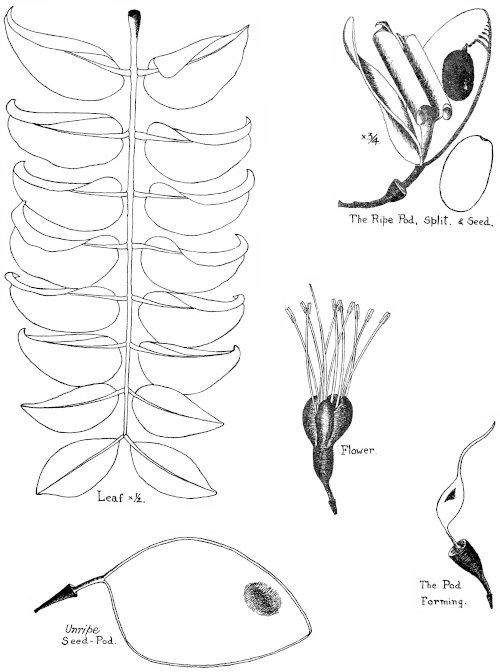
PARINARIUM CURATELLAEFOLIUM Planch.—Rura, Gwanja kusa. ROSACEAE.
A small and very common tree averaging 15-20 feet high with a girth of 1-2 feet. It has no form or special characteristic of growth, being similar to the many other species with which it occurs in open savannah forests. Its only importance lies in its occurrence in large quantities over considerable areas. It is readily distinguished from other species by its flowers and fruits, which latter may be seen for several months in the year.
The Bark is very dark, sometimes almost black, with small, prominent, corky scales up to 1 inch square. The slash is a dull, dark red.
The Wood is light brown, with a slight orange tinge. In transverse section the rings show as slightly darker lines, the pores are small, oval, with their length radial, single, not numerous, and connected by continuous waved concentric lines of soft tissue. The rays are extremely fine and very close together, quite invisible to the naked eye. In vertical section the pores are open and slightly darker, the grain close. It is a soft, sound wood, easily worked, planing with a dull, smooth finish, not picking up much. The weight is 48 lbs. a cubic foot.
The Leaves are about 5 inches long and 2½ inches broad. They are alternate, pale green and smooth above and greyish beneath.
The Flowers are in long, dense or open, terminal panicles, a number together. They are greenish in colour, the whole panicle covered with a light pubescence. Each flower consists of a grey-green, 5-pointed calyx, 5 minute white petals and 10 stamens, some with pink anthers. They appear about December or January, and are conspicuous by their numbers on the leafless tree.
The Fruits are reddish-brown drupes, about an inch long, the skin covered with a number of small, grey lenticels. They have a reddish, sweet, edible flesh and a large, hard stone. They ripen towards the end of the year and are the readiest means of identification of the species.
Uses.—The fruits are eaten fresh.
The young trees are cut for poles for building (gofa).
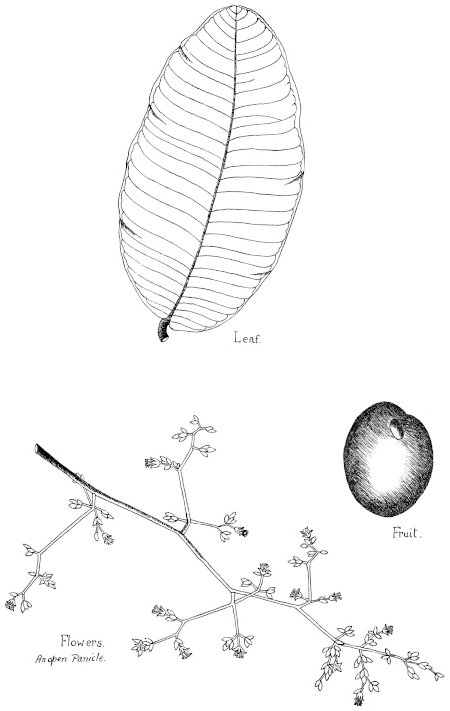
PARINARIUM MACROPHYLLUM Sabine.—Gawasa. “Ginger-Bread Plum.” ROSACEAE.
A common tree locally in parts of the more northerly provinces. It is not found distributed evenly through the forests but in numbers over small areas here and there. It is very highly valued by the native for its fresh fruit and protected on farm lands. It is a thick-set, squat tree with a short, heavy stem and wide-spreading, crooked branches forming a round or flat crown. It is from 15-25 feet high, sometimes more, with a girth up to 8 feet. The foliage, owing to the size of the leaves, is dense. It is somewhat similar to its congener, P. curatellaefolium, but the leaves are larger, the flowers heavier and the whole tree on a larger scale. It grows in dry, sandy soils.
The Bark is grey and not rough, covered with small even-sized scales.
The Wood is a light brown colour, frequently with large grey discolorations darkening the colour. In transverse section the rings are obscure bands, the pores are small, few and distributed rather unevenly, single, connected by very faintly marked and poorly developed soft tissue lines. The rays are exceedingly fine and very close together. In vertical section the pores are few and fine and the grain is close. It is a fairly hard wood, sawing well and planing with little picking up to a hard, smooth finish which polishes well. Weight 45 lbs. a cubic foot.
The Leaves are some 5 inches long and 3-4 inches wide on the average, but may be as much as 8 inches long and 5 inches wide, with a stout stalk not above ¼ inch long. They are slightly cordate at the base and broad at the tip with a small point. There are some 15-20 straight veins on each side of the mid-rib, sunken on the upper surface and very prominent on the underneath. The upper surface is a brilliant light green gradually darkening with age, the under side grey. There is a dusty brown covering of hairs on the upper surface, which rubs off readily in the hand and exposes the smooth green surface. The stalk is densely covered with brown hairs.
The Flowers are in terminal racemes from 3-9 inches long, all parts except the petals covered with the hairs. Each flower has a 5-lobed calyx, 5 white petals in 2 groups of 3 and 2, 10-20 white stamens with yellow anthers and a curved, white pistil. The flower in bud is enclosed in 2 bracts which are pushed up by expansion of the flower and then fall off the end. The flowers are found on the tree every month of the year, a continual succession of flowers and fruit occurring.
The Fruits, which are found all the year round, are plums, reddish-brown with an orange tint, rounded or oblong, 1½-2 inches long and 1-1½ inches broad, the surface roughened with numerous grey lenticels. The sweet, edible flesh is whitish, moist and mealy, about ½ inch thick round the very tough, thick stone which has one or two “kernels.” The ripe fruit has a sickly sweet smell.
Uses.—The wood of large specimens makes very good mortars.
The fruits are highly appreciated and eaten fresh. They are brought to the big towns from long distances in some places and will sell for as much as a penny each in the markets.
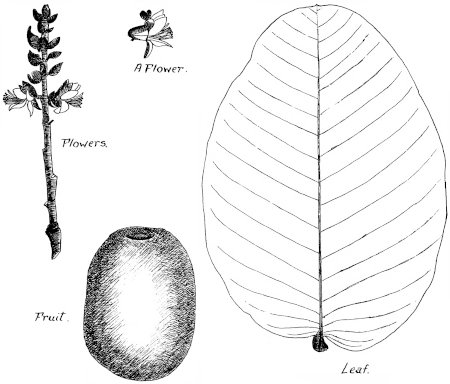
PARKIA FILICOIDEA Welw.—Dorowa. “Locust Bean Tree.” LEGUMINOSAE.
This is the type tree of the Park formations and a very common and well-known species with a wide distribution. Owing to its great value as a food and its uses by the natives, it is often the sole occupant of extensive areas of cultivation. It grows to large sizes, 50-60 feet high with girths of 10 feet or more. The bole, in the case of trees which are grown in the open, is short, not, as a rule, above 10 or 12 feet, and several large, spreading limbs form a very wide crown which appears dark and dense at a distance, but which, in fact, gives only average shade. There are small, rounded root-flanges. All trees near habitation are owned by the individual. Those in the forests have a different habit of growth, the bole being longer, the branches more erect and the crown less spreading. The large crowns of the park trees are generally due to the cutting of the branches for fuel. See Uses. The tree pollards well and shoots readily from the stool. It is liable to attack from white ants when young, and to the ravages of caterpillars which may completely defoliate the tree.
The Bark is dark brown or dull grey, with small, regular scales of varying roughness. The branches and the stems of young trees are a light grey, almost silvery, and smooth. The bark at the base of the tree is often much chipped about by the natives who make an infusion of it, drunk as a tonic. The slash is brick red, spongy and fibrous in thin layer formation.
The Wood. The heartwood is a dull brown colour, the sapwood a dirty yellow. Even the largest stems, 3-4 feet in diameter, cut in the north, show none of this heartwood. In transverse section the rings are faint and wide apart, the pores are large, open, fairly regularly distributed in the well-marked soft tissue festoons, with nests of 3 or 4 here and there. The rays are straight, continuous, evenly spaced, not all the same thickness, and show as long, light-reflecting bands in radial section. In vertical section the grain is fairly open, the hard and soft tissue giving a mottled appearance in tangential section. The wood is most easily worked with all tools, planes with a dull finish and though liable to crack a little is on the whole a sound, though weak, timber. The weight is only 32 lbs. a cubic foot.
The Leaves are bipinnate, 15-18 inches long, with opposite, pinnate leaflets bearing numerous dark green pinnules, oblique, ¾ inch long, alternate but nearly opposite towards the tip. They have a shining surface, and the young leaf is reddish.
The Flowers are pendulous balls some 2½ inches in diameter on a 7 inch stalk. They appear in March before the new leaves or with them and are dark red in colour and sweet-scented. They consist of 10 long, red stamens with black anthers and a simple style, in a 5-lobed calyx with honey glands. The flowers are visited both by bees and flies. Called “tutu” by the native, boys suck the balls for the honey. The flower-buds are called “gundar tutu.”
The Fruit is a bean, some 9 inches long, dark brown in colour, in pendulous clusters on the tree in July. When young they are called “sabada”; when brown, but before ripening, they are called “garda.” The ripe seeds are black and embedded in a yellow, mealy pulp. They are of great value as an annual food-crop.
Uses.—The timber is used for making mortars and basins. The seeds are fermented and made into cakes called “daudawa.”
The husks are soaked in water till fermentation takes place and the resulting liquid spread over earth floors and on the walls of dye-pits to bind the surface. The liquid is called “makuba” and is also used as a fish poison.
The branches are cut for fuel for the boiling of the water used in the purification of women after child-birth.
The mealy pulp round the seeds (garin dorowa) is used in soup.
An infusion of the bark is a tonic.
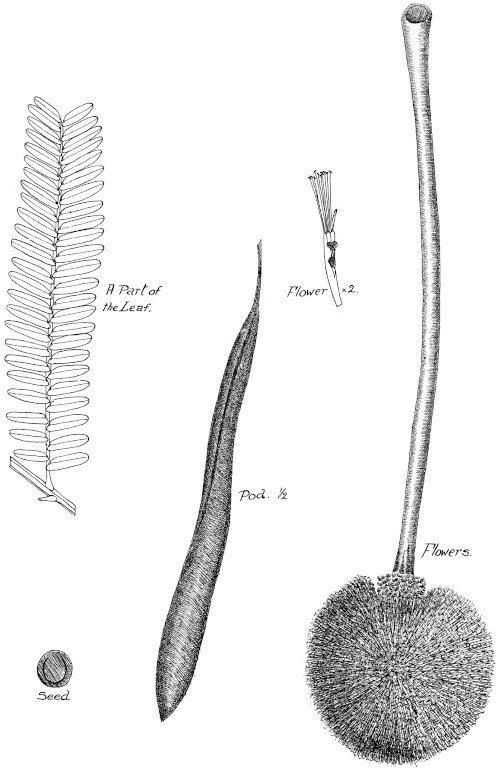
PARKINSONIA ACULEATA Linn.—Sasabani, Sharan labbi. “Jerusalem Thorn.” LEGUMINOSAE.
A small exotic tree introduced by Arabs and planted in most of the Northern towns to such an extent that it is worthy of inclusion here. It is a delicate and graceful shrub-like tree up to 25 feet high. It has a single stem branched a foot or two above ground level; in some cases there is a stem over 6 feet in length before the branches, erect, with their ends spreading out and drooping down, occur. It grows best in an open position and does not thrive in the shade, where it grows very weak and straggling, without the vivid green of trees in the open.
The Bark is bright green and smooth.
The Thorns are straight and sharp, ¼ inch long, light red in colour with thickened, fleshy green bases from which spring the leaves. The scars of fallen leaves can be seen on this thickened base.
The Leaves are bipinnate with one or two pairs of pinnae which consist of a broad, flat mid-rib some 9 inches long from which little oval leaflets under ¼ inch long spring alternately. These are sensitive and at night, or when gathered, fold inwards and lie flat on the mid-rib. The rib and leaflets are dark green and smooth.
The Flowers are in pendulous, sparse spikes amongst the leaves. Each is an inch in diameter and has 5 pale green sepals, 5 crinkly yellow petals, one of which is more prominent than the rest and forms a throat covered with small red spots. There are 10 short stamens with red anthers and a short brown pistil. The flowers are found most months of the year.
The Fruits are jointed pods, varying in length according as they contain 1-6 seeds, the longest being 6-7 inches long. They are jointed, light brown and veined, and when ripe are very light and brittle. The seeds are ⅓ inch long, black, oval, round in cross section, very hard and smooth and rattling loose in the pod. They may be found for some months in the year, particularly in February.
Uses.—Ornamental and shade providing.
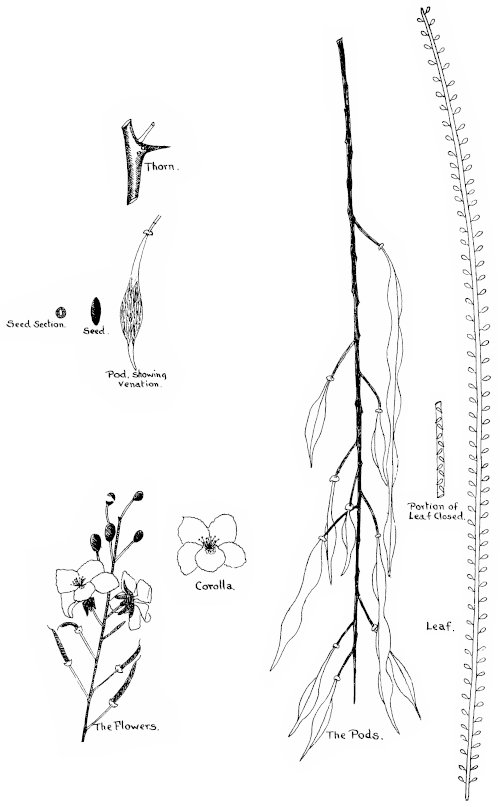
PROSOPIS OBLONGA Benth.—Kiriya. LEGUMINOSAE.
A large tree attaining a height of over 60 feet with girths of 6-7 feet. In good forest it may have a bole length of 30 feet, but in the open savannahs it is branched to within a few feet of the ground, as a rule, and its crooked limbs form an irregular, rather open crown. The finer twigs droop considerably and the tree may bear some resemblance to Tamarindus. In old trees in good forest there is a high, wide crown, open, and giving little shade. There are small rounded root flanges. The features which most readily distinguish it are its bark, colour of foliage and pods, q.v. It likes good, open soils.
The Bark is almost black, with ragged, crisp, curling scales which are concave on the outer surface and leave light brown patches where they fall. Sometimes the bark has a bluish tint. That of the smaller branches is light grey or brownish and smooth. The slash is reddish, darkening to orange and red-brown.
The Wood is a rich red brown. The sapwood is grey. In transverse section the rings are indistinct, the pores are open, regularly distributed, mostly single, a few double. The rays are very fine, waved and unevenly spaced, not visible to the naked eye. In vertical section the pores are seen to have dark resin contents, the grain is open, and there are bands of colour, the lighter soft wood picking up and the darker hard tissue planing smooth, according to direction of planing. There is a marked reflection of light from these bands. It blunts axes, is hard to saw, must be finished with glass-paper after planing, when a fine surface is obtained, oily to the touch. It will not take nails. A very tough, strong, durable timber. Weight 65 lbs. a cubic foot.
The Leaves are bipinnate with 2-4 opposite pairs of pinnae each bearing some 6-10 leaflets ¾-1 inch long and ¼ inch or more wide, with a pointed tip and the rib not in the middle. They are light green and softly pubescent. The pairs are inclined to the top side of the main stalk and between each pair of pinnae there is a little gland. The base of the stalks is much enlarged.
The Flowers are in short pedunculate spikes, the latter 1½-2½ inches long and densely composed of small yellowish flowers, which appear in May. Each flower has a 5-lobed calyx, 10 stamens with yellow anthers and a short hairy pistil. The flowers are sweet-scented.
The Fruits are large pods from 4-6 inches long and an inch in diameter, slightly flattened in one direction, pointed at the tip, a dark, purple-brown colour. The hard, shiny, brown seeds, oval and ⅓ inch long, are embedded in a dry, cream-coloured, spongy-looking pulp, each separated from the other by a thin, transparent membrane. The seeds rattle loose in the pod. The pods are very persistent on the tree.
Uses.—The natives use the wood for tool handles and burn it for charcoal, the quality of which is very fine and much valued by blacksmiths.
The wood is also used for making pestles for large mortars and the manufacture of tobacco pipes.
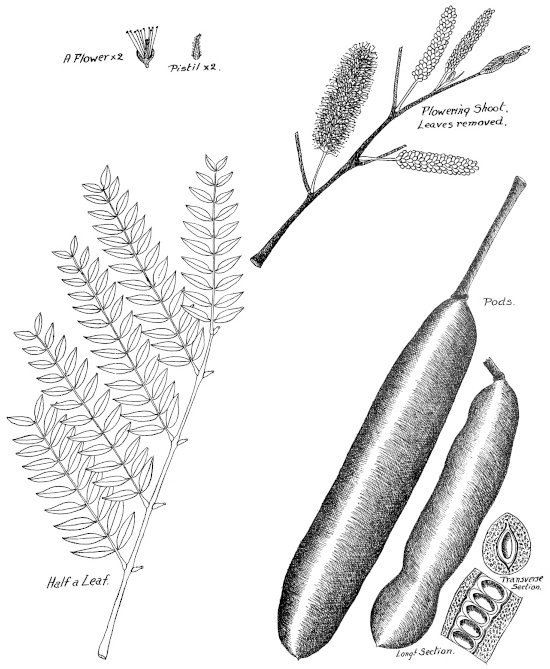
PSEUDOCEDRELA KOTSCHYI Harms.—Tuna(s). MELIACEAE.
This species, which is closely allied to the mahoganies (Khaya), is a large and valuable timber tree and occurs particularly in groups, or singly here and there in the Tree savannah. It is a handsome tree, regular in shape, with a straight stem and a bole of often 20 feet in length with a girth of 5 or 6 feet. The total height may be 40 feet. It is rather slow growing and though the crown is fairly dense, is essentially light-demanding and not much of a soil-improving species. It can be seen reproducing itself from root-suckers and very rarely from seed, since the latter is destroyed by fire. The crown is cylindrical and regular and the limbs ascend vertically.
The Bark is very conspicuous by its light grey, almost silvery, colour. It is regularly fissured and the scales are of equal size and soft and thick. The base of the stem is often swollen and the bark charred by repeated firing. The slash is bright crimson and shows a layer formation.
The Wood is a red-brown colour, flecked with black and dark brown of a most distinctive pattern, rather open grained, scented, hard and weighs 50 lbs. a cubic foot. It carpenters well and polishes. The pores are small and open, scattered rather thinly along and between the rays which are long and evenly spaced and straight. A useful and ornamental wood if large sizes could be obtained.
The Leaves are pinnate, about 1 foot long with 4 or 5 pairs of leaflets which have wavy edges so that the leaf resembles that of the oak. The leaflets may be opposite or not and a terminal leaflet is not always in evidence. In colour the leaf is dark and shiny on the upper surface and soft and grey with rough venation beneath. They are in a rosette-like formation like the mahoganies.
The Flowers are in panicles in the axils of the end leaves and are white and sweet-scented. Each is about ¼ inch across, with 5 petals, a knobbed pistil and 10 stamens whose filaments are united and surround the pistil. They appear in February.
The Fruits, which ripen in February of the following year, are capsules about 4 inches long, shaped like a club and standing erect. They are brown in colour and split from the apex into five sections which curl back and release the seeds. These are packed, about six in each section, round a pith centre, the wings, 1¼ inches long, pointing downwards, one over the other. The split capsule remains some time on the tree after the seeds have fallen. The capsules are very few in number on a tree considering the enormous number of flowers which bloom, but are very conspicuous and a ready means of identification. The mahogany coloured seeds will blow 200 yards away.
Uses.—An infusion of the bark is used as a cure for digestive trouble. The timber is used for furnishings and is an excellent wood for all articles, owing to its being so easy to work.
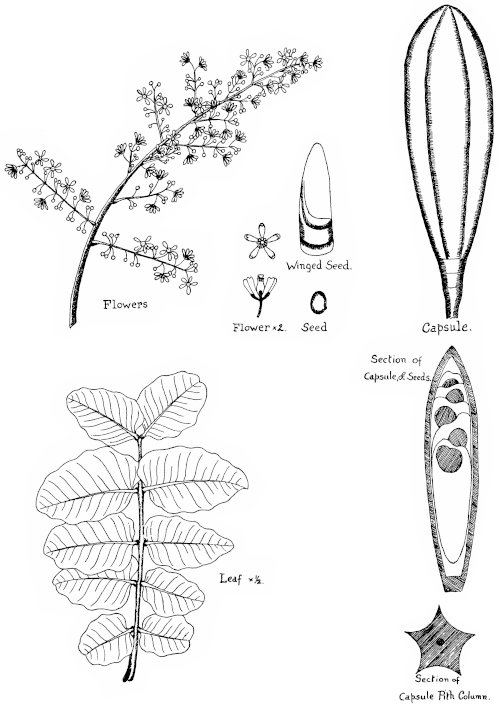
PSOROSPERMUM SENEGALENSE Spach.—Kashekaji. Kaskawami. HYPERICACEAE.
A common shrub in the Bush savannahs, not extending very far north, but abundant in secondary growth after cultivation. It is common amongst the rocks on the Bauchi plateau almost up to the 4,000 feet level. It is equally common all through Zaria and S. Sokoto, in fact, anywhere up to 12° N. It forms a large, compact, round shrub some 15 feet high with dense foliage, generally on a single, low-branched stem. The distinguishing character is the rusty-coloured underside of the hairy leaves.
The Bark is light brown and has small corky ridges and fissures.
The Leaves are from 3-5 inches long and 1½-2½ inches broad, in pairs, ovate, with wavy margins, tapering tips, very short stalks, downy on both surfaces, that on the upper surface rubbing off to expose a light, shiny green. The under surface is densely covered with rust-coloured down, readily rubbed off and exposing a fine network of veins with a minute black dot in almost every cell and a pronounced row of dots all round the margin. The mid-rib is recurved causing the leaf to fold up along it. The shoots are covered with orange-coloured hairs.
The Flowers are in dense clusters 3-4 inches in diameter, from January onwards. Each is ¼ inch across, has a 5-pointed calyx with vertical purple lines on the inside, 5 white petals densely covered with white hairs, 5 columns of stamens with some 9 anthers each and a pistil with 5 lobes each with a globular stigma, shining brown.
The Fruits are capsules with 5 cells, one generally maturing at the expense of the rest. They are a little over ¼ inch in diameter, purple, shiny and fleshy. The sepals clasp them close, and the stigma remains are persistent.
Uses.—A concoction of the leaves and bark is applied for skin diseases.
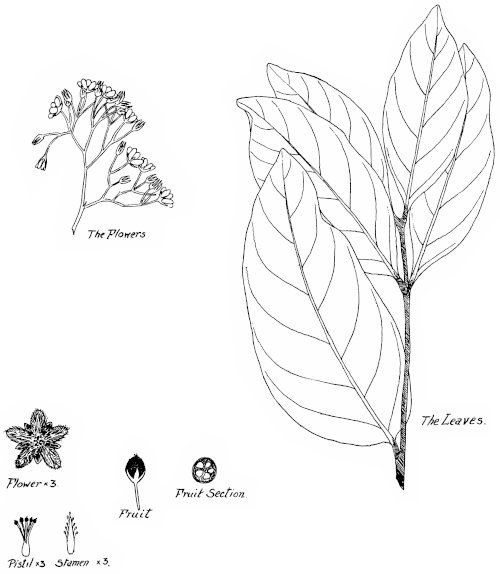
PTEROCARPUS ERINACEUS Poir.—Madobia. LEGUMINOSAE.
A medium-sized tree of the savannahs, averaging some 40 feet in height with a girth of 4-6 feet. Timber producing examples considerably larger are common enough and good, clean, straight boles 20 feet or more in length are found. It has a wide distribution up to 14° N., but is a small tree at this latitude. The crown is high, open, wide and rounded, not giving much shade. Larger examples have short buttresses. The species is susceptible to fire which hollows the stems. The long pinnate leaves, masses of yellow flowers and winged, hairy seeds on the leafless tree are characteristic features. Over many miles of the better types of savannah it is the type tree amongst others and occurs in quantities.
The Bark is very dark and rough with scales which curl up at the ends and make the bole appear shaggy. The scales fall in pieces 3-4 inches long. The bark of the branches is light grey and smooth. The slash is brown with fine red lines and a blood-red resin exudes from it.
The Wood is a rose-red or rich brown colour with a wavy grain of darker streaks. It might almost be called figured, especially in tangential section. In transverse section the pores are small, single and scattered and connected by fine, wavy lines of soft tissue; the rays are extremely fine and closely spaced, not visible to the unaided eye, and the rings are indistinctly marked darker lines, generally varying in width apart and rarely concentric. The radial section has a marked banding of dark and light. The wood is hard, liable to split in seasoning, difficult to saw and the planed surface smooth, slightly oily and taking a high polish. The weight is 60 lbs. a cubic foot.
The Leaves are pinnate, a foot long, with some 11-13 pinnae, alternate, and wide apart. The upper surface is shiny, the lower grey-green, the mid-rib prominent beneath and grooved above. The leaves are pendulous.
The Flowers appear from December to February on the leafless tree, and are in such numbers as to be conspicuously yellow from a great distance. The flowering tends to be patchy, that is, part of the tree may be smothered in flowers on one side and not on the other. The flowers are in short spikes with a bright green calyx and a papilionaceous corolla of much-wrinkled yellow petals, which turn pale when fertilised.
The Fruits are winged, round, 2 inches in diameter with the wing much waved and the embossed seed portion covered with short, bristly hairs which lie in all directions. They are often so numerous as to give the tree the appearance of being in leaf. They dry light brown.
Uses.—Larger specimens yield timber suitable for construction and furniture. Smaller trees are used for building posts.
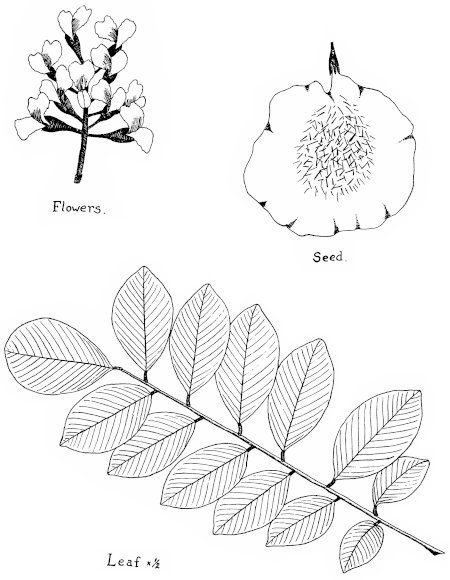
RANDIA NILOTICA Stapf.—Chibra. RUBIACEAE.
A shrub or small tree, readily recognised by its stiff, spiny stems densely covered with the small leaves. The stems spring from the base and are either erect or finally bent out and down. Occasionally it forms a dense shrub of large size, but usually is light and open. It occurs as far north as 13°, and is common in open high savannah forests.
The Bark is light grey, sometimes almost white, with black scales scattered about in patches.
The Thorns are above the leaves and are short, sharp, very strong and woody, with bark at the base and smooth tips.
The Leaves are about 1½ inches long, narrow at the base, broad at the tip, and smooth; the veins slightly raised on both surfaces. They are borne in rosettes at the ends of very short twigs, above which is a thorn, and densely cover the branches.
The Flowers spring from amongst the rosettes of leaves and may be so numerous as to cover the twigs with a mass of bloom. They are white, changing to yellow and are slightly scented. Each has a short-stalked tubular calyx with 5 unequal-sized sepals with cleft tips, a tubular corolla about ¾ inch in diameter with 5 petals, bent back, 5 stamens in the angles between the petals, consisting of dark brown anthers only, and a yellow, protruding, clubbed pistil. The flowers appear in May.
The Fruits, ripening in June, and often persisting for several months, are oval, 5-8 inches long and ½ inch in diameter, brown, shiny, hard, with thin “skin” vertically ribbed and cellular veined. It is 2-celled and the partition is vertical, each cell containing a number of small black wedge-shaped seeds packed close and cemented together. The fruit falls entire and rots.
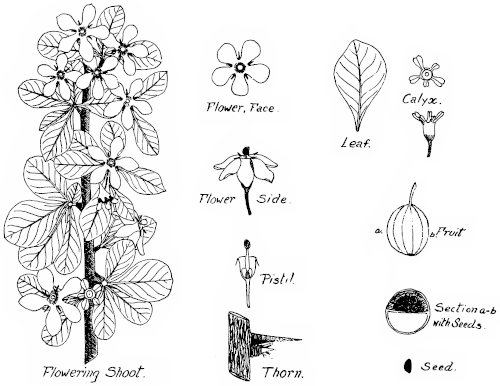
RAPHIA VINIFERA P. Beauv.—Tukuruwa. PALMACEAE.
This very common palm grows in swamps, where it forms impenetrable thickets often of large extent. It is readily distinguished by its very long erect leaves growing from ground level, there being no stem. It reaches a height of over 30 feet, the girth of the base being some 8 feet. The leaves spread out from a growing centre, visible as an erect shoot in the middle.
The Leaves are upwards of 30 feet in length with long leaflets whose edges and mid-rib at the back are armed with small sharp spines. The mid-rib is an orange colour, turning grey with age.
The Flowers are in a loose branched spadix up to 6 or 8 feet long, the male and female on the same palm and on the same spadix. The males on the lower part of the branches of the spadix have a tubular calyx, a corolla of 3 petals, long and narrow and a number of stamens, varying from 10-12 inside the base of the petals, attached to them. The female flowers, situated at the end of the branches of the spadix, are larger than the males, the calyx tubular, the corolla bell-shaped with 3 sharp lobes, the rudiments of the stamens forming a cup attached to the corolla and a 3-celled ovary.
The Fruits are like cones, some 3 inches long and 1½-2 inches broad, smooth and shiny, with a number of broad, pointed scales, varying in colour from chestnut to red-brown. They contain one kernel, loose in the shell.
Uses.—The leaflets are used for plaiting into mats, &c. The mid-rib is used for roofing material, beds, canoe poles, and split into lengths, the inner portion makes mats. The sap is used for wine. The inside of the fruit (outside the kernel) is eaten, expressed for oil, used as a medicine or for dressing the hair in various parts of Nigeria.
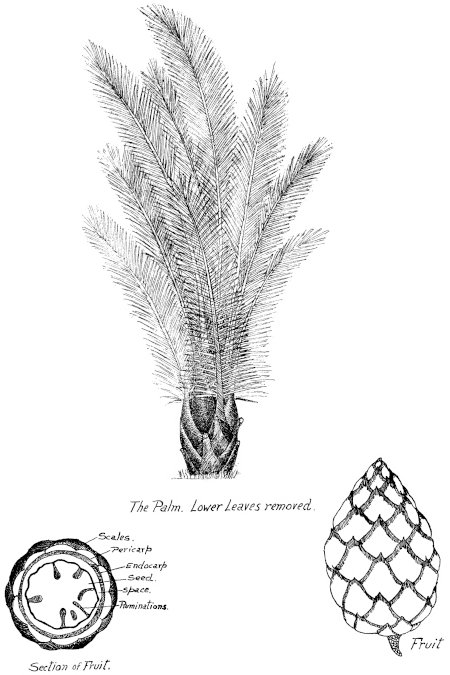
RHUS INSIGNIS Del.—Kasheshi. ANACARDIACEAE.
A small tree of the open Bush savannah, some 15-20 feet high. There is either a single stem or several. The crown is distinctive with its long, straight, slender branches and light appearance. It is very susceptible to fire and is frequently met with in coppice form owing to the destruction of the stems. The distinguishing features are the drooping leaves in threes and the small black, wrinkled fruits.
The Bark is grey or light brown, vertically, but not deeply, ridged.
The Leaves are borne in threes at a node and the short stalk bends back, allowing the leaves to hang vertical. They are 3 inches long and an inch broad, a rich, dark green above, silvery below, with the dense covering of silky hairs. The venation is parallel on either side of the mid-rib, short and long nerves alternating. The leaf is inclined to fold up along the mid-rib.
The Flowers appear in the rains and are in large, erect sprays. Each flower is about ¼ inch in diameter with 5 sepals, 5 white petals and 10 stamens. Owing to their numbers and prominent position at the twig ends, they are conspicuous.
The Fruits are numerous, flattened, single-seeded ovals, shiny black with wrinkled skins and persistent for many months on the leafless tree in the dry season. They are very hard and are a ready means of identification.
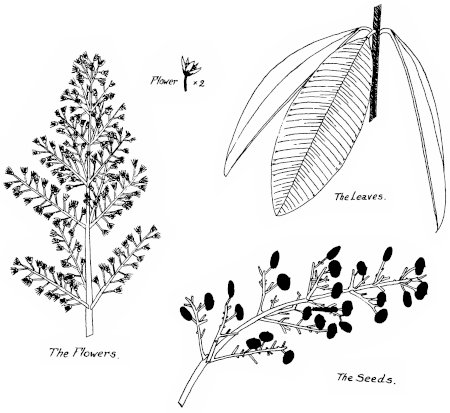
SARCOCEPHALUS RUSSEGERI Kotschy.—Tafashiya. RUBIACEAE.
This common species is often more of a shrub than a tree, but in the more favourable localities which it inhabits, chiefly “fadammas” or wet soils among rocks, 30 feet is by no means an unusual height. Older trees generally have several large, crooked stems rising from a common stock or a short, stout bole some 5 feet in girth. Smaller, shrub-like specimens are very straggling with open growth and long, drooping and interlacing branches. The crown, in spite of the size and thickness of the leaves, is fairly open. It is easily identified by either the flowers or fruit which latter can be found for several months of the year.
The Bark is grey, or brown and dull in older trees, with very deep, wide and long fissures and thick, soft ridges. The scales are up to 12 inches in length. The slash is yellow, with crimson streaks.
The Wood is a deep red-brown colour, but is not used owing both to the small sizes and the lack of bole in the tree.
The Leaves are large and rounded with a tongued tip. They average 7 inches long and 3 inches wide, but reach as much as 10 inches long and 5 inches wide. The upper surface is a dark, shining green with pale venation; the under surface pale green with the venation raised. There is a short, red leaf-stalk.
The Flowers are in balls about 2 inches in diameter and appear in February. They fade very quickly. The flower-balls are composed of some hundreds of small flowers which seem white, as each is a yellow, tubular, 5-lobed corolla with a shiny white pistil with an acorn-shaped stigma which is very long. There are 5 small stamens attached to the inside of the corolla, which do not appear. The flowers are sweet-scented.
The Fruits vary somewhat in size and shape but are roughly round or oval, 2-3 inches in diameter and dark red-brown with the surface pitted with the pentagonal scars of the flowers. There is a crimson flesh surrounding a mass of small seeds round a pith centre. They are edible and have a not unpleasant, sweet, acid flavour. They ripen towards the end of the year but can be found for many months on the tree and fall to rot on the ground.
Uses.—A medicine for stomach pains is made from the fruits.
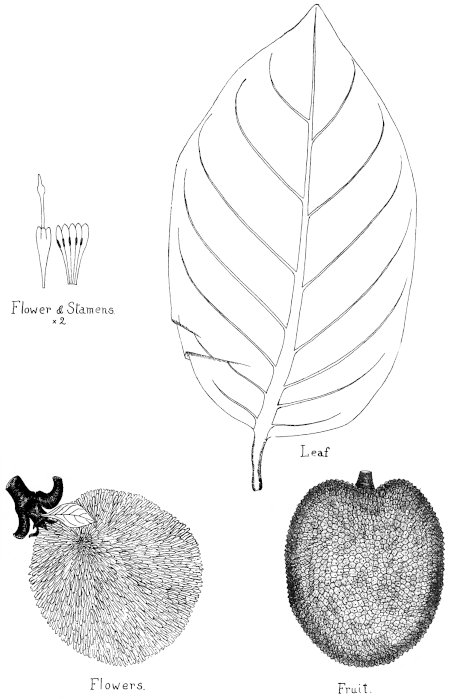
SCLEROCARYA BIRROEA Hochst.—Danya. ANACARDIACEAE.
This very common tree was, until 1922, considered a species of Spondias, from its resemblance to S. lutea, a species occurring commonly further south. It is of medium size, up to 40 feet in height with girths of 6-8 feet. It grows on almost any soil and flourishes in loose sand or dry barren situations where it can be found almost as pure forest. The short heavy bole gives a large volume of timber, but the bole length rarely exceeds 12 feet from which point the much bent branches form a large, round, open crown giving little shade. The pinnate foliage, red flower-spikes or yellow plums distinguish it. Owing to its use for native mortars enormous waste takes place, one mortar being carved from trees which will provide three or four, the rest being allowed to rot or burn. Quite large limbs can be pulled off by hand as they snap very readily. It is not very fast growing and seedlings branch at ground level. Seedlings, however, are very hardy, sending a thickened tap-root several feet into the ground the first year.
The Bark is light grey, sometimes smooth and silvery, and large scales, which turn up at their edges and give the stem a ragged appearance, leave the stem smooth again after falling. The slash is salmon pink to red and spongy and fibrous in composition.
The Wood has a dirty white ground colour with a well-marked reddish grain in bands and streaks, with dark brown patches. In transverse section the pores are small, not very numerous, evenly distributed, mostly single with a few double pores and small nests, in oblique rows, the soft tissue very poorly developed as fine lines imperfectly connecting the pores. The rays are fine, closely and regularly spaced and fairly straight, and they show as light-reflecting bands in radial section, and as a fine stippling in tangential section. The wood is soft, coarse-grained, sawing roughly and picking up, often full of small knots and liable to small borer-beetle attacks. It is fairly durable if well seasoned and weighs 36 lbs. a cubic foot. Good sizes are obtainable.