PREFACE. (continued 2)
Reading edition
The Wood is heavy and hard, apt to splinter into separate fibres, but very durable above ground. It weighs about 50 lbs. a cubic foot. The wood of the male is more compact throughout than that of the female whose centre is looser, the outside only being really serviceable.
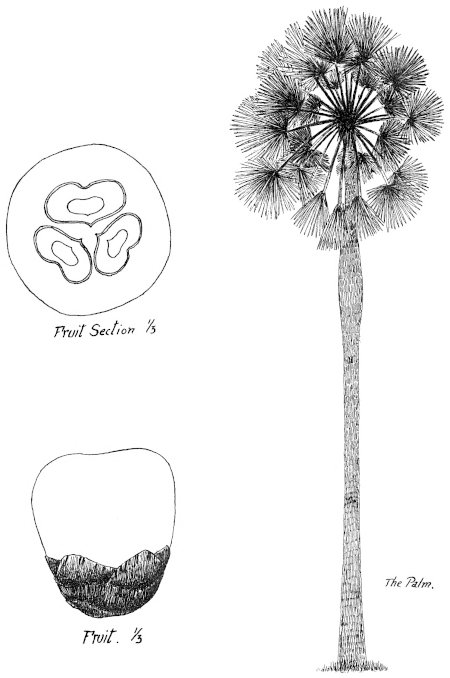
The Leaves are up to 12 feet long, fan-shaped, the segments V-shaped, joined for half their length, the stalk concave above and spiny on the margins. The sheath divides at the base before falling and remains for some time clasping the stem.
The Flowers appear in April, just as the fruit has fallen, the females on one tree the males on another. The males are on branched spadices up to 6 feet long, the separate catkins a foot long and 2 inches broad. There are 3 sepals, 3 petals and 6 stamens, the flowers being green. The females are on a 6-8 feet long spadix, unbranched, with up to a dozen spikes of flowers, with 3 sepals, 3 smaller petals and the rudiments of 6 stamens.
The Fruits are the most conspicuous feature, ripening in April to a rich orange colour. They are some 6 inches long and 5 inches broad, the enlarged calyx cupping the fruit. The edible, fibrous pulp surrounds three seeds with hard fibrous coats and edible kernels.
Uses.—Locally the pulp is eaten raw or pounded with milk. The kernel is eaten young. The root-buds are roasted and are a delicacy. The leaves are used for mats, bags, baskets, fans, &c. Some tribes extract salt from them. The wood is used for canoes, rafters, poles, water-pipes, doors and guttering. Elsewhere the leaf stalks are the source of fibre, a spirit has been distilled from the flower spathes and buttons made from the seeds.
BOSWELLIA DALZIELII Hutch.—Hano, Ararabi, Basamu. BURSERACEAE.
A very common tree in high savannah, extending as far north as 13° where the soil is suitably rich and well watered. It will not grow as far north as this where the conditions are dry and barren, granite soils and situations on stony ground of the right kind being suitable. In sand or laterite it will not thrive, but it will flourish on bare granite where its roots can make their way into crevices. In some suitable localities it forms almost pure forest and is a very handsome species under those circumstances. The leaf, flower, fruit or bark are all distinctive. Another closely allied species, B. odorata, differs only in having a branched panicle in place of the bunch of racemes of B. Dalzielii. When young or middle-aged the stem is erect and the limbs ascend steeply forming a high crown, foliated down to a low point. Older trees exhibit a short, massive bole from which the heavy limbs spread out forming huge crowns with drooping extremities.
The Bark is most conspicuous, pale brown, with large papery pieces peeling off and at times hanging in shreds from the stem. The slash is reddish-brown and a scented gum-resin exudes, partly drying into nodules, almost white in colour, readily crumbled.
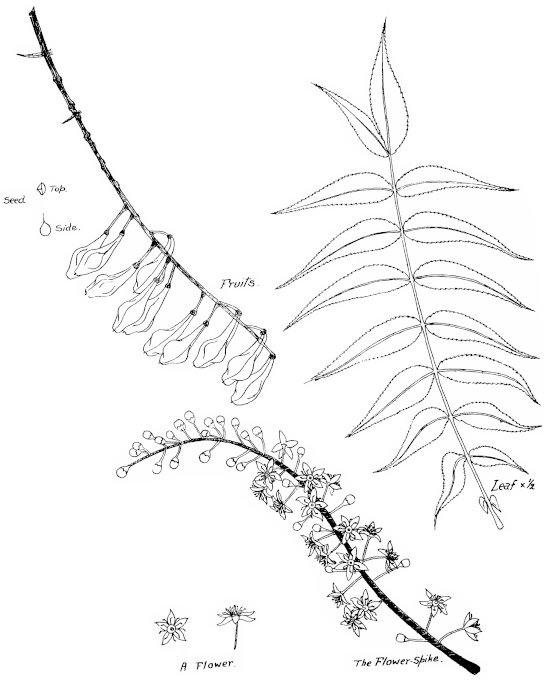
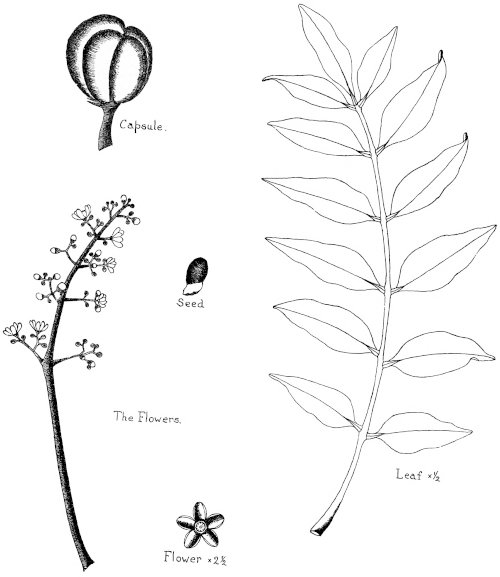
The Leaves are 12-18 inches long, pinnate, with some 7-9 pairs of long, slender, pointed, deeply-toothed leaflets. These increase in size towards the top end of the leaf, the basal pair often being very small and distinct in shape. The terminal pair are frequently partly united into one for half or more of their length. The leaflets are sessile, in colour light green and shining, with the venation raised on both surfaces.
The Flowers appear from January to April, and are in large bunches of racemes at the tips of the large, blunt twigs. The racemes are from 6-8 inches long and bear numerous white flowers on ½-¾ inch long stalks. Each flower is ⅝ inch in diameter with 5 white, pointed petals, 10 stamens whose anthers are bent away from the filament at a side angle, and a small, blunt pistil. The flower disc is red and the flower scented.
The Fruits are 3-angled capsules, elongated pear-shaped, with prominent bulges opposite the seeds. They are ¾ inch long and the stigma remains are present. The capsule splits into three and the small seeds are released, each with a sharp spike at the top end.
Uses.—The gum-resin, being scented, is used for burning in houses, or fumigating clothes, and as an ingredient in medicine.
BRIDELIA FERRUGINEA Benth.—Kisni, Kirni. EUPHORBIACEAE.
A small tree of the Tree and Bush savannahs which does not extend very far north and will not grow away from fairly good soils. It is rather shapeless, except occasionally in closer forest, where it may reach a height of 30 feet with a girth of 3-4 feet. This species and B. scleroneura are similar in habit, with open, formless crowns, straggling, drooping limbs covered with numerous, slender, erect twigs which are apt to be burnt back repeatedly by fires and show the position of leaves and flowers as prominent clusters at frequent intervals. The distinguishing features are larger leaves of this species and the absence of the marked crenate edges.
The Bark is dark grey, covered with small, close-fitting, prominent scales. That of the branches is lighter and covered with rectangular scales, clearly cut in rows. That of the smaller branches is almost white with vertical, wavy ridges of cork. The slash is crimson.
The Wood is brown and the sapwood is dull white. In transverse section the rings are clear, fine light lines, the pores are very small, single, double, or in small festoons, the soft tissue not well developed. The rays are fine, close, fairly straight and evenly spaced. In vertical section the grain is coarse, and not very straight and the wood is easily sawn but hard to plane, picking up in patches. The weight is 60 lbs. a cubic foot.
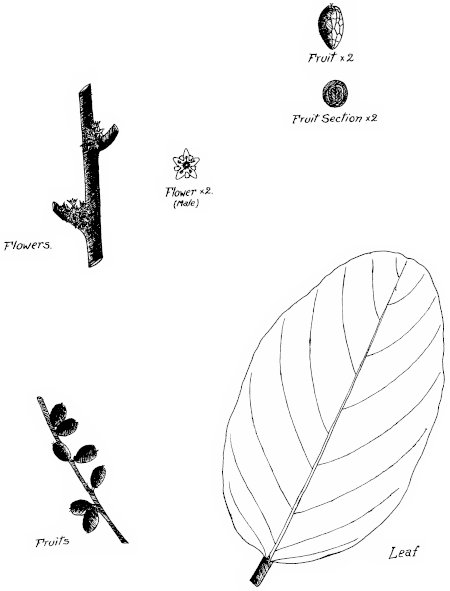
The Leaves are alternate, assuming one plane. They are 4-5 inches long and 2¼-2½ inches broad, with slightly waved edges, the nerves reaching the edge. They are dark green above, olive green beneath, with the venation very prominent and covered with brownish hairs, especially on the short stalk and mid-rib.
The Flowers, male and female on the same tree are in small, compact clusters in the leaf axils from March to June. The male flowers have a calyx of 5 sepals, 5 minute petals and 5 radiating stamens, joined at the base into a short column. The female flower has the same calyx, longer, narrower petals and two styles which are forked. The male flowers have a shiny yellow disc.
The Fruits are small black ovoid drupes, becoming veined and wrinkled when dry, with a single cell containing two seeds. They are ⅜ inch long and flattened at the top, and very persistent on the twigs.
BRIDELIA SCLERONEURA Müll. Arg.—Kisni. EUPHORBIACEAE.
This is a small tree, without any definite form, which grows up to 15 or 20 feet high, with, occasionally a stem some 6 feet high and a misshapen crown. It is distinguished by the small clusters of minute flowers in the leaf axils and the crenate margined leaves which lie in one plane on long, slender, drooping twigs.
The Bark, in old trees, is quite black, with long fissures and fibrous ridges; in young trees it is white, or black and white in patches, with soft, corky scales which fall in large pieces composed of several smaller scales bound together. The slash is bright crimson.
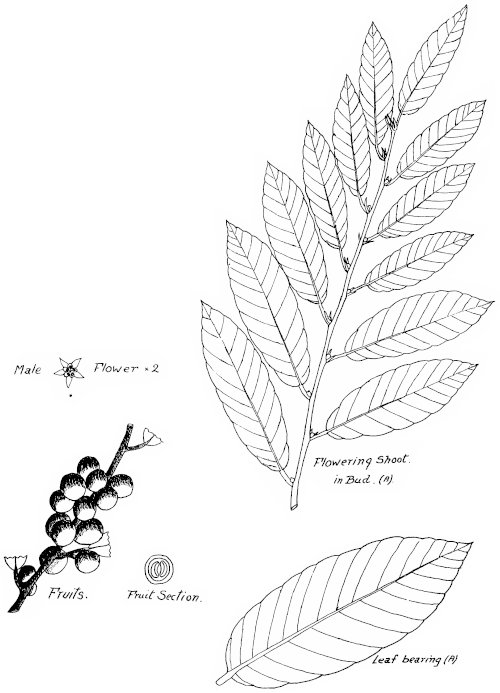
The Leaves are borne on long, drooping, slender twigs, alternate, in one plane and gradually diminishing in size from the base upwards. Each such twig is supported by a larger leaf, 3½ inches long and 1¼ inches broad. The alternate leaves vary from 3 inches long and ¾ inches broad at the base of the twig to 2 inches long and ½ inch broad at the end of the twig. The lateral veins, as they reach the margin, are continued along it so that the edge is crenate. The tips are sharply pointed. The leaves all point well forward. The ¼ inch long stalks are covered with soft, brown hairs. The upper surface is slightly rough and darker than the under surface, on which the veins, especially the laterals and mid-rib, stand out prominently and show yellow in colour. The halves of the leaf tend to fold up along the mid-rib slightly.
The Flowers are in very small clusters in the leaf axils and appear in May and June. They are bright red in bud, the sepals being tinged. Each male flower is ⅛ inch in diameter with a 5 sepal calyx, 5 minute petals and a column of 5 radiating stamens. The female flower has 5 sepals, 5 petals, a disk round the ovary and 2 bifid styles.
The Fruits are in clusters, often a dense crop, at each node. They are the size of peas, green at first, ripening to black with a bloom. A thin skin surrounds a narrow, juicy flesh round a hard, 2-celled stone. The flesh dries and the skin wrinkles while the fruit is on the tree.
Uses.—The roots are sometimes used medicinally.
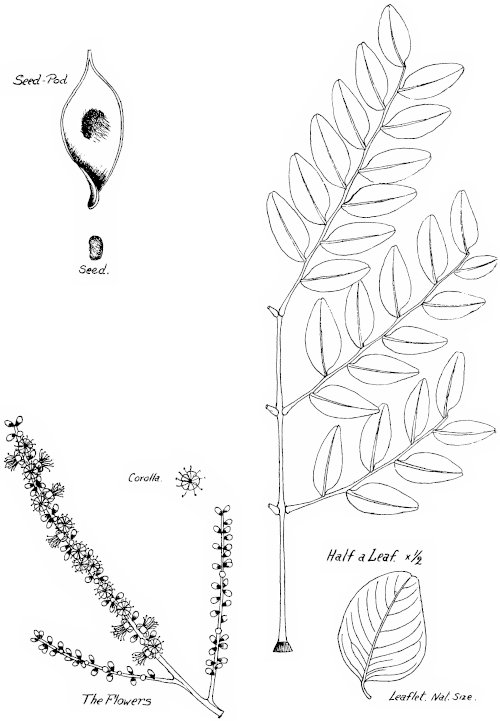
BURKEA AFRICANA Hook. f.—Kolo, Kurdi, Bakin, makarfo, Namijin Kiriya, Kariye gatari. LEGUMINOSAE.
A fairly large tree up to 50 feet in height with girths of 3-6 feet. It is a fine upstanding tree, frequently with a 20 feet bole, straight and clean, with ascending branches and high crown, spreading with age. It bears a resemblance to Amblygonocarpus Schweinfurthii, from which it can be distinguished by its larger and unequal-shaped leaflets. It is plentiful in high savannah forests and will extend, by means of small hollows or valleys as far north as 12½°. In flower or seed it is readily distinguished, and the leafless tree can be recognised by the thick, blunt end of the branches, often tufted with the dead stalks of last year’s leaves.
The Bark is light grey with a bluish tint, and the scales are large and heavy, at times closely fitting, then falling in large sections, so that the trunk may appear shaggy. The branch bark, right up to the tips is very thick, with pronounced ridges and fissures and a light brown colour towards the ends. Often the leaf scars swell and form prominent knobs on the twigs. The slash is dark red and an oily resin exudes.
The Wood is reddish brown, the sapwood, light brown with an orange tinge. In transverse section the rings are very close, well-marked darker lines; the pores are very numerous, single and in festoons in well-developed soft tissue which shows up strongly in contrast with the hard tissue and nearly closes the pores. The rays are fine and evenly spaced, nearly straight, not visible to the naked eye owing to the amount of soft tissue. In vertical section the grain is close, the rings seen as bands of darker colour. The wood is very hard to saw and difficult to plane, but the planed surface is smooth and takes a high polish. It is liable to ring shake when seasoning, but is on the whole a sound, durable wood, very suitable for upright in constructional work. The weight is 72 lbs. a cubic foot.
The Leaves are some 18 inches long, at first erect, then drooping. They are bipinnate, with some four pairs of pinnae bearing 9-11 alternate leaflets, 1½-2 inches long and 1-1¼ inches broad, with unequal lobes and slightly cleft tip, bluish-green above, grey-green below, with a dull surface. The venation is prominent above and not beneath. The short leaflet stalk is curved.
The Flowers appear in March and April, mostly at the base of the new leaf shoot, a few only amongst the leaves higher up. They are in spikes or panicles up to 12 inches long, numerous, pendulous and conspicuous. The small white flowers are crowded and each consists of a minute calyx, 5 white petals which bend back in half, concealing the tips, 10 yellow-anthered stamens and a short blunt, curved pistil. The pentagonal shape of the corolla with its recurved petals and the erect stamens are noticeable. There is no scent.
The Fruits are pods, 2 inches long, 1 inch broad, thin, not flat, but tending to twist at the tip, forming a convex and concave side on the latter, of which the seed is clearly embossed. The colour is mahogany brown, veined, brittle and persistent. There is one brown, oval flat seed.
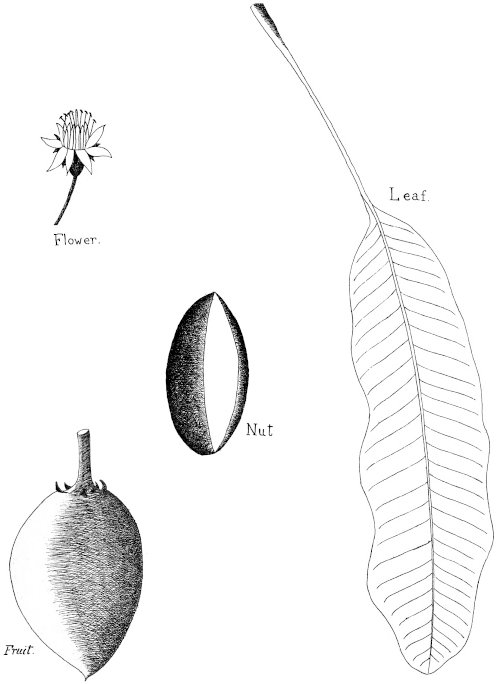
BUTYROSPERMUM PARKII Kotschy.—Kadanya, Kadai. “Shea Butter Tree.” SAPOTACEAE.
This is one of the commonest species of the savannah forests and has a wide distribution. An average tree is about 30 feet high with a girth of 4-5 feet, though large specimens over 40 feet high with a girth of 10 feet are by no means infrequent. A short, stout bole and large, spreading limbs, gnarled and crooked, form a widely spreading crown of considerable density, which, from the drooping habit of the lower branches, reaches almost to the ground in many specimens. It is the type species of the tree savannah and in some parts of the country forms a large percentage of the forests.
The Bark is a distinguishing feature of the species and is dark grey, sometimes almost black, sometimes, particularly in the case of trees growing in barren situations, almost white. It has deep, vertical fissures and prominent, square scales of great thickness. The rough scaling extends to the quite small branches. A milky sap exudes from the crimson slash and from the leaf-stalks and twigs, when broken.
The Wood is a deep, dull red-brown with a purple tinge, the sapwood is pinkish. In transverse section the rings are indistinct lines and bands of dark and light tissue, the pores are small and in little rows between the fine rays, bands of soft tissue running in concentric lines and also connecting the chains of pores. The wood is extremely hard and heavy, difficult to saw and very hard to plane, the resulting finish being hard and taking a high polish. The grain picks up in part and the wood is liable to crack when dried. The weight is 80 lbs. a cubic foot.
The Leaves are strap-like, of an average length of 9-10 inches and a width of 2 inches; 3-4 inches of the length are occupied by the stalk and the veining is strong, these two features and the darker colour distinguishing this species from Lophira alata which it superficially resembles. The springing of the leaves from the end 2 inches of the twigs gives the idea of a rosette. The margin of the leaf is waved.
The Flowers are in round heads, 2-3 inches across, at the tips of the leafless twigs and appear from December onwards. Each flower is cream-white in colour, has 8 sepals in two rows, 8 petals, 8 stamens and a central, petal-like crown round the ovary, consisting of abortive stamens (staminodes). The flowers are sweet, with a rather nauseating perfume. As they die off, the young leaves shoot from the middle of the head. They are visited by bees.
The Fruits, which begin to form from January onwards are like green plums when ripe, and contain one or two shiny, chestnut-brown kernels, with a large scar, or hilum, having the appearance of a split seed coat. They are about 2 inches long and 1 inch wide, the thin seed coat enclosing a firm, white flesh, from which the oil is extracted.
Uses.—The oil is extracted and the butter made by the natives by a preliminary boiling in water, followed by repeated pounding and stirring in cold water, the oil which rises to the surface being skimmed off and placed to harden in calabashes. It is eaten as such, burnt as an illuminant and used as a base for certain medicines.
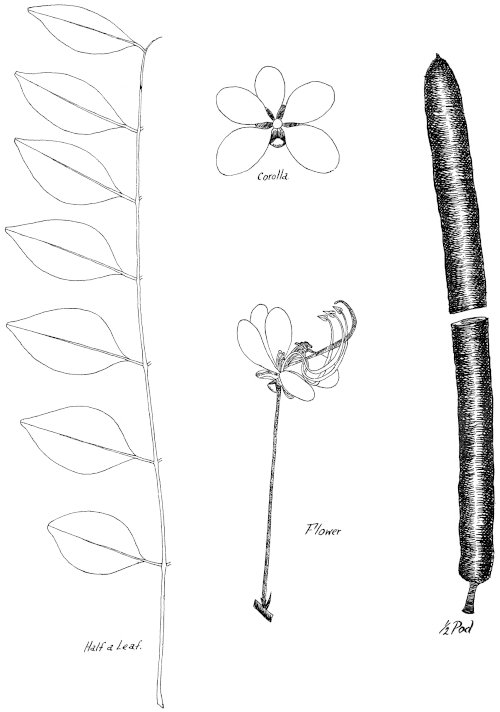
CASSIA AREREH Del.—Malga, Gamma fada. LEGUMINOSAE.
A small, erect tree from 15-20 feet in height, about a foot in girth, with one or more stems and a high, drooping crown of delicate pinnate leaves. It resembles Cassia Sieberiana only in the shape of the flowers, leaves and pods, and the outstanding differences are the erect form, the perfume and the longitudinally splitting pods. It grows in good soils and not in the barren places where C. Sieberiana abounds.
The Bark is a dull grey, with wavy but not prominent ridges of crisp bark, often rather shaggy when the scales fall in long pieces. The slash is pale brown.
The Leaves are pinnate, about 10-12 inches long with 6-7 pairs of leaflets some 2 inches long and narrowing in proportion to the length towards the top of the leaf. The main rib is very slender and is produced beyond the top pair of leaflets in the form of a slender curve, which frequently replaces one of the final pair of leaflets. The leaflets are smooth, clearly veined and purplish when young.
The Flowers are in racemes some 6-10 inches long, crowded, especially at the tip, with the flowers whose stalks grow to 3 inches in length. The three bracts, one long and a pair shorter are very conspicuous, especially at the crowded tip of the flower stalk where the buds are purplish. The flowers are typical of the genus, with 5 curled sepals, 5 irregular oval petals, 3 long, 4 medium and 3 short stamens, and a long, curved pistil swollen in the middle. The flowers are highly perfumed and appear in February in large masses amongst the new leaves.
The Fruits are pods, 12-20 inches long and an inch thick, cylindrical with irregular constrictions, purplish black in colour, shiny and hard. They persist on the tree for a long time and finally split down one side to release the light brown seeds. The inside of the pod has a yellowish, dry, mealy pulp.
Uses.—The pulp of the pod is used as a laxative.
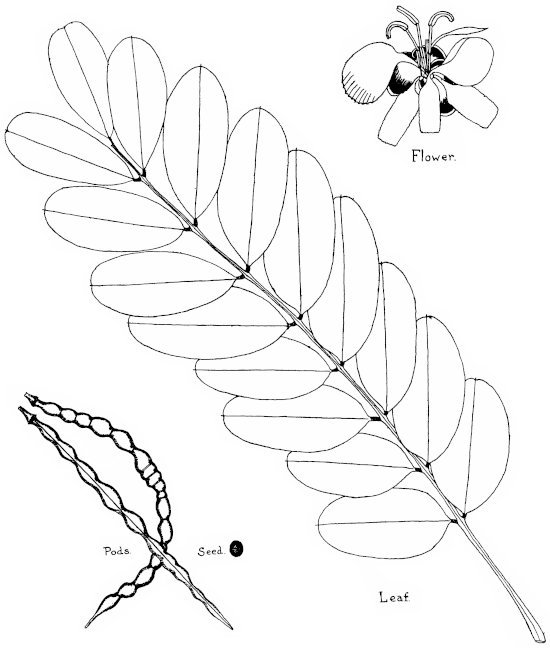
CASSIA GORATENSIS Fres.—Rumfu. Runhu. LEGUMINOSAE.
This is a small and common tree whose only value, apart from medicinal use by the natives, is ornamental. It is found in clumps as a small tree about 10 feet high, but also singly growing to a height of 20 and even 30 feet. Well-grown examples have a 10-12 feet bole some 3 feet in girth and a spherical crown. In its young state it is apt to be confused with Cassia occidentalis, “rai dore,” which latter is a shrubby herb with similar flowers and leaves.
The Bark is grey, sometimes almost white, with wide fissures and large scales. Old trees may have very dark and rough bark. That of the stout tapering twigs is a light brown with a powdery surface which rubs off in the hand. The slash is dull brown.
The Leaves are pinnate, 10-12 inches long with about eight pairs of oval leaflets which are bright green and smooth on the upper surface; grey, with the venation raised on the under surface. They are soft in texture and very often blotched or spotted.
The Flowers are most conspicuous in large, round bunches at the twig ends. They are bright yellow and about 2 inches across, with 5 petals, of which the lower three are much the same size and shape, while the other two are larger, the one spoon-shaped, the other serrate-edged and with marked veining. The sepals are also yellow and saucer-shaped, two of them larger than the other three. Of the 10 stamens, 3 are tall with large anthers, 4 are short with large anthers and 3 are quite small with round, flat anthers. They are grouped accordingly, from back to front as is typical of the genus. They appear in September.
The Fruits are thin, brown, jointed pods about 4 inches long, straight or curved, hanging in bunches. They contain 15 or 20 small, round, flattish grey seeds and ripen in February.
Uses.—The pods and leaves, boiled in water, are used for washing and purification after child-birth. The same infusion is taken internally as a cure for fever.
CASSIA SIEBERIANA DC.—Malga, Gamma fada. LEGUMINOSAE.
A very common tree with a wide distribution, growing on any kind of soil from rich loam to the driest and most barren sand or clay. It is commonest on wastes swept bare and scoured by rain or in little stony gullies. The form varies with the locality, tall, slender trees growing on good soils and wide-spreading, many stemmed shrubs of great size, or small stunted trees on poor soils. The full-grown tree is some 30 feet high, branching from ground level and forming a hemispherical growth with foliage to the ground.
The Bark of young trees is black, smooth and covered with lenticels that are rust-coloured on the smaller branches. That of old trees is dull black and rough with large heavy scales several inches long, that give the stem a shaggy appearance when they are falling. The slash is a yellow ochre colour.
The Wood is pale red, darkening to a light mahogany brown after exposure. The sapwood is white. In transverse section the rings are ill-defined, though the hard and soft tissue is well marked and the colour is much deeper in this section. The pores are numerous in long chains and festoons; the rays, invisible to the unaided eye, are fine and nearly straight. The wood is very hard and heavy and difficult to saw and plane, the finished surface taking a bright polish. Weight 70 lbs. a cubic foot.
The Leaves are some 12 inches long, pinnate with 6-9 pairs of leaflets opposite or nearly opposite. These are varied in shape, the basal pair almost as broad as long and the top pair almost twice as long as broad, with graduations between, 1½-2 inches long and 1-1¼ inches wide. They are bluish-green with a brilliant sheen, paler beneath with the mid-rib prominent. Young leaves are often purplish. The petioles are ¼ inch long.
The Flowers are in 12-18 inches long, pendulous racemes, in masses with the appearance of Laburnum, from February to May. Each flower is 1½-2 inches across on a 1½-2 inch stalk, and has 5 small, irregular sized pointed sepals with a darker green central line, 5 large yellow petals, varying in shape, and 10 stamens, 3 long and large-anthered, 4 shorter and large-anthered, and 3 small and round-anthered. The pistil is large, smooth and green. The petals enlarge and pale after the stamens have fallen from the fertilised flower. There is no scent.
The Fruits are long, black pods, up to 2 feet in length and a little over ½ inch broad, cylindrical, straight or slightly curved, more or less jointed, but never deeply, and divided across the length of the pod by fine, transparent, brittle membranes forming cells up to a hundred in number containing oval, shiny, light brown, hard, ½ inch long seeds, one in each cell, rattling loose in the pod. The pods fall entire or break across and rot on the ground. They are mostly riddled with holes by a small grub. The dry, yellowish pulp has an unpleasant smell.
Uses.—The yellow, mealy pulp is used in the preparation of a laxative.
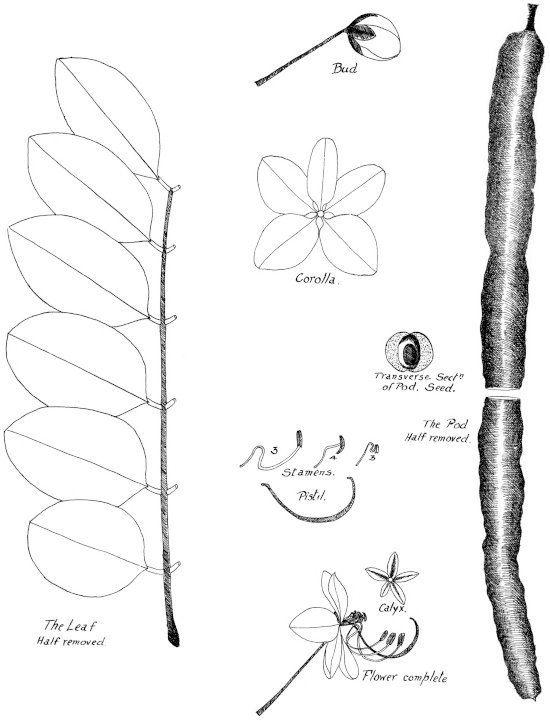
CELTIS INTEGRIFOLIA Lam.—Zuwo, Dukki. ULMACEAE.
A large tree which, when full grown attains a height of over 60 feet and a girth of 12-15 feet. It is not commonly distributed all over the country but is very common locally, e.g., in N.E. Sokoto and in N.W. Bauchi, in both of which places a large number of big trees are found over a small area of country. It may have a clean bole up to 20 feet or more in length with, in old trees, root flanges. The species is so frequently lopped for fodder that it is rare to find a naturally formed tree except in uninhabited forest where it produces a very large crown rounded at the top and, as a rule, branching low down. The limbs are large and bent; the twigs slender, horizontally spreading or drooping. The foliage is dense but not heavy. There are often thickets of adventitious shoots on the trunk.
The Bark is a light, slightly bluish-tinted grey, fairly smooth, with large, thin, very hard, rounded scales which come away from the lower end, remaining attached to the tree at the upper end and giving the rather curious look of sliding down the tree. Under the scales the bark is light brown. The slash is mottled, dark brown crumbling, white fibrous.
The Wood is light yellow in colour, soft, fairly close-grained, easy to work with all tools, planes to a dull, smooth finish, cracks only slightly when seasoning, is not durable under exposure, being inclined to bluish discolorations and weighs only 35 lbs. per cubic foot. The native does not use it, but it seems a useful soft timber. The pores are very numerous, of different sizes, some quite large, open and in festoons. The rays are just visible with the unaided eye and the rings plainly seen as close fine light lines. The rays are much waved.
The Leaves are variable in shape and size, some toothed and some plain along the margin. They are from 2-4 inches long and from 1-2 inches wide with pointed tip and ¼ inch stalk. The serrate leaves are found in numbers on the adventitious twigs, the entire leaves generally on the long, slender twigs which bear the flowers. Old leaves are very much darker in colour and rougher to the touch than younger leaves. Both surfaces are covered with very short, stiff hairs and are rasping to the touch. There are three main veins and the leaf is not symmetrical in shape. They turn their upper surface to the sky and are arranged alternately on the twig.
The Flowers which appear from December onwards are in minute, branched clusters in the leaf axils. Each flower is green in colour and has 5 sepals, 5 stamens with yellow anthers, and a twice forked stigma which enlarges as the fruit grows and then withers. The remains of the sepals and the stamens are found at the base of the fully grown fruit whilst it is green.
The Fruit is a plum, single-stoned and fleshy. If cut through before ripe, the seed can be seen growing in the top under the stigma and it expands downwards from this point, only partly filling the cavity when ripe. The ripe fruit is light brown and ribbed, about ½ inch long, and the stone is white, very hard and marked all over with a raised network.
Uses.—The leaves are a valuable fodder for cattle and made into soup by the natives.
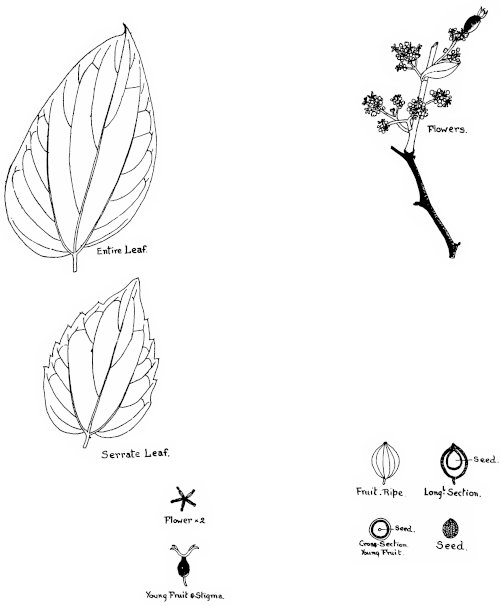
COMBRETUM ABBREVIATUM Engl.—Kariya. COMBRETACEAE.
This very beautiful species is a climbing or spreading shrub with a multitude of stems forming a tangled thicket with occasional stems extending into the air some 30 feet in length. It can be distinguished by its masses of brilliant red flowers and by the great variety of its leaves and the pale colour of its fruits. It is not common, so mention is made of two places where it may be seen, namely, in a “kurmi” at Rahamma (Zaria Province) and at Dan Tudu, near the G. Mainu Reserve on the River Rima (Sokoto Province).
The Leaves vary very considerably from 3-7 inches long and 2-4 inches broad. They may be almost as broad as long or twice as long as broad. On the new shoots there are short branches, modified to the form of blunt spines at the end of which are single leaves. When these drop off the thorn hardens but is never very sharp. These leaves are arranged spirally round the stem, unlike those of the other branches without thorns, which are inclined to one plane. The leaves are dark green and smooth and the venation shows up almost white in contrast. The venation is prominent on the under surface.
The Flowers are in enormous panicles several feet in length at the end of the shoots. The clusters vary in size at close intervals all the way along the shoot and the flowers themselves all stand up in the same vertical position, forming a great flat mass of brilliant red bloom. They appear in February and each consists of a light green 4-lobed calyx, 4 small red petals meeting at the tips and overlapping. From the tips of the petals 8 stamens emerge, 4 long, 4 short, bright red, as is the pistil.
The Fruits are 4-winged, ¾-1 inch in diameter, a delicate green when new and a light brown when ripe. The single seed is long and 4-angled. They are ripe in March.
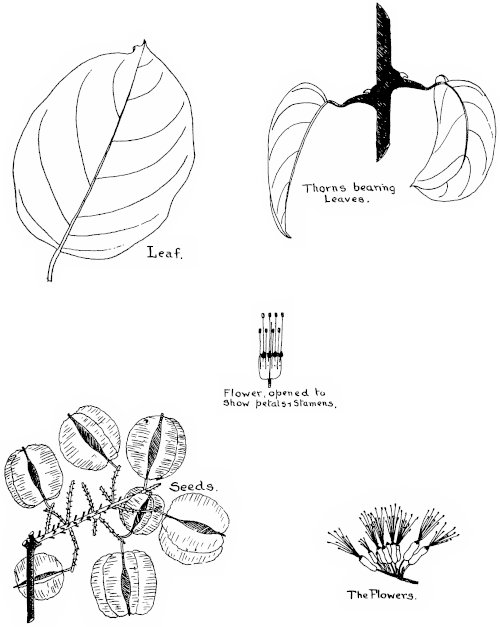
COMBRETUM HYPOPILINUM Diels.—Jan Taramniya, Jan Ganyi. COMBRETACEAE.
A small tree, rarely exceeding 20 feet in height, except in good soils, found very commonly in the drier country of the extreme north or in open savannah where the Terminalia species abound. It is not unlike C. lecananthum, but the seeds are larger and the leaf broader. Its form is typical of the small, wide-spreading trees of the Bush savannah, one or more stems and a number of spreading branches forming an open crown. Occasionally, though rarely, the species exceeds 20 feet and has an 8 feet bole. The tough, deep red fruits are distinctive.
The Bark is grey or brown, smooth in young stems and later showing long, vertical, narrow ridges and stringy fissures. The slash is red-brown.
The Leaves are variable in size, up to 5 inches long and 2½ inches broad, oval with a pointed tip and a stout ¾ inch long stalk. The venation is prominent beneath and flush on the upper surface, the mid-rib very prominent and light coloured. The upper surface is dark green and smooth, the underneath grey-green. They are tough in texture.
The Flowers which appear from December to February are in axillary spikes up to 3 inches in length crowded with cream-coloured, slightly scented flowers, each of which has a 4-pointed calyx, 4 minute petals, 8 stamens and a short pistil rising from a calyx full of white hairs.
The Fruits are 4-winged, 1-1¼ inches in diameter and length, conspicuous by their size, tough texture, and the rich, reddish-purple colour softened by a grey bloom. They are very numerous, crowded, heavy and hard.
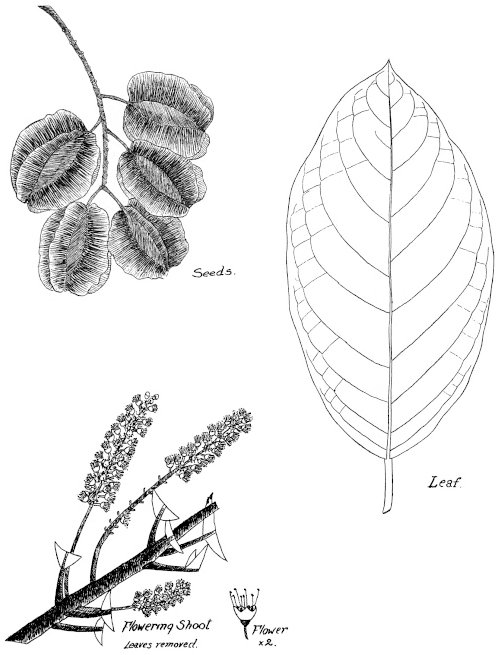
COMBRETUM LECANANTHUM Engl. & Diels.—Chiriri, Dagera. COMBRETACEAE.
A very common tree of the more open, dry savannahs and occurring on hard and barren or dry and sandy soils, often in such quantities as to form almost pure forests. It occurs mixed with the shrubby Combretum species or by itself in belts and patches on slightly better soil than is required to support the latter. It is about 20-25 feet high but a full-grown example will reach 40 feet with a 5 feet bole girth. The stem is rarely straight, often leaning or twisted and branching low down. The crown is either of erect branches and twigs, or the latter may as often as not droop and hang vertically downwards.
The Bark is smooth, grey-brown or rust-red in colour, with hardly any scales, but of a rather fibrous appearance. From it, in the hot season, large quantities of gum exude, white, yellow or red-brown, poor in quality, not brittle, but rubber-like, melting in moist heat and drying only in the dry season. The gum forms strange shapes, from nodules to long slender spirals. The bark is very thin. The slash is crimson, with yellow centre.
The Wood is a dirty white or cream colour. In transverse section it is much darker and the pores are very small and in little wavy lines and festoons, the rays exceedingly fine and close light lines. In the plank the pores are fine dark lines. In the green state the wood is so tough as to blunt axes but when it dries it loses its strength and is often completely destroyed by borer beetle. An unsatisfactory wood of no value. Weight 56 lbs. a cubic foot. The name “kariye gatari,” or “break axe” is given to it.
The Leaves vary largely in shape and in proportion of length to width. They average 4-5 inches long and 2-2½ inches wide, tapering both ends, pointed, shining above, paler beneath, the venation simple and the lateral nerves inclined far forward. They are in pairs and tend to lie in the same plane.
The Flowers are in branched spikes, cream-coloured and sweet-scented. They appear in November and may flower up to July. Each has the 4-pointed calyx, 4 minute petals, 8 stamens and short pistil common in this genus. There are bright orange glands inside the calyx.
The Fruits are 4-winged seeds, about ¾ inch long. They ripen from green through red to brown, and hang in loose clusters amongst the leaves. The stalks of the flower spikes elongate considerably with the seed growth and intermingle, forming a tangle of seed and stalk.
Uses.—There are none other than that the gum is chewed by the natives.
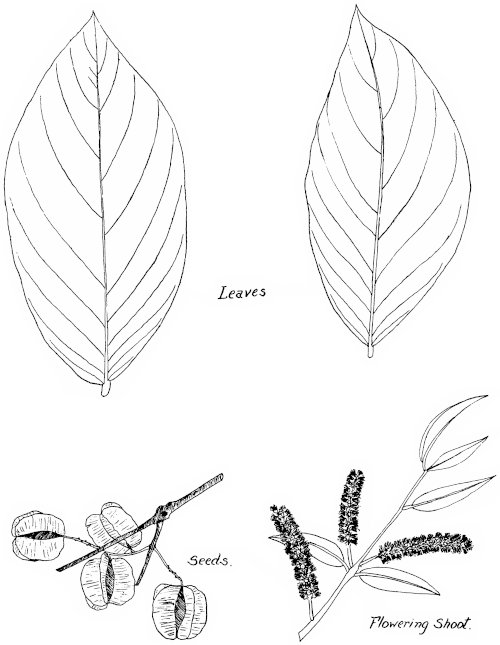
COMBRETUM LEONENSE Engl. & Diels.—Wuyan damo. COMBRETACEAE.
This species is found distributed fairly evenly over large areas of both Tree savannah and the drier, more open forests, and is common in rocky country. It has a tendency to grow longer, straighter boles than other species of Combretum and is commonly met with 20-30 feet high, or even more, with girths of 3-4 feet. If surrounded by other trees, the stem is exceptionally straight and readily distinguished by its dark colour and the small, square, regular scales. The crown, with its large, dark, drooping leaves, is dense, and big trees afford good shade. The branches droop over and the long, slender twigs hang straight down.
The Bark, a ready means of identification, is dark grey, sometimes almost black, and is covered with small, prominent, square, even-sized scales from which the tree gets its Hausa name, owing to its resemblance to the skin of the large lizard. It yields a gum. The slash is yellow.
The Wood is yellow or greenish-yellow. In transverse section the pores are small, in groups and festoons, the rings indistinct and the rays so fine as to be invisible. In the planks the pores are long, wavy and dark, the grain being crooked and fibrous in appearance. It is a very hard, tough, heavy wood, most unsatisfactory to saw and impossible to plane. The strength and durability are great. The weight is 64 lbs. a cubic foot.
The Leaves are larger than those of other species and are dark green, with a softly hairy surface and a soft texture. They are about 7 inches long and 2½-3 inches wide, with a long, slender tip, a taper at both ends and a very short stalk. They are pendulous on the long, slender twigs.
The Flowers are in clusters of 1½ inch spikes and are yellow with a sweet odour of musk. There are 10 yellow stamens round a square calyx and the pistil is surrounded densely by hairs on the receptacle. The flowers appear in March.
The Fruits are the typical winged seed of the genus and are smaller than those of most other species, a light brown in colour, less than 1 inch long and very persistent.
Uses.—The stems of small trees make excellent posts for use in the ground, owing to their great durability.
A concoction from the bark is used medicinally as an astringent.
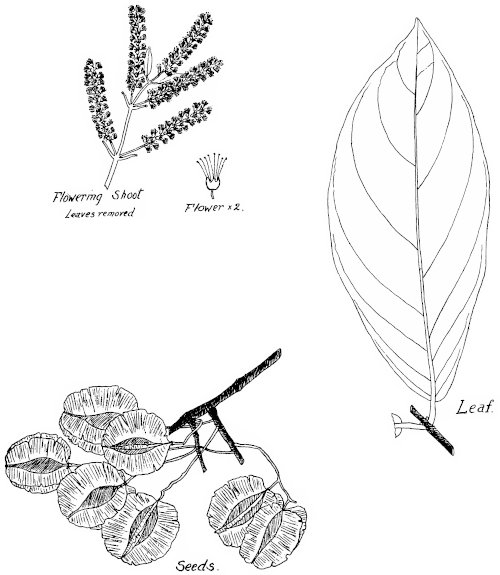
COMBRETUM MICRANTHUM Don.—Fara Geza. COMBRETACEAE.
This is one of the commonest species in the north, and covers many square miles of the driest and most barren of rocky wastes where little else will grow. The stout root stocks and tough, wiry stems survive fire, drought and excessive heat. It grows from 3-10 feet high, pure or mixed with other Combretum species or with Guiera senegalensis. It is distinguished by its generally smaller leaf, smaller fruits (seeds), lighter green foliage and the masses of highly perfumed flowers.
The Leaves are light green and shining, in pairs. The tip is pointed and the margin sinuous. They decrease in size from the base of the twig upwards. The venation is raised on both surfaces. They are 2-3 inches long and 1-2 inches broad.
The Flowers are in dense masses of spikes in the leaf axils from May onwards and fill the air with perfume. Each has a 4-pointed calyx, 4 small petals, 8 stamens and a short pistil. There is a ring of orange-coloured hairs round the pistil.
The Fruits are 4-winged, ½ inch in diameter and length, brown when ripe, in dense clusters on brittle stalks. They are persistent right through to the following rainy season.
Uses.—The bark is stripped for fibre and the stems used entire for binding the rafters of grass roofed houses or split for basket making. The stems are so tough that an axe or matchet will as often as not fail to cut through, but split the stem.
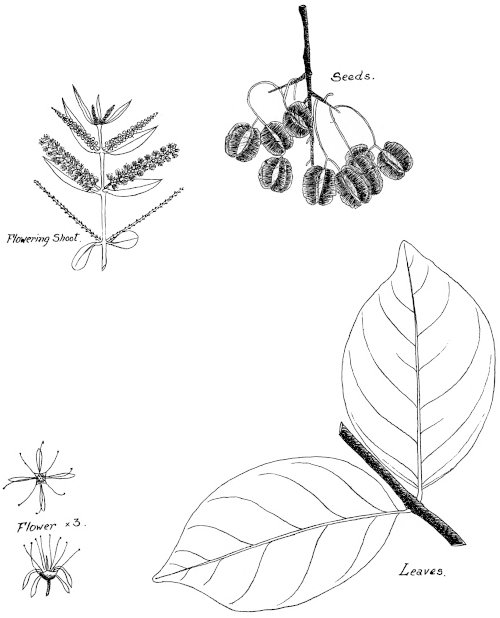
COMBRETUM VERTICILLATUM Engl. & Diels.—Farin Taramniya. COMBRETACEAE.
This is one of the commonest of the larger Combretum species, especially in the drier savannahs. It is particularly common in Sokoto Province and can be distinguished by the grey, dusty-looking leaves. There are two common forms of growth. The more common is that with a bole from 5-10 feet long, or several stems from ground level, and a round straggling open crown with the twigs drooping low down. The other is the tall, erect stem up to 40 feet in height, branching to within a few feet of the ground but having a cylindrical crown composed of erect limbs terminating in long slender branches of great length extending high into the air or dividing into numerous drooping flaccid twigs. The heavy leaves sway and weight down the weak twigs which can be bent to a circle without breaking. The species grows in the poorest sandy soil.
The Bark is pale grey or brown with very small, crisp scales scattered all over it, there being wide spaces between the scales, especially in the spring. The scales are dotted with small rust-coloured lenticels. The bark is sometimes cream-coloured. The bole is rarely cylindrical, but most often columnar and having rounded root flanges. The slash is red-brown.
The Wood is yellow or greenish-yellow. In transverse section the pores are small, single or in small groups, and the rings are very faint, the rays hardly visible, except as small brown bands in radial section. In the plank the pores are brown and open and the grain irregular, with black lines, flecks and brown patches. An unsatisfactory wood, cross-grained and tough, but strong, hard and fairly sound. Difficult to saw and plane. Weight 55 lbs. a cubic foot.
The Leaves vary much in size from 3 inches long and 2 inches wide to 5 inches long and 2½ inches wide. The base may be slightly cordate or narrowing and the tip is generally abruptly pointed. The margin is wavy, the leaf rarely flat and the foliage is very subject to attacks by insects and is much contorted, indented and disfigured. The upper surface has a dusty grey bloom and the lower surface is grey. The venation is raised on both sides of the leaf. The whole is soft and velvety to the touch. There is a ¼ inch stalk.
The Flowers are yellowish and in racemes, the spikes 1-2 inches long. They first appear when the tree is leafless from December onwards and are scented. Each consists of a 4-lobed calyx, 4 small white, recurved petals and 8 stamens opposite sepals and petals.
The Fruits are 4-winged, 1-1¼ inches long, all shades of red till they are ripe, when they turn brown. The seed is long and 4-angled.
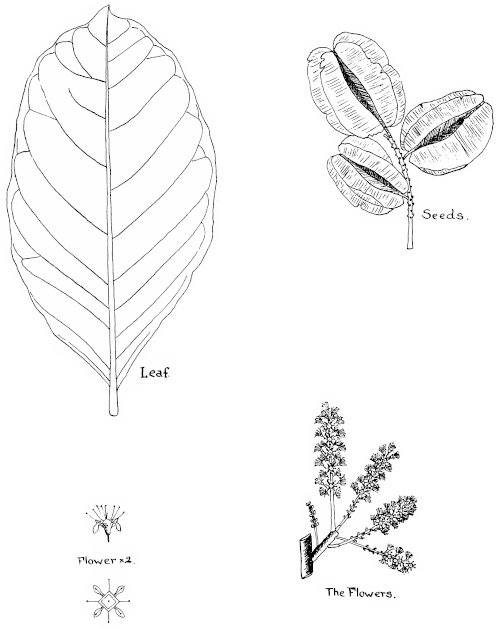
CORDIA ABYSSINICA R. Br.—Aliliba. BORAGINACEAE.
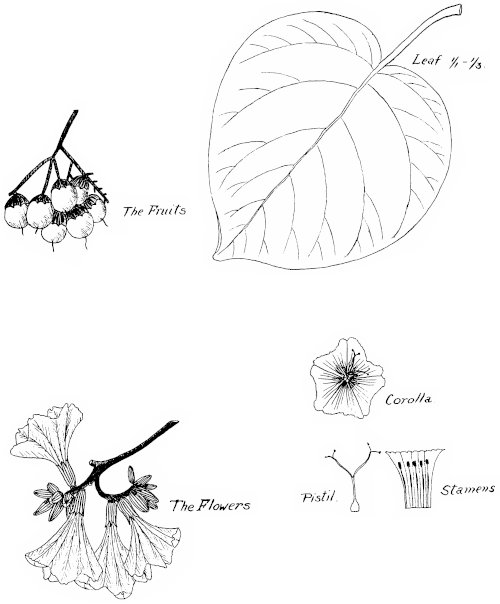
A small tree up to 25 feet high, either shrub-like in habit or with a short bole and round crown. The distinguishing features are the large heart-shaped leaves, large heads of papery flowers and the clusters of yellow fruits. As a shrub the branches spring from ground level and form a large compact bush, and as a tree the bole may be from 6-10 feet long and some 2-3 feet in girth.
The Bark is light grey and smooth with small lenticels. Only on the larger trees do scales form and the bark splits longitudinally and has a fibrous appearance. The slash is white.
The Leaves vary greatly in size from the quite small ones at the twig ends to the large basal leaves a foot long and 9 inches wide. They are heart-shaped, with stout stalks, the mid-rib curved back and the leaf tending to fold up along its length. Both surfaces are rough with short hairs. The upper surface is dark green, the lower paler. The venation is bold, the mid-rib not straight, but changing direction at each lateral nerve. The lateral nerves are connected by parallel veins. The leaf is tough in texture.
The Flowers which appear in October, are in large branched heads, a mass of buds prolonging the flowering period. The flower blooms for one day and then dries crisp, retaining its shape more or less when dry. Each flower is an inch across, funnel-shaped, white, with veined and crinkled corolla with 5 indistinct lobes. There are 5 black-anthered stamens and a twice-forked style with 4 stigmas. The 5-toothed calyx is a short tube and is heavily ribbed. The flowers have no stalks and there is a slight perfume.
The Fruits are in clusters; round juicy drupes with a hard stone and yellow translucent flesh, edible and sweet. They are ½ inch in diameter.
Uses.—The fruits are eaten, either fresh or mixed with honey to make a sweetmeat “alewa.”
CRATAEVA ADANSONII DC.—Gude. CAPPARIDACEAE.
A medium sized tree found growing locally in considerable quantities in “fadammas.” It attains a height of about 30 feet with a girth of 4-5 feet. Owing to the fact that the leaves are cropped as a human foodstuff, few trees retain their natural form and the general appearance is that of a pollard willow, with a short, stout stem and a number of erect slender shoots, inclined to bend down. Owing to its being liable to submersion for certain periods, the stem is frequently in a semi-recumbent position and from it spring a number of shoots forming a false crown. It is a very handsome tree in full flower and the delicate foliage is attractive.
The Bark is a light brown with a few crisp scales here and there. That of the branches is smoke-colour, densely covered with light brown lenticels. That of the new twigs is pale brown.
The Wood is very soft and of a rich yellow colour. It has a strong not unpleasant odour. It is of no practical use.
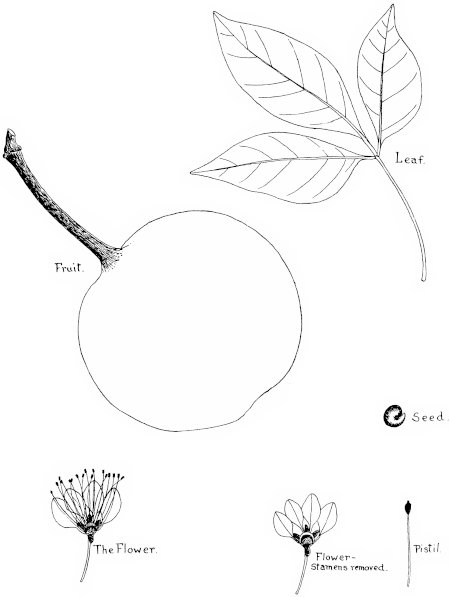
The Leaves are trifoliate with a stalk some 3 inches long and the leaflets from 3-4 inches long and an inch wide. They are narrow at both ends, light green and smooth, tender in consistency. They are in whorl-like bunches at the tips of the twigs.
The Flowers are very handsome and appear in February at the tips of the twigs in clusters of 10-20. Each has 4 small pale green sepals, 4 large leaf-like white petals grouped round one-half of the calyx and some 18 inch-long mauve stamens with mauve anthers. The pistil, which appears prominent in length after fertilisation is some 1½ inches long, with a knob at the end.
The Fruit is very like that of Strychnos (kokiya) in appearance, a pale brown sphere from 1½-3 inches in diameter on a woody stalk about 2½ inches long. The inside contains a number of small dark brown seeds of quaint “curled-up” shape embedded in a white, mealy flesh. The “rind” of the fruit is thin and crisp. The fruits are ripe about November onwards. They are eaten by birds who pick out the contents and leave the empty “shell” on the tree.
Uses.—The leaves are considerably eaten by the natives, and in times of famine are taken great distances to the markets.
CROSSOPTERYX KOTSCHYANA Fenzl.—Kasfiya. Kashin awaki. RUBIACEAE.
This fairly common tree occurs more plentifully in localities which are flooded during the rains and baked hard and burnt bare in the dry season. Thus it may take the place of Mitragyne africana (giyeya) in wet-season fadammas where the grass is rank in growth. It is not, however, confined, like the above, to such situations, but abounds in open savannah and rocky places. It is most readily identified by its fruits, q.v. and also by its habit of sending up a number of stems from a common stock, these stems growing erect and close together and showing an irregular cross section, oval, grooved or flattened in shape by reason of this close proximity to each other. In form the tree is cylindrical with a rounded or pointed top and sparse foliage. The foliage extends almost to the ground. A height of 30 feet and 2-3 feet girth is usual.
The Bark is peculiar in structure and is light grey or brownish, with small grey scales which will crumble in the hand and appear to consist of numerous lenticels. It is smooth and the scales are not prominent. The slash is salmon pink and crumbling.
The Wood is a brown pink, not unlike Pear wood. In transverse section the pores and rays are scarcely visible, so close is the texture. The rings show as faint light lines, close together, and the minute pores are scattered about between the exceedingly fine and numerous rays. The grain shows as slight banded variations in depth of colour. It is a sound, hard wood which seasons well, saws and planes easily to a hard, smooth finish, taking a good polish. The small sizes are unfortunate. Weight 57 lbs. a cubic foot.
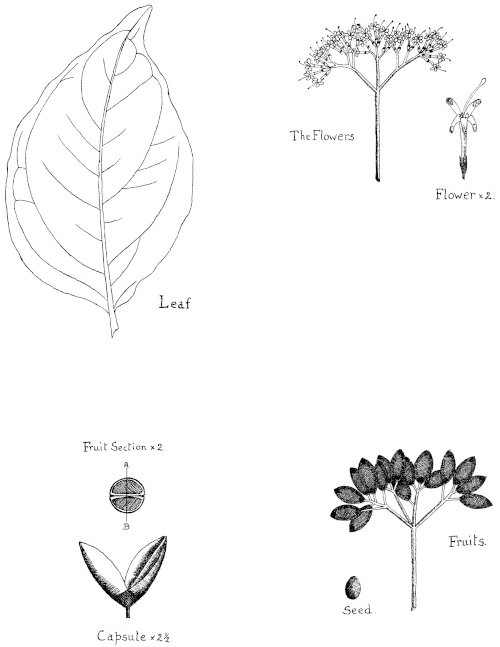
The Leaves are about 3½ inches long and 2 inches broad, alternate and inclined to assume one plane. They are pale green and downy on the upper surface, roughly and intricately veined beneath with light brown velvety hairs on the veins.
The Flowers are in close bunches with a tendency to droop from their weight; each flower consisting of a small 5-lobed calyx, a long tubular corolla with 5 petals, white tinged with pink, and a long, clubbed pistil surrounded by 5 small, protruding stamens. They are sweet-scented and appear in February.
The Fruits are easily recognised, forming bunches similar to the heads of flowers. Each is a small blackish capsule with a black tip, and it splits into two sections across the two seeds which are the shape of half the capsule and are black. They are very persistent and remain on the tree for a long time after they have shed their seeds.
Uses.—The stems are cut for poles (gofas).
CROTON AMABILIS Müll. Arg.—Koriba. EUPHORBIACEAE.
A small, erect tree from 10-25 feet high which will grow in the extreme north in the driest and most barren of soils. It flourishes round the parallel 14° north and extends right down to the extreme south also. It is often a stunted, shrub-like tree growing in quantities on bare, hard, stony soils, but in more open sandy localities will grow a 15 feet bole with an open light crown composed of erect, slender branches. Old trees spread wide and give a little shade. It can be at once distinguished by the silvery glister of its leaf on the under side and by the spikes of closed flowers.
The Bark is grey or light brown with small, close-fitting, even-sized polygonal or rectangular scales.
The Wood is pale yellow, discoloured grey in patches. The rings are fine, close, light lines, the pores are very fine, numerous and evenly distributed, connected by very fine lines of soft tissue, narrower than the pores. The grain is fine and the wood is hard, difficult to saw, not hard to plane and finishes with a hard, smooth surface which will polish. The weight is 64 lbs. a cubic foot.
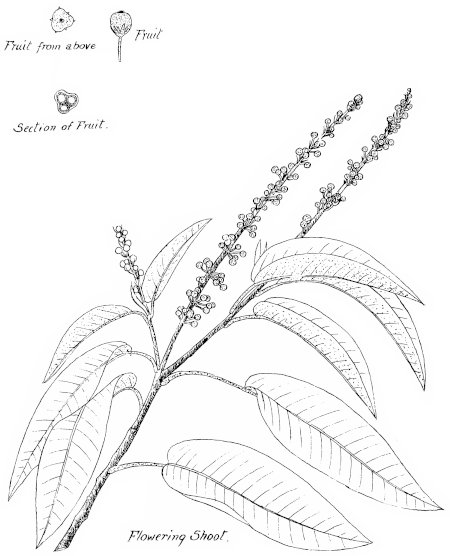
The Leaves are long, narrow and pointed, 4 inches long and 1½ inches broad with a 1½ inch stalk. The upper surface is a dark shining green, the lower glistening silver with minute rust spots all over the surface. The mid-rib is sunk on the upper and very prominent on the under surface. The lateral nerves are numerous and parallel. The stalk and mid-rib are covered with soft brown hairs. The young leaf is bronze or red-coloured. The leaves droop and tend to fold up along the mid-rib.
The Flowers are of two sexes, each on a different tree (dioecious). They are in racemes, resembling long spikes. The male are the longer, up to 4 inches, the female up to 2 inches. The male flower has 5 sepals, 5 petals and some 15 stamens all packed up in the bracts, on short stalks. The females have similar flowers with 3-part styles each with a bifid stigma. The flower parts are hardly visible to the naked eye so closely folded are the bracts.
The Fruit is a capsule, 3-lobed, one seed in each lobe. They ripen about November onwards, but may be found for many months in the year.
CUSSONIA NIGERICA Hutch.—Gwabsa, Takandar giwa. ARALIACEAE.
This quaint looking species is locally very common, more especially on rocky hills where, in its leafless condition, it resembles some cactus growth. It is not, as a rule, above 20 feet in height, but may reach over 30 feet with a girth of 4-5 feet. The girth is large in proportion to the height and there is practically always a clean bole, sometimes divided at the base into two stems, with an umbrella-like crown, flat-topped. The form of the tree is best seen in its leafless state, when it has the appearance of innumerable stags’ horns, the branches being very thick and blunted at the ends. In leaf, its more or less grotesque appearance is disguised by the large and handsome foliage.
The Bark is very rough and vertically fissured, light grey with long, corky ridges and regular sized scales. A clear gum exudes from a cut. Annual fires are harmless but cause a large amount of charcoal on the outside so that the stems are nearly always blackened. The slash is pale brown.
The Wood is a dirty grey colour, very soft, brittle and easy to work, is not durable, rots readily and weighs only 23 lbs. a cubic foot. In transverse section the rings are dark lines at broad intervals and the rays are clearly visible to the unaided eye. The pores are open and distributed in small rows, singles and groups between the rays; a useless wood.
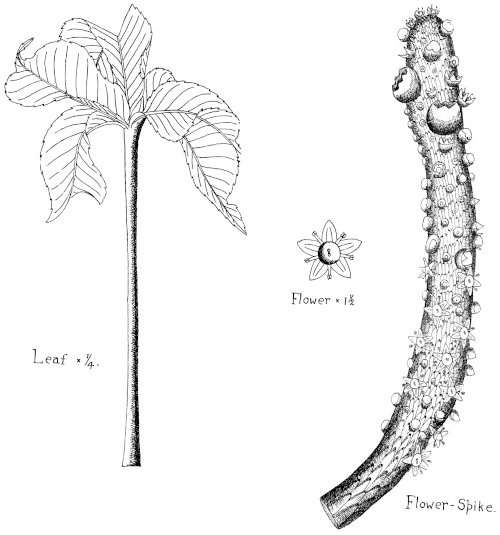
The Leaves are digitate with about 8 digits, in length from some 10-20 inches in the one leaf. They spring from the tips of the blunt twigs in an erect bunch, at first almost purple in colour. Each has a 2 feet long stalk and the edges are serrate. They are pale green in colour.
The Flowers appear in February and are on stout spikes of weird shape and appearance, which grow well over a foot long and are about one inch thick. The flower spike shows flowers and fruits in all stages of maturity from the bud to the seed and may be straight or twisted and tangled up with the others on the twig. Each flower is pale green with 5 petals, between ½ and ¾ inch across, with 5 stamens and a bifid stigma on a stout ovary.
DETARIUM SENEGALENSE Gmel.—Taura. LEGUMINOSAE.
In the north this species is generally quite a small tree from 15-20 feet high with a few erect branches forming a small flat-topped crown. Often, however, quite large trees can be seen, even in the driest country, and further south large specimens up to 40 feet high with girths over 6 feet are not uncommon. In the southern provinces, the same tree will grow to a height of 80 feet with a 12 feet girth. The larger portion of the height is almost always the crown, which is spreading and dense, giving good shade. The tree is readily distinguished by its bluish bark and round, compressed fruits. The small trees show enlarged tips to the branches from which the leaves spring. In places it is so common as to form almost pure forest over small areas.
The Bark is bluish-grey, with large polygonal scales. On young trees there are yellowish patches where the scales have fallen and the bark of the smaller branches is ochrous and powdery. The slash is pale crimson.
The Wood is dark brown or red-brown. In transverse section the rings are slightly darker lines, the pores are small, clear and open, mostly single, some in groups or nests of 2-4, rather unevenly and widely scattered. The rays are visible, not all continuous, some broader than others, evenly spaced with room for the pores between, showing in radial section as brown bands, so conspicuous on the sapwood as to colour it. In vertical section the pores are light coloured in the heartwood and dark in the sapwood, in which the resinous pore contents darken the wood in rings, showing as lines in the vertical section. The wood is tough and hard and not easy to work, though it has a slight sheen and takes a polish. The weight is 55 lbs. a cubic foot.
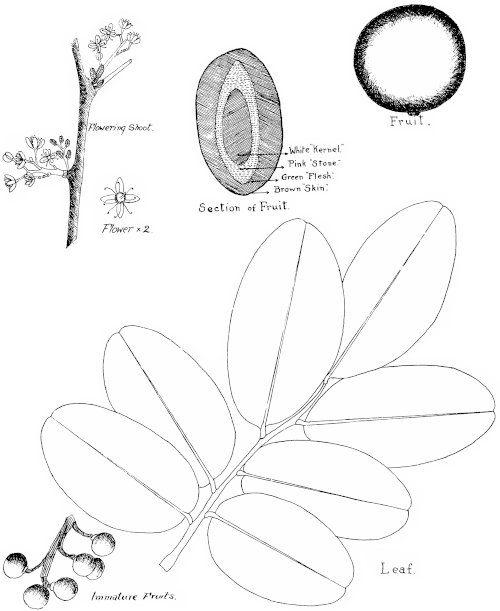
The Leaves are pinnate, 6 or 7 inches long with 6-10 alternate or opposite elliptical leaflets some 3 inches long and 1½ inches broad. Those nearer the top are more oval, those at the base rounder. The tip has a slight cleft. The leaf-stalks are very short and stout and covered with dusty brown hairs. The surface is waxy, there may be a few hairs, and bluish-green. The texture is rather leathery.
The Flowers, which appear in May, are found in masses all over the tree. They grow on short, branched stalks in dense clusters. There are no petals, their place being taken by the white petal-like sepals, 4 in number. There are 8 short, curved stamens with yellow anthers and a short pistil.
The Fruit is a drupe about 1½ inches across and flattened to about ¾ inch. It has a brown outer skin, a greenish, mealy flesh full of fibres which when the flesh decays remain round the kernel. This flesh is sweet and edible, but not very palatable. On small trees clusters of abortive fruits are found; little round, brown-green, soft growths which do not mature.
Uses.—The flesh is used by the natives in the manufacture of the sweetmeat “madi.”
Where it is large enough the timber is used for mortars, but the size is, as a rule, against this use.
DICHROSTACHYS NUTANS Br.—Dundu. LEGUMINOSAE.
A very common, acacia-like shrub which occurs in dense thickets in open situations. It averages about 10 feet high, though it will attain nearly 30 feet, branches near the ground and is most readily distinguished both by its flowers and pods. It is of no use in the composition of the forest, but is quite ornamental in flower.
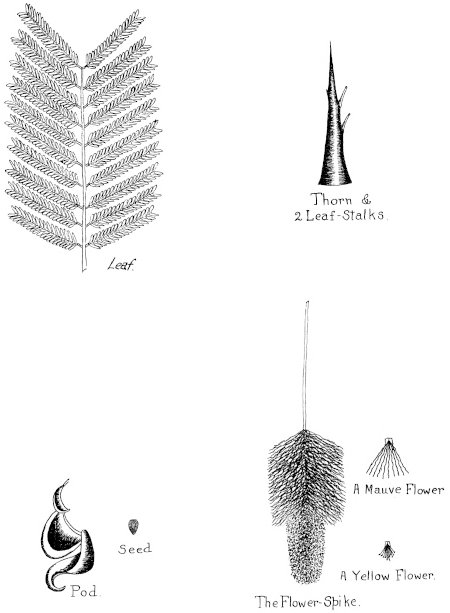
The Thorns are modified branches, each twig ending in a thorn which bears leaves, and is almost black in colour.
The Leaves are bipinnate, up to 4 inches long with 10-15 opposite pinnae, each bearing 15-20 pairs of dark, dull-green leaflets.
The Flowers, the most distinguishing feature of the species, are in pendulous catkins, shaped like large acorns. Those above (next the stalk) are functionless, except for attracting insects by their scent, and consist of 10 long, mauve filaments. Those below (at the tip) are yellow and consist of a pistil surrounded by 10 stamens. The whole flower-spike is 2 inches long with a 1½ inch stalk. They first appear in February and blossom for several months onwards.
The Fruits are bunches of small, brown pods which are so twisted and contorted as to assume fantastic bundles with alternate concave and convex surfaces outwards, each section the reverse of the next. They hold about four small, flat, black seeds, pointed at one end. The pods are very persistent and remain on the tree for several months. They fall without splitting.
Uses.—The stems are made into a good quality bow, very commonly seen, and also into sticks.
DIOSPYROS MESPILIFORMIS Hochst.—Kainya, Kaiwa. “Ebony.” EBENACEAE.
This species, though typically inhabiting the banks of streams and the depths of “kurmis,” is quite commonly found in dry situations, where it attains large dimensions. It is the same species as is found in abundance in the south, but while there it yields a fair proportion of black heartwood, in the north there is but a pencil or none at all. The form varies greatly according to locality. On stream banks in the savannahs, the foliage extends, as a rule, down to ground level, or near it. In the “kurmis” great, tall, tapering stems, cylindrical or, in some cases, apparently built up of a number of stems which have joined and formed a fluted column, or, in other cases, of a number of separate stems forming a huge crown, are the types. In some cases, e.g., north-east of Sokoto Province, a number of large trees occur in the middle of farm land on light sandy soil. These may reach a height of over 60 feet and a girth of over 10 feet.
The Bark distinguishes the tree from all others. It is almost black, and the scales are small, regular, even-sized and rectangular. That of very young trees is green or grey and quite smooth. The slash is salmon pink with darker flecks.
The Wood of the northern examples rarely contains any black wood. The heartwood is a mixture of shades of pink, grey and green, the predominant colour being light red. In transverse section the rings are faint waved dark lines, close together; the pores are small, open, evenly scattered, mostly single, with some small chains in the line of the extremely fine and close rays. The rays show as small red bands in radial section. The grain is close, not very straight and the wood seasons well and is hard and durable. Damage from fires to young trees often extends many feet up the stem. It works fairly well with tools but will not take nails well. The planed surface is smooth and will take a polish. The weight is 48 lbs. a cubic foot.
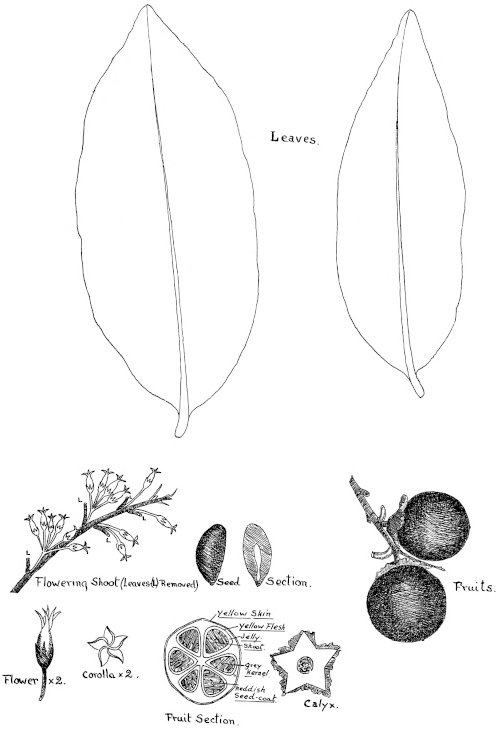
The Leaves are a very dark and rather dull green, the under surface with a slight sheen. The venation is very delicate and not raised on either surface, though the mid-rib is most prominent underneath. They are some 6 inches long and 2½ inches wide, with a short stalk. The young foliage is bright red, which turns brownish before the final green. The shade is dense and nothing grows under it.
The Flowers are borne in small clusters in the axils of the leaves in February. They are green and not conspicuous. Each consists of a 5-lobed calyx on a longish stalk, 5 petals set in spiral formation, one over the other and inside the closed corolla are 10 stamens attached to the petals.
The Fruit is about an inch in diameter, green at first, with the crinkly calyx much enlarged and toughened, ripening to yellow with a crisp rind, a soft, sweet, edible flesh and from 4-6 seeds. The seeds are very hard with shiny, rich red-brown coat and grey interior into which the red colour of the coat runs in streaks as seen in section. The seeds are grouped radially round the centre with thin, jelly-like partitions between each. The fruit falls entire from March onwards.
Uses.—The tree is cut into planks for various uses and the timber is very durable though a little too heavy. Canoes have been made of it. The fruits are eaten fresh by the natives.
EKEBERGIA SENEGALENSIS A. Juss.—Madachin dutsi. MELIACEAE.
This not very common species is found in Bauchi, Zaria, S. Katsina, etc., and has not been observed above 11½° N. It inhabits the outskirts of “kurmis” or the open forests where the soil is good. Considerable quantities occur just below the 4,000 feet level on the Bauchi plateau. The similarity of leaves, flowers and fruits and its rocky habitat are responsible for its local name. It reaches 30 feet in height with a girth of 2-3 feet, rarely has any bole length over 10 feet, but as a rule a number of acutely ascending limbs forming a dense oval crown. It stands shade well and there its growth is taller and more slender and open and inclined to spread. The terminal foliage is noticeable.
The Bark is smooth and dark grey, often with marked light and dark patches, and on younger stems or branches is covered with white lenticels in vertical rows. The slash is crimson with white streaks. The bark of older trees is roughish, with close-fitting, small scales.
The Leaves are about 15 inches long, pinnate, with 6-10 pairs of opposite, or nearly, pointed, wavy-edged leaflets some 3 inches long, a dull dark green above, pale beneath, with a prominent mid-rib on the under side which is reddish, as is the stalk of the leaf. They are borne on the last foot of the twig in erect, rosette-like bunches.
The Flowers are in panicles 5-6 inches long, amongst the leaves in February and March. Each flower has 5 pale green petals, 10 stamens with black anthers and a knobbed pistil. The filaments of the stamens are united up to the anthers.
The Fruits are capsules 1-1½ inches in diameter, normally of 4 segments, but owing to the growth of one or more at the expense of the rest, the capsule is often irregularly developed. They are light brown in colour and at first sight resemble those of Khaya but contain brilliant red oval seeds set in a bright yellow aril, embedded in the thick walls of the capsule, in a vertical position.
ENTADA SUDANICA Schweinf.—Tawatsa. LEGUMINOSAE.
A very common species occurring everywhere in savannah forests of the more open type; usually about 20 feet high, sometimes more, with an average girth of 3 feet. It forks and branches low and has, as a rule, no length of bole and a widespreading, open crown. In full leaf it is graceful in appearance and not unlike Parkia. It is of no use as a forest species except from its frequency.
The Bark is light grey with very long fissures and ridges set widely apart. It peels in long strips and provides a fibre, as does that of the roots which is in local use for rope. The slash is crimson and white in thin streaks.
The Wood is a light red colour. In transverse section the rings are well marked dark lines, close together, the pores are large, open, few, widely scattered, single or in small nests or rows of two or three, the rays straight, continuous, not too evenly spaced, some just visible to the naked eye. In vertical section the pores are long, open and sparse, and the grain fairly well marked in darker red lines. The wood is not hard, easily worked, planes to a nice smooth finish and is sound and compact. The weight is 50 lbs. a cubic foot.
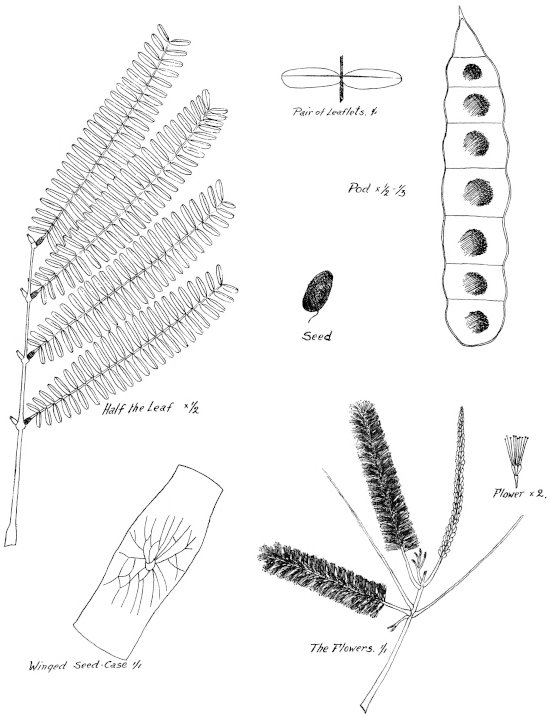
The Leaves, which resemble those of Parkia filicoidea, though they are a much lighter green, are bipinnate and about 18 inches long. The pinnae, 5 or 6 pairs, are set wide apart on the mid-rib, and there are some 15-20 pairs of inch-long leaflets, light green above and grey-green beneath, with a waxy texture. They grow densely near the twig tips and the mid-rib remains on the twig after the leaflets have fallen, persistent through the dry season.
The Flowers are in 4-5 inch spikes, whitish in colour. Each flower consists of 5 small green sepals and 10 white stamens with pistil. They appear amongst the new leaves in March, and are sweet-scented.
The Fruits are the most conspicuous feature of the species and the most ready means of identification for several months in the year, as they are very persistent, in whole or in part. Each is a long, flat, ribbon-like pod, from 6-15 inches long and over 2 inches broad with as many as 15 seeds, embossed. A rich brown in colour, the pod splits into sections between each seed, the outer cover falling away and releasing the seed which has a wing the shape of each section. The seed itself is a small, flat, brown oval, and the papery wing is veined. The seeds fall one by one, leaving the skeleton rim of the pod itself persistent for some time. The pods are a prominent and disfiguring feature of the tree, in the dry season.
Uses.—The leaves are appreciated as cattle fodder. An infusion of the bark is drunk as a tonic. The bark of stem and roots gives a fibre used as rope.
ERIODENDRON ORIENTALE Steud.—Rimi. The White-flowered Silk-Cotton. MALVACEAE.
This well-known tree is the tallest in the northern provinces and a height of 100 feet may be reached, with girths of 12 and 15 feet. Those who are familiar with the giant examples of the south will readily distinguish the difference in form between them and the type found in the north. In place of the clean bole up to 100 feet long with great horizontal limbs, the crown descends to within 10-20 feet of the ground and is, as a rule, very regular and shaped like a sugar-loaf, with a pointed top. The other type is seen but is not typical of the region. The branches, too, ascend at an acute angle and in the case of trees which have been lopped, a very common occurrence in the north, the new branches run up parallel with the main stem. Here and there occur branches which grow at right-angles to the main stem, so that one tree will show both types. The tree, as a rule, bears large, conical thorns, but there is a variety called “Rimi Masar” which has no thorns at all. The young tree shows a whorled arrangement of the branches. It is one of the quickest-growing trees and can be grown from poles, stuck upright in the ground.
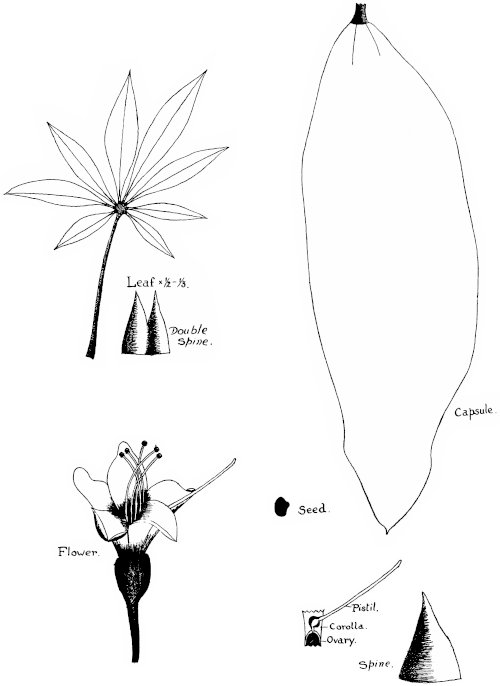
The Bark is pale grey and smooth. In young specimens it is a bright green, with or without a mass of stout, conical thorns with round bases and sharp, black points. The slash is crimson and white in patches, the white darkening to brown.
The Wood is white with small, yellowish streaks, and is soft and fibrous when green, and brittle and inclined to be crumbly when dry. It rapidly rots on exposure to weather but will wear quite well when made up into any article, such as a stool. It is short in the fibre and has been rejected as a source of pulp for that reason.
The Leaves are truly digitate with 7-9 lobes, each 3-4 inches long and narrow and pointed. They are dark green and smooth and slightly paler beneath, with a long stalk.
The Flowers, which appear in December cover the leafless twigs in pendulous masses. They are lily-shaped, with 5 brownish petals, so densely covered with silky hairs as to appear white on the tree, especially when in bud. There are 5 stamens with rolled-up anthers and a long, white pistil. The attachment of the pistil to the ovary is peculiar. The concave base of the corolla, which sits on the ovary, is pierced with a small hole through which the pointed end of the pistil passes, but when the corolla falls entire, the pistil is prevented from remaining attached to it by a swelling of the style at the base of the corolla, on the inside. The ground may be seen littered with the fallen flowers, each containing the unattached pistil.
The Fruits are large, pendulous capsules, 6 inches long, which are black when ripe and split into 5 sections, releasing a number of small, black seeds which are embedded in a mass of silky fibre known as Kapok. The fibre grows from the inner surface of the capsule.
Uses.—The wood is used for canoes of inferior quality in places where a better timber is not handy.
The silk-cotton is used for stuffing all kinds of articles, and by the native for stuffing donkeys’ saddle-pads. It is also used as a kindling for flint and steel.
ERYTHRINA SENEGALENSIS DC.—Minjiriya. Majiriya. LEGUMINOSAE.
This species is common locally and prefers the banks of streams, on which it grows to large dimensions. Examples 40 feet high with a girth of over 6 feet are met with and numbers may be found growing together along a considerable length of a stream. It occurs also, more or less commonly in open forest country, but does not reach the same dimensions as those near water. The larger trees have 20 feet boles and large, crooked limbs forming a wide, open crown, irregular in form.
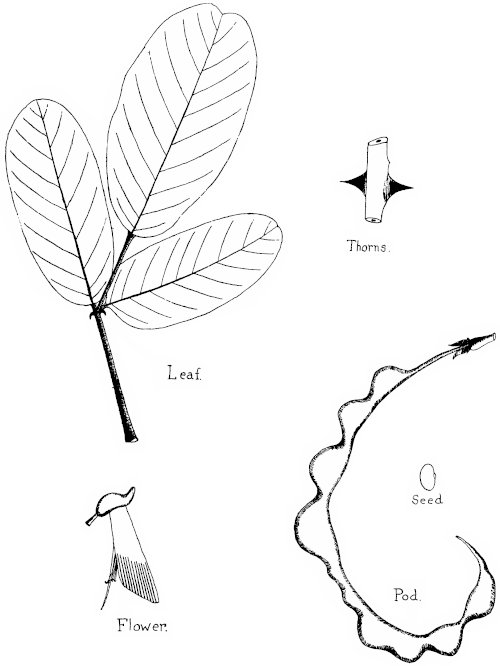
The Bark of old trees is very rough and, in the case of those trees growing on stream banks, covered with lichen. There are long, vertical fissures and long, heavy scales. The stem of the young tree, and the branches of the old, are covered with short, sharp thorns with heavy bases, in pairs, pale brown with black points. The slash is yellow.
The Leaves are trifoliate, the lateral pair without stalks, the terminal larger with an inch stalk. They are a dull, grey-green, often blotched on the under surface. The leaflets are 2-3 inches long.
The Flowers readily identify the species and are borne in bright red, terminal spikes. Each flower is a highly modified form of the “Pea,” and consists of a hood-shaped calyx and a large standard petal, folded down the middle, enclosing the long pistil and 10 stamens, some of which protrude with the pistil. They appear from November-January.
The Fruits are pods, about 6-7 inches long with embossed sections. They are sickle-shaped and dull green with a velvet covering. When ripe they split down one side and twist into fantastic bundles with the coral-red seeds attached alternately to the rims of the two sections. The vivid colour of the seeds gives the name “Coral Tree” to the species.
Uses.—The seeds are used locally by boys in playing games of chance.
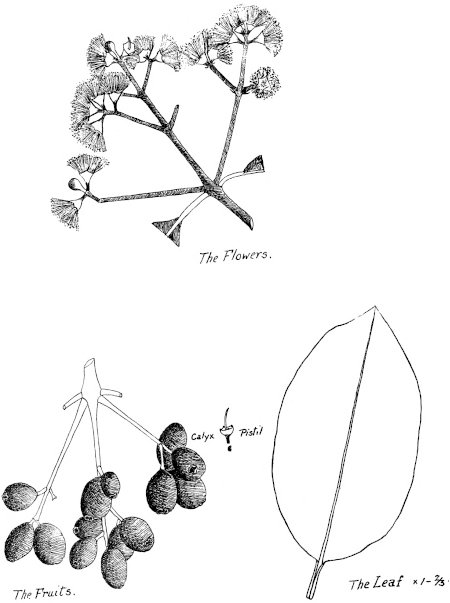
EUGENIA GUINEENSIS DC.—Malmo. MYRTACEAE.
A very familiar species which grows along stream banks as far north as 12°, while from 11° south it may be found gradually more and more able to leave these where conditions are suitable as regards soil and moisture. In Zaria and Bauchi especially it may be seen along streams to the exclusion of nearly all other species, and where it attains large dimensions up to 40 feet with girths of 6 feet. Like most species of the fringing stream belts the foliage approaches close to ground level, except where good protection is formed by the wider influence of “kurmis” when longer boles are found. The crown is dense but not high. Both the flowers and fruits are distinctive features.
The Bark is very dark, sometimes almost black or very dark brown, often lichenous with a mottled appearance. The bark is fairly smooth with long rectangular scales of little thickness. The slash is bright crimson and of fibrous texture.
The Leaves are very variable in shape and size, the true type being oval with rounded base and short pointed tip. They are 3-5 inches long and variable in breadth in proportion to a constant length. The surface is smooth with a rubbery texture, dull wax-like green. The venation is very fine, consisting of a large number of parallel laterals inclined acutely forward connected by a fine network of interlacing veins. The leaves are often distorted, the mid-rib curved or the tip of the leaf cleft.
The Flowers are in terminal racemes, regularly branched, of white flowers, each composed of a funnel-shaped 4-pointed calyx, 4 petals which are noticeable in bud, numerous white stamens which spring from the edge all round and a short curved pistil. They are scented and appear from January to March.
The Fruits are drupes in large falling clusters passing through the green, white and mauve stages before ripening to a rich purple-black. They are oval, a little over ½ inch long, with a prominent mouth. The skin is thin, the juicy flesh narrow and the thin-skinned kernel large. Birds eat them with avidity.
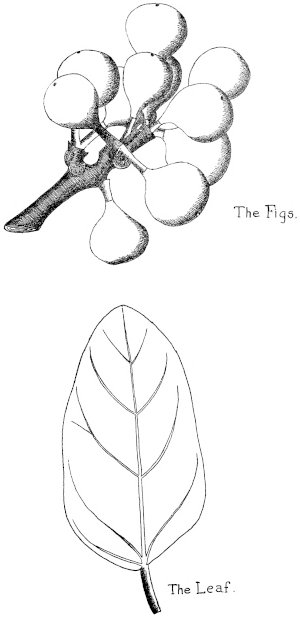
FICUS CAPENSIS Thunb.—Uwar yara, Haguguwa, Farin baure. MORACEAE.
A large fig tree commonly found on stream banks and in gulleys, distinguished by its masses of pear-shaped figs clustered round the trunk of the tree. It grows some 30 feet high with a girth of 4-6 feet, and in form is usually tall and narrow with a cylindrical crown which extends down to near ground level.
The Bark is a light brown colour and the scales are small, rectangular and grey, in patches on the tree. The slash is light red with a flow of milky sap.
The Leaves are 3-4 inches long and some 2 inches wide, of rather unusual shape, with broad tip, unequal basal lobes and wavy edges parallel in the middle portion. They are dark green with a bluish, waxy upper surface, paler beneath, and have ½ inch, stout stalks. The foliage is dense.
The Figs are borne in dense clusters on the trunk and wood of the larger branches, much branched twigs bearing the heavy crop. They are pear-shaped, about an inch long, and smooth. They are not edible.
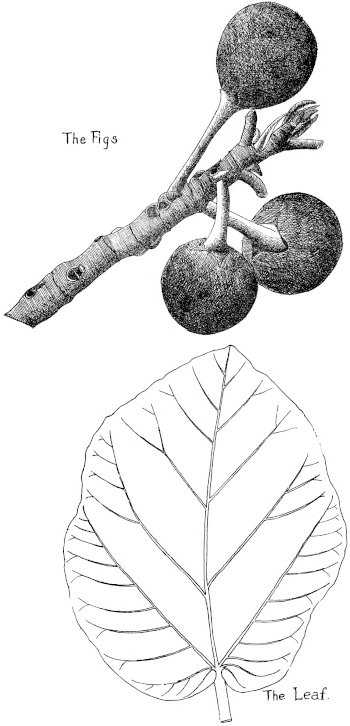
FICUS GNAPHALOCARPA A. Rich.—Baure. MORACEAE.
A very large fig tree, common throughout the country, but not in dry localities. It demands a moist site, preferably on the banks of a stream or in a fairly well watered locality. Though giving a deep shade it is not, like the “chediya” and “durumi” planted in towns for that purpose. It occurs in gregarious clumps, self sown and the seed is distributed by birds or goats and sheep which are very partial to the figs. It grows to very large dimensions, 50 feet in height with girths of 10-20 feet. There are two common forms: the high-crowned with long bole, erect branches and rather narrow, flat-topped crown, and the heavy-crowned, short-boled tree with low, widely-spreading limbs and immense crown. This is probably, like many other trees, merely a question of age and surroundings. Flanges a foot or two high and the roots running above ground for several feet are common features. The tree puts on its new foliage very quickly and this is a brilliant dark green colour.
The Bark of young trees is a light green colour with a soft, powdery covering. That of older trees is very distinctive, grey-green, fairly smooth with grey scales here and there about the bole and light brown patches where these have fallen. The trunk presents a mottled appearance most of the year, and green, grey, light and dark brown and bluish tints are intermingled. The slash is pale pink with a flow of milky sap.
The Leaves are 4-5 inches long and 3-3½ inches broad, cordate at the base with irregular margins. They are dark green on both sides with the veins very clearly visible in lighter colour and all prominent on the underneath. Both surfaces are rough to the touch, this being the most distinguishing characteristic of the species. There is a ½-¾ inch stalk.
The Figs are borne directly behind the leaves in short clusters any time from December to March and there is a heavy crop. They are about 1½ inches long and 1¼ wide, bluntly pear-shaped with ¾-1 inch stalks. When ripe they are various shades of red and orange to almost purple, rarely uniformly coloured throughout, and covered densely with short straight hairs like plush. They are much eaten by the natives, especially by children and are certainly the best eating though much spoilt by the fertilising fly. Sheep and goats relish them.
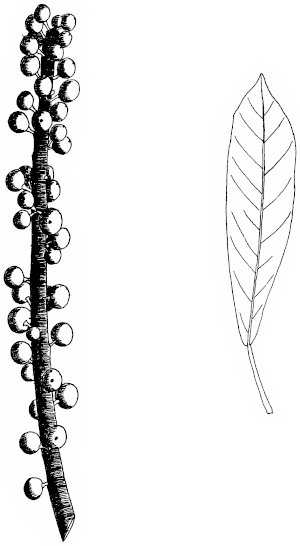
FICUS ITEOPHYLLA Miq.—Shiriya, Shirinya. MORACEAE.
A very well known species of fig tree distinguished by its long narrow leaves and long clusters of small figs. It grows to great sizes, over 40 feet high and with girths of 15 feet. It varies considerably in form from a tall narrow tree to one with enormous flat-topped crown 75 feet in diameter. The foliage is superficial and the shade is not very good. The bole is short, gnarled or compound, and there are many roots trailing over the ground for several feet from the base of the tree in old examples. The branches of younger trees are very erect and it is only in old age that the large spreading form is assumed. It often starts life as a parasite, the seeds being carried by birds to a crevice in another tree which it gradually surrounds and smothers. It is not unlike F. Kawuri, whose leaves are, however, slightly broader and whose figs are hairy and reddish.
The Bark is a creamy colour and a few grey scales are scattered here and there over it, giving it a mottled appearance. The bark is smooth.
The Leaves are 3-4 inches long and an inch wide with an inch stalk. They gradually widen from the base upwards and suddenly narrow to a point. The upper surface is dark, shiny green and the mid-rib and leaf stalk are very light green. The under surface is lighter in colour. The mid-rib is prominently raised on the underneath only. The margin is slightly waved. The leaves are arranged spirally in clusters of about 20 on the last 3-4 inches of the twigs, presenting a whorled arrangement.
The Figs are in 3-9 inch long clusters on the otherwise bare twigs, though they may be borne on the tree when it is in leaf. They are just over ¼ inch in diameter and when ripe are green with a red tint, round and the surface covered with small warts. They are eaten by birds which distribute the seeds to other trees where the tree starts life as a parasite. The crop of figs is a very heavy one.
FICUS KAWURI Hutch.—Kawuri. MORACEAE.
This is perhaps the largest fig tree with the exception of Ficus polita, “durumi,” attaining a height of 50-60 feet with girths of over 20 feet. It may start life as a parasite, when it forms the usual mass of aerial stems forming a compound bole. It grows to vast dimensions, forming a sun-proof shade with its dense, regular-shaped and clearly outlined crown. It is common in and around towns. The slash is pale red-brown with a flow of milky sap.
The Leaves are large, some 6 inches long and 3 inches wide on an average, 8 inches long and 3½ inches wide being the largest. They are broadly spear-shaped with cordate base and tongued tip. The upper surface is very dark green and shiny, the venation clearly marked and prominent on the surface, the mid-rib and main lateral nerves only prominent on the duller under surface. The leaves spring from the short, blunt twigs in a rosette formation.
The Figs are small, squat, pear-shaped and with black mouths, and are borne in small clusters of 2-4 in the axils of the leaves or behind the leaves on the wood. They turn from whitish to pink with purplish tints when ripe, and birds are very partial to them.
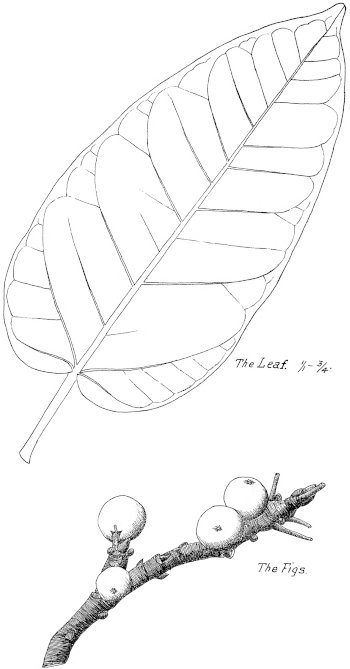
FICUS PLATYPHYLLA Del.—Gamji. MORACEAE.
A common species of fig tree, readily distinguished by the great size of its leaves and by the rusty colour of its bark. It attains a great size, over 60 feet in height, with enormous girths. The size of the large spreading limbs and breadth of crown are a feature. The lower limbs are horizontal and of great length and the crown is either flat-topped or round. There are small root flanges and often great lengths of root above ground. Though the leaves are few in number their size makes the tree give good shade. Life is started epiphytically.
The Bark, especially of younger trees and the branches of old trees, is rust red and there are large, scattered or patchy scales on the bole, which are light grey. The slash is dull pink, with a flow of milky sap.
The Leaves are very large and dark green. Twelve inches long and 8 inches wide, the upper surface is velvety with hairs and the veins show a pink tint. The under surface is lighter and the veins so prominently raised as to resemble rubber piping. The base is cordate and the tip pointed. The new leaves spring from the tips of the twigs above the figs.
The Figs are borne in clusters a foot or more in length and the crop is often a very heavy one. They ripen in December or January, or in places later, and the new foliage grows above them. The twigs on which the figs are borne are an inch thick with blunted tips. The figs themselves are an inch in diameter and have a 1½ inch stalk. They are reddish in colour with a soft skin and are covered with red warts.
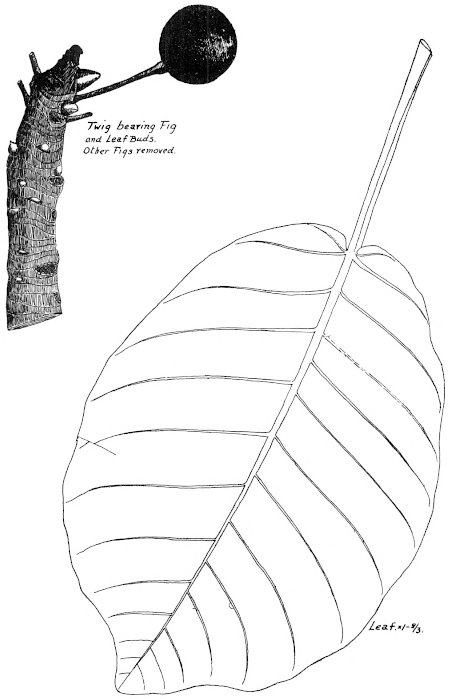
FICUS POLITA Vahl.—Durumi. MORACEAE.
This is one of the commonest of the fig trees, chiefly occurring in towns where it is planted for its shade. It is the densest of all the shade trees and readily identified by its very large, spherical or flat-topped crown of darkest green, and heart-shaped leaves. It branches not above 10 feet from the ground and innumerable straight branches extend in every direction to form the dense, superficial crown. In form it differs from F. Thonningii in being flatter topped and not so tall, the crown being umbrella-shaped. The trunk of an old tree may be of great size and is built up of many aerial stems formed from the growth downwards of the aerial roots which anchor themselves to the soil or hang in festoons from the branches. A network of roots may often be seen spreading several feet round the base of the tree.
The Bark is smooth and light in colour and creeping down it or suspended from it are the aerial roots, red at the tips. The bark yields a copious flow of milky sap.
The Leaves are heart-shaped with a prominent tip and a waved edge, are dark green and shining above, smooth beneath, with the main veins raised on both surfaces. They have a 2 inch stalk and are 4-5 inches long and 3-4 inches wide. They are pendulous.
The Figs are single or in pairs on the wood of the branches and are very numerous, clustering all round the branches. They are about 1¼ inches in diameter and have square, twisted stalks over an inch long. They ripen in January.
Uses.—It is planted, from poles, solely for its shade and in old towns trees may be found with a shade diameter of 100 feet.
The figs are sometimes chewed by the native but not swallowed.
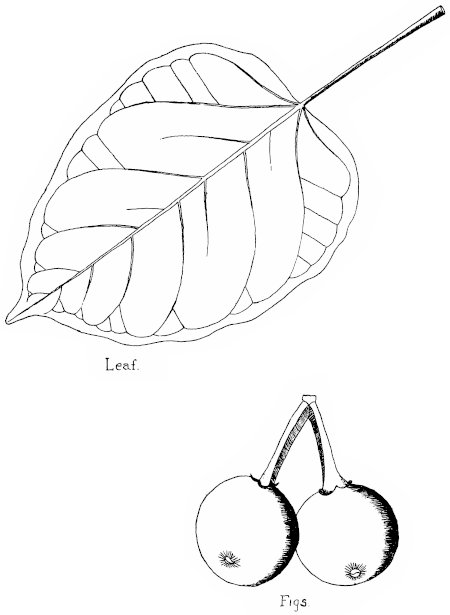
FICUS THONNINGII Blume.—Chediya. MORACEAE.
This species, somewhat similar to F. polita, is also commonest met with in towns, where it is grown for its shade. In form it differs from F. polita in that it reaches a greater height, 60 feet being not unusual, and has, as a rule, a spherical, rounded-topped crown. Numerous straight branches ascend from a large, short stem and, bearing their leaves at the ends, form a dense, superficial crown. The stem itself is, as in the case of F. polita, composed of a large number of aerial roots which have grown downwards from the branches and entered the ground, eventually combining with the stem to form a gigantic whole. Where the main stem branches, a dense mass of small aerial roots is often in evidence. The species is commonly seen in the act of strangling another tree in some fork of which the seed has originally lodged and about which it has twined its aerials till the host is completely enveloped. It is a fast growing species and readily propagated from a branch length placed upright in the ground.
The Bark is light grey and smooth and a copious flow of milky sap will pour from a cut.
The Leaves are dark green and slightly shining on the upper surface, on which the venation is prominent. They are about 5 inches long and 2½ inches broad, with 2 inch stalks.
The Figs are very numerous and are under ½ inch in diameter, in dense clusters amongst the leaves. They are reddish in colour with a warty skin. They ripen about February, and are not edible.
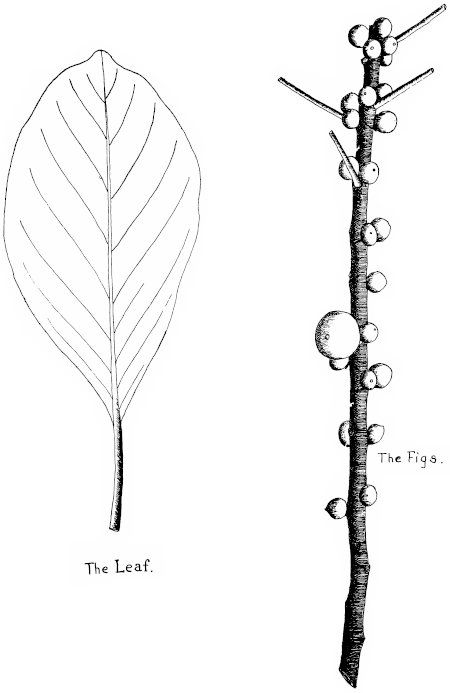
FICUS VALLIS-CHOUDAE Del.—Dulu. MORACEAE.
A large fig tree, most commonly found along the banks of streams and only away from them farther south in moister conditions. It reaches a height of 50-60 feet with very large girths. The bole is short, not above 10 feet and the limbs, widespread, form a large open crown with superficial foliage of very large leaves. Both the leaves and the large, solitary figs are distinguishing features. It is very common indeed in Bauchi province.
The Bark is light grey with large polygonal scales that leave light patches. The slash is pink, with a flow of milky sap.
The Leaves are large, averaging 6 inches long by 5 inches broad, but exceeding these dimensions by some 2 inches in some cases, with a stalk some 2 inches long. The base is slightly cordate and the margin broadly waved or bluntly toothed at wide intervals. The venation is prominent underneath and flat above. The upper surface is dull, dark, smooth, but not shining, the lower side slightly paler.
The Figs are solitary and large, almost up to 2 inches in diameter, flattened or pear-shaped, with a slight, softly hairy coat, and traces of longitudinal lines. The mouth is large and protrudes very slightly. They may be found from February to June.
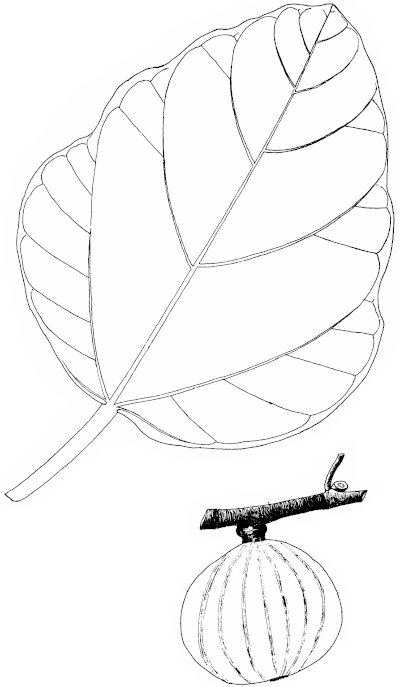
GARDENIA ERUBESCENS Stapf & Hutch.—Gaude. RUBIACEAE.
A common and conspicuous shrub of the savannahs whose only claim to importance lies in its frequent occurrence in large numbers over wide areas of the country. It rarely exceeds 10 or 12 feet in height as against the 20 feet to which its congener, G. ternifolia may attain. It is often gregarious, occurs in rich or poor and rocky soil and is more or less a component of all types of savannah. It branches from ground level and forms a round bush. The branches are twisted and bent, stout, blunt and springy.
A comparison with G. ternifolia shows G. erubescens to have larger, paler and brighter green leaves, with less crinkled margins; crisp, not fibrous fruits of more uniform and oblong shape; stouter, blunter and browner twigs, and a more shrub-like growth.
The Bark is smooth, grey-brown, with a powdery surface and small, thin scales which leave lighter scars. The slash is yellow, with green edges.
The Wood is yellow, hard, crisp under the axe, planes well, seasons well, is sound and clean and weighs 50 lbs. a cubic foot. In transverse section the rings are clearly visible as fine white lines, the pores are minute, open, evenly distributed and more numerous in the light annual rings. The rays are extremely fine, rather far apart and wavy.
The Leaves are about 5 inches long and 2½ inches broad, bright green and shiny on the upper surface, lighter beneath, with the mid-rib raised on both sides. The margin is wavy or not, and some leaves are narrow at the tip and others blunt and flat. They do not form as marked rosettes as those of G. ternifolia.
The Flowers are large, white, tubular, 6-petalled blooms, 3 inches in diameter with a very long, narrow corolla tube from which protrudes a ribbed club-like stigma, surrounded by 6 stamens consisting only of long anthers attached by their centres to the corolla. They are very highly scented and are conspicuous from their size, colour, number and perfume about December.
The Fruits are fleshy, potato-like, yellow, with a smooth surface and variable in size and shape, though usually long. The flower-parts are persistent at the top. The firm, juicy flesh surrounds a number of small, flat, yellow seeds in a bright yellow, pithy pulp, and is sweet and edible. They are eaten by antelopes.
Uses.—The fruits are eaten fresh or made into a sauce as an ingredient of soup.
The whole plant is cut for fencing farms as protection from goats, etc., and the twigs are stuck on the tops of compound walls.
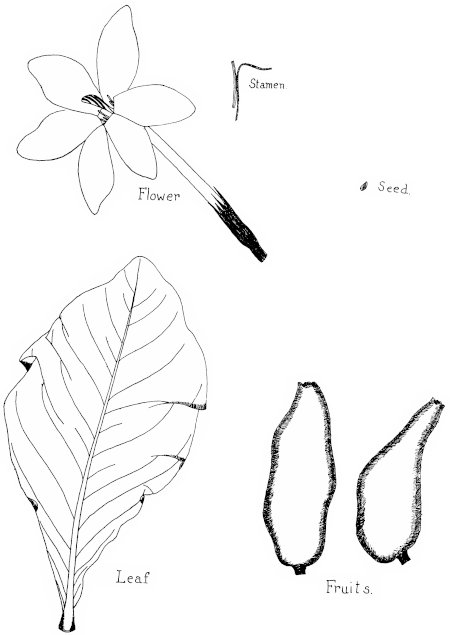
GARDENIA TERNIFOLIA Thunberg.—Gauden kura. RUBIACEAE.
This species, similar to G. erubescens, is found in the same situations, but is less plentiful as a rule. It may be seen mixed with the other species or over considerable areas by itself. It is, or can be, a taller species, occurring as a tree about 20 feet high with a less spreading habit, and a flat-topped crown. It branches from just above the ground and the branches are crooked and very springy, but not so stout and blunt as those of G. erubescens, in fact, the straight twigs of this species are very distinctive.
A comparison with G. erubescens shows G. ternifolia to be a larger or taller tree, less shrub-like; to have greener bark; to have smaller, darker, rougher and more crinkled leaves with pointed tips, and to have fibrous, grey-green fruits which vary exceedingly in size and in shape.
The Bark is smooth and grey or green with a powdery surface, and there are small, thin, grey scales which leave greenish-yellow scars. The end of the twig is covered with knobs of soft green cork. The slash is yellow, with green edges.
The Wood is yellow, close-grained, tough and hard to cut with the axe.
The Leaves are about 4 inches long and 1½ inches wide, dark green and slightly rough on the upper surface with a white mid-rib raised on both sides. The margin is crinkly and the tip pointed. They spring in little rosettes from the ends of the twigs.
The Flowers vary in size; are generally smaller than those of the other species but may be larger, 3½ inches across and with a corolla tube the same length. They are white and the under surface of the petals is very shiny. They have 6 petals, 6 stamens, consisting only of long anthers attached to the mouth of the corolla round a clubbed and green-ridged stigma. The calyx is irregular and a very bright, shiny dark green. The flowers are highly scented and turn yellow when fertilised. They appear about December and are very conspicuous by their size, colour and perfume.
The Fruits are very variable in size and shape, but are always of the same consistency, grey-green on the outside with a fibrous flesh that surrounds a number of small, round, flat, yellow seeds in a firm pith. They may be round or oval, ribbed or plain with roughened surface, covered with lenticels, and from 1 to 4 inches long. They may be found on the tree during the greater part of the year, and fall entire.
Uses.—The fruits are not edible and are used in the making of black cosmetic (katambiri) for decorating the faces of women.
The tree and its branches are used for fences (shingi) round farms and also for sticking on the tops of compound walls.
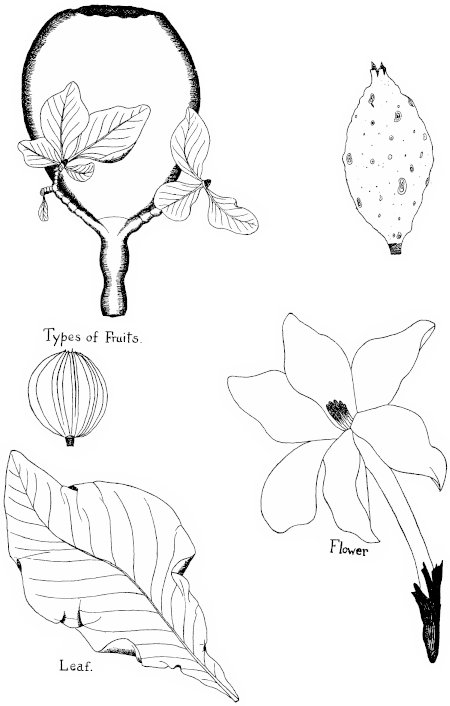
GREWIA MOLLIS Juss.—Kurukubi. TILIACEAE.
A large shrub or small tree growing in higher savannah forest and not occurring in dry latitudes. It is especially partial to granite soils and hills. It has no very definite form, being either a dense shrub 12-15 feet high or a small, shapeless tree up to 20 feet, with crooked branches and a mass of fine twigs. It likes the shade of high forest and is found under the shelter of large trees. The star-shaped yellow flowers and irregularly toothed leaves are the conspicuous means of identification.
The Bark is black and rough, deeply fissured and fibrously scaled. It presents a rough, shaggy appearance.
The Leaves are alternate on the long shoots and assume one plane with their surfaces to the light. Especially in the shrubby forms is this most marked. The leaf is 3-5 inches long and 1-1½ inches broad, borne on a short stalk and with the edges acutely and irregularly cut into teeth of all sizes. There are three main nerves, the mid-rib boldly branched and the laterals less so. All the nerves point well forward, and are prominent beneath. The basal lobes are unequal. The leaf-stalk is dorsally flattened. The upper surface is a dull, blue green, the under surface paler. The leaf-bearing shoots are oval in section.
The Flowers appear in April and persist till well on in June, the fruits almost ripening before the last flowers are over. They are in axillary clusters, 2-3 on a stalk and 2-4 stalks in an axis. They are ½ inch in diameter, bright yellow, with 5 long, narrow yellowish sepals, 5 small, round yellow petals and a mass of yellow stamens surrounding a knobbed pistil.
The Fruits are blackish when ripe, green with a pubescence before ripe, 2-lobed, with a cell in each lobe. They are edible.
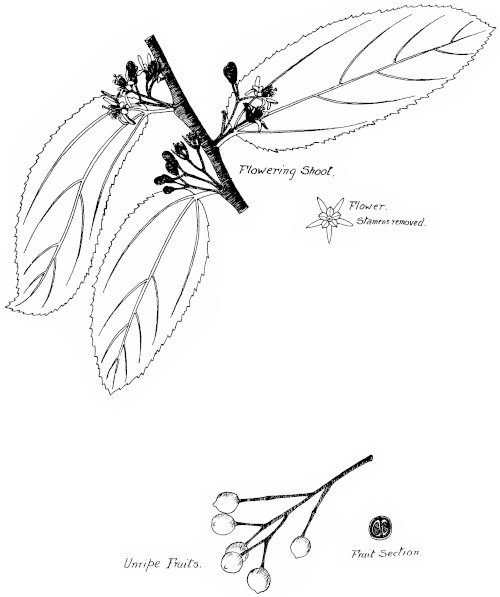
GUIERA SENEGALENSIS Lam.—Sabara. COMBRETACEAE.
A shrub, or, very occasionally, a small tree, which covers wide areas of otherwise barren land in the Bush savannah. In north-west Sokoto, for example, there are miles of this scrub covering what were large areas of cultivation at one time. It also covers the bare rocky slopes and summits of the flat-topped hills. On these it is associated with the smaller Combretum species “geza.” In appearance it is a bushy plant with several stems, dusty grey-green in colour from a few feet to about 15 feet in height. It is most conspicuous in fruit. The stems are very subject to a gall caused by a grub whose brown excretions fill the cavity in the gall. A small black and brown ant is found covering the plant at times.
The Bark is grey, and that of the young stems and branches is brown and covered with loose, brown fibres running vertically.
The Wood is cream-coloured with a reddish tinge. In transverse section the rings are darker bands, the pores are very small, single, in nests and in festoons, the contents closing most of them; the rays are very fine and evenly spaced, close together. The grain is coarse and twisted and the wood is tough and of no practical value. Weight 55 lbs. a cubic foot.
The Leaves vary much in size, being from 1-2 inches long and ¾-1½ inches wide. They have a slightly cordate base, a pointed tip and are broadly oval. The stalk is ¼ inch long. They are in pairs and opposite. They are a dusty grey-green, but a fresh green when new, and are rather dry and leathery in composition.
The Flowers, which are found at most times of the year, are in greeny-yellow, spherical heads about ½ inch across, enclosed at first in a sheath of bracts which splits open first into two parts and finally into four, which bend right back and persist in the fruiting stage. The head of flowers is on an inch long stalk in the axil of a leaf and bears a pair of tiny bracts about half-way up. Each flower has a 5-lobed calyx, 5 slender petals and 10 long stamens round a straight pistil. The whole is covered with minute black dots which are raised.
The Fruits are 1½ inches long, slightly curved, pointed at both ends, extremely hard, and covered with long silky straight hairs. In section they are 5-lobed, occasionally more, and contain one long seed. They may be seen for several months in the year, chiefly in the dry season, and are very conspicuous with their silky hairs. They have often a pronounced pink tint.
Uses.—The shrub is burnt round cattle, sheep and goat camps to keep off the flies and as a remedy for colds in such herds.
The leaves, concocted with water, are a medicine for internal complaints, a preventive of leprosy and, applied externally, a cure for skin irritations. They are also drunk by women after child-birth. The leaves are often added to food to prevent indigestion.