Front matter (continued 4)
Reading edition
"But where could we go? Even if one of the other planets were suitable to receive us, we could not have transported all our masses from Neptune to another planet in time to escape the doom of cold and death that was closing down upon Neptune. To transport all those masses would have required countless trips with our limited number of cylinders. And to take refuge upon another planet, even had time been ours, was almost out of the question. For long our scientists had studied the other planets with their instruments, and though some of them were so cloud-wreathed and others so distant as to make observation difficult, it had long been known to us that none of the other planets, due to their natural conditions or to the presence of intelligent alien beings already upon them, would be possible as a world for us Neptunians. It was for those reasons, indeed, that no expeditions of cylinders had ever been sent to the other planets.
"There remained, then, but one place where we might go, but one place to which our millions might go before Neptune's cold grew too great for life. That place was Triton, our peopled moon. For peopled as that moon was with its own masses of Neptunians, struggling against the same menacing cold that had vanquished us on Neptune, it was the one refuge for our peoples. By crowding into its every corner, the countless millions of Neptune's peoples would be able to exist upon Triton. And though the cooling of Triton had menaced it with cold also, it has been found, as we have mentioned, that it was not so hard to keep Triton warm by means of the artificial globular heat-mechanisms, the space enclosed by its great spherical roof being much smaller. It was a desperate expedient, truly, to mass all the thronging millions from the compartment-city that covered all giant Neptune, to mass all those millions upon little Triton, yet that was the one expedient open, and so it was followed at once.
"Out from Neptune to Triton went all the cylinders of both worlds, loaded with as many Neptunians as they could carry, depositing those Neptunians upon Triton and racing back for more. Countless trips made those thousands of cylinders, trip after swift trip, each occupying but little time because Triton was so near. And so at last there came a day when the whole of Neptune's millions had been transported out to Triton, when there remained on Neptune itself no single one of our races, our giant world lying cold and deserted and dead, no longer a habitable world, its vast compartment-city empty of the millions that had for ages swarmed through it, while all those millions were crowded now upon little Triton.
"And so crowded were those vast hordes of the Neptunian races that for a time it seemed that they could not exist in such numbers upon Triton. This crowding was made less acute, however, by an expedient now adopted by us. As mentioned, the Neptunians who had settled upon Triton long before had found that the unchanging day on one side of it and the unchanging night on the other were inconvenient for them after the alternations of Neptune's day and night, and so had begun the custom of spending a day of ten hours upon the sunlit side of Triton and a night of equal length upon the dark side. And now we found that we could make the crowding of our races upon Triton less acute by having half of them working and active upon the sunward side for ten hours while the other half slept through their night on the dark side. Every ten hours these two halves of our people changed sides, changed from day to night, a signal having been devised to mark the hour for that change, a signal which consisted of a brilliant band of intense light, that passed swiftly around both Triton's dark and sunward sides. With this shifting of our peoples each ten hours it was possible to make use of all of Triton's surface, and thus the crowding of our peoples upon it was made less acute.
"Yet that crowding was still very great. All the thronging Neptunians that had existed upon the surface of giant Neptune had been poured out on little Triton, far, far less in size than its great parent-world. And thus, though they could exist upon it, it was existence only that was possible to the Neptunians on Triton, since this awful crowding would grow worse, we knew, rather than better. And also, and more important, here on Triton the same deadly menace that had driven us from Neptune was again confronting us. For even as Neptune had cooled, Triton had cooled, was cooling also. And though we strained every effort to keep the warmth in Triton constant, though we sent cylinders constantly back to dead and deserted Neptune to bring from it more heat-mechanisms and other needed mechanisms, we found that even as on Neptune we were fighting a losing battle with nature. For Triton was cooling, was cooling still farther, and soon would be completely cold and dead, its interior heat gone out into space. And when that happened, no number of heat-mechanisms could keep warmth upon it, even beneath the great enclosing roof, and all life on it must perish.
"The Neptunian races had come to their last stand! Crowded upon our refuge of Triton, striving with all our power to keep upon it the warmth, without which we could not live, we saw at last that some new and radically different plan must be found, or we could no longer exist. So all the greatest of our Neptunian scientists were called together by us, the Council of Thirty. Into a great conclave here on Triton they were called, and to them, without equivocation of any sort, and to the races of the Neptunians, the situation that confronted us was stated. We had been driven from Neptune by the relentless growing cold, and now that same cold was upon us here at Triton, was threatening us here also with annihilation. How were we to meet this great menace that threatened to wipe us out?
"Countless were the plans that were advanced in answer to that menace by our scientists. The first, and most obvious plan, was migration to another planet. But here we were checked by the same considerations that had made us unwilling to try that before, for we knew by observation of the other planets that upon none of them could we live as we lived upon Neptune. Some of them were greater in size than Neptune, with greater gravitational power, and that was a difficulty that could not be overcome by us since upon those planets our weight would be so increased as to make us helpless, even had those planets been fit for our life. Some planets were peopled by intelligent and powerful races which we might be able to conquer after terrible struggles. Others were too near the sun for us to ever inhabit them, who had evolved on the dim, cool world of Neptune, the outermost world. Other planets, as far as we could tell, were quite uninhabitable. Mercury, Venus, Earth, Mars, Jupiter, Saturn, Uranus—not one of them was suitable as a world for us Neptunians. And we had, also, no desire to move to another planet, in truth, since so many ages had it taken for us to build our great compartment-cities upon Neptune and Triton, to shield them with their great roofs, that it was impossible for us to leave them, even had we been able, to start anew upon another world.
"We must remain with our own great world, it was plain, but how then could we continue to live? Innumerable were the suggestions that were advanced, but even those who advanced them were forced to admit them impracticable. Scores upon scores of useless plans were submitted to us, but none held even a shadow of hope for us, and it was not until we of the Council of Thirty had come to despair almost of warding off the doom that threatened us, that a plan was finally advanced by which that doom could indeed be halted.
"That plan, put forth by three of our Neptunian scientists in cooperation, was one of such colossal nature that even we Neptunians, who had roofed our worlds and had fought for so long the forces of nature, were stupefied by it. These three Neptunian scientists, in stating their plan, stated first that it was apparent to all that no escape to other planets was possible for us, and that our races must remain at Neptune and its moon, for life or death. They stated that it was equally clear that no means could be found by which even Triton could be kept heated artificially, all such means suggested requiring such vast expenditures of energy as to make them impossible for any but the shortest period of time. These premises, they said, were clear indeed, and it was equally clear that unless a new source of heat were found in some way for Neptune and its moon, we races of Neptunians must swiftly die. And so these three suggested a source of heat that never even had occurred to any of the rest of us, suggested—the sun!
"The sun as a source of heat for us! The idea seemed incredible to us—the Council of Thirty. For to us of Neptune, lying so far out in space from the sun, that sun could never mean and had never meant what it does to you of the inner planets. To you it is a source of ceaseless blazing heat, of brilliant light, warming your worlds sometimes to scorching, no doubt. But to us that sun has seemed always but a tiny little disk of fire far off in the void from us, a little sun-disk that gives to us the dim light of our pale Neptunian day, but that gives to us hardly any measurable heat whatever. We had simply never thought of the sun at all as a source of heat, any more than you would think of a star as a source of heat, since we had been accustomed always to rely upon the interior heat of Neptune for our existence. But now with that interior heat gone, with Neptune cold and dead beneath the zero temperatures that reigned there, and with Triton fast approaching the same condition, these three Neptunian scientists advanced the sun as a possible source of heat that might save us.
"The sun, they admitted, was too infinitely far from us to help us any with its heat as conditions were. But what, they asked, if the sun were to divide into a double or multiple star? Countless stars of the universe, we knew, had done so, had split into a double or triple or multiple star, and in so dividing, by reason of their rotatory speed or centrifugal force growing so great as to make it impossible for them to hold together, the two or more small suns forming out of one always moved some distance apart from each other, by the first force of their division. If the sun were to divide into a double star, therefore, the two smaller suns that would be formed thus would undoubtedly follow the same course, would be pushed apart from each other by the very force of their division, some two billion miles, our astronomers had calculated.
"Pushed apart thus, the two new suns would form an ordinary double star, or binary, the two revolving around each other. And by their division almost all the planets of the solar system would without doubt be engulfed in one or the other of the two suns. The four inner planets would inevitably be annihilated when the sun split into two suns, when those two rushed apart from each other. For if they were not directly in the path of the two separating suns, they would be drawn into those separating suns almost at once by the tremendous gravitational disturbances attendant upon this tremendous cataclysm. They would have no more chance of life, indeed, than midges in a great blaze. And in the same way Jupiter and Saturn would be whirled out of their orbits, since those orbits would be fatally confused and changed by the first division of the sun, and by the loss of centrifugal force attendant upon their confused slowing they, too, would without doubt be drawn into the path of one or the other of the separating suns and perish in them. And even Uranus would meet a doom as inevitable, since with a distance of two billion miles between them the two new suns would be resting almost exactly upon Uranus' orbit, and so that world too would go to blazing death in one or the other of them.
"But Neptune would not! For Neptune, farther out than Uranus, farthest out of all the planets, would be the one planet in the solar system that would escape the tremendous cataclysm, due to its distance from the sun. When the two suns separated, Neptune's orbit would probably change a little, it would probably sweep closer in toward those suns for some distance, but except for that it would be unchanged, and would by reason of its great distance continue to circle in its curving path through space, but would circle then around these two new suns instead of around the former single sun. And with those two suns separated as they were, by a distance of two billion miles, Neptune would be near always to one of those suns, because it would undoubtedly sweep nearer to them when the cataclysm occurred, and would take up an elliptical orbit about them with the two suns as the foci of that ellipse. Thus it would always be near enough one of them to gain from it or from both a large amount of heat! For not only would Neptune in its elliptical orbit be far, far closer to them thus, but the other planets hurtling into them would tend to make them hotter. Thus Neptune, revolving close about the two suns, would gain from them the warm, life-giving heat that it had never gained from the single sun!
"That heat would thus solve the great problem that faced us; it would halt the doom that was closing down on us. For that heat would so warm Neptune, that we could go back again and take up our existence once more upon it free from all peril, could live again in that great compartment-city that covered all Neptune. And Triton, too, would be livable, then. For the great roofs that we had erected around Neptune and its moon would tend to make of both worlds great hot-houses in effect, the sun's or suns' heat being able to penetrate down through those roofs. And with those enclosing roofs about us, and with the two new suns close, we could live on in safety. For the enclosing roofs themselves would prevent any inconvenience from the fact that Neptune now and then would be farther from the two suns than at other times, those great roofs keeping a constant warmth upon Neptune and its moon.
"Thus all the great peril that confronted us would be thrust back, and we could live once more on Neptune, more warm and comfortable there than ever before; we could pour back once more to our mighty world that lay now dead and cold and deserted—could do all this, if the sun did divide into a double star. Yet what hope was there that this could happen? We knew that the reason other suns of the universe divide into double or multiple stars is because they have reached a rate of rotatory speed that makes it impossible for them longer to hold together. For when a sun is spinning its mass tends to split up by its own centrifugal force, just as a turning wheel, and the faster the sun spins the greater grows its centrifugal force, the greater its tendency to split. And then at last that rate of spin grows so great, and its centrifugal force is such that its mass can no longer hold together, and fission takes place, the sun dividing into two or three or even more stars, that push apart from each other. But what chance was there of the sun doing this? For the sun, we knew, rotated at the speed of one turn in 25 days, at its equator, and to split it would have to be rotating at a speed of one turn in an hour. That meant that it would be unthinkable eons before the sun's rotatory speed would have increased to that point. For though a sun's rotatory speed does increase as time passes, due to the shrinkage of its mass, it increases so infinitely slowly that it would be eons, indeed, before the sun's rate of spin would be so great as to cause its division. And thus there seemed small hope indeed in that plan.
"Then it was that those scientists revealed to us the heart of their plan, and made clear to us the true colossal nature of their suggestion. What, they asked, if we ourselves increase the sun's rotatory speed? What if we of Neptune should reach across the void of almost three billion miles and set the sun to spinning faster, spinning it ever faster and faster until it had reached the critical point, until it turned once in one hour? Fission would result then, the sun would divide into a double star as they had calculated, and all the benefits mentioned would come to us, and Neptune and its moon would be warmed always by the heat of the two suns about which they would revolve. If we could do that, if we could reach across the void and set the sun to spinning ever faster, it would soon divide into two new suns, and thus we would have saved ourselves. Yet we were thunderstruck by this suggestion of the Neptunian scientists. To reach out across the infinite leagues of space that lay between our outermost planet and the sun, to turn that sun ever faster until it split into a double star—how ever could such a gigantic, stupefying feat as that be accomplished?
"But the Neptunians who had suggested this plan now calmly explained how that colossal deed could be accomplished. Long before, indeed, we had discovered force-vibrations, finding them a vibration that exerted tangible and definite pressure or force upon whatever matter they struck. And we had used those force-rays in some ways. We had used them to propel our cylindrical vehicles out through space from Neptune to Triton, and vice versa. We had used them also, concentrated into slender, pencil-like rays of great power, as weapons, since those concentrated rays penetrated and destroyed all that they touched. Now our scientists proposed to use them for this huge plan—to reach across the void, across the solar system, and to turn the sun ever faster, until the desired division of it had happened.
"Nor was this, as they outlined it, impracticable. The sun, turning there in space at the center of the solar system, has naturally one edge or limb turning away from us, and the other turning toward us. Now, if we constructed colossal generators of the force-vibrations, generators that could produce a gigantic ray that would have almost inconceivable power, and shot that ray across the solar system toward the edge of the sun turning away from us, what would happen? It was clear that that great ray, striking against the side of the sun's mass turning away from us, striking that side with titanic pressure and force, would tend to turn that side faster away from us, would tend in that way to make the whole sun turn faster! Such a gigantic ray, though it would increase the sun's spin thus but slowly, would continue to increase the sun's spin steadily as long as it was kept turned upon the sun's side. Slowly, but steadily, the sun would turn ever faster, until soon it would have reached that critical rotatory speed, of one turn in one hour, that would make its centrifugal force so great as to make it divide into a double star, and so save us of Neptune from the cold death that hung over us.
"Thus this mighty plan was presented to us, and it was at once accepted by us of the Council of Thirty, by all of the Neptunian races. For we saw that in it lay our one chance for life, our one chance to halt the doom of our races, our worlds, and to halt that doom we were willing to make any effort. We knew that the other planets of the solar system, that the seven other worlds of this universe and all their moons, would go to flaming death when our plan succeeded, would be annihilated when the sun divided, but we recked not of that. For the last necessity was upon us, the last closing down of the doom that we had fought against so long, and to remove the shadow of that doom from over us, we were willing to send to a more terrible doom all the other planets of the solar system.
"Only one great difficulty lay before us. That gigantic ray could be generated and shot forth by us, since it would not be difficult, by concentrating all efforts, to construct the generators and mechanisms needed, but from what place was that ray to be shot toward the sun? And how? It was evident that the giant ray could not be sent from Neptune's surface. For not only would it be almost impossible to keep its great mechanism working in the constant terrible cold that reigned there, but Neptune's rotation would make it impossible to send the ray forth from any spot on the great planet, since because of Neptune's rotation, it would follow that that spot—that great ray, would be toward the sun half the time, on Neptune's sunward side, and the other half would have turned and point away into space from its dark or outer side. It was apparent, therefore, that the great ray could not be sent forth from Neptune, since to achieve its effect that ray must play constantly upon the sun's one side or edge; and it became apparent that only from Triton could it be sent forth, since Triton kept one face always toward the sun and it would therefore be necessary only to set the great ray's mechanisms in that sunward side, when it would point unchangingly toward it.
"As far as position was involved, therefore, it was quite feasible to drive the colossal force-ray out from Triton's sunward side toward the sun. But there was another point involved, one that bid fair to ruin the whole great plan. When this gigantic force-ray reached out across the gulf, and struck the sun, it would push the sun's side with inconceivable power, as was planned, with a power great enough to turn that sun's titanic mass faster. It would be, in effect, like a solid arm reaching forth from Triton to press against the sun's edge. But the sun is gigantic, is millions of times greater in mass than Triton, and so what would be the result of that great pressure of the ray? It would, without doubt, turn the huge mass of the sun with that pressure very slowly, but it would, by that pressure and by its reaction, push back against the infinitely smaller mass of Triton itself, and push it away from the sun; it would push it back away from the sun with such colossal power that Triton would be torn loose from the grip of Neptune, its parent-world; would be torn loose almost instantly from the solar system itself, and would be hurtled straight out into the awful void of interstellar space away from the sun and all its planetary worlds!
"It was the same principle, indeed, as that of our cylindrical space-fliers. Those cylinders, generating inside themselves a powerful force-ray, shot that force-ray down against the planet upon which they were. But that force-ray striking with great pressure from the comparatively tiny cylinder to the great planet, did not move the planet, of course, with its push. It moved instead the cylinder itself, hurtling it upward from the planet because its mass was so infinitely smaller than the planet's. And it would be the same way with Triton and the sun. For Triton, sending forth the great force-ray generated upon it, toward the turning sun's edge, pressing against the sun's huge mass with colossal power, would not move the sun, would not turn it noticeably faster as we planned, but would move Triton itself out from the solar system into the void of space. Almost instantly, by that terrific push, Triton would be hurled out into the awful gulf of space, and thus by that terrific push outward would be torn loose from the attraction of the sun and its planets forever, and would by its own inertia shoot out through the interstellar void for all time! And that meant, of course, death for all the massed Neptunian races upon Triton, since in the sunless, awful void of space outside our universe, our solar system, they would at once perish!
"This seemed, indeed, the difficulty, which was to make our great plan impossible. But with only that obstacle standing between us and success, we did not despair, but sought to overcome it. And at last we found a remedy for this difficulty, found a means by which it might be overcome. Triton would be pushed out into the gulf of space away from the solar system forever, when its great force-ray struck the sun's edge. But what, it was asked, if Triton were braced against the push outward of that great ray, were braced by a great force-ray of equal colossal power shooting out from it in an opposite direction against some great mass, tending in that way to push Triton inward toward the sun even as the great ray striking the sun would tend to push it outward? The result would be, obviously, that Triton would be pushed on either side by the two opposing great force-rays with equal power, and being so pushed between them it would not move either inward or outward. And thus being immovable, being braced against the pressure of the ray shot toward the sun by the pressure of the ray shot out into the void against as great a mass, Triton's ray striking the sun's edge would, as we desired, turn that sun faster and faster, spin its huge mass faster without affecting Triton itself! For, the two great rays being so exactly balanced in power, Triton would not be affected in the least in its own positions or motions.
"There was needed, then, only a second great force-ray to go out into space opposite in direction to that of the first. It meant, however, that since the first was radiating straight toward the sun from Triton's sunward side, the second must radiate straight away from the sun from Triton's dark side, which would make the second ray point out into the void toward the constellation in which it would be in reference to the sun. That is, we calculated that by the time all would be ready for us to send the force-ray in toward the sun, the constellation Sagittarius would be straight out from Neptune and the sun; then the second ray would need to be sent out toward Sagittarius. For it would be, then, against one of the great stars of Sagittarius that this second opposing force-ray would strike, to brace Triton against the other ray striking the sun, the star calculated best for that purpose being the bright star in the quadrilateral of Sagittarius. It was apparent, therefore, that when the great force-ray was shot toward the sun, the second or bracing ray should be shot out against that bright star in Sagittarius to brace Triton against the first ray's push.
"Yet in reality the problem was not as simple as that. For that star in Sagittarius, we well knew, lay like all the stars infinitely farther from us than the sun. It would require but a little more than four hours for the first great force-ray, which travels as you know almost as fast as light itself, to reach the sun. But it would require a number of years for the second great force-ray, traveling at the same speed, to reach the bright star in Sagittarius and strike against it. For even the nearest of the stars, of course, lies so far from our solar system, our universe, that it requires years for light to cross that colossal distance; in consequence it would require as long or longer for the second force-ray to cross such a great distance, traveling as it would at a speed almost that of light. Thus, since that bright star in Sagittarius that had been fixed upon lay dozens of light-years from our solar system, it would require dozens of years for that second great force-ray to reach that star!
"It was evident, therefore, that the second force-ray would need to be shot out toward that star long before the first, since it was vitally necessary that the two rays strike their objects at the same moment.
"The first thing to do, therefore, was to prepare the great generators and send that second ray out toward Sagittarius. That work was begun at once, for only a short time was left us. On Triton's dark side, beneath the great roof, countless great generators were constructed, giant generators of the force-vibrations which could by their massed power produce a colossal ray of unthinkable power. Then a great pit or giant well was sunk in the roof, one whose sides sank down from the roof toward the surface of Triton. At the bottom of that great pit, on Triton's surface, was set the mighty mechanism or ray-concentrator that would send the gathered power of all the massed generators driving out into the great void in one colossal ray. That mechanism was, of course, upon Triton's surface, and was cut off from the rest of that surface by the metal walls that rose around it to the roof, since in that way it was possible to send the great ray out from Triton's surface through an opening in the great roof, the enclosing walls or sides of the pit preventing the warm air beneath the roof from escaping outward, and keeping it air-tight as ever.
"With that much done, the controls of the colossal ray and its generators were then constructed. Those controls were not single but were repeated no less than twenty times, there being a score of control-boxes for the great ray, set around the walls of the huge pit from which the ray would spring forth, and entered not from without but from within those walls, of course. A single control-box would have been enough, but our object in having a score of control-boxes was clear enough. It was a matter of life or death for all the Neptunian races that those controls should function properly. If this great second force-ray ceased but for a moment to go toward the star in Sagittarius, as mentioned, the backward pressure of the other great force-ray pressing against the sun would hurl Triton out of the solar system for all time, with all the Neptunians upon it. So those controls were not entrusted to a single control-box but were duplicated in twenty, so that if any one control-box was destroyed or harmed in any way, or even if a half-score or more were so destroyed or harmed, the great ray would continue to go forth.
"With that done, with the great generators ready, the ray-mechanism or opening ready, and the control-boxes and their intricate controls all completed, the first step was finished and there remained but to turn on the giant ray, to send it forth to that bright star in Sagittarius. So on the day that had been designated, the Neptunians to whom had been entrusted the all-important watch of the twenty controls, took their places in the control-boxes. The great ray-mechanism had been so placed in Triton's dark side, of course, that it pointed directly toward that star which the ray was to strike, and so it was needed only to turn on the giant ray. And so, at last, with all the Neptunians gathered there beneath the roof around the walls of the giant pit, staring through those walls, transparent from within, we gave the word. Then, as one, the twenty controls were opened, and from the gathered throbbing generators from the great ray-mechanism at the huge pit's bottom, there drove upward and outward into the great void of space the colossal force-ray, visible only near its source as pale light, flashing out at almost the speed of light itself, on its stupendous journey across the void toward that bright star in Sagittarius that was its goal!
"There was no push against Triton, of course, when that colossal ray went forth, for there could be no push against Triton until that ray struck a solid body, struck the star that was its goal, and then it would push back against Triton. Just as if you reach forth to push yourself away from a wall, there is no push on your body until your hand reaches the wall. Not until dozens of years had passed, we knew, would that great ray strike the star in Sagittarius that was its goal, and not until then would come the back-push against Triton, the bracing back-push that was its purpose. And in those dozens of years, with the great ray shot ceaselessly forth to that star, of course, Neptune and Triton themselves would be moving somewhat, would be moving as Neptune followed its slow orbit around the sun. But so slow and so vast is Neptune's orbit-movement, that it would have moved but little, and as it moved, the ray-mechanism would be turned constantly a very little so that its great ray would still be directed ceaselessly toward the star in Sagittarius, and so that when that ray struck that star, Neptune and Triton would be just between or in line with the sun and that distant star.
"Thus half of our great task was finished, and there remained but to complete the other half, to make ready for the sending forth of the other great force-ray, the first one as we called it, toward the sun. In the years that followed, while the great force-ray traveled ceaselessly, on and on through the great void, toward that distant star that was its goal, we Neptunians were busy here upon Triton with the making ready of the newer force-ray. On Triton's sunward side, directly opposite to the other force-ray's source, we constructed again the great generators that would be used for this newer ray, massing them there beneath the great roof. With those generators finished, we began again to construct a great pit or well in the roof, and to place at its bottom the ray-mechanism that would send this newer force-ray in through the solar system toward the sun.
"Terrible years were those for us, though now at last this terrible time approaches its end. For in those years we had not only to keep on the immense task of constructing generators and mechanisms for the newer force-ray, and to keep operating the other great generators and mechanisms that were sending forth ceaselessly the great force-ray toward Sagittarius; we had also to fight against the ever-encroaching cold that was deepening ever its dread menace over us, and that seemed on the point of overcoming us even as we reached the climax of our giant fight against doom. For ever that cold on Triton grew greater as it grew still cooler at its heart, and ever we must make greater and greater efforts to keep operating the innumerable heat-mechanisms that alone held death back from us. Yet we spurred ourselves onward by the thought that now at last we were approaching victory over this dread menace of cold that had beset us for so long, for at last the dozens of years required were drawing to an end and the great force-ray was fast nearing the star in Sagittarius that was its goal.
"So we labored on with all our strength, and soon the mechanisms of the new giant force-ray were finished, its great pit ready in Triton's sunward side, and the twenty control-boxes set in that pit's walls. Now at last was approaching the crucial moment of our great plan, that moment in which all must be calculated and performed with infinite care lest we meet disaster. The greatest of our scientists had many times, in those years, calculated the exact moment when the huge force-ray we had shot forth would meet at last the star in Sagittarius, would strike against that star. It was necessary that the other giant force-ray that we were to send forth against the sun would strike the sun's edge at the same moment exactly as the other ray struck that star, and with the same power exactly. So all was anxiety unutterable as we approached this great climax of our plan.
"By this time, scores of your Earth-days ago, Neptune in following its orbit had moved so that it was almost exactly between the sun and that distant star in Sagittarius toward which the ray was shooting. The fact that Triton revolved about Neptune did not impede that ray, of course, since as you know Triton moves about Neptune in an orbit slanted greatly, inclined greatly from the ecliptic, and so even when on the outer side of Neptune its ray would be able to go straight toward the sun, through the upper limits of Neptune's atmosphere, and so in the same way, even when it was on the sunward side of Neptune, its great ray, that we had sent forth years before, could shoot directly toward the star in Sagittarius. The only thing needful was that the ray we sent forth toward the sun be of the same power and strike it exactly when the other ray struck that distant star, so that they would push back against Triton with the same force at the same time.
"So in tense anxiety we remained and at last there came the moment for which we waited, more than four hours before the time when we calculated the other ray would strike the star in Sagittarius. And when that moment came the signal was given and the new mighty force-ray was shot forth, from Triton's sunward side, shot forth toward that edge of the sun turning away from us! That ray, of course, had no planets directly between it and the sun, we having chosen long before a time for the whole plan when this would not happen. But in the four hours and more that followed, we millions of Neptunians waited here on Triton with suspense unutterable. The moment was approaching when this giant force-ray would strike the sun. If we had calculated wrongly, if the other giant ray did not strike that star in Sagittarius at the same moment, Triton would be hurled out to doom in the great void by the sun-ray's pressure! Tensely we waited and then at last there came the moment for which we had waited. That moment came, and passed—that moment in which the new giant ray struck the sun—yet Triton did not move beneath its pressure.
"We knew that we had won! For the other ray had struck the star in Sagittarius at the same moment, balancing Triton against the pressure of the sun-ray, and now as we observed the sun, we saw by our instruments that it was turning faster already! Its huge mass was spinning faster as our great ray stabbed from Triton to press against that mass's edge with colossal force! Within the first Earth-day the pressure of that great ray against the sun's edge had increased the sun's speed of spin at almost the exact amount we had calculated, had decreased its rotatory period by four hours. And each day thereafter the steady pressure of that colossal force-ray has turned the sun ever faster at the same steady rate, has decreased its rotatory period by four Earth-hours more. So that even as we had calculated, we saw, within 150 Earth-days from the first sending forth of the sun-ray, that the sun would be spinning so fast beneath that ray's pressure, its rotatory period decreased to the critical period of one hour, that it would no longer be able to hold together and would divide into a double star!
"And even now that great plan which we, the Neptunians, and we, the Council of Thirty, carried out, comes at last to its fruition! For already more than one-half of that time, more than eighty days, have passed, and there remains hardly more than three-score days before the great sun-cataclysm comes. Hardly more than three-score days from now the end, for all your inner planets, for all the planets save Neptune, will come, the sun reaching that critical rotatory period of one hour and spinning then so fast, beneath the pressure of our great ray, that it cannot longer hold together, will divide into two suns that will whirl apart from each other and engulf in their fires all the planets save our own outermost one, sending them with all their peoples to fiery doom! For to that doom we Neptunians are sending them to save ourselves from a doom, in another way, equally as terrible."
CHAPTER XI
Desperate Chances
As the great globe's voice ceased for a moment, that strange, staccato voice to which for many minutes Marlin and I had listened, I found my brain whirling with the things we had just heard. For a moment I glanced around as though to assure myself of the reality of what was about me, of what had just been told us. The great globe, the thirty silent Neptunians of the Council around it, the other disk-bodied Neptunians who guarded us—these, with the towering black walls and strange twilight about us, only deepened the strange trance of horror in which I had listened. And now the great globe was speaking again.
"Thus it is clear to you how unalterable is the doom that we are loosing upon the sun's other planets, upon your own planet, to save our own. Nothing now can save your world, and the other worlds of the sun, from annihilation, and it is to make that clear to you that we of the Council have told you this much of what we have done. Nothing can save your world from death, yet you two of that world shall escape that death with us Neptunians. For it is evident that your race and you must have considerable scientific knowledge to enable you to imitate our great force-ray and use it to venture out here to Neptune. So that, though lesser than our own great ancient race in science and knowledge, it may well be that you have certain knowledge, which would be new and useful to us. For that reason you have been saved, and have been taught our Neptunian tongue. From now on our scientists will question you, and whatever of new knowledge you are able to give to us, you shall give. You have heard, from us, how hopeless it is to think more of your own doomed world, and you know, of course, how entirely in our power you are. Therefore think well, when you are taken back to your cell, upon what you have learned here, since it is only for the sake of what little our knowledge might gain from you that you two have been preserved from the death."
The great globe was silent, and before we could reply to it, could gather even our whirling thoughts, the Neptunians guarding us had closed about us again, pointing to the door through which we had come. As in a daze Marlin and I were led through that door, the great globe turning and following us with its single vision eye as we went out. I think that neither Marlin nor I came to complete realization of our surroundings until we had been thrust once more into our little cell. For it was only then, staring toward me as though half-unseeingly, that Marlin repeated slowly the great globe-mechanism's last words.
"The death that in days will overtake our world! And the Neptunians are loosing that death on our world and all the sun's other worlds to save their own races!"
"And that is the explanation of all!" I exclaimed. "The great ray that turns the sun faster, the other ray shooting out toward the stars, the dead and deserted surface of Neptune, the crowded surface of Triton—God, Marlin, if we could only get back to Earth with what we know!"
"We must get back!" he cried. "Even if we escaped, we two could not turn off that great sun-ray, could not wreck all its twenty controls. But if we could only get back to Earth and lead back here the fleet of space-fliers that the World President planned to build!"
"It's hopeless, Marlin," I said. "We've thought of a thousand ways of escape in the days that we've been here, and not one has even the wildest chance of success."
Hopeless indeed it seemed to Marlin and me as we sat there silent in the dusky little cell. For the colossal epic of Neptune's past and mighty plan which we had heard there from the Council of Thirty, from their globe-mechanism that centralized their minds, had implanted in us a profound despair. We had found at last the explanation of all this vast enigmatic thing that was wrecking our universe, but had found in that very explanation new depths of hopelessness. Earth was doomed, the solar system as such was doomed! We saw it, now, beyond all doubt, we, who alone of Earth's races knew whence that doom was coming. And I think that neither Marlin nor I, sitting silent there in the dusk of our cell, gave any thought to the terrible fate that hung over us two who had been kept alive, as we now knew, for whatever possible knowledge we might be able to impart to the Neptunians. We forgot our own fate of a living death amid the Neptunians in our agonized contemplation of the great deepening shadow of doom that was darkening the sun and all its universe.
It seemed to me, as we sat there, that it was centuries, rather than weeks, since Marlin had given to Earth his first warning of that doom, his first news of the sun's increased spin. All that we had come through since that time seemed the events of countless years. The great meeting of the World Congress, and its adoption of the plan of Marlin and Whitely; the building of the space-flier and that start by night of Marlin and Randall and Whitely and myself in it; our hurtling flight out from Earth on our great mission, past Mars and through the dangers of the asteroidal belt, past mighty Jupiter and on, spinning through the peril that almost annihilated us at Saturn, to our goal, Neptune; our amazement at finding that world roofed and enclosed, the venture of Marlin and myself down into its dead and deserted compartment-city; the attack of the Neptunians, the pursuit and destruction, somewhere out in the mists of Neptune, of our two friends, of Whitely and Randall in the space-flier; and our own capture, our own journey to Triton's swarming, strange world, and our days' imprisonment; and now, at last, this titanic tale of the past and purpose of Neptune's races, which had been told us by the great globe of the Council. It seemed incredible, indeed, that all of these things could have been so compressed into the time of a few-score days as they had been.
Yet they had been, I knew, and knew too that the sixty-odd days that remained to us before the end came, before the sun, spinning ever faster beneath the pressure of the giant ray from Triton, split at last into a double star, that these three-score days would seem centuries on centuries of agonizing torment for us two, who must wait, imprisoned here, for the doom that was closing down upon the solar system to come to its dread climax. And at that thought, at the thought of that helpless inaction that must be ours, a blind unreasoning revolt arose in me as in Marlin, and like him I sprang to my feet, paced the little cell's length with clenched hands. All was unchanged about us, the towering black walls around us, the half-heard staccato voices of the Neptunian guards outside, the dim roar of sound that came to us through the twilight from Triton's swarming sunward side. The very changelessness of the things about us pressed upon my spirits with such suffocating force in that moment, that I was almost on the point of beating blindly against the cell's door, when recalled to myself by the suddenly tense tones of Marlin's voice, beside me.
"Hunt!" he exclaimed. "There is a chance to get out, I think! I've been thinking, and if we can make a great enough effort I think that we can win clear of this cell, at least!"
I shook my head. "It's no use, Marlin," I said. "We've gone over it all a thousand times—there's no way out but through the door, and that never opens but with a half-dozen Neptunian guards standing with ray-tubes outside it."
"But there is another way," he persisted. "Out the cell's top, Hunt, out the roofless top!"
"We tried it," I told him, "and it was useless. Even with the lesser gravitation here on Triton, even without these weights on our feet, we could only jump a score or more feet straight upward, and the walls are two hundred feet high and utterly smooth and vertical."
"But one way we didn't try," he insisted, and as I listened with dull lack of interest, he went on to outline to me his idea. And as I listened, my indifference suddenly vanished, for I saw that Marlin's keen, inventive brain had really found a plan that would give us a chance of escape. "It's our one hope," he finished, "and if we can use it to get out of this cell, we'll have a chance to steal one of these cylinders of the Neptunians and get back to Earth in it in time!"
"We'll try it at once, then," I said, excited now at this faint gleam of hope. "For the changing-hour for the Neptunians on the dark and sunward sides comes soon, and we don't know how soon those Neptunian scientists, who are to question us, will be coming here."
We prepared for the attempt at once. Our first and main preparation was to unbind once more from our feet the little and great-weighted disks of metal, which increased our weight against Triton's lesser gravitation to its normal Earth-figure. With those disks removed, our lightest step sent us a few feet into the air, so greatly were the results of our muscular efforts increased. Then, since with my somewhat greater strength I was to be the first to try Marlin's plan, I stepped, or rather floated, toward the compartment-cell's side with a single step, crouching down there with my body braced against the wall behind me. From that position the square little opening of the cell, two hundred feet above, seemed infinitely distant, yet I did not despair, drawing a long breath and then with all the force of my muscles leaping obliquely upward. Upward and slantwise thus I went with the force of that leap for more than a score of feet, toward the opposite wall that much higher from the floor, seeming to float smoothly up—so much slower than on Earth was my progress through the air.
And as I shot smoothly toward the opposite wall I was twisting myself in mid-air, so that when I struck that wall, more than a score of feet above the floor, it was my feet that struck it. And as they struck it, bent with my impact against the wall, I abruptly straightened them again, shot suddenly away from that wall again on an upward slant again toward the other wall. Again, as I floated upward, I was twisting in mid-air to strike that wall feet-foremost, and again as I struck it I was kicking against it with my legs, so that hardly had I touched it than I was shooting back across the cell again toward the opposite wall, but again on an upward slant, gaining a score of feet on each strange leap I made thus across the cell! Thus, in zig-zag leaps from wall to wall, I was progressing up the narrow cell toward its roofless top far above! It was just the same as when on Earth a man in a wide chimney can work himself up from bottom to top of it by bracing himself now against one wall and now against another. And the fact that the cell was much wider, could only be touched one wall at a time, was counterbalanced by the fact of Triton's far lesser gravitational power, which alone was making it possible for me to continue my strange progress upward!
On Triton alone, indeed, or on a world of similar size and gravitational power, was such a feat possible, for only thus could one leap with such new impetus each time from wall to wall, and twist in mid-air to strike braced for another leap. And as I leapt up in that criss-cross fashion from wall to wall, my heart beating rapidly, putting all my strength into each great leap, I could see Marlin on the cell's floor below gazing up tensely through the dusk, knew what depended upon our escape, and so struggled upward with a superhuman strength. Up—up—back and across—across and back—in leap after slanting leap upward I progressed, until with a half-dozen more leaps the cell's open top lay close above me. By then, though, the energy which I had summoned for this superhuman feat seemed fast waning, and as I shot from wall to wall I realized that I was gaining less and less toward the top with each leap!
Another leap—another—and as I shot back across the cell's width from wall to wall I was aware of the wall's top but a few yards above me, yet felt at the same time the exhaustion that had gained upon me, now almost near to overcoming me. Another leap—with agonized muscles I propelled myself back to the opposite wall, with the top of that wall but a few feet above me. One more up-slanting leap would take me back up and across to the opposite wall's top, I knew, but in that tortured moment I felt that I could never make it, and knew that if I missed it I must inevitably fall downward. So, as I struck that wall feet-foremost, I put the last of my strength into a great effort and shot floatingly across the cell's width for the last time. And this time, with hands outstretched, I struck the top edge of that opposite wall, fumbled with it for an agonizing moment, and then had grasped it and had drawn myself up on the thick wall's top!
For a moment I lay across its top, oblivious to all else in the exhaustion that possessed me, inhaling and exhaling great panting breaths. Then as I drew myself up a little I peered about me. Far away on all sides of me stretched the walls of the compartment-city that covered all of Triton, those walls' tops intersecting like a great checkerboard, and all level with the thick wall's top on which I lay. Twilight lay over a broad band of that compartment-city about me, the twilight band between the dark and sunward sides, the brighter day of the sunward side stretching away to one side, humming with activity and with many cylinders moving to and fro above it, while to the other side stretched the silent, sleeping dark side, beneath its unchanging night. Now I gazed down through the dusk toward the cell's floor far beneath, and saw Marlin gazing up toward me anxiously, gestured silently to him. And in a moment more he was coming up toward me by the same great zig-zag leaps from wall to wall that I had used.
In anxious suspense I watched him as he came gradually up toward me, shooting from side to side of the cell in upward-slanting leaps that brought him each many feet upward. Gradually, though, I saw that the force of his leaps was lessening, his upward progress slowing, as he, too, began to feel the waning of his strength. I knew that, older than myself as he was, those leaps were telling against Marlin even more than they had done against me, and in utmost suspense I watched as he came more and more slowly toward me. At last he was but a score or more feet beneath, his face tense and strained as he shot from wall to wall, gaining now but a few feet each leap. With clenched fingers I watched him, powerless to help, saw him by a last gathering of his strength making another up-slanting leap and another and another, until but one more was needed to reach up to the wall on which I crouched. And even as Marlin made that last leap, even as he shot across the cell's width and up toward the wall on which I crouched, I realized with a thrill of horror that he had leaped short!
In that moment, as Marlin shot across the cell's width toward me with hands outstretched, I saw his white, strained face and knew that even as I did he realized the shortness of the leap that he had made with his last strength, realized that his outstretched hands would miss the wall's top by feet. That moment in which he shot across the cell, as his own hands struck the smooth wall of length, yet as he shot toward me it was more by instinct than by conscious thought that I acted. Swiftly hooking my knees over the wall's top upon which I crouched, I hung with head and body downward into the cell, reached downward with hands open, and as Marlin shot across the cell, as his own hands struck the smooth wall of it many feet below the top, I reached and grasped them tightly. A moment thus we hung there, he held by my own down-swinging body, and then holding his own hand by one of mine I reached upward with the other, drew myself slowly and with an infinite effort upward. In another moment I had drawn myself and Marlin on to the wall's top, and there crouched with him again in a silence of exhaustion for the moment. Only his and my own lessened weight, on Triton, had made it possible for me thus to save him.
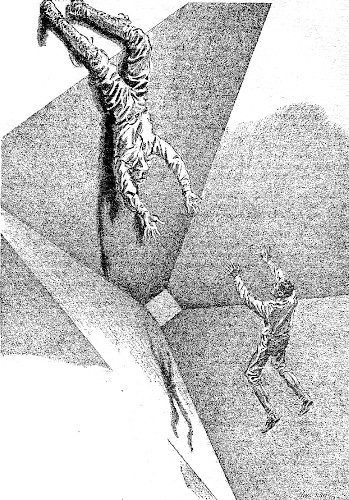
I hung with head and body downward into the cell ... and as Marlin shot across the cell ... I reached to grasp him.
For but a moment we crouched there, then raised ourselves and looked quickly around us. Cylinders were moving to and fro from time to time over the compartments of the twilight band, from the sunward side, and we knew that if we remained upon the wall's top long we would inevitably be discovered. We must descend into one of the compartments as swiftly as possible. But into which one? In an endeavor to solve the question, we began to crawl quietly along the top of the wall, gazing down upon its other side as we did so. The compartment on that other side was a cell like our own, and it was empty; but its only egress was into the hall between the cell-rows, and that was guarded by the Neptunian armed guards. To descend into it or into any of the other compartment-cells was useless, so along the wall's top we crawled, through the dusk, until in a moment or so more we found ourselves looking down into one of the irregular-shaped ante-rooms to the great circular compartment of the Council of Thirty.
In the ante-room compartment stood the usual files of Neptunian guards, and as we saw them, far beneath us, we heard a sharp staccato order from one of them, saw them standing aside from the entrance to the great circular Council compartment. Then, as we watched, we saw emerging from that circular compartment in a moment more, thirty Neptunians, the supreme Council of Thirty before which we had been so short a time before! They were conversing now in their staccato speech, no longer held silent by the synthesizing of their minds in the great globe-mechanism, and as we watched them from far above, we saw them, surrounded now by the files of guards, passing across the ante-room compartment and through a door in it, toward the sunward side of Triton. When they had gone, the ante-room compartment empty beneath us, Marlin pointed downward.
"Down here, Hunt!" he whispered. "If we stay longer on the wall-tops we'll be seen by some cylinder passing above, and if we get down into this compartment, we can make our way to the dark side!"
"You're going to try to steal a cylinder on the dark side?" I asked, and he nodded.
"Yes, in the darkness there, where the Neptunians are sleeping, we'll have a chance to get at one. But we must hurry, for there's little time left before the great signal comes for those on dark and sunward sides to change places!"
So, spurred on by that necessity, we swung ourselves over the wall's edge and then dropped down through the dusk two hundred feet toward the ante-room compartment's floor. Yet that great drop was to us not more than a drop of a tenth that distance on Earth, so slowly did we float down toward the floor, breaking our fall a little by scraping along the smooth wall. We struck the floor, tumbled in a heap there, and then straightened, gazed about. The ante-room was quite empty and in it were but three of the broad low doors. One led back to the cell-compartments from which we had escaped, another led to the sunward side. Through that had just passed the Council of Thirty and their guards. The other led into the great circular Council compartment itself. The last, it was clear, was the only one that held out to us any prospect of reaching the dark side, so we passed through it quickly and into the great Council compartment, moving now in great floating leaps each step.
The great circular compartment was as empty of life as the one which we had just left, the twilight dusk in it dispelled somewhat by the soft-glowing disks in its walls. The great ring-table in it had in the seats around it no Neptunians of the Council now, but at that table's center stood still the great metal globe whose strange mechanism made of the thirty minds of the Council members a single mind, in perception and action. Knowing even as we did that it was but a lifeless mechanism now, without the Council's members connected to it, it was yet with some awe that we stared toward that great mechanism, to whose voice we had listened so short a time before. Much would I have given to have examined it, to have inspected whatever strange mechanism lay within the globe, but time now was our enemy. Soon the signal would come that would send the millions of Neptunians on dark and sunward sides streaming across Triton to change their sides. And unless we could steal one of the cylinders and escape before that signal came, we would inevitably be discovered.
So, sparing only a glance toward the great silent globe, Marlin and I moved silently across the great Council compartment, toward one of the low doors in it that led apparently toward the dark side of Triton, to our right. Cautiously we passed through that door, finding ourselves in another ante-room compartment, as empty now as the one through which we had already come. Swiftly we moved across it, in the great floating leaps that each step of ours made now, toward the door in it that led in the direction of the dark side. But even as we moved toward that door, as we stooped to pass through it, Marlin and I shrank suddenly back, appalled. For as we bent toward that door, the sound of staccato voices had come to us from just ahead, and we had seen in that moment that there were Neptunians in the next compartment, several armed with ray-tubes, who were coming straight toward that door, straight toward us!
A moment we glanced wildly about through the dusky compartment as they came toward us, then we had leaped aside from the door, had reached one of the compartment's corners, leaping more than a score of feet toward that corner and crouching there in the dusk, even as the dozen Neptunians came through the door! It was our one chance of escaping them, the chance that they might not perceive us in the compartment's corner through the twilight dusk that reigned in it. But I knew that so keen were their great bulging multiple eyes that it was against hope that I hoped. The Neptunians who had come into the compartment, however, seemed not to notice us as they entered, passing across it toward the great Council compartment, conversing among themselves in their snapping speech-sounds as they did so. Tensely we crouched there, stiffening suddenly, as we saw one of the disk-bodied monsters suddenly turn and glance back across the compartment in our direction. But in the next moment he had turned back, not seeing us, and then they had passed through the opposite door, their strange voices passing from our hearing.
Marlin and I straightened, with long breaths of relief. "Close, Hunt!" he whispered. "But on to the dark side—we've little enough time left!"
"We're almost out of the twilight band now," I told him, "and in the dark side we'll be a little safer."
And now we were moving quietly through the door from which the approach of the Neptunians had startled us, through the compartment beyond it and on through another and another. These compartments of the twilight band seemed for the most part quite empty, filled neither with masses of working Neptunians like those of the sunward side, nor masses of sleeping Neptunians like those of the dark side. We had found, however, that the compartments of the twilight band were in fact used only for the housing of the Council of Thirty and of the other activities and departments of the rulers of the Neptunians, their only purpose aside from that being to provide easy access from the dark to the sunward side of Triton, and vice versa. So it was that now as we crept through the twilight dusk of those compartments, we found them almost wholly empty and tenantless, though once or twice we were forced again to seek hiding in the shadows as we heard the staccato voices of Neptunians in the distance. Once, too, we were startled by one of the cylinders throbbing by close above us, and since we had had no time to hide from it, thought ourselves discovered by it, though after tense minutes it became plain that its occupants had not seen us.
But soon the twilight of that narrow band was deepening, and almost at once, it seemed, we were moving from that twilight dusk into a deep darkness that obscured all things about us. We had reached the dark side of Triton, we knew, and now moved more carefully still, for upon that dark side, we knew equally well, slept half the massed millions of the Neptunian races. The first few compartments which we traversed in that darkness, however, were as empty as those in the twilight behind us. But then, as we moved silently on, we came into the first of the great sleeping-compartments. Even like those which had puzzled us so on Neptune it was, with its towering walls lined with intersecting shelves whose openings, twice as long as they were high, were ranged in rows, one above the other, like giant pigeon-holes.
This sleep-compartment, though, was not empty like those upon Neptune, for in its hundreds of shelf-openings, its great pigeon-holes, there slept hundreds upon hundreds of the disk-bodied Neptunians! Their seven short limbs folded up around their disk-bodies, they reposed in those openings with their bulging, glassy eyes as open as ever. It was evident they all were sleeping, since the dimness of the day upon Neptune had made lids for those eyes unnecessary in the evolution of their strange race. And eery was that sight to Marlin and myself, as we stepped silently into and across the great sleep-compartment. For it seemed to us that the hundreds of Neptunians reposing thus in those wall-openings were regarding us fixedly with their great multiple eyes, watching us as we moved across the compartment. None stirred, though, as we made our way across it to the opposite door, and moved into the next, which we found to be another sleep-compartment also, its wall-openings, too, holding hundreds of the sleeping monsters.
Through a dozen such sleep-compartments we went, moving with infinite quiet and care, lest any of those sleeping thousands about us be aroused by any sound. And almost it seemed to Marlin and me as we crept on that that hope was ended in any case, since so far we had found none of the landing-compartments for which we searched, none of the cylindrical fliers in which alone we could escape. We had passed through other compartments that held the great heat-radiating globes, now, great glowing globes whose intense heat was not radiated out horizontally at all, but sent up in vertical heat-currents, which by convection in some way warmed all Triton's atmosphere. Past these and through still more sleep-compartments we went, pausing now and then as from the distance in the dark side there reached us a few staccato voices; still we came not upon any of the landing-compartments for which we searched.
Despair was growing in me as we crept on through the sleep-compartments, through the thousands of slumbering Neptunians. For soon would come the signal that would awaken all those Neptunians about us, I knew, and unless we found a landing-compartment, a cylinder that we might steal before then, all was lost. Even with such a cylinder, indeed, little enough hope was ours, since we dared not attempt to get to the twenty controls of the great sun-ray across the swarming sunward side. Our greatest hope would be to escape from Triton in it, if possible through the great roof that surrounded Triton, but even that hope seemed a futile one now, since, as we went on and on through the dense darkness of this sleeping side of Triton, we were moving still through a maze of sleep-compartments, groping blindly through the vast checkerboard maze of intersecting, towering walls. And as we came into still another of the sleep-compartments, with its massed sleeping Neptunians in the wall-openings around it, I halted beside Marlin, twitched his sleeve.
"Marlin!" I whispered. "That signal will be coming soon—this dark side's sleeping millions will be waking around us, and we've seen no sign of cylinders yet!"
"We must go on, Hunt!" he whispered tensely. "It's our only chance now—to get to one of the cylinders before they awaken!"
"But if we were to head in a different direction—" I began, then was abruptly silent, stiffening suddenly, as Marlin did, beside me.
For there across the dark compartment from us it had seemed to us that one of the sleeping Neptunians in the wall-openings had moved! Fixedly, in that moment, we stared toward it, its own great glassy eyes staring back toward us like those of all the other sleeping monsters. Was the creature asleep or waking? The question burned in our brains at that moment as Marlin and I stood there motionless, gazing toward the Neptunian. It was but the merest moment, though, that we gazed thus at the thing transfixed, for in the next instant it and the one in the opening beside it, roused by its own movement, had moved again, and then with their low staccato cries of surprise sounding together as one, the two Neptunian monsters had leaped down to the compartment's floor from their openings and were confronting us!
CHAPTER XII
Through the Roof
Even as the two creatures leaped down to the floor, and before they could change their low cries of astonishment into louder cries of alarm, Marlin and I had leaped across the compartment toward them! For a full two-score feet in one great leap we shot toward them, a feat only possible with Triton's lesser gravitation, and only possible, too, because we knew in that moment that a single loud cry from the two creatures would bring to their aid the hundreds of Neptunians sleeping about us. Before either could utter such a cry, we two had shot through the air and were upon them!
So astounded were they with our appearance and our supernatural leap across the compartment, that before they could put themselves into a posture of defense, we had struck them, had knocked them to the floor and were grappling with them. In that first moment of contact I had reached for the mouth-opening of the disk-bodied monster at whom I had leaped, had gripped that opening in the top of its disk-body to prevent its outcry and then had striven to lift the thing sidewise, to hurl it against the floor. But great as was my strength against Triton's lesser gravitation, the strength of the Neptunian I held was greater still, and its weight, due to the weight-disks worn by it, was enormous. In an instant its seven great limbs were clutching for me, grasping me, and as I strained there against that great monstrous disk-body's grip, I knew with fatal certainty that never could I match my strength against its own. For even as I struggled desperately with it, Marlin struggling as wildly with the other beside me, the thing was lifting me with its own great limbs from the floor!
Upward it drew me with those powerful limbs, its bulging glassy eyes staring from its disk-body's edge straight into my own, as we grappled desperately in the dark compartment with the sleeping Neptunians all about us! I felt myself being overcome, my strength puny beside the strength of that monster, and as I clutched wildly still at the mouth-opening in the top of the disk-body, I thrust my clenched fist down into that small round mouth-opening, half by chance and half by design, closing it thus with my balled fist. Instantly the creature's body turned and twisted frantically, its grip upon me forgotten for the moment, its whole body's mass seeming to heave and twitch as my hand thus cut off the passage of air into that mouth-opening, into its body! I was throttling it, I knew, and hung fiercely to my grip upon it, my clenched hand still within its mouth-opening, while the thing swayed and tore at me with ever-decreasing strength. A moment more and its struggles ceased, it collapsed limply to the floor, and I staggered up again to my feet.
In a single glance I saw that the other Neptunian had gripped Marlin and was crushing him against a corner of the compartment's shelving and instantly, with a single great leap, I was upon that other monster, had gained upon it the same throttling grip which I had found was so deadly to these creatures. In a flash the Neptunian had released his hold upon Marlin, was whirling me around the compartment, shaking me this way and that, and wildly attempting to tear itself loose from me, but with the last of my strength I hung to it, and in a few moments it, too, had weakened, then had slumped down in a lifeless, grotesque mass. And as I rose from it I saw that Marlin had staggered up likewise, was coming toward me. None other of the Neptunians had been aroused by the noise of our mad combat, because in the first excitement of that combat the two Neptunians we fought had not thought to cry out, and after I had gained that throttling hold upon them they could not. So around us the silent ranks of Neptunians slept on unaroused, their open, glassy eyes full upon us even in their sleep, while Marlin and I were stumbling toward the compartment's door.
"On, Hunt!" he whispered hoarsely. "We still have a chance, if we can find a landing-compartment, can steal one of the cylinders before these sleeping Neptunians wake!"
Through the next compartment we went, and the next, and the next, all sleep-compartments, filled with rows of slumbering Neptunians like those behind us, but in our progress we had come upon no landing-compartment. And though we knew that such there were here and there on Triton's dark side, we could not tell, in the darkness and with the huge walls towering all around us, in what direction from us they might be. We could but blunder aimlessly on through the maze of adjoining sleep-compartments in the blind hope that we might chance upon one of the landing-sections, and as we went on, staggering in great, irregular leaps through compartment after compartment, all filled either with masses of sleeping Neptunians or with great heat-radiating mechanisms, we knew that at any moment might come the great signal of light that would awaken the hordes around us.
Never could there have been flight more nightmare-like than that of Marlin and myself through the dark compartments of Triton's dark side, in blind search for the cylinders which alone held out to us any chance of escape. Through the sleep-compartments, with their masses of open-eyed and sleeping disk-bodied Neptunians, through the compartments where reared the great glowing globes whose radiated heat alone held back the cold doom that so long had threatened these strange beings, through compartment after compartment in a flight made more grotesque and unreal to us by the strange method of our progress; by the strange, great, smooth leaps that we made instead of steps, great floating leaps of a score of feet in which we rushed through the dark sleeping compartments, reckless now of the few Neptunians who might be waking and moving upon the dark side. Then suddenly as we leaped toward the door of still another sleep-compartment, poised an instant to leap through that low door, we halted, gazed with abruptly-flaring hope ahead. For the next compartment, we saw, was a rectangular one and greater in size than any we had passed through as yet, and in it there stood the great gleaming shapes of a score or more of the cylinder-fliers that we sought!
With hearts pounding Marlin and I crouched in the low door, gazing through the darkness toward those great cylinders, that gleamed a little in the feeble light that came down upon Triton's dark side from the stars through the great roof overhead. We saw that the low doors in the sides of those cylinders, near the bases, were open, and from them there came to us the throbbing of their mechanisms, inside! It was evident that these were part of the countless cylinders used to help in transporting the Neptunian hordes from dark side to sunward side of Triton, and vice versa, and it was equally evident from those throbbing mechanisms' operation, that the hour of awakening for those hordes was at hand and that these were waiting for that awakening. For there stood also, between us and the nearest of the cylinders, three tube-armed Neptunians who were conversing in brief, snapping speech as they waited!
For the moment, at sight of those cylinders, Marlin and I came near to throwing ourselves toward them regardless of the three, but that we knew would be suicide, so despite our torturing agony of soul we waited there in the doorway, gazing desperately toward the cylinders. And in a moment, as we sought in vain for some way to get to the nearest of those cylinders, there came a final staccato order from one of the three Neptunians and at that order the other two turned and passed through a door in the landing-compartment's side opposite from us. It was our chance, the chance for which we had hardly dared to hope even, and no sooner had the two Neptunians disappeared through the opposite door, the other standing with his eyes following them for the moment, than Marlin and I had crept out a little bit into the landing-compartment and then with a great simultaneous leap had shot through the air toward that remaining Neptunian!
There was no chance for resistance on the creature's part. For even as we knocked it sidewise with the force of our leap Marlin had grasped the creature's limbs and with fierce, desperate strength I had with my clenched fist closed its mouth-opening in that method whose deadliness had been proved to me in our other battle. The thing threshed wildly, then it, too, had gone limp, and had collapsed. And in the next instant Marlin and I were rising from it, were leaping across the compartment toward the open low door of the nearest great cylinder, from whose great gleaming upright bulk before us came the throbbing of its powerful generators. And then, a dozen feet from it, we stopped dead, and from Marlin came a hoarse cry.
For at that moment there had swept over us, through us, past us, from the direction of Triton's sunward side across its surface, a band of intensely brilliant white light, white light that blazed brilliant for the moment all around us, turning the changeless night of Triton's dark side around us for the moment into a white and blinding day, and then sweeping swiftly on, around Triton's surface! It was the great signal of awakening, the signal for the millions of sleeping Neptunians about us to awake and change places with the swarming millions upon the sunward side! And even as that dazzling signal came, as Marlin and I stood stupefied there for the moment before the looming cylinder's open door, there came from all around us, from over all the dark side's great extent and from all its maze of sleep-compartments, a rising babel of staccato voices, the voices of its awakening Neptunian millions! Then, before ever we could recover from the stupefaction that in that instant held us rooted to the spot, there had poured into the great landing-compartment from the compartments on all sides of it swarms of hastening Neptunians, swarms of disk-bodied monsters, who in that moment saw us, uttered as one a sharp great cry of discovery, and in the next moment were rushing from all sides toward us!
"The cylinder!"
It was Marlin's wild cry, that aroused me from the stupefaction of amazement that held me. Straight before us, a dozen feet away, was the open door of the nearest cylinder, and in the next split-second Marlin and I, as one, had leaped toward it, had shot through that door, into the cylinder's interior, even as the Neptunians raced toward us. The next instant I had reached frantically for the door, had with one swift motion slid it clanging shut, and then as the Neptunian masses outside hurled themselves toward it, Marlin and I were throwing ourselves up through the openings toward the cylinder's uppermost section. In one leap I was at the central control-standard, fumbled frantically with the green control-studs for an agonizing moment, and then, just as we heard the Neptunians below flinging themselves against the door, the great throbbing cylinder shot upward!
Up over Triton's dark side we rose, a dozen slender force-rays criss-crossing about us from beneath in that moment, and as we glanced momentarily down we could see the Neptunians in the landing-compartment beneath rushing toward the other cylinders there! And glancing far across the surface of Triton, we could see all its mighty compartment-city, dark and sunward sides alike, swarming now with Neptunian hordes as the end and beginning of their strange day and night periods was signalled. Over the great compartment-city, over all the countless millions of Neptunians that swarmed through it, there was spreading a crackling roar of excited tumult, as our escape was discovered. And from far away on either side and from beneath us, scores of great cylinders whirled toward us!
"Up—up!" Marlin was shouting now beside me. "They'll have us in another moment!"
I pressed swiftly again the studs before me, and as the cylinder shot up and sidewise with terrific speed on an upward slant I shouted back to Marlin over the roar of air about us. "The roof-openings!" I cried. "We'll make for the nearest one!"
But as the cylinder flashed obliquely upward, Marlin and I crouching in the two opposite seats at the control-standard, I became aware of the swarms of racing cylinders behind closing in upon us. And over the dark and sunward surfaces of Triton that great mounting roar of sound was spreading, as the Neptunian hordes saw our wild attempt at escape. Up—up—and now we were racing close beneath the great roof, transparent from below, with the pursuing cylinders drawing ever nearer, their Neptunian occupants more skilled than I in their operation. And now, too, from those uprising, pursuing swarms were directed toward us slender pencil-like rays of pale light, visible only near their source, concentrated force-rays, that would cleave through our cylinder as through paper!
On and upward—and now as we shot on, with the swarming cylinders hurtling hotly after us in wild pursuit, with the throb of our generators and the roar of air about us thundering in our ears, with the wild tumult of the massed Neptunians on Triton's surface coming dully up to us from beneath, Marlin and I were gazing with tense eyes ahead and upward. The great opening, the great sliding section of the roof down through which we had come—that was our one chance to escape from Triton. I knew that unless we could win through that opening, out of Triton's enclosed world, we were doomed. On and on we went—our eyes still upon the vast roof overhead in search of that opening in it, when suddenly Marlin cried hoarsely in my ear, and pointed ahead. And there from ahead were rushing toward us other scores of cylinders, other swarms of racing cylinders answering the spreading alarm, while still others were shooting up from below toward us! From behind, from ahead, from beneath, the cylinders' swarms were converging upon us in that moment, and as instinctively I slowed our cylinder's mad rush I looked upward, toward the great roof——
"The opening-section!" I cried suddenly. "But it's closed against us!"
For there above, indeed, was that great circle in the vast transparent roof that we knew could be slid aside and opened by its Neptunian guards in the bright-lit little cage-room suspended beside it. My one hope had been that in our stolen cylinder we might deceive those guards of the great orifice into opening it for us to pass. But that hope was gone. Behind and below and before us were the pursuing swarms of cylinders and the Neptunians in the cage-room above knew that something was wrong, and had not opened the great circle for us. There were other similar circles, similar opening-sections, in Triton's roof, but it was too late now to seek them because from all about us the swarming, racing cylinders were rushing upon us. In another moment their rays would shatter us! I heard Marlin, beside me, utter a low exclamation of utter hopelessness as those cylinders rushed upon us, held our own cylinder for the moment motionless there in mid-air beneath the great roof's opening-section, and then suddenly reached toward the control-studs, even as Marlin's hoarse cry was sounding beside me.
"The end, Hunt!" he was crying. "The cylinders are almost upon us—and the opening-section is closed!"
"The end maybe—but not this way!" I shouted fiercely, at the same moment sending the cylinder flashing straight upward with all its speed. "Hold to your chair, Marlin—we're going to smash through that opening-section of the roof!"
Even as I cried out thus, our cylinder was rising upward toward the roof with all the power of its throbbing generators, hurtling upward at speed unthinkable toward the great circle of the opening-section! I was aware in that moment of the crowding swarms of cylinders about and beneath us loosing toward us a storm of crossing force-rays that we drove clear of in that instant. I was aware of the Neptunians in the cage-room beside the great opening-section rushing wildly about as we shot upward like the cylindrical projectile of some giant cannon! The next instant I caught the gleam of the transparent roof, of the opening-section just above us, Marlin and I instinctively crouched lower in our seats, and a moment later there was a blinding, stunning shock that seemed to split the universe with its detonation. We were dragged up from our seats with awful force. And then as we straightened up and looked out, we saw that the cylinder had smashed through the great opening-section and was throbbing above Triton's mighty roof!
The cylinder's ceiling, above us, was crumpled and bent badly, but in that moment it seemed a miracle that we had lived through that terrible collision. It was only our awful speed that had saved us, driving us through the opening-section's thick metal even as a cyclone will drive fragile straws and twigs unbroken through a board. Now as we looked downward we saw that the swarming pursuing cylinders were massed beneath the crumpled opening-section and that that circle of the opening-section was slowly sliding aside, bent and crumpled as it was, to allow those cylinders to emerge through Triton's roof after us! And up they came, a full hundred of them, racing up after us at utmost speed, up from the great metal roof of Triton, dark and opaque to our eyes from above, and up through its atmosphere close on our track!
Through the rushing roar of air about us, the throbbing of our generators, I was aware of Marlin shouting something beside me. I was gazing ahead for the moment, as that wild flight and pursuit passed on through Triton's atmosphere. Giant Neptune's cloudy green sphere bulked gigantic in the heavens before us, and far beyond it was the little fire-disk of the sun. Then I turned back to see the hundred pursuing cylinders, getting ever closer behind us. As I started at the sight, I became aware of Marlin shouting beside me, and at the same moment realized the import of his words. I realized that the throbbing of our generators was halting, hesitating, failing! Our great crash out through the roof had broken some part of their mechanism and now they were failing rapidly, and the speed of our cylinder was slowing!
And behind us the scores of onrushing cylinders were closer—closer! Already toward us again from them were leaping the slender pale force-rays, missing us at that distance but sweeping close about us. With an utter tenseness of body and spirit, Marlin and I watched them drawing closer, as our cylinder shot on through Triton's atmosphere. Suddenly another storm of rays had shot and swept toward us from behind, and one of those wild-whirling rays, in a single instant, clove through the cylinder's uppermost sides like a sword of fire through cardboard, slicing away completely the already-crumpled roof above us and the upper half-dozen feet of the walls! Instantly a flood of icy-cold air rushed in upon us and seemed in that moment to freeze us through. At the same moment the throbbing generators ceased completely to operate, the cylinder slowing swiftly on its rush forward, drifting helplessly there in the outer reaches of Triton's atmosphere, while from behind, like leaping creatures of prey, the scores of cylinders rushed upon us!
Neither Marlin nor I voiced a cry in that moment. We could only stare as if we were automatons, toward the onrushing cylinders, the oncoming doom. We had run our course at last. It seemed in that moment that all our bitter battle for freedom, our toilsome escape from our cell, our flight through Triton's sleeping side, our stealing of the cylinder and wild crash upward through the great roof's opening-section—that all this futile flight of ours was reenacting itself with lightning swiftness before my eyes. The swarming cylinders were almost on us, holding their rays now as they saw us helpless until they were closer, their great mass whirling straight toward us. And then, as I gripped the control-standard before me, expectant in that instant of the end. I saw that onrushing mass of cylinders suddenly shattered as though by gigantic blows from above. I saw the scores of cylinders driven this way and that in a single instant with colossal force, even as they rushed to annihilate us! And I looked dazedly up, was looking up——
"The space-flier!" Marlin's insane cry was sounding there beside me. "It's the space-flier—and Whitely and Randall!"
The space-flier! There high above us and above the pursuing cylinders it hung, a gleaming faceted ball, at sight of which I could only gaze stupefied. I saw in that moment that down from its lowest ray-opening there was radiating toward the cylinders that had been hurtling in a mass toward us, a pale, almost invisible great force-ray and that it was that ray's giant pressure that had shattered the mass of our pursuers, and in an instant had driven their massed cylinders to all sides! Then, as they broke thus in wild confusion before that swift great force-ray from above, the space-flier was flashing down toward our roofless, drifting cylinder, was hovering just beside us, touching that cylinder, with the round outer door in its facet within our reach! In an instant Marlin and I had clambered to the drifting cylinder's edge, had whirled open that outer door of the space-flier. When we threw ourselves into the little vestibule-chamber or air-lock, shut the outer door, and turned toward the inner one, that inner one was opened and Whitely—Whitely!—was pulling us inside!
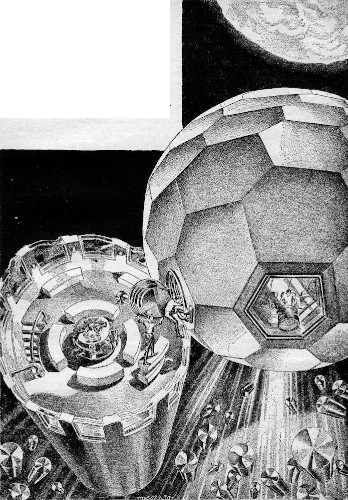
In an instant Marlin and I had clambered to the drifting cylinder's edge and to the open outside door.
"Whitely—Randall—" we were babbling in our excitement, "we thought you dead—saw fragments of the space-flier and thought it destroyed——!"
"No time now to tell you, Marlin—Hunt—" Whitely was hurriedly saying. "Those cylinders are forming again. They're coming up toward us! Head out from Triton, Randall—full speed!"