Front matter (continued 3)
Reading edition
I was aroused from my silent despair, though, by a low exclamation from Marlin, and looked up to see that the cylinders of which our own was foremost had now halted, hanging midway between metal roof beneath and great vapor-masses above. Then down from above I saw, dropping quickly toward us, three other cylinders similar to the eight, three cylinders at sight of which my heart beat suddenly faster. For it had been three cylinders that had pursued Whitely and Randall in the space-flier! Tensely I watched as the three drove down among our eight, and then one of them had shot suddenly close to the cylinder in which we were, hanging beside it so that its low door-opening was directly touching the door-opening of our own. There was a clang of metal beneath as the doors of both cylinders slid aside. They fitted so closely against each other that no colder air from without could enter into the warmed interior of the two cylinders. Then from the other were coming into our own cylinder three Neptunians who climbed swiftly up into the top-section in which we were, while Marlin and I watched them in indescribable suspense.
As they came up into the uppermost section they spoke in their sharp, staccato talk to the Neptunian leader of the crimson-circle insignia, making report to him, it was apparent. But it was not to their snapping speech that Marlin and I gave our attention, but to the things they carried in their grip, and which they were showing to the leader. Those things, I saw with a start of horror, were some shattered and crumpled plates of metal, great flat metal plates that I recognized immediately as being of our space-flier's faceted sides! And they also held a broken, twisted metal thing that I recognized instantly as one of the space-flier's smaller liquid-oxygen tanks! I needed not to understand the strange speech of the Neptunians in that moment to understand what the three were reporting. For those shattered fragments of the space-flier told the tale with terrible clearness.
"Whitely and Randall!" It was Marlin's whisper of horror beside me. "They were caught by those pursuing cylinders—were annihilated by their rays——!"
"Whitely and Randall——" I felt my voice choke then, as I gazed at those last fragments of the space-flier's wreckage, mutely testifying to the end which our friends had met with beneath the shattering rays in their space-flier somewhere in the cold, vast vapor-masses above us.
Whitely—cool and detached and steady, stirred to passion by nothing save some unprecedented physical phenomenon, considering with curious, impersonal eyes each new peril that had confronted us; and Randall—with his sunny hair and eager young courage and unfailing sense of fun; it was as though they had risen before me in that moment, when we saw at last what death had overtaken them and our space-flier there in the chill clouds of mighty Neptune. I felt Marlin's steadying hand on my shoulder and knew that he was sounding similar depths of despair. For with Whitely and Randall gone, with our space-flier and with ourselves captured and held by these monstrous disk-bodied Neptunians who yet seemed not of Neptune, our chance to halt the great doom-ray that was radiating toward the sun, our chance even to return to Earth with word of the position and nature of that ray's source, was gone also!
Through the despair that had sunken upon me I was aware, in a moment, that the throbbing of the cylinder's great generators had waxed again in intensity. Already the three Neptunians, who had reported the destruction of the space-flier, had returned to their own cylinder, which had separated from ours, and now the whole eleven cylinders, our own in the lead, were racing forward once more, were shooting forward between the great vapor-masses above and the vast metal roof below. At immense and mounting speed they shot forward, a dull roar of whistling air coming to us from without, and in a moment the pale, dim light about us had begun to change to dusk, to darkness, as we shot on. For the eleven cylinders were racing around the surface of Neptune toward the side of it away from the sun at the moment, and as they entered the shade of that side they were plunging through the eternal night. But as the cylinders shot on they seemed to need no light or star to guide them through the deep darkness, though all that was visible was an occasional glinting of the great metal roof below.
On we shot through that deep darkness and there rose in me a sudden thought that roused me a little from the despair that held Marlin and me. Could it be that upon that other side there still remained a remnant of their race? A remnant of the race, that once had built the mighty compartment-city that covered all Neptune and the vast roof that shielded it, but that now occupied but a small part of the huge city? Was it from Neptune's other side, then, that the giant force-ray had stabbed toward the sun? Yet how could that be so, how could that great ray be shot out from any point of Neptune unceasingly as it was, when each twenty hours the great planet turned on its axis, when for half of that twenty hours whatever point that was the ray's source would be turned away from the sun instead of toward it?
With tense interest Marlin and I gazed ahead into the darkness through which our cylinders were rushing, while at the control-standard the leader and the other two Neptunians manipulated the force-rays that were propelling onward the cylinder in which we were. At last, after some minutes of this rushing flight of immense velocity, the cylinders seemed to slow down, to pause. Looking out I could discern the surface of the gigantic metal roof below us, just showing itself to us by a little glint of light here and there from it, and in that moment Marlin and I waited in suspense for the cylinders to sink down toward and through it, to whatever place upon Neptune's other side it was that held the remainder of their strange races, since by then, we knew, we were at that side of Neptune almost exactly opposite the sun. Only a moment the cylinders slowed and paused, and then were leaping through the air again at mounting speed. But instead of flashing downward toward the great roof, they were flashing upward!
Upward they were shooting, up through the dense air and straight into the great vapor-masses that loomed above us! Through those great clouds they were racing then, driving upward through them as through a darker darkness, and then suddenly had shot up and out from them, up and out into the clear and thinner air of Neptune's atmosphere's outermost limits. Behind our cylinders thus lay the huge, vapor-wreathed planet, shutting out by its vast bulk all sight of the sun's distant little disk of fire, or of the greater planets. But before us there stretched once more the black vault of space, unfolding itself to our eyes for the first time since we had ventured down through those shrouding vapors to Neptune's surface.
Brightest in that black void there shone, before and somewhat above us, Triton, the moon of Neptune. It was almost white in color, tinged with the pale green of great Neptune, about which it moved, and seeming of the same size to our eyes as Earth's own moon. Beyond and all about it, though, there flamed the great stars, seeming the same to our eyes here at the solar system's outermost limits as they had seemed to us when far within it, at Earth. The great field of stars and star-clusters that was Sagittarius, straight ahead and upward, the irregular parallelogram of Capricorn's stars, to the left, the throbbing crimson heart and jeweled menacing claws of Scorpio, to the right—all seemed to our eyes as they had seemed when we had started—how long ago it seemed!—out from Earth toward great Neptune, that lay now behind us. Yet now, with Neptune behind us, our eleven cylinders were flashing forward with greater and greater speed, were flashing out apparently from the solar system's last outpost into the vast void of interstellar space!
"They're going on—going out from Neptune into outer space!" I exclaimed to Marlin, as we gazed ahead, transfixed.
But suddenly he shook his head, pointing ahead and upward, for now the cylinders were flashing upward as well as forward. "It's Triton they're heading toward!" he said. "Triton—Neptune's single moon!"
"Triton!" I exclaimed, thunderstruck with amazement. "Then—then—it must be on Triton that the remaining Neptunians now are!"
Triton! For it was up toward it, up toward the white, green-tinged moon of Neptune that shone dully in the black vault above and ahead of us, that the eleven cylinders, our own in the lead, were heading! And as they shot out of the last limits of the atmosphere of Neptune, as they flashed forward at swiftly mounting speed still toward the moon, I could but stare at it in amazement. Triton! It was from it, then, that there had come these strange disk-bodied Neptunians who had captured us, who had annihilated our space-flier and our friends. It was on Triton, then, that there must remain whatever Neptunians still were left of those who had built the vast compartment-city that covered all the surface of Neptune itself, who had shielded it with that gigantic floating roof that enclosed all the mighty planet. Yet why had they deserted their vast compartment-city, their great world of Neptune? Why had they left that world for the single moon of Neptune, so much smaller in size? And the giant force-ray that was shooting across space to the sun, turning it ever faster, was it from Neptune then or Triton that that colossal ray was radiating?
It seemed to me that these questions were spinning in my head in a kaleidoscopic whirl of enigmas, as our throbbing cylinder and the ten behind it shot on and upward at a great slant toward the dull-gleaming sphere of Triton. Marlin, beside me, was staring ahead obviously as much mystified as I was, while the four Neptunians ranged on either side of us kept their ceaseless watch upon us. The other three sat still at the central control-standard, directing the cylinder on its rush out from Neptune toward its moon. And now, that moon grew larger ahead of us and above us, a strangely-gleaming sphere that seemed still very small, in comparison with the huge pale-green disk of mighty Neptune that loomed behind us.
I knew, though, that Triton was of the same approximate size as Earth's own moon, and revolved around the great planet at the same approximate distance as Earth's own moon, roughly a quarter of a million miles. As we had noted from our space-flier in flashing out toward Neptune, its moon was now behind the great planet, that is on the other side of it from the sun, but due to the sharp inclination of the plane of Triton's orbit around Neptune, it was so much higher than its great planet in space as to make it possible to see the single moon, even from Neptune's sunward side. And now as our eleven cylinders shot toward it, it was spreading out across the black vault of the heavens before and above us, until at last we were within a few thousand miles of it and the speed of the cylinder was perceptibly decreasing beneath the controls of the three at the central standard.
Smoothly the cylinder, and the ten behind it, slowed, until they were racing forward at a comparatively low velocity. Triton's dull-gleaming sphere filled the heavens before us. Behind and a little below the great green disk of Neptune, belted with the vast cloud-masses of its immense atmosphere, loomed almost as great as ever to our eyes. And far beyond it there burned the sun's bright little disk, just above the huge sphere of Neptune, and visible to us through the thinner vapors of Neptune's uppermost atmosphere. We turned back toward the nearer world of Triton. As the cylinders rushed on toward it, all the suspense of expectation and mystery that had been ours since our first arrival at the strange dead world of Neptune gripped us now with renewed power. And as Marlin and I stared ahead we were aware that the cylinders were dropping, swinging about our pivoted seats and dropping toward the surface of Triton that seemed now to gleam beneath us.
Toward it we smoothly shot, and as Marlin and I gazed intently down we saw that there were below none of the great cloud-masses that wreathed the surface of mighty Neptune. Instead was only a smooth and strangely gleaming surface that we could but vaguely glimpse, and the sight of which made my heart pound in sudden anticipation. Could the thing be—could it be that here upon Triton as upon Neptune——? But my wondering speculations were cut abruptly short by reality as we shot lower toward the surface of Triton, as that surface came clearly at last to the eyes of Marlin and myself, bringing involuntary exclamations of amazement from us. For that surface was metal! Triton was shielded on all sides by a giant metal roof similar to that which enclosed great Neptune itself!
Down toward that mighty roof our eleven cylinders were rushing. When they seemed just above it, they halted their drop and raced along above it, around Triton's vastly curving surface. As they did so, Marlin and I, gazing downward, saw that the vast roof that shielded Triton appeared to be, from above, of the same dark metal as that which protected Neptune, and that it extended away without break or seam as far as we could see over the big moon's surface. And as our cylinders flashed above it, around the world's surface, we were aware that Triton had an atmosphere even as had its great parent-world, since from outside was coming the dull roar of air against the speeding cylinder. It was a fact startling enough, but at that moment it was driven from our minds by a thing more startling still.
For as we flashed thus around Triton's sunward side, Marlin suddenly uttered a hoarse exclamation, pointed ahead and to the left. I gazed in that direction instantly and for a moment saw nothing unusual, but then as the cylinders flashed on I saw that in that direction was what seemed a great round opening in the smooth, dark metal, a titanic circular opening that must be miles across. Up out of that opening was rising what seemed at first glance a vast cylinder of pale light that sprang straight up and outward from the gigantic opening, and that was only visible for a short distance above that opening, fading swiftly into invisibility as it shot out into the gulf of space from Triton. Instinctively my eyes followed the fading length of that mighty beam outward, and then as they did so I felt sudden, awed understanding descending upon me and stared with Marlin toward the giant pit and its great ray in stunned silence. For that giant ray was pointing straight into the great gulf of space, toward the tiny, fiery disk of the distant sun!
"The giant force-ray!" Marlin whispered. "The great force-ray that's turning the sun ever faster—and that we came out here to find!"
"And pointing straight toward the sun!" I exclaimed. "Pointing through Neptune's upper atmosphere toward the sun!"
For we could see now that the giant ray, visible only there at its source, must indeed be cleaving through the upper limits of great Neptune's atmosphere as it reached across the great gulf toward the sun. For since Triton was on the other side of Neptune from the sun, was on its outward side, the great green sphere of Neptune lay almost between the sun and Triton, the big moon being high enough above the great planet, though, due to the inclination of its orbital plane, to make the sun visible to it through the upper reaches of Neptune's vast atmosphere. Through that atmosphere, therefore, we knew, the giant force-ray must be driving on its path across the solar system toward the sun, hurtling across the gulf to strike against that spinning sun's edge with terrific pressure and to spin it ever faster toward that day of division and doom that was marching relentlessly upon it!
But as our cylinders now swept nearer toward the giant force-ray and the pit from which it stabbed up and outward, Marlin and I were staring obliquely down into that vast pit. Seen from the side as we saw it, the tremendous opening seemed only like a mighty well of metal, from which the colossal pale force-ray, almost as great in diameter as the huge pit, stabbed. We could see, however, that set near the great pit's top at regular intervals around its curving wall were what seemed metal cube-like rooms, which were set on the pit's smooth curving wall. They were a score in number, those out-jutting metal cubes, and from slits in their walls came light from within, and glimpses of stud-covered walls and Neptunians moving about them. We knew, without doubt, that those twenty cubes held within them the unthinkably complex controls of this mighty force-ray that was destroying the solar system!
But now our cylinder and the ten that drove close behind it were passing the vast pit, the huge force-ray. I noted that they took extreme care to pass pit and mighty ray at a respectable distance, and knew, too, the reason for it, knew that any luckless cylinder that blundered into that colossal out-stabbing ray would be driven instantly at terrific speed and force out through the solar system and into the sun that the ray was striking! So that it did not surprise us that the cylinders veered far to the side of the huge ray, picking up speed once more when they had passed it, and racing on around Triton's metal-shielded surface and through the cold, dense atmosphere outside it. But as the cylinders drove on the eyes of Marlin and myself now were turned backward, back toward that gigantic pale ray of awful force that shot ceaselessly up and out from that vast pit in Triton's metal side.
"We've found it—the great ray we came out here to find—the source of that ray," I exclaimed to Marlin, "but we've found it too late! Whitely and Randall and the space-flier annihilated—we captured——"
He bent toward me. "Keep your courage up, Hunt," he said. "We may have a chance yet to get free—to get away from this world of Triton before they take us down inside it."
"But what—?" I began, when with a gesture he cut me short. "No more now, Hunt—the guards are watching. But be ready to act if a chance shows itself, for once down in Triton, we'll probably have no chance."
I saw that the four disk-bodied Neptunians who sat about us and guarded us were indeed watching us closely now with their strange bulging eyes, so gave over for the moment our whispered conversation, though with a slight gleam of hope. Glancing back again toward the great force-ray that was almost invisible behind us as the eleven cylinders raced on around Triton's metal surface, I was aware that Marlin was staring back toward it also, intently, shaking his head a little, as though puzzled by something concerning that giant beam of force. In a moment he turned his attention ahead. Our cylinders now were flashing around Triton from its sunward side to its dark side, and as we rushed on Marlin and I could see that to all appearances Triton was not rotating, or at least not above a low rate of speed. Then as we entered into the deeper shadow of the dark side, the sun's little disk vanishing behind us as we shot around Triton's curving surface into the shadow, Marlin uttered a low exclamation once more, and as I turned to look in the same direction I saw that far ahead there was stabbing out and upward into the black void of outer space a second giant force-ray like that one we had already seen shooting toward the sun!
Stupefied, I gazed toward it. For the first giant force-ray, amazing as it was, had yet been expected by us, more or less, since we had known from the first that such a colossal force-beam was stabbing from the region of Neptune toward the sun. But this second mighty force-ray, which seemed exactly the same in size and appearance and which rose from a giant pit or well in the vast metal roof even as did the first, was not directed toward the sun. For it was on the other side of Triton from the first ray, was exactly half around Triton from the first and was going out into space in an exactly opposite direction! Thus while the first colossal force-ray, springing out from Triton's sunward side, shot straight toward the sun, this second huge force-ray, on Triton's dark or outer side, was radiating straight out into the vast void of interstellar space, was radiating straight out, to all appearances, toward the unthinkably distant stars of Sagittarius that burned in that mighty void!
What could be the meaning of this other colossal force-ray, of equal size and power, going out into the vast void outside the solar system? The first great ray that was shooting toward the sun and turning the sun ever faster—its purpose was at least comprehensible, but what purpose could there be in sending an opposite and equal ray out into the mighty void from Triton's other side? That was the question that whirled in my astounded brain in that moment as the eleven cylinders shot on toward that second great ray, over Triton's metal surface. Marlin, though, on seeing that second great ray, seemed to be less puzzled than before. It seemed to have solved for him some problem which the sight of the first huge ray had suggested. To me it was utterly incomprehensible, and perplexed and awed I watched that huge pale ray and the vast pit from which it sprang as we raced toward them. I saw that on that pit's curving walls there jutted forth a score of cube-like projections or control-rooms similar to those in the pit of the first ray. Then I forgot pit and rays alike as the cylinder in which we were and all those behind it slowed suddenly in mid-air and then dipped sharply downward.
Down and down they shot, toward the vast gleaming metal roof of great Triton; down, until we saw that just beneath us there was outlined in that roof a great circle, slightly sunken. Toward this the cylinders dropped, and then as they came to a pause just above it I saw that set beside that circle in the roof was a transparent section beneath which was a small cage-like room, brightly lit. In this were a half-dozen Neptunians, and as they saw the eleven cylinders dropping and pausing above the circle in the roof they turned swiftly, pressed what seemed a series of knobs in their cage-room, and at once the great sunken circle beneath us was sliding along beneath the roof to one side, sliding smoothly away and leaving thus beneath us a great circular opening in the roof.
Instantly up from that opening around our cylinders was rushing a torrent of air, a torrent of uprushing air that I understood well was caused by the warmer air beneath the roof rushing up into the colder outside atmosphere. But now down through that opening and through the air-currents the cylinders were swiftly dropping, and we could see far below in dim light a great compartment-city like the one we had found upon Neptune! In a moment more we would be below the roof, the opening closed above us, prisoned hopelessly in Triton to meet whatever fate our captors decreed. Already two of our four guards, and two of the Neptunians at the control-standard, had left the cylinder's upmost section and had clambered down the ladder to the lowest section in preparation for emerging. There was left with us in the upmost section of the cylinder only two guards and the Neptunian leader of the crimson-circle insignia at the control-standard. And as I saw that, I was leaning quietly toward Marlin.
"Now's our chance, Marlin!" I whispered tensely. "If we could overpower these three Neptunians and the rest beneath afterward we might yet get back to Earth!"
He glanced calmly around, then nodded. "We'll take it!" he whispered. "Once beneath this roof of Triton, there'll be no chance."
"Go for the guard beside you, then, when I cough as signal," I told him. "If we can dispose of them and the leader there we can hold the rest below for a time."
He met my eyes with his own, then turned and as though merely shifting a little in his seat moved nearer toward the guard on his side. I had already done the same toward the disk-bodied monster beside myself, both guards having slightly relaxed their first watchfulness. I glanced out, saw that even at that moment our cylinder was sinking with the others toward the great opening in the roof and knew that no moment was to be lost. So, with heart beating rapidly now, even as our cylinder prepared to sink down through the opening with the rest, I coughed slightly. In the next moment I had flung myself with a single motion upon the Neptunian guard beside me and had seen Marlin in the same instant throwing himself on the monster at his own side!
The moment following was of such swift action as to defy the memory. In my leap upon the Neptunian beside me it had been my first object to knock his tube from his grasp before he could loose its rays upon me, and so swift and sudden was my attack that I did so, as did Marlin with the other guard. With the same motion, even as the guard's seven great limbs reached toward me, I had grasped his big disk-body and then with a superhuman effort had raised it in my arms and had cast him from me, down through the opening in the section's floor to crumple against the floor of one of the sections below! I whirled, saw that the other guard had gripped Marlin and was bearing him down, and then even as there came from beneath and from the Neptunian leader at the controls staccato cries of alarm, I had gripped that other guard likewise and hurled him across the cylinder to strike with stunning force against its wall! Then Marlin and I were whirling toward the Neptunian leader at the control-standard, but in the moment that we turned toward him we stopped short. For that Neptunian had leaped aside from the controls of the cylinder and had swiftly drawn his own ray-tube!
CHAPTER VIII
Prisoned on Triton
Nothing, I know now, of our own doing could ever have saved us from the death that in that moment loomed dark and close above us. For, as the Neptunian leader raised the tube toward us, I knew that before ever a leap could take us across the cylinder to him, the pencil-like rays of force from his tube would be tearing through us. For that split-second, therefore, escape seemed impossible, and then before we could fully realize the situation there came an interruption. The currents of warmer air from the opening just beneath, down through which the cylinder had been dropping with the others, were sweeping still upward with great force around the cylinder. Only the Neptunian's grasp on the controls had kept the cylinder heading down through those currents, and now, as he leaped away from the controls for the moment and drew his tube, those currents immediately seized upon the unguided cylinder and in the next moment had whirled it over and sidewise with immense speed and power! And as it whirled thus over, Marlin and myself and the Neptunian before us were thrown instantly and indiscriminately to the cylinder's side!
For a moment we rolled helplessly about the whirling cylinder's interior, about the upmost section, and in that moment all thought of battle had left us. Then, as I felt Marlin and the Neptunian leader and the stunned guard rolling with me indiscriminately, I was aware, too, of cries from the cylinder's other sections and of Neptunians drawing themselves up to the upmost section on the ladder. Abruptly, in a moment more the cylinder steadied, hung poised and upright as before, and then as Marlin and I scrambled to our feet we saw that a trio of the Neptunians beneath had made their way up to the upmost section, despite the cylinder's whirling, by means of their multiple limbs, and that while one now held the controls the other two had their tubes trained once more full upon us!
Our wild attempt at escape had failed, it was evident, for now, as the Neptunian leader of the crimson circle rose, he was addressing to the others a sharp, snapping order, and at the same time motioning Marlin and me peremptorily to the seats we had formerly occupied. We took them with no further resistance, for we knew that our desperate outbreak had put the Neptunians upon their guard and that the slightest suspicious motion on our part might well mean instant death. And as we seated ourselves once more with the guards on either side, one from beneath replacing the one I had killed, the despair that formerly had filled us seemed immeasurably intensified. For now the cylinder was sinking down after the others, through the great opening in Triton's roof, and even as Marlin and I looked outward we saw the great opening in that roof closing again above us with a clang that to our ears was like the clang of doom.
Above our sinking cylinders now there stretched the great roof, and, even as Neptune's enclosing roof, this one was almost entirely transparent from below, though opaque from above. And here as on Neptune we could see no supporting pillars whatever for this vast spherical roof that enclosed all Triton. This world seemed, indeed, but a smaller replica of mighty Neptune. For, as our cylinders sank down through the shadows of its darker side and then leveled out and began to race back around its curving surface toward the sunward side once more, we saw that all of Triton's surface was covered, even like Neptune, with a great compartment-city whose intersecting black walls stretched in their vast checkerboard arrangement over all the great moon's surface. But as our cylinders shot over these, over the darkened portion of the surface of Triton and toward the sunward side, we saw that the compartment-city beneath was different, in some features, from that of Neptune.
For one thing, there were moving to and fro above it a number of great cylinders like that in which we were, and in the compartments of the darkened side moved, too, a few Neptunians here and there. And the great globes of metal that dotted this compartment-city of Triton, even as that of Neptune, were here glowing with radiant light; glowing, I knew, with radiant heat. For this was the secret of the Neptunians' existence on Triton, this heat that glowed from the numberless giant globes set in compartments here and there. Those great glowing globes kept the air beneath Triton's great roof warm and comfortable, the great roof itself preventing that warmer air from escaping into the moon's colder outer atmosphere. As we shot on over the darkened side of Triton, the side turned away from the sun, I could not but think that the remnants of the Neptunian race must be few indeed, so few of them moved in the shadowy compartments beneath.
At last, as Marlin and I gazed ahead, we could make out a brighter crescent of light at the edge of the strange moon-world, and as we shot on we saw that we were approaching the edge of the sunward or sunlit side. A moment more and we could see it clearly and as we did so Marlin and I gasped in utter amazement. For that part of the great compartment-city that lay on Triton's sunward side, in the pale sunlight, was swarming with incalculable millions upon tens of millions of Neptunians! Crowding, seething, pressing together, they were pouring to and fro through the compartments in the pale light of day, busy with the mechanisms that scarce had room in those compartments, so great were their crowds! And over this sunward side hundreds upon hundreds of cylinders swarmed, rushing to and fro!
"Neptunians! Neptunians in countless millions here on the sunward side of Triton! But why then are there so few upon the dark side?"
Marlin shook his head at my exclamation. "I can't guess," he said. "And I never dreamed that——"
Before he could finish the sentence there came an amazing interruption from beneath. As we gazed downward from our speeding cylinder we saw a giant band of intensely brilliant white light spring suddenly into being at the very line that marked where dark side and sunlit side of Triton met. A mile in width, that great brilliant band of light seemed to extend clear from Triton's north pole to its south, as far north and south of us as our eyes could reach. And then, even as we stared, astounded at it, that brilliant and immense band of light was moving around Triton's surface over the dark side! Swiftly it moved, like a great wave of brilliant light sweeping around Triton's surface, and in a moment had disappeared from view far around the horizon from us on the dark side!
And as that dazzling light-band moved around the big moon-world's dark side, around the almost empty compartment-city that covered that dark side, we saw emerging into that compartment-city of the dark side, as though from its walls themselves, millions on millions of disk-bodied Neptunians that matched in number the vast swarms on the sunlit side! And as we gazed down in utter amazement we saw from whence they came. There were in the dark compartment-city's extent many compartments like those we had seen upon Neptune, with nothing in them save shelving, which formed in their walls myriads of shelfed openings a few feet in height and some four feet in width, one above the other. And in these narrow, flat shelf-openings countless Neptunians had been sleeping! Their disk-bodies, with the flexible legs drawn up, fitted snugly into those flat, strange openings in the walls, and vast hordes of them, countless millions of them, had been sleeping in the shelf-compartments on Triton's dark side!
As that band of brilliant light swept swiftly across the dark side, though, they had awakened, were pouring forth in all their hordes into and through the compartments, all streaming toward the sunward side, while the more remote of them were heading toward the same side in flashing cylinders above. Then, as we gazed toward that sunward side, we saw the brilliant band of light reappearing there, moving swiftly still around Triton's surface, through the pale dim light of its sunward side, having in those moments moved completely around Triton! It moved on until in a moment more it had stopped where first it had formed, at the junction of the dark and sunward sides. There it hung for a moment, dazzling, and then had suddenly snapped out of being. And now we saw that all the crowding millions of Neptunians that had been busy upon the sunlit side were streaming through the compartments toward the dark side!
"The Neptunians' day and night!" Marlin exclaimed, as we gazed downward. "Triton must keep one face always toward the sun and one dark, so these Neptunians spend their day on the sunlit side and sleep their night on the dark side!"
"And that great band of light that traveled around Triton was their signal, then!" I added.
It was plain now that that was the astounding truth. These countless millions of Neptunians, coming here to Triton for some reason, had been accustomed upon their own great turning planet to a day and night of ten hours each, much like those of Earth. Triton, though, as we had already guessed, kept the same face always toward the sun, it was evident, turning at just such a rate of rotation as compensated for its revolutions around Neptune and its slower movements with Neptune around the sun. Thus, with one face always toward the sun and the other always in darkness, the Neptunians had been forced to establish arbitrary day and night periods, dividing their millions into two great bodies, apparently. While half of them worked on the sunlit side for ten hours, in their day, the other half were sleeping upon the dark side. Then, when the ten hours ended, the great band of light went around Triton as a signal, and the two bodies of them changed places, the millions who had worked upon the sunward side taking their places for an equal period of sleep on the dark side, while those who had slept on the dark side streamed to the sunlit side for ten hours!
Even as we watched from our speeding cylinder we saw that great change taking place, millions upon millions of the Neptunians streaming from one side to the other in great throngs through the compartment-city, while, from farther around Triton's two sides, rushed countless cylinders, in which hosts of others were changing sides. Within a few minutes, it seemed, that change had taken place, and beneath us on Triton's sunward side there thronged in the pale light of its day the vast hordes that so lately had been sleeping, while on the dark side the other masses of the Neptunians had disappeared into the countless shelf-like openings of the sleep-compartments, to lie in sleep for another ten hours. In marveling wonder Marlin and I stared, and then woke suddenly to a realization of our own position.
Beneath us there lay the very edge or dividing line between the dark and sunlit sides, a belt of twilight dusk that was very narrow. Squarely across that belt, we saw, there lay beneath us a great compartment that was largest by far of all that we had yet seen, and that was unique among them in that, instead of being rectangular, it was circular in shape. Down, over and past this mighty circular compartment our cylinders were speeding, and we could but vaguely note some circular object inside it, when we were past it, were speeding low over the thronged and busy compartments of the sunward side. Rapidly the speed of the cylinders decreased, and then they had paused in mid-air, were beginning to descend. And in a moment more they had come smoothly to rest in a great rectangular compartment which seemed reserved as a landing-place, since on it there rested scores of other cylinders, others constantly arriving or departing. Later we were to learn that these landing-compartments were scattered in large number over Triton's surface, on the sunlit and dark sides both.
For the present moment, though, Marlin and I were gazing only at our immediate surroundings. As we landed the guards on either side of us gripped us tightly, the others keeping their tubes pointed toward us, and then, as the throbbing of the cylinder's generators ceased, the Neptunian leader of the crimson-circle insignia uttered a staccato order. At once our guards were thrusting us toward the ladder that led downward, and, holding us above and beneath, were descending that ladder with us into the cylinder's lowest compartment. There the Neptunian leader followed us in a moment, and as the cylinder's door was slid open a flood of warm, heavy air and a babel of sound from about us rolled inside. Before emerging, though, the Neptunians performed an action that for the moment puzzled me completely.
This was to take from the cabinets in the cylinder's side a number of small metal objects that seemed to be disks of gray metal a few inches across with flexible metal straps attached to them. These the Neptunians attached to the bottom or ends of their round, short limbs, as though little round sandals of metal. Then at the order of their leader they took other disks and attached them to the feet of Marlin and myself, one to each foot, binding them to our soles by passing the flexible straps up around our ankles. The thing was as puzzling to Marlin as to myself, for the moment, nor could we understand its object until, a moment later, the Neptunians began to pass out of the cylinder to the paving of the compartment outside. For as they did so I had reached toward one of the unused disks to examine it and had uttered an exclamation to find that, though so small in size and thickness, it was of many pounds weight! Yet as Marlin and I, in answer to the leader's order and gesture, passed out of the cylinder to the landing-compartment's floor, we could not feel at all that weight of dozens of pounds which had been fastened to our feet!
Abruptly, though, light came to my perplexed mind. "Triton!" I exclaimed. "It's of about the same size as Earth's moon and hasn't much more gravitational power. And these Neptunians, used to the far greater gravitational power of Neptune, have to use these weights to add to their weight here on Triton to make it possible for them to move as always!"
Marlin's eyes widened, and then he nodded. "It must be so," he said. "I wondered when I saw them from above how these creatures of Neptune could move so freely on its smaller moon."
It was, indeed, a simple, yet ingenious device which the Neptunians had adopted. Accustomed as they had been to the great gravitational power of Neptune, seventeen times that of Earth, their squat, strange bodies owing their form to that great gravitational power, their muscles would have sent them through the air of Triton in immense and uncontrollable leaps at each step, so much smaller was the moon-world's gravitational power. So they had devised these small disks which fitted to the end of their strange limbs, and which, though so small and thin, yet had great weight, no doubt because the atoms of their substance had been compressed closely together for the purpose. The Neptunians had used disks of some thickness for themselves, and had used thinner ones for Marlin and myself, their smaller weight just sufficing to counteract the difference in gravitational power between Earth and Triton. And now, as we stepped out into the landing-compartment with our guards, it seemed as though we were walking with lead-weighted shoes at the ocean's bottom.
The landing-compartment about us held scores of resting cylinders like our own, and even as we looked about we saw throngs of Neptunians hastening forward and removing from our own and the other ten that had just landed, the disassembled mechanisms which they had brought from Neptune. The leader, however, motioned to our guards to follow with us, and set off quickly across the landing-compartment toward one of its doors. Following him, our four tube-armed guards watchful now about us, we saw him pass through the low, broad door before us, and though his strange disk-body passed easily through that door, Marlin and I were forced to stoop low to get through it. Then, our guards never relaxing their cautious watch over us, we were moving on through the next compartment, and the next, and the next, on through compartment after compartment, all thronging with Neptunians, moving across the great compartment-city toward the twilight band that divided Triton's dark and sunlit sides.
And as Marlin and I moved with our guards and their leader thus through the pale daylight of Triton, through the compartments crowded with masses upon masses of Neptunians, we forgot almost the uncertain fate that hung over us, in the interest and wonder of what we saw. For though we had explored the greater compartment-city that covered all the surface of mighty Neptune, had seen its marvels also, it had been a city dead, a city of lifeless and unused mechanisms whose purposes we had not been able to guess. But here on Triton, in the compartments that covered its surface, we saw a Neptunian city bursting with crowding life, saw it as the giant city of Neptune itself must once have been, before some unguessed purpose of the Neptunians had brought them here to Triton. And, seeing it thus, we were able to comprehend many things that had puzzled us in our venture through the city on Neptune's lifeless surface.
We passed through compartments in which throngs of Neptunians moved about great rows of looming, pear-shaped mechanisms such as we had seen on Neptune, great water-making mechanisms that were beating here with a slow, rhythmic sound of power, and from which there pulsed into the great connecting pipes a ceaseless gush of water. That water, we knew, was made synthetically in the mechanisms by the combination of hydrogen and oxygen atoms, but whether those atoms were derived, as on Neptune, from the break-down of Neptune's great vapor-masses, or whether they were formed themselves from the primal electricity, we could not guess. Through many compartments of these we passed, and through other compartments that held great pumps that evidently forced the water supplies thus manufactured to every part of Triton's surface.
And we went through compartments, too, in which were other great objects that had puzzled us so completely on Neptune, but whose purpose we saw now. These were the great flat metal containers stacked one upon the other, each a foot or so in depth, and each filled with black, green-shot soil. About them, as on Neptune, were set in the walls great white disks connected to generating apparatus of some kind, but here those generating mechanisms were humming with power, tended by many Neptunians, and there shot from the disks, over and through those great containers of soil, a ceaseless flood of pale violet light or force. And, even as we passed through those compartments, we saw strange and stocky pale-green plants bursting up from the soil of the containers, growing at incredible speed before our eyes, attaining a height of inches in but a minute or so! As these strange pale-green plants reached a height of a foot or so, there formed upon them masses of fruits or vegetables dead white in color, some being long and pod-like and others ball-shaped. And as these formed, the attendant Neptunians were swiftly turning off the violet force, pulling the fruit-laden little plants from the fine soil, and depositing them in low-wheeled containers, which were wheeled instantly away. Then from the framework that held the great soil-containers there sprayed out upon them fine whitish-green particles that I recognized as seed of some sort, that fell upon the soil and then were turned under it as some reversing mechanism turned over the soil in each container. Then the violet force from the wall-disks was turned on again, and in a moment another crop of pale-green plants was shooting up out of the containers!
It was then that I saw the astounding purpose of those projectors of violet force that were set in the walls around the soil-containers. For it was evident that they shot forth upon the containers a force or vibration which held in it the ultra-violet and other radiations which, in sunlight, stimulate the growth of plant-life. These vibrations were projected artificially through the containers of soil with immeasurably greater intensity than in sunlight, and so stimulated the growth of plant-life in those containers immeasurably more. Also I could see that tubes ran from the framework through the soil of the containers, flooding that soil with moisture, and as that water used thus came through special cubical tanks and mixers, it was apparent that it was impregnated with the chemical elements needed by the plant-life in its swift, astounding growth. Thus, stimulated to an intense degree by those influences, the plant-life in those containers could germinate and shoot up and ripen with unbelievable speed. When it was removed, the containers were ready at once for another crop. The whole operation was swift and almost automatic, and as we saw great masses of the white fruits or vegetables being wheeled away from the plant-compartments, we realized at last how the Neptunians, in their great compartment-cities, obtained a ceaseless and inexhaustible food and water supply.
As we passed on, marveling, we saw other great mechanisms at work. Some were huge and cogged, operated by seated Neptunians before them, turning out ceaseless great blocks of smooth, black stone-like material that composed the intersecting compartment-walls, which poured out as a thick liquid and hardened in molds into that diamond-hard substance. Others were strange-appearing machines like none we had seen on Neptune, whose purpose we could not guess. Here and there there glowed in its square compartment one of the great heat-radiating globes, sending currents of intensely warm air rushing out from about it, all the mechanisms of those globes seeming to be cased inside themselves. Yet even these things were no more wonderful to us than the throngs of Neptunians that swirled and pressed in their millions in the great compartment-city about us.
Numberless, indeed, were the hordes of those Neptunians, their masses swarming about us in great crowds of disk-bodied, pale-green monsters, busy upon the clanking, beating, hissing mechanisms around them, busy in providing the heat and food and water of their strange world. It seemed impossible, almost, that so many countless millions of them could thus have crowded together on Triton's surface. All wore the strange armor or dress of flexible metal around their disk-bodies, some carrying ray-tubes slung in that armor and others various tools or instruments. Here and there we saw one with the same crimson-circle insignia as our leader's upon his metal armor, and it was apparent from the silent deference shown these circle-marked Neptunians that they were officials of some kind. As we marched on behind our leader, our guards close about us, we saw that, despite our strange appearance to them, the Neptunians paid no great attention to us—so busy were they. We saw, too, that here on Triton's sunward side there were no shelf-like sleep-compartments at all, all such being upon the dark side. In silent awe and wonder Marlin and I moved on through the thronging compartments, countless Neptunians crowding busily all about us, and countless cylinders throbbing through the air above, with the vast roof far above them. Then I sensed that we were approaching our destination.
For before us now, as we crossed a last compartment, there lay that twilight band of dusk which marked the division of Triton's dark and sunlit sides, and as we passed out of the pale, dim light of the sunlit side into the twilight of that band, we saw that before us lay a compartment wall that was curving instead of straight, the wall of the great single circular compartment we had noticed from above. The compartment that lay between us and that wall was empty save for a file of Neptunian guards who stood motionless along the curving wall with their force-ray tubes ready in their grasp. As our leader reached them he halted, spoke with them for a moment in staccato speech, and then as their snapping voices ceased the guards stood aside to right and left and permitted us to pass through the low, broad door in that curving wall. Through it we went, our circle-marked leader first and then Marlin and I, our four guards still close about us, and then as we halted inside that door, we two were gazing with a deepened awe and wonder about us.
We were standing just at the edge of that great circular compartment that we had glimpsed from above, one hundreds of feet in diameter, the twilight about it dispelled somewhat in it by soft-glowing disks in its walls. In this great compartment there stood what seemed an immense circular table of metal, only a few feet in height, ring-like in form and with a clear circular space at its center. This great ring-table's edge was not more than a dozen or so feet from the compartment's circular wall, and ranged around it, on low seats between the ring-like table and the wall, were thirty disk-bodied Neptunians. Silent and almost motionless they sat there around the great ring-table, and I saw that upon the metal armor of each was a crimson circle like that of our leader, except that there was a crimson dot at its center, a symbol we had noted on no other Neptunian so far. And from each of the thirty there ran in toward the clear space at the ring-table's center a slender black wire-connection, attached by diverging connections to the body of each of the thirty.
These thirty connections ended at the space at the ring-table's center, running there into a strange object or mechanism that stood in that space. It was composed of a great metal pedestal with straight sides, like an upright pillar, into which the thirty connections ran, while upon the pillar's top was supported a globe of metal somewhat greater in diameter than the pillar, being some five feet across. In this globe's side was a round opening, while set at two other points at opposite sides of it were what seemed inset diaphragms. From the supported globe came a fine hum, scarcely audible, and that was the only sound in the great compartment. The whole scene was strange—the towering black walls of the great circular compartment about us, the great ring-table in it and the thirty silent, motionless disk-bodied Neptunians seated around that table, and the giant globe on its pedestal at the table's central space.
As we stood there the Neptunian leader before us spoke in sharp snaps, as though explaining our presence, but not to the thirty around the table; it spoke to the great central globe of metal! In amazement we watched him, and then we saw that the globe was turning upon its pedestal, turning toward us a small circle of clear glass set in its opposite side, that surveyed us for the moment exactly like a single calm eye. Then the globe turned again, the opening in its side again facing us, and then from that opening came a staccato answer to our leader, a swift question, apparently, in the snapping speech-sounds of the Neptunians! The globe was hearing our captor's report, was questioning him concerning that report, while the thirty around the table uttered no sound, and turned not toward us!
"Good God!" I muttered at that astounding spectacle. "That globe of metal, Marlin—it hears him, answers him! The thing must be alive!"
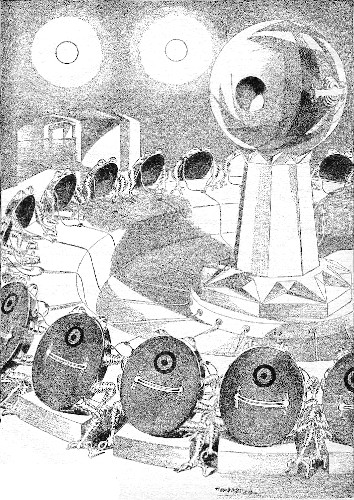
"That globe of metal, Marlin—it hears him, answers him!
The thing must be alive!"
"Not alive, Hunt," Marlin said swiftly, his own eyes startled, though. "Those connections that run from the thirty to the globe—they center in that globe's mechanism in some way the minds, the intelligence, of all the thirty!"
Swift light flashed upon me at Marlin's words, and as I gazed astonished toward the thirty Neptunians and the central globe I knew that Marlin's explanation was the only logical one. These thirty Neptunians, it was apparent, were the supreme rulers, the highest council, of all the Neptunian race. And since it was necessary that they use all of their differing minds as one in directing the destinies of their strange race, they had in some way devised a mechanism for that purpose, which synthesized the intelligence, the minds, of the thirty into one single mind by means of that strange mechanism. So that it was literally as one mind that the thirty perceived and thought, when gathered here together, the central globe speaking out the synthesized thoughts and questions of all the thirty!
As Marlin and I stared in amazement toward it, our leader was answering to the globe's questions concerning us, the snapping speech of the Neptunian indistinguishable from that of the mechanism. Then when he had finished, the globe was speaking briefly to him again, a short order, and in answer to that order the Neptunian leader turned at once toward us. I think that both Marlin and myself would not have been surprised to meet then the death that we knew hung over us, but, instead, the leader gestured to us and to our guards and led the way out of the great circular Council Compartment, through a different door from that by which we had entered. As we passed through that door I glanced back and saw the thirty Neptunians of the great Council still sitting motionless and silent around their weird globe-mechanism, which was listening now to the report of three other Neptunians who had entered behind us.
Once out of the great circular compartment, we found ourselves with our guards in an irregular-shaped compartment, filled with Neptunian guards who parted to allow us to pass. Through that and through another rectangular compartment we went, and then into a long oblong compartment in which we could see, despite the twilight that reigned here, were many smaller compartments or divisions along the walls. These were very like cell-compartments, and the low door of each of these was closed by a black slab that slid down across it from above. Before these doors there were patrolling in the long compartment a half-dozen of Neptunian guards, and, after being challenged by these, our own leader and four guards marched us to one of these little cell-compartments, reaching forth to grasp or touch something on its outside wall.
As the Neptunian leader did so, the door of the cell-compartment slid smoothly and silently upward, leaving its opening clear. Without ceremony, then, Marlin and I were motioned to pass inside, and with the four ray-tubes of the guards full upon us we had no choice in the matter. Stepping inside, therefore, we found ourselves in a compartment some ten feet square, whose walls, like all the black walls of the compartment-city, towered for two hundred feet upward around us, the only light the square of dusky sky far above. Then, as Marlin and I stared about us, the door shot smoothly down across the opening, and we heard the soft, shuffling steps of the Neptunian leader and our four guards retreating, outside, leaving us gazing at each other's white faces in silence. Our great mission out to Neptune, our great attempt to save Earth and prevent the wrecking of the solar system, had come to an end at last, with our two friends gone and with Marlin and myself imprisoned here beyond all hope of escape on Neptune's peopled moon!
CHAPTER IX
Before the Council
"Prisoned here on Triton—and Whitely and Randall dead! It's the end, Hunt—for us, and for the Earth!"
Marlin's voice was but echoing my own thoughts in that moment, and darkly I nodded. "The end—yes. And less than twelve weeks before that end comes, before the sun's rotatory speed reaches its critical point, before it divides into a double star. We've found the source of the great ray from Neptune, and we're helpless."
"Yet the World President—the World Congress——" Marlin seemed to be thinking aloud. "They sent us out to dare all for Earth, and until Earth is destroyed or we are dead we can't give up hope."
"But what hope is there?" I asked. "These Neptunians have only reprieved us for the moment from death, for their own purposes. Death will be ours before long, and in the meantime who could escape from this place?"
I swept my arm around the cell-compartment, and Marlin considered the place with me as silently and almost as hopelessly as myself. For it was, truly, a prison inescapable into which we had been thrust. The square little compartment's walls were diamond-hard, of that impenetrable black stone-like substance, and they towered two hundred feet above us. There were in them no windows, the only light that reached us being the dusky illumination that came down to us from the compartment's roofless top, far above. That illumination was but small indeed, for the cell-compartment lay in the same twilight band as the great Council Compartment, that band of twilight lying between Triton's dark and sunward sides. By it we could see, however, that the black walls about us were quite vertical and smooth, and that the only break in them was that of the low door-opening, closed now by the smooth, black slab across it.
It was, indeed, a prison from which no efforts of ours, it seemed, could win us free. For even were we to escape from it, we knew, we would but find ourselves in the great compartment-city that covered all Triton, thronged with the Neptunians' countless millions. And even that city, in turn, was held beneath the giant metal roof that shielded and enclosed all Triton, so that never, indeed, it seemed, could we hope to be clear of the big moon-world and escape back across the solar system to Earth, to tell the peoples of Earth from what strange source was coming that colossal force-ray that was spinning the sun on to division and doom. Yet, despite that, Marlin and I paced ceaselessly about the little cell in a vain endeavor to formulate some plan of escape.
Our first action was to remove from our feet the heavy-weighted little disks which the Neptunians had fastened upon them, and with those removed we found that we could jump a score of feet upward in our little cell, due to the lesser gravitational power of Triton compared to that of Earth, sailing slowly upward and falling as slowly. Yet this increased agility seemed of no avail to us in escaping, since there were no breaks in the surface of the cell's smooth, towering walls by which we might have been able to jump higher. So, after some futile attempts, we rested upon the cell's floor again, re-attaching to our feet for convenience sake the super-heavy little disks, that increased our weight to its normal Earth-figure.
"It's useless, Marlin," I said, as we sat here, resting after our efforts. "We can never get out that way—or any other, I think."
"Keep steady, Hunt," he told me. "We can't do anything now, it's clear, but a chance will come."
"It had best come soon, then," I said. "For with but eighty-odd days left before the end, I see small hope."
He did not reply to that, and I think that the gloom of utter despair that had settled upon me weighed upon him also. They were hours in which there was no change. The twilight that existed here on this band of Triton's surface never changed; its dusk never lightened or darkened. The only sounds to be heard, too, were the occasional staccato voices of the half-dozen Neptunian guards outside, or the answering snapping speech-sounds of other Neptunians, that seemed to be confined in cells like ourselves. Later we were to learn that despite their super-intelligence, perhaps because of it, the Neptunians were afflicted now and then with a brain disorder in which it seemed that a part of their mind's mechanism would cease to function for a time, during which time they were confined in these cell-compartments about us. Save for the staccato speech of these and the guards, and the dull, dim, distant roar of clanking and humming and hissing mechanisms that came to us from Triton's sunward side, there was no sound in our cell except when cylinders throbbed by overhead.
In those hours the door of our cell never opened, and we found that our food and water were supplied to us inside the cell itself. There were in its wall two metal taps, one of which yielded clear water, that tasted flat and chemical to us. The other gave forth a thick, viscous white liquid, which we recognized after a time as a liquefied preparation of the white vegetables and fruits we had seen grown so rapidly. This preparation or liquid was apparently pumped through the compartment-city like the water. Thus there was no need for the guards to enter our cell. It was a number of hours later that there came an interruption to the monotony of eventlessness of our time, which roused us somewhat from the gloomy apathy of spirit into which we had fallen.
Without warning there sprang into being all about us an intensely brilliant flood of pure white light, that bathed all things about us in its blinding glare for the moment and then swiftly moved away toward the dark side of Triton. We were stupefied by its appearance thus, and then remembered suddenly the great band of brilliant light that we had seen appear and move swiftly, completely around Triton, marking the end of a ten-hour period and the signal for the sleeping millions of Neptunians on Triton's dark side and the busy millions on its sunward side to change places upon this strange world. Surely enough, in a few moments, the brilliant band of light had swept upon us from the sunward side, having traveled completely around Triton, and dwelling for a moment again upon us, had snapped out of being. That great brilliant band of light, as we were to learn, was produced by great projectors at Triton's two poles, and whirled around it by the turning of those projectors. Now as its brilliant signal swept around the big moon-world, we could hear the countless hordes of the Neptunians shifting from dark side to sunward, and from sunlit side to dark, while overhead there throbbed and shot this way and that innumerable cylinders.
Swiftly as before that great change was accomplished, and then, as there began again the dull clamor of activity upon the sunward side, Marlin and I turned from our listening attention. But at that moment we heard a staccato rattle of speech outside our door, and an instant later the great black slab of that door slid sharply upward and three Neptunians moved inside the cell. The foremost one of these bore on the metal armor of his great green disk-body a crimson circle that marked him as one of the Neptunian officials. The other two were apparently guards brought in as a precautionary measure, their force-ray tubes unsheathed and leveled unhesitatingly upon us. The Neptunian official carried in his grasp a small octagonal object or mechanism with a simple button-control, which we gazed at curiously. He touched the button-control of it, and there sounded from it a series of swift, sharp snaps of sound exactly like those of the Neptunians' staccato speech. Then, speaking aloud himself, he motioned from himself to us, and then to the mechanism.
It was Marlin who first understood his purpose. "The Neptunian language!" he exclaimed. "This one has come to teach it to us, to make it possible for them to communicate with us."
"But the mechanism?" I said. "What is its purpose?"
Marlin stared at it a moment, then reached forth and touched its round button-control, bringing from the mechanism an irregular succession of snaps of sound. "It's for us!" he said suddenly. "They know that with our different bodies we can't make the sharp, snapping sounds that are their speech, so have brought this mechanism to us to serve us as an artificial voice!"
The Neptunian official, as though he had understood us, motioned again to the mechanism and then from himself to us, at the same time uttering a few speech-sounds as though in explanation. It was plain, indeed, that his object was to teach us the strange Neptunian speech. Pointing to himself, and to the two guards, he uttered a succession of five sound-snaps, irregularly spaced, over and over again, until it was evident that they represented the name of the Neptunian races. Then Marlin and I attempted with the little speaking mechanism to reproduce those five snaps of sound, and after experimenting for a time with the mechanism's button-control we succeeded. That done, the Neptunian pointed to us and uttered another short succession of sounds, another word, which we then learned to utter on the mechanism also.
Thus, for hour upon hour, the Neptunian continued with us, teaching us word after word, in their strange staccato language. That language, we found, seemed very much like a communication code of dots and dashes, all its sounds or sound-snaps being of the same pitch, there being no raising or lowering of the voice, while for each word there was a certain combination of the sharp sounds. Quickly, too, after a time, we began to understand and learn that strange language, and though never could our own vocal apparatus have produced the clacking bursts of sharp sound which were their speech-sounds, we learned to manipulate easily the little mechanism that spoke to them for us. Hour followed hour and day followed day, until we became so proficient in the knowledge and expression of their words as to be able to communicate effectively, though haltingly, with the great disk-bodied Neptunian who was teaching us.
Yet we found that that ability served us nothing. For though we plied the Neptunian with innumerable questions concerning the great mysteries that we had come through and that lay about us, he would answer nothing. What great chain of events had it been that had made of mighty Neptune's colossal compartment-city a silent desert of death, and that had sent all the Neptunians crowding upon Triton? What was their purpose in directing their mighty force-ray toward the sun, turning the sun ever faster to accomplish its division into a double star? Why, too, had they sent a second great force-ray out in an opposite direction from the first, passing out into the vast void of interstellar space? These questions we put many times to the great Neptunian who taught us, but the big, green-bodied disk-monster simply contemplated us as though unhearingly with his bulging, glassy eyes, and went on with the teaching of their strange speech.
So days followed days while we slowly progressed in our learning of the Neptunian speech, days in which the despair that had gathered in our hearts grew darker and darker. For at last, when more than a score of Earth-days had passed, we realized that all was hopeless indeed, that even had we chanced to escape, even had we still our space-flier that had been destroyed with Whitely and Randall, we would hardly have time enough to return from Neptune to Earth and bring back the fleet of space-fliers that were being prepared on Earth. Not much more than a half-hundred days, indeed, remained before that last day that would see the sun splitting at last to engulf almost all its planets, for with each day, we knew, the giant force-ray of the Neptunians emanating from Triton was turning the sun faster and faster.
Twice, indeed, I almost made a wild attempt to overcome our Neptunian teacher and guards, but was held back by Marlin, who knew as well as I that instant death only could result from such an attempt. And as those days passed, as with each ten hours the great band of light went around Triton and the millions of Neptunians on dark and sunward sides interchanged, I came to look on death as a release from the agony of suspense and torture in which we were. I think that not much longer could either Marlin or I have endured the terrible torture of that imprisonment, when there came at last a break to it, on the twenty-second day of our captivity.
On that day, as we waited in the unchanging twilight for the coming of our Neptunian teacher and his two guards, we were astonished when the door slid up to find facing us outside a different Neptunian official, of the same insignia of the crimson circle, with four guards behind him instead of two. He did not speak to us, but motioned us silently to move outside, and as we did so he gestured to Marlin to take with us the small speech-mechanism by which we were able to converse with the Neptunians. Then, guarded closely before and behind, our attempted escape in the cylinder having kept the Neptunians extremely watchful of us ever since, we were marched out of the long oblong compartment of the cells and across others toward the great circular Council Compartment! Into it we were marched, and found that, as before, there sat around the great ring-table the thirty silent members of the Council, the great metal globe still on its pedestal at their center. They did not turn toward us as we entered and halted beside them, but the great globe did, turning first the single gleaming eye upon us by means of which, we knew, all the massed minds of the thirty members of the Council were receiving a visual impression of us.
Then the globe turned swiftly so that its speech-opening faced us, and it spoke to us, spoke as the assembled minds of the thirty, with all emotions removed and with all thoughts synthesized by its mechanism. "You are the two creatures captured upon our world?" it asked. "And you have been taught our language as we ordered?"
Marlin pressed the button of the little mechanism in his grasp, speaking back in the same snapping speech-sounds by means of it. "We are those two," he said simply.
The globe was silent a moment, then spoke on, the thirty whose minds spoke through it never turning. "When you two were captured upon our great world, others, no doubt like you, were discovered in a space-vehicle which, it was apparent, was operated by the same principle of force-rays which we of Neptune (it was their own word-equivalent for the name of the planet) have long used in our own space-vehicles, and in other ways. That vehicle and those inside it, it has been reported to us, were destroyed by those who discovered it, but we desire to know from whence it and you two came, and in what way you were able to reproduce the force-rays which we of Neptune have long used. From the structure of your bodies it is apparent that you come from a small planet, in all probability the second or third of the sun's worlds. But from which, and why, have you come here?"
Marlin did not answer for some moments, then spoke back through the little mechanism he held. "It is from the sun's third world, indeed, that we have come," he said. "And we have come here, have plunged out through the void to this, the sun's outermost world, to find out why you of Neptune are loosing doom on the solar system with that great force-ray of yours that spins the sun ever faster, and to use all our power to halt that doom!"
In that tense moment a thrill of irrepressible pride shot through me, even in the dark peril in which we stood, at Marlin's words. For they were not his alone; they were the words of Earth, the words of Earth and all its races to Neptune and all its hordes! And at that bold defiance, flung across the void from world to world and issuing here from Marlin in the very face of this supreme Council of the Neptunian rulers, of this great globe-mechanism that held their gathered, synthesized minds for the time being, an order to the guards behind us for our instant death would not have surprised me. Yet here again we were given proof of the difference between the mind-workings of the Neptunians and ourselves. It was evident that the human passions of hate and anger held small place in their cold, machine-like minds, for the great globe that spoke for the minds of the assembled thirty was silent for a time, and when it did speak it seemed not to regard the passion of Marlin's words.
"When you speak of halting the doom that confronts your world," it said, "it is apparent that you do not know the necessity of that doom, the great necessity which has caused our races of Neptunians, under the direction of the Council of Thirty, to loose that doom upon the solar system. Learn now, therefore, that it is to save our own world, our own races, that we are loosing this death upon the sun's other worlds and peoples!"
The great globe again was silent for a moment, the thirty members of the Council silent around it as their assembled minds poured their thoughts into its mechanism, to be released in a single voice. Marlin and I stood there at the great ring-table's edge, and surely no stranger scene could have been imagined than that, with the great circular compartment's towering black walls around us, the twilight that reigned above and around, the thirty silent disk-bodied Neptunians and our own disk-bodied guards, and the great, enigmatic globe-mechanism before us, that spoke and listened as a living thing, representing the massed minds of the thirty. And now that great globe was speaking to us again, in the staccato Neptunian speech.
"It is most wise, perhaps," it said, "that you two of another world learn now what colossal forces and necessities lie behind the loosing of that great doom which you come to strive vainly against. It is most wise that you learn now how useless it is for you or any of your world to oppose yourselves to the plans of us Neptunians. For we of Neptune are of an ancient power and might, beside which you of the inner planets are as newcome children. And lest you doubt that power, lest you doubt the colossal forces that we of Neptune have called into being and use for our own purposes, we of the Council tell you now what mighty past is ours.
"Oldest of all the eight worlds of this solar system, indeed, is our world of Neptune. This you must know, indeed, if your scientists know aught of the formation of the sun's planets. For those eight planets were formed unthinkable eons ago, out of the fiery sun itself. Up to that time the sun had moved through space entirely without planets, one of the countless stars of this galaxy of stars, all moving through the void in differing directions. One of these other stars chanced to be moving in the general direction of our own star, our own sun, and their mutual attraction for each other drew them closer together, until at last they passed each other closely, perhaps even touched each other, their nearness to each other causing by gravitational attraction huge masses of the flaming gaseous substance of each to break loose. Thus the space between the two passing suns was filled with those great flaming masses, and as they separated, each by its gravitational power drew a share of those fiery masses with it on its path through the void.
"Thus when the two suns receded from each other once more, each carried with it a rough half of the fiery masses that had been torn from each. As the sun moved on through space with these fiery masses about it, the greater part of them dropped back into the sun. The flaming masses that remained, however, had been thrown by the cataclysm into a swift motion, which by the sun's attraction had been converted in the case of each flaming mass into a circular or elliptical orbit around the sun. And since the speed of each flaming mass just balanced with its centrifugal force the pull of the sun inward, they continued in those orbits for age on age without perceptible change. The solar system, then, had become stable.
"Thus the sun was moving out through space with eight great flaming masses of matter revolving around it, in addition to a number of great clouds or aggregations of smaller fragments. These eight flaming masses became in time the sun's eight worlds, a solid crust forming first on one and then on another of them. The outermost of these great fiery masses was that which in time was to become the planet Neptune. It had been one of the first of the great fragments of the two suns torn loose by their encounter, and being one of the first had been hurled out to a greater distance than any of the others. And being the first, too, it had had more time to cool, its solid crust had formed earlier on it, and thus Neptune was in fact the oldest of the sun's planets to form as a solid-surfaced world. Neptune, too, is composed of much lighter materials than the denser inner planets, and the reason for that is, that it was the lighter matter of the two suns that had naturally been sent flying forth from them in their encounter; and thus the outer planets, the four great outer worlds, being of the sun's lighter matter, are all much less in density than the four smaller inner worlds, which were thrown forth later from the sun's heavier matter, and thus in smaller masses.
"So out of the great irregular-shaped outermost mass of flaming gases had been formed the great planet Neptune and its smaller moon of Triton. And as Neptune's surface solidified, as the great masses of water-vapor and air that made up its dense and immense atmosphere ensheathed it, it became a habitable world, one fit for life and the continuation of life. For though small heat came to distant Neptune across the great void of almost three billion miles that separated it from the sun, the sun giving it indeed a heat hardly perceptible, yet there was heat enough for the great world in its own fiery interior. For so great in size was Neptune that, though a solid crust had formed upon it, there still lay beneath that crust the vast raging fires of its interior, and those fires' heat was so great that they kept the surface of Neptune and the dense atmosphere above that surface warmed constantly. And Triton had an atmosphere also and interior warming fires.
"Thus great Neptune, though farthest of all planets from the sun, became habitable the earliest of all. And since, wherever a world is found on which life is possible, life sooner or later will arise, so it arose on Neptune. Race upon race of living creatures rose upon it, and race after race vanished, annihilated by changing conditions on its surface which they could not withstand. It was not until we disk-bodied Neptunians evolved upon the great world's surface, indeed, that there came a permanent form of life upon it. For we, whose disk-bodies owed their squat, flat shapes to the gravitational power of Neptune, so much greater than that of your inner worlds, had in larger measure that spark of intelligence which the other creatures had lacked. And with that gleam of mind, of intelligence, we were able to withstand the changing conditions on Neptune's surface by adapting ourselves to those conditions, growing ever in numbers and spreading out over our world's surface, until at last we swarmed in millions upon it and were rising into greater and greater comprehension of the universe about us, into greater and greater intelligence and power.
"Great buildings we built upon Neptune's surface, and deep we tunnelled below its surface, also. Through breaks in the great cloud-screen about our world we looked forth and saw with our instruments the other planets that moved about our sun, and looked forth also into space and saw the hosts of other suns that moved at vast distances from our own. Our eyes were accustomed to the dim Neptunian day, our bodies to its great gravitational power, and it was our home-world. Yet by this time so vast had become our numbers that millions of us were crowded too closely together, and desired to migrate to Triton, our moon, and settle there. And though we had never yet been able to sally forth from the surface of our own great world of Neptune, we found the way to do so then.
"That way was given to us by the discovery by our scientists of a new force-vibration, one that lay in wavelength between the light vibrations and the higher electrical vibrations. This force-vibration, they found, exerted a definite pressure or force upon any object struck by its waves, just as the light rays themselves exert a definite, though far smaller, pressure upon whatever matter they strike. With this new force-ray, therefore, we planned to propel vehicles through space, and we constructed great cylindrical vehicles which were to hurtle out into space by generating inside them a great force-ray which would be shot back against a world and thus propel them by repulsion away from that world. These cylinders were made and tested, and since they worked perfectly, we constructed many of them, enough to take out all the millions of our surplus population to Triton. And so in those cylinders those millions of Neptunians went hurtling out to Triton.
"They found, as our observations had shown us, that Triton had a good atmosphere, and that it was swarming already with many forms of life, some of them unutterably grotesque, and none of more than the lowest intelligence. Using weapons of concentrated force-rays, which clove through all they touched, our millions of Neptunians proceeded to annihilate all life upon Triton, and with that accomplished, proceeded to build for themselves structures and cities like those on Neptune. They found that Triton was a perfectly habitable world for them save for two considerations. One of these was the lesser gravitational power of it, which made it extremely inconvenient for them to move on it with their Neptunian muscles. They solved this problem by attaching to their limbs small and unobtrusive disks of an extremely heavy metal which we could make by the artificial massing of atom-protons without electrons. These disks increased their weight to such a point that they could move as freely and conveniently on Triton as on Neptune.
"The other problem facing them on Triton was the fact that it turned one face always toward the sun. Its rotation on its axis, indeed, was of just enough speed to counteract its revolution around Neptune and Neptune's own revolution around the sun, the sum total of its movements resulting in this keeping of one side always toward the sun, with that side always palely lit by the sun and the other always in darkness. Even when Triton was behind Neptune, invisible perhaps from your own world by reason of the edge of Neptune's great atmosphere projecting up to hide it somewhat, Triton's orbit was so slanted or inclined toward the plane of the solar system that the sun was always in sight of its sunward side, though dimmed a little when the edge of Neptune's atmosphere was between them. The Neptunians who had gone to Triton were accustomed to Neptune's alternating day and night, of approximately ten hours each, and so they solved the problem by living upon the sunlit side of Triton for ten hours, for a day, and then passing to the dark side for ten hours of night.
"Thus they had conquered all the inconveniences that had faced them in settling upon Triton, and so upon Triton as upon Neptune were Neptunians and their cities. The civilization of both Neptune and its circling moon seemed secure and unchangeable, indeed; a civilization that existed upon our world and its moon when all the other planets of the solar system held only the lowest forms of life, if life they held at all. Easily could we of Neptune have ventured into the sun's other worlds had we wished, in our space-cylinders, but we had no desire to do so, having learned all that we wanted of those worlds by observation with our instruments, and being content to remain safe upon our great world of Neptune and smaller moon-world of Triton. And safe we remained there, for ages, yet, during all those ages, there was coming closer toward us a great crisis which we had long before foreseen, yet which we had considered so remote a peril as to give it no attention.
"But now that peril had become close, and great. And it was none other than the extinction of all life on both Neptune and Triton that faced us, due to their steady cooling. For all worlds, however fiery their interior cool in time and die. And steadily, surely, the interior fires of both Neptune and its moon had been cooling and the substance solidifying. Already they had cooled so far that the surface of Neptune was much colder than ever before, and that of Triton also, and with each passing century that cold was increasing. It would be a matter of time only, it was plain, before both Neptune and its moon would lie utterly without life, a terrible frigidity reigning upon each, all life perished from them in that bitter cold. For though worlds nearer the sun might exist by means of the sun's heat, though life on them could cling to existence through the sun's warmth, Neptune and its moon were so unthinkably distant from the sun that almost no heat reached them from it, and as their interior fires cooled, they must inevitably become so cold as to annihilate all life upon them!
"It was evident that some great plan must be adopted that would prevent this condition, and such a plan was quickly decided upon. This plan was to enclose both Neptune and Triton with great roofs of metal that would hold in them the heat that was being radiated out, and that would make it possible to aid the failing heat of the two worlds by artificial means. It would be a gigantic task to place those great roofs about Neptune and Triton, but we set to work upon it and for years upon years all the energies of the Neptunians were centered upon the construction of those roofs. We had established vast workshops in which the plates of metal that were to form the great roofs were turned ceaselessly forth, and these in turn were joined together to make the great roof of giant Neptune.
"It had been decided that that great roof that was to enclose Neptune would have no supports whatever. For that roof was to be in effect a gigantic spherical shell enclosing Neptune, and as such it would float in space around Neptune without touching it at any spot, since the attraction of Neptune upon the roof would be the same in all parts; thus it would not be pulled to this side or that, and would not touch the great planet in any place. The small attraction of the sun and the other heavenly bodies on the free-floating spherical enclosure was nullified by an automatic force-ray pressing against the inside of the roof in the right direction, and thus the giant spherical shell could enclose Neptune, and could float about it, moving with it through space, without touching it at any point!
"The metal plates, that had been joined together to make the vast spherical shell, were of a strength to resist all stresses, and they had been specially treated by a crystallizing process that gave them a unique property. This was the property of admitting all heat and light vibrations from above through them, but repelling those from below. Thus when the great roof was in place around Neptune, enclosing it completely, the sun's light and heat penetrated down to it through the roof without check, making the roof seem transparent from below. But no light or heat vibrations could pass up through the roof from beneath, so that it appeared quite opaque from above. Thus what light and heat the sun furnished were not lost, and Neptune's day not darkened. But very little of that heat of Neptune itself could be radiated outward into space.
"With the great roof in place around Neptune, and with openings that could be opened and closed at will provided in it, for entrance to or exit from Neptune, a similar roof, though far smaller, was constructed around the smaller globe of Triton. With those great enclosures thus shielding Neptune and Triton, therefore, their cooling was slowed, and it seemed to all that the expedient of the great roofs had warded off the menacing cold that had threatened to extinguish all life on Neptune and Triton. Strange new cities were built on Neptune and Triton, great compartment-cities that needed not roofs with the great roof above them. New methods were found of producing vast food supplies for the crowding millions of Neptunians, by stimulating with electrical force and chemicals the growth of vegetation to an unthinkably swift rate. Thus we Neptunians, in our giant enclosed world of Neptune and in our enclosed moon, Triton, had checked the colossal peril that had threatened us and could continue to live safely upon Neptune and its moon for age upon passing age!"
CHAPTER X
To Split the Sun!
"We had checked the great peril that had hung over us, but we found, as the centuries and ages passed, that we had only checked it, that we had not banished it. For nothing in the universe could halt the cooling of Neptune and Triton. As their interior fires cooled, colder and colder grew their surfaces, despite the roofs that enclosed them. It was then that we had recourse to another means of halting that oncoming cold—the use of artificial heat. We set up in the giant compartment-city of Neptune, and in that of Triton also, great globes that radiated out unceasing and intense heat. These globes held inside them their own mechanisms, mechanisms that could change etheric vibrations of electricity and light and others into heat-vibrations, by changing their wavelength. And with these radiating their ceaseless heat, and with the great enclosing roofs, the oncoming cold was again checked.
"Yet after a time we were forced to recognize that this check also was but temporary. For we were fighting the most grim and hopeless battle in the universe; we were fighting against the relentless and inevitable changes caused by the immutable physical laws of the universe. So that, aid its failing heat as we might with artificial heat-producers, the interior heat of Neptune was waning still, and more and more globe heat-radiators were required to keep the temperature of Neptune at its usual height. The Neptunians of Triton were faced with the same problem, but their situation was not so desperate as of those upon Neptune, since though Triton had cooled as quickly, its enclosed space was so much smaller than Neptune's, its great roof so close to it also, that it was possible with an effort to keep enough heat-mechanisms going there to maintain the warmth.
"On Neptune, however, the struggle became more and more desperate, our great struggle against the blind laws of nature. For as Neptune's interior heat declined farther and farther, it became more and more impossible for us to keep enough heat-mechanisms going to keep it warm enough for life. And at last, after years upon years of that awful struggle against fate, we of Neptune realized at last that it was no longer possible to keep Neptune warm enough for us to exist there, and that we must leave it at once for some other world if we were to escape extinction; since as the great planet's interior heat declined, it became more and more agonizing for us to keep enough heat for life by means of the heat-mechanisms, and it was clear to all that the end was at hand unless we left Neptune!