The True History of Tom & Jerry: or, Life in London (continued 3)
Reading edition
“A heap of dust alone remains of thee; ’Tis all thou art, and all the proud shall be!”
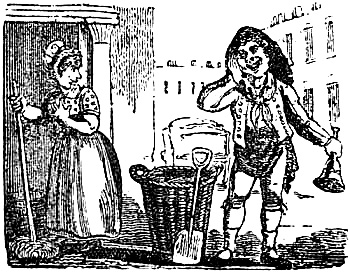
The Literary Dustman.
My dawning genus fust did peep, Near Battle Bridge ’tis plain, sirs— You recollect the cinder heap, Vot stood in Gray’s Inn Lane, sirs?[37] ’Twas there I studied pic—turesque, Vhile I my bread vos yarning, And there, inhailing the fresh breeze, I sifted out my larnin’! They calls me Adam Bell, ’tis clear, (As Adam vos the furst man), And by a co—in—side—ance queer, Vy, I’m the fust of dustmen!— A Literary Dustman!
The “Old Pub.” of sixty years ago is now The Victoria Tavern, Great Northern Railway. Maiden Lane is York Road, and Battle Bridge is known as King’s Cross, from a statue of George IV.—a most execrable performance—taken down in 1842.
Great sculptors all conwarse wi’ me, And call my taste diwine, sirs— King George’s statty at King’s Cross Vas built from my design, sirs. The Literary Dustman.
Besides the authors already mentioned. Tom Dibden, Farrell, and Douglas Jerrold, each produced dramas upon the popular theme; and during the seasons of 1821-2, “Life in London” was performed with great éclat, at ten theatres in and around the metropolis, to overflowing houses. But Pierce Egan at length became tired of the successes of the playwrights in using his book, and resolved to try his own hand at a dramatic version—or, as he termed it, “to take a leaf or two out of his own book”—and the Author’s Piece was “got up” and performed for the first time at Sadler’s Wells, under the respectable management of Mr. Egerton, on Monday, April 8, 1822, with most decided success.
It was thus announced by Mrs. Egerton, in the address written for the occasion by T. Greenwood, Esq.
“To-night, my friends, this modern taste to meet, We show you Jerry at his country seat; Then up to town transport the rustic beau, And show him ‘Life in London,’ HIGH and LOW.”
SADLER’S WELLS THEATRE.
Under the Direction of Mr. Egerton, of the Theatre Royal, Covent Garden, Sole Proprietor.
The Brilliant Success, and increasing Attraction of Pierce Egan’s “Tom and Jerry”: not exceeded by any performance ever yet produced; and the celebrated Pony Races, exciting an interest equal to the Race Course itself: being nightly performed to crowded Audiences, amidst Roars of Laughter and Shouts of applause, will be repeated Every Evening, at half-past six o’clock precisely:—
The new Pedestrian, Equestrian, and Operatic Extravaganza: in Three Acts—of Gaiety, Frisk, Lark, and Patter, called
TOM AND JERRY.
Put into Shape, exclusively for this Theatre, by Pierce Egan.
Who trusts it will not be deemed unfair that he should take a Leaf or Two out of his own Book, several other persons having made free with the Work. The Piece now prepared for representation is not entitled to the appellation of Tragedy, Comedy, Opera, Play, Farce, Ballet, or Melodrama, yet partaking of the Qualities of all, and possessing scenes High and Low in abundance, from the “Sky Parlour” to the “Diamond Vault.” Out and Out, Rambles and Sprees, East and West, and Lots of Characters, Up and Down. A variety of Swells but no Dons: Corinthians and Costard-mongers of many Hues and Colours: Flats and Sharps without a Note—Pinks and Tulips, but no Flowers, yet always in the Hot Houses: and Hells without Devils, only having Black Legs: Muslin and Hopsacks, according as the creatures wear them: the whole forming a “Bit of Good Truth,” en passant, in a Review of Life in London, developed by a precious Trio, in the Persons of a Top-of-The-Tree-Hero Up and Dressed in all suits: seconded by a slap-bang countryman, that neither hedge nor ditch baulk his pursuits; and in unison with a prime piece of Logic without Premises, yet always so much at Home, that Locke and Bacon were muffs to him: also representing the Noble, Respectable, Mechanical, and Tag Rag and Bob-tail part of Society, which constitute the Corinthian Capital, and the Base of the Pillar.
The Overture, with the New and Selected Music, by Mr. Nicholson. The Scenes from Drawings taken on the spot, by Mr. Greenwood, assisted by Mr. Milldenhall and others. The Sporting Subjects, by Mr. George Cruikshank, from designs by himself and Brother, Mr. I. R. Cruikshank. The Quadrilles and Country Dances, by Mr. Kirby. The Machinery, Platforms, and Race Course, by Mr. Copping. Dresses by Mr. Townley and Mrs. Balding.
Corinthian Tom Mr. Elliott.
Jerry Hawthorn Mr. Keeley.
Bob Logic Mr. Vale.
Dusty Bob Mr. Walbourn.
African Sal Mr. Brady.
Little Jemmy Mr. Cooper.
Billy Waters Mr. Hartland.
To Start from the Winning Post on the Stage; Run three times Round the Course.
Separate Matches, and afterwards for the Grand Sweepstakes.
PONY RACES.
Passing Into and Round the Pit.
Ponies. Colours.
1.—The Corinthian Pink.
2.—Bob Logic’s Miss Sly Stripe.
3.—Jerry’s Never to be beat Blue.
4.—Dusty Bob Black.
5.—Touch and-Go Blue and Pink.
6.—The Out-and-Outer Scarlet.
Stewards of the Race Logic, Tom, and Jerry.
Clerk of the Course Dusty Bob.
☞ The eagerness of several Ladies and Gentlemen to Promenade the Course during the Race, having at times produced a temporary delay and inconvenience, they are respectfully intreated to observe the directions of the Clerk of the Course, who will attend with Mrs. Dusty Bob (African Sal) in their Carriage from Maiden Lane, Battle Bridge, for the purpose of preserving order.
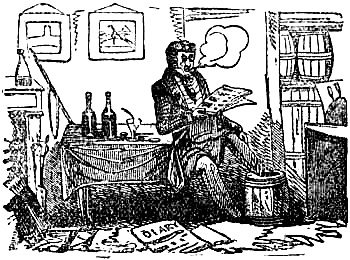
The Corinthian’s Diary.
A Celebrated Comic Song, written by T. GREENWOOD, Esq. And Sung by Mr. Vale, at Sadler’s Wells Theatre, in the Character of Bob Logic.
SUNDAY, got floor’d, in groggy plight, MONDAY, quite stale, took anti-bilious, Pester’d by nausea, nerves not quite right, And noisy duns quite supercilious: A dish of Mocha, ’chovy toast, Remov’d the spasms—increased attrition, So started, when I’d skimm’d the Post, To Tattersall’s, in high condition. TUESDAY, got clean’d at Rouge et Noir, And, done quite brown, was forc’d to toddle; So then I vow’d to play no more, Lest, like a lame duck, I should waddle. WEDNESDAY, reflected; curs’d each star, Swore never more a card to handle: Went to the Fives Court, saw them spar, And patronis’d Cribb, Neat, and Randall. THURSDAY, bowl’d down to Ascot Heath, To sport my blunt upon the races: Rode my own mare almost to death, For I had won three steeplechases: Clean’d out again, I came away Quite undismay’d, though out of feather, At night I bolted to the play, To drown ill-luck and care together. Met with a spree, two glorious frays, So went to work—I hate long parleys; Kick’d up a row, then starr’d the glaze, And mill’d, in style, a brace of Charley’s: Morris’d away to Almack’s Rooms, Danc’d a quadrille, alert and showy, Call’d at the Finish, mops and brooms, And tumbled to bed as drunk as Chloe. FRIDAY, I went to see dear Nancy, But found a Covey there before me, Was forc’d to bolt, I’d lost my chance, But Kate, I knew, would still adore me: So off I set, stay’d SATURDAY, My comforts took, then home departed; Book’d for next week, with spirits gay, I for a fresh game, on SUNDAY started.
SADLER’S WELLS. PIERCE EGAN, The Author of TOM & JERRY; or, Life in London. Most respectfully informs the Public, and his numerous Friends in the Sporting World, that: (Before “all the Gold is taken off the Gingerbread,” being contented with a Small Slice of it,) his BENEFIT is fixed for Wednesday The 25th September, 1822. When a Variety Entertainment, will be performed, in which THE AUTHOR Will make his First and only Appearance on this Stage, in a PRINCIPAL CHARACTER. LIFE IN A SPREE. A Spree’s the thing, with potent port made merry, “Go it Bob Logic,” “Keep it up,” cries Jerry.
The Upper Story all abroad—Mr. Lushington at Work; and when the Wine is in, the Wit is out—Ripe for any thing—How to make a Stop—Watch go—And getting the best of the Timekeepers—Must make a noise in the World:—
No way but this left to obtain renown, Kick up a Row, and knock the Charlie’s down!
LIFE IN THE EAST.
All-Max ...... A bit of good Truth!
Tickets not necessary—Any Port in a Storm—Never a Jack without a Jill—All happiness: no questions asked: and one half the world don’t know how the other half lives—(or dies!)—No matter! Plenty of Taste—Patter without ceremony—And not particular to a shade about Lingo. Spoting a toe without a shoe, and no enquiry after the Snob’s Bill—Reeling without steps—Flooring instead of Waltzing, and nothing the matter. Country or colour no objection—Ladies in mourning not prohibited—Black Sall don’t blush for her appearance—And Dusty Bob not uneasy about his toggery—All the same One Hundred Years hence!—Philosophy.
⁂ To prevent the trouble and fatigue of ascending the numerous Steps to the Author’s Sky Parlour, (in Days of Yore, denominated a Garret, as well as Tumbling over lots of Kids,) Tickets to be had of Messrs. Sherwood, Neely, and Jones, Paternoster Row; Office of the Weekly Dispatch, Wine Office Court, Fleet Street; at all the Sporting Houses; and Places for the Boxes can be taken of Mr. Parker, at the Box Offices, Sadler’s Wells, from 10 till 4.
Full Particulars will be duly Announced.
Boxes 4s. Pit 2s. Gallery 1s.
Glendinning, Printer, 25, Hatton Garden, London.
Brighton, of course, in common with all other large provincial towns had its version of “Life in London.” The theatre was then under the management of Mr. Samuel—or, as he was commonly known, Jerry Sneak Russell, from the inimitable manner in which he personated that character in Foote’s farce of “The Mayor of Garrat.” We have a copy of the play-bill before us, and as we think the manager’s remarks and the selection of criticisms are in their way curious, we here append them, including the cast of characters:
THEATRE ROYAL, BRIGHTON. LAST NIGHT BUT ONE. TOM AND JERRY.
In announcing the successful piece of “Tom and Jerry” for this evening, the manager feels great satisfaction in being able to quote in its favour the following observations from the critiques in the London and other newspapers. “The scenery, dresses, &c., are good throughout, and much credit is due to the manager for the style in which it is got up. It is with pleasure we remark that this piece has been most judiciously freed from the impurities of dialogue, which rendered it improper to meet the delicate ear of the gentler sex. We therefore venture, without subjecting ourselves to reproach, to recommend our readers to see ‘Life in London,’ to witness an exposure of many impositions practised in real life, and be made ‘fly’ (the plain English of au fait) to the multum in parvo phrases which are now introduced into passing conversations.”
“Brighton.—The theatre at this place has just produced its ‘Tom and Jerry’ with great success, and, we may say, deservedly—every objectionable point that might be thought to infringe on decorum having been most ingeniously suppressed, without any diminution of the whim and fire of its varied and entertaining scenes. This regard to propriety argues much discretion, and seems to meet the approbation of the beau monde resorting hither, for the theatre is graced with abundance of fashion and beauty.”
“The ‘Tom and Jerry’ of the Brighton Theatre has good scenery, good acting, and, what in such a piece is perhaps still better, good and chaste dialogue to recommend it; it has been cleansed of its impurities without injuring its life and spirit. As thus represented, it cannot raise a blush on the cheek of the most fastidious female.”
On Wednesday Evening, September 12, 1822, will be reproduced the highly popular and amusing Burletta of
TOM AND JERRY.
Corinthian Tom Mr. Power.
Bob Logic Mr. Chapman.
Jerry Hawthorn Mr. Russell.
Squire Hawthorn Mr. Chambers.
Tattersall Mr. Mortimer.
Yorkshire Cove Mr. Hatton.
Primefit Mr. Julian.
Bill Chaunt Mr. Whatford.
Dusty Bob Mr. Starmer.
Mr. Mace (Landlord of All Max in the East) Mr. Jenkins.
Billy Waters Mr. Sheen.
Mr. Muff Mr. Collier.
Gammoning Jack Mr. Mills.
Snoozy Mr. Cole.
Trifle Mr. Dale.
Little Jemmy Master Williams.
Chaffing Sam Mr. Wiber.
Tom Belcher Mr. Jones.
President of the Daffy Club Mr. Campbell.
Huntsmen, Watchmen, Villagers, Cadgers, &c., &c.
Corinthian Kate Miss M. Cooke.
Hon. Mrs. Gadabout Mrs. Clarke.
Patty Primrose Miss Carr.
Mary Miss Cramer.
Hon. Mrs. Trifle Miss Grosette.
Fortune Teller Mrs. Grosette.
Mrs. Allright Miss H. Grosette.
African Sal Miss Black.
Country Lasses, Ladies at Almack’s in the West, &c., &c.; Prospectus of Scenery, &c., &c., as before.
To conclude with the Romantic Melo-drama of
VALENTINE AND ORSON.
Valentine Mr. Power.
Orson Mr. S. Chapman.
Creasy, Printer, Gazette Office, Brighton.
The notoriety which Tom and Jerry obtained in England, became the topic of conversation amongst our Gallic neighbours—nay, it crept so much into favour with the gay folks of Paris, Life in London was speedily translated into French, under the title of “The Diorama; or, Picturesque Rambles in London—containing the most faithful Notices of the Character, Manners, and Customs of the English Nation, in the various classes of Society. By M. S——.” The translation had a most extensive circulation in France.
The reception of Tom and Jerry was equally flattering—notwithstanding the great prejudices that had previously existed against it—in Dublin. Mr. Wrench, from the Adelphi Theatre, was specially engaged to play the part of Corinthian Tom. The first seven nights produced £1300; and the house, on Mr. Wrench’s benefit night, held £345.
The great success of “Life in London,” in its dramatic form in the Irish capital lead up to the publication of:—
“Real Life in Ireland; or, the Day and Night Scenes, Rovings, Rambles, and Sprees, Bulls, Blunders, Bodderation, and Blarney of Brian Born, Esq., and his elegant friend Sir Shawn O’Dogherty. 1829. Coloured plates.”
In which the pictorial style of the Brothers Cruikshank was imitated from an Hibernian point of view and colouring.
At both the Theatres in Edinburgh, Tom and Jerry attracted crowded audiences, according to the Editor of the Edinburgh Dramatic Review, who states thus:—
“At length the public of Edinburgh had opportunity of judging of the merits of the above celebrated Extravaganza. From the general tendency of the remarks which appeared in the newspapers, we were led to suppose that this piece consisted of indecency and gross vulgarity. From what we heard reported as to the numerous indelicacies which this sketch of Fun, Frolic, Fashion, and Flash contained, we were afraid that its success with our sober citizens would have been precarious; but, we are happy to say, that the applause which was bestowed on it by the unprecedentedly numerous assemblage on Saturday evening, January 25, 1823, which crowded the Caledonian Theatre, is a sufficient answer to the chimerical doubts which were industriously circulated against its propriety. There is nothing, as we before remarked, associated with disgust or offence. There is neither one word, action, or situation, in the whole course of the piece, that can possibly raise a blush, or offend the most fastidious moralist!”
The Burletta of Tom and Jerry had been repeated so often all over the kingdom, and particularly in the metropolis, that the performers, notwithstanding the great applause they nightly received in the above piece, absolutely became tired and worn-out with the repetition of their characters, when the following piece of satire, written by T. Greenwood, Esq., was published, entitled, “The Tears of Pierce Egan, Esq., for the Death of ‘Life in London’; or, The Funeral of Tom and Jerry. Dedicated to Robert and George Cruikshank, Esqs. Price Two Shillings, with an engraving by George Cruikshank.”
“Beat out of the Pit, and thrown over the Ropes, Tom and Jerry resign’d their last breath, With them, too, expired the Manager’s hopes, Who are left to deplore their sad death! “Odd and various reports of the cause are about, But the real one was this I opine: They were run to a standstill, and, therefore, no doubt, That the cause was a rapid decline. “When death showed his Nob, out of Time they were beat, And neither would come to the scratch; They hung down their heads and gave up the last heat, Not prepared with the Spectre to match. “All wept at the Funeral! the Fancy and all— Some new, but a great many mended: And Egan, while Cruikshank and Bob held the pall, As Chief Mourner in person attended!!! “Their Sprees and their Rambles no more shall amuse, Farewell to all nocturnal parleys: The Town felt regret, as the bell tolled the news, And no one rejoiced—but the Charleys! “A monument, too, their kind Patrons will raise, Inscribed on—‘Here lies TOM and JERRY, Who, departing the Stage, to their immortal praise, ONE THOUSAND NIGHTS made the Town merry!!!’ “May their souls rest in peace, since they’ve chosen to flit, Like other great heroes departed; May no mischief arise from their sudden exit, Nor Pierce Egan die—broken-hearted!”
In reference to the above, Pierce Egan states that Jemmy Catnach, the renowned Ballad-monger of the Seven Dials, in less than twelves hours after the publication, produced a pirated edition for street sale, for two-pence.
Mr. Pierce Egan, in his “Finish,” states that he reckoned no less than sixty-five separate publications, which he enumerates in extenso, all derived from his own work, and adds, with his usual amount of large and small Capitals and italics—“We have been pirated, COPIED, traduced; but, unfortunately, not ENRICHED by our indefatigable exertions; therefore NOTORIETY must satisfy us, instead of the smiles of FORTUNE. Our efforts have given rise to numerous productions in the market of literature, yet we can assert, with a degree of confidence hitherto unshaken, that none of our Imitators have dared to think for themselves during the long period of seven years, neither have they shown any originality upon the subject of ‘Life in London’; but who have left it—disinterested souls!—to the Author and Artist to put a CLIMAX to the adventures of Tom, Jerry, and Logic.” The last remark is in reference to the publication of “Pierce Egan’s Finish to the Adventures of Tom, Jerry, and Logic, in their Pursuits through Life in and Out of London. With numerous coloured illustrations by Robert Cruikshank. London: George Virtue & Co., Ivy Lane, Paternoster Row.” Seven years after the date of “The Life in London.” In common with almost all other sequels, or “continuations” it was not successful—the fact being that Pierce Egan, and the subject of his work were alike literally and financially “used up!”
Old Jemmy Catnach, true to his line of life, soon joined what Pierce Egan designates as the “Mob of Literary Pirates” who irritate the poor author almost to madness, blast his prospects, impose on the unwary by their imitations, and render his cash account all but nugatory, and, just as he may be congratulating himself on the success of his genius, receiving the smiles of Fame, and a trifling sweetener from Threadneedle Street, as a reward for his exertions, he may be attacked by Sappers and Miners—those pickers and stealers who do not absolutely come under the denomination of pickpockets, yet thieves to all intents and purposes, and, certainly, robbers of the most unprincipled description—a set of vampires—living upon “the brains” of other persons, and who dare not to think for themselves.
Catnach brought out a broadside, or “whole-sheet,” for street-sale, entitled:—
Larger Image
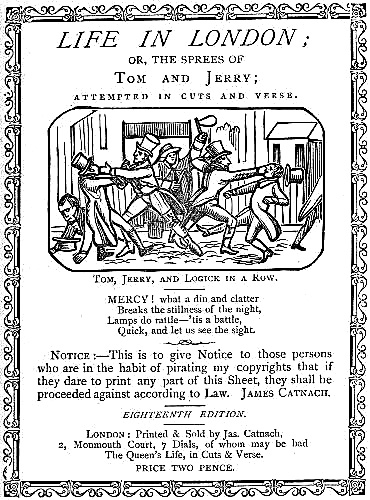
Text of Image
The “broadside,” which Pierce Egan calls—“Another wicked piracy, by Catnach,” consists of twelve woodcuts,—of which we have given facsimiles in our pages—it will be seen that they are reduced and very roughly executed copies of the original plates by the Brothers Cruikshank, but in reverse. Therefore the swaggering Notice to Pirates which Jemmy Catnach published reads funny enough. The letter-press matter consists of flash songs, and a poetical epitome of the plot and design of the original work of “Life in London.” And taking it as it stands, and from where it emanated, rather a creditable performance, particularly when we take into consideration—as duly announced by the street-patterer, that it was—“Just printed and pub—lish—ed, all for the low charge of “Twopence.”
On the rarity of this Catnachian and piratical edition of “Life in London” it is superfluous to enlarge, and it is easy to account for this circumstance, if we reflect that the broadside form of publication is by no means calculated for preservation; hundreds of similar pieces printed at the “Catnach Press” and at other offices publishing for street-sale must have perished. The more generally acceptable a broadside or street-ballad became, and was handed about for perusal, the more it was exposed to the danger of destruction. No copy of Catnach’s version is preserved in the British Museum, therefore, and for reason above stated, it must be considered as a great “Literary Curiosity.”[38]
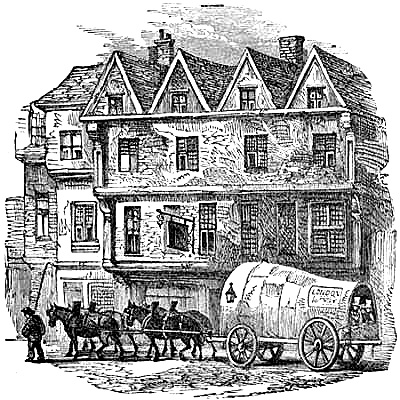
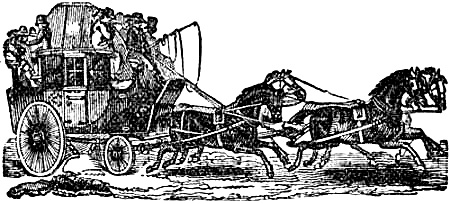
Old Stage Waggon.
As we have before observed, “Life in London” was dedicated by permission to George IV., and it is a circumstance in itself which looks singular enough in this Victorian age, that royalty should have condescended to have had such a work dedicated to it. One paragraph, which we are about to quote, strikes us as being a very peculiar and free-and-easy style for an author to address himself to a King of England. It is as follows:—
“Indeed, the whole chapter of ‘Life in London’ has been so repeatedly perused by your Majesty in such a variety of shapes—from the elegant A, the refined B, the polite C, the lively D, the eloquent E, the honest F, the stately G, the peep-o’-day H, the tasteful I, the manly J, the good K, the noble L, the stylish M, the brave N, the liberal O, the proud P, the long-headed Q, the animated R, the witty S, the flash T, the knowing U, the honourable V, the consummate W, the funny X, the musical Y, and the poetical Z,—that it would only be a waste of your Majesty’s valuable time to expatiate further upon this subject.”
One notable effect of “Life in London,” particularly in its dramatised form, must be recorded. It broke the heart of poor Billy Waters, the one-legged musical negro, who died in St. Giles’s workhouse, on Friday, March 21, 1823, whispering with his ebbing breath, a mild anathema, which sounded very much like: “Cuss him, dam Tom—meē—Tom—meē Jerry!”
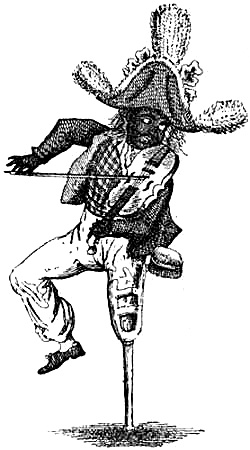
Poor Billy endeavoured, up to the period of his last illness, to obtain for a wife and two children what he termed, “An honest living by scraping de cat-gut!” by which he originally collected considerable sums of money at the West-end of the town, where his ribbon-decked cocked hat and feathers, with the grin on his countenance, and sudden turn and kick out of his wooden limb, and other antics and efforts to please, excited much mirth and attention, and were well rewarded from the pockets of John Bull. The burden of Billy’s ditty “from morn to dewy eve,” and from January to December, was:—
Polly will you marry me—Polly don’t you cry, Polly will you marry me—Polly don’t you cry:— Cry—cry—cry!
BILLY WATERS.
Mr. W. T. Moncrieff, the dramatist, is responsible for the following biographical notice of this old London Street Character:—“Of this meritorious and lamented individual, we had with great trouble collected from various sources, an ample and interesting Biography. But unfortunately for posterity, in the same classic regions where he lost his life, we also lost his life; and, to tell the truth under the influence of the same seductive fluid too—Daffy!—we can therefore only present our reader with a few brief notices from memory.”
Billy Waters, was born in the powerful African kingdom of Tongocongotaboo, where he was a native Prince, and bore the name of Pokikokiquanko; from this place he was at an early age, to the universal regret of his loving subjects, kidnapped, by ‘an auld Quaker,’ who bought him from his treacherous attendants, for two axes, a frying-pan and a bag of nails. This black piece of business made him a slave, in the French settlement, at Demarara, from whence however he speedly took French leave, and entered, we believe, the British navy as a cook par excellence on board the Ganymede sloop of war, under the command of Sir John Purvis, where, during a fierce engagement, he lost a leg, some say gallantly fighting the enemies of old England, though others insinuate it was through falling down the cockpit ladder, in his great hurry to hide himself. His own version was that he fell from the top-sail yard to the quarter deck during a storm, we cannot pretend to decide which was the fact, it however occasioned his being sent to England, as unfit for service. Arriving in London, he betook himself to that wild mode of life, which best suited his origin; the trammels of civilized society, had no charm for him; he scorned the mechanical rules of man, and picked up his living wherever he could find it. Born a Prince, and bearing a native princeliness in his appearance it is not to be wondered at that his associates should speedly elect him to the regal dignity of their tribe.
In the year 1812 Billy was solemnly inauguared ex cathedra into the sovereignty of mendicityship—King of the Beggars—at the cellar of St. Patrick in St Giles’, a rank he supported with great satisfaction and majesty, till the luckless period when a rival Billy (Bodkin), by being placed at the head of the mendicity society, virtually became King of the Beggars in his own right. This—as he conceived it, cruel usurpation by Bodkin, pricked Billy just a leetle too hard. From that moment he drooped as a blighted lily, and like another black hero he exclaimed—‘Othello’s occupation’s gone.’ The fickle British public refused to be as liberal as they had been, which he attributed to the production of “Tom and Jerry” with whom he was made to partake of:—
“Shoulder of veal and garnish—Turkey and appendages—Parmesan and Filberts—Port and Madeira.” Billy on hearing the above list given out as forming the “peck and booze for the evening,” exclaimed “Dat dam goot, me like a de Madery—Landlord, here, you give this bag of broken wittals, vot I had give to me to day, to some genteel dog vot pass your door: and you make haste wid de supper, you curse devil you.”
Enter LANDLORD with Supper.
Landlord. Now, your honours, here’s the rum peck, here’s the supper.
Billy. Eh, de supper! de supper! come along. (After striking Creeping Jack on the fingers with a knife) you damn nasty dog! what for you put yur dirty fingers in de gravy? you call dat gentlemans? you want your fingers in de pie, now you got him dere!
Jack. I only wish’d to taste the stuffining.
Billy. And now you taste de carver knife instead! (Takes candle, and looks at supper). Vy, what him call dis?
Landlord. Why the turkey and the pie, to be sure.
Billy. De turkey and de pie! I tink you said de turkey and de pie,——what! de turkey widout de sassinger! him shock——him wouldn’t give pin for turkey widout dem——me like a de Alderman in chain.
Landlord. I’m very sorry, Mr. Waters, but——
Billy. You sorry!——I sorry for my supper, you damn dog, you serve up de turkey without de sassinger—no lemon to de weal—no hoyster saase to de rum’-steaks, who you tink eat rum’-steaks widout de hoyster saase? You send no filberts to de Port, nor debils to de Madery nather. Mee must use some other hot-hell—you dog.
However, by a combination of events, Billy became very poor, and was obliged, prior to his going into the workhouse, to part with his old friend, the fiddle.—“Him lend him ole fiddle to him uncle at de pop shop,” and the wooden pin (leg) which had so often supported Billy, would have shared the same fate, but its extensive service had rendered it worthless though it had twice saved poor Billy from the penalties of the Treadmill. At length, in the full belief that his spirit was about to flee to meet his coloured ancestors in the realms of bliss and a free hunting ground, he duly made his will, in which he bequeathed to W. Bodkin, Esq,—Billy Bodkin, the Hon. Sec. to the Mendicity Society: a bodkin that had so often pierced Billy to the heart—his wooden leg, earnestly desiring he might receive it in his latter end.
In life he had been accustomed to wear a military cocked hat, a judge’s full-bottomed cauliflower wig, and a naval officer’s jacket and trousers, symbolical of his being the head and arbiter of the naval, military, and judicial departments in his eleemosynary kingdom, these he bequeathed in the following manner: His wig he left to the Court of Chancery, in the vague hope that they might obtain with it a little of his decision in equity, and promptness in justice. His military hat he left to the Heads of the Horse Guards, and his naval jacket and trousers to the old washerwomen that manage the Greenwich Hospital. The Deal Fiddle, on which he had been used to scrape his native WOOD notes wild, we are happy to state, was taken out of lavender, and is now in the possession of the Tyburn Ketch and Glee Club—the duplicate having been bequeathed to them for that purpose.
In conclusion we have only to state, that Billy was an accomplished cadger, a skilful musician, and adroit dancer—doing more on one leg than many others on two, and possessed abilities that as an actor would have rendered him a shining ornament to the stage—“to hold, as t’were, the mirror up to nature; to show virtue her own feature, scorn her own black image!”
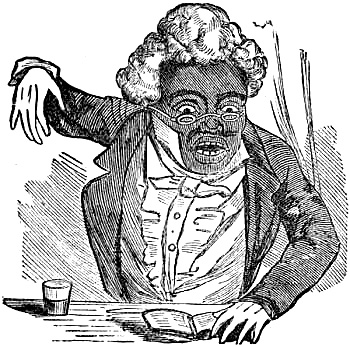
Billy was considered of sufficient public importance, when in the flesh, to be moulded and well baked by a Potter, who taking up and moistening a lump of clay, said, “Be ware!” and then turned Billy out in one of his happiest moods and positions, with a broad grin on his black mug—a perfect image, suitable for a chimney or sideboard ornament; which found a ready sale at the time of its manufacture, but has now become very rare in perfect condition, and, much coveted by collectors to add to their Class, or Section of “English Characters.” Specimens of this style of ware are exhibited in the Bethnal Green Museum, London. Henry Willett, Esq. of Brighton, also exhibits his fine collection of the same class of ware at the Brighton Free Public Library.
LINES ON BILLY WATERS. By W. Reeves, June, 1823. Peace to the manes of Black Billy Waters, Well-known throughout the Town! The reason that he left these quarters— Is plain—He was by Death done brown. His life was one continu’d round Of pleasure and of glee; His fiddle caus’d the hearts to bound Of children as big as me. Mags came thick, this made him merry; Fortune changes in a crack— Folks they went t’see Tom and Jerry, And on Billy turn’d their back. Justice, at length, seiz’d on poor Bill, Who quickly took his peg off; So they didn’t send him to the Mill, ’Cause, why? he’d got a leg off. His day was o’er, he soon found out Poverty with rapid stride Follow’d him, and clamor’s shout Meant poor Billy to deride. In vain he fiddl’d, danc’d and sung, Until he was out of breath; Starving he was, his bow unstrung, Till he danc’d—The Dance of Death.
Little Jemmy.
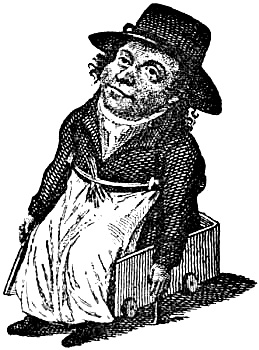
The real name of this notorious street-character was Andrew Whiston. He was a born cripple, and in every respect a most miserable object of charity. Moncrieff imported him into his Adelphi version of “Tom and Jerry; or, Life in London,” as “Little Jemmy,” and there figures in the Scene: Back Slums in the Holy Land: in company with Mr. Jenkins, Soldier Suke, Dingy Bet, Creeping Jack, Billy Waters, Ragged Dick, and other well-known characters.—Vide page 46.
For many years Andrew, alias “Little Jemmy,” had been in the habit of propelling himself about the streets of London in a little truck, or box on wheels, assisted by the aid of two small crutches. He always wore a white apron to conceal the deformity of his legs, which were curved, and had the appearance of thin planks, having no calves.
To avoid the penalties attached to begging and vagrancy he usually carried a few quill pens stuck in his coat and apron; declaring it to be the only trade to which he had been brought up, whence he was called The Penmaker! He has been heard to acknowledge he derived as much in his perambulations through the streets as amounted to £2 per week. It was his custom every morning to cross over Blackfriars Bridge for the purpose of gathering alms. He always prided himself as leader of the “Cadgers,” in the metropolis, and was one of the most dissipated of the class to which he belonged; never returning to the hovel, in which he took up his abode, in the Borough, except in a state of intoxication. In his fits of inebriety, when at a distance from home, and incapable of proceeding, he was generally picked up by some of the numerous coalheavers, residing in the same quarter of the town, and carried to his dwelling on their shoulders; this, from his diminutive stature, was no very difficult task to perform.
On the night of his death, which occurred Monday, April 3, 1826, he had been drinking spirits, and porter, during the day, and was as usual carried home by two men; for which they were to receive a pot of beer. On setting down their burden, the unfortunate man—who had been conveyed with his head downwards, was discovered to be in a dying state. Surgical assistance was immediately procured, but poor “Little Jemmy,” was quite dead ere it arrived. Information of his death was given at 11 o’clock to the night constable of St. Saviour’s Parish, who proceeded to the house, the inmates of which refused to give up the body, on the ground that their late lodger died in their debt a month’s rent. Another strong reason for their refusal in delivering up the corpse, was a report that prevailed in the neighbourhood, that the surgeons of both the hospitals in the Borough had offered no less a sum than £100 for the body after death, for the purpose of dissection, in consequence of its extraordinary formation. The constable, however, claimed the body of the deceased, as none of his relations were on the spot, and conveyed it away to the watch-house, clearly perceiving that if it was left behind, the inmates would dispose of it to the highest bidder.
On Friday, April 7, an inquest was held at the Rose and Ball public-house, Bankside, Southwark, before R. Carter, Esq. Upon the return of the jury after viewing the body, all of whom expressed their astonishment at the decrepitude and peculiar formation of the singular little man. The surgeon in attendance having described the death to have occurred in consequence of apoplexy. The jury brought in a verdict in accordance with the medical evidence that the deceased died of “Apoplexy.”
The day after the inquest sat on the body it was conveyed to St. Saviour’s Burial ground, and interred in a grave dug 14 feet in depth from the surface, over which were placed three other coffins, in order to secure it against the resurrection-men, who were anxious to have the corpse to dispose of.
Subsequently to the death of Billy Waters, the notorious black mendicant fiddler—March, 1823; “Little Jemmy” acquired the soubriquet of The King of the Beggars.
The Tread-Mill at Brixton.
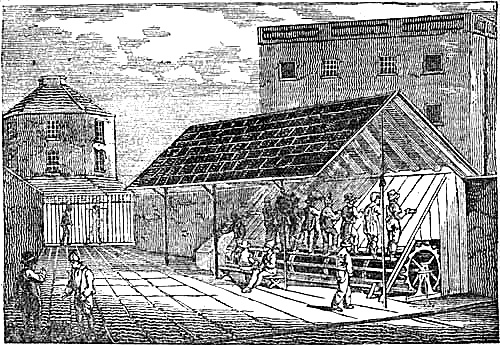
In the year 1817, Mr.—afterwards Sir William—Cubitt, of Ipswich, erected a Tread-Mill at Brixton Gaol—and soon afterwards in other large prisons, as a species of preventive punishment, which excited much attention and terror to evil doers, and proved eminently useful in decreasing the number of commitments; the strict discipline had a most salutary effect upon the prisoners not easily to be forgotten. Yet, the inventor’s name gave rise to many jokes on the subject among such of the prisoners who could laugh at their own crimes, who said that they were now punished by the cubit!
In nearly all the new and fa—vour—ite comic songs of the day allusion was made to the Treadmill of Brixton as—The Everlasting Stairs!—The Stepping Mill!—The New Dancing Academy! &c. A street-ballad on the subject was issued from the “Catnach Press” and had a most unprecedented sale, keeping the pressmen and boys working for weeks:—
“And we’re all treading, tread, tread, treading, And we’re all treading, at fam’d Brixton Mill.”
The following punning ditty was very popular at the period:—
The Treadmill. This Brixton Mill’s a fearful ill, And he who brought the Bill in, Is threatn’d by the cribbing coves, That he shall have a milling. They say he shew’d a simple pate, To think of felons mending: As every step which here they take, They’re still in crime ascending. And when releas’d, and in the streets Their former snares they’re spreading, They swear ’tis Parliament, which wills They must their old ways tread in. The Radicals begin to think ’Twill touch the Constitution, For as the wheel moves round and round, It brings a Revolution. But though these snarlers show their teeth, And try to vex the nation, Their actions soon are tried and judg’d, And grinding is their station. The Gambling swells who near St. James’ Have play’d their double dealings, Say ’tis not fair that Bow-street should Thus work upon their feelings. Tom, Jerry, Logic, three prime sprigs, Find here they cannot come it, For though their fancy soars aloft, They ne’er will reach the summit. Corinthian Kate and buxom Sue Must change their warm direction, For if they make one false step more They’ll have Cold Bath Correction. The moon-struck youths who haunt the stage, And spend their master’s siller, Must here play to another tune, ’Tis called the Dusty Miller. Ye bits of blood (the watchman’s dread) Who love to floor a Charley, As you delight to strip and fight, Come forth and mill the barley. John Barleycorn’s a stout old blade, As every man puts trust in, And you will make no meal of him, But he’ll give you a dusting. But here we’ll stay, for puns they say, Are bad as stealing purses And I to Brixton may be sent, To grind some floury verses.
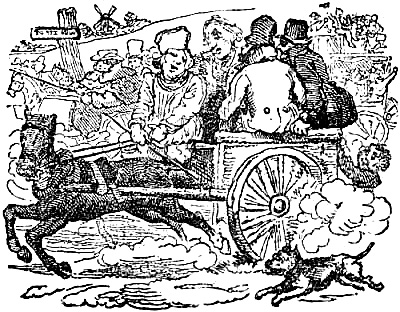
Going to the Mill!
THE WARNING.
Supposed to have been sung by a Cadger to his Companions on his Return from “The New Dancing Academy,” Brixton.
Tune.—“Bow wow, &c.”
You Cadgers all, both great and small, Attend to vat I say, Sirs, All prigging stow, or you vill go Where I com’d from to day, Sirs. As down the Strand, a Gent so grand, Was strutting, mighty fine, Sirs, His hankercher hung out so fur, I really thought ’twas mine, Sirs. Tol de rol, &c. I made a grab—he did me nab, To quod I quick vas taken; The magistrate he sat in state: I trembl’d for my bacon. Evidence o’er—oh vhat a bore!— His eyes on me he fix’d on; Says he to me, “Go, have a spree At the Treading Mill at Brixton.” Tol de rol, &c. Vhen I reach’d there, a surly bear, The steps he bid me mount, Sirs— From Dirty Dick, up to the kick, Ve’d a swelling black legg’d Count, Sirs. Both high and low, they have a go: Oh! ’tis a decent pill, Sirs. They step avay, and cry all day, “The devil take the Mill, Sirs.” Tol de rol, &c. Then varning take, and keep avake, For Traps are not asleep, Sirs; They prowl about, to find us out, Like volves do after sheep, Sirs. My life I’ll change—don’t think it strange, I’ll vork, that’s vat I vill, Sirs, Both night and day, to keep away From the curs’d Treading Mill, Sirs, Tol de rol, &c.
In the Adelphi version of “Tom & Jerry,” there is as follow:—
Black Slums in the Holy Land.
Mr. J. Does any gemmen understand these here Tread Mills, that have lately got such a footing?
Jack. Silence! Gemmen: I’m a-going to make a hobservation, Mr. Jenkins means them there Mills as makes you vork vether there’s any vork or no—I can only say this here, gemmen, if them there Mills are encouraged, it von’t be vorth no body’s vile to exercise vone’s calling—because, vy, von may as vell go and vork for vone’s living at once—but the subject von’t bear not no thinking on.
Omnes. Not by no means. (General groans).
Billy Waters. Oh, curse a de Tread Mill, me no like a de “here we go up, up, up,” and “down you go down, down, down,”—an’ if you no work, a great big lump of wood come and knock you down so—(Strikes beggar on head with his fiddle, who falls down). Poor fellow, him werry sorry.
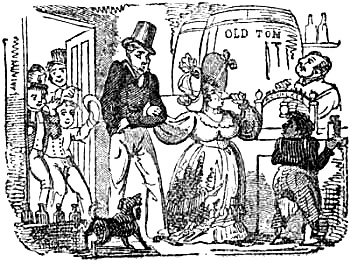
Tom and Jerry; or, Life in London.
Tune.—“Picture of a Playhouse.” Of Life in London, Tom, Jerry, and Logic I sing, ’Tis a subject (I hope it will please) Men and boys in my ears long time they did ding, So I determined to risk a good squeeze— To the Strand then I toddled—the mob it was great— My watch I found gone—pockets undone: I fretted, at first, and rail’d against fate, For I paid well to see “Life in London.”
Spoken.-“La, vel now, if I a’n’t all of a perspiration,—positively, I’m in a melting mood;” this was uttered by a tallow chandler’s fat wife. Her hubby, Mr. Wicks, cries out “What the devil are you talking about melting?—for my part, I hate mention of business when I’m out on pleasure.” “Come, don’t be dipping in my pocket, if you please, Sir.” “Vat, vat is de matter?” “Wat! who’s talking of wats?” “Vy, my dear Mr. Vicks, I think this man’s making a reticule of me.” “By the powers! it is a very fortunate circumstance he be making a reticule for you, Ma’am, for that there young man, in the drab great coat, has just cut yours from the chain, and put it in his pocket.” “Mind what you’re arter, mind your pockets.” “Where are you pushing to?” “Where am I pushing to? I’m pushing
To see Tom and Jerry, The lads who delight in A bottle of Sherry And watch to be fighting, For that’s the time o’ day. In the course of the piece is the parlour of Cribb, There they chaunted their songs full of glee; In the chair sits blythe Tom, he’s the real boy to fib, And he’s also the boy for a spree. The street-row comes next, and is kept up so well, That I laugh’d and never wish’d the fun done, Those who play Charlies, I’m sure they can tell What a street-row is in fam’d London.
Spoken.—“La! now, is this not a delightful picture of life! how do you like it, my dear?” “Oh Mamma, I likes it very well, only one thing is, I’m sorry I didn’t bring some hapennies out of my money-box, to give the poor beggar-people.” “Dear little innocent!” “Was you innocent when you was little, Mamma?” “Yes, my love.” “But, are you innocent now, Mamma?” “Why, yes—that is to say—as most women of my age are, my dear.” “Well. Mr. O’Quiz, how do you like the piece?” “Faith, now, the piece is very well, only one thing.” “And what may that be, pray?” “Why, I’m not inclined to make any objection at all, at all: but, by my soul! this is the first time I ever saw or heard of Life in St. Giles’s, without an Irishman being concerned in it.” “Hollo! what is all this hubbubboo?” “Why, it’s the half price, pushing in
To see Tom and Jerry, &c.
High life and low life are correctly pourtrayed At Almack’s, I mean both the East and the West. The actor’s look life, they so well are arrayed, But the Back Slums to my mind is surely the best. Logic a party invites to give them a treat, The bailiff comes in and Bob’s undone; He by Nab’em is press’d and ta’en to the Fleet, Which brings to a close Life in London.
Spoken.—The piece being over, there’s a grand rush to the doors: then, hey for the pleasures of a soaking wet night. “Well, positively, ’pon honor, if it does’nt rain; its enough to make any one cross when one’s going out to a ball.” “Want a coach your honor?” “Yes, drive me to St. Paul’s.” “What, in the name of St. Patrick, can he want at the cross and ball of St. Paul’s at this time of night?” “Oh! bless my soul! I think I’ve broken my leg.” “Coach to Cripplegate.” “I say, look at that Cove diving at that Gent’s pocket.” “I hope you’ll excuse me, but I’ve got a cold, therefore want my hankerchief; but, as you’re so fond of diving, I’ll accommodate you—the Thames is near, and you shall have a dam’d good ducking.” “All right, Coachee.” “Watch! Watch!” “Hark! the Pianos going.” “Watch! Watch!” “What’s the row?” “Oh! only some fancy Lads, who, having seen the Charlies well mill’d inside, have already commenced milling them outside, and the word with them is
We’re like Tom and Jerry, &c.
The following ballad is from the “Catnach Press:”—
PIERCE EGAN; OR, LIFE IN LONDON. Written by a Corinthian, and sung in Prime Twig by an Out-and-Outer.
In the country, our squire Had a very large book, Which into my hands I quite often had took; Life in London, I think, Were the name that it had, And ’twas wrote by Pierce Egan, That comical lad. Oh, Pierce Egan! knowing Pierce Egan, You must in your time have seen wonderful fun. When I first came from country Into this great town, I laugh’d at each joke As I walked up and down; Till three fellows I met, They were bold as could be; And Tom, Jerry, and Logic, Say they, you now see. Oh, Pierce Egan! &c. At night, in the street, You are sure of a row, And the Charlies are bother’d I cannot tell how; But if to the watch-house The chaps be all taken, You’ll find Egan’s heroes To be there, sure as bacon. Oh, Pierce Egan &c. E’en the boys in the street Do talk flash, you must know, And the real out-and-outers Do strut to and fro; While a gemmen in powder From none will retreat, But will peel, a coal-heaver, Or dustman to beat. Oh, Pierce Egan! &c. And since Life in London Has been all the rage, There’s nothing else now That will do for the stage; And parsons, and tailors, And barbers likewise Go to Spring, Cribb, or Belcher, To learn to black eyes. Oh, Pierce Egan! &c. But this I must say To my friends in this place, That chaffing and milling Does puppies disgrace; And if they would know How such knaves may be undone, They’ll read that same book Which is called Life in London. Oh, Pierce Egan! &c.
J. Catnach, Printer, 2, Monmouth Court, 7 Dials.
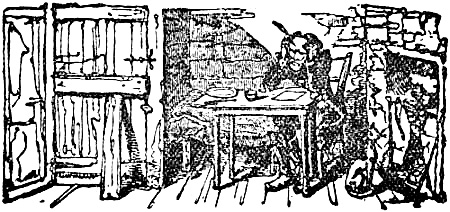
THE LAST CHARLEY.
“Pity the sorrows of a poor old man.”
St. Giles’s clock had sounded two, The moon was on the wane, And bitterly the north wind blew; In torrents fell the rain. When like a goblin from the grave, A ghastly form appear’d, And thrice a grievous groan it gave, Thrice scratch’d its grisly beard. Tall, wretched, shiv’ring, pale and thin, It brav’d the pelting storm, Without an upper Benjamin To keep the carcase warm. Prostrate upon the flags it lay, Where Seven Dials meet; And “Och!” it cried, “is this the way A jontleman to treat? “I soon must haste to join the throng On Pluto’s dreary coast— I’ve given up my spirits long, Now I’ll give up the ghost. “Yes! I must go, at fate’s command, In Charon’s ferry boat, And change the rattle in my hand For rattles in my throat. “That rattle which the prigs to catch Would other Charleys bring, Watchmen, we know, are like a watch— Nothing without a spring. “My lanthorn!—and the thought, I vow, The sob of sorrow draws; No lanthorn can I carry now, Except my lanthorn jaws. “With grief unfeign’d my heart is big— The power of utterance fails, And losing thee, my old Welsh wig, This tortur’d heart be-Wails. “My night-cap red, which this poor head Hath screen’d from damp and dew, Like my poor cap, I’ve lost my nap, And I am worsted too. “Snug in my box I bore the shocks Of drunkard’s jeer and scoffing; Now the vile cough will take me off, And box me in a coffin. “To thee, my pipe, my bosom yearns— Those moments, free from pain, In which I sat and smok’d returns, Will ne’er return again. “This New Police has laid me flat— Let Christian hearts condole; And in the mud they roll poor Pat, Who once was a Patrol. “Och! when I think of former years, It almost drives me crazy; Bear up, my sowl—be dry, my tears— My throbbing heart be azy. “Once I was young, but now I’m owld, Once full of fun and frisky— But now I shudder with the cowld And the devil a drop of whisky!” He spoke, and sadly gaz’d around (The last words he could utter), Then with a mournful guttural sound, Roll’d headlong in the gutter.
Printed by T. BIRT, 10, Great St. Andrew-Street,
(wholesale and retail,) Seven Dials, London.
Country Orders punctually attended to. Every description of Printing on the most reasonable terms, Children’s Books, Battledores, Pictures, &c.
THE SPREES OF TOM, JERRY AND LOGIC;
A New Song, of Flash, Fashion, Frolic, and Fun.
Come all ye swells and sporting blades who love to see good fun, Who in the dark, to have a lark, a mile or two would run; Here’s a dish of entertainment which cannot fail to please, The rigs of Tom and Jerry, and all their jolly sprees. With their dash along, flash along, to Life and London haste away, Where sprees and rambles, larks and gambols, is the time of day. From Hawthorn-Hall young Jerry came to see his cousin Tom, And with his friend Bob Logic acquainted soon became, Then to cut a dash, he learns the flash, to act high life and low, And up and down through all the town at night they rambling go. In a morning at Tattersall’s you may them often see, ’Mong jockies, grooms, and chaunters, a knowing company; In the afternoon they’re lounging in Burlington Arcade, And at night they’re at the Opera, Ball, or Masquerade. Among the milling kiddy coves young Jerry took delight, And was always first to raise a purse to have a glorious fight. A Fancy blade he then became, and his courage ran so high, That in his room, he floor’d his groom, and black’d his valet’s eye. Then off to Leicester-fields they’d march, the Strand, or Drury-lane Among the sporting ladies to carry on the game, They’d take them to a gin-shop and treat them round so civil, Then spur them on to fight and scratch each other like the devil. While rambling up and down one night they came to Temple-Bar, And to have a spree, they did agree, ’gainst the Charlies to make war, Then in the twinkling of an eye a watch-box was upset, The Watchy roar’d till all was blue, but out he could not get. They smash’d their lanterns, kick’d their shins, and did their pipkins crack, And laid them down so neatly one by one upon their backs, The prigs and sporting ladies all joined in the row, But Jerry, Tom, and Logic by the pigs [watchmen] were ta’en in tow. Then to the Holy Land they went disguis’d from top to toe, To see the Beggar’s Opera where all the Cadgers go, With Mahogany Bet they had a lark, Black Moll, and Dumpling Kate, And treated all the apple-women with a yard of tape [gin]. Now, with your leave good folks I will conclude my flashy song, I hope you’re entertained, and I’ve not detain’d you long, And Logic, Tom, and Jerry, do cordially unite, To thank you for your patronage, and wish you all Good Night. With their dash along, &c.
LONDON: Printed by J. CATNACH, 2 Monmouth Court, 7 Dials. Battledores, Lotteries, and Primers sold cheap. Travellers and Shopkeepers supplied with Sheet Hymns. Patter and Slips. Songs as Cheap and Good as any Shop in London. Where an Immense number of songs are always ready. ☞ Cards, &c., Printed cheap.
I’M A CONSTABLE IN MY OWN RIGHT.
I’m a Constable in my own right, I think that I am of some use; A searching by day and by night; Correcting of every abuse. I carries my staff in my hand, My power to let the folks see; I’m certain all over the land There’s no one so busy as me. And I’m a Constable, &c. A Beggar I know by his rags, A thief I can tell by his looks; My eyes and my nose never flags, I puts ’em down in my black books; The blind beggars when they sees me A coming ne’er stops to stand still; Tho’ ever so lame, they walk free, Or else they would walk to the mill. For I’m a Constable, &c. The Publicans all are polite, As soon as they sees me come in, They press, and entreat, and invite To choose of rum, brandy, or gin; But from me they gets a rebuff, The offer I always decline; I scorns to take such vile stuff, As I never drinks nothing but wine. And I’m a Constable, &c. The Watchmen don’t dare go to sleep, They knows they’d be fined if they do; Round with the Patroles I creep, Each morning between one and two. The Patrole’s don’t like it, ’tis true, But of me they all are afraid, And I’m resolved my duty to do, For I know there’s some cash to be made. For I’m a Constable, &c. Old women who sits with the fruit, Had better not come in my claw; I pulls ’em up——won’t let ’em do’t, Because ’tis contrary to law: Such nuisances ought to be fin’d And I get a share of the pelf; My trouble I never don’t mind, ’Cause I keeps a green-grocer’s myself. And I’m a Constable, &c. The Watch-house owns me for its king, I reigns there without a control; If any blackguards they bring, I sends ’em down to the black hole; But if a gentleman gets drunk, so free, And is brought in——mayhap for a whim If he behaves genteel to me, Why I behaves genteel to him. For I’m a Constable, &c. When I sits in my chair of a night, Should any unfortunate gals Be brought in, I thinks it but right To commit ’em along with their pals. The Toms and the Jerrys I hooks, And takes them to Bow Street, next day; Tho’ when very sorry they looks, I lets them off if they can pay. For I’m a Constable, &c. The butchers’ and chandlers’ shops, What used to be serving o’ Sunday, So shockingly wicked, I stops; I pulls them all up on the Monday, I shows no favours to none, My labours they seem to prove double, And thinks before I have done, I shall save Mr. Johnson some trouble. For I’m a Constable, &c. Our Parish has got a bad plan, ’Tis always to quarrel and storm; I’m sure I shall do all I can To bring on a speedy reform: Our Overseers are all quite strange, And that any body may see; It would make a most wonderful change, If they all were as busy as me. For I’m a Constable, &c.
LONDON: Printed by GOLD and WALTON, Wardour Street, Oxford Street, For T. Hudson, Kean’s Head, Russell Court, Drury Lane, 1828.
When again shall we Three meet, Amongst the Swells in Regent Street? Come soon, my boy—come with glee, For lots of Fun—another Spree!
With respect to the publication of Life in London; or, the Day and Night Scenes of Tom and Jerry. The proverbial everybody seems for the nonce to have been pleased with the work. The thirty-six scenes from Real Life, designed and etched by the Brothers Cruikshank had much to do with its success, and everybody seems to have made a great deal of money out of the circumstance—save and except the author, Pierce Egan, for he very loudly and frequently, and also “cry-baby-like,” declared inter alia, that he received—“more of the kicks than the halfpence” by reason of the Pirates and Thieves being ever on the alert to prig his thoughts and ideas, and that the whole crew of them united to grab all the “lively things!” out of his head, and so render the “cash account” at his bankers all but nugatory. Then—“came the cry of immorality, so loudly raised by the Actor’s old rivals the Religious Tract Society, the Methodists, and other sectarian parties.” Yet, in spite of all that could be said or sung in the matter Pierce wrote that—“he was too game to be made a dummy of: therefore he was determined to take the leap, and have another “shy-up,” and go “double or quits,” with that supreme goddess of the gods FAME!!! and try his luck once more in the field of literature and announced the publication of his new work The Finish thus:—
The AUTHOR to the READERS of LIFE IN and OUT of LONDON.
After the lapse of Seven Years the Author has once more seized hold of the feather, and the Artist his pencil, with an earnest endeavour to follow the advice of our immortal bard, or rather adopt him as a model, “nothing to extenuate, or set down aught in malice!” and:—
To hold as ’twere The Mirror up to Nature; to show Virtue her own feature, Vice her own image, and the very age And body of the Time, its form and pressure.
Then thus it is—the “glorious uncertainty” of pleasing every class of society respecting a knowledge of Life in London being essential towards the improvement of the junior branches of mankind; and although contrary to the established and sapient rules of the College of Physicians, and the practice pursued by our learned friends in Westminster Hall, we are, nevertheless, anxious to give advice without a fee, in order to prove that, in all cases, whether connected with youth or more mature age, Prevention is much better than Cure; indeed, so anxious are we to set ourselves right with the public, as to our future intentions respecting this work, and that we may see our way clearly, and tread on the firmest ground, we feel inclined to adopt the latin proverb so often quoted by Bob Logic to the unsuspecting Jerry, on his first arrival in the metropolis:—
Incidit in Scyllam qui vult vitare Charybdim.
The necessity is absolute; or, rather, an apology is required for the introduction of the Author and Artist to the notice of reader, previous to the second appearance of those heroes—Corinthian Tom, Logic and Jerry, on the great theatre of the world! pour quoi? to vindicate the characters of the Author and Artist from unmerited aspersion of having attempted, by the joint efforts of real tales, original anecdotes, and animated sketches, to demoralize the rising generation; and likewise to refute the charge of having turned the heads of older folks towards the commission of acts of folly and intemperance enough! To our task——“Hark forward’s the word, see the game is in view!” and our exertions will be vigorously directed to establish, if possible. “Tâche sans tâche.” Our principal aim being to realize, to the utmost extent, the attractive motto:—
Pro Bono Publico! Proceed, my boy, nor heed their further call, Vain his attempts who strives to please you all!
THE FINISH TO THE ADVENTURES OF TOM, JERRY, AND LOGIC, In their Pursuits through Life In and Out of London, BY PIERCE EGAN. With numerous Coloured Illustrations by Robert Cruikshank. London: George Virtue and Co., Ivy Lane, Paternoster Row.
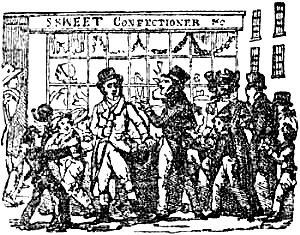
The Finish to Life in London is embellished with thirty six illustrations by Robert Cruikshank, and contains XV. Chapters of letter-press matter. Tom, Jerry and Logic are again brought on the scene, and several additional characters are introduced into the work, notably Sir John Blubber, Knt., a second Falstaff, without stuffing, a most facetious, jolly, good-natured soul, one of that class of persons deemed independent, and his property enabled him to “care for nobody.” The adventures of the personnæ in their pursuits of Life in and Out of London are fully described, and the “Finish!” of Logic, the Oxonian, and Corinthian Tom narrated as follow.
CHAPTER XIV.
Jerry determined to give up all thoughts of Life in London; to retire from the Day and Night Scenes altogether. Moralises on his late imminent danger, and almost miraculous escape from death. Logic rapidly declines in health. The Oxonian makes his Will. His advice to Jerry before his exit. Epitaph on Logic, written by the Corinthian.
********
“I hope Logic will be able to accompany us in our visit to Lord Liberal’s Gallery,” said Tom, when he was interrupted by the footman putting the following letter into his hand—“Aye,” observed Tom to Jerry, “here is a note from Bob; let us hear what he has to offer upon the subject:—”
My dear Tom,
I regret very much that my health will not permit me to accompany you and the “Young One” to view my Lord Liberal’s fine gallery of paintings; a pleasure which I had sincerely anticipated, as it is well known that his Lordship’s taste respecting the fine arts, is considerably above par. But “necessitas non habet legem!” To tell you the truth, I am seriously ill, although not alarmed; yet, I must confess, that I never felt so strangely in the whole course of my life. I think the volume is nearly spun out; and that the Book will soon be closed for ever! But Dr. Finish’em will not have it so, nay, he insists on the contrary, “Lots of pages,” says he, “yet remain to be read;” and several Chapters must be perused, before you arrive at that emphatical word—FINIS! Be that as it may; you are aware that doctors differ, and I do not like appearances; yet, as we say at Oxford, forti et fideli nil difficile! Nevertheless, I am anxious to see you, my dear friend, as soon as convenient; and I wish Jerry to be your companion, as I have something to communicate to both of you, rather of a serious nature, concerning myself; yet, I am far from labouring under un cœur contrit. Therefore tell the “Young One,” I hope his person is now quite cool—that his flame is also cool; and instead of lamenting over the—&c., &c.—I am happy to hear he is Mens sana in corpore sano:—
I remain, my dear Tom, Yours, truly, Robert Logic.
Corinthian Tom, Esq.
“There’s something behind this letter that I do not like,” said Tom; “Bob is very ill, you may rely upon it, or else he would not be so pressing for us to visit him.” “Yes, I am afraid it is too true,” replied Jerry; “but let us hope he is not so bad, neither, as you perceive, he is joking about my late affair.” “Joke with you!” echoed Tom, “I expect Logic will die with a joke in his mouth, he is so fond of punning? But we will lose no time, as I am anxious to ascertain the true cause of his illness.”
Upon the arrival of our heroes at the apartments of Logic, they found him sitting at a table, in his arm chair, with pens and ink before him: his countenance most woefully changed for the worse. Indeed, Tom and Jerry were quite shocked with his altered appearance in so short a time. He endeavoured to smile upon them, as usual; but it savoured more of the “ghastly!” than that sort of enlivening humour which so generally imparted animation to his cheerful face. “I am very glad to see you, my boys,” said he, “before I start on my long journey, which I have been preparing for these last five or six days.” “I was not aware you had any such intention,” answered Tom; “but may I ask, where are you going?”
“To that bourne from whence no traveller returns!”
replied Logic, accompanied by a most penetrating look at the Corinthian. “Dr. Finish’em has given me my quietus, like an honest fellow. On feeling my pulse, he observed—“Your hour-glass is almost run out! Tempus fugit! Therefore, what you have to do, let it be done quickly, or else it will not be done at all!” Old Bolus, too, was rather funny with me on the occasion; “I know,” said he, “your Will was always good to serve everybody; therefore, Mr. Logic, have a good WILL now towards your friends.” I took Pill and Potions advice, and the few hours allotted to me I have made the best use of that I possibly could; and here is my WILL for your approbation.” The tear started down Tom’s cheek, and Jerry was much affected by the unexpected circumstance. “I sincerely hope it is not so bad as you apprehend,” said Tom. “Yes, my dear friends,” replied Logic, “it is all over with me. I have suffered severely from an inflammation in my bowels; but the pain has subsided, and that is the sign of approaching death. You will perceive, on looking over my TESTAMENT,[39] that I have not adhered to any of the technical terms of lawyers, being well aware that the distribution of my property will never puzzle the pericranium of the Lord Chancellor, or occasion a row among the learned brethren, to obtain a brief upon the subject; and if I have not made myself perfectly intelligible, I hope you will now point out any errors that may appear to you, in order to avoid disputes hereafter. It is true, I have no blunt to leave you, my boys, but several notes, which I hope, will always bear an interest, and prove as valuable to you in the hour of need—as cash! You will, my dear Tom, as my last request, read it aloud, for the approbation of my friend Jerry.”
THE LAST WORDS AND TESTAMENT OF ROBERT LOGIC.
Being wide awake—my UPPER STORY in perfect repair—and down to what I am about—I have seized hold of the feather, with a firm hand, to render myself intelligible, and also to communicate the objects I have in view; I give and bequeath unto my friend, Jerry Hawthorn, Esq., my tile, my castor, my topper, my upper-crust, my pimple coverer, otherwise MY HAT, which, I hope, will never be the means of changing the appearance of “an old friend with a new face.” To my out and out friend and companion, Corinthian Tom, I give my spread, my summer-cabbage, my water-plant, but more generally understood as my Umbrella; who, I feel assured will never let it be made use of as a shelter for duplicity, ingratitude, or hum-buggery of any sort! Also, to Jerry Hawthorn, Esq., I resign my fam-snatchers, i.e., my Gloves, under the consideration, if ever he should part with them, that they are only to be worn by those persons, who have “a hand to give, and a heart that forgives!” Likewise to Jerry Hawthorn, Esq., I bequeath my four-eyes, my barnacles, my green-specs, but amongst opticians, denominated Spectacles. It is my sincere wish, that nothing green will be ever seen appertaining to them, except their colour; I also hope they will not, upon any occasion whatever magnify Trifles into difficulties: but enable the wearer to see his way through Life as clear as crystal! I press upon Jerry Hawthorn, Esq., his acceptance of my fogle, my wipe, my clout, my sneezer, politely termed a Silk Handkerchief. This article has often been used to wipe off a tear of pity, and always forthcoming at a tale of distress; may it ever be at hand on such Christian-like occasions! To Philip Timothy Splinter, Esq., I bequeath my upper tog, my Benjaman, my wrapper, generally called a Top Coat, with the advice, that however it may be mended and mended again, he will never let it be turned against unavoidable misfortune, and charity. My ticker, my tatler, my thimble, otherwise my Watch, I bequeath to Jerry Hawthorn, Esq., as an emblematical gift to keep Time upon all occasions—to remember its inestimable value, and also to recollect that he will, some day or another, be wound-up for the last time. My two Seals I give conjointly to my most valued and dear friends, Corinthian Tom and Jerry Hawthorn, Esqrs., in order, if possible, that the bonds of friendship may be more firmly sealed between them, to the end of their lives. To Miss Mary Rosebud, I give and bequeath my Diamond Ring, as a representative of her excellent brilliant qualities, and also as a golden fence, to secure her virtue, reputation, and dignity. To my worthy friend, Sir John Blubber, Knt. I give and bequeath my padders, my stampers, my buckets, otherwise my Boots, whose knowledge of mankind, united with kindness towards the failings of others, teaches him to tread lightly o’er the ashes of the dead! To prevent mistakes respecting my Bit, I have not a bit to leave; it having been with me, for some time past—Pockets to Let, unfurnished; Sic transit gloria mundi! But nevertheless, I trust I have always proved amicus humani generis! My Books having been long booked for their value, and afforded me consolation and support in the hour of need—I, therefore, leave as I found it, for other folks to bustle in, that Great Volume—the World! which upon all occasions, was my sheet-anchor! assisted by the following good old maxims, as my guide:—
Tempus edax rerum.—Time that devours all things. Vincit veritas.—Truth conquors. Principiis obsta.—Resist the first beginnings. Vitiis nemo sine nascitur.—No man without his faults. Spes mea in Deo.—My hope is in God. Spero meliora.—I hope for better things. Robert Logic.
Tom and Jerry were both considerably affected at the kindness displayed towards them by the Oxonian; and had it been at any other time, the singularity of the above Testament would have produced much laughter between them; at all events, it convinced them that Logic still preserved his character for ORIGINALITY. Three proper witnesses, disinterested persons, belonging to the house, were instantly called in to sign it, when the Testament, in the eye of the law, became a valid document. “My dear Jerry,” said Logic, “as we must soon part, I had intended to offer a few remarks for your consideration; but, finding that my strength will not second my intentions, I shall be very concise on the matter: you must perceive that the comical part of my career is at an end, and you are well aware that I always was a merry fellow; but, as Mercutio says, I shall be found a grave man to-morrow. Endeavour, then, “To do unto all men, as you would they should do unto you,” and you will not be a great way off the right path to happiness. I feel myself very faint; my breath getting short; and having settled everything to my satisfaction, have the kindness to assist me into bed, that I may die like a Christian—contented, and in peace with all mankind! Tom, give me your hand; Jerry, yours likewise—I grasp them both with sincerity!” Then looking them full in the face; with a placid smile on his countenance, his last words were—“God bless you!” His lip fell; his eyes lost their brilliancy; and the once-merry, lively, facetious, friendly Logic, was now numbered with the dead!
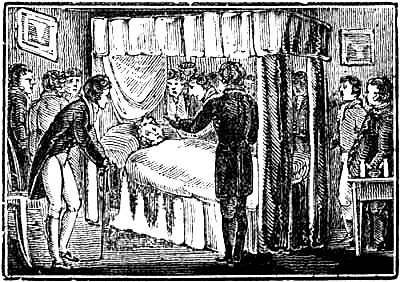
For several days, our heroes were absorbed in grief, at the sudden loss of their much-admired and valued friend; and Corinthian House, for a long time after the decease of the Oxonian, was dull in the extreme. The funeral of Logic, under the direction of Tom, was of the most splendid description; and a handsome monument was also erected by his order, bearing the following inscription:—
This Tablet Was erected in remembrance of ROBERT LOGIC, Esq., Who was viewed throughout the circle of his acquaintances as A MAN, In every sense of the word, Valuable as Gold! Mirth and Good Humour were always at his elbows; but DULL CARE Was never allowed a seat in his presence. He played the first fiddle in all companies, and was never out of tune: Bob was a wit of the first quality; But his Satire was general, and levelled against the follies of mankind: Personality and Scandal he disclaimed: His exertions were always directed to make others happy. As a Choice Spirit, he was unequalled; And as a Sincere Friend, never excelled; but in his character of a MAN OF THE WORLD, Bob Logic was a Mirror to all his Companions. Mankind had been his study; and he had perused the Great Book of Life With superior advantages; and his Commentaries on Men and Manners Displayed not only an enlarged mind; but his Opinions were gentlemanly and liberal. His intimate knowledge of Vice had preserved him from being Vicious. By which source he was able to discriminate with effect; and Virtue appeared more beautiful in his eyes. Truth was his polar star; and Integrity his sheet anchor. Adversity could not reduce his noble mind, And Prosperity was not suffered to play tricks with his feelings; HE WAS A MAN UNDER ALL CIRCUMSTANCES! Flattery he despised; while Candour obtained his respect; and the corner stone of his character was—Sincerity. He was charitable, but not ostentatious, and a well-wisher to all the world. His Friends, TOM AND JERRY, Lamenting his severe loss in society, trust, that upon the AWFUL, DAY OF RECKONING, The Great Auditor of Accounts will find his Balance Sheet correct, (errors excepted): And as the whole tenour of Bob Logic’s life had been A Volume of Pleasure they sincerely hope it will be Well Bound at the last!
CHAPTER XV.
“There is no place like Home!” Jerry bids adieu to Life in London, and sets out, with the Corinthian, for Hawthorn Hall. Rosebud Cottage in sight, the Church in perspective, and a good look-out towards the High Road to Matrimony. Uncertainty of existence: sorrow succeeding sorrow: Tom killed by a fall from his horse while hunting. Jerry disconsolate for the loss of his two Pals. Reflections on the death of the Corinthian, and a few Lines to his Memory. Grieving’s a folly! Thoughts on Marriage: popping the Question—the bit of Gold—the reluctant NO—YES!—Old Jollyboy an important feature. The Wedding Day—all happiness at Hawthorn Hall—Jerry and Mary Rosebud united. The TIE-UP of the Story, i.e., to promote Life in the Country.
The sudden death of Logic made quite a chasm in the movements of Tom and Jerry; indeed he had been the principal caterer for their amusements, and our heroes were not only in grief for his loss, but reduced completely to a stand-still without him. It is true; Jerry had previously made up his mind to quit London, but the sudden demise of the Oxonian positively hurried him out of town. The Metropolis had lost its attractions upon the feelings of Jerry, and he flattered himself that the neighbourhood of Hawthorn Hall, the sports of the field, and the fascinating company of Miss Rosebud, would, in a great measure, afford relief to his mind, and ultimately restore him to cheerfulness. The parents of Jerry were overjoyed in beholding their darling son once more safe under their roof, and the Corinthian also received the most friendly congratulations on his arrival at Hawthorn Hall. The sombre appearance of our heroes, who were in deep mourning for the Oxonian, operated as a great drawback to the festivities which under different circumstances, had been intended to celebrate their reception; indeed, at every step they took, the loss of Logic was sincerely regretted by all those persons who had ranked him as one of their best acquaintances, during his last appearance at Hawthorn Hall. “To me, the loss of Logic is incalculable,” said Jerry, to his father; “he was not only able to advise, but his manner of doing it was so persuasive, that it was impossible not to benefit by his experience; more especially at my time of life, when such experience was by far more valuable to my mind, than any knowledge I might have obtained of men and manners, through my own exertions!”
Our hero lost no time in visiting Rosebud Cottage. On his entrance he was welcomed by the father of our heroine with no common sort of ardour; but, on his being ushered into the presence of Mary Rosebud, he felt confused, nay, ashamed; her looks, although accompanied with a smile, nevertheless told him that he had been neglectful towards her, during his residence in London, and she gently chided him for his want of attention. “I am afraid, Sir,” said she, “it has been with you like most professed lovers, ‘out of sight, out of mind.’” Jerry could not reply; his excuses were lame and impotent; indeed, he was aware that he was in fault, and, therefore, sensibly threw himself upon the mercy of the Court, and sued in the most persuasive manner for pardon. The good nature of Mary, aided by a little of something else—perhaps, love—could not resist the application; and she generously admitted that some allowance might be made for him, when surrounded by the attractions of London. “Generous girl!” exclaimed Jerry, “the remainder of my life shall be devoted to your happiness.”
Jerry being now perfectly established in the good opinion of Miss Rosebud, became doubly attentive in his visits; when the minutes, the hours, the days, nay, the weeks almost appeared to fly, so fascinated was Jerry with the company and attractions of our charming heroine. In truth, the time of Jerry was completely occupied with hunting, dinners, card-parties, assemblies, &c., accompanied by Tom; and his life appeared so happy, that he congratulated himself on his return to the seat of his father, also upon the hair-breadth escapes he had met with, during his Day and Night Scenes in London.
********
********
During a walk one fine evening, and Hawthorn Church appearing in view, Jerry was determined to make the best use of the opportunity which offered itself, by soliciting Mary Rosebud to name the day that was to complete his happiness. “I have always promised my father,” replied Mary, with the utmost frankness, “that he should name the wedding-day; therefore, gain his consent, and you will have no complaint to make against my decision.” “I will be your father upon that joyful occasion,” said the Corinthian, “if you will permit me, my dear Miss Rosebud, as I am very anxious to bestow on my friend Jerry one of the greatest treasures in this life,—a most amiable companion and virtuous wife.” Miss Rosebud blushed at the remark, but nevertheless felt pleased with the compliment paid by the Corinthian; and the subject was dropped until they arrived at Rosebud Cottage. The father of our heroine, on being made acquainted with the wishes of the young folks, observed, “I am quite content; and I sincerely hope they will prove one of the happiest couples alive. Therefore, let the settlements be drawn immediately, the licence procured without delay, the dresses made offhand, our friends invited in good time, and Old Jollyboy requested to hold himself in readiness. Now, having settled this marriage business to my mind, let us have a jolly evening together, before we part; and to-morrow, Jerry, what do you say to a day’s hunting? And your cousin, Tom, I have no doubt, will make one of the party.” “It will afford me great pleasure,” replied the Corinthian; “and we will be in time to start with you.” The evening was spent in great jollity.—“The single married, and the married happy,” were toasted over and over again by the party, until Jerry became as lively as a lark, Old Rosebud roaring out the view halloo! The Corinthian quite merry and facetious, and Old Jollyboy rather above par, hiccoughing, every now and then, with an attempt to pun, that he was “fond of (a) good living!”
Our heroes were ready at the appointed time to take the field with Old Rosebud; the latter fox-hunter was in high glee with the excellence of the day’s sport, Jerry equally delighted, and Tom had just declared he had not been so pleased for a long time; but, unfortunately for him, in his bold endeavour to clear some high palings, his horse fell with him, and he was thrown some distance. On being raised from the ground, it was discovered that his neck was dislocated, and he expired instantly. Upon Jerry’s ascertaining the fate of the Corinthian, his feelings were so completely overcome, that he fell down in a fit quite senseless.
To describe the wretched state of mind which Jerry suffered for several days, at the unexpected accident and melancholy death of his dearest friend in the world would have baffled the poet’s skill and the painter’s talents to pourtray—the shock was so sudden, and the loss to our hero so great, that it was impossible to have been otherwise; just at the moment when happiness appeared to be within his grasp, and he was also slowly recovering from the serious effects which the death of Logic had also made upon his feelings, to have met with such an immense blow—the death of Corinthian Tom—shattered his nerves all to pieces, and anything in the shape of consolation appeared to him officious, troublesome, and unavailing! Ultimately, by the soothing attention of Miss Rosebud, the friendly interference of the old fox hunter, her father, the unremitting kindness of his parents, and the cheering, good advice of Old Jollyboy, by degrees he was restored to a state of convalescence.
From “Gay to grave,” was now the reversed scene for the contemplation of our hero, and the old proverb verified to an awful extent, “that many things happen between the cup and the lip;” the marriage rites were now suspended to make way for the performance of the burial service. The remains of the Corinthian were conveyed to town with the utmost solemnity, and interred in the family vault, with all those obsequies due to his rank; and although Jerry remained extremely ill, and scarcely able to stand upon his legs, yet he was determined, at all hazards, to pay the last respect to his most valued friend and relative, Corinthian Tom, by his appearance at the funeral in the character of chief mourner. Jerry did not quit the Metropolis until he had settled every thing to his satisfaction respecting the interment of the Corinthian. Upon the return of Jerry to Hawthorn Hall, several days elapsed before anything like pleasure occupied his mind; he positively refused to quit the house, and he also shunned the society of his acquaintances. “It requires no common fortitude,” observed Jerry, to Old Jollyboy, “to bear up against the loss of two such invaluable friends as Tom and Logic, snatched, as it were, in an instant from me, when I stood most in need of their assistance, and to whom I am principally indebted for the knowledge of mankind which I now possess. In Logic, I have lost a model of experience, a fund of talent, and a heart overflowing with the milk of human kindness. By the death of Tom, I shall heavily miss that urbanity, discernment and liberality, which highly distinguishes the polished, and thorough-bred gentleman. I am now left to decide for myself; but, nevertheless, I hope I shall sincerely profit by their example. Appearances, I am perfectly aware might be against both of their characters with the fastidious part of society, yet hypocrisy, cant, humbug, or dissimulation, never disgraced their conduct: a love of honour shone conspicuously throughout their actions, and, by an acknowledgment of their own errors, displayed a noble generosity towards the faults of others. They taught me not to spend time in regretting any mistakes that I had made, but to exert myself upon every occasion to repair them. This maxim shall be my guide through life—I will not repine, but struggle with fortitude against unavoidable calamities, and endeavour to make myself happy under all circumstances of my existences.”
Jerry immediately gave orders for a very handsome stone to be placed in the most conspicuous situation near to the spot where Corinthian Tom lost his life, with the following inscription engraved upon it:—
Near to this Spot of Earth, Lost his Life by a Fall from his Horse while Hunting, CORINTHIAN TOM, One of the highest-bred creatures in the Universe, and who got over the ground like nothing else but A GOOD ONE: In the walks of fashion, he was a Corinthian; Amongst the Bloods, a bon vivant; On the Turf a real Sportsman; in the Chase, an Out and Outer; And in his deportment to every person A PERFECT GENTLEMAN! If he could not put in a positive claim to the title of The Rose and Pillar of the State. No man in the world ever possessed the Suaviter in Modo and Fortiter, in re In a more eminent degree than Corinthian Tom. This Remembrance has been erected by his Relative and sincere Friend JERRY HAWTHORN, Esq., Under the hope, that when he hears the Last View Halloo! His Pedigree may be found sound; his Race complete, by Winning the Happy Stakes; and nothing against him Noted down in the Steward’s Book.
“I admit your loss has been great, and I also admire the tenour of your argument,” observed Mr. Rosebud, “but, nevertheless, ‘grieving’s a folly;’ there is a time for every thing, as my friend Old Jollyboy would have observed, therefore, Jerry, having done every thing becoming the character of a sincere friend, I think you ought now to turn to a more pleasant view of the picture, and once more give your acquaintances the benefit of your company.” “Good!” exclaimed Old Jollyboy; “for some time past, I have been holding myself in readiness to receive a summons to perform a certain ceremony, without Squire Hawthorn has given up the marriage altogether. All in good time perhaps!”
The trifling hint was quite sufficient, and Jerry, lest his conduct should be thought cold or neglectful, presented himself, in the course of the morning, “for better or for worse,” to Miss Rosebud, at the Cottage, anxiously soliciting her to name the wedding day. The disposition of Mary Rosebud was of the most ingenious nature, and her attachment to our hero too great to keep him long in suspense. “Perhaps, Sir,” said Mary, “I ought to say ‘No!’—and insist upon more time, to enable me to form a correct opinion of your conduct, whether you have duly considered the serious and important charge of martrimony, and the confinement also attendant on such a state; and, likewise, freely consenting, as it is termed, to surrender a part of your liberty, before I say ‘Yes.’ But I prefer being frank on the present occasion; and, relying on your honour, generosity, and true love, I am content, whenever my father shall think proper to name the day.” “Generous, amiable girl,” replied Jerry, “I have well considered the subject, in every point of view; but I will make no professions: yet my endeavours throughout my life, shall be to strengthen, what the Poet has so beautifully described, the
“Perpetual fountain of domestic sweets.”
The day was immediately fixed for the nuptials by Mr. Rosebud; the marriage ceremony was performed by Old Jollyboy, and when Miss Rosebud answered “I will!” the old Curate was so full of joy, that the word “Good!” had almost escaped his lips. The estates of the Rosebuds and the Hawthorns were united, and Mary and Jerry made the happiest of the happy. The wedding-day was devoted to pleasure. “It shall be kept in the old style,” said Jerry’s father; “every body, shall be welcome; we will have a dance upon the green; all the lads and lasses in the village shall be invited to celebrate the wedding; we will broach a tub of ‘humming bub!!’ and nothing shall be wanting to promote mirth and harmony.” “Good!” said Old Jollyboy, over his pipe; but, long before the approach of night, the “gaily circulating glass” had been pushed about by Old Hawthorn to all the company—that, suffice to observe; as we have too much respect for the cloth to tell tales, the fine old Curate required the assistance of “Amen,” the clerk, to make Jollyboy “all right” at the Curacy.
The honey-moon was, of course, a raptuous one; after which Jerry might be viewed as a “settled being.” Time rolled over pleasantly with him and his bride; and the sports of the field, if possible, he enjoyed with greater zest than heretofore. His fire-side was a pattern of domestic comfort, although a sigh would now and then escape his lips, whenever the thoughts of Tom and Logic came over his mind. In every other respect, Jerry was a picture of contentment; determined to profit by his experience, and to turn to a good account, for the benefit of himself and his family, the many hair-breadth escapes and dangerous adventures he had met with in his Day and Night Scenes in Life in London. He was the delight of all the companies he visited in the neighbourhood of Hawthorn Hall; his general conduct was the praise of the surrounding gentry, and he was admitted, by all parties, to sustain the character of a perfect Country Gentleman. We now take our leave of Jerry, “all happiness,” with his amiable wife, a fine estate, a capital stud of horses, and a crack pack of hounds, to promote—
LIFE IN THE COUNTRY.
The End.
KEY TO PERSONS AND PLACES, &c.
A.
A.B.C.—Any easy matter, the A.B.C. of the affair, i.e., the whole of the particulars can be comprehended as soon, or as easy as you can say A.B.C.:—Then comes answer like A.B.C. book.—Shakespeare.
Above Board.—In open sight, all fair and square, dealing without artifice or trick.
Above Par.—Tolerably drunk—also to be possessed of money beyond one’s actual expenses—plenty of the needful—lots of blunt!—able to post-the-pony—lay down the rag!—chink the ochre! &c., in case of laying a wager or making an investment.
Ace of Spades.—A widow.
Adelphi.—Greek for brothers: several streets on the south side of the Strand, London, erected about 1768 by the brothers, John, Robert, James, and William Adam, after whom the streets are named.
Adelphi Theatre.—Formerly called the Sans Pareil, opened under the management of Mr. and Miss Scott, 27 Nov., 1806. Messrs. Rodwell and Jones purchased the property and opened on Monday, Oct. 18, 1819, and issued the first playbill bearing the name of “Adelphi Theatre.” Messrs. Mathews and Yates became managers, Sept. 29, 1828—Mr. Charles Mathews—Mathews at Home—died the 28th of June, 1835. The theatre was then let for the remainder of the season to Messrs. Ephraim Bond and Company, and announced to be “under the management of Mrs. Nisbett.” After that Mr. Yates had the sole management. In 1840 Messrs. Yates and Gladstone were the proprietors. Mr. Benjamin Webster became lessee, and Madame Celeste directress, 1844. The theatre was re-built and opened, with improved arrangements 27 Dec., 1858, as The New Adelphi. In 1870 it was announced that while Mr. Ben. Webster was sole proprietor, Mr. Webster and Mr. F. B. Chatterton were joint managers. After several changes Messrs. A. and S. Gatti became sole proprietors and managers.
Air and Exercise.—Or, Shoving the tumbler. Being whipped at the cart’s tail.
Alderman.—A turkey, Alderman in chains, a roast turkey well-stuffed and garnished with pork sausages; the latter emblematical of the gold chain worn by that civic dignitary.
Ale Draper.—The alehouse-keeper; a rum cull, a squirt quester. Ale spinner, a brewer or publican.
Alive.—Active, smart, to be ever on the alert. Alive to the subject; the game, the fact, or to any circumstance. Tom’s alive to his own interest, let him alone for that; he’s wide-a-wake!
All Hands to the Pump.—All force concentrated to one spot.
All-Max in the East.—Open to all influenced by none—was held at the Coach and Horses public-house, Nightingale-lane, East Smithfield, and was frequented by most of the Wapping elegantes. Blue Ruin and reels were generally the order—rather the disorder of the evening.
All Out.—The whole of the reckoning. “How stands the great account t’wixt me and vengeance!”
Almack’s.—Aristocratic exclusiveness. A ball given by the highest nobility. Almack’s means properly a suite of assembly rooms in King Street, St. James’s, London, built in 1765 by a Scotchman named Macall, who inverted his name to obviate all prejudice and hide his origin. Balls, presided over by a committee of ladies of the highest rank, used to be given in these rooms; and to be admitted to them was as great a distinction as to be introduced at Court. The rooms are now called Willis’s from the present proprietor.
If once to Almack’s you belong, Like Monarch’s, you can do no wrong; But banished thence on Wednesday night, By Jove, you can do nothing right.
Alone.—A knowing one may be trusted “Alone” by reason of his experience in worldly matters.
Angelics.—Young ladies. N.B. Unmarried!
Annointed.—Knowing, ripe for mischief, full of courage and energy for any desperate exploit.
Apartments to Let.—It is said that the “widow’s cap,” denotes that there are Apartments to Let! Also of an empty-headed or shallow-cove.
Argument.—The best of the. Any man with a pair of leather lungs has the best of an argument at a tavern, unless there be an other present who can lay heavy sums which are quite uncoverable that his opinion or assertion is correct. A stable-keeper being beaten in argument by one of the leather-lunged breed, produced a large roll of bank-notes and a handful of sovereigns, smacking them down on the table exclaiming, “There you —— look at that; if I am a fool my money’s none. That beats you!”
Arm Pits.—To work under the arm pits, is to practise only such depredations as will amount on conviction to transportation. By following this course and system, a thief avoids the halter, or neck-squeezer! which certainly is applied above the arm pits.
Arm Props.—Crutches.—Go it ye cripples crutches are cheap.
Astley’s Amphitheatre.—Was built and opened by Philip Astley, 1773.
Astronomer.—A star-gazer. A horse that carries his head high-up in the air.
At Fault.—At a loss; not knowing in what direction to proceed, like dogs who have lost scent of a hare or fox. This sporting phrase is often used, figuratively to signify that a man has been defeated in his pursuits, and does not know how to extricate himself from difficulty.
At Home.—To Provincials, this phrase may operate rather as a sort of paradox—as houses and persons, in general are robbed not “at home” but when the parties are abroad.
Awake.—Knowing; acquainted with, aware of, or knowing what is going on. Awake to the move, aware of the proceedings; Stow the books, the culls are awake, Hide the cards, the persons know what we intend to do. This word is used on many occasions, and in most situations of life, being expressive of attention.