The True History of Tom & Jerry: or, Life in London (continued 2)
Reading edition
Jerry. A hack! If it is the thing we rattled over the stones in to-day, it might more properly be called a bone-setter.
Tom. Or bone-breaker—But if you dislike going in a hack, we’ll get you a mab.
Jerry. A mab! I’m at fault again—never shall get properly broken in.
Tom. A mab is a jingling jarvey!—a cabriolet Jerry—but we must mind our flash doesn’t peep out at Almack’s. ’Tis classic ground there; the rallying spot of all the rank, wealth, and beauty in the metropolis; the very atmosphere of it is—
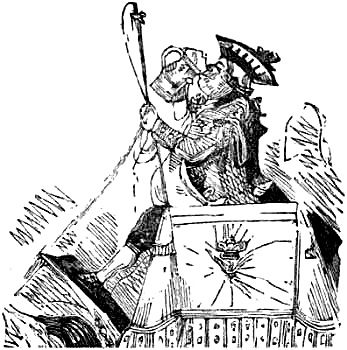
The Bang-up of the Big Wigs.
Jerry. Rather different to that of Rum-ti-tum and the rats. I should imagine.
Tom. A shade or two!—we must be on our P’s and Q’s there—forget the Phenomenon and the Fancy. If you find me tripping, Jerry, whisper Lethe to bury it in oblivion; and, if necessary, I’ll do the same kind office for you.
Jerry. Ten thousand thanks!
Log. Come along, then. Now, Jerry, chivey!
Jerry. Chivey?
Log. Mizzle?
Jerry. Mizzle?
Log. Tip you rags a gallop!
Jerry. Tip my rags a gallop?
Log. Walk your trotters!
Jerry. Walk my trotters?
Log. Bolt!
Jerry. Bolt? oh, aye! I’m fly now. You mean go.—Exeunt Omnes
Almack’s in the West.
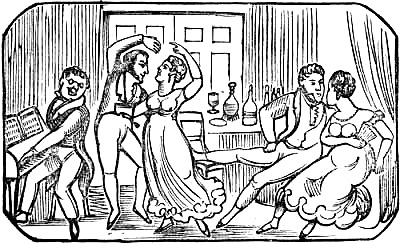
If once to Almack’s you belong, Like Monarch’s you can do no wrong; But banished thence on Wednesday night, By Jove, you can do nothing right. Ladies, your most humble servants, Tom and Jerry stands before you. Our blood is thrilling, you’re so killing; At once we love you and adore you. Let us softly sit beside you; Trust us, you will quickly own, That love’s alarms hath sweeter charms Than joys e’er yet to mortal known.
SCENE.—Almack’s brilliantly illuminated—Duchess of Diamonds, Countess Conversatione, Princess Pulmante, Lady Eastend, Baron Rufus, Sir Tilbury Unit, and Company discovered.
Enter KATE, SUE, JANE, and TRIFLE.
Sue. I do not see them yet.
Kate. I can depend upon Corinthian; and I think you may upon your lover. In the meantime, let us have a minuet to dissipate our ennui.
Enter GREEN, in ball dress.
Green. Aye, aye, a minivit to dissipate our ong vee, by all means.
Sue. As I live, Trifle, here is that Mr. Green, to whom you introduced us.
Trifle. Aye, aye, from the City. We find these City folks—these Greens—excessively useful in money matters, pan hanour. How are you my dear fa-el-low.
Sue. Your servant, Mr. Green.
Green. Ladies, your most dewoted. Mr. Trifle, your humble—Oh, this is the master of the ceremonies, and those are the two that’s to dance the gavotte. Yes, that’s Willis—permitty moy. (Takes Kate and Sue’s arms).
Kate. Eh, bless me, Mr. Green, what is the matter? Why, you seem quite out of spirits; I hope nothing has happened to Mrs. Green or any of the little Greens.
Green. Oh, no, nothing; but you labour under a mistake quite entirely; there is no Mrs. Green—I am not an ’appy man yet! There are no little Greens, neither—no young sprouts, I assure you. No, I’m out of spirits because I have been dished and doodled out of forty pounds to-day; I have been taken in by the purchase of an ’orse at Tattersall’s—It was a very fine looking hanimal but before I got him home, the cursed creature went upon three legs—Dragg’d the other behind him, like a pendulum.
Kate. My dear Mr. Green, will you join in a dance?
Green. Oh, dear no—I couldn’t think of such a thing—I never danced but once, and then I was so excruciated with termidity that I tipped up my partner, lost one of my shoes, and diskivered an ole in my stocking.
Kate. Oh, horrid, how could you support the shock? But here is a lady who is absolutely pining for the honour of your hand.
Green. Vell, if she’ll instruct me when I’m out, I don’t mind making one in a quod-reel.
Sue. That’s well said—hey, here they are, now, my dear Trifle.
Enter TOM, JERRY, and LOGIC, full dressed.
Tom. At length, my dear Jerry, we are at Almack’s, though egad I began to think we should be too late.
Jerry. This indeed is a splendid view of Life in London.
Tom. It is; the tip-top! set off to the best advantage, by the best dresses, finished by the best behaviour. (Trifle quizzes through glass up stage).
Log. Yes, witness that puppy, staring us out of countenance with his quizzing glass yonder—why don’t he wear green specs, as I do, if his ogles are queer.
Tom. LETHE! LETHE! my dear Bob—you forget where you are.
Jerry. The half-and-half coves are somewhat different from the swaddies, and gay tykeboys, at the dog pit—Eh, Tom?
Tom. Lethe! Lethe; my dear Jerry—mum!
Trifle. My dear fa-el-low, you really must excuse my interrupting you—but what can you possibly have been preaching to your friend from the country so long—here are three lovely girls waiting to be introduced to you—relations of mine, the Honourable Miss Trifles—we must make up a quadrille.
Tom. Three girls, Jerry!—Do you hear that?
Jerry. I’m up——
Trifle. I’m not equal to the fatigue of an introduction myself,—but my friend Green from the City here, will oblige me by taking the trouble off my hands.
Green. Vith the greatest of pleasure—the Honourable Miss Trifle—Mr. Corinthian.—The Honourable Miss S. Trifle.—Mr. Hawthorn.—the Honourable Miss J. Trifle—Doctor Logic.
Ceremony of introduction takes place.
Jerry. What divinities! but I say, Tom, this girl is as like my Sue, as—yet it can’t be.
Tom. And this one is as like my Kate as one pea is like another—I could have betted every rap—six quid to four——
Jerry. Lethe, Tom,—Lethe,—L-E-T-H-E. (Spelling it).
Tom. The retort courteous—I own it.
Green. Excuse my hinterfering, my dear fellows, but ve’re just going to make up a quod-reel, and vant you to join us.
Tom. Ah! ah! a quadrille by all means—you’ll dance, Jerry?
Jerry. I know nothing about quadrilles, Tom—but the deuce is in it if I can’t cut as good a figure as this Mister Jemmy Green, so I don’t care if I do kick up my heels a bit.
Green. Aye, a dance, a dance.
After dance, Jerry advances with Sue.
Jerry. Sweet girl! may I be permitted to hope that the partnership of this evening may lead to one for life?
Sue. Ah! Sir, a dance affords you gallant gentlemen worlds of latitude for flattery and deceit.
Jerry. Nay, I am sincere, by heaven!
Sue. Come, Sir, they are about to waltz, and if you wouldn’t have my head as giddy as you seem to think my heart is, you will conduct me to a seat.
Jerry. With rapture! This is, indeed, Life in London.
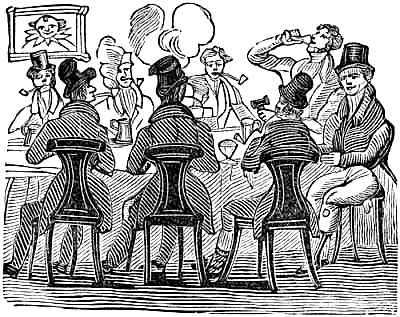
SCENE.—Tom Cribb’s parlour.—Swell coves, Millers, &c., drinking and blowing their clouds; Tom, Jerry, Green, and Logic among them.—Cribb in the chair.—Chorus (Omnes).
Air.—“Oh, who has not heard of a Jolly Young Waterman.”
Oh, who has not heard of our gallant black diamond, Who once down at Hungerford us’d for to ply? His mawleys he us’d with such skill and dexterity, Winning each mill, and making each miller fly! He fibb’d so neat—he stopped so steadily; He hit so straight—he floored so readily. In every game ’twas the Cribb won it fair; He’s Champion of England, and now fills the chair.
Cribb. Thank’ye, gentleman, thank’ye—but as I see by our sporting oracle, “The Dispatch,” there’s a mill on foot—I’ll give you, “May the best man win.”
(All drink). May the best man win.
Green. May the best man vin.
Log. With all my heart; but, zounds! we’ve almost buzz’d the bowl. Let’s have another, and dy’e hear, Tom, serve it up in your prize cup; Jerry hasn’t seen it, and we mustn’t omit that.
Cribb. With all my heart, Doctor; but you must stand a bottle to see the cup.
Log. Yes, yes, I’ll stand a bottle to christen the cup.
Jerry. Aye, aye; I’ll stand a bottle, Tom.
Tom. Ditto for me.
Green. Yes, and I’ll stand a bottle of ditto, too.
Jerry. This may, indeed, be called the very Temple of the Fancy.
Log. Yes, and here are some of the finest fancy sketches in the kingdom.
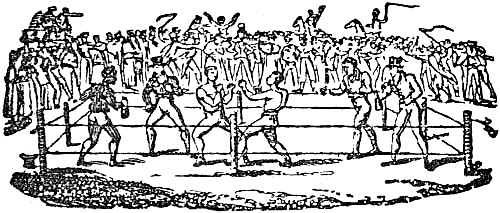
Tom. Well, Jerry, after our last night’s divertisement at Almack’s, the set-to I gave you this morning at the great Commissary-General Jackson’s rooms cannot be better followed up than by a turn in the sporting parlour of honest Tom Cribb.
Cribb. Thank’ye, Mr. Corinthian; I’ll always do my best to satisfy you in any way.
Tom. There is one way, Tom, in which you would very soon satisfy us.
Jerry. Yes, and I’m thinking not a little to our dis-satisfaction. I am of opinion that every gentleman should practice the art of self defence, if it were only to protect him from the insults of vulgar ignorance; though I by no means set myself up as a champion for boxing.
Log. No, for if you did we’ve a champion here who would set you down. We’ll drink his health, and may he ever prove as successful as when he floor’d the Black Miller at Thistleton Gap. (All drink).
Tom. Tom, your health. (Cribb rises). Silence for Tom’s speech—doff your castor, Tom—that’s the time of day.
Cribb. Gentlemen, my humble duty to you. Here’s all your healths, and your families. Bless your soul, I can claim no merit for what I’ve done; fighting came naturally like, and thinking others might be as fond of it as myself, why, I always gave them a bellyfull.
Tom. Bravo, Tom, an excellent speech—Cicero never spoke better.
Log. No, nor anything like it.
Tom. Oh, here comes the cup. Look out, Jerry.
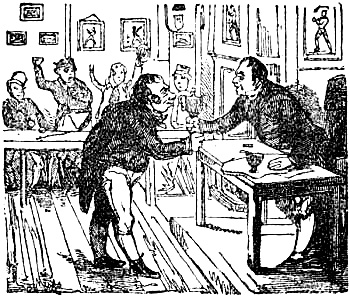
Cribb’s Parlour.[32]
Enter WAITER, with the Champion’s Cup.
Come, Tom—I pledge you. (Cribb drinks; the Cup is passed).
Jerry. Well, this is the pleasantest way of cupping a man I ever heard of—but come, Bob, give us a song.
Log. With all my heart, only let me sluice my whistle first.
SONG.—Logic. Air.—“Such a beauty I did grow.” Oh, when I was a little boy, Some thirty years ago; I prov’d such an anointed one, They made me quite a show. Chorus.—Such a knowing one I did grow. At tea I stole the sugar, And I slyly pinched the girls; I roasted mammy’s parrot, Shod the cat in walnut shells. Such a knowing, &c. At school I play’d the truant, And would robbing orchards go; I burned my master’s cane and rod, And tore the fools’-cap, too. Such a knowing, &c. As I learnt nought but mischief there, To College I was sent, Where I learn’d to game and swear, On fun and frolic bent. Such a knowing, &c. In town I mill’d the Charlies, Aim’d at all within the ring; Became one of the fancy, And was up to everything. Such a knowing, &c.
Jerry. Bravo!—but, zounds! Tom, Tom! what are you musing so profoundedly about?
Tom. I was thinking about the women, Jerry; those enchanting girls we danced with a Almack’s—could they be the incognitas that challenged us thither? There is some secret charm about those girls that hasn’t allowed me to rest all night.
Jerry. Well, and do you know, Tom, to tell you the truth, I haven’t been a whit better than yourself. But, I say, only see how confoundedly the dustman’s getting hold of Logic,—we’ll funk him. (Tom and Jerry smoke Logic).
Log. Oh, hang your cigars, I don’t like it; let’s have no funking.
Tom. Well, come, come, rouse up; don’t be crusty, Bob—let’s start on some spree; no doubt we shall spring a lark somewhere. (Rattles heard).
There’s one! go it, Jerry!—Come, Green.
Log. Aye, come, Jerry, there’s the Charlies’ fiddles going.
Jerry. Charlie’s fiddles!—I’m not fly, Doctor.
Log. Rattles, Jerry, rattles! you’re fly now, I see. Come along, Tom! Go it, Jerry! Exit.
Night Scene.—Tom and Jerry upsetting the Charlies.
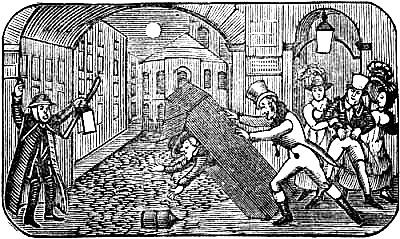
Hark! the watchman springs his rattle, Now the midnight’s lark begun; Boxes crashing, lanthorns smashing, Mill the Charlies—oh! what fun. Pigs are hauling, girls are bawling, Wretch, how durst you bang me so, My sconce you’ve broken—for your joking, You shall to the watch-house go.
SCENE.—The City side of Temple Bar, by Moonlight. Watchbox—Watchmen crying the hour at different parts of the stage.
Enter drunken BUCK.
Buck. Steady! steady!—now where shall I go?—I think I’ll go strait home. (Reels). No, I won’t! I’ll go where I think proper—I’ll go out again—I’ll go—where I like.
(Exit.)
Enter GAS-LIGHT MAN, who lights the Lamp.
SONG.—Gas.
Air.—“I’m Jolly Dick the Lamplighter.”
I’m saucy Jack, the gas-light man, I put the prigs to rout; For where I light do all they can, They’re sure to be found out. Your beaks and traps are fools to me, For in the darkest night; ’Tis I that lets the people see, And bring their tricks to light.
(Exit)
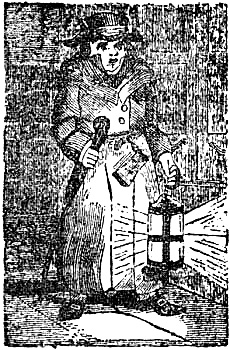
The City Watchman.
Enter O’BOOZLE.—CHAUNT.
Past twelve o’clock—a moon-light night! Past twelve o’clock—and the stars shine bright! Past twelve o’clock—your doors are all fast like you! Past twelve o’clock—and I’ll soon be fast too!
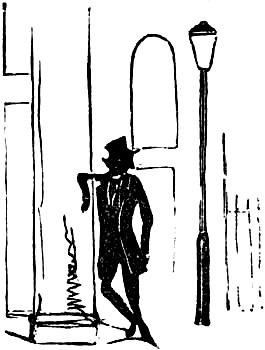
Re-enter BUCK.
Buck. Past two did you say, Watchey? didn’t think it had been half so late—I think it’s time for me to go home to bed.
O’Booz. Why, yes, I thinks as how it is, Sir—you’ve been taking a little too much refreshment—steady! steady! hold up, Sir,
(Pretends to assist him, and picks his pocket of his handkerchief).
Buck. Good night, old Clockey. (Reels off).
O’Booz. Good night, Sir—take care nobody robs your honour. Why, the gentleman’s left his vipe behind him, and I musn’t go off my beat to give it him: how unfortinate—I’ll call him back! Sir, Sir. (Whispers). Bless my soul how wery deaf that ere gentlemen is!—well I must take care of it for him till he calls again!—I don’t know what would become of these here young chaps if it wasn’t for such old coveys as we are—Oh, here comes that cursed Gas!
Re-enter GAS.
Gas. Well, Watchey, and what have you to say about the gas? Eh?
O’Booz. Why, that you have been the ruin of our calling—that’s all!
Gas. Pooh! pooh! nonsense! I only throw a light upon the abuses of it. (Pushes by O’Boozle).
O’Booz. Hollo! you had better mind what you are at with your Jacob, or I shall just— (Sounds rattle).
Gas. Come, come, silence your coffee-mill.
O’Booz. What I’ve got to say is this—yes, the matter of the business is this here:—Since you sprung up, my beat a’nt worth having—I havn’t had a broken head for these ten days past, and there’s no such thing as picking up a couple of sweethearts now—why there isn’t a dark corner in the whole parish.
Gas. No more there should be. Folks have been kept a little too long in the dark.
O’Booz. Have they.
Gas. But good night, for I suppose as how you won’t stand a drop o’ nothin’, old Bacon-face?
O’Booz. No, I suppose I von’t stand a drop of nothing! young Calf’s-head? (Exit Gas singing, “I’m saucy Jack” &c).
O’Booz. I think I’ve given him his change. Well I don’t see the use of kicking my heels about here,—people’s clocks can tell them the time, just as well as I can, I’m sure! and a great deal better, if they knew all! so I shall go into my box, after I’ve called the half-hour, and have a regular snooze. It looks damned cloudy too.
CHAUNT.
Half-past twelve—and a cloudy morning. Half-past twelve—mind, I give you warning, Half-past twelve—now I’m off to sleep! And the morning soon my watch will keep!
(Goes into box and falls asleep).
Tom, Jerry, and Logic in a Row.
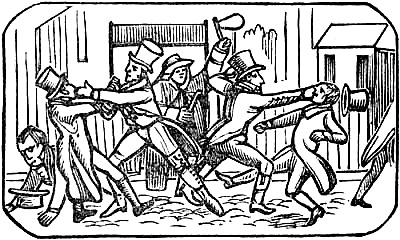
Mercy! what a din and clatter Breaks the stillness of the night, Lamps do rattle—’tis a battle, Quick, and let us see the sight. Old and young at blows like fury, Tom and Jerry leads the row, Milling, flooring all before them, This is Life in London, boys.
Enter KATE and SUE disguised as two young bucks.
Kate. Well, here we are, just before them—and now to cure them of their love and rambling it must be our plan to involve them in all the scrapes we can, we shall never have a better opportunity.
Sue. No, ’tis now the very witching hour of night, as Shakspere says.
SONG.—Kate. Air.—“Ackee oh! Ackee oh!” When the moon o’er Temple Bar Glimmers slow, and gaslights glow; And locked in sleep, grave big wigs are Snoring sound asleep. We for pleasure gaily run, Full of frolic, full of fun; Whisking oh! frisking oh! To pick up a beau.
Sue. Stand aside, my dear Kate, I see occasion for our being active here! If I may trust my eyes, yonder comes a lovely girl—I must have some sport with her.
Enter MRS. TARTAR.
Mrs. T. There, I’ve shut up the shop, and as it’s Mr. Tartar’s turn to sit as constable of the night, I’ll just take him the street-door key, and then he can let himself in when he pleases—I hope the dear man won’t be long.
Kate. Never mind, ma’am, if he should be—anything in my power——
Mrs. T. Keep your distance, sir—I’ll call the watch.
Sue. Nay, but my dear madam, when beauty like yours is neglected, it is the duty of every man. (Kisses her).
Mrs. T. Don’t take liberties, sir.
Kate. I wouldn’t take liberties for the world. (Kisses her).
Mrs. T. Eh, I shall be ruin’d, I’ll call out—here, watch! watch! (Rattles heard).
Enter TOM, JERRY, and LOGIC, with Umbrella.
Jerry. Ay, ay, ay, put down the rain napper, Doctor, the shower is over now. What’s the matter?
Mrs. T. I’m in the greatest distress imaginable.
Tom. Holloa, what’s the row?—a woman in distress! Where’s the man would refuse his assistance?
Kate. Who are you, sir?
Sue. Yes, who are you, sir?
Tom. What, show fight! I’m your man; (To Kate).
Jerry. And I’m your man, my little one. (To Sue).
Log. (To Mrs. T.) And I’m your man, ma’am.
Mrs. T. Watch! watch! (Rattles are heard).
Enter TEDDY M’LUSH, an Irish Watchman.
M’L. Ulloa, here! What the devil have you got a fire?
Tom. What do you ask for your beaver, Charley?
Mrs. T. Why, my goodness, watchman, you are quite drunk.
M’L. Eh, drunk are you,—then I’ll take care of you.
Mrs. T. But I want to give charge of these two gentlemen, who have behaved in the most extravagant manner—almost kissed me to death.
M’L. Oh, you want to charge these gentlemen in an extravagant manner, for almost kissing them to death, do you?—but I’ll soon put a stop to it.
Kate. That’s right, watchman.
Tom. Zounds! fellows, do you think we’re to be bullied in this fashion?
M’L. Oh, you’re bullies dressed in the fashion, are you?—I’ll soon take charge of ye. (Springs rattle—it is answered without, R. and L).
Tom. A surprise! I’ll make sure of this fellow, at all events. Now, Jerry, I’ll show you how to box a Charley.
Log. Stop, my boys, secure your tattlers. (They put up their watches).
Tom. Now, go it, Jerry,—can you play at cricket?
Jerry. Yes, Tom.
Tom. Then catch—here’s the gentleman’s toothpicker, and here’s his glim. (Throw stick and lanthorn to Jerry).
Tom upsets O’Boozle’s box.—enter Watchmen.—General row—Rattles—Logic fights M’Lush.—Kate, Mrs. Turtar and Sue, run off.—Green enters with a bloody nose and two watchmen; he runs off.—Jerry fights with three watchmen.—Tom fights with three watchmen, floors them.
CHORUS. (Omnes). Air.—From the Spectacle of “Don Juan.” Watch! watch! watch! Lord how they’re bawling! Catch! catch! catch! That’s if you can. Scratch! scratch! scratch! Pulling and hauling— Wretch! wretch! wretch! You are the man. Patch! patch! patch! Lots of heads breaking! Fetch! fetch! fetch! The constable, John. Match! match! match! Match them for raking. Watch! watch! watch! My watch is gone.
Mill renewed.—The Women get away as before.—Tom and Jerry perform prodigies of valour, but are at length overpowered by numbers, and borne off.—Green enters alarmed, flies on all sides for safety, but is at length caught up by a watchman in his arms, and carried off.—Scene closes on two watchmen cuffing one another by mistake.
Tom and Jerry in Trouble after a Spree.
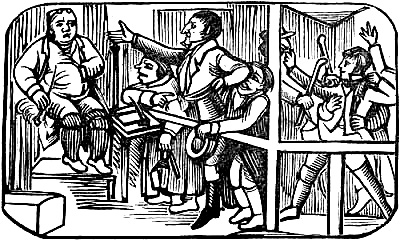
And please your Worship here’s three fellows Been hammering of us all about; Broke our boxes, lanthorns, smellers, And almost clos’d our peepers up. Our pipkins broke, Sir!—’tis no joke, Sir, Faith we’re crush’d from head to toe; We’re not the men, Sir!—Hold your tongue, Sir, You must find bail before you go!
SCENE.—Interior of St. Dunstan’s Watch-house.—Mr. Tartar, Constable of the Night, discovered at table; pen, ink, &c.—Watchman in attendance. Noise heard without.—Cries of “Charge! charge!”
Mr. T. Holloa! a charge! I must get into my big chair, pull off my night-cap, cock my wig, and look official. (Watchman opens the door, and is knocked down by rush).
Enter TOM, JERRY, LOGIC, WATCHMEN, KATE, JANE, SUE, MRS. TARTAR, O’BOOZLE, and M’LUSH, very uproariously. MRS. TARTAR makes signs to MR. TARTAR.
Omnes. Mr. Constable! Mr. Constable—Please your worship, this man!—this woman!
Mr. T. Silence! silence!—Eh, the devil! Sally Tartar, my wife!—and winking at me not to take any notice.
Omnes. Please your worship—I—I——
Mr. T. Silence! silence! Watchman, do you speak first.
Mrs. T. (aside to Tom). Be quiet—I’ll soon turn the tables.
M’L. Plaise your honour, I have brought before your worship a most notorious substitute and common street talker, who, for her foul doings, has been cooped up in the Poultry Compter, as often as there are years in a week.—I caught her charging these honest gentlemen, (pointing to Tom and Jerry) in a most impositious manner, and when I civilly axed her, how she could think of getting drunk, and acting so, she called her bullies here. (Pointing to Kate and Sue).
Kate. Zounds, fellow, you don’t mean us?
Sue. Why, you rascal, I’ll twist your neck for you.
M’L. Yes; they, your worship, who half murdered me first, and then buried poor little Teddy O’Boozle in his box, that he mightn’t prevent them murdering t’other half of me; och, they’re terrible desperadoes!
Kate. Here’s a scoundrel for you!
Mr. T. Silence! we’ll soon get to the bottom of all this.
Kate. Zounds, sirrah, we gave the charge ourselves. (To M’Lush).
M’L. Och, murder!
Kate. Those were the assailants. (Pointing to Tom, Jerry, and Logic).
Mr. T. This is a very intricate affair.
M’L. Sure, won’t I be after telling you my own story:—as I was going my rounds quietly enough, up comes these young sparks, and gave me such a maulagaran, that they knock’d me into the middle of next week—besides tipping me this here black eye—only see how red it is!
Mr. T. I’ll soon set all to rights,—first let me hear what you have to say to all this, woman: these are very serious allegations. (To Mrs. Tartar).
Tom. Aye, aye, let the woman speak.
O’Booz. Oh, the woman will speak fast enough.
Mrs. T. Hold your tongue fellow.—Please your worship, it’s all false from beginning to end—it’s he that’s drunk! nay, you may perceive he’s so drunk he cannot even give a charge—doesn’t know one person from the other, and can scarcely stand.
M’L. Plaise your honour it’s only the ague, I have it every Saturday night regularly, what I’ve said is all true, so help me Bob,—sure, she’s not a woman to put whiskey in a jug, and throw stones at it.
Mr. T. Why, you impudent vagabond you’re drunk now—instead of giving charge of her, the good lady ought to have given charge of you,—what business had you off your beat, and in such a situation?
Tom and Jerry. Aye, what business had you off your beat, old Charley?
M’L. They bate me off my beat.
Mrs. T. I give charge of him, your worship.
Mr. T. And I take it—off with him to the black hole.
Tom. Aye, aye, take him up the spout.
Mr. T. My dear wife! (Embraces Mrs. Tartar). My dear Sally Tartar.
M’L. His wife! Och, by the powers, then I’ve caught a Tartar.
Mr. T. Take him away.
M’L. Och, sure I’m the boy that cares for nobody—so there’s my coat, there’s my hat, there’s my rattle and lanthorn,—and to the devil I pitch the whole of you. (He is carried off).
Kate. They musn’t get off so easily. (Aside).
Tom. A fortunate turn-up for us, faith.
Mr. T. Gentlemen, you are at liberty.
O’Booz. Stay, your honour, I’ve got a charge. This here chap (pointing to Tom) with the Roosian head of hair—he comes up to me like a warment—
Tom. Why, you impudent—(Knocks O’Boozle down—a row ensues).
Mr. T. Silence! silence!—be quiet all of you, can’t you?
Kate. Mr. Constable, I have a charge—(to O’Boozle). Watchman, there’s a crown—what I say, swear to. (Aside).
O’Booz. I’ll swear to anything, your honour.
Log. What the devil’s in the wind now?
Kate. I charge those gentlemen with assaulting this young woman—(pointing to Jane)—the watchman saw the whole transaction.
O’Booz. I’ll swear it, your worship.
Tom. Why, zounds, fellow, I never saw the girl!
Sue. (To Jerry). Come, sir, you can’t say you never saw her.
Jerry. Why I have a recollection of seeing her somewhere, though I am at fault as to the place, at present.
Kate. It’s a clear case.
O’Booz. I’ll swear to it, your worship!
ROUND. (Omnes). Air.—“’Twas you, Sir.” ’Twas you, Sir, ’twas you, Sir; Your worship, it is true, Sir, ’Twas you that pull’d the girl about, ’Twas you, Sir, you. Untrue, Sir, untrue, Sir, It was the man in blue, Sir, ’Twas he that pulled the girl about, ’Tis true, Sir, true. No, no, Sir, no, no, Sir, How can you tell lies so, Sir? I did not pull the girl about, But I know who.
Mr. T. Gentlemen, here are four witnesses against you; and ’tis my painful duty to commit you, unless you can find good bail.
Tom. We’ll give you leg bail.
Kate. Aye, find good bail, and mind that it is good. There’s our card—come, watchman—Come, Sir Jeremy.
Sue. Good-night—Sorry to leave you in such bad company—but beauty calls; we must obey.
Tom. Aye, aye, your mamma waits for you.
Log. Go and get a pennyworth of elycampane.
Jerry. There’s a pair of men-milliners—I say; go home and sleep under the counter.
(Exeunt Sue, Kate, and watchmen).
Tom and Jerry among the “Swell Broad Coves.”
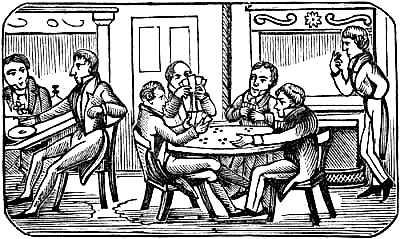
At St. James’s they dine, when, flushed with new wine, To the Gaming Tables they reel, Where blacklegs and sharps, often gammon the flats, As their pockets do presently feel. Success at first Jerry delighted, But ere the next morning he found That his purse was most cleverly lighted Of nearly Five Thousand Pounds.
SCENE.—Interior of a fashionable Hell at the West-end of the Town; a large looking-glass in the flat.
Enter GROOM PORTER and MARKERS.
G. Porter. Come, lads, bustle about; play will soon begin—some of the Pigeons are here already, the Greeks will not be long following.
Enter KATE, SUE, TRIFLE, and GREEN, the latter with a large patch on his nose.
Kate. Assist us in this, my dear Trifle, and we ask no more.—The card we left at the Watchhouse will soon bring our sparks to demand satisfaction,—you and Green must act the parts of conciliators, and propose to end the affair in a game of cards; the insight you have given Green and us into all the arcana of play, will enable us, with the aid of the servant, to fleece them to admiration; thus we may pursue our plan, and cure them of this first of vices of Life in London, gaming! and save their fortune from those who may play for a less disinterested stake.
Trifle. I’faith you ought to be very much obliged to me, girls, pan hanour, for letting Green into the secret,—it cost me fiteen cool thousands, demme! but I’ll assist you.—Green, my dear fa-e-llow, take your post near the glass while they’re playing; and, by the number of fingers you hold up, we shall easily know how many honours they have, and every other particular.
Green. Vith the greatest of pleasure.—I suppose I may hold up my thumb as well as my fingers, may’nt I—because they may have five honours? you know!
Sue. Oh, certainly, Mr. Green—Ah, man, vain glorious man, how easily art thou duped?
Trifle. They come, you must mind your eye, pan hanour, Green.
Green. Oh, you shall find me quite avake—I’m glad I got avay and vas’nt taken to the vatchouse; I was forc’d to give half-a-crown though.
Enter TOM, JERRY, and LOGIC.
Tom. Where is this Sir Jeremy Brag? Oh, here you are, Sir—well met.
Trifle. Ah, my dear Tom, how are you?
Green. My dear Corinthian, how do you do? I’m glad they didn’t put you in the black ’ole.
Tom. Excuse me a moment, Green, I have an affair with this gentleman that will not admit of a moment’s delay.
Trifle. What, my friend, Brag,—honest Sir Jeremy? You musn’t hurt him, he’s a cursed good fellow.—It must be some mistake.
Green. Yes, it must be some mistake.
Kate. Entirely a mistake, I assure you—I’m extremely sorry, if that will give you any satisfaction.
Tom. Oh, if you apologize, I’m satisfied; otherwise nothing would have done, but Chalk Farm! pistols! half-past six! pooh!
Log. That’s the time of day my flower.
Green. Vell, I’m glad it’s settled without bloodshed—Chalk Farm! pistols! half-past six, and pooh!
Jerry. (to Green). Sorry to see your nose in mourning, Green—here, Waiter, take my hat. (Gives waiter the Charley’s old beaver to take care of, who brushes it up ironically, and takes it off).
Green. What say you to burying all differences in a friendly game of vhist? Trifle and I vill cut out.
Trifle. Yes; it’s too great an exertion for me to play, pan han-our—I’m only scarcely endurable to the fatigue of looking on, r-e-a-l-y.
Tom. A rubber at whist? I have no objection,
Jerry. Nor I—you’ll not find me at fault here, coz—no one is better skilled in the mystery of the odd trick, than I am, I flatter myself.
Trifle. (To Tom). Well you and your country friend can pair with Sir Jeremy and the Captain, and this worthy vegetable, Green, and I will see fair play, pan hanour.
(Kate, Sue, Tom and Jerry sit down to cards; Trifle and Green stand behind them, overlooking Tom’s and Jerry’s hand).
Log. (Drinking and looking on). They’ll be done, as sure as my name is Logic.—Upon that suit some of the best judges in London have been had.—Inviting a man to a swell dinner, and making him pay five guineas a mouthful for it afterwards, is no new feature of Life in London—Go it, ye flats—“Thus for men the women fair,” (singing). Why, there’s that fellow giving the office to his pal now: well it’s no business of mine. Go it my pippins—what, Tom, have you got the uneasiness?—“What is beauty but a bait.” (Sings again).
Tom. (Rising and throwing down cards). Oh, if you can’t play better than that, Jerry, we’d better do nothing at all!
Log. (Singing). “Oft repented when too late.”
Jerry. Who can play while the Doctor’s singing?
Log. I knew how it would be—did you hear anything knock, Tom?
Jerry. (Walks about, and, by mistake, takes Logic’s hat). Damn the cards!
Sue. (To Jerry). Come, sir, never be downhearted, bad luck now, better another time.
Jerry. Indeed! I’m not going to try, though.
Kate. Very sorry, Mr. Corinthian—shall be happy to give you your revenge some other evening!
Log. Well, Tom, are you clean’d out?
Tom. Clean’d out! both sides; look here—pockets to let!—here have been two playing four; and we have stood the nonsense in prime style.
Log. Well, don’t grumble—every one must pay for his learning—and you wouldn’t bilk the schoolmaster, would you? But come, I’m getting merry; so if you wish for a bit of good truth, come with me, and let’s have a dive among the Cadgers in the Back Slums, in the Holy Land.
Jerry. Back Slums—Holy Land!—I’m at fault again.
Log. Why, among the beggars in Dyot Street, St. Giles’s.
Tom. Beggars! ah, we shall be very good figures for the part. (Turning out his pockets).
Log. We must masquerade it there.
Kate. (To Sue, aside). And so must we—come, Trifle,
[Exeunt Omnes.
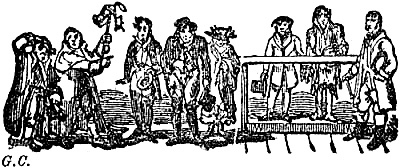
Billy Waters, Soldier Suke, Ragged Dick, Little Jemmy.
There’s a difference between a beggar and a queen, And the reason I’ll tell you why; A queen cannot swagger, not get drunk like a beggar Nor be half so happy as I,—as I.
SCENE—Back Slums in the Holy Land.
MR. JENKINS, SOLDIER SUKE, DINGY BET, LITTLE JEMMY, CREEPING JACK, RAGGED DICK, and other well-known Characters discovered.
SONG.—Mr. Jenkins. Air.—“It was one Frosty Morning.” Cadgers make holiday, Hey, for the maunder’s joys, Let pious ones fast and pray, They save us the trouble, my boys. On the best peck and booze we’ll live, ’Tis fit we their blunt should spend; For what to us they give, Tenfold to the saints they lend. Rumpti bumpti bay, &c. With our doxies, great as a Turk, We taste all life can give; For who but a slave would work, When he like a prince might live? Then lustily call away, Cadgers keep up the ball, Never mind what’s to pay, The public pays for all. Rumpti, bumpti bay, &c.
(Omnes Chorus the burthen of the Song—dancing grotesquely).
Omnes. Ha! ha! ha! (Billy heard without). Eh! stand aside—here comes Billy Waters.
Enter BILLY WATERS, dancing.
Billy. Ah; how do you do, my darley? How you do, Massa Jenkins?—I drink with you. (Drinks deep: Jenkins takes the pot away).—And you Massa Jack, I drink wid you, too. (To Creeping Jack).—Your helt,—your good helt, ladies! (Jack takes pot away).
Jack. I say, Billy, you’re biting your name in it.
Billy. Yes, me likes to bite my name in such goot stuff as that.
Mr. J. Gemman, let’s purceed to business—I’ve got to inform you o’ summat.
Jack. Vat’s that ’ere?
Mr. J. Vy, that ’ere, is this ’ere—I begs to obsarve that the time is come when you may all consider yourselves independent gemmen; for if business should fail, you can at any time retire on a pension now.
Jack. As how?
Mr. J. As how? Vy, this as how. The Mende-city Society, I believe they call themselves, have kindly purwided a fund for us gemmen; so, if anybody offers you less nor a mag, or a duece, vy, you may say with the poet, “Who vou’d his farthings bear? ven he himself might his quivetus make vith a bare Bodkin.”
Omnes. Bravo!
Billy. Dat dam goot—me like dat!—that Bodkin has dam goot point!
Mr. J. It was but t’other day they took’d me up; slapp’d a pick-ax into one of my mauleys, and shov’d a shovel into t’other, and told me to vork—says I, gemmen, I cant’t vork, cause vy, I’m too veak—so they guv’d me two bob, and I bolted!
Beggar. You did quite right; vell, vile I can get fifteen bob a day by gammoning a maim, the devil may vork for me. If any lady or gemmen is inclined for a dance, I’ll nash my arm-props in a minute. (Throws down his crutches).
Billy. An I play you de tune in de key of de X, Y, Z.
Jack. We haven’t had a better job a long vile nor the shabby genteel lay. That, and the civil rig, told in a pretty penny—Come, here’s the ould toast, “Success to Cadging.”
Omnes. (Drinking). Success to Cadging.
Mr. J. Does any gemman understand these here Tread Mills that have got such a footing?
Jack. Silence! Gemmen:—I’m a-going to make a hobservation: Mr. Jenkins means them there Mills as makes you vork vether there’s any vork or no—I can only say this here, gemmens, if them there mills are encouraged, it von’t be vorth no body’s vile to exercise vone’s calling—because, vy, von may as vell go and vork for one’s living at once—but the subject von’t bear not no thinking on.
Omnes. Not by no means. (General groans).
Billy. Oh, curse a de tread mill, me no like a de “here we go up, up, up,” and “down you go down, down, down,” an if you no work, a great lump of wood come and knock you down so—(Striking Beggar on head, with fiddle, who falls down).
Beggar. Oh! he has split my Jemmy!
Billy. (Picking him up). Poor fellow, him werry sorry, so dere no harm done. Gemman of de Noah Ark Society, as Little Jemmy here is no starter, I move he be put in de chair a-top o’ de table.
Omnes. Bravo! Jemmy in the chair. (Jemmy is put on the table).
Mr. J. Silence for the cheer.
Jemmy. Gemman, I shall return thanks—here’s all your jolly good healths, and success to flat catching.
Omnes. Bravo! bravo!
SONG.—Mr. Jenkins, and barking chorus of Beggars. AIR.—Bow, Wow, Wow. That all men are beggars, ’tis very plain to see, Tho’ some they are of lowly, and some they are of high degree; Your ministers of state will say, they never will allow That kings from subjects beg, but that you know is all bow wow. Bow wow, wow! fol lol, &c. Then let us cadgers be, and take in all the flats we can, Experience we know full well, my boys, it is that makes the man; And for experience all should pay, that Billy will allow, And as for conscience that of old we know is all bow wow. Bow, wow, wow! fol lol, &c.
Enter KATE, SUE, JANE, TRIFLE, and GREEN, disguised as Beggars.
Sue. I do not see them here yet.
Kate. They’ll not be long, depend on’t,—have I sufficiently disfigured my charms?
Sue. Yes, they cannot surely recognise us in these disguises?
Trifle. Dear me, a very dreadful perfume, pan hanour—essence of mendicity—I’m sorry I came.
Mr. J. (To Green). Halloa, my little ’un?
Green. Eh! come you a done now; you a done vith you.
Mr. J. Sluice your dominos—vill you?—
Green. Vot! I never plays at dominoes—It’s too wulgar.
Mr. J. Vy, then vash your ivories?
Green. I’ve got no hiveries to vash.
Mr. J. Drink, vill you? don’t you understand Hinglish?
Green. Eh! drink—quite a gemman, I declare.—(While Green drinks Jenkins dances, expectantly).
Ragged Jack. I say, Jenkins has larned to dance since he’s been on the Mill—vy Jenkins you’ll dance your calves into your shoes if you don’t mind.
Mr. J. (To Green, looking at pot). Vy, I say, you’ve been eating red herrings for dinner, my young un!
Green. I vas dry, and that’s the fact on’t.
Billy. (Offering bottle to Sue). I say, Misses, you drink, eh! my Buckra Beaudly?
Jemmy. Gemman, have you ordered the peck and booze for the evening?
Sold. Suke. Aye, aye, I’ve taken care of that—shoulder of veal and garnish—Turkey and appendleges—Parmesan—Filberds—Port and Madery.
Billy. Dat dam goot, me like a de Madery—Landlord, here you give this bag of broken wittals, vot I had give me to-day, to some genteel dog vot pass your door: and you make haste wid de supper, you curse devil you!
Beggar’s Opera. Tom, Jerry, and Logic, among the Cadgers in the Holy Land.
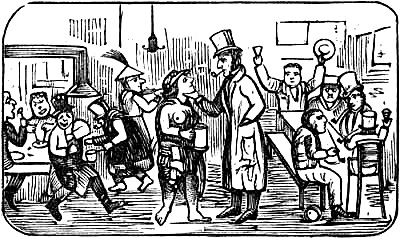
Now to keep up the spree, Tom, Jerry, and Logic, Went disguis’d to the Slums in the Holy Land; Through each cribb and each court, they hunted for sport, Till they came to the Beggar’s Opera so nam’d; But sure such a sight they had never set sight on, The quintessence of Tag, Rag, and Bob-tail was there: Outside of the door Black Molly was fighting. And pulling Mahogany Bet by the hair. There was cobblers and tailors, sweeps, cadgers, and sailors, Enough to confound Old Nick with their din; There was bunters, and ranters and radical chaunters, Clubbing their half-pence for quarterns of gin.
Enter TOM, JERRY, and LOGIC—disguised as Beggars, with Placards on their backs—TOM’S “Burnt Out—lost my little all.”—JERRY’S “Deaf and Dumb.”—LOGIC’S “Thirteen Children.” &c.
Sue. Here they are—I know them in spite of their rags.
Tom. This, my dear Jerry, is a rich page in the book of life, which will save you many a pound, by exposing the imposition of street mendicity.—It almost staggers belief that hypocrisy is so successful, and that the fine feeling of the heart should become so blunted, as to laugh at the humanity of those who step forward to relieve them.
Log. ’Tis the blunt that does it—but stow magging, Tom, or we shall get blown.
Jerry. Tom, here’s a group of blackbeetles—do you see those lovely mendicants?
Tom. Beauty in rags—I do—Cupid imploring charity, I’ll relieve him, for I’ll be after that match-girl directly.
Jerry. And I’ll chant a few words to that beautiful ballad-singer.
Log. And I’ll take pity on that charming beggar.
Song of the Cadgers in the Holy Land. Come, let us dance and sing, While fam’d St. Giles’ bells shall ring, Black Billy scrapes the fiddle strings, Little Jemmy fills the Chair. Frisk away, let’s be gay, This is Cadger’s holiday; While knaves are thinking, we are drinking, Bring in more gin and beer. Come, let us dance and sing, &c. Here’s Dough-boy Bet, and Silver Sall, Lushy Bob, and Yankee Moll, And Suke, as black as any pall, The pinks of the Holy Land. Now, merry, merry, let us be, There’s none more happier sure than we, For what we get we spend it free, As all must understand! Come, let us dance, &c. Now he that would merry be, Let him drink and sing as we, In palaces you shall not see, Such happiness as here. Then booze about, our cash an’t out, Here’s sixpence in a dirty clout; Come landlord bring us in more stout, Our pension-time draws near. Come, let us dance, &c.
Enter LANDLORD with supper.
Land. Now, your honours, here’s the rum peck, here’s the supper.
Billy. Eh, de supper! de supper! come along, (After striking Creeping Jack on fingers with knife). You damn nasty dog! what for you put your dirty fingers in de gravy? you call that gentlemans? you want your finger in de pie, now you got him there!
Jack. I only wish’d to taste the stuffining.
Billy. And now you taste de carver knife instead! (takes candle, and looks at supper). Vy, what him call dis?
Land. Why, the turkey and the pie, to be sure.
Billy. De turkey and de pie! I tink you said de turkey and de pie,—what! de turkey without de sassinger! him shock—him wouldn’t give pin for turkey without dem—me like a de Alderman in chain.
Land. I’m very sorry, Mr. Waters, but—
Billy. You sorry! I’m sorry for my supper, you damn dog.
Mr. J. (To Landlord). Vhat! sarve up a turkey without sassiges,—you’re a nice man I don’t think.
Jack. (To Landlord). I tell you vhat, young man, vhen you talk to gemmen, larn to take off your hat.
Jemmy. Vy there’s no lemon to the weal, nor hoyster sasse to the rump stakes.—It’s shocking, infamous neglect, that’s vot it is.
Mr. J. (To Landlord). Vy, who do you suppose would eat rump stakes without ayesters? I’ve a great mind to smash your countenance for you!—You ought to have your head punched you ought!
Jemmy. Here’s no filberds to the Port, nor devils to the Madery, nather.
Land. Egad, I think there’s devils enough to it. (Aside). Gentlemen, the deficiencies shall be supplied directly. (He is hunted off).
Mr. J. Hit him; he’s got no friends.
Jemmy. We must go to some hother tavern, if we’re neglected in this here manner.
Mr. J. You may do as you please, gemmen, but for my part, I shall certainly use some other hotel.
Billy. You perfectly right, Massa Jenkins, we must use some other hot-hell.
Jerry. (To Sue, she having attracted his attention). And so you sell ballads, eh?
Sue. Yes, Sir, three a penny; but if you like to take twelve, I’ll make you an allowance.
Jerry. Oh, I’ll have the allowance by all means.
Sue. (Singing).
“Relieve my woes, my wants distressing; And Heaven reward you with its blessing.”
Jerry. Enchanting vagrant! come here, and let me bargain with you. (Takes Sue aside).
Tom. (To Kate, bringing her down, C.—in like manner). And so you make matches, do you?
Kate. Yes!—as you’ll find out by and by. (Aside).
Tom. But ’ant these brimstone dealings contagious? you little flower of—hum-um-um—— (Takes her up in a corner).
Log. (To Jane, bringing her down R.—) You’ve moved me so, that I could bestow every mag I’ve got, you beautiful beggar, I could.
(Knocking without).
Enter LANDLORD, running, L,——Previously to which, Kate and Sue have, unobserved, given beggars money, and entered into communication with them pointing aside to Tom, Jerry and Logic.
Billy. Vat de matter, vat broke, eh? (To Landlord).
Land. Gentlemen vagabonds; the traps are abroad, and half a thousand beadle and beaksmen are now about the door.
Billy. De beak! oh curse a de beak!
Jemmy. Gemmen! gemmen! (Knocking on table to command attention).
Jack. Silence for the chair!
Jemmy. Put out the lights, put out the lights, every one shift for himself. Here, Bob, carry me up the ladder, good luck to you do, Bob.
Billy. Landlord! landlord, you dog! which door de beak come in at.
Land. At the front.
Billy. Vy, den carry me out at de back door, you Dick.
[He and Jemmy are carried out.—Lights are put out—General consternation.
FINALE.—Tom, Jerry, Logic, Sue, Kate, Jane, Mr. Jenkins, Creeping Jack, and Beggars.
Air.—“Zitti, Zitti—Piano, Piano!” Mr. Jenkins. Up the ladder, softly creeping, Let us gently steal away, Traps without their watch are keeping, There we’ll let the rascals stay. Creeping Jack. Traps without, their watch are keeping, Tread softly; no delay; Up the ladder slily creeping Through the back door and away. Tom, Jerry, Logic, Kate, Sue, and Jane. To my arms, love, softly creeping, To bliss we’ll steal away; Suspense ’tis idle keeping, Seize pleasure while you may. Where are you? where are you? To my arms, love, softly creeping, To bliss we’ll steal away, Softly, softly; lightly, lightly; away; away! away!
Kate, Sue, and Jane, as Tom, Jerry, and Logic advance, attracted by their voices, adroitly substitute Dingy Bet, Soldier Suke, and another, in the places of themselves.—Drop falls on Tom, Jerry, and Logic, carrying their beggarly bargains off in great exultation.—Kate, Sue, and Jane enjoying the joke in the background.
Jerry Learning to Spar.
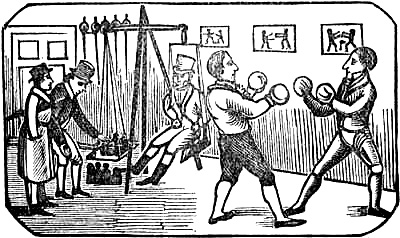
Now Jerry’s become a fancy blade, To Jackson’s he often goes And to shew his skill in the milling trade, He crack’d poor Logic’s nose. He gloried in having a turn-up, And was always the first in a lark, To bang and wallop the Charlies, And pommel them in the dark.
SCENE.—Jackson’s Rooms, in Bond Street.—Tom, Jerry, and Logic discovered.
Life in London with us is a round of delight; It is larking all day, sprees and rambles all night; Tom, Jerry, and Logic have ever the best Of the coves in the East, and the swells in the West; Such pals in a turn-up, so bang up and merry, As Jerry, Tom, Logic—Tom, Logic, and Jerry, Ne’er was seen, since the world first by Noah was undone, So here’s Logic’s, Jerry’s, and Tom’s Life in London!
Tom. We are, indeed, a regular trio; every part well harmonised.
Log. Ay, all sharps! not a flat or a natural among us.
Jerry. I don’t think we were so very sharp last night, though, when we suffered ourselves to be made such apes of in Noah’s Ark.
Tom. You are right, Jerry, we are all at fault here; instead of clasping in my arms my pretty timber merchant—judge my horror, when on approaching a parish lamp, I found myself hugging that duchess of the dust-hole—Dingy Bet.
Log. I was served quite as badly—instead of my seraphic street solicitor, I found myself carrying on the war with Soldier Suke.
Tom. Worse and worse, who did you make yourself agreeable to, eh, Jerry?
Jerry. I beg you won’t mention it!
Tom. Let’s think no more on’t; the tables were fairly turned upon us, and we mustn’t grumble—we have now stepp’d into Jackson’s rooms to decide the bet with Logic as to our weight; and as he has won it, let’s be going—but stop, before we go, what say you to a bout with the foils?
Jerry. No go, Tom,—I’m fly—it’s a bad spec; I am not going to expose my ignorance of fencing here—but as far as a bout at single-sticks goes—why I have no objection.
Tom. Bob will accommodate; won’t you, Bob? come, Doctor, you must have a turn—one small taste.
Log. No go! no, no, Mr. Somerset, you’re a downy one at that sport—it won’t fit.
Tom. Positively you shall, Bob—come the least taste.
Log. Well, well! I won’t baulk your fancy, as you seem bent upon sport—but mind, only one bout.
Jerry. No; one will be sufficient. (They place themselves in position).
Tom. Holloa, Jerry, don’t swallow him.
Log. Use me gently, I’m but a green at this.
Tom. Now, then, come up to the scratch. (They play; Jerry makes a hit; Logic parries).
Tom. Well stopp’d—uncommon well, Bob.
Log. Do you think so; but, I say, none of your chaffing.
Tom. Now, really—
Jerry. Yes, yes, he’s up.
Log. Hum, I don’t think it was so much amiss myself.
Jerry. Now, Doctor, take care of your bread-basket—eyes right, look to your napper.
Tom. Ay, ay, be leary, Bob, take care of your ribs—mind your pipkin—be down on your pimple. (They play a second bout; Jerry breaks Logic’s head).
Tom. I say, Bob, did you hear anything knock?
Log. Yes; and nobody at home.
Jerry. Doctor! I touch’d your knowledge box there, I think.
Log. Touch’d it, zounds! you’ve broken it, Jerry, but it must have been cracked before, or I should never have entered the lists with you. Brown-paper and vinegar for one.
[Exit.
Scene in a Gin Shop.
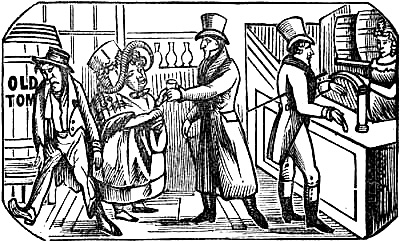
Here some are tumbling and jumping in, And some are staggering out; One’s pawn’d her smock for a quarten of gin, Another, her husband’s coat. Behold, Mr. Tom and Jerry, Have got an old woman in tow, They sluic’d her with gin, ’till she reel’d on her pins, And was haul’d off to quod for a row.
Scene.—interior of a london gin shop.
Tom and Jerry taking Blue Ruin, after the Spell is broken up.
Tom is sluicing the ivories of some of the unfortunate heroines with blue ruin, whom the breaking up of the Spell has turned-up without any luck, in order to send them to their pannies full of spirits. Jerry is in Tip Street on this occasion, and the Mollishers are all nutty upon him; putting it about, one to another, that he is a well breeched Swell. Fat Bet is pretending to Tom, that she had a great objection to every sort of ruin, no matter how coloured, since she had once been queered upon that suit. Swipy Bill, a translator of Soles, who has been out for a day’s fuddle, for fear his money should become too troublesome to him, has just called in at the Gin Spinner’s to get rid of his last duce, by way of a finish, and to have another drop of blue ruin. This last glass would have floored him, had it not been for the large butt of liquor which he staggered against. Hiccoughing, he swears “he’ll stand by Old Tom while he has a sole left to support such a good fellow.”
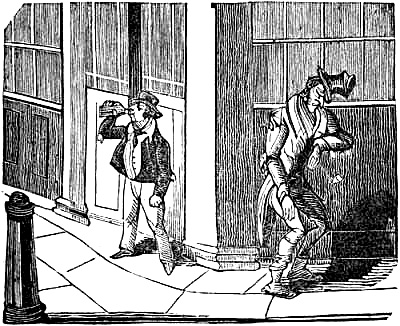
GIN, GIN, SWEET, SWEET GIN!
Air.—Home, Sweet Home.
alk through London town, in Alley, Lane or Street, Eight to ten of all the folks you overtake or meet, List to what they talk about, you’ll find amid the din, The end of every conversation is a drop of Gin. Gin, Gin, sweet, sweet Gin, There’s no drops like Gin. hen the world was young, as we read in classic page, The shepherds drank the purling stream, and pass’d the golden age; For purling streams or golden age folks now don’t care a pin, So that they can raise the brass to keep this age of Gin. Gin, Gin, Hodge’s Gin, &c. hen the weather’s cold and bleak—in rain and frost and snow, The Gin, the Gin they fly to, to warm them with its glow. In summer time, to cool their heat, we see them all flock in And joy or sorrow, heat or cold, all seek relief in Gin. Gin, Gin, Seager and Evans’s Gin, &c.

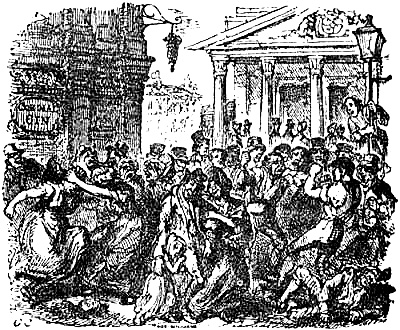
Battle of—A GIN COURT!
ir Richard Burnie sad, declares that never in his time, Was seen so much depravity, want, misery and crime; And all the brawls—the roitings—the day and nightly din, Are caused by what he never tasted! filthy! horrid Gin! Gin, Gin, Booth’s Cordial Gin, &c. n India, when a Husband dies—the Widow ne’er can smile, She’s burnt alive, a sacrifice, upon her husband’s pile; In London many Wives and Widows deem it not a sin, To sacrifice and burn themselves alive with fire of Gin. Gin, Gin, Sir Robert Burnett’s Gin, &c. ecrepit age with furrow’d face, and one foot in the grave, Hobbles on his crutches, and for a drop does crave; Infants, e’er they plainly talk, perk up each little chin And cry, oh mammy, daddy, baby ’ont a d’op o’ din. Gin, Gin, Currie’s strong Gin, &c.


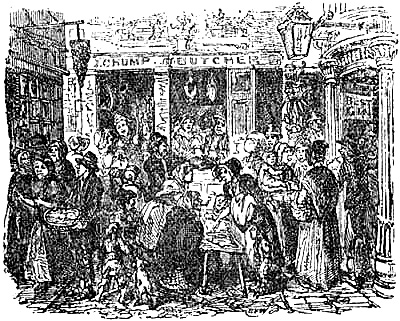
Gin Lane.
n former times we’d Goblins, Fairies, Witches, Ghosts and Sprites, Who ruled the people’s minds by day, and play’d sad pranks o’ nights; But now the tales of Ghosts and such the people can’t take in They won’t believe in Spirits, yet put all their faith in Gin. Gin, Gin, Gaitskell’s Cordial Gin, &c. n the Reign of old Queen Bess good eating did prevail, Her Majesty and all the Court would breakfast on strong ale; But now through every Court, the folk the fashion to be in, Would ail all day, unless ’fore breakfast they could take some Gin. Gin, Gin, renovating Gin, &c. ld women used to cheer their hearts and found it did agree, By sometimes taking with a friend a cup too much of tea; But now they’re much more spirited—for tea don’t care a pin, And only use their tea pots for a cup too much of Gin. Gin, Gin, tongue-relaxing Gin, &c.

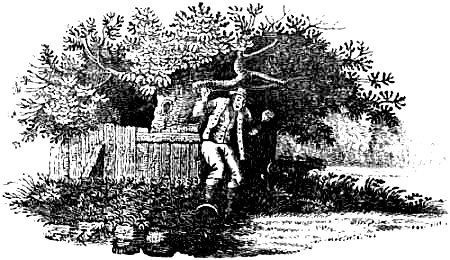
Gin and Bitters.
ighters take a “a shove in the mouth,” though it is their bane, Jack Ketch often has a “drop”—Scavengers a “drain”; Pris’ners “half a yard of tape” to get in merry pin And Actors oft get “mellow” with a “mellow dram” of Gin. Gin, Gin, Tragic, Comic Gin, &c. hompson’s shop on Holborn Hill is crowded like a fair, All the taps continually running out are there; Swing swang go the doors, while some pop out and some pop in, Foreigners must surely think that John Bull lives on Gin. Gin, Gin, dear seductive gin, &c. his World was once deluged by water, drowning Son & Sire, But when it is destroy’d again, we read ’twill be by fire; And this must be the awful time, so prevalent is sin, As all the wicked world do burn their insides out with Gin. Gin, Gin, life-inspiring Gin, &c.


Tom and Jerry Catching Kate and Sue on the Sly Having their Fortunes told.
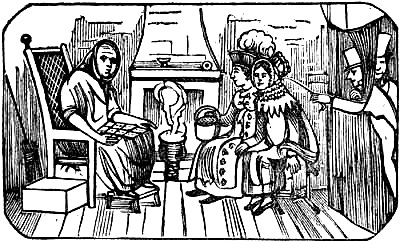
Here lives a Fortune-Telling Gipsy, Wrinkled, crabbed, grim and old: And Tom and Jerry’s fancy ladies Are gone to get their Fortunes told. They slily view’d them, and pursued them, For to have some glorious fun. Behind the curtain, see them sporting, This is life in London Town.
SCENE.—Interior of Fortune Teller’s Garret.
Enter JANE, KATE, SUE, TRIFLE, GREEN, and LANDLORD.
GLEE.—Omnes. Air.—“Who has seen the Miller’s Wife.” Jane, Kate, Sue, Trifle, and Green. Have you the Fortune Teller seen? I, I for hours have waiting been; A shilling o’er her palm I’ll pass If she’ll but look in Fortune’s glass. Have you, &c.
Land. Oh, here she comes at last.
Enter FORTUNE TELLER.
Land. Now mother, stir your stumps; here are two ladies waiting for you, and half a score more below.
F. Teller. Aye, aye! I turn hundreds away.
Green. Vhat an orrid hooman!
F. Teller. You must leave the room, gentlemen, (To Green and Trifle), my charms never hold good in the presence of a third person.
Sue. You hear, Mr. Green, her charms never hold good in the presence of a third person.
Green. I should vondor if they did—Her charms! Lord—I can take an int; I’m to go—wery vell, I shall absconce—Vat an ugly old vitch!
Trifle. (To Girls). We shall meet again at Logic’s, so I’ll leave you with the particularly frightful old hag, pan hanour—demme!
[Exeunt Green, Trifle, and Landlord.
F. Teller. (Sitting at Table). Now then, young women. I’ll tell you—I’ll tell you—but you must let me shuffle the cards first! (Produces cards) For its all done by shuffling! now then, cut them, Miss. (Sue cuts cards).
Kate. Let us sit down while we stay—rather short of furniture; but never mind, we must make shift.
(Turns down chair lengthways to sit; she sits on one side, Sue on the other—Sue is nearly let down by Kate suddenly rising).
F. Teller. (Looking over cards). Hey day! what have we here? You’ll be married soon.
Sue. I hope so, with all my heart!
F. Teller. There’s a fair man been paying some attention to you, lately—Hum! a cradle—three!—nine!—fourteen!—have a large family.
Sue. Fourteen! mercy on me!
Kate. Enough to make one faint!
F. Teller. There’s nothing more that I see at present.
Sue. Nor there hadn’t need been; if I’m to have fourteen children, I think I’ve heard quite enough.
F. Teller. (To Kate). Now, Miss, I’ll tell you your fortune; how many husbands, and how many children, and all about it—all about it.
Kate. But I don’t want to hear “all about it.” (Imitating her). I only want a peep into your magic mirror, and see who I’m to marry.
F. Teller. You should have told me that before, I always charge more for that, but I suppose I must throw it you in! Now, then, stand there; and be very still!——
(Music.—Fortune teller places Kate and Sue in position at off end of the stage—then advances to cabinet—waves her crutch; pulls curtain aside, and discovers a large glass—Landlord passes rapidly behind).
There! I told you I’d show him to you!
Kate. Wonderful! why that’s the man that opened the door to us! (Aside to Sue).
F. Teller. Now, Miss, I’ll show you your sweetheart!
(Music and ceremony as before:—Landlord repasses contrary way).
Kate. Ha, ha, ha! that’s the same man again! We’re both to marry the same husband!
Sue. Amazingly agreeable!
Kate. The old impostor!—Well, now you’ve told us our fortune; can’t you tell your own? (To Fortune Teller).
F. Teller. No, no—I have no power over my own stars.
Kate. Then I’ll tell it for you—In half an hour, unless you make good use of your time, you’ll have a visit from Union Hall.
F. Teller. O, dear me! It’s lucky I’ve a handy cockloft, and a safe way over the houses—I’ll be off directly, I’ll be off directly! (Throws down crutch, cloak, &c., and exits hastily).
Kate. “I’ll be off directly, off directly.” (Imitating Fortune Teller). Ha, ha, ha!—She left all her things behind her!—We can now set up in business for ourselves.
Enter JANE hastily, L.
Jane. Oh, my dear girls, as I was keeping watch below, I saw Tom and Jerry coming down the street, and making for this very house—depend on’t they have traced you here.
Kate. What’s to be done?—Tom and Jerry!
Sue. Jerry and Tom coming here! (Running about in confusion.—Knocking at door).
Jane. Don’t keep running about there, as if you were out of your senses, but listen to me—get behind that glass and leave me to manage; I’ll play the Fortune Teller, now!—Help me on with the things—there! there! that will do; now then, away with you!
(They hide behind Cabinet, after disguising Jane).
Tom. (As entering). Come, Jerry, here they—Eh!—not here!—well, we won’t have our walk for nothing—Let’s quiz the old one a bit. I say, Mother Mummery, can you tell our fortunes for us?
Jane. (As old woman). Oh, yes; but you must cross my hand first.
Tom. She wants the tippery—there—(Gives money). There, that’s the figure, Jerry.
Jane. (Looks at Jerry). Now, Sir!
Jerry. Oh! must I fork out, too. (Gives money)
Jane. (Looking at their palms). Dear me!—dear me!
Tom. You said that before, you know.
Jane. You’ve been sad rakes—sad rakes indeed!
Tom. (Imitating her). Have we, indeed?
Jerry. Why, you witch of Endor!
Tom. What! can the devil speak?—but come, I’ll find you out at once. I conjure you by that which you profess, how’er you come to know it. Answer me, though you untie the winds! unveil your magic mirror, and show us the images of the women we are to marry. Come up with your little machine. Whew! appear—appear!—they won’t come!
Jane. I must have a little more money first!
Tom. Why, you old cormorant! more blunt, eh? there— (Gives money).
Jane. There, then!
(Draws Curtain; Kate and Sue appear behind it in their own dresses; Jane slips away).
Tom. Well, Jerry, what do you see?
Jerry. (Going up to glass). Susan Rosebud!—astonishing.——
Tom. Susan Rosebud! Oh, my dear Jerry, your ogles must be queer! (Goes up; sees Kate). My Kate! by all that’s miraculous! Where is the juggling hag? (Looking for Jane). Why, she’s mizzled! Holloa, Mother Damnable! Oh, there’s some mystery in the infernal mirror, which thus I solve!
Jerry. What are you about, Tom?
Tom. I’m going to mill the glaze—I’ll——
(Is about to break the glass, when Kate and Sue appear as the Miss Trifles).
Tom. The Miss Trifles! by all that’s——
JANE, KATE, and SUE come forward.
Kate. Ha, ha! fairly caught, upon my word. (Retires up the stage, then says aside to Jane and Sue). Now girls it is time we should bring our plans to a conclusion. Logic’s imprudent ramblings have involved him in difficulties which, unless timely met, must terminate in ruin. I have bought up most of his debts; and in the midst of the gaiety of this evening, it is my intention to have him arrested and conveyed to prison. I have sent the officer my card of invitation, that he may be sure to gain admittance. This will open the eyes of the thoughtless trio, and enable us to put the money we took in trust at the gambling-house to its proper use; so let’s away, and about it straight.
[They run off.]
SCENE.—Mr. Mace’s Crib. “All Max” in the East.[33]
“Oh! for a glass of Max.”—Byron’s Don Juan.
A plague on those malty cove fellows, Who’d have us in spirits relax; Drink, they say, and you’ll ne’er burn the bellows, Half-water instead of all max; A glass of good max, had they twigg’d it, Would have made them, like us, lads of wax; For Sal swigg’d, and Dick swigg’d, And Bob swigg’d, and Nick swigg’d. And I’ve swigg’d, and we’ve all of us swigg’d it, And, by Jingo, there’s nothing like max. All-Max! By Jingo, there’s nothing like max!
Here the tag-rag and bob-tail squad who do not care how the blunt comes or how it goes. Togs or no togs! but nevertheless, who must live at any price, and see a “bit of life,” let the world jog on how it will; yet who can drop a tear upon a sorrowful event—laugh heartily at fun—shake with cold—perspire with heat—and go to roost much sounder upon a dust-hill than many of the swells can snooze upon their feather dabs; likewise in comparing notes, feel happy in the presumption that there are hundreds worse off in society than themselves.
Enter SAILORS, DUSTY BOB, AFRICAN SAL, MAHOGANY MARY, MRS. and MISS LILLYWHITE, ROSIN, &c., &c., with gin measures, drinking—Mr. Mace in attendance.
Bob. Now, landlord, ’arter that ’ere drap of max, suppose ve have a drain o’ heavy vet, just by vay of cooling our chaffers—mine’s as dry as a chip—and, I say, do you hear, let’s have a twopenny burster, half a quarten of bees’ vax, a ha’p’orth o’ ingens, and a dollop o’ salt along vith it, vill you?
Mace. Here, Waiter! a burster and bees’vax—ingens and salt here. (Calling as he fetches the porter from the side wing). Now, then, here you are, Muster Grimmuzzle. (Holding out his right hand for the money, and keeping the porter away with the other).
Bob. That’s your sort; give us hold on it. (Takes Mace’s empty hand). Vy, vhere?
Mace. (Keeping the porter back). Vy, here.
Bob. Oh, you are afeard of the blunt, are you?
Mace. No, it ain’t that; only I’m no schollard—so I always takes the blunt with von hand, and gives the pot vith t’other. It saves chalk and prewents mistakes, you know.
Bob. Now then for the stumpy. (Searching about in his pockets for the money). My tanners are like young colts; I’m obliged to hunt ’em into a corner, afore I can get hold on ’em—there! hand us over three browns out o’ that ’ere tizzy; and tip us the heavy. (Landlord receives money and delivers porter). Vy don’t you fill the pot? Likes to have a head on the pot.
Mace. How can you have a head on the pot, vhen the chill’s off?
Bob. Vell, then let me have the next vith the chill on, vill you? (Bob drinks).
Sal. You leave some for me, Massa Bob. (Drinks and empties the pot).
Bob. Vy, Sarah, you seems fond on it—likes to see the end, eh?
(Bob sits down on one stool and pulls another to the front of him on which he arranges the bread, cheese, onions, &c., then tearing open the loaf discovers a live mouse which he holds up by the tail, and walking up to Mr. Mace, says:—I say guv’nor I didn’t axe ye for a hanimated sandvitch did I?
Mace. Oh! you is allus so werry partic’lar some times you is. But I say ladies and gemmen, I hopes for the harmony of the evening, you’ll not be back’ards in handing out your mags and duces to the teazer of the catgut here.
Bob. Aye, aye!—lend us a tanner on the bell, vill you?
Mace. Lend you a tanner on the bell?—It’s vhat I don’t like, Muster Bob; highly improper—you know I’ve a wery great objection to anything of the kind; however, for vonce, I suppose I must; though it ’aint right—but talking o’ that, I begs leave to hint, that I trusts heavy vet von’t be the order of the evening!:—
Tom. (Without).—No, no, damn up stairs, we’ll go in here.
Mace. Zounds, I hope no traps isn’t abroad, and that there ’aint any beaksmen out on the nose!
Sal. (Looking out). Law, lovee, no, it’s only some gemmen out on the spree—I dare say dat dey’ll stand a drop o’ summat all round.
Enter TOM, JERRY, and LOGIC.
Tom. Now, my dear Jerry, here we are amongst the unsophisticated sons and daughters of nature, at All Max in the East. Let the West boast of their highfliers as they will, you’ll find there are still some choice creatures of Society left here.
Log. What, my lily! here take a drop of mother’s milk. (Gives black child gin out of a measure he has received from Landlord). Landlord, let every one have a glass of what they like best, at our cost.
Mace. Regular trumps! I can charge vhat I likes here. (Aside). Now, Muster Bob, vhat’ll you take?
Bob. Oh, ax my Sal.
Mace. Now, Marm Sal, give it a name!
Sal. Vy, bring me de kwarten of de Fuller’s earth.
Tom. Come, it shall be a night of revelry, my pippins—Song—Dance—everything in the world!
Mace. Aye! a jig, a jig!—Remove the stand-stills—sit down, gemmen. Ve shall be as merry as mudlarks, and as gay as sand-boys soon—It’s a poor heart vhat never rejoices. Come, Muster Grimmuzzle, vhat say you to a minnyvit vith your ould lady in mourning, here.
Bob. Vith all my heart; I am never backward at any thing of that ’ere sort; am I Sal?
Sal. Dat you not, Massa Bob.—Massa Fiddler, you ought to be shame; your fiddle drunk, and no play at all.
Log. I’ll gin him a little, my Snow-ball; then he’ll rasp away like a young one; won’t you, my old one? (Gives Fiddler gin and snuff).
Bob. ‘Snowball,’—come, let’s have none o’your sinnywations, Mister Barnacles; she’s none the vurser, though she is a little blackish or so!
Log. Here, Landlord, more Blue Ruin, my boy!
Tom. Ceremonies are not in use here, so there’s no occasion for the master of them, Come, start off, my rum ones! the double shuffle.
Jerry. Aye, aye! come it strong my regulars.
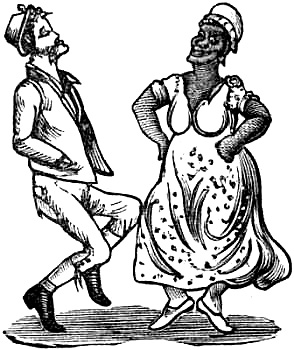
COMIC PAS DEUX—Dusty Bob and Black Sal.
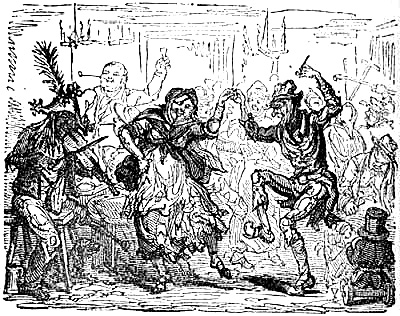
Accompanied by Rosin, on his cracked Cremona, and Jerry on a pair of Tongs, to the Air—“Jack’s alive.” In the course of the Pas Deux, Sal, by way of a variation, and in the fulness of her spirits, keeps twirling about: at the same time going round the Stage—Bob runs after her, with his hat in his hand, crying “Sarah! vy, Sarah, ’aint you well?” &c.—The black child seeing this, and thinking there is something the matter with its mother, also squalls violently; stretching its arms towards her: at length, Sal, becoming tired of her vagaries, sets to Bob, who exclaims, “Oh! it’s all right!” and the dance concludes.
Jerry. That would do honour to any crib; there’s nothing like pairing off according to fancy. You’re quite fly to the trotter shaking department, I see, my rum one!
Tom. To be sure he is a regular gravel digger; come, Sal, my lily. (Gives Sal gin).
Bob. Vy, Sarah, vere’s your manners; vy don’t you kurchy to the gemman?
Sal. Me do dat de second time. (Receives another glass). Your good helts, gemmen all. (Drinks).
Tom. Here, Dusty, my prince, now then, sluice your bolt. (Gives Bob gin).
Bob. Vell, your honours, here’s your luck. (Bolts gin). That’s a regular kwortern, I knows by my mouth.
Tom. There’s a swallow, Jerry, this fellow is a perfect mop.
Jerry. Now, Doctor, we must think of starting—Eh!—zounds! what’s the matter with you? (To Logic).
Log. I’ve left off drinking in a great measure.
(Merry and singing). “There’s a difference between,” &c., &c.
Jerry. Tom, see how snugly Captain Lushington’s getting abroad of Logic. Come, my boy.
Tom. Remember your appointment with the ladies.
Log. I do like this fiddle, I will have this fiddle. (Pulling Fiddler along).
Tom. Eh, zounds, Doctor, you’re going to smug the fiddler, and prig the pewter. (Taking gin measure away from him). Now then, what’s to pay, landlord?
Mace. All out, vill be fourteen bob and a kick, your honour.
Tom. Well, there’s a flimsy for you; serve the change out in max to the coves and covesses. (Gives money).
Mace. Thank your honour—and good luck to you.
Tom. Now then, Doctor, this way, my boy; come, come along.
Log. (Singing). “A Queen she cannot swagger.” I will have this fiddle—“nor get drunk like a beggar.”—More max here—“Nor be half so merry as I.”
[Logic becoming obstreperous, they partly force him off, and exeunt with him.]
Mace. Regular out-and-outers those ’ere! quite gemmen—I’ve stuck it into ’em a bit! (Aside).
Bob. Aye, ay, ve knows it! vith the chill off!—you’re an out-and-out Stringer, you are!
Mace. So I don’t mind standing a trifle of summat all round, just by way of drinking their healths; and vhen ve’ve had the liquor, ve’ll kick up a reel, and all go to our dabs.
Bob. Ay ay! but before that, mind you get us a bit of grub for me and my Sal—about a pound and a half of rump steak—
Sal. No, two pound Massa Bob, for her rather peckish.
Bob. Very vell, two pound, vith a pickled cowcumber, and a pen’orth o’ ketchup, to make some gravy of; and stick it up to the bell!—d’ye hear?
Mace. You’ll melt that ’ere bell if you don’t mind, Muster Bob; this is vhat I don’t like—vhy don’t you always take care and bring plenty of money in your pockets?—You know I’m wery particular in things of this here kind!—though I don’t mind obliging you——
Bob. Ay, ay, vith the chill off, I knows!—but it’s all right—must have the bell in the morning, you know, even if I spout the togs for it.
Mace. Now then, strike up, my beauty!
Bob. Aye, aye, pull it out, my pink!
[Comic Characteristic Reel by all the Characters; who, under the influence of All Max, at last reel off.]
Poor Logic in the Fleet Prison.
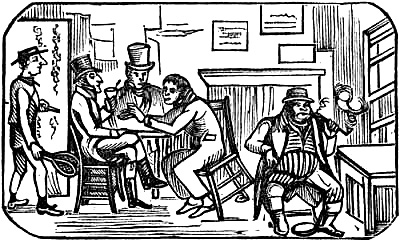
All in the Fleet poor Logic’s moor’d His swaggering’s now at an end! And Tom and Jerry are gone on board, Their friendly assistance to lend. Now, all their sprees and gambols are closed For Logic has vow’d and swore When he’s from Limbo safe loosed, He’ll marry——and rake no more.
SCENE.—Interior of Whistling Shop; Master and Mistress of Whistling Shop—Racket players—Poor Tradesman, Smuggler, and Debtors discovered.
CHORUS.—(Omnes). All in the fleet we’re safely moor’d, But while we’ve trusty pals on board, Law may to The devil go; Then, brother Debtors, sport and play. Let tempests whistle as they will, Our Whistling Shops will drown them still; A yard of tape Will prove the Cape. And drive each thought of care away, Tol de rol.
Enter TURNKEY and LOGIC.
Turn. Here’s Doctor Logic come to pay you a visit, gentlemen—You’ll get good accommodation here, Sir; and find some regular trumps among ’em.
Log. Thank’ye.——
Turnkey. Is that all?—Only thank’ye?
Log. Oh, want some tippery! (Gives money). There! (Exit Turnkey)—Brothers, your most obedient. Some of my friends, thinking my learning was not complete, have sent me to your College to finish my education; not that I owe anything!—
Omnes. Oh, no!—we none of us owe anything!—Oh! dear no.
Log. I’m only here on suspicion of debt.
Omnes. That’s the case with all of us!—we’re all of us only here on suspicion!
Log. You’ll not find me a bad chum—but ready to hunt down any game you can start. Landlady, serve them with a glass of tape, all round; and I’ll stand Sammy—
Omnes. A regular trump! (Landlady serves them all with liquor, out of a bladder, as directed; Logic pays).
Smug. Well, while I can blow my cloud, and get a drop on the sly, I sets the Excise at defiance. What’s a little smuggling?
Poor T. (Aside). Could I have conveyed the value of that liquor to my wife and children, it might have saved them another day from starvation!
Log. (Overhearing). What! hard up!—wife and children starving!—that sha’n’t be while Bob Logic has a quid left.—Here, my honest fellow, go fill their bellies and make them happy. (Gives money).
Poor T. May heaven bless you, Sir—you know not half the good you have done!
[Exit poor T.]
Log. No: but I know one thing enough, and that is, the value of money—a prison is the only place to learn that in; and if ever I get out again——
Enter TOM and JERRY.
Log. Ah, Tom and Jerry! my boys! this is kind indeed!
Tom. Never desert an old pal in limbo, Bob; but when you get safe out of the river tick, take my advice, look into not over your affairs; if young men would but deign to consider this, would but, in the flowery wilds of pleasure, cast one glance at the guiding star of prudence—their pockets would be more full, and the prisons of the law more empty.
Log. Never doubt me, Tom—but welcome to ‘Freshwater Bay,’ to my new settlement on board the Never-Wag man of war;—homeward station—forced to be on good terms with others, if I am not with myself——
Jerry. Still as lively as ever, eh, Doctor?
Log. And so will you be when the haberdasher has served you with a good yard of tape.
Jerry. ‘Haberdasher! Tape!’ I’m at fault again.
Logic. The haberdasher is the whistler, otherwise the spirit-merchant Jerry—and tape the commodity he deals in—It’s a contrabrand article here—white is Max, and red is Cognac.
Jerry. Then give me a yard and a half of red, if you please. (Landlady gives Jerry liquor).
Enter TURNKEY, with a letter.
Turn. Here’s a stiffener for you, Doctor!——
Log. A letter for me!——
Turn. It ’aint paid for.
Log. More tip, eh! (Pays him). This fellow’s a regular leech! you never use any chalk here?
Turn. Can’t afford it; besides it ain’t in our way, and then it makes such a mess over the walls.
Log. (Opening the letter). Aye, aye, that will do, go along—(Exit Turnkey) What’s this?—Five hundred pounds!—(Takes out note).—Wheugh!—Let me read—“Sir Jeremy Brag and the Captain, present compliments to Doctor Logic, request his acceptance of the enclosed, to free him from his present difficulties; it is the same sum his friends threw away on an odd trick the other evening.—If Mr. Logic and his friends will look in at the Venetian Carnival, this evening, they will be joined by the Captain, Sir Jeremy, the Miss Trifles, and the Mendicants from the Holy Land; when, if properly solicited, the Masqueraders may unmask.” Prodigious!—I’m at fault here. I’ll away at once; drop the debt and costs in the hatchway, and be off to the Carnival.
Tom. We’ll go with you, Doctor.
[Exeunt Tom, Jerry, and Logic.
Smug. Why, they’ve hoisted sails, lads—well, success to them—oh the changes of life!
CHORUS.—(Omnes). Air.—“Here we go up, up, up.” Some there are up, up, up, And some there are down, down, down, But whether above or below, Let us always take care of the crown. They that are out may grin, While those that are in may fret, Yet poverty ne’er was a sin, And we’re sure they can’t hang us for debt. Fol, lol.
[Exeunt.
SCENE.—Leicester Square.—Characters dressed in Masquerade, cross the stage, as if going to the Carnival—Dominoes lead the way.
Enter OLD MAID and POODLE followed by CLOWN—CLOWN steals POODLE, and pops his own head in POODLE’S place—OLD MAID enraged, pummels CLOWN’S pate till she breaks her fan—CLOWN carries her off squalling R. They are followed by grotesgue DWARF, in chintz gown and cap, with big head; preceded by servants with candles, who also exit.
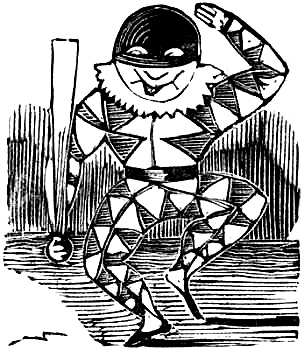
Enter LILLIPUTIAN HARLEQUIN, COLUMBINE, and CLOWN; L. Characteristic PAS de TRIOS, to the “NATIONAL WALTZ;” little COLUMBINE coquetting between HARLEQUIN and CLOWN—after they are off. O. P. various MASKS enter severally—business ad libitum.
SCENE.—Venetian Carnival brilliantly illuminated—various characters on—Music, Dancing, Tumbling, and masquerade business ad libitum, till enter Jerry (as Sportsman) and Sue as Domino.
Sue. (Coming down). What game would you start here, Mr. Sportsman?
Jerry. None, my pretty Domino—I only hunt in Somersetshire; that’s my manor.
Sue. Manners makes the man, certainly; but you’re making game of me.
Jerry. I speak truth, by heaven!—Oh, Susan, lovely Susan, never can I forget thee, dear.
Sue. Indeed! then Susan takes you at your word. (Unmasks).
Jerry. Susan Rosebud!—Astonishment! then the Captain—Miss Trifle, and the pretty ballad singer!——
Susan. Were one and the same person, your humble servant!—I followed to preserve and reclaim you; I have done so, and I am happy—but your cousin comes, stand aside.
[They retire.
Enter TOM, as Don Giovanni, with KATE as Domino.
Tom. (Advancing with Kate). Could I find one of your sex that would be faithful, I would never rove again.
Kate. Are you sincere?—
Tom. By heaven!—I am!
Kate. Then behold the reward of your sincerity, the constancy of your faithful Kate. (Unmasks).
Tom. Kate! oh, my dear Kate!
Enter LOGIC, as Doctor Pangloss, with JANE in Domino.
Log. (Advancing with Jane). I am an L.L.D. and A.S.S.
Jane. (Unmasks). You are indeed an A-S-S, not to have found me out before.
Log. What! my Jenny!——
Jerry. Don’t be astonished, Bob—I’ll explain all:—Tom and I are going to make two matches; you must make the third—form a bunch of matches—exchange one imprisonment for another, her arms, you dog!—’aint you up?—
Log. I’m fly—Oxford has no fellowship like this! (Embracing Jane).
Tom. (Coming down with Kate). You are right, Bob, it has not.—Well, we have been amused by Life in London, now let us endeavour to profit by it;—let our experience teach us to avoid its quicksands, and make the most of its sunshine;—and in that anticipation let us hope our kind friends will pardon Tom, Jerry, and Logic all their sprees and rambles.
Jerry Going Back to the Country.
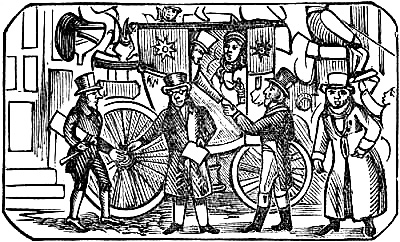
Three merry boys were Logic, Tom and Jerry, And many funny larks they have seen; Farewell, gay London, the country calls me home again, The coach moves on—the play is done—Goodbye, Goodbye.
The White Horse Cellar, Piccadilly:—
Was now the parting scene, and the hand of the clock pointed very near to the time for the departure of the coach. The bustle of this place prevented the Trio from much conversation; but the separation of such staunch pals was a trying moment to the feelings of poor Jerry: and though he was above blubbering like a Johnny Raw, yet his Heart was rather touched, and his ogles underwent some queer sensations, which he endeavoured to suppress, when Coachy asked “if all was right” and began to smack his whip.
The hearty grasps of the hand, and the good-byes were over between Hawthorn and his pals, and Tom and Logic were only waiting to see the coach start, when Jerry, with much eagerness of expression, as if he had forgotten to mention the circumstance previously, said, “my dear Coz”—but the coach was now fast rattling over the stones, and the last broken sentence which the ear of the Corinthian caught was, “Mention me in the kindest manner to the lovely Sue; tell her I am only gone into training, and in the course of a few weeks I shall most certainly return to London to enjoy a few more sprees (which I have so unexpectedly been deprived of), and also to have with her the pleasure of another game at romps.”
The End.
The Adelphi version of Tom and Jerry, or Life in London, was performed ninety-three nights in succession; and its golden career only stopped by the termination of the season. At the end of which, Little Bob Keeley, who had made a great hit as Jemmy Green—a character imported into the piece by Mr. W. T. Moncrieff—went with Walbourn, the great Dusty Bob, and Cooper, who played to the life, Little Jemmy, the cripple, to Sadler’s Wells Theatre, were Pierce Egan’s own version was produced April 8th, 1822. Keeley was threatened by the Adelphi lessees—Messrs. Rodwell and Jones—with an action for breach of engagement, but the action was never brought. In the season of 1822-3 at the Adelphi, John Reeve—‘Glorious John!’ became Jerry Hawthorn, Mr. Brown took the part of Jemmy Green, and several other changes in the original cast were effected. At Christmas, 1822, Tom and Jerry was compressed so as to admit of the production of a pantomime called Beauty and the Beast, or, Harlequin and the Magic Rose. When the managers announced that:—
“In consequence of the astonishing Overflows to witness the admired Extravaganza of Tom and Jerry, or Life in London, and to prevent, as far as possible, any unpleasant Disappointment, the Public are respectfully informed that:—
NO PLACES, IN FUTURE CAN BE KEPT, UNLESS PAID FOR WHEN TAKEN.
Shouts of Laughter and Applause attend each Representation of the New Pantomime.”
When the long run of Tom and Jerry ended at the Adelphi, a spectacular extravaganza of the same kind was produced with the title of “Green in France,” but it did not catch the fancy of the town like its predecessors.[34]
In 1825, Mr. Moncrieff published his dramatic version of Tom and Jerry; or, Life in London—which he dedicated to:—
His Royal Highness, Frederick Duke of York,
May it Please Your Highness:—
The distinguished honour conferred by your Royal Highness on this Drama, in commanding and witnessing its performance at the Adelphi Theatre, (an honour unprecedented in the annals of the Minor Stage) and the flattering manner in which your Royal Highness was afterwards graciously pleased to express your high approbation of it, emboldens me, with the most profound respect, to lay it at your Royal Highness’s feet, and under the sanction of your illustrious name, commit it in its present form to the world.
Having no higher pretensions than that of presenting a faithful picture of the various scenes it pourtrays, the favourable opinion of your Royal Highness stamps it with an authority that was alone wanted to crown the success with which it has been received by the Public.
Like the illustrious Haroun al Raschid, your Royal Highness is said to have made yourself acquainted with the many coloured changes of life; presented in the people over whom you may be one day called to preside, by wisely throwing off the restraint of rank, and witnessing nature in its genuine state. That the scenes I have pourtrayed are not caricatured for the sake of dramatic effect, but are actually those which might have been seen by any one choosing to seek them, your Royal Highness can therefore adequately testify; and your Royal Highness’s imprimatur will effectually ward off all the imputations that have been cast upon my motives and veracity, by the bigoted and envious.
I have the honour to be, With the most profound respect and devotion, Your Royal Highness’s Most obedient and very humble Servant, W. T. Moncrieff.
104, Drury Lane, Dec. 15, 1825.
Mr. Moncrieff in his Dedication—To His Royal Highness: and in his Preface that follows throws so much true light and shade on public opinion—pro et con—of the period, that we deem it not only desirable but instructive to the present generation to publish the same in extenso.
PREFACE.
“It is scarcely necessary to observe this Drama is founded on the “Life in London” of my friends Pierce Egan, and the inimitable Cruickshank. Aided by Pierce’s clever illustrations to the matchless series of plates to that work, I have in this piece, endeavoured to put them into dramatic motion; running a connecting story through the whole, making such modifications and amplifications, and furnishing such reflections and results, as I deemed necessary. From the popularity of the subject, the novelty and acknowledged truth of the various scenes comprised in it, and the beauty of the music I fortunately selected, this Piece obtained a popularity, and excited a sensation, totally unprecedented in Theatrical History; from the highest to the lowest, all classes were alike anxious to witness its representation; Dukes and Dustmen were equally interested in its performance, and Peers might be seen mobbing it with Apprentices to obtain admission. Seats were sold for weeks before they could be occupied, every Theatre in the United Kingdom, even in the United States, enriched its coffers by performing it; and the smallest tithe-portion of its profits, would for ever have rendered it unnecessary for its Author to have troubled the public with any further productions of his Muse. It established the fortunes of most of the Actors engaged in its representation, and gave birth to many publications and several newspapers. The success of the “Beggar’s Opera,” the “Castle Spectre,” and “Pizarro,” sunk into the shade before it. In the furore of its popularity, persons have been known to travel post from the furthest parts of the Kingdom to see it; and five guineas have been offered for a single seat.—These facts are not recapitulated here from any feeling of egotism—the success of this Drama, was the temporary rage of the moment, from time-serving circumstances, and was never regarded in any other light by its Author; they are merely noticed as curious events in theatrical history.—With respect to the cry of immorality, so loudly raised by those inimical to the success and plain-speaking of this piece, it is soon answered! To say nothing of the envy of rival Theatres feeling its attraction most sensibly in their Saturday Treasuries, those notorious pests the Watchmen; dexterously joined in the war-howl of detraction raised against it, and by converting every trifling street-broil into a “Tom and Jerry row,” endeavoured to revenge themselves for the exposè its scenes afforded of their villany and extortion; but all in vain. In vain, too, it was the Actor’s old rivals, the Methodists, took the alarm—in vain they distributed the whole of the stock of the Religious Tract Society at the doors of the Theatre—in vain they denounced “Tom and Jerry” from the pulpit—in vain the puritanical portion of the Press prated of its immorality—in vain the prejudices of the stiff-backed part of the Bench—the hypocritical host of Saints cried it down, and preached woe and destruction to those who supported it.—They but increased the number of its followers, and added to its popularity. Vainly, too, was the Lord Chamberlain called upon to suppress it—His Grace came one night to see it, and brought his Duchess the next. It was nearly the same with the Chief Magistrate of Bow Street: his experience rendered him perfectly sensible, that, long before the appearance of “Tom and Jerry,” young men and country gentlemen would in moments of hilarity, sometimes exceed in their potations, be provoked into quarrels by designing Watchmen, and consigned, for purposes of extortion on the following morning, to His Honour, the Night Constable; but according to the Saints’ accounts, to believe their tales, it must be held as a point of faith, that no one, previous to the appearance of “Tom and Jerry,” ever got into a row!—Oh, no—drinking and all its train of follies were unknown to youth, until inculcated into their minds by the example of “Tom and Jerry!” How many an unsuspecting Country Cousin has been converted, in the public newspapers, through an hour of harmless frolic, into a Jerry; while his equally unconscious Town relation figured as a Tom, and any honest plodder they may have had with them is transformed into a Bob Logic—his first appearance in that character. The thing speaks for itself: the hue and cry of the immorality and danger of this piece was raised merely for the purposes of plunder, by Watchmen and others. So far from being immoral, if the piece be fairly examined, it will be found to be as correct in its tendency as any production ever brought on the stage. The obnoxious scenes of life are only shown that they may be avoided: the danger of mixing in them is strikingly exemplified; and every incident tends to prove, that happiness is only to be found in the domestic circle.
“It has been said, that many of the scenes of this piece should not have been exhibited, being scenes of dissipation, riot, and impropriety—ridiculous!—Has not Shakespeare asserted that the proper use of the drama is—“to hold, as ’twere, the mirror up to nature, to show virtue her own feature, and vice her own image, and the very age and body of the time its form and pressure:” could any piece do this more effectually than “Tom and Jerry?” take away the scenes complained of, it ceases to show the form and pressure of the age and time.
“I should not have published this piece had not its success produced such a host of imitations and plagiarisms, that more to prevent myself suffering from the demerits of others than to avail myself of any merits of my own. I give it with all its imperfections on its head, to the world; willing to pay smart blunt for my own misdeeds, but not stand Sammy for those of others. To those venerable noodles who complain that I and my prototype, Pierce, have made this the age of flash; I answer any age is better than The age of cant! I tell my pious lecturers, in plain terms, I shall always feel pleasure in reflecting that I have in this piece, nosed every move on the board, in the game of the spell; opened the ogles of the green and the yokel, and the muff, and the raw; struck a light on the darky of their knowledge boxes, flashed the gab of the prig, the leg, the scamp and the stringer, in their listeners, put them fly and awake to all they should be up and down to, and enabled them, if their lugs are at all wing to the bits of good truth, pattered to them in every scene of this piece, bank their rag, chivey their nurses, nash their leading strings, and keep out of the way of the cut-along-coaches as they travel the high toby of existence; and having so done, can lay my mawley on my core, and conscienciously chaunt my conviction, in which my reader will bear me out, “that I’ve cut all the buzmen, and done the thing right.”
W. T. M.
104, Drury Lane, Dec. 15, 1825.
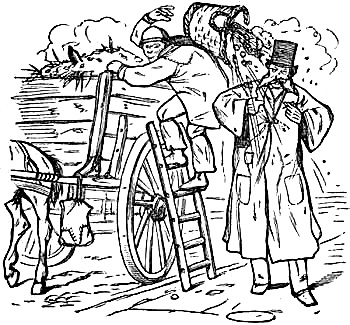
The Dustman.
Bring out your dust the dustman cries, Whilst ringing of his bell: If the wind blows, pray guard your eyes, To keep them clear and well.
Pierce Egan on Mr. Walbourn’s “Dusty Bob.”
“It is the greatest possible praise to be praised by a man who is himself deserving of praise.”
“Approbation from Sir Hubert Stanley is praise indeed.”
Mr. Walbourn’s theatrical fame was made by, and, strange to say, expired with the character of Dusty Bob. Pierce Egan, in his “Life of an Actor,”—which he dedicated to Edmund Kean—classes his performance of this part, as giving him a title in the niche of fame beside John Kemble, Mrs. Siddons, and all the great actors contained in his “Catalogues of Parts Acted”—which can never be forgotten by those who witnessed them. Here is the note, and will be found at page twelve of the work:—“The personification of Dusty Bob, by the above actor, has been unanimously decided by the public to be one of the greatest triumphs of the histrionic art ever exhibited on any stage. The first tragedian of the day,[35] with the utmost liberality, gave it as his opinion, that, during the whole course of his theatrical life, he had never seen any performance equal to it. Also, a comic actor of the greatest celebrity[36] exclaimed, ‘Good heaven! is it possible? Do my eyes deceive me? Most certainly it is a real dustman they have got upon the stage. I am very sorry the profession has descended so low as to be compelled to resort to the streets to procure a person of that description to sustain the character.’ He left the body of the theatre in utter disgust—nor was it until introduced to Mr. Walbourn in person, behind the scenes, that he would believe it was an actor. Further praise than this is superfluous.”
Mr. Walbourn as “Dusty Bob,” was drawn and engraved by George Cruikshank, and sold, with other character-portraits, at the Adelphi Theatre. During the long run of the piece, he exchanged one species of hops for another, as he gave up his business as a private and stage dancing-master, and took the “Maidenhead” public-house at Battle Bridge. The house, previous to his taking it was doing only a small trade; but, when he became the landlord, and put out a spick-span new and a “not so dusty” sign of himself as “Dusty Bob,” painted in oil by George Cruikshank, it drew together many of the “Dusty” fraternity—and their doxies. After that, “Dusty Bob,” together with “Black Sal,” became to be bye words, as, near to the house, was Smith’s dust-yard, at which hundreds were employed, male and female. But:—