Front matter (continued 3)
Sara Helene Petersen Weedon translation
Somehow revivalism did not quite submerge him, for he could not help thinking of other things while the preacher up there threatened his audience with hell and sulphur. It might, for instance, occur to him that the moustache of that fellow was the very spit of the other’s whiskers, and in a bound Gaupa’s thoughts were far from the schoolroom and its close atmosphere. No, he could not get the real hang of the revivalist business, and before he entered upon his seventy-second year he gave it up and became a worldling once more.
Only he ceased to swear, and when religious people were with him he might be heard to talk of how quietly time passed down here. Sometimes he would even sigh audibly.
Poor old Gaupa! He was in earnest right enough. He was no Pharisee. Yet his conscience was never quite easy; he was not regularly “saved,” and when his heart started beating out of time he would feel as timid as a hare!
One day he was at Rust helping with some wood-cutting. He went to feed the horses in the evening, and remained in the stable so long that Halstein began to wonder and went in.
There lay Gaupa senseless after a blow from the young black mare. There was a hole in his skull, and Halstein saw the brain matter pulsating.
It was a strange thing, but Gaupa recovered. He was in bed at Rust for a long time, but as soon as he could walk to his own hut he demanded it, and after six months he was very much as before.
One day about Easter time the sheriff, who lived some two miles to the south, saw Gaupa hatless coming across his yard with a long knife in his hand. He wondered a little, and in a moment the maid came rushing into his office and begged him to go out into the kitchen, for Gaupa must have lost his wits.
The sheriff went. There was Gaupa. His hair had withered at the top of his head so that he was quite bald. He wore a blue blouse, and in his right hand he held his knife, shining, freshly sharpened. Yet Gaupa was an exceptionally good-tempered man.
“Good morning, sheriff. I’ve come to skin him. Where do you keep him?”
The sheriff did not understand, but noticed that the corners of Gaupa’s mouth worked harder than ever. “St. Vitus’s dance,” he thought.
“Skin him, d’you say?”
“Yes, of course; don’t you remember I shot the wizard elk in your woods yesterday? I carted him home, large and whole.”
He pointed the knife straight at the sheriff, till the latter felt the blade like a cold pang through his body.
“This knife,” Gaupa went on, “has tasted Rauten once before, and still it is sharp enough to manage the skinning of the elk. Where do you keep him? Eh?”
The sheriff understood that Gaupa’s mind was queer, and he made believe that everything was as Gaupa said.
“Oh yes,” he replied; “I’ll find him for you soon enough, but you will have a drink first, won’t you?”
Certainly, Gaupa would like a drink; he had one drink, and then another. By that time he forgot his errand and went quietly home to Lynx Hut.
Two days later he went to Lyhus and behaved in exactly the same manner. There was no gainsaying the fact that the day before he had shot Rauten and drove him, in all his bulk, to the farm, so that everyone might see the wizard elk. And now he had come to skin him.
From that time Gaupa was out of his mind. People guessed it was a result from that blow from the horse’s hoof, which seemed probable enough.
Every once in a while he would go to a farm to skin an elk he had shot in their forest, and if only they agreed and said he ought to have the drink due before such a work was undertaken, or they offered him food, he could generally be talked away from his purpose, so that he forgot all about skinning.
The authorities attempted to lodge him at some farm, but Gaupa simply walked home to Lynx Hut, where he would sit busy with his awl and his waxed thread, working quite decently.
But the urchins found great fun in going up to him and showing him a naked knife, for as soon as he saw it he would start telling the story of the elk calf on Black Mountain slopes, always in the same manner, nearly in the same words. He never told anything else than that he cut half an ear from the calf, never anything more detailed about Rauten after the elk had grown up. If they asked him they could see how he strove and strove to remember, but he was never sure. It was always the same story again and again, how he held the calf between his knees, and when he finished they would hear him mumbling something no one understood except one single word: “Beast, beast.”
Later on he imagined he had killed an animal he called Golden Bear. Then he went down the valley to the rich forest owners, to their grand farms with red storehouses and white dwellings with glass balls on the top of their flag-poles, shining like silver in the sunlight. And then Gaupa never stopped till he got speech with the great men themselves, for he could buy their woods and their farms and everything they possessed. They might have their payment in cash and the price was of no consideration, for he had killed the Golden Bear.
Thus fared Gaupa, the elk-killer, in the evening of his life.
§ 27
One spring Lynx Hut remained locked, at first for days, then for weeks, then for ever. Lynx Hut is still locked.
They looked for Gaupa that spring, every one in the Valley who could crawl in forest or mountain. The sheriff donned his uniform cap, used the law and ordered people out. A long chain of men zig-zagged across the Lower Valley slopes, east of the river and west of the river. But no Gaupa was found.
What little he possessed was put to auction. His cobbling tools were scattered over the valley as if by a gust of wind. Martin Lyhus bought “The Tempest.”
I visited Lynx Hut some years ago. It was empty, with naked walls. A hole gaped in the brickwork of the chimney where the stove flue had once gone in, and the window sill was strewn with dead flies. I found a dried-up squirrel on the hearth. The little animal had, I suppose, climbed down the chimney and been unable to climb up, finally lying down mouth open for the food which should have kept it alive.
But also I found something else.
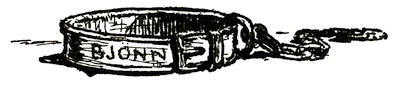
In a corner lay a dog’s collar of coarse leather. It had a shiny buckle and the inside of the leather was worn smooth. In the collar was sewn with white cobbler’s thread the name “Bjönn.”
The man who unlocked Lynx Hut to me was so white of hair that he seemed to carry fresh snow on his head. He wore a waistcoat with silver buttons, and his name was Halstein Rust. It was he who in the autumn after Gaupa’s disappearance went to the relief officer in Lower Valley and told him what he had found above Gipsy Lake out in Ré Valley. It was also Halstein Rust who told me of Gaupa and Bjönn and the wizard elk, Rauten.
To-day a cross stands alternately in sun and shade outside the tar-soaked wall of Lower Valley Church. Under that cross rests the body of Halstein Rust. But I clearly remember the evening when the white-haired man sat before me, crooked, trembling fingers pointing southwards towards Ré Valley, and telling me how Gaupa’s life ended.
§ 28
That spring there were masses of snow in the mountains. First mild weather came in March and afterwards the frost lasted till far into May, then the weather changed suddenly, the air vibrating with sunny heat from morning till night.
The tributary rivers became roaring mad in a few days, Lower River went greenish yellow like ale, lifting timber jams of hundreds of logs, sweeping them along, sucking them on in their mad rush, until the logs would float peacefully into the big lake two leagues to the south.
The birch buds opened in a night. In the morning the trees were thickly covered with what looked like green butterflies. A strong perfume filled the steaming air.
It was late at night, the distant hills were blue. The northern sky was smouldering, a soft tone of sweet sadness rose from the fiery heavens, lulling the senses, like the melody of soft, slowly rolling waves. The people of Lower Valley were asleep.
A belated snipe flew chirping over Lynx Hut.
Gaupa came out, locked his door, and put the key in his pocket. He carried a knapsack, and took out a pair of skis. He remained there as if making sure in his thought that nothing was forgotten. But his ideas were confused, lacking strength to arrange themselves in any definite order, and Gaupa went towards the River with skis on his shoulder and a sack on his back, but his rifle hung peacefully on the wall inside Lynx Hut.
In the darkness of that May night a man walked on the crusted snow on the slopes towards Ré Valley. The skis made a dry grating sound on the snow crust, the man breathed quickly and heavily, and rested sadly often. He grew so very thirsty, and every once in a while he lay down at some brooklet and drank the water from the melting snow.
After midnight the snow crust became stone hard. The man went south along the flat marshes near Ré River, and for such an old man he went remarkably quickly. Gaupa had not in vain been the man who used to show everybody else his back both walking and running.
About two o’clock the door of Gipsy Lake Hut groaned, and on the hard wooden seat where Gaupa and Bjönn used to rest side by side after many a sweat dripping day Gaupa lay alone, after many years.
Strangely enough, that night his brain cleared. He felt as if he had awakened from sleep, and without making a fire he lay, looking backwards in time.
He had lived his life as he himself wanted it, poor in possessions, but rich in happenings. Throughout all the years he could remember there blew a cold breeze from windworn trees and naked mountains. His memories stood out like bright flowers, smelling sweetly of heather and moss. Best of all he remembered the three days’ chase after Rauten, Bjönn’s last chase. Even that time the rumour was true. Bad luck had followed on Rauten’s heels.
Gaupa heard a wood-cock swishing by Gipsy Lake. Then all was silence again.
A little later an owl started hooting in the trees outside the hut, and to Gaupa the hooting seemed to come out from the walls, from the ceiling, from the floor.... The owl is a sinister bird and predicts death, and Gaupa felt quite creepy listening to the sound of the voice. He opened the door and peeped up in the half light between the trees. The bird was silent then, but he could not see it. Yet as soon as he lay down the bird’s voice was heard again, sad, wailing, almost like broken notes of a dirge. The tune never rose, never sank, always keeping the same level.
He went out many times to frighten it away, and although that bird sat just above the roof, he was quite unable to see it; he could almost believe it was a spirit sitting aloft, trying to tell him something.
Day sent a grey square of light through the open door on to the floor of Gipsy Lake Hut. Darkness crept into the corners and hid there.
Then suddenly and unexpectedly the old man jerked his head, steadied his hands against the bench, and half rose. His eyes lost the film of deadness they had had lately and had become keen.
Through the open door he heard the crush, crush, crush of the snow crust shattering under steps heavy enough to break it.
Gaupa knew the snow crust to be hard enough to carry a man, even a heavy one. He rose on his feet and stood in the door, crouching a little, both hands holding on to the lintel above his head.
Crush, crush, crush! he heard from a little mound covered with young trees, just beyond the clearing in front of the hut. Then the sound stopped as if cut off, and the silence afterwards was filled with the boiling rumble from the heath cocks in the marsh by the lake. The owl was silent.
What came over him? Was he afraid? He almost looked like it. His eyes grew keen, staring. His mouth opened, showing his gums with all his teeth still, brown from chewing tobacco.
An elk’s head rose from the bushes on the mound, and Gaupa gave a startled sob.
“Rauten!” he whispered, and his excited face showed everything but fear. It was like the yell from an old, half-blind deer-hound who unexpectedly finds big game, a yell of exultation, a dying fire flaming up.
The elk’s head turned abruptly, a long back floated over the bushes, and once more the snow crust crashed where Rauten ran.
Gaupa turned back to the hut. “The Tempest,” “The Tempest,” his thoughts were wailing. But the rifle was at home in Lynx Hut, rusty with years of disuse.
He was running about on the floor of the hut, his eyes seeking a weapon, anything that could be used for taking life—murmuring all the time: “Sure it is the wizard elk, sure it is the wizard elk!”
Then his hand happened to touch his dagger, hanging at his right-hand side; the touch reminded him of something, and he stopped. He wrenched out the knife, his feet stole quickly across the floor and through the doorway. Shortly afterwards the old man was running on the hard snow, stooping, bareheaded, in his blouse, and with long, homespun trousers flapping round his legs.
Before him were the elk spoors, deep holes straight through the rough snow crust, the bottom of them showing the wide-apart hoofs of Rauten, and the grains of snow in the holes were like pearls.
Gaupa saw how the bits of broken snow crust had flown under the elk’s hoofs, and once more he was the old Gaupa. Body and soul were taken back across the years. He was no longer a rheumatic old cripple running bareheaded towards the rise of the sun, knife in hand. No, he was a man with playing muscles and foaming blood, a shaggy savage who hunted an animal to eat it and to clothe himself in its skin.
The snow crust was so hard that he ran as if on a floor, the sound of his steps was only a slight scratching as from a lynx’s claws in bark. He heard the wizard elk just in front, the beast sinking into the snow till under its belly, and inside him was the song that here was Rauten, Rauten! while audibly he mumbled, “I’ve got him now, I’ve got him now.”
Above the spring-black woods of Ré Valley, the mountains foamed like white waterfalls. In the east the rosy dawn glowed, sending a breath of whitish yellow before her on the sky which in farthest west was still deep-sea blue.
There was Black Mountain with its white head, and the forest down its breast like a shaggy beard. Just such a May morning it was when Black Mountain first saw the little elk calf that was to become Rauten.
Now Black Mountain saw something different. On the marsh east of Gipsy Lake an elk bull was plunging heavily in the crusted snow. He tried to leap, but could not. He sank through as if falling at each step and he looked strangely short-legged.
But on the back of that elk sat a man....
Now both Rauten and Gaupa, “The Lynx,” were animals, one born in and of the forest, the other a human being restored to the animal state by the forest. He sat astride of the elk, feeling its lean, sharp back between his legs. His nostrils were full of the scent of game, and he inhaled it and grew drunk from it, like a beast of prey. His hands held on to the mane and one of them held the knife. He lay forwards along Rauten’s neck as if wanting to bite the elk’s throat. Under his nose his beard bristled like feline whiskers.
The marsh was empty again, the elk spoor marking it like a deep scar, and the trees about it seemed to wonder at what they had just seen.
But in the copses to the south the crash of the elk’s hoofs could be heard, and there was Rauten forcing his way, half mad with terror. Every step was an effort, the man on his back and the difficult snow both increased his fear. He wanted to throw the man off. He strained his body till muscles and sinews groaned inside him, but the snow crust was ever faithless; as soon as his hoofs were on the ground, the weight of his body following, the snow crust broke like brittle ice. No matter however much he willed, willed to go forwards, faster, faster—he could not, it was useless.
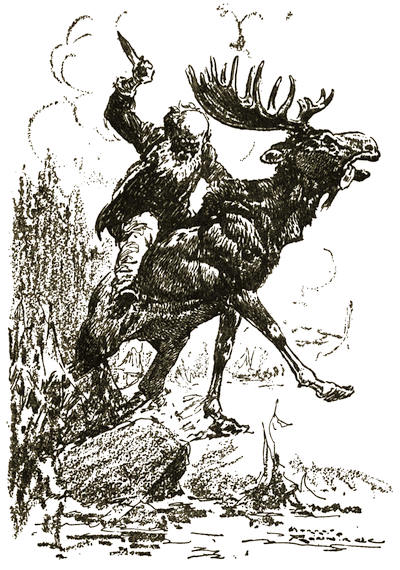
The bushes waved around him, hitting Gaupa’s face till it smarted and he closed his eyes for fear of being blinded. Just before him he saw the ear that was only half an ear. He saw fur had grown where the knife once cut. He noticed also that the antlers were growing out again after the winter’s moulting. They were covered with fur.
Rauten’s breathing was laboured, long and hissing like bellows in a smithy.
Then Gaupa let go one hand from the elk’s mane, the hand rose, slowly at first, then darting like a flame, and a newly ground knife’s edge drew a shiny line across the dark forest. The knife stopped above Gaupa’s head, then sank like lightning. It sank into the elk’s back, deep up to the haft.
Rauten opened his mouth a little, also his eyes, but did not even groan, only took a few leaps out of the undergrowth to a more open place where the sun had been more powerful so that there was less snow. Two weather-grey stumps ran out of it like long tusks.
“Akk,” said a capercailzie hen, wide awake and warning—“Akk, akk!” A capercailzie cock had finished his play, a neck stretched out from the brown-flecked pine branches, and his wings beat the air noisily when he rose.
Rauten staggered forwards, Gaupa on his back. Gaupa had a piece of chewing tobacco in his mouth. It was caught between his clenched teeth and a brown juice ran out of the corners of his mouth down into his beard. He caught the knife out of the elk’s back and swung it aloft once more. But it drew no shiny line this time, it was wet. Once more it sank into Rauten’s body while Gaupa spat out the words:
“Take that for Bjönn.”
The same knife met Rauten with the first rays of day on the morning he was born on Black Mountain slopes. The blade was worn and narrow now, but fate decreed that it should sit in Rauten’s body at his death-leap east of Gipsy Lake. Perhaps they knew, the dull-red sunbeams which that morning, so many years ago, stroked their warm hands over the little calf bidding him welcome to life and to the forest.
But now Rauten had lived his life. Trees and grass, air and water had given him of their own, which they now claimed back. Rauten was old; over his melancholy head the sunset was dead. He was entering on the long night which never is awakened by a dawn in the east.
He had created a number of elks, most of them gone before him into the land of shadows. Now his turn had come to follow them. The Ré Valley woods had no more use for him. His legs were stiff and his steps short. No longer was he a roaring storm at mating time. His muscles sang no more wild songs from bottomless depths of forces; his life was on the ebb, and no flood would rise in him again.
§ 29
That morning a marten sat crouching in a spruce tree near Gipsy Lake. The marten might tell what happened.
That morning a broad-winged eagle soared round and round above Ré Valley. The eagle also might tell what happened.
Rauten ran out on a southwards slope where the snow was partly gone. He hardly saw anything; Gaupa’s knife was diving voluptuously into him. But terror paralysed his nerves so that he hardly felt any pain.
When the elk and the man ran the small bushes nodded after them. But the old trees were indifferent to what happened. Everything was as it should be. The old trees had seen the bear pawing the elk’s skull, had seen the adder swallowing live mice. Life takes life. Thus it was when night first dewed the grass, as long as stars have twinkled in the heavens.
While Rauten leapt down that slope the wind slipped in under Gaupa’s blue-striped blouse, making it bulge out at the back. He rode on intoxicated, far away from everything and everybody. He gave vent to a long yell, old man that he was, and the yell sank into the spring-time roar from Ré River and was swallowed up by it.
Almost blind, the wizard elk rushed down a precipice, about three or four times the height of a man, sliding with legs stretched out and back straight. Gaupa pressed his knees against the elk’s flanks with all his might, but could not keep his seat. He slid forwards along the neck, found the antlers and hung on. The elk’s hoofs tore away patches of moss, disturbing a small stone which became a living thing and jumped down; a jay perched on a tree on that rock started a thin piping as if bewailing the scene it saw. High up under a small cloud red with sunlight the eagle soared easily in the air. Then he screamed, long and hungrily.
Rauten found firm earth below the rocky wall; he nearly fell forwards with the shock, but managed to keep his balance. Gaupa did not let go of the antlers, but his legs slipped off from the elk’s body and turned a somersault, his soles high up towards the sky, as if he wished to kick the tree-tops in play. Then he lost his hold on the antlers, turned over the elk’s muzzle and lay on the snow, his knife still in his hand.
The wizard elk lifted one foreleg. Gaupa saw it, a helpless look in his eyes. An icy-cold blast ran through him, before he rose to his knees. The light-grey elk’s leg was lifted still higher, stopped in the air for a tiny moment, and then fell rapidly. It hit Gaupa between his shoulder-blades. Daylight was extinguished for him as suddenly as when a candle is blown out. With incredible speed he rushed into empty space, then began to sink—down, down.
Gaupa lay on his face, his left arm bent under him, but the right hand which held the knife was stretched out to one side. Then his fingers loosened slowly from the curly maple shaft, straightened out, and the knife lay loose on the snow crust.
Rauten lifted his leg for another blow, but half-way up it became so heavy that he could lift it no further, could not even hold it up. It was as if Rauten thought better of it, as if he believed that the man had had enough. He remained standing, his eyes, soft as dusk, staring sadly at Gaupa. Then he grew sleepy and tired, strangely tired. His great head nodded, nodded lower still, rose and nodded again. Then it stiffened. There lay Rauten, the wizard elk.
The morning sun reached the tree-tops and crept slowly down the trunks. Then reaching the earth it stole forwards as if nosing the man and the elk curiously.
The day was not different from many other days.
It was a day in May, when spring dwells below in the great valleys, early flowers bloom, and clouds sail across the blue sky.
On the Ré Valley slopes dusk turned to evening.
For a little space there was silence.
The jay said no more. A marten sat well hidden in a spruce tree close by, his eyes shining like raindrops among the needles. Dawn lit copper-red fires on all the mountain peaks.
Then the snow crust crashed noisily below that rocky wall on Gipsy Lake slope. Rauten fell on his side. He did not move, but inside him something bubbled with the sound of hidden brooklets under the peat in a bog.
Suddenly the great body curled up and straightened out again just as suddenly.
Gaupa and Rauten slept side by side, Rauten’s head touching Gaupa’s chest as if the animal wished to rest with him.
In the snow beside them red flowers seemed to bloom.
Summer must have come to Ré Valley very early that year.
Printed in Great Britain by Hazell, Watson & Viney, Ld., London and Aylesbury.