Front matter (continued 2)
Sara Helene Petersen Weedon translation
After some reflections he loosened his watchchain from his waistcoat and tied it round the dog’s collar.
Was it morning or evening, dawn or gloaming? It might be either, but after a time the darkening dusk, which came like something soft and fleecy, convinced him that night was advancing.
What about that shot at the elk?...
Perhaps he had struck the beast somewhere in the body. It was impossible to say, for the deer might well run as it did even if it were hit. Perhaps he struck the belly, and Gaupa’s imagination clearly pictured how that bullet would tear the intestines until their contents would run out like a thick butter. The elk would run with a flaming fire inside—Gaupa could almost feel it inside himself.
He wondered at himself for his pity—it was more like a woman than like him, Gaupa, who never before had cared whether he only wounded an elk or killed it. But now a curious tenderness invaded his whole being, and the bare thought of a wound gave him pain, downright physical pain. Most distinctly of all he could feel the possibility of a hit in the lungs—if the elk could no longer draw a full breath, but had to gasp for air. The lungs filled with something that stopped breath and blurred sight. The nose began dripping blood—the elk would be choked....
And Gaupa thought that if he went out alive from that mountain hut he would never more be careless where he sent a bullet into an animal. Either he would be sure that his shot could kill, or he would not shoot.
He was fully conscious throughout the evening.
Those eyes came back to him, as he had seen them off and on during later years, when dreaming or half asleep.
He saw a forest at dusk, it may be one summer evening. Everything was asleep about him, but over there amongst the spruce something was alive, two moist, brownish, living spots side by side. And in another direction he also saw two living eyes, and he knew them. They were the eyes of dead elks shot years ago, calves bereft of their mothers. Such eyes looked at him from behind every tree and every bush; they blamed him and accused him, the elk souls from the land of shades.
A trembling fear assailed him; he turned and turned to get away from the staring glances which caught his own irresistibly. He ran with feet like lead that would not move; but the eyes were everywhere, they seemed to move, staring till madness entered his soul.
Then he noticed two unlike the others. They were deer’s eyes and yet they were not. They were the ones he had met eight years before on the slopes of Black Mountain. Then he threw himself forward, his face in his hands.
§ 14
The next day the farmer Halstein at Rust in Lower Valley saw Bjönn, the dog from Lynx Hut, trotting towards the farm. The dog came into the passage and scratched at the door. Halstein opened, and noticed that the dog was soaking wet. Big wet marks on the floor showed where he placed his paws. He had probably swum across the river.
What was hanging on the dog’s collar?
Halstein loosened the well-worn brass chain, looked at it, and said to his wife:
“This chain belongs to old Gaupa. I’m thinking something must have happened to him.”
Halstein had often followed both Bjönn and his master in the forest, and that was why the dog fetched him for help. The dog behaved exactly as he did with the wood-cutter the day before, running from the door to Halstein and back again.
“Well, well, I’m coming sure,” said Halstein, packing his sack. He took his gun from the beam in the roof, and the two walked quickly across the meadow. When he reached the bank of the river the dog jumped first into the boat, and on the other side they were swallowed up by the forest.
The man and the dog walked for hours, along narrow forest paths, across murmuring brooklets, and through birch bush. Bjönn never wavered, he was going back on his own tracks, and he never walked so far as to be out of Halstein’s sight.
All the time Halstein was wondering what might be the matter with Gaupa. Perhaps he had had an accident, broken a leg.... As far as he knew Gaupa was on the Buvas Slopes a week before, and since then nothing had been heard of him.
The man and the dog walked on, not towards Ré Valley, but farther east. Once they crossed a mountain ridge and stood with their feet on earth and their body in the clear sky. Then again they descended into a narrow valley. Morsæter Lake regarded them like a bright blue eye. They came to a dense copse of healthy young trees, as is usually the case near mountain summer farms, and then they were at their goal. They saw a hut with a brown mossy roof and a cowshed with bright, new-shingled roof.
Halstein Rust stopped outside the door. Bjönn forced his way in, leaving the door ajar. Where Halstein stood in the sun he could see nothing of the interior of the hut, it being darker in there, and he was blinded by the sunlight. He heard Bjönn’s steps on the floor, but no sound of man. Why did not Gaupa say something? Surely he must have heard them both coming.
He cleared his throat and struck his iron-shod heel against a stone with a loud noise, but not a whisper came from the hut. He noticed a thin, worn-out horseshoe lying on the ground before him, and a bunch of fir twigs which the dairymaid had made to scrub her wooden milk-pans with last summer. He hesitated to enter, with the same icy feeling which seized him when about to enter barns and other outlying houses where corpses were laid out....
Then he cleared his throat once more, decisively this time as if driving away an uncanny feeling. He walked to the door with the long, fine steps of the forester, the latch clattered, and he stood before a bed with a man on it. It was Gaupa. Gaupa was alive.
“Good day to you,” said Halstein, half astonished with a question in his voice, as if he had not expected to find Gaupa there. “Are you in bed?” he asked.
“I’ve been sick,” Gaupa replied.
Soon afterwards smoke curled up from the chimney, and Halstein Rust carried a wooden pail to the well, north of the pasture. When he returned Gaupa had something ready, which had occupied his thoughts while the other was away.
“The first thing you must do when you go home,” he said, “is to send a message to Christopher Hovtun, that there is the flesh of an elk bull awaiting him near the little bog under Bog Hill.”
Halstein could not keep back a smile.
“What about a doctor? Would he not be almost as important?”
That same day he returned perspiring to Lower Valley, harnessed his mouse-grey mare in his carriole and drove away northwards through the valley, his stiff, black, Sunday-best hat on his head. And that same night a man with starched linen, spectacles, and thin white hands was riding along the forest paths towards Morsæter. The moon hung in the heavens like a yellow lantern lighting his path, while the farmer’s boy from Rust followed him.
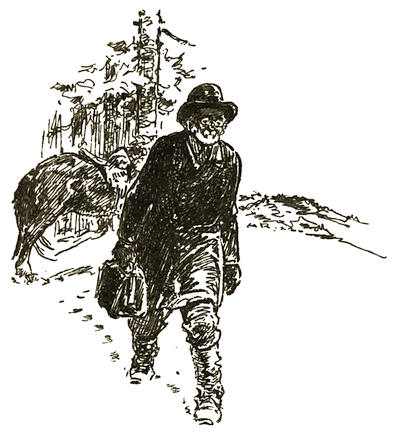
When they reached the hut they heard a deep bark from within. The doctor descended stiffly from the saddle, and it was quite ridiculous to see that from town-habit he knocked at the door before entering.
For three weeks afterwards there was smoke curling up from the Morsæter chimney every day. One day in the fourth week Gaupa and Bjönn stood at the door of Lynx Hut. Gaupa was sickly pale.
But farthest out in Ré Valley where the round head of Ré Mountain seems to bend forwards to look down into the valley, Rauten stood in a marshy place still feeling that nasty gadfly which bit his shoulder. He could not reach it with his tongue, and could only lick the hole where it had crawled under the skin. He did not get rid of that gadfly until winter gleamed on the mountain peaks and Gaupa’s lead bullet was surrounded by a covering of tissue.
§ 15
Gaupa was not his old self all that winter.
He stayed indoors making shoes, and felt cold if he went out. His body seemed to have become open so as to let in the wind and the cold.
But he recovered when spring came. He resembled a strong tree. A wound is covered with resin and the tree is whole again. The same thing happened to Gaupa. Slowly but surely weakness grew out of him. And by the next autumn any number of old footwear lay under his bed awaiting his treatment. But Gaupa had no time for work. His short, muscle-hardened legs were trotting over ridges and far horizons.
That autumn neither he nor any others learned any news of Rauten, and not even the spoor was seen of the wizard elk. Very likely he had gone to some other forests.
Let me see now—did anything worth recording happen to Gaupa?
Yes, he shot an elk bull on a prohibited ground. If the thing had been made known it would have resulted in a thumping big fine; and as Gaupa had nothing with which to pay a fine, it would have meant prison instead. Therefore he did a very sensible thing. He cut off one of the elk’s legs at the knee, then went outside the preserve and made a beautifully clear elk spoor all up to where his elk lay. Then he fetched people and said:
“Here ye are, folks. There is the spoor. I was raising him outside the preserve, and then he ran away in there where he lies.”
Well, the men saw what there was to see. The elk had been raised outside, though lying in the preserve. That was clear enough. The spoor was sufficient evidence as good as a sworn witness. The men bit off a screw of twist and would have sworn ever afterwards on their souls that Gaupa raised the elk on lawful ground. The man who owned the forest had half the meat, as is the custom. The sheriff had some of it for his Christmas dinner, and proposed the health of Sjur Renna whom people called Gaupa, the sprightliest man in the forest who fetched such dainty food from the wilderness.
Well, it was no unusual thing. Elk hunters have a special catechism, with the ninth commandment left out, the one about bearing false witness. But when Gaupa skipped that commandment he made an extra special churchy face, as candidly innocent as if his good conscience was covering it externally.
That winter an elk fell through the ice in Lower River, a league or so to the south. Four men helped him out again with great difficulty. That deer had half an ear, and ran off to the western slopes, having come from the east.
The following autumn Gaupa received a letter. It was brought to him specially by a little boy from Rust who had no other errand.
“I was sent with a letter for you,” he said.
“A letter?” Gaupa could scarcely have been more surprised if one morning the sun had risen in the west and had crossed the sky backwards. A letter? A letter for Gaupa?
He put down the fat pork he was eating, wiped his hand on his trousers, and took the letter as gingerly as if afraid it would burn his fingers.
The envelope bore some printed letters as distinct and black as those in the Prayer Book: “H. Braaten & Co., Drammen.” Below he read “Mr. Sjur Renden, Lower Valley.” But that was in pen-and-ink writing.
Gaupa opened the letter with his sheath knife much as he would cut open the skin of an elk’s belly. The rustling white paper in his hands for once brought home to his mind the fact that his hands were extremely dirty. The paper seemed too nice for them to touch. Even that bore the printed inscription “H. Braaten & Co., Drammen,” and below: “Wholesale Hardware,” which two words he did not understand in the least. The handwriting did not look like what he had learnt at school, round and readable. That before him was nothing but straight lines and broken ones crowded close together. And what a man he must be at handling a pen, he who wrote it! The words raced across the paper like gusts of wind, and below a whirling curl stood by itself; Gaupa guessed it was meant for “Braathe.” He went off at once to find the schoolmaster and have the letter read aloud. By himself he could only puzzle out a few words here and there, like “elk,” “Ré Valley,” “superstition,” and “Yours truly.”
H. Braaten & Co. was a man from Lower Valley who had turned genteel. He hailed from a croft called Vermin Camp, and left home as soon as he was out of school. He sat on a loaded trading cart when he left, and the whole outfit reeked of well-matured old cheese.
But when he returned!...
He arrived in a hired carriage with a hood on it, and he brought a wife whom they called Mrs. Braathe, and who talked town language. And there was so much gold in his teeth that when he laughed his mouth was like an entire sunrise.... That grand gentleman was Hans from Vermin Camp who left the district on a sledgeful of old cheese.
The schoolmaster first took two or three readings of the letter, his lips forming the words but not his tongue. Then he read aloud:
“Mr. Sjur Renden,
“From my good friend up there I learn that there runs in the woods a remarkable elk, which no forest-men can manage to kill. Of course a great deal of superstition is connected with the animal, the dalesmen of Lower Valley being presumably as superstitious now as when I was a child. Lower Valley is on the outskirts of civilisation. But if you, who are, as I have heard, the greatest hunter in those parts, would consent to guide me on a trip after the mysterious elk, you would give great pleasure to an old acquaintance. I long for Ré Valley.
“Please send me an answer.
“With kind regards,
“Yours truly,
“H. Braathe.”
The schoolmaster folded up the letter looking as if he had accomplished a great deed, something that no one else in all the valley could manage.
“You’ll answer for me, won’t you?” said Gaupa. “You’ll say he can come?”
And going home to Lynx Hut he felt himself greater than before. A gentleman from Branæs had sent him a letter, saying it would be a pleasure to have his company. The last “Yours truly” sounded so full of respect and so courteous that one might think it had been written in mockery.
§ 16
One day Mr. Braathe knocked at the door of Lynx Hut. Gaupa was at home, but did not answer. What did that knocking mean? After another knock he went to open the door.
Mr. Braathe was a long lath of a man, who seemed to have been pulled too hard length-ways and grown too narrow. Everything about him hung loosely—his cheeks, shoulders, even his clothes. He was as shrivelled up as a bat.
“Please sit down on the bed,” said Gaupa; “there are no more lice there than the fleas have managed to eat.”
That was a joke he usually quoted to strangers, but this time he swore to himself the moment he had said it. The man before him hailed from Vermin Camp, and might think the words an allusion to his past.
But Mr. Braathe kept smiling, and asked Gaupa to call him plain Hans just as in the old days.
That same evening they stood on the slope above Tolleiv Mountain Farm in Ré Valley. Bjönn was not with them, because Hans did not want him, and in Gaupa’s opinion even a dog could not avail when he was hunting Rauten.
If Gaupa had nursed any ideas about the townsman being worth but little, he was mistaken. Gaupa walked quickly all day, but Hans kept up with him, and there was not a sign of perspiration about him. Once he took out from his bag a strange instrument, a short trumpet of birch-bark with a kind of mouthpiece at one end.
Hans was a much-travelled man. He once saw nothing for nights and days but sea and sky. He had smelt the smoke from Red Men’s camp fires. While he spoke, Gaupa grew silent and his eyes sought the far distance. He was not there in a boggy hollow on the Ré Valley slopes. He followed this tall man through endless woods on the other side of the earth, in a country which to Gaupa’s mind had always been more dream than reality. They seemed to be under a tree, and beside them crouched a copper-coloured Indian with burning eyes. He had a similar birch-bark trumpet in his hand. The wilds of Canada spread out under the clouds. It was early morning. Somewhere a beaver splashed into a calm pool. Farther away a duck was heard.
Then the Red Indian, their guide, moved his moccasins with infinite care, turned towards the rosy dawn over the earth in the east and lifted the birch-bark trumpet to his mouth. At first he only breathed into it as if to warm it. It was a cold autumn morning, as silent as death, except for the occasional splash of the beaver....
The Red Indian lowered his instrument, raised it again, and out of it floated the mating call of an elk, loud and living, luring and treacherous.
Hans arose, saying that that night they would lure the wizard elk. The birch-bark instrument had accompanied him in the wilds of Canada, and more than one crowned head had been turned by it. It would be a strange thing indeed if Rauten were not fooled also.... All that talk about the Ré Valley Swede was the most arrant nonsense, he declared.
Gaupa did not care to show himself superstitious to his companion, for superstition was old-fashioned amongst the genteel. Therefore he guessed that Rauten was an elk like other elks. He ate grass, mated with the cows in the autumn, and when he died he would die like a he goat. No restless spirit would fly out of his nostrils.
§ 17
It was the following night.
On the slopes of Black Mountain Rauten stood on a rock, listening, his ears waving alternately backwards and forwards. His beard hung stiff and awe-inspiring. He was listening for a cow. They usually can be heard at dusk during mating time.
The weather was not quite calm. A darkish cloud sailed slowly above Black Mountain. Just below him in the river there were mild rapids and the water bubbled incessantly against the rocks like a boiling kettle.
Farther up the slope Hans and Gaupa sat under a spruce tree, the lower branches of which touched the earth. They sat as if in a tent, on soft reindeer moss, hardly daring to move. Hans produced a flask, and Gaupa poured the golden brandy down his throat without a word. Little by little the forest grew veiled. Over the east mountains daylight faded away, the roar of Ré River seemed incessant and more wide awake than ever. The sound was uneven, which meant that there was movement in the air. That was bad luck.
Hans bent towards Gaupa. “I wonder if we shall have an answer to-night,” he whispered.
“This is the best elk ground in all Ré Valley,” Gaupa whispered back.
Then once more they sat as still as stones, and Gaupa felt the brandy on his tongue for a long time.
The night before they had tried the trumpet trick, but no bull answered them.
That afternoon they found Rauten’s spoor just below where they were then sitting. A young pine showed white spots on its bark and several branches were broken.
There the wizard elk had rubbed his antlers; the marks were so fresh, perhaps only made that day.
As darkness came on, Gaupa’s excitement grew. Hearing seemed to fill every part of his body. He was nothing but ears....
Hans regarded this strange being beside him. Gaupa’s face was so very short, with next to no chin, and that is rare, for surely energetic people generally have strong chins. Now and then he jerked his head sharply and suddenly, as if he heard something that made him jump every once in a while. Then Hans saw Gaupa smile, and a smile had not been seen on Gaupa’s face all that trip. He was smiling, a strange, stiff-lipped smile, and turning to Hans he asked:
“D’you hear him?”
Hans had not heard a sound. But Gaupa’s keen ear had caught a sound so faint as scarcely to be one at all—the mating cry of a bull elk. The sound seemed to come from below and from the north. Silence reigned around them once more. Gipsy Lake had a silvery streak along its eastern banks. It was the reflection of the northern sky.
Hans carefully pressed the birch-bark mouthpiece against his lips, stuck the other end out through the pine branches, and blew. The call of a cow elk rang out: “Come, come.”
Then all was silence.
A quarter of an hour later Hans once more lifted his instrument.... He stopped, startled.
Immediately to the north, silhouetted against the bright sky in the opening of the valley, an elk bull stood on a mountain ridge. Hans could see the sky between its legs and also two ears and enormous, shovel-shaped antlers.
The elk did not move, and stood out like a statue against the sky above the valley.
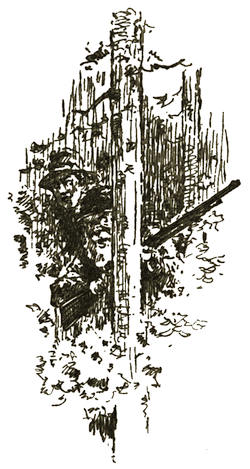
Gaupa cocked his gun. “Rauten,” he whispered, and it sounded like a sob. He had seen the mutilated ear. At that moment the bull stepped down from the ridge, straight towards them, and darkness hid him from their view.
Then they heard “Örrke—örrk,” a kind of nasal grunt, approaching nearer and nearer. A dry twig cracked, and in the clearing a pine stump shimmered with a greyish gleam. The roar from Ré River seemed far distant, as if withdrawn, but suddenly it sounded close again, the forest gave a sigh, and Gaupa saw a lichen tuft move slightly just above Hans’s head.
Then the noise of the elk ceased as if suddenly cut off. There was not a sound. The minutes crawled past. There was still silence.
Gaupa turned.
“Weathered!” he whispered.
But Rauten trotted northwards along the edge of the long Ré marshes hour after hour. He had heard the luring call of a cow, went to meet her, and found man. What a strange thing to happen!... And Rauten ran on. It is bad to be where man is.
§ 18
It was the same autumn, later on in September, one night at Lynx Hut.
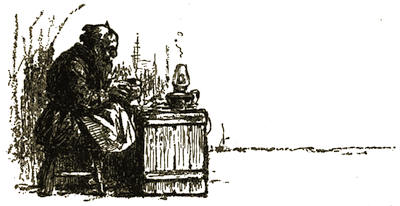
Bjönn was asleep on the bed. “The Tempest” hung on the wall. A wooden box, converted, formed Gaupa’s cobbler’s workshop. A tiny paraffin lamp gave him a sleepy light for the work he had in hand, mending a shoe. On the box awls, plugs, tacks, waxed thread, and heel irons were heaped together, for Gaupa was very far from being a tidy man.
The patch finished, he pulled out from under the bed a violin case, took out his instrument and turned it round in his hands as softly as if caressing it. Then he lifted it to his chin and made a stroke to test the tuning, but when he touched the tenor and bass strings the violin sang so sadly, sweetly, and wildly at the same time, just the tune that will sometimes rise up out of black, hidden river-filled gullies. The violin was tuned for magic.
A lively country dance leaped from the strings. Bjönn woke up and opened his eyes, but shut them again. A few dying embers glowed red through the draught-hole in the stove, and when Gaupa had finished and sat in deep reflection the sound of a watch ticking filled the silence. It was getting on for one o’clock in the morning, but that was Gaupa’s most wide-awake hour.
Steps were heard outside, and Bjönn barked. “Whisht,” said Gaupa. There was a knock, Gaupa unlocked his door, which as it happened he had locked that night.
“Evening,” said somebody in the dark.
“Evening,” Gaupa replied; “are you out walking so late?”
Hans Holmen stood outside, exactly in the line between darkness and the yellow lamplight from within. His coat was unbuttoned and a nickel watchchain gleamed across his waistcoat. He carried a fishing-rod over one shoulder, and Gaupa saw the white top move softly in the dark.
“Oh,” said Hans Holmen again, “it’s early rather than late. It is just about one o’clock.”
Gaupa waited. Full well he knew that Hans must have a very special reason for coming in the night like that.
Then Hans began to relate how he was fishing along the river. There was a dense thicket of bushes growing along the bank and he was well hidden. While he was baiting his hook an enormous animal came out of the undergrowth just to the south of him. At first he thought it was a horse, and wondered why it had no bell, and besides it was not quite the shape of a horse either. When the animal waded out into the river he saw it against the sky-line and recognised it as an elk of unusual size.
Hans Holmen went close up to Gaupa. He lowered his voice as if telling a secret.
“‘Twas the wizard elk I saw,” he said; “I saw the mark of your knife.”
He waited.
“Well,” he summed up the situation, “I thought I’d better tell you, when I saw the light in your window. That elk waded across the river and went up the other side, so now you know where to find his spoor.”
Hans Holmen left, and Gaupa closed the door. He remained for some seconds staring down on the floor, standing in his shirt and trousers.
But out on the high road Hans Holmen went straight homewards and not towards the river.
In Lynx Hut the petroleum lamp was still burning. Gaupa went to and fro slowly, busy as usual. He baked potato flap-jacks on his stove, filled the wooden butter cup, and made ready for a tramp with his knapsack, Bjönn, and “The Tempest.”
About three o’clock he went to the corner cupboard, and after some fumbling produced an old-fashioned leather purse. Out of it he took a slightly flattened lead bullet, as big as a small potato, dirty, knobby, and rough.
That bullet had a name, for it was called the Swede’s Bullet. Gaupa’s father was a soldier at Matrand in 1814, and he shot a Swede who was standing against a tree-trunk. The bullet went straight through him and into the bole of the tree. Afterwards his father picked out that bullet, and ever since the family had regarded it as a priceless possession.
It could heal wounds and cure illness as well as any doctor. Gaupa never forgot the old crofter who had an ulcer in his leg. Gaupa went to him with the Swede’s Bullet and stroked the leg with it in a circle round the ulcer. From that day the ulcer stopped spreading; it could not pass outside the circle where the Swede’s bullet had touched the skin.
But then Gaupa reflected whether he should sacrifice the priceless lump of lead and melt it into a bullet for Rauten.
Rauten, being no ordinary elk, could probably not be killed by ordinary bullets. All the old people believed that there are many animals which demand a special ammunition if you want to shoot them.
But should he really give up the Swede’s bullet?
If it could assist him to kill the wizard elk, the whole district would look upon him as a great man. He would be famous in the valley, and the fact would not easily be forgotten that he was the man who killed Rauten.
For many years he had avoided the beast. For to be quite honest he had to admit that bad luck followed the one who hunted it. Why was he so ill when he shot at the wizard elk at Morsæter? They saw the spoor and knew what animal it was which he saw like a vision in the moonlight.
But while he was conscious of his childish fear of Rauten, he always felt a tantalising desire to see the end of him, to kill him, and cart that enormous body down into the Lower Valley, to exhibit it to the dalesmen and listen to their comments.
Oh what a day that would be! The small boys would gaze at him and Bjönn in deep admiration not unmingled with fear, and the old women would shake their heads knowingly and predict disaster to him....
The Swede’s bullet weighed heavily in his hand, heavier than ordinary lead. Unknown forces were imprisoned in the metal, and it must not go out of the family’s possession. But Gaupa had no relatives in the Valley. He was an only child, his parents were dead, all his other kinsmen had gone away across the Blue Atlantic. When he died the Swede’s bullet would be homeless, so to speak, and that ought not to happen.
Gaupa decided to melt down the Swede’s Bullet.
He made a big fire in the stove under a kind of small pan in which he usually melted his lead. He gazed very earnestly at the Swede’s bullet as it lost form and flattened down until at last it was one big drop of lead in the pan, glittering like a flame, as mysterious as a mountain lake under the moon.
Suddenly Bjönn, who lay upon the bed, grew restless. He looked up at his master, whimpering softly. What on earth was the matter with the dog? “Quiet!” said Gaupa.
Bjönn rolled himself up again, head under tail. But when Gaupa poured the molten lead into the bullet mould, the dog once more raised his head and whined.
How strange! Was the dog ill? Perhaps it was rheumatism. For Bjönn was growing old. He had the pale-blue eyes and the dimmed pupils which indicate age. But he was fairly brisk as yet. What was it he carried on like that for?
Gaupa went up to the dog and stroked his head. Bjönn flattened his ears as a sign of content and calmed down.
The lead had cooled, and Gaupa took out the bullet, fresh and shiny. But it was not like other bullets. It had killed once; it knew its way, and wherever this bullet hit the elk’s body, death would radiate from it as if from a poisoned arrow. Heaven have mercy upon Rauten!
Bjönn again raised his head, whimpering, when Gaupa placed the bullet in the cartridge.
It was four o’clock in the morning. He extinguished the lamp and crept to bed beside Bjönn. Now and then he opened his eyes to look for dawn through the window.
§ 19
That morning an elk bull lay quietly at the upper end of Owl Glen. It was Rauten. He had come from the other side of the valley from the eastern mountains. A dog with a terrible voice in his throat had chased him for half a day, and at last Rauten had swum across Lower Valley River.
But he wanted to go back to Ré Valley, for that was his home. There for months peace reigned in the woods until it entered his own shaggy body and made him at one with the deep silence of the mountains.
Peace was the depth of his nature. He wanted to see, unseen. He liked to stand at the edge of the bogs, looking at the capercailzie hen with all her brood. He liked to see the ever-frightened hare nibbling the grass undisturbed. That was peace, and each day offered fresh joys, however old—a feed of juicy grass not yet withered in some marshy place, a few waterlilies in a mountain lakelet. For him life was food, sleep, and rest, and then feeding again. Life was light and darkness, sun and rain, heat and cold.
He slept at all times of day and night, but as lightly as if even in his sleep all the tiny sounds of the wilderness reached his consciousness. They floated about his ears, and the least unusual crackling let them all into his brain at once, and he was wide awake.
Rauten lived on his instinct—that is, on the experiences accumulated by countless generations through all ages and in all countries. Experiences had glided into him as murmuring brooklets run into the sea.
When he ran towards the wind, and not before it, it was because he had to do so. When he ran away from the scent of man, elks long since dead whispered soundless warnings in his ears. The fear of man was a seed which had been growing since the first arrow flew twirling and singing into the shoulder of an elk and caused life to ebb out of it.
Rauten was lying in Owl Glen this grey morning, with the sleepy murmur from Lower River before him, and a tiny trickle of water over the rocks beside him. That little trickle was a tiny life. A drop fell, and there was an attentive silence, then another drop splashed. Higher up in the glen an owl sat immovable, big sprouts of feather sprouting from the head, yellow eyes staring blindly at the daylight, her beak still bloody after the night’s hunting.
Far below Gaupa was following an elk’s spoor, breathing heavily. He held Bjönn on the leash, and the dog nosed the earth as if seeking something. Once in a while he would snort and tug hard, straight into the mountain, into Owl Glen.
The glen was narrow, with walls of rock on either side, the mountain ash glowing in autumnal glory, and the bracken turning gold. A hawk flew out with a cry, and the sound echoed backwards and forwards from rock to rock, growing into a strong volume of sound, like a loud call in empty space.
The man and the dog crawled upwards. Suddenly Bjönn threw up his head. He had caught the open scent, and Gaupa unfastened the dog’s collar, quietly and carefully.
When the foresters lie in their huts on long winter evenings they often tell of Gaupa and Bjönn and the wizard elk.
The old men amongst them still remember from their boyhood the wild chase which began that morning in Owl Glen, and lasted one day, two days, three days. The end came on the night of the third day.
Rauten lay peacefully in Owl Glen, his ears on the alert, one cocked forwards and the other backwards.
Then he started up from his lair, and ran. The wakeful conscience of the woods had been disturbed. A small pebble loosened and fell clattering downwards, a black deer-hound with a grey nose and grey legs ran out from amongst the scrub, the elk bull turned tail, and strode westwards on his long legs. That was the beginning. Down in Lower Valley the parlour clocks struck seven, and the chimneys gave forth light smoke into the grey morning.
A little later a man stood where the two had left, staring into the west.
He opened his mouth as if to inhale something from the air. He placed his hand behind his ear, inclining his head, his mouth always open. His eyes were far away from the world about him. They looked at the earth, but in the far distance.
The hills swam westwards towards the naked bulk of Ré Mountain, wave upon wave in long, easy swell.
Two animals were running towards Ré Mountain, a big one in front, a smaller one after. They were fighting over the distance between them, at times increasing and then again diminishing. The elk ploughed through the undergrowth with his long, heavy body, his antlers swishing through the green pine needles, his legs clip-clapping evenly and surely. When he lifted them his hoofs touched with a sound like dry sticks beating each other. Once in a while an antler would bang heavily against a tree-trunk.
Rauten kept up a steady, even trot; his flight was unhurried and unafraid, as was in keeping with the greatest beast in the forest, the strongest and wildest of elks, between valley and mountain. He ran because somehow it seemed wise, not because he was afraid. His nozzle was raised almost horizontally and his antlers lay along his back.
Bjönn ran after him. His tongue had grown too long—protruding out of his mouth, his eyes were wild, and the earth burnt his paws, which barely touched the ground only to fly up again. He divided up the distance in lightning leaps. Pine needles clung to his fur, and the shaggy body of the dog flew along like some enormous insect.
Gaupa was forgotten in the dog’s mind, all men were forgotten. He went back thousands of years when the wolves howled along elk spoors in Ré Valley. He was one of them, a dog which no man’s hand had caressed, and no man’s eyes had subdued.
Those grey, fleeting elk legs in front of him called up a bloodthirsty song in his sinews. Passion howled within him, and off and on when he gained on the elk his throat howled out. It was not Bjönn from Lynx Hut, it was the voice of dead wolves returning.
His nose no longer sought the earth, he ran through a thick reek of scent. Every breath filled his nostrils with the maddening smell of game, and everything about him seemed to run. Red pine trunks ran to meet him and Rauten, spruce trees crawled forward, jumping across the marshes. They were left behind, but fresh ones came again and again and again.
Gaupa lifted his head. His eyes returned from the far distance and sought a certain point on the western slopes, a spruce-clad hillock where the silver birches blazed like a flame, and there his gazed fixed. From that hillock came a sound, sudden and unexpected, like a spark from a fire of thorns.
“Wow!” It was a dog’s voice, clear and strained, let out of a throat which had quite enough to do with mere breathing.
The voice on the hillock spoke no more.
Gaupa remained in Owl Glen. He did not hurry. He wanted to be quite sure where Rauten was going, and from his post he could hear half a league away.
A short time afterwards Bjönn barked from the same place, deep-voiced and growling, as a watch-dog barks at strangers. Rauten was at bay!
“Wow! Wow! Wow!”
Then Gaupa began to run, his gun in his hand, its muzzle glaring black, and inside there was a cartridge with the Swede’s Bullet.
Gaupa was hidden in the forest, but appeared again on a hillock farther on, stopped listening as he pushed back his lucky cap. Then he was submerged in the greenery once more.
The dog’s voice to the west was the only token of life on the slopes, breaking the silence incessantly at short, regular intervals like the ticking of a grandfather’s clock.
Bjönn was barking at some close-grown spruce copse. It looked as if he were talking to it, again and again without receiving any answer.
In there amongst the spruce bushes some thin, grey tree trunks seemed to move once in a while. They were the elk’s legs. Some rough boughs with brown bark, just like a small bush, moved amongst the spruce needles. They were the elk’s antlers.
Rauten stood there. Apparently he was not very much concerned about the dog. He turned his head here and there, as if he had a suspicion of something intangible yet dangerous in the forest around him.
Whenever Rauten met that tiny, shaggy, barking animal, which smelt of man, the forest seemed to become unsafe for him, wherever he went. Perhaps it was a reminiscence from that autumn when his mother fell north of Black Mountain, when she blew a golden dust out of her nostrils and moved no more. Ever since that day he had the same feeling when he met a dog. Something alive was close to him, something he could not see, but which he knew was there all the same. From every tree, from every copse something spied upon him; fear threatened from them all....
He felt it then, as he drew his breath after the long run from Owl Glen. He did not catch the scent of Gaupa over there, or he would not have stopped so soon.
“Wow! Wow!”
At each bark Bjönn threw up his nozzle, half closing his eyes, his ears flattened backwards and teeth gleaming. Then he looked at Rauten a little and barked a little again, somewhat quietly, as if to convince Rauten that he was not dangerous at all. He was only out for a friendly chat....
Suddenly the spruce copse vomited a long grey figure, and Rauten’s fore-feet stood where Bjönn had been but was no longer, for Bjönn knew his business and needed no time to get out of the way.
“Wow! Wow!”
Once more there was nothing but those restless grey tree trunks and those brownish-grey living branches in the undergrowth.
But then Bjönn was once more the dog he really was, the dog from Lynx Hut, a beast who took his food from Gaupa’s hand.
As he regarded the elk’s rough throat until he imagined it between his own teeth, he remembered the throats of other elks, which Gaupa used to cut open so that Bjönn could drink the blood. That happened quite often when the deer were standing still among the copses, and the idea made Bjönn look round expectantly. Gaupa ought to come and make thunder about him, the elk ought to stagger, fall on one side, and remain on the earth. “Wow! Wow!”
But Rauten had come to the conclusion that the thing which disconcerted him was something very real, which made dry twigs crackle, and so he ran on again. Bjönn whimpered with disappointment and followed him. The steady barking ceased.
Beads of sweat appeared on Gaupa’s bald head as he ran. When he heard how the elk had broken away he swore softly, being wholly and entirely out of breath.
§ 20
It was late in the day when the snow began to fall.
The first snowflake came alone, thin and light as down.
The flake could not keep its equilibrium, but flew here and there aimlessly, and took its own time about settling down on earth. It had been on earth before, swimming in the white marsh mist one raw morning in the autumn. Afterwards it had lived where the clouds live, but now it came down again and settled on an aspen leaf, white on red, the first snow of winter.
Little by little the air filled with innumerable white butterflies, floating down from the heavens, a gift from God to earth and man, falling, falling.
On the Tolleivsæter Mountain which falls off steeply towards Ré Valley two animals were crawling, one larger, the other small. The first was Rauten, the other was Bjönn.
They followed a narrow gully in the mountain, a chasm which meandered downwards first to the north, then southwards, and then north again. It was no more than a narrow ledge in the mountain where the animals walked. They were hanging at the edge of an abyss and far below the bottom of the valley made a dark shadow in the white whirl.
Rauten led the way, and there was no longer anything long and clumsy about him now. His feet felt each step, carefully seeking a foothold. The knee-joints bent with a little noise, once in a while his hoofs slid a little and scraped the grey reindeer moss.
After him went Bjönn, crouching and frightened, without a sound. They were climbing between earth and heaven, but the snowflakes danced past them into the abyss, and Ré River was heard faintly somewhere far below.
Thus the elk and the dog went on, slowly, slowly. Once they passed some large black holes among the rocks, and then both Rauten and Bjönn felt very uncomfortable. Rauten stopped, his nostrils dilated and eyes ablaze, Bjönn lowered his tail and sniffed towards the rocks, his muzzle quivering, for the animal after which he was named had been in there recently to seek for a winter lair.
After a long time the elk and the dog reached the foot of the mountain. Rauten tore through the birch bushes, and the dog’s voice woke up again. They came to a deep gully—two rocky precipices and between them water boiling into foam far below.... Rauten leapt twice his own length. He flew through the air before he reached earth once more, and ran on. Bjönn made a detour, found a short cut, and when Rauten sprang into Ré River he was not alone. Two splashes were heard from the river, one for the elk and one for the dog, and they ran on straight up the western slope, Bjönn now and then giving vent to short barks.
After a while Gaupa reached the eastern slope. He was like a well-wrung rag. His cap was in his pocket now, his hair was plastered to his skull, his eyes were red and strained, like those of one who has kept awake many nights. His mouth was gaping open, the muscles of his jaws being too tired to keep it shut.
He stopped to regain his breath. What time could it be? Nearly two. He thought as much. Six, seven hours had passed since Bjönn had begun driving the wizard elk. Gaupa had heard the song from the dog’s throat many times that day, east and west. He had been north and south, God only knows exactly where he had been, running and walking. He had stopped at all the well-known elk stations, but Rauten had passed them all, for he did not run like other elks. And now it was two hours since Gaupa had last heard Bjönn.
Gaupa laid his hand behind his ear as he had done that morning in Owl Glen. He tried to hold his breath so that it should not drown the slightest sound in the silence of Ré Valley. He seemed to listen for a message from the snowflakes, but the flakes bore no message. They were like a whirling swarm of silent butterflies. Only when he turned his back to the weather, the flying atoms battered on his knapsack with a barely audible sound as from elfin artillery.
He sat down. The mountains about him were changing their colour, growing white. The weather lightened a little and the earth was revealed, far, far away. He saw Gipsy Lake straight below, pitch black amongst the whiteness.
Hark!
Out of the north-west came a sound, the bark of an almost exhausted dog, a slight break in the silence. Gaupa lifted his head; his entire face, framed in dark beard, stiffened with excitement.
Was that Bjönn? Yes it was! He saw the mountain ridges west of the valley and followed their outlines northwards, as they rose and sank, wave upon wave towards the sky. And farthest north two specks grew out of their white slopes, one larger than the other. First they grew in size, then they rapidly diminished, and at last they vanished altogether.
Bjönn and Rauten had gone into the western mountains. Well, Gaupa had better follow them.
He found a descent not far from where he stood, and went at a jog-trot across the marshes around Gipsy Lake.
Then came the western slope, a sky-high precipice difficult to ascend. The minutes crawled slowly, as evening shadows pass over the fields. And Gaupa crept slowly upwards.
Once or twice he lay down on his back, face upturned. A few snowflakes settled on his skin. They felt like a wet tongue licking him, pleasantly cool. He gathered a little snow from the heather about him, placing it against his hot head, enjoying the coolness of it.
Then he rose and went on his way. A dry branch hooked on to his trousers and made a big rent in them. He heard the brooks grow strangely mute; their voices were no longer natural, and when close at hand they sounded far off. And in his ears there rang a song, thin and high like the buzzing of a gnat.
Oh to lie down and rest, rest a long, long time.... Nonsense, Bjönn and Rauten had gone westwards, and Gaupa had better follow them.
In an hour he reached the barren mountain, the naked bulk of which stretched before him. About a league to the west was another valley, Three Valley. Gaupa knew that an elk would occasionally go there when fleeing from a hound. It had happened often to himself and Bjönn. Probably Rauten had gone that way too.
But he had to rest before descending. He took out food from his knapsack and tried to eat, only his mouth was so dry that it was like biting sawdust. There seemed to be no moisture left in his mouth.
Ever since the chase began Gaupa had not rightly considered the fact that Bjönn was following no ordinary elk. Mystical ideas do not generally go with laboured running in broad daylight.
Then his brain was so strangely empty and weak. He felt as if the power of reasoning had been sweated out of him. His head seemed full of mist, out of which the ideas could not find their way. They worked at the things nearest and immediate, with the spoors and the chase.
But he knew that Rauten would have great difficulty in leaving Bjönn that day. Bjönn was well-rested, his paws hardened and muscles as tough as pemmican—very devil of a rugged deer-hound ready to follow an elk to Hallingdal—or even to the valley beyond that.
Gaupa jogged along west once more. He felt better after his rest, and he began to think. The people of the valley had given him a nickname, Gaupa, the Lynx, although by rights his name was Sjur Renden, as could be seen on his baptismal certificate as well as on his assessment—and they called his hut Lynx Hut, although the correct name was “Elvely” (River Shelter). Christened so by the parson who happened to pass by when they were building it.
But if they had given him a nickname like that, by hell, they should be made to respect it and to recognise the fact that he did honour to the name, for he would show them that he was a Lynx who could go on when other men failed. He would chase him into hottest hell, that elk with the enormous antlers and the restless soul of the Swede. And when he, Gaupa, returned to Lower Valley, clothes in rags and hands bloody, the news would spread like wildfire that Rauten was killed, shot somewhere in the western mountains towards Hallingdal—driven out of Owl Glen at seven in the morning—and the man who shot him was no other than Gaupa—of course.
And even the papers would print the fact: “The well-known hunter Sjur Renden....”
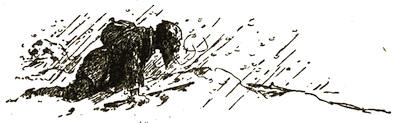
Thoughts slipped away again, as fatigue filled his body once more after the rest his brain held nothing but mist, mist. But somewhere in his consciousness one thing remained hard and fast, the thing that said, “Run, run, for God’s sake run.” Such was the will of Gaupa, the slayer of elks.
§ 21
In the Three Valley a dog had opened full cry, a glorious cry, for his quarry was standing still.
Rauten stood still because he was so tired that he had to. During the last run earth seemed unstable beneath him, and wherever he went he saw a lair before him, full of peace and quiet; he might go to rest under that spruce, or there—and there. Only he could not get rid of that eternal worrying by a big black fox that followed him like his own meaningless shadow. He had tried everything—climbing mountains, jumping across gullies, but the dog followed him with an endless succession of angry barks.
In the course of all those hours those barks had become no more than a habit to the ear; they did not feel like real terror any more, only a slight fear, a subconsciousness of danger. But Rauten was at length compelled to rest now, standing in a spruce copse in Three Valley.
Bjönn was there, lying down. The dog also was nearly spent. His legs seemed to have disappeared of late, and when they ran it was from innate habit.
Several times he had crossed the spoors of Gaupa. The earth threw up the familiar scent into his nostrils, like a message from his master to say that he was there, only “Go on!” And Bjönn went on, he was going for ever now.
His hair was soaking wet; both he and the elk were steaming like fast-running horses in cold weather. The snow lay on the heather like white wool, a frozen bilberry stood up from it, a reminiscence of summer in the midst of winter. Two pine trunks rose tall, straight, and copper-red behind both the animals.
“Wow! Wow!” said Bjönn. There was an interval between each bark, and his voice was so hoarse as hardly to be recognised. He snatched a mouthful of snow now and then, for his thirst. “Wow!”
Both animals felt themselves stiffening after they stopped. Rauten had a broad gash across one of his thighs made by a dry branch. There was reproach in his eyes as they regarded the little animal before him, whom he had never hurt and who would not let him be in peace. But rest, rest, that was all, the only thing.... Rauten stood still.
In the meanwhile Gaupa was hurrying westwards towards Three Valley. His footfall made no sound in the snow, as if he were running on soft moss. He jogged along, walked at times, eating snow.
He found the spoors of the dog and elk, indistinct but unmistakable: long lines across a tuft of wiregrass from the elk hoofs, and close by them clear marks of Bjönn’s paws. He followed the spoors with childish joy, lost them, found them again, and made straight for Three Valley.
All idea of time had long since left him. Only the mountain seemed endless. The snow continued to fall, and the ever-falling white flakes made him dizzy. At last he saw a tall, narrow rock on a ridge before him, a rock exactly like a tall chimney, that he knew to be on the slope towards Three Valley.
He was soon there. The earth sank before him, the valley could be seen—thin forest on the slopes, long marshes with a sleepy river, a large lake, a white summer pasture with a couple of dark houses, far away near the bend of the valley.
A pang of joy rang through Gaupa, vivifying and exciting, for a dog’s bark floated out in the grey air straight below him from the slope.
More barks followed; the whole valley filled with the song of it. Gaupa wondered at the sound. “Poor old dog, he has gone hoarse,” thought he. But what a dog! He was an animal without blemish, no dog like him. He would soon have assistance, warm drink, a taste of warm meat....
Gaupa slipped down the wooded slopes quickly and carefully. Just down there, just down there, he thought time after time. Ten minutes, five minutes more, and the Swede’s Bullet should fly unseen from the muzzle of “The Tempest.”
The next day he would return to Lower Valley, clothes in rags, with bloody hands. And Martin Lyhus would have to take his pipe out of his mouth to ask, staring in astonishment:
“What is it you say? Have you shot him?”
Gaupa stopped to make sure of the movement of the air.... He was in luck, it was straight against him. He could see it in the flying snow. But it would soon clear up. The flakes were restless, flying about like gnats, not falling quietly. That was a sure sign of approaching clear weather.
Gaupa followed a small spruce-grown gully in the slope, and just in front of him, very close now, stood Bjönn holding the wizard elk in check. To Gaupa stealing downwards, the forest grew alive, every tree listened for the dog’s barking, he felt as if on the point of discovering a wonderful secret.
He could not see the animals and heard only one, though he knew there were two. He stopped to look round for cover, and observed something strange about his hands. He stood petrified looking at them, he did not recognise them as his own. They were trembling now, however much he willed them not to do—trembling in spite of himself.
Then he felt a slight shiver in his whole body, something he could not control—and a cool feeling across the lower part of his body. The hunter’s shivers! he thought.
“Wow!” was heard from below, and then a sudden silence. Gaupa held his breath, waiting for the next bark. Surely he could not have frightened him? The wind could not have turned, taking his scent with it to those sensitive nostrils?... Then the barking started again, Rauten was still standing—like a rock.
Gaupa could not rid himself of this inexplicable trembling, and he could not shoot while it lasted. He was no longer the master of his own body, he was not the real Gaupa any more. The real Gaupa had never shivered before an elk—the devil he hadn’t!
Now he really had to be calm. For ten hours dog and man had been hard at work. At last they were at their goal, nearly near enough to touch it, and his hand trembled; he might make a false movement, and the goal might once more dart away to unknown distances.
He knelt down, filled his hands with snow and held it to his skull. It cooled first, then felt too cold.
Bjönn suddenly gave the angry bark which tokened that his prey was escaping, the bark so well known to Gaupa that the sound of it raised anger within him....
Escaped again!
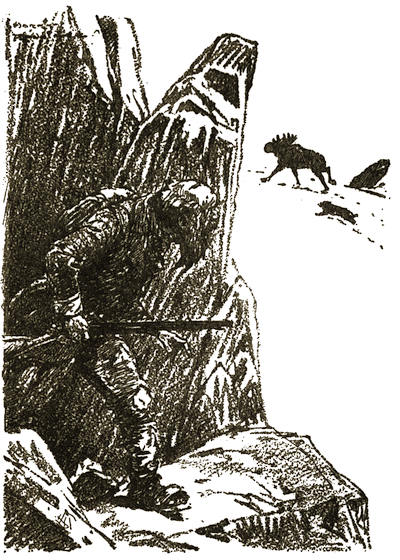
Gaupa stayed kneeling while the thawing snow ran in big drops down his head. His dark-blue eyes changed colour. They were lighter and glazed. His lucky cap was white with snow; his gun lay in the hollow of his arm, held tight to his breast—lay as if listening like Gaupa himself.
Silence. Dead silence. Running water somewhere in Three Valley gave an echo of life.
Gaupa rose. Silence. No barking then.
He ran out of the hollow up to a bare ridge. Then he heard Bjönn again and he understood that the dog was running beside the elk, even in front of him now and then. He could even see the two animals on the long marshes at the bottom of the valley. Rauten ran his jogging even trot, long and tall, forever turning his head from one side or the other as if listening. “A hopeless range,” thought Gaupa. Distance was simply mocking him. At such a range he would not dare to risk the Swede’s Bullet.
The elk crossed Three River and his legs raised white arches of water. Bjönn swam and was on the other side as soon as Rauten. They disappeared, but were seen again, Rauten heading straight for Three Lake.
Gaupa threw back his rifle, breathed deeply and went down the slope.
Rauten and Bjönn came to Three Lake, which lay black and still as night. A waterlily leaf was riding on the surface at rest. The whole lake was all peace, and the green heart-shaped leaf in conjunction with the two animals, the hunted and the hunter, formed as it were a picture of the very life of the wilderness, eternal peace of eternal time, painful efforts of the moment, life or death.
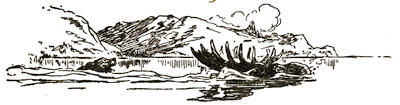
Rauten went straight into the lake, making openings in its smooth surface with his hoofs, cutting it with his thin legs where he waded out quickly, the water rising along his shoulders and flanks. A startled trout ran out from under the bank like a shadow across the white sand into the dark depths. Beside the elk was Bjönn, swimming.
The water gurgled higher and higher about Rauten; at last he swam, his snout so low that he ploughed through the water like a boat’s keel. Bjönn scraped the elk’s back with one paw, found no hold, and tried again. Then he caught the mane with his teeth and soon stood on the back of the wizard elk who was swimming across Three Lake.
The dog did not feel worn out then. He was tasting the fiercest joy. Under him he heard the laboured breath of Rauten, felt the entire huge body trembling with effort, muscles hardening and slackening as the elk trod the water. It was Bjönn from Lynx Hut, sailing! The elderly elk hunter from Lower Valley who never gave up from dawn to dusk—even to another dawn.
Then he poured out his joy from his hoarse, dry throat, and mingling with his song of conquest came the groans from Rauten, who was swimming, wild-eyed. He steered towards a pine top on the farther side of the lake. Terror sat on his back as he swam for his life. Once he felt teeth in his back, and the same icy shiver ran through him as ran through his forefathers when they broke down in the snow with the wolves swarming fiercely over them.
Bjönn bent down and tugged a big tuft of hair out of the elk’s back he dropped it on the water, where it remained floating.
“Wow! Wow!”
He plucked out another tuft.
One might say a raft was sailing along the water, with Rauten’s horns for rowlocks.
Bjönn noticed a tall tree-stump moving across the marshes. It was Gaupa, his master, and his pride knew no bounds. He could conquer every elk from one mountain to the other, if they were many times his own size. He could drive them, bark exhaustion into them, until at last he would drink his fill out of their throats. “Wow! Wow! Wow!”
Gaupa crouched on the marshes north of Three Lake.
He was in pain. The elk’s head and Bjönn floated away farther and farther, and if he were to shoot there was an even chance that he might shoot his dog as easily as the elk. But when Rauten went ashore he would try a shot, howover hopeless.
The Swede’s Bullet could not be risked at such uncertain range, and therefore he changed cartridges quickly. Then he crouched in position for shooting, left elbow on left knee. His cheek caressed the gun. He sat immovable, a huntsman stiffened in the last decisive movement of the hunt.
He trembled no more, although the tension burnt in him like a hidden fire. He saw out of the water a large body grow through the falling snow.
And one of Gaupa’s eyes shut as if sleepy. The other, however, was open, and icy cold. He did not breathe, his whole body was taut calm. “The Tempest” roared, shooting out its breath with a white handful of smoke, and for a moment Gaupa’s ears were plugged up with sound.
But Rauten, who was wading ashore, heard something like a woodpecker hammering at a tree on the shore. Then came the roar of the shot, behind him, and he stretched himself off into the forest, a rain of waterdrops about him. Bjönn followed.
§ 22
Gaupa pursued the chase once more.
Dusk was falling. He did not hear Bjönn any longer, but he had the spoor.
The weather cleared up towards evening. The sky seemed to absorb the snowflakes, making them light and dry. The heavens became fixed and formed a pale-yellow dome over the earth.
The silence increased after the shot and the barking. A man followed a spoor in the new snow, but Sjur Renden did not run any more. He walked!
His face showed signs of utter exhaustion. The cheek, chin, and eyelids were hanging down. His mouth, too, hung open, although he did not breathe heavily. The corners of his mouth were drawn into a grimace of contempt.
The marshes were white, but the ground under the trees was not covered with snow. The woods had assumed an air of solemn grandeur which was not diminished by the oncoming dusk.
Gaupa was fairly staggering. That last effort near Three Lake seemed to have drained his last forces. All the same he went on and on, always showing that grin of contempt, as if he were mocking at the elk spoor before him.
In the middle of an open space where the pines had once been burnt down and never grown up again to their former state, he stroked his eyes with the back of his hand, as people do when they wake up and yet are not really awake.
He walked on a few steps, stopped again and touched his eyes. What devilry disturbed his sight? He saw as clearly as clearly a shiny yellow moon, not quite round, but slightly elliptical as the moon is when she is on the wane. This moon stood in the air a few gun-lengths before his eyes and it moved when he moved. It was so blazingly, glaringly yellow that it made the air gleam yellow. Gaupa felt as if everything glowed and blazed before him. The very dusk flamed. He was dazzled, and shut his eyes for a long time. When he opened them again the air was as it ought to be, soft and nearly dark. But after a few steps that idiotic moon came back.
He knew well enough what moon this was. He had seen it before. Over-exertion, curse it. And his knees felt as they always did when that glaring yellow moon appeared. All the sinews seemed to have been taken out of his joints, all elasticity had left his legs. They moved about anyhow beneath him, without his volition.
Then Gaupa went under a spruce tree and lay face downwards. His face touched some whortleberry ling and he could smell the soil. A bunch of berries caught his eyes, a large, bright red bunch, and they made so intense an impression on him that he seemed to feel the juice seething inside them. Never in all his life had he seen so red a bunch of whortleberries. His eager hands seized them and pushed them into his mouth. He crushed them with his tongue and their juice ran in his dry mouth, an exquisite joy. He looked for more berries, crawling on all-fours round the spruce tree like a child—an oldish man with a flowing beard.
While doing this he saw Bjönn coming, keeping to the spoor, going backwards. The dog gave up before reaching his master, and lay down a little way off. He was utterly exhausted.
Gaupa went up to him, knelt down, talking to him and stroking him. And it seemed to him that those dog’s eyes spoke. Why had he not come when Rauten stood still on the northern slopes? they asked. Why had he missed when the wizard elk rose up from Three Lake? Bjönn had done what he could, the dog’s eyes declared. All the same Rauten was running about in the valley, free, unwounded.
Gaupa sat still, stroking Bjönn’s head.
“I also could do no more,” he said aloud; “but wait till to-morrow.”
The weather cleared up as evening came on. The sky turned blue as the sea, the stars twinkled like tiny lanterns, some clear white, some dullish red. In a small barn near Three River Gaupa and Bjönn slept.
Farthest out in the valley where the moon was rising like a yellow lantern where earth and sky met an elk stood for a long time snuffing towards the north. He was dripping wet. After a while he lay down, and the snow thawed slowly under him.
Thus Rauten lay all that night, his eyes ever open, ears alive, nostrils working. Towards morning it was so cold that his wet back grew white with hoar-frost.
§ 23
About dawn Gaupa and Bjönn dug themselves out from the hay in the barn.
Gaupa had lost his matches the day before, and could make no fire. The only way was to bury himself in the contents of the barn.
His shoes stood frozen stiff at the door. They were so hard that it was out of the question to put them on. He tried many times, but in vain. To wait for the sun to thaw them would take too long—so he thawed them with the warmth of his own body. They softened, and soon after he and Bjönn were following the spoor of the wizard elk.
They found his night lair where the snow was thawed and some hairs lay about. But Rauten had left several hours before, Gaupa could read that much in the spoor. It had hardened, there was a crust on, and also Bjönn told him they were not near him yet.
They chased the elk from sunrise to sunset.
The spoors were there, and there was something alive about them. Every mark of the hoofs meant a movement forwards—one footmark after the other from one slope to another, an endless chase.
The spoor, so strangely alive, kept Gaupa’s interest warm. It was like turning leaf after leaf of an exciting book where the end cannot be guessed.
Once they found fresh excrements after Rauten, and Bjönn grew doubly eager after smelling them. But Gaupa would not let go until he was fairly sure of being near enough.
He did not think much that day either of the fact that he was hunting no ordinary earthly animal; Rauten was only an elk who had wandered for many years among Ré Mountains, mocking all efforts on the part of those who tried to get at him. He was the elk that Gaupa himself had rather avoided. But now he would measure himself against him. As long as he had a bite of food, as long as Bjönn could move, he would stick to that spoor—and he swore loudly and forcibly.
He went towards the west for several hours. The weather was wonderfully fine. The mountain plains in their majestic calm reflected the sunlight like a mirror. The light dazzled his eyes and made him sun-blind. Little black lakelets looked like spots of ink on a white tablecloth.
Rauten had gone into a long lake, and Gaupa found no spoors up from the water. He went round the lake several times, but no tracks could be seen.
He reflected. Could this lakelet, without even a name, be Rauten’s tomb? Could the elk have been drowned out there? It seemed impossible.
He circled the lakelet once more, and in the little brooklet which fed the lake he saw some strange holes in the mud at the bottom. The brook was shallow, and the sun showed him the bottom quite plainly. Those holes down there had a distance between them about as long as the stride of an elk.
He followed the brook for about a quarter of an hour, and found the place where Rauten had left the water. Gaupa had never seen an elk try to hide his tracks so cunningly.
About noon he went straight towards the sun, ignorant of the names of the mountains around him. Then the earth yawned before him, and he perceived a valley so large and deep that it must be Hallingdal.
He heard also that the air was vibrant with some sound, a dull, heavy roar with some sort of rhythm in it. He could not understand what it was. The wind shifted, and into his ears poured the deep, full boom of church bells. Once more the wind shifted, and he heard nothing but that vibrating roar.
Then he remembered that it was Sunday—for ordinary people, but not for him. The elk spoors led straight towards the valley and the church bells—one might think Rauten was going to church. But on a slope the track turned abruptly, and there Gaupa smelt the homely, acrid smell of smoke, the sign of people and houses.
He walked on after the smoke, sniffing his way like a dog on an open scent. A little later he stood before a low Hallingdal cottage with a tall chimney. He touched the doorhandle; Bjönn stole in in front of him, and in a moment was chasing a cat, as red as a fox. But cats made Bjönn mad. He threw one paw over the animal, pinning her to the floor, and then bit twice across her back. There was the sound of crunching as when Bjönn ate bones, and then a cat died in Hallingdal.
They gave him matches and food, and he walked uphill again. He released Bjönn, who soon returned. Rauten was too far in front of them.
Dusk met Gaupa in a bare valley without summer farms where he could spend the night. His axe resounded in the silence as he cut down dry pines. He slept in the shelter of a rock, Bjönn clasped tightly to his breast.
A few hundred yards from Gaupa’s night lair something dark showed up on a ridge. Was it a rock? No, the rocks were not black then, they were white with snow.
That dark thing did not move.
After a while it did move. Two eyes gleamed wet in the moonlight, a tined antler crossed the harvest moon behind it. Rauten was lying there.
He thought he heard some strange sounds in the evening, but there was little wind and he could not make sure.
He was waiting for daylight.
The snow was glittering, the crystals of snow were like innumerable stars which were for ever being lit and extinguished. The mountains were softly moving clouds, cradling the tired body of Rauten, while a few isolated mountain spruces, from which the sun had thawed the snow, were like darkly dressed dwarfs in the hollows.
It was nearly two days and two nights since Rauten left Owl Glen in Lower Valley.
§ 24
When Gaupa hung up his coffee-kettle over the fire he felt shivery after his cold bed. The kettle boiled, and he swallowed hastily four or five cupfuls of scalding-hot coffee. Then he noticed a strange pattern in the grounds at the bottom of the empty cup. The lines were funny, he thought, they made quite a picture.
He turned the cup round and round, and there was not much imagination needed to make those brown lines mean an elk lying on his back.
Then Gaupa smiled to Bjönn.
“We’ll have him before sundown. He lies here.”
A little later the fire under the rock wall was deserted, and while it was dying slowly the resinous smoke floated like a dark mist over the neighbouring bog.
Gaupa had not walked far when Bjönn rose on his hind legs and caught the open scent. He would not come down on all-fours for fear of losing it, and went on hopping on two legs several steps, and Gaupa swore prodigiously out of the joy in his heart. He loosed the leash, and let Bjönn storm into the mountains towards the pale-yellow sky of the dawn, from which a faint sheen fell on the snow.
The snow was crisp now after the night’s frost, and it crunched a little under each of Bjönn’s steps. A family of grouse flew up like a shower from some osier bushes, a cock grouse called “gak-gak,” and soon after the dog sang out farther east. Rauten had company once more.
Three hours later Gaupa was steaming with sweat. He passed unknown summer farms where the windows in the sun shone like fire. It was warm, for summer was still in the air. Winter lay on the ground prematurely born. The trees were dripping, the snow grew wet and heavy, crunching a little under Gaupa’s shoes. A young hare sniffed the snow which he had never seen till the day before, big brown eyes staring with wonder at the bewitched world.
The chase went on—and it was evening.
§ 25
It was night, the third night since Rauten left Owl Glen.
He was lying in a brook in Ré Valley, on Bog Hill where once he fought the three-year-old. On all-fours he was lying in the brook, the water unceasingly licking his stiff limbs, and Rauten enjoyed the refreshing coolness. Once he bent his head to drink, his flanks hollowing.
Before him on the bank of the brook lay Bjönn. He did not say anything, having barked enough throughout the day. It was quite dark, the moon not yet being up and the snow having been thawed on that sun-exposed slope so that no light was reflected by the snow either. Only the silver bark of a birch gleamed faintly among the dense spruce woods.
A good stone’s throw farther south on the slope Gaupa sat, his back against a tree-trunk. His pack lay at his side and his rifle across his knees. Inside it rested a cartridge containing the Swede’s Bullet.
Gaupa felt exceedingly cold, for he was wet with perspiration when he sat down, and now he felt as if he were wrapped up in icy-cold sheets. He beat his arms across each other, carefully so as not to make a noise, and sat on.
In the dusk he had reached Black Mountain and heard Bjönn baying on Bog Hill, but darkness came before he reached him, and he could not discern the sights of “The Tempest” except against the sky.
When he came to the spruce where he was sitting now he heard Bjönn’s last bark, and understood from it that the elk was not running, for the barking sounded so feeble.
Rauten and Bjönn were presumably somewhere in that brook, and if he knew Bjönn he would not leave the elk that night. But when the sun rose over the eastern ridges and lit up Ré Valley, then Gaupa would steal forth, as soon as he could make sure where Rauten was standing. The brook in the hollow murmured unceasingly.
Gaupa listened. No, he could not hear that inexplicable muttering far away which belonged to the night and the unbroken silence. The brook deadened it. He felt how the forest about him was asleep, standing, eyes closed. All the same there was something, that restlessness which has no origin. He seemed to hear something breathing like a human being somewhere.
He remembered one incident after the other told of the remarkable animal who was standing unseen somewhere near him.
There was Anton Rud. Last autumn he was cutting resinous pine-stumps to distil tar, far up Tolleivsæter way.
One evening he kept on longer than usual, and it was dusk when he walked slowly down to the hut again.
He stopped to light his pipe, when he heard a cough below, a faint, dry cough, first once and then twice running. He heard also the noise of someone walking, and he sat down to wait, for it sounded as if someone were coming uphill.
But nobody came, nor did he hear that cough any more. He thought it strange, and called out aloud asking whether there was any human being.... No answer.
In the morning he went up to the same place to search the soil a little. He could not understand that cough—it sounded exactly like a consumptive coughing and clearing his throat. There were no traces of a human being, but he found elk spoors like Rauten’s, and he stopped stump-cutting that selfsame day.
Gaupa remembered that story and many others.
In the meanwhile Rauten and Bjönn remained in the same spot in the hollow, the dog looking steadily at the huge deer before him, his nozzle rested on his forepaws, and he looked like a long, narrow mound of grass or peat. Off and on something moved on the mound; Bjönn’s ears rose and lay down again.
A big bird, an owl, flew noiselessly over the forest, wings caressing the air.
After a while Gaupa nodded drowsily as he sat by the tree-trunk, but he felt so cold that he was wide awake again in no time, and then he heard somewhere a horse’s bell. He turned his head here and there, and the horse’s bell was to be heard from every direction. But it was impossible that there should be a horse’s bell at that time of the year; nobody put bells on a horse in the summer. He happened to take out his watch, and the horse bell suddenly sounded much louder and nearer. Then he understood that what he had been listening to was the tiny tink-tink of his own watch. It was ten o’clock.
A little later something trod softly in the darkness—very softly. He turned and the tread grew alive, became something tangible which was Bjönn. The dog came close up to him and laid his head on his master’s knee; and Gaupa embraced him, whispering fond words into his ear. Bjönn licked his master’s face and he let him do so. Then he fed him from his sack, gave him much food, whispering and prattling with the beast all the time, telling him that Bjönn must be a clever dog and hold Rauten till either the moon or daylight came, and then “The Tempest” should sing.
But Bjönn did not stay long with Gaupa; he wagged his tail a little, and trotted a few steps away from him. Then he seemed to remember something he had forgotten, went back, sniffed Gaupa’s beard and pressed his cold, wet nose close to his cheek. Then he disappeared in the darkness; there was a sound of rustling among the spruce branches, and then the brook was once more the only living thing Gaupa could hear or see.
He thought of Bjönn’s strange behaviour, how he came back to nose his beard. And he remembered the night before he left Lynx Hut, when he was remelting the Swede’s Bullet, how strangely Bjönn stared at him, whimpering as if in the full knowledge of something evil.... However, such things were not worth noticing.
Rauten had not moved the length of a mouse while Bjönn was away.
Then the dog began to walk stiffly in front of the elk, barking once or twice, and Rauten’s peace was broken. He got on to his forelegs, rose and stood still. Bjönn became eager, for he knew that Gaupa was close by, and he could not understand that it was difficult for his master to shoot in complete darkness.
Gaupa heard the sharp crack of a twig, then another. “There goes Rauten,” he thought.
A little later he heard the antlers striking a tree-trunk, and the dog’s bark came nearer, eager and aggressive. “There is the elk coming,” he thought.
Over him the branches hung like a wide-meshed net, a faint light from the sky penetrating it. But the under-bush was so black that he saw the trees only like vague shadows and in there the wizard elk was coming. Listen! how the antlers rustle among the spruce needles with a dry swishing sound, as when you sweep the floor of the hut with a broom!
Gaupa did not stir, but clasped his hands round his gun in trembling excitement. He sat immovable like an animal in its night lair, his eyes burning as if they would burn a hole in the darkness enveloping him.
Both beasts were close by and below him. Once he thought he saw a large shadow glide past down there, but he was not sure. He heard the dog throw himself aside and Rauten’s heavy steps. But he could not, could not see him.
Slowly Bjönn withdrew a little, following the wizard elk.
Gaupa crawled after them on all-fours, slowly, slowly. He was so close after them that he surely could have thrown his gun at the elk, if there had been light enough, and it seemed to him that he was crawling at the bottom of a black lake with the tree-tops floating on the surface of the water.
Then Rauten stopped and the dog’s barking grew rhythmic. Gaupa dragged himself ward on his stomach, and in a glade he caught sight of Bjönn, a dark bundle which glided here and there over the earth. But the elk, the elk?
He did not dare to move farther, and remained where he was, “The Tempest” ready. Over the western ridges the starry sky was sparkling.
Little by little Bjönn calmed down, till finally he remained on the same spot, and from the direction of his head Gaupa guessed whereabouts Rauten must be. For a long time he had been looking for something showing up like antlers against the sky between two tree-trunks, and he was only waiting to see that something move.... It did move, quite distinctly, and Gaupa lifted the barrel of his gun towards the sky, then lowered it towards the antlers, then far enough down to hit the body—and then the Swede’s bullet left the mouth of “The Tempest.”
The splitting flame from the gun sent a broad beam of light across the glade where Bjönn stood. And in front of the dog Gaupa saw as if in a flash of lightning the head of Rauten above some bushes. The head was lifted high, large eyes staring, and the half ear stood out very clearly.... Then darkness came again. Not a sound, no heavy thud of an elk falling, no eager dog’s bark.
Gaupa was half blinded from the sudden change from glaring light to absolute darkness. He listened for the well-known dry crackle of fleeing elk’s hoofs, but it did not come.
Then his ears caught the sound of something astir close in front of him. It could not be Rauten dying, for he would surely have heard him falling.
He struck a match, and at that moment a cock grouse chattered furiously somewhere up south—a coldly mocking guffaw like the laughter of a lunatic. If the grouse chattered in the middle of the night it must have been roused by the elk, therefore Rauten must be far away already. But what, then, was that which moved before his feet?
The match went out, there was a draught in the air. He scratched another, there was a swish along the box, a tiny explosion, and a little fire was born and burnt uncertainly within the hollow of his hand. Two spruces stood within the circle of the light, staring with wonder as if they had just awakened and wanted to know what kind of tiny sun was dancing on the ground.
Gaupa went forward to some yellow moss, that showed elk spoors. But in the middle of the glade Bjönn lay on one side. His eyes blinked a little at the light from the match, but there was in them something strained which Gaupa did not recognise. He knelt down beside the dog, stroking him and talking to him, but Bjönn took no notice, and his flanks laboured so strangely and quickly.
Gaupa lit another match and saw blood on Bjönn’s hair a little behind the left shoulder. He felt with his hand, which became wet. The dog started to open his mouth as if to yawn—and he gaped, and he gaped, and never finished.
“Bjönn!” Gaupa whispered—“my own dog!”
But Bjönn only gaped.
Gaupa understood what had happened. The Swede’s bullet had struck the elk’s antler and was shattered, one bit of lead ricochetting and hitting the dog.
“Bjönn! Don’t you hear me, Bjönn?” he whispered once more half beseechingly.
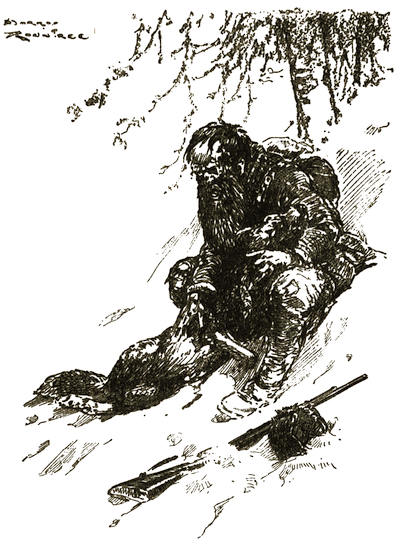
Oh no, Bjönn could not hear anything any more now. He began to nod his head in a strange way, something gurgled in his throat. A large tear leapt out of the dog’s eye and rolled down over the grey muzzle. The dog stretched himself. He was tired of the endless chase. He wanted to rest.
The last thing Bjönn from Lynx Hut did in his life was to stretch himself.
A man was sitting with a dead dog on his knees. It happened on Bog Hill in Ré Valley. The murmur of the river sounded steady and calm, like the very breath of night.
Gaupa thought of the Swede’s Bullet. It concealed strange powers; it had travelled through a body before, and it knew its way. Why, oh why, then, did it take away the only friend, the only child he possessed? It would be small comfort walking down to Lower Valley in the morning.
Gaupa waited for the dawn. Bjönn seemed so strangely heavy on his knees. He felt how the warmth of life slowly left the soulless body of the dog, remembered what the two had shared of better things and worse throughout the years, and the tears fell fast down Gaupa’s unkempt face.
Daylight came. In his arms he carried Bjönn to a heap of rocks tenderly as a mother carries her sleeping baby to bed.
He displaced some pieces of rock, and when he laid Bjönn down there he felt that he was burying some of his joy in life. He sat down, his shoulders heaving.
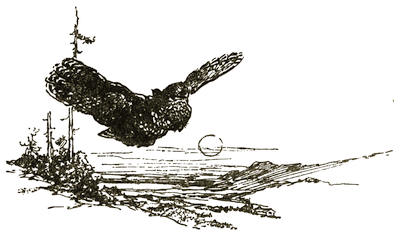
When did Gaupa weep last? He did not remember. It was long ago, long, long ago.
Day broke over Ré Valley.
§ 26
Time floated over the wilderness.
In summer it is warm, in winter cold. Three days before Christmas the sun ceases to descend lower in the sky, rises again, and after a long while he starts work on a fresh spring down on earth.
Through half the year the lakes lie with their eyes closed, for half a year they mirror the sunset. The rivers stiffen when the immigrating birds go south. While the bear dreams in his winter lair, the trees stand bloodless, breaking in the frost. But when the living ploughshares of the wild geese go northwards once more, then the trees spread out all their branches, embracing life.
Such is time, when beasts are born, eat, and die. Such was time when Rauten went towards old age.
His body followed the all-subduing law of nature. At Candlemass time he lost his antlers, which invariably grew out again, every time with more tines. When the leaves fell he roared his hoarse mating call at dusk and at dawn. In the summer nights his huge, dark body would glide through the forest out to Gipsy Lake where the snow-white waterlilies were floating.
On some clear, cruel, frosty winter night he would perhaps stand on guard beside a soft-eyed cow and a calf that was his own flesh and blood. Then Venus, queen of the starry heavens, would glow large and bright above Ré Mountains, lending a pale shimmer to the white snow. The Aurora Borealis would shine bright and strange, then the breath from the elks’ nostrils would smoke in the night.
When once in a while Rauten lay on Black Mountain looking out across the forest, all the happenings of which his life was so rich would stir within him. Probably he did not remember, not live his reminiscences once more in his mind. We do not know about that. But each remarkable incident had set its mark in him in the shadowy life of his soul. They had sharpened his instincts, enriched his experience. There were incidents at all times of the year, in all changing lights of day and night, in sunny heat and in frosty weather—some concerning animals, some human beings.
But he grew solitary and still more solitary as age came on. He sought places where man but rarely made spots on the earth with his shoes of animals’ hide, where the steel tooth of the axe but rarely gnawed a tree, where old times were still dreaming.
For the Ré Valley woods began to be open. Foresters’ huts grew out of the earth, creating unrest. Old trees died, changed their existence, and left Ré Valley. Their stumps stayed, time and weather eating them as ravens eat carrion.
Many a dog had chased Rauten, but their muzzles grew grey and their eyes blue, and one day the barrel of a gun blew out their lives. And still Rauten walked across Black Mountains.
But what of Gaupa?
He also aged; he aged rapidly when Bjönn died. For after that time he lost his love of the woods somehow, and then he seemed to shrink within himself.
Soon he was no longer a wild cat, he became a tame, domestic cat. No more his fire shone at the capercailzie’s play in the blue spring evenings when the song thrush was silent in the tree-tops and flew away for the night. A sleepy petroleum lamp shone dully in Lynx Hut, where the air was not light and pure as drifted snow, but stank of leather and old footwear.
He felt as if something had died within him. His mind was like an everlasting rainy day, monotonous, without a gleam of sun. No more tumults, only silence and death, his mind was luke-warm like marsh water.
Gaupa was not well either. He needed but to drink three or four cups of coffee one after the other to make his heart unmanageable. It would not keep time, but beat eagerly and quickly, and then it lagged, nearly stopped as if lame.... Well, well, that heart had seen hard days, as well he knew.
Gaupa’s calves grew full of small bulbs under his skin from varicose veins. And then rheumatism came. Working in his shop he could feel the rheumatism, like fine red-hot wires being stitched into his body. It was worst in his knees, for there something was gnawing, gnawing like sharp teeth, everlastingly hungry. Well, well, you know those calves and those knees had been through some hard work in his life.
Once somebody asked him to go to a doctor, but then Gaupa guffawed in mocking merriment.
Alas, there was small comfort in Lynx Hut now. No Bjönn came to place his head on his knees while he was stitching shoes, no Bjönn met him with tail waving in the open door when he had been out and came home, no Bjönn shared his bed under the sheepskin covering in the night. When he woke up at night he caught himself listening for the dog’s breath, for Bjönn used to breathe so heavily, so humanly. Gaupa remembered so well.
When he was seventy years old he was converted. After that time the poor old soul would often sit in one of the foremost desks in the schoolhouse, piously listening to what Hans Uppermeadow, the “high priest,” had to announce. He would sit there in his simple blue-striped celluloid collar without a tie. That was the only Sunday best he possessed, and no one knew when last it was washed.