VI TO TRAIN THEM UP OR LET THEM SPREAD
Reading edition
Growers attending conventions will often stay up half the night to argue about training and pruning tomatoes and to debate the details of their favorite procedures.
For home garden, the method is strongly commended. Many market gardeners follow the practice and it has gained materially of recent years in New England. Some market reports quote staked tomatoes separately and at a materially higher level than fruit from unpruned plants.
Most of the southern shipping sections follow the practice and it is practically universal in greenhouses.
One way is to drive a stake by each plant tying at several points along the stem with cheap twine. The other plan, recently gaining in favor, is to set posts every 25 feet or so, string a heavy wire on top, and another a foot from the ground. Cheap jute twine is strung between wires and the tomato plants are merely twisted around the string. Tying is not required. Some omit the lower wire, tying a non-slipping bowline loop around the plant near the ground. In either case, plants are kept trimmed to a single stem though occasionally an extra branch is allowed to grow. In southern Illinois, plants are tied to a short stake without pruning.
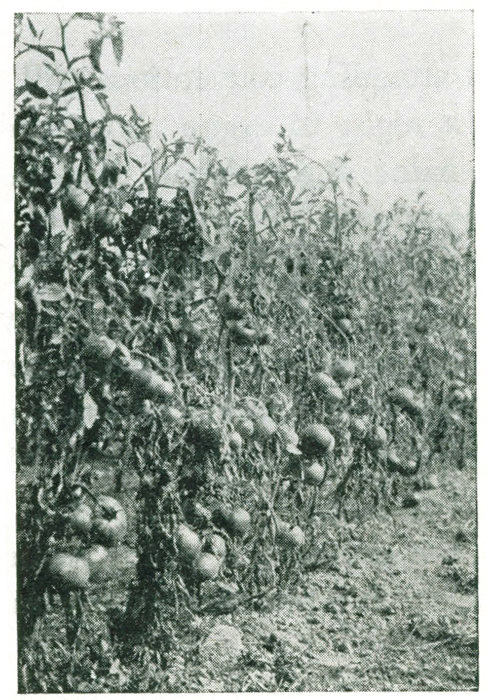
Figure 15.
—Tomatoes pruned and trained with post, wire and twine. This is the trellis system of
New England
.
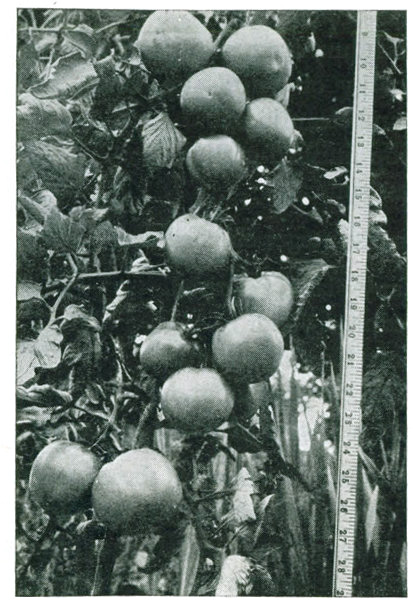
Figure 16.—Fine clusters on trained plants.
Pro and Con
The advantages claimed for pruning and training are:
Earliness. High yield per acre. Ease of cultivating and spraying. Ease of picking. No injury from snails and wire worms. Quality of fruit:—size, color, smoothness and cleanliness. Crop finished earlier. Less sunscald.
The disadvantages claimed are:
Many plants required. Reduced yield. More blossom-end rot. Higher cost of labor. Cost and care of stakes and wire.
The validity of each of these points varies greatly with conditions; in fact, the answer to the whole question depends largely upon the location and the ideas of the grower. In trying to reach a conclusion, it is well to realize that training makes certain radical changes in the plant. It loses leaves through pruning, it is supported from the ground, and it is spaced differently. Since the leaves manufacture the basic substance for themselves, and for the rest of the plant, removal of leaves reduces the resources of the plant. H. C. Thompson[17] has found that the root system is reduced about in proportion to leaf reduction. It is fairly clear that single-stem training greatly reduces the yield per plant, and other methods result similarly in proportion to the severity of pruning. When plants are spaced closely enough together the yield may be brought up to that of areas unpruned and unstaked. Idaho experiments indicate that staking alone does not affect the total yield, but that it does favor early maturity under the different pruning systems. The disadvantages of training are largely economic. Will the marketing conditions justify the extra cost of staking and pruning?
Experiments have shown pretty clearly that sunscald, blossom-end rot and cracking are worse on trained plants. Using varieties of good foliage will help the first trouble while uniform and adequate water supply achieved by selection of suitable land, by building humus content of the soil and by irrigation will solve the latter two problems. Thompson found increased yield of early fruit. Other evidence is somewhat conflicting but, in general, it supports Thompson. It is generally agreed that pruned plants yield larger, cleaner and more perfectly formed and colored fruits. Ease of spraying or dusting and of picking is important.
For pruned plants, 3½ feet between rows and 1½-2 feet between plants is about right.
To train or not to train is a question that one must answer for himself as the controlling factors vary too widely—costs of stakes, wire and labor, prices of early tomatoes and possibility of cultivating a more or less fancy trade.