I THE TOMATO IS A GREAT FOOD AND CROP PLANT
Reading edition
Vegetable, Fruit or Berry,—what is the tomato? A standard query this is and many an argument has raged about it. The answer is easy. It is all three. By culture and use, it is a vegetable; botanically it is a fruit and among the fruits, it is a berry being indehiscent (non-shedding), pulpy, with one or more seeds that are not stones. And they say the tomato is more truly a berry than the raspberry.
But that doesn't make much difference. The thing that matters is that people like the tomato. It is easy to grow and nearly every home garden has it. It is good to look upon—shapely, colorful and of glossy sheen. A trained single stem plant with ripening fruit is a genuine ornament in the garden. It is most gratifying to the palate, fresh or cooked; soft and grainy, smooth and juicy in texture, sweet and tart and with an appealing flavor all of its own that few fail to relish. As juice or cocktail, adding color and flavor to soup, as condiment or as side dish with the entree, as salad freshly sliced or in jell, it is welcome with almost every course and some ingenious chef or, more likely, some clever housewife will, one of these days, fashion from it the dessert supreme.
Nor have we exhausted the list of forms in which the tomato may be served. In addition to its simplest cooked form, stewed or turned hot from the can, it may also be baked, stuffed or not, or it may be escalloped and cooked with rice, spaghetti or other foods. Fried, before fully ripe, and served with brown gravy, it is most popular in many a home.
Ketchup or catsup is one of our most widely used condiments and chili sauce many like even better. Green tomato pickles, chow chow, piccalilli carry the piquant tang of the tomato to enliven the winter table. And tomato juice, plain or dressed up with spices, vinegar or lemon juice has become a great staple of our groceries, a standard send-off for any meal from breakfast snatched on the morning sprint to work on through to the most elaborate of banquets.
The tomato, by reason of its natural acidity, is readily sterilized and so can be preserved easily in glass or tin. It ranks first among the "big three" canned vegetables; the other two being sweet corn and peas. By far the great bulk that goes to the factory is put up with the addition of nothing more than salt. In addition to the condiments, puree and paste are manufactured in commercial quantities. The Italians dry tomatoes extensively in the sun, slicing the fruits, and later flavoring them to taste for various winter uses.
Though the tomato was not recognized as a valuable food until about a century ago, its merit is now universally accepted. Bob Adams used to call it "the poor man's orange" for it is rich in vitamins and in malic and citric acid, possessing besides, a fine appetizing flavor which is as truly a value in nutrition as it is a pleasure.
Actually, the tomato is mostly water, of rather low protein and carbohydrate content but this does not detract, for other foods are dependable for these staples of nutrition and most of us eat too much of them.
The tomato is a youngster among the vegetables. In contrast to the onion of Egyptian lore and the cucumber reputed to have been used in Western Asia many centuries ago, the tomato is not reported until the herbalists of the 16th century recorded its culture in Italy and England—but with little of the esteem now accorded. The name seems to be of Aztec origin and two distinct wild forms—one corresponding to our cherry or currant varieties and the other to our larger, flatter, less regular fruits of many cells,—are to be found wild in Latin America. Its American origin is generally accepted.
Commercially, the tomato is a great crop. Among the vegetables, it is outranked only by the potato and the sweet potato.
The following table gives a few figures on the tomato crop:
1929-38 Average Acres Thousands Value Million dollars
1939 1940 1929-38 Average 1939 1940
U.S. for canning 369 358 386 19 24 24
for fresh market 177 210 204 24 34 29
Total 546 568 590 43 58 53
Average yield for market is about 116 bushels per acre and the average price $1.26 per bushel. The government reckons a bushel at 53 pounds, or about 38 bushels per ton.
The average cannery yield for 1929-38 was 4.15 tons; for 1939, 5.58 tons; and 1940, 5.39 tons. This shows a material increase. The average cannery price for 1929-38 was $12.54 per ton. Yields by states varied widely in 1940 from 2.7 tons per acre in Arkansas with Indiana at 5.5 to 7.5 in California. In northeastern states, it is considered that about a seven ton yield is necessary for the farmer to break even. In New York, it costs about $60.00 to grow an acre of tomatoes to first picking. With a good yield, picking and delivery costs about $3.00 a ton.
Leading market states are Texas, 40,000 acres; Florida, 31,000 and California, 22,000. Tomatoes are grown in a very large number of states—23 or 24 states showing 1,000 acres or more for market.
Leading cannery states are Indiana, 74,000 acres; California, 52,000; Maryland, 51,000; and New Jersey, 33,000. California, also Pennsylvania and Ohio have shown recent large gains.
Large quantities grown in town and country home gardens are not included in these figures and probably also many grown on small scale for market.
After all, however, the United States Department of Agriculture estimated per capita consumption of fresh tomatoes at 17.7 pounds, about one medium sized fruit per week per person. Consumption of canned tomatoes is less than a third of the fresh consumption. These figures include estimates for rural and urban home gardens. So, we can hardly be said to be gluttons for tomatoes nor even to meet a fair health standard, even considering all vegetables together. After all, it does not have to be tomatoes even though their high nutritional value is recognized.
Figure 1.—The tomato is the leader among greenhouse vegetables.
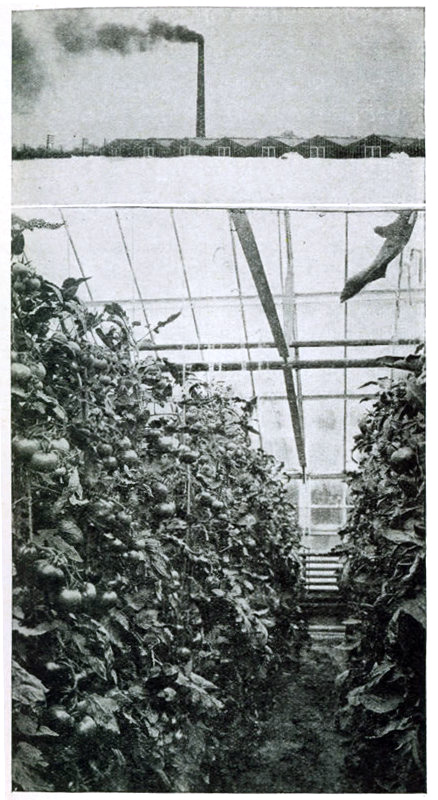
In commercial greenhouses, the tomato has replaced lettuce as the principal crop and it is likely to remain an important under-glass crop until such time as the South finds practical means of getting it to market with first-class quality—perhaps, harvesting the fruit when it first shows color.
Solution Culture
The tomato has been widely used in experiments in solution-culture of plants, sometimes called "hydroponics." The method has been in use for decades for research purposes, but has been widely publicized of recent years as a possible method of commercial culture. A high degree of control of factors governing growth is undertaken and difficulties are proportionately increased. Hence no extensive commercial development has occurred. A good presentation of the method has been offered by Hoagland and Arnon. [1]
The Tomato Plant
To manage a crop, one must needs know the plant. To know the various characters of the tomato helps one to master its culture.
The tomato belongs to the night shade family, the Solanaceae of the botanist, along with the potato, tobacco, petunia, pepper, eggplant, night shade, jimson weed and many other plants useful and noxious.
The tomato is a warm-season crop, sensitive to frost but reasonably resistant to heat and drought, thriving under a wide range of climate and soil. A frost free season of seventy-five to ninety days will mature home garden tomatoes in useful quantities if good plants are set but over 120 days are needed for economical commercial production. Plant growing requires six to eight weeks previous to setting out-of-doors. Each fruit requires about six weeks from blossom to ripeness. The fruit ripens best for yield, color and quality when the weather is warm and sunny. Low temperatures without frost are not favorable for growth and prolonged conditions of this sort may "check" the plant and retard the response when higher temperatures come.
The tomato is sensitive to extreme day-length, setting fruit at 7 to 19 hours but not at 5 or 24 hours.[2]
The tomato responds readily to fertilizers and to moisture, coming quickly into vigorous growth after unfavorable conditions, unless too badly stunted.
As long as moisture and nutrients are available and other conditions are favorable, a tomato plant will continue to branch and blossom and make fruit almost indefinitely. A pruned single stem plant in a greenhouse at Cornell once reached a length of over 40 feet during a year and a half of growth. Thus, it is really a herbaceous perennial grown in northern climates as an annual.
The plant branches freely at leaf joints but fruit clusters are formed along the bare stem,—a habit not common among plants. Some varieties are "determinate" in habit, sometimes miscalled "self-pruning," as branches only attain limited length.
Figure 2.—The tomato flower. Varieties differ in protrusion of pistil beyond the stamen column. If style is too short, pollination may fail; also, if too long. A long pistil increases danger of damage from heat and drying out.
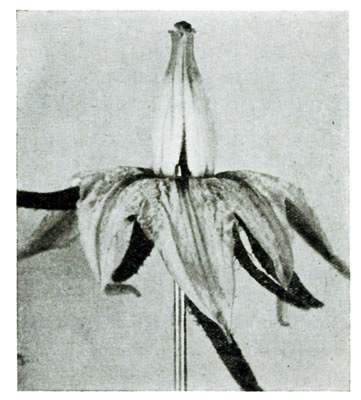
Hot, dry winds often damage floral parts and the blossoms drop without setting fruit.
Smith[3] has shown that pollen grains germinate best at 85° F., almost as well at 70° F., poorly at 50° F. and very poorly at 100° F.
Figure 3.—Long section of tomato flower.
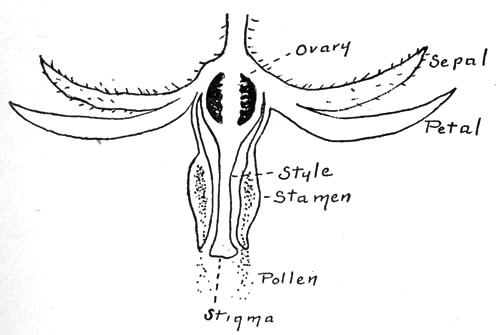
The flowers of the tomato are borne in simple racemes or, in some varieties, in compound clusters. The flowers are normally on the plan of 5 but cultivated varieties may have six or eight sepals and petals. Sepals are narrow and may be as much as an inch long. Petals are united at the base. Stamens are united by the anthers surrounding the style and stigma. The ovary or little tomato is above the calyx but, as it grows, it carries corolla and stamens outward until they, with stigma and style, drop off. Length of style is a fairly important character in its bearing on pollination and on susceptibility to heat and wind injury.
Seedless Fruits
Recent experiments by several workers have demonstrated the possibilities of inducing development of fruits without pollination (parthenocarpy) by means of certain chemical compounds, notably indolebutyric acid, although others are effective.[4] This method yields seedless fruits and promises to be of value in insuring a yield of fruits under conditions unfavorable for natural setting.