III.
Reading edition
THE STORY OF PRINCE KHALAF AND THE PRINCESS OF CHINA.
Prince Khalaf was the son of an aged khan of the Nagäi-Tartars. The history of his time makes honourable mention of his name. It relates that he surpassed all the princes of the age in beauty, in wisdom, and in valour; that he was as learned as the greatest doctors of his age; that he could fathom the deepest mysteries of the commentaries on the Koran; and that he knew by heart the sayings of the prophet: it speaks of him, in short, as the hero of Asia and the wonder of the East.
This prince was the soul of the councils of his father Timurtasch. When he gave advice, the most accomplished statesmen approved it, and could not sufficiently admire his prudence and wisdom. If, moreover, it were necessary to take up arms, he was immediately seen at the head of the troops of the state, seeking out the enemy, engaging them and vanquishing them. He had already won several victories, and the Nagäis had rendered themselves so formidable by their repeated successes, that the neighbouring nations did not venture to quarrel with them.
Such was the prosperous state of affairs in the khan's dominions, when an ambassador from the sultan of Carisma arrived at the court of Timurtasch, and demanded in the name of his master that the Nagäis should henceforth pay him a yearly tribute; he added that in default he would come in person, with an overwhelming force, and compel them to submit, at the same time depriving their sovereign of his crown as a punishment for his refusal. On hearing this arrogant message, the khan immediately assembled his council in order to decide whether to pay the tribute rather than risk a war with so powerful an enemy, or whether to treat his menaces with contempt and prepare to repel the invaders. Khalaf, with the majority of the council, were of the latter opinion, and the ambassador being dismissed with a refusal, took his departure for Carisma.
The khan lost no time in sending deputies to the neighbouring nations, in order to represent to them that it was to their interest to unite with him against the sultan of Carisma, whose ambition now exceeded all bounds, and who would undoubtedly exact the same tribute from them if he should succeed in conquering the Nagäis. The deputies succeeded in these negotiations; the neighbouring nations and tribes, and amongst them the Circassians, engaged to join in the proposed confederation, and to furnish among them a quota of fifty thousand men. On this promise, the khan proceeded to raise fresh troops, in addition to the army which he already had on foot.
While the Nagäis were making these preparations, the sultan of Carisma assembled an army of two hundred thousand men, and crossed the Jaxartes at Cogende. He marched through the countries of Ilac and Saganac, where he found abundance of provisions; and had advanced as far as Jund, before the army of the khan, commanded by prince Khalaf, was able to take the field, in consequence of the Circassians and the other auxiliary troops not having been able sooner to join him. As soon as these succours arrived, Khalaf marched direct towards Jund, but he had scarcely passed Jenge Kemt, when his scouts informed him that the enemy was close at hand, and was advancing to attack him. The young prince immediately ordered his troops to halt, and proceeded to arrange them in order of battle.
The two armies were nearly equal in numbers, and the men who composed them equally courageous. The battle which ensued was bloody and obstinate. The sultan did all that a warrior skilled in the conduct of armies could do; and the prince Khalaf, on his side, more than could be expected from so young a general. At one time the Nagäi-Tartars had the advantage, at another they were obliged to yield to the Carismians; at last both parties, alternately victors and vanquished, were obliged by the approach of night to sound a retreat. The combat was to have recommenced in the morning; but, in the mean time, the leader of the Circassians went secretly to the sultan, and offered to abandon the cause of the Nagäis, provided the sultan would pledge himself, on oath, never to exact tribute from the Circassians upon any pretence whatever. The sultan having consented, the treaty was confirmed, and the Circassian leader, instead of occupying his place next day in the army of the khan, detached his troops from the Nagäis, and took the road back to his own country.
This treachery was a terrible blow to prince Khalaf, who, seeing himself now much weakened in numbers, would have withdrawn for the time from the conflict; but there was no possibility of retreat. The Carismians advanced furiously to the charge, and taking advantage of the ground which allowed them to extend their lines, they surrounded the Nagäis on all sides. The latter, notwithstanding that they had been deserted by their best auxiliaries, did not lose their courage. Animated by the example of their prince, they closed their ranks, and for a long time firmly sustained the terrible onset of their enemies. At last, however, resistance became hopeless, and Khalaf, seeing all hope at an end, thought of nothing but his escape, which he fortunately succeeded in effecting. The moment the sultan was apprised of his flight, he sent six thousand horsemen to endeavour to capture him, but he eluded their pursuit, by taking roads that were unknown to them; and after a few days' hard riding through unfrequented and unknown tracts, arrived at his father's court, where he spread sorrow and consternation, by the disastrous tidings he brought.
If this piece of news deeply afflicted Timurtasch, the intelligence he next received drove him to despair. An officer who had escaped from the battle, brought word that the sultan of Carisma had put to the sword nearly all the Nagäis, and that he was advancing with all possible speed, fully resolved to put the whole family of the khan to death, and to absorb the nation into his own kingdom. The khan then repented of having refused to pay the tribute, but he fully recognized the force of the Arab proverb, "When the city is in ruins, what is the use of repentance?" As time pressed, and it was necessary to fly, for fear of falling into the hands of the sultan, the khan, the princess Elmaze (diamond), his wife, and Khalaf, made a selection of all their most precious treasures, and departed from the capital, Astracan, accompanied by several officers of the palace, who refused to abandon them in their need, as well as by such of the troops as had cut their way through the ranks of their enemies with the young prince.
They directed their march towards Bulgaria; their object being to beg an asylum at the court of some sovereign prince. They had now been several days on their journey, and had gained the Caucasus, when a swarm of some four thousand suddenly poured down upon them from that range. Although Khalaf had scarcely a hundred men with him, he steadily received the furious attack of the robbers, of whom numbers fell; his troops, however, were by degrees overpowered and slaughtered, and he himself remained in the power of the bandits, some of whom fell upon the spoil, whilst others butchered the followers of the khan. They only spared the lives of that prince, his wife, and his son, leaving them, however, almost naked in the midst of the mountains.
It is impossible to describe the grief of Timurtasch when he saw himself reduced to this extremity. He envied the fate of those whom he had seen slain before his eyes, and giving way to despair, sought to destroy himself. The princess burst into tears, and made the air resound with her lamentations and groans. Khalaf alone had strength to support the weight of their misfortunes; he was possessed of an indomitable courage. The bitter lamentations which the khan and his wife uttered were his greatest trouble. "Oh, my father! Oh, my mother!" said he, "do not succumb to your misfortunes. Remember that it is God who wills that you should be thus wretched. Let us submit ourselves without a murmur to his absolute decrees. Are we the first princes whom the rod of justice has struck? How many rulers before us have been driven from their kingdoms, and after wandering about for years in foreign lands, sharing the lot of the most abject of mortals, have been in the end restored to their thrones! If God has the power to pluck off crowns, has He not also the power to restore them? Let us hope that He will commiserate our misery, and that He will in time change into prosperity the deplorable condition in which we now are."
Prince Khalaf holding back his father, p. 63.
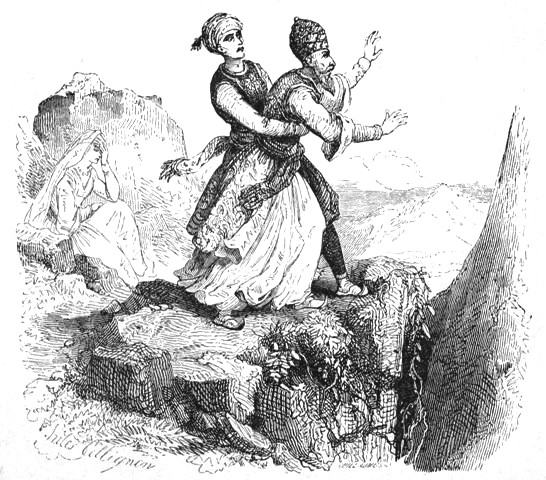
With such arguments he endeavoured to console his father and mother, and to some extent succeeded; they experienced a secret consolation, and at last allowed themselves to take comfort. "So be it, my son," said the khan, "let us bow to Providence; and since these evils which encompass us are written in the book of fate, let us endure them without repining." At these words the royal party made up their minds to be firm under their misfortunes, and proceeded to continue their journey on foot, the robbers having taken their horses. They wandered on for a long time, living upon the fruits they found in the valleys; but at length they entered upon a desert, where the earth yielded nothing upon which they could subsist, and now their courage deserted them. The khan, far advanced in years, began to feel his strength fail him; and the princess, worn out with the fatigue of the journey she had made, could scarcely hold out any longer. In this predicament, Khalaf, although wofully tired himself, had no resource but to carry them by turns on his shoulders. At last all three, overwhelmed by hunger, thirst, and weariness, arrived at a spot abounding with frightful precipices. It was a hill, very steep, and intersected with deep chasms, forming what appeared to be dangerous passes. Through these, however, seemed to be the only way by which to enter upon the vast plain which stretched out beyond; for both sides of the hill were so encumbered with brambles and thorns, that it was impossible to force a way through. When the princess perceived the chasms, she uttered a piercing cry, and the khan at length lost his patience. He rushed furiously forward. "I can bear this no longer," said he to his son; "I yield to my hard destiny; I succumb to so much suffering. I will throw myself headlong into one of these deep gulfs, which, doubtless, Heaven has reserved for my tomb. I will escape the tyranny of wickedness. I prefer death to such a miserable existence."
The khan, yielding himself up to the frenzy which had taken possession of him, was on the point of throwing himself down one of the precipices, when prince Khalaf seized him in his arms and held him back. "Oh, my father!" said he, "what are you doing? Why give way to this transport of fury? Is it thus that you show the submission you owe to the decrees of Heaven? Calm yourself. Instead of displaying a rebellious impatience of its will, let us endeavour to deserve by our constancy its compassion and favour. I confess that we are in a deplorable state, and that we can scarcely take a step without danger amidst these abysses; but there may be another road by which we can enter the plain: let me go and see if I can find one. In the mean time, my lord, calm the violence of your transports, and remain near the princess; I will return immediately."
"Go, then, my son," replied the khan, "we will await you here; do not fear that I will any longer give way to despair."
The young prince traversed the whole hill without being able to discover any path. He was oppressed with the deepest grief; he threw himself on the ground, sighed, and implored the help of Heaven. He rose up, and again searched for some track that would conduct them to the plain. At length he found one. He followed it, returning thanks to Heaven for the discovery, and advanced to the foot of a tree which stood at the entrance of the plain, and which covered with its shade a fountain of pure transparent water. He also perceived other trees laden with fruit of an extraordinary size. Delighted with this discovery, he ran to inform his father and mother, who received the news with the greater joy, since they now began to hope that Heaven had begun to compassionate their misery.
Khalaf conducted them to the fountain, where all three bathed their faces and their hands and quenched the burning thirst which consumed them. They then ate of the fruits which the young prince gathered for them, and which, in their state of exhaustion from want of food, appeared to them delicious. "My lord," said Khalaf to his father, "you see the injustice of your complaints. You imagined that Heaven had forsaken us; I implored its succour, and it has succoured us. It is not deaf to the voice of the unfortunate who put their whole trust in its mercy."
They remained near the fountain two or three days to repose and recruit their wasted strength. After that they collected as much of the fruit as they could carry, and advanced into the plain, hoping to find their way to some inhabited place. They were not deceived in their expectations; they soon perceived before them a town which appeared large and splendidly built. They made their way to it, and having arrived at the gates, resolved to remain there and wait for night, not wishing to enter the town during the day, covered with dust and perspiration, and with what little clothing the robbers had left them, travel-worn and rent with brambles. They selected a tree which cast a delicious shade, and stretched themselves upon the grass at its foot. They had reposed there some time, when an old man came out of the town and directed his steps to the same place, to enjoy the cool shade. He sat down near them after making them a profound obeisance. They in turn saluted him, and then inquired what was the name of the town. "It is called Jaic," replied the old man. "The king, Ileuge-Khan, makes it his residence. It is the capital of the country, and derives its name from the river which flows through it. You must be strangers since you ask me that question." "Yes," replied the khan, "we come from a country very far from here. We were born in the kingdom of Chrisnia, and we dwell upon the banks of the Caspian Sea; we are merchants. We were travelling with a number of other merchants in Captchak; a large band of robbers attacked our caravan and pillaged us; they spared our lives, but have left us in the situation in which you see us. We have traversed mount Caucasus, and found our way here without knowing where we were directing our steps."
The old man, who had a compassionate heart for the distress of his neighbour, expressed his sympathy for their misfortunes, and, to assure them of his sincerity, offered them shelter in his house. He made the offer with such cordiality, that, even if they had not needed it, they would have felt some difficulty in refusing.
As soon as night set in he conducted them to his home. It was a small house, very plainly furnished; but every thing was neat, and wore the appearance rather of simplicity than of poverty. As the old man entered he gave some orders in an undertone to one of his slaves, who returned in a short time followed by two boys, one of whom carried a large bundle of men's and women's clothes ready made, the other was laden with all sorts of veils, turbans, and girdles. Prince Khalaf and his father each took a caftan of cloth and a brocaded dress with a turban of Indian muslin, and the princess a complete suit. After this their host gave the boys the price of the clothes, sent them away, and ordered supper. Two slaves brought the table and placed upon it a tray covered with dishes of china, sandal, and aloe-wood, and several cups of coral perfumed with ambergris. They then served up a repast, delicate, yet without profusion. The old man endeavoured to raise the spirits of his guests; but perceiving that his endeavours were vain, "I see clearly," said he, "that the remembrance of your misfortunes is ever present to your minds. You must learn how to console yourselves for the loss of the goods of which the robbers have plundered you. Travellers and merchants often experience similar mishaps. I was myself once robbed on the road from Moussul to Bagdad. I nearly lost my life on that occasion, and I was reduced to the miserable condition in which I found you. If you please I will relate my history; the recital of my misfortunes may encourage you to support yours." Saying this, the good old man ordered his slaves to retire, and spoke as follows.
THE STORY OF PRINCE AL ABBAS.
I am the son of the king of Moussul, the great Ben-Ortoc. As soon as I had reached my twentieth year, my father permitted me to make a journey to Bagdad; and, to support the rank of a king's son in that great city, he ordered a splendid suite to attend me. He opened his treasures and took out for me four camel-loads of gold; he appointed officers of his own household to wait upon me, and a hundred soldiers of his guard to form my escort.
I took my departure from Moussul with this numerous retinue in order to travel to Bagdad. Nothing happened the first few days; but one night, whilst we were quietly reposing in a meadow where we had encamped, we were suddenly attacked so furiously by an overwhelming body of Bedouin Arabs, that the greater part of my people were massacred almost before I was aware of the danger. After the first confusion I put myself at the head of such of the guards and officers of my father's household as had escaped the first onslaught, and charged the Bedouins. Such was the vigour of our attack, that more than three hundred fell under our blows. As the day dawned, the robbers, who were still sufficiently numerous to surround us on all sides, seeing our insignificant numbers, and ashamed and irritated by the obstinate resistance of such a handful of men, redoubled their efforts. It was in vain that we fought with the fury of desperation; they overpowered us; and at length we were forced to yield to numbers.
They seized our arms and stripped off our clothes, and then, instead of reserving us for slaves, or letting us depart, as people already sufficiently wretched, in the state to which we were reduced, they resolved to revenge the deaths of their comrades; and were cowards and barbarians enough to slaughter the whole of their defenceless prisoners. All my people perished; and the same fate was on the point of being inflicted on me, when making myself known to the robbers, "Stay, rash men," I exclaimed, "respect the blood of kings. I am prince Al Abbas, only son of Ben-Ortoc, king of Moussul, and heir to his throne." "I am glad to learn who thou art," replied the chief of the Bedouins. "We have hated thy father mortally these many years; he has hanged several of our comrades who fell into his hands; thou shalt be treated after the same manner."
Thereupon they bound me; and the villains, after first sharing among them all my baggage, carried me along with them to the foot of a mountain between two forests, where a great number of small grey tents were pitched. Here was their well-concealed camping ground. They placed me under the chief's tent, which was both loftier and larger than the rest. Here I was kept a whole day, after which they led me forth and bound me to a tree, where, awaiting the lingering death that was to put an end to my existence, I had to endure the mortification of finding myself surrounded by the whole gang, insulted with bitter taunts, and every feeling miserably outraged.
I had been tied to the tree for some considerable time, and the last moments of my life appeared fast approaching, when a scout came galloping in to inform the chief of the Bedouins that a splendid chance offered itself seven leagues from thence; that a large caravan was to encamp the next evening in a certain spot, which he named. The chief instantly ordered his companions to prepare for the expedition; this was accomplished in a very short time. They all mounted their horses, and left me in their camp, not doubting but at their return they would find me a corpse. But Heaven, which renders useless all the resolves of men which do not agree with its eternal decrees, would not suffer me to perish so young. The wife of the robber chief had, it seems, taken pity on me; she managed to creep stealthily, during the night, to the tree where I was bound, and said to me, "Young man, I am touched by thy misfortune, and I would willingly release thee from the dangers that surround thee; but, if I were to unbind thee, dost thou think that thou hast strength enough left to escape." I replied, "The same good God who has inspired thee with these charitable feelings will give me strength to walk." The woman loosed my cords, gave me an old caftan of her husband's, and showing me the road, "Take that direction," said she, "and thou wilt speedily arrive at an inhabited place." I thanked my kind benefactress, and walked all that night without deviating from the road she had pointed out.
The next day, I perceived a man on foot, who was driving before him a horse, laden with two large packages. I joined him, and, after telling him that I was an unfortunate stranger, who did not know the country, and had missed my way, I inquired of him where he was going. "I am going," replied he, "to sell my merchandise at Bagdad, and I hope to arrive there in two days." I accompanied this man, and only left him when I entered that great city; he went about his business, and I retired to a mosque, where I remained two days and two nights. I had no desire to go forth into the streets; I was afraid of meeting persons from Moussul, who might recognize me. So great was my shame at finding myself in this plight, that far from thinking of making my condition known, I wished to conceal it, even from myself. Hunger at length overcame my shame, or rather I was obliged to yield to that necessity which brooks no refusal. I resolved to beg my bread, until some better prospect presented itself. I stood before the lower window of a large house, and solicited alms with a loud voice. An old female slave appeared almost immediately, with a loaf in her hand, which she held out to me. As I advanced to take it, the wind by chance raised the curtain of the window, and allowed me to catch a glimpse of the interior of the chamber; there I saw a young lady of surpassing beauty; her loveliness burst upon my vision like a flash of lightning. I was completely dazzled. I received the bread without thinking what I was about, and stood motionless before the old slave, instead of thanking her, as I ought to have done.
I was so surprised, so confused, and so violently enamoured, that doubtless she took me for a madman; she disappeared, leaving me in the street, gazing intently, though fruitlessly, at the window, for the wind did not again raise the curtain. I passed the whole day awaiting a second favourable breeze. Not until I perceived night coming on, could I make up my mind to think of retiring; but before quitting the house, I asked an old man, who was passing, if he knew to whom it belonged. "It is," replied he, "the house of Mouaffac, the son of Adbane; he is a man of rank, and, moreover, a rich man and a man of honour. It is not long since he was the governor of the city, but he quarrelled with the cadi, who found means of ruining him in the estimation of the caliph, and thereby caused him to lose his appointment."
With my thoughts fully taken up by this adventure, I slowly wandered out of the city, and entering the great cemetery determined to pass the night there. I ate my bread without appetite, although my long fast ought to have given me a good one, and then lay down near a tomb, with my head resting on a pile of bricks. It was with difficulty that I composed myself to sleep: the daughter of Mouaffac had made too deep an impression upon me; the remembrance of her loveliness excited my imagination too vividly, and the little food I had eaten was not enough to cause the usual tendency to a refreshing sleep. At length, however, I dozed off, in spite of the ideas that filled my imagination; but my sleep was not destined to be of long duration; a loud noise within the tomb soon awoke me.
Alarmed at the disturbance, the cause of which I did not stay to ascertain, I started up, with the intention of flying from the cemetery, when two men, who were standing at the entrance of the tomb, perceiving me, stopped me, and demanded who I was, and what I was doing there. "I am," I replied, "an unfortunate stranger, whom misfortune has reduced to live upon the bounty of the charitable, and I came here to pass the night, as I have no place to go to in the town." "Since thou art a beggar," said one of them, "thank Heaven that thou hast met with us; we will furnish thee with an excellent supper." So saying, they dragged me into the tomb, where four of their comrades were eating large radishes and dates, and washing them down with copious draughts of raki.
They made me sit near them, at a long stone that served as a table, and I was obliged to eat and drink, for politeness' sake. I suspected them to be what they really were, that is to say, thieves, and they soon confirmed my suspicions by their discourse. They began to speak of a considerable theft they had just committed, and thought that it would afford me infinite pleasure to become one of their gang; they made me the offer, which threw me into great perplexity. You may imagine that I had no desire to associate myself with such fellows, but I was fearful of irritating them by a refusal. I was embarrassed, and at a loss for a reply, when a sudden event freed me from my trouble. The lieutenant of the cadi, followed by twenty or thirty asas (archers) well armed, entered the tomb, seized the robbers and me, and took us all off to prison, where we passed the remainder of the night. The following day, the cadi came and interrogated the prisoners. The thieves confessed their crime, as they saw there was no use in denying it; for myself, I related to the judge how I had met with them, and, as they corroborated my statement, I was put on one side. The cadi wished to speak to me in private, before he set me free. Accordingly, he presently came over to me, and asked what took me into the cemetery where I was caught, and how I spent my time in Bagdad. In fact, he asked me a thousand questions, all of which I answered with great candour, only concealing the royalty of my birth. I recounted to him all that had happened to me, and I even told him of my having stopped before the window of Mouaffac's house to beg, and of my having seen, by chance, a young lady who had charmed me.
At the name of Mouaffac I noticed the eyes of the cadi sparkle, with a curious expression. He remained a few moments immersed in thought; then, assuming a joyous countenance, he said, "Young man, it depends only on thyself to possess the lady thou sawest yesterday. It was doubtless Mouaffac's daughter; for I have been informed that he has a daughter of exquisite beauty. Though thou wert the most abject of beings, I would find means for thee to possess the object of thine ardent wishes. Thou hast but to leave it to me, and I will make thy fortune."
I thanked him, without being able to penetrate his designs, and then by his orders followed the aga of his black eunuchs, who released me from the prison, and took me to the bath.
Whilst I was there, the judge sent two of his tchaous (guards) to Mouaffac's house, with a message that the cadi wished to speak to him upon business of the greatest importance. Mouaffac accompanied the guards back. As soon as the cadi saw him coming he went forward to meet him, saluted him, and kissed him several times. Mouaffac was in amazement at this reception.
"Ho! ho!" said he to himself, "how is this, that the cadi, my greatest enemy, is become so civil to me to-day? There is something at the bottom of all this."
"Friend Mouaffac," said the judge, "Heaven will not suffer us to be enemies any longer. It has furnished us with an opportunity of extinguishing that hatred which has separated our families for so many years. The prince of Bozrah arrived here last night. He left Bozrah without taking leave of his father the king. He has heard of your daughter; and from the description of her beauty which he has received, he has become so enamoured of her, that he is resolved to ask her in marriage. He wishes me to arrange the marriage,—a task which is the more agreeable to me, as it will be the means of reconciling us."
"I am astounded," replied Mouaffac, "that the prince of Bozrah should have condescended to confer upon me the honour of marrying my daughter; and that you of all men should be the chosen means of communicating this happiness to me, as you have always shown yourself so anxious to injure me."
"Let us not speak of the past, friend Mouaffac," returned the cadi; "pray let all recollection of what we have done to annoy each other be obliterated in our happiness at the splendid connexion which is to unite your daughter with the prince of Bozrah; let us pass the remainder of our days in good fellowship."
Mouaffac was naturally as good and confiding as the cadi was crafty and bad: he allowed himself to be deceived by the false expressions of friendship that his enemy displayed. He stifled his hatred in a moment, and received without distrust the perfidious caresses of the cadi. They were in the act of embracing each other, and pledging an inviolable friendship, when I entered the room, conducted by the aga. This officer, on my coming out of the bath, had clothed me with a beautiful dress, which he had ready, and a turban of Indian muslin, with a gold fringe that hung down to my ear, and altogether my appearance was such as fully to bear out the statements of the cadi.
"Great prince," said the cadi as soon as he perceived me, "blessed be your feet, and your arrival in Bagdad, since it has pleased you to take up your abode with me. What tongue can express to you the gratitude I feel for so great an honour? Here is Mouaffac, whom I have informed of the object of your visit to this city. He consents to give you in marriage his daughter, who is as beautiful as a star."
Mouaffac then made me a profound obeisance, saying, "O son of the mighty, I am overwhelmed with the honour you are willing to confer upon my daughter; she would esteem herself sufficiently honoured in being made a slave to one of the princesses of your harem."
Judge of the astonishment that this discourse caused me. I knew not what to answer. I saluted Mouaffac without speaking; but the cadi, perceiving my embarrassment, and fearing lest I should make some reply which would destroy his plot, instantly took up the conversation.
"I venture to submit," said he, "that the sooner the marriage contract is made in presence of the proper witnesses the better." So saying, he ordered his aga to go for the witnesses, and in the mean time drew up the contract himself.
When the aga arrived with the witnesses, the contract was read before them. I signed it, then Mouaffac, and then the cadi, who attached his signature the last. The judge then dismissed the witnesses, and turning to Mouaffac said, "You know that with great people these affairs are not managed as with persons of humble rank. Besides, in this case you readily perceive that silence and despatch are necessary. Conduct this prince, then, to your house, for he is now your son-in-law; give speedy orders for the consummation of the marriage, and take care that every thing is arranged as becomes his exalted rank."
I left the cadi's house with Mouaffac. We found two mules richly caparisoned awaiting us at the door; the judge insisted upon our mounting them with great ceremony. Mouaffac conducted me to his house; and when we were in the court-yard dismounted first, and with a respectful air presented himself to hold my stirrup,—a ceremony to which of course I was obliged to submit. He then took me by the hand and conducted me to his daughter, with whom he left me alone, after informing her of what had passed at the cadi's.
Zemroude, persuaded that her father had espoused her to a prince of Bozrah, received me as a husband who would one day place her upon the throne,—and I, the happiest of men, passed the day at her feet, striving by tender and conciliating manners to inspire her with love for me. I soon perceived that my pains were not bestowed in vain, and that my youth and ardent affection produced a favourable impression upon her. With what rapture did this discovery fill me! I redoubled my efforts, and I had the gratification of remarking that each moment I made advances in her esteem.
In the mean time Mouaffac had prepared a splendid repast to celebrate his daughter's nuptials, at which several members of his family were present. The bride appeared there more brilliant and more beautiful than the houris. The sentiments with which I had already inspired her, seemed to add new lustre to her beauty.
The next morning I heard a knock at my chamber-door; I got up and opened it. There stood the black aga of the cadi carrying a large bundle of clothes. I thought that perhaps the cadi had sent robes of honour to my wife and myself, but I was deceived.
"Sir adventurer," said the negro in a bantering tone, "the cadi sends his salutations, and begs you to return the dress he lent you yesterday to play the part of the prince of Bozrah in. I have brought you back your own old garment, and the rest of the tatters, which are more suited to your station than the other."
I was astounded at the application; my eyes were opened, and I saw through the whole malicious scheme of the cadi. However, making a virtue of necessity, I gravely restored to the aga the robe and turban of his master, and retook my own old caftan, which was a mass of rags. Zemroude had heard part of the conversation; and seeing me covered with rags, "O heavens!" she exclaimed, "what is the meaning of this change, and what has that man been saying to you?"
"My princess," I replied, "the cadi is a great rascal, but he is the dupe of his own malice. He thinks he has given you a beggar for a husband, a man born in the lowest grade, but you are, indeed, the wife of a prince, and my rank is in no way inferior to that of the husband, whose hand you fancy you have received. I am to the full the equal of the prince of Bozrah, for I am the only son of the king of Moussul, and am heir to the kingdom of the great Ben-Ortoc; my name is Al Abbas." I then related my history to her, without suppressing the least circumstance. When I had finished the recital,
"My prince," said she, "even were you not the son of a great king, I should love you none the less; and, believe me, that if I am overjoyed to learn the circumstance of your exalted birth, it is but out of regard to my father, who is more dazzled by the honours of the world than I; my only ambition is to possess a husband who will love me alone, and not grieve me by giving me rivals."
I did not fail to protest that I would love her, and her alone, all my life, with which assurance she appeared delighted. She then summoned one of her women, and ordered her to proceed with all speed and secrecy to a merchant's, and buy a dress, ready made, of the richest materials that could be procured. The slave who was charged with this commission acquitted herself in the most satisfactory manner. She returned speedily, bringing a magnificent dress and robe, and a turban of Indian muslin as handsome, even handsomer, than what I had worn the previous day, so that I found myself even more gorgeously dressed than on the occasion of my first interview with my father-in-law. "Well, my lord," said Zemroude, "do you think the cadi has much reason to be satisfied with his work? He thought to heap reproaches on my family, and he has bestowed upon it an imperishable honour. He thinks that we are now overwhelmed with shame. What will be his grief when he knows that he has conferred such a benefit upon his enemy? But before he is made aware of your birth, we must invent some means of punishing him for his wicked designs against us. I will take that task upon me. There is in this city a dyer, who has a daughter most frightfully ugly. I will not tell you further," she continued, checking herself. "I will not deprive you of the pleasure of the surprise. I shall only let you know that I have conceived a project which will drive the cadi nearly mad, and make him the laughingstock of the court and the city."
She then dressed herself in plain clothes, and covering her face with a thick veil, asked my permission to go out, which I granted her. She went alone, repaired to the cadi's house, and placed herself in one corner of the hall, where the judge gave audience.
He no sooner cast his eyes upon her, than he was struck with her majestic figure; he sent an officer to ask who she was, and what she desired. She answered that she was the daughter of an artisan in the town, and that she wished to speak to the cadi on important private business. The officer having borne her answer to the cadi, the judge made a sign to Zemroude to approach, and enter his private apartment, which was on one side of the court; she complied, making a low obeisance. When she entered the cadi's private apartment, she took her seat upon the sofa, and raised her veil. The cadi had followed her, and as he seated himself near her, was astonished at her beauty.
"Well! my dear child," said he, patronizingly, "of what service can I be to you?"
"My lord," she replied, "you, who have the power to make the laws obeyed, who dispense justice to rich and poor alike, listen, I pray you, to my complaint, and pity the unfortunate situation in which I am placed."
"Explain yourself," replied the judge, already moved, "and I swear by my head and my eyes that I will do every thing that is possible, ay, and impossible, to serve you."
"Know then, my lord," replied Zemroude, "that, notwithstanding the attractions which Heaven has bestowed upon me, I live in solitude and obscurity in a house, forbidden not only to men, but even to women, so that even the conversation of my own sex is denied me. Not that advantageous proposals were at one time wanting for my hand; I should have been married long ago, if my father had not had the cruelty to refuse me to all who have asked me in marriage. To one he says, I am as withered as a dead tree; to another, that I am bloated with unnatural fat; to this one, that I am lame, and have lost the use of my hands; to that one, that I have lost my senses, that I have a cancer on my back, that I am dropsical; in fact, he wishes to make me out a creature not worthy the society of human beings, and has so decried me, that he has at length succeeded in making me the reproach of the human race; nobody inquires about me now, and I am condemned to perpetual celibacy."
When she ceased speaking she pretended to weep, and played her part so well that the judge allowed himself to be deceived.
"What can be the reason, my angel," said he, "that your father prevents your marrying? What can his motive be?"
"I know not, my lord," replied Zemroude; "I cannot conceive what his intentions can be; but I confess my patience is exhausted. I can no longer live in this state. I have found means to leave home, and I have escaped to throw myself into your arms, and to implore your help; take pity on me, I implore you, and interpose your authority, that justice may be done to me, otherwise I will not answer for my life."
"No, no," replied he, "you shall not die, neither shall you waste your youth in tears and sighs. It only remains with yourself to quit the darkness in which your perfections are buried, and to become this very day the wife of the cadi of Bagdad. Yes, lovely creature, more fair than the houris, I am ready to marry you, if you will consent."
"My lord," replied the lady, "even were not your station one of the most dignified and honourable in the city, I could have no objection to give you my hand, for you appear to be one of the most amiable of men; but I fear that you will not be able to obtain the consent of my father, notwithstanding the honour of the alliance."
"Don't trouble yourself upon that point," replied the judge, "I will pledge myself as to the issue; only tell me in what street your father lives, what his name is, and what his profession."
"His name is Ousta Omar," replied Zemroude; "he is a dyer, he lives upon the eastern quay of the Tigris, and in front of his door is a palm-tree laden with dates."
"That is enough," said the cadi; "you can return home now; you shall soon hear from me, depend upon my word."
The lady, after bestowing a gracious smile upon him, covered her face again with her veil, left the private chamber, and returned to me.
"We shall be revenged," she said, laughing gaily; "our enemy, who thought to make us the sport of the people, will himself become so."
The judge had scarcely lost sight of Zemroude, ere he sent an officer to Ousta Omar, who was at home. "You are to come to the cadi," said the man, "he desires to speak with you, and he commanded me to bring you before him." The dyer grew pale at these words, he thought that some one had lodged a complaint against him before the judge, and that it was on that account the officer had come to fetch him. He rose, however, and followed in silence, but in great uneasiness.
As soon as he appeared before the cadi, the judge ordered him into the same chamber where he had had the interview with Zemroude, and made him sit upon the same sofa. The artisan was so astonished at the honour paid him, that he changed colour several times.
"Master Omar," said the cadi, "I am glad to see you; I have heard you spoken very well of this long time past. I am informed that you are a man of good character, that you regularly say your prayers five times a day, and that you never fail to attend the great mosque on Friday; besides, I know that you never eat pork, and never drink wine nor date-spirits; in fact, that whilst you are at work one of your apprentices reads the Koran."
"That is true," replied the dyer; "I know above four thousand hadits (sayings of Mahomet), and I am making preparations for a pilgrimage to Mecca."
"I assure you," replied the cadi, "that all this gives me the greatest pleasure, for I passionately love all good mussulmen. I am also informed that you keep concealed at home a daughter of an age to marry; is that true?"
"Great judge," answered Ousta Omar, "whose palace serves as a haven and refuge for the unfortunate who are tossed about by the storms of the world, they have told you true. I have a daughter who is old enough, in all conscience, to be married, for she is more than thirty years old; but the poor creature is not fit to be presented to a man, much less to so great a man as the cadi of Bagdad; she is ugly, or rather frightful, lame, covered with blotches, an idiot; in a word, she is a monster whom I cannot take too much pains to hide from the world."
"Indeed," said the cadi, "that is what I expected, master Omar. I was certain that you would thus praise your daughter; but know, my friend, that this blotchy, idiotic, lame, frightful person, in short, this monster, with all her defects, is loved to distraction by a man who desires her for his wife, and that man is myself."
At this speech the dyer seemed to doubt whether he were awake; he pinched himself, rubbed his eyes, and then looking the cadi full in the face, said,
"If my lord, the cadi, wishes to be merry, he is master; he may make a jest of my child as much as he pleases."
"No, no," replied the cadi, "I am not joking, I am in love with your daughter, and I ask her in marriage."
The artisan at these words burst into a fit of laughter. "By the prophet," cried he, "somebody wants to give you something to take care of. I give you fair warning, my lord, that my daughter has lost the use of her hands, is lame, dropsical."
"I know all about that," replied the judge, "I recognize her by her portrait. I have a peculiar liking for that sort of girls, they are my taste."
"I tell you," insisted the dyer, "she is not a fit match for you. Her name is Cayfacattaddhari (the monster of the age), and I must confess that her name is well chosen."
"Come, come!" replied the cadi, in an impatient and imperious tone, "this is enough, I am sick of all these objections. Master Omar, I ask you to give me this Cayfacattaddhari just as she is, so not another word."
The dyer, seeing him determined to espouse his daughter, and more than ever persuaded that some person had made him fall in love with her upon false representations for fun, said to himself, "I must ask him a heavy scherbeha (dowry): the amount may disgust him, and he will think no more of her."
"My lord," said he, "I am prepared to obey you; but I will not part with Cayfacattaddhari unless you give me a dowry of a thousand golden sequins beforehand."
"That is rather a large sum," said the cadi, "still I will pay it you." He immediately ordered a large bagful of sequins to be brought, a thousand were counted out, which the dyer took after weighing them, and the judge then ordered the marriage contract to be drawn out. When, moreover, it was ready for signature, the artisan protested that he would not sign it except in the presence of a hundred lawyers at least.
"You are very distrustful," said the cadi; "but never mind, I will satisfy your wishes, for I don't intend to let your daughter slip through my fingers." He thereupon sent immediately for all the neighbouring doctors, alfayins, mollahs, persons connected with the mosques and courts of law, of whom far more crowded in than the dyer required.
When all the witnesses had arrived at the cadi's, Ousta Omar spoke thus,
"My lord cadi, I give you my daughter in marriage, since you absolutely require me to do so; but I declare before all these gentlemen that it is on condition, that if you are not satisfied with her when you see her, and you wish afterwards to repudiate her, you will give her a thousand gold sequins, such as I have received from you."
"Well! so be it," replied the cadi, "I promise it before all this assembly. Art thou content?" The dyer replied in the affirmative, and departed, saying that he would send the bride.
He had scarcely left the house before the enamoured judge gave orders to have an apartment furnished in the most splendid manner to receive his new bride. Velvet carpets were laid down, new draperies hung up, and sofas of silver brocade placed round the walls, whilst several braziers perfumed the chamber with delicious scents. All was at length in readiness, and the cadi impatiently awaited the arrival of Cayfacattaddhari. The fair bride, however, not making her appearance so speedily as his eagerness expected, he called his faithful aga, and said, "The lovely object of my affections ought to be here by this time, I think. What can detain her so long at her father's? How slow the moments appear which retard my happiness!" At length his impatience could brook no longer delay, and he was on the point of sending the aga to Ousta Omar's, when a porter arrived carrying a deal case covered with green taffeta.
"What hast thou got there, my friend," inquired the judge.
"My lord," replied the porter, placing the box on the ground, "it is your bride; you have only to take off the covering and you will see what she is like."
The cadi removed the cloth and saw a girl three feet and a half high: she had a lank visage covered with blotches, eyes sunk deep in their sockets and as red as fire, not the least vestige of a nose, but above her mouth two horrid wide nostrils like those of a crocodile. He could not look at this object without horror; he hastily replaced the cover, and, turning to the porter, cried,
"What am I to do with this miserable creature?"
"My lord," replied the porter, "it is the daughter of master Omar, the dyer, who told me you had married her from choice."
"Merciful heavens!" exclaimed the cadi, "is it possible to marry such a monster as that?"
At that moment the dyer, who had foreseen the surprise of the judge, arrived.
"Wretch," said the cadi, "what dost thou take me for? Thou certainly hast an amazing amount of impudence to dare to play me such a trick as this. Dost thou dare thus to treat me who have it in my power to revenge myself on my enemies; me who, when I please, can put the like of thee in fetters? Dread my wrath, wretch! Instead of the hideous monster which thou hast sent me, give me instantly thy other daughter, whose beauty is unparalleled, or thou shalt experience what an angry cadi can do!"
"My lord," replied Omar, "spare your threats, I beg, and don't be angry with me. I swear by the Creator of the light that I have no other daughter but this. I told you a thousand times that she would not suit you; you would not believe—whose fault is it?"
The cadi at these words felt his soul sink within him, and said to the dyer,
"Master Omar, a damsel of the most exquisite loveliness came here this morning and told me that you were her father, and that you represented her to the world as a perfect monster, indeed so much so, that no one would ask her in marriage."
"My lord," returned the dyer, "that girl must have been playing you a trick; you must have some enemy."
The cadi bent his head on his bosom, and remained some time in deep thought.
"It is a misfortune that was destined to befal me; let us say no more about it; have your daughter taken back home; keep the thousand sequins you have got, but don't ask for any more, if you wish us to be friends."
Although the judge had sworn before witnesses that he would give a thousand sequins more if Omar's daughter did not please him, the artisan did not dare to endeavour to compel him to keep his word, for he knew him to be a most vindictive man, and one who would easily find an opportunity of revenging himself upon any one he disliked, and was, of course, afraid to offend him. He thought it better to be content with what he had received.
"My lord," said he, "I will obey you, and relieve you of my daughter, but you must, if you please, divorce her first."
"Oh! true," said the cadi; "I have not the least objection; be assured that shall soon be done."
Accordingly, he instantly sent for his naib, and the divorce was made out in due form, after which master Omar took leave of the judge, and ordered the porter to bear the wretched Cayfacattaddhari back home.
This adventure was speedily noised all over the city. Every body laughed at it, and warmly applauded the trick which had been played upon the cadi, who could not escape the ridicule in which the whole city indulged at his expense. We carried our revenge still further. By Mouaffac's advice, I presented myself before the prince of the faithful, to whom I told my name and related my story. I did not suppress, as you may imagine, the circumstances which put the malice of the cadi in so strong a light. The caliph, after listening to me with the greatest attention, received me very graciously. "Prince," said he, "why did you not come at once to me? Doubtless you were ashamed of your condition, but you might, without a blush, have presented yourself before my face, even in your wretched state. Does it depend upon men themselves to be happy or unhappy? Is it not Allah that spins the thread of our destiny? Ought you to have feared an ungracious reception? No! You know that I love and esteem king Ben-Ortoc, your father; my court was a safe asylum for you."
The caliph embraced me, and conferred on me a gulute (robe of honour) and a beautiful diamond which he wore on his finger. He regaled me with excellent sherbet, and when I returned to my father-in-law's house, I found six large bales of Persian brocade, gold and silver, two pieces of damask, and a beautiful Persian horse richly caparisoned. In addition, he reinstated Mouaffac in the government of Bagdad; and as to the cadi, by way of punishment for his malicious attempt to deceive Zemroude and her father, he deposed him, and condemned him to perpetual imprisonment, and, to crown his misery, ordered him as a companion in his confinement the daughter of Ousta Omar.
A few days after my marriage, I sent a courier to Moussul, to inform my father of all that had happened to me since my departure from his court, and to assure him that I would return shortly, with the lady whom I had married. I waited most impatiently for the return of the courier; but, alas! he brought me back news which deeply afflicted me. He informed me that Ben-Ortoc having heard that four thousand Bedouin Arabs had attacked me, and that my escort had been cut to pieces, persuaded that I no longer lived, took my supposed death so much to heart that he died; that prince Amadeddin Zingui, my cousin-german, occupied the throne; that he reigned with equity; and that, nevertheless, although he was generally beloved, the people no sooner learned that I was still alive, than they gave themselves up to the greatest joy. Prince Amadeddin himself, in a letter which the courier placed in my hands, assured me of his fidelity, and expressed his impatience for my return, in order that he might restore the crown to me, and become the first subject in my dominions.
This news decided me to hasten my return to Moussul. I took my leave of the prince of the faithful, who ordered a detachment of three thousand cavalry of his own guard to escort me to my kingdom, and, after embracing Mouaffac and his wife, I departed from Bagdad with my beloved Zemroude, who would almost have died of grief at the separation from her parents, if her love for me had not somewhat moderated the violence of her sorrow. About halfway between Bagdad and Moussul, the vanguard of my escort discovered a body of troops marching towards us. Concluding at once that it was a body of Bedouin Arabs, I immediately drew up my men, and was fully prepared for the attack, when my scouts brought me word, that those whom we had taken for robbers and enemies were, in fact, troops from Moussul, who had set out to meet me, with Amadeddin at their head.
This prince, on his part, having learned who we were, left his little army to meet me, accompanied by the principal nobles of Moussul. When he reached the spot where I was awaiting him, he addressed me in the same tone in which his letter had been couched, submissively and respectfully, whilst all the nobles who accompanied him assured me of their zeal and fidelity. I thought it my duty to show my entire confidence in them, by dismissing the soldiers of the caliph's guard. I had no reason to repent of this step; far from being capable of forming any treacherous design, prince Amadeddin did all in his power to give me proofs of his attachment.
When we came to Moussul, our safe and auspicious arrival was celebrated by gifts to the mosques, abundant alms to the poor, fêtes, and an illumination of the palace gardens with lamps of a thousand different colours. The people in general testified the delight they felt at my return by acclamations, and for a space of three days gave themselves up entirely to great rejoicings. The booths of the itinerant merchants, and the bazaars, were hung within and without with draperies, and at night they were lit up by lamps, which formed the letters of a verse of the Koran, so that every shop having its particular verse, this holy book was to be read entire in the city; and it appeared as though the angel Gabriel had brought it a second time in letters of light to our great prophet.
In addition to this pious illumination, before each shop were placed large dishes, plates of pillau, of all sorts of colours, in the form of pyramids, and huge bowls of sherbet and pomegranate juice, for the passers-by to eat and drink at pleasure. In all the cross streets were to be seen dancers, displaying their graceful evolutions to the sounds of drums, lutes, and tambourines.
The different trades formed a procession, consisting of cars decorated with tinsel and many-coloured flags, and with the tools used in their trades; and after traversing the principal streets, defiled to the music of pipes, cymbals, and trumpets, before my balcony, where Zemroude was sitting by my side, and after saluting us, shouted at the top of their voices, "Blessing and health to thee, Apostle of God, God give the king victory."
It was not enough for me to share these honours with the daughter of Mouaffac, my study was to find out every thing that would afford her any pleasure. I caused her apartments to be adorned with every thing most rare and pleasing to the sight. Her suite was composed of twenty-five young Circassian ladies, slaves in my father's harem; some sang and played the lute exquisitely, others excelled on the harp, and the rest danced with the greatest grace and lightness. I also gave her a black aga, with twelve eunuchs, who all possessed some talent which might contribute to her amusement.
I reigned over faithful and devoted subjects; every day I loved Zemroude more and more, and she as ardently reciprocated my attachment.
My days passed thus in perfect happiness, till one day a young dervise appeared at my court. He introduced himself to the principal nobles, and gained their friendship by his pleasing and agreeable manners, as well as by his wit and his happy and brilliant repartees. He accompanied them to the chase, he entered into all their gaieties, and was a constant guest at their parties of pleasure. Every day some of my courtiers spoke to me of him as a man of charming manners, so that at last they excited in me a desire to see and converse with the agreeable stranger. Far from finding his portrait overdrawn, he appeared to me even more accomplished than they had represented him. His conversation charmed me, and I was disabused of an error into which many persons of quality fall, namely, that men of wit and high sentiment are only to be met with at court. I experienced so much pleasure in the company of the dervise, and he seemed so well suited to manage affairs of the greatest importance, that I wished to appoint him my minister, but he thanked me, and told me he had made a vow never to accept any employment, that he preferred a free and independent life, that he despised honours and riches, and was content with what God, who cares for the lowest animals, should provide for him; in a word, he was content with his condition.
I admired a man so much raised above worldly considerations, and conceived the greatest esteem for him; I received him with pleasure each time he presented himself at court; if he was among the crowd of courtiers my eyes sought him out, and to him I most frequently addressed myself; I insensibly became so attached to him, that I made him my exclusive favourite.
One day during a hunt, I had strayed from the main body of my followers, and the dervise was alone with me. He began by relating his travels, for although young he had travelled extensively. He spoke of several curious things he had seen in India, and, amongst others, of an old Bramin whom he knew. "This great man," said he, "knew an infinity of secrets, each more extraordinary than the former. Nature had no mystery but what he could fathom. He died in my arms," said the dervise, "but as he loved me, before he expired he said, 'My son, I wish to teach you a secret by which you may remember me, but it is on condition that you reveal it to no one.' I promised to keep it inviolate, and on the faith of my promise he taught me the secret."
"Indeed!" said I, "what is the nature of the secret? Is it the secret of making gold?"
"No, sire," replied he, "it is a greater and much more precious secret than that. It is the power of reanimating a dead body. Not that I can restore the same soul to the body it has left, Heaven alone can perform that miracle; but I can cause my soul to enter into a body deprived of life, and I will prove it to your highness whenever you shall please."
"Most willingly!" said I, "now, if you please."
At that moment there passed by us most opportunely a doe; I let fly an arrow, which struck her, and she fell dead. "Now let me see," said I, "if you can reanimate this creature."
"Sire," replied the dervise, "your curiosity shall soon be gratified; watch well what I am about to do."
He had scarcely uttered these words, when I beheld with amazement his body fall suddenly without animation, and at the same moment I saw the doe rise with great nimbleness. I will leave you to judge of my surprise. Although there was no room left to doubt what I beheld, I could hardly believe the evidence of my senses. The creature, however, came to me, fondled me, and after making several bounds, fell dead again, and immediately the body of the dervise, which lay stretched at my feet, became reanimated.
I was delighted at so wonderful a secret, and entreated the dervise to impart it to me.
The Dervise and the Prince, p. 91.
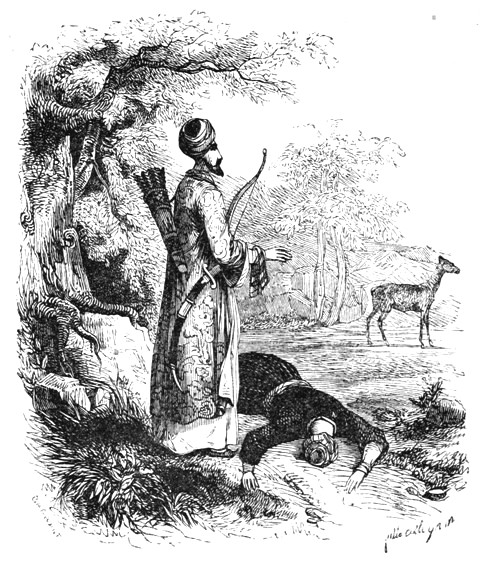
"Sire," said he, "I deeply regret that I cannot comply with your desire; for I promised the dying Bramin not to disclose it to any one, and I am a slave to my word."
The more the dervise excused himself from satisfying my wishes, the more did I feel my curiosity excited.
"In the name of Allah," said I, "do not refuse to comply with my entreaties. I promise thee never to divulge the secret, and I swear by Him who created us both never to employ it to a bad purpose."
The dervise considered a moment, then turning to me said,
"I cannot resist the wishes of a king whom I love more than my life; I will yield to your desire. It is true," added he, "that I only gave a simple promise to the Bramin. I did not bind myself by an inviolable oath. I will impart my secret to your highness. It consists only in remembering two words; it is sufficient to repeat them mentally to be able to reanimate a dead body."
He then taught me the two magic words. I no sooner knew them, than I burned to test their power. I pronounced them, with the intention to make my soul pass into the body of the doe, and in a moment I found myself metamorphosed into the animal. But the delight I experienced at the success of the trial was soon converted into consternation; for no sooner had my spirit entered into the body of the doe, than the dervise caused his to pass into mine, and then suddenly drawing my bow, the traitor was on the point of shooting me with one of my own arrows, when, perceiving his intention, I took to flight, and by my speed just escaped the fatal shaft. Nevertheless, he let fly the arrow at me with so true an aim, that it just grazed my shoulder.
I now beheld myself reduced to live with the beasts of the forests and mountains. Happier for me would it have been if I had resembled them more perfectly, and if in losing my human form, I had at the same time lost my power of reason. I should not then have been the prey to a thousand miserable reflections.
Whilst I was deploring my misery in the forests, the dervise was occupying the throne of Moussul; and fearing that, as I possessed the secret as well as himself, I might find means to introduce myself into the palace, and take my revenge upon him, on the very day he usurped my place he ordered all the deer in the kingdom to be destroyed, wishing, as he said, to exterminate the whole species, which he mortally hated. Nay, so eager was he for my destruction, that the moment he returned from the hunting expedition, he again set out at the head of a large body of followers, intent upon the indiscriminate slaughter of all the deer they might meet.
The people of Moussul, animated by the hope of gain, spread themselves all over the country with their bows and arrows; they scoured the forests, over-ran the mountains, and shot every stag and deer they met with. Happily, by this time I had nothing to fear from them; for, having seen a dead nightingale lying at the foot of a tree, I reanimated it, and under my new shape flew towards the palace of my enemy, and concealed myself among the thick foliage of a tree in the garden. This tree was not far from the apartments of the queen. There, thinking upon my misfortune, I poured forth in tender strains the melancholy that consumed me. It was one morning, as the sun rose, and already several birds, delighted to see its returning beams, expressed their joy by their minstrelsy. For my part, taken up with my griefs, I paid no attention to the brightness of the newborn day; but with my eyes sadly turned towards Zemroude's apartment, I poured forth so plaintive a song, that I attracted the attention of the princess, who came to the window. I continued my mournful notes in her presence, and I tried all the means in my power to render them more and more touching, as though I could make her comprehend the subject of my grief. But, alas! although she took pleasure in listening to me, I had the mortification to see, that instead of being moved by my piteous accents, she only laughed with one of her slaves, who had come to the window to listen to me.
I did not leave the garden that day, nor for several following, and I took care to sing every morning at the same spot. Zemroude did not fail to come to the window; and at length, by the blessing of Providence, took a fancy to have me. One morning she said to her female attendants, "I wish that nightingale to be caught; let birdcatchers be sent for. I love that bird; I doat upon it; let them try every means to catch it, and bring it to me." The queen's orders were obeyed; expert birdcatchers were found, who laid traps for me, and, as I had no desire to escape, because I saw that their only object in depriving me of my liberty was to make me a slave to my princess, I allowed myself to be taken. The moment I was brought to her she took me in her hand, with every symptom of delight. "My darling," said she, caressing me, "my charming bul-bul, I will be thy rose; I already feel the greatest tenderness for thee." At these words she kissed me. I raised my beak softly to her lips. "Ah! the little rogue," cried she laughing, "he appears to know what I say." At last, after fondling me, she placed me in a gold filigree cage, which an eunuch had been sent into the city to buy for me.
Every day as soon as she woke I began my song; and whenever she came to my cage to caress me or feed me, far from appearing wild, I spread out my wings, and stretched my beak towards her, to express my joy. She was surprised to see me so tame in so short a time. Sometimes she would take me out of the cage, and allow me to fly about her chamber. I always went to her to receive her caresses, and to lavish mine upon her; and if any of her slaves wished to take hold of me, I pecked at them with all my might. By these little insinuating ways I endeared myself so much to Zemroude, that she often said if by any mishap I were to die, she should be inconsolable, so strong was her attachment to me.
Zemroude also had a little dog in her chamber, of which she was very fond. One day, when the dog and I were alone, it died. Its death suggested to me the idea of making a third experiment of the secret. "I will pass into the body of the dog," thought I, "for I wish to see what effect the death of her nightingale will produce upon the princess." I cannot tell what suggested the fancy, for I did not foresee what this new metamorphosis would lead to; but the thought appeared to me a suggestion of Heaven, and I followed it at all risks.
When Zemroude returned to the room, her first care was to come to my cage. As soon as she perceived that the nightingale was dead, she uttered a shriek that brought all her slaves about her. "What ails you, madam?" said they in terrified accents. "Has any misfortune happened to you?"
"I am in despair," replied the princess, weeping bitterly; "my nightingale is dead. My dear bird, my little husband, why art thou taken from, me so soon? I shall no more hear your sweet notes! I shall never see you again! What have I done to deserve such punishment from Heaven?"
All the efforts of her women to console her were in vain. The dervise had just returned from his murderous expedition, and one of them ran to acquaint him with the state in which they had found the queen. He quickly came and told her that the death of a bird ought not to cause her so much grief; that the loss was not irreparable; that if she was so fond of nightingales, and wanted another, it was easy to get one. But all his reasoning was to no purpose, he could make no impression upon her.
"Cease your endeavours," she exclaimed, "to combat my grief, you will never overcome it. I know it is a great weakness to mourn so for a bird, I am as fully persuaded of it as you can be, still I cannot bear up against the force of the blow that has overwhelmed me. I loved the little creature; he appeared sensible of the caresses I bestowed on him, and he returned them in a way that delighted me. If my women approached him, he exhibited ferocity, or rather disdain; whereas he always came eagerly on to my hand when I held it out to him. It appeared as though he felt affection for me, he looked at me in so tender and languishing a manner, that it almost seemed as though he was mortified that he had not the power of speech to express his feelings towards me. I could read it in his eyes. Ah! I shall never think of him without despair." As she finished speaking her tears gushed out afresh, and she seemed as if nothing could ever console her.
I drew a favourable omen from the violence of her grief. I had laid myself down in a corner of the room, where I heard all that was said and observed all that passed without their noticing me. I had a presentiment that the dervise, in order to console the queen, would avail himself of the secret, and I was not disappointed.
Finding the queen inaccessible to reason, and being deeply enamoured of her, he was moved by her tears, and instead of persevering in fruitless arguments, he ordered the queen's slaves to quit the room and leave him alone with her. "Madam," said he, thinking that no one overheard him, "since the death of your nightingale causes you so much sorrow, he must be brought to life. Do not grieve, you shall see him alive again; I pledge myself to restore him to you; to-morrow morning, when you wake, you shall hear him sing again, and you shall have the satisfaction of caressing him."
"I understand you, my lord," said Zemroude; "you look upon me as crazed, and think that you must humour my sorrow; you would persuade me that I shall see my nightingale alive to-morrow; to-morrow you will postpone your miracle till the following day, and so on from one day to another; by this means you reckon on making me gradually forget my bird; or, perhaps," pursued she, "you intend to get another put in his place to deceive me."
"No, my queen," replied the dervise, "no; it is that very bird which you see stretched out in his cage without life; this very nightingale, the enviable object of such poignant grief; it is that very bird himself that shall sing. I will give him new life, and you can again lavish your caresses upon him. He will better appreciate that delight, and you shall behold him still more anxious to please you, for it will be I myself who will be the object of your endearments; every morning I will myself be his fresh life in order to divert you. I can perform this miracle," continued he; "it is a secret I possess; if you have any doubts upon it, or if you are impatient to behold your favourite reanimated, I will cause him to revive now immediately."
As the princess did not reply, he imagined from her silence that she was not fully persuaded he could accomplish what he professed; he seated himself on the sofa, and by virtue of the two cabalistic words left his body, or rather mine, and entered into that of the nightingale. The bird began to sing in its cage to the great amazement of Zemroude. But his song was not destined to continue long; for no sooner did he begin to warble than I quitted the body of the dog and hastened to retake my own. At the same time running to the cage, I dragged the bird out and wrung his neck. "What have you done, my lord?" cried the princess. "Why have you treated my nightingale thus? If you did not wish him to live, why did you restore him to life?"
"I thank Heaven!" cried I, without paying any regard to what she said, so much were my thoughts taken up with the feeling of vengeance which possessed me at the treacherous conduct of the dervise, "I am satisfied. I have at length avenged myself on the villain whose execrable treason deserved a still greater punishment."
If Zemroude was surprised to see her nightingale restored to life, she was not the less so to hear me utter these words with such fierce emotion.
"My lord," said she, "whence this violent transport which agitates you, and what do those words mean which you have just spoken?"
I related to her all that had happened to me, and she could not doubt that I was truly Al Abbas, because she had heard that the body of the dervise had been found in the forest, and she was also of course well acquainted with the order which he had given for destroying all the deer.
But my poor princess could not recover the shock her sensitive love had sustained. A few days after she fell ill, and died in my arms, literally frightened to death by the imminence of the danger from which she had just been so happily rescued.
After I had bewailed her, and erected a splendid tomb to her memory, I summoned the prince Amadeddin.
"My cousin," said I, "I have no children, I resign the crown of Moussul in your favour. I give the kingdom up into your hands. I renounce the regal dignity, and wish to pass the rest of my days in repose and privacy." Amadeddin, who really loved me, spared no arguments to deter me from taking the step I proposed, but I assured him that nothing could shake my resolution.
"Prince," said I, "my determination is fixed, I resign my rank to you. Fill the throne of Al Abbas, and may you be more happy than he. Reign over a people who know your merit, and have already experienced the blessings of your rule. Disgusted with pomp, I shall retire to distant climes, and live in privacy; there freed from the cares of state, I shall mourn over the memory of Zemroude, and recall the happy days we passed together."
I left Amadeddin upon the throne of Moussul, and, accompanied only by a few slaves, and carrying an ample supply of riches and jewels, took the road to Bagdad, where I arrived safely. I immediately repaired to Mouaffac's house. His wife and he were not a little surprised to see me, and they were deeply affected when I informed them of the death of their daughter, whom they had tenderly loved. The recital unlocked the fountains of my own grief, and I mingled my tears with theirs. I did not stay long in Bagdad, I joined a caravan of pilgrims going to Mecca, and after paying my devotions, found, by chance, another company of pilgrims from Tartary, whom I accompanied to their native country. We arrived in this city; I found the place agreeable, and took up my abode here, where I have resided for nearly forty years. I am thought to be a stranger who was formerly concerned in trade, and whose time is now passed in study and contemplation. I lead a retired life, and rarely see strangers. Zemroude is ever present to my thoughts, and my only consolation consists in dwelling fondly upon her memory and her virtues.
CONTINUATION OF THE STORY OF PRINCE KHALAF AND THE PRINCESS OF CHINA.
Al Abbas, having finished the recital of his adventures, thus addressed his guests:
"Such is my history. You perceive by my misfortunes and your own, that human life is but as a reed, ever liable to be bent to the earth by the bleak blasts of misfortune. I will, however, confess to you that I have led a happy and quiet life ever since I have been in Jaic; and that I by no means repent having abdicated the throne of Moussul; for in the obscurity in which I now live, I have discovered peaceful and tranquil joys which I never experienced before."
Timurtasch, Elmaze, and Khalaf bestowed a thousand flattering encomiums upon the son of Ben-Ortoc; the khan admired the resolution which had caused him to deprive himself of his kingdom, in order to live in privacy in a country of strangers, where the station which he had filled in the world was unknown. Elmaze praised the fidelity he displayed towards Zemroude, and the grief he experienced at her death. And Khalaf remarked, "My lord, it were to be wished that all men could display the same constancy in adversity which you have done, under your misfortunes."
They continued their conversation till it was time to retire. Al Abbas then summoned his slaves, who brought wax-lights in candlesticks made of aloe-wood, and conducted the khan, the princess, and her son to a suite of apartments, where the same simplicity reigned that characterized the rest of the house. Elmaze and Timurtasch retired to sleep in a chamber appropriated to themselves, and Khalaf to another. The following morning their host entered the chamber of his guests as soon as they were up, and said,
"You are not the only unfortunate persons in the world; I have just been informed that an ambassador from the sultan of Carisma arrived in the city last evening; that his master has sent him to Ileuge-Khan, to beg of him not only to refuse an asylum to the khan of the Nagäis, his enemy, but if the khan should endeavour to pass through his dominions, to arrest him. Indeed, it is reported," pursued Al Abbas, "that the unfortunate khan, for fear of falling into the hands of the sultan of Carisma, has left his capital and fled with his family." At this news, Timurtasch and Khalaf changed colour, and the princess fainted.
The swoon of Elmaze, as well as the evident trouble of the father and son, instantly caused Al Abbas to suspect that his guests were not merchants.
"I see," said he, as soon as the princess had recovered her senses, "that you take a deep interest in the misfortunes of the khan of the Nagäis; indeed, if I may be permitted to tell you what I think, I believe you are yourselves the objects of the sultan of Carisma's hatred."
"Yes, my lord," replied Timurtasch, "we are, indeed, the victims for whose immolation he is thirsty. I am the khan of the Nagäis, you behold my wife and my son; we should, indeed, be ungrateful, if we did not discover our position to you, after your generous reception, and the confidence you have reposed in us. I am encouraged even to hope, that by your counsels you will aid us to escape from the danger which threatens us."
"Your situation is most critical," replied the aged king of Moussul; "I know Ileuge-Khan well, and, as he fears the sultan of Carisma, I cannot doubt that, to please him, he will search for you every where. You will not be safe, either in my house or in any other in this city; the only resource left you, is to leave the country of Jaic as speedily as possible, cross the river Irtisch, and gain, with the utmost diligence, the frontiers of the tribe of the Berlas."
This advice pleased Timurtasch, his wife, and son. Al Abbas had three horses instantly got ready, together with provisions for the journey, and giving them a purse filled with gold; "Start immediately," said he, "you have no time to lose, by to-morrow, no doubt, Ileuge-Khan will cause search to be made for you every where."
They returned their heartfelt thanks to the aged monarch, and then quitted Jaic, crossed the Irtisch, and joining company with a camel-driver, who was travelling that way, arrived after several days' journey in the territories of the tribe of Berlas. They took up their quarters with the first horde they met, sold their horses, and lived quietly enough as long as their money lasted; but, as soon as it came to an end, the misery of the khan recommenced. "Why am I still in the world?" he began to exclaim. "Would it not have been better to have awaited my blood-thirsty foe in my own kingdom, and have died defending my capital, than to drag on a life which is only one continued scene of misery? It is in vain that we endure our misfortunes with patience; for, in spite of our submission to its decrees, Heaven will never restore us to happiness, but leaves us still the sport of misery."
"My lord," replied Khalaf, "do not despair of our miseries coming to an end. Heaven, which decrees these events, is preparing for us, I doubt not, some relief which we cannot foresee. Let us proceed at once," added he, "to the principal horde of this tribe. I have a presentiment, that our fortunes will now assume a more favourable aspect."
They all three proceeded accordingly to the horde with whom the khan of Berlas resided. They entered a large tent which served as a refuge for poor strangers. Here they laid themselves down, worn out with their journey, and at a loss at last to know how to obtain even the necessaries of life. Khalaf, however, quietly slipt out of the tent, leaving his father and mother there, and went through the horde, asking charity of the passers-by. By the evening he had collected a small sum of money, with which he bought some provisions, and carried them to his parents. When they learned that their son had actually solicited charity, they could not refrain from tears. Khalaf himself was moved by their grief, but cheerfully remarked, nevertheless, "I confess that nothing we have yet endured has appeared to me more mortifying than to be reduced to solicit alms; still, as at present I cannot procure you subsistence by any other means, is it not my duty to do it, in spite of the mortification it costs me? But," he added, as though struck with a sudden thought, "there is still another resource—sell me for a slave, and the money you will receive will last you a long time."
"What do you say, my son?" cried Timurtasch, when he heard these words. "Can you propose to us that we should live at the expense of your liberty? Ah! rather let us endure for ever our present misery. But if it should come to this, that one of us must be sold, let it be myself; I do not refuse to bear the yoke of servitude for you both."
"My lord," said Khalaf, "another thought strikes me; to-morrow morning I will take my station among the porters; some one may chance to employ me, and we may thus earn a living by my labour." They agreed to this, and the following day the prince stationed himself among the porters of the horde, and waited till some one should employ him; but unfortunately no one wanted him, so that half the day passed and he had not had a single job. This grieved him deeply. "If I am not more successful than this," thought he, "how am I to support my father and mother?"
He grew tired of waiting among the porters on the chance of some person wanting his services. He went out of the encampment and strolled into the country, in order to turn over in his mind undisturbedly the best means of earning a livelihood. He sat down under a tree, where, after praying Heaven to have pity on his perplexity, he fell asleep. When he woke he saw near him a falcon of singular beauty: its head was adorned with a tuft of gaudy feathers, and from its neck hung a chain of gold filigree-work set with diamonds, topazes, and rubies. Khalaf, who understood falconry, held out his fist, and the bird alighted on it. The prince of the Nagäis was delighted at the circumstance. "Let us see," said he, "what this will lead to. This bird, from all appearance, belongs to the sovereign of the tribe." Nor was he wrong. It was the favourite falcon of Almguer, khan of Berlas, who had lost it the previous day. His principal huntsmen were engaged at that moment in searching every where for it with the greatest diligence and uneasiness, for their master had threatened them with the severest punishments if they returned without his bird, which he loved passionately.
Prince Khalaf returned to the encampment with the falcon. As soon as the people of the horde saw it, they began to cry out, "Ha! here is the khan's falcon recovered. Blessings on the youth who will make our prince rejoice by restoring him his bird." And so it turned out, for when Khalaf arrived at the royal tent, and appeared with the falcon, the khan, transported with joy, ran to his bird and kissed it a thousand times. Then addressing the prince of the Nagäis, he asked him where he found it. Khalaf related how he had recovered the falcon. The khan then said to him, "Thou appearest to be a stranger amongst us; where wast thou born, and what is thy profession?"
"My lord," replied Khalaf, prostrating himself at the khan's feet, "I am the son of a merchant of Bulgaria, who was possessed of great wealth. I was travelling with my father and mother in the country of Jaic, when we were attacked by robbers, who stripped us of every thing but our lives, and we have found our way to this encampment actually reduced to beg our bread."
"Young man," replied the khan, "I am glad that it is thou who hast found my falcon; for I swore to grant to whomsoever should bring me my bird, whatever two things he might ask; so thou hast but to speak. Tell me what thou desirest me to grant thee, and doubt not that thou shalt obtain it." "Since I have permission to ask two things," returned Khalaf, "I request in the first place that my father and mother, who are in the strangers' tent, may have a tent to themselves in the quarter where your highness resides, and that they may be supported during the rest of their days at your highness's expense, and waited on by officers of your highness's household; secondly, I desire to have one of the best horses in your highness's stables and a purse full of gold, to enable me to make a journey which I have in contemplation." "Thy wishes shall be gratified," said Almguer; "thou shalt bring thy father and mother to me, and from this day forth I will begin to entertain them as thou desirest; and to-morrow, dressed in rich attire, and mounted on the best horse in my stables, thou shalt be at liberty to go wherever it shall please thee. Thy modesty, the filial love which is imprinted upon thy features, thy youth, thy noble air, please me; be my guest, come and join my festivities, and thou shalt listen to an Arabian story-teller, whose knowledge and imaginative powers instruct and amuse my tribes."
The khan and the son of Timurtasch presently seated themselves at a table loaded with viands, confectionary, fruit, and flowers; gazelle venison, red-legged partridges, pheasants, and black cock were displayed as trophies of the skill of the hunter king. The Arab stationed near the khan awaited his orders. "Moustapha," said the khan at length, turning to the Arab, "I have been extolling thy knowledge and wit to my guest; surpass thyself, and let him see that I have not exaggerated. He shall give thee a subject; treat it in such a manner as to deserve his praise."
"I am curious," said the prince, "to hear of China; I ask thee to instruct me concerning the government of that important kingdom, and to give me an insight into the manners and customs of its people."
The Arab reflected a moment, and then, prefacing his recital with a few general remarks, proceeded to depict in glowing colours this celestial empire, whose civilization dates back to the remotest ages of the world. He described its extent as equal to one-half of the habitable globe; its population as so numerous that it might be counted by hundreds of millions; he spoke of cities, each of which alone brought a revenue to their crown, which surpassed that of entire kingdoms; of those gigantic works, the canals, whose extent equalled the course of the largest rivers, which traversed the vast empire. And he foretold that a time would come when Tartar warriors should scale that very wall which the terror of their arms had caused to be built, and should again reconquer the whole of that wealthy tract. He then began his story as follows.