III. (continued 2)
Reading edition
THE STORY OF LIN-IN.
A CHINESE TALE.
At Wou-si, a town dependent upon the city of Tchang-tcheou, in the province of Kiang-nan, there resided a family in the middle sphere of life. Three brothers composed the family; the name of the eldest was Lin-in (the jasper); the second Lin-pao (the precious); the youngest Lin-tchin (the pearl); this last was not yet old enough to marry; the other two had taken wives to themselves. The wife of the first was named Wang; the wife of the second Yang; and both possessed every grace which can constitute the charm of woman.
Lin-pao's engrossing passions were gambling and wine; he evinced no inclination to good. His wife was of a similar disposition, and depraved in her conduct; she was very different from her sister-in-law Wang, who was a pattern of modesty and propriety. So although these two women lived together on neighbourly terms, there was but little real sympathy between them.
Wang had a son named Hi-eul, that is to say, "the son of rejoicing." He was a child of six years old. One day having stopped in the street with some other children, to look at a great procession in the neighbourhood, he was lost in the crowd, and in the evening did not return to the house.
This loss caused the deepest sorrow to his parents. They had handbills posted up, and there was not a street in which they did not make inquiries, but all to no purpose; they could gain no intelligence respecting their darling child. Lin-in was inconsolable; and giving way to the grief that overwhelmed him, he sought to fly from his home, where every thing brought back the remembrance of his dear Hi-eul. He borrowed a sum of money from one of his friends to enable him to carry on a small trade in the neighbourhood of the city and the adjacent villages, hoping that in one of these short excursions he might be able to recover the treasure he had lost.
As his whole thoughts were taken up with his child, he took little pleasure in the circumstance that his trade flourished. He nevertheless continued to pursue it during five years, without making long journeys from home, whither he returned every year to spend the autumn. At length, being utterly unsuccessful in discovering the least trace of his son after so many years, and concluding that he was lost to him for ever, and finding moreover that his wife Wang bore him no more children, as he had now amassed a good sum of money, he determined to divert his thoughts from painful recollections by trading in another province.
He joined the company of a rich merchant travelling the road he had fixed upon; and the merchant, having observed his aptitude for business, made him a very advantageous offer. The desire of becoming wealthy now took possession of him, and diverted his thoughts from their accustomed channel.
Within a very short time after their arrival in the province of Chan-si every thing had succeeded to their utmost wishes. They found a quick sale for their merchandise, and the profits arising from it was considerable. The payments, however, were delayed for two years in consequence of a drought and famine which afflicted the country, as well as by a tedious illness by which Lin-in was attacked. They were detained altogether three years in the province; after which, having recovered his money and his health, he took his departure to return to his own country.
He halted one day during his journey near a place named Tchin-lieou to recruit his strength, and strolling round the neighbourhood accidentally came upon a girdle of blue cloth, in the form of a long, narrow bag, such as is worn round the body, under the dress, and in which money is usually kept; as he took it up, he found the weight considerable. He retired to a quiet spot, opened the girdle, and found it contained about two hundred täels.
At sight of this treasure he fell into the following train of reflection: "My good fortune has placed this sum in my hands; I might keep it and employ it for my own use without fearing any unpleasant consequences. Still the person who has dropt it, the moment he discovers his loss, will be in great distress, and will return in haste to look for it. Do they not say that our forefathers dared scarcely touch money found in this way; and if they picked it up, only did so with a view of restoring it to its owner? This appears to me a very praiseworthy custom, and I will imitate it, the more so as I am growing old and have no heir. Of what benefit would money got by such means be to me?"
Whilst thus reasoning, he had wandered to some distance from the spot where he had found the money; he now, however, retraced his steps to the place, and waited there the whole day, to be ready in case the owner should return. Nobody came, however, and the next day he continued his journey.
After five days' travelling, he arrived in the evening at Nan-sou-tcheou, and took up his quarters at an inn where several other merchants were staying. The conversation having turned upon the advantages of commerce, one of the company said, "Five days ago, on leaving Tchin-lieou, I lost two hundred täels, which I had in an inside girdle. I had taken it off, and placed it near me whilst I lay down to sleep, when a mandarin and his cortége chanced to pass by. I hastened to get out of the way for fear of insult, and in my hurry forgot to take up my money. It was only at night, as I was undressing to go to bed, that I discovered my loss. I felt sure that as the place where I lost my money was by the side of a well-frequented road, it would be useless to delay my journey for several days in order to look for what I should never find."
Every one condoled with him on his loss. Lin-in asked him his name and place of abode. "Your servant," replied the merchant, "is named Tchin, and lives at Yang-tcheou, where he has a shop and a large warehouse. May I be so bold in return to inquire to whom I have the honour of speaking?" Lin-in told him his name, and said that he was an inhabitant of the town of Wou-si. "My shortest road there," added he, "lies through Yang-tcheou; and, if agreeable to you, I shall have much pleasure in your company so far."
Tchin acknowledged this politeness in a becoming manner. "Most willingly," said he; "we will continue our journey together, and I esteem myself very fortunate in meeting with such an agreeable companion." The journey was not long, and they soon arrived at Yang-tcheou.
After the usual civilities, Tchin invited his fellow-traveller to his house, and on their arrival there immediately ordered refreshments to be brought. Whilst they were discussing their meal, Lin-in managed to turn the conversation on the subject of the lost money.
"What," he asked, "was the colour of the girdle which contained your money, and of what material was it made?"
"It was of blue cloth," replied Tchin; "and what would enable me to identify it is, that at one end the letter Tchin, which is my name, is embroidered upon it in white silk."
This description left no doubt as to the owner. Lin-in, therefore, rejoined in a cheerful tone, "If I have asked you all these questions, it was merely because passing through Tchin-lieou, I found a belt such as you describe." At the same time producing it, he added, "Look if this is yours." "The very same," said Tchin. Whereupon Lin-in politely restored it to its owner.
Tchin, overwhelmed with gratitude, pressed him to accept the half of the sum which it contained; but his entreaties were in vain, Lin-in would receive nothing. "What obligations am I not under to you?" resumed Tchin; "where else should I find such honesty and generosity?" He then ordered a splendid repast to be brought, over which they pledged each other with great demonstrations of friendship.
Tchin thought to himself, "Where should I find a man of such probity as Lin-in? Men of his character are very scarce in these days. What! shall I receive from him such an act of kindness, and not be able to repay him? I have a daughter twelve years old; I must form an alliance with such an honest man. But has he got a son? On this point I am entirely ignorant."
"My dear friend," said he, "how old is your son?"
This question brought tears into the eyes of Lin-in. "Alas!" replied he, "I had but one, who was most dear to me. It is now eight years ago since my child, having run out of the house to see a procession pass by, disappeared; and from that day to this I have never been able to learn any thing of him; and, to crown my misfortune, my wife has not borne me any more children."
Upon hearing this, Tchin appeared to think for a moment, then, continuing the conversation, said, "My brother and benefactor, of what age was the child when you lost him?" "About six years old," replied Lin-in. "What was his name?" "We called him Hi-eul," returned Lin-in. "He had escaped all the dangers of the small-pox which had left no traces upon his countenance; his complexion was clear and florid."
This description gave the greatest pleasure to Tchin, and he could not prevent his satisfaction from displaying itself in his looks and manner. He immediately called one of his servants, to whom he whispered a few words. The servant, having made a gesture of obedience, retired into the interior of the house.
Lin-in, struck by the questions, and the joy which lit up the countenance of his host, was forming all sorts of conjectures, when he saw a youth of about fourteen years of age enter the room. He was dressed in a long gown, with a plain though neat jacket. His graceful form, his air and carriage, his face with its regular features, and his quick and piercing eyes, and finely arched black eyebrows, at once engaged the admiration and riveted the attention of Lin-in.
As soon as the youth saw the stranger seated at table, he turned towards him, made a low bow, and uttered some respectful words; then approaching Tchin, and standing modestly before him, he said in a sweet and pleasing tone, "My father, you have called Hi-eul; what are you pleased to command?" "I will tell you presently," replied Tchin, "in the mean time stand beside me."
The name of Hi-eul, by which the youth called himself, excited fresh suspicions in the breast of Lin-in. A secret sympathy suddenly forced itself upon him; and by one of those wonderful instincts of nature which are so unerring, recalled to his recollection the image of his lost child, his form, his face, his air, and manners; he beheld them all in the youth before him. There was but one circumstance that made him doubt the truth of his conjectures, and that was his addressing Tchin by the name of 'father.' He felt it would be rude to ask Tchin if the youth really were his son; perhaps he might truly be so, for it was not impossible that there might be two children bearing the same name, and in many respects resembling each other.
Lin-in, absorbed in these reflections, paid little attention to the good cheer placed before him. Tchin could read on the countenance of Lin-in the perplexing thoughts that filled his mind. An indescribable charm seemed to attract him irresistibly towards the youth. He kept his eyes constantly fixed upon him, he could not turn them away. Hi-eul, on his part, despite his bashfulness and the timidity natural to his age, could not help gazing intently upon Lin-in; it seemed as though nature was revealing his father to him.
At length Lin-in, no longer master of his feelings, suddenly broke the silence, and asked Tchin if the youth really was his son.
"I am not," replied Tchin, "really his father, although I look upon him as my own child. Eight years ago, a man passing through this city, leading this child in his hand, addressed me by chance, and begged me to assist him in his great need. 'My wife,' said he, 'is dead, and has left me with this child. The impoverished state of my affairs has compelled me to leave my native place, and go to Hoaingan to my relations, from whom I hope to receive a sum of money, to enable me to set up in business again. I have not wherewith to continue my journey to that town, will you be so charitable as to lend me three täels? I will faithfully restore them on my return, and I will leave as a pledge all that I hold most dear in the world, my only son; I shall no sooner reach Hoaingan, than I will return and redeem my dear child.'
"I felt gratified by this mark of confidence, and I gave him the sum he asked. As he left me he burst into tears, and gave every evidence of the grief he felt in leaving his child. I was, however, surprised that the child did not exhibit the least emotion at the separation; as, however, time wore on, and the pretended father did not return, suspicions began to rise, which I was anxious to set at rest. I called the child, and by various questions I put to him, learned that he was born in Wou-si, that having one day run out to see a procession pass by, he had strayed too far from home, and lost his way, and that he had been trepanned and carried off by a stranger. He also told me the name of his father and mother; indeed, it is that of your own family. I thus discovered that the fellow, so far from being the father of the poor child, was the identical rascal who had carried him off. Not only was my compassion excited, but the boy's pleasing manners had entirely won my heart; I treated him from that time as one of my own children, and I sent him to college with my own son, to study with him. I have often entertained the plan of going to Wou-si, to inquire after his family. But business of some kind always prevented me from undertaking the journey, of which, however, I had never fully relinquished the idea; when, happily, a few moments ago, you chanced in the course of conversation to mention your son, my suspicions were aroused, and upon the extraordinary coincidence of your tale, and the circumstances of which I was acquainted, I sent for your child to see if you would recognize him."
At these words Hi-eul wept for joy, and his tears caused those of Lin-in to flow copiously. "A peculiar mark," said he, "will prove his identity; a little above the left knee you will find a small black spot, which has been there from his birth." Hi-eul pulled up the leg of his trouser, and showed the spot in question. Lin-in, on seeing it, threw himself upon the neck of the child, covered him with kisses, and folded him in his arms. "My child," cried he, "my dear child, what happiness for your father to find you after so many years' absence."
It is not difficult to conceive to what transports of joy the father and son delivered themselves up, during these first moments of pleasure. After a thousand tender embraces, Lin-in at length tore himself from the arms of his son, and made a profound obeisance to Tchin. "What gratitude do I not owe you," said he, "for having received my son into your house, and brought up this dear portion of myself with so much care. But for you we should never have been united."
"My kind benefactor," replied Tchin, rising, "it was the act of disinterested generosity you practised towards me, in restoring the two hundred täels, which moved the compassion of Heaven. It is Heaven that conducted you to my house, where you have found him whom you sought in vain for so many years. Now that I know that good youth is your son, I regret that I have not treated him with greater consideration."
"Kneel, my son," said Lin-in, "and thank your generous benefactor."
Tchin was about to return these salutations, when Lin-in himself prevented him, overcome with this excess of respect. This interchange of civilities being over they resumed their seats, and Tchin placed little Hi-eul on a seat by his father's side.
Then Tchin resuming the conversation, said, "My brother (for henceforth that is the title by which I shall address you), I have a daughter twelve years of age, and it is my intention to give her in marriage to your son, in order that the union may cement our friendship more closely." This proposition was made in so sincere and ardent a manner, that Lin-in did not feel it right to make the usual excuses that good breeding prescribed. He therefore waived all ceremony, and gave his consent at once.
As it was growing late, they separated for the night. Hi-eul slept in the same chamber with his father. You may imagine all the tender and affectionate conversation that passed between them during the night. The next day Lin-in prepared to take leave of his host, but he could not resist his pressing invitation to remain. Tchin had prepared a second day's festivity, in which he spared no expense to regale the future father-in-law of his daughter, and his new son-in-law, and thereby to console himself for their departure. They drank and sang, and gave themselves up fully to the hilarity of the occasion.
When the repast was ended, Tchin drew out a packet of twenty täels, and looking towards Lin-in, said, "During the time my dear son-in-law has been with me, it is possible he may have suffered many things against my wish, and unknown to me; here is a little present I wish to make him, until I can give him more substantial proofs of my affection. I will not hear of a refusal."
"What!" replied Lin-in, "at a time when I am contracting an alliance so honourable to me, and when I ought, according to custom, to make marriage presents for my son, presents which I am prevented from doing at this moment, only because I am travelling, do you load me with gifts? I cannot accept them; the thought covers me with confusion."
"Well!" replied Tchin, "I am not dreaming of offering you such a trifle. It is for my son-in-law, not the father-in-law of my daughter, that I intend this present. Indeed, if you persist in the refusal, I shall consider it as a sign that the alliance is not agreeable to you."
Lin-in saw that he must yield, and that resistance would be useless. He humbly accepted the present, and making his son rise from table, ordered him to make a profound reverence to Tchin. "What I have given you," said Tchin, raising him up, "is but a trifle, and deserves no thanks." Hi-eul then went into the house to pay his respects to his mother-in-law. The whole day passed in feasting and diversions; it was only at night that they separated.
When Lin-in retired to his chamber, he gave himself up entirely to the reflections to which these events gave rise. "It must be confessed," cried he, "that by restoring the two hundred täels, I have done an action pleasing to Heaven, and now I am rewarded by the happiness of finding my child, and contracting so honourable an alliance. This is, indeed, joy upon joy; it is like putting gold flowers upon a beautiful piece of silk. How can I be sufficiently grateful for so many favours? Here are the twenty täels that my friend Tchin has given me; can I do better than employ them towards the maintenance of some virtuous bonzes? It will be sowing them in a soil of blessings."
The next day, after breakfast, the father and son got ready their luggage, and took leave of their host; they proceeded to the quay, hired a boat, and commenced their journey. They had scarcely gone half a league, ere they came in sight of a scene of terrible excitement; the river was full of struggling people, whose cries rent the air. A bark, full of passengers, had just sunk, and the cries of the unfortunate creatures for help were heart-rending! The people on the shore called loudly to several small boats which were near to come to the rescue. But the hard-hearted and selfish boatmen demanded that a good sum should be guaranteed them, before they would bestir themselves. At this critical moment Lin-in's boat came up. The moment he perceived what was going on, he said to himself: "It is a much more meritorious action to save the life of a man, than to adorn the temples and support bonzes. Let us consecrate the twenty täels to this good work; let us succour these poor drowning souls." He instantly proclaimed that he would give the twenty täels amongst those who would take the drowning men into their boats.
At this offer all the boatmen crowded towards the scene of the disaster, and the river was, in a moment, covered with their boats; at the same time, some of the spectators on shore, who knew how to swim, threw themselves into the water, and, in a few moments, all were saved, without exception. Lin-in then distributed amongst the boatmen the promised reward.
The poor creatures, snatched from a watery grave, came in a body to return thanks to their preserver. One amongst them, having looked attentively at Lin-in, suddenly cried out, "What! is that you, my eldest brother? By what good luck do I find you here?"
Lin-in, turning towards him, recognized his youngest brother, Lin-tchin. Then, transported with joy, he exclaimed, clasping his hands, "O wonderful circumstance! Heaven has led me hither to save my brother's life." He instantly reached out his hand to him, and made him come into his boat, helped him off with his wet clothes, and gave him others.
As soon as Lin-tchin had sufficiently recovered, he paid the respects due to an elder brother which good breeding demands from a younger, and Lin-in, having acknowledged his politeness, called Hi-eul, who was in the cabin, to come and salute his uncle; he then recounted all his adventures, which threw Lin-tchin into a state of amazement, from which he was a long time in recovering. "But tell me," said Lin-in, at length, "your motive in coming to this country."
"It is not possible," replied Lin-tchin, "to tell you in a few words the reason of my travels. In the course of the three years which have elapsed since your departure from home, the melancholy news of your death from illness reached us. My second brother made every inquiry, and assured himself that the report was true. It was a thunderbolt for my sister-in-law; she was inconsolable, and put on the deepest mourning. For my part, I could not give credit to the report. After a few days had elapsed, my second brother tried all in his power to induce my sister-in-law to contract a fresh marriage. She, however, steadily rejected the proposal; at length she prevailed upon me to make a journey to Chan-si, to ascertain upon the spot what had become of you; and, when I least expected it, at the point of perishing in the water, the very person I was in search of, my well-beloved brother, has saved my life. Is not this unexpected good fortune, a blessing from Heaven? But believe me, my brother, there is no time to be lost; make all possible haste to return home, and to put an end to my sister-in-law's grief. The least delay may cause an irreparable misfortune."
Lin-in, overwhelmed at this news, sent for the captain of the boat, and, although it was late, ordered him to set sail, and continue the voyage during the night.
Whilst all these events were happening to Lin-in, Wang, his wife, was a prey to the most poignant grief. A thousand circumstances led her to suspect that her husband was not dead; but Lin-pao, who by that reported death became the head of the family, so positively assured her that it was true, that, at last, she had allowed herself to be persuaded into that belief, and had assumed the widow's weeds.
Lin-pao possessed a bad heart, and was capable of the most unworthy acts. "I have no doubt," said he, "of my elder brother's death. My sister-in-law is young and handsome; she has, besides, no one to support her; I must force her to marry again, and I shall make money by this means."
He thereupon communicated his plan to Yang, his wife, and ordered her to employ some clever matchmaker. But Wang resolutely rejected the proposal; she vowed that she would remain a widow, and honour the memory of her husband by her widowhood. Her brother-in-law, Lin-tchin, supported her in her resolution. Thus all the artifices which Lin-pao and his wife employed were useless; and, as every time they urged her on the subject it occurred to her that they had no positive proof of his death, "I am determined," said she, at length, "to know the truth; these reports are often false; it is only on the very spot that certain information can be obtained. True, the distance is nearly a hundred leagues. Still, I know that Lin-tchin is a good-hearted man; he will travel to the province of Chan-si to relieve my anxiety, and learn positively if I am so unfortunate as to have lost my husband; and, if I have, he will, at least, bring me his precious remains."
Lin-tchin was asked to undertake the journey, and, without a moment's hesitation, departed. His absence, however, only rendered Lin-pao more eager in the pursuit of his project. To crown the whole, he had gambled very deeply, and, having been a heavy loser, was at his wit's end to know where to obtain money. In this state of embarrassment, he met with a merchant of Kiang-si, who had just lost his wife, and was looking for another. Lin-pao seized upon the opportunity, and proposed his sister-in-law to him. The merchant accepted the offer, taking care, however, to make secret inquiries whether the lady who was proposed to him was young and good-looking. As soon as he was satisfied on these points, he lost no time, and paid down thirty täels to clinch the bargain.
Lin-pao, having taken the money, said to the merchant, "I ought to warn you, that my sister-in-law is proud and haughty. She will raise many objections to leaving the house, and you will have a great deal of trouble to force her to do it. Now this will be your best plan for managing it. This evening, as soon as it gets dark, have a palanquin and good strong bearers in readiness; come with as little noise as possible, and present yourself at the door of the house. The young woman who will come to the door, attired in the head-dress of mourners, is my sister-in-law; don't say a word to her, and don't listen to what she may say, but seize her at once, thrust her into your palanquin, carry her to your boat, and set sail at once." This plan met with the approbation of the merchant, and its execution appeared easy enough of accomplishment.
In the mean time, Lin-pao returned home, and, in order to prevent his sister-in-law from suspecting any thing of the project he had planned, he assumed an air of the most perfect indifference, but as soon as she left the room, he communicated his plans to his wife, and, alluding to his sister-in-law, in a contemptuous manner, said, "That two-legged piece of goods must leave this house to-night. However, not to be a witness of her tears and sighs, I shall go out beforehand, and, as it gets dark, a merchant of Kiang-si will come, and take her away in a palanquin to his boat."
He would have continued the conversation, when he heard the footsteps of some person outside the window, and went hurriedly away. In his haste he forgot to mention the circumstance of the mourning dress. It was doubtless an interposition of Providence that this circumstance was omitted. The lady Wang easily perceived that the noise she made outside the window had caused Lin-pao to break off the conversation suddenly. The tone of his voice plainly showed that he had something more to say; but she had heard enough; for having remarked by his manner that he had some secret to tell his wife when he entered the house, she had pretended to go away, but listening at the window had heard these words distinctly, "They will take her away and put her into a palanquin."
These words strongly fortified her suspicions. Her resolution was taken at once. She entered the room, and approaching Yang, gave utterance to her anxiety. "My sister-in-law," said she, "you behold an unfortunate widow, who is bound to you by the strongest ties of a friendship which has been always sincere. By this long-standing friendship I conjure you to tell me candidly whether my brother-in-law still persists in his design of forcing me into a marriage that would cover me with disgrace."
At these words Yang at first appeared confused, and changed colour; then, assuming a more confident expression, "What are you thinking of?" she asked, "and what fancies have you got into your head? If there were any intention of making you marry again, do you think there would be any difficulty? What is the good of throwing oneself into the water before the ship is really going to pieces?"
The moment the lady Wang heard this allusion to the ship, she understood more clearly the meaning of the secret conference of her brother-in-law with his wife. She now suspected the worst, and gave vent to her lamentations and sighs; and yielding to the current of her grief, she shut herself up in her room, where she wept, groaned, and bewailed her hard lot. "Unfortunate wretch that I am," cried she, "I do not know what has become of my husband. Lin-tchin, my brother-in-law and friend, upon whom alone I can rely, is gone on a journey. My father, mother, and relations live far from hence. If this business is hurried on, how shall I be able to inform them of it? I can hope for no assistance from our neighbours. Lin-pao has made himself the terror of the whole district, and every body knows him to be capable of the greatest villany. Miserable creature that I am! how can I escape his snares? If I do not fall into them to-day, it may be to-morrow, or at any rate in a very short time."
She fell to the ground half dead; her fall, and the violence of her grief, made a great noise. The lady Yang, hearing the disturbance, hastened to her room, and finding the door firmly fastened, concluded that it was a plan of her distracted sister-in-law to evade the scheme of the night; she therefore seized a bar which stood by and broke the door open. As she entered the room, the night being very dark, she caught her feet in the clothes of the lady Wang, and fell tumbling over her. In her fall she lost her head-dress, which flew to some distance, and the fright and fall brought on a faint, in which she remained for some time. When she recovered she got up, went for a light, and returned to the room, where she found the lady Wang stretched on the floor, without motion and almost without breath.
At the moment she was going to procure other assistance, she heard a gentle knock at the door. She knew it must be the merchant of Kiang-si come to fetch the wife he had bought. She quickly ran to receive him and bring him into the room, that he might himself be witness of what had occurred; but remembering that she had no head-dress, and that she was unfit to present herself in that state, she hastily caught up the one she found at her feet, which was the lady Wang's head-dress of mourning, and ran to the door.
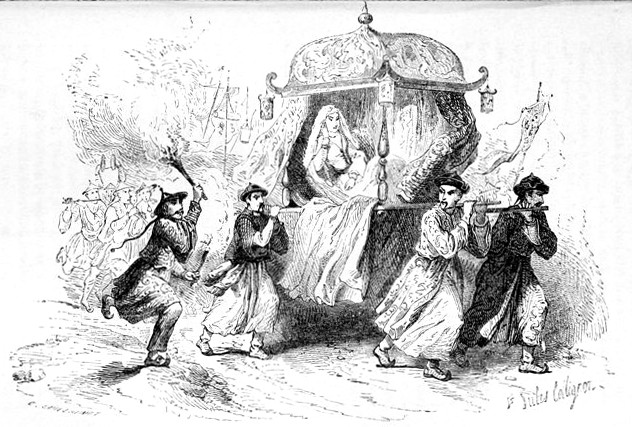
It was indeed the merchant of Kiang-si, who had come to fetch away his promised bride. He had a bridal palanquin, ornamented with silk flags, festoons, flowers, and several gay lanterns; it was surrounded by servants bearing lighted torches, and by a troop of flute and hautboy-players. The whole cortége was stationed in the street in perfect silence. The merchant, having knocked gently and finding the door open, entered the house with some of those who bore torches to light him.
Upon the lady Yang's appearance, the merchant, who spied at a glance the mourning head-dress, which was the mark by which he was to distinguish his bride, flew upon her like a hungry kite upon a sparrow. His followers rushed in, carried off the lady, and shut her into the palanquin, which was all ready to receive her. It was in vain she endeavoured to make herself heard, crying out, "You are mistaken; it is not me you want." The music struck up as she was forced into the palanquin, and drowned her voice, whilst the bearers flew rather than walked, and bore her to the boat.
The lady Yang carried off in the Palanquin, p. 122.
Whilst all this was taking place, the lady Wang had gradually revived and come to her senses. The great hubbub she heard at the door of the house renewed her fears, and occasioned her the most painful anxiety; but as she found that the noise of music, and the tumult of voices, which had arisen so suddenly died gradually away in the distance, she regained her courage, and after a few minutes summoned up strength to go and inquire what was the matter.
After calling her sister-in-law two or three times without effect, the truth began to dawn on her; and after considering the matter carefully, she could only come to the conclusion that the merchant had made a mistake, and had carried off the wrong lady. But now a fresh cause of uneasiness arose; she dreaded the consequences when Lin-pao should return and be informed of the mistake. She shut herself up in her room, and after picking up the head-pins, the earrings, and the head-dress, which were lying on the floor, threw herself, quite worn out with fatigue and anxiety, on her couch, and endeavoured to get a little sleep, but she was not able to close her eyes all night.
At daybreak she rose and bathed her face, and proceeded to complete her toilet. As, however, she was searching about for her mourning head-dress, some one began making a great noise at the room-door, knocking loudly and crying out, "Open the door instantly!" It was, in fact, Lin-pao himself. She recognized the voice at once. She made up her mind at once what to do; she let him go on knocking without answering him. He swore, stormed and bawled, till he was hoarse. At length the lady Wang went to the door, and standing behind it without opening it, asked, "Who is knocking there, and making such a disturbance?" Lin-pao, who recognized the voice of his sister-in-law, began to shout still louder: but seeing that his storming had no effect, he had recourse to an expedient which proved successful. "Sister-in-law," said he, "I have brought you good news! Lin-tchin, my youngest brother, has come back, and our eldest brother is in excellent health; open the door at once!"
Overjoyed at this intelligence, the lady Wang ran to complete her toilet, and in her haste put on the black[8] head-dress that her sister-in-law had left behind, and eagerly opened the door; but, alas! in vain did she look for her friend Lin-tchin; no one was there but Lin-pao. He entered her room hurriedly and looked round, but not seeing his wife, and perceiving a black head-dress on the head of his sister-in-law, his suspicions began to be excited in a strange manner.
"Well! where is your sister-in-law?" he asked roughly.
"You ought to know better than I," replied the lady Wang, "since you had the whole management of this admirable plot."
"But tell me," returned Lin-pao, "why don't you still wear a white head-dress? have you left off mourning?" The lady Wang forthwith proceeded to relate to him all that had happened during his absence.
Just at this moment he caught sight through the window of four or five persons hurrying towards his house. To his utter astonishment he perceived that they were his eldest brother Lin-in, his youngest brother Lin-tchin, his nephew Hi-eul, and two servants carrying their luggage. Lin-pao, thunderstruck at this sight, and not having impudence enough to face them, ran off by the back-door, and disappeared like a flash of lightning.
The lady Wang was transported with joy at her husband's return. But who shall describe her ecstasies of joy when her son was presented to her? She could scarcely recognize him, so tall and handsome had he grown. "Oh!" cried she, "by what good fortune did you recover our dear child, whom I thought we had lost for ever?"
Lin-in gave her in detail an account of his adventures; and the lady Wang related at length all the indignities she had endured at the hands of Lin-pao, and the extremities to which she had been reduced by his scandalous treatment.
Lin-in lavished on his wife encomiums which indeed her fidelity deserved; after which, reflecting on the whole chain of events by which the present meeting had been brought about, he seemed deeply moved, and remarked, "If a blind passion for wealth had caused me to keep the two hundred täels I found by accident, how should I have ever met with our dear child? If avarice had prevented me from employing the twenty täels in saving those drowning people, my dear brother would have perished in the waves, and I should never have seen him; if by an unlooked-for chance I had not met my kind-hearted brother, how should I have discovered the trouble and confusion that reigned in this house in time to prevent its disastrous consequences? But for all this, my beloved wife, we should never have seen each other again. I recognize the special interposition of Providence in bringing about all these things. As to my other brother, that unnatural brother, who has unconsciously sold his own wife, he has drawn upon himself his own terrible punishment. Heaven rewards men according to their deserts; let them not think to escape its judgments.
"Let us learn from this how profitable in the end, as well as good, it is to practise virtue; it is that alone which bestows lasting prosperity upon a house."
In due course of time Hi-eul brought home his bride, the daughter of Tchin. The marriage was celebrated with great rejoicings, and proved a happy one. They had several children, and lived to see a crowd of grandchildren, several of whom became men of learning, and acquired important positions in the state.
CONTINUATION OF THE STORY OF PRINCE KHALAF AND THE PRINCESS OF CHINA.
The prince applauded the narrative of the story-teller; and, dinner being over, he prostrated himself a second time before the khan, and, after thanking him for his goodness, returned to the tent, where Elmaze and Timurtasch were anxiously expecting him. "I bring you good news," said he to them; "our fortune has changed already." He then related to them all that had passed. This fortunate event caused them the greatest pleasure; they regarded it as an infallible sign that the hardness of their destiny was beginning to soften. They willingly followed Khalaf, who conducted them to the royal tent and presented them to the khan. This prince received them with courtesy, and renewed to them the promise he had given to their son; and he did not fail to keep his word. He appointed them a private tent, caused them to be waited on by the slaves and officers of his household, and ordered them to be treated with the same respect as himself.
The next day Khalaf was arrayed in a rich dress; he received from the hand of Almguer himself a sabre with a diamond hilt and a purse full of gold sequins; they then brought him a beautiful Turcoman horse. He mounted before all the court; and to show that he understood the management of a horse, he made him go through all his paces and evolutions in a manner that charmed the prince and all his courtiers.
After having thanked the khan for all his benefits, he took his leave. He then sought Elmaze and Timurtasch; and after some time spent in desultory conversation, proceeded to unfold to them a scheme which for some days past had been agitating his mind. "I have a great desire," said he, "to see the great kingdom of China; give me permission to gratify that wish. I have a presentiment that I shall signalize myself by some splendid action, and that I shall gain the friendship of the monarch who holds that vast empire under his sway. Suffer me to leave you in this asylum, where you are in perfect safety, and where you can want for nothing. I am following an impulse which inspires me, or rather, I am yielding myself to the guidance of Heaven."
"Go, my son," replied Timurtasch; "yield to the noble impulse which animates you; hasten to the fortune that awaits you. Accelerate by your valour the arrival of that tardy prosperity which must one day succeed our misfortunes, or by a glorious death deserve an illustrious place in the history of unfortunate princes."
The young prince of the Nagäis, after having embraced his father and mother, mounted upon his beautiful charger, took a respectful leave of the khan, received from the hand of the princess Elmaze, who came out of her tent for the purpose, the parting cup, and set out on his journey. Historians do not mention that he encountered any thing worthy notice on his route; they only say that, having arrived at the great city Canbalac, otherwise Pekin, he dismounted at a house near the gate, where a worthy woman, a widow, lived. Khalaf reined up his horse here, and on the widow presenting herself at the door, he saluted her and said,
"My good mother, would you kindly receive a stranger? If you could give me a lodging in your house, I can venture to say that you will have no cause to regret it." The widow scrutinized him; and judging from his good looks, as well as from his dress, that he was no mean guest, she made him a low bow, and replied, "Young stranger of noble bearing, my house is at your service, and all that it contains."
"Have you also a place where I can put my horse?"
"Yes," said she, "I have," and called a young slave, who took the horse by the bridle, and led him into a small stable behind the house. Khalaf, who felt very hungry, then asked her if she would kindly send and buy something for him in the market. The widow replied, that she had a maiden who lived with her, and who would execute his orders. The prince then drew from his purse a sequin of gold and placed it in the girl's hand, who went off to the market.
In the mean time, the widow had enough to do to answer the inquiries of Khalaf. He asked her a thousand questions; what were the customs of the inhabitants of the city? how many families Pekin was said to contain? and, at length, the conversation fell upon the king of China.
"Tell me, I pray you," said Khalaf, "what is the character this prince bears. Is he generous, and do you think that he would pay any regard to a young stranger, who might offer to serve him against his enemies? In a word, is he a man to whose interests I could worthily attach myself?"
"Doubtless," replied the widow; "he is an excellent prince, who loves his subjects as much as he is beloved by them, and I am surprised that you have never heard of our good king, Altoun-Khan, for the fame of his justice and liberality is spread far and wide."
"From the favourable picture you draw of him," replied the prince of the Nagäis, "I should imagine that he ought to be the happiest and most prosperous monarch in the world."
"He is not so, however," replied the widow; "indeed, he may be said to be the most wretched. In the first place, he has no prince to succeed him on his throne; a male heir is denied him, notwithstanding all the prayers of himself and his subjects, and all the good deeds he performs to that end. But I must tell you, the grief of having no son is not his greatest trouble; what principally disturbs the peace of his life is the princess Tourandocte, his only daughter."
"How is it," replied Khalaf, "that she is such a source of grief to him?"
"I will tell you," replied the widow; "and, indeed, I can speak upon the subject from the very best authority; for my daughter has often told me the story and she has the honour of being among the attendants on the princess."
"The princess Tourandocte," continued the hostess of the prince of the Nagäis, "is in her nineteenth year; she is so beautiful, that the artists to whom she has sat for her portrait, although the most expert in the East, have all confessed that they were ashamed of their efforts; and that the most able painter in the world, and the best skilled in delineating the charms of a beautiful face, could not express those of the princess of China; nevertheless, the different portraits which have been taken of her, although infinitely inferior to the original, have produced the most disastrous consequences.
"She combines, with her ravishing beauty, a mind so cultivated, that she not only understands all that is usual for persons in her station to know, but is mistress of sciences suited only for the other sex. She can trace the various characters of several languages, she is acquainted with arithmetic, geography, philosophy, mathematics, law, and, above all, theology, she knows the laws and moral philosophy of our great legislator, Berginghuzin; in fact, is as learned as all the wise men put together. But her good qualities are effaced by a hardness of heart without parallel, and all her accomplishments are tarnished by detestable cruelty.
"It is now two years ago since the king of Thibet sent to ask her in marriage for his son, who had fallen in love with her from a portrait he had seen. Altoun-Khan, delighted with the prospect of this alliance, proposed it to Tourandocte. The haughty princess, to whom all men appeared despicable, so vain had her beauty rendered her, rejected the proposal with disdain. The king flew into a violent rage with her, and declared that he would be obeyed; but instead of submitting dutifully to the wishes of her father, she burst into bitter lamentations, because he showed a disposition to force her to comply; she grieved immoderately, as though it were intended to inflict a great injury upon her; in fact, she took it so much to heart that she fell seriously ill. The physicians, who soon discovered the secret of her complaint, told the king that all their remedies were useless, and that the princess would certainly lose her life, if he persisted in his resolution to make her espouse the prince of Thibet.
"The king then, who loves his daughter to distraction, alarmed at the danger she was in, went to see her, and assured her that he would send back the ambassador with a refusal. 'That is not enough, my lord,' replied the princess; 'I am resolved to die, except you grant what I ask you. If you wish me to live, you must bind yourself by an inviolable oath never to try to influence my wishes in this matter, and to publish a decree declaring that of all the princes who may seek my hand, none shall be allowed to espouse me who shall not previously have replied, without hesitation, to the questions which I shall put to him before all the learned men in this city; that if his answers prove satisfactory, I will consent to his becoming my husband, but if the reverse, that he shall lose his head in the court-yard of your palace.'
"'By this edict,' added she, 'of which all the foreign princes who may arrive at Pekin shall be informed, you will extinguish all desire of asking me in marriage; and that is exactly what I wish, for I hate men, and do not wish to be married.'
"'But, my child,' said the king, 'if by chance some one should present himself, and reply to your questions?'—
"'Ha! I do not fear that,' she said quickly, interrupting him; 'I can put questions which would puzzle the most learned doctors; I am willing to run that risk.'
"Altoun-Khan pondered over what the princess demanded of him. 'I see clearly,' thought he, 'that my daughter does not wish to marry, and the effect of this edict will be to frighten away all lovers. I run no risk, therefore, in yielding to her fancies, no evil can come of it. What prince would be mad enough to face such danger?'
"At length the king, persuaded that this edict would not be followed by any bad results, and that the recovery of his daughter entirely depended upon it, caused it to be published, and swore upon the laws of Berginghuzin to see that it was observed to the letter. Tourandocte, reassured by this oath, which she knew her father dare not violate, regained her strength, and was soon restored to perfect health.
"In spite of the decree, the fame of her beauty attracted several young princes to Pekin. It was in vain that they were informed of the nature of the edict; and as every body, but particularly a young prince, entertains a good opinion of himself, they had the hardihood to present themselves to reply to the questions of the princess; and not being able to fathom her deep meaning, they perished miserably one after another.
"The king, to do him justice, appears deeply afflicted with their sad fate. He repents of having made the oath which binds him; and however tenderly he may love his daughter, he would now almost rather he had let her die than have saved her life at such a price. He does all in his power to prevent these evils. When a lover whom the decree cannot restrain comes to demand the hand of the princess, he strives to deter him from his purpose; and he never consents, but with the deepest regret, to his exposing himself to the chance of losing his life. But it generally happens that he is unable to dissuade these rash young men. They are infatuated with Tourandocte, and the hope of possessing her blinds them to the difficulty of obtaining her.
"But if the king shows so much grief at the ruin of the unfortunate princes, it is not the case with his barbarous daughter. She takes a pride in these spectacles of blood with which her beauty periodically furnishes the Chinese. So great is her vanity, that she considers the most accomplished prince not only unworthy of her, but most insolent in daring to raise his thoughts towards her, and she looks upon his death as a just chastisement for his temerity.
"But what is still more deplorable, Heaven is perpetually permitting princes to come and sacrifice themselves to this inhuman princess. Only the other day, a prince, who flattered himself that he had knowledge enough to reply to her questions, lost his life; and this very night another is to die, who, unfortunately, came to the court of China with the same hopes."
Khalaf was deeply attentive to the widow's story.
"I cannot understand," said he, after she had ceased speaking, "how any princes can be found sufficiently devoid of judgment to come and ask the hand of the princess of China. What man would not be terrified at the condition without which he cannot hope to obtain her? Besides, despite what the artists may say who have painted her portrait; although they may affirm that their productions are but an imperfect image of her beauty, my firm belief is that they have added charms, and that their portraits exaggerate her beauty, since they have produced such powerful effects; indeed, I cannot think that Tourandocte is so beautiful as you say."
"Sir," replied the widow, "she is more lovely by far than I have described her to you; and you may believe me, for I have seen her several times when I have gone to the harem to visit my daughter. Draw upon your fancy as you please, collect in your imagination all that can possibly be brought together in order to constitute a perfect beauty, and be assured that even then you would not have pictured to yourself an object which could approach the perfections of the princess."
The prince of the Nagäis could not credit the story of the widow, so overdrawn did he consider it; he felt, nevertheless, a secret pleasure for which he could not account. "But, my mother," said he, "are the questions which the king's daughter proposes so difficult of solution that it is impossible to reply to them to the satisfaction of the lawyers who are judges? For my part, I cannot help thinking that the princes who were not able to penetrate the meaning of her questions, must have been persons of very little ingenuity, if not absolutely ignorant."
"No, no!" replied the widow. "There is no enigma more obscure than the questions of the princess, and it is almost impossible to reply to them."
Whilst they were conversing thus of Tourandocte and her lovers, the girl arrived from the market loaded with provisions. Khalaf sat down to a table which the widow had prepared, and ate like a man famishing with hunger. Whilst thus engaged the night drew on, and they heard shortly in the town the gong of justice. The prince asked what the noise meant. "It is to give notice to the people," replied the widow, "that some person is going to be executed; and the unfortunate victim about to be immolated is the prince of whom I told you, and who is to be executed to-night for not being able to answer the princess's questions. It is customary to punish the guilty during the day, but this is an exceptional case. The king, who in his heart abhors the punishment which he causes to be inflicted upon the lovers of his daughter, will not suffer the sun to be witness of such a cruel action."
The son of Timurtasch had a wish to see this execution, the cause of which appeared so singular to him. He went out of the house, and meeting a crowd of Chinese in the street animated by the same curiosity, he mixed with them, and went to the court-yard of the palace, where the tragic scene was to be enacted. He beheld in the middle of the yard a schebt-cheraghe, in other words a very high wooden tower, the outside of which, from the top to the bottom, was covered with branches of cypress, amongst which a prodigious quantity of lamps, tastefully arranged, spread a brilliant light around, and illuminated the whole court-yard. Fifteen cubits from the tower a scaffold was raised, covered with white satin, and around the scaffold were arranged several pavilions of taffetas of the same colour open towards the scaffold. Behind these two thousand soldiers of the guard of Altoun-Khan were stationed, with drawn swords and axes in their hands, forming a double rank, which served as a barrier against the people. Khalaf was looking with deep attention at all that presented itself to his view, when suddenly the mournful ceremony commenced. It was ushered in by a confused noise of drums and bells, which proceeded from the town, and could be heard at a great distance. At the same moment twenty mandarins and as many judges, all dressed in long robes of white woollen cloth, emerged from the palace, advanced towards the scaffold, and after walking three times around it, took their places under the pavilions.
Next came the victim, crowned with flowers interwoven with cypress leaves, and with a blue fillet round his head,—not a red one, such as criminals condemned by justice wear. He was a young prince, who had scarcely reached his eighteenth year; he was accompanied by a mandarin leading him by the hand, and followed by the executioner. The three ascended the scaffold; instantly the noise of the drums and bells ceased. The mandarin then addressed the prince in a tone so loud that he was heard by nearly the whole concourse of people. "Prince," said he, "is it not true that you were apprised of the terms of the king's edict before you presented yourself to ask the princess in marriage? Is it not also true that the king himself used all his endeavours to dissuade you from your rash resolution?" The prince, having replied in the affirmative, "Acknowledge, then," continued the mandarin, "that it is by your own fault that you lose your life to-day, and that the king and princess are not guilty of your death."
"I pardon them," returned the prince; "I impute my death to myself alone, and I pray Heaven not to require of them my blood which is about to be shed."
He had scarcely finished these words, when the executioner swept off his head with one stroke of the sword. The air instantly resounded with the noise of the drums and the bells. Then twelve mandarins took up the body, laid it in a coffin of ivory and ebony, and placed it upon a litter, which six of them bore away upon their shoulders into the gardens of Serail. Here they deposited it under a dome of white marble, which the king had ordered to be erected purposely to be the resting-place of all those unfortunate princes who should share the same fate. He often retired there to weep upon the tombs of those who were buried within it, and tried, by honouring their ashes with his tears, in some measure to atone for the barbarity of his child. As soon as the mandarins had carried away the body of the prince who had just suffered, the people and all the councillors retired to their homes, blaming the king for having had the imprudence to sanction such barbarity by an oath that he could not break. Khalaf remained in the court-yard of the palace in a state of bewilderment; he noticed a man near him weeping bitterly; he guessed that it was some person who was deeply interested in the execution that had just taken place, and wishing to know more about it, addressed him in these words:
"I am deeply moved," said he, "by the lively grief you exhibit, and I sympathize in your troubles, for I cannot doubt that you were intimately acquainted with the prince who has just suffered."
"Ah! sir," replied the mourner, with a fresh outburst of grief, "I ought indeed to know him, for I was his tutor. O unhappy king of Samarcand!" added he, "what will be thy grief when thou shalt be told of the extraordinary death of thy son? and who shall dare to carry thee the news?"
Khalaf asked by what means the prince of Samarcand had become enamoured of the princess of China. "I will tell you," replied the tutor: "and you will doubtless be astonished at the recital I am about to make. The prince of Samarcand," pursued he, "lived happily at his father's court. The court looked upon him as a prince who would one day be their sovereign, and they studied to please him as much as the king himself. He usually passed the day in hunting and playing at ball, and at night he assembled secretly in his apartments the distinguished youth of the court, with whom he drank all sorts of liquors. He sometimes amused himself by seeing the beautiful slaves dance, or by listening to music and singing. In a word, his life was passed in a constant round of pleasure.
"One day a famous painter arrived at Samarcand with several portraits of princesses which he had painted in the different courts through which he had passed. He showed them to my prince, who, looking at the first he presented, said, 'These are very beautiful pictures; I am certain that the originals are under a deep obligation to you.'
"'My lord,' replied the artist, 'I confess that in these portraits I have somewhat flattered the sitters; but I crave permission to tell you that I have one far more beautiful than these, which does not approach the original.' Saying this, he drew from the case which contained his portraits that of the princess of China.
"Scarcely had my master looked at it, when not conceiving that nature was capable of producing so perfect a beauty, he exclaimed that there was not in the world a woman of such exquisite loveliness, and that the portrait of the princess of China was more flattering than the others. The artist protested that it was not, and assured him that no pencil could convey an idea of the grace and beauty which shone in the countenance of the princess Tourandocte. Upon this assurance my master bought the portrait, which made so deep an impression on him, that, leaving the court of his father, he quitted Samarcand, accompanied by me alone, and without informing any one of his intentions, took the road for China, and came to this city. He volunteered to serve Altoun-Khan against his enemies, and asked the hand of his daughter the princess. We were apprized of the severe edict connected with the proposal, but alas! my prince, instead of being dismayed by the severity of the conditions, conceived the liveliest joy. 'I will go,' said he, 'and present myself to answer the questions of Tourandocte; I am not deficient in talent or ready wit, and I shall obtain the hand of the princess.'
"It is needless to tell you the rest, sir," continued the tutor, sobbing; "you may judge by the mournful spectacle you have beheld that the unfortunate prince of Samarcand was unable to answer, as he hoped, the fatal questions of this barbarous beauty, whose delight is to shed blood, and who has already been the means of sacrificing the lives of several kings' sons. A few moments before his death he gave me the portrait of this cruel princess. 'I entrust,' said he, 'this portrait to thee; guard carefully the precious deposit. Thou hast but to show it to my father when thou informest him of my sad fate, and I doubt not that when he beholds so beautiful a face, he will pardon my temerity.' But," added the old man, "let any one else who pleases carry the sad news to the king his father; for my part, borne down by the weight of my affliction, I will go far from hence and Samarcand, and mourn for my beloved charge. This is what you wished to know; and here is the dangerous portrait," pursued he, taking it from beneath his cloak and throwing it on the ground in a paroxysm of rage; "behold the cause of the sad fate of my prince. O execrable portrait! why had my master not my eyes when he took thee into his hands? O inhuman princess! may all the princes of the earth entertain for thee the same sentiments as those with which thou hast inspired me! Instead of being the object of their love, thou wouldest then be their aversion." Saying this, the tutor of the prince of Samarcand retired full of rage, regarding the palace with a furious eye and without speaking another word to the son of Timurtasch. The latter quickly picked up the portrait of Tourandocte, and turned to retrace his steps to the house of the widow; but he missed his way in the darkness, and wandered heedlessly out of the city. He impatiently awaited the daylight to enable him to contemplate the beauty of the princess of China. As soon as the approach of dawn furnished him with sufficient light to satisfy his curiosity, he opened the case which contained the portrait.
Still he hesitated before he looked at it. "What am I about to do?" cried he; "ought I to disclose to my eyes so dangerous an object? Think, Khalaf, think of the direful effects it has caused; hast thou already forgotten what the tutor of the prince of Samarcand has just narrated to thee? Look not on this portrait; resist the impulse which urges thee, it is nothing more than a feeling of idle curiosity. Whilst thou retainest thy reason thou canst prevent thy destruction. But what do I say? prevent," added he, checking himself; "with what false reasoning does my timid prudence inspire me. If I am to love the princess, is not my love already written in indelible characters in the book of fate. Besides, I think that it is possible to look upon the most beautiful portrait with impunity; one must be weak, indeed, to be influenced by the sight of a vain array of colours. Never fear; let us scan these surpassing and murderous features without emotion. I will even find defects, and taste the pleasure of criticizing the charms of this too beautiful princess; and I could wish, in order to mortify her vanity, that she might learn that I have looked upon her portrait without emotion."
The son of Timurtasch had fully made up his mind to look upon the portrait of Tourandocte with an indifferent eye. He now casts his eyes on it, he regards it attentively, examines it, admires the contour of the countenance, the regularity of the features, the vivacity of the eyes,—the mouth, the nose, all appear perfect; he is surprised at so rare a combination of perfect features, and although still on his guard, he allows himself to be charmed. An inconceivable uneasiness takes possession of him in spite of himself; he can no longer understand his feelings. "What fire," said he, "has suddenly kindled itself in my bosom! What tumult has this portrait produced in my thoughts! Merciful Heaven, is it the lot of all those who look upon this portrait to become enamoured of this inhuman princess? Alas! I feel but too surely that she has made the same impression upon me, as she did upon the unhappy prince of Samarcand; I yield to the charms that wounded him, and far from being terrified by his melancholy fate, I could almost envy his very misfortune. What a change, gracious Heaven! I could not conceive a short time ago, how one could be mad enough to despise the severity of the edict, and now I see nothing that frightens me, all the danger has vanished.
"No! incomparable princess," pursued he, devouring the portrait with an enamoured gaze, "no obstacle can stop me, I love you spite of your barbarity; and since it is permitted to me to aspire to your possession, from this day I will strive to win you; if I perish in the bold attempt, I shall only feel in dying the grief of not being able to possess you."
Khalaf, having formed the resolve of demanding the hand of the princess, returned to the widow's house, a journey which cost him no little trouble, for he had rambled to some considerable distance during the night. "Ah! my son," exclaimed his hostess, as soon as she beheld him, "I am so glad to see you, I was very uneasy about you, I feared some accident had befallen you; why did you not return earlier?"
"My good mother," replied he, "I am sorry to have caused you any uneasiness, I missed my way in the darkness." He then related to her how he had met the tutor of the prince whom they had put to death, and did not fail to repeat to her all that he had told him. Then showing her the portrait of Tourandocte; "Tell me," said he, "if this portrait is only an imperfect likeness of the princess of China; for my part, I cannot conceive that it is not equal to the original."
"By the soul of the prophet Jacmouny," cried the widow, after she had examined the portrait, "the princess is a thousand times more beautiful, and infinitely more charming than she is here represented. I wish you could see her, you would be of my opinion, that all the artists in the world who should undertake to paint her as she really is, could never succeed. I will not even make an exception in favour of the famous Many."
"You delight me above measure," replied the prince of the Nagäis, "by assuring me that the beauty of Tourandocte surpasses all the efforts of the artist's power. How flattering the assurance! It strengthens me in my determination, and incites me to attempt at once the brilliant adventure. Oh that I were before the princess! I burn with impatience to try whether I shall be more fortunate than the prince of Samarcand."
"What do you say, my son?" eagerly asked the widow, "what enterprise are you so rashly planning? And do you seriously think of carrying it into effect?"
"Yes, my good mother," returned Khalaf, "I intend this very day to present myself to answer the questions of the princess. I came to China only with the intention of offering my services to the great king, Altoun-Khan, but it is better to be his son-in-law than an officer in his army."
At these words the widow burst into tears. "Ah! sir, in the name of Heaven do not persist in so rash a resolution; you will certainly perish if you are bold enough to aspire to the hand of the princess; instead of allowing her beauty to charm you, let it be the object of your detestation, since it has been the cause of so many frightful tragedies; picture to yourself what the grief of your parents will be when they hear of your death; let the thoughts of the mortal grief into which you will plunge them deter you."
"For pity's sake, my mother," interrupted the son of Timurtasch, "cease to present to my mind such affecting images. I cannot be ignorant, that if it be my destiny to die this day, my sad end will be a source of bitter and inexhaustible grief to my beloved parents; nay, I can conceive their misery being so excessive as to endanger their own lives, for well do I know their extreme affection for me; notwithstanding all this, however, notwithstanding the gratitude with which their love ought to inspire, and indeed does inspire me, I must yield to the passion that consumes me. But, what! Is it not in hopes of making them more happy that I am about to expose my life? Yes, doubtless, their interest is bound up with the desire that urges me on, and I feel sure that if my father were here, far from opposing my design, he would rather excite me to its speedy execution. My resolution is taken; waste no more time in trying to dissuade me; nothing shall shake my determination."
When the widow found that her young guest would not heed her advice, her grief increased. "So it must be, then, sir," continued she; "you will not be restrained from rushing headlong on your destruction. Why was it ordained that you should come to lodge in my house? why did I speak of Tourandocte? You became enamoured of her from the description I gave of her; wretched woman that I am, it is I who have caused your ruin; why must I reproach myself with your death?"
"No, my good mother," said the prince of the Nagäis, interrupting her a second time, "you are not the cause of my misfortune; do not blame yourself because I love the princess; I am to love her, and do but fulfil my destiny. Besides, how do you know that I shall not be able to reply to her questions? I am not without understanding, and I have studied much; and Heaven may have reserved for me the honour of delivering the king of China from the grief with which his frightful oath overwhelms him. But," added he, drawing out the purse which the khan of Berlas had given him, and which still contained a considerable quantity of gold pieces, "as my success is after all uncertain, and I may chance to die, I make you a present of this purse to console you for my death. You may sell my horse and keep the money, for it will be of no more use to me, whether the daughter of Altoun-Khan become the reward of my boldness, or my death be the mournful forfeit of my audacity."
The widow took the purse from Khalaf, saying, "O my son, you are much mistaken if you imagine that these pieces of gold will console me for your loss. I will employ them in good works, I will distribute a portion among the poor in the hospitals, who bear their afflictions with patience, and whose prayers are consequently acceptable to Heaven; the remainder I will give to the ministers of our religion, that they all may pray together that Heaven may inspire you, and not suffer you to perish. All the favour I ask you is, not to go to-day and present yourself to answer the questions of Tourandocte; wait till to-morrow, the time is not long; grant me that interval to enlist the hearts of the pious in your behalf, and propitiate our Prophet in your favour, after that you can do as you think best. I pray you to grant me that favour; I am bold to say that you owe it to one who has conceived so great a friendship for you, that she would be inconsolable if you were to die."
Indeed Khalaf's appearance had made a favourable impression upon her, for, besides being one of the handsomest princes in the world, his manners were so easy and pleasing that it was impossible to see him without loving him. He was moved by the grief and affection the good lady exhibited. "Well, my mother," said he, "I will do as you desire me; and I will not go to-day to ask the hand of the princess; but, to speak my sentiments frankly, I don't believe that even your prophet Jacmouny will be able to make me forego my determination."
The following morning, the prince appeared more determined than ever to demand Tourandocte. "Adieu, my good mother," said he, to the widow. "I am sorry that you have given yourself so much trouble on my account; you might have spared it, for I assured you yesterday that I should be of the same mind." With these words, he left the widow, who, giving herself up to the deepest sorrow, covered her face with her veil, and sat with her head on her knees, overwhelmed with indescribable grief.
The young prince of the Nagäis, perfumed with rare scents and more beautiful than the moon, repaired to the palace. He found at the gate five elephants, and, on each side, a line of two thousand soldiers, with helmets on their heads, armed with shields, and covered with plate armour. One of the principal officers in command of the troops, judging from Khalaf's air that he was a stranger, stopped him, and demanded his business at the palace.
"I am a foreign prince," replied the son of Timurtasch. "I am come to present myself to the king, and pray him to grant me permission to reply to the questions of the princess his daughter."
The officer, at these words, regarding him with astonishment, said to him, "Prince, do you know that you come to seek death? You would have done more wisely to have remained in your own country, than form the design which brings you hither; retrace your steps, and do not flatter yourself with the deceitful hope that you will obtain the hand of the cruel Tourandocte. Although you may have studied until you have become more learned in science than all the mandarins, you will never be able to fathom the meaning of her ambiguous questions."
"Accept my heartfelt thanks," replied Khalaf; "but, believe me, I am not come thus far to retreat."
"Go on to your certain death, then," returned the officer, in a tone of chagrin, "since it is impossible to restrain you." At the same moment, he allowed him to enter the palace, and then, turning towards some other officers who had been listening to their conversation, he said, "How handsome and well-grown this young prince is. It is a pity he should die so early."
Khalaf traversed several saloons, and, at length, found himself in the hall where the king was accustomed to give audience to his people. In it was placed the steel throne of Cathay, made in the form of a dragon, three cubits high; four lofty columns, of the same material, supported above it a vast canopy of yellow satin, ornamented with precious stones. Altoun-Khan, dressed in a caftan of gold brocade upon a crimson ground, was seated on his throne, with an air of gravity which was in admirable keeping with his long moustache and ample beard. The monarch, after listening to some of his subjects, cast his eyes by chance to where the prince of the Nagäis stood amongst the crowd; he saw, at once, by his noble bearing and splendid dress, that he was not a man of common birth; he pointed out Khalaf to one of his mandarins, and gave an order, in an undertone, to learn his rank, and the reason of his visit to his court.
The mandarin approached the son of Timurtasch, and told him that the king desired to know who he was, and whether he wished to make any request of the king. "You may tell the king, your master," replied the prince, "that I am the only son of a king, and that I am come to endeavour to merit the honour of becoming his son-in-law."
Altoun-Khan no sooner learned the reply of the prince of the Nagäis, than he changed colour; his august countenance became pale as death, he broke up the audience, and dismissed all the people; he then descended from his throne, and, approaching Khalaf, "Rash young man," said he, "are you aware of the severity of my edict, and of the miserable fate of those who have hitherto persisted in their desire to obtain the hand of the princess my daughter?"
"Yes, my lord," replied the son of Timurtasch, "I know all the danger I incur; my eyes have witnessed the just and severe punishment your majesty inflicted upon the prince of Samarcand; but the deplorable end of the audacious youths who have flattered themselves with the sweet, though vain, hope of possessing the princess Tourandocte, only stimulates the desire I have of deserving her."
"What madness!" rejoined the king; "scarcely has one prince lost his life, than another presents himself to share the same fate; it appears as though they took a pleasure in sacrificing themselves. What blindness! Reconsider the step you are taking, and be less prodigal of your blood; you inspire me with more pity than any who have hitherto come to seek their destruction; I feel a growing inclination towards you, and wish to do all in my power to hinder you from perishing. Return to your father's kingdom, and do not inflict upon him the pain of learning from strangers' lips the sad intelligence that he will never more behold his only son."
"My lord," replied Khalaf, "I am overjoyed to hear, from your majesty's own lips, that I have the honour of pleasing you; I draw a happy presage from it. It may be that Heaven, touched by the misfortunes caused by the beauty of the princess, will use me as a means of putting an end to them, and securing you, at the same time, tranquillity for the remainder of your life, which the necessity of authorizing these cruel deeds disturbs. Can you be sure that I shall not be able to answer the questions that may be put to me? What certainty have you that I shall perish? If others have been unable to fathom the depths of the obscure propositions of Tourandocte, is it to be concluded that I cannot penetrate their meaning? No, my lord, their example shall never make me renounce the brilliant honour of having you for a father-in-law."
"Ah! unhappy prince," replied the king, melting into tears, "you wish to die; all the princes who have presented themselves before you, to answer the fatal questions put by my daughter, used the same language; they all hoped that they could penetrate her meaning, and not one was able to do so. Alas! you will be the dupe of your own confidence. Once more, my son, let me dissuade you. I love you, and wish to save you; do not frustrate my good intentions by your obstinacy; whatever confidence you may feel, distrust it. You deceive yourself, if you imagine that you will be able to answer upon the spot what the princess may propose to you; you will, it is true, have seven minutes to answer in; that is the rule. But if in that time you do not give a satisfactory reply, and one that shall be approved of by all the doctors and wise men who are appointed the judges, that moment you will be declared worthy of death, and on the following night will be conducted to execution. So, prince, retire; pass the rest of the day in considering what is your duty in reference to the step you propose to take; consult wise persons, reflect well, and to-morrow let me know your determination." When the king had finished speaking, he dismissed Khalaf, who immediately quitted the palace, much mortified that he was obliged to wait till the next day, for he was no way daunted by what the king had said. He returned to his hostess without exhibiting the least concern about the danger to which he had determined to expose himself. As soon as he presented himself to the widow, and had related all that had passed at the palace, she began to remonstrate with him afresh, and bring every argument she could think of into play to dissuade him from his enterprise; but her efforts were crowned with no better success, and she had the mortification of seeing that they only inflamed her young guest more, and strengthened him in his resolution. The next day the prince returned to the palace, and was announced to the king, who received him in his cabinet, not wishing any one to be present at their interview.
"Well, prince," began Altoun-Khan, "am I to rejoice or grieve at your presence here to-day? What is your determination?"
"My lord," replied Khalaf, "I am in the same mind as yesterday. Before I had the honour of presenting myself then before your majesty, I had thoroughly reflected upon the matter; and I am still prepared to suffer the same punishment as my rivals, if Heaven has not otherwise ordained." At these words the king smote his breast, rent his clothes, and plucked the hairs from his beard.
"Wretched man that I am!" cried he, "that I should have conceived such friendship for him. The death of the others has not caused me half the pain which his will occasion me. Ah! my son," continued he, embracing the prince of the Nagäis with a tenderness that caused him deep emotion, "yield to my grief, if my arguments are not able to shake thee. I feel that the blow which takes thy life will strike my heart with deadly force. Renounce, I conjure thee, the hope of possessing my cruel daughter; thou wilt find in the world plenty of other princesses whom thou mayst gain with more ease and as much honour. Why persevere in the pursuit of an inhuman creature whom thou wilt never be able to obtain? Remain, if thou wilt, in my court; thou shalt hold the first rank after me; thou shalt have beautiful slaves; pleasures shall follow thee wherever thou goest; in a word, I will look on thee as my own son. Desist from thy pursuit of Tourandocte. Oh! let me at least have the joy of rescuing one victim from the sanguinary princess."
The son of Timurtasch was deeply moved by the friendship which the king of China exhibited towards him; but he replied, "My lord, let me for pity's sake expose myself to the danger from which you seek to deter me; the greater it is, the more do I feel myself tempted to encounter it. I must avow that even the cruelty of the princess stimulates my love. I feel an inward pleasure in the thought that I am the happy mortal who is to triumph over this proud beauty. For Heaven's sake, your majesty," pursued he, "cease to oppose a design which my glory, my repose, my life even render it necessary for me to prosecute; for, truly, I cannot live unless I obtain Tourandocte."
Altoun-Khan, perceiving that Khalaf was not to be moved, was overwhelmed with affliction. "Ah! rash youth," said he, "thy death-warrant is sealed, since thou art still determined to persist in demanding my daughter. Heaven is witness that I have done all in my power to inspire thee with rational thoughts. Thou rejectest my counsel, and lovest rather to perish than follow it; let us say no more; thou wilt receive the reward of thy mad constancy. I consent to thy undertaking to answer the questions of Tourandocte, but I must first pay thee the honour which I am accustomed to bestow upon princes who seek my alliance."
At these words he called the chief of his first band of eunuchs; he ordered him to conduct Khalaf into the princes' palace, and to assign him two hundred eunuchs to wait upon him.
The prince of the Nagäis had scarcely entered the palace to which the eunuch conducted him, before the principal mandarins came to salute him, which they did in the following manner: they placed themselves on their knees before him, bowed their heads to the ground, saying one after the other, "Prince, the perpetual servant of your illustrious race comes to make his obeisance to you." They then all made him presents and retired.
The king, who felt the greatest friendship for the son of Timurtasch, and pitied him, sent for the most learned professor of the royal college, and said to him, "There is a new prince, who has come to my court to demand the hand of my daughter. I have spared no pains to induce him to renounce his intention, but without success. I wish thee to exert thine eloquence in endeavouring to make him listen to reason. It is for this I have sent for thee." The professor obeyed. He went to Khalaf and entered into a long conversation with him; after which he returned to Altoun-Khan, and said, "My lord, it is impossible to dissuade this young prince; he will absolutely deserve the princess or die. When I saw the futility of attempting to conquer his resolution, I had the curiosity to try and ascertain whether his obstinacy did not proceed from some other cause than his love. I interrogated him upon several different subjects, and I found him so well informed that I was surprised at his learning. He is a Moslem, and appears to me perfectly instructed in all that concerns his religion; in fact, to confess the truth to your majesty, I believe if any prince is capable of replying to the questions of the princess it is he."
"O wise man," cried the king, "I am overjoyed at thy report. Heaven grant that he may become my son-in-law. From the moment he appeared before me I felt an affection for him; may he be more fortunate than the others who came to this city only to seek a grave."
After prayers and sacrifices, the Chinese monarch sent his calao to the prince of the Nagäis with notice that he was to hold himself in readiness to reply to the princess's questions on the next day, and to tell him that the proper officers would come at the right time to conduct him to the divan; and that the persons who were to compose the assembly had already received orders to attend.
Notwithstanding his inflexible determination to persevere in this adventure, Khalaf did not pass a quiet night; if at one time he dared to trust to his genius, and promise himself success, at another, losing confidence, he represented to himself the shame he should endure if his replies did not please the divan; at another time he thought of Elmaze and Timurtasch. "Alas!" said he, "if I die, what will become of my father and mother?"
Day surprised him occupied with these conflicting thoughts. Presently he heard the ringing of bells and beating of drums. He concluded that this was to call to the council all those who were ordered to attend. Then raising his thoughts to Mahomet, "O great prophet," said he, "you behold my difficulties and know my doubts. Inspire me, and reveal to me whether I must go to the divan, or must confess to the king that the danger terrifies me!" He had scarcely pronounced these words, before he felt all his fears vanish and his confidence return. He rose and dressed himself in a caftan, and mantle of red silk worked with gold flowers, which Altoun-Khan had sent him, with stockings and slippers of blue silk.
When he had finished dressing, six mandarins, booted and dressed in very wide robes of crimson, entered his apartment, and after having saluted him in the same manner as on the previous day, informed him that they came from the king to lead him to the divan. He immediately rose and accompanied them; they traversed a court between a double file of soldiers, and when they arrived in the first council-chamber found more than a thousand singers and players upon instruments, who performing in concert produced a wonderful noise. From thence they advanced into the hall, where the council was sitting, and which communicated with the interior palace.
All the persons who were to assist at this assembly were already seated under canopies of different colours arranged round the hall. The mandarins of the highest rank were on one side, the calao with the professors of the college on the other, and several doctors, renowned for their erudition, occupied other seats. In the middle were placed two thrones of gold raised upon triangular pedestals.
As soon as the prince of the Nagäis appeared, the noble and learned assembly saluted him with gestures of great respect, but without speaking a word; for every body, being in expectation of the king's arrival, preserved the strictest silence.
The sun was upon the point of rising. As soon as the first rays of that brilliant luminary were perceived, two eunuchs drew aside the curtains which hung before the door of the inner palace, and immediately the king appeared, accompanied by the princess Tourandocte, who wore a long robe of silk and gold tissue, whilst her face was concealed by a veil of the same material. When the king and princess had taken their seats upon their thrones, which they ascended by five steps of silver, two young girls of perfect beauty approached and stationed themselves, one on the side of the king and the other near the princess. They were slaves of the harem of Altoun-Khan; their faces and necks were exposed; they wore large pearls in their ears; and they stood each with pen and paper, ready to transcribe what the king or the princess might desire. All this time the whole assembly, who had risen upon the entrance of Altoun-Khan, stood up with great gravity and their eyes half closed. Khalaf alone looked about him, or rather looked only at the princess, whose majestic demeanour filled him with admiration.
When the powerful monarch of China had ordered the mandarins and doctors to be seated, one of the six nobles who had conducted Khalaf, and who stood with him at fifteen cubits' distance from the two thrones, kneeled down and read a petition, which contained the demand of the stranger prince for the hand of the princess Tourandocte. He then rose and told Khalaf to make three salutations to the king. The prince of the Nagäis acquitted himself with so much grace, that Altoun-Khan could not refrain from smiling and expressing the pleasure he experienced in seeing him.
The calao then rose from his place and read with a loud voice the fatal edict, which condemned to death all the rash lovers who should fail to reply satisfactorily to the questions of Tourandocte. Then addressing Khalaf, "Prince," said he, "you have just heard the conditions upon which alone the princess's hand is to be obtained. If the sense of danger makes any impression upon you, there is still time to retire."
"No, no!" said the prince; "the prize to be carried off is too precious to be lost by cowardice."
The king, seeing Khalaf ready to reply to the questions of Tourandocte, turned towards the princess and said, "My daughter, it is for you to speak; propose to this young prince the questions which you have prepared; and may all the spirits to whom sacrifices were offered yesterday grant that he may penetrate the meaning of your words."
Tourandocte thereupon said, "I take the prophet Jacmouny to witness, that I behold with sorrow the death of so many princes; but why do they persist in desiring to wed me? why will they not leave me to live in peace without making attempts on my liberty? Know then, rash young man," added she, addressing Khalaf, "that you cannot reproach me if you suffer a cruel death; you have the examples of your rivals before your eyes; you alone are the cause of your own destruction; I do not oblige you to come and ask my hand."