The Thomson Rice Arc Lamp.
Reading edition
They are manufactured in two styles the single lamp used for stores, buildings etc., and the double lamp used for street service, all night work, etc. The light is produced by the voltaic arc between two carbons, the negative pole or lower carbon burning away about half as fast as the positive pole or upper carbon. The outside view of the single lamp is seen in Fig. 21 and of the double lamp in Fig. 22.
The regulation of the double lamp is diagramatically shown in Fig. 24, which is a plan of the lamp with cover removed, showing only a plan of cylindrical part of the lamp. The wires marked a b c d run along the top in order to be out of the way. In Fig. 24 the current comes in at the binding post and is at A divided into three currents A, B, and C. The current a goes to the yoke I of the electromagnets h and i and when the yoke is not held down by magnets h and i, it goes out wire a to binding post B. This only continues a moment until the current b which goes through the carbons and at the start has almost no resistance offered it, attracts the yoke I thus breaking contact of curcuit a until the current ceases or till both carbons burn away, when in the latter case the resistance of b becoming very high as compared to j and k but little current goes through h and i and I is raised by a weak spring not shown, thus making contact of circuit a, and since current a has little resistance as compared to b or c most of the current goes through it, thus practically making a cut-out. The current b goes round the electro-magnets h and i, then to the “bed” through screw J, the “bed” being a cast iron bottom of the cylinder E Fig. 22. From the bed it goes down carbon holder C (or H) through carbons and arc to frame bed A Fig. 22. From there it comes up a wire by the side of frame C Fig. 22 and joins other currents at B. The third current a goes through electromagnets j and k and joins other currents at B.
This is when switch F Fig. 22 and M Fig. 24, is turned on. Now since the dynamo will regulate all differences in current the lamps can be turned on or off at will by any one. This is accomplished at the lamp by turning off the switch. When the switch is turned off, the current goes through d to screw K which is then touched by metal L (in contact with binding post B and worked by M).
It will be perceived that any disorder in a lamp cannot affect other lamps in the circuit and will right itself or if not the lamp can immediately be switched out of circuit.
Now as to the regulating gear. The two carbon holders are held up, H, by clutch operated by springs (not shown) till end N of lever ON is permanently held down, and C, by the raising and falling of yoke D. There is only one arc burning at a time in a double lamp and the so-called positive carbon C burns first. When the lamps are trimmed the switch is first turned off the carbons put in and the switch turned on. This will draw the upper carbons up about a quarter of an inch.
When the current is turned on the circuit aa is almost instantly broken and most of the current goes through c as the distance between carbons being a quarter of an inch the arc has a very large resistance. The electromagnets j an k attract D which lets loose C, which falls to lower carbon, and the resistance being almost nothing, most of the current goes through b. This weakens j and k which lets D up while D takes C up with it thus establishing the arc. The current all goes down C till the enlarged end of C strikes lever ON thus letting H drop and also putting it in electrical contact with “bd,” which it was not in before. After a short time the carbons burn away, the arc becomes longer and establishes itself and the resistance becoming greater in passing from carbon to carbon and a correspondingly less current flows through b and a greater one through c. This makes the electro-magnets j and k strong enough to draw D to them in spite of spring Q. When D is attracted by j and k, C (or H) falls and again the arc lengthens, always being kept about 3/32 inch long. This is frequently and continually repeated, the delicacy depending upon the strengh of the spring Q as compared to the electromagnets strength.
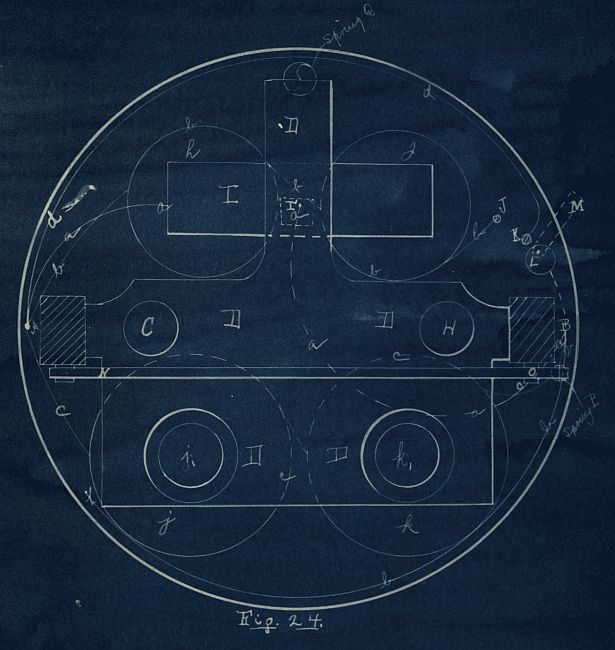
Fig. 24.
When the carbon in carbon holder C burns to a length of about two inches in attempting to fall to maintain arc’s length, an enlarged port at the top of the carbon holder C strikes and holds down lever ON pivoted at O (and end N held up by a spring P) thus letting loose a clutch by which electrical contact is made between H and “bed” and letting H fall till it touches lower carbon when an arc is established and regulated just as for C.
The Thomson-Rice single lamp has the same gear with the exception of having only carbon holder C, H, lever ON, and spring clutch and spring P being absent. The single lamp will burn eight hours and the double lamp fourteen hours continuous running.
These lamps are intended only for a steady current and will not cut out of circuit if the current gets too strong. But with the Thomson Houston dynamo the current never gets too strong and because of this there are less power absorbing mechanism and as anything’s functions decrease the remaining functions are increasedly better. As the Thomson-Rice lamp has less functions and power consuming machinery, it can but be the most economical, delicately adjusted and steadiest lamp extant. They are made to stand a current of five amperes above the normal current for a short time, as, when forty lights are simultaneously cut out of a forty-five light circuit, the current runs up about four amperes above the normal current for about one half a minute.
Prof. Thomson has gotten out a divided arc lamp which supplies a light of moderate candle power for locations where a 2000 candle power lamp gives more light than can be economically utilized. It is specially suited for factory and mill use where looms or other tall machines are liable to cast disadvantageous shadows. It is said that these lights are supplied cheaper per candle power than the standard lamp and up to date is sucessful.
He has also arranged apparatus by which arc lamps are run in multiple series, series or multiple arc. It is said that divisions, redivisions and reunions are practicable. This is also sucessful as far as we can find out.