THE FIRST TWO GOVERNORS OF MISSISSIPPI
Reading edition
By A. C. Chase
I. Governor Winthrop Sargent

The first governor of Mississippi Territory was Winthrop Sargent, a New Englander, the record of whose administration lives in history because of the discontent and even open dissensions that marked it. Your true Mississippian has always been wont to hold this sour and selfish Puritan—so characterized—who had been foisted upon the young territory through the prejudice of President Adams, as solely answerable for all these troubles. The leading historian of Mississippi, J. F. H. Claiborne, has depicted Sargent as so lacking in the kindly virtues that the wonder is, not that he was removed at the close of his third year of office, but that he had not been sooner thrust forth through the just anger of the people.
Recently the Mississippi Department of History has sent out the first volume of “Territorial Archives,” containing the journals of the first two executives of that state. These papers, now for the first time printed, are important for the light which they throw upon Sargent’s character and official record.
Winthrop Sargent was a native of Massachusetts, well born and college bred, who achieved a good record as an officer of artillery during the Revolutionary War. After the war he worked as a surveyor, until in 1787 he was made secretary of the Northwest Territory. In May, 1798, he was made governor of the territory of Mississippi. He was in very poor health at the time and when he at last reached Natchez, August 6, he was so weak that he was taken to Concord House, the old home of the Spanish Governors, to rest and recover his strength. Twelve days later, however, he was able to make a brief address before a large assemblage of citizens at Natchez. In this he assured the people of his solicitude for their welfare, of his desire to so administer the government as to deserve and retain their confidence, and he pledged himself to consider merit only in his appointments to office.
It must be admitted that he showed a sincere desire to make a good impression upon his new constituency, and the reason for his total failure is not readily defined, from the evidence of the record.
The historian Claiborne ascribes the mistakes of Governor Sargent largely to the influence of Andrew Ellicott. The latter, sent to the territory in 1795 to lay out the boundary line under the Spanish treaty, applied himself after he arrived there to everything but his business. He claimed authority as a representative of the government which his commission in no way warranted, established himself as a sort of adviser-in-chief of all newcomers, and by ingratiating himself with the Indian tribes of the territory, he made no end of trouble for the government by lavish promises of gifts and privileges. It may well be that this man Ellicott was by no means as black as he has been painted, but there is sufficient contemporary evidence that he acted the part of a mischief-maker in Mississippi. From the journals, however, no evidence can be obtained that he had any particular influence with the governor. And before the close of his first year in office, Sargent fully recognized the mischief that the surveyor’s meddling in Indian affairs had caused.
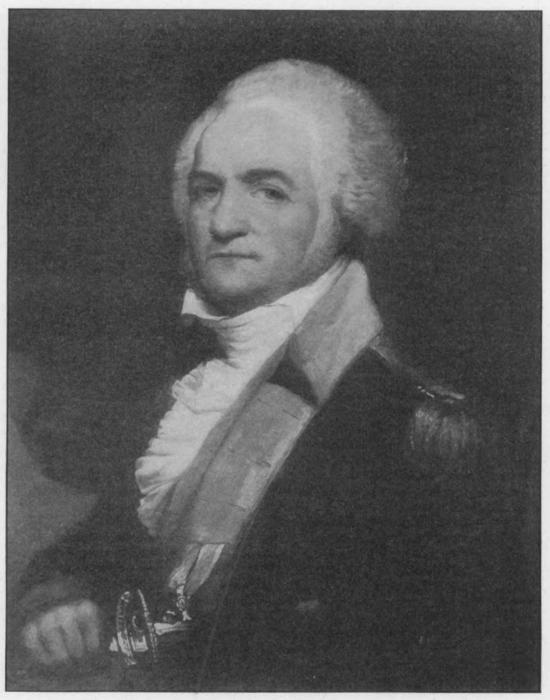
WINTHROP SARGENT
Photographic facsimile of portrait by Gilbert Stuart, in the Mississippi Hall of Fame
It should be remembered that Sargent, having had a military training, was disposed to expect more deference to law and order than could fairly be looked for in a frontier community. The population of Mississippi at that time was of a very mixed sort, being made up of Spaniards, Frenchmen, Indians, negroes, half-breeds of all grades of parentage, renegade Americans and British, and at the same time a ruling class of exceptional uprightness and intelligence. The fact that the better element was outnumbered by the heterogeneous class beneath them, fully justified the governor’s apprehension of lawless outbreaks, which he sought to forestall by urging the organization and arming of a strong militia force. The opposition which he met with in this eminently wise measure, is in itself proof that prejudice largely inspired the movement against him.
Political feeling had a share therein, beyond a doubt, for Sargent was a Federalist, the appointee of a Federalist President, whereas Mississippians were, almost to a man, Jefferson Republicans. Affiliation between them was impossible, even had it not been true that on one side was the frank, easy-going, ardent temperament of those resident in a land of torrid summers, and, on the other, the unbending austere, cold nature that has its home in the land of ice and snow.
The administration of the Spanish governors had been very lax, but it had been popular. There were no prisons in the territory when Sargent came thither, a fact which Claiborne adduces to prove the high grade of morals then prevalent, but which really recommend the territory no more than the further fact that there were no judges and no courts. Three persons had been named as territorial judges at the same time the executive appointment was made, but one of these only, Judge Bruin, was a resident of the territory. Judge Tilton did not arrive until January 10, 1799, and Judge McGuire delayed his coming until the following September. How the absence of these officials embarrassed the governor in his efforts to organize his administration becomes plain when we remember that the enabling act of the territory rested all legislative authority in the governor and these judges. They and they only were empowered to draw up a code of laws for the territory. These laws were imperatively needed, and upon Sargent, harassed with a thousand tasks and cares at once, rested the sole responsibility for their suitable nature and correct form. Bruin was not a lawyer, nor was Tilton; only McGuire, who did not appear upon the scene until the hard task was completed, possessed the necessary legal knowledge therefor.
As soon as Tilton arrived in January, the legislative work of the government was begun, and the first law of Mississippi Territory bears date of February 28, 1799; others followed as soon as they could be properly framed. Though the governor had declared, truthfully enough, in December, when writing to the Secretary of State, that the want of laws kept territorial affairs in a condition of absolute anarchy, yet no sooner was the code drawn up than it was violently attacked by the governor’s political opponents. They declared the laws to be unconstitutional, a charge which Claiborne’s “History of Mississippi” reiterates. But he also charges Tilton and McGuire with aiding the governor in this concoction of laws in conflict with the Constitution of the United States; whereas, McGuire did not arrive in the territory until nearly all of these laws had been enacted. And it is worthy of note, that notwithstanding all the outcry against them, only two of the Sargent laws were set aside, subsequently, by Congress.
April 2, 1799, Governor Sargent established the first two counties of Mississippi Territory, by proclamation, and provided a system of courts. And if we judge him from his written word, his efforts during following months to provide by careful appointments for worthy administration in these courts, to promote order by the organization of an efficient militia, to avoid conflicts with discontented Indians and disorderly white men, were unceasing. And this is the more noteworthy, since during this time, the political opposition to him was steadily growing, and, in spite of his efforts, taking on daily a more bitter tone. That this opposition was in a sense honest, cannot be doubted from the names of many connected with it, but that its main impulse was political malice, there is too much evidence to show; and that it was by no means warranted in any lack of principle or dereliction from duty on the part of the executive, the written record shows plainly.
July 6, 1799, a popular meeting was held under the Jeffersonian leaders, to express disaffection toward the governor. At this a circular was drawn up, which was printed and sent to each district urging the people to meet and name delegates to bring their grievances before the governor and before Congress. This committee drew up a letter to Governor Sargent, the burden of which was a protest against the machinations of Andrew Ellicott, which, it was alleged, had given rise to the many mistakes made by the governor, and his misunderstandings with his people. It further prepared a memorial to Congress, protesting against the laws that had been framed by Sargent, and urging the setting aside of the existing territorial government, and the substitution therefor of what was then known as “the second grade of government,” to-wit, a legislative assembly, chosen by the people. This petition laid before Congress in January, was referred to a committee, which in due time reported thereon, advocating the substitution of an elective general assembly for the existing territorial government of Mississippi. March 18, 1800, the House, in committee of the whole, voted upon this report, approving the change by a vote of 54 to 37. With a few exceptions, this was a strict party vote, the Federalists all voting against the measure, and the Jeffersonian Republicans voting in its favor. This change, it might be noted, was not desired by all Mississippians, as there accompanied it increased expense, and a decided augmentation of the taxes levied on the people. But it was an advance in the history of the territory that could not be retraced, and besides, it was a triumph for the Jeffersonian party not to be forgotten, especially as the great leader of this party had just taken his seat in the White House at Washington.
The unfortunate Sargent, occupied deeply with questions of administration, with preserving the true relations between the civil and military forces, with watching out for Spanish schemes to win the especial favor of the Indians, with expounding the details of the new laws to the untried judges, seems not to have “caught on” to the successful strategy of his enemies for some time. At last, June 15, a package of papers received from John Marshall, Secretary of State, told him the whole story. His long letter of reply to the secretary, intended to vindicate himself in that official’s good opinion, betrays not a little bitterness, which assures us that this austere, cold-blooded New Englander had considerable human nature in him after all.
He claimed, and unquestionably with truth, that his duties had been no light ones, saying: “To organize a new government upon the very confines of the power and energy of the United States—amongst a people of diversity of interests, sentiment and language—acknowledgedly unversed in jurisprudence, and not all distinguished for their complacency—without the aid of the territorial judges to a late period, in ill health and under the apprehension of an attack from a foreign enemy, must be confessed an arduous task; I draw not, however, upon the good nature of my countrymen, ’tis justice only that I ask.”
He then proceeded to show how much malice and misinformation lay behind the attacks upon him, showed that he had done the best that he could under all circumstances, had made the most careful appointments in his power, and had in no sense attempted to enrich himself at the expense of the people. In a word, he made a good defense, and if it was quite unavailing he was not to blame. The star of his party had come to its setting time, and the orb of the Jeffersonians was in the ascendant.
During the Adams administration Sargent had been promised a leave of absence when the general apprehension of trouble with France had passed away, and this privilege he claimed soon after Jefferson’s inauguration. He went to Washington early in April, 1801, desiring to vindicate the course of his administration against the “mighty obloquy” that had been cast upon it, and to seek the justification of re-appointment. His hopes, however, were dashed to the ground by the receipt of a letter from the President as soon as he reached the capitol, transmitted through James Madison, Secretary of State. This declared: “That from various and delicate considerations, which entered into the appointment of a governor for the Mississippi Territory, it was expedient to fill the station with another than himself, whose administration, with whatever meritorious intentions conducted, had not been so fortunate as to secure the general harmony, and the mutual attachment between the people and the public functionaries, so particularly necessary for the prosperity and happiness of an infant establishment.”
It was hard on Sargent, and I shall always think better of him that instead of shaking Mississippi dust from his shoes, then and forever, he returned to the territory a few months later, quietly took up the life of a planter, and bore a not unworthy part in the task of building up the new community, notably aiding in the establishment of the first banking house in the territory in 1809. He endured much from the malice of others, but gave none in return. He died while on a visit to New Orleans, June 3, 1820, and his ashes sleep on the site of his old plantation home, near Natchez.
II. Governor William C. C. Claiborne
Exit Sargent—enter Claiborne. Exit the man whose record as governor, whether through native fault or inexorable fate, was a conspicuous failure, and enter one whose story throughout was that of brilliant success. In characteristics, the two men were the very antipodes, each of the other. The one, of austere temperament, and stern, unbending manner; the other of warm and genial nature, in demeanor gracious and inviting. Claiborne possessed in preëminent degree the ready tact, the power of always saying and doing the right thing, in which the other was so noticeably wanting.
William Charles Cole Claiborne was a native of Virginia, born in Sussex county. At the age of fifteen he went to New York, then the seat of government, and there was given employment by the clerk of the Congress. It was his good fortune while in that work to attract the attention of a number of leading men, who became his friends for life. Jefferson especially took him as a protégé, and gave him books to read and good advice. He read law in his spare moments, went to Tennessee, was admitted to the bar there, and took part in the first constitutional convention of the state. He received appointment as Judge of the State Supreme Court, by Governor Sevier, when he was in his twenty-second year, and a few months later was elected to Congress.
Claiborne was in Congress as member from Tennessee when the petition from Mississippi against Sargent was presented; was on the committee to which it was referred, and strongly recommended the change of the form of government in the territory. He is known to have censured Sargent’s course, and there is proof that Sargent subsequently doubted whether his motives in so doing were free from self-interest. It is not, however, necessary to think of Claiborne as guilty of meanness of this sort. He was no place-hunter, nor one who, at any time in his life, placed self-seeking above principle. He was an ardent Jeffersonian, and his sympathy was naturally with the party opposing the governor. He was young, too, twenty years Sargent’s junior, and his rapid advancement had doubtless rendered him a trifle “bumptious.” But from his standpoint, the contentions between Sargent and his people were quite unnecessary, and should not be tolerated.
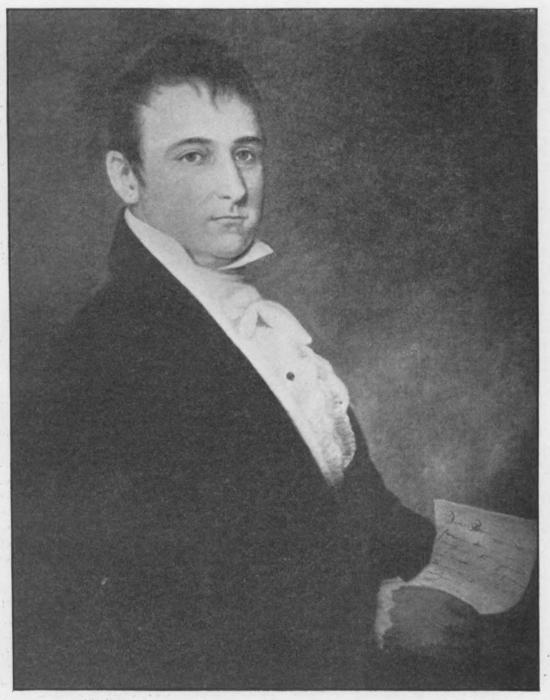
WILLIAM C. C. CLAIBORNE
Photographic facsimile from the oil painting in the possession of W. C. C. Claiborne, New Orleans
I think that Jefferson commissioned Claiborne as governor of Mississippi, not because he thought the young man wanted the place, or for the adjustment of any political bargain. He named him because he was convinced that such selection would prove to be the right man in the right place, and so indeed it was.
Claiborne reached Natchez, November 23, 1801, and one of his first official acts was a message to the first Legislature of Mississippi, meeting a few days later. Records of the time assure us that his suavity of manner and speech made him popular with all classes from the very first. But his efforts to ensure perfect harmony between contending factions of the people were not immediately successful, as is shown by a most unworthy attack made by some members of the new Legislature upon the justices of the Territorial Supreme Court. This came to nothing, however, and at the election for representatives held in July, 1802, so many of the contentious spirits were relegated to private life, that it might have been well judged that the people at large were already ashamed of their unfair actions toward the previous governor.
I like to think of Claiborne as becoming more charitable toward Sargent as time went on and he learned the many difficulties of the situation; less inclined to censure the “contumacy” of the older man in feeble health, as he found the problems besetting him difficult enough to tax the powers of his own vigorous strength. From his journals we learn that the same hindrances which harassed Sargent tormented his successor—the imperfect military equipment of the feeble garrisons, the need of a trained militia, the interference of Spanish plotters, the tendency of the floating population toward brigandage, the greed of the idle Indians, and so on. One of his very first requests of the authorities at Washington was that he be allowed the services of an interpreter, to aid him in carrying on his dealings with the Indians, a privilege for which Sargent had begged in vain.
Things, however, improved rapidly under the new incumbent, whose talent for administration was the most remarkable, perhaps, of his many gifts. Few men more richly endowed, not only in the line of pure intellect, but also in that wisdom that guides toward the best in man’s intercourse with his fellows, have figured in American history. During his brief career as governor of Mississippi he ensured the construction of a government fort near Washington, then the capital of the state; established Jefferson College at Natchez, the first institution of learning in the great Southwest; laid out roads; surveyed boundaries and mail routes; prepared the new land, in fact, for the forces of civilization on their way to enter it. His dealings with the robber bands that infested river traffic and with the disaffected Indians was prompt, decisive and thoroughly effective, compelling the order so essential to the prosperity of a young community.
When, in October, 1802, the port of New Orleans was closed, by the Intendant there, against foreign commerce and the American right of deposit, much feeling was aroused in Mississippi, since the injury thereby caused to American trade was great. Governor Claiborne, in his letters to the President and others, advocated stern measures of retaliation, which indeed would doubtless have been tried, had it not been generally known that Spain was negotiating for the sale of Louisiana. Indeed, there was more than a suspicion current as early as 1801, that the sale had been secretly consummated. In 1803, when the purchase of this territory by the United States from France was announced, it was known that no further fear of our encroaching neighbors need be cherished; they were now at our mercy.
One of the most important acts of Claiborne’s administration was the collection, at the request of James Madison, Secretary of State, of facts relative to land claims in Mississippi, and conflicting titles thereto. These included, Mr. Madison noted, not only claims grounded upon two grants of land made by Georgia to Mississippi, but also claims under the French government prior to 1763, those derived from the British and Spanish governments previous to the Spanish treaty of 1795, and those under Spanish title subsequent to this treaty. On all these items Governor Claiborne made a most exhaustive report, which became the foundation on which Congress based all future measures for the settlement of local land titles not only in Mississippi, but other Southern states as well.
November 9, 1803, Governor Claiborne received notification of his appointment as commissioner, associated with General James Wilkinson, to receive from France the Louisiana Purchase, and to succeed the Spanish governor provisionally, until a government for the new territory should be established. This transfer was received with all due ceremony, in the building known as the Cabildo at New Orleans, December 20, 1803.
Claiborne, though still nominally governor of Mississippi, exercised no further the functions of that office, these devolving on his secretary, Cato West. But he fulfilled the duties of provisional governor of the newly acquired province until October 2, 1804, when he was made governor of the “Territory of Orleans.” He served in this capacity until this territory was admitted to the Union as the State of Louisiana, when he was elected governor of the new state. He held this office for two terms, after which he was elected to the United States Senate, January 13, 1817. He did not live to take his seat in the Senate, dying November 3, following. Thus passed away, at the early age of forty-two, one who had already given a long life of active effort to his countrymen. Had he been spared for twenty years longer, his would surely have been one of the grandest national careers of America’s first century of history.