Part 11 — SAMUEL SPENCER AS A FACTOR IN NATIONAL AFFAIRS
Reading edition
By Ismay Dooly
In the office of the general counsel of the Southern Railroad in Washington is a frame containing a newspaper article relative to a recent railroad trial, wherein the case was one of national import.
An incident described in the article relates to that lion of financial power, Pierpont Morgan, who, after he had given sworn testimony of vital importance, was asked if he gave the facts of his own knowledge.
“No,” was the reply, “not on my own knowledge, but the information was given to me by Samuel Spencer, and I would swear to anything he stated as a fact.”
This single tribute to the accuracy of the late Samuel Spencer, president of the Southern Railway, who was one of the greatest men the South has given to the nation’s productive machinery, illustrates but one of the many qualities of a man who for the past ten years has been among the foremost in the public eye of the republic.
He was a man whose career in public and private life was the expression of an accuracy proceeding not alone from a sense of truth and justice, but from a thorough and proficient knowledge of any subject of which he was in any way the exponent.
He was the highly educated man, whose mental and almost instantaneous grasp of people and things was demonstrated in an adaptability that served him in every relation and situation.
He possessed as well a wonderful power of perspective—the power to discriminate between the worthy and the little things, and to economize and conserve his forces, to that extent when he was equal to direct action whenever the occasion demanded. Poise and balance completed his equipment for a life of great action.
LOYALTY TO SOUTHERN INTERESTS
He was one of the most successful railroad men and promoters of industrial institutions in the South, and one who, from the first days of his public career, has justly and fully presented the claims of the South in her higher achievement along every line.
In his splendid leadership of movements entrusted to his guidance he quickly demonstrated the ability expressive, not alone of his loyalty to the interests of the South, but his broader aspiration that these interests become national, and become so a part of the forces upon which the nation as a whole would find a common interest, that he became one of the men looked to by his fellow countrymen to solve the great problems of our complex twentieth century activities.
The expression of this broader aspiration by which he made the interests of his section the interests of the nation illustrated one of the essential principles of the highly evolved man—the constructive principle—the one that draws man to the building up of big movements that the smaller ones may be inspired to grow and become a part.
HIS NATIONAL SPIRIT
That Mr. Spencer was an exponent of this spirit was given national recognition in the responsibilities that have been thrust upon him, no greater example of which could be given than in his part in the recent rate bill agitation in the United States Congress. He was selected by the railroad systems of the country as their representative before the national body and was entrusted with the responsibilities of personally presenting their side of the question.
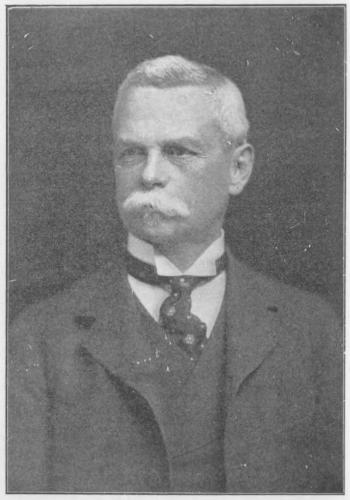
SAMUEL SPENCER
His ready appreciation of the influences necessary to bring to bear upon the present status of problems in which certain forces of the nation are retarded in their processes of solving has been seen in his personal alliance with movements or organizations standing for peace and arbitration and conciliatory measures.
He was an influential member of the National Civic Federation and his opinions were no more highly regarded by the president, August Belmont, than by the vice president, Samuel Gompers, the two men representing at present the two great conflicting national interests of capital and labor.
A recent incident, widely discussed at the time when Mr. Spencer’s ready appreciation and acceptance of justice, indicated his ability to assume great responsibilities, was when the National Civic Federation was agreed upon as the medium of arbitration in the machinists’ strike on the Southern Railway system in Knoxville.
Mr. Spencer, as president of the Southern Railway, and other officials of the road, including the vice president and general manager, met James O’Connell, the president of the International Association of Machinists, and the local officials of that organization concerned along the line. The federation was represented by the chairman of the conciliation committee, Hon. Seth Low; V. Everet Macy, a capitalist; Ralph M. Easley, chairman of the executive council, and Samuel B. Donnelly, one of the labor members representing the Typographical Union. This resulted in the settlement of the controversy through an agreement reached by both sides in conference.
POWER IN ORGANIZATION
In reference to the incident a member of the federation in discussing it with a Georgian said:
“I must tell you of the fine impression made by your fellow Georgian, Mr. Samuel Spencer, in the strong, impassioned address he made to the labor representatives at the conciliation meeting. What he said was noble and stirring, and the expressions of Mr. Samuel B. Donnelly, one of our labor members representing his side of the controversy, and finally, the decision of the presiding officer, Hon. Seth Low, the Civic Federation representative, made the occasion one fully demonstrating the greatness of the co-operative spirit for which the National Civic Federation stands in uniting in its membership men representing the forces of the nation.”
These few incidents illustrate the appreciation with which Mr. Spencer was held by men representing great national questions; the responsibility thrown upon him by the railroads of the country as their representative in the House of Congress; his readiness to assume the individual responsibility thereof; his factorship in national organized effort are many incidents that entitle him to a position of Napoleonic ascendency in the history of railroad construction and development; to an everlasting monument in the hearts of the people of his native Southland, and to a position of national recognition among men standing for the highest civilization making now the history of the twentieth century.
Mr. Spencer was born in Columbus, Georgia, in 1846. He went from the military school of Marietta, Georgia, into the Civil War, and served gallantly under General Forrest’s command. After the war he graduated from the University of Georgia, and subsequently from the University of Virginia.
Soon afterward he became interested in the construction work of Southern railroads, and died president of one of the greatest railroad systems in the world.