PART I
Reading edition
Seventeenth Century
TIDEWATER
The country surrounding the Chesapeake Bay, which is known as the Tidewater, has been compared to the Bible Lands, the Netherlands and Venice.
Captain John Smith, military leader of the expedition to Virginia in 1607, who explored and mapped the Chesapeake Bay and the Bay Country, described it thus:
"There is but one entrance by sea into this country, and that is at the mouth of a very goodly Bay, the widenesse whereof is 18 or 20 miles.
"Within is a country ... heaven and earth never agreed better to frame a place for man's habitation.... Here are ... hils, plaines, valleys, rivers and brookes all running most pleasantly into a faire Bay compassed but for the mouth with fruitfull and delightsome land...."
"YE NORTHERNE NECK"
On the western shore of the Bay there are three peninsulas, or necks, carved out of Virginia's shoreline by the tidal rivers.
The third, and northernmost, of these peninsulas lies between the Rappahannock and the Potomac Rivers. It was probably referred to orally by the first white men who settled at Jamestown as "the northern neck." The name appeared in print certainly as early as 1677, when in an official document it was mentioned as "ye Northerne Neck."
This third peninsula north lies aloof, and long, between its broad rivers, as they flow into the Chesapeake Bay on the east.
From the Bay the narrow strip of land, only fifteen or twenty miles wide, runs inland between the rivers for almost a hundred miles, until it narrows near Fredericksburg so that the rivers almost join—not quite an island but more cut-off than the usual peninsula. In the old days when there were almost no roads, and no bridges, the Neck was to those living in the eastern portion more like an island than a peninsula. Only from the west could one travel in or out by land and that exit was rarely used.
Its geographical position made the Northern Neck for many years almost as inaccessible as an ancient stronghold surrounded by a moat.
THE PEOPLE
The Northern Neck could be compared with ancient Mesopotamia—a land between two rivers where a new civilization started.
The early settlers came to the wilderness in satins and velvets, they surrounded themselves with the niceties of living, as near like those they had left in England as was possible. They shopped in London as they had before and traded with the world directly from their own habitations.
But the conditions of their new wilderness home changed and moulded them and made them into something different—a new breed of men.
By the time unusual men were needed to shape an unusual type of government, descendants from this stock were ready for the undertaking.
In the Northern Neck there are still so many reminders of these remarkable people that it is not hard to imagine them as they might have been in their habitat several centuries ago—John Mottrom sailing into the Coan in his brightly-colored shallop; the Mottrom children playing their medieval games in the shadow of the primeval woods; Ursula twirling the venison roast on its hempen string before the fire; Hanna Neale passing the witchcraft test; young Jack Lee dashing down the forest aisles on his spirited mount; George Mason pulling the arrows from the "poor people"; Moore Fauntleroy measuring off his thirty arm's lengths of rhoanoke for the waiting Accopatough; King Carter rumbling down his avenue in his coach and six; Mary Ball on her dapple gray; James Monroe and John Marshall walking down the Parson's Lane with school books and muskets; Nelly Madison singing to her new baby; young George Washington riding down to see "Miss Betsy" on a fruitless mission, and little Robert E. Lee saying good-bye to the cherubs in the nursery fireplace....
INDIANS AND EARLY EXPLORERS
What men first knew this land between the Rappahannock and the Potomac Rivers?
It is believed that Indians lived along the shores of the Chesapeake Bay's tributaries three thousand years ago.
The Vikings may have entered the Bay and explored the nearby streams and lands in the eleventh century.
Cabot, an Italian seaman under commission from King Henry VII of England, may have entered the Chesapeake at the end of the fifteenth century.
Spaniards sailed into the Bay and explored some of the region in the sixteenth century.
European traditions tell of adventurers of other nations who may have visited this region.
Late in the year 1607, Captain John Smith traveled from Jamestown as far north as the Potomac when, as a captive of Opechancanough, he was paraded before the Indian tribes of the Tidewater region. He may have been the first white man to make a comprehensive tour of the Northern Neck of Virginia.
CAPTAIN JOHN SMITH
When John Smith heard about the New World across the seas it sounded good to him—it was the sort of adventure that he had been waiting for all of his life.
He had been born in Lincolnshire, England, in 1579. Even as a small lad John Smith had been "set upon brave adventures." Tradition says that he sold his books and satchel and was preparing to run away to sea when he was stopped by the death of his father.
He was soon apprenticed to a merchant but he hated the counting-house. He longed to be free and go to sea. When he was about fifteen he could no longer stand being caged so he ran away. After a number of adventures he became a soldier in the Netherlands.
Some time later he went home on a visit to Lincolnshire, where he "lived a great deal in society." He soon tired of this way of life and retired to a wooded pasture where he built himself a shelter of boughs and became a hermit.
In the peace and solitude of the pasture he studied Machiavelli's Arte of Warre and the writings of Marcus Aurelius. He exercised with a good horse, a lance and a ring, and lived mostly on venison, which he took without worrying too much over the game laws. His other wants were supplied by a servant, his only contact with the world.
Because of his unusual mode of life news of John Smith traveled around the countryside but it did not worry him because "he provoked the wonder of the peasantry."
At length an Italian gentleman, who had become interested in what he had heard of John Smith, penetrated his forest hideout and persuaded him to come into society once more. After many more adventures and hairbreadth escapes in foreign lands he returned to England in 1604, in time for another adventure. He was still a young man, about twenty-five, but he was matured and hardened far beyond his years.
When the little band of colonists set sail for America from Blackwall, England in December 1606, John Smith was with them.
The voyage was a stormy one in more ways than one. By the time the little "sea-wagons" arrived in the West Indies Smith, who had been put in irons, came very near being hanged, according to tradition.
It was April when the ships with their bedraggled passengers entered the Chesapeake Bay. The fragrance of "pyne" reached them from the virgin forest that covered the face of the land. It was a New World in every sense of the meaning—new, fresh, untouched.
When the sealed orders of the King were opened it was found that John Smith had been named a member of the Council. He demanded trial for the charges preferred against him: "that he plotted on arrival in Virginia to murder the Council and make himself the king there." He was tried and acquitted by the first jury to serve in America. Smith was released but was not yet admitted to the Council.
As it turned out John Smith was the only man among them who was prepared to build a new country. In the beginning he warned the colonists that "no man is entitled to a place in America, he must make his own."
POWHATAN'S EMPIRE
When John Smith started exploring the region around the Chesapeake he found that it was inhabited by a number of small Indian tribes. These Indians were known as the Algonquians.
These tribes made up a confederation under the iron rule of a powerful "king" called Powhatan. At his command there were about twenty-five hundred warriors.
Smith made a map which shows a total of one hundred and sixty-one villages within Powhatan's "32 Kingdomes."
Indian villages were owned in common. The hunting grounds, and pieces of cleared land used for the cultivation of corn, tobacco and vegetables belonged to the tribe. A warrior owned nothing except his garments, tomahawks, bows and arrows.
The Algonquians had no written laws. Their customs were handed down through the old men around the campfires from generation to generation. These unwritten laws were well-defined and worked in a positive and forceful way.
The tribes between the Rappahannock and the Potomac Rivers belonged to the Powhatan confederacy. Their language was a variety of the Delaware Indian language.
CAPTAIN SMITH VISITS THE NECK
It was bitterly cold, "with frost and snow," when Captain John Smith first saw the land between the Rappahannock and the Potomac Rivers.
Captain Smith's first visit to the Neck was not one of pleasure or exploration. He came as a captive of the Indian chief, Opechacanough.
It was in the winter of 1607-08. During that year Smith made "3. or 4. journies and discovered the people of Chickahamania." It was on the last of these "journies" that he was taken prisoner, and led about in triumph and exhibited to the tribes of the Tidewater region, from the James to the Potomac.
Smith was carried to Tophanocke, "a kingdome upon a River northward." This river was the Rappahannock. Here they stopped at the village of the Nantaughtacunds.
Smith and his captors may have sped swiftly and silently through the forest but when they approached a village a triumphal procession was formed which was marked by "a barbarous sort of pomp."
Captain Smith was guarded on either side by a savage who kept fast hold upon his wrist. Opechacanough moved in the middle of the column and the swords, guns and pistols which had been taken from Smith and his companions were borne before the Indian chief.
Their approach was heralded by the songs and shrieks and dances of the warriors. Their yells of death and victory brought out the women and children to behold their triumph over this strange-looking creature from another world, after which there was great feasting.
Smith was feasted, too. He was fed so well "with bread and venison that would have served 20 men" that he believed that he was being fattened to be eaten later on.
From the Rappahannock the procession pushed on across the Neck until it reached the village of the Nominies,[1] near the Potomac. Here the same procedure was again repeated.
After their stay near the Potomac the parade turned back from whence it had come. The destination, now, was Powhatan's favorite spot on the York River, where that great chief was waiting to settle the fate of Captain John Smith.
When at length Smith was brought before Powhatan, he was received with all the formal pomp and state known to the savage court. A long consultation was held by the council there assembled.
Captain Smith knew what the decision was when two large stones were brought in by the warriors. His end was not yet, however, for Powhatan's daughter, Pocahontas, according to Smith, saved the day by thrusting herself between him and the up-raised club.
By the time Captain Smith reached Jamestown again nearly seven weeks had elapsed since his capture. Though his tour of the Tidewater country had been under humiliating conditions he had gathered by observation and from the Indians a large amount of useful knowledge.
"A PLAINE WILDERNES"
How did the Northern Neck look to Captain John Smith on his first visit there?
Just like the rest of the Chesapeake Bay country—"all over-growne with trees and ... being a plaine wildernes as God first made it."
The size of the trees impressed him most, and the lack of undergrowth beneath them.
"So lofty and erect," he wrote, "were many of these trees and so great their diameter that their trunks afforded plank twenty yards in length and two and a half feet square."
Freedom from undergrowth he found was due to the annual burnings of the Indians in their efforts to capture whole herds of deer by surrounding them with a belt of fire. These firings made no impressions upon the giant trees.
The trees were so far apart, Smith says, "... that a man may gallop a horse amongst these woods any waie, but where the creeks or Rivers shall hinder." (Other early writers say that a coach could have been driven through the trees, and a person could be seen in the forest at a mile and a half.)
It was winter when Captain Smith first saw the Neck therefore he had a view unobstructed by foliage of the great tree trunks and spacious forest aisles, "bespred" with brown pine needles and ornamented with green vines and scarlet turkey berries.
Since it is impossible to travel far in the Neck without coming upon some stream of water, many of John Smith's forest vistas must have ended with a glimpse of a river or frozen pond. He wrote of the many "sweete and christall springs" that flowed through the woods on their way to the sea.
Many of the forest trees were white oaks, and some may have been a thousand or more years old. These groves were revered by the Indians. Indians were fond of the mulberry tree. Smith notes: "By the dwelling of the savages are some great Mulberry trees; and in some parts of the country, they are found growing naturally in prettie groves."
Besides pine, oak and mulberry, there were, Smith writes, "... goodliest Woods as Beech, Cedar, Cypresse, Walnuts, Sassfras, and other trees unknowne." Chinquapin was one of the "trees unknowne."
Locust and tulip poplar were plentiful. Sweet gum, live oak, holly and cedar flourished in low grounds. Bayberry grew in the swamps and near the edge of the water.
When Captain Smith first saw the Neck it was bitterly cold, with "frost and snow," so he may not have seen the pine needles and scarlet turkey berries. The forest aisles may have been deeply covered with snow.
"WILD BEASTES"
If the forest floor was covered with snow when Captain John Smith was led a captive across the Northern Neck in the winter of 1607, it is probable that he saw snowshoe rabbits scampering about between the big trees. Porcupines lived there too, and wild-cats, pole-cats and a marten known as "black fox." The little animal he saw with the spotted coat, like the skin of a fawn, was a ground squirrel.
John Smith saw the flying squirrel and the opossum for he describes them: "A small beast they haue ... we call them flying squirrels, because spreading their legs, and so stretching the largeness of their skins, that they have bin seene to fly 30 or 40 yards. An opassom hath an head like a Swine, and a taile like a Rat, and is the bigness of a Cat."
Ordinary squirrels, rabbits, foxes and "Rackoones" were abundant. Captain John Smith no doubt saw beaver at work when they crossed the many streams. "The Beaver," he wrote, "is as bigge as an ordinary water dogge ... His taile somewhat like ... a Racket, bare without haire."
The procession of Indians and the lone white man may have come upon a herd of heavy, slow-moving "Kine." (These were buffalo but are believed to have lacked the hump.) They were not as wild as the other animals of the wilderness. Perhaps Smith caught glimpses of the elk that roamed the forest.
At night John Smith heard the sounds of many wild beasts. The wolves were small but numerous and ravenous. In the evening they hunted like a pack of beagle hounds.
If the procession happened to be encamped near the head of a river he probably heard before morning the scream of a panther as he stalked his prey.
But of all the animals in the Tidewater region at that time, Smith says "Of beastes the chiefe are Deare."
The Northern Neck had been hunted less by the Indians than the lower peninsulas, and it was teeming with wildlife. The primeval forest furnished home and food for the "wild beastes."
"BIRDS TO VS UNKNOWNE"
When John Smith traveled across the Northern Neck, from the Rappahannock to the Potomac, in the winter of 1607, he probably saw many birds, for this was their season.
"In winter," he wrote, "there are great plenty of Swans, Craynes gray and white with blacke wings, Herons, Geese, Brants, Ducke, Wigeon, Dotterell, Oxeies, Parrots, and Pigeons. Of all those sorts great abundance, and some other strange kinds, to vs unknowne by name. But in sommer not any, or a very few to be seene."
For ages wildfowl had been multiplying with little to hinder them. The Indians killed only what they needed and their weapons were too primitive to make an impression on the great flocks of waterfowl that came to the rivers and marshes to feed on the heavy growth of wild celery, oats and other aquatic plants.
In early winter when these fowl gathered in their annual migration from the North the sky, it was said, was darkened with them as they arose and descended from their feeding grounds in the marshes lying along shore.
John Smith probably heard the trumpet notes of the swans and saw the pattern of flight of the wild geese many times while on his "journie."
He may have at some time seen one of the flightless Great Auks, swimming along down the Bay on its way South for the winter. Or he may have espied a heath hen on the shores of the Chesapeake.
It is doubtful if he saw very many of the "Parrots" he mentioned. They were nocturnal creatures—small, swift, bright and beautiful. The passenger pigeons came in such flocks that their "weights brake down the limbs of large trees thereon they rested at night."
There were many red birds to brighten the somber forest aisles. A little bird with white breast and black wings and back was called "snow-bird" by the English because it arrived at the first fall of snow. Captain Smith probably saw these in the vicinity of the Indian villages as they stayed near habitations.
Turkeys were common in the reedy marshes. Flocks of four and five hundred were not unusual. These wild turkeys, early writers say, averaged forty pounds in weight.
Quail and other common varieties of birds were abundant.
THE NOMINIES
The Indians reckoned their years by winters, or cohonks, as they called them, "which was a name taken from the note of the wild geese, intimating so many times of the wild geese coming to them, which was every winter."
There is no way of knowing whether it was the first or second moon of cohonks when John Smith and his captors arrived at the village of the Nominies, near the Potomac. It was so cold that Smith marveled at how some of the scantily clad warriors could endure it. He felt thankful that his own "gowne," which he had lost when he was captured, had been returned to him.
The village must have appeared bleak and primitive, with its fifteen or twenty arbor-like dwellings scattered among the sparse trees, its barren garden plots, its cornfields, marked by last season's dead stalks and some burned-out tree stumps.
As the procession approached there is little doubt that the scene came to life. The dogs were probably the first to join their howls with the death and victory yells of the warriors. These Indian dogs resembled a cross between a male wolf and an ordinary female dog. There were no other domestic animals, no beasts of burden, and no way to travel except by foot or canoe.
The women and children who emerged from the mat-covered doors of their houses were dressed in garments made of the skins of wild beasts with the hair left on for winter. Some wore long cloaks, made of skins embroidered with beads, others wore beautiful mantles of turkey feathers. Some wore feathered headgear, and jewelry fashioned of shells, beads and copper.
Smith wrote that the Indians gazed upon him "as he had beene a monster."
He was probably deposited in one of the houses, with a guard of six or eight warriors. These houses were built of flexible boughs, set in two parallel rows with floor space between, and lashed together at the top to form an arch-shaped roof. The entire framework was covered with bark or woven grass mats. "He who knoweth one such house," wrote Smith, "knoweth them all."
Inside the houses were "drie, warme, smokie." There was no chimney to conduct the smoke from the fire on the dirt floor to the vent in or near the roof. If the fire ever went out it was hard to start a new one—"their fire they kindle by chafing a dry pointed stike in a hole of a little peece of wood, that firing itselfe will so fire mosse, leaves, or anie such like drie thing that will quickly burne."
John Smith was no doubt glad to have a "warme," "drie" place to rest, even though "smokie." He could stretch out on one of the platforms running down each side of the building. There were no partitions in these houses. The platforms, about a foot high, served as beds, and were spread with "fyne white mattes" and skins. Whole families, from six to twenty persons, slept in these one-room dwellings, some on the platforms, some on the ground.
Captain Smith could probably hear the celebration going on outside. The Indians had a large plot which they used for feasts and a place where they made merry when the feasts were over.
With the abundance of wildfowl and game and the harvest of corn stored away, this was an ideal time for feasting. Oysters from the Potomac were probably included in the menu for the Indians were fond of roasted oysters.
Smith was not forgotten. He noted that they "fedde" him "bountifully," but would not eat with him. We can imagine him there at his solitary meal, supping on corn pone, "fish, fowle, and wild beastes, exceeding fat," by the light of "candells of the fattest splinters of the pine."
THE DISCOVERERS
When Captain John Smith was in the Northern Neck he saw the Potomac and heard tales from the "Salvages" of a place where there was a mine of "glistering mettal." He made up his mind that if he got out of this predicament he would explore the river "Patowmeke," find the gold mine, and perhaps a passage "strait through to the South Sea."
When he finally did get back to Jamestown the colony was in a bad way. During the extreme cold of the winter of 1607-8, the heavy fires necessary for warmth had caused the thatch-roofed town to burn. This included the granary with all their provisions, and the "palisadoes."
By the time the town had been rebuilt, and other difficulties adjusted, it was summer. John Smith was impatient to begin his next adventure but he waited until the corn crop had been "laid by."
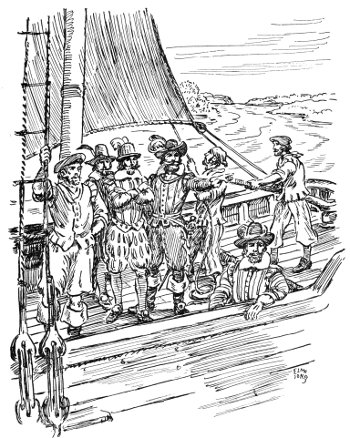
John Smith in the shallop exploring the waters of Northern Neck, Virginia.
He left the fort on the second of June, 1608, in an open barge of "less than three tons burthen." His only instrument was a compass. His companions were—a physician, six gentlemen and seven soldiers.
They crossed the Chesapeake Bay to the eastern shore, proceeding along the coast, "searching every inlet and bay fit for harbours and habitations." The Bay was easy to navigate, the greatest menace were the sudden thunder squalls.
Smith soon became disgusted with his crew. He wrote that they had not "a marriner or any that had skill to trim their sayles, use their oares, or any business belonging to the Barge, but 2 or 3, the rest being Gentlemen, or as ignorant in such toyle and labour."
For provisions they had "nothing but a little meale or oatmeale and water to feed them; and scarse halfe sufficient of that for halfe that time, but by the Savages and by the plentie of fish they found in all places, they made themselves provision as opportunitie served."
A thunder-storm took mast and sails and they were so "over-racked" by such "mightie waves," that it was with great difficulty that they kept the barge from sinking. They repaired the sails with their shirts. The crew begged to turn back to Jamestown but Captain Smith spoke to them in this manner:
"Gentlemen—
"You cannot say but I have shared with you of the worst that is past; and for what is to come, of lodging, diet, or whatsoever, I am contented you allot the worst part to my selfe. As for your feares, that I will lose my selfe in these unknowne large waters, or be swallowed up in some stormie gust: abandon those childish fears, for worse then is past cannot happen, and there is as much danger to returne, as to proceed forward. Regaine therefore your old spirits: for returne I will not (if God assist me) til I have—found Patawomeck, or the head of this great water you conceit to be endlesse."
It was now the thirteenth of June.
THE RIVER OF SWANS
Captain John Smith headed the barge toward the western shore of the Bay. On the sixteenth of June "we fel with the river Patawomeck."
When John Smith had last seen this River of Swans, as the Indians had named it, water and sky were darkened by hordes of wildfowl. There had been the sound of the whirring of many wings and great clamour. Now all was quiet. There was nothing to remind him of that amazing congregation of fowl that he had seen during "cohonks" except the marshes, lying here and there along shore.
"Feare being gone and our men recovered, wee were all contented" as the barge sailed into the mouth "of this 9 myle broad river." On the south lay the Northern Neck, indented by numerous inlets that promised harbours, its eastern end extending into Chesapeake Bay. Its virgin forest was now decked out with leaf and flower which sent fragrance to the sea-weary voyagers.
For thirty miles they sailed without adventure. Then two Indians appeared and conducted them up a little creek towards Onawmanient—"where all the woods were laid with Ambuscadoes to the number of 3 or 400 Salvages; but so strangely painted, grimed, and disguised, shouting, yelling, and crying, as we rather supposed them so many divels."
Captain Smith thought it best to scare them a little, so he trained his guns so that the bullets would graze the water. This and the "eccho of the woods so amazed them, that down went their bowes and arrowes." Peace was made, hostages were exchanged and James Watkins, one of the company, was sent with them "6 myles up the woods to their king's habitation. Wee were kindly used by these Salvages: of whom we understand they were commanded to betray us by Powhatan."
Powhatan had his forces well organized. As they progressed up the river they found the Indians ready for them: "The like incounters were found at Patawomeck, Cecocawone, (Coan) and divers other places."
The only tribes that received them with friendliness were the Moyaones, Nacotchtants and Toags. There seems to be no further record of these tribes.
They went as far up the river as they could go in the barge, "140 myles"; this was above the site of the present city of Washington, and about ten miles above Georgetown. Captain Smith was stopped here by impassable falls. His disappointment must have been great that his search here did not yield an outlet to the "South Sea."
On the return trip they had the good fortune to meet a number of Indians in canoes loaded with slaughtered game—bears, deer and other "beasts." Smith and his party were given liberal portions of the fresh meat, which must have cheered them some.
In this part of the river there were great rocks on the shores towering above the trees, and the high banks gleamed in places like "a tinctured spangled skurfe, that made many places seeme as guilded." Dreams of gold were always in the minds of men at that time. Perhaps here was to be found the "glistering mettal" that John Smith had heard about from the Indians the winter before.
Most of the company clambered up the banks and burrowed in the earth among the cliffs. The ground was so sprinkled with gleaming spangles as to seem "halfe pin dust." Smith refrained from this made scramble and proceeded in a more organized way.
With Japazaws, King of Patowmeke, as guide, he ascended one of the tributaries of the river, called Quiyough, as far as the depth of water would allow. Here Captain Smith left the barge, taking with him six men. He was surrounded by Indians. Some of these he decorated with chains and told them that if they conducted him safely to the mine they could keep the ornaments.
When they arrived at the place of the treasure, nine or ten miles inland, the Englishmen saw that the Indians had been digging there with their shells and hatchets for a long time.
To their great disappointment the mine was not gold but antimony. The Indians, who had been in the habit of digging there, washed the element of its dross "in a fayre brooke of christel-like water" which "runneth hard by it" and put it in little bags and sold it all over the country. It was used to paint their idols and themselves. Smith noted that it made them look like "blackmoores dusted over with silver."
No minerals were discovered in this search either. They were rewarded in a slight degree by some furs of mink, beaver, otter, bear and marten, which they obtained mostly from the Indians of Cascarawaoke. This was a merchant tribe that did much of the manufacturing and trading of this country. The Potomac must have been used as a highway for trade as the word Patowmeke is said to mean "to bring again," or, in a freer rendering, "traveling traders, or pedlars."
Smith's party found "plentie" of fish, "lying so thicke, with their heads above the water, as for want of nets (our barge driving amongst them) we attempted to catch them with a frying pan; but we found it a bad instrument to catch fish with."
Smith now continued toward the mouth of the Potomac and the Chesapeake. He had little of tangible value to show for the trip up the river but he had added greatly to his store of knowledge and could now add the Potomac to his map of the Chesapeake and surrounding country.
He notes that the Potomac was "inhabited on both sides. First on the South side at the very entrance is Wighcocomoco (Little Wicomico) and hath some 130 men, beyond them Sekacawone (Coan) with 30. The Onawmanient with 100. And the Patawomekes more than 200."
A point of land at the mouth of the Potomac, on the south side, he named for himself, Smith's Point.[2]
MOTHER OF WATERS
When Captain John Smith and his bargeload of adventurers left the Potomac they passed the tip of Smith's Point and headed south. They were now on the Chesapeake Bay.
Indians had long used this great inland sea as their waterway. Their word, Chesapeake, has been translated in a number of ways, among them—country on a great river and great salt bay.
The Spaniards, who visited the Bay in the sixteenth century, had documented it as Bahia de Santa Maria (St. Mary's Bay). Later, they called it Bahia del Xacan (Axacan Bay), and a very old Spanish map calls it, Madre de Aguas, meaning Mother of Waters.
Captain Smith describes it simply as "a goodly bay." He wrote: "This Bay lyeth North and South, in which the water floweth neare 200-myles, and hath a channell for 140 myles, of depth betwixt 6 and 15 fadome, holding in breadth for the most part 10 or 14 myles."
Two of Smith's company recorded the fact that "Neither better fish, more plenty or variety, had any of us seene in any place, swimming in the water, then in the bay of Chesapeake."
The Indians well knew the riches of their great Bay. They caught the fat fish in weirs, with nets and lines for their angles made by their women from thread spun from "the barkes of trees, Deeres Sinews, or a Kind of Grass." They ate the sea-crabs that were said to be so large that four Englishmen could feast on one of them. They roasted the oysters reported to have been thirteen inches long at the time of the coming of the white man. The shells were not wasted by the Indians—they were used for medicine, ornaments, and wampum was made from the purple edges of the clams. Even the lowly periwinkle was eaten.
As the first English ships entered Chesapeake Bay the crews were startled to see whales and schools of tumbling porpoises. The early colonists were soon to learn that there were so many porpoises in the Bay that canoes were sometimes overturned by them.
When the Jamestown colony was starving they lived on the bounties of the Bay—they caught the sea-crabs and sturgeons and sheepshead; the latter they likened to the broth of their English mutton. And these same strangers "groped in the deep for oysters which lay in places thick as stones," according to an early writer.
There were many oddities in the Bay which intrigued the Europeans—a small fish that resembled St. George's Dragon, with legs and wings omitted, the stinging nettle, and "the Todefish which will swell till it be like to brust, when it commeth into the aire."
As Captain John Smith and his crew proceeded down the Bay in the barge they passed the end of the Northern Neck and came to the mouth of the Rappahannock River. It was the intention of Smith to explore this river and visit the acquaintances he had made "upon the river of Toppahannock" during his captivity the preceding winter. But they were stopped by the ebb-tide. The following account of what happened at the mouth of the Rappahannock was written by members of the company, Dr. Walter Russell and Anas Todkill.
"But our boate (by reason of the ebbe) chansing to ground upon many shoules lying in the entrance, we spied many fishes lurking amongst the weedes on the sands. Our captaine sporting himselfe to catch them by nailing them to the ground with his sword, set us all a fishing in that manner. By this devise, we tooke more in an houre then we all could eat.
"But it chanced, the captaine taking a fish from his sword (not knowing her condition) being much of the fashion of a Thornebacke with a long taile whereon is a most poysoned sting of 2 or 3 inches long, which shee strooke an inch and (a) halfe into the wrist of his arme. The which, in 4 houres, had so extremely swolne his hand, arme, shoulder and part of his body, as we al with much sorrow concluded (anticipated) his funerall, and prepared his grave in an Ile hard by (as himselfe appointed); which then wee called Stingeray Ile, after the name of the fish. Yet by the helpe of a precious oile, Doctor Russell applyed, ere night his tormenting paine was so wel asswaged that he eate the fish to his supper: which gave no lesse joy and content to us, then ease to himselfe.
"Having neither Surgeon nor surgerie but that preservative oile, we presently set saile for James Towne."
QUICK-RISING-WATER
It was not until August of 1608 that Captain John Smith had the opportunity to explore the Rappahannock River. With him in the barge were twelve men—"nearly the same persons as before"—and an Indian guide named Mosco, "a lusty Salvage of Wighcocomoco."
Unlike the other Indians, Mosco had a fine black bushy beard, of which he was proud. Because of this peculiarity he ranked himself with the Englishmen. Smith believed him to have been the son of a Frenchman.
It was probably due to Mosco's influence that Smith's party was kindly received and entertained by the Moraughtacunds. Mosco hurried about, bringing wood and water, and guiding them throughout the neighborhood. When Smith decided that it was time to push on Mosco warned him not to visit the Rappahannock Indians. He described them as hostile to the Moraughtacunds, and would be to the English too, because of their friendly visit.
Captain Smith believed that Mosco was using this argument to keep all their trade for his friends. He headed the barge across the river toward the forbidden territory.
All seemed well as they neared the shore. A dozen or more Indians were on hand to direct them to a good landing in a creek, where three or four canoes filled with corn and other commodities for barter, were already lined up.
When in doubt Smith's custom was to exchange hostages. He made this known but the Indians were reluctant to comply. After consultation among themselves four or five of them ran out in the creek bringing with them their hostage.
Still distrustful, Smith sent one of his men, Anas Todkill, ashore to look around. Within a stone's throw of the landing Anas discovered two or three hundred Indians in ambush among the trees. Todkill attempted to return to the barge but was intercepted by the Rappahannocks. At the same time the Indian hostage jumped from the barge but was instantly killed in the water by the English. A volley of shot from the barge scattered the Indians and Todkill managed to escape. Several Indians were wounded and killed but the English were unharmed.
In this short while many arrows were shot but the barge was protected by Indian shields, or targets, woven so firmly of sticks and grass that no arrow could penetrate them. These Smith had gotten from the Massawomeks.
Captain Smith and his comrades carried the captured canoes and arrows across the river as gifts to Mosco and his friends. The return of the English "was hailed with a trumpet."
When the barge started up the river the next day Mosco was one of the company. As they passed through a narrow place in the river, arrows that seemed to fly from unseen hands began to hit the shields around the boat. At the first arrow Mosco fell flat, hiding his head against the bottom of the barge, but he directed his friends where to look in the marsh, at the little bushes growing amongst the grass. The guns were trained accordingly and at the first volley the bushes fell down and the ambush disappeared. After the barge had moved about half a mile away the Englishmen looked back and saw the thirty or forty Rappahannocks of the ambuscade "dancing and singing very merrily."
As the barge progressed up the river the explorers were kindly treated by the several tribes that they encountered. But the company was saddened, and lessened, by the death of Richard Featherstone, whose body had weakened under the excessive heat and humidity of this unaccustomed climate.
The body of the young Englishman was laid to rest on the shores of a little bay. His comrades honored him as best they could by firing a volley of shot, and naming the bay for him—Featherstone Bay. Smith marked it on his map and it is believed by some to have been near the site of the present city of Fredericksburg.[3]
The next day they sailed as high up the river as the barge would float. Smith went ashore and set up crosses of wood and brass and cut their names upon trees to signify that possession had been taken of the country by English authority.
While Smith was thus occupied the sentinel was surprised by an arrow that fell beside him. The white men found that they were surrounded by Indians who were hiding behind trees. After a half-hour skirmish the Indians disappeared as suddenly as they had appeared. Mosco was the hero of the battle—he emptied his quiver, ran to the barge for fresh supplies and pursued the fugitives. Coming upon a wounded enemy Mosco would have beaten his brains out except for the English.
After the physician, Anthony Bagnalle, had dressed the prisoner's wounds, he recovered enough to answer Smith's questions. He belonged, he told them, to the nation of the Mannahocks and was the brother of a chief. He had heard that the English were a people come from under the world to take their world from them. When asked what was beyond the mountains, he answered, "The sun." This Indian's name was Amoroleck.
Mosco was not in sympathy with these proceedings. He told the English that the Mannahocks were a "naughty" race, as bad as the Rappahannocks, and that they had better be on their way.
Smith did not take Mosco's advice. It was night when the party finally embarked and started back down the river. Before long the arrows started rattling against the shields and dropping into the barge. The stream was narrow here, with high banks on one side. Amoroleck called to his people, but in vain; he could not be heard above the shrieks of the warriors. Every now and then Smith discharged a musket in the direction of the most noise. The Indians were persistent and followed the barge for about twelve miles. The darkness was probably all that saved the Englishmen.
At daybreak the barge emerged into a wide place, where the weary adventurers dropped anchor out of arrow-shot, and ate breakfast. They were so tired and hungry that they paid no attention to the four or five hundred warriors crowded along the banks, until after breakfast. Then they took down the shields and showed themselves, with Amoroleck in plain view amongst them. After a consultation the Indians hung their bows and arrows upon trees and two Indians, with bows and quivers on their heads, swam out to the barge and presented these in token of friendship.
Captain Smith now went ashore and told the Indians to send for their kings. Four kings, or chiefs, soon appeared. Smith gave them back Amoroleck. The Indians were happy over this and gave the English bows, arrows, pipes and pouches, but in return they asked for the pistols which the English carried. Smith satisfied them with less dangerous trinkets, and left them dancing and singing and making merry.
The barge continued its journey downstream until the neighborhood of the Moraughtacunds was reached. They stopped here to tell these friends of Mosco of their victory over the Mannahocks. The Moraughtacunds were a feeble race, and small in stature. They begged Smith to subdue the Rappahannocks also.
Smith decided to help this weak tribe, as he would be at the same time helping the English. He summoned the kings of the Rappahannocks to a conference. When they had assembled Captain Smith threatened to burn their villages, destroy their canoes and corn and prove himself a bad enemy. Among the things that Smith demanded was the son of a "king," named Rappahannock, as a hostage. The chief objected to this—he had only one son and he could not live without him—but he would give up certain of his women who had been stolen by the Moraughtacunds. Smith found that this was the cause of the recent wars.
Captain Smith returned to the Moraughtacunds[4] and had the three women brought before him. He had a chain of beads put around the neck of each. He then sent for the King Rappahannock to come, and bade him choose the one he most desired. The second choice was given to the "king" of the Moraughtacunds. Then Smith generously presented Mosco with the third woman. All parties seemed to be satisfied with this distribution.
The next day six or seven hundred Indians of both tribes assembled to celebrate the peace that had been thus established. No weapons were to be seen, friendship was pledged with the English, and the Indians volunteered to plant corn for them. In return John Smith promised hatchets, beads and copper.
Mosco was so pleased that at the height of the celebration he renounced his name in favor of one meaning "stranger" and voluntarily became a subject of the English King, James the First.
After the celebration Captain Smith sailed again into the Chesapeake, leaving behind this river that the Indians called Quick-Rising-Water.
HENRY AND POCAHONTAS
In 1609 an English boy landed at Jamestown. He was probably about fourteen years old at that time since records show that he had been baptized in England in 1595.
In a short while Henry Spelman was to find himself in a virgin forest among painted savages and wild beasts. What a change for this young son of a British nobleman!
Harry had no doubt been accustomed to a quiet and bookish atmosphere at his home at Congham, Norfolk. His father, Sir Henry, was interested in history and antiques, and in fact was noted for his studies along those lines.
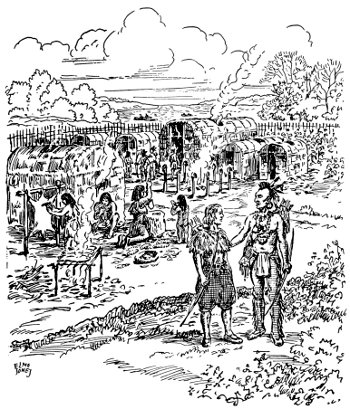
Henry Spelman living amongst the Indians.
And why did Sir Henry permit a boy so young to set out upon such a dangerous expedition? Was it because Harry was a third son and could therefore expect little in the way of lands and riches? Since Sir Henry was one of the Council for New England, and treasurer of the Guiana Company, he may have had his eyes on broader horizons.
It was August when Henry arrived in Virginia. It was the hot, muggy season when mosquitoes were plentiful. Shortly after his arrival Captain John Smith took him on a little journey to visit Powhatan. How excited Henry must have been at the prospect of seeing the great chieftain! How little did he suspect what Captain Smith had planned to do with him. Henry later wrote the following account:
"I was carried by Capt. Smith, our President, to ye litell Powhatan where unknowne to me he sould (sold) me to him for a towne called Powhatan (site of present Richmond city) and leavinge me with him, he made knowne to Capt. Weste, (Francis, brother of Lord Delaware) how he had bought a towne for them to dwell in...."
Soon after Captain Smith left Henry with the Indians a massacre ensued in the Indian village. According to early writers of Jamestown, Henry's life was saved by Powhatan's daughter Pocahontas.
At this time the King of Patowmeke was visiting his emperor, probably to pay his tribute, and to save the white boy from the "furie of Powhatan" he took him home with him when he returned to the land between the Rappahannock and the Potomac.
This arrangement was probably made by Pocahontas. Before very long she too would be hiding out in the Northern Neck as a guest of the King and Queen of Patowmeke. It is believed by some that Pocahontas and Henry fled with the King of Patowmeke to his village on the Potomac at the same time.
HENRY AND KING PATOWMEKE
Henry probably adjusted himself quickly to the way of life in the village of the Potomac Indian tribe. He was probably soon wearing a skin belt and a cord as a breechclout like the Indian boys of his age.
Henry doubtless played a game with them that was like football for he later described this game and indicated that it was played by both boys and women but with different rules: "They use football play which wemen and young boyes doe much play at. The men never. They make their gooles as ours only they never fight nor pull one another doune.
"The men play with a litel balle lettinge it fall out of ther hand and striketh it with the tope of his foot, and he that can strike the ball furthest winns that they play for."
We can visualize Henry learning to shoot the bow and arrow, and learning to follow a trail through the forest. The Indian boys probably taught him to snare beaver, otter and other small animals, and to fish with hooks of bone or stone, and to catch crabs with dip-nets made of silk grass.
We know that Henry watched the women gather corn in hand baskets and dump it into larger baskets for he later recorded these facts. He no doubt learned quickly to like the Indian food—the corn pones that came brown-crusted and smoking from the ashes, the fish and meat broiled on hurdles over the fire or turned on a spit. He doubtless tasted the broth and bread made from chestnuts and chinquapins and reserved for the chief men at the greatest feasts, and opossum and beaver, stews of fish and vegetables, and doves and partridges baked in wet clay, and dined on venison, turkey and oysters.
Henry had chores to do too. He wrote that one of his duties was "stilling the king's young child, for none could quiet him so well as myselfe." This undoubtedly makes Henry Spelman the Neck's first white baby-sitter.
He perhaps had his turn with the Indian boys to sit in a little hut on a platform in the field and scare crows away from the newly planted corn.
We can be certain that Henry avoided the hideous priests and their temples and the houses where the bodies of the dead kings and statues of their god Okee were kept. These places were considered too holy for ordinary people to enter. Indians passed these houses quickly, and even when going up or down the river they would throw "some peece of copper, white beads or pocones into the river for feare their Okee should be offended and revenged of them."
Henry attended funerals of the common people where he saw the body wrapped in mats and placed on a scaffold ten or twelve feet high. The relatives mourned greatly and threw beads among the poor. After the funeral the relatives entertained with feasting, music and dancing.
The corpse stayed on the scaffold until the flesh had disappeared and then it was wrapped in a new mat and later buried.
In the Potomac country punishment for crime was swift and often final. Henry was an eye-witness to such punishment: "Then cam the officer to thos that should dye, and with a shell cutt off ther long locke, which they weare on the left side of ther heade, and hangeth that on a bowe before the kings house. Then thos for murther weare beaten with staves till ther bonns weare broken and beinge alive weare flounge into the fier, the other for robbinge was knockt on the heade and beinge deade his bodye was burnt."
The white boy saw many moons come and go there in the wilderness—the moon of stags, the corn moon, the first and second moon of cohonks. He was there at the budding of the spring, the earing of the corn, the highest sun, the fall of the leaf, and then again—cohonks.
He witnessed the solemn celebrations of the plentiful coming of the wild fowl to the river, the return of the hunting season and the ripening of certain fruits. He saw the greatest annual festival at the time of the corn gathering with its war dances, heroic songs, the music rattles and drums, and then the feasting.
One day news came to the village of a boat with sails that was moving up the river and stopping at the Indian settlements in quest of corn. The white men sent from Jamestown by Lord De la Ware were ready to barter copper, beads and other "trucke" for corn. While Henry had been dining so well with the Indians his own people at Jamestown were starving.
As the boat neared the village of the Potomac Indians a messenger came to the chief with word from the captain. Captain Samuel Argall had heard that in the village there was an "English boy named Harry" and he desired to "hear further of him."
King Patowmeke sent the boy to the ship where he conversed with Captain Argall and then returned to the village with an invitation to the chief to visit the ship. The chief accompanied the boy back to the ship.
The visit was pleasant and a deal was made between the chief and the captain—the vessel was "fraughted with corne" and Henry was exchanged for some copper.
Henry had lived with the Indians for "a year and more." Captain Argall found him healthy and apparently contented. He returned to Jamestown and stayed there until the following spring at which time he sailed for England in company with Lord De la Ware.
How different Henry must have seemed to his family! And he was different for he had become almost more like an Indian than a white boy.
HENRY'S RELATION
While on his return visit to England Henry Spelman wrote a manuscript, entitled "Relation of Virginia," in which he described the country between the Rappahannock and the Potomac. It is probably the first recorded specific description of the Northern Neck:
"The cuntry is full of wood in sum partes, and water they have plentifull, they have marish (marsh) ground and smale fields, for corn, and other grounds wher on their Deare, goates, and stages feadeth, ther be in this cuntry Lions, Beares, Wolves, foxes, muske catts, Hares, a fleinge squirel, and other squirls beinge all graye like conyes, a great store of foule, only Peacockes and common hens wanting: fish in aboundance wher on they (Indians) live most part of the Summer time. They have a kind of wheat cald locataunce and Pease and Beanes, Great store of walnuts growing in every place. They have no orchard frutes, only tow kind of plumbes, the one a sweet and lussius plumbe, long and thicke in forme and liknes of A Nutt Palme, the other resemblinge a medler." (Persimmon)
BETRAYED
IN 1616 Henry Spelman returned to Virginia and was employed as interpreter to the colony. In 1618 he was again in England but returned to Virginia on board the Treasurer in that same year. By now he "knew most of the kings of Virginia and spake their languages very understandingly."
In August, 1619, Spelman was tried by the House of Burgesses for speaking disparagingly of Governor Yeardley to Opechancanough. These charges were preferred by Robert Poole, interpreter. Poole said that he had been present at the court of Opechancanough when Spelman had talked "unreverently and maliciously" against the colony government.
Spelman denied most of the charges but admitted that he "hade informed Opechancanough that within a yeare there would come a governor greater then this that nowe is in place."
For this misdemeanor Spelman lost his title of Captain and was sentenced to serve the colony seven years in the nature of interpreter to the Governor. Many thought that he had been "badly rewarded for much good service" that he had done.
When the sentence was read to Spelman it was reported that he showed no signs of remorse for his offenses and muttered to himself and acted more like a "Savage than a Christian."
It was not long before Henry was again in good standing in the colony. He was put in command of a small bark called Elizabeth, and was trading with the Indians along the Potomac at the time of the massacre in March, 1622. At Chicacoan (Coan) an Indian stole aboard his boat and told of the massacre and that Opechancanough had "plotted with his King and countrey to betray them also, which they refused; but them of Wighcocomoco (Little Wicomico) at the mouth of the river, had undertaken it." When Spelman heard this he went to Wicomico but the Indians seeing his men were so well armed appeared friendly and loaded his boat with corn.
In March, 1623, an expedition of twenty-six men, in the Tiger under the command of Captain Spelman, went to trade for beaver and corn with the Anacostan and other Indian tribes between Potomac Creek and the falls of the Potomac (probably near the present site of Washington, D. C.).
Captain Spelman, Henry Fleet and twenty of their companions went ashore, believing the Indians to be their friends. Spelman was "a warie man, well acquainted with the savage nature" but evidently he was not aware how bitterly these Indians had been antagonized a short time before by a party under the command of Captain Isaac Matthews.
While Spelman and his men were ashore the pinnace with only five men left on board was surrounded by Indians in canoes, some of whom climbed up on the deck. The sailors were thus surprised and one of them fired a cannon at random. The savages were so frightened that they jumped overboard and swam ashore leaving their canoes drifting.
The sailors then heard an uproar on shore. It sounded as if a fight was in progress. Suddenly they saw a man's head thrown down the bank. They recognized it as the head of Henry Spelman.
The Anacostan Indians had proved themselves to be too "subtile" for Henry Spelman. But "how he was surprised or slaine is uncertaine." The sailors hastily weighed anchor and set sail for Jamestown.
This ends the true story of the "English boy named Harry" who was betrayed twice in the wilds of Virginia—first by his own people and then by his adopted people.
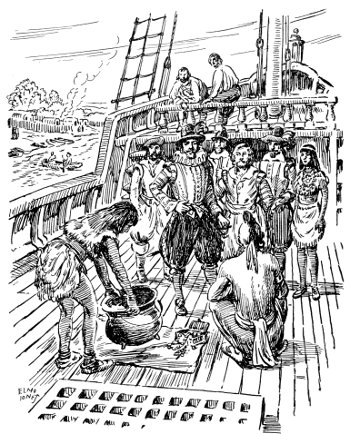
Pocahontas is traded for a copper kettle and becomes an hostage to Captain Argall.
Henry Spelman was about twenty-eight years old when he was killed. He had contributed in many ways to the building of a new country. He left to posterity his valuable recorded observations so that others could profit by his courage and industry.
KIDNAPPED
In the autumn of 1609, Captain John Smith was disabled when his powder-bag was accidentally fired. He sailed for England and never returned to Virginia.
After Captain Smith left, Pocahontas came no more to Jamestown. But she did visit elsewhere. In the spring of 1613 she was visiting in the Northern Neck with her relatives and friends along the Potomac.
The sympathy which Pocahontas had shown for the colonists had caused an estrangement between her and her father, Powhatan. She lived with him no longer and was staying in some secrecy with her relations, the King and Queen of Patowmeke.
For the trip Pocahontas probably wore her robe of deer skins, which was lined with pigeons' down, and her royal jewels of shell, and the white feather in her hair which signified that she was a princess. Though slight of stature, she was doubtless impressive when dressed in her regalia.
In April, Captain Samuel Argall was sent to the Potomac to trade for corn. There, he became acquainted with Chief Japazaws, an old friend of Captain Smith, and learned from him that Pocahontas was his guest.
This knowledge gave Captain Argall an idea. Since Captain Smith had left the colony at Jamestown the Indians had again become troublesome. If, thought Captain Argall, Powhatan's favorite daughter could be captured and held as a hostage peace might be made. The idea grew, and he plotted to steal the little Indian princess.
Captain Argall bargained with Japazaws—a copper kettle in exchange for his guest. The chief agreed, but how could he get Pocahontas aboard the English ship?
Japazaws turned the details of the plot over to his wife. It was up to her to lure the princess into the hands of Captain Argall.
The chief's wife told Pocahontas that she had a great desire to see an English ship and that her husband had promised to take her aboard if the princess would go with her. Although she had no idea that her identity was known to Captain Argall, Pocahontas refused to go. She had seen "great canoes" before and did not care to see this one.
Japazaws threatened to beat his wife unless she could persuade Pocahontas to go aboard the ship. In tears the chief's wife again begged Pocahontas to go with her. The kind-hearted girl finally consented.
Captain Argall welcomed his three guests and ushered them into the ship's cabin where a feast had been spread for them. While the banquet was in progress, Japazaws stepped often on the Captain's foot, under the table, to remind him that his part had been done.
At an opportune time the Captain persuaded Pocahontas to go into the gun-room, pretending to have something to talk over in private with Japazaws. Presently, he sent for her and told her, before her friends, that she must go with him and "compound peace betwixt her countrie" and the English before she should ever see her father again.
Pocahontas began to weep and Japazaws and his wife joined in, howling and crying louder than the girl they had betrayed. Soon the chief and his wife, with the copper kettle, went "merrily on shore."
A messenger was sent to Powhatan by Captain Argall, to tell him that he must ransom his beloved daughter with the "men, swords, peeces, tools, &c. hee trecherously had stolne."
Powhatan did not respond to these demands as Captain Argall had planned. His stand against the invaders was more important to him than his own daughter.
In the meantime, fate took a hand—at Jamestown, Pocahontas and "Master John Rolfe, an honest gentleman," fell in love and were married. In this way peace was established, for a time, between the Indians and the colonists.
As "Lady Rebecca," wife of John Rolfe, Pocahontas traveled to England and had other adventures, but her last happy days as a free Indian maiden were spent in the land between the Rappahannock and the Potomac, later known as the Northern Neck. An Indian village called "Petomek," near the mouth of Potomac Creek, was the scene of her kidnapping.
Potomac Creek is located in Stafford County, three miles north of Falmouth. Some believe that Captain Argall found Henry Spelman and Pocahontas at the village of the Potomacs at the same time.
THE INDIAN TRADER
Henry Fleet was one of the expedition of twenty-six men aboard the Tiger who under Captain Spelman in March, 1623, went to trade for beaver skins and corn with the Anacostan and other Indian tribes near the head of the Potomac.
Fleet was with Spelman when he went ashore. After Spelman was killed and his head tossed over the river bank, Fleet was taken prisoner and carried to the village of the Anacostans. This is believed to have been located not far from the present monument of Washington, in Washington, D. C.
Fleet was about twenty-five years old and had but recently arrived in Virginia. His father was William Fleet of the London Virginia Company, which may have been the reason that Henry came to the New World. Henry was adventurous, quick-witted and intelligent. He made good use of his stay in the wilderness of the Northern Neck by studying his new environment. Later he wrote down some of these observations:
"It aboundeth in all manner of fish. The Indians in one night will commonly catch thirty sturgeons in a place where the river is not above three fathom broad. And as for deer, buffaloes, bears, turkeys, the woods do swarm with them, and the soil is exceedingly fertile." He also wrote that he had seen "plenty of black fox, which of all others is the richest fur." This animal was a large marten, so fierce that it was the match for any forest animal up to the size of a deer.
Henry was kept in captivity for four years, when his friends managed to ransom him. Small vessels were then trading with the Indians of the Potomac and news of him was probably carried to Jamestown in this way.
During the year 1627 the London Merchants were surprised by the arrival of Henry Fleet from Virginia. Startling tales of his adventures spread abroad. It was said that he had lived with the Indians so long that he had forgotten his own language, that he had often seen the South Sea; that he had seen Indians "besprinkle their paintings with powder of gold."
These stories impressed William Cloberry, a merchant adventurer, and chief man in the Guinea trade. Cloberry believed that Fleet could be useful to him as a trader among the Indians.
On September 6, 1627, the ship Paramour of London, one hundred tons burden, was licensed to clear with Henry Fleet as master. William Cloberry and Company were the owners.
Captain Fleet was well suited by nature and experience to be an Indian trader. For years he traded with the Indians along the Potomac—bartering "beads, bells, hatchets, knives, coats, shirts, Scottish stockings and broadcloth" and other "trucke," for beaver fur, tobacco and corn. Some of the Indian tribes traveled "seven, 8 and 10 days journey" to trade with him. He was the most regular and dependable trader the Indians knew.
By 1632 Captain Fleet was operating several boats in the Indian trade, and in that year he built a shallop and a "Barque" of sixteen tons for his own use. He also opened a trade between the Massachusetts settlement and the Potomac River. Sometimes he carried as much as eight hundred bushels of corn at one time from the Potomac to New England.
One day, while trading for beaver with the Anacostans, Captain Fleet ran into trouble. He met the pinnace of a rival trader, and on board was John Utie of the Virginia Council. The latter arrested him by order of the Council for trading with the Indians without license. Fleet had to stop his activities and set sail for Jamestown, where he was tried, but soon given his liberty.
Captain Fleet became a powerful man in Indian affairs. After the massacre of 1644 he was commissioned to negotiate a peace, at his own expense should he fail. He was successful in arranging a treaty with Necotowance, successor of Opechancanough, "in terms that showed a marked advance of civilization; Necotowance must do homage for his land to the King of England, in token whereof he was fined 20 beaver skins at the going away of the Geese yearly."
When bargaining with Necotowance Captain Fleet had been authorized to build a fort on the Rappahannock, "an important station."
Fleet remained in the region of the Potomac long enough to see the first settlers come to the Northern Neck. He was their friend and interpreter and helped them with their Indian troubles.
A PETITION
In July, 1639, owing to the increase of population in Bermuda, the Proprietors of the Island, in London, petitioned for the region "scituate betwixt the two Rivers of Rapahanock, and Patowmack wch by good Informacon your petit'iors finde to be both healthful and otherwise—not yet Inhabited." (Lefroy's Bermudas, Vol. I, p. 558.)
FROM NORTH OF THE POTOMAC
The first settlers did not come to the Northern Neck from the direction of Jamestown, which would have been the natural direction. Nor did they come for the natural reason—new lands.
Instead, they came from north of the Potomac. In order to understand the reason for the migration of these pioneers from the north side of the Potomac to its south side, it is necessary to go back a few years and study the situation in the upper Chesapeake Bay region.
Before 1640 the activity of white men in the Chesapeake Bay centered about a trading post at Kent Island, situated far up the Bay. The trade there was with the Indian tribes in "fur, skins and Indian baskets."
Captain Henry Fleet, William Claiborne, a Virginian, and Lord Baltimore and his brother were chief among those who were making history in this region at that time.
Claiborne and a number of Virginians had established a colony on Kent Island under a charter secured before Lord Baltimore had settled his colony on the north side of the Potomac in a region that he called Maryland.
When Lord Baltimore was granted a charter to settle in this area, his charter included Kent Island. The charter, however, had said that he should have authority only over uninhabited lands.
Claiborne considered that Kent Island was inhabited and was not, therefore, a part of Maryland.
In 1634, the second Lord Baltimore sent about one hundred settlers, under the leadership of his brother, Leonard Calvert, to a point of land across the Potomac from the Northern Neck, and a settlement was established there, known as the "Citie of St. Mary's."
A year after this colony had been planted the settlers were instructed by their Governor, Leonard Calvert, to seize Kent Island.
Claiborne appealed to the Crown but the decision was in favor of Lord Baltimore's claim.
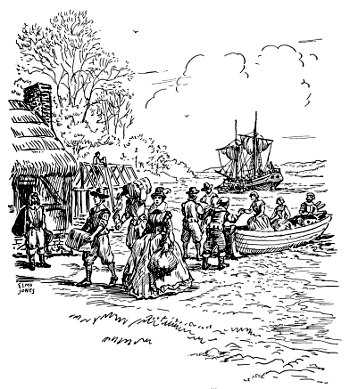
First settlers at Coan.
Claiborne did not give up so easily. With the help of Puritan rebels he seized Kent Island, captured the "Citie of St. Mary's" and drove Calvert from the colony.
But Calvert was also tenacious. He returned a year later, regained control of his Maryland possessions and forced Claiborne to give up Kent Island. Later, the English government decided, once and for all, in favor of Lord Baltimore's claim.
At this time there was much religious dissension in England and in Virginia. Lord Baltimore, a Catholic himself, had hoped to establish a colony where religious freedom could be had by all. Many Puritans left the lower Tidewater Virginia and joined the Maryland settlers.
But Lord Baltimore's plan for a harmonious mingling of all religions did not work out. The Puritans seized the reins of government and there followed years of intolerance and persecution in the "Citie of St. Mary's."
Many Protestants and Royalists in the Maryland colony decided to look for a new home where they could live as they pleased.
Across the Potomac there was a long peninsula inhabited only by Indians. What better place was there to find peace?
It was in this way that the first settlers came to the Northern Neck from north of the Potomac.
THE FIRST SETTLER
IT WAS probably about the year 1640 when the Indians of Chicacoan[5] saw a white man's boat turning from the Potomac into their inlet, Sekacawone.
The boat was of the type called a shallop, built and used by Indian traders. This one may have been of fifteen or twenty tons burden, with two masts, and square sails that were higher than they were wide. The wood may have been turpentined, or painted in a gay combination of colors, such as red, blue, green or yellow. If oars were used as well as sails they were probably painted red.
The white men on board the shallop were doubtless dressed in the manner of seamen of their day—loose breeches and jerkins of canvas, hose of coarse wool and boots of leather. They may have worn woolen stocking caps or felt hats, depending upon the season.
The owner of the vessel was an Englishman, not over thirty years of age. His clothes were probably of a finer weave and cut than those of his men. Unless he was different from other men of his time and station, he wore his natural hair long and flowing about his shoulders. He may have worn a sword at his side. This young gentleman's name was John Mottrom, formerly of Maryland, but more recently from the vicinity of the York River.
If the inhabitants of Chicacoan thought that the shallop held "trucke" to barter for their corn, they were mistaken. Far better for them had this been so.
John Mottrom was not looking for trade but for a new home, and he liked what he saw here—a wilderness peninsula, shut-away from the government at Jamestown by miles of water and forest, protected from Maryland by the Potomac, but close enough to keep in touch with his friends in the "Citie of St. Mary's."
He could see, too, that this wilderness held promises of future riches. He had done well as a merchant, trading with Maryland, around the Potomac and up the Bay at Kent Island, but now the fur trade was on the wane and tobacco was taking the place of beaver skins as currency.
Here, in this peninsula of northern Virginia, new lands could be had for the taking—fields for tobacco. This inlet of the Potomac that the Indians called Sekacawone was a sheltered harbor but deep enough for big ships to come in and take the tobacco away to foreign markets. The adjacent lands had been cleared by the natives; the forest would furnish materials for homes and boats.
There are no records to tell what kind of bargain Mottrom made with the Chicacoans for their land, but apparently the relations between the white men and the Indians were friendly. Marshvwap, King of the Chicacoan and Wicocomoco Indians, became a friend of his new neighbor, John Mottrom.
COAN HALL
When John Mottrom came to the Indian district of Chicacoan to live, it must have been like the Garden of Eden. The river was there; the trees that were pleasant to the sight, and good for food; the beast of the field and the fowl of the air. Except for the Indian clearings along the margin of the river it was new, untouched and as it was in the beginning.
Mottrom chose a site for his house on the east bank of the Coan, and like all early Virginia settlers he knew how to select the spot. Springs were numerous in this region so that it was not necessary to dig a well.
And how did he go about building a house in this wilderness, so far from any place where skilled labor, tools and bricks, glass and nails could be obtained? No records to answer this question have been uncovered to this date. Perhaps, he brought indentured servants and a few crude tools with him in the shallop.
What kind of a house did he build? It is fairly certain that he did not build a log cabin, even for a temporary shelter.
In the seventeenth century the English settlers in Virginia built log forts, log prisons and log garrison houses but they were of "logs hewn square," and they were built in the traditional Old World manner.
These early settlers mentioned living in cottages, huts and frame cabins but, so far as is known, they never said that they lived in log cabins. The American-type log cabin is believed to have developed later and in another part of the country.
Mottrom and his men may have erected temporary shelters of saplings, boughs and bark, similar to the Indian houses.
If wood was cut from the forest for his permanent home, time was needed. Locust for sills, oak for framing, heart pine and cedar were at hand, but green lumber had to be seasoned.
Mottrom may have made several trips to Jamestown or Maryland for artisans and building supplies before his new home was completed. Meanwhile, he may have brought his family to live in one of the temporary shelters.
There are no buildings surviving in Virginia that were known to have been built before 1650, therefore, no true picture of the Mottrom home can be presented.
However, there are enough facts known of the period to enable one to reconstruct a reasonably accurate picture of the first house on the Coan.
First of all—the house had to be strong, for life itself might depend upon the house. Its style was, no doubt, patterned after the architecture of England but modified by circumstances in the New World.
A framed building, one storey and a half high, with brick underpinning, and brick chimneys at either end, was the typical dwelling of Virginia about the middle of the seventeenth century. Its size would have been about forty by twenty feet, with downstairs ceilings about nine feet high.
We can visualize those workmen at Coan "riving" out the weather boards for the first known house in the Northern Neck. One of the men would be holding a rough-squared length of timber on a "frow" horse, while another would be pounding, with a wooden mallet, a wedge-shaped knife into the wood. Presently a board would fall off. With the same tools shingles for the roof would be split from cedar.
John Mottrom may have bought English bricks from some ship bound homeward with a load of tobacco and eager to get rid of the ballast of bricks at any price. It is more likely that his bricks were burned in a kiln at Coan, made with clay dug from the riverbank.
Nails were so hard to get that settlers when they were leaving to settle elsewhere burned their homes in order to get the nails to start a new house. Mottrom probably brought some nails from his former home and supplemented them with wooden pegs.
Rarely before 1720 were "windows sasht with crystal glass." Casements were used. Glassmaking had ended at Jamestown in 1624. Mottrom's windows may have been diamond-shaped panes of oiled paper with solid wooden shutters, or merely sliding panels of wood. But it was possible to get imported glass and he may have had some glass, drawn lead and solder from England. The window openings were a structural part of the framing, not just holes cut in the sheathing. Sometimes the windows did not open, as they were mainly intended to let in light. In this case the leaded glass was permanently set in the frames in diamond-shaped panes.
Mottrom's front door may have had hinges made in the shapes of the letters H and L, to stand for Holy Lord, for it was believed then that such hinges would drive ghosts away from the door. The door may have had panels in the form of a cross to keep out the witches. Or, the door may have been made of oak battens, heavy enough to keep out wolves, Indians and "hurry-canes." In either case, it was fastened with a latch and string, with possibly an oaken bar inside for added strength.
The chimneys of Virginia houses were much larger than those in England, and the fireplaces were at least seven feet across, for the hearth was the heart of the home.
From these various facts of the time, we assume that the first house in the Northern Neck which John Mottrom named Coan Hall was strong, simple, functional, and its character was medieval.
NEIGHBORS
In spite of its isolation Coan Hall was probably not a lonely place. Besides John Mottrom and his wife there were two children, and probably several indentured servants. There were at least a few domestic animals. The Indians were near, the forest was alive and rustling and "nimble" with wild beasts, the sky was darkened and animated by the various birds in their season. The shallop lay at anchor not far away and was a reminder that it was possible to reach some civilization beyond the woods and water.
And Coan Hall was hardly established before guests began to arrive. They came by boat, and perhaps after dark. These Protestant friends and refugees were from Lord Baltimore's "Citie of St. Mary's."
It was whispered in that unhappy "citie" north of the Potomac that treason was being plotted at Coan Hall.
John Mottrom's new home must have been filled to capacity in those days. Although the rooms were few we can be sure that there was no lack of beds or chairs. Rooms then, with the exception of the kitchen, had no distinct character. Beds were in every room, even in the hall where meals were taken.
On a winter's night we can imagine John Mottrom dispensing hospitality at Coan Hall—food, drink and roaring fires. Great plotting and planning must have gone on before the hearths, while the passing tankards of metheglin cheered and warmed the indignant gentlemen from Maryland.
Perhaps John Mottrom's guests were charmed with his new home and decided that it was easier just to settle at Chicacoan. At any rate we hear no more of treason. Instead, settlers begin to arrive in the Northern Neck.
William Presley and his English wife were among the first to arrive at Chicacoan. They built at the head of a creek not far from Coan Hall.
Richard Thompson and his family probably arrived early too. Richard was a young man, about twenty-seven, when he came to live at Chicacoan. He was a native of Norwich, Norfolk County, England. As a boy he had come to Virginia as an indentured servant and had served William Claiborne on Kent Island for three years.
When at twenty-one Richard became a free man, he went into business for himself, trading with the Indians for beaver. He must have been a good trader for he acquired a considerable estate. He also worked as an agent for William Claiborne, which in the end brought about his downfall. When Claiborne was proclaimed an enemy by the Maryland Council, Thompson was denounced also. He was in this way forced to flee to Chicacoan.
Before long a settlement had sprung up along the Coan. John Mottrom became the unofficial leader of this first white settlement in the Northern Neck. Although he did not know it, there was one among them who was to play an important part in his life—her name was Ursula, wife of Richard Thompson.
THE "KIDS"
As soon as their homes were built the settlers at Chicacoan began to remove the forest and clear the ground for tobacco fields.
The sound of axes was no doubt heard from sunrise until sunset. Then the stumps had to be dug up, and the soil had to be broken up with hoes. This hard labor was probably done by white indentured servants.
These British servants were commercially known as "kids," probably because most of them were young, their ages ranging from thirteen to thirty as a rule.
An early English writer described the manner in which these "kids" were obtained to send to Virginia—"very many children ... were violently taken away or cheatingly duckoyed without the consent or knowledge of their Parents by ... persons ... called Spirits ... into private places or ships, and there sold to be transported, and then resold there to be servants to those that will give most for them."
A letter written in England in 1610 says that—"there are many ships going to Virginia with them 14 or 15 hundred children w'ch they have gathered up in divers places."
The shipmaster who brought the children over could sell the indentures for whatever he could get for them. If he could not find a purchaser, he could sell the children to persons known as "soul drivers" who would "buy a parcel of servants" to fill his wagon and drive through the country until he could sell them at a cash profit.
Other indentured servants were brought over by planters as "head-rights," which meant that the planter paid for their transportation and received fifty acres of land as a reward for transporting an immigrant to Virginia.
The indenture was a simple bargain between master and servant with protection by law for each. The treatment of the servant depended upon the nature of his master.
The boys who had long terms to serve became restless and often ran away across the Potomac to Maryland or to an Indian village. They were usually caught and punished and put back to work. In Virginia the punishment was sometimes thirty lashes and the letter R branded on the cheek, forehead or shoulder. The hair was sometimes cropped, and the leg shackled with irons, even during working hours. There is no evidence that the settlers of the Northern Neck did anything more severe than to whip their "kids."
Food, clothing and shelter was provided by the master. The shelter was usually in "a house set apart for him." The list of clothing might include a coat of frieze, a pair of leather breeches, a black hat, or cap of fur, a pair of "wooden heel shoes," and underclothes of dowlas and lockram.
The indentured girl servants did not work in the fields unless they were slattern and offensive. Their work was to bake and brew, clean, milk, churn, wash and sew.
Due to the scarcity of women in Virginia the girl servants usually married within the first three months. If their reputation was good, they often married into a higher station.
INDIAN SERVANTS
The settlers at Chicacoan may have had some Indian servants. Tradition says that William Presley of Coan employed Indians to care for his "roaming stock."
It was customary in Virginia to take Indian children as apprentices to learn a trade, and to learn to read and write. This was with the consent of the parents that the child should be instructed in the Christian religion.
The children were usually taken at thirteen or fourteen years of age and the apprenticeships lasted until they were twenty-one.
The value of the Indian servant was about the same as that of the English indentured servant. The relationship between the Indian boy and his master was the same as that between the master and the English servant. Food, clothing and shelter was furnished by the master. Records of the clothing lists included leather breeches, cotton waistcoats, shoes and stockings.
MONEY
The indian word wampum meant "shells." Wampum and copper were the Indians' substitute for gold and silver. The early settlers also used the Indian wampum as a medium of exchange.
Wampum, in Virginia, was usually made from the oyster shell. The dark wampum, which was made from the black or purple part of the shell, had twice the value of the white. For instance, three of the dark beads or six of the white beads equalled one English penny.
The beads were cylindrical in shape about an eighth of an inch in diameter and one-fourth of an inch long. They were rubbed against stones until they were polished smooth. A hole was bored through the center of each bead with a flint instrument so that it could be strung on thread. Much of this wampum was made by tribes who manufactured and carried on commerce.
The most common wampum, made of white shell, was called rhoanoke. In old records wampum was sometimes referred to as "a chain of pearl." In a Northumberland County record there is listed among the items in the estate of "James Claughton, dec'd: Mr. Richard Thompson per order 20 arms length of Rhoanoke." Another early settler of the Northern Neck, Moore Fauntleroy, paid the Indians for his land "ten fathoms of peake" and "thirty arms length of Rhoanoke."
The English went so far as to import imitation wampum of white porcelain for sale to the Indians.
The early settlers also used beaver skins as currency. Northern Neck records about 1656 show that Colonel Nathaniel Pope offered to go security for John Washington "in beaver skins." Even hens were used for currency.
Tobacco soon became the most important currency in the colony. The words of the old song—"Where money grows on white oak trees," was almost true in Virginia for there tobacco was money and tobacco grew everywhere. Instead of gold and silver the colonial had his "tobacco note." The chief reason that metallic coin was scarce throughout the whole colonial period in Virginia was the fact that tobacco was currency.
It seems that there was always a small stock of coin in the colony, but it was either used in trade with other countries or it was hoarded by the colonists. A Virginia county record of 1700 says that: "Spanish money may not be exported out of this colony, but that it may pass currently from man to man and that all pieces of eight pass for five shillings specie."
The most convenient metallic money in Virginia (1722-1835) was a Portuguese gold coin called a johannes. A full johannes was called a "half-joe," and a double johannes was called a "joe."
As banking institutions were non-existent in the colony in the early days, and as robbers sometimes lay in wait in the woods for a lone horseman, travelers used to carry gold coins sewed under the lining of their waistcoats or quilted into their coats.
A PARADISE DISCOVERED
For several years the settlers at Chicacoan lived in a dream-like paradise—ungoverned and untaxed.
But this state of freedom could not last. News of the thriving young settlement in the Northern Neck was probably carried to Jamestown by the stream of travellers who plied back and forth along the waterways between that city and St. Mary's in Maryland.
How great the consternation must have been at Chicacoan when one day a boat arrived from Jamestown. There may have been soldiers on board or other representatives of the government. They brought a startling message.
The message was in the form of an Act passed by the House of Burgesses at an Assembly in 1644. It said:
"Whereas, the inhabitants of Chicawane, alias Northumberland, being members of this colony, have not hitherto contributed toward the charges of the war (with the Indians) it is now thought fit that the said inhabitants do make payment of the levy according to such rates as are by this present Assembly assessed."
The rates were "for every 100 acres of land, 15 pounds tobacco; for every cow above 3 years old, 15 pounds tobacco."
But the real shock came at the end of the message: "And in case the said inhabitants shall refuse or deny payment of the said levy, as above expressed, that upon report thereof to the next Assembly, speedy course shall be adopted to call them off the said Plantation."
The settlers were no doubt infuriated at this command. They ignored it, and continued to live in their independent way.
John Mottrom, however, must have thought it high time to look into the situation. In the fall of 1645 he sailed for Jamestown.
A VISIT TO JAMESTOWN
Although a trip to Jamestown would have been an exciting change after years of wilderness living, there is reason to believe that Mrs. Mottrom did not accompany her husband to the capital city. She probably supervised the preparation of food for the voyage, and packed his clothes.
John Mottrom's clothes were no doubt as fashionable as the English tailors could furnish. Rich fabrics and bright colors were worn by Virginia gentlemen of the seventeenth century, and they never seemed to think that their "citified" garments looked out of place in the primitive setting of the New World.
Among the clothes that Mrs. Mottrom may have packed, there might have been "a sea-green scarf edged with gold lace," a scarlet coat with silver buttons, a camlet coat with sleeves ending in lace ruffles, a pair of red slippers, a Turkey-worked waistcoat, a whole suit of olive-color plush, silk stockings, a beaver hat, neckcloths of finest holland and muslin, shoes with shining silver buckles, delicately scented handkerchiefs of silk and lace, and a gold belt for her husband's sword.
The Mottrom household was probably on the bank of the Coan to wave good-byes when the anchor was weighed and the sails of the shallop were hoisted.
Out of the Coan sailed the shallop, and into the Potomac. Out of the Potomac into the Chesapeake. Then it was straight sailing down the Bay, past the mouths of the Rappahannock and York, and finally, into the James. It usually took four average sailing days to travel from the Northern Neck to Jamestown.
As the boat neared Jamestown Island John Mottrom could doubtless see the orange-tiled roofs and tall red chimneys of the "citie," which had long ago burst from its palisades and was now stretched for half a mile along the river front, as well as backward into the swamps and meadows.
He could no doubt see the tower of the new brick church, and east of it the State House, which looked so "London-like" with its three steep gable ends facing the river.
Captain John Smith had written that the water here was deep "so neare the shoare that they moored to the trees in six fathom water," but the Mottrom boat may have tied up at Friggett Landing in the rear of the Island. There were probably other vessels already tied up there, and others still arriving for the Assembly.
Mottrom may have seen a barge coming down from the upper James, loaded with gaily dressed men and women—a Burgess or Councillor and his family and retinue, perhaps.
Once ashore John Mottrom probably took a walk to stretch his legs and see what changes had taken place since he had last visited "James Citie." He may have passed the new church, which was still unfinished, and strolled along some of the narrow lanes. Outside the town there were some "cart paths," and over some of the swamps there were bridges. Back of the Island lay the forested Indian district of the "Passbyhaes."
"New Towne" was the most thickly settled part of "James Citie." Most of the houses were a story-and-a-half of "framed timber" with steeply-pointed roofs of tile, and a few of slate. Each had its garden and was enclosed with palings. The road along the river bank was edged with mulberry trees.
The State House, situated near the river and down stream from the church, was probably the most imposing building in the town. It was really three brick houses joined together in a row to form a block, like the medieval gabled houses in London. Its windows were casements with lattices of lead and diamond-shaped panes of greenish colored glass. The place had a garden, fruit trees and vines, all enclosed by palings.
This State House was the focal point of the government and the center of social life at Jamestown. John Mottrom probably stayed there during his visit for the governor, Sir William Berkeley, who lived in the building on the western end, acted as host to all important visitors.
The Assemblies, courts and councils were held in the "middlemost" of the three houses. The Assembly would soon convene and the visitor from the Northern Neck had come a long way to be present at that meeting of November 20, 1645.
We can imagine him there on that important day, sitting with that dignified group of men, dressed in their rich bright garments, all with their hats on in imitation of the House of Commons in far away England.
Little is known of what took place in that meeting that concerned Chicacoan except that John Mottrom was accepted and recognized in this Assembly as a Burgess from the "Plantation of Northumberland." It seems that an English name was preferred instead of the Indian name for that land between the Rappahannock and the Potomac.
FRANCES
Mrs. Mottrom probably did not accompany her husband to Jamestown because in that same year a baby was born at Coan Hall.
What a time that must have been in the wilderness household—the little indentured English maids scurrying about with wooden pails of steaming water, perhaps, and the curtains all drawn about the great bed, and John Mottrom pacing the floor no doubt like any modern father-to-be!
Frances Mottrom, for thus she was christened, may have been the first white baby to have been born in the Northern Neck.