PART I (continued 3)
Reading edition
What feelings of dread must Edward Cole have had as he watched the approach of Hanna Neall! We can see him slowly opening the door and standing far aside for her to enter.
We can picture Hanna, looking into the dark room where the candle in the tin lanthorn threw shadows across the strained faces, and a pomander ball gave off the sickening odors that were supposed to ward off infection. And there in the dimness of the bed with its heavy hangings lay the sick woman.
Was Hanna frightened when she looked into the face of her accuser? Was she angry? Or did she pity him? In any case, when she trod on the threshold, brushed the horseshoe with her skirts, and entered the room—nothing happened.
Hanna crossed to the sick woman, knelt beside the bed and "shee prayed so heartily for her" that Edward Cole believed in her sincerity.
It was in this way that Hanna Neall was saved from being banished from the county, or from lashes at the whipping post, or from the ducking "stoole" at Northumberland County court-house, down in Hull's Neck. Saved by a horseshoe and a prayer!
And Edward Cole straightened matters out with the following statement:
"I, Edward Cole, doe acknowledge yt ye words which I did speake concerning Mrs. Neall as tending to defame her with the aspersion of being a witch, were passionately spoken.
"Edward Cole" April ye 11, 1671
MUSTER
In the early days of the colony there was a unit of militia in each county. The governor, who was in command, appointed for each unit a colonel, lieutenant-colonel, and major, who had lesser officers under them. Every freeman between the ages of sixteen and sixty was subject to this military duty. Single troops and companies were mustered four times a year, and once a year there was a general muster.
Everyone looked forward to the general muster—on that day all roads led to the county seat. Some of the people came as far as they could by boat and then walked the rest of the way. Others came in carts and on horseback, with the women and girls riding pillion behind their husbands, fathers or brothers. Small children were probably perched up in front of the riders. All were dressed in their bravest clothes.
At the county seat there was excitement in the air—the British flags were all flying, swords were glinting, and there was the sound of the "brass Trumpetts w'th silver mouth pieces" and the roll of drums. There were "Troopes of horse & Companies of Foot ... provided w'th Armes & Ammunition" and with their "coullours" flying. The officers wore handsome belts and "Bootes." The men carried "firelock musketts" and had "Pistolls & Houlsters."
After the parades and drills were over the people mingled and enjoyed being together. It was probably the second day before the crowd broke up and the people started homeward. Liquor was no doubt flowing freely among the men.
The citizens of Northumberland petitioned the House of Burgesses in 1696, "praying" that no musters should be allowed to take place on Saturday, "as it led to the profamation of Sunday."
THE STORE
The store was one of the principal institutions in the colony in early days. Every important planter kept a store somewhere on his plantation. Sometimes it was in a room in the manor but usually it was in a detached building. Storehouses were small, often not more than sixteen by eighteen feet.
The contents of these stores included nearly every article used by Virginians. A plantation store of 1667, with contents valued at six hundred fourteen pounds sterling, carried merchandise such as: materials of all kinds, carpenters' tools, bellows, sickles, locks, nails, staples, cooking utensils, flesh forks, shovels and tongs, medicines, wool cards, compasses, needles, stirrups, looking-glasses, candlesticks, candles, raisins, brandy, wine, and many other items.
Most of the manufactured articles came from England. To be very salable merchandise had to bear an English label.
THE WOLF-DRIVE
For a century after the first settlers came to the Northern Neck the forest was still alive with wolves. In the evenings they could be heard hunting and they sounded "like a pack of beagles."
These wolves were small, not much larger than a fox, but so ravenous that if a traveler was forced to spend the night in the woods he could hardly keep his horse from being devoured even though tied close to him and to the light of the fire.
The scattered sheepfolds and grazing pastures had to be guarded. Wolves were such a nuisance to the planters that authorities sought ways to destroy them. Rewards were offered for any person killing a wolf "provided the said wolf shall not be so young that it is not of age to do mischief."
The planters caught the wolves in various ways—in wolf-pits, log-pens and log-traps. Several mackerel hooks were fastened together and then dipped in melted tallow which hardened and concealed them. These were fastened to a chain so that after the wolf had swallowed the hooks he could not wander away in the forest and his head be lost for bounty.
In 1674, John Mottrom, II of Coan was rewarded with fourteen hundred pounds of tobacco for "killing seven wolves in a pitt." The settlers often paid their public dues in the skins of wolves.
As late as 1691 the county court of Northumberland made public arrangements for an annual wolf-drive. The wolves were hunted on horseback with dogs, very much in the manner of fox-hunting. Early writers state that it was possible while going at full speed to run down a wolf.
The wolf-drive was somewhat like the old English "drift of the forest," where a ring of men and boys with guns surrounded a large tract of woods. The wolves scenting them would retreat to the center of the circle, where the hunters would close in on them. Many were killed in this way. "Wolf-driving" was considered great sport.
Wolf-Trap Light, in Chesapeake Bay, is said to have been named because ashore near there was a famous place for catching the last of the wolves.
THE INDIANS AND ROBERT HEN
In the year 1675, strange things were happening in the Northern Neck.
Thomas Matthews, a planter, whose "dwelling was in Northumberland, the lowest county on Potomack River," recorded these strange events—there "appear'd three prodigies in that country, which from attending disasters were look'd upon as ominous presages.
"The one was a large comet every evening for a week, or more at Southwest; thirty-five degrees high streaming like a horse taile westwards, until it reach'd (almost) the horizon, and setting toward the North-west.
"Another was, fflights of pigeons in breadth nigh a quarter of the mid-hemisphere, and of their length was no visible end; whose weights brake down the limbs of large trees whereon these rested at nights, of which the ffowlers shot abundance and eat 'em; this sight put the old planters under the more portentous apprehensions, because the like was seen, (as they said), in the year 1644 when th' Indians committed the last massacre, ...
"The third strange appearance was swarms of fflyes about an inch long, and big as the top of a man's little finger, rising out of spigot holes in the earth, which eat the new sprouted leaves from the tops of the trees without doing other harm, and in a month left us." (This insect was the seventeen-year locust.)
The events which followed these strange occurrences not only justified the apprehensions of the old planters but also changed the course of history in the New World.
Thomas Matthews, of Cherry Point in Northumberland, also had a plantation, servants and cattle in Stafford County. His over-seer there had bargained with an Englishman, Robert Hen, to come "thither" and be herdsman of the Stafford flocks.
Robert Hen arrived in due course of time and made his habitation on the Stafford plantation.
On a Sunday morning in the summer of 1675, people on their way to church found Hen lying across his threshold, and an Indian lying in the dooryard—"both chopt on their heads, arms and other parts, as if done with Indian hatchetts, th' Indian was dead, but Hen when asked who did that? answered Doegs, Doegs, and soon died, and then a boy who came out from under a bed where he had hid himself, told them, Indians had come at break of day and done those murders."
"Ffrom this Englishman's bloud," wrote Matthews, "did (by degrees) arise Bacon's rebellion."
Matthews continues: "Of this horrid action Coll: Mason who commanded the militia regiment of ffoot & Capt. Brent[6] the troop of horse in that county ... having speedy notice raised 30, or more men, & pursu'd those Indians 20 miles up & 4 miles over that river into Maryland, where landing at dawn of day, they found two small paths ... each leader with his party took a separate path and in less than a furlong either found a cabin, which they (silently) surrounded. Capt. Brent went to the Doegs cabin (as it proved to be) who speaking the Indian tongue called to have a council ... such being the usual manner with Indians ... the king came trembling forth, and would have fled, when Capt. Brent, catching hold of his twisted lock (which was all the hair he wore) told him he was come for the murder of Rob't Hen, the king pleaded ignorance and slipt loos, whom Brent shot dead with his pistoll, th' Indians shot two or three guns out of the cabin, th' English shot into it, th' Indians throng'd out at the door and fled, the English shot as many as they could so that they killed ten ... and brought away the kings son of about 8 years old ... the noise of the shooting awaken'd the Indians in the cabin, which Coll: Mason had encompassed, who likewise rush'd out and fled, of whom his company (supposing from that noise of shooting Brent's party to be engaged) shot fourteen before an Indian came, who with both hands shook him (friendly) by one arm saying Susquehanoughs netoughs, meaning Susquehanoughs friends and fled. Whereupon Col: Mason ran amongst his men crying out for the Lords sake shoot no more, these are our friends the Susquehanoughs."
This attack upon the friendly Susquehannocks was a very unfortunate and costly mistake. The incensed Indians took to the warpath and murders were committed in both Virginia and Maryland. A body of Virginia militia under the command of Colonel John Washington, Colonel George Mason and Major Allerton, all of the Northern Neck, crossed the Potomac after the Indians.
This warfare ended, after much bloodshed, with Bacon in command. The allied Indians were defeated and the once friendly Susquehannocks were anihilated. And it was in this way, with an army at his command, that Bacon established his power and became strong enough to fight Governor Berkeley.
Thus it was, according to Thomas Matthews, that Bacon's Rebellion started with the murder of Robert Hen in the Northern Neck.
THE ROYAL CAVALCADE
When Robert Carter of Corotoman, Lancaster County, dressed on Sunday mornings he had a choice of several dress swords and of several belts to hold them—there was the silken belt, the buff, and the one of tan leather which was both "genteel and strong." His coat was of velvet with lace choker and cuffs, and his satin shorts were fastened at the knees with silver buckles to match those on his shoes.
If he looked in the mirror, as a servant adjusted his wig, he saw a strong man of medium height with a plump clean-shaven face and dark eyes that observed everything but saw no humour in anything.
When Carter and his lady, equally as splendid, stepped outside their mansion, a coach was a-waiting them, with liveried servants to help them inside. The coach was a heavy, four-wheeled, enclosed vehicle with two seats facing each other, and it carried four or more passengers. Most likely it was painted in shades of yellow and green, or a subdued red, with the family crest or coat of arms painted on the doors.
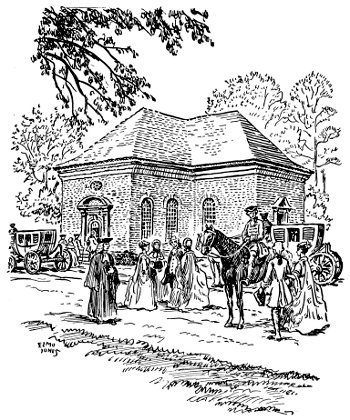
"King" Carter attends Christ Church.
The six matched horses which drew the coach were being held in check by the driver and the outriders. A chaise may have been waiting behind the coach for the older daughters and guests. The sons of the house, if they were old enough, were mounted and attended by servants on horseback, one for each gentleman. Other mounted servants with led horses may have brought up the rear, but it is doubtful, as the distance to be traveled was only three miles.
There must have been a great rumbling of wheels, creaking of saddle leather and clatter of hoofs when the cavalcade swung onto the road which led from Corotoman to Christ Church. The master had built the road high, drained by deep ditches, and bordered on both sides by closely set cedars. It was like a long formal alley.
When the churchyard came into view people could be seen waiting there. The procession came to a halt with noise and "a great to-do." The family alighted and the master led the way. At the church door he halted and drew a key from his vest pocket with which he unlocked the door. It was customary for gentlemen to remove their swords at the church door and place them in a rack provided for the purpose, but whether or not the head of the Carter family did so is not known.
The Carters entered the church and proceeded to their high boxed pews, where curtains on gilt rods screened them from the gaze of the congregation.
According to tradition, this bit of pageantry was put on by Robert (King) Carter every Sabbath, and the congregation, it was said, waited rain or shine in the churchyard until he came to unlock the door. If he chose to take a Sunday off, services were held in the churchyard, it was said.
Though it was the custom for the rector to sign the vestry minute book first and then the members in order of their rank, in Christ Church the Carters always signed first, tradition says.
King Carter was a vestryman at Christ Church. He wanted his children to belong to the Established Church—"As I am of the Church of England way so I desire they should be."
The first Christ Church had been built by John Carter, the immigrant, in 1669. The second Christ Church was built on the same site by King Carter in 1732.
THE KING OF THE NORTHERN NECK
Robert Carter was born to be a king among men. His fellow countrymen called him "King" and his real name was eventually forgotten. Like King Midas, everything that King Carter touched turned to gold, but in the case of the latter there was no magic in it—he planned it that way and worked to make his plans succeed.
Robert Carter was the second son of John, the immigrant and Indian fighter. His mother was Sarah Ludlow Carter, his father's fourth wife.
Robert Carter was born in 1663, at his father's plantation, Corotoman, in Lancaster County. The foundation had already been laid there for his future success. The immigrant Carter had done well. His plantation was orderly and successful and he had accumulated considerable wealth.
John Carter died when Robert was six years old, and the elder son inherited the bulk of the estate, as was the custom then according to the law of primogeniture and entail.
But John Carter did not forget Robert. He left instructions that his younger son should be well educated, specifying that "during his minority" he should have a man or youth servant bought for him. This servant was "not only to teach him his books ... but also to preserve him from harm and evil." He further specified that his son should learn both Latin and English. These instructions were followed and Robert's education was completed in England.
The elder brother soon died, without male heir, and the whole estate reverted to Robert. It was now up to him to carry on the family traditions.
Corotoman, a bee-hive of activity, was typical of the plantations of that day. It was like a village, which was dominated by the manor house. There were the cottages of the white indentured servants, the slaves' quarters, the barn and farm buildings, the spinning-house, the laundry-house, the milk-house. There were the shops of the artisans who manufactured and repaired the articles used on the plantation. There was a shop where boats were built. Corotoman had everything that it needed to make it a self-sustaining unit.
To the sloop-landing, near the mouth of Carter's Creek, ships came directly from foreign ports with cargoes of clothing, furniture and luxuries for the manor, and shoes and other necessities for the white serfs and negro slaves. These vessels went away loaded with tobacco and grain.
Robert Carter was aware of everything that went on at Corotoman and on his other plantations, not the smallest detail escaped him. He knew when a slave's shoes didn't fit, or when a servant's child needed medical attention. When his sons were in school in England he followed their progress by remote control and never let them forget that he was holding the purse-strings—"Mind your book," he wrote his son, Landon. He wanted them to have a classical education, a thorough understanding of Latin and English. He also wanted them to have religious training.
Robert Carter was a politician as well as a planter. He held every high office in the county and colony, and even acted as governor for more than a year.
But most of all, the land fascinated Robert Carter. He loved the rich virgin soil that would grow tobacco. It was the same thing as growing money. But in about three years time tobacco had worn out the soil and new fields must always be on tap in this tobacco game.
Carter's big opportunity came in 1702 when he was appointed as a land agent of the Northern Neck proprietary. He set up a land office at Corotoman and began to acquire lands for himself as well as for others. He had accumulated 20,000 acres by 1711, at which time he lost the agency to Thomas Lee, of Westmoreland.
In 1719 Carter regained the agency and again became the representative of the Fairfax interests in the Northern Neck. In 1726 he took an even bolder step by leasing the entire Northern Neck from the proprietor for a fixed rental of 450 pounds a year. Now he had the income from the quit-rents for the entire region.
When King Carter died in 1732, he owned 330,000 acres of land, a thousand slaves and 10,000 pounds sterling. The latter fact was remarkable because there was such a small amount of metallic money in the colony. He also left more than a hundred head of horses, over two thousand cattle and swine and several hundred sheep. These slaves and stock were scattered over his various plantations. His estate also included indentured servants, ships and nautical equipment, crops, farming equipment, cabins and mansions, furnishings, personal effects and a library of 521 volumes.
King Carter had done well for himself, and well for the proprietor. He had also opened up the back lands of the Northern Neck to settlers, which automatically forced the Indians back.
King Carter was a builder. He had a large brick kiln at Corotoman, which doubtless furnished the bricks for some of his homes and the church. He built a breakwater at Corotoman to save the waterfront from being washed away by tide and storm. It was made of huge rocks, probably brought as ballast in some of the ships. He dug a well at Corotoman and had it lined with stone. It was a far-cry from the early settlers' "spring near the door."
King Carter built a road from Corotoman to Lease-Land (Fredericksburg), a distance of almost a hundred miles. It was known as the King's Highway.
In everything that King Carter did he looked ahead. He was building for the future generations of his family. When he died he was the richest and most powerful man in Virginia. His given name had long since been forgotten. He was known to everyone in the Northern Neck as King Carter. He was laid to rest in the yard of Christ Church.
KITH AND KIN
There used to be an old saying—"everybody in the Northern Neck is kith and kin." This was almost a fact.
It all came about because in the early days the families of wealth and ability assumed leadership locally and in the Colonial Government. It was the custom of these families to intermarry in order to keep the power of wealth and influence within their own circle.
By the end of the eighteenth century it was hardly possible to find a prominent Northern Necker who was not "kin" to some other outstanding Virginian. This rigid rule of "keeping up the bars," as they called it, resulted in an aristocracy similar in many ways to the nobility of the Old World. This system accounts for the high political intelligence for which Tidewater Virginia was noted.
The marriages of King Carter's children illustrate this characteristic of colonial life in the Northern Neck, and in Virginia. King Carter married only twice but he had twelve children.
By his first wife, Judith Armistead, King Carter had four children, John, Elizabeth, Judith and Anne.
Judith died in 1699, and he married Elizabeth Landon Willis, a widow and daughter of Thomas Landon of England. She died in 1719. The best known of her eight children are Robert, Charles, Landon, Mary and Lucy.
Elizabeth, the eldest daughter, was married to Nathaniel Burwell. King Carter gave her Carter's Grove. After Burwell died she married George Nicholas. Judith married Mann page of Rosewell, in Gloucester County. Anne married Benjamin Harrison of Berkeley, on the James.
Mary married George Braxton of Newington, in King and Queen County. Lucy married Colonel Henry Fitzhugh of Eagle's Nest, in Stafford County, on the Potomac.
John became a barrister in the Middle Temple, London, and married Elizabeth Hill of Shirley, on the James. Robert settled on the plantation of Nomini, on the Potomac. He married Priscilla, the daughter of William Churchill, a member of the Council.
Charles married three times—Mary Walker, Anne, daughter of William Byrd of Westover, and Lucy Taliaferro. His home was Cleve on the Rappahannock.
Landon's home was Sabine Hall, on the Rappahannock. He married three times—an Armistead of Hesse, a Byrd of Westover and a Wormeley of Rosegill.
King Carter's direct descendants include: a signer of the Declaration of Independence (Carter Braxton), two Presidents of the United States (the Harrisons), and General Robert E. Lee.
Thus King Carter's children were well established. These Carters and the heads of other top-ranking families were sometimes known in the Northern Neck as the "river barons."
THE FIELDINGS
Ambrose Fielding was a justice of the peace for Northumberland County in 1670.
Ambrose's son, Edward, came to Virginia from England, about 1687-88, to take up his inheritance of three hundred twenty-five acres left him by his father in 1675. His Northern Neck holdings were increased in 1695 by the will of his "Uncle Edward" Fielding, a great merchant of Bristol, England, who left him "500 acres at Wiccomocco in the County of Northumberland, in the Country of Virginia beyond the seas." In the same year Edward, by grant from Lady Culpeper and Lord Fairfax, acquired four hundred twenty-five more acres on "Wicocomoco river ... near ye Mill Dam of ye sd. Fielding, of Lee parish."
Edward owned a snuff box, marked with his initials, "E.F.," and the date "1716." The portrait of a young woman was painted on the lid. It is believed to have been his wife, or his daughter Sarah. The girl in the picture wears a dress of satin, with white skirt, green stomacher and plain colored bodice; the head-dress, which is like a scarf or loose hood, is of white and green, and the flower held in her hand is blue, as are the velvet cushions of the chair.
Edward's oldest son was born in 1689. Edward named him for his father, Ambrose.
When Ambrose was about twenty-one years old he married the daughter of a "chirugeon," Mark Attkins. After their marriage Ambrose and Catherine moved to Lancaster County and settled on a plantation known as Broad Neck Quarter.
The house of Ambrose Fielding II, was built like a small fort in the wilderness, probably for defense against Indians. It was built of brick with loop-holes in the walls. A brick wall surrounded the house, and it too was pierced with loop-holes.
This house is said to have been located near the seat of the Carters at Corotoman. This statement seems to have been borne out by the will of King Carter, 1728, in which he mentions a "Fielding's Place." In 1749 the King's grandson, Robert Carter III, of Nomini Hall, owned about two thousand acres in a tract in Northumberland called Fielding's Quarter.
PIRATES
In the time of King Carter of Corotoman, the Chesapeake was alive with pirates. He wrote that they were "very bold and roguish ... miserable case, the Crown takes no more care of so vast a fleet of ships as uses this bay."
The pirates reaped a rich harvest from the unprotected ships that traveled to and from foreign ports. In one year four ships bound back to Virginia from England had been sunk.
There were three types of pirates—the "bloody pirate," who was simply a robber on the high seas; the privateers, who commanded armed private vessels commissioned to cruise against the commerce or war vessels of the enemy; and buccaneers, who were freeholders who preyed upon Spanish as well as American vessels and settlements.
With its many bays and rivers the coastline of Tidewater Virginia was hard to defend. Pirates could swoop down in their fast boats and rob vessels and plunder the plantations along the shore. It was easy to make a landing in the lower counties of the Neck where the land was low and there were wharves at the plantations.
In 1699, Captain Kidd, who tradition says wore a gold chain around his neck and picked his teeth with a toothpick of gold, entered the Chesapeake in his vessel Alexander. The militia of the maritime counties was called out but Captain Kidd, after plundering several ships, sailed away.
Louis Guittar entered the Bay in 1700 and plundered and destroyed five vessels while there. At some time during this period, a ship-load of pirates reached the waters of the upper Chesapeake, where they captured a large sloop. They anchored that evening not far from shore and, tradition says, "the pirates were heard beating their drums all night long."
The pirate, George Lowther, entered the Bay in 1722. Roger Makeele was another Bay pirate. He and his gang of thirteen men and four women preyed on small craft in the Bay channels. After a successful venture they celebrated by "drinking and feasting with Rumm or Brandy, mutton, Turkey etc." This gang was captured and brought to trial by the Governor of Virginia.
The Virginia government used several methods of defense: look-outs, militia, forts and guard-ships. There was a fort with twenty-four guns and one hundred fifty "available shot" at Corotoman, on the Rappahannock. At Yeocomico, on the Potomac, there was a fort with six guns. Since almost no maintenance was given to the forts in Virginia they were in a dilapidated condition by 1691. The guns were "spoiled in the sand with the water flowing over them at high tide." This form of defense proved to be ineffective. The colony had already turned to guard-ships as a means of protection.
These guard-ships were used to convoy merchant vessels to their destination, or to a safe "riding place." The designated "riding place" on the Rappahannock was above the fort at Corotoman. On the Wicomico and on the Potomac the "riding places" were "as high as they can go."
One of these guard-ships, H.M.S. Deptford, a ketch, under command of Captain Thomas Berry, was upset in a squall in the Potomac. Captain Berry, who was ill at the time, was drowned along with eight members of his crew.
In 1726, Joseph Parsons, mate of the ship Tayloe of Bristol, was tried in the court of Richmond County and convicted of piracy and the murder of Captain John Heard of the Tayloe. Parsons was sent to the "gaol" at Williamsburg. The Council in Williamsburg re-examined the case and discharged Parsons because of lack of sufficient evidence. The silver plate and other articles found in the possession of the crew were held by the authorities until the rightful owners could claim them. The crew said that they had taken the property from the Tayloe "for sustinance while journeying through the colony."
After Blackbeard was captured by Maynard, in 1718, piracy in the Tidewater declined. The last pirate reported in the Chesapeake was in 1807. Tales of pirates, piracy and buried treasure were told in the region for many years.
CHRISTMAS AT COLONEL FITZHUGH'S
An account of a Christmas spent at Bedford plantation in the Northern Neck was written by Monsieur Durand, a Frenchman, who was journeying through Virginia in the holiday season of the year 1686. He wrote:
"We were now approaching the Christmas Festival.... It was agreed that all should go to spend the night with Colonel Fitzhugh, whose house is on the shore of the great river Potomac....
"By the time we reached Col. Fitzhugh's we made up a troop of 20 horse.
"The Colonel's accomodations were, however, so ample that this company gave him no trouble at all; we were all supplied with beds, though we had to double up. Col Fitzhugh showed us the largest hospitality. He had store of good wine and other things to drink, and a frolic ensued.
"He called in three fiddlers, a clown, a tight-rope dancer and an acrobatic tumbler, and gave us all the divertisement one would wish. It was very cold but no one thought of going near the fire because they never put less than the trunk of a tree upon it and so the entire room was kept warm."
William Fitzhugh, the owner of Bedford, came to Virginia in 1670. He secured a grant of land in the upper Neck, in what later became King George County. He married "little Sarah Tucker" of Tucker Hill when she was only eleven years old, and then sent her to England to be educated. Sarah and William reared a family of five sons. Colonel Fitzhugh became one of the largest landowners in the Northern Neck. At the time of his death in 1701 he owned 54,054 acres of land.
INDIAN VISITORS
When the French Huguenot, Monsieur Durand, was in Stafford County in 1686 he described the Indians who lived along the Rappahannock River as follows:
"As we were about to take horse all those savages, men, women & little children, came to return our visit. Those who had been able to procure jerkins from the Christians were wearing them, as also the women who wore some kind of petticoats, others wore some pieces of shabby cloth from which were made the blankets they had traded on some ships in exchange for deer skins. They had a hole in the center to put their heads through & fastened it around their body with deer-thongs. The women were wearing theirs as a mantilla, like the Egyptian women in Europe, & their children were entirely naked. They had taken to adorn themselves some kind of pure white fishbones, slipping a strand of hair through a bone, & so on all around their head. They also wore necklaces & bracelets of small grains which are found in the country."
HORSE RACING
Horse racing was the most popular form of amusement in Virginia in the seventeenth century. The lower counties of the Northern Neck were the center of horse racing in the colony at that time.
These races had many spectators, including women, but only gentlemen could participate. Racing was considered "a sport for gentlemen alone," and records show that if one not of that class presumed to enter his horse in a race he was heavily fined.
The races were taken seriously and conducted with fairness, even if it might be necessary to be assisted to this end by the courts. There are many records of contested decisions decided by jury.
Saturday was the customary day for the races. These occasions when a crowd was gathered together were used by the public authorities for making announcements to the people.
In 1696 citizens of Northumberland complained to the House of Burgesses that the races on Saturday often caused the Sabbath to be profaned. The races may have been carried over into Sunday, or they may have ended in drinking and fighting bouts which continued on that day.
There were three racing tracks in the lower Neck: Coan Race Course, Willoughby's Old Field, located in Richmond County, and a third course at Yeocomico. Of these the principal and the most popular was the Coan track. These race-tracks were kept in good condition. Early race-courses were not always oval. Some were over "race paths." The "quarter race" was the outcome of this—where two horses ran a straight quarter of a mile. The stretch was sometimes a quarter and a half-quarter of a mile.
Smoker, owned by Mr. Joseph Humphrey, was one of the most famous race-horses in the colony. He was later owned by Captain Rodham Kenner, who was High Sheriff of Northumberland. Prince, owned by Captain John Haynie, II, was another noted race-horse. In 1695 Smoker was run in a race against Prince on Coan Race Course. The stake was four thousand pounds of tobacco and forty shillings. The race was won by Smoker.
Betting was part of the pleasure of the races. The stakes ran high—they were usually made up of a large amount of tobacco with a small addition of metallic coin.
Another horse celebrated in the region was Young Fire, owned by John Gardiner. This horse was snow-white in color. Captain John Hartley owned a horse called Campbell. Folly was a mare owned by Mr. Peter Contanceau. The owners were sensitive as to the reputations of their horses and would go to great lengths to preserve them.
Other Northern Neck turfmen mentioned in seventeenth century records were: Mr. Yewell of Westmoreland, John Hartridge, Daniel Sullivant, Mr. Raleigh Travers, Mr. John Clemens, Captain William Barber and John Washington.
MANUFACTURE
Early attempts at manufacture were begun in Virginia. The Assembly estimated that five children not over thirteen years of age could spin and weave enough to keep thirty persons clothed. In 1646 it was ordered that two houses be erected in Jamestown for spinning-schools.
These "Flax-Houses," as they were called in some records, were to be "one-storey, measuring eight feet from floor to ceiling, with a loft of sawn boards above." A "stack" of brick chimneys were to stand in the middle of each house, and suitable partitions were to be made.
Each county was to send to these schools two "poor children," about seven or eight years old, who were to work at carding, knitting and spinning. For their maintenance the county authorities were to supply each of their children when they were admitted with: "6 barrels of Indian corn, a pig, 2 hens, clothing, shoes, a bed, rug, blanket, 2 coverlets, a wooden tray, and 2 pewter dishes or cups."
This plan was not very successful and it probably failed before the counties of the Northern Neck had advanced far enough to send children to the spinning-schools.
To encourage manufacture in early Virginia, prizes in tobacco were given for every pound of flax raised, for every skein of yarn, and for every yard of linen produced.
In 1697, Tobias Hall of Lancaster County, claimed the reward for the production of linen. Inventories of Lancaster disclose woolen-wheels and wool cards. A loom was owned by Charles Kelly. Flannel, and even blankets, were manufactured on these looms.
Between 1660 and 1702 there were at least two tailors in Lancaster County. Daniel Harrison, of the same county, must have manufactured quite a lot of shoes, for the time and place. He employed three shoemakers, and his personal estate included: "122 sides of leather, 72 pairs of shoes, 37 awls, 26 paring knives, 12 dozen lasts and numerous curriers' and tanners' tools."
A reward of fifty pounds of tobacco was offered for any sea-going vessel built in Virginia. There was no lack of Virginia-built small vessels, such as barges, shallops and sloops.
Rural life was not favorable to manufacture, although each plantation manufactured those articles necessary to its needs. William Fitzhugh, a wealthy landowner of the upper Neck, wrote to his London agent in 1692 and requested him to send to his plantations several shoemakers, "with lasts, awls and knives, together with half a hundred shoemaker's thread, some 20 or 30 gallons of train oil and proper colorings for leather." He had set up a tan-house and wished to convert the product into shoes on his own plantation.
Later on, in the eighteenth century, Robert Carter of Nomini Hall, a grandson of King Carter, manufactured on quite a large scale.
THE POTOMAC RANGERS
The Potomac rangers were appointed by the governor for frontier duty. The county lieutenant, in command of the county militia, was given the power to impress men who lived in the region for this service.
The outfit was composed of a commander and eleven men with horses, arms, and necessary equipment. The Rangers had orders from the Jamestown government to "seize any Indian or Indians whatsoever," and have him, or them, put in jail to remain there until "delivered by due process of law."
Indians were not the only public enemies in the frontier country. In 1698, the gentlemen of Stafford sent a letter of "grievances" to Jamestown asking that the "bloody villain, Squire Tom, a convict upon record," be demanded from the "Emperor of Piscataway," who was then protecting him from punishment.
The activities of the Potomac Rangers are described in a quaint journal kept by one of the Rangers in 1692:
"A Journiall of our Ranging. Given by me, David Strahan, Lieutenant of ye Rangers of Pottomack. June the 17th; We ranged over Ackoquane, and so we Ranged Round persi-Neck and ther we lay that night. And on ye 18th came to Pohike, and ther we heard that Capt. Mason's Servt-man was missing. Then we went to see if we could find him, and we followed his foot abut a mile, to a house that is deserted, and we took ye tract of a great many Indians and we followed it about 10 miles, and having no provisions we was forced to return. June 26th: We Ranged up to Jonathan Matthews hs. along with Capt. Masone, and ther we met with Capt. Houseley, and we sent over for the Emperor, but he would not come, and we went over to ye towne, and they held a Masocomacko and ordered 20 of their Indians to goe after ye Indians that carried away Capt. Masone's man, and so we returned. July the 3d ... July 11th; We ranged up to Brenttowne and ther we lay.... The 19th we ranged up to Ackotink, and discovered nothing.... So we Ranged once in ye Neck till ye 20th Septbr, then we mercht to Capt. Masone's and ther we met with Capt. Houseley and his men; so we draved out 12 of our best horses, and so we ranged up Ackotink and ther we lay that night. Sept 22^d ... Sept. 23^d We marcht to the Suggar Land[7].... And the 24th we Ranged about to see if we could find ye tract of any Indians, but we could not see any fresh signe ...; the 26th marcht to Capt. Masone's, and ther dismissed my men till ye next March."