Front matter
Reading edition
EARLIEST OFFICIAL RECORDS OF THE FLITCH.
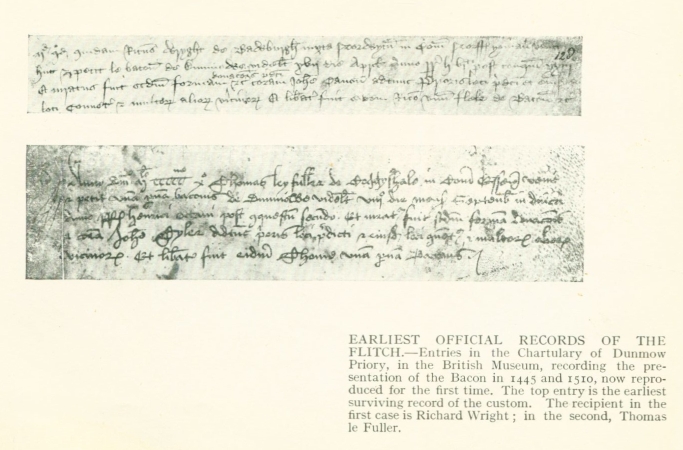
EARLIEST OFFICIAL RECORDS OF THE FLITCH.—Entries in the Chartulary of Dunmow Priory, in the British Museum, recording the presentation of the Baron in 1445 and 1510, now reproduced for the first time. The top entry is the earliest surviving record of the custom. The recipient in the first case is Richard Wright; in the second, Thomas le Fuller.
TWO BACON RECEIPTS.
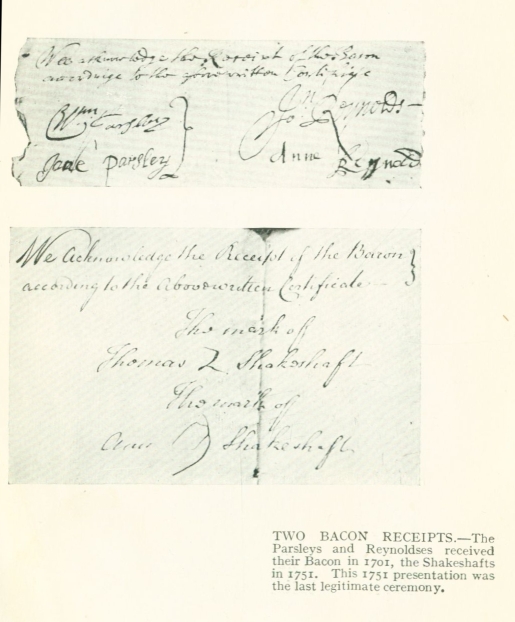
TWO BACON RECEIPTS.—The Parsleys and Reynoldses received their Bacon in 1701, the Shakeshafts in 1751. This 1751 presentation was the last legitimate ceremony.
The Strange Story of the Dunmow Flitch
By
J. W. ROBERTSON-SCOTT ("HOME COUNTIES")
WITH 34 ILLUSTRATIONS
Nil nisi jurantibus ("Nothing unless you are able to swear") —Motto of a former Dunmow Lord of the Manor
Two Shillings
DUNMOW: D. CARTER
TO H. W. W. H.
CONTENTS
Twas thought a sumptuous treat On Birthdays, Festivals, or Days of State, A salt dry Flitch of Bacon to prepare. —Congreve.
INTRODUCTION
CHAPTER I
A Narrative of Nine Hundred Years
CHAPTER II
The Priory and the Rhymester
CHAPTER III
A Yeoman, a Husbandman and Thomas le Fuller
CHAPTER IV
The Vanished Cloisters
CHAPTER V
A Tale of Tyranny and War
CHAPTER VI
The Jury of Spinsters
CHAPTER VII
—And Bachelors
CHAPTER VIII
The Bacon Refused
CHAPTER IX
Enter The Novelist
CHAPTER X
The Winners of the Bacon
CHAPTER XI
The Scene at the Modern Ceremony
CHAPTER XII
Another Flitch Custom
CHAPTER XIII
The Bacon Over Sea
APPENDIX
The Last Prior and the "Fair Matilda"
LAST LEGITIMATE PRESENTATION OF THE BACON.
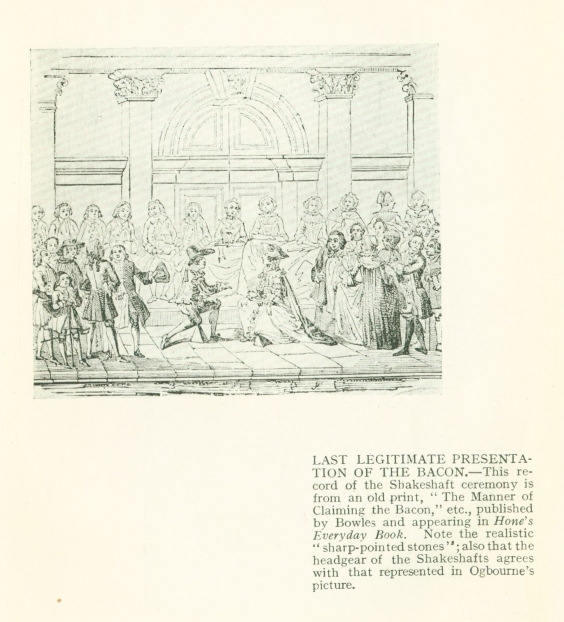
LAST LEGITIMATE PRESENTATION OF THE BACON.—This record of the Shakeshaft ceremony is from an old print, "The Manner of Claiming the Bacon," etc., published by Bowles and appearing in Hone's Everyday Book. Note the realistic "sharp-pointed stones"; also that the headgear of the Shakeshafts agrees with that represented in Ogbourne's picture.
PROCESSION AT THE LAST LEGITIMATE PRESENTATION OF THE BACON.
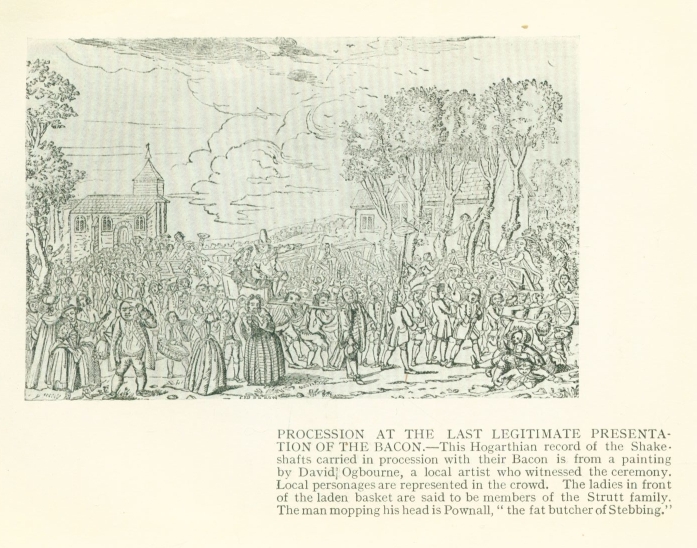
PROCESSION AT THE LAST LEGITIMATE PRESENTATION OF THE BACON.—This Hogarthian record of the Shakeshafts carried in procession with their Bacon is from a painting by David Ogbourne, a local artist who witnessed the ceremony. Local personages are represented in the crowd. The ladies in front of the laden basket are said to be members of the Strutt family. The man mopping his head is Pownall, "the fat butcher of Stebbing."
INTRODUCTION
Although, as in duty bound, a member of his county Archæological Society, no claim to what may be dignified by antiquarian research is made by the Author of this modest publication.
If he is entitled to any credit at all, it can be merely in respect of the fact that (in addition to making the best use of the historical stores and constant kindness of Mr. Hastings Worrin), he has regarded it as a kind of minor act of local patriotism to try to gather together and set forth, in as simple and attractive a fashion as possible, such data as, with a little trouble, may be collected concerning a Custom all the surviving records of which are of interest and importance to those who live in Great or Little Dunmow or their vicinity.
The subject has, however, a wider appeal. It is so familiar that throughout the land there can be few persons who have never heard of the Dunmow Flitch. It is so old as to be enshrined, for as long as English Literature shall endure, in Chaucer and Langland.
It is proper to mention, perhaps, that most of the subjects illustrated have not before been photographed for publication.
For corrections or for any light on difficulties still confronting the historian of the Flitch, the Author will be greatly obliged.
In order to save labour to other students of the subject, he may perhaps mention that he has searched the following MSS. at the British Museum: "Registrum Cartarum Prioratus de Dunmawe," "Exscripta è Chronico de Dunmow," "Collectanea ex Chronico de Dunmowe," "Excerpta ex Chronico de Parva Dunmowe," "Memorandum de Pernis, a Prioratu de Dunmowe," the household accounts of the last Prior of Dunmow, and "Transcripta ex Libro Rubeo in Scarrario," and has glanced through certain Court Rolls. One list of presentations of the Bacon (which appears in Leland) is described in the catalogue at the British Museum as "perhaps a fragment of some larger work on the subject." Does it still exist?
GREAT CANFIELD, DUNMOW. Christmas, 1909.