Chapter XIII · The Bacon Over Sea
Reading edition
A few years ago Mr. Hastings Worrin, J.P., a churchwarden of the Priory Church of Little Dunmow, and a well-known collector of memorials of the Bacon ceremonies and of the old Priory, to whom the writer of this record is greatly indebted, received a letter addressed to "The Prior of Dunmow." It was from a New York lawyer and his wife, also a member of the legal profession, who had had a little Flitch celebration on their own account, and seemed to think (as the Times of August 21, 1803, actually did) that the old Priory still existed—
Whereas, (runs a little fly sheet which they issued to their friends) Girdwood Mulliner and Gabrielle his wife, in reverence for the old tradition, its quaint basic thought so sweetly resting in the sanctity of the marriage relation, knowing in their hearts that they have earned the Flitch of Bacon by the sure right of their living, although far from the Priory and the pointed stones, do here and now kneel and lay claim to it—
I, Leslie Allen Wright, the chief attendant to the Bridegroom upon his day of wedding, praying a grace of pardon for usurping the Prior's rightful duty, yet feeling the fine prompting spirit of the ancient custom, do now bestow upon these two worthy persons, Walter Girdwood Mulliner and Gabrielle his wife, a Flitch of Bacon.
May they in all the added years of their life grow in Ripeness and in Spirit. Amen.
A Bacon custom in Brittany has been referred to. Mention may also be made of a German story, "The Man and the Flitch of Bacon"; also of the Flitch which hung in the old Red Tower of Vienna with doggerel below it which Dr. Bell has thus translated—
Is there to be found a married man That in verity declare can, That his marriage him doth not rue, That he has no fear of his wife for a shrew, He may this Bacon for himself down hew?
The tale goes that a would-be possessor of the Red Tower Bacon asked, when a ladder had been brought for his assistance, that some one should cut down the Flitch for him, as if he got a grease-spot on his best clothes his wife would scold him! Needless to say, this applicant was not allowed to have the Bacon.
Dr. Bell traces to the earliest times the origin of all customs of hanging up Bacon. Does not Dionysius Halicarnassus mention the presence of a fine Flitch in the chief temple at Alba Longa? Jewellers still sell as charms little pigs of gold, silver and bog oak, and in time past the side of what had once been a sow was no doubt displayed as an emblem of fertility.
APPENDIX The Last Prior of Dunmow
In the Manuscript Department of the British Museum one may turn over in Latin and in an old English transcript, the household accounts kept by Geoffrey Shether, the last Prior of Dunmow. During the last four years of the Priory's existence, 1531-5, that is up to the time of the dissolution of the minor monasteries, the Prior entered up his accounts every Sunday in a long narrow book such as one sees on bakers' counters.
The entries at the very end of the book are in regard to the payment to one "Purcas"—still a Little Dunmow name—"for iiij days' werke, xxd," and to two "labryng" men for their "werke." Earlier in the book a payment "to my stuarde for kepying of my Curte at Dunmowe" is chronicled. A large proportion of the expenses are in respect of farm work or stock. There is an entry more than once for "stoor bolox." On several occasions expenditure was incurred for the ringing of pigs and the destruction of rats. There are also various sums for work on the steeple.
The fishponds of our illustration do not appear to have yielded all the fish needed by the Priory, for there are two entries for "fyscche" bought. If there is no mention of Bacon, there are "rewardes for venison," and if no allusion occurs to the Flitch ceremony, it was not, apparently, because the Prior would have been above being interested in such a mundane thing, for twice or thrice he puts down "my costs at the feyr," and he gave a "reward to the Lord of Mysrule of Dunmow." Moreover, is there not an entry, "For sugar candy I bowte"?
THE WICHNOR FLITCH, SILVER RING, RELIQUARY, IMPRESSION
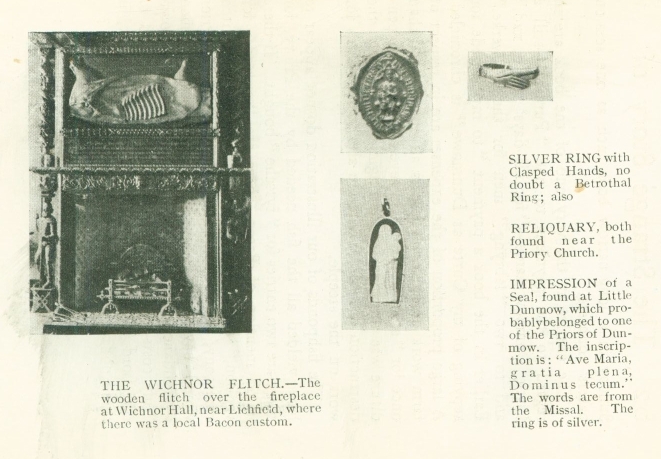
THE WICHNOR FLITCH.—The wooden flitch over the fireplace at Wichnor Hall, near Lichfield, where there was a local Bacon custom.
SILVER RING with Clasped Hands, no doubt a Betrothal Ring; also
RELIQUARY, both found near the Priory Church.
IMPRESSION of a Seal, found at Little Dunmow, which probably belonged to one of the Priors of Dunmow. The inscription is: "Ave Maria, gratia plena, Dominums tecum." The words are from the Missal. The ring is of silver.
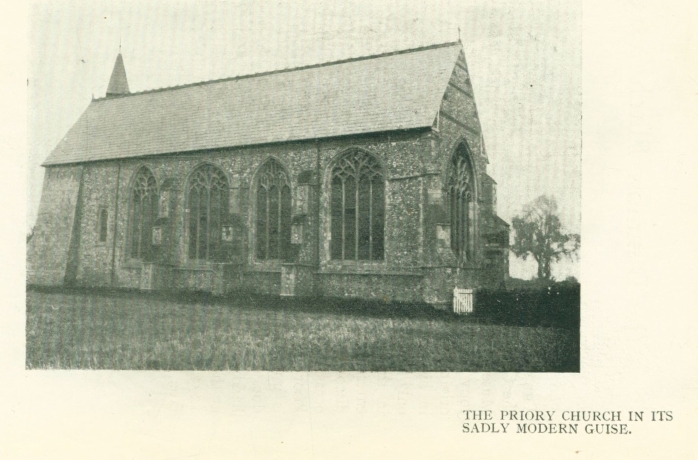
THE PRIORY CHURCH IN ITS SADLY MODERN GUISE.
The Fair Matilda
The story of the poisoning of the Fair Matilda is in the Cotton MS., Cleopatra, C. iii., folio 291 (British Museum), a sixteenth or early seventeenth century copy of or extract from the Dunmow Chronicle. The original of the Chronicle has not been traced. Tanner in his Notitia Monastica does not mention it, but only the Cotton MS. and the Harley MS. referred to in the Introduction to this booklet. The story is entered under the year 1211, in which "mota est discordia inter Regem Johannem et Barones suos occasione Matildis," etc. The Chartulary of Dunmow Priory (page 20), a register of charters, deeds, etc., is quite a different thing from the Chronicle, and does not contain the story. The Chartulary is in handwriting of the thirteenth century. The rubric at the beginning gives the date of its compilation as 1275. A few documents have been copied into it at later times.
The photographs of the effigies and of the chair in Little Dunmow Church are by Mr. F. T. Morris, of Felsted; of the modern trial scene and procession by Mr. R. Stacey, of Dunmow; of the Counsel for the Bacon by Mr. J. Willett, of Dunmow; of the rest of the subjects (with the exception of the manuscripts) by Miss Arundel, B.A., of Great Canfield, by kind permission of Mr. Hastings Worrin, J.P., of Little Dunmow, in whose possession they are. The photograph of carving in the Church was taken for Mr. Worrin. The photograph of the fireplace in Wichnor Hall is by Mr. J. S. Simnett, Guild Street, Burton-on-Trent.
For the List of Winners of the Bacon on page 47, we are indebted to the Misses Carter, Dunmow.
Butler & Tanner The Selwood Printing Works Frome and London