Types of English Beauty.
Reading edition
From Photographs by Alex. Bassano, Old Bond Street, W.
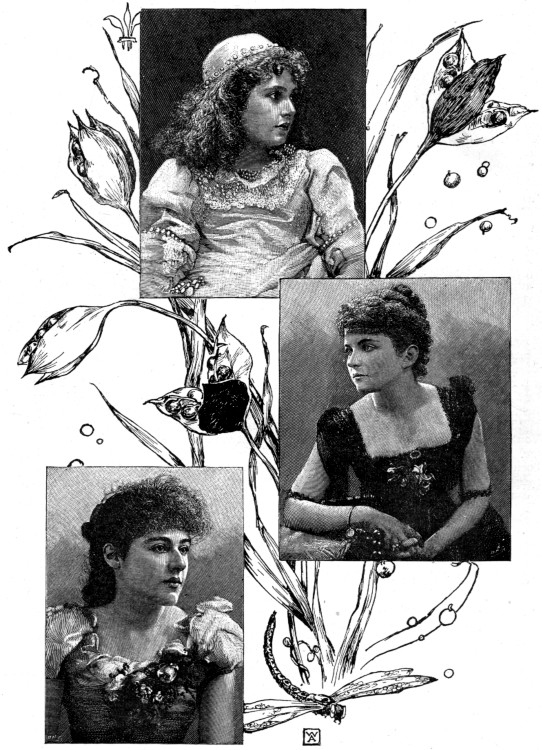
MISS LEE. MISS MENCE. MISS HAYTER.
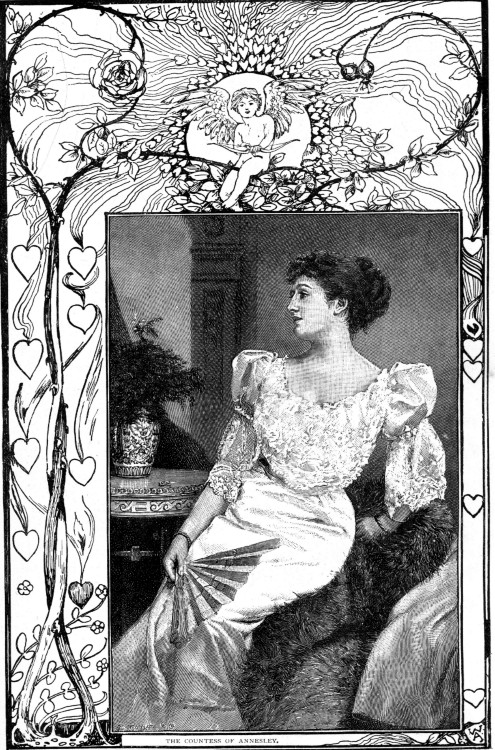
THE COUNTESS OF ANNESLEY.
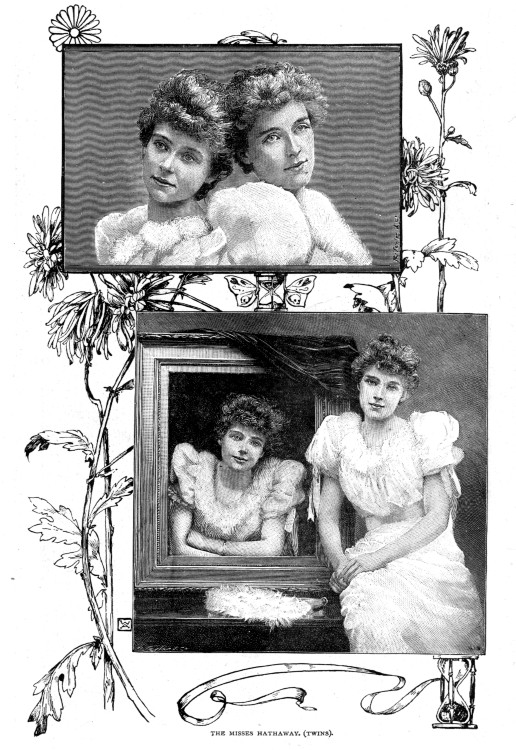
THE MISSES HATHAWAY. (TWINS).
'What's on the cards?' A question common enough when the actual knowledge of the moment does not afford a positive answer; a question, too, which has an origin taking us back to the earliest use of playing cards. But to how many of those to whom playing cards as a means of recreation are familiar is it known what may be found on the cards? Yet upon these "bits of painted cardboard" there has been expended a greater amount of ingenuity and of artistic effort than is to be found in any other form of popular amusement. Pope's charming epic, "The Rape of the Lock," gives us, in poetic form, a description of the faces of the cards as known to him and to the card-players of his time:—
FIG. 1.
"Behold four kings in majesty revered, With hoary whiskers and a forky beard; And four fair queens, whose hands sustain a flower, Th' expressive emblem of their softer pow'r; Four knaves in garbs succinct, a trusty band, Caps on their heads and halberds in their hand."
It is not our purpose to historically trace the evolution of cards—this is a subject beyond the reach of the present article—but a look farther afield will give us evidence that during the last three centuries there has been a constant adaptation of cards to purposes which take them beyond their intention as the instruments for card playing only. The idea that playing cards had their origin in the later years of Charles VI. of France may be disposed of at once as a popular error, though it is true that the earliest authentic examples which still exist are parts of the two packs of cards which were produced for the amusement of that King, by the hands of Jacques Gringonneur, and of which seventeen are preserved in the Bibliothèque Nationale of Paris.
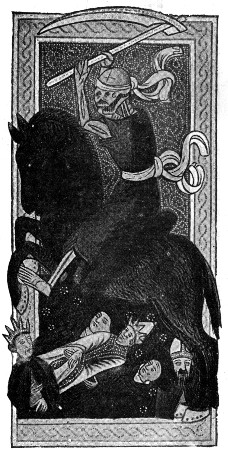
These are the most early forms of playing cards, and are known as "Tarots" (as distinguished from "Numerals," or cards which have the consecutively marked "suit" signs), and which had evidently a purpose outside the ordinary games of playing cards as known to us. The "Tarot" pack consists variously of seventy-two, seventy-seven, or seventy-eight cards, including the "Tarots," which give them their distinctive name. "Tarot" as a game was familiar three centuries ago in England, but is so no longer, although it has a limited use in other parts of Europe still. One of the "Tarot" cards, of the Bibliothèque Nationale, "La Mort," is shown as the first of our illustrations (Fig. 1).
FIG. 2.
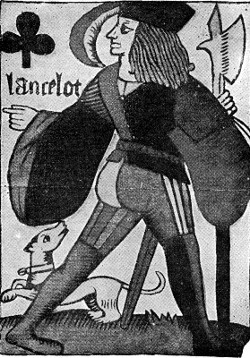
FIG. 3.
Familiar to those who are conversant with the literature of playing cards will be the Knave of Clubs, shown in Fig. 2, which is one of the fragments of a pack of cards found, in 1841, by Mr. Chatto, in the wastepaper used to form the pasteboard covers of a book. These cards are printed in outline from wood blocks and the colour filled in by stencilling, a method employed in the manufacture of cards down to a very few years ago. The date of these cards may safely be taken as not more recent than 1450, and they are most interesting as being coeval with, if not antecedent to, the most early form of printed book illustration as shown in the "Biblia Pauperum."[B] The archaic drawing of the features, with its disregard of facial perspective, and the wondrous cervical anatomy, do not lessen our admiration of the vigour and "go" shown in this early example of the art of the designer and wood engraver.
It is in interesting relation to the knaves of a pack of cards to note the curious conservatism which has belonged to them during the last four centuries and a half. In a MS. in the British Museum, written in the year 1377, the monkish writer, in a moralization on the life of man, suggests its resemblance to a game of cards; and he gives us a description and the attributes of some of the cards. Of those which we now know as knaves, he says two of them hold their halberds or arms downwards and two of them upwards—a distinction which is retained on many of the playing cards still manufactured.
FIG. 4.
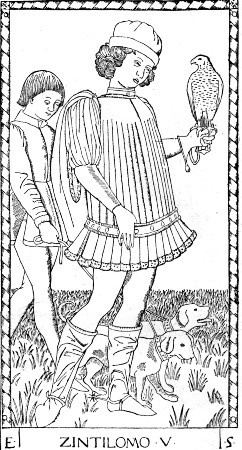
In Fig. 3 we have one of the cards from a series of "Tarots" of Italian origin, also preserved in the Bibliothèque Nationale, and which may be dated about 1470. These are very beautiful in design, and indicate that they were thought worthy of the employment of the highest artistic talent.
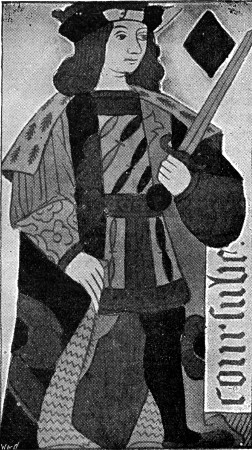
We have an example of a somewhat more modern date in the Knave of Diamonds (Fig. 4), in which the costume and character point to the early part of the sixteenth century as the period of their production. This also is from a fragment discovered in the boards of an old book—a source which may be commended to the watchfulness of the bookbinder, as the bindings of old books are still likely to provide other interesting examples.
FIG. 5
Before us are parts of two packs of cards which were discovered in Edinburgh, in 1821, pasted up in a book of household accounts, one of its leaves bearing the date of 1562; and it would be no great stretch of fancy to believe that they were taken to Edinburgh by some follower of Mary Queen of Scots on her return to Scotland a year before this date. These cards are of Flemish make; on one of them is the name "Jehan Henault," who was a card-maker in Antwerp in 1543, and in passing we may remark that at this period there was a considerable trade between London and France in playing cards of Flemish manufacture. Old playing cards may be looked for in most unlikely places; a few years ago two nearly complete packs were found wedged in an old cross-bow, for the purpose of securing the bow where it had worked loose in the head; they were of sixteenth century manufacture, and had doubtless been the means of relieving the tedium of many a weary watch or waiting, in field or fortress, before they found their resting-place of a couple of centuries in the obsolete missive weapon where they were discovered.
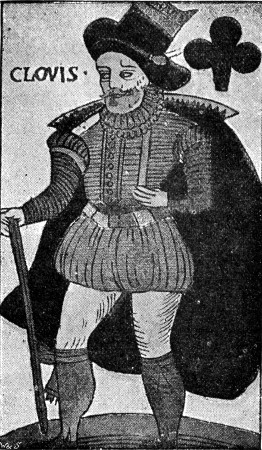
We find on many cards some attempts at portraiture. Thus we have in Fig. 5 Clovis as the King of Clubs, but depicted in a costume of the time of Henry IV. of France, the card itself being of that period. This, as well as Fig. 4, is from a pack of fifty-two "Numeral" cards, printed from wood-block and stencilled in colour.
FIG. 6.
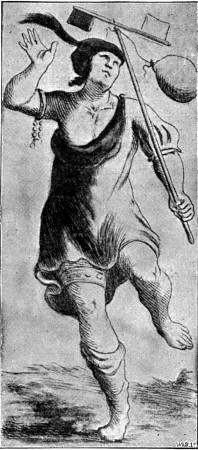
Returning to "Tarots," we have in Fig. 6 (Le Fou) one of the cards designed by Mitelli about 1680, it is said to the order of a member of the Bentivoglio family (parts of whose armorial bearings are to be found on many of the cards), for the "Tarrocchini di Bologna," a special form of the game of Tarot, a series of spirited designs of vigorous and careful drawing, and the most artistically valuable of any of the Tarots with which we are acquainted. In them not only the Tarot series but the ordinary suits display a quaint conception and generally elegant design.
It is curious to note that in the eleven packs or parts of packs of these Bolognese cards which we have met with in various parts of Europe there is not any uniformity of manufacture, but while the designs are the same and evidently produced from the same copper plates, the making of them into cards for the purpose of play bears indication of what might be termed a "domestic" manufacture. For some time the game was interdicted in Bologna, and it is possible that this may have induced a surreptitious production and illicit sale of the cards. Fortunately, the interdict did not prevent the preservation to us of this interesting series.
FIG. 7.
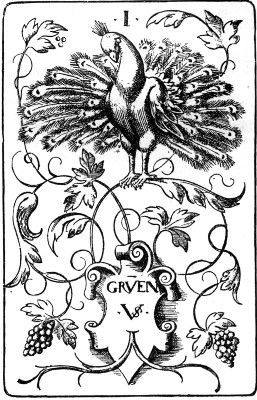
At different periods between the sixteenth and nineteenth centuries, but notably in the two earlier of them, card "suits" have been used other than the familiar ones of Hearts, Spades, Clubs, and Diamonds, and much ingenuity and imagination have been exercised upon them. Among the most beautiful of such cards we take the set designed and engraved by Virgil Solis, the celebrated Nuremberg artist and engraver, in which the suit signs are Lions, Peacocks, Monkeys, and Parroquets. In Fig. 7 we have the Ace of Peacocks. The aces are lettered with the distinctive suit-titles of the German cards, viz., "Grun," "Eicheln," "Schellen," and "Herzen." The pack consists of fifty-two, divided into four suits of thirteen cards each; the date of these cards is between 1535 and 1560, and they are an important and valuable item in the artistic history of playing cards.
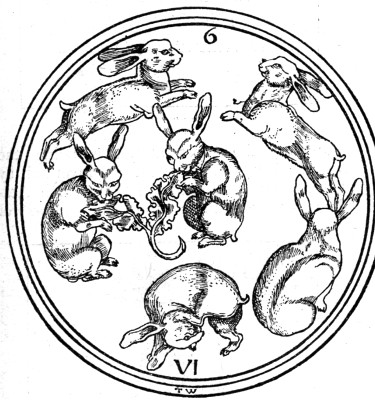
Another example of this variation in the suit signs, as well as of a variation from the ordinary rectangular form, is to be found in the round card (Fig. 8), of a somewhat earlier date than the preceding, where the suits are Hares, Parrots, Pinks, and Columbines, and which when complete make also a pack of fifty-two, the value of the cards following the sequence of King, Queen, and Knave being indicated by the Arabic numeral at the base of and the Roman figure at the top of each, the card shown being the Six of Hares.
FIG. 8
In both of them there is a great decorative facility and clever adaptation to the form of the card. To indicate the coincidence of idea, in the next (Fig. 9) we have a round card from India—one of the "Coate" cards of a pack, or more properly series, of 120 cards. The material used in their manufacture is matted vegetable fibre coated with lacquer and painted by hand. Most of the playing cards of Persia are also round, and are similarly decorated by the same means. About a dozen years ago round playing cards were patented in America as a novelty, in ignorance of the fact that cards of that shape had probably been in common use in the East, centuries before the discovery of that great and inventive country!
FIG. 9.
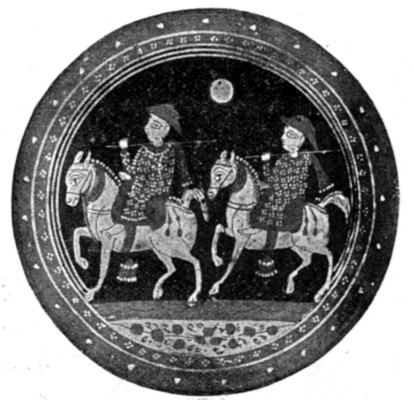
FIG. 10.
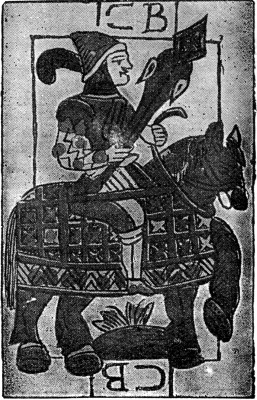
As an illustration (Fig. 10) of the suit signs of Southern Europe, we take a card from a Portuguese pack of 1610, the "Cavalier de Bâtons" (Clubs); the other suit signs are Swords, Coins, and Cups. The anatomy of the charger and the self-satisfied aspect of the Cavalier are striking; and as to the former, we are reminded of the bizarre examples of hippic adornment which, on a summer Bank Holiday, may be seen on the road to Epping Forest.
FIG. 11.
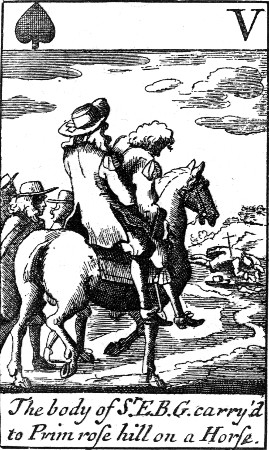
Among the secondary uses to which playing cards have been applied, we find them as political weapons. Among such cards are those which were produced to commemorate what is historically known as the "Titus Oates Plot" in 1678, one of the most prominent incidents being the murder of Sir Edmondbury Godfrey, who is here shown (Fig. 11), carried on a horse, the day after his murder, to Primrose Hill, where the body was put into a ditch, the carrying on the horse and the discovery in the ditch being shown as coincident. They were produced, probably, as one of the means of inflaming the public mind against the Roman Catholics, which led to the execution, among others, of the Viscount Stafford in 1680. As illustration of costume and of stirring incident, these cards are, apart from their intention, an admirable and interesting series, and are worth study from their historic and artistic aspects.
FIG. 12.
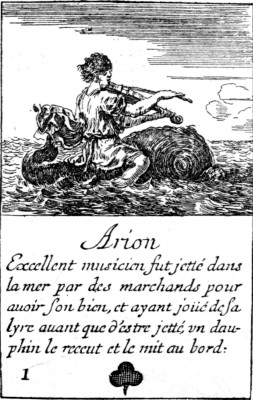
FIG. 13.
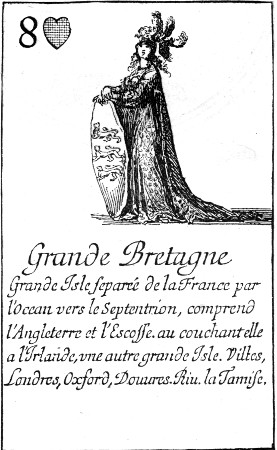
FIG. 15.
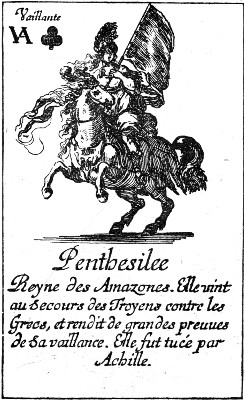
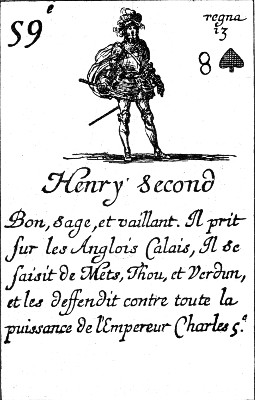
We come now to playing cards designed as methods of education, of which a considerable number have been produced—and which cover the widest possible range—from cookery to astrology! In the middle and latter half of the seventeenth century, England, France and Germany abounded in examples, the most attractive being the series of "Jeux Historiques," invented by Desmarests, a member of the French Academy acting under the instructions of Cardinal Mazarin—as aids to the education of the boy King, Louis XIV. In Figs. 12, 13, 14, and 15 are given examples from the four packs so designed, and they afford a good instance of the primary use of cards being subordinated to the educational. The first of these is the "Jeu de Fables," with representations and short notices of the heroes and heroines of classic history, the four Kings being Jupiter, Neptune, Pluto, and Saturn. The second is the "Jeu de Geographie," the four suits being formed by the division of the world into four quarters, each having its distinctive group of thirteen designs, with brief geographical descriptions; Great Britain being shown as the Eight of Hearts. If designed by an Englishman, it would surely have been as Queen of that suit that our country would have appeared. We have then the "Jeu de Rois de France," intended to teach the history and succession of the Kings of France, whom we find depicted in their numeric order, from Pharamond to Louis XIV., with the length of their reigns and short biographies.
FIG. 14.
The third and fourth of these packs are singular in consisting in the one case of all Kings, and the other of all Queens, in the "Jeu de Reynes Renommées," the famous Queens of history, from the Queen of Sheba downward, furnishing the design, and who are classified under the descriptions of Good, Wise, Holy, Clever, Brave, Happy, Cruel, Licentious, Capricious, and Unfortunate; our Queen Elizabeth being placed as "clever," and Mary Stuart as "unfortunate." They are beautiful examples of design and workmanship, and are the work of the Florentine artist-engraver, Stefano de la Bella.
(To be continued.)
FOOTNOTES:
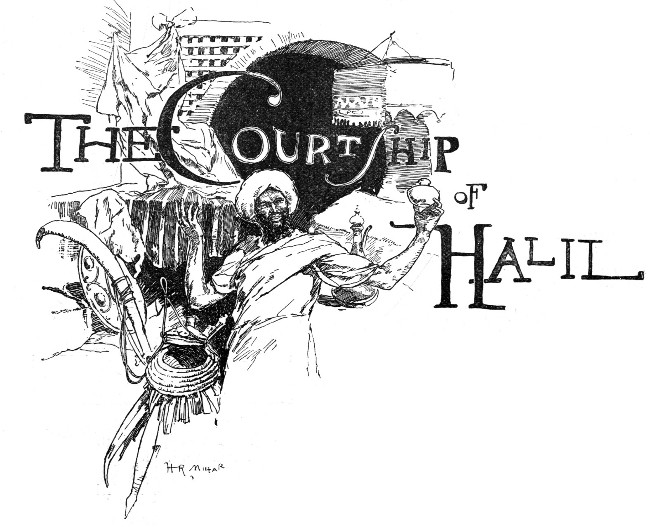
BY A. E. BURN.
When I went out to Egypt some years ago, I determined to devote myself to the study of Arabic, and not to rest till I could speak and write it like an educated native. This rash resolve, however, was made in ignorance of the sublime difficulties of this language, and after plodding at it with great vigour for a year, and acquiring some facility in speaking it, and the ability to read a sentence so as to sometimes get a faint glimpse into the meaning hidden behind the hieroglyphs which the Arabs call letters, I came to the conclusion that I had better rest on my laurels.
While my enthusiasm lasted I used to seize every possible opportunity of talking Arabic with any native I came across, and great was my disgust when, as sometimes happened, an Arab would persist in airing his English on me. As a rule, however, they were rather flattered by my evident desire to know their tongue, and some of the shopkeepers with whom I dealt would take a pleasure in teaching me new phrases.
One of these, by name Halil, who sold silks, shawls, etc., etc., and whose respect I had gained by some considerable purchases for friends in England, became quite intimate with me, and related to me a considerable portion of his own history and that of his family, and it was from him that I heard the following story of his courtship, which is not quite so prosaic and business-like as such affairs usually are in Mohammedan countries. His shop was in the silk bazaar at Cairo, and what first led to the subject was a sentence in Arabic written over it, which I had puzzled my brains in trying to read for some time before I at last managed to translate it. It ran as follows: "Long is the hair of woman, and long also is her understanding." This motto rather surprised me, as the Arabs have not, as a rule, that high opinion of the fair sex's understanding which it expressed, and I thought I could see the reason for a certain reluctance to assist me in translating it in the usually obliging Halil. After some evasive answers to my questions he took me into his confidence, and told me the following story in explanation of it:—
"I have already told you, Effendi, that my father died when I was eighteen years old, and that, being the only son, I became proprietor of this shop and the head of our household.
"I was not married, and had no wish to be, as I looked upon women with aversion and contempt, and was angry with my mother when she wished to get me a wife. I was encouraged in these ideas by an old man named Mahran Effendi, who had been a great friend of my father, and who still came in the evening to my house to smoke a nargileh with me. He had two wives, who gave him much trouble with their quarrels, and he used to say that women were created as a punishment for the sins of men, and to prevent them from being so much attached to this world as to be unwilling to leave it even for the joys of paradise, which, he said, would certainly be the case if there were no women. He repeated to me a sentence which he said was out of the Koran, though I have not seen it there myself. It was, 'Long is the hair of woman, but short is her understanding.'
"I was much struck with this, and repeated it to my mother with great pleasure, who was not so much pleased with it as I was. Indeed, she was quite angry, and said that Mahran was an old donkey, and the son of a donkey. I, however, had a higher opinion of the wisdom of my old friend, and, acting upon his advice, I determined to adopt this as my motto, and to paint it over my shop instead of the proverb which had been put there by my father. My motto made quite a stir in the bazaar for the first few days, and caused a good deal of amusement amongst the other shopkeepers and the passers-by. I have no doubt it was repeated in many of the harems also, for some of the women, who may have been teased about it by their husbands, reviled me as they passed.
"SHE GAVE ME A GLANCE OUT OF HER DARK EYES."
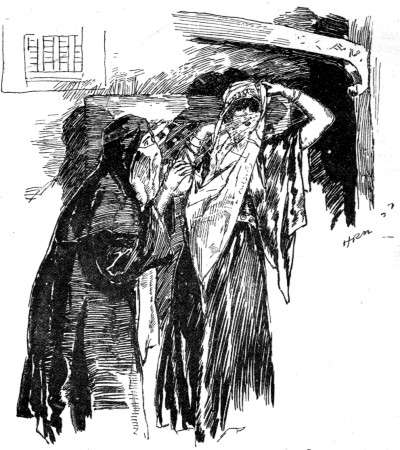
"One day, not long after this, two women entered my shop and asked to be shown some of my finest silks; so I took them into the inner part, where I keep the most costly of my goods. While they were examining them I noticed that one of them had eyes that shone like stars, and which she kept fixed on me even while she laughed and chatted with her companion. Then, in stooping to pick up one of the shawls, her veil by some means became detached and fell to the ground, and I saw the face of what I thought to be surely the loveliest houri ever seen by mortal man. She gave a little scream and called to her companion, who seemed to be her servant, to assist her to refasten it, but at the same time gave me a smile and a glance out of her dark eyes, which swallowed up all my dislike to women as the light of a taper is swallowed up in that of the noonday sun. I was so confused by the new emotions which possessed my soul, that when they departed, saying they would come again shortly to decide about the silk, I could not utter a word to detain them. Nay, by the beard of the Prophet, I could do nothing but gaze at the houri till she was out of my sight. For three long days I waited in vain for their return. At last my heart began to be sick within me, and I feared I should never again behold the lovely maiden who had bewitched my soul, when on the fourth day I saw two females approaching, and I recognised that the slighter of the two was she. I had provided myself with several gold pieces, and was ready to give them all, if necessary, to make the attendant my friend. As soon as they had entered, and I had brought forth my silks, I drew this woman aside, and slipping one of the gold pieces into her hand, disclosed to her my passion for her mistress, and begged her to tell me who she was. The woman seemed inclined to laugh at first, but when I had finished became grave and said in a low voice, 'My young mistress looks upon you with favour; but, alas! her father, the Sheikh Abdu Hassan, is so mean that he cannot bear the thought of his daughter marrying, on account of the dowry he would be expected to give with her, and he will not even allow her to see any visitors, lest her beauty should become known, and he tells all who ask for her that she is very ugly and ill-tempered, so no one will marry her on that account; but if you love Khadijah, my mistress, go to the Sheikh and say that you will take her without any dowry, and then he will, perhaps, be tempted to give her to you.'
"When she had told me this, she went back to her mistress, and they both hastily departed.
"I shut my shop an hour earlier that day, and, on arriving home, told my mother all that had happened. She was very much astonished, and could not understand why, after refusing to have a wife for so long, I was now so anxious to have one without a dowry. She tried to dissuade me, but I paid no heed to her words, and went that same evening to the Sheikh, whom I fortunately found alone. I told him who I was and what my possessions were, and that I wanted a wife; but, as I had no one to speak for me—my father being dead—I had come myself to ask him for his daughter.
"He listened quietly, with his eyes fixed on my face, and when I had finished, said:—
"'Alas! my son, the girl Khadijah is ugly, and has the temper of a mule.'
"'For these things, O Sheikh,' I replied, 'I care not.'
"'You think you will get a heavy dowry with her,' he said, coldly; 'it is for that you have come.'
"'I swear by the holy Prophet,' I cried, 'that I want the girl and not the money. Nay, I will even take her without a single piastre, to prove it.'
"At these words his eye brightened, and on my promising that no one should know that I was not to receive a dowry with her, he embraced me, saying, 'She is yours, my son,' and the matter was settled.
"A SHARP-FACED, UGLY WOMAN".
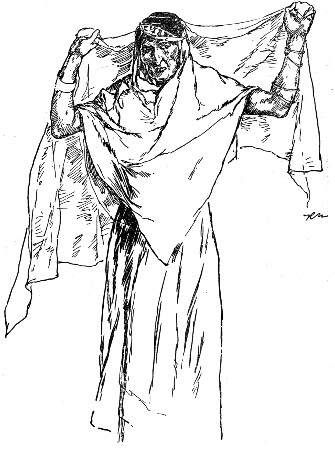
"Of course, I did not see my bride till we were married, which we were in seven days. What was my horror when, after the ceremonies were over and my wife unveiled, I beheld, instead of the lovely girl who had come to my shop, a sharp-faced, ugly woman with a sour expression. I was dumb with amazement; but, by a great effort, I controlled my temper, and pretending to seem satisfied with my bargain, inwardly resolved to find out why I had thus been duped. My wife soon showed her temper, and quarrelled with my mother the very first day. She seemed to think she had married beneath her, and to show her superiority, began to ill-treat the servants, and usurped my mother's place in the house.
"Some days after my wedding I was in my shop as usual, when the two women appeared as before. I immediately beckoned them to follow me into the inner part. As soon as we were there I turned to the false Khadijah, and almost choking with anger I asked her why she had brought this curse upon my life.
"'What have I ever done to you that you should make such a day of pitch for me?' I cried.
"She laughed heartily, and her old servant followed her example. I was just about to burst forth into a torrent of invectives when she threw off her veil and, laying her hand on my arm, said softly, 'I have done this, O Halil, to show you that the motto over your shop is not true, and that the understanding of woman is as long as her hair. I will show you a way by which you can divorce your wife without offending her father, but on one condition only.'
"CHANGE THE MOTTO OVER YOUR SHOP."
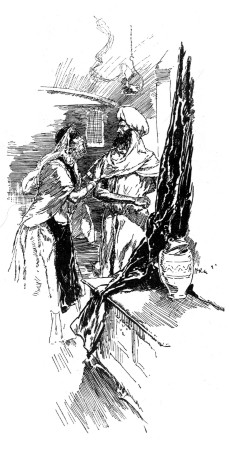
"'It is granted,' I cried, 'if I come freely out of this.'
"'Change, then, the motto over your shop, and put instead, "Long is the hair of woman, and long also is her understanding,"' she said, almost fiercely.
"'But I shall have the whole bazaar laughing at me,' I cried, aghast at this proposal. 'I will take it away and restore my father's proverb if you will help me, and will give you as much jewellery as you shall ask, but I cannot change the motto to what you say.'
"'Jewellery is nothing to me,' she said, scornfully. 'Change the motto to what I have said, or keep your wife, I care not which.' Upon this she veiled herself and was going away, but I detained her and said, 'O maiden, you have asked me a very hard thing; but I will do even this if you will rid me of this woman, and tell me in truth who you are, so that I may have you for myself.'
"She promised she would, and made me swear by the sacred window of the Prophet that I would change the motto to her liking the day after I should be married to her. She then went away, saying she had stayed too long already, but that she would send her servant the next day, who would tell me her plan.
"On my return home that evening my mother met me with many complaints of the behaviour of my wife, who had abused her during my absence, and she ended by bewailing that I had not let her choose a wife for me.
"The next day the servant appeared, and after telling me who her mistress really was, thus unfolded her plan:—
"'To-morrow evening you must meet your father-in-law at the coffee-house he frequents, and in the meantime collect some of the poorest and lowest men you can find, and promise them a good backsheesh if they will obey the orders you will give them, which are these: While you are at the coffee-house the oldest man of them must come in and sit by your side, and call you his dear nephew, and say he hears that you have made a rich marriage, and that he hopes you are not going to slight your own relations in consequence. The other men must follow his example, and say much the same thing, but call you cousin, brother-in-law, or friend.
"'The old Sheikh, who is very proud of his family, will want you to divorce his daughter at once, but you must pretend you are too satisfied with her to do that, and from threats he will come to entreaties, and will at last want to bribe you. Not till then must you yield, and when you do, it must be with apparent reluctance.'
"I SAW DISGUST AND DISMAY RISE IN ABDU HASSAN'S FACE."
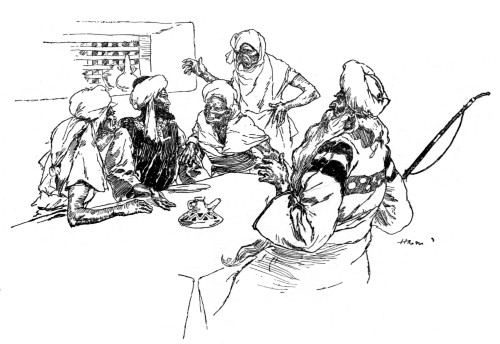
"I was overjoyed at this plan, and bestowed one of my brightest shawls on Fatima, who went away promising to come soon again and see how I had got on. I told my mother of the plan, which comforted her a good deal, and on the next evening I carried it out. I saw disgust and dismay rise in Abdu Hassan's face when we were at the café and the first dirty old beggar came up to me and addressed me as his nephew, which became mingled with rage when another ragged fellow came up to congratulate his cousin, as he called me; but when two more supposed cousins had joined us, even dirtier than the others, he could contain his feelings no longer, and turning to me, cried: 'Is it true, O Halil, that these sons of dogs are indeed your relations?'
"'Yes, O Sheikh,' I said, humbly. 'Be not displeased with me; a man must not disown the brother of his father, or the sons of his father's sister, even though they be poor.'
"'Poor!' he roared. 'Poor! They are not only poor, but they are sons of pigs. Give me back my daughter. She shall not stay with you to be the mother of dogs!'
"'You cannot take her away unless I divorce her,' I replied, calmly, 'and that I will not do, for I love the girl.'
"At this he began to entreat me, offering me at first four purses of silver, and at last offered me the same number of purses filled with gold, to which I consented, with apparent reluctance.
"He made me divorce her that very evening, for divorce, as you know, Effendi, is very easy with us; and a week afterwards I altered the motto over my shop door to what it now is, for Ayesha (that was her true name) was mine."
As Halil finished his story, I became aware that he had another listener in the shape of a little urchin, clad in a brightly coloured gown, which reached to the ground, and who wore, perched on his closely-shaven head, a small tarboosh. He had appeared from some corner of the shop, and now sidled up to Halil, his bright black eyes fixed on my face.
"See, Effendi," said Halil, with a proud smile, "this is the eldest of my five boys."
After I had rejoiced the eldest son's heart with a small "backsheesh," I took leave of Halil with many friendly salutations, and a pressing invitation on his part to come again soon.