A Little Surprise.[A]
Reading edition
A Little Surprise.[A]
Adapted from the French of Abraham Dreyfus
By Constance Beerbohm.
Characters:
Sir William Beauchamp, Bart. (43). Lady Florence Beauchamp (39). Kate Dugdale (18). Mr. James Dugdale (23). Porter, the Lady's-maid (30).
Scene: A country drawing-room. A French window opening on to a flower garden at the back of the stage. Doors right and left. A sofa, arm-chairs, smaller chairs, etc.
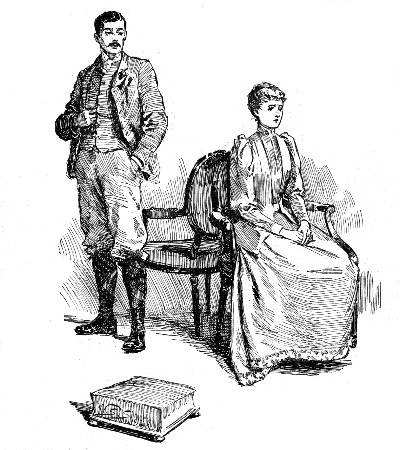
At the rise of the curtain, Jem and Kitty are discovered sitting with their backs to one another, evidently sulking. Jem looks round every now and then, trying to catch his wife's eye, and she studiously avoids his glance. At length their eyes meet.
Jem (rises): No! I tell you I can't stand it!
Kitty: And why not? I always went out with the guns at home.
Jem: "At home" and your husband's house are two very different places.
Kitty: So I find!
Jem: And I have told you over and over again I detest to see any woman—more especially a girl of eighteen, like yourself—tramping over the moors in gaiters, and a skirt by a long way too short!
Kitty: Perhaps, with your old-maidish ideas, you would like to see me taking my walks abroad with a train as long as my Court frock!
Jem: Perversity!
Kitty: I only know that papa, mamma, and grandmamma always said——
Jem: Ah! But your grandmother——
Kitty: How dare you speak in that way of dear grandmamma?
Jem: I never said a word against her——
Kitty: But you were going to!
Jem: Nothing of the sort.
Kitty (repeats): I only know that papa, mamma, and grandmamma always said——
Jem: Oh, Heavens! (He escapes.)
Kitty: Was ever anyone so wretched as I? Only three months married, and to find my husband an obstinate, vindictive, strait-laced country bumpkin! Well, not a bumpkin perhaps, after all, but almost as bad as that! Why, oh! why did I leave my happy home, where I could do what I liked from morning till night, and no one was ever disagreeable to me? And yet during my engagement what a lovely time I had! Jem seemed so kind and gentle, and promised me he would never say a cross word to me! He declared our married life should be one long sunshiny summer day; whilst I promised to be his little ministering angel! I reminded him of that yesterday. And what did he say? That he had never thought a little ministering angel could be such a little brute! I can hardly believe he is the same man I used to love so dearly! (Exit in tears.)
(After a moment, Porter, the lady's-maid, enters, ushering in Lady Florence Beauchamp.)
Lady Flo: Your mistress is not here, after all, Porter?
Porter: No, milady! Yet I heard her voice only a few moments ago.
Lady Flo: Well then, Porter, you must go and tell her a lady wishes to speak with her in the boudoir, and be sure not to say who the "lady" is, however much she may ask. I wish this visit to be a little surprise to her. Nor must you mention that Sir William is here.
(Enter Kitty, with traces of tears on her face.)
Lady Flo: Kitty, darling, Kitty!
Kitty: Aunty! Can it be you? This is delightful! (They embrace.)
Lady Flo: I'm glad you call it delightful! I came here as a little surprise to you; but I daresay you will think me a great bore for taking you by storm, and interrupting your tête-à-tête with Jem.
Kitty: Oh! far from it! I am only too, too happy you've come!
Lady Flo: Is that the real truth?
Kitty: Indeed, it is!
Lady Flo: I thought I should find you as blooming as a rose in June; but you are not quite so flourishing as I expected. Those pretty eyes look as if—as if—well, as if you had a cold in the head!
Kitty: They look as if I had been crying, you mean! And so I have. (Bursts into tears afresh, and throws herself into Lady Flo's arms.)
(Enter Sir William and Jem, the former standing amazed. Kitty, leaving Lady Flo's arms, throws herself into those of Sir William, with renewed sobs. Sir William turns in surprise to Jem. Lady Flo looks down in embarrassment.)
Jem: Oh! yes, Kitty! This is all very well. Why not tell them I'm a monster at once?
Kitty: And so you are!
Jem (aside): Have you no sense of decency?
Lady Flo (aside): This is truly shocking.
Sir W. (aside): Good Heavens!
Kitty: Is it my fault that my uncle and aunt are witnesses of your ill-temper?
(Enter Porter.)
Porter: Your ladyship's trunks have just arrived from the station.
Lady Flo (hesitating): Let them be taken back again.
Sir W.: We had intended staying but an hour or two.
Jem (to Sir W.): But I beg you to stay.
Kitty (to Lady Flo): Never were you so much needed.
Jem (to Porter): Let her ladyship's trunks be taken to the Blue Rooms.
Kitty: Not to the Blue Rooms. They are quite damp. (To Jem) I may speak a word in my own house, I suppose? (To Porter) Let the trunks be taken to the Turret Room.
Jem: The chimneys smoke there.
Kitty: Excuse me. They do not.
Jem: Excuse me. They do.
Sir W.: They smoked once upon a time, perhaps, but may not now.
Porter: Where may I say the luggage is to be carried?
Jem: Take your orders from your mistress.
Kitty: No! From your master!
Jem (to Kitty): Spare me at least before the lady's-maid!
Kitty (to Jem): Oh! nobody knows better how you behave than Porter. Our quarrels are no secret from her.
Jem: That must be your fault. How can she know of them but from you?
Kitty: I tell her nothing. But your voice would reach to the ends of the earth.
Jem: As for yours—why——
Kitty: Grandmamma always said my voice was the most gentle she had ever heard.
Jem: But, then, your grandmother——
Sir W. (to Lady Flo): I really think we had better leave, after all.
Lady Flo (affectionately): No! dearest Will! I really think we had better stay.
Sir W.: For my part——
Lady Flo: I tell you we must stay.
Sir W.: Very well, Flo, as you wish. You always know best. (They exchange smiles.)
Lady Flo (to Jem): Kitty will take me to my room. So I leave my better half in your good company. (Exit with Kitty.)
Sir W.: I can't help regretting I came here, old fellow. It was your aunt's idea. I made objections. But she insisted that you'd both be glad enough to have a little interruption in your honeymoon.
Jem: She never said a truer word.
Sir W.: Then the honeymoon is not so great a success, after all?
Jem: To tell the truth, it's all a ghastly failure!
Sir W.: Poor boy! Believe me, I'm awfully sorry for you. (Puts his hand on Jem's shoulder.)
Jem: I'm awfully glad you're sorry.
Sir W.: I pity you from my heart.
Jem: Thanks very much.
Sir W.: For my part, if I led a cat-and-dog life with your aunt, I should wish to blow my brains out.
Jem: So that's the advice you give me! (Moves towards door.)
Sir W.: Oh! no! All I want is five minutes' chat with you. Anything that affects Flo's niece naturally affects me.
Jem: Naturally. (Laughs.)
Sir W.: Now come! Tell me! How did your misunderstandings begin?
Jem: I really couldn't say.
Sir W.: And yet quarrels always have a beginning.
Jem: Of course, when women are so confoundedly selfish.
Sir W.: Kitty is selfish?
Jem: I don't want to make any complaints about her. Yet I must admit that she takes absolutely no interest in anything which interests me. You know my hobby—fishing——
Sir W.: And Kitty doesn't care for fishing?
Jem: Not she! Though, finding myself here, surrounded with trout streams, you may imagine how I was naturally anxious to spend my days. Kitty said fishing was a bore, and after having come out with me once or twice, she sternly refused to do so any more. And why? Simply because she wanted to tramp about with the shooters from Danby.
Sir W.: All this is but a trifling dissimilarity of taste, and insufficient to cause a real estrangement.
Jem: A trifling dissimilarity! Why, our tastes differ in every essential point! Kitty has got it into her head that a woman should take an interest in things "outside herself." A friend of her mother's, who used to conduct her to the British Museum, taught her to believe in Culture—with a capital "C." To hear her talk of Pompeiian marbles, Flaxman's designs, and all that sort of thing—why, it's sickening!
Sir W.: It strikes me you are unreasonable.
Jem: Oh, no! I'm not! A woman who takes an interest in things outside herself becomes a nuisance.
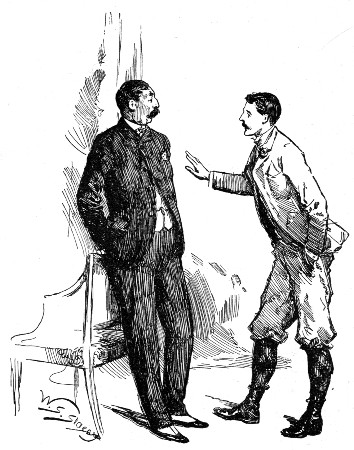
SIR W.: "IT STRIKES ME YOU ARE UNREASONABLE." JEM: "OH, NO! I'M NOT!"
Sir W.: And yet I believe that with a little tact, a little gentleness, you would be able to manage Kitty, just as I have managed your aunt all these long years. There is no doubting the dear girl's affection for you. Remember her joy when her mother's scruples as to the length of your engagement were overcome.
Jem: That's true enough. Kitty was very fond of me three months ago. But it isn't only fondness I require of a wife. She must be bored when I'm bored, and keen when I'm keen, and that sort of thing, you know.
Sir W.: Yes! I see. In fact, lose her identity, as your dear good aunt has lost hers!
Jem (aside): Or, rather, as you have lost yours!
Sir W.: Well, I'll try and view things in your light, my good fellow. At the same time, you must have great patience—very great patience, Jem, and then all may come right in the end. It is true I never needed patience with your aunt. But had there been the necessity, I should have been equal to the demand. Now, I daresay your little quarrels have been but short lived; and that after having caused Kitty any vexation, you have always been ready to come forward with kind words to make up your differences?
Jem: Yes, ready! But not too ready, as I feared too much indulgence might not be advisable. Now, one morning, after having been out early, I determined to give up fishing for the rest of the day to please Kitty. On my way home—remember, it was before eight o'clock—I met her betaking herself to what she calls "matins." Now, I like a girl to be good and strict, and all that sort of thing. But imagine going to church at eight o'clock on a Monday morning!
Sir W.: A slight error in judgment; you might easily forgive the dear child.
Jem: I didn't find it easy. I said so. And Kitty refused her breakfast in consequence—only to aggravate me.
Sir W.: No! No! Perhaps she fasted only to soften your heart!
Jem: Far from it. In fact, to sum up the whole matter, we have no common sympathies. Kitty has not even any ambition, for instance, as to my future. You know I wish to stand for Portborough one day?
Sir W.: You!!
Jem: Why not?
Sir W.: Oh, no! Of course! Why not, as you say?
Jem: Yet if I begin to discuss it all with her, she begins to yawn; and her yawning drives me nearly mad, when I am talking on a matter of vital interest.
Sir W.: Dear! Dear! I begin to find all this more serious than I thought. For it does seem to me as if you differed on most subjects.
Jem (moodily): So we do.
Sir W.: Ah! I am afraid it may be pretty serious! And after listening to all your story I can't help feeling, my dear fellow, that there is not the chance of things bettering themselves, as I had hoped in the first instance.
Jem: You feel that?
Sir W.: I do! I do! This divergence of taste and sympathies is no laughing matter. It rather alarms me when I think that the abyss between you and your wife as time goes on may only widen. (He indicates an imaginary abyss, which Jem stares at dubiously.) Yes! widen—and widen!
Jem (after a moment's pause of half surprise, half pain): What you say is not consoling.
Sir W.: At first I thought differently; but now I hesitate to mislead you, and I admit my heart sinks when I think of your future, after hearing all you have to say. Indeed, I hope I may be mistaken. I have, as you know, but little experience in these matters. Your aunt and I have lived in undisturbed harmony these fifteen years. Never has an angry word been heard within our walls.
Jem: Whilst Kitty and I squabbled as soon as we had left the rice and slippers behind us! And since then scarcely an hour has passed without some sort of difference. I declare, when I think over it, that it would be best for us to plunge into the ice at once. A separation is the only hope for us. But, hush! I think I hear Aunt Flo's and Kitty's footsteps! (Lowers his voice, speaking rapidly) For Heaven's sake, don't breathe a word of what I have said! Fool that I've been! Worse than a fool—disloyal! Not a word to my aunt!
Sir W.: Oh! I promise you! (Mysteriously into Jem's ear) Women are so indiscreet. Now, I wouldn't tell your aunt for the wide world!
(Enter Lady Flo and Kitty, who have overheard the last words.)
Lady Flo (icily): I beg pardon! We interrupt!
Jem: Not at all! We were merely discussing the relations of man and wife! Uncle Will has been telling me that a wife—you, under the circumstances—has everything in her own hands.
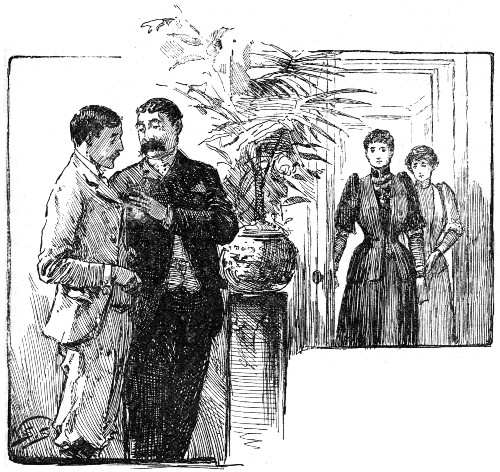
SIR W.: "WOMEN ARE SO INDISCREET."
Lady Flo (flattered): Indeed!
Kitty: Indeed! I must say that no one could appreciate Aunt Flo's virtues more than I, although at the same time I am certain she would very soon have lost her sweet temper if her husband had been aggravating, ignorant, domineering!
Jem: Why not call me a savage at once?
Kitty: A savage! Yes! A savage!
Lady Flo: Oh! Kitty! Kitty! Is this the way to make friends?
Jem: Come, Uncle Will! Let us go into the smoking-room! I shall choke here! (Exit.)
Sir W.: There's but little hope for them! Little hope! Little hope! (Exit, shaking his head.)
Kitty: Now, perhaps, you believe that I have something to put up with?
Lady Flo (soothingly): And yet there's no doubt Jem is extremely fond of you.
Kitty: He has a strange way of showing it! The other morning, after we had had one of our little scenes, I went down to the stream to find him when he was fishing. I would even have been willing to try and bait (shudders) his hook. But as I was starting off I met him coming up the garden, and he stared at me like an avenging god (or demon, I should say), and asked if I wasn't on my way to matins? Naturally, I did not contradict him.
Lady Flo: Dearest! You distress me!
Kitty: There's another thing I can't endure! You know I took the pledge, so as to be a good example to the village people here. Well! Jem is furious every time I refuse wine at luncheon or dinner. He declares that I pose! Can you imagine such nonsense?
Lady Flo: Well, dear! I confess I sympathize with Jem. I don't think any really nice women ever take the pledge—do they? I only ask, you know.
Kitty: Why, yes! Of course they do, aunty—when they want to be good examples. Jem cannot understand this; and, far from taking the pledge himself, he revolts me day after day by drinking—(whispers mysteriously)—Bass's pale ale!
Lady Flo: Ah! That's bad! But, oh! my dear, if you only knew the proper way to manage a husband!
Kitty: How could I? For Jem is as unmanageable as the Great Mogul.
Lady Flo: I see you don't realize how the most violent men are those most easy to subdue. Now, there's your uncle——
Kitty: I always thought him as mild as Moses!
Lady Flo: So he is now! But there was a time——
Kitty: Oh! Do tell me all about it!
Lady Flo: Well. There was a time when your uncle imagined he might be allowed to complain if dinner were late. One day he actually dared to ask, in a voice of thunder, "Is dinner ready?"
Kitty: Jem dares that every day.
Lady Flo: It happened to be the cook's fault.
Kitty: Ah! That would make no difference to Jem.
Lady Flo (impatient): I wish, darling, you would allow me to speak!
Kitty: Oh! I beg pardon.
Lady Flo (continuing, blandly): Not at all! Now, I replied: "The salmon has just fallen into the fire, and cook has had to send for another!"
Kitty: That was true?
Lady Flo: Not in the least! I had ordered red mullet. And Will ate his fish without noticing the difference.
Kitty: Jem would not have made that mistake.
Lady Flo: Oh, yes, he would, if you had just glanced at him in the right manner.
Kitty (eagerly): Show me how to do it!
Lady Flo (drily): It requires the inspiration of the moment. Ah! could you but see me with Will!
Kitty: It is certain you are very happy together.
Lady Flo: So we are; owing to my always using sweetness, firmness, and indifference just at the right moment. But all this, I confess, requires intelligence.
Kitty: Had I but the intelligence! It must be splendid to be able to avert a coming storm in this way.
Lady Flo: There never has been the question of a storm between Will and me!
Kitty: Happy, happy people!
Lady Flo: And you, my very dear children, must become happy, happy people too! William would feel your sorrow as deeply as I. We must do all in our power to restore peace and comfort between you! I shall try my very utmost to show you your little failings—here and there—you know. And as for Will! Why, he'll talk Jem over in no time! Before a week is out we shall see you walking arm-in-arm to matins—the happiest couple in all Yorkshire.
Kitty: Impossible!
Lady Flo: Nay! We can but try. (Enter Sir William.) Ah! Here comes your uncle. Now, run away, dear, and leave us alone for a discreet little talk. Who knows but what we may hit upon a plan to help you! (Exit Kitty.)
Lady Flo: Will, dearest! We must talk very seriously over our niece and nephew together.
Sir W. (aside): It is high time!
Lady Flo: But, first of all, by the way, I want to know what it was you were saying to Jem, when I came into the room a few minutes ago.
Sir W. (consciously): To Jem? Why, I was saying nothing to Jem!
Lady Flo: Oh, yes, you were! Now try to remember. Kitty and I heard you talking in quite an excited manner as we came downstairs. Then as we came nearer the door you lowered your voice.
Sir W.: Indeed, no!
Lady Flo: Yes, yes, you did, dear!
Sir W.: No, no, I didn't, dear!
Lady Flo: Don't tell fibs, darling.
Sir W.: You want to know too much, my dear, good Flo.
Lady Flo: Too much? Oh, no! That would be impossible! However, I know you will tell me the whole truth by-and-by.
Sir W.: First let me know what you have to say.
Lady Flo: Well, I'm in the deepest distress about the two young people. They seem to be at terrible loggerheads. Now, perhaps Jem confided the secret of his unhappy married life to you?
Sir W.: He never said a word about it! (Bites his lip.)
Lady Flo: Nevertheless, I assure you they lead a cat-and-dog existence.
Sir W.: Oh, dear, dear! Is that so?
Lady Flo: Why, of course! You saw them quarrelling yourself. But still I have hopes we may be able to arrange matters a little better for them. Who knows but what we may see them re-united before we leave this house?
Sir W.: We will do our best to help them, poor young things!
Lady Flo: Yes! Poor young things!
Sir W.: And I've no doubt we shall succeed.
Lady Flo: At the same time, it seems to me as if the abyss between them may widen.
Sir W.: That may be so. The abyss may widen! (Indicates an imaginary abyss, at which Lady Flo shakes her head).
Lady Flo: If a man and woman aren't made for one another——
Sir W.: Like you and me. I pointed that out to Jem.
Lady Flo: I'm afraid it didn't affect him as it ought. (With a sentimental sigh) The only consolation we can derive from the misfortune of our nephew and niece is that we are happier than they!
Sir W.: Clever little woman! (Kisses her.)
Lady Flo: Dear old Will! (Kisses him. Then with a sudden change of tone) But now I must hear what it was Jem was saying to you when I came into the room! You answered that "of course you wouldn't tell his aunt for the wide world." That must have been a façon de parler!
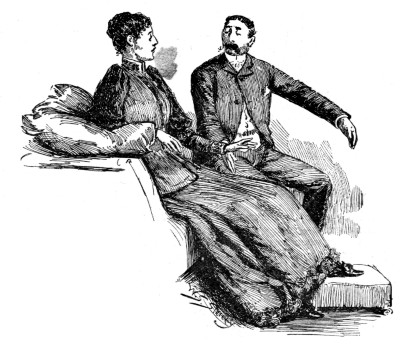
SIR W.: "THE ABYSS MAY WIDEN!" (INDICATES AN IMAGINARY ABYSS.)
Sir W.: Of course! of course! And you shall know all about it as soon as I have asked Jem's leave. Meanwhile we must attend to the fates of these unhappy young people. We had better first try to show them their grievous fault as gently as possible, and if gentleness does not answer——
Lady Flo: Oh, yes! Gentleness is all very well! But I tell you quite candidly, Will, that before we talk of gentleness I must insist on knowing what it is you told Jem that you would not let me hear.
Sir W.: The fact is, my dear——(Coughs.)
Lady Flo: Tell me what the fact is, and at once, my dear!
Sir W.: The facts are, dear child——(Coughs again.)
Lady Flo (irritated): Don't cough!
Sir W. (continues coughing): Well! it's a long story.
Lady Flo: Haven't you a lozenge?
Sir W.: Never mind the lozenge! The story, I say, is a long one.
Lady Flo: Long or short, I must hear it!
Sir W.: I'll tell it to you, later on.
Lady Flo: I begin to suspect you can't tell me all about it, simply—because you can't!
Sir W.: Oh! I can! I could!
Lady Flo: Oh, no, you can't. You couldn't, and you ought to be ashamed of yourself!
Sir W.: You are going just a little bit too far, Florence.
Lady Flo: Oh, no; it was you who went too far. Why, I knew it by the look on your face the instant I came into the room!
Sir W. (aside): She is going very much too far. (Aloud) Nonsense!
Lady Flo: I beg pardon?
Sir W.: I repeat "Nonsense." And ridiculous nonsense!
Lady Flo: Then, how dare you?
Sir W.: You forget yourself strangely.
Lady Flo: Do not attempt to adopt your nephew's manner to his wife towards me!
Sir W.: It is you, my love, who are unfortunate in your choice of a manner this morning; and although pettishness in a young girl like Kitty has a certain little charm of its own——
Lady Flo: Yes!
Sir W.: When a woman has reached your time of life——
Lady Flo (furious): Yes!!!
Sir W.: Petulance sits remarkably ill upon her—upon you, my dear——
Lady Flo: When a man has reached your time of life and remains as great a fool——
Sir W. (furious): A fool?
Lady Flo: Yes! As great a fool and an idiot as ever——
Sir W.: I was always aware you had the very devil of a temper, Florence, and now, after fifteen years of married life, I make the discovery that you can be excessively—ahem!—unladylike.
Lady Flo: It's highly amusing to hear you express an opinion on the subject of how a lady should behave. When one remembers your sisters, one is inclined to believe you were not, perhaps, brought up in a school of the very highest standard.
Sir W.: You insult my sisters! (Becomes much excited and takes her by the arm.) Repeat that again!
(Enter Jem. Stands in amazement.)
Jem: For Heaven's sake, what is the matter?
Sir W.: Ask your Aunt Florence, my dear boy.
Lady Flo: I feel positively ashamed that you should come upon us—upon your uncle, I mean—at a moment when he is behaving like a raving madman!
Jem: A raving madman! My uncle Jem!
Lady Flo: Man-like, you side with a man! (With increasing agitation) I have always known your uncle to be a weak, nerveless——(Enter Kitty. Looks around, dumfounded.)
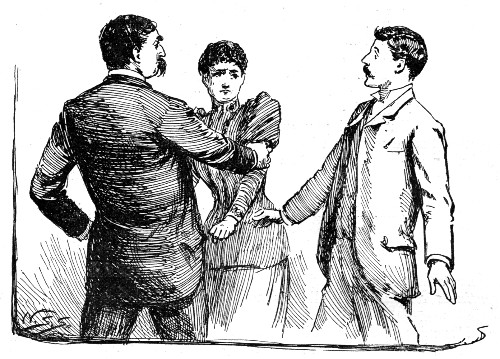
JEM: "WHAT IS THE MATTER?"
Kitty: Dear aunty! I'm frightened! You can't be well! What does this mean?
Lady Flo: Only that your husband is inciting mine to be abusive.
Kitty: Impossible!
Lady Flo: Woman-like, you side with a man! Let me tell you that your poor uncle is pitiable in his foolishness this morning.
Sir W.: Florence! Once for all, I assert my authority. Be silent this moment, or I shall feel obliged to ask you to return home.
Lady Flo: Without you?
Sir W.: If that pleases you!
Lady Flo: It would suit me remarkably well.
Sir W.: In that case—"Go!"
Lady Flo: I shall, instantly; and when you desire to come home, I shall give the servants orders not to admit you——
Sir W. (turning to Jem): A man not admitted to his own house! That's rather too good, isn't it, Jem?
Lady Flo: We shall see! (Turns to Kitty) Meanwhile, Kitty, I bid you good-bye.
Kitty: Oh! Aunty! You can't mean that! Pray don't say good-bye!
Lady Flo (dramatically): Yes, I mean "Good-bye"! (Brushes furiously past Sir William, and exit. Kitty makes movement to follow, but returns to Sir William and Jem.)
Sir W. (bitterly): Don't hold her back, Kitty.
Jem: You are mad!
Sir W.: Less mad than you, when an hour ago you told me you found life intolerable with Kitty.
Kitty (moved): He said that? Jem said that to you?
Jem: No, no! (Compunctious.)
Sir W.: Oh! It's an easy matter for two young people to kiss again with tears. 'Twill be a different matter between your aunt and me. Florence will have no chance, however much she may wish it. The time has come for me to put down my foot at last. (Exit, talking and gesticulating angrily.)
(After the exit of Sir William, Jem and Kitty look up slowly at one another. Their eyes meet. They turn away.)
Jem: (much embarrassed): Kitty!
Kitty: Jem!
Jem: This is painful! In fact, it's worse than wicked—it's vulgar!
Kitty (gently): It's simply dreadful to see two people behaving in such a way.
Jem: And at their time of life!
Kitty: That's the awful part of it!
Jem: I wonder how they can do it!
Kitty (archly, yet on the verge of tears): So do I!
(At the last words they turn; their eyes meet. Kitty falters. Jem falters. After a moment they fall into one another's arms.)
KITTY: "SPLENDID! I NEVER SAW ANYTHING SO WELL DONE!" SIR W.: "IT'S NO LAUGHING MATTER!"
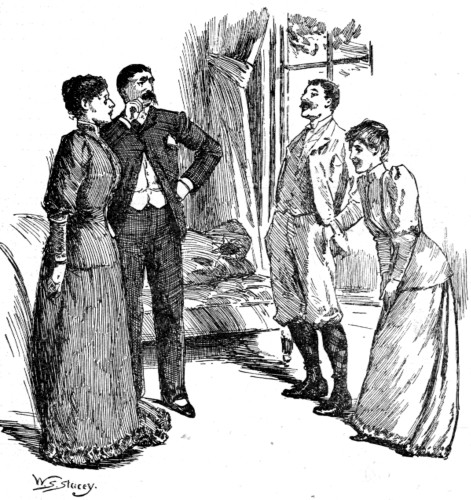
Enter Porter: Her ladyship has bidden me to put her trunks together, ma'am.
Kitty: Wait a minute, Porter. Perhaps I can persuade her ladyship to stay. (Voices from without.)
Lady Flo: I wish to go this instant, and alone.
Sir W.: By all means, and to-morrow my lawyer shall wait on you.
Lady Flo: And mine on you. (After a moment, they enter.)
Lady Flo: And it has come to this, William!
Sir W.: By mutual consent. This is the happiest day of my life. I breathe again. I know now I have never breathed until this moment since the day I married you!
Lady Flo: This is beyond everything! (Violently excited.)
Jem (whispers aside to Kitty, unobserved; play on both sides; then, after evidently agreeing on a plan, pretend to treat the matter as a joke; advancing): Bravo! Bravissimo! Capital! (Roars with forced laughter.)
Kitty: Splendid! I never saw anything so well done! (Joins her husband in laughter.)
Sir W.: It's no laughing matter!
Jem: Ha! ha! I daresay not.
Kitty: Irving and Ellen Terry are not in it! (Continues laughing.)
Lady Flo: What can you mean?
Jem: Oh, don't pretend that you and my uncle have not been getting up this little comedy of a quarrel, merely to show Kitty and me what fools we look when we are fighting! Why! It was better than any play I ever saw!
Sir W.: It's all been in sober earnest, I assure you.
(Lady Flo recovers slightly. Looks first at Jem, then at Kitty, and lastly at Sir William.)
Lady Flo (slowly): You call—all—this—a little comedy? (Recovers more, but very gradually.)
Kitty: Why, yes! Don't attempt to say it wasn't—(slyly)—especially after all you told me this morning about how cleverly you manage my uncle. Just let me see you glance at him in the way you said you could. (Whispering.)
(Lady Flo further recovers herself. Her expression softens. After a minute or two she smiles meaningly to herself.)
Jem: Now, Uncle Will, do finish off by pretending to make up the quarrel! There's my aunt waiting with her smile already!
Sir W. (stupidly): Pretend to make up the quarrel?
Lady Flo (suddenly radiant): Why, yes! You silly old goose! Don't you see the fun? Pretend to give me a kiss at once. (They kiss.)
Jem and Kitty (aside): That's a comfort. (They walk up stage.)
Lady Flo (aside to Sir William): I can see you are dying to make amends for all you have just said!
Sir W.: I don't deny that I may be!
Lady Flo: Then tell me what it was you were concocting with Jem! There's an old dear!
Sir W.: Since we are all good friends again I don't mind telling you Jem was confiding his little troubles to me.
Lady Flo: But you had already found them out!
Sir W.: And also that there was a possibility of a separation!
Lady Flo: Silly children!
Sir W.: Had you not at once flown into a rage, I should have broken my promise to Jem, and have told you all!
Lady Flo: That was quite right of you. (They walk up stage, amicably, arm-in-arm. Jem and Kitty walk to centre.)
Jem: You will find me ready dressed to start for eight o'clock matins, to-morrow morning, Kitty!
Kitty: Oh! That's very much too much to ask of you!
Jem: Not at all! Providing you won't insist on going out with the guns.
Kitty: I shall only wish what you wish from this day forward, dearest Jem!
Jem: That's all right! (They kiss, laughingly, as the curtain descends. Lady Flo and Sir William look on smiling.)
FOOTNOTES:
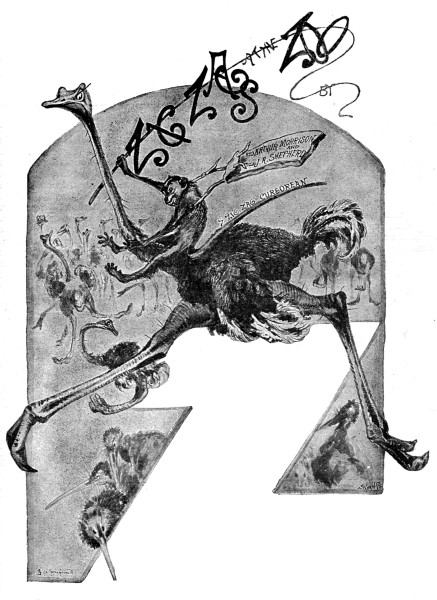
Zig Zag: Cursorean
Such birds as, having wings, fly not, preferring to walk, to run, or to waddle, as legs and other circumstances may permit or compel—these are the cursores: such birds also as, having no wings, or none to speak of, run by compulsion on such legs as they may muster. These are many—so many that I almost repent me of the heading to this chapter, wherein I may speak only of the struthiones among the cursores—the curious cassowary, the quaint kiwi, the raucous rhea, the errant emeu, and the overtopping ostrich. But the heading is there—let it stand; for in the name of the cursores I see the raw material of many sad jokes—whereunto I pray I may never be tempted, but may leave them for an easy exercise for such as have set out upon the shameless career of the irreclaimable pun-flinger.
"GET OUT OF THIS!"
It was some time—years—before I got rid of the impression left upon me by the first ostrich with which I became acquainted. He lived in an old picture-book, and would nowadays be considered quite out of fashion by up-to-date ostriches, having webbed feet and an improper number of toes. I like to believe that feet of this sort were popular among ostriches at that time, being loath to destroy early beliefs. From the same cause, I have other little private superstitions about the ostrich; there was no ostrich, so far as I can remember, in my Noah's ark, whence I derive my conviction that the species cannot have existed at the time of the Deluge, but has been evolved, in the succeeding centuries, by a gradual approach and assimilation of the several characteristics of the camel and the goose.
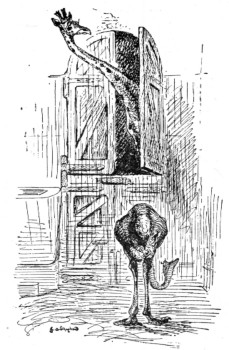
The two ostriches here, at the Zoo, have no pet names bestowed on them by the keepers. This is inconvenient, not to say unfair. They have been placed, it will be observed, in the stables hitherto occupied by the late lamented giraffes. It is a striking and notable instance of care and the sense of fitness of things on the part of the Society. These stables, they probably reflected, have all along been fitted with tenants twenty feet high—queer tenants, which were often called camelopards. We can't replace these with similar tenants, unfortunately, but we will do our best with animals as high as possible and with all available neck; and they shall be camel-geese. And here they are; a few feet short, unavoidably, but as high as possible; quite the equivalent of the giraffes so far as concerns the camel, and as much superior as one may consider a goose to a leopard. And here you may stand and watch them, or sit. And you may watch, if you please, for the coming of the giraffes which the Society are now anxious to buy, or for the wandering wraiths of those dead, dispossessed, and indignant. Meantime inventing names for the two camel-geese—let us say Atkinson and Pontius Pilate.
ATKINSON DOZES.
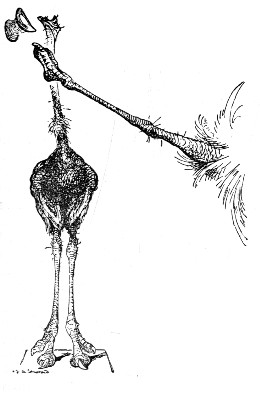
HIGH KICKS.
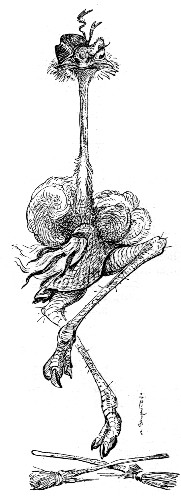
I like to stand by Atkinson till he dozes. Atkinson is a fine, big fellow, and when he squats down his head is in a convenient position for observation. Presently he gapes; then his eyes shut, and his beak droops—just a very little. Then the beak droops a little more, and signs of insecurity appear about the neck. Very soon a distinct departure from the vertical is visible in that neck; it melts down ruinously till almost past recovery, and then suddenly springs erect, carrying an open-eyed head, wherefrom darts a look of indignant repudiation of any disposition to fall asleep; and so keeps until the eyes close again. I have waited long, but have never seen Atkinson fall permanently asleep.
GILLIE CALLUM.
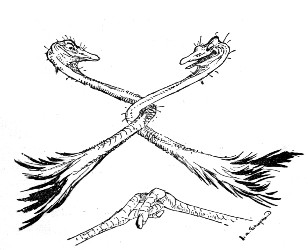
The possibilities of the ostrich are not properly recognised. He is domesticated, and bred with the utmost ignominy in a poultry run, and his tail is pulled out with impunity. I am not quite sure that he habitually figures on South African dinner tables with his legs skewered to his ribs, but he has fallen quite low enough for that; submitting even to the last indignity of being hatched out by a common stove incubator. Now, the elephant has also been domesticated, but he has also been allowed to adopt a profession. He dances on a tub and rides a tricycle at a circus. Nothing of this sort has been attempted with the ostrich, but much might be done. He would make a first-rate bicyclist, and could get through much of the business of the "eccentric comedian." A couple of them would go to make a capital knockabout act. High kicks of the very highest, floor-strides of the very longest—and there would be a world of opportunities in the neck. No end of possibilities lie in the neck—even the "legitimate." You could run in a forty-minute sketch, wherein two long-separated but faithful lovers should fall against each other and wind their necks about together like a caduceus, or barley-sugar—or anything. Also the camel-goose might fling his neck about the villain, and strangle him. But perhaps, after all, variety business would suit best. Pontius Pilate in a kilt and philibeg would bring down the house with a Highland fling or gillie callum. And Atkinson in a long-stride table chair and banjo act would be comforting to the perceptions.
LONG SEPARATED.
Whether the ostrich is actually such an ass as to hide his head with a notion of concealing himself I don't quite know, but there is certainly a deal of ass in the camel-goose. A Hottentot will put an ostrich skin over his head, and walking with his natural shanks exposed get among an ostrich family and kill them off one after another, to the family's astonishment. Now, a bird who mistakes a nigger with a mask for an intimate relation plainly enjoys in his composition a large flavour of the ass. Not knowing it, however, the camel-goose is just as happy, and neither experiences the bitterness of being sold nor the sweetness of selling. I don't believe that Atkinson was even aware of the triumphant sell which he lately assisted in administering to Mr. Toots, the cat from the camel-house.
The cat in the ostrich-house is a sly fellow, and I believe he knows why there are fewer pigeons in the roof of the hippopotamus-house than there were. He horribly sold Mr. Toots, who was anxious to have a snack of poultry himself, for a change. "In my house," said this bold, bad cat, "there are the biggest pigeons you ever saw. Go in and try one, while I look out for the keeper." And the trustful Mr. Toots went in; and when, full of a resolve to make it hot for everything feathered in that house, Mr. Toots bounced into the presence of Atkinson, who is rather more than seven feet high, he came out anxious for the scalp of that other cat. I never mention this little adventure to Mr. Toots, who is sensitive, but all the other Zoo cats chaff him terribly. Even Jung Perchad and the other elephants snigger quietly as they pass, and Bob the Bactrian, from the camel-house, laughs outright; it is a horrid, coarse, vulgar, exasperating laugh, that of Bob's. Atkinson, however, is all unconscious of the joke, and remains equally affable to cats, pigeons, and human beings.
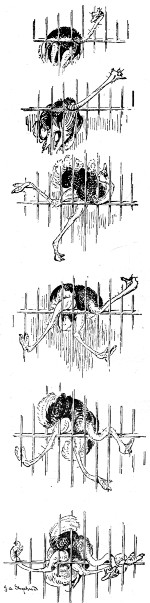
Pontius Pilate is just the sort of camel-gander that would bury its head to hide itself. Pontius Pilate is, I fear, an ass; also a snob. He has a deal of curiosity with regard to Atkinson, who is a recent arrival, and lately belonged to the Queen. Also, he is often disposed to pay a visit—with his head—to Atkinson's quarters, and take a friendly snack—at Atkinson's expense; this by an insinuation of the neck out between his own bars and in between those of Atkinson, adjoining. But he doesn't understand the laws of space. Having once fetched his neck around the partition into Atkinson's larder by chancing to poke his head through the end bars, he straightway assumes that what is possible between some bars is possible between all; and wheresoever he may now be standing when prompted by companionable peckishness, straight he plunges among the nearest bars, being mightily astonished at his inability to reach next door, if by chance he have dropped among bars far from Atkinson's. He suspects his neck. Is the ungrateful tube playing him false? Maliciously shortening? Or are his eyes concerned in fraud? He loops his head back among his own adjoining bars, with a vague suspicion that they may be Atkinson's after all; and he stretches and struggles desperately. Some day Pontius Pilate will weave himself among those bars, basket fashion, only to be extricated by a civil engineer and a practical smith. Pontius Pilate is the sort of camel-gander that damages the intellectual reputation of the species. Of course he would bury his head to hide himself. Equally of course he would muzzle himself to prevent you from biting him, or tie his legs together to prevent you from running and catching him, or anything else equally clever. Pontius Pilate, I have known you long—even loved you, in a way. But I have observed you closely, and though, like Dogberry, you may have everything fine about you, I am impelled sorrowfully to write you down an ass.
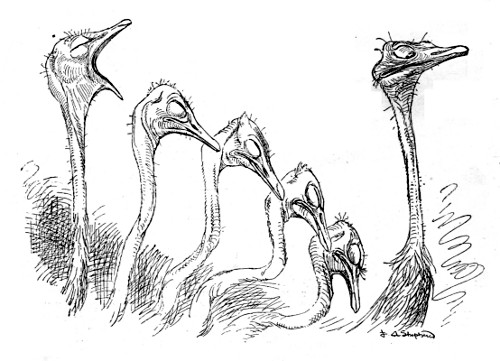
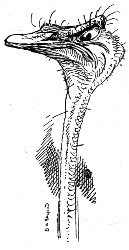
The ostrich is one of those birds whose whole command of facial expression is carried in the neck. He can only express himself through his features by offering you different views of his head. This is a great disadvantage. It limits the range. You may express three sentiments by the back, front, and side of the head, and something by way of combination in a three-quarter face. Then you stop, and have no further resource than standing on your head, one of the few things an ostrich is not clever at. But with such materials as he has, the ostrich does very well. Observe, his mouth is long, and droops at the corners; but the corners are wide apart, for there the head is broad.
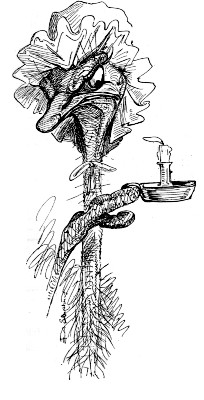
Now you may present simple drama by the aid of this mouth—suitably disposed and ordered by the neck. Take Atkinson, here, whose beak has a certain tip-tinting distrusted of the teetotaler. Bend his head (only in theory, because Atkinson won't stand any practical nonsense)—bend his head to look downward, and let his neck wilt away sleepily. Now, viewed from the side, where is a more lamentable picture of maudlin intoxication? What could improve it, except, perhaps, a battered hat, worn lop-sided, and a cigar-stump? He is a drunken old camel-gander, coming home in the small hours, and having difficulties with his latch-key. Straighten Atkinson's neck, open wide his eyes, and take a three-quarter face view of him. Sober, sour, and indignant, there stands, not the inebriated Atkinson, but the disturbed Mrs. Atkinson on the stairs, with a candle, and a nightcap, and a lecture. That awful mouth actually conjures that candle, that nightcap, and that lecture into existence—you see and hear them more clearly than you do Atkinson, although they are not there. But this is an advanced exercise in struthian expression—a complicated feat, involving various and complex elements. There is the neck-wilt and the bending of the head; also the three-quarter face, not a simple element.
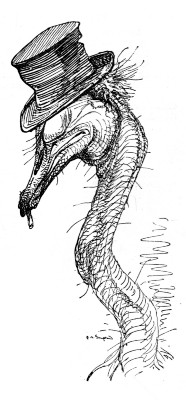
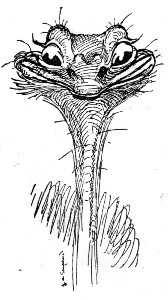
The plain and elementary principles of struthian expression lie in the mere front and side views. The third simple view, the back, is not particularly eloquent, although practice might do something even for that. At the side the ostrich is glum, savage, misanthropical, depressed—what you will of that sort. Let him but turn and face you—he can't help a genial grin. All done by the versatile neck, you observe, which gives the head its position.
GENIAL FRONT.
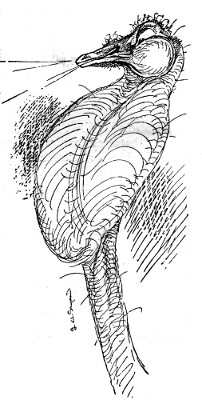
A ROARING SOLILOQUY.
Man, instigated by woman, has a habit of pulling out the camel-gander's tail. This ruins the appearance of the site of that tail, without commensurately improving the head whereunto the tail is transplanted—an unprofitable game of heads and tails, wherein tails lose and heads don't win. Even the not over clever ostrich knows better than to wear those feathers on the wrong end. Perhaps he knows that he is enough of a fool already.
There is a deal of hidden interest about the ostrich's neck. It is the cleverest piece of an ostrich—unless you count his stomach; and even in the triumphs of the stomach the neck takes a great share. When a camel-goose lunches off a box of dominoes, or a sack of nails, or a basketful of broken bottles, there is quite as much credit in the feat due to the neck as to the stomach; with anybody else all the difficulties of that lunch would begin with the neck—even a thicker neck. Parenthetically, one remembers that the ostrich's neck is not always thin. Catch Atkinson here in a roaring soliloquy, and you shall see his red neck distended as a bladder, with a mighty grumbling and grunting. This by the way. The neck makes nothing of the domino difficulty, or the tenpenny nail difficulty, or the door-knob difficulty, or the broken bottle difficulty—which are not difficulties to the camel-goose. On the contrary, the neck revels in them and keeps the dainties as long as possible. Give Pontius Pilate, or Atkinson—I am quite impartial—an apple. When he swallows it you shall see it, in a bulge, pass along and round his neck; down it goes and backward, in a gradual curve, until it disappears among the feathers—corkscrews, in fact. Observe, I recommend an apple for this demonstration. Dominoes and clinkers are all very well, but they rattle about inside, and disturb the visitors; and with an apple you will the more plainly observe that corkscrew.
HEADS AND TAILS.
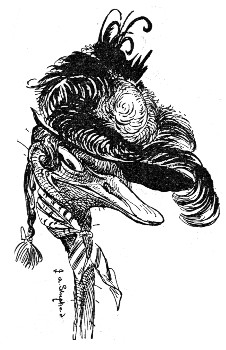
GLUM SIDE.
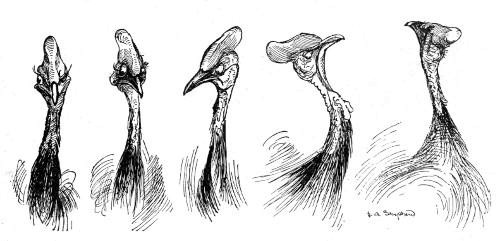
Not satisfied, you perceive, with enjoying his domino or his door-knob all the way along that immense neck, the camel-gander must needs indulge in a spiral gullet. It is mere gluttony. Especially is it wicked of Atkinson, who has already the longest bird-neck in all these gardens. Look at the necks of all the cursores. The poor little wingless kiwi, with a mere nothing of a neck—for a cursore. He does without a spiral gullet. The festive cassowary—which, by-the-bye, doesn't abound—or exist—on the plains of Timbuctoo, as the rhyme says—the festive cassowary, I say, wears his gullet plain. The rusty rhea takes things below with perfect directness. The lordly emeu gets his dinner down as quickly as the length of his neck will permit. It is only when one reaches the top of the cursorean thermometer, all among the boilings, so to speak, that the ostrich, with the longest neck of all, must poach another few inches by going in for a spiral. Pontius Pilate is bad enough, but a spiral for Atkinson!—well, there!
The partiality of the struthians for eccentric refreshments—clinkers, nut-crackers, and the like—leads many to a superstition that these things are as nourishing as they are attractive. They're not. Certain liberal asses have a curious habit of presenting the birds with halfpence. I scarcely understand why, unless modern environments have evolved penny-in-the-slotomaniacs. And I am prepared to bet that on occasions they are less generous with their pence. Nevertheless, they do it, and it kills the birds. One cassowary who died recently was found to contain one and eightpence in copper. I suggest that in future the experimentalizers confine their contributions to bank-notes. I have taken the trouble to ascertain that these will do no harm while their disappearance will afford an additional enjoyment to the contributors commensurate with their higher value.
Perhaps there is something in the habits of the cassowary himself that explains these offerings. The cassowary always comes to meet you at the bars with a look of grave inquiry. If you offer no tribute he turns off, with many cockings of the beak, surprised, indignant, and contemptuous. Very few people can endure this. They hastily produce anything they have—anything to conciliate the contemptuous cassowary. And as he takes it, an expression steals across the cassowary's face which seems to admit that perhaps the fellow isn't such a shocking outsider after all. When a man has nothing more nutritive about him, this form of extortion may produce halfpence.
THE CURSOREAN THERMOMETER.

The rhea is small potatoes beside the ostrich—merely a smaller and dingier camel-gander. But the emeu is a fine upstanding fellow, with his haughty sailing head and his great feather boa.
THE CASSOWARY DISGUSTED.
He is a friendly and inquisitive chap, and will come stalking down to the wires to inspect you. If you like to walk up and down outside his inclosure he will take a turn with you, walking at your side and turning when you do. He is justly proud of his height and his ruff, but there is nothing objectionably haughty about the emeu; I have always found him ready for a quiet chat. He will eat various things, like the ostrich; so that one regards him with a certain respect, not to say awe, for there is no telling what wonderful things may or may not be inside him. The biggest and handsomest emeu here is my particular friend. When he talks to you or walks by your side he is very fine; but when he walks about a little way off, with his head to the ground, foraging, he looks rather like a tortoise on stilts, which is not imposing. Sometimes, when he thinks nobody is looking, he rushes madly up and down his territory by way of relieving his pent-up feelings, stopping very suddenly and looking cautiously about to assure himself that nobody saw him. I call this emeu Grimaldi; firstly, because Grimaldi is rather a fine name, and secondly, because when once you have had a view of his head from the back you can't call him anything else.
THE PROUD EMEU.
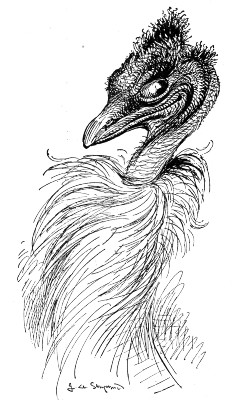
GRIMALDI.
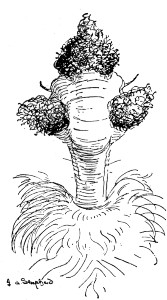
THE DIET OF WORMS.
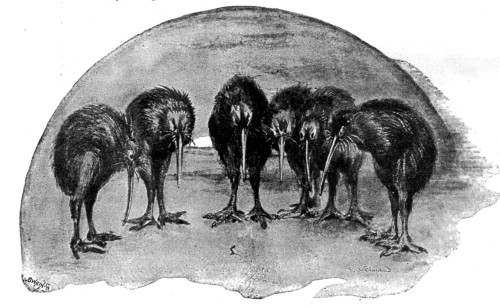
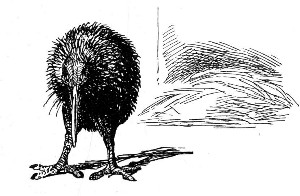
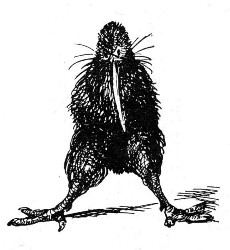
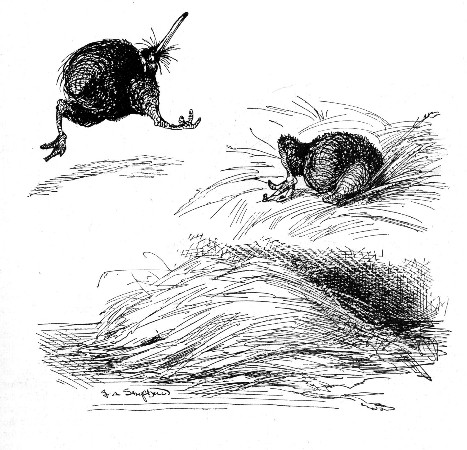
The most extraordinary bird in the world is the kiwi. But it is not the most extraordinary bird seen by visitors to the Zoo, because they never see it. The kiwi buries itself asleep all day, and only comes out in the night to demolish an unpleasant and inconvenient proverb. The kiwi is the latest of all the birds, but catches the most worms. For this let us honour the kiwi, and hurl him in the face of the early risers. He stamps about the ground in the dark night, and the worm, being naturally a fool, as even the proverb demonstrates, comes up to investigate, and is at once cured of early rising for ever. The kiwi, having no wings (unless you count a bit of cartilage an inch or so long, buried under the down), has the appearance of running about with his hands in his pockets because of the cold. And being covered with something more like hair than feathers, is a deal more like a big rat than a bird of any sort. Indeed, I don't believe the kiwi himself has altogether made up his mind which to be. Before he decides he will probably become extinct. Any glimpse his friends have of him here is short. Suddenly brought out into the day, he stands for a moment, and blinks; then he puts his beak up and his legs apart, and there is a black streak and a heap of straw where it vanishes.