I THE PERPETUAL DELEGATION
Reading edition
ON THE PICKET LINE
The avenue is misty gray,
And here beside the guarded gate
We hold our golden blowing flags
And wait.
The people pass in friendly wise;
They smile their greetings where we stand
And turn aside to recognize
The just demand.
Often the gates are swung aside:
The man whose power could free us now
Looks from his car to read our plea—
And bow.
Sometimes the little children laugh;
The careless folk toss careless words,
And scoff and turn away, and yet
The people pass the whole long day
Those golden flags against the gray
And can’t forget.
Beulah Amidon.
The Suffragist, March 3, 1917.
1. The Peaceful Picketing
Before we examine the consideration which actuated the National Woman’s Party in waging the picket campaign of 1917, let us see where President Wilson stood at the beginning of the war; let us briefly recapitulate the steps which brought him there.
194It will be remembered that, shortly after the President took his seat in March, 1913, he told a deputation from the Congressional Committee that Suffrage was a question to which he had given no thought and on which he had no opinion. During the year, no longer stating that he knew nothing about Suffrage, he gave as a reason for inaction that the Congressional program was too crowded to consider it. By the end of the year, he had reached the point where he stated that he could take no action on the Suffrage Amendment until commanded by his Party.
In 1914, he continued to state that he was prohibited from acting because of being bound by his Party until June, when he seized on the excuse of States Rights further to explain his inaction. In the autumn of 1915 he first came out personally for Suffrage by voting for it in New Jersey but still refused to support it in Congress. His next step forward came in June, 1916, when he caused the principle of Suffrage to be recognized in the Party platform, though as yet neither he nor the Party had endorsed the Federal Amendment. In September of that same year—after the Woman’s Party had begun its active campaign in the Suffrage States—the President took another step and addressed a Suffrage Convention of the National American Woman’s Suffrage Association. But as yet he was not committed to the Federal Amendment, had not begun to exert pressure on Congress.
The situation of the President and the Woman’s Party at this juncture may be summed up in this way. Wilson, himself, was beginning to realize that the Suffrage Amendment must ultimately pass. But he had just been re-elected. He was safe for four years; he could take his time about it. The Woman’s Party on the other hand, realized that the President being safe for four years, no political pressure could be exerted upon him. They realized that they must devise other methods to keep Suffrage, as a measure demanding immediate enactment, before him.
In the meantime, a feeling of acute discontent was growing 195in the women of the United States. The older women—and they were the third generation to demand the vote—were beginning to ask how long this period of entreaty must be protracted. The younger women—the fourth generation to demand the vote—were becoming impatient with the out-worn methods of their predecessors. Moreover, when the disfranchised women of the East visited the enfranchised States of the West, their eyes were opened in a practical way to the extraordinary injustice of their own disfranchisement. Equally, the enfranchised women of the West, moving to Eastern States, resented their loss of this political weapon. On many women in America the militant movement of England had produced a profound impression.
A new note had crept into the speeches made by the members of the Woman’s Party—the note of this impatience and resentment. It will be remembered that Mrs. Kent told the President that the women voters of the West were accustomed to being listened to with attention by politicians, and that they resented the effort to make it seem that they were merely trying to bother a very busy official. Mrs. Blatch had told him that the time had gone by when she would stand on street corners and ask the vote from every Tom, Dick, and Harry; that she was determined to appeal instead to the men who spoke her own language and who had in charge the affairs of the government.
Doris Stevens, in an interview in the Omaha Daily News for June 29, 1919, voices perfectly what her generation was feeling.
A successful young Harvard engineer said to me the other day, “I don’t believe you realize how much men objected to your picketing the White House. Now I know what I’m talking about. I’ve talked with men in all walks of life, and I tell you they didn’t approve of what you women did.”
This last with warmer emphasis and a scowl of the brow. “I don’t suppose you were in a position to know how violently men felt about it.”
I listened patiently and courteously. Should I disillusion him? I thought it was the honest thing to do. “Why, of course 196men didn’t like it. Do you think we imagined they would? We knew they would disapprove. When did men ever applaud women fighting for their own liberty? We are approved only when we fight for yours!”
“You don’t mean to say you planned to do something knowing men would not approve?”
I simply had to tell him, “Why, certainly! We’re just beginning to get confidence in ourselves. At last we’ve learned to make and stand by our own judgments.”
“But going to jail. That was pretty shocking.”
“Yes, indeed it was. It not only shocked us that a government would be alarmed enough to do such a thing, but what was more to the point, it shocked the entire country into doing something quickly about Woman Suffrage.”
It will be seen by the foregoing pages of this book that Suffragists had exhausted every form of Suffrage agitation known to the United States. In particular, they had sent to the President every kind of deputation that could possibly move him.
They decided to send him a perpetual deputation.
Alice Paul, in explanation of her strategy in this matter, uses one of the vivid figures that are so typical of her: “If a creditor stands before a man’s house all day long, demanding payment of his bill, the man must either remove the creditor or pay the bill.”
At first, the President tried to remove the creditor. Later he paid the bill.
At ten o’clock on January 10, 1917, the day after the deputation to the President, twelve women emerged from Headquarters and marched across Lafayette Square to the White House. Four of them bore lettered banners, and eight of them carried purple, white, and gold banners of the Woman’s Party. They marched slowly—a banner’s length apart. Six of them took up their stand at the East gate, and six of them at the West gate. At each gate—standing between pairs of women holding on high purple, white, and gold colors—two women held lettered banners. 197One read:
MR. PRESIDENT WHAT WILL YOU DO FOR WOMAN SUFFRAGE?
The other read:
HOW LONG MUST WOMEN WAIT FOR LIBERTY?
These were the first women to picket the White House.
The first picket line appeared on January 10, 1917; the last, over a year and a half later. Between those dates, except when Congress was not in session, more than a thousand women held lettered banners, accompanied by the purple, white, and gold tri-colors, at the White House gates, or in front of the Capitol. They picketed every day of the week, except Sunday; in all kinds of weather, in rain and in sleet, in hail, and in snow. All varieties of women picketed: all races and religions; all cliques and classes; all professions and parties. Washington became accustomed to the dignified picture—the pickets moving with a solemn silence, always in a line that followed a crack in the pavement; always a banner’s length apart; taking their stand with a precision almost military; maintaining it with a movelessness almost statuesque. Washington became accustomed also to the rainbow splash at the White House gates—“like trumpet calls,” somebody described the banners. Artists often spoke of the beauty of their massed color. In the daytime, those banners gilded by the sunlight were doubly brilliant, but at twilight the effect was transcendent. Everywhere the big, white lights—set in the parks on such low standards that they seemed strange, luminous blossoms, springing from the masses of emerald green shrubbery—filled the dusk with bluish-white splendor, and, made doubly colorful by this light, the long purple, white, and gold ribbon stood out against a background beautiful and appropriate; a mosaic on the gray of the White House pavement; the pen-and-ink blackness of the White House iron work; the bare, brown 198crisscross of the White House trees, and the chaste colonial simplicity of the White House itself.
With her abiding instinct for pageantry and for telling picturesqueness of demonstration, Alice Paul soon punctuated the monotony of the picketing by special events. Various States celebrated State days on the picket line. Maryland was the first of these, and the long line of Maryland women bearing great banners, extended along Pennsylvania Avenue the entire distance from the East gate to the West gate. Pennsylvania Day, New York Day, Virginia Day, New Jersey Day, followed. The Monday of every week was set aside finally for District of Columbia Day.
The New York delegation carried on their banners phrases from President Wilson’s book, The New Freedom.
LIBERTY IS A FUNDAMENTAL DEMAND OF THE HUMAN SPIRIT.
WE ARE INTERESTED IN THE UNITED STATES, POLITICALLY
SPEAKING, IN NOTHING BUT HUMAN LIBERTY.
On College Day, thirteen colleges were represented, the biggest group from Goucher College, Baltimore. Then came Teachers’ Day; Patriotic Day, and Lincoln Day. On Patriotic Day, one of the banners read:
DENMARK ON THE VERGE OF WAR GAVE WOMEN THE VOTE.
WHY NOT GIVE IT TO AMERICAN WOMEN NOW?
On Lincoln Day, they said:
WHY ARE YOU BEHIND LINCOLN?
AFTER THE CIVIL WAR WOMEN ASKED FOR POLITICAL FREEDOM.
THEY WERE TOLD TO WAIT—THIS WAS THE NEGRO’S HOUR.
IN 1917, AMERICAN WOMEN STILL ASK FOR FREEDOM.
WILL YOU, MR. PRESIDENT, TELL THEM TO WAIT—THAT THIS IS THE PORTO RICAN’S HOUR?
199On Sunday, February 18, came Labor Day on the picket line. It was, of course, impossible for wage-earning women to picket the White House on any other day. They represented not only office workers, but factory workers from the great industrial centers. Many of them had come from other cities.
Susan B. Anthony’s birthday, February 15, was celebrated impressively, although it rained and snowed heavily. Three new banners appeared that day. The first—big enough and golden enough even to suit that big, golden woman—bore quotations from Susan B. Anthony:
WE PRESS OUR DEMAND FOR THE BALLOT AT THIS TIME IN
NO NARROW, CAPTIOUS, OR SELF-SEEKING SPIRIT, BUT FROM
PUREST PATRIOTISM FOR THE HIGHEST GOOD OF EVERY CITIZEN,
FOR THE SAFETY OF THE REPUBLIC, AND AS A GLORIOUS
EXAMPLE TO THE NATIONS OF THE EARTH.
The second Susan B. Anthony banner said:
AT THIS TIME OUR GREATEST NEED IS NOT MEN OR MONEY,
VALIANT GENERALS OR BRILLIANT VICTORIES, BUT A CONSISTENT
NATIONAL POLICY BASED UPON THE PRINCIPLES THAT
ALL GOVERNMENTS DERIVE THEIR JUST POWERS FROM THE
CONSENT OF THE GOVERNED.
The third Susan B. Anthony banner said:
THE RIGHT OF SELF-GOVERNMENT FOR ONE-HALF OF ITS
PEOPLE IS OF FAR MORE VITAL CONSEQUENCE TO THE NATION
THAN ANY OR ALL OTHER QUESTIONS.
On March 2, 1917, the Congressional Union and its Western organization, the Woman’s Party, met in joint convention and organized themselves into the National Woman’s Party.
On that occasion, Alice Paul said:
200We feel that by combining the Congressional Union and the Woman’s Party we shall bring about a unity in organization which will make impossible duplication, difference of opinion, and divergence of method. By uniting we make, moreover, for unity of spirit in the whole Suffrage movement, bringing the voters and non-voters together in a movement in which they should both be integral parts.
The original purpose for which the Woman’s Party, as an organization confined to women voters alone, was formed, has, we believe, been served. In the first three years of our work we endeavored to call the attention of political leaders and Congress to the fact that women were voting and that these voting women were interested in Suffrage. But words alone did not have much effect. We found we had to visualize the existence of voting women out in the West and their support of the Suffrage Amendment. The Woman’s Party was formed as one means of doing this.
The Woman’s Party did, I believe, have an effect on the political leaders. It was very clear, I think, at the convention in Chicago and in St. Louis that the idea that women were voting and that those women were interested in the Federal Amendment was at last appreciated. This November’s election completed our work in getting that fact into the minds of Congressmen and political leaders. There is no longer any need to draw a line around women voters and set them off by themselves in order to call attention to them. They now enter into the calculations of every political observer.
If we amalgamate and make ourselves one great group of voters and non-voters all working for the Federal Amendment, the question arises: What name shall we be called by, the Congressional Union or the Woman’s Party? Our Executive Committee felt that we ought to keep the name of the Woman’s Party, because it stands for political power.
The objections brought against this are, I think, two. First, that non-voters should not, according to custom, be part of a political Party; second, that if they are included, that Party will not command as much respect as would a Party composed solely of voters. There are non-voters in the Socialist, the Progressive, and the Prohibition Parties; there is no reason why, if we are interested in precedent and custom, they should not be in our Party also. As to the second point: The Congressional Union has the reputation of being an active, determined, and well-financed organization. When the political world realizes that this young Woman’s Party has been strengthened by the influx 201of twenty-five thousand workers of the Congressional Union ready to give their service and money it will consider that the Woman’s Party stands for more power than if formed of the women of the Western States only.
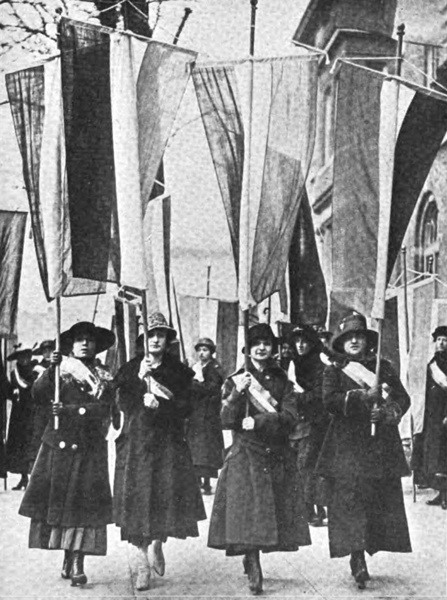
Wage Earners Picketing the White House, February, 1917. Photo Copr. Harris and Ewing, Washington, D. C.
All of us in the Congressional Union feel an affection for it. But that is no reason for continuing the organization. The Congressional Union has served a useful purpose, we believe. But now that we have created the Woman’s Party we ought, it seems to me, to develop and make that the dominant Suffrage factor in this country because that, through its name and associations, throws the emphasis more than does the Congressional Union on the political power of women.
The following officers were elected unanimously at the morning session: Chairman of the National Woman’s Party, Alice Paul; Vice-Chairman, Anne Martin; Secretary, Mabel Vernon; Treasurer, Gertrude Crocker. The executive board elected were: Lucy Burns, Mrs. O. H. P. Belmont, Mrs. J. W. Brannan, Mrs. Gilson Gardner, Abby Scott Baker, Mrs. William Kent, Maud Younger, Doris Stevens, Florence Bayard Hilles, Mrs. Donald Hooker, Mrs. J. A. H. Hopkins, and Mrs. Lawrence Lewis.
At that Convention, various resolutions were passed; the most notable in regard to the attitude of the National Woman’s Party towards the rapidly developing war situation. That resolution runs as follows:
Whereas the problems involved in the present international situation, affecting the lives of millions of women in this country, make imperative the enfranchisement of women,
Be it resolved that the National Woman’s Party, organized for the sole purpose of securing political liberty for women, shall continue to work for this purpose until it is accomplished, being unalterably convinced that in so doing the organization serves the highest interests of the country.
And be it further resolved that to this end we urge upon the President and the Congress of the United States the immediate passage of the National Suffrage Amendment.
It was decided to present these resolutions to the President. Shortly after, Dudley Field Malone, Collector of the 202Port of New York, on behalf of the Woman’s Party, informed the President that a deputation would visit him for that purpose.
This demonstration was not so much a protest at the failure of the first administration to pass the Anthony Amendment, or at the adjournment of Congress without passing it, as a presentation of the demands of the National Woman’s Party immediately upon the opening of President Wilson’s second term.
During the first three days in March, Washington filled steadily with inauguration crowds. When they got off the train, the Great Demand banner of the National Woman’s Party confronted them, and girls handed them slips inviting them to the demonstration of the National Woman’s Party at the White House on Inauguration Day and to the mass-meeting of the National Woman’s Party to be held that night. Girls also stood in theatre lobbies, handing out more of these slips. Girls made the rounds of the government departments, handing out still more. Everywhere great posters said:
COME TO THE WHITE HOUSE ON MARCH 4.
COME IN THOUSANDS.
Inauguration Day dawned a day of biting wind and slashing rain.
Outside Headquarters was turmoil; inside a boiling activity. Hundreds of women were preparing to picket the White House. To accommodate them, a rubber company, hastily summoned, had commandeered one room and was selling rain-coats; tarpaulin hats; rubbers.
An extraordinary, a magnificent demonstration followed. To the music of several bands, nearly a thousand pickets circled the White House four times—a distance of four miles. Vida Milholland, the younger sister of Inez Milholland, marched at the head, carrying on a golden banner her sister’s last words for Suffrage.
203MR. PRESIDENT, HOW LONG MUST WOMEN WAIT FOR LIBERTY?
The Great Demand banner followed, carried by Mrs. Benton Mackaye:
WE DEMAND AN AMENDMENT TO THE CONSTITUTION OF
THE UNITED STATES ENFRANCHISING WOMEN.
Beulah Amidon carried the Suffrage banner which Inez Milholland bore in the first Suffrage procession in New York:
“Forward, Out Of Darkness,
Leave Behind The Night.
Forward Out Of Error,
Forward Into Light.”
Behind there came hundreds of women bearing the purple, white, and gold. They were divided according to States; and before each division marched the State flag of the division. The drenching rain fell steadily. The pavements turned to shallow lakes, and the banners—their brilliancy accentuated by the wet—threw long, wavy reflections on the glassy, gray streets. They were of course expecting this demonstration at the White House, and, as though it were dangerous, unusual precautions had been taken against it. Every gate was locked. The Washington force of police officers, augmented by police from Baltimore and by squads of plain-clothes men, guarded the grounds without and within. Gilson Gardner said the President seemed to think the women were going to steal his grass roots.
There was no one at the locked gates to receive the women or the resolutions except the guards; these guards protested that they had not been ordered to receive either. The women visited every gate, but received the same answer. The cards of the leaders were finally handed over to a guard to present at the White House. He tried to deliver them, but was reprimanded for leaving his post, and sent back. Learning 204that the cards would be delivered at the end of the day, as is the custom with visiting-cards of casual visitors at the White House, the thousand pickets took up their march again.
Gilson Gardner wrote of this demonstration:
The weather gave this affair its character. Had there been fifteen hundred women carrying banners on a fair day, the sight would have been a pretty one. But to see a thousand women—young women, middle-aged and old women—and there were women in the line who had passed their three score and ten—marching in a rain that almost froze as it fell; to see them standing and marching and holding their heavy banners, momentarily growing heavier—holding them against a wind that was half gale—hour after hour, until their gloves were wet, their clothes soaked through; to see them later with hands sticky from the varnish from the banner poles—bare hands, for the gloves had by this time been pulled off, and the hands were blue with cold—to see these women keep their lines and go through their program fully, losing only those who fainted or fell from exhaustion, was a sight to impress even the dulled and jaded senses of one who has seen much.
One young woman from North Dakota I saw clinging to the iron pickets around the White House, her banner temporarily abandoned, fighting against what was to her a new feeling, faintness resulting from the pain in her hands. She was brought to the automobile in which I was riding before she actually fell to the ground; but after a short rest she was back in the line, and finished with the others.
There is no doubt that what Gilson Gardner said was true—the weather gave this affair its character.
People passing by, thrilled by the gallantry of the marchers, joined the procession. And as Gilson Gardner says, it was not because it was a pretty sight, or because these women were all young. Anna Norris Kendall of Wisconsin, seventy-two years old, and the Rev. Olympia Brown, eighty-two years old, one of the pioneer Suffragists of the country, both took part.
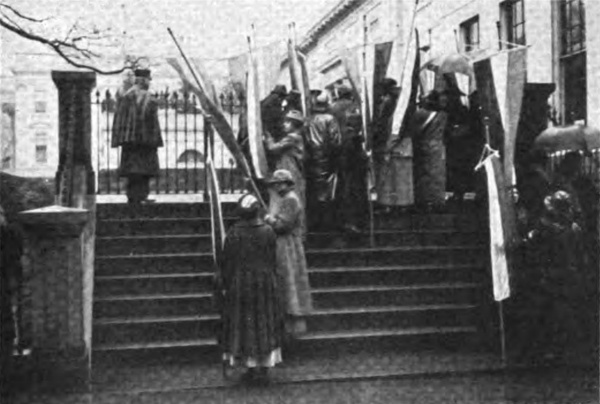
The Thousand Pickets Try Vainly to Deliver Their Resolutions to the President, March 4, 1917.
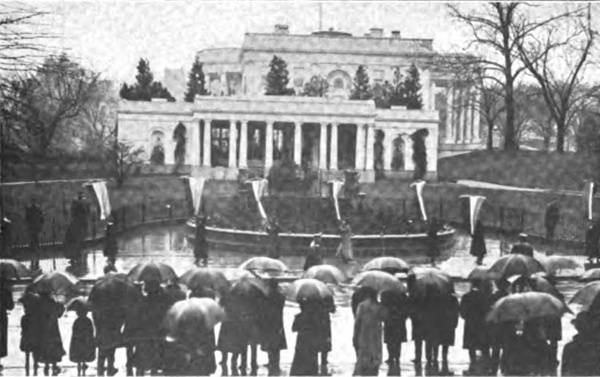
A Thousand Pickets Marching Around the White House, March 4, 1917.
That day, a newly elected Congressman drove about Washington, showing the city to his wife. He had always 205been a Suffragist. She had always been an anti-Suffragist. The sudden sight of the thousand women marching in the rain not only converted her, but it produced such an effect on her she burst into tears.
Later, President Wilson sent a letter to the National Woman’s Party, acknowledging the resolutions presented to him by the deputations of March 4, and concluded: “May I not once more express my sincere interest in the cause of Woman Suffrage?”
Congress adjourned on March 3, 1917. The pickets adjourned with it. On April 2, a Special War Session of Congress convened. The Suffragist gives an interesting description of that interesting day.
Just half an hour before Congress formally opened, the Suffrage sentinels at the Capitol took their places.... There was tensity in the atmosphere. The Capitol grounds were overrun with pacifists from many cities wearing white-lettered badges; and with war advocates, as plainly labeled, with partisan demands. They swarmed over the Capitol grounds unmolested, though extra precautions were taken throughout the day and in the evening when troops of cavalry were called out. The silent sentinels stood unmoved the while for democracy while peace and war agitation eddied around them.
The pickets convened with Congress. They continued to stand at the gates of the White House, but they extended their line to the Capitol. Three pickets, led by Elsie Hill, took up their station by the House entrance and three by the Senate entrance. At night—this evoked from the newspapers sly allusions to the Trojan horse—they used to store their banners in the House Office Building.
On April 7, the United States declared itself to be at war with Germany.
After war was declared, the Woman’s Party continued—and continued with an increasing force and eloquence—to 206demand the enfranchisement of the women of the United States by Constitutional Amendment. This brought down upon their heads a storm of criticism; antagonism; hostility. But Alice Paul was not deflected by it from her purpose. She recalled that, at the outbreak of the Civil War, Suffragists of that day, were entreated to relinquish their Suffrage work in favor of war work. They were promised that, at the end of the war, they would be enfranchised. Susan B. Anthony complied with great reluctance, carried on, against her will, by the majority of those who surrounded her.
At the end of the war, the black man was enfranchised. The white women had been asking for the vote ever since.
Every effort was made to shake this young leader in her fearless stand. All kinds of people came to her and begged her to give up the picketing. One strong friend, a newspaper man, said, “It’s as though you opened the windows and said, ‘There’s a nice big cyclone coming. Come out of your cyclone-cellars, girls, and let’s go in it!’” Denunciations, violence, mobs, murders were predicted.
There was no officer of the National Woman’s Party who did not realize what it meant to go on with such a fight at such a time.
They determined, whatever befell, not to lower their banners; to hold them high.
Alice Paul announced in the editorial columns of the Suffragist, that members of the Woman’s Party would, if they so desired, work for war through various organizations, especially organized for war work, but that the Woman’s Party itself would continue to work only for the enfranchisement of women.
The eyes of the world were now turned on the White House. Distinguished men from all over the country visited the President. Foreign missions came one after another.
207Picturesque events continued to happen on the picket line. Arthur Balfour, the leader of the British Mission, called at the White House to pay his respects. He was confronted with forty pickets. Their banners were inscribed with the President’s own words:
WE SHALL FIGHT FOR THE THINGS WHICH WE HAVE ALWAYS HELD NEAREST OUR HEARTS—FOR DEMOCRACY, FOR THE RIGHT OF THOSE WHO SUBMIT TO AUTHORITY TO HAVE A VOICE IN THEIR OWN GOVERNMENTS.—President Wilson’s War Message, April 2, 1917.
This quotation from the President’s words became a slogan among the Suffragists.
The pickets recalled that when Arthur Balfour used to emerge into Downing Street, where the English militants were producing a demonstration, he always wore a bunch of violets in his buttonhole, to show his sympathy with them.
The spring brought its usual beautiful metamorphosis to Washington. If the pickets had seemed beautiful in the winter, they were quadruply so when the fresh green came. Everywhere that luxuriance of foliage, exquisitely tender and soft, which marks Washington, made an intensive background for their great golden banners and their tri-color. The pickets found it a delightfully humorous coincidence that, when they came to take up their station at the White House, the White House lawns were ablaze with their tri-color—the white of hyacinths, the purple of azalea, and the gold of forsythia. The Little White House itself was not exempt from this burst of bloom. The huge wistaria vine on its façade turned to a purple cascade; and out of it spirted the purple, white, and gold of their tri-color and the red, white, and blue of the national banner. When the French Commission, including Joffre and Viviani, passed all this massed color, they leaped to their feet, waving their hats and shouting their approval.
208On June 20, the Mission headed by Bakmetief, sent by the new Russian Republic which had just enfranchised its women, was officially received by President Wilson. When they reached the White House gates, they were confronted by a big banner—since known as the “Russian” banner—borne by Lucy Burns and Mrs. Lawrence Lewis.
PRESIDENT WILSON AND ENVOY ROOT ARE DECEIVING RUSSIA.
THEY SAY “WE ARE A DEMOCRACY. HELP US WIN THE
WAR SO THAT DEMOCRACIES MAY SURVIVE.”
WE WOMEN OF AMERICA TELL YOU THAT AMERICA IS NOT A
DEMOCRACY. TWENTY MILLION WOMEN ARE DENIED THE
RIGHT TO VOTE. PRESIDENT WILSON IS THE CHIEF OPPONENT
OF THEIR NATIONAL ENFRANCHISEMENT.
HELP US MAKE THIS NATION REALLY FREE. TELL OUR
GOVERNMENT THAT IT MUST LIBERATE ITS PEOPLE BEFORE
IT CAN CLAIM FREE RUSSIA AS AN ALLY.
The appearance of this banner produced strange results. A man standing at the White House gates leaped at it—the instant the Russian Mission had vanished—and tore the sign from its supports.
The crowd closed in around them. The two women continued to stand facing them. Nina Allender, who saw this from across the street, said that the surging back and forth of straw hats as the crowd closed in upon the women gave her a sense of faintness. “One instant the banners were there, the next there were only bare sticks.”
Later, a prominent member of the Mission said to a no less prominent American, “You know, it was very embarrassing for us, because we were in sympathy with those women at the gates.”
The next day, June 21, Lucy Burns and Katherine Morey carried a banner which was the duplicate of the one borne the day before to the lower White House gate. Before they could set it up some boys destroyed it. The police did 209not interfere; they looked placidly on. Immediately other banners were sent off from Headquarters. Hazel Hunkins carried one which said harmlessly:
DEMOCRACY SHOULD BEGIN AT HOME.
The crowds gathered and surged up and down the street but the two pickets stood motionless. Nothing happened for a while. Then a man, who stopped to congratulate Miss Hunkins, was applauded by the crowd. It is an interesting example of mob psychology that after this applause such an incident as happened five minutes later could happen. A woman of the War Department, who had been boasting that morning in her office that she was going to do this, attacked Hazel Hunkins. She tore the banners and spat on them. The avenue was crowded with government clerks and they immediately fell on the banners and destroyed them after a struggle. Katherine Morey, who was lunching at Headquarters, says in almost Bunyanesque language: “And I heard a great roar.” She ran towards the White House gates and saw that the mobs had charged the pickets, had torn the banners into shreds. The mob then rushed to the other gate, picketed by Catherine Lowry and Lillian Crans. After a struggle, their banners also were destroyed. Lillian Crans ran to Headquarters for another banner, carrying the news of what had happened.
Immediately, there emerged from the Little White House four women led by Mabel Vernon, carrying purple, white, and gold banners. It was a moment of tension, and the pickets were white-faced with that tension. This silent, persistent courage had, however, its inevitable effect on the crowd. It fell back. Before it could recover from its interval of indecision, the police met the groups of girls, and conducted them to their places. Police reserves ultimately appeared, and cleared the crowd from Pennsylvania Avenue. The pickets kept guard the rest of the day in peace. One of them even did her war-time knitting.
About this time a prominent newspaper man was sent to 210Alice Paul by the powers that be, on a mission of intervention. He told her it was feared the President might be assassinated by some one in the crowds that the pickets collected.
“Is the Administration willing to have us make this public?” Alice Paul asked.
“Oh, no!” was the answer.
Alice Paul replied, “The picketing will go on as usual.”
So now Major Pullman, Chief of Police for the District of Columbia, called at Headquarters. He told Alice Paul that if the pickets went out again they would be arrested. Alice Paul answered in effect:
“Why has picketing suddenly become illegal? Our lawyers have assured us all along that picketing was legal. Certainly it is as legal in June as in January.” She concluded, “The picketing will go on as usual.”
Major Pullman then told her again that the pickets would be arrested if they went out.
Alice Paul replied, “The picketing will go on as usual.”
The next morning, June 22, Miss Paul telephoned Major Pullman that the pickets were going out with the banners. Rows of policemen stood outside Headquarters. However, that did not daunt the pickets. Suffragists began to come out; return; emerge again. All this made so much coming and going that, when Mabel Vernon appeared, carrying a box under her arm, nobody paid any attention. That box, however, contained a banner. Miss Vernon crossed to the park and sat down. Presently Lucy Burns came out of Headquarters and walked leisurely in one direction; a little later Katherine Morey came out, and strolled in another direction. At a given moment these two women met at the East gate of the White House. Mabel Vernon joined them with the banner. They set it up and stood undisturbed in front of the White House for several minutes. Suddenly one of the policemen caught sight of them: “The little devils!” he exclaimed: “Can you beat that!”
211The banner carried the President’s own words: “We shall fight for the things, etc.”
The day before the police had been in a bad quandary. Now they were in a worse one: it did not seem reasonable to arrest such a banner. One policeman did, however, start to do so. “My God, man, you can’t arrest that,” another policeman remonstrated. “Them’s the President’s own words.” They did make the arrest, though—after seven minutes of indecision. When the prisoners arrived at the police station Lucy Burns asked what the charge was: “Charge! Charge!” the policeman said, obviously much puzzled: “We don’t know what the charge is yet. We’ll telephone you that later.”
These two, Lucy Burns and Katherine Morey, were the first of the long list of women to be arrested for picketing the White House. They were, however, never brought to trial.
212
2. The Peaceful Reception
THE YOUNG ARE AT THE GATES
If any one says to me: “Why the picketing for Suffrage?” I should say in reply, “Why the fearless spirit of youth? Why does it exist and make itself manifest?”
Is it not really that our whole social world would be likely to harden and toughen into a dreary mass of conventional negations and forbiddances—into hopeless layers of conformity and caste, did not the irrepressible energy and animation of youth, when joined to the clear-eyed sham-hating intelligence of the young, break up the dull masses and set a new pace for laggards to follow?
What is the potent spirit of youth? Is it not the spirit of revolt, of rebellion against senseless and useless and deadening things? Most of all, against injustice, which is of all stupid things the stupidest?
Such thoughts come to one in looking over the field of the Suffrage campaign and watching the pickets at the White House and at the Capitol, where sit the men who complacently enjoy the rights they deny to the women at their gates. Surely, nothing but the creeping paralysis of mental old age can account for the phenomenon of American men, law-makers, officials, administrators, and guardians of the peace, who can see nothing in the intrepid young pickets with their banners, asking for bare justice but common obstructors of traffic, naggers—nuisances that are to be abolished by passing stupid laws forbidding and repressing to add to the old junk-heap of laws which forbid and repress? Can it be possible that any brain cells not totally crystallized could imagine that giving a stone instead of bread would answer conclusively the demand of the women who, because they are young, fearless, eager, and rebellious, are fighting and winning a cause for all women—even for those who are timid, conventional, and inert?
A fatal error—a losing fight. The old stiff minds must give way. The old selfish minds must go. Obstructive reactionaries must move on. The young are at the gates!
Lavinia Dock.
The Suffragist, June 30, 1917.
213This hostility in June had worked up suddenly after the five quiet months, during which the Woman’s Party had been peacefully picketing the White House. Perhaps their immunity was at first due to the fact that when the picketing in January began, the people in Washington did not expect it to last. “When the rain comes, they will go,” Washingtonians said, and then, as the line still continued to appear, “When the snow comes, they will go.” But, instead of going with the rain, the pickets waited for Smith, the janitor, to bring them slickers and sou’westers. And instead of leaving with the snow, they only put on heavier coats. The pickets became an institution.
It is true, too, that, though that picket line was a surprise to every one (and to many a shock) to some it was a joke.
There was one Congressman, for instance, who took it humorously. He said to Nina Allender, when the Suffragists began to picket the Special War Session of Congress:
“The other day, a man covered the gravestones in a cemetery with posters which read: ‘Rise up! Your country needs you!’ Now that was poor publicity. I consider yours equally poor.”
“But,” replied Mrs. Allender, “we are not picketing a graveyard. We are picketing Congress. We believe there are a few live ones left there.”
The Congressman admitted that he had laid himself wide open to this.
But, from the very beginning, there were those who did not consider it a joke. The first day the pickets appeared, a gentleman—old and white-haired—stopped to stare at the band of floating color. He read the words:
MR. PRESIDENT, HOW LONG MUST WOMEN WAIT FOR LIBERTY?
Then he took off his hat, and held it off, bowing his white head to each of the six silent sentinels. Having passed them, he covered his head again. But he repeated this reverential formality as he passed the six women at the other gate.
One Washingtonian took his children out to see the picket 214line. He told them he wanted them to witness history in the making.
That first day when the President came out for his daily afternoon drive, he seemed utterly unaware of the pickets; but the next day he laughed with frank good-nature as he passed, and thereafter he too bared his head as he drove between them.
It was the intention at first for these sentinels to keep complete silence. But, as the throngs hurrying past began to question them, continued to question them, conversation became inevitable.
The commonest question, of course, was, “Why are you doing this?”
The pickets always answered, “The President asked us to concert public opinion before we could expect anything of him. We are concerting it upon him.” The second most popular question was, “Why don’t you go to Congress?” The answer, “We have—again and again and again; and they tell us if the President wants it, it will go through.”
That hurrying crowd was made up of many types. In the early morning and the late afternoon, government clerks predominated. Almost as many were the sight-seers from every part of the country. Then there were diplomats, newspapermen, schoolboys, and schoolgirls, and the matinée crowds. In the streets came the endless file of motor-cars, filled mainly with women going to teas. Many people pretended not to see the sentinels. They would walk straight ahead with an impassive expression, casting furtive, side-long glances at the banners. Again and again, the pickets enjoyed the wicked satisfaction of seeing them walk straight into the wire wickets which enclosed the Pennsylvania Avenue trees. At first, Congressmen tried not to see what was going on. After a while, however, they too stopped to chat with the pickets. One Congressman told Mrs. Gilson Gardner that he felt there was “something religious about that bannered picket line; that it had already become to him a part of the modern religion of this country.”
215Another Congressman, who had been opposed at first to the picketing, called out one day, “That’s right. Keep it up! Don’t let us forget you for a moment!”
All kinds of pretty incidents occurred. Once, Ex-Senator Henry W. Blair visited the picket line. He had been a friend of Susan B. Anthony, and he made the first speech ever delivered in the Senate in favor of Suffrage. White-haired, keen-eyed, walking with a crutch and a stick, he came along the line of pickets, greeting each one of them in turn—ninety years old.
“And I, too, have been a picket,” said General Sherwood to them.
“I salute you as soldiers in a great revolution,” said one chance passer-by to the Women Workers’ Delegation on Labor Day. And—struck apparently by the high spiritual quality in the beautiful procession—a woman, a stranger to them, remarked to the pickets: “I wonder if you realize what a mediæval spectacle you young women present. You have made us realize that this cause is a crusade.”
Workmen digging trenches in the streets discussed the matter among themselves. Picketing is an institution very dear to the heart of Labor. These men showed their sympathy by devising and making supports for the banners. They offered to make benches for the pickets, but agreed with the women when they said that sentinels must stand, not sit, at their posts.
When the Confederate Reunion occurred in Washington, many of the feeble, white-haired men in their worn Confederate grey and their faded Confederate badges, stopped to talk with the pickets. I quote the Suffragist:
“We-all came out early to see the sights,” said one. “We went three times around this place, and I thought the big house in the center was the White House. But we weren’t sure—not until you girls came out with your flags and stood here. ‘This is sure enough where the President lives,’ I said, ‘here are the Suffrage pickets and there are the purple and gold flags we read about down home.’ You are brave girls.”
216One old soldier, hat off, said, “I have picketed in my time. And now it is your turn, you young folks. You have the courage. You are going to put it through.”
That was the note many of them sounded. “Girls, you are right,” a third encouraged them. “I have been through wars, and I know. You-all got to have some rights.”
Even the anti-Suffragists were moved sometimes. One of them said: “I have never been impressed by Suffragists before, but the sincerity you express in being willing to stand here in all weathers for the thing you believe in makes me think that there is something in the Suffrage fight after all.”
And yet, Suffragists themselves were occasionally antagonistic. “You have put the Suffrage cause back fifty years!” said one. She little suspected that, within a year, the House of Representatives would have passed the Amendment; within less than two years thereafter the Senate.
People went further than words. Many paused to shake hands. Many asked to be allowed to hold the banners for a moment.
Once a bride and groom—very young—stopped. The groom talked to one picket, the bride to another. The man said: “I think this is outrageous. I have no sympathy with you whatever. I wouldn’t any more let my wife——” At that moment the little bride came rushing up, radiant. “Oh, do you mind,” she said to her husband, “if I hold one of those banners for a while?”
“No, if you want to,” the bridegroom answered.
And she took her stand on the picket line.
Children stopped to spell out the inscriptions, and sometimes asked what they meant.
Once, a group of boys from a Massachusetts school inquired what the colors stood for, and asked to have the slogan translated. As by one impulse, they lifted their hats and said, “You ought to have it now.”
Occasionally, distinguished visitors leaving the White House would smile their appreciation and approval. On one occasion Theodore Roosevelt beamed vividly on the 217pickets, waving his hat as he passed. As the weather changed and the winter storms began, the gaiety in the attitude of their audience deepened to a real admiration. With the rains, the pickets appeared in slickers and rubber hats. This was not, of course, unendurable. But, when the freezing cold came, often with snow and swirling winds, picketing became a real hardship. There were days when it was almost impossible to stand on the picket line for more than half an hour at a time. At regular intervals, Smith, the janitor, assisted at times by a little colored boy, used to appear from Headquarters, trundling a wheelbarrow. That wheelbarrow was piled high with hot bricks covered with gunny-sacking. He would distribute the bricks among the pickets and they would stand on them. An observer said that, when the relay of pickets, leaving at the end of the day, stepped down from the bricks at the word of command, it was like a line of statues stepping from their pedestals.
But others—and sometimes strangers—sought to mitigate for the pickets the rigors of the freezing weather. One woman, coming regularly every day in her car, brought thermos bottles filled with hot coffee. On one occasion, a young girl—a passing volunteer—came on picket duty in a coat too light and shoes too low. While she stood there, a closed limousine drew up to the curb. A woman alighted and forced the girl to retire to her car and put on her fur coat and her gaiters. The stranger held the banner while the warming-up process was going on. She offered to organize a committee, made up of older women, who would collect warm clothing for the pickets. In point of fact, the Virginia and Philadelphia branches of the Congressional Union presented the pickets with thick gloves, spats, and slickers for rainy days. Thousands of men and women from all over the country sent suggestions for their comfort.
Official kindness, even, was not lacking. One superlatively cold day, an attaché of the President invited the whole company of pickets into the East Room of the White House. 218The superintendents of the Treasury Building and the War Department Annex extended to them similar invitations.
The police were, at the beginning, friendly, not only in words but in acts. An officer stopped one day, after telephoning at the near police box, to say: “You are making friends every minute. Stick to it! Do not give up. We are with you and admire your pluck.” The majority of them did not like to do what afterwards they had to do.
As for the White House guards—they were the champions of the pickets. At the outbreak of the war, the White House gates were closed for the first time in its history. The pickets without often informed the guards within as to the kind of vehicle that demanded entrance of them. The guards came to treat them as comrades patrolling the same beat. Once, when the pickets were five minutes late, one of these guards said: “We thought you weren’t coming, and we’d have to hold down this place alone.”
When the pickets reconvened with the Special War Session of the Sixty-fifth Congress on April 2, the White House police were most demonstrative in their welcome. They were glad to see them back: they said they had missed them. And indeed they had come to look on the women as a kind of auxiliary police force. Once, when somebody asked a policeman, “When is the President coming out?” Mary Gertrude Fendall said, “I guess you’d like a dollar for every time people ask you that.” The policeman answered, “I’d rather have a dollar for every time they ask when are the Suffragists coming out?” The country at large had accepted the pickets. The directors of the sight-seeing busses pointed them out as one of the city’s sights. Tourists said, oftener and oftener, “Well, we weren’t quite sure where the White House was until we saw you pickets.” And when these tourists used to crowd about the gates, waiting for the President’s limousine to come out, and the signal was flashed that the Presidential motor had started, the guards pressed the crowds away. “Back!” they would order. “Back! 219Back! All back but the pickets! No one allowed inside the line but the pickets!”
As can be imagined, Headquarters was a busy place during the picketing; and sometimes a hectic one. Later, of course, when the arrests began, and mobs besieged it, it seethed with excitement. It was not easy always to find women with the leisure and the inclination to serve on the picket line before the arrests. But, when arrests began and imprisonments followed, naturally it became increasingly difficult.
Many members of the Woman’s Party in Washington looked on their picketing as a part of the day’s work. Mrs. William Kent, who said that no public service she had ever done gave her such an exalted feeling, always excused herself early from teas on Monday. “I picket Mondays from two to six,” she explained simply.
Watchers said that those high groups of purple, white, and gold banners coming down the streets of Washington were like the sails, magically vivid and luminous, of some strange ship. They were indeed the sails of a ship—the mightiest that women ever launched—but only the women who manned those sails saw that ship.
220
3. The War on the Pickets
“I have no son to give my country to fight for democracy abroad and so I send my daughter to Washington to fight for democracy at home.”
Mrs. S. H. B. Gray of Colorado.
It will be remembered that the arrest of Lucy Burns and Katherine Morey—the first of a series extending over more than a year—occurred on June 22.
On June 23, Mrs. Lawrence Lewis and Gladys Greiner were arrested in front of the White House. On the same day, Mabel Vernon and Virginia Arnold were arrested at the Capitol.
On June 25, twenty women bore Suffrage banners to their stations. The slogans on these banners were:
HOW LONG MUST WOMEN WAIT FOR LIBERTY?
MR. PRESIDENT, YOU SAY “LIBERTY IS A FUNDAMENTAL
DEMAND OF THE HUMAN SPIRIT.”
WE ADDRESS OUR DEMAND FOR THE BALLOT AT THIS TIME
IN NO NARROW, CAPTIOUS, OR SELFISH SPIRIT, BUT FROM
PUREST PATRIOTISM FOR THE HIGHEST GOOD OF EVERY CITIZEN
FOR THE SAFETY OF THE REPUBLIC AND AS A GLORIOUS EXAMPLE
TO THE NATIONS OF THE EARTH.
Twelve women were arrested. They were: Mabel Vernon, Lucy Burns, Gladys Greiner, Katherine Morey, Elizabeth Stuyvesant, Lavinia Dock, Berta Crone, Pauline Clarke, Virginia Arnold, Maude Jamison, Annie Arniel, and Mrs. Townsend Scott.
On Tuesday, June 26, nine women were arrested for carrying the same banners. They included some of the women from the day before, and, in addition, Vivian Pierce and Hazel Hunkins.
221A high-handed detail of this arrest was that the women were overpowered by the police before they had proceeded half a block.
Most of these women were released after each arrest. The last six to be arrested were asked to return to court for trial.
On June 27, six American women were tried in the police court of the District of Columbia.
These women were: Virginia Arnold, Lavinia Dock, Maud Jamison, Katherine Morey, Annie Arniel, Mabel Vernon.
The women defended themselves. Mabel Vernon, who conducted the case, demanded that the banners they had carried be exhibited in court. It made a comic episode in the midst of the court proceedings when the policeman, who had been sent for them, returned, bristling all over his person with banner sticks, and trailing in every direction the purple, white, and gold. The courtroom crowd burst out laughing when they read the legend:
MR. PRESIDENT, YOU SAY “LIBERTY IS THE FUNDAMENTAL DESIRE OF THE HUMAN SPIRIT.”
There was a technical discussion as to how much sidewalk space the young women occupied, and how near the White House palings they stood. The Suffrage group had photographs which showed the deserted pavements at the time of the arrests.
The women cross-examined the police who testified that there was no crowd at that time of the morning and that the women stood with their backs to the White House fence.
The Judge said: “If you had kept on moving, you would be all right.”
“I find these defendants guilty as charged,” was his verdict, “of obstructing the highway in violation of the police regulations and the Act of Congress, and impose a fine of twenty-five dollars in each case, or in default of that, three days’ imprisonment.”
222The six young women refused to pay the fine. They were each sentenced to three days in the District jail.
When the first pickets came out of jail, a hundred women, representing many States, gave them a reception breakfast in the garden of Cameron House.
A subsequent chapter will relate the prison experiences of these women and of the long line of their successors.
The next picket line went out on Independence Day, July 4, 1917. Five women marched from Headquarters bearing purple, white, and gold banners. They were: Helena Hill Weed, Vida Milholland, Gladys Greiner, Margaret Whittemore, Iris Calderhead. Helena Hill Weed carried a banner:
GOVERNMENTS DERIVE THEIR JUST POWER FROM
THE CONSENT OF THE GOVERNED.
Following the advice of the Judge, they kept moving. Across the street, a crowd had gathered in expectation of arrests. Standing about were policemen—a newspaper man said twenty-nine. The police walked along parallel with the women, and the crowd followed them. As the banner bearers crossed the street to the White House, the police seized them before they could get onto the sidewalks. An augmenting crowd surged about them. Some of the onlookers protested, but most of them took their cue from the police, and tore the flags away from the women. Apart from the pickets, Kitty Marion, who for some weeks had been selling the Suffragist on the streets, was attacked by a by-stander who snatched her papers away from her, tearing one of them up. Miss Marion was arrested. She protested at the behavior of her assailant and he was arrested too. Hazel Hunkins, who was not a part of the procession, came upon a man who had seized one of the banners carried by the pickets and was bearing it away. Miss Hunkins attempted to get it from him, and she also was arrested.
The police commandeered automobiles, and commenced bundling the women into them.
223Immediately another group of women came marching up Pennsylvania Avenue on the opposite side of the street. This second group contained Mrs. Frances Green, Mrs. Lawrence Lewis, Lucile Shields, Joy Young, Elizabeth Stuyvesant, Lucy Burns. Joy Young, who is a little creature, led this group. They reached the West gate of the White House, and there the police arrested them. A Washington paper described with great glee how, like a tigress, little Joy Young fought to retain her banner, and how finally three policemen managed to overpower her. The women were booked for “unlawful assembly” all except Kitty Marion, who was charged with “disorderly conduct.”
Helena Hill Weed and Lucy Burns cross-examined the witnesses on behalf of the women. Mrs. Weed insisted that the torn, yellow banner should be brought into court. Throughout the trial, it hung suspended from the Judge’s bench—GOVERNMENTS DERIVE THEIR JUST POWERS FROM THE CONSENT OF THE GOVERNED. Lucy Burns, examining the police officers, asked why citizens carrying banners on June 21 were protected by the police, and on July 4 arrested for doing the same thing. The officer replied that they were protected on June 21 because he had no orders for that day. The orders which came later were, he said, not to allow picketing, though he admitted there were no directions about seizing banners. The women brought out by skillful cross-questioning that it was the action of the police which had collected a disorderly crowd, and not the marching of the two groups of women; that at the former trial of a group of Suffrage pickets, the Judge himself had declared that marching pickets did not violate the law.
Lucy Burns summed up the case for the Suffragists as follows:
I wish to state first—she said—as the others have stated, that we proceeded quietly down the street opposite the White House with our banners; that we intended to keep marching; that our progress was halted by the police, not the crowd. There was no interference on the part of the crowd until after the police had 224arrested us and turned their backs on the crowd. Our contention is as others have stated that the presence of the crowd there was caused by the action of the police and the previous announcement of the police that they would arrest the pickets, and not by our action which was entirely legal.
In the second place I wish to call your attention to the fact that there is no law whatever against our carrying banners through the streets of Washington, or in front of the White House. It has been stated that we were directed by the police not to carry banners before the White House, not to picket at the White House. That is absolutely untrue. We have received only one instruction from the chief of police and that was delivered by Major Pullman in person. He said that we must not carry banners outside of Headquarters. We have had no other communication on this subject since that time.
We, of course, realized that that was an extraordinary direction, because I don’t think it was ever told an organization that it could not propagate its views, and we proceeded naturally to assume that Major Pullman would not carry out that order in action because he would not be able to sustain it in any just court.
We have only been able since to judge instructions by the action of the police, and the actions of the police have varied from day to day, so that as a point of fact, we don’t know what the police have been ordered to do—what is going to be done. On one occasion we stepped out of Headquarters with a banner—the so-called Russian banner—and it was torn to fragments before we had reached the gate of our premises, although Major Pullman had given no notice to us at that time. Another time we proceeded down Madison Place with banners, walking in front of the Belasco Theatre, and were arrested. Another time we were allowed to proceed down Madison Place and the north side of the Avenue and were not molested.
Now the district attorney has stated that on account of the action of this court a few days ago, we knew and deliberately did wrong. But we were advised then by the Judge—and he was familiar with the first offense—that we would have been all right if we had kept on walking. On July 4 we kept on walking and this is the result of that action.
I myself was informed on June 22 by various police, that if I would keep on walking, my action would be entirely legal. We were innocent of any desire to do anything wrong when we left our premises.
It is evident that the proceedings in this court are had for the 225purpose of suppressing our appeal to the President of the United States, and not for the purpose of accusing us of violating the police regulations regarding traffic in the District of Columbia.
The eleven women were found “Guilty,” and sentenced to pay a fine of twenty-five dollars or to serve three days in the District jail. They refused to pay the fine, and were sent to jail. The case against Hazel Hunkins was dismissed. Kitty Marion was found “Not Guilty,” of disorderly conduct.
In the meantime, Alice Paul had been seized with what looked like a severe illness. A physician finally warned her that she might not live two weeks. It was decided, on July 14, to send her to a hospital in Philadelphia for treatment. The day before she left, a meeting of the Executive Board was held at her bedside in the Washington hospital. Although later diagnosis proved more favorable, and Miss Paul was to be away from Washington only a month, many of the women present at that meeting believed that they would never see her again. That was a poignant moment, for the devotion of her adherents to their leader can neither be described nor measured. But they felt that there was only one way to serve her if she left them forever and that was to carry out her plans.... The next day they went out on the picket line.
That next day was the French national holiday—July 14. The Woman’s Party had, as was usual with them when they planned a demonstration, announced this through the press.
On the anniversary of the fall of the Bastille, therefore, three groups of women carrying banners, one inscribed with the French national motto: Liberty, Equality, Fraternity, and the Woman’s Party colors, marched one after another from Headquarters.
In the first group were Mrs. J. A. H. Hopkins, Mrs. Paul Reyneau, Mrs. B. R. Kincaid, Julia Hurburt, Minnie D. Abbot, Anne Martin.
In the second group were, Amelia Himes Walker, Florence Bayard Hilles, Mrs. Gilson Gardner, Janet Fotheringham.
226In the third group were Mrs. John Winters Brannan, Mrs. John Rogers, Jr., Louise P. Mayo, Doris Stevens, Mary H. Ingham, Eleanor Calnan.
A big crowd, attracted by the expectation of excitement, had collected outside Headquarters. The police made no effort to disperse them. When the first group appeared, there was some applause and cheering. They crossed the street, and took up their station at the upper gate of the White House. As nothing happened to the first group, the second group, led by Amelia Himes Walker, emerged from Headquarters and took up a position at the lower gate of the White House. However, the instant the two groups had established themselves, the policemen, who had been making a pretense of clearing the sidewalks, immediately arrested them.
The third group of pickets, however, came forward undismayed, their flags high. The crowd applauded them; then fell back and permitted the pickets to take their places. The police in this third case waited for four minutes, watches in hand. Then they arrested the women on the charge of “violating an ordinance.”
At the station the sixteen women were booked for “unlawful assembly.” On July 17, Judge Mullowny, sentenced the sixteen women to sixty days in Occoquan Workhouse on the charge of “obstructing traffic.”
A detailed consideration of the treatment of the pickets in Occoquan and the Jail is reserved for a later chapter. It will, therefore, be stated briefly here that these sixteen women were pardoned by the President after three days in Occoquan. However, they were submitted to indignities there such as white prisoners were nowhere else compelled to endure. When J. A. H. Hopkins and Gilson Gardner were permitted to visit their wives, they did not at first recognize them in the haggard, exhausted-looking group of creatures in prison garb, sitting in the reception room. One of the women, however, seeing her husband, half rose from her chair.
227“You sit down!” Superintendent Whittaker yelled, pointing his finger at her.
J. A. H. Hopkins, who had been a member of the Democratic National Campaign Committee of 1916, went immediately to the President and told him the conditions under which these women were being held. Gilson Gardner, a well-known newspaper man who had supported Wilson throughout the previous election campaign, wrote a long communication to the President on the same subject. Dudley Field Malone, Collector of the Port of New York and one of the President’s closest friends and warmest advisors, who was later in so gallant a way to show his disapproval of the Suffrage situation, saw the President also. President Wilson professed himself as being “shocked” at his revelations. He said he did not know what was going on at Occoquan.
“After this, Mr. President,” Mr. Malone replied, “you do know.”
After her release, Mrs. J. A. H. Hopkins wanted to find out whether this pardon also meant that the President supported their Amendment. She therefore wrote him the following letter:
My dear Mr. President:
The pardon issued to me by you is accompanied by no explanation. It can have but one of two meanings—either you have satisfied yourself, as you personally stated to Mr. Hopkins, that I violated no law of the country, and no ordinance of this city, in exercising my right of peaceful petition, and therefore you, as an act of justice, extended to me your pardon, or you pardoned me to save yourself the embarrassment of an acute and distressing political situation.
In this case, in thus saving yourself, you have deprived me of the right through appeal to prove by legal processes that the police powers of Washington despotically and falsely convicted me on a false charge, in order to save you personal or political embarrassment.
228As you have not seen fit to tell the public the true reason, I am compelled to resume my peaceful petition for political liberty. If the police arrest me, I shall carry the case to the Supreme Court if necessary. If the police do not arrest me, I shall believe that you do not believe me guilty. This is the only method by which I can release myself from the intolerable and false position in which your unexplained pardon has placed me.
Mr. Hopkins and I repudiate absolutely the current report that I would accept a pardon which was the act of your good nature.
In this case, which involves my fundamental constitutional rights, Mr. Hopkins and myself do not desire your Presidential benevolence, but American justice.
Furthermore, we do not believe that you would insult us by extending to us your good-nature under these circumstances.
This pardon without any explanation of your reasons for its issuance, in no way mitigates the injustice inflicted upon me by the violation of my constitutional civil right.
Respectfully yours,
Alison Turnbull Hopkins.
After having written this letter, quite alone and at the crowded hour of five o’clock in the afternoon, Mrs. Hopkins carried a banner to the White House gates, and stood there for ten minutes. The banner said: WE ASK NOT PARDON FOR OURSELVES BUT JUSTICE FOR ALL AMERICAN WOMEN. A large and curious crowd gathered, but nobody bothered her. While she stood there, the President passed through the gates and saluted.
On Monday, July 23, exactly a month from the time that the police had first interfered with the picketing and the Suffragists, the daily Suffrage picket was resumed. The crowds streaming home in the afternoon from the offices, laughed when they saw the banners at the White House gates again. Some stopped to congratulate the women.
Time went on and still the President did nothing about putting the Amendment through. As always when it was not strikingly brought to his attention, Suffrage seemed to pass from his mind. It became again necessary to call his 229attention to the Amendment. Often it seemed as though the President’s attention could be gained only by calling the country’s attention to his inaction.
Within a week appeared a new banner. Elihu Root, the Special Envoy of the United States to Russia, had just come home from a country which had enfranchised its women. With the other members of the American Mission to Russia, he called at the White House, and at the gates he was confronted by these words:
TO ENVOY ROOT:
YOU SAY THAT AMERICA MUST THROW ITS MANHOOD IN THE
SUPPORT OF LIBERTY.
WHOSE LIBERTY?
THIS NATION IS NOT FREE. 20,000,000 WOMEN ARE DENIED
BY THE PRESIDENT OF THE UNITED STATES THE RIGHT TO
REPRESENTATION IN THEIR OWN GOVERNMENT.
TELL THE PRESIDENT THAT HE CANNOT FIGHT AGAINST
LIBERTY AT HOME WHILE HE TELLS US TO FIGHT FOR LIBERTY
ABROAD.
TELL HIM TO MAKE AMERICA FREE FOR DEMOCRACY BEFORE
HE ASKS THE MOTHERS OF AMERICA TO THROW THEIR SONS TO
THE SUPPORT OF DEMOCRACY IN EUROPE.
ASK HIM HOW HE COULD REFUSE LIBERTY TO AMERICAN
CITIZENS WHEN HE HAS FORCED MILLIONS OF AMERICAN BOYS
OUT OF THEIR COUNTRY TO DIE FOR LIBERTY.
For two hours, Lucy Ewing and Mary Winsor stood holding this banner. It attracted the largest crowd that the pickets had as yet experienced. But the police managed them perfectly—although in the courts there had been plenty of testimony that they could not manage similar crowds—and without a word of protest—although half a block was completely obstructed for two hours.
230The following day saw scenes the most violent in the history of the pickets. This was August 14. Catherine Flanagan’s story of this period of terror is one of the most thrilling in the annals of the Party:
That day a new banner was carried for the first time by Elizabeth Stuyvesant—the “Kaiser” banner. The banner read:
KAISER WILSON, HAVE YOU FORGOTTEN YOUR SYMPATHY WITH
THE POOR GERMANS BECAUSE THEY WERE NOT SELF-GOVERNING?
TWENTY MILLION AMERICAN WOMEN ARE NOT SELF-GOVERNING.
TAKE THE BEAM OUT OF YOUR OWN EYE.
I do not remember when Elizabeth took this banner out, but I think she was on the four o’clock shift. For a half an hour people gathered about the banner. The crowd grew and grew. You felt there was something brewing in them, but what, you could not guess. Suddenly it came—a man dashed from the crowd and tore the banner down. Immediately, one after another, the other banners were torn down. As fast as this happened, the banner bearers went back to Headquarters; returned with tri-colors and reinforcements; took up their stations again. Finally the whole line of pickets, bannerless by this time, marched back to Headquarters. The crowd, which was fast changing into a mob, followed us into Madison Place. As the pickets emerged again, the mob jumped them at the very doors of Cameron House, tore their banners away from them and destroyed them. By this time the mob, which had become a solid mass of people, choking the street and filling the park, had evolved a leader, a yeoman in uniform, who incited everybody about him to further work of destruction. Suddenly, as if by magic, a ladder appeared in their midst. A yeoman placed it against Cameron House, and accompanied by a little boy, he started up. He pulled down the tri-color of the Woman’s Party which hung over the door. In the meantime, it was impossible for us to take any banners out. We locked the door, but two strange women, unknown to the Woman’s Party, came in. They opened a window on the second floor and were about to push the ladder, on which the sailor and the little boy still stood, back into the street when Ella Morton Dean drew them away.
At the other side of the house and at the same moment, another member of the crowd climbed up the balcony and pulled down the American flag which hung beside the tri-color. Immediately Virginia Arnold and Lucy Burns appeared on the balcony carrying, 231the one the Kaiser banner and the other the tri-color. The crowd began to throw eggs, tomatoes, and apples at them, but the two girls stood, Virginia Arnold white, Lucy Burns flushed, but—everybody who saw them comments on this—with a look of steady consecration, absolutely motionless, holding the tri-color which had never before been taken from its place over the door at Headquarters.
Suddenly a shot rang out from the crowd. A bullet went through a window of the second story, directly over the heads of two women who stood there—Ella Morton Dean and Georgiana Sturgess—and imbedded itself in the ceiling of the hall. The only man seen to have a revolver was a yeoman in uniform, who immediately ran up the street. By this time Elizabeth Stuyvesant had joined Lucy Burns and Virginia Arnold on the balcony; others also came. Three yeomen climbed up onto the balcony and wrested the tri-color banners from the girls. As one of these men climbed over the railing, he struck Georgiana Sturgess. “Why did you do that?” she demanded, dumbfounded. The man paused a moment, apparently as amazed as she. “I don’t know,” he answered; then he tore the banner out of her hands and descended the ladder. Lucy Burns, whose courage is physical as well as spiritual, held her banner until the last moment. It seemed as though she were going to be dragged over the railing of the balcony, but two of the yeomen managed to tear it from her hands before this occurred. New banners were brought to replace those that had disappeared.
While this was going on, Katherine Morey and I went out the back way of Headquarters, made our way to the White House gates, unfurled a Kaiser banner, and stood there for seventeen minutes unnoticed. There was a policeman standing beside each of us, but when the yeoman who had led the mob and who was apparently about to report for duty, tore at the banner, they did not interfere. We were dragged along the pavements, but the banner was finally destroyed.
By this time the crowd had thinned a little in front of Headquarters. The front door had been unlocked when we went back. Five different times, however, we and others, led always by Lucy Burns, made an effort to bear our banners to the White House gates again. Always, a little distance from Headquarters, we were beset by the mob and our banners destroyed.
About five o’clock, the police reserves appeared and cleared the street. Thereupon, every woman who had been on picket duty that day, bearing aloft the beautiful tri-color, went over to the White House gates, marched up and down the pavements three 232times. The police protected us until we started home. When, however, our little procession crossed the street to the park, the crowd leaped upon us again, and again destroyed our banners. Madeline Watson was knocked down and kicked. Two men carried her into Headquarters.
While the crowd was milling its thickest before Headquarters, somebody said to a policeman standing there, “Why don’t you arrest those men?” “Those are not our orders,” the policeman replied.
Twenty-two lettered banners and fourteen tri-color flags were destroyed that day.
During all the early evening, men were trying to climb over the back fence of the garden to get into Cameron House. None of us went to bed that night. We were afraid that something—we knew not what—might happen.
The next day, August 15, was only a degree less violent. The Suffrage pickets went on duty as usual at twelve o’clock, and picketed all that afternoon.
All the afternoon yeomen, small boys, and hoodlums attacked the women without hindrance. Elizabeth Stuyvesant was struck by a soldier who destroyed her flag. Beulah Amidon was thrown down by a sailor, who stole her flag. Alice Paul was knocked down three times. One sailor dragged her thirty feet along the White House sidewalk in his attempts to tear off her Suffrage sash, gashing her neck brutally. They were without protection until five o’clock.
During this time they lost fifty tri-color banners and one Kaiser banner.
The pickets were, of course, constantly going back to Headquarters for new banners, and constantly returning with them.
At five o’clock, in anticipation of the President’s appearance, and while still the turmoil was going on, five police officers quickly and efficiently cleared a wide aisle in front of each gate, and as quickly and as efficiently drove the mob across the street. The President, however, left by a rear gate.
On the next day, August 16, the policy toward the pickets changed again. Fifty policemen appeared on the scene, and 233instead of permitting Suffragists to be attacked by others, they attacked them themselves. Virginia Arnold was set upon by three police officers. Before she could relinquish her banner to them, her arms were twisted and her hands bruised. Elizabeth Stuyvesant, Natalie Gray, and Lucy Burns were all severely handled by the police. Elizabeth Smith and Ruth Crocker, who were carrying furled flags, were knocked down. When men, more chivalrous-minded than the crowd, came to their rescue, they were arrested.
In the late afternoon, the crowd grew denser. The police, therefore, ceased their efforts, and waited while the crowd attacked the women and destroyed their banners An officer threatened to arrest one young woman who defended her banner against an assailant.
“Here, give that up!” called the second officer to a girl who was struggling with a man for the possession of her flag.
During these days of mob attacks, the pickets had been put to it to get outside Headquarters to some coign of vantage where they could stand for a few seconds before the inevitable rush. For the first time in the history of their picketing the girls could not carry their banners on poles. Either the mobs seized them or the policemen who lined the sidewalks outside Headquarters. The pickets carried them inside their sweaters and hats, in sewing bags, or pinned them, folded in newspapers or magazines, under their skirts. One picket was followed by crowds who caught a gleam of yellow at the hem of her gown. When they got to the White House, the pickets held the banners in their hands. Lucy Burns kept sending out relays with new banners to take the place of those which were torn.
Catherine Flanagan says that on August 16 when the four o’clock shift of the picket line started out, Lucy Burns pointed to rolls of banners done up in various receptacles and said, “Take out as many of these as you can carry and keep them concealed until it is necessary to use them.” The eight pickets distributed the banners in different parts of their clothes, and approaching the White House by various 234routes, suddenly lined themselves against the White House fence, each unfurling a Kaiser banner at the word of command. They were faced by forty policemen, policewomen, and secret service men. Instantly the police were on them. The pickets held the banners as long as it was physically possible—it took three policemen to remove each banner. The policemen heaved sighs of relief, as though their work for the day was done, turned, and moved to the edge of the pavement. Instantly, eight more banners appeared and as instantly they fell on the pickets again. This happened seven times. As often as the police turned with captured banners in their hands, reinforcing pickets in the crowd handed fresh banners to the pickets at the gates. Fifty-six Kaiser banners were captured this day. When the Kaiser banners were exhausted, the eight pickets returned to Headquarters and soon emerged bearing the tri-color. The tactics of the police changed then. They did not, themselves, attack the pickets, but they permitted the crowds to do so. In all, one hundred and forty-eight flags were destroyed.
On August 17, Major Pullman, police head of Washington, called upon Alice Paul, and warned her that young women carrying banners would be arrested.
Alice Paul replied, “The picketing will go on as usual.”
In a letter to his friend, Major Pullman, quoted in the Suffragist of August 25, Gilson Gardner put the case concisely and decisively....
You must see, Pullman, that you cannot be right in what you have done in this matter. You have given the pickets adequate protection; you have arrested them and had them sent to jail and the workhouse, you have permitted the crowds to mob them, and then you have had your officers do much the same thing by forcibly taking their banners from them. In some of these actions, you must have been wrong. If it was right to give them protection and let them stand at the White House for five months, both before and after the war, it was not right to do what you did later.
You say it was not right and that you were “lenient,” when 235you gave them protection. You cannot mean that. The rightness or wrongness must be a matter of law, not of personal discretion, and for you to attempt to substitute your discretion is to set up a little autocracy in place of the settled laws of the land. That would justify a charge of “Kaiserism” right here in our Capitol city.
The truth is, Pullman, you were right when you gave these women protection. That is what the police are for. When there are riots they are supposed to quell them, not by quelling the “proximate cause,” but by quelling the rioters.
I know your police officers now quite well and I find that they are most happy when they are permitted to do their duty. They did not like that dirty business of permitting a lot of sailors and street riffraff to rough the girls....
It is not my opinion alone when I say that the women were entitled to police protection, not arrest. President Wilson has stated repeatedly that these women were entirely within their legal and constitutional rights, and that they should not have been molested. Three reputable men, two of them holding office in this Administration, have told me what the President said, and I have no reason to doubt their word. If the President has changed his mind he has not changed the law or the Constitution, and what he said three weeks ago is just as true today.
In excusing what you have done, you say that the women have carried banners with “offensive” inscriptions on them. You refer to the fact that they have addressed the President as “Kaiser Wilson.” As a matter of fact, not an arrest you have made—and the arrests now number more than sixty—has been for carrying one of those “offensive” banners. The women were carrying merely the Suffrage colors or quotations from President Wilson’s writings.
But suppose the banners were offensive? Who made you censor of banners? The law gives you no such power. Even when you go through the farce of a police court trial, the charge is “obstructing traffic,” which shows conclusively that you are not willing to go into court on the real issue.
No. As chief of police you have no more right to complain of the sentiments on a banner than you have of the sentiments in an editorial in the Washington Post, and you have no more right to arrest the banner bearers than you have to arrest the owner of the Washington Post. So long as the law against obscenity and profanity is observed, you have no business with the words on the banners. Congress refused to pass a press censorship law. There are certain lingering traditions to the effect that a people’s 236liberties are closely bound up with the right to talk things out and those who are enlightened know that the only proper answer to words is words.
During the entire afternoon of that day—August 17—the day that Major Pullman called on Alice Paul—the sentinels stood at their posts. One of the banners read:
ENGLAND AND RUSSIA ARE ENFRANCHISING WOMEN IN WAR TIME;
Another:
THE GOVERNMENT ORDERS OUR BANNERS DESTROYED BECAUSE THEY TELL THE TRUTH.
At intervals of fifteen minutes—for two hours—the pickets were told by a captain of police that they would be arrested if they did not move. But they held their station. At half-past four, the hour at which the thousand of government clerks invade the streets, there was enough of a crowd to give the appearance that the pickets were “blocking traffic.” Lavinia Dock; Edna Dixon; Natalie Gray; Madeline Watson; Catherine Flanagan; Lucy Ewing, were arrested soon after four o’clock. Their trial lasted just forty minutes. One police officer testified that they were obstructing traffic. They all refused to pay the ten-dollar fine, which, though it would have released them, would also have been an admission of guilt, and Police Magistrate Pugh sentenced them to serve thirty days in the Government Workhouse.
On August 23, six women appeared at the White House, bearing banners. They were, Pauline Adams; Gertrude Hunter; Clara Fuller; Kate Boeckh; Margaret Fotheringham; Mrs. Henry L. Lockwood. All of their banners quoted words from the President’s works:
I TELL YOU SOLEMNLY, LADIES AND GENTLEMEN, WE CANNOT
POSTPONE JUSTICE ANY LONGER IN THESE UNITED
237STATES, AND I DON’T WISH TO SIT DOWN AND LET ANY MAN
TAKE CARE OF ME WITHOUT MY HAVING AT LEAST A VOICE IN
IT; AND IF HE DOESN’T LISTEN TO MY ADVICE I AM GOING TO
MAKE IT AS UNPLEASANT FOR HIM AS I CAN.
In ten minutes they were all arrested. When they appeared before Police Magistrate Pugh, Clara Kinsley Fuller said in part:
I am the editor, owner, and publisher of a daily and weekly newspaper in Minnesota. I pay taxes to this government, yet I have nothing to say in the making of those laws which control me, either as an individual or as a business woman. Taxation without representation is undemocratic. For that reason, I came to Washington to help the Federal Amendment fight. When I learned that President Wilson said that picketing was perfectly legal, I went on the picket line and did my bit towards making democracy safe at home, while our men are abroad making democracy safe for the world.
Margaret Fotheringham, a school-teacher, said:
I have fifteen British cousins who are in the fighting line abroad. Some are back very badly wounded, and others are still in France. I have two brothers who are to be in our fighting line. They were not drafted; they enlisted. I am made of the same stuff that those boys are made of; and, whether it is abroad or at home, we are fighting for the same thing. We are fighting for the thing we hold nearest our hearts—for democracy.
To these pleas, Judge Pugh answered that the President was “not the one to petition for justice”; that the people of the District virtuously refrained from picketing the White House for the vote for themselves “for fear the military would take possession of the streets.”
I quote the Suffragist of September 2.
Here is a sample of Judge Pugh’s logic:
“These ladies have been told repeatedly that this law was ample to prevent picketing in front of the White House, or anywhere else on the sidewalks of the District of Columbia; that it was not the fashion to petition Congress in that way, to stand in front 238of the White House, the President’s mansion, to petition somebody else, a mile and a half away. The President does not have to be petitioned.... You ladies observe all the laws that give you benefits, property rights that legislatures composed of men have passed ... and those that are aimed at preserving the peace and good order of the community you do not propose to observe.”
And much more to the same effect, which proved that Judge Pugh knew nothing of the long vigil of the pickets at the doors of Congress, and apparently nothing of the President’s actual dictatorship.
Finally he admitted that he did not care to send “ladies of standing” to jail, and would refrain if they promised to stop picketing, although they were not charged with picketing. In the face of the dead silence that followed, he pronounced sentence: A fine of twenty-five dollars or thirty days at Occoquan Workhouse. Every woman refused to pay the fine.
Attorney Matthew O’Brien represented the women in the District Court, appealing finally from the judgment of the court.
On August 28, the same women, with Cornelia Beach, Vivian Pierce, Maud Jamison, and Lucy Burns, were again arrested, and given the same sentence. An appeal was granted them again, the Judge announcing that this was the last appeal he would give in the picketing cases until a decision had been given by the Court of Appeals.
On September 4, the day of the parade of the drafted men, thirteen women were arrested. They were: Abby Scott Baker, Dorothy Bartlett, Annie Arniel, Pauline Adams, Mrs. W. W. Chisholm, Lucy Burns, Margaret Fotheringham, Lucy Branham, Julia Emory, Eleanor Calnan, Edith Ainge, Maude Malone, Mary Winsor.
The banner these women bore was inscribed:
MR. PRESIDENT, HOW LONG MUST WOMEN BE DENIED A VOICE
IN THE GOVERNMENT THAT IS CONSCRIPTING THEIR SONS?
They were sent to Occoquan for sixty days.
At this vivid interval in the history of the Woman’s Party occurred a notable incident.
239Dudley Field Malone, who had long been a staunch friend of the Woman’s Party—and one of the few men who had been willing to make a sacrifice for Suffrage—resigned his position as Collector of the Port of New York as a protest against the intolerable Suffrage situation. This was a beau geste on the part of Mr. Malone. There are those who believe that that gallant deed will go rolling down the centuries gathering luster as it rolls. It had an inevitable effect, not only on the members of the Woman’s Party, but on the members of other Suffrage organizations as well, and it produced a profound impression on the country at large.
His letter of resignation reads as follows:
New York, N. Y., Sept. 7, 1917.
The President,
The White House,
Washington, D. C.
Dear Mr. President:
Last autumn, as the representative of your Administration, I went into the Woman Suffrage States to urge your re-election. The most difficult argument to meet among the seven million voters was the failure of the Democratic Party, throughout four years of power, to pass the Federal Suffrage Amendment, looking towards the enfranchisement of all the women in the country. Throughout those States, and particularly in California, which ultimately decided the election by the votes of women, the women voters were urged to support you, even though Judge Hughes had already declared for the Federal Suffrage Amendment, because you and your Party, through liberal leadership, were more likely nationally to enfranchise the rest of the women of the country than were your opponents.
And if the women of the West voted to re-elect you, I promised them I would spend all my energy, at any sacrifice to myself, to get the present Democratic Administration to pass the Federal Suffrage Amendment.
But the present policy of the Administration, in permitting splendid American women to be sent to jail in Washington, not for carrying offensive banners, nor for picketing, but on the technical charge of obstructing traffic, is a denial even of their constitutional right to petition for, and demand the passage of, the Federal Suffrage Amendment. It, therefore, now becomes my profound obligation actively to keep my promise to the women of the West.
240In more than twenty States it is a practical impossibility to amend the State constitutions; so the women of those States can only be enfranchised by the passage of the Federal Suffrage Amendment. Since England and Russia, in the midst of the great war, have assured the national enfranchisement of their women, should we not be jealous to maintain our democratic leadership in the world by the speedy national enfranchisement of American women?
To me, Mr. President, as I urged upon you in Washington two months ago, this is not only a measure of justice and democracy, it is also an urgent war measure. The women of the nation are, and always will be, loyal to the country, and the passage of the Suffrage Amendment is only the first step toward their national emancipation. But unless the government takes at least this first step toward their enfranchisement, how can the government ask millions of American women, educated in our schools and colleges, and millions of American women in our homes, or toiling for economic independence in every line of industry, to give up by conscription their men and happiness to a war for democracy in Europe while these women citizens are denied the right to vote on the policies of the government which demands of them such sacrifice?
For this reason many of your most ardent friends and supporters feel that the passage of the Federal Suffrage Amendment is a war measure which could appropriately be urged by you at this session of Congress. It is true that this Amendment would have to come from Congress, but the present Congress shows no earnest desire to enact this legislation for the simple reason that you, as the leader of the Party in power, have not yet suggested it.
For the whole country gladly acknowledges, Mr. President, that no vital piece of legislation has come through Congress these five years except by your extraordinary and brilliant leadership. And millions of men and women today hope that you will give the Federal Suffrage Amendment to the women of the country by the valor of your leadership now. It will hearten the mothers of the nation, eliminate a just grievance, and turn the devoted energies of brilliant women to a more hearty support of the government in this crisis.
As you well know, in dozens of speeches in many States I have advocated your policies and the war. I was the first man of your Administration, nearly five years ago, publicly to advocate preparedness, and helped to found the first Plattsburg training camp. And if, with our troops mobilizing in France, you will 241give American women this measure for their political freedom, they will support with greater enthusiasm your hope and the hope of America for world freedom.
I have not approved all the methods recently adopted by women in the pursuit of their political liberty; yet, Mr. President, the Committee on Suffrage of the United States Senate was formed in 1883, when I was one year old; this same Federal Suffrage Amendment was first introduced in Congress in 1878; brave women like Susan B. Anthony were petitioning Congress for the Suffrage before the Civil War, and at the time of the Civil War men like William Lloyd Garrison, Horace Greeley, and Wendell Phillips assured the Suffrage leaders that if they abandoned their fight for Suffrage, when the war was ended the men of the nation, “out of gratitude,” would enfranchise the women of the country!
And if the men of this country had been peacefully demanding for over half a century the political right or privilege to vote, and had been continuously ignored or met with evasion by successive Congresses, as have the women, you, Mr. President, as a lover of liberty, would be the first to comprehend and forgive their inevitable impatience and righteous indignation. Will not this Administration, re-elected to power by the hope and faith of the women of the West, handsomely reward that faith by taking action now for the passage of the Federal Suffrage Amendment?
In the port of New York, during the last four years, billions of dollars in the export and import trade of the country have been handled by the men of the customs service; their treatment of the traveling public has radically changed, their vigilance supplied the evidence for the Lusitania note; the neutrality was rigidly maintained; the great German fleet guarded, captured, and repaired; substantial economies and reforms have been concluded, and my ardent industry has been given to this great office of your appointment. But now I wish to leave these finished tasks, to return to my profession of the law, and to give all my leisure time to fight as hard for the political freedom of women as I have always fought for your liberal leadership.
It seems a long seven years, Mr. President, since I first campaigned with you when you were running for Governor of New Jersey. In every circumstance throughout those years, I have served you with the most respectful affection and unshadowed devotion. It is no small sacrifice now for me, as a member of your Administration, to sever our political relationship. But I think it is high time that men in this generation, at some cost to 242themselves, stood up to battle for the national enfranchisement of American women. So in order effectively to keep my promise made in the West, and more freely to go into this larger field of democratic effort, I hereby resign my office as Collector of the Port of New York, to take effect at once, or at your earliest convenience.