I THE PERPETUAL DELEGATION (continued 2)
Reading edition
Yours respectfully,
Dudley Field Malone.
On September 13, six pickets left Headquarters at half-past four in the afternoon. They were: Katherine Fisher, Mrs. Frederick Willard Kendall, Mrs. Mark Jackson, Ruth Crocker, Nina Samardin, Eleanor Gwinter. The two lettered banners were borne by Miss Fisher and Mrs. Kendall:
HOW LONG MUST WOMEN WAIT FOR LIBERTY?
MR. PRESIDENT, WHAT WILL YOU DO FOR WOMAN SUFFRAGE?
They marched straight to the lower gate. A crowd had already collected there. Another crowd lined the edge of the sidewalk across the street on Lafayette Square. There were two police officers on the White House sidewalk, and several across the way.
The crowd made way for the group of pickets, and they took their accustomed places at the gate. For a few minutes nothing happened. During all these days of roughness and riot, it had been very difficult to take pictures. It seemed as though the thing the police most feared was the truth. They would not permit the moving-picture men to record these vivid events. They even confiscated cameras. Photographers ran the risk always of having their cameras destroyed. On this day, Gladys Greiner, a Suffragist, was taking pictures of the crowd. As she leveled her kodak at a police captain, he kicked her. She continued to take her pictures nevertheless. A sailor and a marine, both in uniform, instead of moving as the police had ordered, came closer and closer to the pickets. Suddenly, the sailor snatched the banner from the pole. The two men tore the 243banner into pieces; passed the scraps to their friends. The police looked on without interference. Then they arrested the women. They were taken to Judge Mullowny.
Judge Mullowny had been away for two months from the bench. In the meantime, his ideas on the offense of picketing had undergone another change. His first decision in regard to the Suffragists was that they obstructed traffic, and, in regard to the banners, that they “had nothing to do with the case.” Later, he decided that the banners were “treasonable.” Now, in regard to their banner, How Long Must Women Wait for Liberty?, he decided: “Since this banner is unlikely to give offense, I will give you women a light sentence this time.”
All evidence except that of the two policemen was ruled out. In regard to the conduct of the police captain in kicking Miss Greiner, the Judge said: “I have nothing to do with those things; they have nothing to do with the case.”
He asked, “Would you pay a fine instead of going to prison, if I made the fine fifty cents?”
“Not if you made it five cents,” replied Mrs. Kendall, who spoke for the six prisoners.
He therefore sentenced them to thirty days in the government workhouse.
On September 22, four more Suffragists were arrested. They were Peggy Baird Johns, Margaret Wood Kessler, Ernestine Hara, Hilda Blumberg. They carried a new banner this time, quoting words from an early work of the President. It said:
PRESIDENT WILSON, WHAT DID YOU MEAN WHEN YOU SAID, “WE HAVE SEEN A GOOD MANY SINGULAR THINGS HAPPEN RECENTLY. WE HAVE BEEN TOLD THAT IT IS UNPATRIOTIC TO CRITICIZE PUBLIC ACTION. WELL, IF IT IS, THERE IS A DEEP DISGRACE RESTING UPON THE ORIGIN OF THIS NATION. THIS NATION ORIGINATED IN THE SHARPEST SORT OF CRITICISM OF PUBLIC POLICY. WE ORIGINATED, TO PUT IT IN THE VERNACULAR, 244IN A KICK AND IF IT IS UNPATRIOTIC TO KICK, WHY, THEN THE GROWN MAN IS UNLIKE THE CHILD. WE HAVE FORGOTTEN THE VERY PRINCIPLE OF OUR ORIGIN IF WE HAVE FORGOTTEN HOW TO OBJECT, HOW TO RESIST, HOW TO AGITATE, HOW TO PULL DOWN AND BUILD UP EVEN TO THE EXTENT OF REVOLUTIONARY PRACTICES IF IT BE NECESSARY TO READJUST MATTERS. I HAVE FORGOTTEN MY HISTORY IF THAT BE NOT TRUE HISTORY.”
The Suffragist of September 29 describes this event:
When the pickets this week took up their stations at the East gate of the White House, and unfurled the “seditious” utterance of the President himself, the banner was almost immediately confiscated by the two police officers who had hurried to the spot. They seemed anxious to keep from the little pressing crowd the fact that the President had once been not only a Democrat, but a democrat.
The two officers then stood directly in front of the little group of women carrying tri-colored flags, with their backs to what crowd there was. More than half of the wide White House sidewalks were vacant of pedestrians. The officers had evidently been ordered to let the crowd collect for a certain number of minutes before they arrested the women. They betrayed not the slightest interest in the spectators, but watched their victims with bored attention as they waited for the patrol....
The four young women were, on the following day, after the usual court proceeding, sentenced to thirty days in the government workhouse for “obstructing traffic.”
A brief statement was made by each of the little group. “We are not citizens,” said these young women. “We are not represented. We were silently, peacefully attempting to gain the freedom of twenty million women in the United States of America. We have broken no law. We are guilty of no crime. We have been illegally arrested. We demand our freedom, and we shall continue to ask for it until the government acts.”
They were given thirty days in the workhouse.
The last picketing of the Emergency War Session of the Sixty-fifth Congress took place on October 6, the day Congress adjourned. There were eleven women in this picket line: Dr. Caroline Spencer, Vivian Pierce, Louise Lewis 245Kahle, Rose Winslow, Joy Young, Matilda Young, Minnie Henesy, Kate Heffelfinger, Maud Jamison, Lou C. Daniels.
Alice Paul led them. Congress was adjourning. The work of the Woman’s Party was going on smoothly. For the first time, Alice Paul felt that she had the leisure to go to jail.
In the Suffragist of October 13, Pauline Jacobson of the San Francisco Bulletin thus describes their arrest:
I had had much of the Western prejudice against the “militant movement” that the live Suffrage battle had become in this country. I had thought from the newspaper reports that have gone forth concerning the action of these “militant Suffragists,” that “picketing” was rowdy and unlovely. I found it a silent, a still thing—a thing sublime....
The sun, which never seems bright to me under these paler Eastern skies, slanted chill and thin through the falling golden foliage of autumn trees lining the broad avenue on which the White House stands. Diagonally across, flying the Suffrage colors, stands the handsome old Cameron House, the Headquarters of the Woman’s Party.
Suddenly that chill avenue vista became vibrant with color, with fluttering banners, wide-striped of purple, white, and gold, borne aloft on tall, imposing, war-like spears. Down the Avenue they fluttered slowly, as if moved by some mysterious force. Then I saw the force that was sending those banners forward through the careless crowds.
There were eleven women, each bearing high her colored banner. The leader, a woman frail, and slight, and very pale, her eyes and face really lit with exaltation of purpose, carried a white flag on which was printed: “Mr. President, what will you do for Woman Suffrage?” Then behind them followed the others with the vivid purple and gold flags on the spear-headed staffs. They looked neither to the right nor to the left. They seemed to me to walk so lightly that the great banners carried them; and there was the glow in all of their eyes though their faces were quite unsmiling.
The street in an instant had become alive with people who gathered about, followed, or lined the curbs, men and women—the women for the most part curious, the men for the most part disdainful, insolent, or leering. It was not a Western crowd; there was no generosity in it.
But silently, perceived by all but perceiving none, the women 246marched straight ahead. As they neared the White House a sailor sprang forward and tore the banner from one picket, threw it on the ground, and trampled on it. The young girl who had carried it stooped down and silently rescued her banner. I thought there was tenderness in the way she smoothed it out and tried to fasten it again to her tall staff. Four banners were torn and mutilated like that. Each girl, without a word, like the first, tried to protect her flag.
And then, like a flash, those eleven women, a few feet apart, were flanking either side of the wide White House gates like living statues, only their colored banners fluttering upward. They stood facing the coming and going crowd silently. There was the pale little leader with her staff bare; the crowd had torn away that simple question on the white flag....
Then came shouted orders, the sudden waving of blue-coated arms, and the elbowing to the front of blue coats with much gold braid. The police were scattering the curious crowd. Above their orders came the clang of the patrol. Next the eleven statues had disappeared from the White House gates. They were being crowded to the front by the fat officer in the uniform. They were still silent and still proud. There was something majestic even in the way each stooped her head to enter the small door of the patrol wagon. And the last uniformed officer who had gathered together the brilliant flags sat in front, where they still fluttered triumphant in the wind as the patrol clanged off and the crowd shouted.
I followed them to the police station. It seemed to me there was strange delay in the procedure of accepting bail for people charged with so simple an offense—for they were charged with “obstructing traffic.” That same day, I had seen dense crowds watching the World Series returns, with mounted police to clear a space for the cars. There were no arrests for blocking traffic. They were finally released on bail for trial the following Monday.
The eleven women were tried on October 8. They refused to recognize the Court. They would not be sworn. They would not question witnesses. They would not speak in their own behalf.
Alice Paul said—I quote the Suffragist:
We do not wish to make any plea before this Court. We do not consider ourselves subject to this Court since, as an unenfranchised class, we have nothing to do with the making of the laws which have put us in this position.
247The Judge did not sentence the eleven women. He suspended sentence and restored the bail furnished by the Suffragists for their appearance. For this surprising change of front, no reason was given. Though apparently inconsistent, it was perfectly consistent with the policy of an Administration quite dazed and uncertain in regard to its treatment of the picketing women.
In point of fact, the Court did not sentence the women because Congress was adjourning. They did not dismiss the charge, however.
Regarding the freeing of the pickets Miss Paul said:
We are glad that the authorities have retreated at last from their untenable position, and grown wary of prosecuting women for peacefully petitioning for political liberty.
The action of the Court this morning makes more glaring than ever the injustice of holding nineteen women on sixty and thirty day sentences in Occoquan Workhouse for the same offense of petitioning for liberty which we committed. We will use our unexpected freedom to press our campaign with ever-increasing vigor.
On October 15, four pickets, under suspended sentence from their picketing of October 6, went out again. They were Rose Winslow, Kate Heffelfinger, Minnie Henesy, Maud Jamison. The police were taken absolutely by surprise. It was ten minutes before the patrol wagons appeared. In the meantime, of course, a crowd gathered to see what was going to happen. When the patrol stopped at the curb, an officer approached the pickets. “Move on!” he ordered, and, before the pickets could move on, or even make a reply—“I will put you under arrest,” and immediately, “You are under arrest.” Rose Winslow, one of the pickets, lifted her banner high, and marched with the air of a conqueror to the waiting patrol. The crowd burst into spontaneous applause.
In court Rose Winslow said:
We have seen officers of the law permit men to assault women, to destroy their banners, to enter their residences. How, then, can you ask us to have respect for the law? We thought that 248by dismissing the Suffragists without sentence this Court had finally decided to recognize our legal right to petition the government. We shall continue to picket because it is our right. On the tenth of November there will be a long line of Suffragists who will march to the White House gates to ask for political liberty. You can send us to jail, but you know that we have broken no law. You know that we have not even committed the technical offense on which we were arrested. You know that we are guiltless.
Judge Mullowny gave them the choice between a twenty-five dollar fine and six months in the district workhouse. They, of course, refused to pay the fine.
At half-past four on October 20, Alice Paul led a deputation of three pickets to the West gate of the White House. The others were Dr. Caroline Spencer, Gladys Greiner, Gertrude Crocker. Alice Paul carried a banner with the words of President Wilson which had appeared recently on the posters for the Second Liberty Bond Loan of 1917:
THE TIME HAS COME TO CONQUER OR SUBMIT. FOR US THERE
CAN BE BUT ONE CHOICE. WE HAVE MADE IT.
Dr. Caroline Spencer’s banner bore the watchword of ’76:
RESISTANCE TO TYRANNY IS OBEDIENCE TO GOD.
They were arrested as soon as the police had permitted what seemed a sufficient crowd to gather, placed in the patrol wagon, and taken to the district jail.
The officer testified as follows—the italics are my own:
I made my way through the crowd that was surrounding them, and told the ladies they were violating the law by standing at the gates, and would not they please move on.
Assistant District Attorney Hart asked: Did they move on?
Lee answered: They did not, and they did not answer either.
Hart: What did you do then?
Lee: Placed them under arrest.
249The two women who carried the banners—Alice Paul and Caroline Spencer—were sentenced to seven months in jail; the other two pickets were offered the choice of a five dollar fine or thirty days, and, of course, took the thirty days.
On the same occasion, Rose Winslow and those who were arrested with her, Maud Jamison, Kate Heffelfinger, Minnie Henesy—both on October 4 and October 15—came up for further sentence. Rose Winslow described very vigorously the confusion of the Suffragists who, she admitted, were not more nonplussed than Judge Mullowny admitted the Court was. She said:
You sentence us to jail for a few days, then you sentence us to the workhouse for thirty days, then sixty, and then you suspend sentence. Sometimes we are accused of carrying seditious banners, then of obstructing traffic. How do you expect us to see any consistency in the law, or in your sentences?
The Court smiled, and pronounced an additional thirty days, saying: “First, you will serve six months, and then you will serve one month more.”
Alice Paul had been in jail ever since October 20. When the news first got out, women came from all over the country to join the picket forces. It was decided that on November 10, forty-one women should go out on the picket line as a protest against her imprisonment. But on the night of November 9, these forty-one women—accompanied by sympathizers and friends—went down to the jail where their leader was confined. Headquarters had heard from Alice Paul from time to time, and Alice Paul had heard from Headquarters—by means of a cleaning-woman in the jail. In her Jailed for Freedom, Doris Stevens tells how she went down to the jail and talked to Alice Paul from the yard. Catherine Flanagan and Mrs. Sophie Meredith had communicated with her in this same manner. And once Vida Milholland came and sang under her window. But this was the first time that a deputation visited their imprisoned leader.
250The house in which Warden Zinkham lived was close to the wing in which Alice Paul was imprisoned. The leader of the delegation, Katherine Morey, accompanied by Catherine Flanagan, went to Zinkham’s door and rang the bell; asked to see him. They were told that he was ill and could not be seen. Immediately, the two girls gave a prearranged signal to the silent crowd of pickets back of them. With one accord, they ran and grouped themselves under Alice Paul’s window. Before the guards could rush upon them and push them out of the yard, they had managed to call up to her their names; the large sum of money which that day had come into the Treasury; that forty-one of them would protest against her imprisonment on the picket line the next day.
The next morning, the picket line of forty-one women marched from Headquarters in five groups. The first was led by Mrs. John Winters Brannan.
As usual, the pickets bore golden-lettered banners. As usual, they bore purple, white, and gold flags. As usual, they walked slowly—always a banner’s length apart. They moved over to Pennsylvania Avenue; took up their silent statuesque position at the East and West gates of the White House.
The thick stream of government clerks, hastening with home-going swiftness, paused to look at them. Involuntarily they applauded the women when they were arrested. This happened almost immediately, the police hurrying the pickets into the line of waiting patrols. Suddenly the crowd raised a shout:
“There come some more!”
The second picket line numbered ten women.
They also bore golden lettered banners. They also bore flags of purple, white, and gold. They were arrested immediately.
The applause continued to grow and grow in volume.
251Immediately a third group appeared, and after they had been arrested, a fourth; and, on their arrest, a fifth. For half an hour a continuous line of purple, white, and gold blazed its revolutionary path through the grayness of the November afternoon.
Mary A. Nolan of Florida headed the fifth group of pickets. Little, frail, lame, seventy years old, her gallantry elicited from the two lines of onlookers applause, cheers, calls of encouragement.
“Keep right on!” one voice emerged from the noise. “You’ll make them give it to you!”
The women of the first group were: Mrs. John Winters Brannan, Belle Sheinberg, L. H. Hornesby, Paula Jakobi, Cynthia Cohen, M. Tilden Burritt, Dorothy Day, Mrs. Henry Butterworth, Cora Weeks, Peggy Baird Johns, Elizabeth Hamilton, Ella Guilford, Amy Juengling, Hattie Kruger.
The women of the second group were: Agnes H. Morey, Mrs. William Bergen, Camilla Whitcomb, Ella Findeisen, Lou Daniels, Mrs. George Scott, Mrs. Lawrence Lewis, Elizabeth McShane, Kathryn Lincoln.
The women of the third group were: Mrs. William Kent, Alice Gram, Betty Gram, Mrs. R. B. Quay, Mrs. C. T. Robertson, Eva Decker, Genevieve Williams.
The women of the fourth group were: Mrs. Charles W. Barnes, Kate Stafford, Mrs. J. H. Short, Mrs. A. N. Beim, Catherine Martinette.
The women of the fifth group were: Mrs. Harvey Wiley, Alice Cosu, Mary Bartlett Dixon, Julia Emory, Mary A. Nolan, Lucy Burns.
The forty-one women were tried on November 12. They were charged with “obstructing traffic,” and pleaded “Not Guilty.” The police sergeants and plain-clothes men gave their testimony which was refuted absolutely by witnesses for the defendants—Helena Hill Weed, Olivia Dunbar Torrence, Marie Manning Gasch, Mary Ingham.
Mrs. John Winters Brannan said:
252The responsibility for an agitation like ours against injustice rests with those who deny justice, not those who demand it. Whatever may be the verdict of this Court, we shall continue our agitation until the grievance of American women is redressed.
Mrs. Harvey Wiley said:
I want to state that we took this action with great consecration of spirit. We took this action with willingness to sacrifice our personal liberty in order to focus the attention of the nation on the injustice of our disfranchisement, that we might thereby win political liberty for all the women of the country. The Constitution says that Congress shall not in any way abridge the right of citizens peacefully to assembly and petition. That is exactly what we did. We peacefully assembled and then proceeded with our petition to the President for the redress of our grievance of disfranchisement. The Constitution does not specify the form of petition. Ours was in the form of a banner. To say that we “broke traffic regulations” when we exercised our constitutional right of petition is therefore unconstitutional.
Judge Mullowny admitted the embarrassment of the Administration.
“The trouble of the situation is that the Court has not been given power to meet it,” he complained. “It is very, very puzzling.”
A little after three o’clock, he dismissed the pickets without imposing sentence. He said he would take the case under advisement.
An hour later, twenty-seven of the women who had just been tried—with, in addition, Mrs. William L. Colt, Elizabeth Smith, Matilda Young, Hilda Blumberg—emerged from Headquarters. They walked twice up and down in front of the White House before they took their places at the gates.
The police were dumbfounded by their unexpected onslaught. There were no patrols waiting. But they pulled themselves together, arrested the pickets, and commandeered cars in which to take them to the police headquarters.
The thirty-one women were ordered to appear in court on November 14. There, after waiting all the morning, 253Judge Mullowny told them to come back Friday.
At Headquarters, it was believed that this was not only a challenge to the quality of their spirit, but to the degree of their patience.
Many women had come from a long distance to make this protest. Not all could spare the time, money, and vitality. Their answer to that challenge was instant and convincing. On the afternoon of November 13, the picket line went out again—thirty-one of them.
The pickets blazed their way through dense, black throngs. The crowd was distinctly friendly.
Suddenly one of the banners disappeared; another and another until six of them were destroyed; the bare poles proceeded on their way however. The same person accomplished all this—the uniformed yeoman who dragged Alice Paul across thirty feet of pavement on August 15. But this time, the crowd—friendly—manifested its disapproval, and the police arrested him. The pickets stood for a long time, their line stretching from gate to gate, until they began to think that the Administration had changed its tactics. Then suddenly the patrol wagon gong sounded in the distance. Presently they were all arrested.
Many of the pickets had been tried the day before. As their bail had not been refunded, they refused to give more. They were kept that night in the house of detention. As this institution had but two rooms with eight beds each, some of the women slept on the floor. They were tried and sentenced the next day. One of them—the aged Mrs. Nolan—got six days, three fifteen days, twenty-four thirty days, two—Mrs. Lawrence Lewis and Mrs. John Winters Brannan—sixty days, and one—Lucy Burns—six months.
It was this group of women who went through the Night of Terror, subsequently to be described.
On November 17, three more women—Mrs. Harvey Wiley, Mrs. William Kent, and Elizabeth McShane—were sentenced to fifteen days on the November 10 charges.
254All these prisoners except four were sent to the Occoquan Workhouse.
Habeas corpus proceedings became necessary—owing to conditions which will presently be set forth—and a writ was procured; but only after numberless obstacles were surmounted. The case came up in the United States District Court at Alexandria, Virginia, with Judge Edmund Waddill sitting. Judge Waddill ordered the prisoners transferred to the jail on the ground that they should have been confined there instead of at Occoquan Workhouse. Later the Court of Appeals reversed this decision. In the meantime, brought to the jail, the government was faced with the necessity of forcibly feeding the majority of these women, already weakened from hunger-striking.
Here, perhaps, is the place to tell of a curious incident that happened during Alice Paul’s jail term. For this to strike the reader with the force it deserves, he must remember that Alice Paul was held almost incommunicado, that she saw but two friends from the outside, and then only for a few minutes, that she could not confer with her counsel, Dudley Field Malone, who had to overcome extraordinary obstacles—had finally to threaten habeas corpus proceedings and to see high officials who were his personal friends—to get to her. Two newspaper men were admitted, but they were friendly to the Administration.
One evening, at nine o’clock—an hour when all the prisoners were supposed to be in bed—the door opened and a stranger entered her room. He proved to be David Lawrence, a newspaper man, very well known as one who was closely associated with the Administration. He did not say that he had come from the Administration, but, of course, it is obvious that if he had not been in favor with the Administration, he would not have been admitted. He stayed two hours, and Miss Paul talked over the situation with him.
I now quote Miss Younger, who has told this episode on many platforms:
255He asked Miss Paul how long she and the other pickets would give the Administration before they began picketing again. She said it would depend upon the attitude the Administration and Congress seemed to be taking toward the Federal Amendment. He said he believed the prohibition bill would be brought up and passed, and after that was out of the way the Suffrage bill would be taken up.
He asked if we would be content to have it go through one House this session and wait till the next session for it to pass the other House. Miss Paul said that if the bill did not go through both Houses this session, the Woman’s Party would not be satisfied.
Then the man said he believed that the President would not mention Suffrage in his message at the opening of Congress, but would make it known to the leaders of Congress that he wanted it passed and would see that it passed.
He said in effect: Now the great difficulty is for these hunger-strikers to be recognized as political prisoners. Every day you hunger-strike, you advertise the idea of political prisoners throughout the country. It would be the easiest thing in the world for the Administration to treat you as political prisoners; to put you in a fine house in Washington; give you the best of food; take the best of care of you; but if we treat you as political prisoners, we would have to treat other groups which might arise in opposition to the war program as political prisoners too, and that would throw a bomb in our war program. It would never do. It would be easier to give you the Suffrage Amendment than to treat you as political prisoners.
On November 27 and 28, a few days after Miss Paul’s strange experience—suddenly, quite arbitrarily, and with no reason assigned—the government released all the Suffrage prisoners.
The speakers of the Woman’s Party began telling this story of the visit to Alice Paul’s cell, everywhere. It finally appeared in the Milwaukee Leader and in the San Francisco Bulletin in an article written by John D. Barry. The National Association Opposed to Woman Suffrage immediately questioned the truth of this episode.
Congress reconvened on December 3. The President, true to David Lawrence’s prophecy, did not mention Suffrage in his message to Congress. However, on January 9, 1918, on 256the evening of the victorious vote in the House—as will subsequently and in more detail again be told—the President declared for the Federal Amendment.
Minnie Bronson, the General Secretary of the National Association Opposed to Woman Suffrage, immediately sent Alice Paul a letter of apology for questioning the truth of her statement. In that letter, she repeats Maud Younger’s statement in regard to this visit to Alice Paul in prison, and says:
The inference contained in this article that the President of the United States would under cover assist a proposition which he had publicly and unqualifiedly repudiated, seemed to us unworthy of his high office, and we felt justified in defending him from what seemed an unwarranted and unbelievable accusation.
However, the President’s subsequent public support of the Federal Suffrage Amendment, his announcement coming on the eve of the vote in the House of Representatives, indicates the truth of your original assertion, and we therefore deem it incumbent upon ourselves to apologize for having questioned Miss Younger’s statement.
We are sending a copy of this letter to the President and members of Congress.
Very truly yours,
Minnie Bronson.
Perhaps a word should be said of description—and even of explanation—in regard to the crowds who harried the Suffragists. Of course, in all crowds there is a hoodlum element, and if that element is not held down by the police, it rapidly becomes the controlling power; tends to become more and more destructive. The police, as has been indicated from time to time, adopted various policies. At first, they maintained order. Then they began to permit the rowdy element in the crowds to do as it pleased. Later, they even worked with these destructive forces.
Men were heard to say, one to another, “Stick around here. Something’s going to happen this afternoon. I saw it this morning.” To them, of course, it was merely an entertaining exhibition.
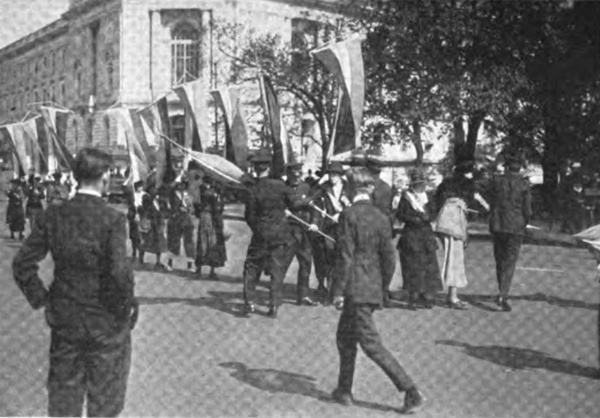
Obeying Orders. Washington Police Arresting White House Pickets Before the Treasury Building. Photo Copr. Harris and Ewing, Washington, D. C.
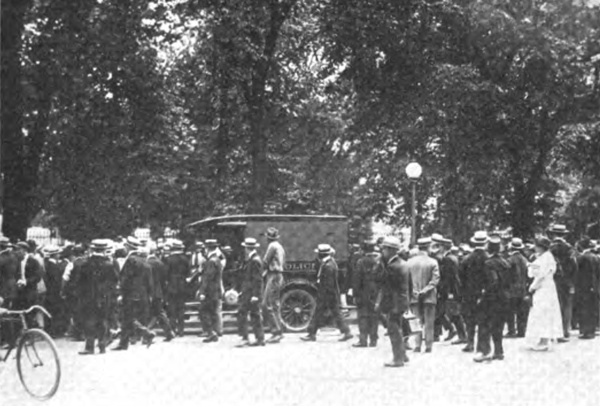
The Patrol Wagon Waiting the Arrival of the Suffrage Pickets. Photo Copr. Harris and Ewing, Washington, D. C.
257An enlisting sergeant used often to make his way through the crowds saying, “Now you have shown your spirit, boys, come and enlist!”
At all times, however, the people who annoyed, and later ill-treated the girls, were very young men—often in uniform. After a while there appeared men in plain clothes with groups of men in khaki, or yeomen, who were obviously in the crowd for the purpose of making trouble for the Suffragists. These people did not like cameras, and the moving picture people who, appreciating the news value of the situation, tried to get views of the crowd, did so at the risk of having their cameras smashed. Indeed, Helena Hill Weed once dispersed a crowd by pointing a camera at them. This was the worst element the pickets had to deal with—unthinking young men of a semi-brutalized type. Of course, boys took their cue from their elders, and snatched or destroyed banners where they could. After a demonstration, you would come across groups of them, marching with the tattered banners that they had managed to steal.
“When is the shooting going to begin?” one little boy was heard to ask once.
In the very midst of the riots, one would come across older men cutting up banners into small pieces which they gave away as souvenirs.
Of course, there were chivalrous spirits who protested against the treatment of the pickets by the police—protested even after they were threatened with arrest. Some of them were actually arrested, and one of them fined.
Often—very often indeed—the waiting crowds broke into spontaneous applause when group after group marched from Headquarters into the certainty of arrest. Those who were Anglo-Saxons inevitably admired the sporting quality of these women.
Perhaps a negro street sweeper summed it up better than anybody else. He said: “I doan know what them women want, but I know they ain’t skeered!”
The reader is probably asking by this time what was the 258effect of the picketing on the Woman’s Party itself. The first reaction was exactly what he would guess—that members resigned in large numbers. The second, however, was one which he might not expect—that new members joined in large numbers. In other words, the militant action which alienated some women brought others into the organization; women who were aroused by the simple and immediate demands of the Woman’s Party and by the courage and the forthrightness with which it pushed those demands; women who had become impatient at the impasse to which the older generation of Suffrage workers had brought the Suffrage Amendment. The majority of the people who deserted came back later.
As far as money was concerned, the effect was magical. In some months during the picketing the receipts were double what they had been the corresponding months of the previous year when there had been no picketing. Once those receipts jumped as high as six times the normal amount. This was what happened in England during the militant period.
259
4. The Court and the Pickets
“So long as you send women to prison for asking for justice, so long will women be ready to go in such a cause.”
Anne Martin to the judge before whom she was tried.
After Judge Waddill’s decision that the commitment of the pickets to Occoquan was illegal, the pickets filed sixteen suits for damage. Eight of these were against Whittaker, Superintendent of the Workhouse at Occoquan, and his assistant, Captain Reams, on account of their brutal treatment of the women while at Occoquan Workhouse. They were filed in the United States Court for the Western District of Virginia at Richmond. The other eight were against the Commissioners of the District of Columbia and Superintendent Zinkham of the District Jail for the unlawful transfer of the pickets to the institution of Whittaker at Occoquan. These suits were filed in the Supreme Court of the District of Columbia at Washington.
The appeals in the cases of two groups of women arrested August 23 and 28 came up in the District of Columbia Court of Appeals on January 8, 1918, before Chief Justice Smyth, and Justices Robb and Van Orsdel. Matthew O’Brien, of Washington, and Dudley Field Malone, of New York, appeared for the Suffragists. Corporation Counsel Stevens conducted the case for the government.
“Suppose,” suggested Justice Robb, “some upholders of Billy Sunday should go out on the streets with banners on which were painted some of Billy’s catch phrases, and should stand with their backs to the fence, and a curious crowd gathered, some of whom created disorder and threw stones at the carriers of the banners. Who should be arrested, those who created the disorder, or the banner carriers?”
Mr. Stevens gave it as his opinion that both parties should be arrested.
260“Did I make myself clear that the banner carriers were perfectly peaceful?” Justice Robb asked.
“When it is commonly known there is a forty-foot sidewalk there?” Justice Van Orsdel reinforced him.
“Well, then,” observed Attorney O’Brien, when he answered Mr. Stevens in his argument, “the honorable Justices obstruct traffic, according to learned counsel’s definition, when court adjourns, and they walk down the street together.”
On March 4, Judge Van Orsdel handed down the opinion, which was concurred in by the other two judges of the court, that in the case of those pickets who appealed, no information had been filed justifying their arrest and sentence. Since the offense of every other picket who was arrested was identical with that of these twelve who appealed their case, they were all illegally arrested, illegally convicted and illegally imprisoned. The Appellate Court thus reversed the decision of the District Police Court. In addition, it ordered the cases dismissed. All of the costs involved in the cases, it was decided, should be paid by the Court of the District of Columbia, for which an appropriation would have to be made by Congressional enactment.
Later, the case of Mrs. Harvey Wiley came up. It will be remembered that Mrs. Wiley was one of the forty-three women who picketed the President on November in the last picket line demonstration. She was sentenced to serve fifteen days in the District Jail. Dr. Wiley, her husband, appealed her case. Early in April the Court decided that there was no information filed justifying her arrest. So that she also was illegally arrested, illegally convicted, and illegally imprisoned.
Yet in spite of the brutalities to which the Courts sentenced the pickets, unconsciously they furthered the Suffrage cause. The women turned the Court sessions into Suffrage meetings. In defending their case at one of the early trials, the pickets, each taking up the story where the other left it, told the entire history of the Suffrage movement. Crowds thronged the Court. People attended these trials who had never been to a Suffrage meeting in their lives.
261
5. The Strange Ladies
THE EMPTY CUP
Evening at Occoquan. Rain pelts the workhouse roof. The prison matrons are sewing together for the Red Cross. The women prisoners are going to bed in two long rows. Some of the Suffrage pickets lie reading in the dim light. Through the dark, above the rain, rings out a cry.
We listen at the windows. (Oh, those cries from punishment cells!) A voice calls one of us by name. “Miss Burns! Miss Burns! Will you see that I have a drink of water?” Lucy Burns arises; slips on the coarse blue prison gown. Over it her swinging hair, red-gold, throws a regal mantle.
She begs the night-watch to give the girl water. One of the matrons leaves her war-bandages; we see her hasten to the cell. The light in it goes out. The voice despairing cries: “She has taken away the cup and she will not bring me water.” Rain pours on the roof. The Suffragists lie awake. The matrons work busily for the Red Cross. Katherine Rolston Fisher, The Suffragist, October 17, 1917.
WOMAN’S PARTY SONG
Composed in Prison by the Suffrage Pickets
SHOUT THE REVOLUTION OF WOMEN
Tune (Scotch):
“Charlie Is My Darling.”
Shout the Revolution
Of Women, of Women,
Shout the Revolution
Of Liberty.
262Rise, glorious women of the earth,
The voiceless and the free,
United strength assures the birth
Of True Democracy.
Invincible our army,
Forward, forward,
Strong in faith we’re marching
To Victory.
Shout the Revolution
Of Women, of Women,
Shout the Revolution
Of Liberty.
Men’s revolutions born in blood
But ours conceived in peace
We hold a banner for a sword,
’Til all oppression cease,
Prison, death defying,
Onward, onward,
Triumphant daughters marching
To Victory.
The preceding two chapters have been concerned mainly with the treatment of the pickets at the hands of the law. We now approach a much graver matter—their treatment at the hands of the prison authorities. This chapter describes what is one of the most disgraceful episodes in the history of the United States. It is futile to argue that what happened in the District Jail and at Occoquan Workhouse, and later at the abandoned Workhouse, was unknown to the Administration. The Suffragists, indeed, published it to the entire country. That the treatment to which the pickets were subjected was the result of orders from above is almost demonstrable. It must be remembered that the officials who are responsible for what happened to the pickets—the three Commissioners who govern the District of Columbia, the police court judges, the Chief of Police, the warden of the jail, the superintendent of Occoquan Workhouse, are directly or indirectly answerable to the President.
When the first pickets came out of prison (arrested on June 27, 1917), their spirit was that of women who have 263willingly gone to jail for a cause—and was in consequence entirely without self-pity.
In a speech at a breakfast tendered them in the garden at Headquarters, Mabel Vernon sounded this note:
I do not want any one here to think we have been martyrs because of this jail experience we have had. There was no great hardship connected with it. It was a very simple thing to do—to be imprisoned for three days, really two nights and a day. Do not think we have gone through any great sacrifices.
But I do not feel patient about this experience. I do not want to go back to jail, and I do not want others to go, because it should not be necessary.
The jail in which the women were first imprisoned was the conventional big white-washed octagonal building with wings at both sides. This was as filthy then as any place could be. The bathroom, with its shower was a damp, dank, dark place. The jail was filled with vermin and rats. Julia Emory said that, in the night, prisoners could actually hear the light cell chairs being moved, so big and strong were the rats. The prisoners complained so constantly that finally the prison officials put poison about; but this did not decrease them. Then they brought a dog, but the dog was apparently afraid of the rats. The girls used to hear the matrons telling visitors that they had got rid of the rats by means of this dog. One night, Julia Emory beat three rats in succession off her bed. Alice Paul says that among her group of jailed pickets was one whose shrieks nightly filled the jail as the rats entered her cell.
On July 17, however, when the sixteen women charged with obstructing traffic went to Occoquan Workhouse, things got much worse. Occoquan is charmingly situated, and, judged superficially, seems a model institution. It consists of a group of white buildings placed in a picturesque combination of cultivated fields with distant hills. All about lie the pleasant indications of rural life—crops; cows grazing; agricultural implements; even flower gardens. The District 264Jail cannot compare with it for charm of situation. It has not even a pretense of the meretricious effect of cleanliness which Occoquan shows. Nevertheless, no picket who went to Occoquan emerged without a sinister sense of the horror of the place. Lucy Burns, of whom it may almost be said that she knows no fear, confesses that at Occoquan she suffered with nameless and inexplicable terrors. This evidence is all the more strange because, I reiterate, Occoquan has an effect of cleanliness, of open air, of comfort; almost of charm. One reason for this sinister atmosphere was that no question the pickets put was ever answered directly. If they asked to see Superintendent Whittaker, he was always out—they could see him tomorrow. If they made a request, it would be granted to them in two days, or next week. The women’s ward was a long, clean, sunny, airy room with two rows of beds—like a hospital ward. Here they put colored prisoners to sleep in the same room with the Suffragists. Moreover, they set the Suffragists to paint the lavatories used by the colored women. The matron who handled the bedclothes was compelled to wear rubber gloves, but the Suffragists were permitted no such luxury—even in painting the lavatories. Indeed, often they slept in beds in which the blankets had not been changed or cleaned since the last occupant. It seemed a part of their premeditated system in the treatment of the Suffragists that they made them all undress in the same bathroom, and, without any privacy, take shower baths one after another.
The punishment cells, of which later we shall hear in reference to the Night of Terror, were in another building. These were tiny brick rooms with tiny windows, very high up.
A young relative of one of the jail officials, in the uniform of an officer of the United States Army, used to come into this building at night, and look in through the undraped grating of these cells. Once he unlocked the door, and came into a room where two young pickets were sleeping. “Are you a physician?” one of them had the presence of mind to ask.
265He answered that he was not. She lay down, and covered her head with the bedclothes. Presently he left.
There were open toilets in all these cells, and they could only be flushed from the outside. It was necessary always to call a man guard to do this. They came, or not, as they pleased.
In the Suffragist of July 28, 1917, occurs the first account of Occoquan, by Mrs. Gilson Gardner. Mrs. Gardner, it will be remembered, was one of that early group of sixteen pickets whom the President pardoned after three days.
She says:
The short journey on the train was pleasant and uneventful. From the station at Occoquan the women sent to the Workhouse were put into three conveyances; two were filled with white women and the third with colored women. In the office of the Workhouse we stood in a line and one at a time were registered and given a number. The matron called us by number and first name to the desk. Money and jewelry were accounted for and put in the safe. We were then sent to the dining-room. The meal of soup, rye bread, and water was not palatable....
From the dining-room we were taken to the dormitory. At one end of the long room, a white woman and two colored women were waiting for us. Before these women we were obliged, one by one, to remove all our clothing, and after taking a shower bath, put on the Workhouse clothes. These clothes consisted of heavy unbleached muslin chemises and drawers, a petticoat made of ticking, and a heavy dark gray cotton mother hubbard dress. The last touch was a full, heavy, dark blue apron which tied around the waist. The stockings were thick and clumsy. There were not enough stockings, and those of us who did not have stockings during our sojourning there were probably rather fortunate. We were told to wear our own shoes for the time being, as they did not have enough in stock. The one small rough towel that was given to us we were told must be folded and tucked into our aprons. The prisoners were permitted to have only what they could carry.
The dormitory was clean and cool and we longed to go to bed, but we were told we must dress and go into the adjoining room where Superintendent Whittaker would see us. Mr. Whittaker brought with him a man whom we afterward learned was a newspaper man. The superintendent informed us that for about an 266hour we could do as we chose, and pointing to the piano said that we might play and sing. The piano was not unlocked while we were there, but that night no one had a desire to sing. Although Mr. Whittaker’s words were few and not unpleasant, we realized that our presence did not cause him either embarrassment or regret.
We were told that one dormitory was given up to colored women; in the other one, the one in which we were to sleep, there would be both colored and white women. We had asked to be allowed to have our toilet things and were told we could not have them until the next morning, that is, we would be permitted to have our combs and toothbrushes then. But we were not permitted to have these until Thursday. One woman told us we must not lend our comb to other prisoners and must not mingle with the colored women....
The days were spent in the sewing-room. We were permitted to talk in low tones, two or three being allowed to sit together. While we were there, the sewing was very light. We turned hems on sheets and pillow slips and sewed on the machine. There were both white and colored women working in the sewing-room. The work was monotonous and our clothing extremely heavy.
The great nervous strain came at meal time. All the women ate in one big room. The white women sat at one side. The meal lasted thirty and sometimes forty minutes. The food to us was not palatable, but we all tried to be sensible and eat enough to keep up our strength. The real problem, however, was not the food; it was the enforced silence. We were not allowed to speak in the dining-room, and after a conscientious effort to eat, the silent waiting was curiously unpleasant....
The use of the pencil is forbidden at all times. Each inmate is permitted to write but two letters a month, one to her family and one business letter. All mail received and sent is opened and read by one of the officials. Next to our longing for our own toilet articles was our desire for a pencil and a scrap of paper. Another rule which makes life in the Workhouse more difficult than life in the jail is that the Workhouse prisoners are not permitted to receive any food sent in from outside.
We found that the other prisoners were all amazed at the excessive sentences we had received. Old offenders, they told us, received only thirty days.
In the Suffragist of August 11, Doris Stevens, who was a member of the same group says:
267No woman there will ever forget the shock and the hot resentment that rushed over her when she was told to undress before the entire company, including two negress attendants and a harsh-voiced wardress, who kept telling us that it was “after hours,” and they “had worked too long already today,” as if it were our fault that we were there. We silenced our impulse to resist this indignity, which grew more poignant as each woman nakedly walked across the great vacant space to the doorless shower....
“We knew something was goin’ to happen,” said one negro girl, “because Monday,” (we were not sentenced until Tuesday) “the clo’es we had on were took off us and we were given these old patched ones. We was told they wanted to take stock, but we heard they were being washed for you-all Suffragists.”
It will be remembered that this was that early group of pickets whom the President pardoned after the appeals of J. A. H. Hopkins, Dudley Field Malone, and Gilson Gardner. Before leaving they were taken to Superintendent Whittaker.
Asking for the attention of Miss Burns and the rest of them, he said:
“Now that you are going, I have something to say to you.” And turning to Miss Burns, he continued, “And I want to say it to you. The next lot of women who come here won’t be treated with the same consideration that these women were.”
Mrs. Virginia Bovee, an officer of Occoquan Workhouse, was discharged in September. At that time Lucy Burns filed charges with Commissioner Brownlow of the District of Columbia concerning conditions in the Workhouse. Evidence is submitted on Whittaker’s brutal treatment of other prisoners, but our concern must be with his treatment of the Suffragists.
Lucy Burns says in that complaint:
The hygienic conditions have been improved at Occoquan since a group of Suffragists were imprisoned there. But they are still bad. The water they drink is kept in an open pail, from which it is ladled into a drinking cup. The prisoners frequently dip the drinking cup directly into the pail.
The same piece of soap is used for every prisoner. As the 268prisoners in Occoquan are sometimes afflicted with disease, this practice is appallingly negligent.
Mrs. Bovee’s affidavit reads in part:
The blankets now being used in the prison have been in use since December without being washed or cleaned. Blankets are washed once a year. Officers are warned not to touch any of the bedding. The one officer who has to handle it is compelled by the regulations to wear rubber gloves while she does so. The sheets for the ordinary prisoners are not changed completely, even when one has gone and another takes her bed. Instead, the top sheet is put on the bottom, and one fresh sheet given them. I was not there when these Suffragists arrived, so I do not know how their bedding was arranged. I doubt whether the authorities would have dared to give them one soiled sheet.
The prisoners with diseases are not always isolated, by any means. In the colored dormitory there are now two women in advanced stages of consumption. Women suffering from syphilis, who have open sores, are put in the hospital. But those whose sores are temporarily healed are put in the same dormitory with the others. There have been several such in my dormitory.
When the prisoners come, they must undress and take a shower bath. For this they take a piece of soap from a bucket in the storeroom. When they have finished, they throw the soap back in the bucket. The Suffragists are permitted three showers a week, and have only these pieces of soap which are common to all inmates. There is no soap at all in the washrooms.
The beans, hominy, rice, corn meal (which is exceedingly coarse, like chicken feed), and cereal have all had worms in them. Sometimes the worms float on top of the soup. Often they are found in the corn bread. The first Suffragists sent the worms to Whittaker on a spoon. On the farm is a fine herd of Holsteins. The cream is made into butter, and sold to the tuberculosis hospital in Washington. At the officers’ table, we have very good milk. The prisoners do not have any butter, or sugar, and no milk except by order of the doctor.
As time went on and great numbers of pickets were arrested, more and more indignities were put on them. They were, in every sense, political prisoners, and were entitled to the privileges of political prisoners. In all countries distinction is made in the treatment of political prisoners. Of 269course, the hope of the Administration was that these degrading conditions would discourage the picketing, and, of course, the results were—as has happened in the fight for liberty during the whole history of mankind—that more and more women came forward and offered themselves.
In the Suffragist for October 13, 1917 (“From the Log of a Suffrage Picket”), Katherine Rolston Fisher writes the following:
Upon entering Occoquan Workhouse, we were separated from the preceding group of Suffragists. Efforts were made by the officers to impress us by their good will towards us. Entirely new clothing, comfortable rooms in the hospital, and the substitution of milk and buttered toast for cold bread, cereal, and soup, ameliorated the trials of the table. The head matron was chatty and confidential. She told us of the wonderful work of the superintendent in creating these institutions out of the wilderness and of the kindness shown by the officers to inmates. She lamented that some of the other Suffragists did not appreciate what was done for them....
“Why are we segregated from all the white prisoners?” I asked the superintendent of the Workhouse. Part of the time we were not segregated from the colored prisoners, a group of whom were moved into the hospital and shared with us the one bathroom and toilet. “That is for your good and for ours,” was the bland reply....
That was quite in the tone of his answer to another inquiry made when the superintendent told me that no prisoner under punishment—that is, in solitary confinement—was allowed to see counsel. “Is that the law of the District of Columbia?” I inquired. “It is the law here because it is the rule I make,” he replied.
We learned what it is to live under a one-man law. The doctor’s orders for our milk and toast and even our medicine were countermanded by the superintendent, so we were told. Our counsel after one visit was forbidden, upon a pretext, to come again.
On Tuesday, September 18, we were made to exchange our new gingham uniforms for old spotted gray gowns covered with patches upon patches; were taken to a shed to get pails of paint and brushes, and were set to painting the dormitory lavatories and toilets. By this time we were all hungry and more or less weak from lack of food. A large brush wet with white paint 270weighs at least two pounds. Much of the work required our standing on a table or stepladder and reaching above our heads. I think the wiser of us rested at every opportunity, but we did not refuse to work.
All this time we had been without counsel for eight days....
The food, which had been a little better, about the middle of the month reached its zenith of rancidity and putridity. We tried to make a sport of the worm hunt, each table announcing its score of weevils and worms. When one prisoner reached the score of fifteen worms during one meal, it spoiled our zest for the game....
We had protested from the beginning against doing any manual labor upon such bad and scanty food as we received....
Mrs. Kendall, who was the most emphatic in her refusal, was promptly locked up on bread and water. The punishment makes a story to be told by itself. It clouded our days constantly while it lasted and while we knew not half of what she suffered....
All this time—five days—Mrs. Kendall was locked up, her pallid face visible through the windows to those few Suffragists who had opportunity and ventured to go to her window for a moment at the risk of sharing her fate.
Ada Davenport Kendall’s story runs as follows:
For stating that she was too weak from lack of food to scrub a floor and that the matron’s reply that there was no other work was “hypocritical,” Mrs. Kendall was confined in a separate room for four days for profanity. She was refused the clean clothing she should have on the day of her confinement, and was therefore forced to wear the same clothing for eleven days. She was refused a nightdress, or clean linen for the bed in the room. The linen on her bed was soiled from the last occupant and Mrs. Kendall lay on top of it all. The only toilet accommodation consisted of an open pail. Mrs. Kendall was allowed no water for toilet purposes during the four days, and was given three thin slices of bread and three cups of water a day. The water was contained in a small paper cup, and on several occasions it seeped through.
Friends of Mrs. Kendall’s obtained permission to see her. She was then given clean clothing, and taken from the room in which she was in solitary confinement. When the door opened upon her visitors, she fainted.
271Aroused by an inspection of samples of food smuggled out to him by Suffrage prisoners, Dr. Harvey Wiley, the food expert, requested the Board of Charities to permit him to make an investigation of the food. “A Diet of Worms won one revolution, and I expect it will win another,” promulgated Dr. Wiley.
The most atrocious experience of the pickets at Occoquan was, however, on the night known to them generally as The Night of Terror. This happened to that group of Suffragists who were arrested on November 14, sentenced to Occoquan, and who immediately went on hunger-strike as a protest against not being treated as political prisoners and as the last protest they could make against their imprisonment. Whittaker was away when they arrived, and they were kept in the office which was in the front room of one of the small cottages. Out of these groups there always evolved a leader. If the group included the suave and determined Lucy Burns, she inevitably took command. If it included Mrs. Lawrence Lewis, equally velvet-voiced and immovable, she inevitably became spokesman. This group included both. The Suffragists were then still making their demand to be treated as political prisoners, and so, when the woman at the desk—a Mrs. Herndon—attempted to ask the usual questions, Mrs. Lewis, speaking for the rest, refused to answer them, saying that she would wait and talk to Mr. Whittaker.
“You will sit here all night then,” said Mrs. Herndon.
The women waited for hours.
Mrs. Lewis always describes what follows as a sinister reversal of a French tale of horror she read in her girlhood. In that story, people began mysteriously to disappear from a group. One of them would be talking one instant—the next he was gone; the space where he stood was empty. In this case, slowly, silently, and in increasing numbers, men began to appear from outside, three and then four.
272Mrs. Herndon again tried to get the Suffragists to register, but they made no reply.
“You had better answer up, or it will be the worse for you,” said one man.
“I will handle you so you’ll be sorry you made me,” said another.
The Suffragists did not reply. Mrs. Nolan says that she could see that Mrs. Herndon was afraid of what was going to happen.
Suddenly the door burst open, and Whittaker came rushing in from a conference, it was later discovered, of the District of Columbia Commissioners at the White House—followed by men—more and more of them. The Suffragists had been sitting or lying on the floor. Mrs. Lewis stood up.
“We demand to be treated as political pris——” she began. But that was as far as she got.
“You shut up! I have men here glad to handle you!” Whittaker said. “Seize her!”
Two men seized Mrs. Lewis, dragged her out of the sight of the remaining Suffragists.
In the meantime, another man sprang at Mrs. Nolan, who, it will be remembered, was over seventy years old, very frail and lame. She says:
I am used to being careful of my bad foot, and I remember saying: “I will come with you; do not drag me. I have a lame foot.” But I was dragged down the steps and away into the dark. I did not have my feet on the ground. I guess that saved me.
It was black outside, and all Mrs. Nolan remembers was the approach to a low, dark building from which, made brilliantly luminous by a window light, flew the American flag.
As Mrs. Nolan entered the hall, a man in the Occoquan uniform, brandishing a stick, called, “Damn you! Get in there!” Before she was shot through this hall, two men brought in Dorothy Day,—a very slight, delicate girl; her captors were twisting her arms above her head. Suddenly 273they lifted her, brought her body down twice over the back of an iron bench. One of the men called: “The damned Suffrager! My mother ain’t no Suffrager! I will put you through hell!” Then Mrs. Nolan’s captors pulled her down a corridor which opened out of this room, and pushed her through the door.
Back of Mrs. Nolan, dragged along in the same way, came Mrs. Cosu, who, with that extraordinary thoughtfulness and tenderness which the pickets all developed for each other, called to Mrs. Nolan: “Be careful of your foot!”
The bed broke Mrs. Nolan’s fall, but Mrs. Cosu hit the wall. They had been there but a few minutes when Mrs. Lewis, all doubled over like a sack of flour, was thrown in. Her head struck the iron bed, and she fell to the floor senseless.
The other women thought she was dead. They wept over her.
Ultimately, they revived Mrs. Lewis, but Mrs. Cosu was desperately ill all night, with a heart attack and vomiting. They were afraid that she was dying, and they called at intervals for a doctor, but although there was a woman and a man guard in the corridor, they paid no attention. There were two mattresses and two blankets for the three, but that was not enough, and they shivered all night long.
In the meantime, I now quote from Paula Jakobi’s account. We go back to that moment in the detention room when they seized Mrs. Lewis.
“And seize her!” rang in my ears, and Whittaker had me by the arm. “And her!” he said, indicating Dorothy Day. Miss Day resisted. Her arm was through the handle of my bag. Two men pulled her in one direction, while two men pulled me in the opposite direction. There was a horrible mix-up. Finally, the string of the bag broke. Two men dragged her from the room. I saw it was useless to resist. The man at the right of me left me, and tightly grasped in the clutches of the man at my left, I was led to a distant building.
When Julia Emory, who was rushed along just after Mrs. Jakobi, entered the building, the two guards were smashing 274Dorothy Day’s back over the back of a chair; she was crying to Paula Jakobi for help; and Mrs. Jakobi, struggling with the other two guards, was trying to get to her. They placed Julia Emory in a cell opposite Lucy Burns.
Of the scene in the reception room of the Workhouse, Mrs. John Winters Brannan, who saw all this from a coign of vantage which apparently surveyed the whole room, says:
I firmly believe that, no matter how we behaved, Whittaker had determined to attack us as part of the government plan to suppress picketing.... Its (the attack’s) perfectly unexpected ferocity stunned us. I saw two men seize Mrs. Lewis, lift her from her feet, and catapult her through the doorway. I saw three men take Miss Burns, twisting her arms behind her, and then two other men grasp her shoulders. There were six to ten guards in the room, and many others collected on the porch—forty to fifty in all. These all rushed in with Whittaker when he first entered.
Instantly the room was in havoc. The guards brought from the male prison fell upon us. I saw Miss Lincoln, a slight young girl, thrown to the floor. Mrs. Nolan, a delicate old lady of seventy-three, was mastered by two men. The furniture was overturned, and the room was a scene of havoc.
Whittaker in the center of the room directed the whole attack, inciting the guards to every brutality.
The whole group of women were thrown, dragged, and hurled out of the office, down the steps, and across the road and field to the Administration Building, where another group of bullies was waiting for us. The assistant superintendent, Captain Reams, was one of these, armed with a stick which he flourished at us, as did another man. The women were thrown roughly down on benches.
In the meantime, Lucy Burns, fighting desperately all the way, had been deposited in a cell opposite.
As always, when she was arrested, she took charge of the situation. In her clear, beautiful voice, she began calling the roll one name after another, to see if all were there and alive. The guards called, “Shut up!” but she paid no more attention to them than if they had not spoken. “Where is Mrs. Lewis?” she demanded. Mrs. Cosu answered: 275“They have just thrown her in here.” The guard yelled to them that if they spoke again, he would put them in strait-jackets. Mrs. Nolan and Mrs. Cosu were so terrified that they kept still for a while.
But Lucy Burns went right on calling the roll. When she refused—at the guard’s orders—to stop this, they handcuffed her wrists and fastened the handcuffs above her head to the cell door. They threatened her with a buckle gag. Little Julia Emory could do nothing to help, of course, but she put her hands above her head in exactly the same position and stood before her door until they released Lucy Burns. Lucy Burns wore her handcuffs all night.
Mrs. Henry Butterworth, for some capricious reason, was taken away from the rest, and placed in a part of the jail where there were only men. They told her that she was alone with the men, and that they could do what they pleased with her. Her Night of Terror was doubly terrifying—with this menace hanging over her.
For a description of the rest of that night, and of succeeding days, I quote the account of Paula Jakobi:
I didn’t know at the time what happened to the other women. I only knew that it was hell let loose with Whittaker as the instigator of the horror. In the ante-chamber to the cells, some of the guards were standing, swinging night sticks in a menacing manner. We were thrust into cells; the ventilators were closed. The cells were bitter cold. There was an open toilet in the corner of the cell, which was flushed from the outside. We had to call a guard who had previously attacked us to flush them. The doors were barred, there were no windows. The doors were uncurtained, so that through the night the guard could look into the cell. There was no light in the room, only one in the corridor. Three of us were thrown into every cell. There was a single bed in each room and a mattress on the floor. The floors were filthy as were the blankets.
In the morning, we were roughly told to get up. No facilities for washing were given us. Faint, ill, exhausted, we were ordered before the superintendent. It was eight o’clock and we had had no food since the preceding day at twelve. None had been offered us, nor were any inquiries made about our physical condition. 276Whittaker asked my name; then whether I would go to the Workhouse and obey prison regulations and be under the care of the ladies. I told him I would not. I would not wear prison clothes, and I demanded the rights of political prisoners. He interrupted me with, “Then you’ll go to the male hospital”—he emphasized the “male”—“and be in solitary confinement. Do you change your mind?” I said “No!” and was taken to the hospital by a trusty.
Then followed a series of bullying, of privileges, and of curtailing them. The first day at three o’clock milk and bread were brought to the room. After I refused it, it was taken away. That evening some more milk and bread were brought. These were left in the room all night. The second day toast and milk were brought. These were left in the room all night. The third day the matron suggested an egg and coffee for breakfast. I told her I did not want anything to eat. This day at lunch time fried chicken and salad were brought in. Later Miss Burns passed a note which read, “I think this riotous feast which has just passed our doors is the last effort of the institution to dislodge all of us who can be dislodged. They think there is nothing in our souls above fried chicken.” No matter what was offered, a glass of milk and piece of bread were left from meal to meal, and once bouillon and bread was left.
The fast did not make me ill at this time, only weak. The second day there was slight nausea and headache; the third day, fever and dizziness; the fever remained, causing very dry, peeling skin and swollen lips. By the third day, I was rather nervous—there were no other manifestations except increasing weakness and aphasia. I could remember no names, and it was quite impossible to read.
We were summoned so often and so suddenly from our rooms to see Whittaker, or to have the rooms changed—we were in the same room scarcely two consecutive nights—that one was never sure when she would be searched and when the few remaining treasures would be taken from us, so I hid stubs of pencils in my pillow, ripping the ticking with a hairpin, and one pencil in the hem of the shade. The dimes and nickels for the trusty I placed in a row over the sill of the door, paper behind the steam radiator pipes. It was difficult to find places to secrete anything, for the only furniture in the room was a single iron bed and one chair. Notes to one another are passed by tapping furtively on the steampipe running through the walls; then, when the answer comes, passing the note along the pipe. Everything is conducive to concealment.
277The second day our writing materials were asked for (I did not give up those I had hidden). Then we were summoned to Whittaker—each of the hunger-strikers. (There were now seventeen of us.) He had a stenographer with him. He asked my name; then, “Are you comfortable?” His manner was quite changed; he was as civil as he could be. I answered him with the little formula, “I demand the right to be treated as a political prisoner. I am now treated as a common criminal.”
He: If you have steak and vegetables, will you go to the Workhouse and obey rules?
I: I will not.
He: If you will promise not to picket any more and to leave Washington soon, I will let you go without paying any fine and I’ll take you to Washington in my own automobile.
I: I will not promise this.
He: What is it you want?
I: The right to keep my own clothes, to have nourishing food permanently, which will not be taken away and given back at your will, the right to send and receive mail, and above all, the right to see counsel and have fresh air exercise.
He: If I grant you all these things, will you go to the Workhouse and work?
I: I will not.
He: Are the matrons and interns kind to you?
I: Yes.
He: What food is left in your room?
I: Chiefly bread and milk, once bouillon and toast.
He: Anything else?
I: No.
He: Have you any request?
I: That I receive the rights due me—those of a political prisoner.
Whittaker will use these interviews in expurgated form, I am sure. When I said anything which did not please him, he said to the stenographer, “You needn’t put that down.”
After the above interviews, he absolutely refused to let our counsel who came from Washington see us.
After my visit to Whittaker this day, I was summoned to the Workhouse. My clothes were listed—those I wore—before two matrons, just as those of criminals are listed; then I was obliged to undress before the two matrons and two trusties, walk to a shower, take a bath, and dress before them in prison clothes. The clothes were clean, but so coarse that they rubbed my skin 278quite raw. They have two sizes of shoes for the prisoners—large and small.
The only message which reached me from “outside” was a telegram from a friend asking that I allow my bail to be paid. I answered that I would not. This day six girls in our section were taken away “somewhere.” The sense of some unknown horror suddenly descending is the worst of the whole situation. Whittaker’s suave manner was interrupted for a moment this day when he came into the hospital ward and saw Julia Emory in the corridor—she was returning from the wash-room—and taking Julia by the neck he threw her into her cell. “Get in there,” he snarled, or words to that effect.... I was coming out of an adjoining wash-room at the moment, and saw this.
This night I had a most vivid dream. The interne brought in a rabbit. He held it up and told us he would cook it for us. The women—our women—did not wait for him to cook it, but rushed toward him, pulled it from his hands, and tore the living animal into pieces and ate it. I awoke, sobbing.
Next evening, there was great commotion in our corridor. The doors, which did not lock, were held; there were rapid footsteps to and fro. Distressed sounds came from the room adjoining mine, and soon it was evident that Miss Burns was being forcibly fed. Half an hour earlier, her condition was found normal by the doctor, who strolled casually through our ward, looked in at the door, nodded, felt her pulse, and went on. Now Miss Burns was being forcibly fed. What could it mean? Then there were more hurried steps, and the men went to Mrs. Lewis’s room. Fifteen minutes later, they were both hurried into an ambulance and taken away—no one told us where. We had visions accentuated that night, of being separated, hurried out of sight to oblivion, somewhere away from every one we knew.
A detachment of the United States Marines guarded the place. The prisoners were kept incommunicado. That meant, not only were they not allowed visitors, but they were not allowed counsel—and counsel is one of the inalienable rights of citizenship.
In the meantime at Headquarters, the Suffragists, under the leadership of Doris Stevens, now that Alice Paul and Lucy Burns were both in prison, could not even find out where the prisoners were. They had received a jail sentence but were not in the District Jail. Katherine Morey, in great 279anxiety in regard to her mother, who was one of the prisoners, came from Boston to see her. She could not even locate her. Finally, she hit on the device of meeting the morning train, on which released prisoners always came from Occoquan, and one of them informed her that her mother was at the Workhouse.
In the meantime, sixteen of the women had gone on a hunger-strike. They were committed to Occoquan on Wednesday, November 14. By the following Sunday, Superintendent Whittaker became alarmed. He declared he would not forcibly feed any of them unless they signed a paper saying that they themselves were responsible for any injury upon their health. Of course, they all refused to do this, whereupon Superintendent Whittaker said: “All right, you can starve.” However, by Sunday night, he was a little shaken in this noble resolution. He went to Mrs. Lewis, and asked her what could be done. Mrs. Lewis answered that all they asked was to be treated as political offenders, which provided for exercise, receiving of mail and visitors, buying food and reading matter. He asked her to write this statement out in his name, as though he demanded it. On Monday he brought the statement to the Commissioners of the District of Columbia. Commissioner Gardner gave out a statement that such demands would never be granted.
In the meantime too, Matthew O’Brien, the counsel for the Woman’s Party, succeeded in getting an order from the Court which admitted him to Occoquan. He saw Mrs. Lewis, Mrs. Brannan, and Miss Burns once; but afterwards in spite of his Court order, they refused him admission.
It had been part of the system in attempting to lower Miss Burns’s morale to take her clothes away from her. When Mr. O’Brien visited Miss Burns she was lying on a cot in a dark cell, wrapped in blankets. He came back to Headquarters filled with admiration for her extraordinary spirit. He said that she was as much herself as if they were talking in the drawing-room of Cameron House. Mrs. Nolan, released at the end of her six day sentence, also 280brought the news of what happened back to Headquarters. These were the things that made the Suffragists determine on habeas corpus proceedings. Mr. O’Brien applied to the United States District Court at Richmond for this writ. It was granted returnable on November 27. Mr. O’Brien, however, afraid that, in combination with the indignities to which they were being submitted, the women would collapse from starvation, made another journey to Judge Waddill, who set the hearing forward to the 23rd.
The next step was serving the writ on Superintendent Whittaker. This was done by a ruse. On the night of the 21st, Mr. O’Brien called at Superintendent Whittaker’s home. He was told that the Superintendent was not there. Mr. O’Brien went not far away, and telephoned that he would not return until the morning. Then he returned immediately to Superintendent Whittaker’s home, found him there, of course, and served the papers.
In the meantime, Superintendent Whittaker began to fear that Mrs. Lawrence Lewis and Lucy Burns would die. Unknown to the other prisoners—and thereby causing them the most intense anguish—he had them taken to the hospital of the District Jail. They had been forcibly fed at Occoquan, and the feeding was continued at the jail.
Mrs. Lewis writes:
I was seized and laid on my back, where five people held me, a young colored woman leaping upon my knees, which seemed to break under the weight. Dr. Gannon then forced the tube through my lips and down my throat, I gasping and suffocating with the agony of it. I didn’t know where to breathe from, and everything turned black when the fluid began pouring in. I was moaning and making the most awful sounds quite against my will, for I did not wish to disturb my friends in the next room. Finally the tube was withdrawn. I lay motionless. After a while I was dressed and carried in a chair to a waiting automobile, laid on the back seat, and driven into Washington to the jail hospital. Previous to the feeding I had been forcibly examined by Dr. Gannon, I struggling and protesting that I wished a woman physician.
281Lucy Burns was fed through the nose. Her note, smuggled out of jail, is as follows:
Wednesday, 12 M. Yesterday afternoon at about four or five, Mrs. Lewis and I were asked to go to the operating room. Went there and found our clothes. Told we were to go to Washington. No reason, as usual. When we were dressed Dr. Gannon appeared, said he wished to examine us. Both refused. Were dragged through halls by force, our clothing partly removed by force, and we were examined, heart tested, blood pressure and pulse taken. Of course such data was of no value after such a struggle. Dr. Gannon told me that I must be fed. Was stretched on bed, two doctors, matron, four colored prisoners present, Whittaker in hall. I was held down by five people at legs, arms, and head. I refused to open mouth, Gannon pushed the tube up left nostril. I turned and twisted my head all I could, but he managed to push it up. It hurts nose and throat very much and makes nose bleed freely. Tube drawn out covered with blood. Operation leaves one very sick. Food dumped directly into stomach feels like a ball of lead. Left nostril, throat, and muscles of neck very sore all night. After this I was brought into the hospital in an ambulance. Mrs. Lewis and I placed in same room. Slept hardly at all.
This morning Dr. Ladd appeared with his tube. Mrs. Lewis and I said we would not be forcibly fed. Said he would call in men guards and force us to submit. Went away and we not fed at all this morning. We hear them outside now cracking eggs.
We resume Paula Jakobi’s account:
We were summoned two days later to appear at Alexandria jail next day, Friday of that week—that would make nine days spent in the Workhouse.
A writ of habeas corpus had been issued for our unjust imprisonment at Occoquan when we had been sentenced to Washington jail. This day I fainted. It was now seven and a half days since I had started hunger-striking. Three young doctors came in to have a look at the hunger-strikers. They did not take our pulse; they just gazed and departed. Later in the day, I was told that I could not go to court next day if I did not eat, as they would not take the responsibility for my trip. They prepared to forcibly feed me. I concluded to eat voluntarily, since I had to break my fast, so that evening I had a baked potato and a baked apple. Next morning I ate no breakfast, but 282was threatened with forcible feeding at noon if I did not eat, so I ate again.
The next day we were taken to Alexandria Court House. There we found out why Miss Burns and Mrs. Lewis had been taken away from Occoquan. It was to prevent their appearance at Court, although it was shown that Whittaker had been removed after he had received the writ of habeas corpus. Our counsel pleaded for their appearance in Court. The warden of the Washington jail, where they now were, was so solicitous for their health that he feared to move them. Mr. Dudley Field Malone asked him whether they were being forcibly fed. The warden replied that they were. “How many men does it take to hold Miss Burns?” Mr. Malone quietly questioned, “while she is being forcibly fed?” Zinkham answered, “Four.” “Then, your Honor,” asked Mr. Malone, “don’t you think that if it takes four men to hold Miss Burns to give her forcible feeding, she is strong enough to appear in Court?”
Next day, both Mrs. Lewis and Miss Burns were at the trial.
It was found that our detention in the Workhouse was illegal and we were given our freedom on parole. I refused to accept it, and with twenty-two other prisoners was taken to Washington jail to finish my term of imprisonment.
The Suffragists were brought from Occoquan to the Court on November 23, according to schedule. Their condition was shocking. They all showed in their pallor and weakness the effect of the brutal régime to which they had been subjected. The older women could hardly walk, and were supported by their younger and stronger companions. When they reached their chairs, they lay back in them, utterly worn out. Mrs. John Winters Brannan collapsed, and had to be taken from the Courtroom.
As Paula Jakobi has stated, Judge Waddill decided that the thirty-one Suffragists had been illegally committed to Occoquan Workhouse, and were entitled to liberation on bail pending an appeal or the return to the District Jail. Rose Winslow, it will be remembered, was tried at the same time as Alice Paul and received a sentence of seven months. 283Here are some extracts from the prison notes of Rose Winslow smuggled out to friends:
The women are all so magnificent, so beautiful. Alice Paul is as thin as ever, pale and large-eyed. We have been in solitary for five weeks. There is nothing to tell but that the days go by somehow. I have felt quite feeble the last few days—faint, so that I could hardly get my hair combed, my arms ached so. But today I am well again. Alice Paul and I talk back and forth though we are at opposite ends of the building and a hall door also shuts us apart. But occasionally—thrills—we escape from behind our iron-barred doors and visit. Great laughter and rejoicing!...
I told about a syphilitic colored woman with one leg. The other one was cut off, having rotted so that it was alive with maggots when she came in. The remaining one is now getting as bad. They are so short of nurses that a little colored girl of twelve, who is here waiting to have her tonsils removed, waits on her. This child and two others share a ward with a syphilitic child of three or four years, whose mother refused to have it at home. It makes you absolutely ill to see it. I am going to break all three windows as a protest against their boarding Alice Paul with these!
Dr. Gannon is chief of a hospital. Yet Alice Paul and I found we had been taking baths in one of the tubs here, in which this syphilitic child, an incurable, who has his eyes bandaged all the time, is also bathed. He has been here a year. Into the room where he lives came yesterday two children to be operated on for tonsillitis. They also bathed in the same tub. The syphilitic woman has been in that room seven months. Cheerful mixing, isn’t it? The place is alive with roaches, crawling all over the walls everywhere. I found one in my bed the other day....
In regard to the forcible feeding, she said:
Yesterday was a bad day for me in feeding. I was vomiting continually during the process. The tube has developed an irritation somewhere that is painful....
I fainted again last night. I just fell flop over in the bathroom where I was washing my hands, and was led to bed, when I recovered, by a nurse. I lost consciousness just as I got there again. I felt horribly faint until twelve o’clock, then fell asleep for awhile....
The same doctor feeds us both.... Don’t let them tell you 284we take this well. Miss Paul vomits much. I do, too, except when I’m not nervous, as I have been every time but one. The feeding always gives me a severe headache. My throat aches afterward, and I always weep and sob, to my great disgust, quite against my will. I try to be less feeble-minded.
The final barbarity, however, in the treatment of the pickets came out in the experience of Alice Paul. Of course, the Administration felt that in jailing Alice Paul, they had the “ringleader.” That was true. What they did not realize, however, was that they had also jailed the inspired reformer, the martyr-type, who dies for a principle, but never bends or breaks. Miss Paul was arrested, it will be remembered, on October 20. The banner that she carried had, in the light of later events, a grim significance. It bore President Wilson’s own words:
THE TIME HAS COME TO CONQUER OR SUBMIT. FOR US THERE
CAN BE BUT ONE CHOICE. WE HAVE MADE IT.
Her sentence was seven months.
“I am being imprisoned,” said Miss Paul as she was taken from the District Police Court to the patrol wagon that carried her to jail, “not because I obstructed traffic, but because I pointed out to President Wilson the fact that he is obstructing the progress of justice and democracy at home while Americans fight for it abroad.”
When Alice Paul reached the jail, she found ten other Suffragists who had been brought there four days before from Occoquan. The air of this jail was stifling. There were about seventy-five women prisoners locked in three tiers of cells, and no window had been opened. The first appeal of the Suffragists to Alice Paul was for air.
Alice Paul, not committed to her cell yet, looked about her. High up she saw a little, round window with a rope hanging from it. She asked the matron why they did not open the window. “If we started opening windows, we should have to give the colored women more clothes,” the matron told her.
285With her usual promptness and decision Alice Paul crossed the corridor and pulled the window open. There was no place to fasten the rope so she stood there holding it. The matron called for the guards. Two of them, unusually big and husky in comparison with Alice Paul’s ninety-five pounds, tried to take the rope away. It broke in her hands, the window closed, and the guards carried Miss Paul to her cell.
Alice Paul had brought, in the pocket of her coat, a volume of Browning. Before they closed the door, she threw it with what Florence Boeckel describes as a “desperate, sure aim,” through the window.
Miss Paul’s confrères say that it is amusingly symbolic of the perfection of her aim in all things that she hit one of the little panes of that far-away window. As the glass had not been repaired when the Suffragists left jail, they had the pure air they demanded. They said that the old-timers told them it was the first good air they had ever smelled in jail.
Alice Paul and Rose Winslow went on hunger-strike at once. This strike lasted three weeks and a day. The last two weeks they were forcibly fed. Both women became so weak that they were finally moved to the hospital.
Two or three alienists with Commissioner Gardner were brought in to examine Alice Paul. They usually referred to her in her presence as “this case.” One of the alienists, visiting her for the first time, said to the nurse, “Will this patient talk?” Alice Paul burst into laughter.
“Talk!” she exclaimed. “That’s our business to talk. Why shouldn’t we talk?”
“Well, some of them don’t talk, you know,” the alienist said.
“Well, if you want me to talk——” Weak as she was, Miss Paul sat up in bed and gave him a history of the Suffrage movement beginning just before the period of Susan B. Anthony and coming down to that moment. It lasted an 286hour. This alienist told the present writer that in his report to the authorities he said in effect:
“There is a spirit like Joan of Arc, and it is as useless to try to change it as to change Joan of Arc. She will die but she will never give up.”
Alice Paul says that she realized after a while that the questions of the alienists were directed towards establishing in her one of the well-known insane phobias—the mania of persecution. The inquiries converged again and again toward one point: “Did she think the President personally responsible for what was occurring?” As it happened her sincere conclusion in this matter helped in establishing their conviction of her sanity. She always answered that she did not think the President was responsible in her case—that he was perhaps uninformed as to what was going on.
Notwithstanding the favorable report of the alienist, after a while they removed Alice Paul from the hospital to the psychopathic ward. The conditions under which she lived here are almost incredibly sinister. It is difficult to avoid the conclusion that it was hoped that they would affect Alice Paul’s reason; would certainly discredit the movement she led by making the world believe that she was mentally unbalanced. The room in which she was confined was big and square, pleasant enough. It had two windows, one of which they boarded up. They took off the wooden door and replaced it with a grated door. All day long patients—mentally unbalanced—came to that door and peered in at her. All night long, shrieks rang in her ears. Just before dawn would come an interval of quiet, then invariably it was broken by the long, harrowing, ululating cries of a single patient who kept this up for hours.
One of the alienists told the nurse to keep Miss Paul under observation. This observation consisted of flashing a light in her face every hour all night long. This—naturally—brought her with a start out of her sleep. She averaged, she says, only a little sleep between flashes. Of course one 287cannot but think that if she had been trembling on the verge of insanity, this process would certainly have pushed her over the edge.
The women nurses were almost unfailingly kind and thoughtful. One carried her kindness to the point of saying once, “You know, I don’t think you are insane.” Alice Paul says, it was staggering to have people express their friendliness for you by assuring you that they thought you were in your right mind. The doctor who forcibly fed her protested against having to do it. She was kept in the psychopathic ward a week incommunicado. When it was discovered where she was, Dudley Field Malone got her removed back to the hospital. Of course the forcible feeding went on.
In the files at Headquarters, there are dozens of affidavits made by the women who went to jail for picketing. It is a great pity that they cannot all be brought to the attention of a newly enfranchised sex. More burningly than anything else, these affidavits would show that sex what work lies before them, as far as penal institutions are concerned. I quote but one of them—that of Ada Davenport Kendall—because it sums up so succinctly and specifically the things that the prison pickets saw.